EP4008249A1 - Marqueur de microsubstance magnétique sous forme d'un plaque de mousse, sans fil et activé par ultrasons - Google Patents
Marqueur de microsubstance magnétique sous forme d'un plaque de mousse, sans fil et activé par ultrasons Download PDFInfo
- Publication number
- EP4008249A1 EP4008249A1 EP20211521.8A EP20211521A EP4008249A1 EP 4008249 A1 EP4008249 A1 EP 4008249A1 EP 20211521 A EP20211521 A EP 20211521A EP 4008249 A1 EP4008249 A1 EP 4008249A1
- Authority
- EP
- European Patent Office
- Prior art keywords
- magnetic
- foam
- medium
- marker device
- oscillation
- Prior art date
- Legal status (The legal status is an assumption and is not a legal conclusion. Google has not performed a legal analysis and makes no representation as to the accuracy of the status listed.)
- Withdrawn
Links
- 239000003550 marker Substances 0.000 title claims abstract description 102
- 238000002604 ultrasonography Methods 0.000 title abstract description 41
- 239000006260 foam Substances 0.000 title description 5
- 230000005291 magnetic effect Effects 0.000 claims abstract description 216
- 230000005284 excitation Effects 0.000 claims abstract description 73
- 230000004044 response Effects 0.000 claims abstract description 63
- 230000010355 oscillation Effects 0.000 claims description 69
- 238000000034 method Methods 0.000 claims description 27
- 239000000463 material Substances 0.000 claims description 22
- 239000011247 coating layer Substances 0.000 claims description 13
- 239000002562 thickening agent Substances 0.000 claims description 12
- 238000012545 processing Methods 0.000 claims description 11
- 238000004519 manufacturing process Methods 0.000 claims description 10
- 238000002844 melting Methods 0.000 claims description 10
- 230000008018 melting Effects 0.000 claims description 10
- 238000004590 computer program Methods 0.000 claims description 9
- 239000002480 mineral oil Substances 0.000 claims description 5
- 235000010446 mineral oil Nutrition 0.000 claims description 5
- 239000003302 ferromagnetic material Substances 0.000 claims description 4
- 230000001939 inductive effect Effects 0.000 claims description 4
- 230000008859 change Effects 0.000 abstract description 32
- 239000003623 enhancer Substances 0.000 description 48
- 239000000696 magnetic material Substances 0.000 description 17
- 238000013459 approach Methods 0.000 description 15
- 239000000203 mixture Substances 0.000 description 15
- 239000007787 solid Substances 0.000 description 14
- 239000011324 bead Substances 0.000 description 10
- 229920001971 elastomer Polymers 0.000 description 10
- 239000007788 liquid Substances 0.000 description 9
- 230000008901 benefit Effects 0.000 description 8
- 239000010410 layer Substances 0.000 description 7
- 239000011248 coating agent Substances 0.000 description 6
- 238000000576 coating method Methods 0.000 description 6
- 239000004088 foaming agent Substances 0.000 description 6
- 238000002690 local anesthesia Methods 0.000 description 6
- 229920000052 poly(p-xylylene) Polymers 0.000 description 6
- 229920001296 polysiloxane Polymers 0.000 description 6
- 229920002379 silicone rubber Polymers 0.000 description 6
- 239000004945 silicone rubber Substances 0.000 description 6
- 230000036760 body temperature Effects 0.000 description 5
- 230000001419 dependent effect Effects 0.000 description 5
- 239000011888 foil Substances 0.000 description 5
- -1 polysiloxane Polymers 0.000 description 5
- 239000002033 PVDF binder Substances 0.000 description 4
- 239000012141 concentrate Substances 0.000 description 4
- 238000001514 detection method Methods 0.000 description 4
- 230000005294 ferromagnetic effect Effects 0.000 description 4
- 239000006247 magnetic powder Substances 0.000 description 4
- 229920002981 polyvinylidene fluoride Polymers 0.000 description 4
- 239000011343 solid material Substances 0.000 description 4
- 238000003860 storage Methods 0.000 description 4
- 230000000694 effects Effects 0.000 description 3
- 230000001965 increasing effect Effects 0.000 description 3
- 239000011344 liquid material Substances 0.000 description 3
- 230000005415 magnetization Effects 0.000 description 3
- 238000002156 mixing Methods 0.000 description 3
- 238000003756 stirring Methods 0.000 description 3
- AZDRQVAHHNSJOQ-UHFFFAOYSA-N alumane Chemical class [AlH3] AZDRQVAHHNSJOQ-UHFFFAOYSA-N 0.000 description 2
- 230000009286 beneficial effect Effects 0.000 description 2
- 230000002596 correlated effect Effects 0.000 description 2
- 235000014113 dietary fatty acids Nutrition 0.000 description 2
- 239000000194 fatty acid Substances 0.000 description 2
- 229930195729 fatty acid Natural products 0.000 description 2
- 150000004665 fatty acids Chemical class 0.000 description 2
- 239000006249 magnetic particle Substances 0.000 description 2
- 229920002050 silicone resin Polymers 0.000 description 2
- 239000011345 viscous material Substances 0.000 description 2
- 229920009405 Polyvinylidenefluoride (PVDF) Film Polymers 0.000 description 1
- 230000009471 action Effects 0.000 description 1
- 239000003795 chemical substances by application Substances 0.000 description 1
- 230000001276 controlling effect Effects 0.000 description 1
- 238000001816 cooling Methods 0.000 description 1
- 230000000875 corresponding effect Effects 0.000 description 1
- 238000013016 damping Methods 0.000 description 1
- 239000006185 dispersion Substances 0.000 description 1
- 238000009826 distribution Methods 0.000 description 1
- 230000002708 enhancing effect Effects 0.000 description 1
- 230000001747 exhibiting effect Effects 0.000 description 1
- 230000004907 flux Effects 0.000 description 1
- 230000036541 health Effects 0.000 description 1
- 238000003780 insertion Methods 0.000 description 1
- 230000037431 insertion Effects 0.000 description 1
- 239000008258 liquid foam Substances 0.000 description 1
- 238000005259 measurement Methods 0.000 description 1
- 239000000155 melt Substances 0.000 description 1
- QEFYFXOXNSNQGX-UHFFFAOYSA-N neodymium atom Chemical compound [Nd] QEFYFXOXNSNQGX-UHFFFAOYSA-N 0.000 description 1
- 230000003287 optical effect Effects 0.000 description 1
- 239000002907 paramagnetic material Substances 0.000 description 1
- 239000002245 particle Substances 0.000 description 1
- 239000000843 powder Substances 0.000 description 1
- 230000008569 process Effects 0.000 description 1
- 239000011241 protective layer Substances 0.000 description 1
- 229920005989 resin Polymers 0.000 description 1
- 239000011347 resin Substances 0.000 description 1
- 238000007789 sealing Methods 0.000 description 1
- 239000000126 substance Substances 0.000 description 1
- 238000012360 testing method Methods 0.000 description 1
- 238000012285 ultrasound imaging Methods 0.000 description 1
- 238000009736 wetting Methods 0.000 description 1
Images
Classifications
-
- A—HUMAN NECESSITIES
- A61—MEDICAL OR VETERINARY SCIENCE; HYGIENE
- A61B—DIAGNOSIS; SURGERY; IDENTIFICATION
- A61B34/00—Computer-aided surgery; Manipulators or robots specially adapted for use in surgery
- A61B34/20—Surgical navigation systems; Devices for tracking or guiding surgical instruments, e.g. for frameless stereotaxis
-
- A—HUMAN NECESSITIES
- A61—MEDICAL OR VETERINARY SCIENCE; HYGIENE
- A61B—DIAGNOSIS; SURGERY; IDENTIFICATION
- A61B5/00—Measuring for diagnostic purposes; Identification of persons
- A61B5/06—Devices, other than using radiation, for detecting or locating foreign bodies ; Determining position of diagnostic devices within or on the body of the patient
- A61B5/061—Determining position of a probe within the body employing means separate from the probe, e.g. sensing internal probe position employing impedance electrodes on the surface of the body
- A61B5/062—Determining position of a probe within the body employing means separate from the probe, e.g. sensing internal probe position employing impedance electrodes on the surface of the body using magnetic field
-
- A—HUMAN NECESSITIES
- A61—MEDICAL OR VETERINARY SCIENCE; HYGIENE
- A61B—DIAGNOSIS; SURGERY; IDENTIFICATION
- A61B90/00—Instruments, implements or accessories specially adapted for surgery or diagnosis and not covered by any of the groups A61B1/00 - A61B50/00, e.g. for luxation treatment or for protecting wound edges
- A61B90/39—Markers, e.g. radio-opaque or breast lesions markers
-
- A—HUMAN NECESSITIES
- A61—MEDICAL OR VETERINARY SCIENCE; HYGIENE
- A61B—DIAGNOSIS; SURGERY; IDENTIFICATION
- A61B17/00—Surgical instruments, devices or methods
- A61B2017/00526—Methods of manufacturing
-
- A—HUMAN NECESSITIES
- A61—MEDICAL OR VETERINARY SCIENCE; HYGIENE
- A61B—DIAGNOSIS; SURGERY; IDENTIFICATION
- A61B34/00—Computer-aided surgery; Manipulators or robots specially adapted for use in surgery
- A61B34/20—Surgical navigation systems; Devices for tracking or guiding surgical instruments, e.g. for frameless stereotaxis
- A61B2034/2046—Tracking techniques
- A61B2034/2051—Electromagnetic tracking systems
-
- A—HUMAN NECESSITIES
- A61—MEDICAL OR VETERINARY SCIENCE; HYGIENE
- A61B—DIAGNOSIS; SURGERY; IDENTIFICATION
- A61B34/00—Computer-aided surgery; Manipulators or robots specially adapted for use in surgery
- A61B34/20—Surgical navigation systems; Devices for tracking or guiding surgical instruments, e.g. for frameless stereotaxis
- A61B2034/2072—Reference field transducer attached to an instrument or patient
-
- A—HUMAN NECESSITIES
- A61—MEDICAL OR VETERINARY SCIENCE; HYGIENE
- A61B—DIAGNOSIS; SURGERY; IDENTIFICATION
- A61B90/00—Instruments, implements or accessories specially adapted for surgery or diagnosis and not covered by any of the groups A61B1/00 - A61B50/00, e.g. for luxation treatment or for protecting wound edges
- A61B90/08—Accessories or related features not otherwise provided for
- A61B2090/0818—Redundant systems, e.g. using two independent measuring systems and comparing the signals
-
- A—HUMAN NECESSITIES
- A61—MEDICAL OR VETERINARY SCIENCE; HYGIENE
- A61B—DIAGNOSIS; SURGERY; IDENTIFICATION
- A61B90/00—Instruments, implements or accessories specially adapted for surgery or diagnosis and not covered by any of the groups A61B1/00 - A61B50/00, e.g. for luxation treatment or for protecting wound edges
- A61B90/39—Markers, e.g. radio-opaque or breast lesions markers
- A61B2090/3925—Markers, e.g. radio-opaque or breast lesions markers ultrasonic
-
- A—HUMAN NECESSITIES
- A61—MEDICAL OR VETERINARY SCIENCE; HYGIENE
- A61B—DIAGNOSIS; SURGERY; IDENTIFICATION
- A61B90/00—Instruments, implements or accessories specially adapted for surgery or diagnosis and not covered by any of the groups A61B1/00 - A61B50/00, e.g. for luxation treatment or for protecting wound edges
- A61B90/39—Markers, e.g. radio-opaque or breast lesions markers
- A61B2090/3933—Liquid markers
-
- A—HUMAN NECESSITIES
- A61—MEDICAL OR VETERINARY SCIENCE; HYGIENE
- A61B—DIAGNOSIS; SURGERY; IDENTIFICATION
- A61B90/00—Instruments, implements or accessories specially adapted for surgery or diagnosis and not covered by any of the groups A61B1/00 - A61B50/00, e.g. for luxation treatment or for protecting wound edges
- A61B90/39—Markers, e.g. radio-opaque or breast lesions markers
- A61B2090/3954—Markers, e.g. radio-opaque or breast lesions markers magnetic, e.g. NMR or MRI
-
- A—HUMAN NECESSITIES
- A61—MEDICAL OR VETERINARY SCIENCE; HYGIENE
- A61B—DIAGNOSIS; SURGERY; IDENTIFICATION
- A61B90/00—Instruments, implements or accessories specially adapted for surgery or diagnosis and not covered by any of the groups A61B1/00 - A61B50/00, e.g. for luxation treatment or for protecting wound edges
- A61B90/39—Markers, e.g. radio-opaque or breast lesions markers
- A61B2090/3954—Markers, e.g. radio-opaque or breast lesions markers magnetic, e.g. NMR or MRI
- A61B2090/3958—Markers, e.g. radio-opaque or breast lesions markers magnetic, e.g. NMR or MRI emitting a signal
-
- A—HUMAN NECESSITIES
- A61—MEDICAL OR VETERINARY SCIENCE; HYGIENE
- A61B—DIAGNOSIS; SURGERY; IDENTIFICATION
- A61B90/00—Instruments, implements or accessories specially adapted for surgery or diagnosis and not covered by any of the groups A61B1/00 - A61B50/00, e.g. for luxation treatment or for protecting wound edges
- A61B90/39—Markers, e.g. radio-opaque or breast lesions markers
- A61B2090/3995—Multi-modality markers
-
- A—HUMAN NECESSITIES
- A61—MEDICAL OR VETERINARY SCIENCE; HYGIENE
- A61M—DEVICES FOR INTRODUCING MEDIA INTO, OR ONTO, THE BODY; DEVICES FOR TRANSDUCING BODY MEDIA OR FOR TAKING MEDIA FROM THE BODY; DEVICES FOR PRODUCING OR ENDING SLEEP OR STUPOR
- A61M25/00—Catheters; Hollow probes
- A61M25/01—Introducing, guiding, advancing, emplacing or holding catheters
- A61M25/0105—Steering means as part of the catheter or advancing means; Markers for positioning
- A61M25/0127—Magnetic means; Magnetic markers
Definitions
- the invention relates to a marker device, a reading system for tracking a marker device, a method for manufacturing a marker device and a method for tracking a marker device.
- a medical device inserted into the human body such as a needle used for applying the local anesthesia. This tracking should hereby be as accurate as possible.
- the medical device is equipped with an ultrasound transducer and tracked by a respective ultrasound detector.
- the ultrasound detector may be used to generate an ultrasound image, indicating the position of the medical device.
- the ultrasound transducer may particularly be a transducer implementing piezoelectric polyvinylidene fluoride (PVDF) films as transducer material. Employing PVDF films as transducer material this allows for broad bandwidth and focusing action. Further kinds of ultrasound transducers may also be used.
- PVDF piezoelectric polyvinylidene fluoride
- a respective ultrasound detector For detection of the ultrasound waves emitted by the transducer, a respective ultrasound detector has to be used. Such ultrasound detectors are typically provided with a cable connection in order to read out the detector. For procedures such as local anesthesia, the handling of ultrasound detectors which a cable connection is both, cumbersome and relatively expensive.
- this object is solved by a marker device to be tracked, wherein the marker device comprises a body comprising a foam-like medium and at least one magnetic object arranged in contact with the foam-like medium, wherein the foam-like medium is adapted to oscillate in response to an externally applied excitation field, such as to initiate a motion of the at least one magnetic object.
- the marker device may particularly be provided in the format of a miniature patch that may be attached to the medical device.
- the miniature patch may hereby particularly have a body.
- body may, in this context, be understood as the main part of the marker device that forms the miniature patch.
- the body may comprise and/or consist of a foam-like medium. That is, is some embodiments, the foam-like medium may be provided in the entire body of the marker device. In some embodiments, the body of the marker device may be larger than the part of the body comprising the foam-like medium.
- foam-like medium hereby has to be understood broadly as any kind of material having a flexible and/or viscous structure and one or more holes or the like therein.
- foam-like medium may refer to a flexible solid material, such as a rubber, having respective holes or bubbles formed therein and/or a liquid material capable of forming foam which allows to form holes or bubbles of a given size.
- the holes or bubbles shall be capable of oscillating in response to an externally applied excitation field, thereby acting as oscillation enhancers in the foam-like medium.
- the foam-like medium may particularly be made of a material in which the holes or bubbles formed have a predetermined size, i.e. a size within a particular range.
- the term magnetic object may particularly refer to a magnetic object having a size such a plurality of magnetic objects may attach onto the holes or bubbles formed by the foam.
- the term magnetic object may particularly refer to magnetic beads.
- the magnetic object may be derived from a magnetic powder.
- the magnetic object may be arranged in contact with the foam-like medium.
- a plurality of magnetic objects may be used. This plurality of magnetic objects may be dispersed through the foam-like medium. In some embodiments, this dispersion causes the plurality of magnetic objects to attach on close to the holes or bubbles provided therein.
- the magnetic objects may attach and/or be provided in the free space of the holes in the foam-like medium.
- the magnetic objects may attach and/or be provided on the surfaces of the bubbles in the foam-like medium.
- the term externally applied excitation field may particularly refer to an ultrasound excitation field that is applied on the marker device by a respective ultrasound generator.
- the externally applied excitation field causes the foam-like medium to respond to the excitation field by a respective oscillation.
- the present approach shows some similarities to known approaches in which PVDF is used as an ultrasound transducer. Contrary to the approach using PVDF, there is no cable connection needed for the present approach, making it much more flexible and less costly.
- the present approach is based on the understanding that the tracking may be performed by providing a marker device comprising a foam-like medium in which at least one magnetic object, particularly a plurality of magnetic objects, such as magnetic beads, is distributed.
- the marker device may then be tracked by using the external ultrasound excitation field to initiate motion, in particular tilting, of the at least one magnetic obj ect.
- the foam-like medium may particularly be provided such as to contain a plurality of oscillation enhancers of a particular size, whereby this size is such that the oscillation frequency of the oscillation enhancers corresponds to the resonance frequency of the excitation field. This further enhances the response to the excitation field generated by the ultrasound wave, thereby increasing the motion of the at least one magnetic obj ect.
- the foam-like medium responds to this by having the oscillation enhancers therein oscillate according to the frequency of the excitation field. This causes the magnetic object or magnetic objects to be moved, particularly to be tilted.
- the motion specifically tilting motion, causes a change in the magnetic field caused by the at least one magnetic object in the marker device.
- This change in magnetic field may then be read out by a reading system.
- the reading system may thus detect the marker device on the basis of the magnetic field. This allows tracking the marker device with relatively high accuracy.
- the magnetic object or magnetic objects may particularly correspond to a hard magnetic object, i.e. a magnetic object having a fixed dipole moment.
- a hard magnetic object i.e. a magnetic object having a fixed dipole moment.
- a combination of a hard magnetic material and a soft magnetic material in the foam-like medium i.e. to provide a first plurality of magnetic objects comprising or being made of a hard magnetic material and a second plurality of magnetic objects comprising or being made of a soft magnetic material.
- the use of such a first plurality of magnetic objects comprising or being made of a hard magnetic material and a second plurality of magnetic objects comprising or being made of a soft magnetic material may allow to employ the effect of correlated magnetization change, thereby allowing to derive further information on the marker device.
- correlated magnetization change means that if the marker device, being made of a foam-like, and, thus, flexible, medium is, for example, squeezed together, the magnetization is increases as the flux lines are better concentrated in the more dense material.
- This magnetic reference field may act as a reference, in order to distinguish the components of the magnetic field detected, such as to determine which change is caused by motion of the magnetic objects and which change in magnetic field is caused by the change in magnetic properties.
- This magnetic reference field may hereby be generated in a plurality of manners.
- the magnetic reference field may be an externally generated field, generated by an external magnetic field generator.
- an external magnetic field generator may be complicated.
- a permanent magnet may be used to generate the magnetic reference field.
- This permanent magnet may be very small and may be provided at or near the marker device itself.
- the magnetic reference field may be generated by the first plurality of magnetic objects comprising or being made of the hard magnetic material. As indicated herein above, these objects are caused to move, in particular tilt, thereby generating and changing a magnetic field. This may be sufficient in itself to provide the necessary reference.
- a marker device which allows to track the position of a medical device with high accuracy.
- This tracking is hereby performed by measuring a change in magnetic field that is caused by the motion of magnetic objects, such as magnetic beads and/or magnetic particles in a foam-like medium that is caused to oscillate, in particular at the resonance frequency, in response to an external excitation field caused by the ultrasound waves generated by an ultrasound generator.
- the foam-like medium may comprise one or more oscillation enhancers having a predetermined size.
- the foam-like medium may particularly comprise oscillation enhancers.
- oscillation enhancer may hereby refer to any kind of measure in the foam-like medium that enhances the oscillation in response to the external excitation field.
- the oscillation enhancers may particularly correspond to holes and/or bubbles, in particular gas bubbles, that are provided in a foam-like medium.
- the oscillation enhancers may particularly have a predetermined size. This size is predetermined in that it is determined to correspond to a size such that the oscillation frequency of the oscillation objects is close to the applied ultrasound frequency.
- the term predetermined size does not refer to one single particular size, but that the size may be variable based on the material used for the foam-like medium.
- the oscillation enhancers may have different sizes within a particular size range, thereby also having said predetermined size. That is, it shall be understood that the predetermined size may particularly comprise multiple size values in a particular range.
- the predetermined size may be determined by means of computation. As an example, it may be assumed that, there would be only a single oscillation enhancer in the in the foam-like medium. The material of the foam-like medium and the oscillation enhancer therein is known. Further, the frequency of the excitation field caused by the ultrasound wave is known. Then, it may be determined which size the oscillation enhancer should have in order to oscillate with the resonance frequency of the external excitation field.
- the foam-like medium may comprise a plurality of oscillation enhancers.
- These oscillation enhancers may be of a particular predetermined size, i.e. may have size values within the predetermined range. It is noted that in this case, a highly coupled system is provided in which the response to the external excitation field of one oscillation enhancer is coupled to the response of one or more other oscillation enhancers.
- the size values of the multiple oscillation enhancers need not be exactly the same.
- the distribution of size values of the individual oscillation enhancers alone with their respective proximity, surface tension, the density of the foam-like medium and the like need to be in the required range.
- the particular combination of values for these features may particularly be determined using experimental measurements. For this purpose, different materials forming the basis of the foam-like medium and different materials for the at least one magnetic object may be tested.
- the foam-like medium may be provided by mixing a liquid with a foaming agent. Further, the magnetic objects may be added to the mixture. The resulting composition may then be stirred, in particular whipped, to generate the foam-like medium comprising the at least one magnetic object. During the whipping, the magnetic objects are dispersed through the liquid-foaming agent mixture. Further, the liquid foams such as to form the foam-like medium. That is, the oscillation enhancers, such as respective bubbles in the foam, may be formed.
- the magnetic objects may hereby preferably be provided such as to concentrate on the surfaces of the oscillation enhancers.
- the size of the oscillation enhancers, such as holes or bubbles, such as gas bubbles, in the foam-like medium may be dependent on the materials used.
- the size of the oscillation enhancers may be dependent on the stirring, in particular whipping, duration and the intensity thereof.
- different whipping durations and whipping intensities are tested per composition.
- the thus generated foam-like media comprising the magnetic objects may then be tested as to it susceptibility to a particular excitation field of a particular excitation frequency. For a particular excitation frequency, the best-performing composition is used.
- the marker device functions on the concept that, upon incidence of the externally applied excitation field, the foam-like medium comprising the magnetic objects situated near at or on the surfaces of the oscillation enhancers begins to oscillate in response to the excitation field. Particularly, the oscillation enhancers begin to oscillate. This causes the magnetic objects to be moved, in particular tilted, which then leads to a change in the magnetic field which can then be read out by a respective reading system.
- the foam-like medium may be provided in solid form.
- the foam-like medium may particularly be provided by using a patterned rubber foil made of a solid, rubbery material, such as a polysiloxane/silicone rubber.
- a solid material is used for the foam-like medium, the material is particularly chosen as to be flexible enough to respond to the externally applied excitation field.
- the rubber foil may have at least one hole, particularly a plurality of holes.
- the magnetic objects such as magnetic beads or magnetic powder may then be inserted into the holes.
- the arrangement may be closed up using a respective silicone rubber film or a layer of curing silicone resin having such a wetting that the holes are not filled by the resin.
- the oscillation enhancers may thus be provided in terms of holes in the silicone rubber and the magnetic objects may be provided within these holes.
- the marker device functions on the concept that, upon incidence of the externally applied excitation field, the foam-like medium including the holes starts oscillating. This causes the magnetic objects arranged in the cavity caused by the holes in the solid foam-like medium to start bouncing around, thus changing their orientation. This leads to the change in magnetic field.
- the benefit resides in the fact that the marker devices of this kind are relatively simply to manufacture as the manufacturing process only requires mixing of a liquid and a plurality of magnetic objects and then stirring, in particular whipping, them for a certain duration and with a certain intensity.
- the at least one magnetic object may be made of a ferromagnetic material.
- ferromagnetic is used to distinguish the magnetic material from paramagnetic materials which do not exhibit a high magnetic force.
- any magnetic material that is capable of exhibiting a high magnetic force in response to being moved, in particularly tilted or moved around in a cavity shall be considered a ferromagnetic material in this context.
- mainly magnetic materials shall be used which have fixed dipole moment, such as to avoid any additional components adding to the change in magnetic field that is determined in order to track the marker device.
- ferromagnetic shall be understood as referring to a magnetic material that is ferromagnetic somewhere below 200 Kelvin. This is the case since, in accordance with this approach, such a material, being ferromagnetic at below 200 Kelvin, is still usable for the purpose of the approach taught herein, even if the temperature is above its Curie temperature.
- the foam-like medium may comprise a plurality of magnetic objects, and an individual one of the plurality of magnetic objects may have an object size between 4 ⁇ m 3 to 40 ⁇ m 3 .
- the term object size may particularly refer to the size of one single magnetic object.
- the specified object size is particularly suitable for having the magnetic objects attach to the surface of the oscillation enhancers in the marker device and to be moved by the respective oscillation.
- the plurality of magnetic objects may correspond to a plurality of magnetic beads having the above-indicated size.
- the plurality of magnetic objects may correspond to a plurality of magnetic particles, such as particles of a magnetic powder. Further kinds of magnetic objects may be envisioned which allow for the object size being as indicated herein above.
- the body further comprises a material having a melting point below 35°C.
- the material comprises a purified mineral oil.
- the melting point of the material that the foam-like medium comprises may particularly be below 35°C, i.e. slightly below body temperature of a grown human. This temperature is below average room temperature of between 20°C to 24°C. Accordingly, the marker devices may be stored relatively easily with the foam-like medium being in a solid state. This allows for longer storage times, i.e. maximizes shelf life.
- the surrounding body temperature of around or above 35°C causes the foam-like medium to melt.
- the oscillation caused by the external excitation field is enhanced.
- the magnetic objects dispersed in the foam-like medium may move more easily, thereby improving the tracking result.
- providing the foam-like medium with a melting point below 35°C allows for improving the accuracy of the tracking of the marker device.
- the foam-like medium comprises a rubber-like medium.
- the foam-like medium may also be made from a solid material having a certain flexibility. It has been found that a rubber-like medium may particularly be used for this purpose.
- the rubber-like medium may particularly comprise of polysiloxane, also known as silicone.
- a polysiloxane rubber may particularly be used.
- the polysiloxane rubber may be provided with respective holes as oscillation enhancers.
- a plurality of magnetic objects may be provided.
- the rubber material should be selected such that the material starts oscillating in response to an externally applied excitation field, in particular an externally applied ultrasound field. If this is the case, the magnetic objects provided in the holes of the rubber will be moved inside these holes. This movement results in a change in magnetic field that may be detected by a respective magnetic response detector. On the basis of this detection, the position of the marker device and, hence, the medical device, may be determined.
- the body may further comprise a coating layer (104).
- the coating layer may have a thickness of between 5 to 10 ⁇ m.
- the coating layer may comprise a parylene coating.
- coating layer may particularly refer to a layer arranged on the outer surface of the body comprising the foam-like material.
- the coating layer may particularly act as a sealing layer, forming the outer surface of the body comprising the foam-like medium. This may be particularly useful in cases where the foam-like medium transforms from a viscous/solid to a molten - liquid - state due to the temperature exceeding the foam-like medium's melting point. In these cases, the coating layer may prevent that the foam-like medium exits the body. However, the coating layer may also be used for other purposes, such as protecting the foam-like medium from outer influences during storage and/or attachment to the medical device or the like.
- the layer may particularly have a thickness between 5 to 10 ⁇ m and a sufficient resilience to pressure from the outside.
- this coating may particularly be made of a polymere having a backbone consist of para-benzenediyl rings connected by 1,2-ethanediyl bridges, commonly known as parylene.
- parylene The benefit of parylenes as coating is that parylene is bio-compatible and easy to apply in thin layers and brings forward the necessary resilience.
- the body may further comprise a thickening agent.
- thickening agent may particularly refer to an agent which allows to adjust the flexibility and/or viscosity of the foam-like medium when being mixed with the remaining substances. This may allow to improve efficiency.
- the thickening agent may be used to improve the stability of the foam-like medium, and, thus, in some cases, the body. That is, in particular in those embodiments where are a mixture of liquid and foaming agent is used as basis for the foam-like medium.
- the thickening agent may be added to the liquid and foaming agent in order to improve the stability of the foam-like medium, such that the foam-like medium, in the molten state, is still sufficiently thick such that the relative places of the oscillation enhancers and magnetic objects are maintained. This allows to avoid that the magnetic objects cluster together.
- the amount of thickening agent should be kept as low as possible in order to avoid damping of the motion of the magnetic objects, while at the same time being as high as needed to keep the relative places of the oscillation enhancers, such as the bubbles, and the magnetic objects.
- the thickening agent may particularly correspond to an aluminum salt of fatty acids.
- a reading system for wirelessly tracking a marker device as described above.
- the reading system comprises an excitation field generator for generating an excitation field for inducing an oscillation in the foam-like medium, a magnetic response detector for detecting the motion of the magnetic objects and generating a respective response signal on the basis of the motion of the magnetic objects and a processor for processing the response signal to track a position of the marker device.
- the reading system may also comprise the marker device itself.
- the excitation field generator may be adapted to generate an ultrasound field as the excitation field.
- the magnetic response detector may comprise one or more magnetic coil arrangements.
- a reading system which is used to track the marker device as discussed herein above.
- the reading system comprises the excitation field generator which may generate the excitation field that causes the oscillation of the foam-like medium.
- the excitation field generator may hereby particularly be capable of generating an ultrasound field, i.e. may be a generator for generating ultrasound waves. These ultrasound waves generate an ultrasound excitation field which ultrasound energy is transferred to the foam-like medium and causes it to oscillate.
- the benefit of such an ultrasound generator is such that ultrasound is generally harmless to the human body and, thus, no additional health concerns arise. Further, ultrasound generators are generally available in medical environments due to their large field of application.
- the reading system shall comprise a magnetic response detector which is configured to detect the motion of the magnetic objects.
- This detection of the motion may particularly be performed by detecting the change in the magnetic field generated by the magnetic objects. That is, if the magnetic objects are moved, in particular tilted and/or moved around in the cavities, the magnetic field changes accordingly.
- typically hard magnetic materials may be employed, which have a fixed dipole moment, the change in magnetic field is only caused by the tilting of the magnetic objects. Accordingly, it is possible to determine the motion of the magnetic objects using a magnetic response detector and, therefore, draw conclusions on the position of the marker device.
- the component caused by the change in dipole moment may be corrected for by using an additional magnetic reference field that allows to distinguish the individual components adding to the change in magnetic field as described above.
- the magnetic response detector is further configured to, upon detection the motion of the magnetic objects in the above-described manner, generate a respective response signal on the basis of the motion of the magnetic objects.
- This response signal is then processed by a respective processor to determine the position of the marker device. In some embodiments, this may particularly be achieved by determining the position where a change in magnetic field occurs. At that particular position, the external excitation field acts on the marker device and causes it to oscillate, which, in turn, causes the magnetic objects to be moved, in particular titled, thereby resulting in the magnetic field being changed. For all positions, at which no marker device is provided, no oscillation and, hence, no change in magnetic field may be detected.
- a method for manufacturing a marker device as described herein above comprises the steps of providing a foam-like medium, introducing at least one demagnetized magnetic object into the foam-like medium and magnetizing the at least one demagnetized magnetic object upon introduction.
- the providing of the foam-like medium may particularly comprise manufacturing the foam-like medium.
- a liquid may be mixed with a foaming agent.
- a plurality of magnetic objects may first be demagnetized.
- demagnetized shall particularly be considered as referring to a magnetic object that still has magnetic properties, but the magnetic dipoles inside the magnetic object are arranged relative to one another, such that the outside field is low. It shall be understood that the demagnetizing (and subsequent magnetizing) may particularly be performed for hard magnetic materials. However, soft magnetic materials may also be demagnetized and, later on, be magnetized again.
- the plurality of demagnetized magnetic objects may be added to the liquid foaming agent mixture.
- the composition may be stirred, in particular whipped, with a particular intensity and for a particular duration that has previously been determined as beneficial for said case.
- the oscillation enhancers in terms of respective bubbles may be formed.
- the demagnetized magnetic objects may hereby preferably be provided such as to concentrate on the surfaces of the oscillation enhancers.
- a thickening agent may be added to the composition in order to enhance stability.
- the thus generated foam-like medium comprising the demagnetized magnetic objects may subsequently be left to change to solid state. Then, a thin coating layer of about 5 to 10 ⁇ m may be provided on the foam-like medium.
- the demagnetized magnetic objects shall be magnetized upon introduction. This shall be interpreted that meaning that the demagnetized magnetic object may be magnetized right after the marker device is manufactured and prior to being stored. Alternatively, upon introduction may also mean that the magnetizing of the demagnetized magnetic object is done after storage prior to attaching the marker device to the medical device. Further alternatively, the term upon introduction may also refer to the case where the magnetizing of the demagnetized magnetic material is done after the marker device has been attached to the medical device. In some embodiments where soft magnetic materials are used, the magnetizing may even be performed after the medical device having the marker device attached thereto has been inserted into the body. Further possibilities are also foreseeable.
- a method for tracking a marker device comprising the steps of providing a marker device having a body comprising a foam-like medium and at least one magnetic object arranged in contact with the foam-like medium, generating, by an excitation field generator, an excitation field for inducing an oscillation in the foam-like medium, detecting, by a magnetic response detector, a motion of the magnetic objects, generating a respective response signal on the basis of the motion of the magnetic objects, and processing the response signal to track a position of the marker device.
- the steps of the tracking method may be performed by a respective computer program, which, when implemented by programming code means on a processing device, causes the processing device to implement the method steps.
- a computer program for controlling a reading system for tracking a marker device as specified herein above, when executed by a processing device, is adapted to perform the method as specified herein above.
- a computer-readable medium having stored thereon the computer program is provided.
- the marker device of claim 1 the reading system of claim 11, the manufacturing method of claim 12 and the tracking method of claim 13, the computer program according to claim 14 and the computer-readable medium of claim 15 have similar and/or identical preferred embodiments, in particular, as defined in the dependent claims.
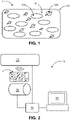
- Fig. 1 schematically and exemplarily shows an embodiment of a marker device 1 for being attached to a medical device for being tracked by a reading system, for example during local anesthesia on a human being, in particular a patient.
- the marker device 1 comprises a foam-like medium 101, a plurality of oscillation enhancers 102, a plurality of magnetic objects 103 and a coating layer 104.
- the marker device 1 is provided as a miniature patch attachable to the medical device.
- the foam-like medium 101 and the coating layer 104 form the body of the miniature patch. That is, in the specific embodiment according to Fig. 1 , the body consists of the foam-like medium 101 and the coating layer 104.
- the foam-like medium 101 comprises a plurality of oscillation enhancers 102, which, in the specific embodiment according to Fig. 1 correspond to bubbles in the foam-like medium 101.
- the oscillation enhancers 102 have a predetermined size. That is, the size value of the individual oscillation enhancers 102 is within a certain predetermined range. The range in which the size value may be may hereby particularly be predetermined on the basis of the excitation frequency of the externally applied excitation field that is supposed to act upon the marker device 1 for the purpose of tracking. Specifically, the size should be chosen such that the oscillation enhancers 102 have a resonance frequency of oscillation that is close to the excitation frequency of the externally applied excitation field.
- the foam-like medium 101 comprises a plurality of magnetic objects 103, which, in the specific embodiment of Fig. 1 , are provided in terms of a plurality of magnetic beads having a size between 5 and 30 ⁇ m.
- the plurality of magnetic objects 103 comprises a plurality of hard magnetic objects, i.e. magnetic objects having a fixed dipole moment as indicated in Fig. 1 by the arrows.
- the plurality of magnetic objects 103 is dispersed in the foam-like medium 101.
- the plurality of magnetic objects preferably concentrate around the individual oscillation enhancers 102 of the plurality of oscillation enhancers 102, in particular on the surfaces thereof. This allows to maximize the motion of the magnetic objects 103 upon oscillation of the foam-like material and, thereby, improve the overall signal quality of the response of the marker device 1.
- the foam-like medium 101 has been prepared by mixing a purified mineral oil product having a melting point slightly below body temperature, i.e. slightly below 35°C, with a thickening agent made of an aluminum salt of fatty acids. To this mixture, magnetic beads of a size between 5 to 30 ⁇ m may then be added. These magnetic beads may be made of any hard magnetic and/or ferromagnetic material. In some embodiments, the magnetic beads may be added by adding a crushed magnet powder, such as a crushed neodymium powder.
- This composition may then be stirred with a particular intensity and for a particular duration, until bubbles are being formed in the composition. Then, the composition may be left to change into a solid state. Since the melting point of the purified mineral oil used is slightly below body temperature, i.e. below 35°C, the composition will become solid upon cooling to room temperature. In the solid state, the coating 104, acting as a protective layer, may be added.
- the coating 104 according to Fig. 1 has a thickness of around 5 ⁇ m.
- this coating comprises or consists of a parylene. The advantage of using parylene is that it is bio-compatible and easy to apply in thin layers.
- the foam-like medium 101 has been prepared using a purified mineral oil having a melting temperature slightly below 35° mixed with an thickening agent, and, thereby, becomes liquid once used attached to the medical device, it shall be understood that the foam-like medium 101 of the marker device 1 may also be manufactured such as to comprise a solid foam-like medium.
- the foam-like medium may particularly be manufactured from a patterned rubber foil made of a polysiloxane - silicone - rubber, as this kind of rubber is flexible enough to respond to the externally applied excitation field.
- the silicone rubber foil may be provided with a plurality of holes, i.e. cavities in the foil.
- the magnetic objects such as magnetic beads or magnetic powder
- the cavities may be closed off, using a cover, such as a silicone rubber film or a layer of curing silicone resin.
- the oscillation enhancers correspond to the holes or cavities in the closed rubber patch, whereby the magnetic objects are provided in the holes.
- the plurality of magnetic objects 103 may be added in a magnetized or in a demagnetized state. If the plurality of magnetic objects 103 is added in a demagnetized state, this means that the magnetic dipoles in each of the magnetic objects 103 are arranged relative to one another such that the overall magnetic field of the particular magnetic object 103 is low. In this case, the plurality of magnetic objects 103 has to be magnetized again later on. This may be done right after manufacture and before storing the thus manufactured marker devices 1 or directly prior to or upon attachment of the marker device 1 to the medical device. In some cases, the magnetizing may even be done upon introduction of the medical device into the human being, in particular the patient.
- the marker device 1 being made of a foam-like medium 101 that has a melting point slightly below 35°C, i.e. slightly below body temperature of a grown human being, is such that, the marker device 1 may be stored at room temperature with the foam-like medium 101 being in a solid state, which maximizes shelf life.
- the foam-like medium melts. Since thickening agent has been added to the foam-like medium 101, the foam-like medium 101 then corresponds to a thickened liquid, having a plurality of oscillation enhancers 102 and a plurality of magnetic objects 103 also provided therein. Due to the increased viscosity caused by the thickening agent, the plurality of oscillation enhancers 102 and the plurality of magnetic objects 103 may remain at a substantially same relative position in the marker device 1 during the tracking. This further improves accuracy.
- a tracking of a medical device may be achieved with high accuracy.
- Fig. 2 schematically and exemplarily shows an embodiment of a reading system 10 for tracking a marker device 1 as discussed herein above.
- the reading system 10 comprises an excitation field generator 20, a magnetic response detector 30, a processor 40 and a user interface 50, comprising a display unit and a user input unit.
- the marker device 1 as described in relation to Fig. 1 is used to track a medical device (not shown) during an invasive procedure, which, in the specific embodiment according to Fig. 2 , corresponds to the application of a local anesthesia using a needle as medical device.
- the marker device 1 is attached to the needle as the medical device to be tracked.
- the excitation field generator 20 is used to generate an externally applied excitation field.
- this externally applied excitation field corresponds to an ultrasound excitation field generated by an ultrasound generator.
- the externally applied excitation field generated by the excitation field generator 20 causes the foam-like medium 101 in the marker device 1 to oscillate in response thereto. Since, as described above, the foam-like medium 101 is in a viscous state when attached to the medical device and used during the invasive procedure, this oscillation is improved.
- the oscillation of the foam-like medium 101 causes the plurality of oscillation enhancers 102 to oscillate. Since the size of each of the plurality of oscillation enhancers 102 has been determined such that the oscillation occurs with the resonance frequency of the excitation field, this further enhances the oscillation effect.
- the plurality of magnetic objects 103 which are dispersed in the foam-like medium 101 and, in the specific embodiment according to Fig. 2 , concentrate at the surfaces of the oscillation enhancers 102 are caused to move due to this oscillation. In the specific embodiment according to Fig. 2 , the motion of the plurality of magnetic objects 103 particularly corresponds to a tilting motion.
- the tilting of the plurality of magnetic objects 103 causes the fixed dipole moments to change direction relative to the magnetic response detector 30.
- the magnetic response detector 30 thus detects a change in the magnetic field that is indicative of a motion, i.e. a tilting in this case, of the magnetic objects 103. Based on this detected motion, the magnetic response detector 30 may then generate a respective response signal indicating that the plurality of magnetic objects 103 has been moved.
- the magnetic objects 103 are caused to tilt in response to the externally applied excitation field
- the magnetic objects 103 may be caused to move within the holes/cavities, to bounce of the walls of the holes/cavities. This movement likewise causes a change in the magnetic field detected by the magnetic response detector 30.
- the magnetic response detector 30 may then provide the response signal to the processor 40.
- Processor 40 uses the response signal to track the medical device to which the marker device 1 is attached.
- the signal processing by processor 40 is performed in a similar manner as known approaches employing PVDF.
- the person to be examined i.e. the patient, into whom the medical device is introduced is scanned by the ultrasound system using the excitation field generator 20.
- the magnetic response detector 30 detects the change in magnetic field.
- the excitation field generator 20 is at a scanning position where the marker device 1 is positioned, the magnetic response detector may detect an increased signal.
- the processor 40 receives the information about the scanning position from the ultrasound system comprising the excitation field generator 20 and the signal from the magnetic response detector, this allows the processor to precisely determine the position of the marker device 1 (based on the highest signal being measured there) in the obtained ultrasound image.
- the depth is generated from a relative timing between the ultrasound system comprising the excitation field generator 20 and the magnetic response detector 30. That is, the magnetic response detector 30 gives a signal at exactly half the time the corresponding acoustic echo in in the ultrasound system comprising the excitation field generator 20 is obtained.
- the processor 40 makes use of the fact that the change in magnetic field detected by the magnetic response detector 30 will depend upon the position of the marker device 1 relative to the excitation field generator 20 and the magnetic response detector 30. That is, if the marker device 1 is positioned such that it does not experience the excitation field generated by the excitation field, the magnetic response detector 30 cannot detect any change. Only if the foam-like medium 101 in the marker device 1 starts oscillating in response to the externally applied excitation field, a response may be detected by the magnetic response detector 30. The processor 40 may thus process the response signal provided by the magnetic response detector 30 and determine the position of the marker device 1 and, thereby, the position of the medical device. The processor 40 may then be configured to provide the processing result to user interface 50.
- the display of user interface 50 may use the information to generate a graphical representation of the tracking and present said graphical representation to a user, such as a doctor. This allows the user, in particular the doctor, to track the position of the medical device during the invasive procedure in real time and, to intervene if necessary.
- a marker device which allows to track the position of a medical device with high accuracy using a magnetic field that is generated through movement of a plurality of magnetic objects in a viscous foam-like medium that is caused to oscillate by respective ultrasound waves.
- the movement causes a change in the magnetic field generated by the plurality of magnetic objects.
- This change may be picked up by a magnetic response detector.
- the thus obtained response signal may be used to determine the position of the marker device 1 and, hence, the medical device, during an invasive procedure.
- the current approach allows to track the medical device with high accuracy, while at the same time keeping the costs for the tracking low and the tracking in itself simple and harmless for the patient.
- a single unit or device may fulfill the functions of several items recited in the claims.
- the mere fact that certain measures are recited in mutually different dependent claims does not indicate that a combination of these measures cannot be used to advantage.
- Procedures like the generating of the excitation field, the detecting of the motion of the magnetic objects, the generating of a response signal and/or the processing of said response signal, et cetera, performed by one or several units or devices can be performed by any other number of units or devices.
- These procedures, particularly the tracking of the marker device in accordance with the tracking method as carried out by the reading system, can be implemented as program code means of a computer program and/or as dedicated hardware.
- a computer program may be stored/distributed on a suitable medium, such as an optical storage medium or a solid-state medium, supplied together with or as part of other hardware, but may also be distributed in other forms, such as via the Internet or other wired or wireless telecommunication systems.
- a suitable medium such as an optical storage medium or a solid-state medium, supplied together with or as part of other hardware, but may also be distributed in other forms, such as via the Internet or other wired or wireless telecommunication systems.
- the invention relates to a marker device to be tracked, wherein the marker device comprises a body comprising a foam-like medium and at least one magnetic object arranged in contact with the foam-like medium, wherein the foam-like medium is adapted to oscillate in response to an externally applied excitation field, such as to initiate a motion of the at least one magnetic object.
Landscapes
- Health & Medical Sciences (AREA)
- Life Sciences & Earth Sciences (AREA)
- Engineering & Computer Science (AREA)
- Surgery (AREA)
- Veterinary Medicine (AREA)
- General Health & Medical Sciences (AREA)
- Public Health (AREA)
- Biomedical Technology (AREA)
- Heart & Thoracic Surgery (AREA)
- Medical Informatics (AREA)
- Molecular Biology (AREA)
- Animal Behavior & Ethology (AREA)
- Pathology (AREA)
- Nuclear Medicine, Radiotherapy & Molecular Imaging (AREA)
- Physics & Mathematics (AREA)
- Biophysics (AREA)
- Human Computer Interaction (AREA)
- Oral & Maxillofacial Surgery (AREA)
- Robotics (AREA)
- Ultra Sonic Daignosis Equipment (AREA)
- Geophysics And Detection Of Objects (AREA)
- Medicines Containing Antibodies Or Antigens For Use As Internal Diagnostic Agents (AREA)
Priority Applications (7)
| Application Number | Priority Date | Filing Date | Title |
|---|---|---|---|
| EP20211521.8A EP4008249A1 (fr) | 2020-12-03 | 2020-12-03 | Marqueur de microsubstance magnétique sous forme d'un plaque de mousse, sans fil et activé par ultrasons |
| PCT/EP2021/084151 WO2022117807A1 (fr) | 2020-12-03 | 2021-12-03 | Dispositif de marquage et suivi des dispositifs de marquage |
| DE112021006246.8T DE112021006246T5 (de) | 2020-12-03 | 2021-12-03 | Markervorrichtung und markervorrichtungsverfolgung |
| US18/038,847 US20240206977A1 (en) | 2020-12-03 | 2021-12-03 | Marker device and marker device tracking |
| JP2023526586A JP2023551781A (ja) | 2020-12-03 | 2021-12-03 | マーカー装置及びマーカー装置の追跡 |
| CN202180081379.1A CN116546938A (zh) | 2020-12-03 | 2021-12-03 | 标记设备和标记设备跟踪 |
| GB2310126.4A GB2617025A (en) | 2020-12-03 | 2021-12-03 | Marker device and marker device tracking |
Applications Claiming Priority (1)
| Application Number | Priority Date | Filing Date | Title |
|---|---|---|---|
| EP20211521.8A EP4008249A1 (fr) | 2020-12-03 | 2020-12-03 | Marqueur de microsubstance magnétique sous forme d'un plaque de mousse, sans fil et activé par ultrasons |
Publications (1)
| Publication Number | Publication Date |
|---|---|
| EP4008249A1 true EP4008249A1 (fr) | 2022-06-08 |
Family
ID=73698622
Family Applications (1)
| Application Number | Title | Priority Date | Filing Date |
|---|---|---|---|
| EP20211521.8A Withdrawn EP4008249A1 (fr) | 2020-12-03 | 2020-12-03 | Marqueur de microsubstance magnétique sous forme d'un plaque de mousse, sans fil et activé par ultrasons |
Country Status (7)
| Country | Link |
|---|---|
| US (1) | US20240206977A1 (fr) |
| EP (1) | EP4008249A1 (fr) |
| JP (1) | JP2023551781A (fr) |
| CN (1) | CN116546938A (fr) |
| DE (1) | DE112021006246T5 (fr) |
| GB (1) | GB2617025A (fr) |
| WO (1) | WO2022117807A1 (fr) |
Citations (4)
| Publication number | Priority date | Publication date | Assignee | Title |
|---|---|---|---|---|
| EP1374791A1 (fr) * | 2002-06-17 | 2004-01-02 | Biosense, Inc. | Système de détection de position avec élément intégral de localisation et affichage de position |
| WO2017167594A1 (fr) * | 2016-03-31 | 2017-10-05 | Koninklijke Philips N.V. | Système de localisation sans fils |
| WO2019180580A1 (fr) * | 2018-03-23 | 2019-09-26 | Endomagnetics Limited | Marqueurs magnétiques pour guidage chirurgical |
| EP3583896A1 (fr) * | 2018-06-20 | 2019-12-25 | Koninklijke Philips N.V. | Système de suivi et dispositif de marqueur destiné à être suivi par le système de suivi |
Family Cites Families (1)
| Publication number | Priority date | Publication date | Assignee | Title |
|---|---|---|---|---|
| US8784336B2 (en) * | 2005-08-24 | 2014-07-22 | C. R. Bard, Inc. | Stylet apparatuses and methods of manufacture |
-
2020
- 2020-12-03 EP EP20211521.8A patent/EP4008249A1/fr not_active Withdrawn
-
2021
- 2021-12-03 JP JP2023526586A patent/JP2023551781A/ja not_active Withdrawn
- 2021-12-03 GB GB2310126.4A patent/GB2617025A/en active Pending
- 2021-12-03 WO PCT/EP2021/084151 patent/WO2022117807A1/fr not_active Ceased
- 2021-12-03 US US18/038,847 patent/US20240206977A1/en not_active Abandoned
- 2021-12-03 CN CN202180081379.1A patent/CN116546938A/zh active Pending
- 2021-12-03 DE DE112021006246.8T patent/DE112021006246T5/de active Pending
Patent Citations (4)
| Publication number | Priority date | Publication date | Assignee | Title |
|---|---|---|---|---|
| EP1374791A1 (fr) * | 2002-06-17 | 2004-01-02 | Biosense, Inc. | Système de détection de position avec élément intégral de localisation et affichage de position |
| WO2017167594A1 (fr) * | 2016-03-31 | 2017-10-05 | Koninklijke Philips N.V. | Système de localisation sans fils |
| WO2019180580A1 (fr) * | 2018-03-23 | 2019-09-26 | Endomagnetics Limited | Marqueurs magnétiques pour guidage chirurgical |
| EP3583896A1 (fr) * | 2018-06-20 | 2019-12-25 | Koninklijke Philips N.V. | Système de suivi et dispositif de marqueur destiné à être suivi par le système de suivi |
Also Published As
| Publication number | Publication date |
|---|---|
| US20240206977A1 (en) | 2024-06-27 |
| DE112021006246T5 (de) | 2023-09-14 |
| WO2022117807A1 (fr) | 2022-06-09 |
| GB2617025A (en) | 2023-09-27 |
| GB202310126D0 (en) | 2023-08-16 |
| JP2023551781A (ja) | 2023-12-13 |
| CN116546938A (zh) | 2023-08-04 |
Similar Documents
| Publication | Publication Date | Title |
|---|---|---|
| US9107581B2 (en) | Elastography device and method for determining and imaging of mechanical and elastic parameters of an examination object | |
| US5343865A (en) | Apparatus and method for locating an interventional medical device with a ultrasound color imaging system | |
| Gao et al. | Sonoelasticity imaging: theory and experimental verification | |
| Sadiq et al. | High-performance planar ultrasonic tool based on d 31-mode piezocrystal | |
| JPH10505763A (ja) | 生物組織の機械的性質の測定装置 | |
| JP2016516559A5 (fr) | ||
| US4383535A (en) | Method for preventing remanence phenomena from interfering with magnetic field sensing systems and a device for implementation of the method | |
| EP4008249A1 (fr) | Marqueur de microsubstance magnétique sous forme d'un plaque de mousse, sans fil et activé par ultrasons | |
| JP6506273B2 (ja) | 柔軟な固体の情報を収集するための、せん断弾性波画像化方法および装置 | |
| Cavlu et al. | Determining the position and orientation of in-body medical instruments using near-field magnetic field mapping | |
| CN106133548B (zh) | 适用于确定介质内精确位置的物理特性的方法适用于确定介质图像的方法及其实施所述方法的装置 | |
| Ersepke et al. | Frequency response of soft tissue displacements induced by the force on magnetic nanoparticles | |
| Chen et al. | Measurement of dynamic and static radiation force on a sphere | |
| JP2023540570A (ja) | 磁気動力プローブおよびその使用方法 | |
| US20110127996A1 (en) | Apparatus and method for determining the roll angle of a device with a housing | |
| US9717473B2 (en) | Method and apparatus for detecting a dipole position marker | |
| King et al. | Preliminary results using ultrasound transmission for image-guided thermal therapy | |
| EP4353147A2 (fr) | Microdispositif permettant une localisation du microdispositif | |
| JP2002209899A (ja) | 医療用超音波診断装置 | |
| Uffmann et al. | Characterization of an electromagnetic actuator for MR elastography | |
| JP2002291720A (ja) | 位置検出システム、医用画像撮影装置、操作器具および超音波プローブ | |
| JPH11123190A (ja) | 外部励起ラベリング手段を併用する音響映像装置 | |
| TW201700990A (zh) | 基於磁特性檢測技術的檢測方法、造影方法與相關裝置 | |
| JPS6244902A (ja) | 導電ゲル材 | |
| JPH11206763A (ja) | 生体組織診断方法および装置 |
Legal Events
| Date | Code | Title | Description |
|---|---|---|---|
| PUAI | Public reference made under article 153(3) epc to a published international application that has entered the european phase |
Free format text: ORIGINAL CODE: 0009012 |
|
| STAA | Information on the status of an ep patent application or granted ep patent |
Free format text: STATUS: THE APPLICATION HAS BEEN PUBLISHED |
|
| AK | Designated contracting states |
Kind code of ref document: A1 Designated state(s): AL AT BE BG CH CY CZ DE DK EE ES FI FR GB GR HR HU IE IS IT LI LT LU LV MC MK MT NL NO PL PT RO RS SE SI SK SM TR |
|
| STAA | Information on the status of an ep patent application or granted ep patent |
Free format text: STATUS: THE APPLICATION IS DEEMED TO BE WITHDRAWN |
|
| 18D | Application deemed to be withdrawn |
Effective date: 20221209 |