EP4008368A1 - Gewebefibroseinhibitor, in dem biokompatibles polymer verwendet wird - Google Patents
Gewebefibroseinhibitor, in dem biokompatibles polymer verwendet wird Download PDFInfo
- Publication number
- EP4008368A1 EP4008368A1 EP20847207.6A EP20847207A EP4008368A1 EP 4008368 A1 EP4008368 A1 EP 4008368A1 EP 20847207 A EP20847207 A EP 20847207A EP 4008368 A1 EP4008368 A1 EP 4008368A1
- Authority
- EP
- European Patent Office
- Prior art keywords
- tissue
- fibrosis
- decellularized
- fibrin
- kit according
- Prior art date
- Legal status (The legal status is an assumption and is not a legal conclusion. Google has not performed a legal analysis and makes no representation as to the accuracy of the status listed.)
- Ceased
Links
Images


Classifications
-
- A—HUMAN NECESSITIES
- A61—MEDICAL OR VETERINARY SCIENCE; HYGIENE
- A61L—METHODS OR APPARATUS FOR STERILISING MATERIALS OR OBJECTS IN GENERAL; DISINFECTION, STERILISATION OR DEODORISATION OF AIR; CHEMICAL ASPECTS OF BANDAGES, DRESSINGS, ABSORBENT PADS OR SURGICAL ARTICLES; MATERIALS FOR BANDAGES, DRESSINGS, ABSORBENT PADS OR SURGICAL ARTICLES
- A61L27/00—Materials for grafts or prostheses or for coating grafts or prostheses
- A61L27/14—Macromolecular materials
- A61L27/22—Polypeptides or derivatives thereof, e.g. degradation products
-
- A—HUMAN NECESSITIES
- A61—MEDICAL OR VETERINARY SCIENCE; HYGIENE
- A61P—SPECIFIC THERAPEUTIC ACTIVITY OF CHEMICAL COMPOUNDS OR MEDICINAL PREPARATIONS
- A61P9/00—Drugs for disorders of the cardiovascular system
-
- A—HUMAN NECESSITIES
- A61—MEDICAL OR VETERINARY SCIENCE; HYGIENE
- A61K—PREPARATIONS FOR MEDICAL, DENTAL OR TOILETRY PURPOSES
- A61K31/00—Medicinal preparations containing organic active ingredients
- A61K31/70—Carbohydrates; Sugars; Derivatives thereof
- A61K31/715—Polysaccharides, i.e. having more than five saccharide radicals attached to each other by glycosidic linkages; Derivatives thereof, e.g. ethers, esters
- A61K31/716—Glucans
- A61K31/718—Starch or degraded starch, e.g. amylose, amylopectin
-
- A—HUMAN NECESSITIES
- A61—MEDICAL OR VETERINARY SCIENCE; HYGIENE
- A61K—PREPARATIONS FOR MEDICAL, DENTAL OR TOILETRY PURPOSES
- A61K35/00—Medicinal preparations containing materials or reaction products thereof with undetermined constitution
- A61K35/12—Materials from mammals; Compositions comprising non-specified tissues or cells; Compositions comprising non-embryonic stem cells; Genetically modified cells
-
- A—HUMAN NECESSITIES
- A61—MEDICAL OR VETERINARY SCIENCE; HYGIENE
- A61K—PREPARATIONS FOR MEDICAL, DENTAL OR TOILETRY PURPOSES
- A61K35/00—Medicinal preparations containing materials or reaction products thereof with undetermined constitution
- A61K35/12—Materials from mammals; Compositions comprising non-specified tissues or cells; Compositions comprising non-embryonic stem cells; Genetically modified cells
- A61K35/22—Urine; Urinary tract, e.g. kidney or bladder; Intraglomerular mesangial cells; Renal mesenchymal cells; Adrenal gland
-
- A—HUMAN NECESSITIES
- A61—MEDICAL OR VETERINARY SCIENCE; HYGIENE
- A61K—PREPARATIONS FOR MEDICAL, DENTAL OR TOILETRY PURPOSES
- A61K35/00—Medicinal preparations containing materials or reaction products thereof with undetermined constitution
- A61K35/12—Materials from mammals; Compositions comprising non-specified tissues or cells; Compositions comprising non-embryonic stem cells; Genetically modified cells
- A61K35/30—Nerves; Brain; Eyes; Corneal cells; Cerebrospinal fluid; Neuronal stem cells; Neuronal precursor cells; Glial cells; Oligodendrocytes; Schwann cells; Astroglia; Astrocytes; Choroid plexus; Spinal cord tissue
-
- A—HUMAN NECESSITIES
- A61—MEDICAL OR VETERINARY SCIENCE; HYGIENE
- A61K—PREPARATIONS FOR MEDICAL, DENTAL OR TOILETRY PURPOSES
- A61K35/00—Medicinal preparations containing materials or reaction products thereof with undetermined constitution
- A61K35/12—Materials from mammals; Compositions comprising non-specified tissues or cells; Compositions comprising non-embryonic stem cells; Genetically modified cells
- A61K35/34—Muscles; Smooth muscle cells; Heart; Cardiac stem cells; Myoblasts; Myocytes; Cardiomyocytes
-
- A—HUMAN NECESSITIES
- A61—MEDICAL OR VETERINARY SCIENCE; HYGIENE
- A61K—PREPARATIONS FOR MEDICAL, DENTAL OR TOILETRY PURPOSES
- A61K35/00—Medicinal preparations containing materials or reaction products thereof with undetermined constitution
- A61K35/12—Materials from mammals; Compositions comprising non-specified tissues or cells; Compositions comprising non-embryonic stem cells; Genetically modified cells
- A61K35/36—Skin; Hair; Nails; Sebaceous glands; Cerumen; Epidermis; Epithelial cells; Keratinocytes; Langerhans cells; Ectodermal cells
-
- A—HUMAN NECESSITIES
- A61—MEDICAL OR VETERINARY SCIENCE; HYGIENE
- A61K—PREPARATIONS FOR MEDICAL, DENTAL OR TOILETRY PURPOSES
- A61K35/00—Medicinal preparations containing materials or reaction products thereof with undetermined constitution
- A61K35/12—Materials from mammals; Compositions comprising non-specified tissues or cells; Compositions comprising non-embryonic stem cells; Genetically modified cells
- A61K35/37—Digestive system
- A61K35/38—Stomach; Intestine; Goblet cells; Oral mucosa; Saliva
-
- A—HUMAN NECESSITIES
- A61—MEDICAL OR VETERINARY SCIENCE; HYGIENE
- A61K—PREPARATIONS FOR MEDICAL, DENTAL OR TOILETRY PURPOSES
- A61K35/00—Medicinal preparations containing materials or reaction products thereof with undetermined constitution
- A61K35/12—Materials from mammals; Compositions comprising non-specified tissues or cells; Compositions comprising non-embryonic stem cells; Genetically modified cells
- A61K35/48—Reproductive organs
- A61K35/50—Placenta; Placental stem cells; Amniotic fluid; Amnion; Amniotic stem cells
-
- A—HUMAN NECESSITIES
- A61—MEDICAL OR VETERINARY SCIENCE; HYGIENE
- A61K—PREPARATIONS FOR MEDICAL, DENTAL OR TOILETRY PURPOSES
- A61K38/00—Medicinal preparations containing peptides
- A61K38/16—Peptides having more than 20 amino acids; Gastrins; Somatostatins; Melanotropins; Derivatives thereof
- A61K38/17—Peptides having more than 20 amino acids; Gastrins; Somatostatins; Melanotropins; Derivatives thereof from animals; from humans
- A61K38/36—Blood coagulation or fibrinolysis factors
-
- A—HUMAN NECESSITIES
- A61—MEDICAL OR VETERINARY SCIENCE; HYGIENE
- A61K—PREPARATIONS FOR MEDICAL, DENTAL OR TOILETRY PURPOSES
- A61K38/00—Medicinal preparations containing peptides
- A61K38/16—Peptides having more than 20 amino acids; Gastrins; Somatostatins; Melanotropins; Derivatives thereof
- A61K38/17—Peptides having more than 20 amino acids; Gastrins; Somatostatins; Melanotropins; Derivatives thereof from animals; from humans
- A61K38/36—Blood coagulation or fibrinolysis factors
- A61K38/363—Fibrinogen
-
- A—HUMAN NECESSITIES
- A61—MEDICAL OR VETERINARY SCIENCE; HYGIENE
- A61L—METHODS OR APPARATUS FOR STERILISING MATERIALS OR OBJECTS IN GENERAL; DISINFECTION, STERILISATION OR DEODORISATION OF AIR; CHEMICAL ASPECTS OF BANDAGES, DRESSINGS, ABSORBENT PADS OR SURGICAL ARTICLES; MATERIALS FOR BANDAGES, DRESSINGS, ABSORBENT PADS OR SURGICAL ARTICLES
- A61L24/00—Surgical adhesives or cements; Adhesives for colostomy devices
- A61L24/001—Use of materials characterised by their function or physical properties
- A61L24/0015—Medicaments; Biocides
-
- A—HUMAN NECESSITIES
- A61—MEDICAL OR VETERINARY SCIENCE; HYGIENE
- A61L—METHODS OR APPARATUS FOR STERILISING MATERIALS OR OBJECTS IN GENERAL; DISINFECTION, STERILISATION OR DEODORISATION OF AIR; CHEMICAL ASPECTS OF BANDAGES, DRESSINGS, ABSORBENT PADS OR SURGICAL ARTICLES; MATERIALS FOR BANDAGES, DRESSINGS, ABSORBENT PADS OR SURGICAL ARTICLES
- A61L24/00—Surgical adhesives or cements; Adhesives for colostomy devices
- A61L24/04—Surgical adhesives or cements; Adhesives for colostomy devices containing macromolecular materials
- A61L24/08—Polysaccharides
-
- A—HUMAN NECESSITIES
- A61—MEDICAL OR VETERINARY SCIENCE; HYGIENE
- A61L—METHODS OR APPARATUS FOR STERILISING MATERIALS OR OBJECTS IN GENERAL; DISINFECTION, STERILISATION OR DEODORISATION OF AIR; CHEMICAL ASPECTS OF BANDAGES, DRESSINGS, ABSORBENT PADS OR SURGICAL ARTICLES; MATERIALS FOR BANDAGES, DRESSINGS, ABSORBENT PADS OR SURGICAL ARTICLES
- A61L24/00—Surgical adhesives or cements; Adhesives for colostomy devices
- A61L24/04—Surgical adhesives or cements; Adhesives for colostomy devices containing macromolecular materials
- A61L24/10—Polypeptides; Proteins
- A61L24/106—Fibrin; Fibrinogen
-
- A—HUMAN NECESSITIES
- A61—MEDICAL OR VETERINARY SCIENCE; HYGIENE
- A61L—METHODS OR APPARATUS FOR STERILISING MATERIALS OR OBJECTS IN GENERAL; DISINFECTION, STERILISATION OR DEODORISATION OF AIR; CHEMICAL ASPECTS OF BANDAGES, DRESSINGS, ABSORBENT PADS OR SURGICAL ARTICLES; MATERIALS FOR BANDAGES, DRESSINGS, ABSORBENT PADS OR SURGICAL ARTICLES
- A61L27/00—Materials for grafts or prostheses or for coating grafts or prostheses
- A61L27/14—Macromolecular materials
- A61L27/20—Polysaccharides
-
- A—HUMAN NECESSITIES
- A61—MEDICAL OR VETERINARY SCIENCE; HYGIENE
- A61L—METHODS OR APPARATUS FOR STERILISING MATERIALS OR OBJECTS IN GENERAL; DISINFECTION, STERILISATION OR DEODORISATION OF AIR; CHEMICAL ASPECTS OF BANDAGES, DRESSINGS, ABSORBENT PADS OR SURGICAL ARTICLES; MATERIALS FOR BANDAGES, DRESSINGS, ABSORBENT PADS OR SURGICAL ARTICLES
- A61L27/00—Materials for grafts or prostheses or for coating grafts or prostheses
- A61L27/14—Macromolecular materials
- A61L27/22—Polypeptides or derivatives thereof, e.g. degradation products
- A61L27/225—Fibrin; Fibrinogen
-
- A—HUMAN NECESSITIES
- A61—MEDICAL OR VETERINARY SCIENCE; HYGIENE
- A61L—METHODS OR APPARATUS FOR STERILISING MATERIALS OR OBJECTS IN GENERAL; DISINFECTION, STERILISATION OR DEODORISATION OF AIR; CHEMICAL ASPECTS OF BANDAGES, DRESSINGS, ABSORBENT PADS OR SURGICAL ARTICLES; MATERIALS FOR BANDAGES, DRESSINGS, ABSORBENT PADS OR SURGICAL ARTICLES
- A61L27/00—Materials for grafts or prostheses or for coating grafts or prostheses
- A61L27/36—Materials for grafts or prostheses or for coating grafts or prostheses containing ingredients of undetermined constitution or reaction products thereof, e.g. transplant tissue, natural bone, extracellular matrix
-
- A—HUMAN NECESSITIES
- A61—MEDICAL OR VETERINARY SCIENCE; HYGIENE
- A61L—METHODS OR APPARATUS FOR STERILISING MATERIALS OR OBJECTS IN GENERAL; DISINFECTION, STERILISATION OR DEODORISATION OF AIR; CHEMICAL ASPECTS OF BANDAGES, DRESSINGS, ABSORBENT PADS OR SURGICAL ARTICLES; MATERIALS FOR BANDAGES, DRESSINGS, ABSORBENT PADS OR SURGICAL ARTICLES
- A61L27/00—Materials for grafts or prostheses or for coating grafts or prostheses
- A61L27/36—Materials for grafts or prostheses or for coating grafts or prostheses containing ingredients of undetermined constitution or reaction products thereof, e.g. transplant tissue, natural bone, extracellular matrix
- A61L27/3604—Materials for grafts or prostheses or for coating grafts or prostheses containing ingredients of undetermined constitution or reaction products thereof, e.g. transplant tissue, natural bone, extracellular matrix characterised by the human or animal origin of the biological material, e.g. hair, fascia, fish scales, silk, shellac, pericardium, pleura, renal tissue, amniotic membrane, parenchymal tissue, fetal tissue, muscle tissue, fat tissue, enamel
-
- A—HUMAN NECESSITIES
- A61—MEDICAL OR VETERINARY SCIENCE; HYGIENE
- A61L—METHODS OR APPARATUS FOR STERILISING MATERIALS OR OBJECTS IN GENERAL; DISINFECTION, STERILISATION OR DEODORISATION OF AIR; CHEMICAL ASPECTS OF BANDAGES, DRESSINGS, ABSORBENT PADS OR SURGICAL ARTICLES; MATERIALS FOR BANDAGES, DRESSINGS, ABSORBENT PADS OR SURGICAL ARTICLES
- A61L27/00—Materials for grafts or prostheses or for coating grafts or prostheses
- A61L27/36—Materials for grafts or prostheses or for coating grafts or prostheses containing ingredients of undetermined constitution or reaction products thereof, e.g. transplant tissue, natural bone, extracellular matrix
- A61L27/3683—Materials for grafts or prostheses or for coating grafts or prostheses containing ingredients of undetermined constitution or reaction products thereof, e.g. transplant tissue, natural bone, extracellular matrix subjected to a specific treatment prior to implantation, e.g. decellularising, demineralising, grinding, cellular disruption/non-collagenous protein removal, anti-calcification, crosslinking, supercritical fluid extraction, enzyme treatment
-
- A—HUMAN NECESSITIES
- A61—MEDICAL OR VETERINARY SCIENCE; HYGIENE
- A61L—METHODS OR APPARATUS FOR STERILISING MATERIALS OR OBJECTS IN GENERAL; DISINFECTION, STERILISATION OR DEODORISATION OF AIR; CHEMICAL ASPECTS OF BANDAGES, DRESSINGS, ABSORBENT PADS OR SURGICAL ARTICLES; MATERIALS FOR BANDAGES, DRESSINGS, ABSORBENT PADS OR SURGICAL ARTICLES
- A61L27/00—Materials for grafts or prostheses or for coating grafts or prostheses
- A61L27/50—Materials characterised by their function or physical properties, e.g. injectable or lubricating compositions, shape-memory materials, surface modified materials
-
- A—HUMAN NECESSITIES
- A61—MEDICAL OR VETERINARY SCIENCE; HYGIENE
- A61L—METHODS OR APPARATUS FOR STERILISING MATERIALS OR OBJECTS IN GENERAL; DISINFECTION, STERILISATION OR DEODORISATION OF AIR; CHEMICAL ASPECTS OF BANDAGES, DRESSINGS, ABSORBENT PADS OR SURGICAL ARTICLES; MATERIALS FOR BANDAGES, DRESSINGS, ABSORBENT PADS OR SURGICAL ARTICLES
- A61L27/00—Materials for grafts or prostheses or for coating grafts or prostheses
- A61L27/50—Materials characterised by their function or physical properties, e.g. injectable or lubricating compositions, shape-memory materials, surface modified materials
- A61L27/54—Biologically active materials, e.g. therapeutic substances
-
- A—HUMAN NECESSITIES
- A61—MEDICAL OR VETERINARY SCIENCE; HYGIENE
- A61L—METHODS OR APPARATUS FOR STERILISING MATERIALS OR OBJECTS IN GENERAL; DISINFECTION, STERILISATION OR DEODORISATION OF AIR; CHEMICAL ASPECTS OF BANDAGES, DRESSINGS, ABSORBENT PADS OR SURGICAL ARTICLES; MATERIALS FOR BANDAGES, DRESSINGS, ABSORBENT PADS OR SURGICAL ARTICLES
- A61L27/00—Materials for grafts or prostheses or for coating grafts or prostheses
- A61L27/50—Materials characterised by their function or physical properties, e.g. injectable or lubricating compositions, shape-memory materials, surface modified materials
- A61L27/56—Porous materials, e.g. foams or sponges
-
- A—HUMAN NECESSITIES
- A61—MEDICAL OR VETERINARY SCIENCE; HYGIENE
- A61L—METHODS OR APPARATUS FOR STERILISING MATERIALS OR OBJECTS IN GENERAL; DISINFECTION, STERILISATION OR DEODORISATION OF AIR; CHEMICAL ASPECTS OF BANDAGES, DRESSINGS, ABSORBENT PADS OR SURGICAL ARTICLES; MATERIALS FOR BANDAGES, DRESSINGS, ABSORBENT PADS OR SURGICAL ARTICLES
- A61L27/00—Materials for grafts or prostheses or for coating grafts or prostheses
- A61L27/50—Materials characterised by their function or physical properties, e.g. injectable or lubricating compositions, shape-memory materials, surface modified materials
- A61L27/58—Materials at least partially resorbable by the body
-
- A—HUMAN NECESSITIES
- A61—MEDICAL OR VETERINARY SCIENCE; HYGIENE
- A61L—METHODS OR APPARATUS FOR STERILISING MATERIALS OR OBJECTS IN GENERAL; DISINFECTION, STERILISATION OR DEODORISATION OF AIR; CHEMICAL ASPECTS OF BANDAGES, DRESSINGS, ABSORBENT PADS OR SURGICAL ARTICLES; MATERIALS FOR BANDAGES, DRESSINGS, ABSORBENT PADS OR SURGICAL ARTICLES
- A61L31/00—Materials for other surgical articles, e.g. stents, stent-grafts, shunts, surgical drapes, guide wires, materials for adhesion prevention, occluding devices, surgical gloves, tissue fixation devices
- A61L31/005—Ingredients of undetermined constitution or reaction products thereof
-
- A—HUMAN NECESSITIES
- A61—MEDICAL OR VETERINARY SCIENCE; HYGIENE
- A61L—METHODS OR APPARATUS FOR STERILISING MATERIALS OR OBJECTS IN GENERAL; DISINFECTION, STERILISATION OR DEODORISATION OF AIR; CHEMICAL ASPECTS OF BANDAGES, DRESSINGS, ABSORBENT PADS OR SURGICAL ARTICLES; MATERIALS FOR BANDAGES, DRESSINGS, ABSORBENT PADS OR SURGICAL ARTICLES
- A61L31/00—Materials for other surgical articles, e.g. stents, stent-grafts, shunts, surgical drapes, guide wires, materials for adhesion prevention, occluding devices, surgical gloves, tissue fixation devices
- A61L31/04—Macromolecular materials
- A61L31/042—Polysaccharides
-
- A—HUMAN NECESSITIES
- A61—MEDICAL OR VETERINARY SCIENCE; HYGIENE
- A61L—METHODS OR APPARATUS FOR STERILISING MATERIALS OR OBJECTS IN GENERAL; DISINFECTION, STERILISATION OR DEODORISATION OF AIR; CHEMICAL ASPECTS OF BANDAGES, DRESSINGS, ABSORBENT PADS OR SURGICAL ARTICLES; MATERIALS FOR BANDAGES, DRESSINGS, ABSORBENT PADS OR SURGICAL ARTICLES
- A61L31/00—Materials for other surgical articles, e.g. stents, stent-grafts, shunts, surgical drapes, guide wires, materials for adhesion prevention, occluding devices, surgical gloves, tissue fixation devices
- A61L31/04—Macromolecular materials
- A61L31/043—Proteins; Polypeptides; Degradation products thereof
-
- A—HUMAN NECESSITIES
- A61—MEDICAL OR VETERINARY SCIENCE; HYGIENE
- A61L—METHODS OR APPARATUS FOR STERILISING MATERIALS OR OBJECTS IN GENERAL; DISINFECTION, STERILISATION OR DEODORISATION OF AIR; CHEMICAL ASPECTS OF BANDAGES, DRESSINGS, ABSORBENT PADS OR SURGICAL ARTICLES; MATERIALS FOR BANDAGES, DRESSINGS, ABSORBENT PADS OR SURGICAL ARTICLES
- A61L31/00—Materials for other surgical articles, e.g. stents, stent-grafts, shunts, surgical drapes, guide wires, materials for adhesion prevention, occluding devices, surgical gloves, tissue fixation devices
- A61L31/04—Macromolecular materials
- A61L31/043—Proteins; Polypeptides; Degradation products thereof
- A61L31/046—Fibrin; Fibrinogen
-
- A—HUMAN NECESSITIES
- A61—MEDICAL OR VETERINARY SCIENCE; HYGIENE
- A61L—METHODS OR APPARATUS FOR STERILISING MATERIALS OR OBJECTS IN GENERAL; DISINFECTION, STERILISATION OR DEODORISATION OF AIR; CHEMICAL ASPECTS OF BANDAGES, DRESSINGS, ABSORBENT PADS OR SURGICAL ARTICLES; MATERIALS FOR BANDAGES, DRESSINGS, ABSORBENT PADS OR SURGICAL ARTICLES
- A61L31/00—Materials for other surgical articles, e.g. stents, stent-grafts, shunts, surgical drapes, guide wires, materials for adhesion prevention, occluding devices, surgical gloves, tissue fixation devices
- A61L31/14—Materials characterised by their function or physical properties, e.g. injectable or lubricating compositions, shape-memory materials, surface modified materials
- A61L31/146—Porous materials, e.g. foams or sponges
-
- A—HUMAN NECESSITIES
- A61—MEDICAL OR VETERINARY SCIENCE; HYGIENE
- A61L—METHODS OR APPARATUS FOR STERILISING MATERIALS OR OBJECTS IN GENERAL; DISINFECTION, STERILISATION OR DEODORISATION OF AIR; CHEMICAL ASPECTS OF BANDAGES, DRESSINGS, ABSORBENT PADS OR SURGICAL ARTICLES; MATERIALS FOR BANDAGES, DRESSINGS, ABSORBENT PADS OR SURGICAL ARTICLES
- A61L31/00—Materials for other surgical articles, e.g. stents, stent-grafts, shunts, surgical drapes, guide wires, materials for adhesion prevention, occluding devices, surgical gloves, tissue fixation devices
- A61L31/14—Materials characterised by their function or physical properties, e.g. injectable or lubricating compositions, shape-memory materials, surface modified materials
- A61L31/148—Materials at least partially resorbable by the body
-
- A—HUMAN NECESSITIES
- A61—MEDICAL OR VETERINARY SCIENCE; HYGIENE
- A61P—SPECIFIC THERAPEUTIC ACTIVITY OF CHEMICAL COMPOUNDS OR MEDICINAL PREPARATIONS
- A61P43/00—Drugs for specific purposes, not provided for in groups A61P1/00-A61P41/00
-
- A—HUMAN NECESSITIES
- A61—MEDICAL OR VETERINARY SCIENCE; HYGIENE
- A61L—METHODS OR APPARATUS FOR STERILISING MATERIALS OR OBJECTS IN GENERAL; DISINFECTION, STERILISATION OR DEODORISATION OF AIR; CHEMICAL ASPECTS OF BANDAGES, DRESSINGS, ABSORBENT PADS OR SURGICAL ARTICLES; MATERIALS FOR BANDAGES, DRESSINGS, ABSORBENT PADS OR SURGICAL ARTICLES
- A61L2300/00—Biologically active materials used in bandages, wound dressings, absorbent pads or medical devices
- A61L2300/20—Biologically active materials used in bandages, wound dressings, absorbent pads or medical devices containing or releasing organic materials
- A61L2300/23—Carbohydrates
- A61L2300/232—Monosaccharides, disaccharides, polysaccharides, lipopolysaccharides
-
- A—HUMAN NECESSITIES
- A61—MEDICAL OR VETERINARY SCIENCE; HYGIENE
- A61L—METHODS OR APPARATUS FOR STERILISING MATERIALS OR OBJECTS IN GENERAL; DISINFECTION, STERILISATION OR DEODORISATION OF AIR; CHEMICAL ASPECTS OF BANDAGES, DRESSINGS, ABSORBENT PADS OR SURGICAL ARTICLES; MATERIALS FOR BANDAGES, DRESSINGS, ABSORBENT PADS OR SURGICAL ARTICLES
- A61L2300/00—Biologically active materials used in bandages, wound dressings, absorbent pads or medical devices
- A61L2300/20—Biologically active materials used in bandages, wound dressings, absorbent pads or medical devices containing or releasing organic materials
- A61L2300/252—Polypeptides, proteins, e.g. glycoproteins, lipoproteins, cytokines
-
- A—HUMAN NECESSITIES
- A61—MEDICAL OR VETERINARY SCIENCE; HYGIENE
- A61L—METHODS OR APPARATUS FOR STERILISING MATERIALS OR OBJECTS IN GENERAL; DISINFECTION, STERILISATION OR DEODORISATION OF AIR; CHEMICAL ASPECTS OF BANDAGES, DRESSINGS, ABSORBENT PADS OR SURGICAL ARTICLES; MATERIALS FOR BANDAGES, DRESSINGS, ABSORBENT PADS OR SURGICAL ARTICLES
- A61L2300/00—Biologically active materials used in bandages, wound dressings, absorbent pads or medical devices
- A61L2300/40—Biologically active materials used in bandages, wound dressings, absorbent pads or medical devices characterised by a specific therapeutic activity or mode of action
- A61L2300/424—Anti-adhesion agents
-
- A—HUMAN NECESSITIES
- A61—MEDICAL OR VETERINARY SCIENCE; HYGIENE
- A61L—METHODS OR APPARATUS FOR STERILISING MATERIALS OR OBJECTS IN GENERAL; DISINFECTION, STERILISATION OR DEODORISATION OF AIR; CHEMICAL ASPECTS OF BANDAGES, DRESSINGS, ABSORBENT PADS OR SURGICAL ARTICLES; MATERIALS FOR BANDAGES, DRESSINGS, ABSORBENT PADS OR SURGICAL ARTICLES
- A61L2430/00—Materials or treatment for tissue regeneration
- A61L2430/20—Materials or treatment for tissue regeneration for reconstruction of the heart, e.g. heart valves
-
- A—HUMAN NECESSITIES
- A61—MEDICAL OR VETERINARY SCIENCE; HYGIENE
- A61L—METHODS OR APPARATUS FOR STERILISING MATERIALS OR OBJECTS IN GENERAL; DISINFECTION, STERILISATION OR DEODORISATION OF AIR; CHEMICAL ASPECTS OF BANDAGES, DRESSINGS, ABSORBENT PADS OR SURGICAL ARTICLES; MATERIALS FOR BANDAGES, DRESSINGS, ABSORBENT PADS OR SURGICAL ARTICLES
- A61L2430/00—Materials or treatment for tissue regeneration
- A61L2430/40—Preparation and treatment of biological tissue for implantation, e.g. decellularisation, cross-linking
Definitions
- the present invention relates to a fibrosis inhibitor for a tissue after a surgical operation. More specifically, the present invention relates to a fibrosis inhibitor characterized by using a biocompatible polymer, which can also be used for the inhibition of the occurrence of adhesion of tissues.
- Fibrosis is a phenomenon that connective tissues are accumulated in a tissue, and is caused as the result of the excessive production and accumulation of connective tissues such as an extracellular matrix mainly composed of collagen in a tissue. Fibrosis is observed in heart, lung, liver, pancreas, kidney and the like. Among these, fibrosis in heart causes the hardening of cardiac muscles and impairs the functions of the heart, although the fibrosis can prevent cardiac rupture in the heart after the death of cardiac muscle cell. When the cardiac malfunction becomes persistent, the enlargement of the heart occurs so as to compensate the cardiac malfunction. Therefore, it is quite important to control fibrosis.
- fibrosis another risk which may cause a damage in an organ or a tissue is the adhesion of a tissue after surgery.
- the adhesion of a tissue after surgery occurs in various fields, including cardiology as well as digestive system surgery, orthopedic surgery, gynecology and obstetrics, ophthalmology and the like.
- the adhesion in abdominal cavity after an abdominal surgery is a physiological biological repairing reaction, and it is difficult to absolutely prevent the occurrence of the adhesion.
- the adhesion occurring after surgery causes adhesive intestinal obstruction with some frequency. It is believed that this frequency is proportional to some extent to the duration of surgery and the amount of bleeding.
- Non-Patent Document 1 In order to prevent or reduce the occurrence of adhesion, it has been required to minimize detachment/bleeding and operative duration, to prevent contamination during operation, and to minimize remaining foreign matters by careful surgical operation by a surgeon, to use an absorbable suture thread, to perform proper drainage, to prevent infection, to perform early postoperative ambulation, and so on. In an emergency contaminated operation, it has been also required to perform sufficient intraperitoneal irrigation and the change in a body position and to use an antibiotic after operation.
- these countermeasures are effective to some extent on the prevention of adhesive intestinal obstruction, it is impossible to prevent the occurrence of intestinal obstruction completely by these countermeasures (Non-Patent Document 1).
- mesothelial cells which are film-like tissues that cover the surface of a body cavity such as chest cavity, pericardium and abdominal cavity, produce interleukin-6 at an operative stress site; neutrophils produce tumor necrosis factor TNF- ⁇ and transforming growth factor TGF- ⁇ by the action of interleukin-6; and the mesothelial cells are replaced by fibrosis by the action of this TGF- ⁇ to serve as a main body of the formation of adhesion (Non-Patent Document 2) .
- Non-Patent Document 3 In the field of cardiology, the adhesion of epicardium to chest wall or the adhesion of pericardium to epicardium after surgery increases the risk of damage to the heart or a large blood vessel during reoperative surgery.
- pericardial substitute examples include bovine pericardium, a silicone coated polyester fabric, and a polytetrafluoroethylene (PTFE) sheet (Non-Patent Document 4).
- a PTFE sheet having a thickness of 0.1mm has been used frequently as a pericardial substitute.
- the results of the reoperative surgery in the long-term late postoperative phase are quite different from those in a case where the heart was covered with an autologous pericardium.
- the non-absorbable PTFE sheet which has a structure into which a biological tissue cannot invade, can be removed easily during a reoperative surgery.
- both of the heart side and the sternum side of the PTFE sheet are covered with fiber tissues to such a level that the anatomical structure of each of the fiber tissues cannot be confirmed. Particularly in a case where a burden by a residual lesion is found, the thickening of the fiber tissues appears remarkably.
- CP constrictive pericarditis
- a PTFE sheet When a PTFE sheet is transplanted as a pericardial substitute, an evidence of an inflammation induced by a foreign-body reaction is strongly observed, the inflammatory reaction becomes remarkable 4 weeks after the transplantation and is weakened 12 weeks after the transplantation. As the result of the transplantation, a very thick fibrous connective tissue film is formed on the epicardium side of the PTFE sheet.
- This PTFE sheet is useful, because the sheet covers the heart and a large blood vessel so as not to damage the heart and the large blood vessel during sternotomy that is performed when a reoperative surgery becomes necessary.
- Non-Patent Document 5 a PTFE sheet is likely to cause an inflammatory reaction.
- Non-Patent Document 9 it is also reported that the fibrosis of epicardium which is caused by a PTFE sheet impairs the visibility of the heart.
- the fibrosis of epicardium is induced not only by a PTFE sheet but also by a pericardium defect case where an autologous pericardium is resected or an autologous pericardium closure case.
- a rabbit model there has been reported about the occurrence of fibrosis in an expanded polytetrafluoroethylene (ePTFE) closure case and a pericardium defect case where an autologous pericardium is resected (Non-Patent Document 10) .
- ePTFE expanded polytetrafluoroethylene
- Non-Patent Document 11 there has been reported about the occurrence of fibrosis in an ePTFE closure case and an autologous pericardium closure case.
- Non-Patent Documents 12 and 13 a case where a fibrin glue that is a biological tissue adhesive agent is used for adhesion inhibition purposes has also been reported.
- a fibrin glue cannot inhibit the adhesion of tissues completely (Patent Documents 1 to 3), and therefore serious problems which surgeons are concerned about have not been solved yet.
- a decellularized biological tissue and a decellularized organ (which is collectively referred to as a "decellularized tissue", hereinafter) is a matrix produced by removing cell components from a biological tissue or an organ in a human body or an animal of a different species, and has been focused as a cell scaffold material or a wound healing promoting material which can be used for transplantation or regenerative medicine.
- a component other than cells in a biological tissue i.e., an extracellular matrix (ECM) is conserved with respect to the structure and composition thereof among organism species, and it is found clearly that the component does not induce immune rejection among almost all of organism species.
- ECM extracellular matrix
- Non-Patent Document 14 a decellularized tissue constituting an ECM does not undergo immune rejection after transplantation, and is expected to be regenerated by cells of a recipient.
- problems to be solved by the present invention is (1) the inhibition of the fibrosis of the surface of an organ or a tissue, particularly (2) the inhibition of the fibrosis of the surface of epicardium, and is to provide a fibrosis inhibitor which can solve the problems.
- Another problem is to prevent and reduce the occurrence of the subsequent adhesion by inhibiting the fibrosis to avoid the damage of the organ or the tissue during a reoperative surgery.
- the present inventors have made extensive and intensive studies. As a result, the present inventors have found a fibrosis inhibitor by which a biocompatible polymer is fixed to a tissue fibrosis of which is to be inhibited, thereby the fibrosis of the tissue is inhibited, and they have found that the fibrosis inhibitor can solve the problems.
- the present invention includes the following aspects:
- the fibrosis inhibitor according to the present invention has an effect to inhibit the fibrosis of the surface of an organ or a tissue.
- the fibrosis inhibitor of the present invention inhibits the fibrosis of the surface of an organ or a tissue, particularly the surface of epicardium, to improve the visibility of the epicardium, and thereby can reduce the damages of the heart or a blood vessel during a reoperative surgery.
- the fibrosis inhibitor of the present invention can inhibit an inflammatory reaction that induces fibrosis. Therefore, the fibrosis inhibitor is also expected to have an effect to reduce adhesion associated with an inflammatory reaction and may be used as an adhesion inhibitor.
- the present invention includes: a biocompatible polymer that can be used as a fibrosis inhibitor; and a cell scaffold material.
- biocompatible polymer refers to a polymer which exerts less immune reactions in vivo.
- examples of the biocompatible polymer include, but are not limited to, alginic acid, chitin, chitosan, glycosaminoglycan, collagen, chondroitin sulfate, cellulose, gelatin, dextran, dextrin, a glycoprotein, hyaluronic acid, fibrinogen, fibrin, fibronectin, heparin, and heparan.
- fibrin or a dextrin gel is particularly preferable.
- cell scaffold material refers to a material which promotes the adhesion/proliferation of cells.
- the decellularized tissue can be obtained by collecting a biological tissue from an animal (donor) and then subjecting the biological tissue to a decellularization treatment.
- a decellularization treatment By subjecting the biological tissue to a decellularization treatment, cells or pathogens (viruses, bacteria) from the donor can be removed from the biological tissue.
- the type of the animal from which the biological tissue is to be collected is not particularly limited. Meanwhile, it is preferred to obtain the biological tissue easily. Therefore, the animal is preferably a non-human animal, particularly preferably a mammalian livestock or an avian livestock.
- Examples of the mammalian livestock include cattle, horse, camel, llama, ass, yak, sheep, pig, goat, deer, alpaca, dog, raccoon dog, weasel, fox, cat, rabbit, hamster, guinea pig, rat, squirrel and raccoon.
- Examples of the avian livestock include parakeet, parrot, chicken, duck, turkey, goose, guinea fowl, pheasant, ostrich and quail. Among these animals, pig is preferred from the viewpoint of availability.
- tissue which has an extracellular matrix structure and can be subjected to a decellularization treatment.
- tissue is a tissue selected from the group consisting of a small intestinal submucosa, bladder, amnion, dura mater, peritoneum, thoracic diaphragm, fascia, dermis, skin, liver, kidney, urinary duct, urethra, tongue, tonsilla, esophagus, stomach, greater omentum, small intestine, large intestine, anus, pancreas, heart, pericardium, blood vessel, spleen, lung, brain, bone, spinal cord, cartilage, testis, uterus, uterine tube, ovary, placenta, cornea, skeletal muscle, a tendon, a nerve and the like.
- the decellularized tissue When the decellularized tissue has a sheet-like form, the decellularized tissue can be applied into a living body easily. Therefore, one preferred example of the tissue is a tissue selected from the group consisting of a small intestinal submucosa, bladder, amnion, dura mater, peritoneum, greater omentum, thoracic diaphragm, fascia, dermis and skin.
- a decellularized tissue that does not have a sheet-like form is not unacceptable, because the decellularized tissue just has to be processed into a sheet-like form.
- a method suitable for the animal species of the donor or the biological tissue may be employed.
- the biological tissue collected from the animal is subjected to a decellularization treatment.
- the decellularization treatment is not particularly limited, as long as cells or pathogens originated from the donor can be removed.
- Examples of the method include a treatment with a surfactant (Non-Patent Documents 15 to 21, Patent Documents 4 to 6), and the method may be selected appropriately depending on the animal spices of the donor and the type of the biological tissue.
- the fixation of the biocompatible polymer to a tissue fibrosis of which is to be inhibited can be achieved by the gelation of the biocompatible polymer by itself.
- the method for fixing fibrin which is one of biocompatible polymers, include: a method in which fibrin is fixed to a tissue fibrosis of which is to be inhibited by applying fibrin to the tissue; and a method in which fibrin is fixed to the tissue by spraying a powder that is a fibrin constituent component (a fibrinogen powder, a thrombin powder) to the tissue.
- a fibrin constituent component a fibrinogen powder, a thrombin powder
- fibrin is fixed to the epicardium while the decellularized tissue is sutured and fixed to an autologous pericardium that remains for the purpose of reducing the contact with a sternum.
- Fibrin is fixed to a tissue fibrosis of which is to be inhibited, more specifically epicardium, while prosthesis is made with the decellularized tissue for a pericardium defect site located between the epicardium and a sternum. In this manner, the effect as a fibrosis inhibition kit can be exerted.
- fixation of fibrin it may be possible to apply either one of fibrinogen or thrombin firstly and to apply the other secondly, or it may also be possible to apply both of them simultaneously.
- a spraying application using a spraying device may also be selected.
- the fixation of fibrin is completed when the slight clouding of a transparent gel is observed.
- An example of the tissue fibrosis of which is to be inhibited is epicardium, as mentioned above. However, examples of the tissue are not limited to epicardium. In addition to epicardium, it is believed that the occurrence of fibrosis can be inhibited in a tissue of the lung or the like.
- the concentration of fibrinogen or thrombin at the time of application of fibrin is not particularly limited, as long as fibrin can be formed.
- the concentration of fibrinogen is 4 mg/mL to 160 mg/mL, preferably 10 mg/mL to 80 mg/mL.
- the concentration of thrombin is 1 U/mL to 1200 U/mL, preferably 60 U/mL to 600 U/mL.
- Fibrin is a glue-like coagulate formed as the result of the interaction of fibrinogen with thrombin that is an enzyme, and is a drug product that can be utilized for the closing of a tissue, the adhesion of a damaged site in an organ, the arrest of bleeding and the like.
- the type of fibrin is not particularly limited, and may be one in which constituent components such as fibrinogen and thrombin are derived from blood or may be prepared by a recombination technique.
- a preferred example is BOLHEAL for tissue adhesion (registered trade mark, KM Biologics Co., Ltd.).
- the present invention also includes a fibrosis inhibition kit in which fibrin and the decellularized tissue are prepared separately.
- the kit is configured such that a physician applies fibrin and the decellularized tissue upon use.
- the decellularized tissue is lyophilized, the decellularized tissue is impregnated with a solvent to restore the decellularized tissue and the restored decellularized tissue is applied to an affected site. Therefore, the kit may include a solvent for restoring use.
- the animal to be used for the production of a cardiac fibrosis model is not particularly limited, and is preferably a rabbit, more preferably a 5- to 6-month-old Japanese white rabbit.
- the thorax of the animal is opened by an incision under anesthesia and then a metallic raspatory is brought into contact with the heart or the epicardium.
- the duration of contact with the metallic raspatory is not particularly limited, and is, for example, 10 to 20 minutes.
- the heart may be dried with a drier (by supplying air).
- An example of the method for evaluating the inhibition of fibrosis is rating by visual observation.
- the evaluation may be carried out by the rating at fibrosis grade 0 (fibrosis is not observed), fibrosis grade 1 (the pericardium can be visually observed) and fibrosis grade 2 (the epicardium cannot be visually observed).
- the determination may be performed depending on whether or not blood vessels on the epicardium can be visually observed.
- the epicardium is whitened and blood vessels cannot be observed, it may be determined that fibrosis is not inhibited satisfactorily.
- a method in which a region with fibrosis grade 2 is compared with a control group to evaluate the fibrosis inhibition effect can also be employed preferably.
- self-organization of a cell scaffold material or a pericardial substitute refers to reconstruction of the artificial material or the like into a tissue like an autogenous tissue, with a reduced immune reaction, after transplantation of an artificial material or the like into a living body.
- Fibrosis inhibition effect by fibrosis inhibitor and fibrosis inhibition kit As decellularized tissues, a decellularized porcine small intestinal submucosa, a decellularized fetal rabbit skin, and a decellularized rabbit pericardium were used.
- fibrin As a biocompatible polymer, fibrin was used.
- a fibrinogen solution was prepared by using a fibrinogen lyophilized powder and a fibrinogen dissolution in BOLHEAL for tissue adhesion (registered trade mark, KM Biologics Co., Ltd.).
- a thrombin solution was prepared by using a thrombin lyophilized powder and a thrombin dissolution in BOLHEAL for tissue adhesion (registered trade mark, KM Biologics Co., Ltd.).
- Recombinant fibrin was prepared using recombinant fibrinogen (Non-Patent Document 22) and recombinant thrombin (Non-Patent Document 23) both produced by a genetic engineering technique by KM Biologics Co., Ltd.
- a dextrin gel AdSpray (registered trade mark, Terumo Corporation) was used. The completion of the fixation of fibrin was confirmed when the transparent gel was slightly clouded, and the completion of the fixation of dextrin was confirmed when a white gel containing microbubbles was formed.
- a cardiac fibrosis model was produced using a 5-to 6-month-old male Japanese white rabbit.
- An endotracheal tube was inserted into the trachea under anesthesia with xylazine and ketamine hydrochloride, and was then connected to an artificial respirator.
- a portion (5 cm) of a sternum was incised around notches for second to fifth costal cartilages.
- Pericardium 2.0 cm ⁇ 1.5 cm
- the epicardium was brought into contact with a metallic raspatory for 10 minutes.
- the sternum, muscle and skin in the incised thorax wound were sutured and closed.
- Timing for the evaluation was a timing after an inflammation in the tissue ended and fibrosis was completed. Then, a long-term evaluation was performed in such a manner that the animal was raised in the conventional manner for 3 months and was then incised at the thorax, and the fibrosis grade of the epicardium was evaluated with naked eyes.
- the fibrosis was rated in accordance with the following criteria:
- the fibrosis inhibition effect was determined by comparing a region with fibrosis grade 2 with a control group.
- the region (%) with fibrosis grade 2 was calculated in accordance with the formula: the area of fibrosis grade 2 / the area of a pericardium defect site ⁇ 100 .
- Example 1 the following test groups were compared and evaluated.
- Groups (1) to (6) were groups of the invention, and groups (7) to (10) were control groups.
- a fibrinogen solution and a thrombin solution were mixed together and the resultant mixture was applied to epicardium in a pericardium defect site using an application device, in which the final concentrations of the fibrinogen solution and the thrombin solution were 40 mg/mL and 125 U/mL, respectively, and the applied solutions were fixed.
- the dextrin gel preparation method and the dextrin gel application method for (6) were carried out as prescribed in a package insert for AdSpray.
- the decellularized tissue was sutured and fixed (prosthesis) to the remaining autologous pericardium in such a manner that the decellularized tissue was fixed to the pericardium defect site located between the epicardium and the sternum.
- fibrin or the dextrin gel was fixed to epicardium, and subsequently the decellularized tissue was sutured and fixed (prosthesis) to an autologous pericardium.
- Groups (7) to (10) were groups in each of which no fibrosis inhibitor was applied.
- Group (10) was a group in which fibrin was complexed with a decellularized tissue.
- the fibrinogen solution and the thrombin solution were mixed together and the resultant mixture was applied to both surfaces of the decellularized tissue to complex these components with each other, and the resultant product was sutured and fixed (prosthesis) to the remaining autologous pericardium in such a manner that the resultant product was fixed to a pericardium defect site located between the epicardium and the sternum.
- the results of the evaluation are shown in Table 1.
- Test groups Number of animals The range (%) of fibrosis grade 2 in epicardium (1) A fibrosis inhibitor group (blood-derived fibrin) 4 0, 50, 10, 5 (2) A fibrosis inhibition kit group (blood-derived fibrin and a decellularized porcine small intestinal submucosa) 11 100, 20, 60, 30, 0, 10, 0, 0, 20, 20, 10 (3) A fibrosis inhibition kit group (recombinant fibrin and a decellularized porcine small intestinal submucosa) 6 0, 30, 30, 0, 0, 20 (4) A fibrosis inhibition kit group (recombinant fibrin and decellularized fetal rabbit skin) 6 30, 30, 0, 55, 0, 10 (5) A fibrosis inhibition kit group (recombinant fibrin and decellularized rabbit pericardium) 6 25, 50, 30, 20, 70, 20 (6) A fibrosis inhibition kit group (a dextrin gel and a decellularized porcine small intestinal submucosa) 6 10, 30, 40, 20, 100, 50 (7) A control group (pericardium defect
- the fibrosis inhibitor group blood-derived fibrin
- the fibrosis inhibition kit group blood-derived fibrin and a decellularized porcine small intestinal submucosa
- the fibrosis inhibition kit group recombinant fibrin and a decellularized fetal rabbit skin
- the fibrosis inhibition kit group recombinant fibrin and a decellularized rabbit pericardium
- Adhesion inhibition effect by adhesion barrier kit As decellularized tissues, a decellularized porcine small intestinal submucosa, a decellularized fetal rabbit skin, and a rabbit decellularized pericardium were used.
- fibrin As a biocompatible polymer, fibrin was used.
- a fibrinogen solution was prepared by using a fibrinogen lyophilized powder and a fibrinogen dissolution in BOLHEAL for tissue adhesion (registered trade mark, KM Biologies Co., Ltd.).
- a thrombin solution was prepared by using a thrombin lyophilized powder and a thrombin dissolution in BOLHEAL for tissue adhesion (registered trade mark, KM Biologics Co., Ltd.).
- Recombinant fibrin was prepared using recombinant fibrinogen (Non-Patent Document 22) and recombinant thrombin (Non-Patent Document 23) both produced by a genetic engineering technique by KM Biologics Co., Ltd.
- a dextrin gel AdSpray (registered trade mark, Terumo Corporation) was used. The completion of the fixation of fibrin was confirmed when the transparent gel was slightly clouded, and the completion of the fixation of dextrin was confirmed when a white gel containing microbubbles was formed.
- a cardiac tissue adhesion model was produced using a 5- to 6-month-old male Japanese white rabbit.
- An endotracheal tube was inserted into the trachea under anesthesia with xylazine and ketamine hydrochloride, and was then connected to an artificial respirator.
- a portion (5 cm) of a sternum was incised around notches for second to fifth costal cartilages.
- Pericardium 2.0 cm ⁇ 1.5 cm
- the epicardium was brought into contact with a metallic raspatory for 10 minutes.
- the sternum, costa, muscle and skin in the incised thorax wound were sutured and closed.
- Timing for the evaluation was a timing after an inflammation in the tissue ended and adhesion was completed. Then, a long-term evaluation was performed in such a manner that the animal was raised in the conventional manner for 3 months and was then incised at the thorax, and the adhesion at the epicardium abraded site was evaluated.
- the adhesion was rated based in accordance with the criterial shown below depending on the level of detachment of the adhesion at an epicardium abraded site.
- the adhesion inhibition effect was determined by comparing a region in epicardium which had adhesion grade 0 and a region in the epicardium which had adhesion grade 3 with control groups.
- a region (%) in the epicardium which had adhesion grade 0 was calculated in accordance with the formula: the area in epicardium which had adhesion grade 0 / the area of a pericardium defect site ⁇ 100 .
- a region (%) in the epicardium which had adhesion grade 3 was calculated in accordance with the formula: (the area in epicardium which had adhesion grade 3)/(the area of a pericardium defect site) ⁇ 100.
- Example 2 the following test groups were compared and evaluated.
- Groups (1) to (5) were groups of the invention, and groups (6) to (8) were control groups.
- a fibrinogen solution and a thrombin solution were mixed together and the resultant mixture was applied and fixed to epicardium in a pericardium defect site using an application device, in which the final concentrations of the fibrinogen solution and the thrombin solution were 40 mg/mL and 125 U/mL, respectively.
- the dextrin gel preparation method and the application method for (5) were carried out as prescribed in a package insert for AdSpray.
- the decellularized tissue application method for (1) to (5) the decellularized tissue was sutured and fixed (prosthesis) to the remaining autologous pericardium so as to be fixed to the pericardium defect site located between the epicardium and the sternum.
- fibrin or a dextrin gel was fixed to epicardium, and subsequently a decellularized tissue was sutured and fixed to an autologous pericardium.
- Groups (6) to (8) were groups in each of which no adhesion barrier kit was applied.
- Group (8) was a group in which fibrin was complexed with a decellularized tissue.
- the fibrinogen solution and the thrombin solution were mixed together and the resultant mixture was applied to both surfaces of the decellularized tissue to complex these components with each other, and the resultant product was sutured and fixed (prosthesis) to the remaining autologous pericardium in such a manner that the resultant product was fixed to a pericardium defect site located between the epicardium and the sternum.
- the results of the evaluation are shown in Table 2.
- Adhesion barrier kit group (blood-derived fibrin and decellularized porcine small intestinal submucosa) 11 100, 100, 70, 50, 100, 0, 30, 100, 30, 0, 70 0, 0, 0, 0, 0, 0, 0, 5, 20, 0
- Adhesion barrier kit group (recombinant fibrin and decellularized porcine small intestinal submucosa) 6 100, 0, 40, 100, 90, 100 0, 0, 0, 0, 0, 0, 0
- Adhesion barrier kit group (recombinant fibrin and decellularized fetal rabbit skin) 6 90, 20, 100, 100, 100, 100, 60 0, 5, 0, 0, 0, 20 (4)
- Adhesion barrier kit group (recombinant fibrin and decellularized rabbit pericardium) 6 100, 0, 0, 100, 40, 95 0, 20, 20, 0, 0, 0 (5)
- Adhesion barrier kit group (dextrin gel and decellularized porcine small intestinal submucosa) 6 0,
- decellularized tissue a decellularized porcine small intestinal submucosa was used.
- fibrin As a biocompatible polymer, fibrin was used.
- a fibrinogen solution was prepared by using a fibrinogen lyophilized powder and a fibrinogen dissolution in BOLHEAL for tissue adhesion (registered trade mark, KM Biologics Co., Ltd.).
- a thrombin solution was prepared by using a thrombin lyophilized powder and a thrombin dissolution in BOLHEAL for tissue adhesion (registered trade mark, KM Biologics Co., Ltd.).
- Recombinant fibrin was prepared using recombinant fibrinogen (Non-Patent Document 22) and recombinant thrombin (Non-Patent Document 23) both produced by a genetic engineering technique by KM Biologics Co., Ltd. The completion of the fixation of fibrin was confirmed when the transparent gel was slightly clouded, and the completion of the fixation of dextrin was confirmed when a white gel containing microbubbles was formed.
- the self-organization of a decellularized tissue was evaluated using a rabbit cardiac model.
- a 5- to 6-month-old male Japanese white rabbit was used.
- An endotracheal tube was inserted into the trachea under anesthesia with xylazine and ketamine hydrochloride, and was then connected to an artificial respirator.
- a portion (5 cm) of a sternum was incised around notches for second to fifth costal cartilages.
- Pericardium (2.0 cm ⁇ 1.5 cm) immediately below the incised thorax part was incised.
- the epicardium was brought into contact with a metallic raspatory for 10 minutes.
- the sternum, costa, muscle and skin in the incised thorax wound were sutured and closed.
- the rabbit was subjected to the conventional raising for 3 months and was then subjected to an incision that opened the thorax to collect a decellularized tissue.
- the breakage occurrence rate (%) was calculated in accordance with the following formula: the number of individuals in which the decellularized tissue was broken upon the collection / the number of individuals in each test group ⁇ 100 .
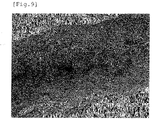
- a histopathological specimen of the collected decellularized tissue was produced, and was then subjected to HE staining. In this manner, the degree of self-organization was evaluated.
- the pathological photographs of the results are shown in Figs. 7 to 9 .
- Example 3 the following test groups were evaluated.
- the decellularized tissue was sutured and fixed (prosthesis) to the remaining autologous pericardium so that the decellularized tissue was fixed to the pericardium defect site located between epicardium and a sternum.
- Group (3) was a group in which fibrin was complexed with a decellularized tissue The complexed product was sutured and fixed (prosthesis) to the remaining autologous pericardium in such a manner that the complexed product was fixed to a pericardium defect site located between epicardium and a sternum.
- the results of the evaluation are shown in Table 3.
- the fibrosis inhibition and adhesion barrier kit which was a product of the present invention can promote the self-organization of a decellularized tissue to reconstruct an autologous pericardium-like tissue having proper strength.
- the present invention can be used as a fibrosis inhibitor for the surface of an organ or a tissue, and can also be used for the inhibition of adhesion of tissues.
Landscapes
- Health & Medical Sciences (AREA)
- Life Sciences & Earth Sciences (AREA)
- Chemical & Material Sciences (AREA)
- Animal Behavior & Ethology (AREA)
- General Health & Medical Sciences (AREA)
- Public Health (AREA)
- Veterinary Medicine (AREA)
- Epidemiology (AREA)
- Medicinal Chemistry (AREA)
- Engineering & Computer Science (AREA)
- Cell Biology (AREA)
- Biomedical Technology (AREA)
- Pharmacology & Pharmacy (AREA)
- Developmental Biology & Embryology (AREA)
- Dermatology (AREA)
- Zoology (AREA)
- Oral & Maxillofacial Surgery (AREA)
- Transplantation (AREA)
- Immunology (AREA)
- Surgery (AREA)
- Virology (AREA)
- Biotechnology (AREA)
- Heart & Thoracic Surgery (AREA)
- Vascular Medicine (AREA)
- Chemical Kinetics & Catalysis (AREA)
- Bioinformatics & Cheminformatics (AREA)
- Dispersion Chemistry (AREA)
- Botany (AREA)
- Molecular Biology (AREA)
- Cardiology (AREA)
- Proteomics, Peptides & Aminoacids (AREA)
- Gastroenterology & Hepatology (AREA)
- Hematology (AREA)
- Urology & Nephrology (AREA)
- Organic Chemistry (AREA)
- Nuclear Medicine, Radiotherapy & Molecular Imaging (AREA)
- General Chemical & Material Sciences (AREA)
- Physiology (AREA)
- Nutrition Science (AREA)
- Ophthalmology & Optometry (AREA)
Applications Claiming Priority (2)
| Application Number | Priority Date | Filing Date | Title |
|---|---|---|---|
| JP2019142482 | 2019-08-01 | ||
| PCT/JP2020/029532 WO2021020576A1 (ja) | 2019-08-01 | 2020-07-31 | 生体適合性高分子を用いた組織の線維化抑制剤 |
Publications (2)
| Publication Number | Publication Date |
|---|---|
| EP4008368A1 true EP4008368A1 (de) | 2022-06-08 |
| EP4008368A4 EP4008368A4 (de) | 2023-06-07 |
Family
ID=74228963
Family Applications (1)
| Application Number | Title | Priority Date | Filing Date |
|---|---|---|---|
| EP20847207.6A Ceased EP4008368A4 (de) | 2019-08-01 | 2020-07-31 | Gewebefibroseinhibitor, in dem biokompatibles polymer verwendet wird |
Country Status (9)
| Country | Link |
|---|---|
| US (2) | US20220265896A1 (de) |
| EP (1) | EP4008368A4 (de) |
| JP (1) | JP7472142B2 (de) |
| KR (1) | KR102673609B1 (de) |
| CN (1) | CN114144206B (de) |
| BR (1) | BR112022001136A2 (de) |
| CA (1) | CA3144487C (de) |
| TW (1) | TW202214312A (de) |
| WO (1) | WO2021020576A1 (de) |
Family Cites Families (14)
| Publication number | Priority date | Publication date | Assignee | Title |
|---|---|---|---|---|
| JPH0492397U (de) | 1990-12-28 | 1992-08-11 | ||
| US5605938A (en) * | 1991-05-31 | 1997-02-25 | Gliatech, Inc. | Methods and compositions for inhibition of cell invasion and fibrosis using dextran sulfate |
| ATE244584T1 (de) | 1995-01-16 | 2003-07-15 | Baxter Int | Selbsttragende flächengebilde aus vernetztem fibrin zur hemmung von postoperativen adhäsionen |
| EP1085920B1 (de) * | 1998-05-13 | 2001-12-19 | ML Laboratories PLC | Dextrinhaltige mischung zur verhinderung von chirurgischen verklebungen |
| DE10025001A1 (de) | 2000-05-22 | 2001-11-29 | Aventis Behring Gmbh | Gewebekleber mit verbesserten anti-adhäsiven Eigenschaften |
| WO2000072852A1 (en) | 1999-06-01 | 2000-12-07 | Bristol-Myers Squibb Company | Prevention of post surgical adhesions using a fibrin monomer sealant |
| AU2003260086A1 (en) * | 2002-04-01 | 2003-10-20 | Board Of Regents, The University Of Texas System | Composite material for wound repair |
| JP4092397B2 (ja) | 2002-09-10 | 2008-05-28 | 国立循環器病センター総長 | 超高静水圧印加による移植用生体組織の処理方法 |
| JP2008111530A (ja) | 2006-10-31 | 2008-05-15 | Sankei Giken:Kk | 管継手 |
| JP2009050297A (ja) | 2007-08-23 | 2009-03-12 | Tokyo Medical & Dental Univ | 脱細胞処理液、脱細胞化組織の調製方法、移植片、及び培養部材 |
| CN103405811B (zh) * | 2013-08-16 | 2015-10-28 | 陕西佰傲再生医学有限公司 | 一种防粘连生物膜及其制备方法 |
| EP3269402B1 (de) * | 2015-03-12 | 2025-10-22 | Adeka Corporation | Antihaftungsmaterial und ersatzbiomembrane unter verwendung von dezellularisiertem gewebe |
| CN106310373B (zh) * | 2015-07-09 | 2019-06-18 | 陕西佰傲再生医学有限公司 | 一种生物修复膜及其制备方法 |
| CN106983918B (zh) * | 2017-03-03 | 2020-05-05 | 北京博辉瑞进生物科技有限公司 | 一种生物防粘连材料、制备方法及其应用 |
-
2020
- 2020-07-31 JP JP2021535469A patent/JP7472142B2/ja active Active
- 2020-07-31 CN CN202080055061.1A patent/CN114144206B/zh active Active
- 2020-07-31 WO PCT/JP2020/029532 patent/WO2021020576A1/ja not_active Ceased
- 2020-07-31 BR BR112022001136A patent/BR112022001136A2/pt not_active Application Discontinuation
- 2020-07-31 EP EP20847207.6A patent/EP4008368A4/de not_active Ceased
- 2020-07-31 KR KR1020227005549A patent/KR102673609B1/ko active Active
- 2020-07-31 US US17/630,301 patent/US20220265896A1/en not_active Abandoned
- 2020-07-31 CA CA3144487A patent/CA3144487C/en active Active
-
2021
- 2021-07-30 TW TW110128145A patent/TW202214312A/zh unknown
-
2024
- 2024-03-19 US US18/609,457 patent/US20240216577A1/en active Pending
Also Published As
| Publication number | Publication date |
|---|---|
| CN114144206A (zh) | 2022-03-04 |
| US20240216577A1 (en) | 2024-07-04 |
| KR102673609B1 (ko) | 2024-06-10 |
| TW202214312A (zh) | 2022-04-16 |
| US20220265896A1 (en) | 2022-08-25 |
| EP4008368A4 (de) | 2023-06-07 |
| CN114144206B (zh) | 2023-03-24 |
| CA3144487C (en) | 2024-01-02 |
| BR112022001136A2 (pt) | 2022-05-24 |
| JP7472142B2 (ja) | 2024-04-22 |
| CA3144487A1 (en) | 2021-02-04 |
| KR20220044520A (ko) | 2022-04-08 |
| JPWO2021020576A1 (de) | 2021-02-04 |
| WO2021020576A1 (ja) | 2021-02-04 |
Similar Documents
| Publication | Publication Date | Title |
|---|---|---|
| US12311079B2 (en) | Decellularized biomaterial from non-mammalian tissue | |
| US11033661B2 (en) | Anti-adhesion material and substitute biomembrane using decellularized tissue | |
| DE60031461T2 (de) | Zusammensetzung zur Geweberegeneration | |
| EP0160025B1 (de) | Biomaterial | |
| DE602004000323T2 (de) | Zubereitungen zur Wiederherstellung und Regeneration humaner Dura Mater | |
| DE2631909C2 (de) | Synthetische Haut | |
| DE60026586T2 (de) | Zellulare matrix | |
| EP0781564A2 (de) | Naturelle menschliche Collagenmembran enthaltendes Material für medizinische Zwecke | |
| WO2000016822A1 (en) | Compositions and methods for tissue repair | |
| CN104684593B (zh) | 用于生产胶原蛋白膜的方法及其应用 | |
| Gangwar et al. | Acellular dermal graft for repair of abdominal wall defects in rabbits | |
| Meyer et al. | A new biocompatible material (Lyoplant®) for the therapy of congenital abdominal wall defects: first experimental results in rats | |
| US20240216577A1 (en) | Tissue fibrosis inhibitor in which biocompatible polymer is used | |
| CN114533959A (zh) | 一种肌腱修复材料、制备方法及在制备肌腱修复产品中的应用 | |
| RU2829524C2 (ru) | Ингибитор фиброза тканей, в котором используется биосовместимый полимер | |
| HK40069786A (en) | Tissue fibrosis inhibitor in which biocompatible polymer is used | |
| HK40069786B (en) | Tissue fibrosis inhibitor in which biocompatible polymer is used | |
| DE102011000666B4 (de) | Blutplasma-beschichtete Implantate |
Legal Events
| Date | Code | Title | Description |
|---|---|---|---|
| STAA | Information on the status of an ep patent application or granted ep patent |
Free format text: STATUS: THE INTERNATIONAL PUBLICATION HAS BEEN MADE |
|
| PUAI | Public reference made under article 153(3) epc to a published international application that has entered the european phase |
Free format text: ORIGINAL CODE: 0009012 |
|
| STAA | Information on the status of an ep patent application or granted ep patent |
Free format text: STATUS: REQUEST FOR EXAMINATION WAS MADE |
|
| 17P | Request for examination filed |
Effective date: 20220220 |
|
| AK | Designated contracting states |
Kind code of ref document: A1 Designated state(s): AL AT BE BG CH CY CZ DE DK EE ES FI FR GB GR HR HU IE IS IT LI LT LU LV MC MK MT NL NO PL PT RO RS SE SI SK SM TR |
|
| DAV | Request for validation of the european patent (deleted) | ||
| DAX | Request for extension of the european patent (deleted) | ||
| REG | Reference to a national code |
Ref country code: DE Ref legal event code: R079 Free format text: PREVIOUS MAIN CLASS: A61L0027220000 Ipc: A61L0031040000 |
|
| A4 | Supplementary search report drawn up and despatched |
Effective date: 20230509 |
|
| RIC1 | Information provided on ipc code assigned before grant |
Ipc: A61P 43/00 20060101ALI20230502BHEP Ipc: A61P 9/00 20060101ALI20230502BHEP Ipc: A61L 27/58 20060101ALI20230502BHEP Ipc: A61L 27/36 20060101ALI20230502BHEP Ipc: A61K 38/36 20060101ALI20230502BHEP Ipc: A61K 35/50 20150101ALI20230502BHEP Ipc: A61K 35/38 20150101ALI20230502BHEP Ipc: A61K 35/36 20150101ALI20230502BHEP Ipc: A61K 35/34 20150101ALI20230502BHEP Ipc: A61K 35/30 20150101ALI20230502BHEP Ipc: A61K 35/22 20150101ALI20230502BHEP Ipc: A61K 35/12 20150101ALI20230502BHEP Ipc: A61L 27/22 20060101ALI20230502BHEP Ipc: A61L 31/14 20060101ALI20230502BHEP Ipc: A61L 31/04 20060101AFI20230502BHEP |
|
| STAA | Information on the status of an ep patent application or granted ep patent |
Free format text: STATUS: EXAMINATION IS IN PROGRESS |
|
| 17Q | First examination report despatched |
Effective date: 20240219 |
|
| REG | Reference to a national code |
Ref country code: DE Ref legal event code: R003 |
|
| STAA | Information on the status of an ep patent application or granted ep patent |
Free format text: STATUS: THE APPLICATION HAS BEEN REFUSED |
|
| 18R | Application refused |
Effective date: 20250401 |