EP4008536B1 - Installation von indexierungsmerkmalen auf verbundteilen - Google Patents
Installation von indexierungsmerkmalen auf verbundteilen Download PDFInfo
- Publication number
- EP4008536B1 EP4008536B1 EP21207586.5A EP21207586A EP4008536B1 EP 4008536 B1 EP4008536 B1 EP 4008536B1 EP 21207586 A EP21207586 A EP 21207586A EP 4008536 B1 EP4008536 B1 EP 4008536B1
- Authority
- EP
- European Patent Office
- Prior art keywords
- mandrel
- composite part
- indexing
- work station
- feature
- Prior art date
- Legal status (The legal status is an assumption and is not a legal conclusion. Google has not performed a legal analysis and makes no representation as to the accuracy of the status listed.)
- Active
Links
Images






Classifications
-
- B—PERFORMING OPERATIONS; TRANSPORTING
- B29—WORKING OF PLASTICS; WORKING OF SUBSTANCES IN A PLASTIC STATE IN GENERAL
- B29C—SHAPING OR JOINING OF PLASTICS; SHAPING OF MATERIAL IN A PLASTIC STATE, NOT OTHERWISE PROVIDED FOR; AFTER-TREATMENT OF THE SHAPED PRODUCTS, e.g. REPAIRING
- B29C70/00—Shaping composites, i.e. plastics material comprising reinforcements, fillers or preformed parts, e.g. inserts
- B29C70/68—Shaping composites, i.e. plastics material comprising reinforcements, fillers or preformed parts, e.g. inserts by incorporating or moulding on preformed parts, e.g. inserts or layers, e.g. foam blocks
- B29C70/86—Incorporated in coherent impregnated reinforcing layers, e.g. by winding
-
- B—PERFORMING OPERATIONS; TRANSPORTING
- B29—WORKING OF PLASTICS; WORKING OF SUBSTANCES IN A PLASTIC STATE IN GENERAL
- B29C—SHAPING OR JOINING OF PLASTICS; SHAPING OF MATERIAL IN A PLASTIC STATE, NOT OTHERWISE PROVIDED FOR; AFTER-TREATMENT OF THE SHAPED PRODUCTS, e.g. REPAIRING
- B29C37/00—Component parts, details, accessories or auxiliary operations, not covered by group B29C33/00 or B29C35/00
- B29C37/02—Deburring or deflashing
-
- B—PERFORMING OPERATIONS; TRANSPORTING
- B29—WORKING OF PLASTICS; WORKING OF SUBSTANCES IN A PLASTIC STATE IN GENERAL
- B29C—SHAPING OR JOINING OF PLASTICS; SHAPING OF MATERIAL IN A PLASTIC STATE, NOT OTHERWISE PROVIDED FOR; AFTER-TREATMENT OF THE SHAPED PRODUCTS, e.g. REPAIRING
- B29C70/00—Shaping composites, i.e. plastics material comprising reinforcements, fillers or preformed parts, e.g. inserts
- B29C70/04—Shaping composites, i.e. plastics material comprising reinforcements, fillers or preformed parts, e.g. inserts comprising reinforcements only, e.g. self-reinforcing plastics
- B29C70/28—Shaping operations therefor
- B29C70/54—Component parts, details or accessories; Auxiliary operations, e.g. feeding or storage of prepregs or SMC after impregnation or during ageing
- B29C70/541—Positioning reinforcements in a mould, e.g. using clamping means for the reinforcement
-
- B—PERFORMING OPERATIONS; TRANSPORTING
- B29—WORKING OF PLASTICS; WORKING OF SUBSTANCES IN A PLASTIC STATE IN GENERAL
- B29C—SHAPING OR JOINING OF PLASTICS; SHAPING OF MATERIAL IN A PLASTIC STATE, NOT OTHERWISE PROVIDED FOR; AFTER-TREATMENT OF THE SHAPED PRODUCTS, e.g. REPAIRING
- B29C70/00—Shaping composites, i.e. plastics material comprising reinforcements, fillers or preformed parts, e.g. inserts
- B29C70/04—Shaping composites, i.e. plastics material comprising reinforcements, fillers or preformed parts, e.g. inserts comprising reinforcements only, e.g. self-reinforcing plastics
- B29C70/28—Shaping operations therefor
- B29C70/54—Component parts, details or accessories; Auxiliary operations, e.g. feeding or storage of prepregs or SMC after impregnation or during ageing
- B29C70/545—Perforating, cutting or machining during or after moulding
Definitions
- the disclosure relates to the field of aircraft, and in particular, to fabrication of aircraft components.
- Patent document EP 2 881 234 A1 states: a semifinished arrangement for the production of a fiber composite component by forming a flat fiber composite semifinished product in a mold, comprising the fiber composite semifinished product and a plurality of holding elements extending beyond the edge of the fiber composite semifinished product.
- the holding elements are recessed in recesses of the fiber composite semifinished product in order to avoid a height-wise projection. This allows for the edge of the fiber composite semifinished product to extend at least partially within the molding tool during the reshaping.
- a method for producing a fiber composite component using a semifinished arrangement is also provided.
- Patent document US 2004/217497 A1 states: a method and apparatus for use in manufacturing a composite part includes molding a composite part on a lay-up tool, machining a sacrificial portion of a first surface for securing a first hardware device with the composite part while the part is on the lay-up tool and cutting the part forming a peripheral edge while the part is on the lay-up tool.
- the method can further include positioning the first hardware device in contact with a machined interface of the composite part and machining the part including drilling a plurality of positioning holes through the hardware device and the part while the part is on the lay-up tool.
- the machining can include machining the sacrificial portion creating a machined interface and positioning the hardware device on the machined interface.
- Patent document EP 3 034 284 A1 states: a method for manufacturing of a CFRP part comprising the following steps: laying out one or more pre-preg or composite plies, on a mould comprising a marking tool, forming an uncured laminate with a guiding mark on the uncured laminate using, curing the laminate giving the part the final shape with the guiding mark and, trimming and/or drilling the CFRP part taking as reverence the guiding mark. Further, a mould is provided for moulding and curing a CFRP part comprising a marking tool adapted to perform a guiding mark on a fresh CFRP part, and a system for manufacturing of a moulded CFRP part.
- Embodiments described herein provide systems and methods for fabricating indexing features into a composite part that resides at a mandrel.
- the mandrel being a rigid tool, is already machined to a desired level of precision.
- a machine may rapidly apply indexing features precisely to a composite part hardened thereon.
- After the composite part is removed, its integral indexing features are utilized to rapidly the index the composite part to one or more stations that perform work on the composite part as the composite part moves in a process direction.
- One embodiment is a method for preparing a composite part for assembly.
- the method includes receiving a mandrel to which a composite part has been molded, and operating a work station to install an indexing feature into a manufacturing excess of the composite part.
- a further embodiment is a system for preparing a composite part for assembly.
- the system includes a mandrel that moves in a process direction while transporting a composite part.
- the mandrel comprises a layup surface for the composite part, and indexing features disposed at predetermined locations.
- the system further includes a work station that indexes to the indexing features at the mandrel, and that installs an indexing feature onto the composite part that is offset from the indexing feature at the mandrel, and a downstream work station that indexes to the indexing feature installed onto the composite part.
- a further embodiment is a method for processing a composite part.
- the method includes receiving a mandrel to which a composite part has been molded, and processing the composite part based on indexing features located in the mandrel.
- Yet another embodiment is a non-transitory computer readable medium embodying programmed instructions which, when executed by a processor, are operable for performing a method of preparing a composite part for assembly.
- the method includes receiving a mandrel to which a composite part has been molded, and operating a work station to install an indexing feature into a manufacturing excess of the composite part.
- a method for preparing a composite part for assembly comprising: placing a preform with a manufacturing excess upon a mandrel; hardening the preform into composite part with a hardened manufacturing excess while still upon mandrel; and installing an indexing feature into the manufacturing excess pre-hardening and/or post hardening prior to demolding from mandrel.
- the method further comprises demolding the composite part from the mandrel advancing the composite part in a process direction and indexing the composite part to a downstream work station via the indexing feature installed into the composite part.
- the method further comprises operating a mandrel work station to install an indexing feature into the manufacturing excess of the composite part prior to demolding the composite part from the mandrel.
- the method further comprises separating flash edges from the composite part prior to demolding.
- the method further comprises indexing the mandrel work station to a mandrel indexing feature at the mandrel.
- the indexing feature installed into the manufacturing excess of the composite part is offset from a mandrel indexing feature.
- indexing the mandrel work station to the mandrel indexing feature at the mandrel comprises inserting a complementary key of the mandrel work station into a corresponding keyway at the mandrel.
- the mandrel work station follows a groove at the mandrel.
- the mandrel work station follows a track at the mandrel.
- operating the mandrel work station to install the indexing feature comprises subtractive fabrication using drilling, milling or trimming or by additive fabrication such as adding pins adding RFID tags or adding bar codes.
- the mandrel work station cuts through the composite part into a potted recess of the mandrel to install the indexing feature into composite part.
- installing the indexing feature comprises installing a notch in the bearing edge and/or edge at the mandrel of the composite part.
- installing the indexing feature comprises installing the indexing feature in a manufacturing excess selected from the group consisting of window manufacturing excess and/or door manufacturing excess, and antenna cut-out regions on the composite part.
- operating the mandrel work station to install the indexing feature comprises installing multiple types of indexing features, wherein different types of indexing features are utilized by different downstream work stations.
- the indexing features installed into the manufacturing excess of the composite part are selected from the group consisting of cup locating features, drill start locations, drill through locations, slots, installed pins RFID tags bar codes, formed indexing feature and notch.
- the indexing features installed into the manufacturing excess of the composite part using mandrel indexing features selected from the group consisting of indents, protrusions, ridges, grooves, notches, through-holes, blind holes, RFID tags, and bar code.
- a system for preparing a composite part for assembly comprising: a mandrel that comprises: a layup surface for the composite part; and mandrel indexing features disposed at the mandrel; and a mandrel work station that indexes to the mandrel indexing features, and that installs an indexing feature onto the composite part that is offset from the mandrel indexing feature.
- a downstream work station indexes to the indexing feature.
- a downstream work station receives the composite part after the composite part has been demolded from the mandrel.
- the system further comprises the mandrel moves in a process direction while transporting the composite part.
- the mandrel work station comprises an indexing feature tool that cuts into the composite part without cutting through the composite part.
- a complementary key of the mandrel work station is inserted into a corresponding keyway at the mandrel to index the mandrel work station to the mandrel indexing feature.
- a method for processing a composite part comprising: receiving a mandrel to which a composite part has been molded; and processing the composite part based on indexing features located on the mandrel.
- the method wherein processing the composite part comprises installing indexing features into the composite part prior to demolding.
- the method further comprises processing the composite part comprises separating flash edges from the composite part prior to demolding.
- the method further comprises demolding the composite part from the mandrel advancing the composite part in a process direction and indexing the composite part to a downstream work station via the indexing feature installed into the composite part.
- the method further comprises operating a mandrel work station to install an indexing feature into the manufacturing excess of the composite part prior to demolding the composite part from the mandrel.
- the method further comprises indexing the mandrel work station to a mandrel indexing feature at the mandrel.
- the method further comprises the indexing feature installed into the manufacturing excess of the composite part is offset from the mandrel indexing feature at the mandrel.
- the method further comprises indexing the mandrel work station to the mandrel indexing feature at the mandrel comprises inserting a complementary key of the mandrel work station into a corresponding keyway at the mandrel.
- the method further comprises the mandrel work station follows a groove and/or track at the mandrel.
- the method further comprises operating the mandrel work station to install the indexing feature comprises cutting into the composite part without cutting through the composite part.
- the method further comprises the mandrel work station cuts through the composite part into a potted recess of the mandrel to install the indexing feature.
- the method further comprises installing the indexing feature comprises installing a notch in the bearing edge and/or edge at the mandrel of the composite part.
- the method further comprises installing the indexing feature comprises installing a notch in a bearing edge of the composite part.
- the method further comprises installing the indexing feature comprises installing the indexing feature in a manufacturing excess, window manufacturing excess and/or door manufacturing excess.
- the method further comprises removing the manufacturing excess from the composite part.
- the method further comprises operating the mandrel work station to install the indexing feature comprises installing multiple types of indexing features, wherein different types of indexing features are utilized by different downstream work stations.
- the method further comprises the indexing features installed into the manufacturing excess, window manufacturing excess and/or door manufacturing excess of the composite part are selected from the group consisting of cup locating features, drill start locations, drill through locations, slots, installed pins RFID tags bar codes , formed indexing feature and notch.
- a portion of an aircraft assembled according to the method described above is part of the present disclosure.
- an apparatus for forming composite parts comprising: a mandrel defining a contour for a composite part, the mandrel comprising: potted recesses disposed in a layup region for the composite part, beneath locations providing a layup region for a manufacturing excess of the composite part; and an index contour feature disposed within the layup region.
- the mandrel further comprises keyways disposed beyond the layup region.
- the mandrel further comprises grooves disposed beyond the layup region that guide a mandrel work station.
- a system for preparing a composite part for assembly comprising: a mandrel that comprises a layup region for the composite part; a composite part placed upon the layup region; and mandrel indexing features disposed at the mandrel.
- system further comprises a mandrel work station that indexes to the mandrel indexing features.
- the system further comprises the mandrel work station installs an indexing feature onto the composite part that is offset from the mandrel indexing feature.
- the system further comprises a potted recess disposed in a layup region, beneath locations providing a layup region for a manufacturing excess of the composite part.
- the system further comprises the mandrel further comprises keyways disposed beyond the layup region.
- the mandrel further comprises grooves disposed beyond the layup region that guide a mandrel work station.
- the system further comprises the flash edge and manufacturing excess is separated from the composite part prior to demolding.
- the separated flash edge and separated manufacturing excess are collected in chute system.
- an indexing feature installer comprising: a mandrel work station; and a feature creator coupled to the mandrel work station.
- the indexing feature installer further comprises a transmitter coupled to the mandrel work station.
- the indexing feature installer further comprises an indexing key coupled to the mandrel work station.
- the indexing key comprises a complementary key.
- the feature creator is selected from the group consisting of a blade, a drill, a mill, a pin installer, an RFID tag installer, a bar code installer and a fastener installer.
- the mandrel work station is coupled to a mandrel.
- the mandrel work station is coupled to the mandrel by a groove in the mandrel.
- the mandrel work station is transportable relative to manufacturing excess by slide-ably engaging the groove.
- the mandrel work station is transportable relative to manufacturing excess by slide-ably engaging the groove via a roller system.
- the mandrel work station is coupled to the mandrel by a track on the mandrel.
- the mandrel work station is transportable relative to manufacturing excess by slide-ably engaging the track.
- the mandrel work station is transportable relative to manufacturing excess by slide-ably engaging the track via a roller system.
- the indexing feature installer further comprises the complementary key configured to complementarily mate with a mandrel indexing feature.
- the indexing feature installer further comprises the blade selected from the group consisting of a reciprocating blade or a circular blade.
- the mandrel work station comprising a controller.
- CFRP Carbon Fiber Reinforced Polymer
- CFRP Carbon Fiber Reinforced Polymer
- the preform includes a viscous resin that solidifies in order to harden the preform into a composite part (e.g., for use in an aircraft).
- CFRP Carbon Fiber Reinforced Polymer
- Carbon fiber that has been impregnated with an uncured thermoset resin or a thermoplastic resin is referred to as "prepreg”.
- Other types of carbon fiber include "dry fiber” which has not been impregnated with thermoset resin but may include a tackifier or binder. Dry fiber is infused with resin prior to curing.
- the hardening is a one-way process referred to as curing, while for thermoplastic resins, the resin reaches a viscous form if it is re-heated.
- Aircraft 10 is an example of an aircraft which can be formed caul plate 150, 150-1 of FIG. 1 , 1A 1B , respectively.
- Aircraft 10 is an example of an aircraft 10 which is formed of half barrel sections 24 of fuselage 12.
- aircraft 10 has wing 15 and wing 16 attached to body 38.
- Aircraft 10 includes engine 14 attached to wing 15 and engine 14 attached to wing 16.
- Body 28 has tail section 18. Horizontal stabilizer 20, horizontal stabilizer 21, and vertical stabilizer 22 are attached to tail section 18 of body 38.
- Fuselage 12 is fabricated from half barrel sections 24 with an upper half barrel section 26 joined to a lower half barrel section 28 to form a full barrel section 29-1, 29-2, 29-3, 29-4, 29-n. There are n numbers of full barrel sections as illustrated by 29-n. The full barrel sections are joined serially, such as end to end, to form fuselage 12.
- Wing 15 and 16 are formed of wing panels 30 comprising upper wing panel 32 and a lower wing panel 34 joined together.
- Section cut 46 is a cut through of upper wing panel 32 and corresponds to unhardened preform 189, 189-1 ( FIG.1A and 1B ). Section cut 46 is orientated chord wise roughly perpendicular to upper wing panel 32.
- Section cut 44 is a cut through composite part 55 and corresponds to half barrel section preform 24-1 ( FIG. 3 ) prior to hardening.
- Half barrel section preform 24-1 corresponds to preform 189.
- Section cut 44 is orientated longitudinally 181 through a contour 112-1 along a stringer.
- FIG. 1A , 1B is a block diagram of a fabrication environment 100, 100-1 for installing indexing features 126, B126 into and/or onto composite parts 120, 120-1 in an illustrative embodiment.
- manufacturing excess for a composite part is trimmed immediately after demolding.
- Fabrication environment 100, 100-1 is unique in that it utilizes material during subsequent assembly that is traditionally immediately trimmed from a composite part 120, 120-1 after demolding.
- Fabrication environment 100, 100-1 comprises any system, device, or component operable to install indexing features 126, B126 onto a composite part 120, 120-1 that resides on a layup surface 112, 112-1 (e.g., defining a curved or flat contour) in a layup region 111, 111-1 of a mandrel 110, 110-1 (e.g., a rigid tool, such as a steel tool, composite tool, Invar tool, aluminum tool, etc., that is capable of withstanding heat and pressure applied during hardening of the composite part 120, 120-1, such as a half barrel section 113 or wing panel 113-1).
- a layup surface 112, 112-1 e.g., defining a curved or flat contour
- a layup region 111, 111-1 of a mandrel 110, 110-1 e.g., a rigid tool, such as a steel tool, composite tool, Invar tool, aluminum tool, etc., that is capable of withstanding heat and pressure applied during hardening
- an indexing feature 126, B126 comprises a physical, electrical, optical, or other sensory feature that is integrated into the mandrel or the composite part 120, 120-1, and characterizes a portion of the composite part 120, 120-1 (or mandrel) within the purview 115-1 of a work station 160-1.
- the mandrel 110, 110-1 that carries the composite part 120, 120-1 proceeds in a process direction 101, 101-9 during fabrication.
- the mandrel 110, 110-1 proceeds along a track 140, 140-1 (e.g., a series of discrete stanchions having rollers, a rail or set of rails, etc.) during fabrication, and may be pulsed incrementally such as its entire length, several feet to several inches in the process direction 101, 101-9, in what is known as a micro pulse 121.
- the mandrel 110, 110-1 proceeds continuously in the process direction 101, 101-9.
- the mandrel 110, 110-1 defines a contour for the placed composite part 120, 120-1, such as a half barrel section 113 of an aircraft fuselage 12, or a wing panel 113-1 for a wing 15.
- a half barrel section preform 24-1 is placed upon mandrel 110, 110-1 during layup and then is hardened into composite part 120, 120-1.
- the mandrel 110, 110-1 has mandrel indexing features 114, B114, such as indents 114-1, B114-1, protrusions 114-2, B114-2, ridges 114-3, B114-3, grooves 114-4, B114-4, notches 114-5, B114-5, through-holes 114-6, B114-6, blind holes 114-7, B114-7, RFID tags 114-8, B114-8, bar code 114-9, B114-9 , etc. While all of mandrel indexing features 114, 114-1 through 114-9 and B114, B114-1 through B114-9 are illustrated in FIG.
- each mandrel indexing feature 114 has the shape commensurate with the shape of that mandrel index feature 114, B114, such as indents 114-1, B114-1, protrusions 114-2, B114-2, ridges 114-3, B114-3, grooves 114-4, B114-4, notches 114-5, B114-5,through-holes 114-6, B114-6, blind holes 114-7, B114-7, RFID tags 114-8, B114-8, bar code 114-9, B114-9.
- Mandrel indexing features 114, B114 are capable of being used directly to place indexing features 126, B126 onto the half barrel section 113 or wing panel 113-1 while others accommodate trimming of manufacturing excess 122, 122-9.
- the trimming of manufacturing excess 122, 122-9 creates separated flash edge 124-1, 124-8 from flash edge 124, 124-9 and creates bearing edge 123 and edge 129-1 at the mandrel 110, 110-1.
- Drilling and/or milling of the half barrel section 113 or wing panel 113-1 at the mandrel 110 add indexing feature 126, B126 to composite part 120, 120-1, respectively.
- Separated flash edge 124-1, 124-8 and separated manufacturing excess 127-2, 124-8 are collected in chute system 147.
- Chute system 147 facilitates removing the trimmed off materials, such as separated flash edge 124-1, 124-8 and separated manufacturing excess 127-2, 124-8, from the removed material location prior to demold from the mandrel 110, 110-1.
- index contour features 125 on mandrel 110 are recesses, indents, dimple, bumps or ridges that are filled with resin and reinforcing fibers or displaces resin and reinforcing fibers, respectively, thus imparting a indexing feature 126-8, B126-8 into manufacturing excess 122-1, 122-9, 128 prior to hardening which is made permanent by the hardening process.
- FIG. 1A shows the index contour features 125 through cut through view 125-1 of manufacturing excess 122-1.
- Index contour features 125 on mandrel 110, 110-1 also convey indexing features 126, B126 into window manufacturing excess 128 and/or door manufacturing excess 128-9. Trim edge 128-1 remains after window manufacturing excess 128 is separated.
- Potted recesses 322 FIG. 3 ) are recesses filled with potting compound and finished to a mandrel 110, 110-1 surface contour 313. Overshoot during drilling or trimming through composite part 120, 120-1 and into the mandrel 110, 110-1 into potted recess 322 and piercing surface contour 313 and result in a need to restore the surface contour 313 prior to the reuse of the mandrel 110.
- a mandrel work station 130, 130-6, 130-7 aligns itself to mandrel indexing features 114 in mandrel 110, which are precisely machined and located into the mandrel 110.
- the mandrel work station 130, 130-6, 130-7 installs indexing features 126, B126 onto the composite part 120, 120-1.
- indexing features 126, B126 are installed at locations on the composite part 120, 120-1 with the assistance of mandrel work station 130, 130-6, 130-7 and mandrel index feature 114, 114-1 through 114-9 and B114, B114-1 through B114-9.
- the indexing features 126 are installed at manufacturing excess 122-1 or within window manufacturing excess 128.
- the indexing features B126 are installed at manufacturing excess 122-9 or in other words between edge 129-1 and final trim 148-2.
- the precision of the mandrel 110, 110-1 and the layup upon the mandrel 110, 110-1 is leveraged to locate the indexing features 126, B126 relative to composite part 120, 120-1 such as half barrel section 113 and/or 113-1.
- the composite part 120, 120-1 is precisely laid-up onto the mandrel 110 during fabrication.
- Indexing feature 126, B126 carries the precision of the mandrel indexing features 114, B114 into the composite part 120, 120-1 and carries it through the post demold fabrication process until manufacturing excess 122-1, 122-9 and 128 are finally separated.
- the mandrel indexing features 114, B114 at the mandrel 110, 110-1 enable precise alignment of the mandrel work station 130, 130-6, 130-7 to the mandrel 110, 110-1.
- the indexing features 126, B126 facilitate indexing 119, 119-1 of the composite part 120, 120-1 to downstream work stations 160, 160-1, such as work station 160, 160-1 after the composite part 120, 120-1 has been removed from the mandrel 110, 110-1.
- Indexing features 126, B126 comprise cup locating features 126-1, B126-1 for a cup and cone arrangement ( FIG. 4 ), drill start locations 126-2, B126-2 ( FIG. 5 ), drill through locations 126-3, B126-3 ( FIG.6 ) , slots 126-4, B126-4 ( FIG.
- FIG. 7 installed pins 126-5, B126-5 ( FIG. 8 ), RFID tags 126-6, B126-6 ( FIG. 9 ), bar codes 126-7, B126-7 ( FIG. 10 ), formed indexing feature 126-8, B126-8 ( FIG. 11 ), notch 126-9, B126-9 ( FIG. 12 ).
- Some of the mandrel indexing features 114, B114 of the mandrel 110, 110-1 are located beneath or beyond a final trim 129, 129-1 of the composite part 120, while the indexing features 126, B126 are installed above a bearing edge 123 or between edge 129-1 and final trim 148-2 of the composite part 120, 120-1, respectively.
- Bearing edge 123 is an edge of the composite part 120 that bears a weight of the composite part 120 after demolding.
- Formed indexing feature 126-8, B126-8 is created during layup and hardening due to forming over an index contour feature 125 shaping the composite part 120, 120-1 before hardening occurs and which is made permanent by the hardening process.
- the formed indexing feature 126-8 is present in the hardened composite part 120, 120-1.
- Each indexing feature 126, B126 in the composite part 120, 120-1 may be common to (i.e., used by) one or more stations 160, 160-1 at an assembly line 102, 102-1 after demolding, and the precision of each indexing feature 126, 126-1 through 126-8 and B126, B126-1 through B126-8 is tailored to a tolerance determined for the work station 160, 160-1 that utilizes the indexing feature 126, 126-1 through 126-8 and B126, B126-1 through B126-8. For example, work stations 160, 160-1 that require precision operations may require more tightly toleranced indexing features 126, B126.
- Mandrel work stations 130-6, 130-7 are block representations of mandrel work station 130.
- Mandrel work station 130-6 is also capable of creating separated flash edge 124-8.
- Mandrel work stations 130-6, 130-7 have the same capabilities as mandrel work station 130 and 130-6 except it traverses mandrel 110-1 on track 354 without using groove 352.
- Another possibility is to have the mandrel work station 130-6 and mandrel work station 130-7 carried along upon both a track 354 and a groove 352 to trim along edge 148-2 and to install indexing features B126.
- indexing features 126 through 126-8 and indexing features B126 through B126-8 are coupled to composite part 120, 120-1, respectively, by subtractive fabrication using drilling, milling or trimming or by additive fabrication such as adding pins 126-5, B126-5, adding RFID tags 126-6, B126-6, or adding bar codes 126-7, B126-7. While each mandrel work station 130-5, 130-6, 130-7, 130-8 type is shown along one edge only, it is possible to have one type of the work stations serving multiple edges.
- mandrel work stations 130-5 can service each of the four edges or two mandrel work stations 130-6 and two mandrel work stations 130-7 could each work an edge or three or four mandrel work stations 130-8 could each work an edge and a mandrel work station 130-5 can work an edge. Therefore, any combination of mandrel work stations 130-5, 130-6, 130-7, 130-8 are able to be used to service a particular edge.
- mandrel indexing features 114, B114 are implemented as Radio Frequency Identifier (RFID) tags 114-8, B114-8 that are coupled to the mandrel 110, 110-1.
- RFID Radio Frequency Identifier
- mandrel work stations 130, 130-6, 130-7 interact with information provided by the mandrel indexing features 114, B114 to characterize the mandrel 110, 110-1, and use this information to determine locations for receiving indexing features 126, B126.
- the mandrel work station 130, 130-6, 130-7 installs indexing features 126, B126 in the form of RFID tags 114-8 that each characterize a portion of the composite part 120, 120-1 within the purview 115, 115-1 of work station 160, 160-1.
- the composite part 120, 120-1 is rough-trimmed to form a bearing edge 123 of the manufacturing excess 122-1.
- rough-trimming may remove the flash edge 124, such as the rough edge of the layup including portions with resin and reinforcing fibers or just one or the other, from the composite part 120.
- the rough trimming creates the bearing edge 123 and edge 129-1 prior to demold from mandrel 110.
- the removed material is a separated flash edge 124-1, 124-8 from manufacturing excess 122, 122-9.
- Window manufacturing excess 128 are typically removed after installation of window surrounds, and windows are installed at a downstream work station 160.
- indexing features 126, B126 are installed into other forms of manufacturing excess, such as window manufacturing excess 128 door cut-out regions (not shown), or antenna cut-out regions (not shown).
- Mandrel work station 130, 130-6, 130-7 includes a feature creator 132, such as blade 137, drill, mill, pin installer, RFID tag installer, bar code installer, fastener installer or other machine tool to install the indexing features 126, B126 by removing material, adding material or scannable device to the composite part 120.
- a feature creator 132 such as blade 137, drill, mill, pin installer, RFID tag installer, bar code installer, fastener installer or other machine tool to install the indexing features 126, B126 by removing material, adding material or scannable device to the composite part 120.
- the feature creator 132 trims portions of a composite part 120, 120-1 that is disposed at the mandrel 110, 110-1.
- the cutting operation is typically performed prior to demolding of the composite part 120, 120-1 from the mandrel 110, 110-1, and leaves a sufficient amount of manufacturing excess 122-1, 122-9 to include indexing features 126, B126 and bearing edge 123 for use by work stations 160, 160-1 in an assembly line 102, 102-1, respectively.
- Feature creator 132 is employed to apply a preliminary cut that provides a bearing edge 123 or edge 129-1 to the composite part 120, 120-1 during the manufacturing process, prior to trimming the edge to a final trim 148, 148-2.
- Cutter 133 provides all of the trimming, milling or drilling to create separated flash edge 124-1, 124-8 from manufacturing excess 122-1, 122-9.
- Trimming prior to demold saves the non-value added time of placing the composite part 120, 120-1, such as half barrel section 113 and/or wing panel 113-1, into a cell dedicated only to trimming the composite part 120, 120-1.
- the composite part 120, 120-1 is indexed to the cell and the trimming equipment including the cutter prior to trimming to produce a final trim and then indexing the composite structure 120 to each successive cell in a repetitive process to scan the part perimeter and contour.
- the terms composite structure 120 and composite part 120 are used interchangeably throughout the application.
- Using the manufacturing excess 122-1 and 128 to convey indexing features 126 saves much if not all of the repetitive part perimeter and contour scan-able process when moving from work station to work station through the assembly process.
- 102-1 protects the final trim 148, 148-2 edge from bump damage until manufacturing excess 122-1, including bearing edge 123 and manufacturing excess 122-9 is separated. Any damage to bearing edge 123, particularly after demolding, can be rough patched to restore transportation capabilities on assembly line 102 as needed before being trimmed off with manufacturing excess 122-1.
- Mandrel work station 130 further comprises a support 134 (e.g., a rigid bar, an actuated linkage such as a robot arm, kinematic chain, or other component, etc.) that is capable of aligning the feature creator 132 in position.
- Mandrel work stations 130-6, 130-7 are block representations of mandrel work station 130.
- Mandrel work stations 130-6, 130-7 have the same capabilities as mandrel work station 130 and 130-6 except it traverses mandrel 110-1 on track 354 without using groove 352.
- Another possibility is to have the mandrel work station 130-6 and mandrel work station 130-7 carried along upon both a track 354 and a groove 352 to trim along edge 148-2 and to install indexing features B126.
- Mandrel work station 130 installing the indexing features 126 and also cutting the bearing edge 123 in a single work station in a single or multiple passes along mandrel 110, 110-1.
- Mandrel work station 130 still further comprises indexing key 136, which complementarily mates with mandrel indexing features 114, such as indents 114-1, protrusions 114-2, ridges 114-3, grooves 114-4, notches 114-5, through-holes 114-6, blind holes 114-7 to lock the feature creator 132 in place relative to the mandrel 110.
- Mandrel work station 130, through 130-8 comprises an indexing feature installer and indexing key 136.
- the complementary mating of the indexing key 136 with the indents 114-1, protrusions 114-2, ridges 114-3, grooves 114-4, notches 114-5, through-holes 114-6, blind holes 114-7 conveys a message from the mandrel 110 regarding placement and type of indexing feature 126 relative to composite part 120.
- the Mandrel work station 130 places the message conveyed by the mating of the indexing key 136 from the mandrel indexing feature 114 into operation to locate and install the indexing features 126, 126-1 through 126-8 and B126, B126-1 through B126-8 into or onto manufacturing excess 122-1.
- mandrel work station 130 includes a blade 137, such as a reciprocating or circular blade, and/or a mill and/or a drill and a control system that drives the blade 137 to trim, mill or drill portions of a composite part 120 at the mandrel 110.
- This trimming, milling or drilling operation are performed prior to demolding of the composite part 120 from the mandrel 110, and leaves indexing features 126, B126 including cup locating features 126-1, B126-1 for a cup and cone arrangement, drill start locations 126-2, B126-2, drill through locations 126-3, B126-3, slots 126-4, B126-4, installed pins 126-5, B126-5 for use by work stations 160, 160 in an assembly line 102, 102-1.
- the RFID tags 126-6, and bar codes 126-7 are also placed by the mandrel work station 130.
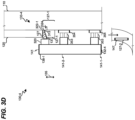
- RFID tags 114-8 and bar code 114-9 are placed RFID tags and/or bar code placer 329 ( FIG. 3-3D ).
- Groove 352 is used to guide and for transport of the cutter 133 relative to manufacturing excess 122-1, 128 with support 355-1 slide-ably engaging it with roller system 350-1.
- This embodiment is cantilever mounted into groove 352 and is guided along groove 352 to facilitate installing indexing features 126, 126-1 through 126-8 and B126, B126-1 through B126-8 into manufacturing excess 122-1, 128.
- the cutter 133 is cantilevered from groove 352 with one or more roller systems 350 slide-ably engaging and propelling the cutter 133 along mandrel 110 to facilitate creating indexing features 126, 126-1 through 126-8 and B126, B126-1 through B126-8.
- Mandrel indexing features 114 such as indents 114-1, protrusions 114-2, ridges 114-3, grooves 114-4, notches 114-5, through-holes 114-6, blind holes 114-7, RFID tags 114-8, bar code 114-9 are engaged by indexing key 136 such as a complementary key 310 ( FIG. 3 ) and/or RFID tag reader 325 and/or bar code reader 325-1.
- Installed pins 126-5 are placed by pin installer 327 ( FIG. 3 and FIG. 3D ) into the hole created by blade 137 ( FIG. 3A ).
- Mandrel work station 130, through 130-8 comprises an indexing feature installer and complementary key 310.
- a cutter 133 has a transverse mount 133-9 travelling in transverse direction 135 to the feature creator 132.
- the cutter 133 includes the blade 137 which is a reciprocating blade or a circular blade or a mill type cutter blade to separate flash edge 124, 124-9 and create bearing edge 123 or edge 129-1, respectively.
- the transverse mount 133-9 travelling in transverse direction 135 of the cutter 133 comes into play when locating indexing features 126 in a transverse direction 135 relative to track 354. This can be accomplished by using the same cutter 133-1 to install index features 126, B126 into manufacturing excess 122, 122-9 at different distances from bearing edge 123 and/or edge 129-1.
- the complementary key 310 complementarily engages with mandrel indexing feature 114, such as indents 114-1, protrusions 114-2, ridges 114-3, grooves 114-4, notches 114-5, through-holes 114-6, blind holes 114-7, RFID tags 114-8, and bar code 114-9.
- Indexing the mandrel work station 130 to the mandrel indexing feature 114 at the mandrel 110, 110-1 comprises inserting a complementary key 310 of the mandrel work station 130 into a corresponding keyway 312 at the mandrel 110, 110-1.
- Mandrel work station 130, through 130-8 comprises an indexing feature installer and keyway 312.
- the wheels 350 enable longitudinal 101-1 movement relative to mandrel 110 along groove 352 to the next in mandrel indexing features 114, and the complementary key 310 facilitates fine alignment of the indexing feature tool 320 to mandrel indexing features 114, such as indents 114-1, protrusions 114-2, ridges 114-3, grooves 114-4, notches 114-5, through-holes 114-6, blind holes 114-7 when complementary key 310 mates to mandrel indexing feature 114.
- Sensor 331 senses the mandrel indexing features 114, such as indents 114-1, protrusions 114-2, ridges 114-3, grooves 114-4, notches 114-5, through-holes 114-6, blind holes 114-7 and rough positions the mandrel work station 130 such that complementary key 310 is mate-able with mandrel indexing feature 114.
- the sensor 331 is an optical sensor or some other type of sensor that detects mandrel indexing feature 114.
- the mandrel 110 indexing feature 114 such as RFID tags 114-8, bar code 114-9 conveys the locations of the mandrel indexing features 114 to mandrel work station 130 to help with locating each and then using the sensor 331 to mate the complementary key 310 with the mandrel indexing feature 114.
- An embodiment has groove 352 engaging with wheels 350 in a rack and pinion arrangement that can also be used to convey position data relative to mandrel 110 and/or propel the mandrel work station 130 relative to mandrel 110.
- the mandrel work station 130 follows one or more grooves 352 at the mandrel 110, pausing and mating with mandrel indexing features 114.
- Other embodiments of mandrel work station 130 use multiple tracks 354 with groove 352 or multiple tracks 354 only without groove 352.
- the tracks 354 are shown removably attached to composite part 120 such as half barrel section 113 and mandrel 110.
- the tracks 354 are vacuum coupled or by some other means of removable attaching to composite part 120.
- the housing 138 spans between the track 354 and groove 352 and transports along the track 354 and groove 352.
- a cutter 133 has a transverse mount 133-9 travelling in transverse direction 135 to the feature creator 132.
- the cutter 133 includes the blade 137 which is a reciprocating blade or a circular blade or a mill type cutter blade to separate flash edge 124, 124-9 and create bearing edge 123 and edge 129-1.
- the transverse mount 133-9 travelling in transverse direction 135 of the cutter 133 comes into play when locating indexing features 126 in a transverse direction relative to track 354.
- An embodiment of the roller system 353 has a rack and pinion connection between the feature creator 132 and the tracks 354.
- An embodiment has a rack and pinion connection between the feature creator 132 and the groove 352.
- Another embodiment has the mandrel work station 130 carried directly upon track 140.
- mandrel work station 130-1 includes a feature creator 132-1, such as blade, drill, mill, pin installer, RFID tag installer, bar code installer or fastener installer other machine tool to install the indexing features 126 by removing material, adding material or scannable device to the composite part 120.
- the feature creator 132-1 trims portions of a composite part 120 that is disposed at the mandrel 110. The cutting operation is typically performed prior to demolding of the composite part 120 from the mandrel 110, and places an indexing features 126 in manufacturing excess 128 for use by work stations 160 in an assembly line 102, 102-1.
- Trimming prior to demold saves the non-value added time of placing the composite part 120 such as half barrel section 113 into a cell dedicated to only trimming and indexing to the cell and the cutter prior to trimming to a production perimeter and then indexing the composite structure 120 to each successive cell in a repetitive part perimeter and contour scan-able process.
- Using the manufacturing excess 128 to convey indexing features 126 saves much if not all of the repetitive part perimeter and contour scan-able process time when moving through the assembly process from work station to work station.
- Mandrel work station 130-2 further comprises a receiver 134-2 that receives coordinating information from mandrel work station 130 transmitter 134-1.
- Mandrel work station 130 comprises indexing key 136 and specifically complementary key 310, which complementarily mates with mandrel indexing features 114, such as indents 114-1, protrusions 114-2, ridges 114-3, grooves 114-4, notches 114-5, through-holes 114-6, blind holes 114-7 to lock the feature creator 132 in place relative to the mandrel 110.
- the complementary mating of the complementary key 310 with the indents 114-1, protrusions 114-2, ridges 114-3, grooves 114-4, notches 114-5, through-holes 114-6, blind holes 114-7 conveys a message from the mandrel 110 regarding placement and type of indexing feature 126.
- the mandrel work station 130 transmits the message, via transmitter 134-1 to receiver 134-2 conveyed by the mating of the complementary key 310 with the mandrel indexing feature 114 into operation to locate and install the indexing features 126, 126-1 through 126-8 and B126, B126-1 through B126-8 into or onto manufacturing excess 128.
- mandrel work station 130-1 includes a blade 137, such as a reciprocating or circular blade, and/or a mill and/or a drill and a controller 150 that drives the blade 137 to trim, mill or drill portions of manufacturing excess 128 at the mandrel 110 to install indexing feature 126, 126-1 through 126-7.
- This trimming, milling or drilling operation are performed in manufacturing excess 128 prior to demolding of the composite part 120 from the mandrel 110, and leaves indexing features 126, locating features 126-1, drill start locations 126-2, drill through locations 126-3, slots 126-4, installed pins 126-5 for use by work stations 160 in an assembly line 102, 102-1.
- the RFID tags 126-6 and bar codes 126-7 are also placed by the mandrel work station 130.
- RFID tags 114-8 and bar code 114-9 are placed RFID tags and/or bar code placer 329.
- the tracks 354 are shown removably attached to composite part 120 such as half barrel section 113 and mandrel 110.
- the tracks 354 are vacuum coupled or by some other means of removable attaching to composite part 120.
- the housing 138-1 spans between the tracks 354 and transports along the track 354 by a roller system 353 and/or also couples the tracks 354 to housing 138-1.
- a cutter 133-1 has a transverse mount 133-9 travelling in transverse direction 135 to the feature creator 132-1.
- the cutter 133-1 includes the blade 137 which is a reciprocating blade or a circular blade or a mill type cutter blade to separate flash edge 124, 124-9 and create bearing edge 123 or edge 129-1, respectively.
- the transverse mount 133-9 travelling in transverse direction 135 of the cutter 133-3 comes into play when locating indexing features 126 in a transverse direction relative to track 354. This can be accomplished by using the same cutter 133-1 to install index features 126 into manufacturing excess 128 at different distances from bearing edge 123.
- An embodiment of the roller system 353 has a rack and pinion connection between the feature creator 132-1 and the tracks 354.
- mandrel work station 130-2 includes a cutter 133-2 with a blade 137, such as blade, drill, mill, to create separated manufacturing excess 124-1 from manufacturing edge 122-1 and bearing edge 123.
- the cutting operation is typically performed prior to demolding the composite part 120 from the mandrel 110, and leaves a sufficient amount of manufacturing excess 122-1 to include indexing features 126 for use by work stations 160 in an assembly line 102.
- the trimming also creates the bearing edge 123 used to transport composite part 120 on track 140 through work stations 160 on assembly line 102.
- Trimming prior to demold saves the non-value added time of placing the composite part 120, such as half barrel section 113, into a cell dedicated to only trimming and indexing to the cell and indexing to a edge 129-1 final trim 148, 148-2 trim line 122-8 prior to trimming to a final trim 148 and then indexing the composite structure 120 to each successive cell in a repetitive part perimeter and contour scan-able process.
- Using the manufacturing excess 122-1 to convey indexing features 126 saves much if not all of the repetitive part perimeter and contour scan-able process time needed to index to each cell when moving through the assembly process.
- Groove 352 is used to guide and enable longitudinal 101-1 transport of the cutter 133-2 relative to manufacturing excess 122-1 with support 355-1 slide-ably engaging it with roller system 350-1.
- a version of mandrel work station 130-2, 130-8 is cantilever mounted into groove 352. The mandrel work station 130-2 is guided along groove 352 to facilitate creating separated flash edge 124-1 from manufacturing excess 122.
- the cutter 133-2 is cantilevered from groove 352 with one or more roller systems 350 slide-ably engaging and propelling the cutter 133-2 along mandrel 110.
- Groove 352 is illustrated having a rectangular cross section, but other cross sections are possible.
- the groove 352 also provides cutter 133-2 guidance during the creation of bearing edge 123.
- the track 354 as well as groove 352 is used to enable longitudinal 101-1 transport of the cutter 133-2 relative to manufacturing excess 122-1.
- the track 354 instead of groove 352 is used to enable longitudinal 101-1 movement.
- wheels 350 enable longitudinal 101-1 movement relative to mandrel 110 along groove 352 relative to bearing edge 123 and trim line 122-8 from one end of mandrel 110 to the other.
- a version has groove 352 engaging with wheels 350 in a rack and pinion arrangement that can also be used to convey position data relative to mandrel 110 and/or propel the mandrel work station 130-2 relative to mandrel 110.
- the mandrel work station 130-2 follows one or more grooves 352 at the mandrel 110.
- one end 141 of the feature creator 132-2 is coupled via roller system 353 and track 354 to composite part 120 as part of a flex track type of device and the other end 141-1 of the feature creator 132-2 is coupled via support 355 and roller system 350-1 to groove 352.
- one end 141 of the feature creator 132-2 is coupled via roller system 353 and track 354 to composite part 120, 120-1 as part of a flex track type of device and the other end 141-1 of the feature creator 132-2 is coupled via roller system 353 and track 354, 354 to mandrel 110 as part of a flex track type of device without using a connection to groove 352.
- one end 141 of the feature creator 132-2 is coupled via roller system 353 and track 354 to composite part 120 as part of a flex track type of device and the other end 141-1 of the feature creator 132-2 is coupled via roller system 353 and track 354 to mandrel 110 as part of a flex track type of device and other end 141-1 of the feature creator 132-2 is coupled via support 355 and roller system 350-1 to groove 352.
- the tracks 354 are shown removably attached to composite part 120 and mandrel 110.
- the tracks 354 are vacuum coupled or by some other means of removable attaching to composite part 120 and/or mandrel 110.
- the cutter housing 138-2 spans between the tracks 354 and transports along the track 354 by a roller system 353 and/or also couples the tracks 354 to housing 138-2.
- a cutter 133-1 has a transverse mount 133-9 travelling in transverse direction 135 to the feature creator 132-2.
- the cutter 133-2 includes the blade 137 which is a reciprocating blade or a circular blade or a mill type cutter blade to separate manufacturing excess 124 and create bearing edge 123.
- the transverse mount 133-9 travelling in transverse direction 135 of the cutter 133-2 comes into play within feature creator 132-2 when locating indexing features 126 in a transverse direction relative to track 354. This can be accomplished by using the same cutter 133-2 to create bearing edge 123.
- An embodiment of the roller system 353 has a rack and pinion connection between the feature creator 132-2 and the tracks 354. Groove 352 is used to guide cutter 133-2 relative to bearing edge 123 and for transport of the cutter 133-3 relative to manufacturing excess 122-1, 128 with support 355-1 slide-ably engaging it with roller system 350-1.
- This embodiment is cantilever mounted into and guided along groove 352-1 to facilitate creating bearing edge 123 within manufacturing excess 122.
- the cutter 133-2 is cantilevered from groove 352 with one or more roller systems 350 slide-ably engaging and propelling the cutter 133-2 along mandrel 110 either autonomously or manually.
- Groove 352-1 in another embodiment is used to guide the cutter 133-2 relative to bearing edge 123 with support 355 slide-ably engaging it with roller system 350-1.
- This embodiment does not use tracks 354 and roller system 353, but is instead cantilever mounted into groove 352 and is guided along groove 352-1 to facilitate cutting bearing edge 123.
- the feature creator 132-2 and cutter 133-2 is cantilevered from groove 352-1 with one or more roller systems 350-1 slide-ably engaging and propelling the feature creator 132-2 and cutter 133-2 along mandrel 110 to facilitate creating bearing edge 123. This may result in a rougher cut than for final trim and provides a consistent bearing edge 123 to the composite part 120 for use during the manufacturing process, prior to trimming off the bearing edge 123 to a final trim 148.
- mandrel work station 130-3 and mandrel work stations 130-5, 130-7 includes a cutter 133-3, 133-6, 133-8 with a blade 137, such as blade, drill and/or mill, to create separated manufacturing excess 127-2, 124-8 from manufacturing edge 127-1, trim line 122-8 leaving edge 127, 129-1, respectively.
- the cutting operation is typically performed prior to demolding of the composite part 120 from the mandrel 110, and creating a final trim edge 127 or edge 129-1 prior to processing through work stations 160, 160-1 in an assembly line 102, 102-1.
- Trimming prior to demold saves the non-value added time of placing the composite part 120, 120-1 into a cell dedicated to only trimming and indexing to the cell and indexing to a edge 129-1 final trim 148, 148-2 trim line 122-8 prior to trimming to a final trim 148, 148-2 and then indexing the composite structure 120, 120-1 to each successive cell in a repetitive part perimeter and contour scan-able process prior to beginning work in the cell.
- Using the manufacturing excess 122-1, 122-9 to convey indexing features 126, B126 saves much if not all of the repetitive part perimeter and contour scan-able process time needed to index to each cell when moving through the assembly process.
- Mandrel work stations 130-5 and mandrel work stations 130-7 correspond to mandrel work station 130-3 and trims off flash edge 124-9 in a manner similar to flash edge 124.
- Mandrel work stations 130-5, 130-7 could be substituted for by mandrel work station 130-3 in some versions depending upon location, or lack thereof, of groove B352 and/or track B354.
- Mandrel work station 130-5 is sized to facilitate placement of housing 138 with halfway point 138-1 roughly directly above track B354 to help balance mandrel work station 130-5 relative to the one groove B352.
- mandrel work station 130-7 is sized to facilitate placement of housing 138 with halfway point 138-1 roughly directly above groove B352 to help balance mandrel work station 130-5 above the one groove B352. Trimming prior to demold saves the non-value added time of placing the composite part 120, 120-1 such as half barrel section 113 and/or wing panel 113-1 into a cell dedicated to only trimming and indexing to the cell and indexing to a edge 129-1 final trim 148, 148-2 trim line 122-8 prior to trimming to a final trim 148, 148-2 and then indexing the composite structure 120, 120-1 to each successive cell in a repetitive part perimeter and contour scan-able process. Using the manufacturing excess 122-1, 122-9 to convey indexing features 126, B126 saves much if not all of the repetitive part perimeter and contour scan-able process time needed to index to each cell when moving through the assembly process.
- Groove 352-1, B352 is used to guide and enable longitudinal 101-1 transport of the cutter 133-2 relative to final trim edge 127 with support 355-1 slide-ably engaging it with roller system 350-1.
- Groove B352 is used to guide and enable transport of the cutter 133-6, 133-8 relative to edge 129-1 with support 355-1 slide-ably engaging it with roller system 350-1.
- Groove 352, B352 is illustrated having a rectangular cross section, but other cross sections are possible.
- the mandrel work station 130-3, 130-7 is mounted into groove 352-1, B352 and is guided along groove 352-1, B352 to facilitate creating separated manufacturing excess 127-2 or separated flash edge 124-8 from composite part 120, 120-1.
- the cutter 133-3, 133-6, 133-8 has one or more roller systems 350 slide-ably engaging and propelling the cutter 133-3 along mandrel 110.
- the groove 352-1, B352 also provides cutter 133-3, 133-6, 133-8 guidance during the creation of bearing edge 123 or edge 129-1, respectively. This means that the wheels 350 enable movement relative to mandrel 110, 110-1 along groove 352-1, B352 relative to edge 127-1, trim line 122-8 leaving final trim edge 127 or edge 129-1 from one end of mandrel 110, 110-1 to the other end.
- An embodiment has groove 352-1, B352 engaging with wheels 350 in a rack and pinion arrangement that can also be used to convey position data relative to mandrel 110 and/or propel the mandrel work station 130-3, 130-5, 130-7 relative to mandrel 110, 110-1.
- the mandrel work station 130-3, 130-5, 130-7 follows one or more grooves 352-1, B352 at the mandrel 110, 110-1.
- one end 141 of the feature creator 132-3 is coupled via roller system 353 and track 354 to composite part 120 as part of a flex track type of device and the other end 141-1 of the feature creator 132-3 is coupled via support 355 and roller system 350-1 to groove 352-1.
- one end 141 of the feature creator 132-3 is coupled via roller system 353 and track 354 to composite part 120 as part of a flex track type of device and the other end 141-1 of the feature creator 132-3 is coupled via support 355 and 350-1 to groove 352-1, B352.
- Another embodiment not illustrated has one end 141 of the feature creator 132-3 is coupled via roller system 353 and track 354 to composite part 120, 120-1 as part of a flex track type of device and the other end 141-1 of the feature creator 132-3 is coupled via roller system 353 and track 354 to mandrel 110 as part of a flex track type of device without using a connection to groove 352-1, B352.
- one end 141 of the feature creator 132-3 is coupled via roller system 353 and track 354 to composite part 120 as part of a flex track type of device and the other end 141-1 of the feature creator 132-3 is coupled via roller system 353 and track 354 to mandrel 110, 110-1 as part of a flex track type of device and other end 141-1 of the feature creator 132-3 is coupled via support 355 and roller system 350-1 to groove 352-1, B352.
- a flex track type of device such as but not limited to mandrel work station 130-1, 130-4, with a cutter moveably attached to two tracks removeably attached to the composite part 120, 120-1 such as half barrel section 113.
- the tracks 354 are shown removably attached to composite part 120, 120-1 such as half barrel section 113 and/or wing panel 113-1 and mandrel 110, 110-1.
- the tracks 354, B354, B354-1 are vacuum coupled or by some other means of removable attaching to composite part 120, 120-1 and/or mandrel 110, 110-1.
- the cutter housing 138-1 spans between the track 354, B354-1 and the groove 352-1, B352 and transports cutter housing 138-1 along the track 354, B354-1 and groove 352-1, B352 by a roller system 353 and rollers 350-1, respectively.
- a cutter 133-3 has a transverse mount 133-9 travelling in transverse direction 135 to the feature creator 132-3.
- the cutter 133-3 includes the blade 137 which is a reciprocating blade or a circular blade or a mill type cutter blade to separate manufacturing excess 127-2 and final trim edge 127 or edge 129-1.
- An embodiment of the roller system 353 has a rack and pinion connection between the feature creator 132-3 and the tracks 354, B354-1.
- mandrel work station 130-4 includes a cutter 133-4 with a blade 137, such as blade, drill, mill, to create separated manufacturing excess 127-2 from manufacturing edge 127-1 leaving final trim edge 127.
- the cutting operation is typically performed prior to demolding of the composite part 120 from the mandrel 110, and creating a final trim edge 127 prior to processing through work stations 160 in an assembly line 102, 102-1.
- Trimming prior to demold saves the non-value added time of placing the composite part 120 such as half barrel section 113 into a cell dedicated to only trimming and indexing to the cell and indexing to edge 129-1 or final trim 148, 148-2 or trim line 122-8 prior to trimming final trim 148, 148-2 and then indexing the composite structure 120, 120-1 to each successive cell in a repetitive part perimeter and contour scan-able process.
- Using the manufacturing excess 122-1, 122-9 to convey indexing features 126, B126 saves much if not all of the repetitive part perimeter and contour scan-able process time needed to index to each cell when moving through the assembly process.
- groove 352-1 is used in some embodiments to guide and enable longitudinal 101-1 transport of the cutter 133-3 relative to final trim edge 127 with support 355-1 slide-ably engaging it with roller system 350-1, it is not illustrated in this embodiment.
- one end 141 of the feature creator 132-4 is coupled to blade 137 while mid-span 141-2 of feature creator 132-4 is coupled via roller system 353 and track 354 to composite part 120 as part of a flex track type of device and the other end 141-1 of the feature creator 132-4 is coupled via roller system 353 and track 354 to mandrel 110 as part of a flex track type of device without using a connection to groove 352-1.
- the blade 137 is cantilevered over the composite part 120 relative to the tracks 354.
- the controller 150 guides the blade 137 relative to the final trim edge 127 to create separate manufacturing edge 127-2.
- a flex track type of device (mandrel work station 130-1) with a cutter moveably attached to two tracks removeably attached to the composite part 120 such as half barrel section 113.
- the tracks 354 are shown removably attached to composite part 120 such as half barrel section 113 and mandrel 110.
- the tracks 354 are vacuum coupled or by some other means of removable attaching to composite part 120 and/or mandrel 110.
- the cutter housing 138-1 spans between the track 354 and the groove 352-1 and transports along the track 354 and groove 352-1 by a roller system 353 and rollers 350-1, respectively.
- a cutter 133-4 has a transverse mount 133-9 travelling in transverse direction 135 to the feature creator 132-4.
- the cutter 133-4 includes the blade 137 which is a reciprocating blade or a circular blade or a mill type cutter blade to separate manufacturing excess 127-2 and final trim edge 127.
- An embodiment of the roller system 353 has a rack and pinion connection between the cutter feature creator 132-4 and the tracks 354.
- a The flex track type of device is embodied as mandrel work stations 130-1, 130-2, 130-3, 130-4, 130-6, 130-8,
- mandrel work stations 130, 130-1, 130-2, 130-3, 130-4 and mandrel 110 are capable of being coupled with either grooves 352, 352-1 or tracks 354 or a combination of the two as illustrated in FIG. 1 , 3 , 3A , 3B , 3C , 3D .
- mandrel work stations 130, 130-1, 130-2, 130-3, 130-4 and mandrel 110 cover several different ways to couple these together.
- One or more of the several coupling methods could be used for the embodiments of cutter 133, 133-1, 133-2, 133-3, 133-4. Therefore, 133-4 is coupleable to mandrel 110 by a groove 352, 352-1 similar to cutter 133, 133-3.
- method of coupling of mandrel work stations 130, 130-1, 130-2, 130-3, 130-4 and mandrel 110 are capable of use on cutter 133, 133-1, 133-2, 133-3, 133-4.
- a controller 150 manages the operations of the mandrel work station 130, 130-1, 130-2, 130-3, 130-4.
- the controller 150 includes an interface, such as an ethernet interface, Universal Serial Bus (USB) interface, wireless interface, etc., for communicating with the mandrel work station 130, 130-1, 130-2, 130-3, 130-4, and includes a memory that stores one or more Numerical Control (NC) programs for operating the mandrel work station 130, 130-1, 130-2, 130-3, 130-4.
- Controller 150 may further process feedback from mandrel work station 130, and provide instructions based on such feedback.
- Controller 150 may be implemented, for example, as custom circuitry, as a hardware processor executing programmed instructions, or some combination thereof.
- Track 140 guides the mandrel 110 in the process direction 101, and may comprise rollers 146, rails, or other components that facilitate movement of the mandrel 110.
- the track 140 comprises a discretized series of stanchions that are separated in the process direction 101, and to which rollers are mounted.
- the track 140 includes a drive 142 (e.g., a chain drive or other component) to move the mandrel 110 in one embodiment, while in further embodiments an Autonomous Guided Vehicle (AGV) (not shown) is used to move the mandrel 110.
- AGV Autonomous Guided Vehicle
- the track 140 is also used to move the composite part 120, after the composite part 120 has been demolded from the mandrel 110 while figure 1 has the composite part 120 carried on into assembly line 102, 102-1 on track 144.
- the feature creator 132 is carried by the track 140, or by another rail or groove system.
- the composite part 120, 120-1 may be demolded, placed onto track 144, and moved in the process direction 101, 101-9 to a downstream work station 160, 160-1, while the mandrel 110, 110-1 is returned to a cleaning and/or reconditioning station.
- the mandrel 110, 110-1 may be sent to a pulsed line or dedicated station, such as assembly line 102, 102-1 and work station 160, 160-1, where it is processed for reuse, and potted recesses 322 are recesses within mandrel 110, 110-1 that are filled with potting compound and finished to a mandrel 110, 110-1 surface contour 313 before reused to receive another laminate for hardening into a composite part 120, 120-1.
- a pulsed line or dedicated station such as assembly line 102, 102-1 and work station 160, 160-1
- the downstream work station 160, 160-1 utilizes the indexing features 126, B126 in the demolded composite part 120, 120-1 in order to index the downstream work station 160, 160-1 to the composite part 120, 120-1 before performing work such as NDI, drilling, installing fasteners, installing frames, cutting out windows or doors, installing window or door surrounds, etc.
- multiple downstream work stations 160, 160-1 are placed along a track 144 for carrying the demolded composite part 120, 120-1, and multiple types of indexing features 126, B126 (e.g., having different shapes, sizes, and/or spacing) are installed at the composite part 120, 120-1.
- different ones of the downstream work stations 160, 160-1 may utilize different types of indexing features 126, B126 at the composite part 120, 120-1.
- indexing features 126, B126 are created prior to hardening the composite part 120.
- the composite part 120 is laid-up as a preform 189, 189-1 onto the layup surface 112 of the mandrel 110.
- index contour features 125 on mandrel 110 are recesses, indents, dimple, bumps or ridges that are filled with resin and reinforcing fibers or otherwise shapes resin and reinforcing fibers, respectively, thus imparting an indexing feature 126-8, B126-8 into manufacturing excess 122, 128, 122-9 prior to hardening which is made permanent by the hardening process.
- indexing features 126, B126 are also envisioned.
- This version has the bearing edge 123 and/or edge 129-1.
- Another version has a indexing features 126, B126 along one manufacturing excess 122-1, 122-9 between final trim 148, 148-2 and bearing edge 123 or edge 129-1, respectively.
- FIG. 2A Illustrative details of the operation of fabrication environment 100, 100-1 will be discussed with regard to FIG. 2A . Assume, for this embodiment, that mandrel 110, 110-1 has received a laminate, and that heat and pressure has been applied to harden the laminate on the mandrel 110, 110-1 in order to form the composite part 120, 120-1.
- FIG. 2A is a flowchart illustrating a method for applying indexing features 126, 126-1 through 126-7 and B126, B126-1 through B126-7 to composite parts 120, 120-1 in an illustrative embodiment.
- the steps of method 200 are described with reference to fabrication environment 100, 100-1 of FIG. 1 , but those skilled in the art will appreciate that method 200 may be performed in other systems.
- the steps of the flowcharts described herein are not all inclusive and may include other steps not shown. The steps described herein may also be performed in an alternative order.
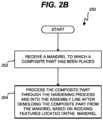
- Step 202 includes receiving a mandrel 110, 110-1 to which a composite part 120, 120-1 has been placed.
- mandrel 110, 110-1 may comprise a contoured layup mandrel onto which the composite part 120, 120-1 has been hardened.
- the mandrel 110, 110-1 may be continuously moved or pulsed in the process direction during fabrication and/or assembly of the composite part 120, 120-1, or may remain stationary after removal from an autoclave.
- Receiving the mandrel 110, 110-1 comprises the mandrel 110, 110-1 being placed at a location where it may be indexed by the mandrel work station 130, 130-1, through 130-8.
- the mandrel work station 130, 130-1, through 130-8 indexes 119, 119-1 to the mandrel 110, 110-1. This may be performed by placing indexing key 136 into one or more of the mandrel indexing features 114, B114 at the mandrel 110, 110-1, in order to precisely enforce a positional relationship/offset between the mandrel 110, 110 and the mandrel work station 130, 130-1, through 130-8.
- the mandrel work station 130, 130-6, 130-8 may be operated to install the indexing features 126, B126 as desired.
- the mandrel 110, 110-1 includes recesses or holes that facilitate cutting through the composite part 120. These recesses may be filled in with potting compound.
- the potting compound permits a smooth tooling surface for layup and curing, while also allowing tooling to cut through the inner mold line of the composite part 120 and the outer mold line/tooling surface of the mandrel 110.
- index contour features 125 on mandrel 110 are recesses, indents, dimple, bumps or ridges that are filled with resin and reinforcing fibers or otherwise shapes resin and reinforcing fibers, respectively, thus imparting a indexing feature 126-8, B126-8 into manufacturing excess 122-1, 122-9, 128 prior to hardening which is made permanent by the hardening process.
- the mandrel work station 130, 130-6, 130-8 is operated to install part indexing feature 126, B126 into a manufacturing excess 122-1, 128 of the composite part 120.
- the indexing feature 126, B126 is offset from the mandrel indexing feature 114 at the mandrel 110.
- Installing the indexing feature 126, B126 may comprise cutting, drilling, or otherwise removing and/or adding material from or onto the composite part 120, 120-1.
- installing the indexing feature 126, B126 comprises milling or machining a portion of the composite part 120, 120-1 that was formed during layup. That is, installing the indexing feature 126 comprises machining a layup feature in the composite part 120.
- this comprises adding cup locating features 126-1, B126-1 for a cup and cone arrangement, drill start locations 126-2, B126-2, drill through locations 126-3, B126-3, slots 126-4, B126-4, installed pins 126-5, B126-5, RFID tags 126-6, B126-6 and bar codes 126-7, B126-7
- installing the indexing feature 126 may comprise the pin installer 327 ( FIG. 3 ) driving the pin 126-5, B126-5 through a hole in the composite part 120, 120-1.
- the mandrel 110 is removed from an autoclave, the separated flash edge 124-1, 124-8 is created from the composite part 120, 120-1 to reveal the bearing edge 123 and edge 129-1.
- Step 206 may be repeated multiple times (e.g., once per mandrel indexing feature 114, B114. Each time the mandrel work station 130, 130-6, 130-8 is progressed relative to mandrel 110, 110-1 from mandrel indexing feature 114, B114 to place multiple indexing features 126, B126 to be installed a manufacturing excess 122-1, 128, 122-9 of the composite part 120, 120-1, respectively.
- the mandrel work station 130, 130-6, 130-8 is progressed in either the process direction 101, 101-9 when progressing from mandrel indexing feature 114, 114-1 through 114-9 and B114, B114-1 through B114-9 to the next mandrel indexing feature 114, 114-1 through 114-9 and B114, B114-1 through B114-9 and installing each successive indexing feature 126, B126 linked to the mandrel indexing feature 114.
- the indexing features 126 are used by work stations 160, 160-1 as the composite part 120, 120-1 advances in the process direction 101, 101-9, respectively.
- step 207 operate the mandrel work stations 130-2 through 130-8 to trim the composite part 120, 120-1 to remove manufacturing excess while composite part 120, 120-1 is still on the mandrel 110, 110-1 using info conveyed by the mandrel 110, 110-1.
- the composite part 120 is demolded from the mandrel 110. This may comprise lifting, flexing, or otherwise separating the composite part 120, 120-1 from the mandrel 110, 110-1.
- the composite part 120, 120-1 then proceeds to an assembly line 102, 102-1 for further fabrication and assembly, while the mandrel 110, 110-1 returns for cleaning, reconditioning and receiving another preform 189, 189-1for a composite part 120, 120-1.
- the mandrel 110 is also reworked (e.g., refilled with potting material, repaired, etc.) and transported to a layup start location.
- the composite part 120, 120-1 is placed on track 144, 144-1 for transport to a downstream work station 160, 160-1.
- the track 144, 144-1 may include rails or stanchions at desired position in order to enforce a desired curvature/contour (e.g., shape and loft) onto the composite part 120, 120-1.
- the track 144 may include rails or stanchions at a position to carry bearing edge 123 in order to enforce a desired curvature/contour (e.g., shape and loft) onto the composite part 120, in particular half barrel section 113.
- the method then continues, for example, the composite part 120, 120-1 is indexed to work station 160, 160-1 or shuttle, in particular with wing panel 113-1, in an assembly line 102, 102-1 via the indexing features 126, B126, and work may be performed on the composite part 120, 120-1 by one or more of the work stations 160, 160-1 at the same time while the composite part 120, 120-1 is indexed to the one or more work stations 160, 160-1.
- step 210 the composite part 120, 120-1 is advanced in the process direction 101, 101-9, for example by operating a drive system at the track 144, 144-1, or by pulling the composite part 120, 120-1 along the track 144, 144-1.
- This may be performed in a micro pulsed, pulsed or continuous fashion, after demolding from mandrel 110, 110-1.
- the composite part 120, 120-1 is indexed to the downstream work station 160, 160-1 (or any work station, or multiple work stations at the same time, including an upstream or adjacent work station) via the indexing features 126, B126 installed onto the composite part 120, 120-1.
- the downstream work station 160, 160-1 may couple with (e.g., buck into) the indexing features 126, B126 to determine the positions of the indexing features 126, B126.
- the downstream work station 160, 160-1 may then adjust its position based on the positions of the indexing features 126, B126, in order to account for any deviations from an expected position/orientation.
- each downstream work station 160, 160-1 is dependent on the requirements of location accuracy used for the alignment and placement of a component being installed.
- Method 200 provides a technical benefit over prior techniques and systems, because it enables indexing features to be applied to a composite part 120, 120-1 while it is still coupled with and taking advantage of precisely fabricated composite part 120, 120-1 and the precisely located and shaped mandrel 110, 110-1.
- indexing features 126, B126 are added to the composite part 120, 120-1 without the need to reindex the composite part 120, 120-1, because the precise nature of the mandrel 110, 110-1 is known and leveraged onto the composite part 120, 120-1 prior to demolding from the mandrel 110, 110-1.
- the composite part 120 does not need to be probed, scanned, or otherwise inspected as part of an indexing protocol to each work station 160, 160-1 in order to characterize its structure and/or 3Dconfiguration before the indexing features are installed. That is, the install location of each of those indexing features is precisely known by referencing to an indexing feature that has already been installed at the mandrel.
- the indexing feature also conveys precise 3D configuration characterization about the composite structure within the purview 115, 115-1 of each work station 160, 160-1, respectively.
- mandrels 110, 110-1 are utilized to fashion multiple composite parts 120, 120-1, respectively, there is little additional labor and time involved in applying mandrel indexing features 114, B114 to the mandrels 110, 110-1 that guide the installation of indexing features 126, B126 for composite parts 120, 120-1.
- the mandrels 110, 110-1 are fabricated as an initial process prior to composite fabrication.
- manufacturing excess 122-1, 128, 122-9 is retained at the composite part 120, 120-1, it communicates its fabrication instructions to each subsequent work station 160, 160-1 as well as 3D configuration characterization of the structure, such as inner mold line contour and/or outer mold line contour, within the purview of 115, 115-1 or each work station 160, 160-1.
- FIG. 2B is a flowchart illustrating a method 250 for processing composite parts 120, 120-1 in an illustrative embodiment.
- Step 252 includes receiving a mandrel 110, 110-1 to which composite part 120, 120-1 has been placed, and may be performed in a similar manner to step 202 above.
- Step 254 comprises processing the composite part 120, 120-1 through the hardening process and into the assembly line 102, 102-1 after demolding the composite part 120, 120-1 from the mandrel 110, 110-1 based on mandrel indexing features 114, B114 located on the mandrel 110, 110-1.. This may comprise installing indexing features 126, B126 into the composite part 120, 120-1, trimming the composite part 120, 120-1, or performing any suitable actions while the composite part remains molded to the mandrel.
- FIG. 12 is a side view of a variety of indexing features 126, B126 installed at a composite part 800 in an illustrative embodiment. Any one or combination of these indexing features 126, B126 may be implemented at a given composite part (e.g., a half barrel fuselage section). Indexing features 126, B126 may be placed in a manufacturing excess 802, and these indexing features 126, B126 are installed during the post cure process, prior to demolding. Eventually, when the manufacturing excess 802 is no longer needed for indexing, the manufacturing excess 802 is trimmed off (e.g., before the half barrel fuselage section is fastened to another half barrel section to form a full barrel section wherein the lower half barrel section is joined to the upper half barrel section). FIGS.
- FIG. 4 is a cross sectional view of composite part 120 and cup 410, which is a type of locating feature 126, but could also apply to composite part 120-1 with indexing feature B126.
- the cup 410 is a receiver for a cone 420 coupled to work station 160 and/or work station 160-1 during an index mating of composite part 120, 120-1 to work station 160, 160-1, respectively.
- the cup 410 has a version, as illustrated, forming a passage through composite part 120, 120-1. Another version has the cup 410 not passing entirely through the composite part 120, 120-1.
- the cup 410 and the cone 420 form a tapered female to male connection, respectively, when indexing occurs.
- FIG. 5 is a cross sectional view of a drill start 510, one of the indexing features 126, B126.
- FIG. 5 illustrates a cross sectional view of composite part 120 and drill start 510, which is a type of locating feature 126, but could also apply to composite part 120-1 with indexing feature B126.
- Drill start 510 is a receiver for a mating coupler 520, such as a stubby pin 521.
- the drill start 510 is a non-through hole into the composite part 120, 120-1.
- the drill start 510 and the mating coupler 520 form a female to male connection, respectively, when indexing occurs during an index mating of composite part 120, 120-1 to work station 160, 160-1.
- FIG. 6 is a cross sectional view of a drill through 610, one of the indexing features 126, B126.
- FIG. 6 illustrates a cross sectional view of composite part 120 and drill through 510, which is a type of locating feature 126, but could also apply to composite part 120-1 with indexing feature B126.
- the drill through 610 is a receiver for a pin 620 coupled to work station 160, 160-1 during index mating of composite part 120, 120-1 to work station 160, 160-1.
- the drill through 610 has a version forming a passage through composite part 120, 120-1.
- the drill through 610 and the pin 620 form a female to male connection, respectively, when indexing occurs. Pin 620 fills at least a portion of drill through 610 during indexing mating.
- FIG. 7 is a cross sectional view of slots 126-4, B126-4, one of the indexing features 126, B126.
- the slot 710 corresponds to 126-4, B126-4, is a receiver for a slot engager 720 coupled to work station 160, 160-1 during an index mating of composite part 120, 120-1 to work station 160, 160-1.
- the slots 710 has a version, as illustrated, forming a non-pass through portion of composite part 120, 120-1.
- Another version, not illustrated has a slot passing through composite part 120, 120-1.
- the slot 710 and the slot engager 720 form a female to male connection, respectively, when indexing occurs. Slot engager 720 passes into composite part 120, 120-1 during indexing mating, in one version.
- FIG. 8 is a cross sectional view of a drill through 851 with pin 831 install therein and is one of the indexing features 126, B126.
- FIG. 8 illustrates a cross sectional view of composite part 120 and pin 831, but could also apply to composite part 120-1 with indexing feature B126.
- the pin 831 is a receiver for a pin connector 841 coupled to work station 160, 160-1 during index mating of composite part 120, 120-1 to work station 160, 160-1.
- the pin 831 and the pin connector 841 form a male to female connection, respectively, when indexing occurs.
- Pin 620 fills at least a portion of drill through 610 during indexing mating.
- FIG. 9 is a cross sectional view of a Radio Frequency Identification (RFID) Chip 910 and is one of the indexing features 126, B126.
- RFID Radio Frequency Identification
- FIG. 9 illustrates a cross sectional view of composite part 120 and RFID Chip 910, but could also apply to composite part 120-1 with indexing feature B126.
- the Radio Frequency Identification (RFID) Reader 920 is a receiver for RFID Chip 910 communicated information.
- RFID Reader 920 is coupled to work station 160, 160-1 during index mating of composite part 120, 120-1 to work station 160, 160-1.
- FIG. 10 is a cross sectional view of a Bar Code 1010 and is one of the indexing features 126, B126.
- FIG. 10 illustrates a cross sectional view of composite part 120 and Bar Code 1010, but could also apply to composite part 120-1 with indexing feature B126.
- the Bar Code Reader 1020 is a receiver for Bar Code 1010 communicated information. Bar Code Reader 1020 is coupled to work station 160, 160-1 during index mating of composite part 120, 120-1 to work station 160, 160-1.
- FIG. 11 is a cross sectional view of notch 1110, one of the indexing features 126, B126.
- Notch 1110 of any suitable shape (e.g., trapezoid, square, triangle, vertical hole, etc.) machined out of the bearing edge 123 of the composite part 800, which terminates leaving a backing 1100 as shown in FIG. 11 .
- the notch 1110 is a receiver for a notch engager 1120 coupled to work station 160, 160-1 during an index mating of composite part 120, 120-1 to work station 160, 160-1.
- the notch 1110 has a version, as illustrated, forming a non-pass through portion of composite part 120, 120-1.
- Another version, not illustrated has a notch 1110 passing through composite part 120, 120-1.
- the notch 1110 and the notch engager 1120 form a female to male connection, respectively, when indexing occurs.
- Notch engager 1120 passes into composite part 120, 120-1 during indexing mating, in one version.
- Each of these different indexing features 126, B126 may therefore be utilized to facilitate indexing or other operations at various work stations 160, 160-1.
- some work stations 160, 160-1 may use one type of feature (e.g., blind holes that facilitate placement of a structure relative to the work station 160, 160-1), while other work stations 160, 160-1 may use another type of features (e.g., pins that facilitate gripping of the part).
- the potential to use male features (e.g., pins) and/or female features (e.g., holes) means that low-profile work stations 160, 160-1 (e.g., NDI inspection stations) can interact with female indexing features 126, B126 of a composite part 120, 120-1 without encountering physical interference, These are all examples of some of the many geometries that could be implemented in order to achieve indexing fits in desired fashions. Still further, the shapes of indexing features 126, B126 (and/or corresponding receptacles at work stations 160, 160-1) may be shaped to constrain the composite part 120, 120-1 to a desired position, without over-constraining the composite part 120, 120-1.
- a slot 710 is an example of an indexing feature 126
- B126 may constrain vertical motion while enabling motion in the process direction 101, 101-9
- a pin, notch, slot or hole may constrain motion in both the process direction 101, 101-9 as well as vertically.
- the features described herein may be installed into any suitable portions of the composite part 120, 120-1 (e.g., a door cut-out region or window cut-out region), or indexing features 126, B126 may even be applied to composite parts 120, 120-1 during layup, by placing pins, bladders, or other tools onto a laminate for the composite part 120, 120-1 before the laminate is hardened.
- suitable portions of the composite part 120, 120-1 e.g., a door cut-out region or window cut-out region
- indexing features 126, B126 may even be applied to composite parts 120, 120-1 during layup, by placing pins, bladders, or other tools onto a laminate for the composite part 120, 120-1 before the laminate is hardened.
- FIGS. 13-14 are views of a downstream work station 1400 that indexes 119, 119-1 to indexing features 1432 installed onto a composite part 1430 in an illustrative embodiment.
- Indexing features 1432 and composite part 1430 correspond to indexing features 126, B126 and composite part 120, 120-1, respectively.
- receptacles 1420 at a frame 1410 of the work station 1400 receive indexing features 1432 in the form of pins 1433 cantilevered out from composite part 1430.
- Each pin 1433 is engaged and/or engaged by a receptacle 1420 and indexes 119, 119-1 and/or places the composite part 1430 in a desired position along the process direction 101, 101-9.
- FIG. 14 which corresponds with view arrows 15 of FIG. 13 , the half-barrel shape of the composite part 1430 is clearly visible. Furthermore, the indexing features 1432 (i.e., pins) are more clearly visible within receptacles 1420.
- method 1600 may include specification and design 1604 of the aircraft 1602 and material procurement 1606.
- component and subassembly manufacturing 1608 and system integration 1610 of the aircraft 1602 takes place.
- the aircraft 1602 may go through certification and delivery 1612 in order to be placed in service 1614.
- the aircraft 1602 is scheduled for routine work in maintenance and service 1616 (which may also include modification, reconfiguration, refurbishment, and so on).
- Apparatus and methods embodied herein may be employed during any one or more suitable stages of the production and service described in method 1600 (e.g., specification and design 1604, material procurement 1606, component and subassembly manufacturing 1608, system integration 1610, certification and delivery 1612, service 1614, maintenance and service 1616) and/or any suitable component of aircraft 1602 (e.g., airframe 1618, systems 1620, interior 1622, propulsion system 1624, electrical system 1626, hydraulic system 1628, environmental 1630).
- any suitable component of aircraft 1602 e.g., airframe 1618, systems 1620, interior 1622, propulsion system 1624, electrical system 1626, hydraulic system 1628, environmental 1630.
- a system integrator may include without limitation any number of aircraft manufacturers and major-system subcontractors; a third party may include without limitation any number of vendors, subcontractors, and suppliers; and an operator may be an airline, leasing company, military entity, service organization, and so on.
- the aircraft 1602 produced by method 1600 may include an airframe 1618 with a plurality of systems 1620 and an interior 1622.
- systems 1620 include one or more of a propulsion system 1624, an electrical system 1626, a hydraulic system 1628, and an environmental system 1630. Any number of other systems may be included.
- an aerospace example is shown, the principles of the invention may be applied to other industries, such as the automotive industry.
- apparatus and methods embodied herein may be employed during any one or more of the stages of the production and service described in method 1600.
- components or subassemblies corresponding to component and subassembly manufacturing 1608 may be fabricated or manufactured in a manner similar to components or subassemblies produced while the aircraft 1602 is in service.
- one or more apparatus embodiments, method embodiments, or a combination thereof may be utilized during the subassembly manufacturing 1608 and system integration 1610, for example, by substantially expediting assembly of or reducing the cost of an aircraft 1602.
- one or more of apparatus embodiments, method embodiments, or a combination thereof may be utilized while the aircraft 1602 is in service, for example and without limitation during the maintenance and service 1616.
- the invention may be used in any stages discussed herein, or any combination thereof, such as specification and design 1604, material procurement 1606, component and subassembly manufacturing 1608, system integration 1610, certification and delivery 1612, service 1614, maintenance and service 1616) and/or any suitable component of aircraft 1602 (e.g., airframe 1618, systems 1620, interior 1622, propulsion system 1624, electrical system 1626, hydraulic system 1628, and/or environmental 1630.
- any suitable component of aircraft 1602 e.g., airframe 1618, systems 1620, interior 1622, propulsion system 1624, electrical system 1626, hydraulic system 1628, and/or environmental 1630.
- a part comprises a portion of airframe 1618, and is manufactured during component and subassembly manufacturing 1608.
- the part may then be assembled into an aircraft in system integration 1610, and then be utilized in service 1614 until wear renders the part unusable. Then, in maintenance and service 1616, the part may be discarded and replaced with a newly manufactured part.
- Inventive components and methods may be utilized throughout component and subassembly manufacturing 1608 in order to manufacture new parts.
- control elements e.g., electrical or electronic components
- a processor implementing software
- a processor implementing firmware or some combination of these.
- an element may be implemented as dedicated hardware.
- Dedicated hardware elements may be referred to as "processors", “controllers”, or some similar terminology.
- the functions may be provided by a single dedicated processor, by a single shared processor, or by a plurality of individual processors, some of which may be shared.
- processor or “controller” should not be construed to refer exclusively to hardware capable of executing software, and may implicitly include, without limitation, digital signal processor (DSP) hardware, a network processor, application specific integrated circuit (ASIC) or other circuitry, field programmable gate array (FPGA), read only memory (ROM) for storing software, random access memory (RAM), non-volatile storage, logic, or some other physical hardware component or module.
- DSP digital signal processor
- ASIC application specific integrated circuit
- FPGA field programmable gate array
- ROM read only memory
- RAM random access memory
- non-volatile storage logic, or some other physical hardware component or module.
- a control element may be implemented as instructions executable by a processor or a computer to perform the functions of the element.
- instructions are software, program code, and firmware.
- the instructions are operational when executed by the processor to direct the processor to perform the functions of the element.
- the instructions may be stored on storage devices that are readable by the processor. Some examples of the storage devices are digital or solid-state memories, magnetic storage media such as a magnetic disks and magnetic tapes, hard drives, or optically readable digital data storage media.
Landscapes
- Chemical & Material Sciences (AREA)
- Engineering & Computer Science (AREA)
- Composite Materials (AREA)
- Mechanical Engineering (AREA)
- Physics & Mathematics (AREA)
- Thermal Sciences (AREA)
- Moulding By Coating Moulds (AREA)
- Processing And Handling Of Plastics And Other Materials For Molding In General (AREA)
Claims (15)
- Verfahren zum Vorbereiten eines Verbundteils für die Montage, das Verfahren umfassend:- Platzieren eines Vorformlings (189, 189-1) mit einem Fertigungsüberschuss (122, 122-9) auf einem Dorn (110, 110-1);- Aushärten des Vorformlings (189, 189-1) zu einem Verbundteil (120, 120-1) mit einem ausgehärteten Fertigungsüberschuss (122, 122-9), während es sich noch auf dem Dorn (110, 110-1) ist; und- Bedienen einer Dornarbeitsstation (130 bis einschließlich 130-8), um ein Indexierungsmerkmal (126, B126) in den Fertigungsüberschuss (122, 122-9) des Verbundteils (120, 120-1) vor dem Aushärten und/oder nach dem Aushärten vor dem Entformen des Verbundteils (120, 120-1) von dem Dorn (110, 110-1) einzubauen.
- Verfahren nach Anspruch 1, ferner umfassend:- Entformen des Verbundteils (120, 120-1) von dem Dorn (110, 110-1);- Vorschieben des Verbundteils (120, 120-1) in eine Prozessrichtung (101, 101-9); und- Indexieren des Verbundteils (120, 120-1) zu einer nachgelagerten Arbeitsstation (160, 160-1) über das Indexierungsmerkmal (126, B126), das in dem Verbundteil (120, 120-1) eingebaut ist.
- Verfahren nach Anspruch 1 oder 2, ferner umfassend das Indexieren (119, 119-1) der Dornarbeitsstation (130 bis einschließlich 130-8) gegen ein Dornindexierungsmerkmal (114, B114) an dem Dorn (110, 110-1), vorzugsweise umfassend ein Einführen eines komplementären Schlüssels (310) der Dornarbeitsstation (130 bis einschließlich 130-8) in eine entsprechende Schlüsselnut (312) an dem Dorn (110, 110-1).
- Verfahren nach einem der Ansprüche 1 bis 3, wobei das Indexierungsmerkmal (126, B126), das in den Fertigungsüberschuss (122, 122-9) des Verbundteils (120, 120-1) eingebaut ist, von einem Dornindexierungsmerkmal (114, B114) versetzt ist.
- Verfahren nach einem der Ansprüche 1 bis 4, wobei:die Dornarbeitsstation (130 bis einschließlich 130-8) einer Nut (352) an dem Dorn (110, 110-1) folgt, und/oderdie Dornarbeitsstation (130 bis einschließlich 130-8) einer Bahn (354) an dem Dorn (110, 110-1) folgt.
- Verfahren nach einem der Ansprüche 1 bis 5, wobei das Bedienen der Dornarbeitsstation (130 bis einschließlich 130-8), um das Indexierungsmerkmal (126 bis einschließlich 126-8, B126 bis einschließlich B126-8) einzubauen, umfasst:subtraktive Fertigung unter Verwendung von Bohren, Fräsen oder Trimmen oder durch additive Fertigung wie das Hinzufügen von Stiften (126-5, B126-5), das Hinzufügen von RFID-Tags (126-6, B126-6) oder das Hinzufügen von Strichcodes (126-7, B126-7) und/oderEinbauen mehrerer Typen von Indexierungsmerkmalen (126 bis einschließlich 126-9, B126 bis einschließlich B126-9), wobei unterschiedliche Typen von Indexierungsmerkmalen (126 bis einschließlich 126-9, B126 bis einschließlich B126-9) durch unterschiedliche nachgelagerten Arbeitsstationen (160, 160-1) verwendet werden.
- System zum Herstellen eines Verbundteils (120, 120-1) für die Montage, das System umfassend:- einen Dorn (110, 110-1), der umfasst:- eine Auflagefläche für das Verbundteil (120, 120-1); und- Dorn(110, 110-1)-Indexierungsmerkmale (126, B126), die an dem Dorn (110, 110-1) angeordnet sind; und- eine Dornarbeitsstation (130 bis einschließlich 130-8), die auf die Dornindexierungsmerkmale (126, B126) indexiert (119, 119-1) und die ein Indexierungsmerkmal (126, B126) auf dem Verbundteil (120, 120-1) einbaut, das von dem Dornindexierungsmerkmal (114, B114) versetzt ist,
wobei eine nachgeschaltete Arbeitsstation (160, 160-1) das Verbundteil (120, 120-1) empfängt, nachdem das Verbundteil (120, 120-1) von dem Dorn (110, 110-1) entformt wurde, vorzugsweise wobei die nachgeschaltete Arbeitsstation (160, 160-1) gegen das Indexierungsmerkmal (126, B126) indexiert (119, 119-1). - System nach Anspruch 7, wobei ein komplementärer Schlüssel (310) der Dornarbeitsstation (130 bis einschließlich 130-8) in eine entsprechende Schlüsselnut (312) an dem Dorn (110, 110-1) eingesetzt wird, um die Dornarbeitsstation (130 bis einschließlich 130-8) gegen das Dornindexierungsmerkmal (114, B114) zu indexieren.
- Vorrichtung zum Formen von Verbundteilen, die Vorrichtung umfassend:- einen Dorn (110, 110-1), der eine Kontur für ein Verbundteil (120, 120-1) definiert, der Dorn (110, 110-1) umfassend:- vergossene Vertiefungen (322), die in einer Auflegeregion (111, 111-1) für das Verbundteil (120, 120-1), unterhalb von Stellen, die eine Auflegeregion (111, 111-1) für einen Fertigungsüberschuss (122, 122-9) des Verbundteils (120, 120-1) bereitstellen, angeordnet sind; und- ein Indexkonturmerkmal, das innerhalb der Auflegeregion (111, 111-1) angeordnet ist,
wobei:der Dorn (110, 110-1) ferner Schlüsselnuten (312) umfasst, die über der Auflegeregion (111, 111-1) angeordnet sind, und/oderder Dorn (110, 110-1) ferner Rillen (352) umfasst, die über der Auflegeregion (111, 111-1) angeordnet sind, die eine Dornarbeitsstation (130 bis einschließlich 130-8) führen. - System zum Herstellen eines Verbundteils (120, 120-1) für die Montage, das System umfassend:- einen Dorn (110, 110-1), der eine Auflegeregion (111, 111-1) für das Verbundteil (120, 120-1) umfasst;- ein Verbundteil (120, 120-1), das auf der Auflegeregion (111, 111-1) platziert ist; und- Dorn(110, 110-1)-Indexierungsmerkmale (126, B126), die an dem Dorn (110, 110-1) angeordnet sind,
wobei:der Dorn (110, 110-1) weist ferner Keilnuten (312) umfasst, die über der Auflegeregion (111, 111-1) angeordnet sind, und/oderder Dorn (110, 110-1) ferner Rillen (352) umfasst, die über der Auflegeregion (111, 111-1) angeordnet sind, die eine Dornarbeitsstation (130 bis einschließlich 130-8) führen. - System nach Anspruch 10, ferner umfassend eine Dornarbeitsstation (130 bis einschließlich 130-8), die gegen die Dorn(110, 110-1)-Indexierungsmerkmale (126, B126) indexiert (119, 119-1), optional wobei die Dornarbeitsstation (130 bis einschließlich 130-8) ein Indexierungsmerkmal (126, B126) auf dem Verbundteil (120, 120-1) einbaut, das von dem Dornindexierungsmerkmal (114, B114) versetzt ist.
- Indexierungsmerkmal-Einbauwerkzeug, umfassend:- eine Dornarbeitsstation (130 bis einschließlich 130-8);- einen Merkmalserzeuger (132), der mit der Dornarbeitsstation (130 bis einschließlich 130-8) gekoppelt ist; und- wobei die Dornarbeitsstation (130 bis einschließlich 130-8) mit einem Dorn (110, 110-1) gekoppelt ist,
wobei:die Dornarbeitsstation (130 bis einschließlich 130-8) mit dem Dorn (110, 110-1) durch eine Nut (352) in dem Dorn (110, 110-1) gekoppelt ist, und/oderdie Dornarbeitsstation (130 bis einschließlich 130-8) mit dem Dorn (110, 110-1) durch eine Bahn (354) auf dem Dorn (110, 110-1) gekoppelt ist. - das Indexierungsmerkmal-Einbauwerkzeug nach Anspruch 12, ferner umfassend einen Transmitter 134-1, der mit der Dornarbeitsstation (130 bis einschließlich 130-8) gekoppelt ist, und/oder
wobei die Dornarbeitsstation (130 bis einschließlich 130-8) eine Steuerung (150) umfasst. - Indexierungsmerkmal-Einbauwerkzeug nach Anspruch 12 oder 13, ferner umfassend einen Indexierungsschlüssel (136), der mit der Dornarbeitsstation (130 bis einschließlich 130-8) gekoppelt ist, vorzugsweise wobei der Indexierungsschlüssel (136) einen komplementären Schlüssel (310) umfasst, und ferner vorzugsweise wobei der komplementäre Schlüssel (310) konfiguriert ist, um mit einem Dornindexierungsmerkmal (114, B114) komplementär zusammenzupassen.
- Indexierungsmerkmal-Einbauwerkzeug nach einem der Ansprüche 12 bis 14, wobei:- die Dornarbeitsstation (130 bis einschließlich 130-8) relativ zu dem Fertigungsüberschuss (122, 122-9) transportierbar ist, durch gleitendes Eingreifen in die Nut (352), vorzugsweise über ein Rollensystem (350-1), und/oder- die Dornarbeitsstation (130 bis einschließlich 130-8) relativ zu dem Fertigungsüberschuss (122, 122-9) transportierbar ist, durch gleitendes Eingreifen in die Bahn (354), vorzugsweise über ein Rollensystem (350-1).
Priority Applications (1)
| Application Number | Priority Date | Filing Date | Title |
|---|---|---|---|
| EP24203563.2A EP4464491B1 (de) | 2020-11-18 | 2021-11-10 | Installation von indexierungsmerkmalen auf verbundteilen |
Applications Claiming Priority (2)
| Application Number | Priority Date | Filing Date | Title |
|---|---|---|---|
| US202063115061P | 2020-11-18 | 2020-11-18 | |
| NL2027423A NL2027423B1 (en) | 2021-01-26 | 2021-01-26 | Installation of indexing features onto composite parts |
Related Child Applications (1)
| Application Number | Title | Priority Date | Filing Date |
|---|---|---|---|
| EP24203563.2A Division EP4464491B1 (de) | 2020-11-18 | 2021-11-10 | Installation von indexierungsmerkmalen auf verbundteilen |
Publications (2)
| Publication Number | Publication Date |
|---|---|
| EP4008536A1 EP4008536A1 (de) | 2022-06-08 |
| EP4008536B1 true EP4008536B1 (de) | 2024-10-23 |
Family
ID=78414602
Family Applications (2)
| Application Number | Title | Priority Date | Filing Date |
|---|---|---|---|
| EP24203563.2A Active EP4464491B1 (de) | 2020-11-18 | 2021-11-10 | Installation von indexierungsmerkmalen auf verbundteilen |
| EP21207586.5A Active EP4008536B1 (de) | 2020-11-18 | 2021-11-10 | Installation von indexierungsmerkmalen auf verbundteilen |
Family Applications Before (1)
| Application Number | Title | Priority Date | Filing Date |
|---|---|---|---|
| EP24203563.2A Active EP4464491B1 (de) | 2020-11-18 | 2021-11-10 | Installation von indexierungsmerkmalen auf verbundteilen |
Country Status (1)
| Country | Link |
|---|---|
| EP (2) | EP4464491B1 (de) |
Family Cites Families (3)
| Publication number | Priority date | Publication date | Assignee | Title |
|---|---|---|---|---|
| US7141191B2 (en) * | 2003-05-02 | 2006-11-28 | The Boeing Company | Triple purpose lay-up tool |
| DE102013018148B4 (de) | 2013-12-04 | 2015-07-30 | Premium Aerotec Gmbh | Verfahren zur Herstellung eines Faserverbundbauteils, sowie hierfür verwendbare Halbzeuganordnung |
| EP3034284A1 (de) | 2014-12-16 | 2016-06-22 | Airbus Operations S.L. | Verfahren und System zur Herstellung eines geformten CFRP-Teils |
-
2021
- 2021-11-10 EP EP24203563.2A patent/EP4464491B1/de active Active
- 2021-11-10 EP EP21207586.5A patent/EP4008536B1/de active Active
Also Published As
| Publication number | Publication date |
|---|---|
| EP4008536A1 (de) | 2022-06-08 |
| EP4464491A3 (de) | 2025-03-05 |
| EP4464491A2 (de) | 2024-11-20 |
| EP4464491B1 (de) | 2026-05-20 |
Similar Documents
| Publication | Publication Date | Title |
|---|---|---|
| US11807395B2 (en) | Assembly line fabrication and assembly of aircraft wings | |
| US12509247B2 (en) | Indexing for airframes undergoing pulsed-line assembly | |
| US12304660B2 (en) | Contour enforcement for line assembled fuselage segments | |
| US12187457B2 (en) | Assembly line fabrication and assembly of aircraft wings | |
| US12246852B2 (en) | Frame installation station for aircraft fuselage segments | |
| US11643224B2 (en) | Assembly line fabrication and assembly of aircraft wings | |
| US11753184B2 (en) | Assembly line fabrication and assembly of aircraft wings | |
| EP4008536A1 (de) | Installation von indexierungsmerkmalen auf verbundteilen | |
| US11639038B2 (en) | Installation of indexing features onto composite parts | |
| NL2027423B1 (en) | Installation of indexing features onto composite parts | |
| EP4000902A1 (de) | Indexierung für flugzeugzellen, die eine pulsbandmontage durchlaufen | |
| EP4000899A1 (de) | Verfahren und system zum tragen von paneelen von flugzeugflügeln | |
| EP4001126A1 (de) | Fliessbandfertigung und montage von flugzeugflügeln | |
| EP4001100A1 (de) | Verfahren und system zum zusammenbau eines flugzeugflügels mit ausgleichsscheiben | |
| EP4000900B1 (de) | Verfahren und vorrichtung zum anbringen von indexiermerkmale in ein verbundbauteil | |
| CN114535689A (zh) | 用于航空器的移动流水线制造的切边 | |
| US12296984B2 (en) | Assembly line fabrication and assembly of aircraft wings | |
| NL2027416B1 (en) | Indexing for airframes undergoing pulsed line assembly | |
| NL2027393B1 (en) | Assembly line fabrication and assembly of aircraft wings | |
| NL2027392B1 (en) | Assembly line fabrication and assembly of aircraft wings | |
| NL2027387B1 (en) | Assembly line fabrication and assembly of aircraft wings | |
| EP4001098A1 (de) | Fliessbandfertigung und montage von flugzeugflügeln | |
| US20250058489A1 (en) | Cut-Out Processes for Moving-Line Structure Assembly | |
| NL2027421B1 (en) | Assembly line fabrication and assembly of aircraft wings | |
| EP4001097A1 (de) | Fliessbandfertigung und montage von flugzeugflügeln |
Legal Events
| Date | Code | Title | Description |
|---|---|---|---|
| PUAI | Public reference made under article 153(3) epc to a published international application that has entered the european phase |
Free format text: ORIGINAL CODE: 0009012 |
|
| STAA | Information on the status of an ep patent application or granted ep patent |
Free format text: STATUS: THE APPLICATION HAS BEEN PUBLISHED |
|
| AK | Designated contracting states |
Kind code of ref document: A1 Designated state(s): AL AT BE BG CH CY CZ DE DK EE ES FI FR GB GR HR HU IE IS IT LI LT LU LV MC MK MT NL NO PL PT RO RS SE SI SK SM TR |
|
| STAA | Information on the status of an ep patent application or granted ep patent |
Free format text: STATUS: REQUEST FOR EXAMINATION WAS MADE |
|
| 17P | Request for examination filed |
Effective date: 20221103 |
|
| RBV | Designated contracting states (corrected) |
Designated state(s): AL AT BE BG CH CY CZ DE DK EE ES FI FR GB GR HR HU IE IS IT LI LT LU LV MC MK MT NL NO PL PT RO RS SE SI SK SM TR |
|
| RAP3 | Party data changed (applicant data changed or rights of an application transferred) |
Owner name: THE BOEING COMPANY |
|
| GRAP | Despatch of communication of intention to grant a patent |
Free format text: ORIGINAL CODE: EPIDOSNIGR1 |
|
| RIC1 | Information provided on ipc code assigned before grant |
Ipc: B29C 37/02 20060101ALI20240506BHEP Ipc: B29C 70/54 20060101ALI20240506BHEP Ipc: B29C 70/86 20060101AFI20240506BHEP |
|
| STAA | Information on the status of an ep patent application or granted ep patent |
Free format text: STATUS: GRANT OF PATENT IS INTENDED |
|
| INTG | Intention to grant announced |
Effective date: 20240613 |
|
| GRAS | Grant fee paid |
Free format text: ORIGINAL CODE: EPIDOSNIGR3 |
|
| GRAA | (expected) grant |
Free format text: ORIGINAL CODE: 0009210 |
|
| STAA | Information on the status of an ep patent application or granted ep patent |
Free format text: STATUS: THE PATENT HAS BEEN GRANTED |
|
| AK | Designated contracting states |
Kind code of ref document: B1 Designated state(s): AL AT BE BG CH CY CZ DE DK EE ES FI FR GB GR HR HU IE IS IT LI LT LU LV MC MK MT NL NO PL PT RO RS SE SI SK SM TR |
|
| REG | Reference to a national code |
Ref country code: GB Ref legal event code: FG4D |
|
| REG | Reference to a national code |
Ref country code: CH Ref legal event code: EP |
|
| P01 | Opt-out of the competence of the unified patent court (upc) registered |
Free format text: CASE NUMBER: APP_53859/2024 Effective date: 20240930 |
|
| REG | Reference to a national code |
Ref country code: DE Ref legal event code: R096 Ref document number: 602021020590 Country of ref document: DE |
|
| REG | Reference to a national code |
Ref country code: IE Ref legal event code: FG4D |
|
| REG | Reference to a national code |
Ref country code: LT Ref legal event code: MG9D |
|
| REG | Reference to a national code |
Ref country code: NL Ref legal event code: MP Effective date: 20241023 |
|
| REG | Reference to a national code |
Ref country code: AT Ref legal event code: MK05 Ref document number: 1734513 Country of ref document: AT Kind code of ref document: T Effective date: 20241023 |
|
| PG25 | Lapsed in a contracting state [announced via postgrant information from national office to epo] |
Ref country code: NL Free format text: LAPSE BECAUSE OF FAILURE TO SUBMIT A TRANSLATION OF THE DESCRIPTION OR TO PAY THE FEE WITHIN THE PRESCRIBED TIME-LIMIT Effective date: 20241023 |
|
| PG25 | Lapsed in a contracting state [announced via postgrant information from national office to epo] |
Ref country code: NL Free format text: LAPSE BECAUSE OF FAILURE TO SUBMIT A TRANSLATION OF THE DESCRIPTION OR TO PAY THE FEE WITHIN THE PRESCRIBED TIME-LIMIT Effective date: 20241023 |
|
| PG25 | Lapsed in a contracting state [announced via postgrant information from national office to epo] |
Ref country code: PT Free format text: LAPSE BECAUSE OF FAILURE TO SUBMIT A TRANSLATION OF THE DESCRIPTION OR TO PAY THE FEE WITHIN THE PRESCRIBED TIME-LIMIT Effective date: 20250224 Ref country code: IS Free format text: LAPSE BECAUSE OF FAILURE TO SUBMIT A TRANSLATION OF THE DESCRIPTION OR TO PAY THE FEE WITHIN THE PRESCRIBED TIME-LIMIT Effective date: 20250223 Ref country code: HR Free format text: LAPSE BECAUSE OF FAILURE TO SUBMIT A TRANSLATION OF THE DESCRIPTION OR TO PAY THE FEE WITHIN THE PRESCRIBED TIME-LIMIT Effective date: 20241023 |
|
| PG25 | Lapsed in a contracting state [announced via postgrant information from national office to epo] |
Ref country code: FI Free format text: LAPSE BECAUSE OF FAILURE TO SUBMIT A TRANSLATION OF THE DESCRIPTION OR TO PAY THE FEE WITHIN THE PRESCRIBED TIME-LIMIT Effective date: 20241023 |
|
| PG25 | Lapsed in a contracting state [announced via postgrant information from national office to epo] |
Ref country code: BG Free format text: LAPSE BECAUSE OF FAILURE TO SUBMIT A TRANSLATION OF THE DESCRIPTION OR TO PAY THE FEE WITHIN THE PRESCRIBED TIME-LIMIT Effective date: 20241023 |
|
| PG25 | Lapsed in a contracting state [announced via postgrant information from national office to epo] |
Ref country code: ES Free format text: LAPSE BECAUSE OF FAILURE TO SUBMIT A TRANSLATION OF THE DESCRIPTION OR TO PAY THE FEE WITHIN THE PRESCRIBED TIME-LIMIT Effective date: 20241023 |
|
| PG25 | Lapsed in a contracting state [announced via postgrant information from national office to epo] |
Ref country code: NO Free format text: LAPSE BECAUSE OF FAILURE TO SUBMIT A TRANSLATION OF THE DESCRIPTION OR TO PAY THE FEE WITHIN THE PRESCRIBED TIME-LIMIT Effective date: 20250123 |
|
| PG25 | Lapsed in a contracting state [announced via postgrant information from national office to epo] |
Ref country code: LV Free format text: LAPSE BECAUSE OF FAILURE TO SUBMIT A TRANSLATION OF THE DESCRIPTION OR TO PAY THE FEE WITHIN THE PRESCRIBED TIME-LIMIT Effective date: 20241023 Ref country code: AT Free format text: LAPSE BECAUSE OF FAILURE TO SUBMIT A TRANSLATION OF THE DESCRIPTION OR TO PAY THE FEE WITHIN THE PRESCRIBED TIME-LIMIT Effective date: 20241023 Ref country code: GR Free format text: LAPSE BECAUSE OF FAILURE TO SUBMIT A TRANSLATION OF THE DESCRIPTION OR TO PAY THE FEE WITHIN THE PRESCRIBED TIME-LIMIT Effective date: 20250124 |
|
| PG25 | Lapsed in a contracting state [announced via postgrant information from national office to epo] |
Ref country code: PL Free format text: LAPSE BECAUSE OF FAILURE TO SUBMIT A TRANSLATION OF THE DESCRIPTION OR TO PAY THE FEE WITHIN THE PRESCRIBED TIME-LIMIT Effective date: 20241023 |
|
| PG25 | Lapsed in a contracting state [announced via postgrant information from national office to epo] |
Ref country code: RS Free format text: LAPSE BECAUSE OF FAILURE TO SUBMIT A TRANSLATION OF THE DESCRIPTION OR TO PAY THE FEE WITHIN THE PRESCRIBED TIME-LIMIT Effective date: 20250123 |
|
| REG | Reference to a national code |
Ref country code: CH Ref legal event code: PL |
|
| PG25 | Lapsed in a contracting state [announced via postgrant information from national office to epo] |
Ref country code: SM Free format text: LAPSE BECAUSE OF FAILURE TO SUBMIT A TRANSLATION OF THE DESCRIPTION OR TO PAY THE FEE WITHIN THE PRESCRIBED TIME-LIMIT Effective date: 20241023 |
|
| PG25 | Lapsed in a contracting state [announced via postgrant information from national office to epo] |
Ref country code: MC Free format text: LAPSE BECAUSE OF FAILURE TO SUBMIT A TRANSLATION OF THE DESCRIPTION OR TO PAY THE FEE WITHIN THE PRESCRIBED TIME-LIMIT Effective date: 20241023 |
|
| PG25 | Lapsed in a contracting state [announced via postgrant information from national office to epo] |
Ref country code: DK Free format text: LAPSE BECAUSE OF FAILURE TO SUBMIT A TRANSLATION OF THE DESCRIPTION OR TO PAY THE FEE WITHIN THE PRESCRIBED TIME-LIMIT Effective date: 20241023 |
|
| PG25 | Lapsed in a contracting state [announced via postgrant information from national office to epo] |
Ref country code: LU Free format text: LAPSE BECAUSE OF NON-PAYMENT OF DUE FEES Effective date: 20241110 |
|
| REG | Reference to a national code |
Ref country code: CH Ref legal event code: PL |
|
| PG25 | Lapsed in a contracting state [announced via postgrant information from national office to epo] |
Ref country code: EE Free format text: LAPSE BECAUSE OF FAILURE TO SUBMIT A TRANSLATION OF THE DESCRIPTION OR TO PAY THE FEE WITHIN THE PRESCRIBED TIME-LIMIT Effective date: 20241023 |
|
| PG25 | Lapsed in a contracting state [announced via postgrant information from national office to epo] |
Ref country code: CH Free format text: LAPSE BECAUSE OF NON-PAYMENT OF DUE FEES Effective date: 20241130 |
|
| PG25 | Lapsed in a contracting state [announced via postgrant information from national office to epo] |
Ref country code: RO Free format text: LAPSE BECAUSE OF FAILURE TO SUBMIT A TRANSLATION OF THE DESCRIPTION OR TO PAY THE FEE WITHIN THE PRESCRIBED TIME-LIMIT Effective date: 20241023 |
|
| REG | Reference to a national code |
Ref country code: DE Ref legal event code: R097 Ref document number: 602021020590 Country of ref document: DE |
|
| PG25 | Lapsed in a contracting state [announced via postgrant information from national office to epo] |
Ref country code: SK Free format text: LAPSE BECAUSE OF FAILURE TO SUBMIT A TRANSLATION OF THE DESCRIPTION OR TO PAY THE FEE WITHIN THE PRESCRIBED TIME-LIMIT Effective date: 20241023 |
|
| PG25 | Lapsed in a contracting state [announced via postgrant information from national office to epo] |
Ref country code: CZ Free format text: LAPSE BECAUSE OF FAILURE TO SUBMIT A TRANSLATION OF THE DESCRIPTION OR TO PAY THE FEE WITHIN THE PRESCRIBED TIME-LIMIT Effective date: 20241023 |
|
| PG25 | Lapsed in a contracting state [announced via postgrant information from national office to epo] |
Ref country code: IT Free format text: LAPSE BECAUSE OF FAILURE TO SUBMIT A TRANSLATION OF THE DESCRIPTION OR TO PAY THE FEE WITHIN THE PRESCRIBED TIME-LIMIT Effective date: 20241023 |
|
| REG | Reference to a national code |
Ref country code: BE Ref legal event code: MM Effective date: 20241130 |
|
| PLBE | No opposition filed within time limit |
Free format text: ORIGINAL CODE: 0009261 |
|
| STAA | Information on the status of an ep patent application or granted ep patent |
Free format text: STATUS: NO OPPOSITION FILED WITHIN TIME LIMIT |
|
| PG25 | Lapsed in a contracting state [announced via postgrant information from national office to epo] |
Ref country code: SE Free format text: LAPSE BECAUSE OF FAILURE TO SUBMIT A TRANSLATION OF THE DESCRIPTION OR TO PAY THE FEE WITHIN THE PRESCRIBED TIME-LIMIT Effective date: 20241023 |
|
| 26N | No opposition filed |
Effective date: 20250724 |
|
| PG25 | Lapsed in a contracting state [announced via postgrant information from national office to epo] |
Ref country code: BE Free format text: LAPSE BECAUSE OF NON-PAYMENT OF DUE FEES Effective date: 20241130 |
|
| PG25 | Lapsed in a contracting state [announced via postgrant information from national office to epo] |
Ref country code: IE Free format text: LAPSE BECAUSE OF NON-PAYMENT OF DUE FEES Effective date: 20241110 |
|
| PGFP | Annual fee paid to national office [announced via postgrant information from national office to epo] |
Ref country code: DE Payment date: 20251128 Year of fee payment: 5 |
|
| PGFP | Annual fee paid to national office [announced via postgrant information from national office to epo] |
Ref country code: GB Payment date: 20251127 Year of fee payment: 5 |
|
| PGFP | Annual fee paid to national office [announced via postgrant information from national office to epo] |
Ref country code: FR Payment date: 20251125 Year of fee payment: 5 |
|
| PG25 | Lapsed in a contracting state [announced via postgrant information from national office to epo] |
Ref country code: HU Free format text: LAPSE BECAUSE OF FAILURE TO SUBMIT A TRANSLATION OF THE DESCRIPTION OR TO PAY THE FEE WITHIN THE PRESCRIBED TIME-LIMIT; INVALID AB INITIO Effective date: 20211110 |
|
| PG25 | Lapsed in a contracting state [announced via postgrant information from national office to epo] |
Ref country code: CY Free format text: LAPSE BECAUSE OF FAILURE TO SUBMIT A TRANSLATION OF THE DESCRIPTION OR TO PAY THE FEE WITHIN THE PRESCRIBED TIME-LIMIT; INVALID AB INITIO Effective date: 20211110 |