EP4008800A1 - Stahlblech zum warmformen, warmgeformtes teil und verfahren zu seiner herstellung - Google Patents
Stahlblech zum warmformen, warmgeformtes teil und verfahren zu seiner herstellung Download PDFInfo
- Publication number
- EP4008800A1 EP4008800A1 EP20860644.2A EP20860644A EP4008800A1 EP 4008800 A1 EP4008800 A1 EP 4008800A1 EP 20860644 A EP20860644 A EP 20860644A EP 4008800 A1 EP4008800 A1 EP 4008800A1
- Authority
- EP
- European Patent Office
- Prior art keywords
- hot
- steel sheet
- less
- formed member
- forming
- Prior art date
- Legal status (The legal status is an assumption and is not a legal conclusion. Google has not performed a legal analysis and makes no representation as to the accuracy of the status listed.)
- Pending
Links
Images



Classifications
-
- C—CHEMISTRY; METALLURGY
- C21—METALLURGY OF IRON
- C21D—MODIFYING THE PHYSICAL STRUCTURE OF FERROUS METALS; GENERAL DEVICES FOR HEAT TREATMENT OF FERROUS OR NON-FERROUS METALS OR ALLOYS; MAKING METAL MALLEABLE, e.g. BY DECARBURISATION OR TEMPERING
- C21D6/00—Heat treatment of ferrous alloys
- C21D6/002—Heat treatment of ferrous alloys containing Cr
-
- C—CHEMISTRY; METALLURGY
- C21—METALLURGY OF IRON
- C21D—MODIFYING THE PHYSICAL STRUCTURE OF FERROUS METALS; GENERAL DEVICES FOR HEAT TREATMENT OF FERROUS OR NON-FERROUS METALS OR ALLOYS; MAKING METAL MALLEABLE, e.g. BY DECARBURISATION OR TEMPERING
- C21D1/00—General methods or devices for heat treatment, e.g. annealing, hardening, quenching or tempering
- C21D1/26—Methods of annealing
-
- C—CHEMISTRY; METALLURGY
- C21—METALLURGY OF IRON
- C21D—MODIFYING THE PHYSICAL STRUCTURE OF FERROUS METALS; GENERAL DEVICES FOR HEAT TREATMENT OF FERROUS OR NON-FERROUS METALS OR ALLOYS; MAKING METAL MALLEABLE, e.g. BY DECARBURISATION OR TEMPERING
- C21D1/00—General methods or devices for heat treatment, e.g. annealing, hardening, quenching or tempering
- C21D1/62—Quenching devices
- C21D1/673—Quenching devices for die quenching
-
- C—CHEMISTRY; METALLURGY
- C21—METALLURGY OF IRON
- C21D—MODIFYING THE PHYSICAL STRUCTURE OF FERROUS METALS; GENERAL DEVICES FOR HEAT TREATMENT OF FERROUS OR NON-FERROUS METALS OR ALLOYS; MAKING METAL MALLEABLE, e.g. BY DECARBURISATION OR TEMPERING
- C21D6/00—Heat treatment of ferrous alloys
- C21D6/004—Heat treatment of ferrous alloys containing Cr and Ni
-
- C—CHEMISTRY; METALLURGY
- C21—METALLURGY OF IRON
- C21D—MODIFYING THE PHYSICAL STRUCTURE OF FERROUS METALS; GENERAL DEVICES FOR HEAT TREATMENT OF FERROUS OR NON-FERROUS METALS OR ALLOYS; MAKING METAL MALLEABLE, e.g. BY DECARBURISATION OR TEMPERING
- C21D6/00—Heat treatment of ferrous alloys
- C21D6/005—Heat treatment of ferrous alloys containing Mn
-
- C—CHEMISTRY; METALLURGY
- C21—METALLURGY OF IRON
- C21D—MODIFYING THE PHYSICAL STRUCTURE OF FERROUS METALS; GENERAL DEVICES FOR HEAT TREATMENT OF FERROUS OR NON-FERROUS METALS OR ALLOYS; MAKING METAL MALLEABLE, e.g. BY DECARBURISATION OR TEMPERING
- C21D6/00—Heat treatment of ferrous alloys
- C21D6/008—Heat treatment of ferrous alloys containing Si
-
- C—CHEMISTRY; METALLURGY
- C21—METALLURGY OF IRON
- C21D—MODIFYING THE PHYSICAL STRUCTURE OF FERROUS METALS; GENERAL DEVICES FOR HEAT TREATMENT OF FERROUS OR NON-FERROUS METALS OR ALLOYS; MAKING METAL MALLEABLE, e.g. BY DECARBURISATION OR TEMPERING
- C21D6/00—Heat treatment of ferrous alloys
- C21D6/02—Hardening by precipitation
-
- C—CHEMISTRY; METALLURGY
- C21—METALLURGY OF IRON
- C21D—MODIFYING THE PHYSICAL STRUCTURE OF FERROUS METALS; GENERAL DEVICES FOR HEAT TREATMENT OF FERROUS OR NON-FERROUS METALS OR ALLOYS; MAKING METAL MALLEABLE, e.g. BY DECARBURISATION OR TEMPERING
- C21D7/00—Modifying the physical properties of iron or steel by deformation
- C21D7/13—Modifying the physical properties of iron or steel by deformation by hot working
-
- C—CHEMISTRY; METALLURGY
- C21—METALLURGY OF IRON
- C21D—MODIFYING THE PHYSICAL STRUCTURE OF FERROUS METALS; GENERAL DEVICES FOR HEAT TREATMENT OF FERROUS OR NON-FERROUS METALS OR ALLOYS; MAKING METAL MALLEABLE, e.g. BY DECARBURISATION OR TEMPERING
- C21D8/00—Modifying the physical properties of ferrous metals or ferrous alloys by deformation combined with, or followed by, heat treatment
- C21D8/02—Modifying the physical properties of ferrous metals or ferrous alloys by deformation combined with, or followed by, heat treatment during manufacturing of plates or strips
-
- C—CHEMISTRY; METALLURGY
- C21—METALLURGY OF IRON
- C21D—MODIFYING THE PHYSICAL STRUCTURE OF FERROUS METALS; GENERAL DEVICES FOR HEAT TREATMENT OF FERROUS OR NON-FERROUS METALS OR ALLOYS; MAKING METAL MALLEABLE, e.g. BY DECARBURISATION OR TEMPERING
- C21D8/00—Modifying the physical properties of ferrous metals or ferrous alloys by deformation combined with, or followed by, heat treatment
- C21D8/02—Modifying the physical properties of ferrous metals or ferrous alloys by deformation combined with, or followed by, heat treatment during manufacturing of plates or strips
- C21D8/0221—Modifying the physical properties of ferrous metals or ferrous alloys by deformation combined with, or followed by, heat treatment during manufacturing of plates or strips characterised by the working steps
- C21D8/0226—Hot rolling
-
- C—CHEMISTRY; METALLURGY
- C21—METALLURGY OF IRON
- C21D—MODIFYING THE PHYSICAL STRUCTURE OF FERROUS METALS; GENERAL DEVICES FOR HEAT TREATMENT OF FERROUS OR NON-FERROUS METALS OR ALLOYS; MAKING METAL MALLEABLE, e.g. BY DECARBURISATION OR TEMPERING
- C21D8/00—Modifying the physical properties of ferrous metals or ferrous alloys by deformation combined with, or followed by, heat treatment
- C21D8/02—Modifying the physical properties of ferrous metals or ferrous alloys by deformation combined with, or followed by, heat treatment during manufacturing of plates or strips
- C21D8/0221—Modifying the physical properties of ferrous metals or ferrous alloys by deformation combined with, or followed by, heat treatment during manufacturing of plates or strips characterised by the working steps
- C21D8/0236—Cold rolling
-
- C—CHEMISTRY; METALLURGY
- C21—METALLURGY OF IRON
- C21D—MODIFYING THE PHYSICAL STRUCTURE OF FERROUS METALS; GENERAL DEVICES FOR HEAT TREATMENT OF FERROUS OR NON-FERROUS METALS OR ALLOYS; MAKING METAL MALLEABLE, e.g. BY DECARBURISATION OR TEMPERING
- C21D8/00—Modifying the physical properties of ferrous metals or ferrous alloys by deformation combined with, or followed by, heat treatment
- C21D8/02—Modifying the physical properties of ferrous metals or ferrous alloys by deformation combined with, or followed by, heat treatment during manufacturing of plates or strips
- C21D8/0247—Modifying the physical properties of ferrous metals or ferrous alloys by deformation combined with, or followed by, heat treatment during manufacturing of plates or strips characterised by the heat treatment
-
- C—CHEMISTRY; METALLURGY
- C21—METALLURGY OF IRON
- C21D—MODIFYING THE PHYSICAL STRUCTURE OF FERROUS METALS; GENERAL DEVICES FOR HEAT TREATMENT OF FERROUS OR NON-FERROUS METALS OR ALLOYS; MAKING METAL MALLEABLE, e.g. BY DECARBURISATION OR TEMPERING
- C21D8/00—Modifying the physical properties of ferrous metals or ferrous alloys by deformation combined with, or followed by, heat treatment
- C21D8/02—Modifying the physical properties of ferrous metals or ferrous alloys by deformation combined with, or followed by, heat treatment during manufacturing of plates or strips
- C21D8/0247—Modifying the physical properties of ferrous metals or ferrous alloys by deformation combined with, or followed by, heat treatment during manufacturing of plates or strips characterised by the heat treatment
- C21D8/0263—Modifying the physical properties of ferrous metals or ferrous alloys by deformation combined with, or followed by, heat treatment during manufacturing of plates or strips characterised by the heat treatment following hot rolling
-
- C—CHEMISTRY; METALLURGY
- C21—METALLURGY OF IRON
- C21D—MODIFYING THE PHYSICAL STRUCTURE OF FERROUS METALS; GENERAL DEVICES FOR HEAT TREATMENT OF FERROUS OR NON-FERROUS METALS OR ALLOYS; MAKING METAL MALLEABLE, e.g. BY DECARBURISATION OR TEMPERING
- C21D8/00—Modifying the physical properties of ferrous metals or ferrous alloys by deformation combined with, or followed by, heat treatment
- C21D8/02—Modifying the physical properties of ferrous metals or ferrous alloys by deformation combined with, or followed by, heat treatment during manufacturing of plates or strips
- C21D8/0247—Modifying the physical properties of ferrous metals or ferrous alloys by deformation combined with, or followed by, heat treatment during manufacturing of plates or strips characterised by the heat treatment
- C21D8/0273—Final recrystallisation annealing
-
- C—CHEMISTRY; METALLURGY
- C21—METALLURGY OF IRON
- C21D—MODIFYING THE PHYSICAL STRUCTURE OF FERROUS METALS; GENERAL DEVICES FOR HEAT TREATMENT OF FERROUS OR NON-FERROUS METALS OR ALLOYS; MAKING METAL MALLEABLE, e.g. BY DECARBURISATION OR TEMPERING
- C21D9/00—Heat treatment, e.g. annealing, hardening, quenching or tempering, adapted for particular articles; Furnaces therefor
- C21D9/46—Heat treatment, e.g. annealing, hardening, quenching or tempering, adapted for particular articles; Furnaces therefor for sheet metals
-
- C—CHEMISTRY; METALLURGY
- C22—METALLURGY; FERROUS OR NON-FERROUS ALLOYS; TREATMENT OF ALLOYS OR NON-FERROUS METALS
- C22C—ALLOYS
- C22C38/00—Ferrous alloys, e.g. steel alloys
- C22C38/001—Ferrous alloys, e.g. steel alloys containing N
-
- C—CHEMISTRY; METALLURGY
- C22—METALLURGY; FERROUS OR NON-FERROUS ALLOYS; TREATMENT OF ALLOYS OR NON-FERROUS METALS
- C22C—ALLOYS
- C22C38/00—Ferrous alloys, e.g. steel alloys
- C22C38/002—Ferrous alloys, e.g. steel alloys containing In, Mg, or other elements not provided for in one single group C22C38/001 - C22C38/60
-
- C—CHEMISTRY; METALLURGY
- C22—METALLURGY; FERROUS OR NON-FERROUS ALLOYS; TREATMENT OF ALLOYS OR NON-FERROUS METALS
- C22C—ALLOYS
- C22C38/00—Ferrous alloys, e.g. steel alloys
- C22C38/02—Ferrous alloys, e.g. steel alloys containing silicon
-
- C—CHEMISTRY; METALLURGY
- C22—METALLURGY; FERROUS OR NON-FERROUS ALLOYS; TREATMENT OF ALLOYS OR NON-FERROUS METALS
- C22C—ALLOYS
- C22C38/00—Ferrous alloys, e.g. steel alloys
- C22C38/04—Ferrous alloys, e.g. steel alloys containing manganese
-
- C—CHEMISTRY; METALLURGY
- C22—METALLURGY; FERROUS OR NON-FERROUS ALLOYS; TREATMENT OF ALLOYS OR NON-FERROUS METALS
- C22C—ALLOYS
- C22C38/00—Ferrous alloys, e.g. steel alloys
- C22C38/06—Ferrous alloys, e.g. steel alloys containing aluminium
-
- C—CHEMISTRY; METALLURGY
- C22—METALLURGY; FERROUS OR NON-FERROUS ALLOYS; TREATMENT OF ALLOYS OR NON-FERROUS METALS
- C22C—ALLOYS
- C22C38/00—Ferrous alloys, e.g. steel alloys
- C22C38/18—Ferrous alloys, e.g. steel alloys containing chromium
- C22C38/26—Ferrous alloys, e.g. steel alloys containing chromium with niobium or tantalum
-
- C—CHEMISTRY; METALLURGY
- C22—METALLURGY; FERROUS OR NON-FERROUS ALLOYS; TREATMENT OF ALLOYS OR NON-FERROUS METALS
- C22C—ALLOYS
- C22C38/00—Ferrous alloys, e.g. steel alloys
- C22C38/18—Ferrous alloys, e.g. steel alloys containing chromium
- C22C38/34—Ferrous alloys, e.g. steel alloys containing chromium with more than 1.5% by weight of silicon
-
- C—CHEMISTRY; METALLURGY
- C22—METALLURGY; FERROUS OR NON-FERROUS ALLOYS; TREATMENT OF ALLOYS OR NON-FERROUS METALS
- C22C—ALLOYS
- C22C38/00—Ferrous alloys, e.g. steel alloys
- C22C38/18—Ferrous alloys, e.g. steel alloys containing chromium
- C22C38/38—Ferrous alloys, e.g. steel alloys containing chromium with more than 1.5% by weight of manganese
-
- C—CHEMISTRY; METALLURGY
- C22—METALLURGY; FERROUS OR NON-FERROUS ALLOYS; TREATMENT OF ALLOYS OR NON-FERROUS METALS
- C22C—ALLOYS
- C22C38/00—Ferrous alloys, e.g. steel alloys
- C22C38/18—Ferrous alloys, e.g. steel alloys containing chromium
- C22C38/40—Ferrous alloys, e.g. steel alloys containing chromium with nickel
- C22C38/48—Ferrous alloys, e.g. steel alloys containing chromium with nickel with niobium or tantalum
-
- C—CHEMISTRY; METALLURGY
- C22—METALLURGY; FERROUS OR NON-FERROUS ALLOYS; TREATMENT OF ALLOYS OR NON-FERROUS METALS
- C22C—ALLOYS
- C22C38/00—Ferrous alloys, e.g. steel alloys
- C22C38/18—Ferrous alloys, e.g. steel alloys containing chromium
- C22C38/40—Ferrous alloys, e.g. steel alloys containing chromium with nickel
- C22C38/54—Ferrous alloys, e.g. steel alloys containing chromium with nickel with boron
-
- C—CHEMISTRY; METALLURGY
- C22—METALLURGY; FERROUS OR NON-FERROUS ALLOYS; TREATMENT OF ALLOYS OR NON-FERROUS METALS
- C22C—ALLOYS
- C22C38/00—Ferrous alloys, e.g. steel alloys
- C22C38/18—Ferrous alloys, e.g. steel alloys containing chromium
- C22C38/40—Ferrous alloys, e.g. steel alloys containing chromium with nickel
- C22C38/58—Ferrous alloys, e.g. steel alloys containing chromium with nickel with more than 1.5% by weight of manganese
-
- C—CHEMISTRY; METALLURGY
- C22—METALLURGY; FERROUS OR NON-FERROUS ALLOYS; TREATMENT OF ALLOYS OR NON-FERROUS METALS
- C22C—ALLOYS
- C22C38/00—Ferrous alloys, e.g. steel alloys
- C22C38/60—Ferrous alloys, e.g. steel alloys containing lead, selenium, tellurium, or antimony, or more than 0.04% by weight of sulfur
-
- B—PERFORMING OPERATIONS; TRANSPORTING
- B21—MECHANICAL METAL-WORKING WITHOUT ESSENTIALLY REMOVING MATERIAL; PUNCHING METAL
- B21D—WORKING OR PROCESSING OF SHEET METAL OR METAL TUBES, RODS OR PROFILES WITHOUT ESSENTIALLY REMOVING MATERIAL; PUNCHING METAL
- B21D22/00—Shaping without cutting, by stamping, spinning, or deep-drawing
- B21D22/02—Stamping using rigid devices or tools
- B21D22/022—Stamping using rigid devices or tools by heating the blank or stamping associated with heat treatment
-
- C—CHEMISTRY; METALLURGY
- C21—METALLURGY OF IRON
- C21D—MODIFYING THE PHYSICAL STRUCTURE OF FERROUS METALS; GENERAL DEVICES FOR HEAT TREATMENT OF FERROUS OR NON-FERROUS METALS OR ALLOYS; MAKING METAL MALLEABLE, e.g. BY DECARBURISATION OR TEMPERING
- C21D2211/00—Microstructure comprising significant phases
- C21D2211/004—Dispersions; Precipitations
-
- C—CHEMISTRY; METALLURGY
- C21—METALLURGY OF IRON
- C21D—MODIFYING THE PHYSICAL STRUCTURE OF FERROUS METALS; GENERAL DEVICES FOR HEAT TREATMENT OF FERROUS OR NON-FERROUS METALS OR ALLOYS; MAKING METAL MALLEABLE, e.g. BY DECARBURISATION OR TEMPERING
- C21D2211/00—Microstructure comprising significant phases
- C21D2211/005—Ferrite
Definitions
- the present disclosure relates to a steel sheet for hot forming, a hot-formed member using the same, and a method for manufacturing the same, and more particularly, to a high-strength and non-plated steel sheet which is for hot forming and may be suitable for use in automotive structural members that require collision resistance characteristics, a hot-formed member, and a method for manufacturing the same.
- thickness of materials used for the vehicles may be reduced to increase fuel efficiency, but a decrease in thickness may cause a stability problem in the vehicles and thus enhancement of strength of the material should be accompanied therewith.
- AHSS advanced high strength steels
- DP dual phase steels
- TRIP steels have been developed based on studies on various materials and have been actually applied to automobile parts, and such steel sheets exhibit excellent formability compared to conventional high-strength steels for vehicles.
- a martensitic steel having an ultra-high strength of 1,000 MPa or more may be effective on reducing a weight of the body of a vehicle when used in the vehicle, commercialization of the martensitic structure is difficult due to poor formability.
- a method of preparing a high-strength martensitic structure by cold forming an initial ferritic structure having excellent formability, forming an austenite by heat treatment at a high temperature, and quenching the resultant has been used.
- a problem of poor shape fixability may occur according to the above-described forming method due to phase transformation in a non-constrained sate.
- a volume change is accompanied by a change in the crystal structure from FCC to BCT in phase transformation from austenite to martensite occurring during a cooling process, and accordingly dimensional precision deteriorates.
- an additional process of performing dimensional correction is required.
- Hot press forming is a forming method to increase a strength of a final product by preparing an austenite single phase by heating a steel sheet at a high temperature higher than Ac1 at which processing is easily performed, hot forming the steel sheet by press forming, and forming a low-temperature structure such as martensite by quenching.
- the hot forming is advantageous in that a problem in formability caused during preparation of a high-strength material may be minimized.
- the steel sheet is heated to a high temperature in the case of using the hot press forming method, the surface of the steel sheet is oxidized, and thus a process of removing oxides from the surface of the steel sheet needs to be added after the press forming.
- Patent Document 1 a method disclosed in Patent Document 1 has been proposed.
- a steel sheet coated with Al-Si is heated at a temperature of 850°C or higher and then hot-pressed to form a martensite structure
- the steel sheet is not oxidized during heating due to an Alcoating layer formed on the surface of the steel sheet.
- hot press forming is performed using the Al-coated steel sheet, not only a product having an ultra-high strength of 1,000 MPa may be easily obtained but also a product having high dimensional precision may be obtained, and thus the hot press forming has drawn attention and interest as a very effective method for forming automobile parts on a decrease in weight and an increase in rigidity of vehicles.
- a plating layer includes aluminum as a main phase
- aluminum may be liquified at a temperature higher than a melting point of the plating layer to be fused to a roll in a heating furnace when a blank is heated in a heating furnace or partial exfoliation may occur due to stress.
- a hot-pressed, formed member may be prepared by bonding two or more members using an adhesive.
- a sufficient adhesive strength needs to be maintained to verify adhesive strength.
- a method of testing whether the bonded portion is easily maintained at a high strength by applying a tensile stress in a direction perpendicular to the bonded surface is often used.
- a plating layer is often detached from the inside of the plating layer or an interface between the plating layer and a steel sheet. In this case, a problem of separation of the two members may occur even under a low stress.
- a tailored welded blank which is made by pre-bonding different steel sheets having different thicknesses for decreasing a weight of a vehicle, has been used as a major material in hot press forming.
- the TWB is mainly prepared by laser bonding and it is known that combination of the surface condition of a material and strength of the raw material considerably affects properties.
- breakage of a welded part was observed when deformed by press forming after heat treatment. This is because Al on the plating layer of the surface penetrates into the welded part during laser welding of a TWB material and thus a ferrite phase remains in the welded part after heat treatment to embrittle the welded part.
- an additional process of removing a surface film is suggested before laser welding of the hot dip Al plated steel sheet.
- Embodiments of the present disclosure have been proposed to solve problems described above and provided are a steel sheet for hot forming having ultra-high strength while preventing surface oxidation during hot press forming without using a plating layer, a hot-formed member, and a method for manufacturing the same.
- a steel sheet for hot forming includes, in percent by weight (wt%), 0.05 to 0.3% of carbon (C), 0.5 to 3.0% of silicon (Si), 0.1 to 2.0% of manganese (Mn), 3.0 to 9.0% of chromium (Cr), more than 0% and less than 0.2% of nitrogen (N), 0.03 to 1.0% of niobium (Nb), and the remainder of iron (Fe) and inevitable impurities, wherein a microstructure comprises a ferrite phase and 20 vol% or less of a carbonitride.
- tThe ferrite phase may have an average grain size of 100 ⁇ m or less.
- the steel sheet may satisfy Expression (1) below: 0.80 * Si + 0.57 * Cr ⁇ 3.53 * C ⁇ 1.45 * Mn ⁇ 1.9 > 0
- a content of Cr may be from 3.5 to 5.5%.
- the steel sheet may further include less than 3.0% of nickel (Ni).
- the steel sheet may further include less than 0.1% of phosphorus (P) and less than 0.01% of sulfur (S).
- a hot-formed member includes, in percent by weight (wt%), 0.05 to 0.3% of carbon (C), 0.5 to 3.0% of silicon (Si), 0.1 to 2.0% of manganese (Mn), 3.0 to 9.0% of chromium (Cr), more than 0% and less than 0.2% of nitrogen (N), 0.03 to 1.0% of niobium (Nb), and the remainder of iron (Fe) and inevitable impurities.
- the hot-formed member may satisfy Expression (1) below: 0.80 * Si + 0.57 * Cr ⁇ 3.53 * C ⁇ 1.45 * Mn ⁇ 1.9 > 0
- an average oxygen content may be 20 wt% or less at a point of 0.1 ⁇ m depth from the surface.
- the hot-formed member may have a yield strength of 1,100 MPa or more and a tensile strength of 1,500 MPa or more.
- a content of Cr may be from 3.5 to 5.5%.
- the hot-formed member may further include less than 3.0% of nickel (Ni).
- the hot-formed member may further include less than 0.1% of phosphorus (P) and less than 0.01% of sulfur (S).
- a method for manufacturing a hot-formed member includes: preparing a steel sheet for hot forming comprising, in percent by weight (wt%), 0.05 to 0.3% of carbon (C), 0.5 to 3.0% of silicon (Si), 0.1 to 2.0% of manganese (Mn), 3.0 to 9.0% of chromium (Cr), more than 0% and less than 0.2% of nitrogen (N), 0.03 to 1.0% of niobium (Nb), and the remainder of iron (Fe) and inevitable impurities; heating the steel sheet at a rate of 1 to 1,000 °C/sec to a temperature range of Ac3+50°C to Ac3+200°C and maintaining for 1 to 1,000 seconds; and hot-forming the heated and maintained steel sheet and cooling the steel sheet at a rate of 1 to 1000°C/sec to a temperature below Mf.
- the steel sheet for hot forming may satisfy Expression (1) below. 0.80 * Si + 0.57 * Cr ⁇ 3.53 * C ⁇ 1.45 * Mn ⁇ 1.9 > 0
- the steel sheet for hot forming may include a microstructure comprising a ferrite phase and 20 vol% or less of a carbonitride, wherein an average grain size of the ferrite phase is 100 ⁇ m or less.
- a content of Cr in the steel sheet for hot forming may be from 3.5 to 5.5%.
- the steel sheet for hot forming may further include less than 3.0% of nickel (Ni).
- the steel sheet for hot forming may further include less than 0.1% of phosphorus (P) and less than 0.01% of sulfur (S).
- the preparing of the steel sheet for hot forming may include: reheating a slab in a temperature range of 1,000 to 1,300°C; preparing a hot-rolled steel sheet by finish-rolling the reheated slab in a temperature range higher than Ar3 and equal to or lower than 1,000°C; coiling the hot-rolled steel sheet in a temperature range higher than Ms and equal to or lower than 850°C; and acid-pickling the coiled, hot-rolled steel sheet.
- the method may further include: preparing a cold-rolled steel sheet by rolling the acid pickled, hot-rolled steel sheet with a reduction ratio of 30 to 80%; and continuously annealing the cold-rolled steel sheet in a temperature range of 700 to 900°C.
- the method may further include batch-annealing the coiled, hot-rolled or acid-pickled steel sheet in a temperature range of 500 to 850°C for 1 to 100 hours.
- a steel sheet for hot forming according to an embodiment of the present disclosure may include, in percent by weight (wt%), 0.05 to 0.3% of carbon (C), 0.5 to 3.0% of silicon (Si), 0.1 to 2.0% of manganese (Mn), 3.0 to 9.0% of chromium (Cr), more than 0% and less than 0.2% of nitrogen (N), 0.03 to 1.0% of niobium (Nb), and the remainder of iron (Fe) and inevitable impurities, wherein a microstructure includes a ferrite phase and 20 vol% or less of a carbonitride.
- the present inventors have designed optimum alloying elements such as Cr, Si, and Mn to obtain high strength at an equivalent level to that of conventional plated-steel sheet, to inhibit surface oxidation without using a plated layer, and to have excellent formability suitable for preparation of a formed member.
- a steel sheet for hot forming and a hot-formed member may include, in percent by weight (wt%), 0.05 to 0.3% of carbon (C), 0.5 to 3.0% of silicon (Si), 0.1 to 2.0% of manganese (Mn), 3.0 to 9.0% of chromium (Cr), more than 0% and less than 0.2% of nitrogen (N), 0.03 to 1.0% of niobium (Nb), and the remainder of iron (Fe) and inevitable impurities.
- the content of C is from 0.05 to 0.3%.
- C is an element not only effective on stabilization of an austenite phase but also effective on obtaining high strength by solid solution strengthening effects.
- an excess of C may not only deteriorate processibilty due to an increase in a carbide in a microstructure but also deteriorate physical and mechanical properties (e.g., ductility, toughness, and corrosion resistance) of a welded part and a heat-affected portion. Therefore, an upper limit thereof is set to 0.3%.
- C needs to be added in an amount of 0.05% or more to obtain stability of the austenite stability and target mechanical properties.
- C may be added in an amount of 0.15% or more to obtain high strength.
- the C content is not necessarily 0.15% or more.
- the content of Si is from 0.5 to 3.0%.
- Si serving as a deoxidizer during a steelmaking process, is effective on enhancing corrosion resistance and oxidation resistance, and these properties are effective when the Si content is 0.5% or more.
- Si is an element effective on stabilizing a ferrite phase, an excess of Si may promote formation of delta ( ⁇ ) ferrite in a cast slab, thereby not only deteriorating hot processibility but also deteriorating ductility and toughness of a steel material due to solid solution strengthening effects. Therefore, an upper limit thereof is set to 0.7%.
- Si may be added in an amount of 1.0 to 2.0%.
- the content of Mn is from 0.1 to 2.0%.
- the content of N is more than 0% and less than 0.2%.
- N as not only an austenite phase-stabilizing element but also an element effective on obtaining high strength by solid solution strengthening effects, may decrease the amounts of Ni and Mn, thereby preventing an increase in costs of materials.
- an excess of N may cause formation of a large amount of a nitride in a microstructure, thereby deteriorating processibility.
- delta ( ⁇ ) ferrite formed during a cooling process after casting may cause local formation of nitrogen pin holes, thereby deteriorating quality. Therefore, an upper limit thereof is set to 0.2%.
- the content of Nb is from 0.03 to 1.0%.
- Nb forming a carbonitride of Nb(C,N) at a high temperature
- Nb is effective on preventing coarsening of grains during heat treatment and this property is effective when the Nb content is 0.03% or more.
- Such grain refinement is effective not only on improving processibilty of a steel material at a high temperature but also on enhancing impact resistance.
- an excess of Nb may cause formation of a large amount of the Nb(C,N) carbonitride, thereby decreasing amounts of solute C and N, making it difficult to obtain target mechanical properties. Therefore, an upper limit thereof is set to 1.0%, preferably 0.3%.
- the content of Ni is less than 3.0%.
- Ni is not an essential element in the present disclosure because manufacturing costs are increased thereby.
- an austenite phase may be easily formed at a high temperature.
- an upper limit thereof is set to 3.0%.
- the content of P is less than 0.1%.
- the content of S is less than 0.01%.
- an upper limit thereof is set to 0.01%.
- the remaining component of the composition of the present disclosure is iron (Fe).
- the composition may include unintended impurities inevitably incorporated from raw materials or surrounding environments, and thus addition of other alloy components is not excluded.
- the impurities are not specifically mentioned in the present disclosure, as they are known to any person skilled in the art of manufacturing.
- the steel sheet for hot forming of the present disclosure has a microstructure including a ferrite phase and 20 vol% or less of a carbonitride. Because good hot formability is required to prevent cracks or bursts on the surface during hot forming, e.g., hot press forming (HPF), grain refinement is required in a ferrite phase.
- hot press forming HPF
- the steel sheet for hot forming may include a ferrite phase having an average grain size of 100 ⁇ m or less.
- the average grain size of the ferrite phase is controlled by the chemical composition of alloying elements.
- Nb is added to reduce in size of grains and coarsening of grains may be prevented at a high temperature, and thus addition of Nb is essential.
- the ranges of contents of C and N which form the carbonitride with Nb are also important to control the average grain size.
- the content of Cr is too low, e.g., less than 3.0%, grains are coarsened, thereby deteriorating formability.
- the steel sheet for hot forming may be a hot-rolled steel sheet obtained by batch annealing, a cold-rolled steel sheet obtained by continuous annealing, or a hot-rolled steel sheet obtained by acid pickling without performing annealing.
- the grain size of steel sheets provided to hot forming may generally be controlled by annealing, excellent formability may be obtained during hot forming regardless of performing annealing when the range of the chemical composition of alloying elements of the present disclosure is satisfied.
- the steel sheet for hot forming may satisfy Expression (1) below. 0.80 * Si + 0.57 * Cr ⁇ 3.53 * C ⁇ 1.45 * Mn ⁇ 1.9 > 0
- oxidation resistance may be obtained by adjusting the contents of Si, Cr, C, and Mn to satisfy Expression (1) although a plating layer is not formed.
- the contents of oxidation-inhibiting elements such as Cr and Si have the greatest influence on oxidation resistance of a hot-formed member, the oxidation resistance is also sensitive to the contents of C and Mn that promote formation of precipitates and oxides as well thereby deriving Expression (1) above.
- the contents of Cr and Si are low, dense formation of Cr and Si oxides is inhibited and a thick Fe oxide is formed on the surface layer.
- formation of a Cr carbide increases to reduce the Cr content in a matrix, thereby causing formation of an Fe oxide.
- a Mn oxide is formed thereby deteriorating oxidation resistance on the surface.
- Oxidation behavior of the surface layer sensitively changes during hot forming due to influence of various alloying elements as described above, It is important to define the quality of oxidation resistance of the surface layer, and the hot-formed member according to an embodiment of the present disclosure may have an average oxygen content of 20 wt% or less at a point of 0.1 ⁇ m depth from the surface.
- a steel sheet for hot forming may be manufactured according to a well-known manufacturing process as a cold-rolled steel sheet or an acid-pickled, hot-rolled steel sheet, but manufacturing conditions are not particularly limited.
- An example of the method for manufacturing the steel sheet for hot forming is as follows.
- An ingot or slab having the above-described chemical composition of alloying elements is heated in a temperature range of 1,000 to 1,300°C and hot-rolled. At a heating temperature below 1,000°C, it is difficult to homogenize the slab structure, and at a heating temperature exceeding 1,300°C, an oxide layer may be excessively formed and manufacturing costs may increase.
- hot finish rolling is performed in a temperature range higher than Ar3 and equal to or lower than 1,000°C.
- a finish rolling temperature of Ar3 or less recrystallization rolling may be easily induced making it difficult to control formation of a surface mixed structure and a steel sheet.
- the finish rolling temperature exceeds 1,000°C, hot-rolled grains may be easily coarsened.
- the hot-rolled steel sheet may be coiled in a temperature range higher than Ms and equal to or lower than 850°C.
- a coiling temperature is Ms or below, it is difficult to perform a subsequent cold rolling due to too high strength of the hot-rolled steel.
- the coiling temperature is higher than 850°C, a thickness of an oxide layer excessively increases making it difficult to perform acid pickling on the surface.
- the hot-rolled steel sheet may be hot-formed immediately after acid pickling. Meanwhile, the acid pickling and cold rolling may be performed to control the thickness of the steel sheet more precisely. Although a cold rolling reduction ratio after acid pickling is not particularly limited, the cold rolling may be performed with a reduction ratio of 30 to 80% to obtain a target thickness. In this regard, to reduce a rolling load of the cold rolling, if required, the hot-rolled steel sheet or the previously acid-pickled, hot-rolled steel sheet may be batch-annealed. In this regard, although batch annealing conditions are not particularly limited, the batch annealing may be performed at a temperature of 500 to 850°C for 1 to 100 hours to reduce strength of the hot-rolled steel sheet.
- the cold-annealed, cold-rolled steel sheet may be continuously annealed.
- a continuous annealing heat treatment process is not particularly limited, the heat treatment may be performed in a temperature range of 700 to 900°C.
- the hot-rolled steel sheet or cold-rolled, annealed steel sheet prepared as described above may be hot-formed to prepare a hot-formed member.
- the prepared steel sheet for hot forming is heated to a temperature range of Ac3+50°C to Ac3+200°C at a heating rate of 1 to 1,000°C/sec. At a heating rate below 1°C/sec, it is difficult to obtain sufficient productivity. Also, a too long heating time not only excessively increases a grain size to deteriorate impact toughness but also excessively forms oxides on the surface of the formed member to deteriorate spot weldability. To increase the heating rate to exceed 1,000°C/sec, expensive equipment is required.
- the heat treatment may be maintained in the temperature range of Ac3+50°C to Ac3+200°C for 1 to 1,000 seconds.
- a heating temperature below Ac3+50°C there is a high possibility that ferrite is formed while a blank is transferred from a heating furnace to a mold, thereby failing to obtain a target strength.
- the heating temperature exceeds Ac3+200°C an excess of oxides on the surface of the formed member makes it difficult to obtain spot weldability and coating property during a subsequent process.
- the hot-formed member is cooled to a temperature below Mf simultaneously with the hot forming and a cooling rate may be controlled in a range of 1 to 1000°C/sec.
- a cooling rate below 1°C/sec, undesirable ferrite is formed making it difficult to obtain a tensile strength 1,500 MPa or more.
- a cooling rate exceeding 1,000°C/sec expensive, specified equipment is required.
- Ingot materials having chemical compositions of alloying elements shown in Table 1 were below melted, heated in a furnace at a temperature of 1,180°C for 2 hours, and hot-rolled to obtain hot-rolled steel sheets having a final thickness of 3 mm. Subsequently, the hot-rolled steel sheets were acid-pickled for cold rolling, cold-rolled with a reduction ratio of 60%, and annealed at 760°C to obtain steel sheets for hot forming.
- FIG. 1 is an electron microscope image illustrating a microstructure of a steel sheet for hot forming according to an embodiment of the present disclosure. Referring to FIG. 1 , it may be confirmed that a microstructure of a cold-rolled, annealed steel sheet for hot forming includes 20 vol% of a carbonitride in a ferrite matrix structure.
- the steel sheets for hot forming prepared as described above were hot-formed and heat treatment conditions therefor are shown in Table 2 below.
- the steel sheets were put into a furnace pre-heated to 950°C, maintained for 5.5 minutes, air-cooled for 12 seconds, hot-formed in a mold, and quenched to room temperature at a cooling rate of 30°C/sec or more.
- a first mold was a plate-shaped mold for forming the hot-formed member and performing a tensile test to evaluate physical properties after hot forming
- a second mold was prepared as a mini-bumper mold to evaluate formability and oxidation resistance.
- FIG. 2 is a photograph exemplarily illustrating good formability (a) and poor formability (b) obtained when hot forming is performed using a mini-bumper mold after hot forming.
- (b) of FIG. 2 cracks or bursts occurred on the surfaces during hot forming in some of the comparative examples and they were indicated as “poor” in Table 2.
- good formability as shown in (a) of FIG. 2 was indicated as "good”.
- Oxidation resistance of the hot-formed members obtained using the mini-bumper mold was evaluated based on whether excessive oxide scales were locally formed on the surface. A case in which surface oxidation was inhibited was indicated as “good” and a case in which excessive oxide scales were locally formed was indicated as "inferior".
- Patent Document 2 Korean Patent Publication No. 10-1696121
- occurrence of a fracture was observed before a maximum strength was obtained in a tensile curve, and a normal fracture was not observed in the tensile test due to the high H content in the steel sheet. That is, this indicates that hydrogen delayed fracture resistance may be judged based on the results of the tensile curve obtained from the tensile test.
- the hot-formed member prepared using the chemical composition of the alloying elements according to the present disclosure a tensile behavior, in which fracture occurred after a tensile strength reached a maximum level, was observed and thus excellent hydrogen delayed fracture resistance was confirmed.
- FIGS. 4 and 5 are electron microscope images of microstructures of steel sheets for hot forming according to an example and a comparative example prior to formation, respectively.
- FIG. 4 is a photograph of the microstructure of Example 2 before hot forming
- FIG. 5 is a photograph of the microstructure of Comparative Example 1 before hot forming.
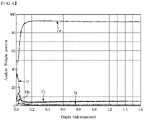
- FIGS. 6 and 7 are graphs illustrating GDS analysis results of hot-formed members using a mini-bumper mold according to an example exhibiting good oxidation resistance and a comparative example exhibiting inferior oxidation resistance with respect to depth from the surface.
- GDS glow discharge spectrometer
- the average oxygen content exceeds 20 wt% at a point of 0.1 ⁇ m depth from the surface in the comparative example exhibiting inferior oxidation resistance of FIG. 7 , it was confirmed that the average oxygen content was about 2 to 3 wt% at a point of 0.1 ⁇ m depth from the surface in the example exhibiting good oxidation resistance of FIG. 6 . Based on these results, it was confirmed that the average oxygen content needs to be controlled to 20 wt% or less at a point of 0.1 ⁇ m depth from the surface to obtain good oxidation resistance of a final hot-formed member.
- Comparative Examples 1 to 9 to which Nb was not added grain refinement did not occur before hot forming, and thus poor formability was obtained. Among them, inferior oxidation resistance was observed in Comparative Examples 3 to 5 due to negative values of Expression (1). However, in the cases of Comparative Examples 6 and 7, good oxidation resistance was obtained despite negative values of Expression (1) because Al, effective on oxidation resistance, was added in an amount of 0.5% or more.
- Sb was further added to the steel types of Comparative Examples 18 to 23. Sb was oxidized at a hot forming temperature of 950°C to be present as scales in the form of ash resulting in inferior oxidation resistance although Expression (1) was satisfied in Comparative Examples 18 to 20.
- the steel sheet for hot forming according to the present disclosure may be applied to automotive structural members because ultra-high strength may be obtained simultaneously inhibiting surface oxidation during hot press forming without using a plating layer.
Landscapes
- Chemical & Material Sciences (AREA)
- Engineering & Computer Science (AREA)
- Mechanical Engineering (AREA)
- Materials Engineering (AREA)
- Metallurgy (AREA)
- Organic Chemistry (AREA)
- Crystallography & Structural Chemistry (AREA)
- Physics & Mathematics (AREA)
- Thermal Sciences (AREA)
- Heat Treatment Of Sheet Steel (AREA)
- Shaping Metal By Deep-Drawing, Or The Like (AREA)
- Heat Treatment Of Articles (AREA)
Applications Claiming Priority (2)
| Application Number | Priority Date | Filing Date | Title |
|---|---|---|---|
| KR1020190108827A KR102279900B1 (ko) | 2019-09-03 | 2019-09-03 | 열간 성형용 강판, 열간 성형 부재 및 그 제조방법 |
| PCT/KR2020/011684 WO2021045476A1 (ko) | 2019-09-03 | 2020-09-01 | 열간 성형용 강판, 열간 성형 부재 및 그 제조방법 |
Publications (2)
| Publication Number | Publication Date |
|---|---|
| EP4008800A1 true EP4008800A1 (de) | 2022-06-08 |
| EP4008800A4 EP4008800A4 (de) | 2022-11-30 |
Family
ID=74852499
Family Applications (1)
| Application Number | Title | Priority Date | Filing Date |
|---|---|---|---|
| EP20860644.2A Pending EP4008800A4 (de) | 2019-09-03 | 2020-09-01 | Stahlblech zum warmformen, warmgeformtes teil und verfahren zu seiner herstellung |
Country Status (6)
| Country | Link |
|---|---|
| US (1) | US20220298595A1 (de) |
| EP (1) | EP4008800A4 (de) |
| JP (1) | JP7461464B2 (de) |
| KR (1) | KR102279900B1 (de) |
| CN (1) | CN114391049B (de) |
| WO (1) | WO2021045476A1 (de) |
Family Cites Families (21)
| Publication number | Priority date | Publication date | Assignee | Title |
|---|---|---|---|---|
| JPH07310141A (ja) * | 1993-07-09 | 1995-11-28 | Kawasaki Steel Corp | 高温多湿環境用耐海水鋼およびその製造方法 |
| FR2780984B1 (fr) | 1998-07-09 | 2001-06-22 | Lorraine Laminage | Tole d'acier laminee a chaud et a froid revetue et comportant une tres haute resistance apres traitement thermique |
| KR100878614B1 (ko) * | 2005-12-01 | 2009-01-15 | 주식회사 포스코 | 열처리 경화형 초고강도 강판, 이를 이용한 열처리 경화형부재와 그 제조방법 |
| KR101010971B1 (ko) * | 2008-03-24 | 2011-01-26 | 주식회사 포스코 | 저온 열처리 특성을 가지는 성형용 강판, 그 제조방법,이를 이용한 부품의 제조방법 및 제조된 부품 |
| JP5347393B2 (ja) * | 2008-09-12 | 2013-11-20 | Jfeスチール株式会社 | 延性に優れたホットプレス部材、そのホットプレス部材用鋼板、およびそのホットプレス部材の製造方法 |
| JP5637342B2 (ja) * | 2008-09-18 | 2014-12-10 | 国立大学法人 岡山大学 | ホットプレス加工を施した鋼板部材及びその製造方法 |
| JP4766186B2 (ja) * | 2009-08-21 | 2011-09-07 | Jfeスチール株式会社 | ホットプレス部材、ホットプレス部材用鋼板、ホットプレス部材の製造方法 |
| KR101382981B1 (ko) * | 2011-11-07 | 2014-04-09 | 주식회사 포스코 | 온간프레스 성형용 강판, 온간프레스 성형 부재 및 이들의 제조방법 |
| KR20150075277A (ko) | 2013-12-25 | 2015-07-03 | 주식회사 포스코 | 용융 도금재 테일러드 블랭크를 이용한 차등 강도 핫 프레스 포밍 부품 제조 방법 및 그 부품 |
| EP3124637B9 (de) * | 2014-03-26 | 2019-12-04 | Nippon Steel Corporation | Hochfestes, warmgeformtes stahlblechelement |
| MX377269B (es) * | 2014-05-15 | 2025-03-07 | Nippon Steel Corp | Elemento placa de acero laminada en caliente. |
| WO2016079565A1 (en) * | 2014-11-18 | 2016-05-26 | Arcelormittal | Method for manufacturing a high strength steel product and steel product thereby obtained |
| KR101696052B1 (ko) * | 2014-12-24 | 2017-01-13 | 주식회사 포스코 | 내식성이 우수한 열간성형 부재 및 그 제조방법 |
| KR101677398B1 (ko) * | 2015-11-30 | 2016-11-18 | 주식회사 포스코 | 열간성형용 강재 및 이를 이용한 부재 제조방법 |
| KR101696121B1 (ko) * | 2015-12-23 | 2017-01-13 | 주식회사 포스코 | 내수소지연파괴특성, 내박리성 및 용접성이 우수한 열간성형용 알루미늄-철 합금 도금강판 및 이를 이용한 열간성형 부재 |
| KR101747034B1 (ko) * | 2016-04-28 | 2017-06-14 | 주식회사 포스코 | 항복비가 우수한 초고강도 고연성 강판 및 이의 제조방법 |
| KR101830527B1 (ko) * | 2016-09-26 | 2018-02-21 | 주식회사 포스코 | 내식성 및 점용접성이 우수한 열간성형용 냉연강판, 열간성형부재 및 그들의 제조방법 |
| JP6428970B1 (ja) * | 2017-03-30 | 2018-11-28 | Jfeスチール株式会社 | ホットプレス部材およびその製造方法 |
| JP6589928B2 (ja) | 2017-04-13 | 2019-10-16 | Jfeスチール株式会社 | ホットプレス部材およびその製造方法 |
| KR102010048B1 (ko) | 2017-06-01 | 2019-10-21 | 주식회사 포스코 | 도장 밀착성과 도장 후 내식성이 우수한 열간 프레스 성형 부재용 강판 및 그 제조방법 |
| WO2019127240A1 (en) | 2017-12-28 | 2019-07-04 | GM Global Technology Operations LLC | Steel for hot stamping with enhanced oxidation resistance |
-
2019
- 2019-09-03 KR KR1020190108827A patent/KR102279900B1/ko active Active
-
2020
- 2020-09-01 CN CN202080061905.3A patent/CN114391049B/zh active Active
- 2020-09-01 JP JP2022513945A patent/JP7461464B2/ja active Active
- 2020-09-01 EP EP20860644.2A patent/EP4008800A4/de active Pending
- 2020-09-01 US US17/639,414 patent/US20220298595A1/en active Pending
- 2020-09-01 WO PCT/KR2020/011684 patent/WO2021045476A1/ko not_active Ceased
Also Published As
| Publication number | Publication date |
|---|---|
| KR20210027841A (ko) | 2021-03-11 |
| KR102279900B1 (ko) | 2021-07-22 |
| JP7461464B2 (ja) | 2024-04-03 |
| CN114391049A (zh) | 2022-04-22 |
| JP2022546124A (ja) | 2022-11-02 |
| CN114391049B (zh) | 2023-03-03 |
| EP4008800A4 (de) | 2022-11-30 |
| WO2021045476A1 (ko) | 2021-03-11 |
| US20220298595A1 (en) | 2022-09-22 |
Similar Documents
| Publication | Publication Date | Title |
|---|---|---|
| KR101353787B1 (ko) | 용접성 및 굽힘가공성이 우수한 초고강도 냉연강판 및 그 제조방법 | |
| US12467107B2 (en) | Cold rolled steel sheet with ultra-high strength, and manufacturing method therefor | |
| KR101879104B1 (ko) | TWB 용접 특성이 우수한 열간성형용 Al-Fe 합금화 도금강판, 열간성형 부재 및 그들의 제조방법 | |
| US11655518B2 (en) | Steel material for taylor welded blank and method for manufacturing hot-stamped part using same steel | |
| KR101225246B1 (ko) | 성형성이 우수한 자동차용 고강도 냉연 복합조직강판 및 그 제조 방법 | |
| US11299793B2 (en) | Steel sheet having excellent resistance to liquid metal embrittlement cracks and method for manufacturing the same | |
| KR20110018363A (ko) | 초고강성강 강 제품 및 이의 제조방법 | |
| CA2933709A1 (en) | Sheet steel product, a steel component produced from such a sheet steel product, and body for a motor vehicle | |
| CN112218969A (zh) | TWB焊接特性优异的用于热成型的Al-Fe合金化镀覆钢板、热成型部件及它们的制造方法 | |
| EP4527970A1 (de) | Hochfestes galvanisiertes stahlblech mit hervorragender schweissbarkeit und herstellungsverfahren dafür | |
| KR20220078173A (ko) | 굽힘가공성이 우수한 초고강도 냉연강판 및 그 제조방법 | |
| EP4578987A1 (de) | Plattiertes stahlblech für heisspressformen mit hervorragender schlagfestigkeit, heisspressgeformtes teil und herstellungsverfahren dafür | |
| EP4407058A1 (de) | Hochfestes kaltgewalztes stahlblech mit hervorragender oberflächenqualität und geringer abweichung von mechanischen eigenschaften und herstellungsverfahren dafür | |
| EP4578986A1 (de) | Kaltgewalztes stahlblech zur heisspressformung mit ausgezeichneter oberflächenqualität, heisspressgeformtes element und verfahren zur herstellung davon | |
| KR101999000B1 (ko) | 용접강도가 우수한 고망간 강판 및 이의 제조방법 | |
| EP4407059A1 (de) | Hochfestes kaltgewalztes stahlblech mit hervorragender oberflächenqualität und geringer abweichung von mechanischen eigenschaften und herstellungsverfahren dafür | |
| EP4008800A1 (de) | Stahlblech zum warmformen, warmgeformtes teil und verfahren zu seiner herstellung | |
| KR101615032B1 (ko) | 냉연강판 및 그 제조 방법 | |
| KR101758563B1 (ko) | 연신율이 우수한 초고강도 강판 및 이의 제조방법 | |
| KR102678567B1 (ko) | 굽힘 가공성이 우수한 초고강도 냉연강재 및 그 제조방법 | |
| EP4589042A1 (de) | Ultrahochfestes kaltgewalztes stahlblech und verfahren zur herstellung davon | |
| EP4407060A1 (de) | Hochfestes kaltgewalztes stahlblech mit ausgezeichneter oberflächenqualität und geringer materialvariation und verfahren zur herstellung davon | |
| EP4610386A1 (de) | Stahlblech mit hervorragender biegbarkeit und herstellungsverfahren dafür | |
| KR20250094567A (ko) | 열간 성형용 강판, 열간 성형 부재 및 그 제조방법 | |
| KR20250032167A (ko) | 핫 스탬핑용 강판의 제조 방법 및 핫 스탬핑 부품의 제조 방법 |
Legal Events
| Date | Code | Title | Description |
|---|---|---|---|
| STAA | Information on the status of an ep patent application or granted ep patent |
Free format text: STATUS: THE INTERNATIONAL PUBLICATION HAS BEEN MADE |
|
| PUAI | Public reference made under article 153(3) epc to a published international application that has entered the european phase |
Free format text: ORIGINAL CODE: 0009012 |
|
| STAA | Information on the status of an ep patent application or granted ep patent |
Free format text: STATUS: REQUEST FOR EXAMINATION WAS MADE |
|
| 17P | Request for examination filed |
Effective date: 20220302 |
|
| AK | Designated contracting states |
Kind code of ref document: A1 Designated state(s): AL AT BE BG CH CY CZ DE DK EE ES FI FR GB GR HR HU IE IS IT LI LT LU LV MC MK MT NL NO PL PT RO RS SE SI SK SM TR |
|
| A4 | Supplementary search report drawn up and despatched |
Effective date: 20221102 |
|
| RIC1 | Information provided on ipc code assigned before grant |
Ipc: C21D 1/26 20060101ALI20221026BHEP Ipc: C21D 1/673 20060101ALI20221026BHEP Ipc: C21D 6/02 20060101ALI20221026BHEP Ipc: C21D 6/00 20060101ALI20221026BHEP Ipc: C21D 8/02 20060101ALI20221026BHEP Ipc: C21D 7/13 20060101ALI20221026BHEP Ipc: C21D 9/46 20060101ALI20221026BHEP Ipc: C22C 38/38 20060101ALI20221026BHEP Ipc: C22C 38/26 20060101ALI20221026BHEP Ipc: C22C 38/00 20060101ALI20221026BHEP Ipc: C22C 38/02 20060101ALI20221026BHEP Ipc: C22C 38/04 20060101ALI20221026BHEP Ipc: C22C 38/34 20060101ALI20221026BHEP Ipc: C22C 38/48 20060101AFI20221026BHEP |
|
| DAV | Request for validation of the european patent (deleted) | ||
| DAX | Request for extension of the european patent (deleted) |