EP4008986B1 - Schalldämpfer zur montage an einem waffenlauf - Google Patents
Schalldämpfer zur montage an einem waffenlauf Download PDFInfo
- Publication number
- EP4008986B1 EP4008986B1 EP21211312.0A EP21211312A EP4008986B1 EP 4008986 B1 EP4008986 B1 EP 4008986B1 EP 21211312 A EP21211312 A EP 21211312A EP 4008986 B1 EP4008986 B1 EP 4008986B1
- Authority
- EP
- European Patent Office
- Prior art keywords
- silencer
- housing
- weapon barrel
- barrel
- clamping device
- Prior art date
- Legal status (The legal status is an assumption and is not a legal conclusion. Google has not performed a legal analysis and makes no representation as to the accuracy of the status listed.)
- Active
Links
Images
Classifications
-
- F—MECHANICAL ENGINEERING; LIGHTING; HEATING; WEAPONS; BLASTING
- F41—WEAPONS
- F41A—FUNCTIONAL FEATURES OR DETAILS COMMON TO BOTH SMALLARMS AND ORDNANCE, e.g. CANNONS; MOUNTINGS FOR SMALLARMS OR ORDNANCE
- F41A21/00—Barrels; Gun tubes; Muzzle attachments; Barrel mounting means
- F41A21/32—Muzzle attachments or glands
-
- F—MECHANICAL ENGINEERING; LIGHTING; HEATING; WEAPONS; BLASTING
- F41—WEAPONS
- F41A—FUNCTIONAL FEATURES OR DETAILS COMMON TO BOTH SMALLARMS AND ORDNANCE, e.g. CANNONS; MOUNTINGS FOR SMALLARMS OR ORDNANCE
- F41A21/00—Barrels; Gun tubes; Muzzle attachments; Barrel mounting means
- F41A21/30—Silencers
Definitions
- the invention relates to a silencer for mounting on a weapon barrel, comprising a silencer housing for completely enclosing the weapon barrel at least in sections.
- silencers also known as muzzle signature reducers
- muzzle signature reducers are devices arranged at the muzzle of a firearm's barrel to reduce sound emissions and muzzle flash.
- silencers can also reduce recoil when firing, which, together with the mass of the silencer, reduces the upward impact of the firearm.
- the precision of long weapons is increased because silencers have a positive, physical influence on the (propellant/combustion) gases that follow the bullet.
- a silencer changes the sound of the muzzle blast.
- silencers reduce the loudness of the muzzle blast and thus reduce the risk of hearing damage for hunters, drivers and dogs, for example.
- silencers do not restrict three-dimensional hearing.
- Such silencers are often designed as screw-on barrel attachments.
- the silencers have an internal thread which can be screwed on the front side (muzzle side) onto a corresponding external thread of a weapon barrel (muzzle thread).
- these threads are often formed with a fine thread. For example, if dirt gets on it during a hunt Fine threads make it difficult or even impossible to attach the silencer.
- an integral silencer for a rifle barrel wherein the integral silencer contains a tubular housing designed to almost completely or completely enclose the rifle barrel in its longitudinal direction with an internal thread arranged within the housing for fastening the integral silencer to an external thread provided at the muzzle of the rifle barrel.
- the US 6,385,891 B1 describes an adapter for attaching silencers or other additional devices to a weapon with a flash hider mounted on the end of the rifle barrel.
- the adapter includes an anchor attachable to a smooth portion of a barrel, preferably near obstructions located near the muzzle end of the barrel, and a housing designed to fit with the anchor in Intervention is coming.
- the housing has a size and/or shape that extends over and/or around various obstacles, projections, and geometries near the muzzle end of the barrel.
- the device further includes an alignment surface designed to receive the muzzle of the firearm and to guide the muzzle into elongate and concentric alignment with a silencer attached to a distal end of the housing.
- the US 2016/161203 A1 discloses a silencer having a body and a first connector half coupled to the body and securable with respect to a second connector half disposed on the firearm.
- the invention is based on the object of providing a particularly suitable silencer for mounting on a weapon barrel.
- simple and effort-reduced assembly should be made possible, even on weapon barrels without muzzle threads.
- the silencer according to the invention is intended for mounting on a weapon barrel and is suitable and set up for this purpose.
- the silencer is preferably designed as a barrel attachment, which can be placed on a weapon barrel or a muzzle of a firearm, in particular a hand-held firearm, preferably a hunting rifle.
- the silencer has a silencer housing which, in the assembled state, completely encloses the weapon barrel at least in sections.
- the silencer housing has an integrated casing tube, which preferably surrounds the weapon barrel when assembled.
- a muzzle brake is accommodated in the silencer housing, which keeps the casing tube centered in the silencer housing.
- the muzzle brake is intended and set up to use the energy of the combustion gases (propellant gases) produced when a shot is fired in order to reduce the recoil of the firearm.
- the silencer also has a device for deflecting and/or cooling the gases produced when a shot is fired, thereby reducing the muzzle blast and muzzle flash.
- the silencer has a clamping device for positive and/or non-positive fixation of the weapon barrel.
- a non-destructive clamping attachment of the silencer to the weapon barrel is provided, so the weapon barrel is clamped by the clamping device.
- a “positive connection” or a “positive connection” between at least two interconnected parts is understood here and below in particular to mean that the cohesion of the interconnected parts is achieved at least in one direction by direct interlocking of contours of the parts themselves or by indirect interlocking via an additional connecting part.
- the “blocking” of mutual movement in this direction is therefore dependent on the form.
- a “non-positive connection” or a “non-positive connection” between at least two interconnected parts is understood here and in the following in particular to mean that the interconnected parts are prevented from slipping against one another due to a frictional force acting between them. If there is no "connecting force” that causes this frictional force (this means the force that presses the parts against each other, for example a screw force or the weight itself), the frictional connection cannot be maintained and can therefore be released.
- the silencer can preferably be completely dismantled manually and can be assembled by a user without risk.
- the clamping device is designed as a collet.
- the collet has, for example, an externally conical, radially slotted sleeve with a central bore as a receiving or passage opening for the weapon barrel.
- the sleeve or the bore are adapted to the respective barrel diameter of the weapon barrel.
- the collet is opened, for example, using a key or lever clamped the gun barrel. This ensures a particularly stable and operationally reliable attachment of the silencer. In particular, a cost-effective and always centering clamping of the weapon barrel is thus achieved.
- the clamping device is arranged on an end face of the silencer housing.
- the clamping device is arranged on a side of the silencer housing opposite the outlet opening.
- the front side is designed, for example, as a removable housing cover.
- the silencer is designed, for example, as an integral silencer, whereby the silencer housing is not only placed on the muzzle, but extends essentially completely over the weapon barrel in its longitudinal direction and encloses it at least in sections like a jacket. This optimizes the damping performance of the silencer. Due to the frontal arrangement of the clamping device or collet, a center of gravity of the silencer is shifted backwards, i.e. towards the firearm and away from the muzzle of the gun barrel. Furthermore, the silencer has a particularly compact design in front of the muzzle barrel, which significantly improves the maneuverability and balance of the firearm equipped with it.
- the front side of the silencer housing is provided with an internal thread into which an external thread of the clamping device is screwed or can be screwed.
- the clamping device or the collets are screwed into the front side or the housing cover.
- the clamping device has at least one seal on an inner circumference surrounding or enclosing the weapon barrel.
- the clamping device - and thus the silencer - is sealed, in particular gas-tight, from the outer circumference of the weapon barrel by means of the seal.
- the seal absorbs, on the one hand, the forces of the gas pressure of the combustion gases and, on the other hand, the clamping or clamping effect of the clamping device or collet. The seal further increases the frictional resistance and thus the frictional holding force on the weapon barrel.
- the at least one seal allows the casing pipe not to be permanently installed inside the silencer housing, which means that a larger expansion chamber can be realized. This further improves the damping performance of the silencer.
- An additional or further aspect of the invention provides a centering sleeve for centering the weapon barrel, which is arranged on an end face of the casing tube facing the muzzle brake.
- the silencer is thus centered via the centering sleeve to the bore axis of the weapon barrel.
- the gun barrel is thus held at two points by the centering sleeve and the clamping device. This ensures a reliable and secure mounting and alignment of the silencer on a thread-free weapon barrel.
- the muzzle brake is screwed to the casing tube. This ensures that the casing tube is reliably fastened and held in the silencer housing.
- the muzzle brake is screwed to the outside of the casing tube; for this purpose, the casing tube has an internal thread and the muzzle brake has an external thread.
- the device has a (baffle) chamber with a number of baffles and/or a (gas rotation) chamber with a gas rotation insert.
- the device preferably has both a baffle chamber and a gas rotation chamber, which are connected downstream of one another. This enables a reliable reduction in sound emissions and muzzle flash.
- the baffles are designed, for example, as reflection surfaces for the combustion gases.
- the propellant gases of the projectile emerging from the muzzle are slowed down and cooled, which leads to a reduction in muzzle blast and muzzle flash.
- the baffles are, for example, each designed as a cone shell of a cone and have, for example, an opening angle of approximately 45°.
- the gas rotation insert has a significant influence on the damping performance of the silencer. Due to the (gas) rotation use, the gases are cooled very quickly and the muzzle blast is swirled.
- the rotary insert preferably has a shape or geometry which achieves a particularly high damping performance in as compact an installation space as possible.
- the gas rotation insert is manufactured as an exchangeable 3D printed part.
- the gas rotation insert is manufactured using a three-dimensional printing process, resulting in a particularly effective and suitable shape and geometry in terms of Damping performance is possible. This makes it possible to produce the silencer in significantly shorter designs, which is a significant advantage when it comes to handling a firearm equipped with it.
- the gas rotation insert Due to the interchangeability or interchangeability of the gas rotation insert, it is also possible to flexibly adapt the silencer to a respective caliber of the firearm. For example, when changing a caliber, only the gas rotation insert needs to be replaced.
- a space is formed between the silencer housing and the casing tube as an expansion chamber, the silencer housing having at least one vent hole for the space.
- the ventilation hole can also be part of the device, for example. The vent hole allows cold air to escape from the expansion chamber so that the hot (combustion/drive) gases can spread and be cooled more quickly. This further improves the damping performance of the silencer.
- moisture is possible for moisture to escape from the casing pipe through the ventilation hole.
- moisture here and below is understood to mean in particular the presence of water, in particular in the form of water vapor from the humidity of air enclosed in the casing tube. This means that there can be an unbound water content within the casing tube, which can react chemically with powder residues, for example, and can lead to damage or corrosion.
- the vent hole ensures that moisture can escape from the casing pipe, thereby improving the service life of the casing pipe and thus the silencer.
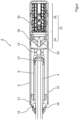
- the figure shows a perspective sectional view of a silencer 2, which is mounted on the muzzle side of a weapon barrel 4 of a firearm, not shown in detail.
- the firearm is, for example, a hunting rifle.
- the weapon barrel 4 has no muzzle thread in this exemplary embodiment. In other words, the gun barrel 4 is designed without threads.
- the silencer 2 is designed in particular as an integral silencer and has a cylindrical or tubular silencer housing 6 as an outer jacket tube, which completely encloses the weapon barrel 4 in sections.
- An (inner) casing tube 8 is accommodated in the silencer housing 6, which surrounds the weapon barrel 4 coaxially.
- the casing tube 8 is held centered in the silencer housing 6 by means of a muzzle brake 10.
- the casing tube 8 sits in an unspecified receptacle of an annular housing cover 12, which closes the silencer housing 6 on one end face.
- the muzzle brake 10 engages at least in sections in the casing tube 8, with a centering sleeve 14 being arranged in the engaging area of the muzzle brake 10, by means of which the weapon barrel 4 is aligned centered on the muzzle side in the casing tube 8 or the silencer housing 6.
- the muzzle brake 10 is provided with an external thread in the engaging area, which is screwed into a corresponding internal thread of the casing tube 8.
- the housing cover 12 has a threaded hole on the outside of the housing, into which a clamping device 16 designed as a collet is screwed.
- the clamping device 16 has an externally threaded fastening section which is inserted into the internal thread of the threaded hole is screwed in.
- the clamping device 16 fixes the silencer 2 in the assembled state in a form-fitting and/or non-positive manner on the weapon barrel 4.
- the clamping device 16 has four axially distributed seals 18, which are arranged as radial ring seals on a clamping device 16 surrounding or enclosing the weapon barrel 4.
- the clamping device 16 - and thus the silencer 2 - is sealed, in particular gas-tight, from the outer circumference of the weapon barrel 4 by means of the seals 18.
- the seals 18 absorb, on the one hand, the forces of the gas pressure of the combustion gases and, on the other hand, the clamping or clamping effect of the clamping device 16 or collet.
- the seals 18 further increase the frictional resistance and thus the frictional holding force on the weapon barrel 4.
- axial or an “axial direction” is understood to mean, in particular, a direction parallel (coaxial) to the weapon barrel 4, i.e. perpendicular to the end faces of the silencer 2.
- radial or a “radial direction” is understood to mean, in particular, a direction oriented perpendicularly (transversely) to the longitudinal axis of the weapon barrel 4 along a radius of the weapon barrel 4 or of the silencer 2.
- tangential or a “tangential direction” is understood to mean, in particular, a direction along the circumference of the silencer 2 or the weapon barrel 4 (circumferential direction, azimuthal direction), i.e. a direction perpendicular to the axial direction and the radial direction.
- the figure also shows a projectile 20 fired from the weapon barrel 4, which is shown in the area of a device 22 for deflecting and/or cooling a (propellant/combustion) gas produced when a shot is fired.
- the device 22 has a baffle chamber 24 and a gas rotation chamber 26, which adjoin the muzzle brake 10 in axial succession.
- the baffle chamber 24 has, for example, two baffle walls 28 arranged one behind the other.
- the baffles 28 are, for example, each designed as a conical shell of a cone and have, for example, an opening angle of approximately 45°.
- An approximately hollow cylindrical gas rotation insert 30 is accommodated in the gas rotation chamber 26.
- the gas rotation insert 30 preferably has a shape or geometry which achieves a particularly high damping performance in as compact an installation space as possible.
- the gas rotation insert 30 is manufactured in particular as an exchangeable 3D printed part.
- An unspecified space is formed as an expansion chamber between the silencer housing 6 and the casing tube 8.
- the silencer housing 6 has at least one vent hole 32, which passes through the silencer housing 6 approximately radially, and thus couples the expansion chamber or the gap with the environment. Cold air can escape from the expansion chamber through the vent hole 32, so that the hot (combustion/drive) gases can spread more quickly and be cooled.
- the silencer 2 can preferably be completely dismantled manually and can be assembled by a user without risk.
Landscapes
- Engineering & Computer Science (AREA)
- General Engineering & Computer Science (AREA)
- Portable Nailing Machines And Staplers (AREA)
- Exhaust Silencers (AREA)
- Clamps And Clips (AREA)
- Toys (AREA)
Description
- Die Erfindung betrifft einen Schalldämpfer zur Montage an einem Waffenlauf, aufweisend ein Schalldämpfergehäuse zum zumindest abschnittsweise vollständigen Umschließen des Waffenlaufs.
- Schalldämpfer, auch Mündungssignaturreduzierer genannt, sind im Bereich der Waffentechnik eine an der Mündung eines Waffenlaufs der Schusswaffe angeordnete Vorrichtungen zur Reduktion von Schallemissionen und des Mündungsfeuers. Des Weiteren können Schalldämpfer auch einen Rückstoß bei der Schussabgabe reduzieren, was zusammen mit der Masse des Schalldämpfers den Hochschlag der Schusswaffe vermindert. Weiterhin wird die Präzision von Langwaffen gesteigert, da Schalldämpfer einen positiven, physikalischen Einfluss auf die dem Geschoss nacheilenden (Trieb-/Verbrennungs-)Gase nehmen. Zusätzlich verändert ein Schalldämpfer den Klang des Mündungsknalls.
- Schalldämpfer reduzieren insbesondere die Lautstärke des Mündungsknalls und senken somit beispielsweise die Gefahr eines Gehörschadens bei Jägern, Treibern und Hunden. Im Gegensatz zu Gehörschützern schränken Schalldämpfer hierbei ein dreidimensionales Hören nicht ein.
- Derartige Schalldämpfer sind häufig als aufschraubbare Laufaufsätze ausgeführt. Die Schalldämpfer weisen hierbei ein Innengewinde auf, welches stirnseitig (mündungsseitig) auf ein korrespondierendes Außengewinde eines Waffenlaufs (Mündungsgewinde) geschraubt werden kann. Um eine möglichst verkippungsfreie Führung und Befestigung zu gewährleisten, sind diese Gewinde häufig mit einem Feingewinde gebildet. Wenn beispielsweise während einer Jagd Schmutz an dieses Feingewinde gelangt, wird die Befestigung des Schalldämpfers dadurch erschwert oder sogar unmöglich gemacht.
- In der
DE 20 2017 101 110 U1 ist ein Integralschalldämpfer für einen Gewehrlauf offenbart, wobei der Integralschalldämpfer ein zum nahezu vollständigen oder vollständigen Umschließen des Gewehrlaufs in dessen Längsrichtung ausgebildetes rohrförmiges Gehäuse mit einem innerhalb des Gehäuses angeordneten Innengewinde zur Befestigung des Integralschalldämpfers auf einem an der Mündung des Gewehrlaufs vorgesehenen Außengewinde enthält. - Die
US 6 385 891 B1 beschreibt einen Adapter zum Anbringen von Schalldämpfern oder anderen Zusatzgeräten an einer Waffe mit einem am Ende des Gewehrlaufs montierten Mündungsfeuerdämpfer. - Aus der
US 10 082 354 B1 - Die
US 2016/161203 A1 offenbart einen Schalldämpfer mit einem Körper und einer ersten Verbinderhälfte, die mit dem Körper gekoppelt ist, und mit einer an der Schusswaffe angeordneten zweiten Verbinderhälfte in Bezug aufeinander sicherbar ist. - Der Erfindung liegt die Aufgabe zugrunde, einen besonders geeigneten Schalldämpfer zur Montage an einem Waffenlauf anzugeben. Insbesondere soll eine einfache und aufwandsreduzierte Montage, auch an Waffenläufen ohne Mündungsgewinde ermöglicht werden.
- Die Aufgabe wird erfindungsgemäß mit den Merkmalen des Anspruchs 1 gelöst. Vorteilhafte Ausgestaltungen und Weiterbildungen sind Gegenstand der Unteransprüche.
- Der erfindungsgemäße Schalldämpfer ist zur Montage an einem Waffenlauf vorgesehen, sowie dafür geeignet und eingerichtet. Der Schalldämpfer ist hierbei vorzugsweise als ein Laufaufsatz ausgeführt, welcher auf einen Waffenlauf oder eine Mündung einer Schusswaffe, insbesondere einer handgeführten Schusswaffe, vorzugsweise einem Jagdgewehr, aufsetzbar ist.
- Der Schalldämpfer weist ein Schalldämpfergehäuse auf, welches im Montagezustand den Waffenlauf zumindest abschnittsweise vollständig umschließt. Das Schalldämpfergehäuse weist hierbei ein integriertes Mantelrohr auf, welches den Waffenlauf im Montagezustand vorzugsweise einfasst. In dem Schalldämpfergehäuse ist eine Mündungsbremse aufgenommen, welche das Mantelrohr zentriert in dem Schalldämpfergehäuse hält. Die Mündungsbremse ist hierbei dazu vorgesehen und eingerichtet, die Energie der bei einer Schussabgabe entstehenden Verbrennungsgase (Triebgase) zu nutzen, um den Rückstoß der Schusswaffe zu reduzieren. Der Schalldämpfer weist weiterhin eine Einrichtung zur Ablenkung und/oder Abkühlung der bei einer Schussabgabe entstehenden Gase auf, wodurch einer Minderung des Mündungsknalls und Mündungsfeuers realisiert wird.
- Erfindungsgemäß weist der Schalldämpfer eine Klemmvorrichtung zurform- und/oder kraftschlüssigen Fixierung des Waffenlaufs auf. Mit anderen Worten ist eine zerstörungsfreie Klemmbefestigung des Schalldämpfers am Waffenlauf vorgesehen, der Waffenlauf wird also von der Klemmvorrichtung eingeklemmt. Dadurch ist es möglich, den Schalldämpfer auch auf einem Waffenlauf ohne ein Mündungsgewinde zu befestigen. Somit ist ein besonders geeigneter Schalldämpfer realisiert.
- Die Konjunktion "und/oder" ist hier und im Folgenden derart zu verstehen, dass die mittels dieser Konjunktion verknüpften Merkmale sowohl gemeinsam als auch als Alternativen zueinander ausgebildet sein können.
- Unter einem "Formschluss" oder einer "formschlüssigen Verbindung" zwischen wenigstens zwei miteinander verbundenen Teilen wird hier und im Folgenden insbesondere verstanden, dass der Zusammenhalt der miteinander verbundenen Teile zumindest in einer Richtung durch ein unmittelbares Ineinandergreifen von Konturen der Teile selbst oder durch ein mittelbares Ineinandergreifen über ein zusätzliches Verbindungsteil erfolgt. Das "Sperren" einer gegenseitigen Bewegung in dieser Richtung erfolgt also formbedingt.
- Unter einem "Kraftschluss" oder einer "kraftschlüssigen Verbindung" zwischen wenigstens zwei miteinander verbundenen Teilen wird hier und im Folgenden insbesondere verstanden, dass die miteinander verbundenen Teile aufgrund einer zwischen ihnen wirkenden Reibkraft gegen ein Abgleiten aneinander gehindert sind. Fehlt eine diese Reibkraft hervorrufende "Verbindungskraft" (dies bedeutet diejenige Kraft, welche die Teile gegeneinander drückt, beispielsweise eine Schraubenkraft oder die Gewichtskraft selbst), kann die kraftschlüssige Verbindung nicht aufrecht erhalten und somit gelöst werden.
- Der Schalldämpfer ist vorzugsweise manuell komplett zerlegbar und kann von einem Benutzer ohne Gefahr zusammengebaut werden.
- In einer erfindungsgemäßen Ausführung ist die Klemmvorrichtung als eine Spannzange ausgeführt. Die Spannzange weist hierbei beispielsweise eine außen kegelförmige, radial geschlitzte, Hülse mit einer zentralen Bohrung als Aufnahme oder Durchführöffnung für den Waffenlauf auf. Die Hülse beziehungsweise die Bohrung sind hierbei an den jeweiligen Laufdurchmesser des Waffenlaufs angepasst. Die Spannzange wird hierbei beispielsweise mittels eines Schlüssels oder Hebels auf den Waffenlauf geklemmt. Dadurch ist eine besonders stabile und betriebssichere Befestigung des Schalldämpfers gewährleistet. Insbesondere ist somit eine aufwandsreduzierte und stets zentrierende Klemmung des Waffenlaufs realisiert.
- In einer geeigneten Ausgestaltung ist die Klemmvorrichtung an einer Stirnseite des Schalldämpfergehäuses angeordnet. Mit anderen Worten ist die Klemmvorrichtung an einer der Austrittsöffnung gegenüberliegenden Seite des Schalldämpfergehäuses angeordnet. Die Stirnseite ist hierbei beispielsweise als ein abnehmbarer Gehäusedeckel ausgeführt.
- In einer möglichen Ausgestaltungsform ist der Schalldämpfer beispielsweise als ein Integralschalldämpfer ausgeführt, wobei das Schalldämpfergehäuse nicht lediglich an der Laufmündung aufgesetzt wird, sondern sich im Wesentlichen vollständig über den Waffenlauf in dessen Längsrichtung erstreckt und diesen zumindest abschnittsweise wie einen Mantel umschließt. Dadurch wird eine Dämpferleistung des Schalldämpfers optimiert. Durch die stirnseitige Anordnung der Klemmvorrichtung oder Spannzange wird ein Schwerpunkt des Schalldämpfers nach hinten, also in Richtung der Schusswaffe und weg von der Mündung des Waffenlaufs, verschoben. Des Weiteren weist der Schalldämpfer somit einen besonders bauraum kompakten Aufbau vor dem Mündungslauf auf, wodurch die Führigkeit und Balance der damit ausgestatten Schusswaffe wesentlich verbessert wird.
- In einer zweckmäßigen Ausbildung ist die Stirnseite des Schalldämpfergehäuses mit einem Innengewinde versehen, in welches ein Außengewinde der Klemmvorrichtung eingedreht oder eindrehbar ist. Mit anderen Worten wird die Klemmvorrichtung oder die Spannzangen in die Stirnseite oder den Gehäusedeckel eingeschraubt. Dadurch ist eine einfache und zerstörungsfrei lösbare Befestigung der Klemmvorrichtung an dem Schalldämpfergehäuse realisiert. Dadurch ist einerseits eine einfache Montage und Demontage des Schalldämpfers, beispielsweise zu Wartungszwecken, ermöglicht. Andererseits ist es somit möglich, die Klemmvorrichtung beziehungsweise die Spannzange auszutauschen oder zu wechseln, so dass der Schalldämpfer durch einen Wechsel der Klemmvorrichtung besonders variabel und flexibel an einen jeweiligen Waffenlauf anpassbar ist.
- In einer erfindungsgemäßen Weiterbildung weist die Klemmvorrichtung an einem dem Waffenlauf umgebenden oder einfassenden Innenumfang mindestens eine Dichtung auf. Im Montagezustand wird die Klemmvorrichtung - und somit der Schalldämpfer - mittels der Dichtung gegenüber dem Außenumfang des Waffenlaufs, insbesondere gasdicht, abgedichtet. Durch die Dichtung werden einerseits die Kräfte des Gasdrucks der Verbrennungsgase und andererseits die Klemm- oder Spannwirkung der Klemmvorrichtung beziehungsweise Spannzange aufgenommen. Die Dichtung erhöht weiterhin den Reibungswiderstand und somit die kraftschlüssige Haltekraft an dem Waffenlauf.
- Des Weiteren ermöglicht die mindestens eine Dichtung, das Mantelrohr im Inneren des Schalldämpfergehäuses nicht fest zu verbauen, wodurch eine größere Expansionskammer realisierbar ist. Dadurch wird die Dämpfungsleistung des Schalldämpfers weiter verbessert.
- Ein zusätzlicher oder weiterer Aspekt der Erfindung sieht eine Zentrierhülse zur Zentrierung des Waffenlaufs vor, welche an einer der Mündungsbremse zugewandten Stirnseite des Mantelrohrs angeordnet ist. Der Schalldämpfer wird somit über die Zentrierhülse zur Laufseelenachse des Waffenlaufs zentriert. Der Waffenlauf ist somit von der Zentrierhülse und der Klemmvorrichtung an zwei Punkten gehalten. Dadurch ist eine zuverlässige und sichere Halterung und Ausrichtung des Schalldämpfers an einem gewindefreien Waffenlauf realisiert.
- Bei einem Einsatz an einem mit Mündungsgewinde versehenen Waffenlauf ist es beispielsweise möglich, die Zentrierhülse mit einem Gewindeeinsatz oder einer Gewindehülse auszutauschen oder zu wechseln, um den Schalldämpfer auf den Waffenlauf beziehungsweise auf das Mündungsgewinde aufzuschrauben. Bei einer solchen Schraubbefestigung ist es beispielsweise denkbar, dass an der Stirnseite beziehungsweise dem Gehäusedeckel des Schalldämpfergehäuses ein Kunststoffeinsatz eingebracht ist, welcher ein Verkratzen des Waffenlaufes beim Aufsetzen verhindert.
- In einer denkbaren Ausführung ist die Mündungsbremse mit dem Mantelrohr verschraubt. Dadurch ist eine zuverlässige Befestigung und Halterung des Mantelrohrs in dem Schalldämpfergehäuse realisiert. Beispielsweise wird die Mündungsbremse mit dem Mantelrohr außen verschraubt, hierzu weist das Mantelrohr ein Innengewinde und die Mündungsbremse ein Außengewinde auf.
- In einer zweckmäßigen Ausgestaltung weist die Einrichtung eine (Prallwand-) Kammer mit einer Anzahl von Prallwänden und/oder eine (Gasrotations-)Kammer mit einem Gasrotationseinsatz auf. Vorzugsweise weist die Einrichtung sowohl eine Prallwandkammer als auch eine Gasrotationskammer auf, welche einander nachgeschaltet sind. Dadurch ist eine zuverlässige Reduktion von Schallemissionen und des Mündungsfeuers ermöglicht.
- Die Prallwände sind hierbei beispielsweise als Reflexionsflächen für die Verbrennungsgase ausgeführt. Hierbei werden die aus der Mündung austretenden Triebgase des Projektils abgebremst und gekühlt, was zu einer Minderung des Mündungsknalls und Mündungsfeuers führt. Die Prallwände sind beispielsweise jeweils als Kegelmantel eines Kegels ausgeführt, und weisen beispielsweise einen Öffnungswinkel von etwa 45° auf.
- Der Gasrotationseinsatz weist einen wesentlichen Einfluss auf die Dämpfungsleistung des Schalldämpfers auf. Durch den (Gas-)Rotationseinsatz, werden die Gase sehr schnell abgekühlt und der Mündungsknall verwirbelt. Hierbei weist der Rotationseinsatz vorzugsweise eine Form oder Geometrie auf, welche möglichst bauraumkompakt eine besonders hohe Dämpfungsleistung realisiert.
- In einer besonders bevorzugten Ausführung ist der Gasrotationseinsatz hierbei als ein austauschbares 3D-Druckteil hergestellt. Dies bedeutet, dass der Gasrotationseinsatz in einem dreidimensionalen Druckverfahren hergestellt ist, wodurch eine besonders effektive und geeignete Form und Geometrie hinsichtlich der Dämpfungsleistung ermöglicht ist. Dadurch ist es möglich, den Schalldämpfer in wesentlich kürzeren Bauformen herzustellen, was für die Handhabung einer damit ausgestatteten Schusswaffe einen wesentlichen Vorteil bringt.
- Durch die Austauschbarkeit oder Auswechselbarkeit des Gasrotationseinsatzes ist es weiterhin möglich, den Schalldämpfer flexibel an ein jeweiliges Kaliber der Schusswaffe anzupassen. Beispielsweise muss bei einem Kaliberwechsel lediglich der Gasrotationseinsatz ausgetauscht werden.
- In einer geeigneten Weiterbildung ist zwischen dem Schalldämpfergehäuse und dem Mantelrohr ein Zwischenraum als Expansionskammer gebildet, wobei das Schalldämpfergehäuse mindestens eine Entlüftungsbohrung für den Zwischenraum aufweist. Die Entlüftungsbohrung kann hierbei beispielsweise auch Teil der Einrichtung sein. Durch die Entlüftungsbohrung kann eine kalte Luft aus der Expansionskammer entweichen, so dass sich die heißen (Verbrennungs-/Trieb-)Gase schneller ausbreiten und abgekühlt werden können. Dadurch wird die Dämpfungsleistung des Schalldämpfers weiter verbessert.
- Des Weiteren hat dies den zusätzlichen Effekt, dass der Schalldämpfer nicht so schnell erhitzt. Dadurch wird ein in einer Zieloptik (Zielfernrohr) sichtbares Flackern aufgrund einer aufsteigenden Hitze reduziert. Insbesondere tritt ein solches Flackern erst nach mehreren kurz hintereinander abgegebenen Schüssen auf.
- Weiterhin ist es durch die Entlüftungsbohrung möglich, dass Feuchtigkeit aus dem Mantelrohr entweichen kann. Unter dem Begriff "Feuchtigkeit" ist hier und im Folgenden insbesondere die Anwesenheit von Wasser, insbesondere in Form von Wasserdampf aus einer Luftfeuchtigkeit einer im Mantelrohr eingeschlossenen Luft, zu verstehen. Dies bedeutet, dass innerhalb des Mantelrohrs ein ungebundener Wassergehalt vorliegen kann, welcher beispielsweise mit Pulverrückständen chemisch reagieren kann, und zu Beschädigungen oder Korrosionen führen kann. Durch die Entlüftungsbohrung ist sichergestellt, dass die Feuchtigkeit aus dem Mantelrohr entweichen kann, wodurch die Lebensdauer des Mantelrohrs und somit des Schalldämpfers verbessert wird.
- Nachfolgend ist die Erfindung anhand einer Zeichnung näher erläutert. Darin zeigt die einzige Figur einen an einem Waffenlauf montierten Schalldämpfer.
- Die Figur zeigt in einer perspektivischen Schnittansicht einen Schalldämpfer 2, welcher mündungsseitig an einem Waffenlauf 4 einer nicht näher gezeigten Schusswaffe montiert ist. Die Schusswaffe ist beispielsweise ein Jagdgewehr. Der Waffenlauf 4 weist in diesem Ausführungsbeispiel kein Mündungsgewinde auf. Mit anderen Worten ist der Waffenlauf 4 also gewindelos ausgebildet.
- Der Schalldämpfer 2 ist insbesondere als ein Integralschalldämpfer ausgeführt, und weist ein zylindrischerförmiges oder tubusförmiges Schalldämpfergehäuse 6 als ein äußeres Mantelrohr auf, welches den Waffenlauf 4 abschnittsweise vollständig umschließt. In dem Schalldämpfergehäuse 6 ist ein (inneres) Mantelrohr 8 aufgenommen, welches den Waffenlauf 4 koaxial einfasst. Das Mantelrohr 8 ist einerseits mittels einer Mündungsbremse 10 zentriert im Schalldämpfergehäuse 6 gehalten. Andererseits sitzt das Mantelrohr 8 in einer nicht näher bezeichneten Aufnahme eines ringförmigen Gehäusedeckels 12 ein, welcher das Schalldämpfergehäuse 6 an einer Stirnseite verschließt.
- Die Mündungsbremse 10 greift zumindest abschnittsweise in das Mantelrohr 8 ein, wobei eine Zentrierhülse 14 im eingreifenden Bereich der Mündungsbremse 10 angeordnet ist, mittels welcher der Waffenlauf 4 mündungsseitig zentriert in dem Mantelrohr 8 beziehungsweise dem Schalldämpfergehäuse 6 ausgerichtet wird. Die Mündungsbremse 10 ist hierbei in dem eingreifenden Bereich mit einem Außengewinde versehen, welches in ein korrespondierendes Innengewinde des Mantelrohrs 8 eingedreht ist.
- Der Gehäusedeckel 12 weist an der Gehäuseaußenseite eine Gewindebohrung auf, in welcher eine als Spannzange ausgeführte Klemmvorrichtung 16 eingedreht ist. Hierzu weist die Klemmvorrichtung 16 einen mit Außengewinde versehenen Befestigungsabschnitt auf, welcher in das Innengewinde der Gewindebohrung eingedreht ist. Die Klemmvorrichtung 16 fixiert den Schalldämpfer 2 im Montagezustand form- und/oder kraftschlüssig am Waffenlauf 4.
- Die Klemmvorrichtung 16 weist vier axial verteilt angeordnete Dichtungen 18 auf, welche als radiale Ringdichtungen an einem den Waffenlauf 4 umgebenden oder einfassenden der Klemmvorrichtung 16 angeordnet sind. Im Montagezustand wird die Klemmvorrichtung 16 - und somit der Schalldämpfer 2 - mittels der Dichtungen 18 gegenüber dem Außenumfang des Waffenlaufs 4, insbesondere gasdicht, abgedichtet. Durch die Dichtungen 18 werden einerseits die Kräfte des Gasdrucks der Verbrennungsgase und andererseits die Klemm- oder Spannwirkung der Klemmvorrichtung 16 beziehungsweise Spannzange aufgenommen. Die Dichtungen 18 erhöhen weiterhin den Reibungswiderstand und somit die kraftschlüssige Haltekraft an dem Waffenlauf 4.
- Unter "axial" oder einer "Axialrichtung" wird hier und im Folgenden insbesondere eine Richtung parallel (koaxial) zum Waffenlauf 4, also senkrecht zu den Stirnseiten des Schalldämpfers 2 verstanden. Entsprechend wird hier und im Folgenden unter "radial" oder einer "Radialrichtung" insbesondere eine senkrecht (quer) zur Längsachse des Waffenlaufs 4 orientierte Richtung entlang eines Radius des Waffenlaufs 4 beziehungsweise des Schalldämpfers 2 verstanden. Unter "tangential" oder einer "Tangentialrichtung" wird hier und im Folgenden insbesondere eine Richtung entlang des Umfangs des Schalldämpfers 2 oder des Waffenlaufs 4 (Umfangsrichtung, Azimutalrichtung), also eine Richtung senkrecht zur Axialrichtung und zur Radialrichtung, verstanden.
- In der Figur ist weiterhin ein vom Waffenlauf 4 abgegebenes Geschoss 20 gezeigt, welches im Bereich einer Einrichtung 22 zur Ablenkung und/oder Abkühlung eines bei einer Schussabgabe entstehenden (Trieb-/Verbrennungs-)Gases dargestellt ist. Die Einrichtung 22 weist hierbei eine Prallwandkammer 24 und eine Gasrotationskammer 26 auf, welche sich axial aufeinanderfolgend an die Mündungsbremse 10 anschließen.
- Die Prallwandkammer 24 weist beispielsweise zwei hintereinander angeordnete Prallwände 28 auf. Die Prallwände 28 sind beispielsweise jeweils als ein Kegelmantel eines Kegels ausgeführt, und weisen beispielsweise einen Öffnungswinkel von etwa 45° auf.
- In der Gasrotationskammer 26 ist ein etwa hohlzylindrischer Gasrotationseinsatz 30 aufgenommen.
- Der Gasrotationseinsatz 30 weist vorzugsweise eine Form oder Geometrie auf, welche möglichst bauraumkompakt eine besonders hohe Dämpfungsleistung realisiert. Der Gasrotationseinsatz 30 ist insbesondere als ein austauschbares 3D-Druckteil hergestellt.
- Zwischen den Schalldämpfergehäuse 6 und dem Mantelrohr 8 ist ein nicht näher bezeichneter Zwischenraum (Ringraum) als Expansionskammer gebildet. Das Schalldämpfergehäuse 6 weist hierbei mindestens eine Entlüftungsbohrung 32 auf, welche das Schalldämpfergehäuse 6 etwa radial durchsetzt, und somit die Expansionskammer beziehungsweise den Zwischenraum mit der Umgebung koppelt. Durch die Entlüftungsbohrung 32 kann eine kalte Luft aus der Expansionskammer entweichen, so dass sich die heißen (Verbrennungs-/Trieb-)Gase schneller ausbreiten und abgekühlt werden können.
- Der Schalldämpfer 2 ist vorzugsweise manuell komplett zerlegbar und kann von einem Benutzer ohne Gefahr zusammengebaut werden.
- Die Erfindung ist nicht auf die vorstehend beschriebenen Ausführungsbeispiele beschränkt. Vielmehr können auch andere Varianten der Erfindung von dem Fachmann hieraus abgeleitet werden, ohne den Gegenstand der Erfindung zu verlassen. Insbesondere sind ferner alle im Zusammenhang mit den Ausführungsbeispielen beschriebenen Einzelmerkmale auch auf andere Weise miteinander kombinierbar, ohne den Gegenstand der Erfindung zu verlassen.
-
- 2
- Schalldämpfer
- 4
- Waffenlauf
- 6
- Schalldämpfergehäuse
- 8
- Mantelrohr
- 10
- Mündungsbremse
- 12
- Gehäusedeckel
- 14
- Zentrierhülse
- 16
- Klemmvorrichtung
- 18
- Dichtung
- 20
- Geschoss
- 22
- Einrichtung
- 24
- Prallwandkammer
- 26
- Gasrotationskammer
- 28
- Prallwand
- 30
- Gasrotationseinsatz
- 32
- Entlüftungsbohrung
Claims (8)
- Schalldämpfer (2) zur Montage an einem Waffenlauf (4), aufweisend ein Schalldämpfergehäuse (6) zum zumindest abschnittsweise vollständigen Umschließen des Waffenlaufs (4), und ein in das Schalldämpfergehäuse (6) integriertes Mantelrohr (8) zum Einfassen des Waffenlaufs, sowie eine Mündungsbremse (10), mit welcher das Mantelrohr (8) zentriert im Schalldämpfergehäuse (6) gehalten ist, und mindestens eine Einrichtung (22) zur Ablenkung und/oder Abkühlung eines bei einer Schussabgabe entstehenden Gases, dadurch gekennzeichnet, dass- eine als Spannzange ausgeführte Klemmvorrichtung (16) zur form- und/oder kraftschlüssigen und zerstörungsfreien Klemmbefestigung des Schalldämpfers (2) am Waffenlauf (4) vorgesehen ist, und- die Klemmvorrichtung (16) an einem dem Waffenlauf (4) umgebenden Innenumfang mindestens eine Dichtung (18) zur gasdichten Abdichtung gegenüber dem Außenumfang des Waffenlaufs (4) aufweist.
- Schalldämpfer (2) nach Anspruch 1,
dadurch gekennzeichnet,
dass die Klemmvorrichtung (16) an einer Stirnseite des Schalldämpfergehäuses (6) angeordnet ist. - Schalldämpfer (2) nach Anspruch 2,
dadurch gekennzeichnet,
dass die Stirnseite des Schalldämpfergehäuses (6) mit einem Innengewinde versehen ist, in welches ein Außengewinde der Klemmvorrichtung (16) eingedreht oder eindrehbar ist. - Schalldämpfer (2) nach einem der Ansprüche 1 bis 3,
dadurch gekennzeichnet,
dass an einer der Mündungsbremse (19) zugewandten Stirnseite des Mantelrohrs (8) eine Zentrierhülse (14) zur Zentrierung des Waffenlaufs (4) vorgesehen ist. - Schalldämpfer (2) nach einem der Ansprüche 1 bis 4,
dadurch gekennzeichnet,
dass die Mündungsbremse (10) mit dem Mantelrohr (8) verschraubt ist. - Schalldämpfer (2) nach einem der Ansprüche 1 bis 5,
dadurch gekennzeichnet,
dass die Einrichtung (22) eine Kammer (24) mit einer Anzahl von Prallwänden (28) und/oder eine Kammer (26) mit einem Gasrotationseinsatz (30) aufweist. - Schalldämpfer (2) nach Anspruch 6,
dadurch gekennzeichnet,
dass der Gasrotationseinsatz (30) ein austauschbares 3D-Druckteil ist. - Schalldämpfer (2) nach einem der Ansprüche 1 bis 7,
dadurch gekennzeichnet,
dass zwischen dem Schalldämpfergehäuse (6) und dem Mantelrohr (8) ein Zwischenraum gebildet ist, wobei das Schalldämpfergehäuse (6) mindestens eine Entlüftungsbohrung (32) für den Zwischenraum aufweist.
Priority Applications (2)
| Application Number | Priority Date | Filing Date | Title |
|---|---|---|---|
| HRP20240528TT HRP20240528T1 (hr) | 2020-12-02 | 2021-11-30 | Prigušivač za montažu na cijev oružja |
| RS20240443A RS65461B1 (sr) | 2020-12-02 | 2021-11-30 | Prigušivač za montažu na cev oružja |
Applications Claiming Priority (1)
| Application Number | Priority Date | Filing Date | Title |
|---|---|---|---|
| DE102020132017.5A DE102020132017A1 (de) | 2020-12-02 | 2020-12-02 | Schalldämpfer zur Montage an einem Waffenlauf |
Publications (3)
| Publication Number | Publication Date |
|---|---|
| EP4008986A1 EP4008986A1 (de) | 2022-06-08 |
| EP4008986B1 true EP4008986B1 (de) | 2024-01-17 |
| EP4008986C0 EP4008986C0 (de) | 2024-01-17 |
Family
ID=78820062
Family Applications (1)
| Application Number | Title | Priority Date | Filing Date |
|---|---|---|---|
| EP21211312.0A Active EP4008986B1 (de) | 2020-12-02 | 2021-11-30 | Schalldämpfer zur montage an einem waffenlauf |
Country Status (8)
| Country | Link |
|---|---|
| US (1) | US11644266B2 (de) |
| EP (1) | EP4008986B1 (de) |
| CA (1) | CA3141046A1 (de) |
| DE (1) | DE102020132017A1 (de) |
| HR (1) | HRP20240528T1 (de) |
| HU (1) | HUE066431T2 (de) |
| PL (1) | PL4008986T3 (de) |
| RS (1) | RS65461B1 (de) |
Families Citing this family (4)
| Publication number | Priority date | Publication date | Assignee | Title |
|---|---|---|---|---|
| EP4271960A4 (de) * | 2021-01-04 | 2024-12-11 | Eight Holdings LLC | Mündungsvorrichtung für eine feuerwaffe |
| US12135180B2 (en) * | 2022-08-04 | 2024-11-05 | WHG Properties, LLC | Firearm suppressor |
| US12264889B2 (en) | 2023-01-13 | 2025-04-01 | Replicator LLC | Suppressor for a firearm |
| US20250137761A1 (en) * | 2023-10-27 | 2025-05-01 | Scott Bell | Firearm sound suppression device |
Family Cites Families (28)
| Publication number | Priority date | Publication date | Assignee | Title |
|---|---|---|---|---|
| US1435084A (en) * | 1921-06-09 | 1922-11-07 | Schneider & Cie | Apparatus for reducing the length of recoil in guns |
| IT1194990B (it) | 1981-09-30 | 1988-09-28 | Beretta Armi Spa | Dispositivo di fissaggio del silenziatore ad armi portatili |
| US5136923A (en) * | 1982-07-30 | 1992-08-11 | Walsh Donald J Jun | Firearm silencer and flash attenuator |
| US4939977A (en) * | 1989-06-07 | 1990-07-10 | Stroup Larry J | Gun silencer and muzzle protector |
| US6385891B1 (en) * | 2000-04-04 | 2002-05-14 | Robert Rabatin | Adapter for attaching sound suppressors or other auxiliary devices to weapons |
| US7676976B2 (en) * | 2003-11-06 | 2010-03-16 | Surefire, Llc | Systems for attaching a noise suppressor to a firearm |
| US20080098880A1 (en) | 2005-06-30 | 2008-05-01 | Karl Brugger | Lock/rotation mounted suppressor |
| US7588122B2 (en) * | 2007-08-20 | 2009-09-15 | Kevin Tyson Brittingham | Orientation apparatus for eccentric firearm noise suppressor and assembly method |
| US20090193963A1 (en) * | 2007-09-11 | 2009-08-06 | Poulsen Peter Ostergaard | Joint between a sound suppressor and a barrel of a firearm |
| US8291805B1 (en) * | 2010-03-10 | 2012-10-23 | Quilligan Jay J | Quick-attach locking device for a flash hider |
| US20160161203A1 (en) * | 2012-12-21 | 2016-06-09 | Bert John WILSON | Suppressors and their methods of manufacture |
| US9658019B2 (en) | 2014-09-19 | 2017-05-23 | Ra Brands, L.L.C. | Silencer and mounting system |
| US9927201B2 (en) * | 2014-10-03 | 2018-03-27 | Alexander Nikolaevich PENCHUK | Barrel coupling for firearm |
| DE102016000437A1 (de) | 2016-01-18 | 2017-07-20 | Prime Manufacturing Group Limited (BVI) | Einrichtung zum lösbaren Befestigen eines Schalldämpfers und Schalldämpferanordnung |
| EP3208567B1 (de) | 2016-02-18 | 2019-04-10 | Martin Ernsperger | Schalldämpfer |
| DE202016006589U1 (de) * | 2016-10-25 | 2018-01-21 | Tim Enderle | Gasumlenker im 120° Winkel, verbunden mit einem Schalldämpfer für Langwaffen |
| US10330420B2 (en) * | 2017-02-21 | 2019-06-25 | Nemo Arms, Inc. | Suppressor assembly |
| DE202017101110U1 (de) * | 2017-02-28 | 2018-05-29 | L&O Hunting Group GmbH | Integralschalldämpfer für einen Gewehrlauf |
| US10066890B1 (en) * | 2017-04-27 | 2018-09-04 | Darryl S. Lee | Firearm suppressor adapter |
| US10527379B2 (en) * | 2017-04-27 | 2020-01-07 | Dbdrop Inc. | Firearm adapter |
| US9891017B1 (en) * | 2017-05-22 | 2018-02-13 | Darryl S. Lee | Firearm suppressor adapter |
| US10082354B1 (en) * | 2018-02-21 | 2018-09-25 | Darryl S. Lee | Firearm suppressor adapter for barrels having obstructions |
| US10969188B1 (en) | 2018-12-04 | 2021-04-06 | Brent R. Cottingham | Pistol slide-mounted suppressor |
| DE102019000223A1 (de) | 2019-01-16 | 2020-07-16 | Voere Holding Gmbh | Klemmdämpfer für eine Waffe |
| US11397065B2 (en) * | 2019-10-04 | 2022-07-26 | Silention Oy | Silencer for a firearm |
| US11112200B2 (en) * | 2019-11-04 | 2021-09-07 | Earth Outdoor Tactical L.L.C. | Suppressor |
| US20210404760A1 (en) * | 2020-06-02 | 2021-12-30 | Aaron Hipp | Adjustable tuning device |
| US11662172B2 (en) * | 2020-08-30 | 2023-05-30 | Keith A. Langenbeck | Integrated barrel and muzzle device system |
-
2020
- 2020-12-02 DE DE102020132017.5A patent/DE102020132017A1/de active Pending
-
2021
- 2021-11-30 PL PL21211312.0T patent/PL4008986T3/pl unknown
- 2021-11-30 HU HUE21211312A patent/HUE066431T2/hu unknown
- 2021-11-30 RS RS20240443A patent/RS65461B1/sr unknown
- 2021-11-30 EP EP21211312.0A patent/EP4008986B1/de active Active
- 2021-11-30 HR HRP20240528TT patent/HRP20240528T1/hr unknown
- 2021-12-02 US US17/540,627 patent/US11644266B2/en active Active
- 2021-12-02 CA CA3141046A patent/CA3141046A1/en active Pending
Also Published As
| Publication number | Publication date |
|---|---|
| US11644266B2 (en) | 2023-05-09 |
| HUE066431T2 (hu) | 2024-08-28 |
| PL4008986T3 (pl) | 2024-07-08 |
| CA3141046A1 (en) | 2022-06-02 |
| EP4008986A1 (de) | 2022-06-08 |
| HRP20240528T1 (hr) | 2024-07-05 |
| RS65461B1 (sr) | 2024-05-31 |
| DE102020132017A1 (de) | 2022-06-02 |
| US20220170712A1 (en) | 2022-06-02 |
| EP4008986C0 (de) | 2024-01-17 |
Similar Documents
| Publication | Publication Date | Title |
|---|---|---|
| EP2867607B1 (de) | Schalldämpfer für eine handfeuerwaffe | |
| EP4008986A1 (de) | Schalldämpfer zur montage an einem waffenlauf | |
| US8342071B2 (en) | Firearm flash suppressor | |
| EP0071799B1 (de) | Schallgedämpfte Handfeuerwaffe | |
| EP0660915B1 (de) | Schalldämpfer für feuerwaffen | |
| US20190154387A1 (en) | Firearm Adapter | |
| US11397065B2 (en) | Silencer for a firearm | |
| US11828557B2 (en) | Suppressor | |
| EP3367042B1 (de) | Integralschalldämpfer für einen gewehrlauf | |
| US20190154386A1 (en) | Firearm Adapter | |
| DE102011010639B4 (de) | Schalldämpfer für eine Handfeuerwaffe | |
| DE102011116059A1 (de) | Schalldämpfer für eine Handfeuerwaffe | |
| US10508879B1 (en) | Device for dampening residual effects from a firearm suppressor | |
| US20230296344A1 (en) | Firearm suppressor with secondary retention system | |
| DE202014004278U1 (de) | Modulschalldämpfer für Feuerwaffen | |
| DE202017101110U1 (de) | Integralschalldämpfer für einen Gewehrlauf | |
| EP3800433B1 (de) | Schalldämpfer für eine schusswaffe | |
| EP2769166A1 (de) | Schalldämpfer mit angriffsfläche für ein werkzeug | |
| WO2021008658A1 (de) | Kompensator | |
| DE3046639A1 (de) | Einrichtung an einem waffenrohr zur verringerung des abgangsfehlerwinkels | |
| CA2666528C (en) | Firearm flash suppressor | |
| BG3438U1 (bg) | Супресор | |
| DE102020128767A1 (de) | Schalldämpfer für eine Handfeuerwaffe | |
| DE102021003389A1 (de) | Waffenschalldämpfer | |
| AU2009202048A1 (en) | Firearm flash suppressor |
Legal Events
| Date | Code | Title | Description |
|---|---|---|---|
| REG | Reference to a national code |
Ref country code: HR Ref legal event code: TUEP Ref document number: P20240528T Country of ref document: HR |
|
| PUAI | Public reference made under article 153(3) epc to a published international application that has entered the european phase |
Free format text: ORIGINAL CODE: 0009012 |
|
| STAA | Information on the status of an ep patent application or granted ep patent |
Free format text: STATUS: THE APPLICATION HAS BEEN PUBLISHED |
|
| AK | Designated contracting states |
Kind code of ref document: A1 Designated state(s): AL AT BE BG CH CY CZ DE DK EE ES FI FR GB GR HR HU IE IS IT LI LT LU LV MC MK MT NL NO PL PT RO RS SE SI SK SM TR |
|
| STAA | Information on the status of an ep patent application or granted ep patent |
Free format text: STATUS: REQUEST FOR EXAMINATION WAS MADE |
|
| 17P | Request for examination filed |
Effective date: 20221208 |
|
| RBV | Designated contracting states (corrected) |
Designated state(s): AL AT BE BG CH CY CZ DE DK EE ES FI FR GB GR HR HU IE IS IT LI LT LU LV MC MK MT NL NO PL PT RO RS SE SI SK SM TR |
|
| GRAP | Despatch of communication of intention to grant a patent |
Free format text: ORIGINAL CODE: EPIDOSNIGR1 |
|
| STAA | Information on the status of an ep patent application or granted ep patent |
Free format text: STATUS: GRANT OF PATENT IS INTENDED |
|
| INTG | Intention to grant announced |
Effective date: 20230905 |
|
| P01 | Opt-out of the competence of the unified patent court (upc) registered |
Effective date: 20230911 |
|
| GRAS | Grant fee paid |
Free format text: ORIGINAL CODE: EPIDOSNIGR3 |
|
| GRAA | (expected) grant |
Free format text: ORIGINAL CODE: 0009210 |
|
| STAA | Information on the status of an ep patent application or granted ep patent |
Free format text: STATUS: THE PATENT HAS BEEN GRANTED |
|
| AK | Designated contracting states |
Kind code of ref document: B1 Designated state(s): AL AT BE BG CH CY CZ DE DK EE ES FI FR GB GR HR HU IE IS IT LI LT LU LV MC MK MT NL NO PL PT RO RS SE SI SK SM TR |
|
| REG | Reference to a national code |
Ref country code: GB Ref legal event code: FG4D Free format text: NOT ENGLISH |
|
| REG | Reference to a national code |
Ref country code: CH Ref legal event code: EP |
|
| REG | Reference to a national code |
Ref country code: DE Ref legal event code: R096 Ref document number: 502021002488 Country of ref document: DE |
|
| REG | Reference to a national code |
Ref country code: IE Ref legal event code: FG4D Free format text: LANGUAGE OF EP DOCUMENT: GERMAN |
|
| U01 | Request for unitary effect filed |
Effective date: 20240214 |
|
| P04 | Withdrawal of opt-out of the competence of the unified patent court (upc) registered |
Effective date: 20240219 |
|
| U07 | Unitary effect registered |
Designated state(s): AT BE BG DE DK EE FI FR IT LT LU LV MT NL PT SE SI Effective date: 20240222 |
|
| REG | Reference to a national code |
Ref country code: SK Ref legal event code: T3 Ref document number: E 43918 Country of ref document: SK |
|
| PG25 | Lapsed in a contracting state [announced via postgrant information from national office to epo] |
Ref country code: IS Free format text: LAPSE BECAUSE OF FAILURE TO SUBMIT A TRANSLATION OF THE DESCRIPTION OR TO PAY THE FEE WITHIN THE PRESCRIBED TIME-LIMIT Effective date: 20240517 |
|
| REG | Reference to a national code |
Ref country code: HR Ref legal event code: T1PR Ref document number: P20240528 Country of ref document: HR |
|
| PG25 | Lapsed in a contracting state [announced via postgrant information from national office to epo] |
Ref country code: GR Free format text: LAPSE BECAUSE OF FAILURE TO SUBMIT A TRANSLATION OF THE DESCRIPTION OR TO PAY THE FEE WITHIN THE PRESCRIBED TIME-LIMIT Effective date: 20240418 |
|
| PG25 | Lapsed in a contracting state [announced via postgrant information from national office to epo] |
Ref country code: ES Free format text: LAPSE BECAUSE OF FAILURE TO SUBMIT A TRANSLATION OF THE DESCRIPTION OR TO PAY THE FEE WITHIN THE PRESCRIBED TIME-LIMIT Effective date: 20240117 |
|
| PG25 | Lapsed in a contracting state [announced via postgrant information from national office to epo] |
Ref country code: IS Free format text: LAPSE BECAUSE OF FAILURE TO SUBMIT A TRANSLATION OF THE DESCRIPTION OR TO PAY THE FEE WITHIN THE PRESCRIBED TIME-LIMIT Effective date: 20240517 Ref country code: GR Free format text: LAPSE BECAUSE OF FAILURE TO SUBMIT A TRANSLATION OF THE DESCRIPTION OR TO PAY THE FEE WITHIN THE PRESCRIBED TIME-LIMIT Effective date: 20240418 Ref country code: ES Free format text: LAPSE BECAUSE OF FAILURE TO SUBMIT A TRANSLATION OF THE DESCRIPTION OR TO PAY THE FEE WITHIN THE PRESCRIBED TIME-LIMIT Effective date: 20240117 |
|
| REG | Reference to a national code |
Ref country code: HU Ref legal event code: AG4A Ref document number: E066431 Country of ref document: HU |
|
| PG25 | Lapsed in a contracting state [announced via postgrant information from national office to epo] |
Ref country code: SM Free format text: LAPSE BECAUSE OF FAILURE TO SUBMIT A TRANSLATION OF THE DESCRIPTION OR TO PAY THE FEE WITHIN THE PRESCRIBED TIME-LIMIT Effective date: 20240117 |
|
| REG | Reference to a national code |
Ref country code: DE Ref legal event code: R097 Ref document number: 502021002488 Country of ref document: DE |
|
| PG25 | Lapsed in a contracting state [announced via postgrant information from national office to epo] |
Ref country code: SM Free format text: LAPSE BECAUSE OF FAILURE TO SUBMIT A TRANSLATION OF THE DESCRIPTION OR TO PAY THE FEE WITHIN THE PRESCRIBED TIME-LIMIT Effective date: 20240117 |
|
| PLBE | No opposition filed within time limit |
Free format text: ORIGINAL CODE: 0009261 |
|
| STAA | Information on the status of an ep patent application or granted ep patent |
Free format text: STATUS: NO OPPOSITION FILED WITHIN TIME LIMIT |
|
| REG | Reference to a national code |
Ref country code: HR Ref legal event code: ODRP Ref document number: P20240528 Country of ref document: HR Payment date: 20241120 Year of fee payment: 4 |
|
| 26N | No opposition filed |
Effective date: 20241018 |
|
| U20 | Renewal fee for the european patent with unitary effect paid |
Year of fee payment: 4 Effective date: 20241126 |
|
| P05 | Withdrawal of opt-out of the competence of the unified patent court (upc) changed |
Free format text: CASE NUMBER: APP_8902/2024 Effective date: 20240222 |
|
| PGFP | Annual fee paid to national office [announced via postgrant information from national office to epo] |
Ref country code: HU Payment date: 20241122 Year of fee payment: 4 |
|
| PGFP | Annual fee paid to national office [announced via postgrant information from national office to epo] |
Ref country code: NO Payment date: 20241119 Year of fee payment: 4 |
|
| PGFP | Annual fee paid to national office [announced via postgrant information from national office to epo] |
Ref country code: PL Payment date: 20241118 Year of fee payment: 4 |
|
| PGFP | Annual fee paid to national office [announced via postgrant information from national office to epo] |
Ref country code: CZ Payment date: 20241115 Year of fee payment: 4 Ref country code: HR Payment date: 20241120 Year of fee payment: 4 |
|
| PGFP | Annual fee paid to national office [announced via postgrant information from national office to epo] |
Ref country code: RO Payment date: 20241126 Year of fee payment: 4 Ref country code: SK Payment date: 20241118 Year of fee payment: 4 |
|
| PGFP | Annual fee paid to national office [announced via postgrant information from national office to epo] |
Ref country code: RS Payment date: 20241115 Year of fee payment: 4 |
|
| PGFP | Annual fee paid to national office [announced via postgrant information from national office to epo] |
Ref country code: CH Payment date: 20241201 Year of fee payment: 4 |
|
| PGFP | Annual fee paid to national office [announced via postgrant information from national office to epo] |
Ref country code: TR Payment date: 20241120 Year of fee payment: 4 |
|
| PG25 | Lapsed in a contracting state [announced via postgrant information from national office to epo] |
Ref country code: MC Free format text: LAPSE BECAUSE OF FAILURE TO SUBMIT A TRANSLATION OF THE DESCRIPTION OR TO PAY THE FEE WITHIN THE PRESCRIBED TIME-LIMIT Effective date: 20240117 |
|
| PG25 | Lapsed in a contracting state [announced via postgrant information from national office to epo] |
Ref country code: IE Free format text: LAPSE BECAUSE OF NON-PAYMENT OF DUE FEES Effective date: 20241130 |
|
| PG25 | Lapsed in a contracting state [announced via postgrant information from national office to epo] |
Ref country code: CY Free format text: LAPSE BECAUSE OF FAILURE TO SUBMIT A TRANSLATION OF THE DESCRIPTION OR TO PAY THE FEE WITHIN THE PRESCRIBED TIME-LIMIT; INVALID AB INITIO Effective date: 20211130 |
|
| REG | Reference to a national code |
Ref country code: HR Ref legal event code: PBON Ref document number: P20240528 Country of ref document: HR Effective date: 20251130 |
|
| REG | Reference to a national code |
Ref country code: CH Ref legal event code: H13 Free format text: ST27 STATUS EVENT CODE: U-0-0-H10-H13 (AS PROVIDED BY THE NATIONAL OFFICE) Effective date: 20260623 |
|
| PG25 | Lapsed in a contracting state [announced via postgrant information from national office to epo] |
Ref country code: RS Free format text: LAPSE BECAUSE OF NON-PAYMENT OF DUE FEES Effective date: 20251130 |
|
| PG25 | Lapsed in a contracting state [announced via postgrant information from national office to epo] |
Ref country code: NO Free format text: LAPSE BECAUSE OF NON-PAYMENT OF DUE FEES Effective date: 20251130 |
|
| U90 | Renewal fees not paid: noting of loss of rights |
Free format text: RENEWAL FEE NOT PAID FOR YEAR 05 Effective date: 20260616 |
|
| PG25 | Lapsed in a contracting state [announced via postgrant information from national office to epo] |
Ref country code: RO Free format text: LAPSE BECAUSE OF NON-PAYMENT OF DUE FEES Effective date: 20251130 Ref country code: HU Free format text: LAPSE BECAUSE OF NON-PAYMENT OF DUE FEES Effective date: 20251201 Ref country code: CH Free format text: LAPSE BECAUSE OF NON-PAYMENT OF DUE FEES Effective date: 20251130 |
|
| PG25 | Lapsed in a contracting state [announced via postgrant information from national office to epo] |
Ref country code: HR Free format text: LAPSE BECAUSE OF NON-PAYMENT OF DUE FEES Effective date: 20251130 |
|
| PG25 | Lapsed in a contracting state [announced via postgrant information from national office to epo] |
Ref country code: CZ Free format text: LAPSE BECAUSE OF NON-PAYMENT OF DUE FEES Effective date: 20251130 |
|
| REG | Reference to a national code |
Ref country code: SK Ref legal event code: MM4A Ref document number: E 43918 Country of ref document: SK Effective date: 20251130 |
|
| PG25 | Lapsed in a contracting state [announced via postgrant information from national office to epo] |
Ref country code: SK Free format text: LAPSE BECAUSE OF NON-PAYMENT OF DUE FEES Effective date: 20251130 |