EP4009089B1 - Lentille optique, procédé de fabrication de lentille optique et module de caméra - Google Patents
Lentille optique, procédé de fabrication de lentille optique et module de caméra Download PDFInfo
- Publication number
- EP4009089B1 EP4009089B1 EP20861769.6A EP20861769A EP4009089B1 EP 4009089 B1 EP4009089 B1 EP 4009089B1 EP 20861769 A EP20861769 A EP 20861769A EP 4009089 B1 EP4009089 B1 EP 4009089B1
- Authority
- EP
- European Patent Office
- Prior art keywords
- lens
- area
- optical
- height measurement
- assembly
- Prior art date
- Legal status (The legal status is an assumption and is not a legal conclusion. Google has not performed a legal analysis and makes no representation as to the accuracy of the status listed.)
- Active
Links
Images


Classifications
-
- G—PHYSICS
- G02—OPTICS
- G02B—OPTICAL ELEMENTS, SYSTEMS OR APPARATUS
- G02B7/00—Mountings, adjusting means, or light-tight connections, for optical elements
- G02B7/02—Mountings, adjusting means, or light-tight connections, for optical elements for lenses
- G02B7/021—Mountings, adjusting means, or light-tight connections, for optical elements for lenses for more than one lens
-
- G—PHYSICS
- G02—OPTICS
- G02B—OPTICAL ELEMENTS, SYSTEMS OR APPARATUS
- G02B1/00—Optical elements characterised by the material of which they are made; Optical coatings for optical elements
- G02B1/10—Optical coatings produced by application to, or surface treatment of, optical elements
- G02B1/11—Anti-reflection coatings
-
- G—PHYSICS
- G02—OPTICS
- G02B—OPTICAL ELEMENTS, SYSTEMS OR APPARATUS
- G02B27/00—Optical systems or apparatus not provided for by any of the groups G02B1/00 - G02B26/00, G02B30/00
- G02B27/62—Optical apparatus specially adapted for adjusting optical elements during the assembly of optical systems
-
- G—PHYSICS
- G02—OPTICS
- G02B—OPTICAL ELEMENTS, SYSTEMS OR APPARATUS
- G02B7/00—Mountings, adjusting means, or light-tight connections, for optical elements
- G02B7/003—Alignment of optical elements
Definitions
- the present application relates to the field of optical elements, and more specifically, to an optical lens, a manufacturing method of optical lens, and a camera module.
- a split type optical lens generally includes a plurality of lens assemblies. Each assembly includes at least one lens. In the process of manufacturing the split type optical lens, it is necessary to repeatedly correct a relative position between the lens assemblies through an active alignment process. In this process, the posture or position measurement of the lens assembly is an important step.
- CN 208 432 776 U refers to an optical lens and module of making a video recording.
- JP 2004 030770 A refers to an object lens and method of adjusting its tilt.
- JP 2003 294915 A refers to an objective lens for optical head device and method for regulating obliquity thereof.
- JP 2009 139702 A refers to a lens unit and camera module.
- US 2017/176705 A1 refers to an adjustable optical lens and camera module and aligning method thereof.
- the present disclosure provides an optical lens according to claim 1, a manufacturing method of an optical lens according to claim 10, and a camera module according to claim 15.
- An aspect of the present application provides an optical lens, comprising: a first lens including a first optical area and a first structural area surrounding the first optical area, the first structural area including a height measurement area not coated with an anti-reflective coating; and a lens assembly including a lens barrel and at least one second lens disposed in the lens barrel, wherein the at least one second lens includes a second optical area and a second structural area surrounding the second optical area, and the first structural area is connected to an end face of the lens barrel near the first lens or the second structural area of the second lens closest to the first lens.
- the height measurement area is an annular planar area.
- a length of the annular planar area in an axial direction of the first lens is 0.2 mm or more.
- the height measurement area is coated with a reflective coating.
- a roughness of the height measurement area is smaller than a roughness of other areas of the first structural area.
- the height measurement area is located at an outer edge of the first lens.
- Another aspect of the present application provides a manufacturing method of an optical lens, comprising: obtaining a first posture of a first lens based on a ranging beam reflected by a height measurement area of the first lens not coated with an anti-reflective coating; adjusting an angle of the first lens according to the first posture, so that there is a relative inclination angle between the first lens and the lens assembly within a predetermined threshold; pre-positioning the first lens, the lens assembly and a photosensitive assembly so that an image formed through the first lens and the lens assembly can be obtained on the photosensitive assembly; actively aligning a relative position of the first lens and the lens assembly based on the formed image; and fixing the first lens to the lens assembly based on the actively aligned relative position of the first lens and the lens assembly.
- a length of the annular planar area in an axial direction of the first lens is 0.2 mm or more.
- the height measurement area includes at least three sections of planar area spaced apart from each other.
- a length of the planar area in an axial direction of the first lens is 0.2 mm or more, and a length of the planar area along a peripheral direction of the first lens is 0.5 mm or more.
- a roughness of the height measurement area is smaller than a roughness of adjacent areas of the height measurement area.
- said adjusting the angle of the first lens according to the first posture comprises: obtaining a second posture of the lens assembly based on the ranging beam reflected by the lens assembly; and adjusting the angle of the first lens according to the first posture and the second posture, so that there is a relative inclination angle between the first lens and the lens assembly within the predetermined threshold.
- the manufacturing method further comprises: coating a reflective coating in the height measurement area.
- the first lens includes a first optical area and a first structural area surrounding the first optical area, the first structural area includes the height measurement area, and the manufacturing method further comprises: by controlling an evaporation angle of an evaporation source, coating the anti-reflective coating only in the first optical area and a part of the first structural area other than the height measurement area.
- the first lens includes a first optical area and a first structural area surrounding the first optical area
- the first structural area includes the height measurement area
- the manufacturing method further comprises: by disposing a mask between the height measurement area and an evaporation source, coating the anti-reflective coating only in the first optical area and a part of the first structural area other than the height measurement area.
- the predetermined threshold may be 0.1 degrees.
- Still another aspect of the present application provides a camera module, comprising: the optical lens provided in the above implementation; a lens holder to which the optical lens is fixed, the lens holder including an opening aligned with a lens of the optical lens; a filter fixed to the opening; a substrate to which the lens holder is fixed; and a photosensitive component fixed on the substrate and enclosed by the lens holder and the filter.
- the optical lens provided by the present application comprises a first lens and a lens assembly connected thereto.
- the first posture of the first lens is obtained based on the ranging beam reflected by the height measurement area of the first structural area of the first lens that is not coated with the anti-reflective coating.
- the angle of the first lens can be adjusted according to the first posture, so that there is a relatively small relative inclination angle between the first lens and the lens assembly, so as to facilitate pre-positioning and active alignment in subsequent optical lens manufacturing, thereby improving the yield and efficiency of lens production.
- the present application provides an optical lens having high imaging quality with accurate posture adjustment and alignment between a lens and a lens assembly. Its specific structure will be described in detail in the following embodiments.
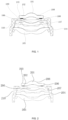
- FIG. 1 is a schematic view showing a cross-sectional structure of an optical lens according to an embodiment of the present application.
- the optical lens of the present application includes a first lens 100 and a lens assembly 110 connected to the first lens 100.
- the first lens 100 includes a first optical area 101 and a first structural area 102 surrounding the first optical area 101, and the first structural area 102 includes a height measurement area 103 not coated with an anti-reflective coating.
- the first optical area 101 and an area of the first structural area 102 other than the height measurement area 103 may be coated with an anti-reflective coating 108 to improve the transmittance of the first lens 100 to light.
- the height measurement area 103 is not coated with an anti-reflective coating, which may enable the first lens 100 to better reflect the ranging beam in the height measurement area 103, so as to help obtain a more accurate inclined posture of the first lens 100, i.e., a first posture of the first lens 100.
- the lens assembly 110 includes a lens barrel 104 and at least one second lens 105 disposed in the lens barrel 104.
- the at least one second lens 105 includes a second optical area 106 and a second structural area 107 surrounding the second optical area 106.
- the first structural area 102 is connected to an end surface 109 of the lens barrel 104 close to the first lens 100.
- the angle of the first lens 100 can be adjusted according to the obtained first posture, so that there is a relative inclination angle between the first lens 100 and the lens assembly within a predetermined threshold, so as to facilitate pre-positioning and active alignment during the subsequent manufacture of the optical lens, thereby improving the yield and efficiency of lens production.
- the predetermined threshold may be 0.1 degrees (°).
- FIG. 7 is a schematic view illustrating an overall structure of an optical lens according to an embodiment of the present application. As shown in FIG. 7 , the first lens 100 of the optical lens 1 is connected to the lens assembly 110.
- FIG. 2 is a schematic view showing a structure of an optical lens according to another embodiment of the present application.
- the optical lens of the present application includes a first lens 200 and a lens assembly 210 connected to the first lens 200.
- the first lens 200 includes a first optical area 201 and a first structural area 202 surrounding the first optical area 201, and the first structural area 202 includes a height measurement area 203 not coated with an anti-reflective coating.
- the first optical area 201 and an area of the first structural area 202 other than the height measurement area 203 may be coated with an anti-reflective coating 208 to improve the transmittance of the first lens 200 to light.
- the height measurement area 203 is not coated with an anti-reflective coating, which may enable the first lens 200 to better reflect the ranging beam in the height measurement area 203, so as to help obtain a more accurate inclined posture of the first lens 200, i.e., a first posture of the first lens 200.
- the lens assembly 210 includes a lens barrel 204 and at least one second lens 205 disposed in the lens barrel 204.
- the at least one second lens 205 includes a second optical area 206 and a second structural area 207 surrounding the second optical area 206.
- the first structural area 202 is connected to the second structural area 207 of the second lens 205 of the lens barrel 204 that is closest to the first lens 200.
- the angle of the first lens 200 can be adjusted according to the obtained first posture, so that there is a relative inclination angle between the first lens 200 and the lens assembly within a predetermined threshold, so as to facilitate pre-positioning and active alignment during the subsequent manufacture of the optical lens, thereby improving the yield and efficiency of lens production.
- the predetermined threshold may be 0.1 degrees (°). In addition, the predetermined threshold may be selected to be 0.03 degrees or 0.01 degrees according to the requirements for precision and tolerance.
- the first structural area 202 is connected to the second structural area 207 of the second lens 205 of the lens barrel 204 that is closest to the first lens 200, which can reduce the influence of the end face of the lens barrel 204 close to the first lens 100 on the assembly process of the split type optical lens.
- the height measurement area is coated with an anti-reflective coating, the light beam received by the distance measuring device at the same position will be reduced, resulting in inaccurate detection of the tilt posture of the lens. Therefore, in the present application, no anti-reflective coating is coated on the height measurement area.
- FIG. 3 is a schematic view showing a structure of a first lens according to an embodiment of the present application.
- FIG. 4 is a schematic plan view showing a first lens according to an embodiment of the present application.
- the first structural area 302 of the first lens 300 is formed around the first optical area 301.
- the height measurement area 303 is located in the first structural area 302 and may be an annular planar area.
- the height measurement area 303 being the annular planar area can ensure that the first lens 300 has a suitable light beam emission angle and emission position at any inclined posture in actual operation, so that the height measurement area 303 can reflect the ranging beam, thereby obtaining the first posture of the first lens 300.
- the length w of the annular planar area in the axial direction of the first lens 300 is 0.2 mm or more.
- Appropriately increasing the light beam reflection area of the height measurement area 303 can improve the reflection probability of the ranging beam and increase the reflection amount.
- FIG. 5 is a schematic plan view showing a first lens according to another embodiment of the present application.
- the first structural area 502 of the first lens 500 is formed around the first optical area 501.
- the height measurement area 503 is located in the first structural area 502, and the height measurement area 503 includes at least three sections of planar area spaced apart from each other.
- the height measurement area 503 is illustrated in FIG. 5 with the example of three sections of planar area spaced apart from each other.
- FIG. 6 is an enlarged schematic partial plan view showing a first lens according to another embodiment of the present application. As shown in FIG.
- the length d of the planar area in the axial direction of the first lens 500 is 0.2 mm or more, and the length s of the planar area along the peripheral direction of the first lens 500 is 0.5 mm or more.
- ranging beams reflected from multiple sections of planar area spaced apart from each other can be obtained, and the inclined posture of the first lens 500 can be accurately determined by three base points that can form a triangular area in multiple measurement positions.
- the larger planar area of the height measuring area can measure multiple positions, and can effectively improve the reflectivity of the beam.
- the height measurement area can be coated with a reflective coating to further improve the reflectivity of the height measurement area to the ranging beam, so that the ranging device can obtain enough light beams and more accurately calculate the inclined posture and spatial position of the first lens.
- the height measurement area may be located on a side of the first lens facing away from the lens assembly. For example, when the first lens is between the ranging device and the lens assembly, the height measurement area is located on the side of the first lens facing away from the lens assembly.
- the height measurement area is located on the side of first lens close to the lens assembly. For example, when the lens assembly is between the first lens and the ranging device, the height measurement area is located on the side of the first lens close to the lens assembly.
- a roughness of the height measurement area may be smaller than a roughness of other areas of the first structural area.
- the roughness of the height measurement area being too large will reduce the light beam received by the ranging device at the same position, resulting in inaccurate detection of the inclined posture of the lens.
- the height measurement area is relatively smooth and has a smaller roughness, which is advantageous to obtain the inclined posture of the first lens more accurately.
- the height measurement area may be a planar area, and the planar area may be perpendicular to the central axis of the first lens.
- the height measurement area may be located at the outer edge of the first lens. Based on the coating process of the anti-reflective coating, it is easier to avoid the anti-reflective coating if the height measurement area is located at the outer edge of the first lens.
- FIG. 8 is a flowchart showing a method of manufacturing an optical lens according to an embodiment of the present application. As shown in FIG. 8 , the manufacturing method comprises the following steps.
- Step 10 Obtain a first posture of a first lens based on a ranging beam reflected by a height measurement area of the first lens not coated with an anti-reflective coating.
- Step 20 Adjust an angle of the first lens according to first posture, so that there is a relative inclination angle between first lens and the lens assembly within a predetermined threshold.
- Step 30 Pre-position the first lens, the lens assembly and a photosensitive assembly, so that an image formed through first lens and lens assembly can be obtained on the photosensitive assembly.
- Step 40 Actively align a relative position of the first lens and the lens assembly based on the formed image.
- Step 50 Fix the first lens to the lens assembly based on the actively aligned relative position of the first lens and the lens assembly.
- the predetermined threshold may be 0.1 degrees.
- the predetermined threshold may be selected to be 0.03 degrees or 0.01 degrees according to the requirements for precision and tolerance.
- the manufacturing method of optical lens provided by the present application is used for the manufacture of a split type optical lens.
- the manufacturing method may be used for the manufacture of a split type optical lens with a single lens and a lens assembly.
- the height measurement area not coated with an anti-reflective coating can reflect more ranging beams to ensure that the ranging device can receive enough ranging beams to obtain the inclined posture of the first lens more accurately.
- step 30 if the degree of inclination of the first lens relative to the lens assembly is relatively large, or the inclination angle between the first lens and the lens assembly is greater than a certain threshold, when the first lens, the lens assembly and the photosensitive assembly are arranged along an optical axis, it is difficult for the optical lens with multiple lens assemblies to form imaging normally. At the same time, this may also result in that the imaging quality of the photosensitive assembly in step 30 is too low, and in step 40, it is difficult to determine the adjustment amount of the first lens that needs to be adjusted relative to the lens assembly. Therefore, in this embodiment, the angle of the first lens is adjusted more accurately according to the obtained first posture, so that the relative inclination angle between the first lens and the lens assembly is within a predetermined threshold. This not only facilitates the imaging of light through the first lens and the lens assembly in the subsequent pre-positioning step of lens manufacturing, but also facilitates improving the adjustment efficiency of the relative inclination angle between the first lens and the lens assembly during the lens manufacturing process.
- the angle of the first lens can be adjusted more accurately according to the obtained accurate first posture, so that the relative inclination angle between the first lens and the lens assembly may preferably be within 0.03 degrees, so as to better perform subsequent optical lens manufacturing. Further, the relative inclination angle between the first lens and the lens assembly may also preferably be within 0.01 degrees.
- actively aligning the relative position of the first lens and the lens assembly based on the formed image comprising: the photosensitive assembly being powered on to obtain images formed by multiple groups of lenses, and obtaining the imaging quality of the split type optical lens and its adjustment amount through an image algorithm such as SFR and MTF.
- FIG. 9 is a schematic view showing the adjustment direction of the first lens relative to the lens assembly during active alignment according to an embodiment of the present application. According to the adjustment amount, as shown in FIG.
- the relative inclination angle of the first lens relative to the lens assembly may be adjusted along any axial direction of x, y, and z axes, any direction perpendicular to the x, y, and z axes, or any rotation direction around the x, y, and z axes, or the relative inclination angle of the first lens relative to the lens assembly may be adjusted according to a possible combination of the above adjustment directions, wherein u, v, and w correspond to the rotation directions of x, y, and z axes, respectively.
- the imaging quality of the optical lens can be observed in real time, including optical parameters such as peak value, field curvature, astigmatism, etc.
- an adhesive is disposed on the lens assembly.
- the adhesive may be disposed on the end face of the lens barrel of the lens assembly close to the first lens, or may also be disposed on the second structural area of the second lens closest to the first lens.
- the adhesive may include a photocurable adhesive. The adhesive is cured by at least one of visible light, ultraviolet light, or baking.
- the height measurement area is an annular planar area, and the length of the annular planar area in the axial direction of the first lens is 0.2 mm or more.
- the height measurement area being the annular planar area can ensure that the first lens has a suitable light beam emission angle and emission position at any inclined posture in actual operation, so that the height measurement area can reflect the ranging beam, so as to obtain the first posture of the first lens.
- the length of the annular planar area in the axial direction of the first lens is 0.2 mm or more.
- Appropriately increasing the light beam reflection area of the height measurement area can improve the reflection probability of the ranging beam and increase the reflection amount, so as to improve the measurement accuracy of the inclined posture of the first lens, facilitating the improvement of the manufacturing efficiency of the optical lens with multiple lens assemblies.
- the height measurement area includes at least three sections of planar area spaced apart from each other. After the ranging beam is emitted to the height measurement area, ranging beams reflected from multiple sections of planar area spaced apart from each other can be obtained, and the inclined posture of the first lens can be more accurately determined through three base points that can form a triangular area in the multiple measurement positions.
- the roughness of the height measurement area is smaller than the roughness of adjacent areas of the height measurement area.
- the roughness of the light beam reflection area being too large will reduce the light beam received by the ranging device at the same position, resulting in inaccurate detection of the inclined posture of the lens.
- the height measurement area is relatively smooth and has a smaller roughness, which is advantageous to obtain the more accurate inclined posture of the first lens.
- the height measurement area is a planar area, and the planar area is perpendicular to the central axis of the first lens.
- adjusting the angle of the first lens according to the first posture comprises: obtaining a second posture of the lens assembly based on the ranging beam reflected by the lens assembly; and adjusting the angle of the first lens according to the first posture and the second posture, so that there is a relative inclination angle between the first lens and the lens assembly within a predetermined threshold.
- the first posture of the lens and the second posture of the lens assembly may be detected simultaneously, or may be detected successively. According to the first posture and the second posture, the relative inclination angle between the first lens and the lens assembly can be adjusted more accurately.
- the manufacturing method further comprises coating a reflective coating in the height measurement area, so as to further improve the reflectivity of the height measurement area to the ranging beam.
- the first lens includes a first optical area and a first structural area surrounding the first optical area, the first structural area includes a height measurement area, and the manufacturing method further comprises: by controlling an evaporation angle of an evaporation source, coating the anti-reflective coating only in the first optical area and a part of the first structural area other than the height measurement area.
- FIG. 10 is a schematic view showing a method of coating a film on a first lens provided in an embodiment of the present application. As shown in Figure 10 , by controlling the evaporation angle ⁇ of the evaporation source, the anti-reflective coating is directly coated on the first lens.
- an area with a width of at least 0.2 mm in the axial direction, which is not coated with an anti-reflective coating, can be reserved on the edge of the lens.
- the area not coated with an anti-reflective coating is used as the height measurement area of the first lens.
- the first lens includes a first optical area and a first structural area surrounding the first optical area, the first structural area includes a height measurement area, and the manufacturing method further comprises: by disposing a mask between the height measurement area and the evaporation source, coating the anti-reflective coating only in the first optical area and a part of the first structural area other than the height measurement area.
- a jig or another shielding object is used as a mask 111 (such as photoresist) to shield the height measurement area of the first lens, and then the first optical area and the part of the first structural area other than the height measurement area of the first lens are coated with an anti-reflective coating. After coating is complete, the shielding object is removed.
- the jig to shield the height measurement area, the first lens with the height measurement area can be obtained more conveniently.
- the first posture of the first lens may be obtained by a pulsed laser ranging method, a phased laser ranging method or a triangular laser ranging method.
- the present application further provides a camera module.
- FIG. 11 is a schematic view showing a structure of a camera module according to an embodiment of the present application.
- the camera module includes an optical lens 400, a lens holder 401, a filter 403, a substrate 404 and a photosensitive component 405 provided in the above embodiment.
- the optical lens 400 is fixed to the lens holder 401, and the lens holder 401 includes an opening 402 aligned with a lens of the optical lens 400.
- the filter 403 is fixed to the opening 402, and the lens holder 401 is fixed to the substrate 404.
- the photosensitive component 405 is fixed on the substrate 404 and is enclosed by the lens holder 401 and the filter 403, so as to obtain a camera module having a single lens and a lens assembly combined.
Landscapes
- Physics & Mathematics (AREA)
- General Physics & Mathematics (AREA)
- Optics & Photonics (AREA)
- Lens Barrels (AREA)
- Surface Treatment Of Optical Elements (AREA)
Claims (15)
- Une lentille optique, comprenant :une première lentille (100, 200, 300, 500), comprenant une première zone optique (101) et une première zone structurelle (102) entourant la première zone optique (101), caractérisée en ce que la première zone structurelle (102) comprend un zone de mesure de hauteur (103), dans lequel la première zone optique (101) et une zone de la première zone structurelle (102) autre que la zone de mesure de hauteur (103) sont recouvertes d'un revêtement antireflet, et la zone de mesure de hauteur (103) n'est pas recouverte d'un un revêtement antireflet et est configuré pour réfléchir un faisceau de télémétrie ; etun assemblage de lentille (110, 210), comprenant un barillet de lentille (104, 204) et au moins une deuxième lentille (105, 205) disposée dans le barillet de lentille, dans lequel la première lentille étant disposée sur l'assemblage de lentilles et étant plus proche d'un côté de l'objet que la deuxième lentille, dans lequel au moins une deuxième lentille comprend une deuxième zone optique (106) et une deuxième zone structurelle (107) entourant la deuxième zone optique, dans lequel la première zone structurelle (102) est reliée à une face d'extrémité du barillet de lentille à proximité du premier lentille ou à la deuxième zone structurelle de la deuxième lentille la plus proche de la première lentille.
- La lentille optique selon la revendication 1, dans laquelle la zone de mesure de hauteur (103) est une zone plane annulaire, et de préférence une longueur de la zone plane annulaire dans une direction axiale de la première lentille est de 0,2 mm ou plus.
- La lentille optique selon la revendication 1, dans laquelle la zone de mesure de hauteur (503) comprend au moins trois sections de zone plane espacées les unes des autres.
- La lentille optique selon la revendication 3, dans laquelle une longueur de la zone plane dans une direction axiale de la première lentille est de 0,2 mm ou plus, et une longueur de la zone plane le long d'une direction périphérique de la première lentille est de 0,5 mm ou plus.
- La lentille optique selon la revendication 1, dans laquelle la zone de mesure de hauteur (103) est recouverte d'un revêtement réfléchissant.
- La lentille optique selon la revendication 1, dans laquelle la zone de mesure de hauteur (103) est située sur un côté de la première lentille opposé à l'assemblage de lentilles.
- La lentille optique selon la revendication 1, dans laquelle la zone de mesure de hauteur (103) est située sur un côté de la première lentille proche de l'assemblage de lentilles.
- La lentille optique selon la revendication 1, dans laquelle une rugosité de la zone de mesure de hauteur (103) est inférieure à une rugosité d'autres zones de la première zone structurelle (102).
- La lentille optique selon la revendication 1, dans laquelle la zone de mesure de hauteur (103) est située au niveau d'un bord extérieur de la première lentille.
- Un procédé de fabrication d'une lentille optique, caractérisé en ce que le procédé de fabrication comprend :obtenir une première posture d'une première lentille la plus proche d'un côté de l'objet sur la base d'un faisceau de télémétrie réfléchi par une zone de mesure de hauteur (103) de la première lentille non recouverte d'un revêtement antireflet, dans lequel la première lentille comprenant une première zone optique (101) et une première zone structurelle (102) entourant la première zone optique (101), dans lequel la première zone structurelle (102) comprend la zone de mesure de hauteur (103), et la première zone optique (101) et une zone de la première zone structurelle (102) autre que la zone de mesure de hauteur (103) sont recouvertes d'un revêtement antireflet;ajuster un angle de la première lentille selon la première posture, de sorte qu'il existe un angle d'inclinaison relatif entre la première lentille et un assemblage de lentilles (110, 210) à l'intérieur d'un seuil prédéterminé, dans lequel la première lentille étant disposée sur l'assemblage de lentilles et connecté à l'assemblage de lentilles ;prépositionner la première lentille, l'assemblage de lentille et un assemblage photosensible de telle sorte qu'une image formée à travers la première lentille et l'assemblage de lentille puisse être obtenue sur l'assemblage photosensible ;aligner activement une position relative de la première lentille et de l'assemblage de lentille sur la base de l'image formée ; etfixer la première lentille à l'assemblage de lentilles sur la base de la position relative activement alignée de la première lentille et de l'assemblage de lentilles.
- La procédé de fabrication selon la revendication 10, dans lequel ledit réglage de l'angle de la première lentille selon la première posture comprend :obtenir une deuxième posture de l'assemblage de lentille (110, 210) sur la base du faisceau de télémétrie réfléchi par l'assemblage de lentille ; etajuster l'angle de la première lentille en fonction de la première posture et de la deuxième posture, de sorte qu'il existe un angle d'inclinaison relatif entre la première lentille et l'assemblage de lentille dans le seuil prédéterminé.
- Le procédé de fabrication selon la revendication 10, dans lequel le procédé de fabrication comprend en outre :
recouvrir un revêtement réfléchissant dans la zone de mesure de hauteur (103). - Le procédé de fabrication selon la revendication 10, dans lequel le procédé de fabrication comprend en outre :
en contrôlant un angle d'évaporation d'une source d'évaporation, recouvrir le revêtement antireflet uniquement dans la première zone optique (101) et une partie de la première zone structurelle (102) autre que la zone de mesure de hauteur (103). - Le procédé de fabrication selon la revendication 10, dans lequel le procédé de fabrication comprend en outre :
en disposant un masque entre la zone de mesure de hauteur (103) et une source d'évaporation, recouvrir le revêtement antireflet uniquement dans la première zone optique (101) et une partie de la première zone structurelle (102) autre que la zone de mesure de hauteur (103). - Un module de caméra, dans lequel le module de caméra comprend :la lentille de caméra optique selon l'une quelconque des revendications 1 à 9 ; etun support de lentille (401), auquel la lentille optique est fixée, dans lequel le support de lentille (401) comprenant une ouverture (402) alignée avec une lentille de la lentille optique ;un filtre (403) fixé à l'ouverture ;un substrat (404) sur lequel le support de lentille (401) est fixé ; etun composant photosensible (405) fixé sur le substrat (404) et entouré par le support de lentille (401) et le filtre (403).
Applications Claiming Priority (3)
| Application Number | Priority Date | Filing Date | Title |
|---|---|---|---|
| CN201921469888.8U CN210666151U (zh) | 2019-09-05 | 2019-09-05 | 光学镜头及摄像模组 |
| CN201910836853.1A CN112540433B (zh) | 2019-09-05 | 2019-09-05 | 光学镜头、光学镜头的制造方法及摄像模组 |
| PCT/CN2020/112055 WO2021043079A1 (fr) | 2019-09-05 | 2020-08-28 | Lentille optique, procédé de fabrication de lentille optique et module de caméra |
Publications (3)
| Publication Number | Publication Date |
|---|---|
| EP4009089A1 EP4009089A1 (fr) | 2022-06-08 |
| EP4009089A4 EP4009089A4 (fr) | 2022-09-14 |
| EP4009089B1 true EP4009089B1 (fr) | 2025-03-19 |
Family
ID=74852746
Family Applications (1)
| Application Number | Title | Priority Date | Filing Date |
|---|---|---|---|
| EP20861769.6A Active EP4009089B1 (fr) | 2019-09-05 | 2020-08-28 | Lentille optique, procédé de fabrication de lentille optique et module de caméra |
Country Status (3)
| Country | Link |
|---|---|
| US (1) | US12468113B2 (fr) |
| EP (1) | EP4009089B1 (fr) |
| WO (1) | WO2021043079A1 (fr) |
Family Cites Families (7)
| Publication number | Priority date | Publication date | Assignee | Title |
|---|---|---|---|---|
| JP2003294915A (ja) | 2002-04-04 | 2003-10-15 | Sankyo Seiki Mfg Co Ltd | 光ヘッド装置用対物レンズおよびその傾角調整方法 |
| JP2004030770A (ja) | 2002-06-25 | 2004-01-29 | Enplas Corp | 対物レンズおよびそのチルト調整方法 |
| JP5425392B2 (ja) | 2007-12-07 | 2014-02-26 | シャープ株式会社 | レンズユニットおよびカメラモジュール |
| CN105445888B (zh) * | 2015-12-21 | 2020-04-03 | 宁波舜宇光电信息有限公司 | 可调光学镜头和摄像模组及其校准方法 |
| CN208432776U (zh) | 2018-04-28 | 2019-01-25 | 宁波舜宇光电信息有限公司 | 光学镜头及摄像模组 |
| CN110109226B (zh) * | 2019-04-12 | 2021-11-12 | 深圳市万普拉斯科技有限公司 | 镜头结构、摄像头模组及移动终端 |
| CN210666151U (zh) | 2019-09-05 | 2020-06-02 | 宁波舜宇光电信息有限公司 | 光学镜头及摄像模组 |
-
2020
- 2020-08-28 EP EP20861769.6A patent/EP4009089B1/fr active Active
- 2020-08-28 US US17/640,526 patent/US12468113B2/en active Active
- 2020-08-28 WO PCT/CN2020/112055 patent/WO2021043079A1/fr not_active Ceased
Also Published As
| Publication number | Publication date |
|---|---|
| US12468113B2 (en) | 2025-11-11 |
| EP4009089A4 (fr) | 2022-09-14 |
| EP4009089A1 (fr) | 2022-06-08 |
| WO2021043079A1 (fr) | 2021-03-11 |
| US20220334342A1 (en) | 2022-10-20 |
Similar Documents
| Publication | Publication Date | Title |
|---|---|---|
| US6526089B1 (en) | Laser marker and method of light spot adjustment therefor | |
| CN110824653B (zh) | 光学镜头、摄像模组及其组装方法 | |
| US9268240B2 (en) | Exposure apparatus, exposure method, and device fabrication method | |
| JP6463935B2 (ja) | 露光装置、露光方法、およびデバイス製造方法 | |
| CN112433365A (zh) | 一种基于锥镜的光束指向控制系统及其偏差修正方法 | |
| CN210666151U (zh) | 光学镜头及摄像模组 | |
| CN103226240B (zh) | 一种多通道正入射成像系统及其装调方法 | |
| US6937345B2 (en) | Measuring system for measuring performance of imaging optical system | |
| CN110631477A (zh) | 用于测量技术的光学成像单元和系统 | |
| CN112492192A (zh) | 用于adas的相机聚焦 | |
| CN101019057A (zh) | 透镜系统调整装置和使用该装置的透镜系统调整方法以及摄像装置的制造装置和摄像装置的制造方法 | |
| CN112558264A (zh) | 分体式光学镜头和摄像模组及其组装方法 | |
| US11365964B2 (en) | Stitching-measurement device and stitching-measurement method | |
| US10884236B2 (en) | Optical device, projection optical system, exposure apparatus using the same, and method for manufacturing article | |
| US10133177B2 (en) | Exposure apparatus, exposure method, and article manufacturing method | |
| EP4009089B1 (fr) | Lentille optique, procédé de fabrication de lentille optique et module de caméra | |
| WO2025219305A1 (fr) | Dispositif de capture d'images de micro-et/ou nanostructures | |
| US12269115B2 (en) | Laser processing apparatus | |
| CN112197940B (zh) | 一种单光路精确测量近远场基准与准直装置 | |
| CN112540433B (zh) | 光学镜头、光学镜头的制造方法及摄像模组 | |
| CN117234046A (zh) | 一种曝光设备及离焦补偿方法 | |
| US9557523B2 (en) | Focusing method, focusing apparatus, exposure method, and device manufacturing method | |
| JPS6211324B2 (fr) | ||
| TWI572991B (zh) | 曝光設備、曝光方法、和製造裝置的方法 | |
| JP6829514B1 (ja) | 走査光学系の製造方法 |
Legal Events
| Date | Code | Title | Description |
|---|---|---|---|
| STAA | Information on the status of an ep patent application or granted ep patent |
Free format text: STATUS: THE INTERNATIONAL PUBLICATION HAS BEEN MADE |
|
| PUAI | Public reference made under article 153(3) epc to a published international application that has entered the european phase |
Free format text: ORIGINAL CODE: 0009012 |
|
| STAA | Information on the status of an ep patent application or granted ep patent |
Free format text: STATUS: REQUEST FOR EXAMINATION WAS MADE |
|
| 17P | Request for examination filed |
Effective date: 20220302 |
|
| AK | Designated contracting states |
Kind code of ref document: A1 Designated state(s): AL AT BE BG CH CY CZ DE DK EE ES FI FR GB GR HR HU IE IS IT LI LT LU LV MC MK MT NL NO PL PT RO RS SE SI SK SM TR |
|
| A4 | Supplementary search report drawn up and despatched |
Effective date: 20220812 |
|
| RIC1 | Information provided on ipc code assigned before grant |
Ipc: G02B 27/62 20060101ALI20220808BHEP Ipc: G02B 7/00 20210101ALI20220808BHEP Ipc: H04N 5/225 20060101ALI20220808BHEP Ipc: G02B 1/11 20150101ALI20220808BHEP Ipc: G02B 7/02 20210101AFI20220808BHEP |
|
| DAV | Request for validation of the european patent (deleted) | ||
| DAX | Request for extension of the european patent (deleted) | ||
| P01 | Opt-out of the competence of the unified patent court (upc) registered |
Effective date: 20230524 |
|
| GRAP | Despatch of communication of intention to grant a patent |
Free format text: ORIGINAL CODE: EPIDOSNIGR1 |
|
| STAA | Information on the status of an ep patent application or granted ep patent |
Free format text: STATUS: GRANT OF PATENT IS INTENDED |
|
| RIC1 | Information provided on ipc code assigned before grant |
Ipc: G02B 27/62 20060101ALI20240913BHEP Ipc: G02B 7/00 20210101ALI20240913BHEP Ipc: G02B 1/11 20150101ALI20240913BHEP Ipc: G02B 7/02 20210101AFI20240913BHEP |
|
| INTG | Intention to grant announced |
Effective date: 20241018 |
|
| GRAS | Grant fee paid |
Free format text: ORIGINAL CODE: EPIDOSNIGR3 |
|
| GRAA | (expected) grant |
Free format text: ORIGINAL CODE: 0009210 |
|
| STAA | Information on the status of an ep patent application or granted ep patent |
Free format text: STATUS: THE PATENT HAS BEEN GRANTED |
|
| AK | Designated contracting states |
Kind code of ref document: B1 Designated state(s): AL AT BE BG CH CY CZ DE DK EE ES FI FR GB GR HR HU IE IS IT LI LT LU LV MC MK MT NL NO PL PT RO RS SE SI SK SM TR |
|
| REG | Reference to a national code |
Ref country code: GB Ref legal event code: FG4D |
|
| REG | Reference to a national code |
Ref country code: CH Ref legal event code: EP |
|
| REG | Reference to a national code |
Ref country code: DE Ref legal event code: R096 Ref document number: 602020048091 Country of ref document: DE |
|
| REG | Reference to a national code |
Ref country code: IE Ref legal event code: FG4D |
|
| PG25 | Lapsed in a contracting state [announced via postgrant information from national office to epo] |
Ref country code: RS Free format text: LAPSE BECAUSE OF FAILURE TO SUBMIT A TRANSLATION OF THE DESCRIPTION OR TO PAY THE FEE WITHIN THE PRESCRIBED TIME-LIMIT Effective date: 20250619 |
|
| PG25 | Lapsed in a contracting state [announced via postgrant information from national office to epo] |
Ref country code: FI Free format text: LAPSE BECAUSE OF FAILURE TO SUBMIT A TRANSLATION OF THE DESCRIPTION OR TO PAY THE FEE WITHIN THE PRESCRIBED TIME-LIMIT Effective date: 20250319 |
|
| REG | Reference to a national code |
Ref country code: LT Ref legal event code: MG9D |
|
| PG25 | Lapsed in a contracting state [announced via postgrant information from national office to epo] |
Ref country code: NO Free format text: LAPSE BECAUSE OF FAILURE TO SUBMIT A TRANSLATION OF THE DESCRIPTION OR TO PAY THE FEE WITHIN THE PRESCRIBED TIME-LIMIT Effective date: 20250619 |
|
| PG25 | Lapsed in a contracting state [announced via postgrant information from national office to epo] |
Ref country code: HR Free format text: LAPSE BECAUSE OF FAILURE TO SUBMIT A TRANSLATION OF THE DESCRIPTION OR TO PAY THE FEE WITHIN THE PRESCRIBED TIME-LIMIT Effective date: 20250319 |
|
| PG25 | Lapsed in a contracting state [announced via postgrant information from national office to epo] |
Ref country code: LV Free format text: LAPSE BECAUSE OF FAILURE TO SUBMIT A TRANSLATION OF THE DESCRIPTION OR TO PAY THE FEE WITHIN THE PRESCRIBED TIME-LIMIT Effective date: 20250319 |
|
| PG25 | Lapsed in a contracting state [announced via postgrant information from national office to epo] |
Ref country code: GR Free format text: LAPSE BECAUSE OF FAILURE TO SUBMIT A TRANSLATION OF THE DESCRIPTION OR TO PAY THE FEE WITHIN THE PRESCRIBED TIME-LIMIT Effective date: 20250620 Ref country code: BG Free format text: LAPSE BECAUSE OF FAILURE TO SUBMIT A TRANSLATION OF THE DESCRIPTION OR TO PAY THE FEE WITHIN THE PRESCRIBED TIME-LIMIT Effective date: 20250319 |
|
| REG | Reference to a national code |
Ref country code: NL Ref legal event code: MP Effective date: 20250319 |
|
| REG | Reference to a national code |
Ref country code: AT Ref legal event code: MK05 Ref document number: 1777392 Country of ref document: AT Kind code of ref document: T Effective date: 20250319 |
|
| PG25 | Lapsed in a contracting state [announced via postgrant information from national office to epo] |
Ref country code: NL Free format text: LAPSE BECAUSE OF FAILURE TO SUBMIT A TRANSLATION OF THE DESCRIPTION OR TO PAY THE FEE WITHIN THE PRESCRIBED TIME-LIMIT Effective date: 20250319 |
|
| PG25 | Lapsed in a contracting state [announced via postgrant information from national office to epo] |
Ref country code: SE Free format text: LAPSE BECAUSE OF FAILURE TO SUBMIT A TRANSLATION OF THE DESCRIPTION OR TO PAY THE FEE WITHIN THE PRESCRIBED TIME-LIMIT Effective date: 20250319 |
|
| PG25 | Lapsed in a contracting state [announced via postgrant information from national office to epo] |
Ref country code: SM Free format text: LAPSE BECAUSE OF FAILURE TO SUBMIT A TRANSLATION OF THE DESCRIPTION OR TO PAY THE FEE WITHIN THE PRESCRIBED TIME-LIMIT Effective date: 20250319 |
|
| PG25 | Lapsed in a contracting state [announced via postgrant information from national office to epo] |
Ref country code: ES Free format text: LAPSE BECAUSE OF FAILURE TO SUBMIT A TRANSLATION OF THE DESCRIPTION OR TO PAY THE FEE WITHIN THE PRESCRIBED TIME-LIMIT Effective date: 20250319 Ref country code: PT Free format text: LAPSE BECAUSE OF FAILURE TO SUBMIT A TRANSLATION OF THE DESCRIPTION OR TO PAY THE FEE WITHIN THE PRESCRIBED TIME-LIMIT Effective date: 20250721 |
|
| PGFP | Annual fee paid to national office [announced via postgrant information from national office to epo] |
Ref country code: DE Payment date: 20250730 Year of fee payment: 6 |
|
| PG25 | Lapsed in a contracting state [announced via postgrant information from national office to epo] |
Ref country code: IT Free format text: LAPSE BECAUSE OF FAILURE TO SUBMIT A TRANSLATION OF THE DESCRIPTION OR TO PAY THE FEE WITHIN THE PRESCRIBED TIME-LIMIT Effective date: 20250319 Ref country code: PL Free format text: LAPSE BECAUSE OF FAILURE TO SUBMIT A TRANSLATION OF THE DESCRIPTION OR TO PAY THE FEE WITHIN THE PRESCRIBED TIME-LIMIT Effective date: 20250319 |
|
| PGFP | Annual fee paid to national office [announced via postgrant information from national office to epo] |
Ref country code: GB Payment date: 20250731 Year of fee payment: 6 |
|
| PG25 | Lapsed in a contracting state [announced via postgrant information from national office to epo] |
Ref country code: AT Free format text: LAPSE BECAUSE OF FAILURE TO SUBMIT A TRANSLATION OF THE DESCRIPTION OR TO PAY THE FEE WITHIN THE PRESCRIBED TIME-LIMIT Effective date: 20250319 |
|
| PGFP | Annual fee paid to national office [announced via postgrant information from national office to epo] |
Ref country code: FR Payment date: 20250808 Year of fee payment: 6 |
|
| PG25 | Lapsed in a contracting state [announced via postgrant information from national office to epo] |
Ref country code: EE Free format text: LAPSE BECAUSE OF FAILURE TO SUBMIT A TRANSLATION OF THE DESCRIPTION OR TO PAY THE FEE WITHIN THE PRESCRIBED TIME-LIMIT Effective date: 20250319 Ref country code: CZ Free format text: LAPSE BECAUSE OF FAILURE TO SUBMIT A TRANSLATION OF THE DESCRIPTION OR TO PAY THE FEE WITHIN THE PRESCRIBED TIME-LIMIT Effective date: 20250319 |
|
| PG25 | Lapsed in a contracting state [announced via postgrant information from national office to epo] |
Ref country code: RO Free format text: LAPSE BECAUSE OF FAILURE TO SUBMIT A TRANSLATION OF THE DESCRIPTION OR TO PAY THE FEE WITHIN THE PRESCRIBED TIME-LIMIT Effective date: 20250319 |
|
| PG25 | Lapsed in a contracting state [announced via postgrant information from national office to epo] |
Ref country code: SK Free format text: LAPSE BECAUSE OF FAILURE TO SUBMIT A TRANSLATION OF THE DESCRIPTION OR TO PAY THE FEE WITHIN THE PRESCRIBED TIME-LIMIT Effective date: 20250319 |
|
| PG25 | Lapsed in a contracting state [announced via postgrant information from national office to epo] |
Ref country code: IS Free format text: LAPSE BECAUSE OF FAILURE TO SUBMIT A TRANSLATION OF THE DESCRIPTION OR TO PAY THE FEE WITHIN THE PRESCRIBED TIME-LIMIT Effective date: 20250719 |
|
| REG | Reference to a national code |
Ref country code: DE Ref legal event code: R097 Ref document number: 602020048091 Country of ref document: DE |
|
| PG25 | Lapsed in a contracting state [announced via postgrant information from national office to epo] |
Ref country code: DK Free format text: LAPSE BECAUSE OF FAILURE TO SUBMIT A TRANSLATION OF THE DESCRIPTION OR TO PAY THE FEE WITHIN THE PRESCRIBED TIME-LIMIT Effective date: 20250319 |
|
| PLBE | No opposition filed within time limit |
Free format text: ORIGINAL CODE: 0009261 |
|
| STAA | Information on the status of an ep patent application or granted ep patent |
Free format text: STATUS: NO OPPOSITION FILED WITHIN TIME LIMIT |
|
| REG | Reference to a national code |
Ref country code: CH Ref legal event code: L10 Free format text: ST27 STATUS EVENT CODE: U-0-0-L10-L00 (AS PROVIDED BY THE NATIONAL OFFICE) Effective date: 20260128 |
|
| 26N | No opposition filed |
Effective date: 20251222 |
|
| REG | Reference to a national code |
Ref country code: CH Ref legal event code: H13 Free format text: ST27 STATUS EVENT CODE: U-0-0-H10-H13 (AS PROVIDED BY THE NATIONAL OFFICE) Effective date: 20260324 |
|
| PG25 | Lapsed in a contracting state [announced via postgrant information from national office to epo] |
Ref country code: MC Free format text: LAPSE BECAUSE OF FAILURE TO SUBMIT A TRANSLATION OF THE DESCRIPTION OR TO PAY THE FEE WITHIN THE PRESCRIBED TIME-LIMIT Effective date: 20250319 |
|
| PG25 | Lapsed in a contracting state [announced via postgrant information from national office to epo] |
Ref country code: LU Free format text: LAPSE BECAUSE OF NON-PAYMENT OF DUE FEES Effective date: 20250828 |
|
| PG25 | Lapsed in a contracting state [announced via postgrant information from national office to epo] |
Ref country code: CH Free format text: LAPSE BECAUSE OF NON-PAYMENT OF DUE FEES Effective date: 20250831 |