EP4009238B1 - Procédé et système de conception de matériaux structurés artificiellement avec fonctionnalités personnalisées - Google Patents
Procédé et système de conception de matériaux structurés artificiellement avec fonctionnalités personnalisées Download PDFInfo
- Publication number
- EP4009238B1 EP4009238B1 EP21164980.1A EP21164980A EP4009238B1 EP 4009238 B1 EP4009238 B1 EP 4009238B1 EP 21164980 A EP21164980 A EP 21164980A EP 4009238 B1 EP4009238 B1 EP 4009238B1
- Authority
- EP
- European Patent Office
- Prior art keywords
- decoder
- encoder
- artificially structured
- network
- biases
- Prior art date
- Legal status (The legal status is an assumption and is not a legal conclusion. Google has not performed a legal analysis and makes no representation as to the accuracy of the status listed.)
- Active
Links
Images




Classifications
-
- G—PHYSICS
- G02—OPTICS
- G02B—OPTICAL ELEMENTS, SYSTEMS OR APPARATUS
- G02B1/00—Optical elements characterised by the material of which they are made; Optical coatings for optical elements
- G02B1/002—Optical elements characterised by the material of which they are made; Optical coatings for optical elements made of materials engineered to provide properties not available in nature, e.g. metamaterials
-
- G—PHYSICS
- G06—COMPUTING OR CALCULATING; COUNTING
- G06F—ELECTRIC DIGITAL DATA PROCESSING
- G06F30/00—Computer-aided design [CAD]
- G06F30/20—Design optimisation, verification or simulation
- G06F30/27—Design optimisation, verification or simulation using machine learning, e.g. artificial intelligence, neural networks, support vector machines [SVM] or training a model
-
- G—PHYSICS
- G06—COMPUTING OR CALCULATING; COUNTING
- G06N—COMPUTING ARRANGEMENTS BASED ON SPECIFIC COMPUTATIONAL MODELS
- G06N3/00—Computing arrangements based on biological models
- G06N3/02—Neural networks
- G06N3/04—Architecture, e.g. interconnection topology
- G06N3/044—Recurrent networks, e.g. Hopfield networks
-
- G—PHYSICS
- G06—COMPUTING OR CALCULATING; COUNTING
- G06N—COMPUTING ARRANGEMENTS BASED ON SPECIFIC COMPUTATIONAL MODELS
- G06N3/00—Computing arrangements based on biological models
- G06N3/02—Neural networks
- G06N3/04—Architecture, e.g. interconnection topology
- G06N3/044—Recurrent networks, e.g. Hopfield networks
- G06N3/0442—Recurrent networks, e.g. Hopfield networks characterised by memory or gating, e.g. long short-term memory [LSTM] or gated recurrent units [GRU]
-
- G—PHYSICS
- G06—COMPUTING OR CALCULATING; COUNTING
- G06N—COMPUTING ARRANGEMENTS BASED ON SPECIFIC COMPUTATIONAL MODELS
- G06N3/00—Computing arrangements based on biological models
- G06N3/02—Neural networks
- G06N3/04—Architecture, e.g. interconnection topology
- G06N3/045—Combinations of networks
-
- G—PHYSICS
- G06—COMPUTING OR CALCULATING; COUNTING
- G06N—COMPUTING ARRANGEMENTS BASED ON SPECIFIC COMPUTATIONAL MODELS
- G06N3/00—Computing arrangements based on biological models
- G06N3/02—Neural networks
- G06N3/04—Architecture, e.g. interconnection topology
- G06N3/045—Combinations of networks
- G06N3/0455—Auto-encoder networks; Encoder-decoder networks
-
- G—PHYSICS
- G06—COMPUTING OR CALCULATING; COUNTING
- G06N—COMPUTING ARRANGEMENTS BASED ON SPECIFIC COMPUTATIONAL MODELS
- G06N3/00—Computing arrangements based on biological models
- G06N3/02—Neural networks
- G06N3/08—Learning methods
-
- G—PHYSICS
- G06—COMPUTING OR CALCULATING; COUNTING
- G06N—COMPUTING ARRANGEMENTS BASED ON SPECIFIC COMPUTATIONAL MODELS
- G06N3/00—Computing arrangements based on biological models
- G06N3/02—Neural networks
- G06N3/08—Learning methods
- G06N3/09—Supervised learning
Definitions
- the disclosure herein generally relates to the field of designing artificially structured materials and, more particularly, to a method and system for designing artificially structured materials, such as metamaterials, with customized functionalities.
- Metamaterials are materials whose fundamental structural unit (or unit cell) has dimensions on spatial scales corresponding to fractional orders of the interrogating wavelength(s) (or the wavelengths of interest) and exhibit behavior that is strongly influenced by its structure. Metamaterials are not found in nature, i.e., are created artificially and offer customizable properties (primarily electromagnetic or EM response).
- Optical metamaterials (MMs) are artificially structured composites that demonstrate customizable electromagnetic (EM) properties that stem from morphological feature dimensions of the order of the interrogating wavelength.
- MM devices are composed of periodic 2D or 3D arrays of subwavelength conducting elements and exhibit lightmatter interactions that enable the manipulation of the effective electrical permittivity and effective magnetic permeability, therefore opening up new paths for versatile, photonic devices.
- Metamaterials have vast scope for a multitude of applications across domains as diverse as high-speed communications, photovoltaics, novel healthcare devices, stealth applications for defense amongst others, however, their technology penetration has been limited so far due to complex design processes that require advanced skills and knowledge base(s).
- the artificially structured materials design process relies heavily on the knowledge and intuitive reasoning of a researcher as achieving a target spectral behavior involves iteratively tweaking the design till the outcome is satisfactory.
- standard numerical techniques such as the finite-difference time domain method, boundary element method are employed for solving the Maxwell's equations for obtaining the spectral response.
- commercially available EM solver software packages have been widely adopted by the artificially structured materials community for designing metamaterials but there too, only a fraction of the parameter space can be explored with conventional computational hardware.
- Non-patent literature DIANJING LID ET AL "Training deep neural networks for the inverse design of nanophotonic structures",CONFERENCE ON LASERS AND ELECTRO-OPTICS, 1 January 2019 (2019-01-01), page JF2F.4, Washington, D.C ., discloses a tandem network structure cascading an inverse-design network with a forward-modeling network.
- a system for designing artificially structured materials comprises an input/output interface, one or more hardware processors, and a memory.
- the input/output interface configured to collate a set of requirements from a user based on an intended use case, wherein the set of requirements comprises one or more of a set of dimensional parameters, field profiles, or field resonances.
- the memory in communication with the one or more hardware processors, wherein the one or more first hardware processors are configured to execute programmed instructions stored in the memory, to: create a dataset corresponding to a structure of the artificially structured materials using the set of requirements; train a forward model using the dataset, wherein the set of dimensional parameters are provided as input and their corresponding desired electromagnetic response as output using a coupled artificial neural network and sequence model based architecture; save weights and biases for the forward model; fix the weights and the biases of a decoder part in an encoder-decoder tandem network from the saved weights and the biases of the forward model; train the encoder-decoder tandem network for an inverse problem using a single input multiple output model with the desired electromagnetic response as input and an output electromagnetic response at a time distributed layer of the encoder-decoder tandem network in the end and the dimension of artificially structured materials at a mid-dense layer of the encoder-decoder tandem network as output; save the weights and the biases of the encoder part from
- a method for designing artificially structured materials is provided. Initially, a set of requirements re collated from a user based on an intended use case, wherein the set of requirements comprises one or more of a set of dimensional parameters, field profiles, or field resonances. Further, dataset corresponding to a structure of the artificially structured materials is created using the set of requirements. In the next step, a forward model is trained using the dataset, wherein the set of dimensional parameters are provided as input and their corresponding desired electromagnetic response as output using a coupled artificial neural network and sequence model based architecture. Weights and biases for the forward model is then saved.
- the weights and the biases of a decoder part is fixed in an encoder-decoder tandem network from the saved weights and the biases of the forward model. Later, the encoder-decoder tandem network is trained for an inverse problem using a single input multiple output model with the desired electromagnetic response as input and an output electromagnetic response at a time distributed layer of the encoder-decoder tandem network in the end and the dimension of artificially structured materials at a mid-dense layer of the encoder-decoder tandem network as output. In the next step, the weights and the biases of the encoder part is saved from the trained encoder-decoder tandem network.
- the desired electromagnetic response is provided as input to the trained encoder-decoder tandem network to obtain a final set of dimensions from the mid-dense layer of the encoder-decoder tandem network.
- the artificially structured material is designed using the final set of dimensions.
- one or more non-transitory machine readable information storage mediums comprising one or more instructions which when executed by one or more hardware processors cause designing of artificially structured materials.
- a set of requirements re collated from a user based on an intended use case, wherein the set of requirements comprises one or more of a set of dimensional parameters, field profiles, or field resonances.
- dataset corresponding to a structure of the artificially structured materials is created using the set of requirements.
- a forward model is trained using the dataset, wherein the set of dimensional parameters are provided as input and their corresponding desired electromagnetic response as output using a coupled artificial neural network and sequence model based architecture. Weights and biases for the forward model is then saved.
- the weights and the biases of a decoder part is fixed in an encoder-decoder tandem network from the saved weights and the biases of the forward model. Later, the encoder-decoder tandem network is trained for an inverse problem using a single input multiple output model with the desired electromagnetic response as input and an output electromagnetic response at a time distributed layer of the encoder-decoder tandem network in the end and the dimension of artificially structured materials at a mid-dense layer of the encoder-decoder tandem network as output. In the next step, the weights and the biases of the encoder part is saved from the trained encoder-decoder tandem network.
- the desired electromagnetic response is provided as input to the trained encoder-decoder tandem network to obtain a final set of dimensions from the mid-dense layer of the encoder-decoder tandem network.
- the artificially structured material is designed using the final set of dimensions.
- the existing methodologies for designing the artificially structured metamaterials employ complex numerical modeling tools (e.g. finite element). Further, the existing methodologies lack a suitable method to specify requirements in multiple formats (geometrical parameters, field profiles, field resonances etc.). There is also lack of ability to accept a manually defined spectrum from the user and seek a suitable structure for the electromagnetic response by using multiple libraries using techniques such as deep learning, machine learning etc. Further the existing design methodologies lack ability to scan multidimensional parameter spaces (feature geometries, EM field profiles, electric and magnetic field resonances) in order to provide an optimal solution.
- a system 100 provides a technical solution to the above mentioned technical problems.
- the system is configured to design artificially structured materials with customized functionalities.
- the present disclosure provides an integrated and intelligent, data-driven framework for design, development and deployment of the artificially structured materials.
- the present disclosure provides: (i) comprehensive design system and methodologies that help a user to rapidly converge on the right design for a desired application or functionality and (ii) Design system that does not require complex modeling techniques and advanced computational resources (high performance/exascale computing).
- the system 100 is utilizing an approach based on neural networks for approximating the electromagnetic (EM) responses of artificially structured materials.
- the artificially structured material is a mesoscale, split-ring resonator photonic metamaterials.
- SIMO single-input, multi-output
- architecture learns the geometry of the designs from the training data as opposed to abstract features thereby addressing both the forward and the inverse design problem with great promise.
- the method used in the present disclosure is faster and computationally less expensive than standard metamaterial simulations using first principles.
- FIG. 1 through FIG. 7B where similar reference characters denote corresponding features consistently throughout the figures, there are shown preferred embodiments and these embodiments are described in the context of the following exemplary system and/or method.
- FIG. 1 a network diagram of the system 100 for designing artificially structured materials with customized functionalities is shown in FIG. 1 .
- the system 100 comprises one or more computing devices 102, such as a laptop computer, a desktop computer, a notebook, a workstation, a cloud-based computing environment and the like.
- the system 100 may be accessed through one or more input/output interfaces 104, collectively referred to as I/O interface 104 or user interface 104.
- I/O interface 104 may include, but are not limited to, a user interface, a portable computer, a personal digital assistant, a handheld device, a smartphone, a tablet computer, a workstation and the like.
- the I/O interface 104 are communicatively coupled to the system 100 through a network 106.
- the network 106 may be a wireless or a wired network, or a combination thereof.
- the network 106 can be implemented as a computer network, as one of the different types of networks, such as virtual private network (VPN), intranet, local area network (LAN), wide area network (WAN), the internet, and such.
- the network 106 may either be a dedicated network or a shared network, which represents an association of the different types of networks that use a variety of protocols, for example, Hypertext Transfer Protocol (HTTP), Transmission Control Protocol/Internet Protocol (TCP/IP), and Wireless Application Protocol (WAP), to communicate with each other.
- the network 106 may include a variety of network devices, including routers, bridges, servers, computing devices, storage devices. The network devices within the network 106 may interact with the system 100 through communication links.
- the system 100 may be implemented in a workstation, a mainframe computer, a server, and a network server.
- the computing device 102 further comprises one or more hardware processors 108, one or more memory 110, hereinafter referred as a memory 110 and a data repository 112, for example, a repository 112.
- the memory 110 is in communication with the one or more hardware processors 108, wherein the one or more hardware processors 108 are configured to execute programmed instructions stored in the memory 110, to perform various functions as explained in the later part of the disclosure.
- the repository 112 may store data processed, received, and generated by the system 100.
- the system 100 supports various connectivity options such as BEUETOOTH ® , USB, ZigBee and other cellular services.
- the network environment enables connection of various components of the system 100 using any communication link including Internet, WAN, MAN, and so on.
- the system 100 is implemented to operate as a stand-alone device.
- the system 100 may be implemented to work as a loosely coupled device to a smart computing environment. The components and functionalities of the system 100 are described further in detail.
- the system 100 is configured to provide end-to-end workflow from collating the requirement specifications from the user (based on the intended use case such as solar energy harvesting, biological sensing, thermos-photovoltaics, photo-detection, creation of imaging devices, absorption filtering and stealth technology) to generating a device design for the intended functionality with visualization of the resulting solution space.
- the intended use case such as solar energy harvesting, biological sensing, thermos-photovoltaics, photo-detection, creation of imaging devices, absorption filtering and stealth technology
- the system 100 comprises two aspects: a forward problem (predicting the electromagnetic response for a given geometry) as well as an inverse problem (generating the structural parameters for a desired electromagnetic response).
- the workflow of the present methodology for designing the artificially structured materials is divided into two: First, the training of a forward model with the geometry as input and the corresponding spectrum as output, and second, posing the training approach for the inverse problem as a single-input, multi-output (SIMO) model using a tandem network of an encoder and a decoder with sequential input data (spectral information in this case).
- the dimensions and the spectra are outputs of the trained inverse model.
- the combined loss is controlled by fixing the weights and biases of decoder with the pre-trained forward multi-layer perceptron - long short term memory (MLP-LSTM) network (dimensions-sequence).
- MLP-LSTM pre-trained forward multi-layer perceptron - long short term memory
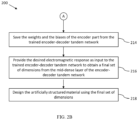
- FIG. 2A-2B a flow diagram of a method 200 for designing artificially structured materials with customized functionalities, according to some embodiments of the present disclosure is shown in FIG. 2A-2B .
- the method 200 depicted in the flow chart may be executed by a system, for example, the system, 100 of FIG. 1 .
- the system 100 may be embodied in a computing device.
- Operations of the flowchart, and combinations of operation in the flowchart may be implemented by various means, such as hardware, firmware, processor, circuitry and/or other device associated with execution of software including one or more computer program instructions.
- one or more of the procedures described in various embodiments may be embodied by computer program instructions.
- the computer program instructions, which embody the procedures, described in various embodiments may be stored by at least one memory device of a system and executed by at least one processor in the system. Any such computer program instructions may be loaded onto a computer or other programmable system (for example, hardware) to produce a machine, such that the resulting computer or other programmable system embody means for implementing the operations specified in the flowchart.
- the operations of the method 200 are described with help of system 100. However, the operations of the method 200 can be described and/or practiced by using any other system.
- the method 200 includes collating a set of requirements from the user.
- the set of requirements comprises a set of dimensional parameters, field profiles, field resonances etc.
- the set of requirements are collated based on the intended use case such as solar energy harvesting, biological sensing, thermos-photovoltaics, photo-detection, creation of imaging devices, absorption filtering and stealth technology.
- the method 200 includes creating a dataset using the set of requirements and a set of dimensional parameters.
- the dataset consisting of the set of dimensional parameters and corresponding electromagnetic response by solving Maxwell's equation using first principles with help of a numerical simulation package.
- the dataset is stored in the data repository 112.
- the set of dimensional parameters may also be referred to as the geometry of the artificially structured materials.
- the set of dimensional parameters comprises a length, a width, a thickness of a substrate and a width of a capacitor of the artificially structured materials.
- the set of dimensional parameters may also include any other parameters which is required for designing the artificially structured materials.
- the structure of the artificially structured material is one or more of a 3 dimensional or 2 dimensional structure.
- the method 200 includes training a forward model with the set of dimensional parameters as input and their corresponding desired electromagnetic response as output using a coupled artificial neural network and a sequence model, based architecture.
- the sequence model may be one of a recurrent neural network, a long-short term memory (LSTM) network, transformer, gated recurrent unit (GRU) based recurrent neural networks, any network which can deal with sequence data.
- long-short term memory network is used as sequence model.
- Tanh activation function was used in LSTM layer. Kernel and bias regularization is used for preventing overfitting.
- ReLu activation function is used throughout dense layers to obtain the value between 0 and 1 in the hidden layers. Time distributed layer is used for wrapping the output of LSTM layers.
- the method 200 includes saving weights and biases for the forward model.
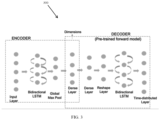
- the method 200 includes fixing the weights and the biases of a decoder part in an encoder-decoder tandem network 300 or architecture from the saved weights and the biases of the forward model as shown in FIG. 3 .
- the method includes training the encoder-decoder tandem network 300 for an inverse problem using a single input multiple output (SIMO) model with the desired electromagnetic response as input and an output electromagnetic response at a time distributed layer of the encoder-decoder tandem network 300 in the end and the dimension of artificially structured materials at a mid-dense layer of the encoder-decoder tandem network 300 as output.
- SIMO single input multiple output
- the method 200 includes saving the weights and the biases of the encoder part from the trained encoder-decoder tandem network 300.
- the method 200 includes providing the desired electromagnetic response as input to the trained encoder-decoder tandem network 300 to obtain a final set of dimensions from the mid-dense layer of the encoder-decoder tandem network 300.
- the method 200 includes designing the artificially structured material using the final set of dimensions.
- the system 100 is also configured to visualize the designed artificially structured materials on a visualization tool for performing analysis.
- the system 100 is further configured to pre-process the dataset prepared at step 202 of the method 200 to remove undesired dimensional parameters out of the set of dimensional parameters.
- the system 100 can also be explained with the help of a metamaterial (MM) device based on split-ring resonators (SRRs).
- SRR has been designed for near-unity absorption (97%) at 1.6 terahertz (THz).
- the split-ring resonators (SRRs) are a MM design element type that demonstrates negative permeability and supports inductive-capacitive (LC) resonances.
- FIG. 4 depicts a schematic of the SRR along with its dimensions. A magnetic flux penetrating the metal rings will induce rotating currents in the rings, which produce their own flux to enhance or oppose the incident field. Negative permeability is obtained using periodic array of split ring resonators. These property alters the way electromagnetic waves interact with the material obtaining absorption spectrum completely different from ordinary materials.
- the method started by building the dataset.
- the dataset is comprising of 5169 geometries and their corresponding spectral response calculated by solving for Maxwell's equation using first principles with the help of a numerical simulation package such as COMSOL 5.3.
- Split ring resonator physics was learnt for applying the boundary conditions and material properties and electromagnetic wave simulation.
- the geometries were generated by performing parametric sweeps over its defining geometrical parameters namely, the linewidth of the gold features (w), the thickness of the dielectric substrate (t), the length of the gold layer (l) and the width of the split region's (capacitor) region (c).
- the corresponding absorption curves were plotted between 0.8 THz to 2.4 THz and discretized into 161 data points. Further data preprocessing is done to get the absorption simulation and the non-absorption simulation.
- the dataset was split into three parts, namely, the training set, the validation set and the test set in the ratio 70:15:15 respectively.
- the forward model in this case is a combination of a multilayer perceptron (MLP) and a bidirectional long short-term memory (LSTM) layer wherein the inputs comprise of 16 expanded dimensions obtained by combining the four geometrical parameters (l, t, w, c) using ratios and products.
- the 161-dimensional output was treated as time steps for the sequential input to the bidirectional LSTM layer and the output is then obtained through a time-distributed wrapper on the final feedforward layer with a linear activation function.
- L2 regularization was done for all layers to make more generalized and robust model which can discriminate between geometries having near identical spectra.
- the regularization parameter and the learning rate was set at 0.00001 and 0.0001 respectively.
- the architecture is trained for 1000 epochs and the mean squared error (MSE) was selected as the loss function.
- MSE mean squared error
- FIG. 5A and FIG. 5B depicts the superiority of the LSTM-based forward network in predicting the spectral response. Therefore, for the inverse model as well, the LSTM layer is a fitting choice considering the sequential nature of the input spectral data.
- the forward model was connected to the inverse model to form a tandem neural network consisting of an encoder and a decoder, wherein the decoder has the weights saved from the pre-trained forward model.
- the encoder input is the sequence of 161 absorption values, which are encoded to the geometry's dimensions using a combination of the LSTM layer and a MLP encompassing the architecture for the inverse predictions.
- the MLP transforms the LSTM output features averaged over the time steps into the dimensions (geometry).
- the decoder takes these dimensions and outputs the spectral response using the pre-trained network weights.
- the tandem network learns to yield the dimensional information for the SRR structures while trying to reproduce the spectral input given.
- the loss function is selected as MSE for both the outputs and trained for 1000 epochs.
- the training approach for the tandem network is similar to auto-encoder architectures used for dimensionality reduction and learning latent representations of data in an unsupervised manner. However, here, the network is forced to learn the geometry of the MM device rather than abstract features, thus solving the inverse problem with great promise.
- Table 1 summarizes the average losses obtained for the forward and the tandem inverse models over 5 runs.
- a few geometries were randomly selected and compared the ground truth spectra to their corresponding spectra as predicted, from the test set.
- the predictions from the tandem model closely follows the actual curves, thereby validating the approach of the present disclosure.
- a performance test for the inverse model a random selection were again done of a few predicted SRR geometries, computed their EM response using the full-wave EM solver, and compared them to the test set spectra from the inverse model as shown in FIG. 7A and FIG. 7B .
- Table 2 The results (Table 2) show that the SIMO approach is able to converge on a design solution without significant deviations.
- Table 1 Model evaluation (Average losses over 5 runs) Model Train Validation Test Forward model 0.0056 0.0057 0.0056 Inverse model (spectrum) 0.004 0.0039 0.004 Inverse model (dimension) 48.64 59.79 53.38
- Table 2 Predicted vs actual values of design parameters of the SRR. All values are in micrometers.
- D1 and D2 are randomly selected geometries from the test set D1 D2 l w t c l w t c Ground truth 23.95 4.96 9.43 10.52 27.49 5.50 8.31 10.69 Predicted 23.90 4.75 9.00 11.50 27.90 5.25 8.10 10.60
- the embodiments of present disclosure herein addresses unresolved problem of lengthy and time taking process of designing the artificially structured materials.
- the embodiment thus provides a method and system for designing artificially structured materials with customized functionalities.
- the method is faster and computationally less expensive than standard metamaterial simulations used in the prior art.
- the hardware device can be any kind of device which can be programmed including e.g. any kind of computer like a server or a personal computer, or the like, or any combination thereof.
- the device may also include means which could be e.g. hardware means like e.g. an applicationspecific integrated circuit (ASIC), a field-programmable gate array (FPGA), or a combination of hardware and software means, e.g.
- ASIC applicationspecific integrated circuit
- FPGA field-programmable gate array
- the means can include both hardware means and software means.
- the method embodiments described herein could be implemented in hardware and software.
- the device may also include software means.
- the embodiments may be implemented on different hardware devices, e.g. using a plurality of CPUs.
- the embodiments herein can comprise hardware and software elements.
- the embodiments that are implemented in software include but are not limited to, firmware, resident software, microcode, etc.
- the functions performed by various components described herein may be implemented in other components or combinations of other components.
- a computerusable or computer readable medium can be any apparatus that can comprise, store, communicate, propagate, or transport the program for use by or in connection with the instruction execution system, apparatus, or device.
- a computer-readable storage medium refers to any type of physical memory on which information or data readable by a processor may be stored.
- a computer-readable storage medium may store instructions for execution by one or more processors, including instructions for causing the processor(s) to perform steps or stages consistent with the embodiments described herein.
- the term "computer-readable medium” should be understood to include tangible items and exclude carrier waves and transient signals, i.e., be non-transitory. Examples include random access memory (RAM), read-only memory (ROM), volatile memory, nonvolatile memory, hard drives, CD ROMs, DVDs, flash drives, disks, and any other known physical storage media.
Landscapes
- Engineering & Computer Science (AREA)
- Physics & Mathematics (AREA)
- Theoretical Computer Science (AREA)
- Evolutionary Computation (AREA)
- General Physics & Mathematics (AREA)
- Software Systems (AREA)
- Artificial Intelligence (AREA)
- General Engineering & Computer Science (AREA)
- Computing Systems (AREA)
- Mathematical Physics (AREA)
- General Health & Medical Sciences (AREA)
- Molecular Biology (AREA)
- Computational Linguistics (AREA)
- Biophysics (AREA)
- Biomedical Technology (AREA)
- Data Mining & Analysis (AREA)
- Life Sciences & Earth Sciences (AREA)
- Health & Medical Sciences (AREA)
- Computer Vision & Pattern Recognition (AREA)
- Medical Informatics (AREA)
- Computer Hardware Design (AREA)
- Geometry (AREA)
- Optics & Photonics (AREA)
- Management, Administration, Business Operations System, And Electronic Commerce (AREA)
Claims (12)
- Procédé mis en oeuvre par processeur pour concevoir des matériaux structurés artificiellement, le procédé comprenant :la réception, via un ou plusieurs processeurs matériels, d'un ensemble de paramètres dimensionnels provenant d'un utilisateur correspondant à une structure des matériaux structurés artificiellement, l'ensemble de paramètres dimensionnels faisant référence à des géométries des matériaux structurés artificiellement ;la création d'un ensemble de données des géométries correspondant à la structure des matériaux structurés artificiellement à l'aide de l'ensemble des exigences ;l'entraînement, via les un ou plusieurs processeurs matériels, d'un modèle prospectif utilisant l'ensemble de paramètres dimensionnels en entrée et prédisant leur réponse électromagnétique correspondante en sortie à l'aide d'un modèle prospectif réalisé à l'aide d'une architecture basée sur un réseau neuronal profond (DNN) et une mémoire à long terme (LSTM) ;l'enregistrement, via les un ou plusieurs processeurs matériels, de pondérations et de biais pour le modèle prospectif ;la fixation, via les un ou plusieurs processeurs matériels, des pondérations et des biais d'une partie de décodeur dans un réseau codeur-décodeur en tandem à partir des pondérations et des biais enregistrés du modèle prospectif pour contrôler une perte combinée ;l'entraînement, via les un ou plusieurs processeurs matériels, du réseau codeur-décodeur en tandem pour un problème inverse à l'aide d'un modèle à entrée unique et sorties multiples avec la réponse électromagnétique prédite en entrée et une réponse électromagnétique de sortie au niveau d'une couche distribuée dans le temps du réseau codeur-décodeur en tandem à la fin et la dimension des matériaux structurés artificiellement au niveau d'une couche de moyenne densité du réseau codeur-décodeur en tandem en sortie ;l'enregistrement, via les un ou plusieurs processeurs matériels, des pondérations et des biais de la partie de codeur provenant du réseau codeur-décodeur en tandem entraîné ;la fixation, via les un ou plusieurs processeurs matériels, des pondérations et des biais du codeur à partir des pondérations et des biais enregistrés du réseau codeur-décodeur en tandem entraîné ;la fourniture, via les un ou plusieurs processeurs matériels, la réponse électromagnétique souhaitée en entrée du réseau codeur-décodeur en tandem entraîné pour obtenir un ensemble final de dimensions à partir de la couche de moyenne densité du réseau codeur-décodeur en tandem ; etla conception, via les un ou plusieurs processeurs matériels, du matériau structuré artificiellement à l'aide de l'ensemble final de dimensions.
- Procédé mis en oeuvre par processeur selon la revendication 1, comprenant en outre la visualisation du matériau structuré artificiellement conçu sur un outil de visualisation pour effectuer une analyse.
- Procédé mis en oeuvre par processeur selon la revendication 1, dans lequel l'ensemble de paramètres dimensionnels comprend une longueur, une largeur, une épaisseur d'un substrat et une largeur d'un condensateur des matériaux structurés artificiellement.
- Procédé mis en oeuvre par processeur selon la revendication 1, dans lequel l'ensemble de données comprend un ensemble de paramètres géométriques et une réponse électromagnétique correspondante par résolution de l'équation de Maxwell en utilisant des premiers principes à l'aide d'un progiciel de simulation numérique.
- Procédé mis en oeuvre par processeur selon la revendication 1, dans lequel le modèle de séquence est l'un parmi un réseau neuronal récurrent, un réseau à mémoire à long terme (LSTM), ou des réseaux neuronaux récurrents basés sur un transformateur et une unité récurrente fermée (GRU).
- Procédé mis en oeuvre par processeur selon la revendication 1, dans lequel le matériau structuré artificiellement est un métamatériau de résonateur en anneau fendu (SRR).
- Procédé mis en oeuvre par processeur selon la revendication 1, dans lequel la structure du matériau structuré artificiellement est l'une ou plusieurs parmi une structure tridimensionnelle ou bidimensionnelle.
- Système de conception de matériaux structurés artificiellement, le système comprenant :une interface d'entrée/sortie configurée pour recevoir un ensemble de paramètres dimensionnels provenant d'un utilisateur correspondant à une structure des matériaux structurés artificiellement, l'ensemble de paramètres dimensionnels faisant référence à des géométries des matériaux structurés artificiellement et pour créer un ensemble de données des géométries correspondant à la structure des matériaux structurés artificiellement à l'aide de l'ensemble des exigences ;un ou plusieurs processeurs matériels ; etune mémoire en communication avec les un ou plusieurs processeurs matériels, les un ou plusieurs premiers processeurs matériels étant configurés pour exécuter des instructions programmées stockées dans la mémoire, pour :entraîner un modèle prospectif à l'aide de l'ensemble de paramètres dimensionnels en entrée et prédisant leur réponse électromagnétique correspondante en sortie à l'aide d'un modèle prospectif réalisé à l'aide d'une architecture basée sur un réseau neuronal profond (DNN) et une mémoire à long terme (LSTM) ;enregistrer des pondérations et des biais pour le modèle prospectif ;fixer les pondérations et les biais d'une partie de décodeur dans un réseau codeur-décodeur en tandem à partir des pondérations et des biais enregistrés du modèle prédictif pour contrôler une perte combinée ;entraîner le réseau codeur-décodeur en tandem pour un problème inverse à l'aide d'un modèle à entrée unique et sorties multiples avec la réponse électromagnétique prédite en entrée et une réponse électromagnétique de sortie au niveau d'une couche distribuée dans le temps du réseau codeur-décodeur en tandem à la fin et la dimension des matériaux structurés artificiellement au niveau d'une couche de moyenne densité du réseau codeur-décodeur en tandem en sortie ;enregistrer les pondérations et les biais de la partie de codeur du réseau codeur-décodeur en tandem entraîné ;fixer les pondérations et les biais du codeur à partir des pondérations et des biais enregistrés du réseau codeur-décodeur en tandem entraîné ;fournir la réponse électromagnétique souhaitée en entrée au réseau codeur-décodeur en tandem entraîné pour obtenir un ensemble final de dimensions à partir de la couche de moyenne densité du réseau codeur-décodeur en tandem ; etconcevoir le matériau structuré artificiellement à l'aide de l'ensemble final de dimensions.
- Système selon la revendication 8, dans lequel l'ensemble de paramètres dimensionnels comprend une longueur, une largeur, une épaisseur d'un substrat et une largeur d'un condensateur des matériaux structurés artificiellement.
- Système selon la revendication 8, dans lequel la structure du matériau artificiellement structuré est l'une ou plusieurs parmi une structure tridimensionnelle ou bidimensionnelle.
- Système selon la revendication 8, dans lequel le matériau structuré artificiellement est un métamatériau de résonateur en anneau fendu (SRR).
- Un ou plusieurs supports de stockage d'informations non transitoires lisibles par machine comprenant une ou plusieurs instructions qui lorsqu'elles sont exécutées par un ou plusieurs processeurs matériels, provoquent la gestion d'une pluralité d'événements, les instructions provoquant :la réception d'un ensemble de paramètres dimensionnels provenant d'un utilisateur correspondant à une structure des matériaux structurés artificiellement basée sur un cas d'utilisation prévu, l'ensemble de paramètres dimensionnels faisant référence à des géométries des matériaux structurés artificiellement ;la création d'un ensemble de données des géométries correspondant à la structure des matériaux structurés artificiellement à l'aide de l'ensemble des exigences ;l'entraînement d'un modèle prospectif à l'aide de l'ensemble de données, l'ensemble de paramètres dimensionnels étant fourni en entrée et la prédiction de leur réponse électromagnétique correspondante en sortie à l'aide d'un réseau neuronal artificiel couplé et d'une architecture basée sur un modèle de séquence ;l'enregistrement des pondérations et des biais pour le modèle prospectif ;la fixation des pondérations et des biais d'une partie de décodeur dans un réseau codeur-décodeur en tandem à partir des pondérations et des biais enregistrés du modèle prospectif pour contrôler une perte combinée ;l'entraînement du réseau codeur-décodeur en tandem pour un problème inverse à l'aide d'un modèle à entrée unique et sorties multiples avec la réponse électromagnétique prédite en entrée et une réponse électromagnétique de sortie au niveau d'une couche distribuée dans le temps du réseau codeur-décodeur en tandem à la fin et la dimension des matériaux structurés artificiellement au niveau d'une couche de moyenne densité du réseau codeur-décodeur en tandem en sortie ;l'enregistrement des poids et des biais de la partie de codeur provenant du réseau codeur-décodeur en tandem entraîné ;la fourniture de la réponse électromagnétique souhaitée en entrée du réseau codeur-décodeur en tandem entraîné pour obtenir un ensemble final de dimensions à partir de la couche de moyenne densité du réseau codeur-décodeur en tandem ; etla conception, via les un ou plusieurs processeurs matériels, du matériau structuré artificiellement à l'aide de l'ensemble final de dimensions.
Applications Claiming Priority (1)
| Application Number | Priority Date | Filing Date | Title |
|---|---|---|---|
| IN202021053131 | 2020-12-07 |
Publications (3)
| Publication Number | Publication Date |
|---|---|
| EP4009238A1 EP4009238A1 (fr) | 2022-06-08 |
| EP4009238B1 true EP4009238B1 (fr) | 2024-08-07 |
| EP4009238C0 EP4009238C0 (fr) | 2024-08-07 |
Family
ID=75252280
Family Applications (1)
| Application Number | Title | Priority Date | Filing Date |
|---|---|---|---|
| EP21164980.1A Active EP4009238B1 (fr) | 2020-12-07 | 2021-03-25 | Procédé et système de conception de matériaux structurés artificiellement avec fonctionnalités personnalisées |
Country Status (2)
| Country | Link |
|---|---|
| US (1) | US11966674B2 (fr) |
| EP (1) | EP4009238B1 (fr) |
Families Citing this family (3)
| Publication number | Priority date | Publication date | Assignee | Title |
|---|---|---|---|---|
| CN116303749B (zh) * | 2023-04-03 | 2023-10-20 | 新之航传媒科技集团有限公司 | 一种用于智慧展厅管理的布局优化方法及系统 |
| WO2024216247A1 (fr) * | 2023-04-14 | 2024-10-17 | The Regents Of The University Of Michigan | Systèmes et procédés de conception inverse de structures de film mince multicouche optique utilisant un modèle de fondation |
| CN120012580B (zh) * | 2025-01-21 | 2025-08-22 | 华北电力大学 | 基于xLSTM和Transformer网络的重型燃气轮机智能建模方法 |
Family Cites Families (1)
| Publication number | Priority date | Publication date | Assignee | Title |
|---|---|---|---|---|
| CN111767678A (zh) | 2020-07-06 | 2020-10-13 | 桂林电子科技大学 | 基于深度学习神经网络的超材料电磁感应透明器件的结构按需设计方法 |
-
2021
- 2021-03-25 EP EP21164980.1A patent/EP4009238B1/fr active Active
- 2021-03-31 US US17/219,204 patent/US11966674B2/en active Active
Also Published As
| Publication number | Publication date |
|---|---|
| EP4009238A1 (fr) | 2022-06-08 |
| US20220180025A1 (en) | 2022-06-09 |
| EP4009238C0 (fr) | 2024-08-07 |
| US11966674B2 (en) | 2024-04-23 |
Similar Documents
| Publication | Publication Date | Title |
|---|---|---|
| Sajedian et al. | Finding the optical properties of plasmonic structures by image processing using a combination of convolutional neural networks and recurrent neural networks | |
| EP4009238B1 (fr) | Procédé et système de conception de matériaux structurés artificiellement avec fonctionnalités personnalisées | |
| Chen et al. | End‐to‐end quantitative analysis modeling of near‐infrared spectroscopy based on convolutional neural network | |
| Yang et al. | Simplicial convolutional filters | |
| EP4120138A1 (fr) | Système et procédé de prédiction de propriété moléculaire utilisant un réseau de neurones de passage de messages hypergraph (hmpnn) | |
| Mall et al. | A cyclical deep learning based framework for simultaneous inverse and forward design of nanophotonic metasurfaces | |
| Zhu et al. | Frequency transfer and inverse design for metasurface under multi-physics coupling by Euler latent dynamic and data-analytical regularizations | |
| US20200167593A1 (en) | Dynamic reconfiguration training computer architecture | |
| Pillai et al. | Leveraging long short-term memory (LSTM)-based neural networks for modeling structure–property relationships of metamaterials from electromagnetic responses | |
| JP7214863B2 (ja) | 人工画像生成用コンピュータアーキテクチャ | |
| US12572658B2 (en) | Directed graph transformers | |
| EP4394783A1 (fr) | Procédé et système de prédiction inverse de nanocaractéristiques de métasurface plasmonique à l'aide d'un auto-encodeur variationnel remodélisé | |
| Ma et al. | Optical multilayer thin film structure inverse design: From optimization to deep learning | |
| Ge et al. | Inverse design of multistructured terahertz metamaterial sensors based on improved conditional generative network | |
| Kim et al. | Nanophotonic device design based on large language models: multilayer and metasurface examples | |
| Yang et al. | Exploring AI in metasurface structures with forward and inverse design | |
| Hegde | Sample-efficient deep learning for accelerating photonic inverse design | |
| Wang et al. | Inverse design of metasurfaces with customized transmission characteristics of frequency band based on generative adversarial networks | |
| Grbčić et al. | Inverse design of photonic surfaces via multi fidelity ensemble framework and femtosecond laser processing | |
| Sahu et al. | Surrogate modeling of passive microwave circuits using recurrent neural networks and domain confinement | |
| Seo et al. | Physics-guided and fabrication-aware inverse design of photonic devices using diffusion models | |
| Celis et al. | Simplified modal-cancellation approach for substrate-integrated-waveguide narrow-band filter design | |
| CN118941860A (zh) | 一种基于局部增强选择性状态空间模型的高光谱分类方法 | |
| Silva et al. | Exploring the hidden dimensions of an optical extreme learning machine | |
| Sajedian et al. | Predicting resonant properties of plasmonic structures by deep learning |
Legal Events
| Date | Code | Title | Description |
|---|---|---|---|
| PUAI | Public reference made under article 153(3) epc to a published international application that has entered the european phase |
Free format text: ORIGINAL CODE: 0009012 |
|
| STAA | Information on the status of an ep patent application or granted ep patent |
Free format text: STATUS: THE APPLICATION HAS BEEN PUBLISHED |
|
| AK | Designated contracting states |
Kind code of ref document: A1 Designated state(s): AL AT BE BG CH CY CZ DE DK EE ES FI FR GB GR HR HU IE IS IT LI LT LU LV MC MK MT NL NO PL PT RO RS SE SI SK SM TR |
|
| STAA | Information on the status of an ep patent application or granted ep patent |
Free format text: STATUS: REQUEST FOR EXAMINATION WAS MADE |
|
| 17P | Request for examination filed |
Effective date: 20220721 |
|
| RBV | Designated contracting states (corrected) |
Designated state(s): AL AT BE BG CH CY CZ DE DK EE ES FI FR GB GR HR HU IE IS IT LI LT LU LV MC MK MT NL NO PL PT RO RS SE SI SK SM TR |
|
| REG | Reference to a national code |
Ref country code: DE Ref country code: DE Ref legal event code: R079 Ref document number: 602021016658 Country of ref document: DE Free format text: PREVIOUS MAIN CLASS: G06N0003040000 Ipc: G06N0003044000 |
|
| GRAP | Despatch of communication of intention to grant a patent |
Free format text: ORIGINAL CODE: EPIDOSNIGR1 |
|
| STAA | Information on the status of an ep patent application or granted ep patent |
Free format text: STATUS: GRANT OF PATENT IS INTENDED |
|
| RIC1 | Information provided on ipc code assigned before grant |
Ipc: G06N 3/08 20060101ALI20240503BHEP Ipc: G02B 1/00 20060101ALI20240503BHEP Ipc: G06N 3/045 20230101ALI20240503BHEP Ipc: G06N 3/044 20230101AFI20240503BHEP |
|
| INTG | Intention to grant announced |
Effective date: 20240522 |
|
| GRAS | Grant fee paid |
Free format text: ORIGINAL CODE: EPIDOSNIGR3 |
|
| GRAA | (expected) grant |
Free format text: ORIGINAL CODE: 0009210 |
|
| STAA | Information on the status of an ep patent application or granted ep patent |
Free format text: STATUS: THE PATENT HAS BEEN GRANTED |
|
| AK | Designated contracting states |
Kind code of ref document: B1 Designated state(s): AL AT BE BG CH CY CZ DE DK EE ES FI FR GB GR HR HU IE IS IT LI LT LU LV MC MK MT NL NO PL PT RO RS SE SI SK SM TR |
|
| REG | Reference to a national code |
Ref country code: GB Ref legal event code: FG4D |
|
| REG | Reference to a national code |
Ref country code: CH Ref legal event code: EP |
|
| REG | Reference to a national code |
Ref country code: IE Ref legal event code: FG4D |
|
| REG | Reference to a national code |
Ref country code: DE Ref legal event code: R096 Ref document number: 602021016658 Country of ref document: DE |
|
| U01 | Request for unitary effect filed |
Effective date: 20240807 |
|
| U07 | Unitary effect registered |
Designated state(s): AT BE BG DE DK EE FI FR IT LT LU LV MT NL PT SE SI Effective date: 20240814 |
|
| PG25 | Lapsed in a contracting state [announced via postgrant information from national office to epo] |
Ref country code: NO Free format text: LAPSE BECAUSE OF FAILURE TO SUBMIT A TRANSLATION OF THE DESCRIPTION OR TO PAY THE FEE WITHIN THE PRESCRIBED TIME-LIMIT Effective date: 20241107 |
|
| PG25 | Lapsed in a contracting state [announced via postgrant information from national office to epo] |
Ref country code: GR Free format text: LAPSE BECAUSE OF FAILURE TO SUBMIT A TRANSLATION OF THE DESCRIPTION OR TO PAY THE FEE WITHIN THE PRESCRIBED TIME-LIMIT Effective date: 20241108 Ref country code: PL Free format text: LAPSE BECAUSE OF FAILURE TO SUBMIT A TRANSLATION OF THE DESCRIPTION OR TO PAY THE FEE WITHIN THE PRESCRIBED TIME-LIMIT Effective date: 20240807 |
|
| PG25 | Lapsed in a contracting state [announced via postgrant information from national office to epo] |
Ref country code: IS Free format text: LAPSE BECAUSE OF FAILURE TO SUBMIT A TRANSLATION OF THE DESCRIPTION OR TO PAY THE FEE WITHIN THE PRESCRIBED TIME-LIMIT Effective date: 20241207 |
|
| PG25 | Lapsed in a contracting state [announced via postgrant information from national office to epo] |
Ref country code: HR Free format text: LAPSE BECAUSE OF FAILURE TO SUBMIT A TRANSLATION OF THE DESCRIPTION OR TO PAY THE FEE WITHIN THE PRESCRIBED TIME-LIMIT Effective date: 20240807 |
|
| PG25 | Lapsed in a contracting state [announced via postgrant information from national office to epo] |
Ref country code: RS Free format text: LAPSE BECAUSE OF FAILURE TO SUBMIT A TRANSLATION OF THE DESCRIPTION OR TO PAY THE FEE WITHIN THE PRESCRIBED TIME-LIMIT Effective date: 20241107 Ref country code: ES Free format text: LAPSE BECAUSE OF FAILURE TO SUBMIT A TRANSLATION OF THE DESCRIPTION OR TO PAY THE FEE WITHIN THE PRESCRIBED TIME-LIMIT Effective date: 20240807 |
|
| PG25 | Lapsed in a contracting state [announced via postgrant information from national office to epo] |
Ref country code: RS Free format text: LAPSE BECAUSE OF FAILURE TO SUBMIT A TRANSLATION OF THE DESCRIPTION OR TO PAY THE FEE WITHIN THE PRESCRIBED TIME-LIMIT Effective date: 20241107 Ref country code: PL Free format text: LAPSE BECAUSE OF FAILURE TO SUBMIT A TRANSLATION OF THE DESCRIPTION OR TO PAY THE FEE WITHIN THE PRESCRIBED TIME-LIMIT Effective date: 20240807 Ref country code: NO Free format text: LAPSE BECAUSE OF FAILURE TO SUBMIT A TRANSLATION OF THE DESCRIPTION OR TO PAY THE FEE WITHIN THE PRESCRIBED TIME-LIMIT Effective date: 20241107 Ref country code: IS Free format text: LAPSE BECAUSE OF FAILURE TO SUBMIT A TRANSLATION OF THE DESCRIPTION OR TO PAY THE FEE WITHIN THE PRESCRIBED TIME-LIMIT Effective date: 20241207 Ref country code: HR Free format text: LAPSE BECAUSE OF FAILURE TO SUBMIT A TRANSLATION OF THE DESCRIPTION OR TO PAY THE FEE WITHIN THE PRESCRIBED TIME-LIMIT Effective date: 20240807 Ref country code: GR Free format text: LAPSE BECAUSE OF FAILURE TO SUBMIT A TRANSLATION OF THE DESCRIPTION OR TO PAY THE FEE WITHIN THE PRESCRIBED TIME-LIMIT Effective date: 20241108 Ref country code: ES Free format text: LAPSE BECAUSE OF FAILURE TO SUBMIT A TRANSLATION OF THE DESCRIPTION OR TO PAY THE FEE WITHIN THE PRESCRIBED TIME-LIMIT Effective date: 20240807 |
|
| PG25 | Lapsed in a contracting state [announced via postgrant information from national office to epo] |
Ref country code: SM Free format text: LAPSE BECAUSE OF FAILURE TO SUBMIT A TRANSLATION OF THE DESCRIPTION OR TO PAY THE FEE WITHIN THE PRESCRIBED TIME-LIMIT Effective date: 20240807 |
|
| PG25 | Lapsed in a contracting state [announced via postgrant information from national office to epo] |
Ref country code: CZ Free format text: LAPSE BECAUSE OF FAILURE TO SUBMIT A TRANSLATION OF THE DESCRIPTION OR TO PAY THE FEE WITHIN THE PRESCRIBED TIME-LIMIT Effective date: 20240807 |
|
| PG25 | Lapsed in a contracting state [announced via postgrant information from national office to epo] |
Ref country code: SK Free format text: LAPSE BECAUSE OF FAILURE TO SUBMIT A TRANSLATION OF THE DESCRIPTION OR TO PAY THE FEE WITHIN THE PRESCRIBED TIME-LIMIT Effective date: 20240807 |
|
| U20 | Renewal fee for the european patent with unitary effect paid |
Year of fee payment: 5 Effective date: 20250325 |
|
| PLBE | No opposition filed within time limit |
Free format text: ORIGINAL CODE: 0009261 |
|
| STAA | Information on the status of an ep patent application or granted ep patent |
Free format text: STATUS: NO OPPOSITION FILED WITHIN TIME LIMIT |
|
| 26N | No opposition filed |
Effective date: 20250508 |
|
| PGFP | Annual fee paid to national office [announced via postgrant information from national office to epo] |
Ref country code: CH Payment date: 20250401 Year of fee payment: 5 |
|
| PG25 | Lapsed in a contracting state [announced via postgrant information from national office to epo] |
Ref country code: MC Free format text: LAPSE BECAUSE OF FAILURE TO SUBMIT A TRANSLATION OF THE DESCRIPTION OR TO PAY THE FEE WITHIN THE PRESCRIBED TIME-LIMIT Effective date: 20240807 |
|
| PG25 | Lapsed in a contracting state [announced via postgrant information from national office to epo] |
Ref country code: IE Free format text: LAPSE BECAUSE OF NON-PAYMENT OF DUE FEES Effective date: 20250325 |
|
| REG | Reference to a national code |
Ref country code: CH Ref legal event code: U11 Free format text: ST27 STATUS EVENT CODE: U-0-0-U10-U11 (AS PROVIDED BY THE NATIONAL OFFICE) Effective date: 20260401 |
|
| PGFP | Annual fee paid to national office [announced via postgrant information from national office to epo] |
Ref country code: GB Payment date: 20260304 Year of fee payment: 6 |
|
| PG25 | Lapsed in a contracting state [announced via postgrant information from national office to epo] |
Ref country code: RO Free format text: LAPSE BECAUSE OF FAILURE TO SUBMIT A TRANSLATION OF THE DESCRIPTION OR TO PAY THE FEE WITHIN THE PRESCRIBED TIME-LIMIT Effective date: 20240807 |
|
| U20 | Renewal fee for the european patent with unitary effect paid |
Year of fee payment: 6 Effective date: 20260323 |