EP4009328B1 - Procédé, dispositif et appareil pour prévoir des informations de structure protéique, et support de stockage - Google Patents
Procédé, dispositif et appareil pour prévoir des informations de structure protéique, et support de stockage Download PDFInfo
- Publication number
- EP4009328B1 EP4009328B1 EP20882879.8A EP20882879A EP4009328B1 EP 4009328 B1 EP4009328 B1 EP 4009328B1 EP 20882879 A EP20882879 A EP 20882879A EP 4009328 B1 EP4009328 B1 EP 4009328B1
- Authority
- EP
- European Patent Office
- Prior art keywords
- sequence feature
- sequence
- protein
- augmented
- database
- Prior art date
- Legal status (The legal status is an assumption and is not a legal conclusion. Google has not performed a legal analysis and makes no representation as to the accuracy of the status listed.)
- Active
Links
Images




Classifications
-
- G—PHYSICS
- G16—INFORMATION AND COMMUNICATION TECHNOLOGY [ICT] SPECIALLY ADAPTED FOR SPECIFIC APPLICATION FIELDS
- G16B—BIOINFORMATICS, i.e. INFORMATION AND COMMUNICATION TECHNOLOGY [ICT] SPECIALLY ADAPTED FOR GENETIC OR PROTEIN-RELATED DATA PROCESSING IN COMPUTATIONAL MOLECULAR BIOLOGY
- G16B15/00—ICT specially adapted for analysing two-dimensional [2D] or three-dimensional [3D] molecular structures, e.g. structural or functional relations or structure alignment
- G16B15/20—Protein or domain folding
-
- G—PHYSICS
- G16—INFORMATION AND COMMUNICATION TECHNOLOGY [ICT] SPECIALLY ADAPTED FOR SPECIFIC APPLICATION FIELDS
- G16B—BIOINFORMATICS, i.e. INFORMATION AND COMMUNICATION TECHNOLOGY [ICT] SPECIALLY ADAPTED FOR GENETIC OR PROTEIN-RELATED DATA PROCESSING IN COMPUTATIONAL MOLECULAR BIOLOGY
- G16B15/00—ICT specially adapted for analysing two-dimensional [2D] or three-dimensional [3D] molecular structures, e.g. structural or functional relations or structure alignment
-
- G—PHYSICS
- G16—INFORMATION AND COMMUNICATION TECHNOLOGY [ICT] SPECIALLY ADAPTED FOR SPECIFIC APPLICATION FIELDS
- G16B—BIOINFORMATICS, i.e. INFORMATION AND COMMUNICATION TECHNOLOGY [ICT] SPECIALLY ADAPTED FOR GENETIC OR PROTEIN-RELATED DATA PROCESSING IN COMPUTATIONAL MOLECULAR BIOLOGY
- G16B20/00—ICT specially adapted for functional genomics or proteomics, e.g. genotype-phenotype associations
- G16B20/30—Detection of binding sites or motifs
-
- G—PHYSICS
- G16—INFORMATION AND COMMUNICATION TECHNOLOGY [ICT] SPECIALLY ADAPTED FOR SPECIFIC APPLICATION FIELDS
- G16B—BIOINFORMATICS, i.e. INFORMATION AND COMMUNICATION TECHNOLOGY [ICT] SPECIALLY ADAPTED FOR GENETIC OR PROTEIN-RELATED DATA PROCESSING IN COMPUTATIONAL MOLECULAR BIOLOGY
- G16B30/00—ICT specially adapted for sequence analysis involving nucleotides or amino acids
- G16B30/10—Sequence alignment; Homology search
-
- G—PHYSICS
- G16—INFORMATION AND COMMUNICATION TECHNOLOGY [ICT] SPECIALLY ADAPTED FOR SPECIFIC APPLICATION FIELDS
- G16B—BIOINFORMATICS, i.e. INFORMATION AND COMMUNICATION TECHNOLOGY [ICT] SPECIALLY ADAPTED FOR GENETIC OR PROTEIN-RELATED DATA PROCESSING IN COMPUTATIONAL MOLECULAR BIOLOGY
- G16B40/00—ICT specially adapted for biostatistics; ICT specially adapted for bioinformatics-related machine learning or data mining, e.g. knowledge discovery or pattern finding
- G16B40/20—Supervised data analysis
-
- G—PHYSICS
- G16—INFORMATION AND COMMUNICATION TECHNOLOGY [ICT] SPECIALLY ADAPTED FOR SPECIFIC APPLICATION FIELDS
- G16B—BIOINFORMATICS, i.e. INFORMATION AND COMMUNICATION TECHNOLOGY [ICT] SPECIALLY ADAPTED FOR GENETIC OR PROTEIN-RELATED DATA PROCESSING IN COMPUTATIONAL MOLECULAR BIOLOGY
- G16B5/00—ICT specially adapted for modelling or simulations in systems biology, e.g. gene-regulatory networks, protein interaction networks or metabolic networks
-
- G—PHYSICS
- G16—INFORMATION AND COMMUNICATION TECHNOLOGY [ICT] SPECIALLY ADAPTED FOR SPECIFIC APPLICATION FIELDS
- G16B—BIOINFORMATICS, i.e. INFORMATION AND COMMUNICATION TECHNOLOGY [ICT] SPECIALLY ADAPTED FOR GENETIC OR PROTEIN-RELATED DATA PROCESSING IN COMPUTATIONAL MOLECULAR BIOLOGY
- G16B50/00—ICT programming tools or database systems specially adapted for bioinformatics
-
- G—PHYSICS
- G16—INFORMATION AND COMMUNICATION TECHNOLOGY [ICT] SPECIALLY ADAPTED FOR SPECIFIC APPLICATION FIELDS
- G16B—BIOINFORMATICS, i.e. INFORMATION AND COMMUNICATION TECHNOLOGY [ICT] SPECIALLY ADAPTED FOR GENETIC OR PROTEIN-RELATED DATA PROCESSING IN COMPUTATIONAL MOLECULAR BIOLOGY
- G16B50/00—ICT programming tools or database systems specially adapted for bioinformatics
- G16B50/30—Data warehousing; Computing architectures
Definitions
- the disclosure relates to the field of biological information technologies, and in particular, to a protein structure information prediction method and apparatus, a device, and a storage medium.
- Patent application CN106951736 discloses a method for secondary protein structure prediction based on multiple evolution matrices. It relates to the problem that existing traditional protein structure prediction methods do not account for the positional information of amino acids in proteins and point mutations occurring during protein evolution, and lacks the expression to biological evolution information, resulting in problems such as classifier parameter selection.
- Paper MA YUMING ET AL "Protein Secondary Structure Prediction Based on Data Partition and Semi-Random Subspace Method", SCIENTIFIC REPORTS, vol. 8, no. 1, 29 June 2018 (2018-06-29 ) relates to methods for predicting protein secondary structures by training a model using data partition of the training data into several groups based on their length.
- Paper ATASEVER SEMA ET AL “Sample Reduction Strategies for Protein Secondary Structure Prediction", APPLIED SCIENCES, vol. 9, no. 20, 18 October 2019 (2019-10-18 ) relates to methods of predicting protein secondary structures using support vector machines (SVM), which does not work well with large datasets for the training.
- SVM support vector machines
- Embodiments of the disclosure provide a protein structure information prediction method and apparatus, a device, and a storage medium, which can improve the prediction efficiency of protein structure information while ensuring the prediction accuracy of the protein structure information.
- the technical solution is as follows: According to an aspect, a protein structure information prediction method is provided, including:
- a protein structure information prediction apparatus including:
- a data distribution similarity between the first database and the second database is higher than a similarity threshold.
- the first database is a database obtained by randomly removing a specified proportion of data based on the second database.
- the sequence feature augmentation model is a fully convolutional network (FCN) model for one-dimensional sequence data, or a recurrent neural network (RNN) model including a plurality of layers of long short-term memory (LSTM) units or an RNN model including bidirectional LSTM units.
- FCN fully convolutional network
- RNN recurrent neural network
- the initial sequence feature and the augmented sequence feature are position-specific scoring matrices (PSSMs).
- the apparatus further includes:
- the model update module includes:
- the loss function obtaining submodule includes:
- the error calculation unit calculates a root mean square reconstruction error between the augmented initial sequence feature sample and the augmented sequence feature sample.
- the model update module is configured to, in a case that the sequence feature augmentation model is determined not to converge according to the loss function value, update the model parameter in the sequence feature augmentation model according to the loss function value.
- the structure information prediction module includes:
- a computer device including a processor and a memory, the memory storing at least one instruction, at least one program, a code set, or an instruction set, the at least one instruction, the at least one program, the code set, or the instruction set being loaded and executed by the processor to implement the foregoing protein structure information prediction method.
- a computer program product or a computer program including computer instructions, the computer instructions being stored in a computer-readable storage medium.
- a processor of a computer device reads a computer instruction from a computer-readable storage medium, and executes the computer instruction, so that the computer device performs the protein structure information prediction method provided in various optional implementations of the foregoing aspects.
- the technical solution provided in the disclosure may include the following beneficial effects:
- an augmented sequence feature of the protein is obtained by using a sequence feature augmentation model, and then structure information of the protein is predicted.
- the sequence alignment query only needs to be performed in a first database with a smaller data scale to obtain higher prediction accuracy.
- the disclosure provides a protein structure information prediction method, which can recognize structure information of a protein through artificial intelligence (AI) to provide an efficient and high-accuracy protein structure information prediction solution.
- AI artificial intelligence
- Amino acids are compounds in which a hydrogen atom on a carbon atom of a carboxylic acid is substituted with an amino group.
- An amino acid molecule contains amino and carboxyl functional groups. Similar to hydroxy acids, amino acids can be classified according to different locations of an amino group attached to a carbon chain as ⁇ -, ⁇ -, ⁇ -, ..., and w-amino acids, but the amino acids obtained after protein hydrolysis are only more than twenty ⁇ -amino acids, which are the basic units that make up proteins.
- the 20 amino acids that make up human proteins are glycine, alanine, valine, leucine, isoleucine, phenylalanine, proline, tryptophan, serine, tyrosine, cysteine, methionine, asparagine, glutamine, threonine, aspartic acid, glutamic acid, lysine, arginine, and histidine.
- Compounds containing a plurality of peptide bonds formed by dehydration and condensation of these 20 amino acid molecules are polypeptides.
- a polypeptide is usually a chain structure, which is also referred to as a peptide chain.
- a peptide chain can be twisted and folded to form a protein molecule with a certain spatial structure.
- the protein structure refers to a spatial structure of a protein molecule.
- a protein is mainly composed of chemical elements of carbon, hydrogen, oxygen, nitrogen, and the like, which is an important biological macromolecule. All proteins are multimers formed by linking 20 different amino acids. The remaining of the amino acids after forming a protein is referred to as a residue.
- the molecular structure of a protein can be classified into four levels to describe different aspects thereof:
- AI involves a theory, a method, a technology, and an application system that use a digital computer or a machine controlled by the digital computer to simulate, extend, and expand human intelligence, perceive an environment, obtain knowledge, and use knowledge to obtain an optimal result.
- AI is a comprehensive technology of computer science, which attempts to understand essence of intelligence and produces a new intelligent machine that can react in a manner similar to human intelligence.
- AI is to study the design principles and implementation methods of various intelligent machines, to enable the machines to have the functions of perception, reasoning, and decision-making.
- the AI technology is a comprehensive discipline and relates to a wide range of fields including both hardware-level technologies and software-level technologies.
- the basic AI technologies generally include technologies such as a sensor, a dedicated AI chip, cloud computing, distributed storage, a big data processing technology, an operating/interaction system, and electromechanical integration.
- AI software technologies mainly include several major directions such as a computer vision (CV) technology, a speech processing technology, a natural language processing technology, and machine learning (ML)/deep learning.
- CV computer vision
- ML machine learning
- ML is a multi-disciplinary subject involving a plurality of disciplines such as probability theory, statistics, approximation theory, convex analysis, and algorithm complexity theory. ML specializes in studying how a computer simulates or implements a human learning behavior to obtain new knowledge or skills, and reorganize an existing knowledge structure, so as to keep improving its performance. ML is the core of AI, is a basic way to make the computer intelligent, and is applied to various fields of AI. ML and deep learning generally include technologies such as an artificial neural network, a belief network, reinforcement learning, transfer learning, inductive learning, and learning from demonstrations.
- FIG. 1 is a framework diagram of model training and protein structure information prediction according to an exemplary embodiment.
- a model training device 110 trains a machine learning model by performing a multi-sequence alignment data query operation and a sequence feature extraction operation on amino acid sequences corresponding to the same protein in databases with different scales; and in the prediction stage, a prediction device 120 may predict structure information of the protein corresponding to the amino acid sequences according to the trained machine learning model and the inputted amino acid sequences.
- the model training device 110 and the prediction device 120 may be computer devices with a machine learning capability.
- the computer device may be a fixed computer device such as a personal computer, a server, or a fixed research device; alternatively, the computer device may be a mobile computer device such as a tablet computer, or an e-book reader.
- the model training device 110 and the prediction device 120 may be the same device or may be different devices.
- the model training device 110 and the prediction device 120 may be devices of the same type, for example, the model training device 110 and the prediction device 120 both may be personal computers; alternatively, the model training device 110 and the prediction device 120 may be devices of different types, for example, the model training device 110 may be a server, and the prediction device 120 may be a fixed research experimental device, or the like.
- a specific type of the model training device 110 and the prediction device 120 is not limited in the embodiments of the disclosure.
- FIG. 2 is a model architecture diagram of a machine learning model according to an exemplary embodiment.
- a machine learning model 20 in this embodiment of the disclosure may include two models, where a sequence feature augmentation model 210 is used for automatically augmenting an inputted sequence feature and outputting an augmented sequence feature.
- the sequence feature augmentation model 210 further inputs the augmented sequence feature into a protein structure information prediction model 220.
- the protein structure information prediction model 220 is used for predicting protein structure information according to the augmented sequence feature inputted by the sequence feature augmentation model 210 and outputting a prediction result of the protein structure information.
- the protein structure information prediction does not only use the feature sequence extracted from a single database through the multi-sequence alignment data query as data inputted into the protein structure information prediction model, but uses the augmented sequence feature as the inputted data for predicting the protein structure information.
- the automatically augmented sequence feature is more accurate in predicting the protein structure information.
- Proteins have important practical roles in organisms. For example, proteins can cause some genetic diseases, or proteins can make organisms immune to specific diseases.
- the role of a protein in an organism is largely determined by a three-dimensional structure of the protein.
- the three-dimensional structure of the protein is essentially determined by amino acid sequence information corresponding to the protein.
- the three-dimensional structure of the protein may be determined by experimental methods.
- the three-dimensional structure of the protein may be determined by methods such as X-ray crystallography, nuclear magnetic resonance, and cryogenic electron microscopy. Due to high time and economic costs of determining the three-dimensional structure of the protein based on the experimental methods, it is of high scientific significance and practical value to directly predict the three-dimensional structure of the protein according to the amino acid sequence corresponding to the protein by calculation methods rather than the experimental methods.
- the part of the structure information of the protein includes a backbone dihedral angle, a secondary structure, or the like.
- the protein structure information prediction method provided in the disclosure can reduce a data scale requirement of an amino acid sequence database, obtain the prediction accuracy of the protein structure information similar to that obtained by a conventional method with lower database storage and query costs, and improve the prediction accuracy and calculation efficiency of the protein structure information, thereby promoting the improvement of the prediction accuracy of the three-dimensional structure of the protein.
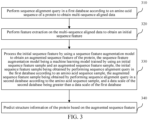
- FIG. 3 is a schematic flowchart of a protein structure information prediction method according to an exemplary embodiment of the disclosure.
- the protein structure information prediction method may be performed by a computer device, for example, the prediction device 120 shown in FIG. 1 .
- the protein structure information prediction method may include the following steps: Step 310. Perform sequence alignment query in a first database according to an amino acid sequence of a protein to obtain multi-sequence alignment data.
- the computer device may obtain the multi-sequence alignment data through a sequence alignment operation.
- the sequence alignment refers to aligning a plurality of amino acid sequences and highlighting similar structure regions therein. By comparing an amino acid sequence corresponding to a known protein structure and function with an amino acid sequence corresponding to an unknown protein structure and function, homology between the two amino acid sequences is determined, so as to predict the protein structure and function composed of unknown amino acid sequences.
- the first database is a database including several amino acid sequences.
- Step 320 Perform feature extraction on the multi-sequence alignment data to obtain an initial sequence feature.
- the prediction device may obtain a homologous sequence in the first database through the multi-sequence alignment data query operation by using a position-specific iterative basic local alignment search tool (PSI-BLAST) for each amino acid sequence, and then obtain a position-specific scoring matrix (PSSM) by comparing homology information of each sequence.
- PSI-BLAST position-specific iterative basic local alignment search tool
- PSSM position-specific scoring matrix
- the PSSM may be expressed as a frequency value of the amino acid appearing at a corresponding location obtained after the multi-sequence alignment is performed on the amino acid sequence, or a frequency of each amino acid appearing at each corresponding location, or a probability of each amino acid appearing at each corresponding location.
- Step 330 Process the initial sequence feature by using a sequence feature augmentation model to obtain an augmented sequence feature of the protein.
- the prediction device may input the initial sequence feature into the sequence feature augmentation model, and the sequence feature augmentation model performs feature augmentation on the initial sequence feature, that is, adds a new feature to the initial sequence feature to obtain a more comprehensive augmented sequence feature.
- the sequence feature augmentation model is a machine learning model trained by using an initial sequence feature sample and an augmented sequence feature sample, the initial sequence feature sample is obtained by performing sequence alignment query in the first database according to an amino acid sequence sample, the augmented sequence feature sample is obtained by performing sequence alignment query in a second database according to the amino acid sequence sample, and a data scale of the second database is greater than a data scale of the first database.
- the computer device may use the initial sequence feature sample as an input of the sequence feature augmentation model, and use the augmented sequence feature sample as labeled data of the initial sequence feature sample, to train the sequence feature augmentation model.
- the sequence feature augmentation model may be an FCN model for one-dimensional sequence data.
- a convolutional neural network is a feedforward neural network. Artificial neurons in the CNN may respond to surrounding units in a partial coverage area, and therefore there is excellent performance for large-scale image processing.
- the CNN includes a convolutional layer and a pooling layer. From CNN to FCN, the CNN is usually connected to several fully connected layers after the convolutional layer, and a feature map generated by the convolutional layer is mapped into a fixed-length feature vector.
- the sequence feature augmentation model is an RNN model including a plurality of layers of LSTM units or an RNN model including bidirectional LSTM units.
- the RNN is a type of recursive neural network in which sequence data is used as an input, recursion is performed in a sequence evolution direction, and all nodes, that is, recurrent units, are in a chain connection.
- Step 340 Predict structure information of the protein based on the augmented sequence feature.
- the prediction device predicts the structure information of the protein, including, but not limited to, predicting a backbone dihedral angle of the protein and/or a secondary structure of the protein.
- the dihedral angle is between two adjacent amide planes and can rotate with common Ca as a fixed point.
- An angle that rotates around a Ca-N bond is referred to as a ⁇ angle
- an angle that rotates around a C-Ca bond is referred to as a ⁇ angle.
- the ⁇ angle and the ⁇ angle are referred to as dihedral angles.
- a backbone chain of a peptide chain may be composed of many planes separated by Ca.
- a dihedral angle determines relative locations of two peptide planes and then determines a location and a conformation of the backbone chain of the peptide chain.
- an augmented sequence feature of the protein is obtained by using a sequence feature augmentation model, and then structure information of the protein is predicted.
- the sequence alignment query only needs to be performed in a first database with a smaller data scale to obtain higher prediction accuracy.
- the amino acid sequence sample includes an amino acid sequence with known protein structure information, or an amino acid sequence with unknown protein structure information, or both an amino acid sequence with known protein structure information and an amino acid sequence with unknown protein structure information.
- Step 402. The training device performs sequence alignment query in a second database according to an amino acid sequence sample and obtains an augmented sequence feature sample according to a query result.
- the training device obtains the initial sequence feature sample and the augmented sequence feature sample respectively from the first database and the second database through the same amino acid sequence sample, and the initial sequence feature sample and the augmented sequence feature sample are in one-to-one correspondence.
- a data distribution similarity between the first database and the second database is higher than a similarity threshold.
- the databases may be two existing databases with similar data distributions.
- the first database and the second database may be UniRef databases with different data scales, or the first database and the second database may be a Swiss-Prot database and a TrEMBL database in a UniProtKB database.
- the first database may be the UniRef50 database
- the second database may be the UniRef90 or UniRef100 database (a data scale of the UniRef50 database is less than a data scale of the UniRef90 or UniRef100 database).
- the first database may be the UniRef90 database
- the second database may be the UniRef100 database.
- the first database is a database obtained by randomly removing a specified proportion of data based on the second database.
- the second database may be an existing database.
- the second database may be the UniRef90 database (or may be another existing database).
- the training device randomly removes general amino acid sequences in the UniRef90 database to obtain the first database.
- the sequence feature augmentation model in this step may be a model that has not finished training.
- Step 404 The training device updates the sequence feature augmentation model according to the augmented initial sequence feature sample and the augmented sequence feature sample.
- the training device performs a loss function calculation according to the augmented initial sequence feature sample and the augmented sequence feature sample to obtain a loss function value. Then, the training device updates a model parameter in the sequence feature augmentation model according to the loss function value.
- the reconstruction error is a root mean square reconstruction error. That is, when the reconstruction error is obtained, the training device calculates the root mean square reconstruction error between the augmented initial sequence feature sample and the augmented sequence feature sample, and acquires the root mean square reconstruction error as the loss function value.
- a length of an amino acid sequence sample is represented as L
- a feature dimension is represented as D
- an automatically augmented initial sequence feature sample is represented as x
- a reference sequence feature that is, an augmented sequence feature sample
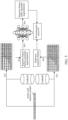
- FIG. 5 is a schematic diagram of sequence feature augmentation model training according to an embodiment of the disclosure. As shown in FIG. 5 , the training process of the sequence feature augmentation model is as follows:
- the training device updates the model parameter in the sequence feature augmentation model according to the loss function value.
- the training device may determine whether the model converges according to a loss function value. If the sequence feature augmentation model converges, the training device may end training and output the sequence feature augmentation model to a prediction device, and the prediction device predicts structure information of a protein.
- the training device may update the model parameter in the sequence feature augmentation model according to the loss function value.
- the training device compares the loss function value with a loss function value obtained in a previous round of the update process. If a difference between the loss function value obtained this time and the loss function value obtained in the previous round is less than a difference threshold, it means that the accuracy of the sequence feature augmentation model is improved slightly, and no significant improvement can be achieved by continuing training, and in this case, the model is determined to converge. Conversely, if the difference between the loss function value obtained this time and the loss function value obtained in the previous round is not less than the difference threshold, it means that the accuracy of the sequence feature augmentation model is improved greatly, and there may be a significant improvement by continuing training, and in this case, the model is determined to not converge.
- the training device compares the loss function value with a loss function value obtained in a previous round of the update process, and at the same time, compares the loss function value obtained this time with the loss function threshold. If the loss function value is less than the loss function threshold, and the difference between the loss function value obtained this time and the loss function value obtained in the previous round is less than the difference threshold, the model is determined to converge.
- the prediction device may predict structure information of a protein of which the structure is unknown according to the sequence feature augmentation model and the first database.
- the prediction process may refer to subsequent steps.
- Step 405. A prediction device performs sequence alignment query in the first database according to an amino acid sequence of a protein to obtain multi-sequence alignment data.
- the protein structure information prediction model used for predicting the structure information of the protein may alternatively be a model obtained through machine learning.
- the training device may obtain several protein samples with known structure information and an amino acid sequence of each protein sample; next, the training device performs sequence alignment query in a third database according to the amino acid sequence of the protein sample to obtain multi-sequence alignment data, and performs feature extraction on the multi-sequence alignment data obtained through the query to obtain an sequence feature of the protein sample; and then the protein structure information prediction model is trained by using the sequence feature of the protein sample as an input and using the structure information of the protein sample as labeled information.
- the protein structure information prediction model may be applied to this step.
- the prediction device predicts the structure information of the protein by using the protein structure information prediction model according to the augmented sequence feature of the protein to be predicted.
- the second database may be used as a database (that is, the third database) used in the training process of the protein structure information prediction model, that is, the second database and the third database may be the same database.
- the second database and the third database may be different data.
- the third database may be a database with a larger data scale than the second database, and a data distribution similarity between the second database and the third database is higher than a similarity threshold.
- the second database may be the UniRef90 database
- the third database may be the UniRef100 database.
- the foregoing training device and prediction device may be the same computer device, that is, the computer device first trains the sequence feature augmentation model, and then predicts the structure information of the protein according to the sequence feature augmentation model.
- the foregoing training device and prediction device may be different computer devices, that is, the training device first trains the sequence feature augmentation model and provides the sequence feature augmentation model to the prediction device, and the prediction device predicts the structure information of the protein according to the sequence feature augmentation model.
- an augmented sequence feature of the protein is obtained by using a sequence feature augmentation model, and then structure information of the protein is predicted.
- the sequence alignment query only needs to be performed in a first database with a smaller data scale to obtain higher prediction accuracy.
- FIG. 7 is a structural block diagram of a protein structure information prediction apparatus according to an exemplary embodiment.
- the protein structure information prediction apparatus may be implemented as a part or all of a computer device in a form of hardware or a combination of software and hardware, to perform all or some steps in the method shown in the embodiment corresponding to FIG. 3 or FIG. 4 .
- the protein structure information prediction apparatus may include:
- a data distribution similarity between the first database and the second database is higher than a similarity threshold.
- the first database is a database obtained by randomly removing a specified proportion of data based on the second database.
- the sequence feature augmentation model is a fully convolutional network (FCN) model for one-dimensional sequence data, or a recurrent neural network (RNN) model including a plurality of layers of long short-term memory (LSTM) units or an RNN model including bidirectional LSTM units.
- FCN fully convolutional network
- RNN recurrent neural network
- the initial sequence feature and the augmented sequence feature are position-specific scoring matrices (PSSMs).
- the model update module includes:
- the error calculation unit calculates a root mean square reconstruction error between the augmented initial sequence feature sample and the augmented sequence feature sample.
- the model update module is configured to, when the sequence feature augmentation model is determined to be not converged according to the loss function value, update the model parameter in the sequence feature augmentation model according to the loss function value.
- an augmented sequence feature of the protein is obtained by using a sequence feature augmentation model, and then structure information of the protein is predicted.
- the sequence alignment query only needs to be performed in a first database with a smaller data scale to obtain higher prediction accuracy.
- FIG. 8 is a schematic structural diagram of a computer device according to an exemplary embodiment.
- the computer device may be implemented as the training device or the prediction device in the foregoing embodiments, or may be implemented as a combination of the training device and the prediction device.
- the computer device 800 includes a central processing unit (CPU) 801, a system memory 804 including a random access memory (RAM) 802 and a read-only memory (ROM) 803, and a system bus 805 connecting the system memory 804 and the CPU 801.
- the server 800 further includes a basic input/output system (I/O system) 806 helping transmit information between components in a computer, and a mass storage device 807 used for storing an operating system 813, an application program 814, and another program module 815.
- I/O system basic input/output system
- the basic I/O system 806 includes a display 808 used for displaying information, and an input device 809, such as a mouse and a keyboard, used for a user to input information.
- the display 808 and the input device 809 are both connected to the CPU 801 by an input and output controller 810 connected to the system bus 805.
- the basic I/O system 806 may further include the input and output controller 810, to receive and process inputs from a plurality of other devices, such as a keyboard, a mouse, or an electronic stylus.
- the input and output controller 810 further provides an output to a display screen, a printer, or another type of output device.
- the mass storage device 807 is connected to the CPU 801 by a mass storage controller (not shown) connected to the system bus 805.
- the mass storage device 807 and an associated computer-readable medium provide non-volatile storage for the server 800. That is, the mass storage device 807 may include a computer-readable medium (not shown), such as a hard disk or a CD-ROM drive.
- the server 800 may be connected to the Internet or another network device by a network interface unit 811 connected to the system bus 805.
- the memory further includes one or more programs.
- the one or more programs are stored in a memory.
- the CPU 801 implements the steps performed by the computer device in the protein structure information prediction method shown in FIG. 3 or FIG. 4 by executing the one or more programs.
- the disclosure further provides a computer program product, the computer program product, when run on a computer, causing the computer to perform the method according to the foregoing method embodiments.
- FIG. 9 is a schematic structural diagram of a terminal 900 according to an exemplary embodiment of the disclosure.
- the terminal 900 may be a smartphone, a tablet computer, a Moving Picture Experts Group Audio Layer III (MP3) player, a Moving Picture Experts Group Audio Layer IV (MP4) player, a notebook computer, or a desktop computer.
- the terminal 900 may also be referred to as a user equipment, a portable terminal, a laptop terminal, a desktop terminal, or the like.
- the terminal may be implemented as the prediction device in the foregoing method embodiments.
- the terminal may be implemented as the prediction device 120 in FIG. 1 .
- the terminal 900 includes a processor 901 and a memory 902.
- the processor 901 may include one or more processing cores, for example, a 4-core processor or an 8-core processor.
- the processor 901 may be implemented in at least one hardware form of a digital signal processor (DSP), a field-programmable gate array (FPGA), and a programmable logic array (PLA).
- DSP digital signal processor
- FPGA field-programmable gate array
- PDA programmable logic array
- the processor 901 may alternatively include a main processor and a coprocessor.
- the main processor is configured to process data in an active state, also referred to as a CPU.
- the coprocessor is a low-power processor configured to process data in a standby state.
- the processor 901 may be integrated with a graphics processing unit (GPU).
- the GPU is configured to be responsible for rendering and drawing content that a display needs to display.
- the processor 901 may further include an AI processor.
- the AI processor is configured to process a computing operation related to machine learning.
- the memory 902 may include one or more computer-readable storage media.
- the computer-readable storage media may be non-transient.
- the memory 902 may further include a high-speed RAM and a non-volatile memory, such as one or more magnetic disk storage devices or a flash storage device.
- the non-transitory computer-readable storage medium in the memory 902 is configured to store at least one instruction, and the at least one instruction is used to be executed by the processor 901 to implement the protein structure information prediction method provided in the method embodiments of the disclosure.
- the terminal 900 may optionally include: a peripheral interface 903 and at least one peripheral.
- the processor 901, the memory 902, and the peripheral interface 903 may be connected by a bus or a signal cable.
- Each peripheral may be connected to the peripheral interface 903 by a bus, a signal cable, or a circuit board.
- the peripheral includes: at least one of a radio frequency (RF) circuit 904, a touch display screen 905, a camera 906, an audio circuit 907, a positioning component 908, and a power supply 909.
- RF radio frequency
- the peripheral interface 903 may be configured to connect at least one peripheral related to I/O to the processor 901 and the memory 902.
- the processor 901, the memory 902, and the peripheral interface 903 are integrated on the same chip or circuit board.
- any one or two of the processor 901, the memory 902, and the peripheral interface 903 may be implemented on an independent chip or circuit board. This is not limited in this embodiment.
- the RF circuit 904 is configured to receive and transmit an RF signal, which is also referred to as an electromagnetic signal.
- the RF circuit 904 communicates with a communication network and other communication devices through the electromagnetic signal.
- the RF circuit 904 converts an electrical signal into an electromagnetic signal for transmission, or converts a received electromagnetic signal into an electrical signal.
- the RF circuit 904 includes an antenna system, an RF transceiver, one or more amplifiers, a tuner, an oscillator, a digital signal processor, a codec chip set, a subscriber identity module card, and the like.
- the RF circuit 904 may communicate with another terminal by using at least one wireless communication protocol.
- the wireless communication protocol includes, but is not limited to, a world wide web, a metropolitan area network, an intranet, generations of mobile communication networks (2G, 3G, 4G, and 5G), a wireless local area network and/or a wireless fidelity (Wi-Fi) network.
- the RF circuit 904 may further include a near field communication (NFC)-related circuit. This is not limited in the disclosure.
- the display screen 905 is configured to display a user interface (UI).
- the UI may include a graph, a text, an icon, a video, and any combination thereof.
- the display screen 905 is further capable of collecting a touch signal on or above a surface of the display screen 905.
- the touch signal may be inputted, as a control signal, to the processor 901 for processing.
- the display screen 905 may be further configured to provide a virtual button and/or a virtual keyboard that are/is also referred to as a soft button and/or a soft keyboard.
- the display screen 905 may be a flexible display screen, disposed on a curved surface or a folded surface of the terminal 900. Even, the display screen 905 may be further set to have a non-rectangular irregular pattern, that is, a special-shaped screen.
- the display screen 905 may be made of materials such as a liquid crystal display (LCD), an organic light-emitting diode (OLED), or the like.
- the camera component 906 is configured to capture images or videos.
- the camera component 906 includes a front-facing camera and a rear-facing camera.
- the front-facing camera is disposed on a front panel of the terminal
- the rear-facing camera is disposed on a rear surface of the terminal.
- there are at least two rear-facing cameras which are respectively any of a main camera, a depth-of-field camera, a wide-angle camera, and a telephoto camera, to achieve background blur through fusion of the main camera and the depth-of-field camera, panoramic photographing and virtual reality (VR) photographing through fusion of the main camera and the wide-angle camera, or other fusion photographing functions.
- VR virtual reality
- the camera component 906 may further include a flash.
- the flash may be a single-color-temperature flash, or may be a double-color-temperature flash.
- the double-color-temperature flash refers to a combination of a warm-light flash and a cold-light flash, and may be used for light compensation under different color temperatures.
- the audio circuit 907 may include a microphone and a speaker.
- the microphone is configured to collect sound waves of users and surroundings, and convert the sound waves into electrical signals and input the signals to the processor 901 for processing, or input the signals to the RF circuit 904 to implement voice communication.
- the microphone may be further an array microphone or an omni-directional collection type microphone.
- the speaker is configured to convert electrical signals from the processor 901 or the RF circuit 904 into sound waves.
- the speaker may be a conventional thin-film speaker or a piezoelectric ceramic speaker.
- the speaker When the speaker is the piezoelectric ceramic speaker, the speaker can not only convert electrical signals into sound waves audible to a human being, but also convert electrical signals into sound waves inaudible to the human being for ranging and other purposes.
- the audio circuit 907 may also include an earphone jack.
- the positioning component 908 is configured to determine a current geographic location of the terminal 900, to implement navigation or a location based service (LBS).
- the positioning component 908 may be a positioning component based on the Global Positioning System (GPS) of the United States, the BeiDou system of China, or the GALILEO System of the European Union.
- GPS Global Positioning System
- BeiDou system of China
- GALILEO System of the European Union.
- the power supply 909 is configured to supply power to components in the terminal 900.
- the power supply 909 may be an alternating current, a direct current, a primary battery, or a rechargeable battery.
- the rechargeable battery may be a wired charging battery or a wireless charging battery.
- the wired charging battery is a battery charged through a wired circuit
- the wireless charging battery is a battery charged through a wireless coil.
- the rechargeable battery may be further configured to support a fast charge technology.
- the terminal 900 further includes one or more sensors 910.
- the one or more sensors 910 include, but are not limited to, an acceleration sensor 911, a gyroscope sensor 912, a pressure sensor 913, a fingerprint sensor 914, an optical sensor 915, and a proximity sensor 916.
- the acceleration sensor 911 may detect acceleration on three coordinate axes of a coordinate system established by the terminal 900.
- the acceleration sensor 911 may be configured to detect components of gravity acceleration on the three coordinate axes.
- the processor 901 may control, according to a gravity acceleration signal collected by the acceleration sensor 911, the touch display screen 905 to display the UI in a landscape view or a portrait view.
- the acceleration sensor 911 may be further configured to collect motion data of a game or a user.
- the gyroscope sensor 912 may detect a body direction and a rotation angle of the terminal 900, and may work with the acceleration sensor 911 to collect a 3D action performed by the user on the terminal 900.
- the processor 901 may implement the following functions according to data collected by the gyroscope sensor 912: motion sensing (for example, the UI is changed according to a tilt operation of the user), image stabilization during shooting, game control, and inertial navigation.
- the pressure sensor 913 may be disposed on a side frame of the terminal 900 and/or a lower layer of the touch display screen 905.
- a holding signal of the user on the terminal 900 may be detected.
- the processor 901 performs left and right hand recognition or a quick operation according to the holding signal collected by the pressure sensor 913.
- the processor 901 controls, according to a pressure operation of the user on the touch display screen 905, an operable control on the UI.
- the operable control includes at least one of a button control, a scroll-bar control, an icon control, and a menu control.
- the fingerprint sensor 914 is configured to collect a fingerprint of the user, and the processor 901 recognizes an identity of the user according to the fingerprint collected by the fingerprint sensor 914, or the fingerprint sensor 914 recognizes the identity of the user according to the collected fingerprint.
- the processor 901 authorizes the user to perform a related sensitive operation.
- the sensitive operation includes unlocking a screen, viewing encrypted information, downloading software, paying, changing a setting, and the like.
- the fingerprint sensor 914 may be disposed on a front surface, a back surface, or a side surface of the terminal 900. When a physical button or a vendor logo is disposed on the terminal 900, the fingerprint sensor 914 may be integrated with the physical button or the vendor logo.
- the program may be stored in a computer-readable storage medium.
- the computer-readable storage medium may be the computer-readable storage medium included in the memory in the foregoing embodiments, or may be a computer-readable storage medium that exists independently and that is not assembled in a terminal.
- the computer-readable storage medium stores at least one instruction, at least one program, a code set, or an instruction set, and the at least one instruction, the at least one program, the code set, or the instruction set is loaded and executed by the processor to implement the protein structure information prediction method according to FIG. 3 or FIG. 4 .
- the computer-readable storage medium may include: a ROM, a RAM, a solid state drive (SSD), an optical disc, or the like.
- the RAM may include a resistance random access memory (ReRAM) and a dynamic random access memory (DRAM).
- ReRAM resistance random access memory
- DRAM dynamic random access memory
- a computer program product or a computer program including computer instructions, the computer instructions being stored in a computer-readable storage medium.
- a processor of a computer device reads a computer instruction from a computer-readable storage medium, and executes the computer instruction, so that the computer device performs the protein structure information prediction method provided in various optional implementations of the foregoing aspects.
Landscapes
- Life Sciences & Earth Sciences (AREA)
- Physics & Mathematics (AREA)
- Engineering & Computer Science (AREA)
- Health & Medical Sciences (AREA)
- Bioinformatics & Cheminformatics (AREA)
- Spectroscopy & Molecular Physics (AREA)
- Medical Informatics (AREA)
- Theoretical Computer Science (AREA)
- Bioinformatics & Computational Biology (AREA)
- Biotechnology (AREA)
- Evolutionary Biology (AREA)
- General Health & Medical Sciences (AREA)
- Biophysics (AREA)
- Chemical & Material Sciences (AREA)
- Bioethics (AREA)
- Databases & Information Systems (AREA)
- Analytical Chemistry (AREA)
- Molecular Biology (AREA)
- Proteomics, Peptides & Aminoacids (AREA)
- Physiology (AREA)
- Data Mining & Analysis (AREA)
- Crystallography & Structural Chemistry (AREA)
- Genetics & Genomics (AREA)
- Artificial Intelligence (AREA)
- Computer Vision & Pattern Recognition (AREA)
- Epidemiology (AREA)
- Evolutionary Computation (AREA)
- Public Health (AREA)
- Software Systems (AREA)
- Information Retrieval, Db Structures And Fs Structures Therefor (AREA)
Claims (13)
- Procédé mis en œuvre par ordinateur pour prédire des informations de structure d'une protéine, caractérisé en ce que le procédé comprend :la réalisation d'une requête d'alignement de séquence dans une première base de données selon une séquence d'acides aminés de la protéine afin d'obtenir des données d'alignement multi-séquence (310) ;la réalisation d'une extraction de caractéristique sur les données d'alignement multi-séquence afin d'obtenir une caractéristique de séquence initiale (320) ;le traitement de la caractéristique de séquence initiale en utilisant un modèle d'augmentation de caractéristique de séquence afin d'obtenir une caractéristique de séquence augmentée de la protéine (330), la caractéristique de séquence initiale et la caractéristique de séquence augmentée étant des matrices de notation spécifiques à la position, PSSM, le modèle d'augmentation de caractéristique de séquence étant un modèle d'apprentissage machine entraîné en utilisant un échantillon de caractéristique de séquence initiale et un échantillon de caractéristique de séquence augmentée, l'échantillon de caractéristique de séquence initiale étant obtenu en réalisant une requête d'alignement de séquence dans la première base de données selon un échantillon de séquence d'acides aminés, l'échantillon de caractéristique de séquence augmentée étant obtenu en réalisant une requête d'alignement de séquence dans une deuxième base de données selon l'échantillon de séquence d'acides aminés, et une échelle de données de la deuxième base de données étant plus grande qu'une échelle de données de la première base de données, dans lequel une plus grande échelle de données comporte un stockage de base de données plus important ; etla prédiction d'informations de structure de la protéine en fonction de la caractéristique de séquence augmentée (340),dans lequel la prédiction des informations de structure de la protéine en fonction de la caractéristique de séquence augmentée (340) comprend :la prédiction de la caractéristique de séquence augmentée en utilisant un modèle de prédiction d'informations de structure de protéine afin d'obtenir les informations de structure de la protéine,dans lequel le modèle de prédiction d'informations de structure de protéine est un modèle entraîné selon une caractéristique de séquence d'un échantillon de protéine et des informations de structure de l'échantillon de protéine.
- Procédé selon la revendication 1, dans lequel une similarité de répartition de données entre la première base de données et la deuxième base de données est supérieure à un seuil de similarité.
- Procédé selon la revendication 2, dans lequel la première base de données est une base de données obtenue en supprimant de manière aléatoire une proportion spécifiée de données en fonction de la deuxième base de données.
- Procédé selon la revendication 1, dans lequel
le modèle d'augmentation de caractéristique de séquence est un modèle de réseau entièrement convolutif, FCN, pour des données de séquence unidimensionnelles, ou un modèle de réseau neuronal récurrent, RNN, comprenant une pluralité de couches d'unités de mémoire à long et court terme, LSTM, ou un modèle RNN comprenant des unités LSTM bidirectionnelles. - Procédé selon l'une des revendications 1 à 4, dans lequel, après la réalisation d'une requête d'alignement de séquence dans la première base de données selon la séquence d'acides aminés de la protéine afin d'obtenir les données d'alignement multi-séquence (310), le procédé comprend en outre :le traitement de l'échantillon de caractéristique de séquence initiale en utilisant le modèle d'augmentation de caractéristique de séquence afin d'obtenir un échantillon de caractéristique de séquence initiale augmentée ; etla mise à jour du modèle d'augmentation de caractéristique de séquence selon l'échantillon de caractéristique de séquence initiale augmentée et l'échantillon de caractéristique de séquence augmentée.
- Procédé selon la revendication 5, dans lequel la mise à jour du modèle d'augmentation de caractéristique de séquence selon l'échantillon de caractéristique de séquence initiale augmentée et l'échantillon de caractéristique de séquence augmentée comprend :la réalisation d'un calcul de fonction de perte selon l'échantillon de caractéristique de séquence initiale augmentée et l'échantillon de caractéristique de séquence augmentée afin d'obtenir une valeur de fonction de perte ; etla mise à jour d'un paramètre de modèle dans le modèle d'augmentation de caractéristique de séquence selon la valeur de fonction de perte.
- Procédé selon la revendication 6, dans lequel la réalisation du calcul de fonction de perte selon l'échantillon de caractéristique de séquence initiale augmentée et l'échantillon de caractéristique de séquence augmentée afin d'obtenir la valeur de fonction de perte comprend :le calcul d'une erreur de reconstruction entre l'échantillon de caractéristique de séquence initiale augmentée et l'échantillon de caractéristique de séquence augmentée ; etl'acquisition de l'erreur de reconstruction comme valeur de fonction de perte.
- Procédé selon la revendication 7, dans lequel le calcul d'une erreur de reconstruction entre l'échantillon de caractéristique de séquence initiale augmentée et l'échantillon de caractéristique de séquence augmentée comprend :
le calcul d'une erreur de reconstruction moyenne quadratique entre l'échantillon de caractéristique de séquence initiale augmentée et l'échantillon de caractéristique de séquence augmentée. - Procédé selon la revendication 6, dans lequel la mise à jour du paramètre de modèle dans le modèle d'augmentation de caractéristique de séquence selon la valeur de fonction de perte comprend :
lorsqu'il est déterminé que le modèle d'augmentation de caractéristique de séquence n'a pas convergé selon la valeur de fonction de perte, la mise à jour du paramètre de modèle dans le modèle d'augmentation de caractéristique de séquence selon la valeur de fonction de perte. - Dispositif pour prédire des informations de structure d'une protéine, applicable à un dispositif informatique, caractérisé en ce que le dispositif comprend :un module d'obtention de données (710) configuré pour réaliser une requête d'alignement de séquence dans une première base de données selon une séquence d'acides aminés de la protéine afin d'obtenir des données d'alignement multi-séquence ;un module d'obtention de caractéristique initiale (720), configuré pour réaliser une extraction de caractéristique sur les données d'alignement multi-séquence afin d'obtenir une caractéristique de séquence initiale ;un module d'obtention de caractéristique augmentée (730), configuré pour traiter la caractéristique de séquence initiale en utilisant un modèle d'augmentation de caractéristique de séquence afin d'obtenir une caractéristique de séquence augmentée de la protéine, la caractéristique de séquence initiale et la caractéristique de séquence augmentée étant des matrices de notation spécifiques à la position, PSSM, le modèle d'augmentation de caractéristique de séquence étant un modèle d'apprentissage machine entraîné en utilisant un échantillon de caractéristique de séquence initiale et un échantillon de caractéristique de séquence augmentée, l'échantillon de caractéristique de séquence initiale étant obtenu en réalisant une requête d'alignement de séquence dans la première base de données selon un échantillon de séquence d'acides aminés, l'échantillon de caractéristique de séquence augmentée étant obtenu en réalisant une requête d'alignement de séquence dans une deuxième base de données selon l'échantillon de séquence d'acides aminés, et une échelle de données de la deuxième base de données étant plus grande qu'une échelle de données de la première base de données, dans lequel une plus grande échelle de données comporte un stockage de base de données plus important ; etun module de prédiction d'informations de structure (740), configuré pour prédire des informations de structure de la protéine en fonction de la caractéristique de séquence augmentée,dans lequel module de prédiction d'informations de structure (740) est configuré pour :prédire la caractéristique de séquence augmentée en utilisant un modèle de prédiction d'informations de structure de protéine afin d'obtenir les informations de structure de la protéine,dans lequel le modèle de prédiction d'informations de structure de protéine est un modèle entraîné selon une caractéristique de séquence d'un échantillon de protéine et des informations de structure de l'échantillon de protéine.
- Appareil selon la revendication 10, dans lequel une similarité de répartition de données entre la première base de données et la deuxième base de données est supérieure à un seuil de similarité.
- Appareil selon la revendication 11, dans lequel la première base de données est une base de données obtenue en supprimant de manière aléatoire une proportion spécifiée de données en fonction de la deuxième base de données.
- Support de stockage lisible par ordinateur stockant au moins une instruction, au moins un programme, un ensemble de codes, ou un ensemble d'instructions, l'au moins une instruction, l'au moins un programme, l'ensemble de codes, ou l'ensemble d'instructions étant chargés et exécutés par un processeur pour mettre en œuvre le procédé de prédiction d'informations de structure de protéine selon l'une des revendications 1 à 9.
Applications Claiming Priority (2)
| Application Number | Priority Date | Filing Date | Title |
|---|---|---|---|
| CN201911042649.9A CN110706738B (zh) | 2019-10-30 | 2019-10-30 | 蛋白质的结构信息预测方法、装置、设备及存储介质 |
| PCT/CN2020/114386 WO2021082753A1 (fr) | 2019-10-30 | 2020-09-10 | Procédé, dispositif et appareil pour prévoir des informations de structure protéique, et support de stockage |
Publications (3)
| Publication Number | Publication Date |
|---|---|
| EP4009328A1 EP4009328A1 (fr) | 2022-06-08 |
| EP4009328A4 EP4009328A4 (fr) | 2022-09-14 |
| EP4009328B1 true EP4009328B1 (fr) | 2025-06-25 |
Family
ID=69203871
Family Applications (1)
| Application Number | Title | Priority Date | Filing Date |
|---|---|---|---|
| EP20882879.8A Active EP4009328B1 (fr) | 2019-10-30 | 2020-09-10 | Procédé, dispositif et appareil pour prévoir des informations de structure protéique, et support de stockage |
Country Status (5)
| Country | Link |
|---|---|
| US (1) | US12288599B2 (fr) |
| EP (1) | EP4009328B1 (fr) |
| JP (1) | JP7291853B2 (fr) |
| CN (1) | CN110706738B (fr) |
| WO (1) | WO2021082753A1 (fr) |
Families Citing this family (21)
| Publication number | Priority date | Publication date | Assignee | Title |
|---|---|---|---|---|
| CN110706738B (zh) | 2019-10-30 | 2020-11-20 | 腾讯科技(深圳)有限公司 | 蛋白质的结构信息预测方法、装置、设备及存储介质 |
| CN111243668B (zh) * | 2020-04-09 | 2020-08-07 | 腾讯科技(深圳)有限公司 | 分子结合位点检测方法、装置、电子设备及存储介质 |
| CN111755065B (zh) * | 2020-06-15 | 2024-05-17 | 重庆邮电大学 | 一种基于虚拟网络映射和云并行计算的蛋白质构象预测加速方法 |
| US20240153577A1 (en) * | 2020-11-28 | 2024-05-09 | Deepmind Technologies Limited | Predicting symmetrical protein structures using symmetrical expansion transformations |
| CN112289370B (zh) * | 2020-12-28 | 2021-03-23 | 武汉金开瑞生物工程有限公司 | 一种蛋白质结构预测方法及装置 |
| CN112837204B (zh) * | 2021-02-26 | 2024-07-23 | 北京小米移动软件有限公司 | 序列处理方法、序列处理装置及存储介质 |
| CN113255770B (zh) * | 2021-05-26 | 2023-10-27 | 北京百度网讯科技有限公司 | 化合物属性预测模型训练方法和化合物属性预测方法 |
| CN113837036B (zh) * | 2021-09-09 | 2024-08-02 | 成都齐碳科技有限公司 | 生物聚合物的表征方法、装置、设备及计算机存储介质 |
| CN115881211B (zh) * | 2021-12-23 | 2024-02-20 | 上海智峪生物科技有限公司 | 蛋白质序列比对方法、装置、计算机设备以及存储介质 |
| CN114300038B (zh) * | 2021-12-27 | 2023-09-29 | 山东师范大学 | 基于改进生物地理学优化算法的多序列比对方法及系统 |
| CN116564412A (zh) * | 2022-01-27 | 2023-08-08 | 京东方科技集团股份有限公司 | 蛋白质间相互作用的预测方法、装置及电子设备 |
| CN114613427B (zh) * | 2022-03-15 | 2023-01-31 | 水木未来(北京)科技有限公司 | 蛋白质三维结构预测方法及装置、电子设备和存储介质 |
| CN114974437A (zh) * | 2022-04-26 | 2022-08-30 | 北京理工大学 | 一种分析蛋白质稳态系综结构变化及关键氨基酸的方法 |
| CN115101122A (zh) * | 2022-05-23 | 2022-09-23 | 清华大学 | 蛋白质处理方法、设备、存储介质和计算机程序产品 |
| CN115116559B (zh) * | 2022-06-21 | 2023-04-18 | 北京百度网讯科技有限公司 | 氨基酸中原子坐标的确定及训练方法、装置、设备和介质 |
| CN115240044B (zh) * | 2022-07-22 | 2023-06-06 | 水木未来(北京)科技有限公司 | 蛋白质电子密度图处理方法、装置、电子设备和存储介质 |
| CN117292743A (zh) * | 2022-09-05 | 2023-12-26 | 北京分子之心科技有限公司 | 用于预测蛋白质复合物结构的方法、设备、介质及程序产品 |
| CN117253541A (zh) * | 2022-10-24 | 2023-12-19 | 腾讯科技(深圳)有限公司 | 蛋白质处理方法、装置、计算机设备及存储介质 |
| CN115831219B (zh) * | 2022-12-22 | 2024-05-28 | 郑州思昆生物工程有限公司 | 一种质量预测方法、装置、设备及存储介质 |
| CN118398079A (zh) * | 2024-06-25 | 2024-07-26 | 中国人民解放军军事科学院军事医学研究院 | 一种预测氨基酸突变效应或对蛋白质进行设计改造的计算机装置、方法和应用 |
| CN119811500B (zh) * | 2024-12-18 | 2025-10-31 | 上海交通大学 | 基于多分子模态融合的通用蛋白质-rna结合预测方法 |
Family Cites Families (16)
| Publication number | Priority date | Publication date | Assignee | Title |
|---|---|---|---|---|
| US7157266B2 (en) * | 1999-01-25 | 2007-01-02 | Brookhaven Science Associates Llc | Structure of adenovirus bound to cellular receptor car |
| WO2002064743A2 (fr) * | 2001-02-12 | 2002-08-22 | Rosetta Inpharmatics, Inc. | Confirmation du contenu d'exon de transcrits d'arn par pcr au moyen d'amorces complementaires a chaque exon |
| US20100057419A1 (en) * | 2008-08-29 | 2010-03-04 | Laboratory of Computational Biology, Center for DNA Fingerprinting and Diagnostics | Fold-wise classification of proteins |
| CN103175873B (zh) * | 2013-01-27 | 2015-11-18 | 福州市第二医院 | 基于目标dna重复序列自身增强放大信号的dna电化学传感器 |
| CN104615911B (zh) * | 2015-01-12 | 2017-07-18 | 上海交通大学 | 基于稀疏编码及链学习预测膜蛋白beta‑barrel跨膜区域的方法 |
| CN105574359B (zh) * | 2015-12-15 | 2018-09-14 | 上海珍岛信息技术有限公司 | 一种蛋白质模板库的扩充方法及装置 |
| CN106951736B (zh) * | 2017-03-14 | 2019-02-26 | 齐鲁工业大学 | 一种基于多重进化矩阵的蛋白质二级结构预测方法 |
| CN107563150B (zh) * | 2017-08-31 | 2021-03-19 | 深圳大学 | 蛋白质结合位点的预测方法、装置、设备及存储介质 |
| CN108197427B (zh) * | 2018-01-02 | 2020-09-04 | 山东师范大学 | 基于深度卷积神经网络的蛋白质亚细胞定位方法和装置 |
| CN109147868B (zh) * | 2018-07-18 | 2022-03-22 | 深圳大学 | 蛋白质功能预测方法、装置、设备及存储介质 |
| CN109300501B (zh) * | 2018-09-20 | 2021-02-02 | 国家卫生健康委科学技术研究所 | 蛋白质三维结构预测方法及用其构建的预测云平台 |
| CN109255339B (zh) * | 2018-10-19 | 2021-04-06 | 西安电子科技大学 | 基于自适应深度森林人体步态能量图的分类方法 |
| CN109411018A (zh) * | 2019-01-23 | 2019-03-01 | 上海宝藤生物医药科技股份有限公司 | 根据基因突变信息对样本分类的方法、装置、设备及介质 |
| CN110097130B (zh) * | 2019-05-07 | 2022-12-13 | 深圳市腾讯计算机系统有限公司 | 分类任务模型的训练方法、装置、设备及存储介质 |
| EP4008006A1 (fr) * | 2019-08-02 | 2022-06-08 | Flagship Pioneering Innovations VI, LLC | Conception de polypeptides guidée par apprentissage automatique |
| CN110706738B (zh) * | 2019-10-30 | 2020-11-20 | 腾讯科技(深圳)有限公司 | 蛋白质的结构信息预测方法、装置、设备及存储介质 |
-
2019
- 2019-10-30 CN CN201911042649.9A patent/CN110706738B/zh active Active
-
2020
- 2020-09-10 JP JP2022514493A patent/JP7291853B2/ja active Active
- 2020-09-10 WO PCT/CN2020/114386 patent/WO2021082753A1/fr not_active Ceased
- 2020-09-10 EP EP20882879.8A patent/EP4009328B1/fr active Active
-
2021
- 2021-12-01 US US17/539,946 patent/US12288599B2/en active Active
Also Published As
| Publication number | Publication date |
|---|---|
| CN110706738B (zh) | 2020-11-20 |
| EP4009328A1 (fr) | 2022-06-08 |
| WO2021082753A1 (fr) | 2021-05-06 |
| JP7291853B2 (ja) | 2023-06-15 |
| US12288599B2 (en) | 2025-04-29 |
| US20220093213A1 (en) | 2022-03-24 |
| CN110706738A (zh) | 2020-01-17 |
| JP2022547041A (ja) | 2022-11-10 |
| EP4009328A4 (fr) | 2022-09-14 |
Similar Documents
| Publication | Publication Date | Title |
|---|---|---|
| EP4009328B1 (fr) | Procédé, dispositif et appareil pour prévoir des informations de structure protéique, et support de stockage | |
| CN111476306B (zh) | 基于人工智能的物体检测方法、装置、设备及存储介质 | |
| CN111243668B (zh) | 分子结合位点检测方法、装置、电子设备及存储介质 | |
| KR102890779B1 (ko) | 타겟의 위치들을 취득하기 위한 방법 및 장치와, 컴퓨터 디바이스 및 저장 매체 | |
| CN113516665B (zh) | 图像分割模型的训练方法、图像分割方法、装置、设备 | |
| CN111192262A (zh) | 基于人工智能的产品缺陷分类方法、装置、设备及介质 | |
| CN111589138B (zh) | 动作预测方法、装置、设备及存储介质 | |
| CN111930964B (zh) | 内容处理方法、装置、设备及存储介质 | |
| CN113822791B (zh) | 图像配准方法、配准网络训练方法、装置、设备及介质 | |
| US10019464B2 (en) | Apparatus and method for searching for image | |
| CN113516143A (zh) | 文本图像匹配方法、装置、计算机设备及存储介质 | |
| CN113821658B (zh) | 对编码器进行训练的方法、装置、设备及存储介质 | |
| CN113052240B (zh) | 图像处理模型的确定方法、装置、设备及存储介质 | |
| CN110990549A (zh) | 获取答案的方法、装置、电子设备及存储介质 | |
| CN110853704B (zh) | 蛋白质数据获取方法、装置、计算机设备及存储介质 | |
| CN112527104A (zh) | 确定参数确定方法、装置、设备及存储介质 | |
| CN111737415A (zh) | 实体关系抽取方法、实体关系学习模型的获取方法及设备 | |
| CN114281958A (zh) | 回复模型的获取方法、回复语句的获取方法、装置及设备 | |
| CN116863460A (zh) | 姿态识别、姿态识别模型的训练方法、装置、设备及介质 | |
| HK40020275A (en) | Method and apparatus for predicting structure information of protein, device, and storage medium | |
| HK40020275B (en) | Method and apparatus for predicting structure information of protein, device, and storage medium | |
| HK40099886A (zh) | 姿态识别、姿态识别模型的训练方法、装置、设备及介质 | |
| HK40025288A (en) | Method and apparatus for detecting molecular binding sites, electronic device and storage medium | |
| HK40025288B (en) | Method and apparatus for detecting molecular binding sites, electronic device and storage medium | |
| HK40025896B (zh) | 基於人工智能的物体检测方法、装置、设备及存储介质 |
Legal Events
| Date | Code | Title | Description |
|---|---|---|---|
| STAA | Information on the status of an ep patent application or granted ep patent |
Free format text: STATUS: THE INTERNATIONAL PUBLICATION HAS BEEN MADE |
|
| PUAI | Public reference made under article 153(3) epc to a published international application that has entered the european phase |
Free format text: ORIGINAL CODE: 0009012 |
|
| STAA | Information on the status of an ep patent application or granted ep patent |
Free format text: STATUS: REQUEST FOR EXAMINATION WAS MADE |
|
| 17P | Request for examination filed |
Effective date: 20220301 |
|
| AK | Designated contracting states |
Kind code of ref document: A1 Designated state(s): AL AT BE BG CH CY CZ DE DK EE ES FI FR GB GR HR HU IE IS IT LI LT LU LV MC MK MT NL NO PL PT RO RS SE SI SK SM TR |
|
| RAP3 | Party data changed (applicant data changed or rights of an application transferred) |
Owner name: TENCENT TECHNOLOGY (SHENZHEN) COMPANY LIMITED |
|
| REG | Reference to a national code |
Ref country code: DE Ref legal event code: R079 Free format text: PREVIOUS MAIN CLASS: G16B0005000000 Ipc: G16B0015200000 Ref document number: 602020053519 Country of ref document: DE |
|
| A4 | Supplementary search report drawn up and despatched |
Effective date: 20220811 |
|
| RIC1 | Information provided on ipc code assigned before grant |
Ipc: G16B 50/30 20190101ALI20220805BHEP Ipc: G16B 30/10 20190101ALI20220805BHEP Ipc: G16B 40/20 20190101ALI20220805BHEP Ipc: G16B 15/20 20190101AFI20220805BHEP |
|
| DAV | Request for validation of the european patent (deleted) | ||
| DAX | Request for extension of the european patent (deleted) | ||
| STAA | Information on the status of an ep patent application or granted ep patent |
Free format text: STATUS: EXAMINATION IS IN PROGRESS |
|
| 17Q | First examination report despatched |
Effective date: 20230714 |
|
| GRAP | Despatch of communication of intention to grant a patent |
Free format text: ORIGINAL CODE: EPIDOSNIGR1 |
|
| STAA | Information on the status of an ep patent application or granted ep patent |
Free format text: STATUS: GRANT OF PATENT IS INTENDED |
|
| INTG | Intention to grant announced |
Effective date: 20250120 |
|
| GRAS | Grant fee paid |
Free format text: ORIGINAL CODE: EPIDOSNIGR3 |
|
| GRAA | (expected) grant |
Free format text: ORIGINAL CODE: 0009210 |
|
| STAA | Information on the status of an ep patent application or granted ep patent |
Free format text: STATUS: THE PATENT HAS BEEN GRANTED |
|
| AK | Designated contracting states |
Kind code of ref document: B1 Designated state(s): AL AT BE BG CH CY CZ DE DK EE ES FI FR GB GR HR HU IE IS IT LI LT LU LV MC MK MT NL NO PL PT RO RS SE SI SK SM TR |
|
| REG | Reference to a national code |
Ref country code: GB Ref legal event code: FG4D |
|
| REG | Reference to a national code |
Ref country code: CH Ref legal event code: EP |
|
| REG | Reference to a national code |
Ref country code: DE Ref legal event code: R096 Ref document number: 602020053519 Country of ref document: DE |
|
| REG | Reference to a national code |
Ref country code: CH Ref legal event code: EP |
|
| REG | Reference to a national code |
Ref country code: IE Ref legal event code: FG4D |
|
| PG25 | Lapsed in a contracting state [announced via postgrant information from national office to epo] |
Ref country code: FI Free format text: LAPSE BECAUSE OF FAILURE TO SUBMIT A TRANSLATION OF THE DESCRIPTION OR TO PAY THE FEE WITHIN THE PRESCRIBED TIME-LIMIT Effective date: 20250625 |
|
| PGFP | Annual fee paid to national office [announced via postgrant information from national office to epo] |
Ref country code: DE Payment date: 20250919 Year of fee payment: 6 |
|
| REG | Reference to a national code |
Ref country code: LT Ref legal event code: MG9D |
|
| PG25 | Lapsed in a contracting state [announced via postgrant information from national office to epo] |
Ref country code: GR Free format text: LAPSE BECAUSE OF FAILURE TO SUBMIT A TRANSLATION OF THE DESCRIPTION OR TO PAY THE FEE WITHIN THE PRESCRIBED TIME-LIMIT Effective date: 20250926 Ref country code: NO Free format text: LAPSE BECAUSE OF FAILURE TO SUBMIT A TRANSLATION OF THE DESCRIPTION OR TO PAY THE FEE WITHIN THE PRESCRIBED TIME-LIMIT Effective date: 20250925 |
|
| PG25 | Lapsed in a contracting state [announced via postgrant information from national office to epo] |
Ref country code: BG Free format text: LAPSE BECAUSE OF FAILURE TO SUBMIT A TRANSLATION OF THE DESCRIPTION OR TO PAY THE FEE WITHIN THE PRESCRIBED TIME-LIMIT Effective date: 20250625 |
|
| PGFP | Annual fee paid to national office [announced via postgrant information from national office to epo] |
Ref country code: GB Payment date: 20250923 Year of fee payment: 6 |
|
| PG25 | Lapsed in a contracting state [announced via postgrant information from national office to epo] |
Ref country code: HR Free format text: LAPSE BECAUSE OF FAILURE TO SUBMIT A TRANSLATION OF THE DESCRIPTION OR TO PAY THE FEE WITHIN THE PRESCRIBED TIME-LIMIT Effective date: 20250625 |
|
| PGFP | Annual fee paid to national office [announced via postgrant information from national office to epo] |
Ref country code: FR Payment date: 20250923 Year of fee payment: 6 |
|
| PG25 | Lapsed in a contracting state [announced via postgrant information from national office to epo] |
Ref country code: RS Free format text: LAPSE BECAUSE OF FAILURE TO SUBMIT A TRANSLATION OF THE DESCRIPTION OR TO PAY THE FEE WITHIN THE PRESCRIBED TIME-LIMIT Effective date: 20250925 |
|
| PG25 | Lapsed in a contracting state [announced via postgrant information from national office to epo] |
Ref country code: LV Free format text: LAPSE BECAUSE OF FAILURE TO SUBMIT A TRANSLATION OF THE DESCRIPTION OR TO PAY THE FEE WITHIN THE PRESCRIBED TIME-LIMIT Effective date: 20250625 |
|
| REG | Reference to a national code |
Ref country code: NL Ref legal event code: MP Effective date: 20250625 |
|
| PG25 | Lapsed in a contracting state [announced via postgrant information from national office to epo] |
Ref country code: NL Free format text: LAPSE BECAUSE OF FAILURE TO SUBMIT A TRANSLATION OF THE DESCRIPTION OR TO PAY THE FEE WITHIN THE PRESCRIBED TIME-LIMIT Effective date: 20250625 |
|
| PG25 | Lapsed in a contracting state [announced via postgrant information from national office to epo] |
Ref country code: PT Free format text: LAPSE BECAUSE OF FAILURE TO SUBMIT A TRANSLATION OF THE DESCRIPTION OR TO PAY THE FEE WITHIN THE PRESCRIBED TIME-LIMIT Effective date: 20251027 |
|
| REG | Reference to a national code |
Ref country code: AT Ref legal event code: MK05 Ref document number: 1807442 Country of ref document: AT Kind code of ref document: T Effective date: 20250625 |
|
| PG25 | Lapsed in a contracting state [announced via postgrant information from national office to epo] |
Ref country code: IS Free format text: LAPSE BECAUSE OF FAILURE TO SUBMIT A TRANSLATION OF THE DESCRIPTION OR TO PAY THE FEE WITHIN THE PRESCRIBED TIME-LIMIT Effective date: 20251025 |
|
| PG25 | Lapsed in a contracting state [announced via postgrant information from national office to epo] |
Ref country code: AT Free format text: LAPSE BECAUSE OF FAILURE TO SUBMIT A TRANSLATION OF THE DESCRIPTION OR TO PAY THE FEE WITHIN THE PRESCRIBED TIME-LIMIT Effective date: 20250625 Ref country code: SM Free format text: LAPSE BECAUSE OF FAILURE TO SUBMIT A TRANSLATION OF THE DESCRIPTION OR TO PAY THE FEE WITHIN THE PRESCRIBED TIME-LIMIT Effective date: 20250625 |
|
| PG25 | Lapsed in a contracting state [announced via postgrant information from national office to epo] |
Ref country code: CZ Free format text: LAPSE BECAUSE OF FAILURE TO SUBMIT A TRANSLATION OF THE DESCRIPTION OR TO PAY THE FEE WITHIN THE PRESCRIBED TIME-LIMIT Effective date: 20250625 |
|
| PG25 | Lapsed in a contracting state [announced via postgrant information from national office to epo] |
Ref country code: PL Free format text: LAPSE BECAUSE OF FAILURE TO SUBMIT A TRANSLATION OF THE DESCRIPTION OR TO PAY THE FEE WITHIN THE PRESCRIBED TIME-LIMIT Effective date: 20250625 |
|
| PG25 | Lapsed in a contracting state [announced via postgrant information from national office to epo] |
Ref country code: EE Free format text: LAPSE BECAUSE OF FAILURE TO SUBMIT A TRANSLATION OF THE DESCRIPTION OR TO PAY THE FEE WITHIN THE PRESCRIBED TIME-LIMIT Effective date: 20250625 |
|
| PG25 | Lapsed in a contracting state [announced via postgrant information from national office to epo] |
Ref country code: SK Free format text: LAPSE BECAUSE OF FAILURE TO SUBMIT A TRANSLATION OF THE DESCRIPTION OR TO PAY THE FEE WITHIN THE PRESCRIBED TIME-LIMIT Effective date: 20250625 |
|
| PG25 | Lapsed in a contracting state [announced via postgrant information from national office to epo] |
Ref country code: ES Free format text: LAPSE BECAUSE OF FAILURE TO SUBMIT A TRANSLATION OF THE DESCRIPTION OR TO PAY THE FEE WITHIN THE PRESCRIBED TIME-LIMIT Effective date: 20250625 |
|
| PG25 | Lapsed in a contracting state [announced via postgrant information from national office to epo] |
Ref country code: RO Free format text: LAPSE BECAUSE OF FAILURE TO SUBMIT A TRANSLATION OF THE DESCRIPTION OR TO PAY THE FEE WITHIN THE PRESCRIBED TIME-LIMIT Effective date: 20250625 |
|
| PG25 | Lapsed in a contracting state [announced via postgrant information from national office to epo] |
Ref country code: DK Free format text: LAPSE BECAUSE OF FAILURE TO SUBMIT A TRANSLATION OF THE DESCRIPTION OR TO PAY THE FEE WITHIN THE PRESCRIBED TIME-LIMIT Effective date: 20250625 |
|
| PG25 | Lapsed in a contracting state [announced via postgrant information from national office to epo] |
Ref country code: IT Free format text: LAPSE BECAUSE OF FAILURE TO SUBMIT A TRANSLATION OF THE DESCRIPTION OR TO PAY THE FEE WITHIN THE PRESCRIBED TIME-LIMIT Effective date: 20250625 |
|
| PLBE | No opposition filed within time limit |
Free format text: ORIGINAL CODE: 0009261 |
|
| STAA | Information on the status of an ep patent application or granted ep patent |
Free format text: STATUS: NO OPPOSITION FILED WITHIN TIME LIMIT |