EP4009464A1 - Verfahren zur bewertung der erwarteten leistung eines windparks - Google Patents
Verfahren zur bewertung der erwarteten leistung eines windparks Download PDFInfo
- Publication number
- EP4009464A1 EP4009464A1 EP21207935.4A EP21207935A EP4009464A1 EP 4009464 A1 EP4009464 A1 EP 4009464A1 EP 21207935 A EP21207935 A EP 21207935A EP 4009464 A1 EP4009464 A1 EP 4009464A1
- Authority
- EP
- European Patent Office
- Prior art keywords
- wind farm
- voltage
- simulated
- simulated output
- model
- Prior art date
- Legal status (The legal status is an assumption and is not a legal conclusion. Google has not performed a legal analysis and makes no representation as to the accuracy of the status listed.)
- Withdrawn
Links
Images



Classifications
-
- H—ELECTRICITY
- H02—GENERATION; CONVERSION OR DISTRIBUTION OF ELECTRIC POWER
- H02J—ELECTRIC POWER NETWORKS; CIRCUIT ARRANGEMENTS OR SYSTEMS FOR SUPPLYING OR DISTRIBUTING ELECTRIC POWER; SYSTEMS FOR STORING ELECTRIC ENERGY
- H02J3/00—Circuit arrangements for AC mains or AC distribution networks
- H02J3/001—Arrangements for handling faults or abnormalities, e.g. emergencies or contingencies
- H02J3/00125—Transmission line or load transient problems, e.g. overvoltage, resonance or self-excitation of inductive loads
-
- H—ELECTRICITY
- H02—GENERATION; CONVERSION OR DISTRIBUTION OF ELECTRIC POWER
- H02J—ELECTRIC POWER NETWORKS; CIRCUIT ARRANGEMENTS OR SYSTEMS FOR SUPPLYING OR DISTRIBUTING ELECTRIC POWER; SYSTEMS FOR STORING ELECTRIC ENERGY
- H02J3/00—Circuit arrangements for AC mains or AC distribution networks
- H02J3/001—Arrangements for handling faults or abnormalities, e.g. emergencies or contingencies
- H02J3/0012—Arrangements for handling faults or abnormalities, e.g. emergencies or contingencies characterised by the contingency detection means in AC networks, e.g. using phasor measurement units [PMU], synchrophasors or contingency analysis
-
- G—PHYSICS
- G06—COMPUTING OR CALCULATING; COUNTING
- G06F—ELECTRIC DIGITAL DATA PROCESSING
- G06F30/00—Computer-aided design [CAD]
- G06F30/20—Design optimisation, verification or simulation
-
- H—ELECTRICITY
- H02—GENERATION; CONVERSION OR DISTRIBUTION OF ELECTRIC POWER
- H02J—ELECTRIC POWER NETWORKS; CIRCUIT ARRANGEMENTS OR SYSTEMS FOR SUPPLYING OR DISTRIBUTING ELECTRIC POWER; SYSTEMS FOR STORING ELECTRIC ENERGY
- H02J3/00—Circuit arrangements for AC mains or AC distribution networks
- H02J3/38—Arrangements for feeding a single network from two or more generators or sources in parallel; Arrangements for feeding already energised networks from additional generators or sources in parallel
- H02J3/381—Dispersed generators
-
- G—PHYSICS
- G06—COMPUTING OR CALCULATING; COUNTING
- G06F—ELECTRIC DIGITAL DATA PROCESSING
- G06F2113/00—Details relating to the application field
- G06F2113/04—Power grid distribution networks
-
- G—PHYSICS
- G06—COMPUTING OR CALCULATING; COUNTING
- G06F—ELECTRIC DIGITAL DATA PROCESSING
- G06F2113/00—Details relating to the application field
- G06F2113/06—Wind turbines or wind farms
-
- G—PHYSICS
- G06—COMPUTING OR CALCULATING; COUNTING
- G06F—ELECTRIC DIGITAL DATA PROCESSING
- G06F2119/00—Details relating to the type or aim of the analysis or the optimisation
- G06F2119/06—Power analysis or power optimisation
-
- H—ELECTRICITY
- H02—GENERATION; CONVERSION OR DISTRIBUTION OF ELECTRIC POWER
- H02J—ELECTRIC POWER NETWORKS; CIRCUIT ARRANGEMENTS OR SYSTEMS FOR SUPPLYING OR DISTRIBUTING ELECTRIC POWER; SYSTEMS FOR STORING ELECTRIC ENERGY
- H02J2101/00—Supply or distribution of decentralised, dispersed or local electric power generation
- H02J2101/20—Dispersed power generation using renewable energy sources
- H02J2101/28—Wind energy
-
- H—ELECTRICITY
- H02—GENERATION; CONVERSION OR DISTRIBUTION OF ELECTRIC POWER
- H02J—ELECTRIC POWER NETWORKS; CIRCUIT ARRANGEMENTS OR SYSTEMS FOR SUPPLYING OR DISTRIBUTING ELECTRIC POWER; SYSTEMS FOR STORING ELECTRIC ENERGY
- H02J2103/00—Details of circuit arrangements for mains or AC distribution networks
- H02J2103/30—Simulating, planning, modelling, reliability check or computer assisted design [CAD] of electric power networks
-
- Y—GENERAL TAGGING OF NEW TECHNOLOGICAL DEVELOPMENTS; GENERAL TAGGING OF CROSS-SECTIONAL TECHNOLOGIES SPANNING OVER SEVERAL SECTIONS OF THE IPC; TECHNICAL SUBJECTS COVERED BY FORMER USPC CROSS-REFERENCE ART COLLECTIONS [XRACs] AND DIGESTS
- Y02—TECHNOLOGIES OR APPLICATIONS FOR MITIGATION OR ADAPTATION AGAINST CLIMATE CHANGE
- Y02E—REDUCTION OF GREENHOUSE GAS [GHG] EMISSIONS, RELATED TO ENERGY GENERATION, TRANSMISSION OR DISTRIBUTION
- Y02E60/00—Enabling technologies; Technologies with a potential or indirect contribution to GHG emissions mitigation
Definitions
- the invention relates to a method for evaluating expected performance of a wind farm during a voltage event of a power grid.
- the method according to the invention applies a simulation tool comprising a model of the wind farm and a model of the power grid.
- the invention further provides a simulation tool for use in such a method.
- a grid contingency e.g. in the form of a voltage event, such as a low voltage ride through (LVRT) event or a high voltage ride through (HVRT) event
- LVRT low voltage ride through
- HVRT high voltage ride through
- the voltage change from one simulation step to a subsequent simulation step may be significant.
- This may result in the simulated current being based on a too low simulated voltage, and thereby the simulated current is higher than it would be in a real wind farm.
- This may result in spikes in the simulated current, as well as spikes in the simulated power, which would not occur in the real wind farm. Accordingly, inconsistencies between the behaviour of the real wind farm and the simulated behaviour may be introduced.
- CN 102799722 B discloses a wind power plant low voltage ride-through capability emulation verification method.
- the active power of the wind turbine is reduced rapidly.
- the wind turbine stays connected to the power grid.
- An electrical simulation model is used for checking whether the wind power plant possesses low voltage ride-through capability.
- the invention provides a method for evaluating expected performance of a wind farm during a voltage event of a power grid, using a simulation tool, the wind farm comprising a plurality of wind turbines connected to the power grid, and the simulation tool comprising a model of the wind farm and a model of the power grid, the method comprising the steps of:
- the invention provides a method for evaluating expected performance of a wind farm during a voltage event of a power grid.
- the term 'wind farm' should be interpreted to mean a plurality of wind turbines arranged within a specified geographical area, and which share some infrastructure, such as internal power grid, connection to an external power grid, substations, access roads, etc.
- the wind farm may further comprise a central power plant controller (PPC) being responsible for the overall control of the wind farm, such as ensuring that obligations towards the power grid are fulfilled, dispatching operation setpoints to the wind turbines, etc.
- PPC central power plant controller
- 'voltage event' should be interpreted to mean an event in the power grid, which causes the voltage of the power grid to exceed the boundaries of normal operation of the power grid, and which therefore requires measures to be taken by power producers and/or power consumers of the power grid in order to prevent instability of the power grid.
- Examples of such voltage events include low voltage ride through (LVRT) events and high voltage ride through (HVRT) events.
- the method according to the first aspect of the invention is performed using a simulation tool, the simulation tool comprising a model of the wind farm and a model of the power grid. Accordingly, the behaviour of the wind farm during the voltage event is simulated, rather than using measurements obtained at the real wind farm.
- the method can be performed without operating the real wind farm and without the real wind farm being connected to the real power grid. For instance, the method may be performed before a new wind farm is connected to the power grid.
- the model of the wind farm and the model of the power grid may form part of a single, combined model.
- the model of the wind farm and the model of the power grid may be separate models which interact with each other during the simulation.
- a simulated voltage event is caused in the model of the power grid, at a time, t 0 .
- This may be performed manually by an operator performing or supervising the simulation. Alternatively, this may be performed automatically by the simulation tool, e.g. in a random manner. In any case, the information that the simulated voltage event will take place at time, t 0 , is available in the simulation tool prior to the time, t 0 .
- the simulation tool initiates the simulated voltage event, i.e. the model of the power grid simulates that the announced voltage event starts taking place at time, t 0 . Furthermore, the simulation tool initiates simulation of a subsequent response by the wind farm to the initiated voltage event, i.e. the model of the wind farm simulates the behaviour of the real wind farm, in response to the voltage event.
- the response by the wind farm includes transfer from an initial voltage state towards a final voltage state of the model of the wind farm, the initial voltage state being the voltage state of the wind farm before the voltage event is initiated, and the final voltage state being the voltage state of the wind farm after possible measures in order to mitigate the voltage event have been taken by the wind turbines of the wind farm.
- the transfer in voltage state could, e.g., include an abrupt increase or decrease in the voltage level supplied by the wind farm to the power grid.
- the simulation tool retrieves information regarding the initial voltage state of the model of the wind farm, and predicts the final voltage state of the model of the wind farm, based on the retrieved information regarding the initial voltage state. Since the information that the voltage event will be initiated at time, t 0 , is available in the simulation tool prior to time, t 0 , the simulation tool can 'prepare' for the voltage event, in the sense that it can retrieve the initial voltage step exactly at time, t 0 , or even immediately before time, t 0 . Thereby the predicted final voltage state can also be obtained at time, t 0 , or immediately after time, t 0 . This allows the simulation tool to react fast to the simulated voltage event.
- the final voltage state is predicted purely from the initial voltage state, and without awaiting the actual simulation, and thereby the change in simulated output voltage towards the final voltage state which actually takes place when the simulation is running.
- the predicted final voltage state constitutes a qualified 'guess' on how the simulated voltage will change during the simulation, and it therefore allows the simulating tool to prepare for the expected transfer in voltage state, in particular if the expected transfer is of a kind which is expected to result in spikes in simulated output current, which would not be seen in actual output current from a real wind farm.
- the initial voltage state may indicate whether or not the wind farm is currently in a 'fault ride through' state, i.e. whether or not the wind farm is operating at an increased or reduced voltage level, in order to mitigate a grid contingency.
- the initial voltage state may indicate a level of the voltage being supplied from the wind farm to the power grid. Based on such information, the simulation tool can perform an 'informed guess' regarding how the model of the wind farm will react when the voltage event is initiated at time, t 0 , including whether the simulated voltage supplied by the wind farm to the power grid will increase or decrease, and how much.
- a simulated output current, I of the wind farm is lowered. For instance, if the initial voltage state indicates that the modelled wind farm is already operating at a reduced voltage level, then it may be concluded that the voltage event which is initiated at time, t 0 , will most likely cause an increase, possibly an abrupt increase, in the simulated output voltage level, which in turn should cause a decrease in the simulated output current. Thus, when this is the case, the simulated output current, I, is lowered immediately at time, t 0 , and before an expected increase in the output voltage has been detected.
- the simulated output current, I may not be lowered at time, t 0 .
- the simulated output voltage, V, of the model of the wind farm, in response to the simulated voltage event is monitored. Thereby it is monitored whether or not the voltage state of the wind farm model is in fact transferring towards the predicted final voltage state, in response to the simulated voltage event.
- the simulated output current, I, of the wind farm is adjusted, based on the monitored simulated output voltage, V.
- V the simulated output voltage
- I the simulated output current
- simulated output voltage, V is lower than, or increases slower than, predicted when predicting the final voltage state
- the initial lowering of the simulated output current might have been too large, and therefore the simulated output current is, in this case, adjusted by increasing the simulated output current.
- the simulated output voltage, V is higher than, or increases faster than, predicted when predicting the final voltage state
- the initial lowering of the simulated output current may have been too small, and therefore the simulated output current is, in this case, adjusted by decreasing the simulated output current.
- expected performance of the wind farm is evaluated, based on the simulated output voltage, V, simulated output current, I, and/or simulated output power.
- an expected abrupt increase in simulated output voltage of the wind farm model is handled by lowering the simulated output current, already at time, t 0 , i.e. before the increase in output voltage is detected.
- the simulated output current of the wind farm 'overshoots' and creates spikes in the simulated output current as well as in the simulated output power of the wind farm model, due to steps in the simulation.
- the simulated behaviour of the wind farm model follows the actual behaviour of the real wind farm, in response to a voltage event of the power grid, in a closer manner, since such spikes would not occur when the real wind farm operates under an actually occurring similar voltage event.
- the simulated output provides a much better basis for determining whether or not the real wind farm performs appropriately in response to a given voltage event, including whether or not certain requirements from the power grid are fulfilled.
- the step of predicting the final voltage state may be performed prior to time, t 0 .
- the information that the voltage event will occur at time, t 0 is available prior to time, t 0 .
- the simulation tool may prepare in advance, thereby allowing the simulated output current, I, to be lowered exactly at time, t 0 , or immediately thereafter, if this turns out to be necessary.
- the step of predicting the final voltage state may be performed at time, t 0 . In any event, the final voltage state is predicted before the final voltage state is actually reached during the simulation, and it is predicted purely on the basis of the initial voltage state.
- the step of monitoring a simulated output voltage, V, of the model of the wind farm, in response to the simulated voltage event may comprise monitoring a time derivative of the simulated output voltage, dV/dt, and/or a total change in simulated output voltage, ⁇ V, from the initial voltage state to the final voltage state.
- the simulated output voltage is monitored by monitoring the time derivative of the simulated output voltage, dV/dt, and/or the total change in simulated output voltage, ⁇ V.
- the time derivative, dV/dt provides information regarding how the simulated output voltage changes in response to the simulated voltage event. For instance, the sign of the time derivative, dV/dt, indicates whether the simulated output voltage increases (positive time derivative) or decreases (negative time derivate). Furthermore, the magnitude of the time derivative, dV/dt, indicates how fast the simulated output voltage increases or decreases. Accordingly, the time derivative, dV/dt, of the simulated output voltage provides information regarding how the simulated output current, I, is expected to change in response to the changes in simulated output voltage, V, as well as how fast a reaction in the simulated output current, I, is required.
- the total change in simulated output voltage, ⁇ V provides information regarding how much, in total, the simulated output voltage, V, changes during the transfer from the initial voltage state to the final voltage state. This also indicates how much and how fast a change in simulated output current, I, may be expected.
- the time derivative, dV/dt, as well as the total change, ⁇ V provides information regarding how the simulated output current, I, is expected to change in response to the voltage event, and monitoring these parameters thereby allows early initiation of the expected changes in the simulated output current, I, and thereby ensuring that the unwanted overshoots or spikes in the simulated output current, I, are avoided.
- the step of lowering a simulated output current, I, of the wind farm may comprise lowering the simulated output current, I, to a predefined level in the case that the initial voltage state is a fault ride through state, and maintaining the simulated output current, I, in the case that the initial voltage state is not a fault ride through state.
- the initial voltage state is a fault ride through state
- the simulated output voltage will increase abruptly in response to the initiation of the simulated voltage event at time, t 0 , thereby requiring a corresponding abrupt decrease in the simulated output current, I, and therefore the simulated output current, I, is lowered upfront in this case.
- the initial voltage state is not a fault ride through state
- such an abrupt increase in simulated output voltage, V, and abrupt decrease in simulated output current, I are not expected, and therefore the simulated output current, I, is, in this case, maintained when initiating the simulation of the voltage event.
- the step of subsequently adjusting the simulated output current, I, of the wind farm may comprise iteratively predicting the final voltage state, based on the monitored simulated output voltage, V, and adjusting the simulated output current, I, iteratively, based on the predicted final voltage state.
- the simulated output current, I may be adjusted several times from the voltage event is initiated at time, t 0 , and until the final voltage state is reached.
- the simulated voltage event may be a low voltage ride through (LVRT) event.
- LVRT low voltage ride through
- LVRT low voltage ride through
- the voltage of the power grid decreases to a voltage level which requires one or more of the power producers connected to the power grid to take actions in order to prevent instability of the power grid.
- a low voltage ride through (LVRT) event occurs when the voltage of the power grid falls below a certain threshold level.
- the voltage of the power grid will once again increase to a level above the threshold level.
- the changes in voltage may be simulated as abrupt changes. As described above, the simulated abrupt increase in voltage causes a corresponding abrupt decrease in the output current, I.
- the simulated output current, I is lowered immediately when the abrupt increase in simulated output voltage, V, is initiated, and thereby overshoots or spikes in the simulated output current, which would not be present when operating a real wind farm, are avoided.
- the simulated voltage event may be a high voltage ride through (HVRT) event, or another kind of severe voltage event in the power grid.
- HVRT high voltage ride through
- the simulated output current may be a simulated reactive output current, I q
- the simulated output power may be a simulated reactive output power, Q. This is particularly relevant in the case that the simulated voltage event is an LVTR event, since such events can be mitigated by adjusting the reactive current and/or the reactive power supplied to the power grid.
- the model of the wind farm may comprise a plurality of wind turbine models, each wind turbine model corresponding to one of the wind turbines of the wind farm, and the step of lowering a simulated output current, I, of the wind farm may comprise lowering a simulated output current, I WT , of at least some of the wind turbine models.
- the individual wind turbines of the wind farm are modelled in the wind farm model.
- the simulated output current, I supplied from the wind farm to the power grid
- this is obtained by requesting at least some of the wind turbine models to lower their respective output currents, I WT .
- This causes the total output current, I, from the entire wind farm to be lowered.
- the lowered output current, I at wind farm level, is obtained by appropriately adjusting the output currents, I WT , provided by the individual wind turbine models of the wind farm model.
- the invention provides a simulation tool comprising a model of a power grid and a model of a wind farm, the wind farm comprising a plurality of wind turbines connected to the power grid, wherein the simulation tool is adapted to perform the method according to the first aspect of the invention.
- Fig. 1 illustrates a wind farm 1 comprising a plurality of wind turbines 2, three of which are shown.
- the wind turbines 2 are connected to a power grid 3 via a point of common coupling 4. Accordingly, the wind turbines 2 convert energy from the wind into electrical energy, which is supplied to the power grid 3, via the point of common coupling 4.
- the wind farm 1 further comprises a power plant controller 5 which is communicatively connected to the wind turbines 2 via communication connection 6.
- the power plant controller 5 may receive operational data from the wind turbines 2, and the power plant controller 5 may dispatch control commands, e.g. in the form of setpoint values, to the wind turbines 2.
- the wind farm 1 Before the wind farm 1 is connected to the power grid 3 for the first time, it may be required to demonstrate that the wind farm 1 will react appropriately to voltage events, such as low voltage ride through (LVRT) or high voltage ride through (HVRT) events of the power grid 3. To this end the performance of the wind farm 1 during such events may be evaluated by means of a method according to an embodiment of the invention, and using a simulation tool comprising a model of the wind farm 1 and a model of the power grid 3.
- voltage events such as low voltage ride through (LVRT) or high voltage ride through (HVRT) events of the power grid 3.
- LVRT low voltage ride through
- HVRT high voltage ride through
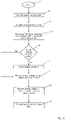
- Fig. 2 is a flow chart illustrating a method according to an embodiment of the invention.
- the process is started at step 7.
- a simulated voltage event in a model of a power grid forming part of a simulation tool is planned to take place at a future time, t 0 .
- the voltage event could, e.g., be a low voltage ride through (LVRT) event.
- step 9 the time, t 0 , has been reached, and the simulated voltage event is initiated by the simulation tool.
- the simulation tool retrieves information regarding an initial voltage state of the model of the wind farm.
- the retrieved information comprises information regarding whether or not the initial voltage state is a fault ride through (FRT) state. Furthermore, a final voltage state of the model of the wind farm is predicted, based on the retrieved information.
- FRT fault ride through
- step 11 it is investigated whether or not the initial voltage state of the model of the wind farm is a fault ride through (FRT) state. If this is the case, then it is likely that the planned simulated voltage event will cause the simulated output voltage, V, to increase abruptly, leading to a corresponding decrease in the simulated output current, I. Therefore, in this case, the process is forwarded to step 12, where the simulated output current, I, is lowered, already at time, t 0 , or immediately thereafter, in order to prevent that the output current, I, is too high, due to the duration of the simulation steps, thereby avoiding overshoots or spikes in the simulated output current, I, and the simulated output power.
- FRT fault ride through
- the simulated output voltage, V is monitored, and the simulated output current, I, is adjusted in accordance therewith.
- the simulated output current, I is adjusted accordingly, and thereby the actual behaviour of the real wind farm is followed accurately by the simulation.
- step 11 reveals that the initial voltage state of the model of the wind farm is not a fault ride through (FRT) state
- the process is forwarded directly to step 13, i.e. the simulated output voltage, V, is monitored and the simulated output current, I, is adjusted as described above, but without the initial lowering of the simulated output current, I.
- the simulated output voltage, V, the simulated output current, I, and/or the simulated output power is/are monitored, in order to monitor the simulated behaviour of the wind farm in response to the voltage event.
- step 15 the performance of the wind farm, in response to the voltage event, is evaluated based on the monitored simulated output voltage, V, simulated output current, I, and/or simulated output power.
- Fig. 3 illustrates simulated reactive power, simulated output voltage, and simulated output reactive current during a simulated voltage event, as a function of time, obtained by means of a prior art method.
- a time period corresponding to a simulation step may elapse from the simulated output voltage is abruptly decreased or increased, and until this is detected and a corresponding abrupt increase or decrease in the simulated reactive output current takes place.
- the spikes represent undesired discrepancies between the behaviour of the simulation model of the wind farm and the behaviour of the real wind farm.
- Fig. 4 illustrates simulated reactive power, simulated output voltage, and simulated output reactive current during a simulated voltage event, as a function of time, obtained by means of a method according to an embodiment of the invention.
- a voltage event is simulated, essentially in the manner described above with reference to Fig. 3 .
- the abrupt changes in the simulated reactive output current are performed substantially simultaneously with the abrupt changes in the simulated output voltage. This can be done because it is known in advance that a voltage event will occur, and it is possible to predict, or provide a qualified guess on, a final voltage state of the wind farm, following the voltage event.
- the delay in the response by the simulated reactive output current is considerably reduced. It can be seen from Fig. 4 , that this significantly reduces the spikes in the simulated reactive output current and the simulated reactive power.
Landscapes
- Engineering & Computer Science (AREA)
- Physics & Mathematics (AREA)
- Theoretical Computer Science (AREA)
- Power Engineering (AREA)
- Computer Hardware Design (AREA)
- Evolutionary Computation (AREA)
- Geometry (AREA)
- General Engineering & Computer Science (AREA)
- General Physics & Mathematics (AREA)
- Supply And Distribution Of Alternating Current (AREA)
Applications Claiming Priority (1)
| Application Number | Priority Date | Filing Date | Title |
|---|---|---|---|
| EP20210957 | 2020-12-01 |
Publications (1)
| Publication Number | Publication Date |
|---|---|
| EP4009464A1 true EP4009464A1 (de) | 2022-06-08 |
Family
ID=73654703
Family Applications (1)
| Application Number | Title | Priority Date | Filing Date |
|---|---|---|---|
| EP21207935.4A Withdrawn EP4009464A1 (de) | 2020-12-01 | 2021-11-12 | Verfahren zur bewertung der erwarteten leistung eines windparks |
Country Status (2)
| Country | Link |
|---|---|
| US (1) | US20220173591A1 (de) |
| EP (1) | EP4009464A1 (de) |
Families Citing this family (2)
| Publication number | Priority date | Publication date | Assignee | Title |
|---|---|---|---|---|
| US20230144092A1 (en) * | 2021-11-09 | 2023-05-11 | Hidden Pixels, LLC | System and method for dynamic data injection |
| US12524530B2 (en) * | 2021-12-27 | 2026-01-13 | Lawrence Livermore National Security | Attack detection and countermeasure identification system |
Citations (1)
| Publication number | Priority date | Publication date | Assignee | Title |
|---|---|---|---|---|
| CN102799722A (zh) | 2012-07-05 | 2012-11-28 | 中国电力科学研究院 | 一种风电场低电压穿越能力仿真验证方法 |
Family Cites Families (3)
| Publication number | Priority date | Publication date | Assignee | Title |
|---|---|---|---|---|
| US6858953B2 (en) * | 2002-12-20 | 2005-02-22 | Hawaiian Electric Company, Inc. | Power control interface between a wind farm and a power transmission system |
| US10041476B2 (en) * | 2014-09-02 | 2018-08-07 | Siemens Industry, Inc. | Systems, methods and apparatus for improved energy management systems with security-oriented probabilistic wind power generation dispatch |
| US11714934B2 (en) * | 2019-06-18 | 2023-08-01 | The Governors Of The University Of Alberta | Aggregated model of large-scale wind farms for power system simulation software tools |
-
2021
- 2021-11-12 EP EP21207935.4A patent/EP4009464A1/de not_active Withdrawn
- 2021-12-01 US US17/539,944 patent/US20220173591A1/en not_active Abandoned
Patent Citations (2)
| Publication number | Priority date | Publication date | Assignee | Title |
|---|---|---|---|---|
| CN102799722A (zh) | 2012-07-05 | 2012-11-28 | 中国电力科学研究院 | 一种风电场低电压穿越能力仿真验证方法 |
| CN102799722B (zh) * | 2012-07-05 | 2017-09-26 | 中国电力科学研究院 | 一种风电场低电压穿越能力仿真验证方法 |
Non-Patent Citations (1)
| Title |
|---|
| ETXEGARAI AGURTZANE ET AL: "Current procedures and practices on grid code compliance verification of renewable power generation", RENEWABLE AND SUSTAINABLE ENERGY REVIEWS, ELSEVIERS SCIENCE, NEW YORK, NY, US, vol. 71, 3 January 2017 (2017-01-03), pages 191 - 202, XP029923476, ISSN: 1364-0321, DOI: 10.1016/J.RSER.2016.12.051 * |
Also Published As
| Publication number | Publication date |
|---|---|
| US20220173591A1 (en) | 2022-06-02 |
Similar Documents
| Publication | Publication Date | Title |
|---|---|---|
| CN101919134B (zh) | 用于风力涡轮发电机的基于事件的控制系统及控制方法 | |
| CN112868157B (zh) | 用于将电功率馈送到供电网中的方法和风电场 | |
| EP3289656B1 (de) | Ausfallsicheres leistungsprofil für ein verteiltes erzeugungsverwaltungsverfahren | |
| EP2351189B1 (de) | Frequenzsensitive ladungserhaltungssteuerung von stromspeichersystemen für hilfsdienste in einem stromnetz | |
| CN102782318B (zh) | 运行风力发电站的方法 | |
| US20190294741A1 (en) | Simulation of a maximum power output of a wind turbine | |
| US20150280629A1 (en) | Method and apparatus for feeding electric energy into an electric supply grid | |
| EP4009464A1 (de) | Verfahren zur bewertung der erwarteten leistung eines windparks | |
| US11916394B2 (en) | Renewable energy system stabilization system and system stabilization support method | |
| EP3737857B1 (de) | Verfahren zur steuerung eines windparks unter berücksichtigung von nachlaufeffekten | |
| CN112952893B (zh) | 风电机组的无功功率控制方法、装置以及风电场 | |
| JP2015162997A (ja) | 電力系統監視装置、電力系統制御装置及び電力系統監視方法 | |
| EP4111569A1 (de) | Verfahren zum steuern einer kraftwerksanlage für erneuerbare energie während spannungsereignissen | |
| CN120073894A (zh) | 一种集合风-光-蓄一体式多能源协调控制方法 | |
| TW202246641A (zh) | 在劇烈天氣條件下運行風力渦輪機 | |
| CN114198265A (zh) | 风力发电机组故障判断方法 | |
| CN102075012B (zh) | 自动装置逻辑验证系统及测试方法 | |
| CN120175590A (zh) | 一种风电机组状态监测方法及系统 | |
| KR20250047248A (ko) | 전력공급 프로파일 예측 방법 | |
| CN115513991A (zh) | 光伏电站功率快速控制方法、装置、系统及可读存储介质 | |
| CN111509724B (zh) | 分散时序与集中模型预测结合的分层配电网电压控制方法 | |
| RU2530836C2 (ru) | Способ автоматического распределенного управления электрическими устройствами, способными регулировать свое продольное сопротивление, для разгрузки элементов сети энергообъединения при их перегрузке | |
| Amraee | Under frequency load shedding against severe generation outages in low inertia power grids | |
| CN119109062B (zh) | 一种电力信息安全风险管控系统及方法 | |
| EP4300751B1 (de) | Vorrichtung zur steuerung der rückwärtsflussleistung und verfahren zur steuerung der rückwärtsflussleistung |
Legal Events
| Date | Code | Title | Description |
|---|---|---|---|
| PUAI | Public reference made under article 153(3) epc to a published international application that has entered the european phase |
Free format text: ORIGINAL CODE: 0009012 |
|
| STAA | Information on the status of an ep patent application or granted ep patent |
Free format text: STATUS: THE APPLICATION HAS BEEN PUBLISHED |
|
| AK | Designated contracting states |
Kind code of ref document: A1 Designated state(s): AL AT BE BG CH CY CZ DE DK EE ES FI FR GB GR HR HU IE IS IT LI LT LU LV MC MK MT NL NO PL PT RO RS SE SI SK SM TR |
|
| STAA | Information on the status of an ep patent application or granted ep patent |
Free format text: STATUS: REQUEST FOR EXAMINATION WAS MADE |
|
| 17P | Request for examination filed |
Effective date: 20221206 |
|
| RBV | Designated contracting states (corrected) |
Designated state(s): AL AT BE BG CH CY CZ DE DK EE ES FI FR GB GR HR HU IE IS IT LI LT LU LV MC MK MT NL NO PL PT RO RS SE SI SK SM TR |
|
| STAA | Information on the status of an ep patent application or granted ep patent |
Free format text: STATUS: EXAMINATION IS IN PROGRESS |
|
| 17Q | First examination report despatched |
Effective date: 20241121 |
|
| STAA | Information on the status of an ep patent application or granted ep patent |
Free format text: STATUS: THE APPLICATION HAS BEEN WITHDRAWN |
|
| 18W | Application withdrawn |
Effective date: 20250224 |