EP4009546A1 - Appareil et méthode pour communications en espace libre - Google Patents
Appareil et méthode pour communications en espace libre Download PDFInfo
- Publication number
- EP4009546A1 EP4009546A1 EP20211124.1A EP20211124A EP4009546A1 EP 4009546 A1 EP4009546 A1 EP 4009546A1 EP 20211124 A EP20211124 A EP 20211124A EP 4009546 A1 EP4009546 A1 EP 4009546A1
- Authority
- EP
- European Patent Office
- Prior art keywords
- channel
- receiver
- quantum
- free
- wiretap
- Prior art date
- Legal status (The legal status is an assumption and is not a legal conclusion. Google has not performed a legal analysis and makes no representation as to the accuracy of the status listed.)
- Pending
Links
Images
Classifications
-
- H—ELECTRICITY
- H04—ELECTRIC COMMUNICATION TECHNIQUE
- H04B—TRANSMISSION
- H04B10/00—Transmission systems employing electromagnetic waves other than radio-waves, e.g. infrared, visible or ultraviolet light, or employing corpuscular radiation, e.g. quantum communication
- H04B10/70—Photonic quantum communication
-
- H—ELECTRICITY
- H04—ELECTRIC COMMUNICATION TECHNIQUE
- H04B—TRANSMISSION
- H04B10/00—Transmission systems employing electromagnetic waves other than radio-waves, e.g. infrared, visible or ultraviolet light, or employing corpuscular radiation, e.g. quantum communication
- H04B10/11—Arrangements specific to free-space transmission, i.e. transmission through air or vacuum
- H04B10/112—Line-of-sight transmission over an extended range
- H04B10/1121—One-way transmission
-
- H—ELECTRICITY
- H04—ELECTRIC COMMUNICATION TECHNIQUE
- H04B—TRANSMISSION
- H04B10/00—Transmission systems employing electromagnetic waves other than radio-waves, e.g. infrared, visible or ultraviolet light, or employing corpuscular radiation, e.g. quantum communication
- H04B10/80—Optical aspects relating to the use of optical transmission for specific applications, not provided for in groups H04B10/03 - H04B10/70, e.g. optical power feeding or optical transmission through water
Definitions
- the present invention relates to secure space communication and more particularly to an apparatus and a method providing secure communication between satellites and earth stations.
- Free-Space Optical communication is an optical communication technology that uses light propagating in free space to wirelessly transmit data for telecommunications or computer networking.
- Free space means air, outer space, vacuum, or something similar, where the light propagates in a straight line. This contrasts with guided optics, such as optical fibers or more generally optical waveguides, where light is guided and directed by the waveguide. Free-space technology is useful where the physical connections are impractical due to high costs or other considerations.
- Free-Space optical communications require security to prevent eavesdropping.
- Free-Space Optical communications When one looks into the different security means of Free-Space Optical communications, one can see that several solutions have been investigated in order to provide a solution enabling an emitter and a receiver to share secret information through FSO.
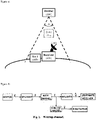
- the eavesdropper Eve1 300 is located on the optical path between the emitter 100 and the receiver 200; therefore Eve1 300 can intercept the optical signal and resend a potentially modified optical signal to the receiver 200.
- This will be referred to as the active scenario which can be tackled by a QKD communication protocol, for example.
- Eve2 305 is not located on the optical path between the emitter 100 and the receiver 200 and is therefore limited to the ability of extracting a fraction of the optical signal transmitted from the emitter 100 to the receiver 200.
- the eavesdropper (Eve2 305) cannot resend any optical signal to the receiver 200. This will be referred to as the passive scenario which will be discussed later.
- the first scenario can be resolved by the application of QKD in Free-space communications.
- QKD is a protocol that allows the exchange of secret keys in an active scenario, when the eavesdropper is located on the optical path between the emitter and the receiver.
- the communication channel between the two users is known as a quantum channel.
- a quantum channel is a communication channel, which transmits quantum particles, typically photons, in a way that conserves their quantum characteristics.
- QKD The basic idea behind QKD is that the eavesdropper is allowed to intercept the signal and process it in any way compatible with quantum mechanics. Nevertheless, the legal users, known as Emitter and Receiver, can still exchange a secure key.
- ground QKD quantum encoding
- the parameter used for quantum encoding is the phase, or a related timing parameter for the COW protocol.
- the reason is that, as polarization is not conserved in an optical fiber, polarization schemes require complicated and expensive components.
- interferometric detection is easier to realize in single-mode optical fibers, which is the medium of choice for ground QKD.
- ground QKD One of the most restrictive limitations of ground QKD is the distance limitation. Due to unavoidable loss in the optical waveguide and the fact that optical amplifiers cannot be used in a quantum channel, the distance between Emitter and Receiver is limited to about hundred kilometers in a commercial setup and up to three hundred kilometers in an academic experiment. Therefore, in order to increase the distance range, FSO QKD, where the quantum channel is free space, which does not have the same loss limitation, has been suggested.
- FSO QKD has been investigated in order to securely exchange a key between an emitter and a receiver in free space, typically between a satellite or a flying drone and a ground-based station.
- Document EP 3 337 063 describes a conventional free-Space key distribution method comprising exchanging information between an emitter and a receiver based on the physical layer wiretap channel model.
- This system is a QKD communication system consisting is exchanging keys between an emitter and a receiver, it follows a QKD protocol-based communication model: quantum part and iterative classical (post-processing) part, where the information is modulated as qbits and where the system operation uses measured QBER as input of the security provision process.
- a drawback of the invention is that, although it allows stronger signals, the force of the signal is still weak, it requires a posttreatment of the key, sifting and distillation, and it requires a two-way communication protocol.
- QKD requires a two-way protocol between the emitter and the receiver and is therefore generating less reliability than a one-way protocol, indeed a two-way protocol over satellite requires long time to distil useful keys due to the propagation times, which for one hop can range from a few dozens to hundreds of milliseconds. Therefore this delay adds up during each iteration of a QKD protocol.
- the conventional communication channel is known as a wiretap channel, first introduced by Wyner.
- the concept of a wiretap channel was later extended, at a more abstract level by Czisar and Korner.
- the wiretap channel is an abstract model, which includes any tripartite channel (with an Emitter, a Receiver and an Eavesdropper), with no restriction on the eavesdropper.
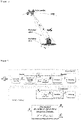
- the wiretap channel comprises two separate channels, one between Emitter and Receiver, and one between Emitter and Eve see figure 1b .
- This object is achieved by combining the physical layer wiretap channel hypothesis (the eavesdropper is limited to listening) and the use of a simple quantum channel, which will limit the amount of information available to Eve, through the principles of quantum mechanics and quantum electrodynamics.
- a first aspect of the invention relates to a free-Space quantum keyless private communication method according to a communication protocol comprising exchanging information between an emitter (100) and a receiver (200) through a main -classical-quantum channel and with an eavesdropper tapping said main channel through a wiretap channel, based on the wiretap channel model, wherein the overall degradation of the wiretap channel is superior than that of the main channel, comprising the steps of preparing, at the emitter (100), a message M composed of classical bits, coding said message M so as to transform it into a coded message X, converting the classical bits of the coded message into a signal to be sent to Bob by modulating the amplitude and/or the phase of the coherent states, sending the signal comprising the encoded message to the receiver (200) through a quantum-classical channel (500), such that an eavesdropper (300) tapping said channel is provided with partial information about the said states only, detecting and decoding the received message
- the transformation step is a stochastic coding step.
- the communication protocol is a one-way communication protocol.
- the classical bits modulate a coherent state which is modeled with quantum electrodynamics.
- d B is the distance between the emitter and the receiver
- d E is the distance between the emitter and the eavesdropper
- D E R is the diameter of the antenna of the eavesdropper
- D B R is the diameter of the antenna of the receiver
- ⁇ B is the (additional) loss of the receiver such as atmospheric, pointing, optic circuits, and detector efficiency
- ⁇ div is the far field divergence
- ⁇ E Eve's angle to the satellite
- the free-Space key distribution method further comprises defining an exclusion surrounding the receiver (200) based on the degradation parameter ⁇ .
- the exclusion surrounding the receiver (200) is defined such that the degradation parameter ⁇ is lower than a given value smaller than 1.
- the exclusion surrounding the receiver (200) is defined such that the degradation parameter ⁇ is lower than 0.1.
- the signal is an optical signal.
- Fig. 1 presents various eavesdropping scenarios.
- An emitter 100 and a receiver 200 exchange data through a FSO communication channel, defined by the dashed lines, wherein an eavesdropper Eve1 300 may be located between 100 and 200, and intercepts and resend the beam, according to the wiretap channel scenario, or an eavesdropper Eve2 305 may be located on the ground and can only collect part of beam without resending it, according to the physical layer wiretap channel scenario, both attempting at gaining information on the exchanged data. Its description will not be repeated here in detail.
- Figure 1b represents the general principle of wiretap channel. It was introduced by Wyner (relaxing the conditions for Shannon's perfect secrecy) and generalized by Csiszár & Körner. It models a general communication system architecture with a transmitter that encodes messages M into codewords X of n symbols for transmission to a receiver, in the presence of an eavesdropper that obtains noisy observations Z of X.
- the literature proved the existence of coding schemes simultaneously ensuring reliable transmission and secrecy for discrete memoryless channels, which was extended to Gaussian channels and wireless channels.
- secrecy is closely related to the concept of channel resolvability from information-spectrum methods developed by Han and Verd ⁇ .
- Fig. 2 represents, on top, the general principle of the invention, i.e. the main channel and the wiretap channel and on the bottom, the information theoretical representation of the classical-quantum degraded wiretap channel. It shows classical input random variable X and output quantum systems B and E..
- the protocol represents the general direct communication protocol as a one-way wiretap protocol where secret bits are channel encoded and sent over n uses of the optical channel.
- the protocol contains the following steps is the codeword received by Bob, i.e. it is a noisy version of the transmitted codeword Xn
- Upper bounds are also known for the speed of convergence rate of leaked information.
- the protocol jointly provides information-theoretical reliable and secure communication. The supremum of all such rates is called the private capacity.
- the private capacity (or secrecy capacity) of the classical-quantum wiretap channel of the present invention is the performance metric of the present protocol.
- the meaning of strong security is that, given a uniform distribution of the message to be transmitted through the channel between an emitter and a receiver, an eavesdropper shall obtain no information about it.
- This criterion is the most common security criterion in classical and quantum information theory.
- Figure 2 shows the physical description of the protocol implemented with coherent states over a degradable channel according to the present invention.
- the main channel between Alice (the emitter) and Bob (the receiver) and the wiretap channel between Alice (the emitter) and Eve (the eavesdropper) are preferably discrete memoryless channels.
- OOK On OFF Keying
- BPSK Binary Phase Shift Keying
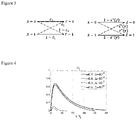
- the coefficient ⁇ ⁇ (0, 1) characterizes the channel power degradation, hence, the transmittance of Eve's channel is ⁇ .
- the received states are simply the vacuum, or
- the wiretap channel transition probabilities depend on the coherent states received by Bob and Eve and by their detection strategies. As mentioned above, for practical purposes, we assume that Bob uses standard single photon detectors, i.e. a threshold detector and one also takes into account limited detection efficiency (included in ⁇ ) and noise (dark counts probability p dark and stray light with a Poisson photon number distribution and average ⁇ 0 ⁇ ).
- the method of the present invention also preferably comprises a degradation parameter ⁇ calculation step depending on the receiver's parameter. Indeed, in order to provide a communication channel between Alice and Bob which is less degraded than the channel between Alice and Eve, this degradation has to be mastered and fixed.
- ⁇ E the fraction of the light collected by Eve
- the satellite has an orbit of about 500 km above the earth surface and exchanges keys over distances up to 1200 km if the satellite is close to the horizon.
- the transmitter is equipped with 300 mm Cassegrain telescope featuring a far field divergence ⁇ div of 10 ⁇ rad (full angle at 1/ e 2 ).
- the receiver at ground station has a telescope with a diameter D R of 1m.
- Table I below presents the private capacity for LEO, MEO and GEO satellites and different ambient light conditions. TABLE I: Comparison table between the achievable secret key rate for QKD and the achievable private rate for the wiretap channel presented in this work. For QKD with unrestricted Eve the values in the table are for an experiment carried out at night. In the case of a restricted Eve, daylight conditions are taken into account.
- Table I shows that the private capacity of a wiretap channel, outperforms QKD in terms of rate and most importantly in terms of resistance against noise. It has to be noted that the necessary laser power in order to reach the optimal signal strength of about 4 photons in average is moderate, e.g. about 15 mW and 15 ⁇ W, for the GEO and the LEO setting, respectively, and therefore it is no limitation.
- the protocol of the present invention is sensitive to jam attacks, so are QKD protocols.
- the protocol of the present invention can also be used in coordination with security mechanisms in communication layers above the physical layer to provide the satellite system availability, integrity and confidentiality.
- the present invention provides achievable private rates which are considerably higher than the QKD rates for the practical systems. Moreover, direct secret communication is also possible close to illuminated cities and even during daytime in contrast to QKD. Moreover, given the low rates, the secret keys generated by QKD will in practice not be used in combination with the one-time-pad but with symmetric encryption systems like AES. This means that the legitimate users have to choose between trusting physical security including exclusion areas around Alice and Bob which is needed for QKD as well or the computational security of encryption algorithms.
Landscapes
- Physics & Mathematics (AREA)
- Electromagnetism (AREA)
- Engineering & Computer Science (AREA)
- Computer Networks & Wireless Communication (AREA)
- Signal Processing (AREA)
- Optics & Photonics (AREA)
- Optical Communication System (AREA)
Priority Applications (5)
| Application Number | Priority Date | Filing Date | Title |
|---|---|---|---|
| EP20211124.1A EP4009546A1 (fr) | 2020-12-01 | 2020-12-01 | Appareil et méthode pour communications en espace libre |
| PCT/EP2021/081955 WO2022117341A1 (fr) | 2020-12-01 | 2021-11-17 | Appareil et procédé de communication dans un espace sécurisé |
| JP2023533974A JP7837974B2 (ja) | 2020-12-01 | 2021-11-17 | 安全な空間通信のための装置及び方法 |
| US18/253,689 US20240007196A1 (en) | 2020-01-12 | 2021-11-17 | Apparatus and method for secure space communication |
| KR1020237022046A KR20230129016A (ko) | 2020-12-01 | 2021-11-17 | 보안 공간 통신을 위한 장치 및 방법 |
Applications Claiming Priority (1)
| Application Number | Priority Date | Filing Date | Title |
|---|---|---|---|
| EP20211124.1A EP4009546A1 (fr) | 2020-12-01 | 2020-12-01 | Appareil et méthode pour communications en espace libre |
Publications (1)
| Publication Number | Publication Date |
|---|---|
| EP4009546A1 true EP4009546A1 (fr) | 2022-06-08 |
Family
ID=73694772
Family Applications (1)
| Application Number | Title | Priority Date | Filing Date |
|---|---|---|---|
| EP20211124.1A Pending EP4009546A1 (fr) | 2020-01-12 | 2020-12-01 | Appareil et méthode pour communications en espace libre |
Country Status (5)
| Country | Link |
|---|---|
| US (1) | US20240007196A1 (fr) |
| EP (1) | EP4009546A1 (fr) |
| JP (1) | JP7837974B2 (fr) |
| KR (1) | KR20230129016A (fr) |
| WO (1) | WO2022117341A1 (fr) |
Citations (2)
| Publication number | Priority date | Publication date | Assignee | Title |
|---|---|---|---|---|
| EP3337063A1 (fr) | 2016-12-13 | 2018-06-20 | ID Quantique S.A. | Appareil et procédé de sécurité de couche physique améliorée quantique |
| CN109525327A (zh) * | 2018-12-11 | 2019-03-26 | 国网江苏省电力有限公司南京供电分公司 | 一种预设阈值实时选择的自由空间量子安全直接通信方法 |
Family Cites Families (2)
| Publication number | Priority date | Publication date | Assignee | Title |
|---|---|---|---|---|
| AU2013265020B2 (en) * | 2012-05-23 | 2017-10-12 | University Of Leeds | Secure communication |
| US9787409B1 (en) * | 2015-04-30 | 2017-10-10 | Hrl Laboratories, Llc | High-speed optical quantum communication system based on mode-locked laser pulses |
-
2020
- 2020-12-01 EP EP20211124.1A patent/EP4009546A1/fr active Pending
-
2021
- 2021-11-17 JP JP2023533974A patent/JP7837974B2/ja active Active
- 2021-11-17 US US18/253,689 patent/US20240007196A1/en active Pending
- 2021-11-17 WO PCT/EP2021/081955 patent/WO2022117341A1/fr not_active Ceased
- 2021-11-17 KR KR1020237022046A patent/KR20230129016A/ko active Pending
Patent Citations (2)
| Publication number | Priority date | Publication date | Assignee | Title |
|---|---|---|---|---|
| EP3337063A1 (fr) | 2016-12-13 | 2018-06-20 | ID Quantique S.A. | Appareil et procédé de sécurité de couche physique améliorée quantique |
| CN109525327A (zh) * | 2018-12-11 | 2019-03-26 | 国网江苏省电力有限公司南京供电分公司 | 一种预设阈值实时选择的自由空间量子安全直接通信方法 |
Non-Patent Citations (5)
| Title |
|---|
| A. D. WYNER: "The Wire-Tap Channel", THE BELL SYSTEM TECHNICAL JOURNAL, vol. 54, no. 8, 1 October 1975 (1975-10-01), pages 1355 - 1387, XP055038949, DOI: 10.1002/j.1538-7305.1975.tb02040.x * |
| DATABASE INSPEC [online] THE INSTITUTION OF ELECTRICAL ENGINEERS, STEVENAGE, GB; May 1977 (1977-05-01), CARLEIAL A B ET AL: "A note on Wyner's wiretap channel", Database accession no. 1040476 * |
| DONG PAN ET AL: "Experimental free-space quantum secure direct communication and its security analysis", ARXIV.ORG, CORNELL UNIVERSITY LIBRARY, 201 OLIN LIBRARY CORNELL UNIVERSITY ITHACA, NY 14853, 3 September 2020 (2020-09-03), XP081754558, DOI: 10.1364/PRJ.388790 * |
| IEEE TRANSACTIONS ON INFORMATION THEORY USA, vol. IT-23, no. 3, 1 January 1977 (1977-01-01), pages 387 - 390, ISSN: 0018-9448 * |
| QI RUOYANG ET AL: "Implementation and security analysis of practical quantum secure direct communication", LIGHT: SCIENCE & APPLICATIONS, vol. 8, no. 1, 6 February 2019 (2019-02-06), XP055803965, DOI: 10.1038/s41377-019-0132-3 * |
Also Published As
| Publication number | Publication date |
|---|---|
| US20240007196A1 (en) | 2024-01-04 |
| WO2022117341A1 (fr) | 2022-06-09 |
| KR20230129016A (ko) | 2023-09-05 |
| JP2023552396A (ja) | 2023-12-15 |
| JP7837974B2 (ja) | 2026-03-31 |
Similar Documents
| Publication | Publication Date | Title |
|---|---|---|
| EP3337063B1 (fr) | Appareil et procédé de sécurité de couche physique améliorée quantique | |
| Shapiro | Defeating passive eavesdropping with quantum illumination | |
| Trinh et al. | Quantum key distribution over FSO: Current development and future perspectives | |
| US12052352B2 (en) | Apparatus and method for quantum enhanced physical layer security | |
| US7245722B2 (en) | System and method for distributing key | |
| Vázquez-Castro et al. | Quantum keyless private communication versus quantum key distribution for space links | |
| Endo et al. | Numerical study on secrecy capacity and code length dependence of the performances in optical wiretap channels | |
| Kasliwal et al. | Enhancing satellite‐to‐ground communication using quantum key distribution | |
| Patil et al. | A comprehensive review on security in free space optical communication | |
| Vázquez-Castro et al. | Quantum keyless private communication with decoy states for space channels | |
| Moli-Sanchez et al. | Performance analysis of quantum cryptography protocols in optical earth-satellite and intersatellite links | |
| Zhu et al. | Average secrecy capacity of free-space optical communication systems with on-off keying modulation and threshold detection | |
| EP4222917B1 (fr) | Procede de communication optique pour la transmission d'informations et pour la distribution d'une cle cryptographique et systeme de mise en oeuvre du procede | |
| Vu et al. | Satellite-based free-space quantum key distribution systems using QPSK modulation and heterodyne detection receiver | |
| EP4009546A1 (fr) | Appareil et méthode pour communications en espace libre | |
| Alshaer et al. | Performance evaluation and security analysis of ground‐to‐satellite FSO system with CV‐QKD protocol | |
| Nguyen et al. | Comprehensive performance analysis of satellite-to-ground FSO/QKD systems using key retransmission | |
| US20250055677A1 (en) | Cryptographic key sharing system | |
| Endo et al. | Secret key agreement for satellite laser communications [international communications satellite systems conference] | |
| Zeilinger | Long-distance quantum cryptography with entangled photons | |
| Mushatet et al. | SIMULATION FOR PERFORMANCE EVALUATION OF SATELLITE-BASED QUANTUM COMMUNICATION SYSTEM. | |
| GB2592639A (en) | Quantum key distribution system | |
| Soni | Performance Review of Quantum Computing Security Mechanisms in Free Space Communication Link | |
| Wang et al. | Application of Adaptive Polar Code based CV-QKD Scheme for LEO Satellite Systems | |
| Soni | Performance Analysis of Quantum Computing Security Mechanisms in Free Space Optics (FSO) Communication Link |
Legal Events
| Date | Code | Title | Description |
|---|---|---|---|
| PUAI | Public reference made under article 153(3) epc to a published international application that has entered the european phase |
Free format text: ORIGINAL CODE: 0009012 |
|
| STAA | Information on the status of an ep patent application or granted ep patent |
Free format text: STATUS: THE APPLICATION HAS BEEN PUBLISHED |
|
| AK | Designated contracting states |
Kind code of ref document: A1 Designated state(s): AL AT BE BG CH CY CZ DE DK EE ES FI FR GB GR HR HU IE IS IT LI LT LU LV MC MK MT NL NO PL PT RO RS SE SI SK SM TR |
|
| STAA | Information on the status of an ep patent application or granted ep patent |
Free format text: STATUS: REQUEST FOR EXAMINATION WAS MADE |
|
| 17P | Request for examination filed |
Effective date: 20221207 |
|
| RBV | Designated contracting states (corrected) |
Designated state(s): AL AT BE BG CH CY CZ DE DK EE ES FI FR GB GR HR HU IE IS IT LI LT LU LV MC MK MT NL NO PL PT RO RS SE SI SK SM TR |
|
| P01 | Opt-out of the competence of the unified patent court (upc) registered |
Effective date: 20230526 |
|
| STAA | Information on the status of an ep patent application or granted ep patent |
Free format text: STATUS: EXAMINATION IS IN PROGRESS |
|
| 17Q | First examination report despatched |
Effective date: 20250402 |