EP4009601A1 - Aufbau von vpn - Google Patents
Aufbau von vpn Download PDFInfo
- Publication number
- EP4009601A1 EP4009601A1 EP20211287.6A EP20211287A EP4009601A1 EP 4009601 A1 EP4009601 A1 EP 4009601A1 EP 20211287 A EP20211287 A EP 20211287A EP 4009601 A1 EP4009601 A1 EP 4009601A1
- Authority
- EP
- European Patent Office
- Prior art keywords
- vpn
- mobile device
- identification
- profile
- device container
- Prior art date
- Legal status (The legal status is an assumption and is not a legal conclusion. Google has not performed a legal analysis and makes no representation as to the accuracy of the status listed.)
- Granted
Links
Images



Classifications
-
- H—ELECTRICITY
- H04—ELECTRIC COMMUNICATION TECHNIQUE
- H04L—TRANSMISSION OF DIGITAL INFORMATION, e.g. TELEGRAPHIC COMMUNICATION
- H04L63/00—Network architectures or network communication protocols for network security
- H04L63/02—Network architectures or network communication protocols for network security for separating internal from external traffic, e.g. firewalls
- H04L63/0272—Virtual private networks
-
- H—ELECTRICITY
- H04—ELECTRIC COMMUNICATION TECHNIQUE
- H04W—WIRELESS COMMUNICATION NETWORKS
- H04W12/00—Security arrangements; Authentication; Protecting privacy or anonymity
- H04W12/03—Protecting confidentiality, e.g. by encryption
- H04W12/033—Protecting confidentiality, e.g. by encryption of the user plane, e.g. user's traffic
-
- H—ELECTRICITY
- H04—ELECTRIC COMMUNICATION TECHNIQUE
- H04W—WIRELESS COMMUNICATION NETWORKS
- H04W12/00—Security arrangements; Authentication; Protecting privacy or anonymity
- H04W12/30—Security of mobile devices; Security of mobile applications
- H04W12/37—Managing security policies for mobile devices or for controlling mobile applications
-
- H—ELECTRICITY
- H04—ELECTRIC COMMUNICATION TECHNIQUE
- H04W—WIRELESS COMMUNICATION NETWORKS
- H04W12/00—Security arrangements; Authentication; Protecting privacy or anonymity
- H04W12/40—Security arrangements using identity modules
- H04W12/47—Security arrangements using identity modules using near field communication [NFC] or radio frequency identification [RFID] modules
-
- H—ELECTRICITY
- H04—ELECTRIC COMMUNICATION TECHNIQUE
- H04W—WIRELESS COMMUNICATION NETWORKS
- H04W12/00—Security arrangements; Authentication; Protecting privacy or anonymity
- H04W12/40—Security arrangements using identity modules
- H04W12/48—Security arrangements using identity modules using secure binding, e.g. securely binding identity modules to devices, services or applications
Definitions
- the present invention generally relates to information technology. More specifically, the present invention is directed to establishing a secure connection between a mobile device container and a number of virtual private networks (VPN).
- VPN virtual private networks
- Mobile device containers act as an additional space within mobile devices. Mobile device containers serve to delimit and protect applications, data, and processes within the mobile device container from those outside of the mobile device container. This delamination between within and outside of mobile device containers has also be complied with when establishing a VPN connection.
- the present invention relates to a system for establishing a secure connection between a mobile device container and a number of VPN.
- the system comprises a mobile device container which is configured to isolate a portion of a mobile device from another portion of the mobile device.
- the system also comprises a number of VPN, where each of the number of VPN has a VPN profile.
- the system comprises a cryptographic token which is configured to provide at least part of the VPN profile of at least one of the number of VPN.
- the system also comprises a communication link which is configured to link the mobile device container and the cryptographic token.
- the mobile device container In order to establish a secure connection to the at least one VPN of the number of VPN, the mobile device container is configured to access at least part of the VPN profile of the VPN of the at least one VPN of the number of VPN through the communication link which is configured to link the mobile device container and the cryptographic token.
- VPN is used herein to indicate a logical network which is established between a client and a server and potential further participants. Further participants of the VPN may comprise gateways, further servers or services. By establishing the logical network between the client and the server and potential further participants, the client itself may become a participant of the VPN.
- the mobile device container may be a client of a VPN. The mobile device container may become a participant of the VPN.
- a secure connection may generally comprise a connection which prevents third parties from unauthorized accessing, reading or interfering with the connection or any communication within the connection.
- a secure connection may refer to a safe channel between the mobile device container and one of the participants of the VPN where any tracking activity from outside is impossible.
- a secure connection may comprise a VPN tunnel.
- the number of VPN may comprise at least one VPN.
- the number of VPN may depend on the VPN architecture the mobile device container is to be connected to. For instance, when a mobile device container of a user is to be connected to the VPN of the user's company department, the mobile device container may first be connected to the company's general VPN before the department's VPN can be accessed. In this case, the number of VPN equals two.
- the number of VPN may depend on the internal organization of a company, government, educational institution, or another entity.
- the number of VPN may be modified in cases where the mobile device container is to be securely connected to less/ more VPN.
- the number of VPN may be configured to any of a multi-hop VPN, a double-hop VPN, a chaining VPN, a cascading VPN, and subsequent VPN.
- Each of the number of VPN may comprise any of a private network, a VPN, a proxy, a gateway proxy, a tunneling proxy, a reverse proxy, a gateway proxy, a bridge proxy, a network socket.
- a gateway proxy it is referred to European Patent Application EP3544252A1 which is hereby incorporated by reference .
- the mobile device container may create an isolated space within a mobile device.
- the mobile device container may allow for strict division between the mobile device container and the remaining mobile device. Data inside the container may be stored and transferred encrypted. Applications within the mobile device container such as calendar, e-mail, contacts may run completely separately from those outside the container.
- a mobile device container may thus unite two separate use cases, for instance private use and business use, on one mobile device. Therefore, mobile device container can cater to companies, governments, educational institution, and other entities for temporary external workers, and policies such as Bring Your Own Device (BYOD), or Corporate Owned, Personally Enabled (COPE) and more.
- BYOD Bring Your Own Device
- COPE Personally Enabled
- Access to the mobile device itself may not yet allow access to the mobile device container. Access to the mobile device container may require additional credentials.
- the mobile device container may protect information and data independently from an underlying operating system.
- the mobile device container may be implemented as an application, software and/ or hardware within a mobile device.
- a mobile device may comprise any device that is principally movable. It may comprise computer, laptop computer, portable computer, tablet computer, smartphones, smartwatches, and eBook reader.
- the cryptographic token may be configured to provide at least part of the VPN profile of at least one of the number of VPN. Alternatively, or in addition thereto, the cryptographic token may provide the full VPN profile of at least one of the number of VPN. Alternatively or in addition thereto, the cryptographic token may provide at least part of each of the VPN profile of each of the number of VPN. Alternatively, or in addition thereto, the cryptographic token may provide the full VPN profile of each of the number of VPN.
- the cryptographic token may be configured for single use.
- accessing at least part of the VPN profile of the VPN may also comprise extracting the accessed at least part of the VPN profile to the mobile device container.
- the at least part of the VPN profile may be permanently accessible by the mobile device container.
- At least part of the VPN profile may be stored on the cryptographic token complying with the Cryptographic Token Information Syntax Standard PKCS#15. At least part of the VPN profile may be stored on the cryptographic token complying with the FIPS 201-2 PIV (Personal Identity Verification) Standard. In addition, or alternatively, at least part of the VPN profile may be parsed and stored in unused space of the cryptographic token. In addition, or alternatively, a further part of the VPN profile may be parsed and stored in unused space of the cryptographic token.
- the mobile device container may comprise instructions on how to access the further part of the VPN profile that has been previously parsed and stored in unused space of the cryptographic token.
- Cryptographic token may contain storage areas where at least part of the VPN profile may be stored. This part of the VPN profile may relate to information such as secret key material.
- this secret key material may be private key material, public key material, X.509 certificates or other data. This storage area may normally not processed by the token during normal operation.
- the VPN profile may serve for authentication of the mobile device container towards the VPN.
- a full VPN profile may be required for successful authentication.
- Authentication may be assured by any or any combination of legitimate possession of the VPN profile, physical or biometric features of the user of the mobile device container, generic secret between the mobile device container and the VPN.
- the VPN profile may comprise classified information.
- the VPN profile of each of the number of VPN may comprise at least one of: a challenge response authentication, user identification (ID), mobile device ID, mobile device container ID, a cryptographic key, an encrypted key, a private key, a public key, a certificate, public key certificate, generic secret, personal identification number (PIN), password, one-time password, application programming interface (API) key, API token, biometric identification, fingerprint identification, palm veins identification, face identification, DNA identification, palmprint identification, iris identification, hand geometrics identification, retina identification, voice ID identification.
- the VPN profile may be any of non-encrypted, asymmetrically or symmetrically encrypted.
- the VPN profile of each of the number of VPN may further comprise at least one of: VPN server information, port number, hostname, network address, target system, configuration information, time-out information, compression information, IP address, identification number.
- the VPN profile may be provided in plaintext and/ or cyphertext.
- the cyphertext may be the result of asymmetrical or symmetric encryption.
- the cryptographic token may be provided by at least one of: a smart card, an integrated circuit card (ICC), a universal serial bus (USB) medium, a quick response (QR) code, an optical medium, an audio medium, a photographic medium, a holographic medium, a transaction authentication number (TAN) generator, a smart watch, a near field communication (NFC) medium, a radio-frequency identification (RFID) medium, a user.
- a smart card an integrated circuit card (ICC), a universal serial bus (USB) medium, a quick response (QR) code, an optical medium, an audio medium, a photographic medium, a holographic medium, a transaction authentication number (TAN) generator, a smart watch, a near field communication (NFC) medium, a radio-frequency identification (RFID) medium, a user.
- ICC integrated circuit card
- USB universal serial bus
- QR quick response
- an optical medium an audio medium
- photographic medium a photographic medium
- a holographic medium a transaction authentication number (TAN
- the communication link may comprise at least one of: Bluetooth, a wired card reader, a wireless card reader, NFC, RFID, a body area network (BAN), a biometric recognition device, an optical recognition device, optical pairing, a QR recognition device, a fingerprint recognition device, a palm veins recognition device, a face recognition device, a DNA recognition device, a palmprint recognition device, an iris recognition device, a hand geometrics recognition device, a retina recognition device, a voice ID recognition device.
- Bluetooth a wired card reader, a wireless card reader, NFC, RFID, a body area network (BAN), a biometric recognition device, an optical recognition device, optical pairing, a QR recognition device, a fingerprint recognition device, a palm veins recognition device, a face recognition device, a DNA recognition device, a palmprint recognition device, an iris recognition device, a hand geometrics recognition device, a retina recognition device, a voice ID recognition device.
- the cryptographic token may further comprise an unlocking mechanism for unlocking by the mobile device container.
- the unlocking mechanism may initiate a graphical user interface which may prompt a user of the mobile device container to PIN entering or fingerprint scanning.
- the at least part of the VPN profile may be manually deployed to the cryptographic token by a network administrator. Alternatively, or in combination thereto, the at least part of the VPN profile may be deployed to the cryptographic token within batch processing.
- the system may further comprise an additional cryptographic token.
- the system may be configured to provide a further part of the VPN profile to establish a secure connection to the VPN of the number of VPN.
- the further part of the VPN profile may be provided by at least one of the following: mobile device container, the VPN of the number of VPN, the communication link, and the additional cryptographic token.
- the additional cryptographic token may be provided by the mobile device container
- the additional token may be manually deployed by an administrator, automatically deployed during configuration of the mobile device container (e.g. via a mobile device management) or may be part of the installation package.
- the additional cryptographic token may also be retrieved from a network resource available after connecting and joining a preceding VPN of the number of VPN.
- the cryptographic token may be configured to indicate to the mobile device container where and/ or how to access the further part of the VPN profile within the system.
- the mobile device container may comprise information on where and/ or how to access the at least part and the further part of the VPN profile within the system.
- system may be further configured to selectively provide at least part of the VPN profile of the subsequent VPN only if the connection between the mobile device container and the VPN has been successfully established.
- “Selectively provided” may be used herein to indicate a mechanism which unlocks and/ or activates the VPN profile of the subsequent VPN upon feedback that the secure connection to the VPN, that is to say the VPN which precedes the subsequent VPN, has been successfully established.
- the mechanism may comprise logic, a flag, arithmetic processes, registers, or the like. This mechanism may further enhance security of processing VPN profiles in that it hides at least part of the VPN profile of the subsequent VPN until the mobile device container has already successfully proved authentication to a related VPN.
- This mechanism may be particularly employed for VPN profiles that comprise classified information.
- "selectively provided” could be illustrated by a sequence of doors whereat at least part of the key and/ or address for second next door is only provided after the next door.
- An implementation of "selectively provided” may use different sets of cryptographic tokens to access the subsequent VPN.
- the different sets of cryptographic tokes may be multi-use, single-use or only valid for a certain time.
- the mobile container may have access to a cryptographic token (a) and an additional cryptographic token (b).
- the mobile device container may use token (a) to connect and access VPN1.
- the mobile container may now be able to connect and authenticate using cryptographic token (b) to an internal service only reachable via VPN1 which may provide another cryptographic token for single use (c).
- the mobile container may then use the single-use cryptographic token (c) to connect and access VPN2.
- “Successfully established” may be used herein to indicate that the mobile device container has authenticated itself towards the VPN and has been securely connected to the VPN. Thereupon, the mobile device container and/ or other components of the system may receive a corresponding feedback which in turn might be necessary for unlocking and/ or activating the VPN profile of the subsequent VPN.
- At least part of the VPN profile of the subsequent VPN may be selectively provided by at least one of the following: the cryptographic token, the mobile device container, the VPN of the number of VPN, the communication link, and the additional cryptographic token.
- the additional cryptographic token may be provided by at least one of: a smart card, an integrated circuit card (ICC), a universal serial bus (USB) medium, a quick response (QR) code, an optical medium, an audio medium, a photographic medium, a holographic medium, a transaction authentication number (TAN) generator, a smart watch, a near field communication (NFC) medium, a radio-frequency identification (RFID) medium, a user.
- a smart card an integrated circuit card (ICC), a universal serial bus (USB) medium, a quick response (QR) code, an optical medium, an audio medium, a photographic medium, a holographic medium, a transaction authentication number (TAN) generator, a smart watch, a near field communication (NFC) medium, a radio-frequency identification (RFID) medium, a user.
- ICC integrated circuit card
- USB universal serial bus
- QR quick response
- an optical medium an audio medium
- photographic medium a photographic medium
- a holographic medium a transaction authentication number (TAN
- the additional communication link may comprise at least one of: Bluetooth, a wired card reader, a wireless card reader, NFC, RFID, a body area network (BAN), a biometric recognition device, an optical recognition device, optical pairing, a QR recognition device, a fingerprint recognition device, a palm veins recognition device, a face recognition device, a DNA recognition device, a palmprint recognition device, an iris recognition device, a hand geometrics recognition device, a retina recognition device, a voice ID recognition device.
- Bluetooth a wired card reader, a wireless card reader, NFC, RFID, a body area network (BAN), a biometric recognition device, an optical recognition device, optical pairing, a QR recognition device, a fingerprint recognition device, a palm veins recognition device, a face recognition device, a DNA recognition device, a palmprint recognition device, an iris recognition device, a hand geometrics recognition device, a retina recognition device, a voice ID recognition device.
- the additional cryptographic token may further comprise an unlocking mechanism for unlocking by the mobile device container.
- the unlocking mechanism may initiate a graphical user interface which may prompt a user of the mobile device container to PIN entering or fingerprint scanning.
- the smart card comprises cryptographic logic, a central processing unit, a communication interface which is configured to communicate with a mobile device container and memory.
- the memory may comprise volatile memory, such as RAM, and/ or non-volatile memory, such as Flash, EEPROM.
- the mobile device container is configured to isolate processes and data of a mobile device from other processes and data of the mobile device, and the mobile device container is also configured to establish a secure connection to a number of VPN, each VPN having a VPN profile.
- the smart card is configured to provide, using cryptographic logic, upon request of the mobile device container, at least part of a VPN profile of a VPN of the number of VPN.
- the VPN profile provided by the smart card may comprise at least one of the following: a challenge response authentication, user identification (ID), mobile device ID, mobile device container ID, a cryptographic key, an encrypted key, a private key, a public key, a certificate, public key certificate, generic secret, personal identification number (PIN), password, one-time password, API key, API token, biometric identification, fingerprint identification, palm veins identification, face identification, DNA identification, palmprint identification, iris identification, hand geometrics identification, retina identification, voice ID identification, VPN server information, port number, hostname, network address, target system, configuration information, time-out information, compression information, IP address, identification number.
- the VPN profile provided by the smart card may be provided in plaintext and/ or cyphertext.
- the smart card may be further configured, upon a subsequent request of the mobile device container, to selectively provide at least part of a subsequent VPN profile only if the mobile device container successfully established a secure connection to the VPN.
- the smart card may further comprise an unlocking mechanism for unlocking by the mobile device container.
- the smart card may also be configured to receive updates of the memory and/ or cryptographic logic that are stored on the mobile device container and forwarded to the smart card through the communication interface.
- the mobile device container is configured to isolate a portion of the mobile device from another portion of the mobile device.
- the mobile device container comprises a first interface which is configured to securely connect to a number of VPN, and a second interface which is configured to communicate with an integrated circuit card (ICC).
- ICC integrated circuit card
- the ICC is configured to provide at least part of a VPN profile of a VPN of the number of VPN. For establishing a secure connection to the VPN of the number of VPN over the first interface, the mobile device container is configured to access at least part of the VPN profile of the VPN of the number of VPN over the second interface.
- the mobile device container may be further configured to prompt a user to enter an authentication code for unlocking the ICC.
- Another aspect of present invention relates to a method for establishing a secure connection between a mobile device container and a number of VPN.
- the mobile device container is configured to isolate a portion of a mobile device from another portion of the mobile device.
- the method comprises the steps of
- the method may further comprise the steps of
- Cryptographic processes may be used herein to indicate any of decrypting or encrypting processes, creating digital signatures, key exchange mechanisms (e.g. Diffie-Hellman key exchange) or creating message authentication codes using symmetric or asymmetric cryptography. Such cryptographic processes may comprise using a smartcard.
- the step of accessing at least part of a VPN profile may as well comprise extracting at least part of the VPN profile.
- the at least part of the VPN profile may be stored within the mobile device container and thereby made permanently accessible. This may for instance be the case for smart cards configured for single use.
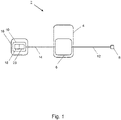
- Fig. 1 shows a simplified, schematic illustration of a system 2 for establishing a secure connection 12 between a mobile device container 6 which is implemented in a mobile device 4 and a number of VPN 8.
- the number of VPN 8 is equal to one VPN.
- the system 2 comprises a cryptographic token 10.
- the cryptographic token is provided on a smart card 16.
- the cryptographic token 10 provides a VPN profile 18, 20.
- the VPN profile includes VPN server information 18 which, for instance, indicates a target network address.
- the VPN profile further includes an authentication key 20 for authentication of the mobile device container 6 towards the VPN 8.
- the cryptographic token 10 and the mobile device container 6 are linked by a communication link 14.
- the mobile device container 6 accesses the VPN server information 18 and the authentication key 20 from the cryptographic token 10 through the communication link 14.
- the mobile device container 6 extracts and stores the VPN server information 18 and the authentication key 20 for permanent accessibility.
- Fig. 2 shows another schematic example of the system 2 for establishing a secure connection between a mobile device container 6 and a number of VPN 8 which comprises two cryptographic tokens 10, 22.
- the number of VPN 8 is also equal to one.
- One cryptographic token 10 is provided by the smart card 16 and includes VPN server information 18.
- the mobile device container 6 and cryptographic token 10 are linked by the communication link 14.
- Another cryptographic token 22 is provided by a near field communication medium 24 and includes the authentication key 20.
- the mobile device container 6 and cryptographic token 22 are linked by communication link 26.
- mobile device container 6 accesses VPN server information 18 from cryptographic token 10 through communication link 14, and the authentication key 20 from cryptographic token 22 through communication link 26.
- Either of the cryptographic tokens 10, 22, or the mobile device container 6 indicates where to find the different parts of the VPN profile (not shown).
- Fig. 3a to 3c illustrate exemplary configurations of the number of VPN 8.
- the number of VPN comprises one VPN 28.
- one VPN profile is necessary for establishing a secure connection to this one VPN 28.
- Fig. 3b shows a multi-hop VPN configuration with three subsequent VPN 28a, 28b, 28c.
- the three subsequent VPN 28a, 28b, 28c correspond to different VPN within a company, government, educational institution, or other entity.
- VPN 28a corresponds to the main VPN of the entity
- VPN 28b corresponds to a department VPN of the entity
- 28c corresponds to a team VPN.
- Parts of the VPN profile of the respective subsequent VPN are provided by the preceding VPN upon successful connection of the mobile device container to the preceding VPN (not shown).
- VPN server information of VPN 28b are provided by VPN 28a once a secure connection has been established to the VPN 28a.
- Fig. 3c shows a cascading VPN configuration of the number of VPN 8.
- specific VPN 28 branch out to more than one subsequent VPN.
- Fig. 4 illustrates an exemplary simplified graphical user interface of an unlocking mechanism 30 of the smart card 16.
- the graphical user interface 30 prompts a user of the mobile device container 6 to enter a PIN in order to unlock the smartcard.
- the mobile device container 6 can access the cryptographic token 10 provided by the smart card 16 through the communication link 14.
- Fig. 5 shows a schematic illustration of an example of a smart card 16.
- the smart card 16 comprises memory 32, cryptographic logic 34, a central processing unit 36, and a communication interface 38.
- the communication interface 38 is configured for wired or wireless communication through communication link 14 with a mobile device container 6 of a mobile device 4.
- the smart card 16 provides, upon request of the mobile device container 6, at least part of a VPN profile from the memory 32.
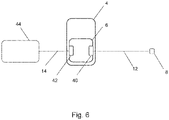
- Fig. 6 shows a schematic illustration of an exemplary mobile device container 6 with two interfaces 40, 42.
- the mobile device container 6 is implemented within a mobile device 4.
- the first interface 40 is configured for connecting over a secure connection 12 to a number of VPN 8.
- the second interface 42 is configured for communication to an ICC.
- the mobile device container 4 accesses at least part of a VPN profile of a VPN of the number of VPN 8 from the ICC 44 over the second interface 42. Thereafter, the mobile device container 6 connects to the VPN of the number of VPN 8 over the first interface 40.
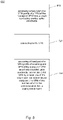
- Fig. 7 and Fig. 8 relate to exemplary method 700, 800 for establishing a secure connection between a mobile device container and a number of VPN.
- method 700 comprises the step 710 of accessing at least part of a VPN profile of a VPN of the number of VPN from a smart card.
- Method 700 further comprises the step 710 of connecting to the VPN.
- step 720 at least part of a VPN profile of a subsequent VPN of the number of VPN is accessed which is selectively provided upon successful connection to the VPN by at least one of the smart card, the mobile device container, the VPN of the number of VPN, the communication link, a cryptographic token.
- the method further comprises connecting to the subsequent VPN in step 730.
- Fig. 8 shows another method 800 which comprises method 700.
- the first step 810 which relates to accessing at least part of a VPN profile of a VPN of the number of VPN from a smart card also comprises cryptographic processes.
Landscapes
- Engineering & Computer Science (AREA)
- Computer Security & Cryptography (AREA)
- Computer Networks & Wireless Communication (AREA)
- Signal Processing (AREA)
- Computer Hardware Design (AREA)
- Computing Systems (AREA)
- General Engineering & Computer Science (AREA)
- Mobile Radio Communication Systems (AREA)
- Reverberation, Karaoke And Other Acoustics (AREA)
- Optical Communication System (AREA)
Priority Applications (3)
| Application Number | Priority Date | Filing Date | Title |
|---|---|---|---|
| PL20211287.6T PL4009601T3 (pl) | 2020-12-02 | 2020-12-02 | Ustanawianie vpn |
| ES20211287T ES2967287T3 (es) | 2020-12-02 | 2020-12-02 | Establecimiento de VPN |
| EP20211287.6A EP4009601B1 (de) | 2020-12-02 | 2020-12-02 | Aufbau von vpn |
Applications Claiming Priority (1)
| Application Number | Priority Date | Filing Date | Title |
|---|---|---|---|
| EP20211287.6A EP4009601B1 (de) | 2020-12-02 | 2020-12-02 | Aufbau von vpn |
Publications (3)
| Publication Number | Publication Date |
|---|---|
| EP4009601A1 true EP4009601A1 (de) | 2022-06-08 |
| EP4009601B1 EP4009601B1 (de) | 2023-10-18 |
| EP4009601C0 EP4009601C0 (de) | 2023-10-18 |
Family
ID=73694875
Family Applications (1)
| Application Number | Title | Priority Date | Filing Date |
|---|---|---|---|
| EP20211287.6A Active EP4009601B1 (de) | 2020-12-02 | 2020-12-02 | Aufbau von vpn |
Country Status (3)
| Country | Link |
|---|---|
| EP (1) | EP4009601B1 (de) |
| ES (1) | ES2967287T3 (de) |
| PL (1) | PL4009601T3 (de) |
Citations (5)
| Publication number | Priority date | Publication date | Assignee | Title |
|---|---|---|---|---|
| US20060212937A1 (en) * | 2005-02-18 | 2006-09-21 | Microsoft Corporation | SyncML based OMA connectivity object to provision VPN connections |
| EP2629570A1 (de) * | 2012-02-16 | 2013-08-21 | Research In Motion Limited | Verfahren und Vorrichtung zur automatischen VPN-Anmeldung und -Schnittflächenauswahl |
| US20130297933A1 (en) * | 2012-03-29 | 2013-11-07 | Lockheed Martin Corporation | Mobile enterprise smartcard authentication |
| US20140109174A1 (en) * | 2012-10-15 | 2014-04-17 | Citrix Systems, Inc. | Providing Virtualized Private Network Tunnels |
| EP3544252A1 (de) | 2018-03-19 | 2019-09-25 | Virtual Solution AG | Verfahren und vorrichtung zur steuerung eines anwendungsspezifischen zugangs zu einem sicheren netzwerk |
-
2020
- 2020-12-02 ES ES20211287T patent/ES2967287T3/es active Active
- 2020-12-02 PL PL20211287.6T patent/PL4009601T3/pl unknown
- 2020-12-02 EP EP20211287.6A patent/EP4009601B1/de active Active
Patent Citations (5)
| Publication number | Priority date | Publication date | Assignee | Title |
|---|---|---|---|---|
| US20060212937A1 (en) * | 2005-02-18 | 2006-09-21 | Microsoft Corporation | SyncML based OMA connectivity object to provision VPN connections |
| EP2629570A1 (de) * | 2012-02-16 | 2013-08-21 | Research In Motion Limited | Verfahren und Vorrichtung zur automatischen VPN-Anmeldung und -Schnittflächenauswahl |
| US20130297933A1 (en) * | 2012-03-29 | 2013-11-07 | Lockheed Martin Corporation | Mobile enterprise smartcard authentication |
| US20140109174A1 (en) * | 2012-10-15 | 2014-04-17 | Citrix Systems, Inc. | Providing Virtualized Private Network Tunnels |
| EP3544252A1 (de) | 2018-03-19 | 2019-09-25 | Virtual Solution AG | Verfahren und vorrichtung zur steuerung eines anwendungsspezifischen zugangs zu einem sicheren netzwerk |
Also Published As
| Publication number | Publication date |
|---|---|
| PL4009601T3 (pl) | 2024-03-25 |
| EP4009601B1 (de) | 2023-10-18 |
| ES2967287T3 (es) | 2024-04-29 |
| EP4009601C0 (de) | 2023-10-18 |
Similar Documents
| Publication | Publication Date | Title |
|---|---|---|
| US11838272B2 (en) | VPN establishment | |
| US10681025B2 (en) | Systems and methods for securely managing biometric data | |
| US8689013B2 (en) | Dual-interface key management | |
| US20130219481A1 (en) | Cyberspace Trusted Identity (CTI) Module | |
| US8295484B2 (en) | System and method for securing data from a remote input device | |
| US8769289B1 (en) | Authentication of a user accessing a protected resource using multi-channel protocol | |
| DK2481230T3 (en) | A method for authentication, method of payment authorization, and similar electronic devices | |
| US8397281B2 (en) | Service assisted secret provisioning | |
| CN108684041A (zh) | 登录认证的系统和方法 | |
| KR20140098872A (ko) | 모바일 nfc단말기 웹 서비스를 위한 바이오인식과 tsm 기반의 보안 시스템 및 방법 | |
| US11303630B2 (en) | Method for opening a secure session on a computer terminal | |
| JP2021519966A (ja) | リモート生体計測識別 | |
| KR100548638B1 (ko) | 스마트카드를 이용한 원 타임 패스워드 생성 및 인증방법그리고 이를 위한 스마트카드 | |
| US20060218397A1 (en) | Apparatus and methods for sharing cryptography information | |
| JP2021050556A (ja) | 認証システム | |
| WO2010048350A1 (en) | Card credential method and system | |
| KR20170070379A (ko) | 이동통신 단말기 usim 카드 기반 암호화 통신 방법 및 시스템 | |
| EP4009601A1 (de) | Aufbau von vpn | |
| US12568374B2 (en) | Cloud computing environment and a method for providing remote secure element services | |
| JP2004206258A (ja) | 多重認証システム、コンピュータプログラムおよび多重認証方法 | |
| WO2016030832A1 (en) | Method and system for mobile data and communication security | |
| US12495027B2 (en) | Secure online authentication method using mobile ID document | |
| EP4407490A1 (de) | Sichere on-boarding persönlicher attribute auf einer externen einheit | |
| EP1705854A1 (de) | Verfahren und Vorrichtung zum Austausch von kryptographischen Daten in einem mobilen Kommunikationssystem | |
| HK1089585A (en) | Method and apparatus for sharing cryptographic information in a mobile communication system |
Legal Events
| Date | Code | Title | Description |
|---|---|---|---|
| PUAI | Public reference made under article 153(3) epc to a published international application that has entered the european phase |
Free format text: ORIGINAL CODE: 0009012 |
|
| STAA | Information on the status of an ep patent application or granted ep patent |
Free format text: STATUS: THE APPLICATION HAS BEEN PUBLISHED |
|
| AK | Designated contracting states |
Kind code of ref document: A1 Designated state(s): AL AT BE BG CH CY CZ DE DK EE ES FI FR GB GR HR HU IE IS IT LI LT LU LV MC MK MT NL NO PL PT RO RS SE SI SK SM TR |
|
| RAP1 | Party data changed (applicant data changed or rights of an application transferred) |
Owner name: MATERNA VIRTUAL SOLUTION GMBH |
|
| STAA | Information on the status of an ep patent application or granted ep patent |
Free format text: STATUS: REQUEST FOR EXAMINATION WAS MADE |
|
| 17P | Request for examination filed |
Effective date: 20221205 |
|
| RBV | Designated contracting states (corrected) |
Designated state(s): AL AT BE BG CH CY CZ DE DK EE ES FI FR GB GR HR HU IE IS IT LI LT LU LV MC MK MT NL NO PL PT RO RS SE SI SK SM TR |
|
| REG | Reference to a national code |
Ref country code: DE Ref legal event code: R079 Ipc: H04L0009400000 Ref country code: DE Ref legal event code: R079 Ref document number: 602020019385 Country of ref document: DE Free format text: PREVIOUS MAIN CLASS: H04L0029060000 Ipc: H04L0009400000 |
|
| GRAP | Despatch of communication of intention to grant a patent |
Free format text: ORIGINAL CODE: EPIDOSNIGR1 |
|
| STAA | Information on the status of an ep patent application or granted ep patent |
Free format text: STATUS: GRANT OF PATENT IS INTENDED |
|
| RIC1 | Information provided on ipc code assigned before grant |
Ipc: H04W 12/47 20210101ALI20230419BHEP Ipc: H04W 12/48 20210101ALI20230419BHEP Ipc: H04W 12/37 20210101ALI20230419BHEP Ipc: H04W 12/033 20210101ALI20230419BHEP Ipc: H04L 9/40 20220101AFI20230419BHEP |
|
| INTG | Intention to grant announced |
Effective date: 20230511 |
|
| GRAS | Grant fee paid |
Free format text: ORIGINAL CODE: EPIDOSNIGR3 |
|
| GRAA | (expected) grant |
Free format text: ORIGINAL CODE: 0009210 |
|
| STAA | Information on the status of an ep patent application or granted ep patent |
Free format text: STATUS: THE PATENT HAS BEEN GRANTED |
|
| AK | Designated contracting states |
Kind code of ref document: B1 Designated state(s): AL AT BE BG CH CY CZ DE DK EE ES FI FR GB GR HR HU IE IS IT LI LT LU LV MC MK MT NL NO PL PT RO RS SE SI SK SM TR |
|
| REG | Reference to a national code |
Ref country code: GB Ref legal event code: FG4D |
|
| REG | Reference to a national code |
Ref country code: CH Ref legal event code: EP |
|
| REG | Reference to a national code |
Ref country code: DE Ref legal event code: R096 Ref document number: 602020019385 Country of ref document: DE |
|
| REG | Reference to a national code |
Ref country code: IE Ref legal event code: FG4D |
|
| U01 | Request for unitary effect filed |
Effective date: 20231117 |
|
| U07 | Unitary effect registered |
Designated state(s): AT BE BG DE DK EE FI FR IT LT LU LV MT NL PT SE SI Effective date: 20231123 |
|
| REG | Reference to a national code |
Ref country code: NO Ref legal event code: T2 Effective date: 20231018 |
|
| U20 | Renewal fee for the european patent with unitary effect paid |
Year of fee payment: 4 Effective date: 20240111 |
|
| PG25 | Lapsed in a contracting state [announced via postgrant information from national office to epo] |
Ref country code: GR Free format text: LAPSE BECAUSE OF FAILURE TO SUBMIT A TRANSLATION OF THE DESCRIPTION OR TO PAY THE FEE WITHIN THE PRESCRIBED TIME-LIMIT Effective date: 20240119 |
|
| PG25 | Lapsed in a contracting state [announced via postgrant information from national office to epo] |
Ref country code: IS Free format text: LAPSE BECAUSE OF FAILURE TO SUBMIT A TRANSLATION OF THE DESCRIPTION OR TO PAY THE FEE WITHIN THE PRESCRIBED TIME-LIMIT Effective date: 20240218 |
|
| REG | Reference to a national code |
Ref country code: ES Ref legal event code: FG2A Ref document number: 2967287 Country of ref document: ES Kind code of ref document: T3 Effective date: 20240429 |
|
| PG25 | Lapsed in a contracting state [announced via postgrant information from national office to epo] |
Ref country code: IS Free format text: LAPSE BECAUSE OF FAILURE TO SUBMIT A TRANSLATION OF THE DESCRIPTION OR TO PAY THE FEE WITHIN THE PRESCRIBED TIME-LIMIT Effective date: 20240218 Ref country code: GR Free format text: LAPSE BECAUSE OF FAILURE TO SUBMIT A TRANSLATION OF THE DESCRIPTION OR TO PAY THE FEE WITHIN THE PRESCRIBED TIME-LIMIT Effective date: 20240119 |
|
| PG25 | Lapsed in a contracting state [announced via postgrant information from national office to epo] |
Ref country code: RS Free format text: LAPSE BECAUSE OF FAILURE TO SUBMIT A TRANSLATION OF THE DESCRIPTION OR TO PAY THE FEE WITHIN THE PRESCRIBED TIME-LIMIT Effective date: 20231018 Ref country code: HR Free format text: LAPSE BECAUSE OF FAILURE TO SUBMIT A TRANSLATION OF THE DESCRIPTION OR TO PAY THE FEE WITHIN THE PRESCRIBED TIME-LIMIT Effective date: 20231018 |
|
| REG | Reference to a national code |
Ref country code: DE Ref legal event code: R097 Ref document number: 602020019385 Country of ref document: DE |
|
| PG25 | Lapsed in a contracting state [announced via postgrant information from national office to epo] |
Ref country code: CZ Free format text: LAPSE BECAUSE OF FAILURE TO SUBMIT A TRANSLATION OF THE DESCRIPTION OR TO PAY THE FEE WITHIN THE PRESCRIBED TIME-LIMIT Effective date: 20231018 |
|
| PG25 | Lapsed in a contracting state [announced via postgrant information from national office to epo] |
Ref country code: SK Free format text: LAPSE BECAUSE OF FAILURE TO SUBMIT A TRANSLATION OF THE DESCRIPTION OR TO PAY THE FEE WITHIN THE PRESCRIBED TIME-LIMIT Effective date: 20231018 |
|
| PG25 | Lapsed in a contracting state [announced via postgrant information from national office to epo] |
Ref country code: SM Free format text: LAPSE BECAUSE OF FAILURE TO SUBMIT A TRANSLATION OF THE DESCRIPTION OR TO PAY THE FEE WITHIN THE PRESCRIBED TIME-LIMIT Effective date: 20231018 Ref country code: SK Free format text: LAPSE BECAUSE OF FAILURE TO SUBMIT A TRANSLATION OF THE DESCRIPTION OR TO PAY THE FEE WITHIN THE PRESCRIBED TIME-LIMIT Effective date: 20231018 Ref country code: RO Free format text: LAPSE BECAUSE OF FAILURE TO SUBMIT A TRANSLATION OF THE DESCRIPTION OR TO PAY THE FEE WITHIN THE PRESCRIBED TIME-LIMIT Effective date: 20231018 Ref country code: CZ Free format text: LAPSE BECAUSE OF FAILURE TO SUBMIT A TRANSLATION OF THE DESCRIPTION OR TO PAY THE FEE WITHIN THE PRESCRIBED TIME-LIMIT Effective date: 20231018 |
|
| PLBE | No opposition filed within time limit |
Free format text: ORIGINAL CODE: 0009261 |
|
| STAA | Information on the status of an ep patent application or granted ep patent |
Free format text: STATUS: NO OPPOSITION FILED WITHIN TIME LIMIT |
|
| PG25 | Lapsed in a contracting state [announced via postgrant information from national office to epo] |
Ref country code: MC Free format text: LAPSE BECAUSE OF FAILURE TO SUBMIT A TRANSLATION OF THE DESCRIPTION OR TO PAY THE FEE WITHIN THE PRESCRIBED TIME-LIMIT Effective date: 20231018 |
|
| PG25 | Lapsed in a contracting state [announced via postgrant information from national office to epo] |
Ref country code: MC Free format text: LAPSE BECAUSE OF FAILURE TO SUBMIT A TRANSLATION OF THE DESCRIPTION OR TO PAY THE FEE WITHIN THE PRESCRIBED TIME-LIMIT Effective date: 20231018 |
|
| 26N | No opposition filed |
Effective date: 20240719 |
|
| REG | Reference to a national code |
Ref country code: IE Ref legal event code: MM4A |
|
| PG25 | Lapsed in a contracting state [announced via postgrant information from national office to epo] |
Ref country code: IE Free format text: LAPSE BECAUSE OF NON-PAYMENT OF DUE FEES Effective date: 20231202 |
|
| PG25 | Lapsed in a contracting state [announced via postgrant information from national office to epo] |
Ref country code: IE Free format text: LAPSE BECAUSE OF NON-PAYMENT OF DUE FEES Effective date: 20231202 |
|
| U20 | Renewal fee for the european patent with unitary effect paid |
Year of fee payment: 5 Effective date: 20241230 |
|
| PG25 | Lapsed in a contracting state [announced via postgrant information from national office to epo] |
Ref country code: CY Free format text: LAPSE BECAUSE OF FAILURE TO SUBMIT A TRANSLATION OF THE DESCRIPTION OR TO PAY THE FEE WITHIN THE PRESCRIBED TIME-LIMIT; INVALID AB INITIO Effective date: 20201202 |
|
| PG25 | Lapsed in a contracting state [announced via postgrant information from national office to epo] |
Ref country code: HU Free format text: LAPSE BECAUSE OF FAILURE TO SUBMIT A TRANSLATION OF THE DESCRIPTION OR TO PAY THE FEE WITHIN THE PRESCRIBED TIME-LIMIT; INVALID AB INITIO Effective date: 20201202 |
|
| PG25 | Lapsed in a contracting state [announced via postgrant information from national office to epo] |
Ref country code: TR Free format text: LAPSE BECAUSE OF FAILURE TO SUBMIT A TRANSLATION OF THE DESCRIPTION OR TO PAY THE FEE WITHIN THE PRESCRIBED TIME-LIMIT Effective date: 20231018 |
|
| REG | Reference to a national code |
Ref country code: CH Ref legal event code: U11 Free format text: ST27 STATUS EVENT CODE: U-0-0-U10-U11 (AS PROVIDED BY THE NATIONAL OFFICE) Effective date: 20260101 |
|
| PGFP | Annual fee paid to national office [announced via postgrant information from national office to epo] |
Ref country code: GB Payment date: 20251218 Year of fee payment: 6 |
|
| PGFP | Annual fee paid to national office [announced via postgrant information from national office to epo] |
Ref country code: NO Payment date: 20251216 Year of fee payment: 6 |
|
| PGFP | Annual fee paid to national office [announced via postgrant information from national office to epo] |
Ref country code: PL Payment date: 20251119 Year of fee payment: 6 |
|
| U20 | Renewal fee for the european patent with unitary effect paid |
Year of fee payment: 6 Effective date: 20251222 |
|
| PGFP | Annual fee paid to national office [announced via postgrant information from national office to epo] |
Ref country code: ES Payment date: 20260119 Year of fee payment: 6 |
|
| PGFP | Annual fee paid to national office [announced via postgrant information from national office to epo] |
Ref country code: CH Payment date: 20260101 Year of fee payment: 6 |