EP4009648A1 - Procédé de lecture vidéo de bureau en nuage, serveur, terminal, et support de stockage - Google Patents
Procédé de lecture vidéo de bureau en nuage, serveur, terminal, et support de stockage Download PDFInfo
- Publication number
- EP4009648A1 EP4009648A1 EP20853891.8A EP20853891A EP4009648A1 EP 4009648 A1 EP4009648 A1 EP 4009648A1 EP 20853891 A EP20853891 A EP 20853891A EP 4009648 A1 EP4009648 A1 EP 4009648A1
- Authority
- EP
- European Patent Office
- Prior art keywords
- cloud desktop
- playing
- player
- stream file
- media stream
- Prior art date
- Legal status (The legal status is an assumption and is not a legal conclusion. Google has not performed a legal analysis and makes no representation as to the accuracy of the status listed.)
- Pending
Links
- 238000000034 method Methods 0.000 title claims abstract description 89
- 230000006870 function Effects 0.000 claims description 37
- 230000008569 process Effects 0.000 claims description 17
- 238000004891 communication Methods 0.000 claims description 16
- 230000005856 abnormality Effects 0.000 claims description 4
- 230000004044 response Effects 0.000 claims 5
- 238000001514 detection method Methods 0.000 claims 1
- 238000012544 monitoring process Methods 0.000 claims 1
- 238000010586 diagram Methods 0.000 description 13
- 230000005540 biological transmission Effects 0.000 description 11
- 238000009877 rendering Methods 0.000 description 6
- 230000009286 beneficial effect Effects 0.000 description 3
- 238000005516 engineering process Methods 0.000 description 3
- 230000001360 synchronised effect Effects 0.000 description 3
- 230000008859 change Effects 0.000 description 2
- 239000003086 colorant Substances 0.000 description 2
- 230000000694 effects Effects 0.000 description 2
- 230000002452 interceptive effect Effects 0.000 description 2
- 230000001052 transient effect Effects 0.000 description 2
- 230000002159 abnormal effect Effects 0.000 description 1
- 238000006243 chemical reaction Methods 0.000 description 1
- 238000004590 computer program Methods 0.000 description 1
- 238000009795 derivation Methods 0.000 description 1
- 230000007246 mechanism Effects 0.000 description 1
- 230000003287 optical effect Effects 0.000 description 1
- 230000009467 reduction Effects 0.000 description 1
- 238000006467 substitution reaction Methods 0.000 description 1
Images



Classifications
-
- H—ELECTRICITY
- H04—ELECTRIC COMMUNICATION TECHNIQUE
- H04N—PICTORIAL COMMUNICATION, e.g. TELEVISION
- H04N21/00—Selective content distribution, e.g. interactive television or video on demand [VOD]
- H04N21/40—Client devices specifically adapted for the reception of or interaction with content, e.g. set-top-box [STB]; Operations thereof
- H04N21/43—Processing of content or additional data, e.g. demultiplexing additional data from a digital video stream; Elementary client operations, e.g. monitoring of home network or synchronising decoder's clock; Client middleware
- H04N21/438—Interfacing the downstream path of the transmission network originating from a server, e.g. retrieving encoded video stream packets from an IP network
- H04N21/4385—Multiplex stream processing, e.g. multiplex stream decrypting
-
- H—ELECTRICITY
- H04—ELECTRIC COMMUNICATION TECHNIQUE
- H04L—TRANSMISSION OF DIGITAL INFORMATION, e.g. TELEGRAPHIC COMMUNICATION
- H04L65/00—Network arrangements, protocols or services for supporting real-time applications in data packet communication
- H04L65/60—Network streaming of media packets
- H04L65/61—Network streaming of media packets for supporting one-way streaming services, e.g. Internet radio
- H04L65/612—Network streaming of media packets for supporting one-way streaming services, e.g. Internet radio for unicast
-
- H—ELECTRICITY
- H04—ELECTRIC COMMUNICATION TECHNIQUE
- H04L—TRANSMISSION OF DIGITAL INFORMATION, e.g. TELEGRAPHIC COMMUNICATION
- H04L65/00—Network arrangements, protocols or services for supporting real-time applications in data packet communication
- H04L65/60—Network streaming of media packets
- H04L65/65—Network streaming protocols, e.g. real-time transport protocol [RTP] or real-time control protocol [RTCP]
-
- H—ELECTRICITY
- H04—ELECTRIC COMMUNICATION TECHNIQUE
- H04L—TRANSMISSION OF DIGITAL INFORMATION, e.g. TELEGRAPHIC COMMUNICATION
- H04L65/00—Network arrangements, protocols or services for supporting real-time applications in data packet communication
- H04L65/60—Network streaming of media packets
- H04L65/75—Media network packet handling
- H04L65/764—Media network packet handling at the destination
-
- H—ELECTRICITY
- H04—ELECTRIC COMMUNICATION TECHNIQUE
- H04L—TRANSMISSION OF DIGITAL INFORMATION, e.g. TELEGRAPHIC COMMUNICATION
- H04L65/00—Network arrangements, protocols or services for supporting real-time applications in data packet communication
- H04L65/80—Responding to QoS
-
- H—ELECTRICITY
- H04—ELECTRIC COMMUNICATION TECHNIQUE
- H04L—TRANSMISSION OF DIGITAL INFORMATION, e.g. TELEGRAPHIC COMMUNICATION
- H04L67/00—Network arrangements or protocols for supporting network services or applications
- H04L67/01—Protocols
- H04L67/10—Protocols in which an application is distributed across nodes in the network
-
- H—ELECTRICITY
- H04—ELECTRIC COMMUNICATION TECHNIQUE
- H04N—PICTORIAL COMMUNICATION, e.g. TELEVISION
- H04N21/00—Selective content distribution, e.g. interactive television or video on demand [VOD]
- H04N21/20—Servers specifically adapted for the distribution of content, e.g. VOD servers; Operations thereof
- H04N21/23—Processing of content or additional data; Elementary server operations; Server middleware
- H04N21/238—Interfacing the downstream path of the transmission network, e.g. adapting the transmission rate of a video stream to network bandwidth; Processing of multiplex streams
- H04N21/2389—Multiplex stream processing, e.g. multiplex stream encrypting
-
- H—ELECTRICITY
- H04—ELECTRIC COMMUNICATION TECHNIQUE
- H04N—PICTORIAL COMMUNICATION, e.g. TELEVISION
- H04N21/00—Selective content distribution, e.g. interactive television or video on demand [VOD]
- H04N21/40—Client devices specifically adapted for the reception of or interaction with content, e.g. set-top-box [STB]; Operations thereof
- H04N21/43—Processing of content or additional data, e.g. demultiplexing additional data from a digital video stream; Elementary client operations, e.g. monitoring of home network or synchronising decoder's clock; Client middleware
- H04N21/4302—Content synchronisation processes, e.g. decoder synchronisation
- H04N21/4307—Synchronising the rendering of multiple content streams or additional data on devices, e.g. synchronisation of audio on a mobile phone with the video output on the TV screen
-
- H—ELECTRICITY
- H04—ELECTRIC COMMUNICATION TECHNIQUE
- H04N—PICTORIAL COMMUNICATION, e.g. TELEVISION
- H04N21/00—Selective content distribution, e.g. interactive television or video on demand [VOD]
- H04N21/40—Client devices specifically adapted for the reception of or interaction with content, e.g. set-top-box [STB]; Operations thereof
- H04N21/43—Processing of content or additional data, e.g. demultiplexing additional data from a digital video stream; Elementary client operations, e.g. monitoring of home network or synchronising decoder's clock; Client middleware
- H04N21/434—Disassembling of a multiplex stream, e.g. demultiplexing audio and video streams, extraction of additional data from a video stream; Remultiplexing of multiplex streams; Extraction or processing of SI; Disassembling of packetised elementary stream
- H04N21/4341—Demultiplexing of audio and video streams
-
- H—ELECTRICITY
- H04—ELECTRIC COMMUNICATION TECHNIQUE
- H04N—PICTORIAL COMMUNICATION, e.g. TELEVISION
- H04N21/00—Selective content distribution, e.g. interactive television or video on demand [VOD]
- H04N21/40—Client devices specifically adapted for the reception of or interaction with content, e.g. set-top-box [STB]; Operations thereof
- H04N21/43—Processing of content or additional data, e.g. demultiplexing additional data from a digital video stream; Elementary client operations, e.g. monitoring of home network or synchronising decoder's clock; Client middleware
- H04N21/438—Interfacing the downstream path of the transmission network originating from a server, e.g. retrieving encoded video stream packets from an IP network
- H04N21/4385—Multiplex stream processing, e.g. multiplex stream decrypting
- H04N21/43853—Multiplex stream processing, e.g. multiplex stream decrypting involving multiplex stream decryption
-
- H—ELECTRICITY
- H04—ELECTRIC COMMUNICATION TECHNIQUE
- H04N—PICTORIAL COMMUNICATION, e.g. TELEVISION
- H04N21/00—Selective content distribution, e.g. interactive television or video on demand [VOD]
- H04N21/40—Client devices specifically adapted for the reception of or interaction with content, e.g. set-top-box [STB]; Operations thereof
- H04N21/43—Processing of content or additional data, e.g. demultiplexing additional data from a digital video stream; Elementary client operations, e.g. monitoring of home network or synchronising decoder's clock; Client middleware
- H04N21/443—OS processes, e.g. booting an STB, implementing a Java virtual machine in an STB or power management in an STB
-
- H—ELECTRICITY
- H04—ELECTRIC COMMUNICATION TECHNIQUE
- H04N—PICTORIAL COMMUNICATION, e.g. TELEVISION
- H04N21/00—Selective content distribution, e.g. interactive television or video on demand [VOD]
- H04N21/40—Client devices specifically adapted for the reception of or interaction with content, e.g. set-top-box [STB]; Operations thereof
- H04N21/43—Processing of content or additional data, e.g. demultiplexing additional data from a digital video stream; Elementary client operations, e.g. monitoring of home network or synchronising decoder's clock; Client middleware
- H04N21/443—OS processes, e.g. booting an STB, implementing a Java virtual machine in an STB or power management in an STB
- H04N21/4431—OS processes, e.g. booting an STB, implementing a Java virtual machine in an STB or power management in an STB characterized by the use of Application Program Interface [API] libraries
-
- H—ELECTRICITY
- H04—ELECTRIC COMMUNICATION TECHNIQUE
- H04N—PICTORIAL COMMUNICATION, e.g. TELEVISION
- H04N21/00—Selective content distribution, e.g. interactive television or video on demand [VOD]
- H04N21/80—Generation or processing of content or additional data by content creator independently of the distribution process; Content per se
- H04N21/81—Monomedia components thereof
- H04N21/8166—Monomedia components thereof involving executable data, e.g. software
- H04N21/8193—Monomedia components thereof involving executable data, e.g. software dedicated tools, e.g. video decoder software or IPMP tool
Definitions
- Embodiments of the present invention relates to the technical field of cloud computing and virtualization, and in particular to a cloud desktop video playing method, a server, a terminal device, and a storage medium.
- Cloud desktop has developed vigorously in China. Many schools, governments, and enterprises are using cloud desktop technology to replace traditional PCs. Cloud desktop is a revolution in enterprise IT architecture, which provides mobile computing experience while meeting the needs of many specific industries.
- the desktop video playing may be realized by two methods, namely server decoding playing and client decoding playing.
- the server decoding playing method will take up a lot of CPU processing resources of a server and reduce the number of virtual machines that the server can carry and run, while the client decoding playing method will easily lead to the problem of video and audio out of sync at a client because audio streams and video image streams are transmitted to the client separately.
- a cloud desktop video playing method, a server, a terminal device and a storage medium are provided to solve one of the related technical problems at least to a certain extent, such as a problem of video and audio out of sync at the client because audio streams and video image streams are transmitted to the client separately.
- the embodiments of the present invention provide a cloud desktop video playing method, including: after an instruction to enable a cloud desktop player is detected, replacing an original playing architecture component in the cloud desktop player with a playing architecture reconstruction component through a Hook Function; intercepting a target media stream file to be played by the cloud desktop player, where the target media stream contains an audio file stream and a video image file stream; transmitting the undecoded target media stream file to a terminal device side; and sending a playing start instruction to the terminal device, and controlling the terminal device to play synchronously with the cloud desktop player, where the terminal device plays the target media stream file, and the cloud desktop player plays false media without decoding.
- the embodiments of the present invention further provide a cloud desktop video playing method, including: receiving an undecoded target media stream file transmitted from a server side, where the target media stream contains an audio file stream and a video image file stream; and decoding and playing the target media stream file based on a playing start instruction sent from the server, and synchronizing a playing process of the target media stream file with the playing process of false media without decoding of the cloud desktop player at the server side.
- the embodiments of the present invention further provide a server, including a first processor, a first memory and a first communication bus.
- the first communication bus is configured to implement communication between the first processor and the first memory.
- the first processor is configured to execute one or more programs stored in the first memory to implement perform the steps of the cloud desktop video playing method at the server side.
- the embodiments of the present invention further provide a terminal device, including a second processor, a second memory and a second communication bus.
- the second communication bus is configured to implement communication between the second processor and the second memory.
- the second processor is configured to execute one or more programs stored in the second memory to perform the steps of the cloud desktop video playing method at the terminal device side.
- the embodiment of the present invention further provide a storage medium storing at least one of a first cloud desktop video playing program and a second cloud desktop video playing program.
- the first cloud desktop video playing program when executed by one or more processors, causes the one or more processors to perform the steps of the above cloud desktop video player method.
- the second cloud desktop video playing program when executed by one or more processors, causes the one or more processors to perform the steps of the above cloud desktop video playing method.
- a desktop video may be played by two methods, namely server decoding playing and client decoding playing.
- server decoding playing and client decoding playing.
- client decoding playing The advantages and disadvantages of the two playing methods are described separately as follows.
- Server decoding playing is a traditional cloud desktop video playing method in which video files are de-encapsulated, decoded and played on a server, and video images are projected as a part of desktop images to a client through a certain transmission protocol.
- the server decoding playing will take up a lot of CPU processing resources of a server side, thus inevitably resulting in the reduction of the number of virtual machines that the same server can carry.
- the amount of decoded data is tens or even hundreds of times that of encoded data, which will take up a lot of network bandwidth resources when transmitted to the client.
- the desktop images are bound to be compressed again for transmission, and therefore may lead to unclear and unsmooth video images at the client.
- Client decoding playing is to re-orientate original audio and video data to the client for video decoding and playing, which may be implemented in two ways, namely playing re-orientation by interception and playing re-orientation by files.
- Playing re-orientation by interception is to replace some components according to different playing architecture, intercept audio and video data and re-orientate the intercepted data to the client for video decoding and playing.
- This playing method takes up neither network bandwidth nor server CPU, and videos are played clearly and smoothly.
- playing re-orientation by interception is to transmit video streams and audio streams to the client separately for playing, and the problem of video and audio out of sync may be solved during playing, which often occurs during pause, fast-forward and other operations of the player.
- a novel cloud desktop video playing method is provided in this embodiment.
- the method includes the following steps of S 102, S104, S106 and S108.
- an original playing architecture component in the cloud desktop player is replaced with a playing architecture reconstruction component through a Hook Function.
- the cloud desktop video playing method provided in this embodiment is actually based on playing re-orientation by interception, so the original playing architecture component in the cloud desktop player will also be replaced with the playing architecture reconstruction component in this embodiment. Two typical and widely used cloud desktop playing architecture are described below.
- FIG. 2 shows a schematic diagram of the DirectShow playing architecture.
- the cloud desktop player under the DirectShow playing architecture includes a Splitter Filter 201, decoders and renders, where the decoders include an Audio Decoder 202 and a Video Decoder 203, and the renders also includes an Audio Render 204 and a Video Render 205.
- the Splitter Filter 201 is a Source Filter of the cloud desktop player configured to read and de-encapsulate video files.
- the Splitter Filter 201 will also transmit de-encapsulated audio streams and video image streams to the corresponding decoders separately.
- the Audio Decoder 202 selected based on an encoded format of audios transmits decoded audio data to the Audio Render 204.
- the Video Decoder 203 selected based on an encoded format of video images transmits decoded video image data to the Video Render 205.
- the Audio Render 204 writes the decoded audio data into a sound card.
- the Video Render 205 renders the video images based on playing duration of video frames.
- Operations such as pause, fast forward and stop, may be exchanged between the DirectShow playing architecture and an application.
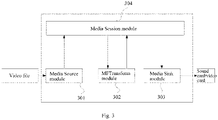
- FIG. 3 shows a schematic diagram of the Media Foundation playing architecture.
- the cloud desktop video player under the Media Foundation playing architecture includes a Media Source module 301, a Media Foundation Transform (MFTransform) module 302, a Media Sink module 303 and a Media Session module 304.
- MFTransform Media Foundation Transform
- the Media Source module 301 is configured to read and de-encapsulate the video files. Different from the DirectShow playing architecture, audio streams and video streams de-encapsulated by the Media Source module 301 will not be transmitted directly to corresponding decoding modules, but to the Media Session module 304, and then to the corresponding decoding modules by the Media Session module 304.
- the MFTransform module 302 is actually an audio-video decoding module which selects corresponding decoders for decoding based on encoded formats of audios and videos and transmits the decoded data to the Media Session module 304. Upon receipt of the decoded audio and video data, the Media Session module 304 transmits the data to the Media Sink module 303.
- the Media Sink module 303 can write the decoded audio data into the sound card and the decoded video data into a video card.
- Operations such as pause, fast forward and stop, may be exchanged between the Media Foundation playing architecture and an application.
- FIG. 4 A schematic diagram of a reconstructed DirectShow playing architecture is shown in FIG. 4 .
- the reconstructed DirectShow playing architecture includes a cloud desktop player 40 at the server side and a client 41 located at the terminal device side, where the architecture of the cloud desktop player 40 is similar to the DirectShow playing architecture in FIG. 2 , and the architecture of the client 41 is basically the same as the DirectShow playing architecture in FIG. 2 .
- the cloud desktop player 40 includes a cloud desktop Splitter Filter 401, a cloud desktop Audio Decoder 402, a cloud desktop Video Decoder 403, a cloud desktop Audio Render 404 and a cloud desktop Video Render 405.
- the cloud desktop player 40 further includes a cloud desktop sound card 406 and a cloud desktop video card 407.
- the client 41 includes a client Splitter Filter 411, a client Audio Decoder 412, a client Video Decoder 413, a client Audio Render 414 and a client Video Render 415.
- the client player 41 further includes a client sound card 416 and a client video card 417.
- the cloud desktop Splitter Filter 401 is still a Source Filter, which is developed based on a corresponding interface of the DirectShow playing architecture, reads file information by FFmpeg, and reads and sends media files based on a file bit rate and a total playing duration.
- FFmpeg is a very powerful open source framework for encoding and decoding multimedia audios and videos, which can implement operations such as audio and video stream collection, recording, encoding, decoding and conversion, and provide a lot of open source libraries that can be compiled and run on various platforms. It is worth noting that, in FIG. 2 , after reading a video file, the Splitter Filter will transmit the video file to the decoders. However, after reading the media stream file, the cloud desktop Splitter Filter 401 in FIG. 4 of this embodiment will not transmit the media stream file to the decoders but to the client 41 for decoding and playing.
- the client Splitter Filter 411, the client Audio Decoder 412, the client Video Decoder 413, the client Audio Render 414, the client Video Render 415, the client sound card 416 and the client video card 417 at the client 41 side process the media stream files in exactly the same way as those of the cloud desktop player in FIG. 2 , which will not be repeated here.
- the Splitter Filter 401 also may transmit some false media data to the decoders.
- the decoders and the renders in the cloud desktop player 40 may be improved, so that the decoders do not have to decode the false media.
- the cloud desktop Audio Decoder 402 and the false videos in the false media to the cloud desktop Video Decoder 403
- the cloud desktop Audio Decoder 402 and the cloud desktop Video Decoder 403 do not decode but directly pass through the received false audios or false videos to corresponding renders.
- the cloud desktop Audio Render 404 writes the false audios into the cloud desktop sound card 406.
- the cloud desktop Video Render 405 writes the false video images into the cloud desktop video card 407.
- the cloud desktop player 40 also plays the false media, so the false audios in the false media are mute audios, and the false video images in the false media may be a black image, to avoid the playing of the false media from affecting the actual playing process of the client 41.
- the Hook Function includes a Hook Function configured at an IMFMediaSession interface and a Hook Function configured at an IMFTopology interface.
- a Start method and a SetTopology method of the Hook IMFMediaSession interface and an AddNode method of the HookIMFTopology interface may be performed at the process entry of the cloud desktop player.
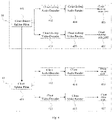
- FIG. 5 A schematic diagram of the reconstructed Media Foundation playing architecture is shown in FIG. 5 .
- the reconstructed Media Foundation playing architecture includes a cloud desktop player 50 at the server side and a client 51 located at the terminal device side.
- the architecture of the cloud desktop player 50 is similar to the Media Foundation architecture in FIG. 3
- the architecture of the client 51 is basically the same as the DirectShow playing architecture in FIG. 2 .
- the cloud desktop video player 50 includes a Media Source module 501, an MFTransform module 502, a Media Sink module 503 and a Media Session module 504.
- the client 51 includes a client Splitter Filter 511, a client Audio Decoder 512, a client Video Decoder 513, a client Audio Render 514 and a client Video Render 515.
- the Media Source module 501 is developed based on a corresponding interface of the Media Foundation playing architecture.
- the Media Source module 501 reads file information by FFmpeg, and reads and sends files based on a file bit rate and a total playing duration. It should be noted that, in FIG. 3 , after reading a video file, the Media Source module will transmit the video file to the Media Session module which transmits the video file to the decoders. However, after reading the media stream file, the Media Source module 501 in FIG. 5 of this embodiment will not transmit the media stream file to the MFTransform module 502 through the Media Session module 504, but to the client 51 for decoding and playing.
- the Splitter Filter 511, the Audio Decoder 512, the Video Decoder 513, the Audio Render 514, the Video Render 515, a sound card 516 and a video card 517 at the client 51 side process the media stream files in exactly the same way as those of the cloud desktop player in FIG. 2 , which will not be repeated here.
- the Splitter Filter 501 also may transmit some false media data to the decoders.
- the MFTransform module 502 in the cloud desktop player 50 may be improved, so that the MFTransform module 502 directly pass through the false media to the Media Session module 504 without decoding, and then the Media Session module 504 transmits the false media to the Media Sink module 503.
- the Media Sink module 503 will write the false audios in the false media into the cloud desktop sound card and the false video images in the false media into the cloud desktop video card.
- the cloud desktop player 50 also plays the false media, so the false audios in the false media are mute audios, and the false video images in the false media may be a black image, to avoid the playing of the false media from affecting the actual playing process of the client 51.
- the target media stream file to be played by the cloud desktop player is intercepted.
- the target media stream file is a media stream file that is intended to be played by the cloud desktop player, and the target media stream file herein is a file that has not been decoded.
- the target media stream file includes both an audio file stream and a video image file stream.
- the target media stream file may be intercepted by the cloud desktop Splitter Filter 401.
- the target media stream file may be intercepted by the Media Source module 501.
- the undecoded target media stream file is transmitted to the terminal device side.
- the undecoded target media stream file may be transmitted to the terminal device side.
- the server may transmit the target media stream file to the terminal device side through Transmission Control Protocol (TCP) connection.
- TCP Transmission Control Protocol
- UDP User Datagram Protocol
- the server may adaptively select one of TCP connection and UDP connection according to the current network condition to transmit the target media stream file to the client at the terminal device side.
- the server can directly transmit the target media stream file to the terminal device.
- the server may also encrypt part of the information in the target media stream file, so that the information can be protected by encryption during the transmission of the target media stream file.
- a playing start instruction is sent to the terminal device to control the terminal device to play synchronously with the cloud desktop player.
- the client at the terminal device side plays the target media stream file, which is in effect adding a new playing window to the cloud desktop player. That is, after the replacement of some of the playing architecture components of the cloud desktop player, there are actually both original and new playing windows in the new cloud desktop player at the same time.
- the new playing window is configured to play the target media stream file, while the original playing window is configured to play the false media.
- the new playing window blocks the original playing window. Therefore, except for the different sources of the content to be played, the original and new playing windows are synchronized in other aspects such as playing progress. Also, when controlling the client to start the playing of the target media stream file, the cloud desktop player should also start the playing of the false media.
- the server will send a playing start instruction to the terminal device side while controlling the cloud desktop player to start the playing.
- the instruction is configured to enable the client side to start the playing of the target media stream file.
- the server controls the Splitter Filter to pass through the false media to the renders of the cloud desktop player through the decoders of the cloud desktop player, and outputs the false media rendered by the renders through the sound card and the video card.
- the server controls the Media Source to pass through the false media to the Media Sink of the cloud desktop player through the Media Session and the MFTransform of the cloud desktop player, and the Media Sink writes the false media into the sound card and the video card for output.
- the server may send the playing start instruction to the terminal device side from the moment of starting to transmit the target media stream file to the terminal device, enabling the client and the cloud desktop player to start the playing immediately.
- the server may wait for a default time from the moment of transmitting the target media stream file to the terminal device side. Given that the default time is TO which is greater than 0, and the moment at which the server starts transmitting the target media stream file to the terminal device side is t1, the server will send the playing start instruction to the terminal device side at the moment of t1+T0, and controls the cloud desktop player to start the playing of the false media at the same time.
- This method is mainly to avoid the impact of network delay on the playing of the client at the terminal device side as the terminal device side may cache a certain number of target media stream files during TO for which the server waits.
- the TO may be 3s, but those having ordinary skills in the art can understand that the TO may be other values, which will not be enumerated herein.
- the server may monitor the real-time network conditions after controlling the client and the cloud desktop player to start the playing.
- the server can control the cloud desktop player to decode and play the target media stream file.
- the target media stream file is played by the client at the terminal device side before the network abnormality or network interruption, and the cloud desktop player only intercepts and transmits the target media stream file to the client and keeps itself from crashing. Therefore, in case of the network abnormality or network interruption, the server should switch to the original playing architecture components of the cloud desktop player and stop utilizing the playing architecture reconstruction components through Hook Function services.
- FIG. 6 the flow of the cloud desktop video playing scheme is shown in FIG. 6 , including following steps of S602 and S604.
- the undecoded target media stream file transmitted from the server side is received.
- the terminal device may receive the target media stream file from the server through TCP connection, or may also receive the target media stream file through UDP connection.
- the target media stream file is decoded and played based on the playing start instruction sent from the server.
- the client does not necessarily decode and play the target media stream file immediately upon receipt of the file, but may wait for the playing start instruction sent from the server. Only upon receipt of the playing start instruction, the client at the terminal device side will start decoding and playing the target media stream file, ensuring that the playing progress of the target media stream file at the client is synchronized with that of the false media at the cloud desktop player.
- the Splitter Filter will split the target media stream file into an audio stream file and a video image stream file in the process of playing the target media stream file, and then transmit the audio stream file and the video image stream file to the Audio Decoder and the Video Decoder, respectively.
- the Audio Decoder decodes the audio stream file and transmits the decoded file to the Audio Render for rendering and then writing into the sound card at the client side.
- the Video Decoder decodes the video image stream file and transmits the decoded file to the Video Render for rendering and then writing into the video card at the client side.
- the target media stream file is transmitted by being output both by the sound card and the video card.
- the terminal device side should first decrypt the encrypted information in the target media stream file upon receipt of the target media stream file.
- the original playing architecture components in the cloud desktop player are replaced with the self-developed playing architecture reconstruction components through the Hook services, so that the cloud desktop player can intercept the target media stream file intended to be played and transmit the intercepted file to the terminal device side for decoding and playing. Since the target media stream file contains both the audio stream file and the video image stream file, the audio stream file and the video image stream file are sent together, which will not cause the problem of video and audio out of sync in the decoding and playing process at the terminal device side to affect the user experience.
- the cloud desktop video playing scheme provided in this embodiment is based on the cloud desktop player and thus only part of cloud playing architecture components in the playing architecture of the cloud desktop player are replaced, so there may no need to completely develop a new player, which not only reduces the R&D cost, but also avoids the problem that users are not accustomed to using specific self-developed players to be installed when needing to play videos.
- the original playing architecture components in the cloud desktop player may be replaced with the playing architecture reconfiguration component under good network conditions, so that the target media stream file can be decoded and played at the client side.
- the playing mode may be switched back to the original playing mode of the cloud desktop player under poor network conditions, which helps to improve the stability of playing.
- the above cloud desktop video playing method will be further described with some examples in this embodiment so that the advantages and details of the cloud desktop video playing method will be clearer to those having ordinary skills in the art, as shown in an interactive flow chart of the cloud desktop video playing method in FIG. 7 .
- the method includes the following steps of S702, S704, S706, S708, S710 and S712.
- Hook Function services are enabled.
- the Hook Function services will be enabled. It can be understood that the Hook Function services may be self-enabled.
- a user selects a media file to be played.
- the cloud desktop operating system will control and enable the cloud desktop player.
- the playing architecture reconfiguration components are added into the playing process of the cloud desktop player through the Hook Function services.
- the Hook Function is configured in the program of the cloud desktop player, a jump will occur when the program is run to a corresponding time point, allowing the video to be played based on the playing architecture reconstruction components instead of the original playing architecture components of the cloud desktop player. In this way, the effect of replacing the original playing architecture components in the cloud desktop player with the playing architecture reconstruction components can be realized.
- the cloud desktop video playing method will be described first with reference to the schematic diagram of the reconstructed DirectShow playing architecture in FIG. 4 .
- a cloud desktop Splitter Filter 401 reads the media file selected by the user by FFmpeg to obtain a target media stream file. Since the original playing architecture components in the cloud desktop player have been replaced with the playing architecture reconfiguration components, the cloud desktop Splitter Filter 401 will not split the read target media stream file into an audio stream file and a video stream file and then transmit them to a cloud desktop Audio Decoder 402 and a cloud desktop Video Decoder 403, respectively, but will transmit the target media stream file to a client 41.
- the key information in the target media stream file transmitted from the cloud desktop Splitter Filter 401 to a client Splitter Filter 411 is encrypted.
- the client Splitter Filter 411 Upon receipt of the target media stream file, the client Splitter Filter 411 will decrypt the target media stream file with a decryption method corresponding to the encryption method.
- the server side will send a playing start instruction to the client for the client to decode and play the target media stream file.
- the server will also control the Splitter Filter 401 to send a false audio file to the cloud desktop Audio Decoder 402 and a false video image file to the cloud desktop Video Decoder 403.
- the cloud desktop Audio Decoder 402 will not decode but pass through the received false audio file to a cloud desktop Audio Render 404.
- the cloud desktop Video Decoder 403 will not decode but directly pass through the received video image stream file to a cloud desktop Video Render 405.
- the desktop Audio Render 404 directly writes mute data to a sound card, and acquires and transmits information on player and system volume adjustment by the user to the client for processing.
- the cloud desktop Video Render 405 will draw a black image of the same size as a current playing window of the cloud client to the video card for display.
- the cloud desktop video render 405 does not draw the black image in real time, but only redraws the black image when the client playing window moves or a change in the size of the playing window occurs, which is mainly to prevent the processing operation of the Video Render 405 from taking up the CPU at the cloud desktop side.
- the false video image file at the client is not necessarily a black image, and other colors are also possible.
- the client Splitter Filter 411 will split the target media stream file into an audio stream file and a video image stream file, and then transmit the audio stream file and the video image stream file to the client Audio Decoder 412 and client Video Decoder 413, respectively.
- the client Audio Decoder 412 decodes the audio stream file and transmits the decoded file to the client Audio Render 414 for rendering and then writing into the client sound card 416.
- the client Video Decoder 413 decodes the video image stream file and transmits the decoded file to the client Video Render 415 for rendering and then writing into the client video card 417.
- the cloud desktop video playing method will be described below with reference to the schematic diagram of the reconstructed Media Foundation playing architecture shown in FIG. 5 .
- a Media Source module 501 reads a media file selected by the user by FFmpeg to obtain a target media stream file. Since the original playing architecture components in the cloud desktop player have been replaced with the playing architecture reconfiguration components, the Media Source module 501 will not transmit the read target media stream file to the Media Session module 504 but to the client 51.
- the key information in the target media stream file transmitted from the Media Source module 501 to a Splitter Filter 511 is encrypted.
- the Splitter Filter 511 Upon receipt of the target media stream file, the Splitter Filter 511 will decrypt the target media stream file with a decryption method corresponding to the encryption method.
- the server side will send a playing start instruction to the client 51 for the client 51 to decode and play the target media stream file.
- the server will also control the Media Source module 501 to transmit the false media to the MFTransform module 502 through the Media Session module 504, and the MFTransform module 502 will not process the received false media, but pass through the false media directly to the Media Sink module 503 through the Media Session module 504.
- An audio processing module in the Media Sink module 503 directly writes the mute data into the sound card, and acquires and transmits information on player and system volume adjustment by the user to the client for processing.
- a video processing module in the Media Sink module 503 draws a black image of the same size as a current playing window of the cloud client to the video card for display.
- the Media Sink module 503 does not draw the black image in real time, but only redraws the black image again when the client playing window moves or a change in the size of the playing window occurs, which is mainly to prevent the processing operation of the Media Sink module 503 from taking up the CPU at the cloud desktop side.
- the false video image file on the client is not necessarily a black image, and other colors are also possible.
- the client Splitter Filter 411 will split the target media stream file into an audio stream file and a video image stream file, and then transmit the audio stream file and the video image stream file to the client Audio Decoder 412 and the client Video Decoder 413, respectively.
- the client Audio Decoder 412 decodes the audio stream file and transmits the decoded file to the client Audio Render 414 for rendering and writing into the client sound card 416.
- the client Video Decoder 413 decodes the video image stream file and transmits the decoded file to the client Video Render 415 for rendering and writing into the client video card 417.
- the original playing architecture components of the cloud desktop player are returned to service in case of network interruption.
- messages may be sent to the playing architecture reconfiguration components so that the system default components are adopted for in-band playing, and the original playing architecture components of the cloud desktop player are still adopted.
- the cloud desktop video playing scheme provided in this embodiment can efficiently meet the use requirements of the cloud desktop in the local video field, save user resources, meet the requirements of users and enhance user experience without limiting the type of players, thus playing a good exemplary role in the promotion of the cloud desktop field.
- a storage medium storing one or more computer programs that may be read, compiled and executed by one or more processors.
- the storage medium can store at least one of a first cloud desktop video playing program and a second cloud desktop video playing program.
- the first cloud desktop video playing program when executed by one or more processors, causes the one or more processors to perform the steps of any one of the cloud desktop video playing methods described in the above embodiments at the server side.
- the second cloud desktop video program when executed by one or more processors, causes the one or more processors to perform the steps of any one of the cloud desktop video playing methods described in the above embodiments at the terminal device side.
- the server 80 includes a first processor 81, a first memory 82, and a first communication bus 83 for connecting the first processor 81 and the first memory 82.
- the first memory 82 may store the first cloud desktop video playing program.
- the first processor 81 may read and compile a software package transmission program to implement the steps of the software package transmission method described in the above embodiment at the server side.
- the first processor 81 After detecting an instruction to enable a cloud desktop player, the first processor 81 replaces the original playing architecture components in the cloud desktop player with the playing architecture reconstruction components through a Hook Function, and then intercepts a target media stream file to be played by the cloud desktop player, where the target media stream contains an audio file stream and a video image file stream.
- the first processor 81 may transmit the undecoded intercepted target media stream file to the terminal device side, and send a playing start instruction to the terminal device to control the terminal device to play synchronously with the cloud desktop player, where the terminal device plays the target media stream file, and the cloud desktop player plays false media without decoding.
- the Hook Function includes a Hook Function configured at an IGraphBuilder interface.
- the Hook Function further includes a Hook Function configured at an IMediaControl interface.
- the first processor 81 when intercepting the target media stream file to be played by the cloud desktop player, may control a Splitter Filter of the cloud desktop player to intercept the target media stream file.
- the first processor 81 sends a playing start instruction to the terminal device while controlling the Splitter Filter to pass through the false media to renders of the cloud desktop player through decoders of the cloud desktop player, and the false media rendered by the renders are output through a sound card and a video card.
- the Hook Function includes a Hook Function configured at an IMFMediaSession interface and a Hook Function configured at an IMFTopology interface.
- the first processor 81 when intercepting the target media stream file to be played by the cloud desktop player, may control the Media Source of the cloud desktop player to intercept the target media stream file.
- the first processor 81 sends a playing start instruction to the terminal device while controlling the Media Source to pass through the false media to the Media Sink of the cloud desktop player through the Media Session and the MFTransform of the cloud desktop player, and the Media Sink writes the false media into the sound card and the video card for output.
- the first processor 81 may encrypt at least part of the information in the target media stream file, and transmit the encrypted target media stream file to the terminal device.
- the first processor 81 also monitors the real-time network conditions after sending the playing start instruction to the terminal device. When determining that the current network is abnormal or interrupted, the cloud desktop player is adopted to decode and play the target media stream file.
- the first processor 81 before controlling the terminal device to play synchronously with the cloud desktop player, the first processor 81 will also ensure that the target media stream file has been transmitted to the terminal device for a default time which is greater than 0.
- the audio file streams are mute audio file streams, and/or the video image file streams are black image file streams.
- the server 90 includes a second processor 91, a second memory 92, and a second communication bus 93 for connecting the second processor 91 and the second memory 92.
- the second memory 92 may store the second cloud desktop video playing program.
- the second processor 91 may read and compile a software package transmission program to implement the steps of the software package transmission method described in the above embodiment at the server side.
- the second processor 91 may receive the undecoded target media stream file transmitted from the server side, and decode and play the target media stream file according to the playing start instruction sent from the server.
- the playing process of the target media stream file by the second processor 91 is synchronized with that of the false media without decoding of the cloud desktop player at the server side.
- the second processor 91 further may decrypt the encrypted information in the target media stream file before decoding and playing the target media stream file based on the playing start instruction sent from the server.
- the server and the terminal device under the original playing architecture of the cloud desktop player, the original playing architecture components in the cloud desktop player are replaced with the self-developed playing architecture reconstruction components through the Hook Function services, so that the cloud desktop player can intercept the target media stream file intended to be played by the cloud desktop player and transmit the intercepted file to the terminal device side for decoding and playing by the terminal device side. Since the target media stream file contains both the audio stream file and the video image stream file, the audio stream file and the video image stream file are sent together, which will not cause the problem of video and audio out of sync in the decoding and playing process at the terminal device side to affect the user experience.
- the server, the terminal device and the storage medium provided in the embodiments of the present invention, after detecting an instruction to enable the cloud desktop player, the server side replaces the original playing architecture components in the cloud desktop player with the playing architecture reconfiguration components through the Hook Function, intercepts and transmits the undecoded target media stream file intended to be played by the cloud desktop player to the terminal device side, and sends a playing start instruction to the terminal device to control the terminal device to play synchronously with the cloud desktop player.
- the terminal device plays the target media stream file, and the cloud desktop player plays the false media without decoding.
- the server side transmits the audio file stream and the video image file stream together in a target media stream file to the terminal device side, and the terminal device side can decode and play the target media stream file, the problem of video and audio out of sync will not occur. Also, while the client plays the video, the cloud desktop player also plays the false media, so the crash of the cloud desktop player is avoided.
- the video playing scheme provided in the embodiments of the present invention is to play the video by replacing part of the original architecture components of the cloud desktop player, so that no self-developed clients may be needed, which avoids the problem that the playing scheme is limited by the user's habits and is beneficial to improving the user experience.
- Such software may be distributed on a computer-readable medium which may include a computer storage medium (or non-transient medium) and a communication medium (or transient medium), executed by a computing device, and in some cases, the steps shown or described may be implemented in a different order than shown herein.
- a computer-readable medium may include a computer storage medium (or non-transient medium) and a communication medium (or transient medium), executed by a computing device, and in some cases, the steps shown or described may be implemented in a different order than shown herein.
- the computer storage medium includes volatile and nonvolatile, removable and non-removable media implemented in any method or technology for storing information, such as computer readable instructions, data structures, program modules or other data.
- the computer storage medium includes, without limitation, RAM, ROM, EEPROM, flash memory or other memory technologies, CD-ROM, digital versatile disk (DVD) or other optical disk storage, magnetic cartridges, magnetic tapes, disk storage or other magnetic storage devices, or any other media that may be adopted to store desired information and may be accessed by a computer.
- the communication medium typically contains computer-readable instructions, data structures, program modules, or other data in modulated data signals such as carrier waves or other transmission mechanisms, and may include any information delivery media. Therefore, the present invention is not limited to any particular combination of hardware and software.
Landscapes
- Engineering & Computer Science (AREA)
- Multimedia (AREA)
- Signal Processing (AREA)
- Computer Networks & Wireless Communication (AREA)
- Software Systems (AREA)
- General Engineering & Computer Science (AREA)
- Library & Information Science (AREA)
- Theoretical Computer Science (AREA)
- Two-Way Televisions, Distribution Of Moving Picture Or The Like (AREA)
Applications Claiming Priority (2)
| Application Number | Priority Date | Filing Date | Title |
|---|---|---|---|
| CN201910760781.7A CN112399257B (zh) | 2019-08-16 | 2019-08-16 | 云桌面视频播放方法、服务器、终端及存储介质 |
| PCT/CN2020/101297 WO2021031739A1 (fr) | 2019-08-16 | 2020-07-10 | Procédé de lecture vidéo de bureau en nuage, serveur, terminal, et support de stockage |
Publications (2)
| Publication Number | Publication Date |
|---|---|
| EP4009648A1 true EP4009648A1 (fr) | 2022-06-08 |
| EP4009648A4 EP4009648A4 (fr) | 2022-11-23 |
Family
ID=74603085
Family Applications (1)
| Application Number | Title | Priority Date | Filing Date |
|---|---|---|---|
| EP20853891.8A Pending EP4009648A4 (fr) | 2019-08-16 | 2020-07-10 | Procédé de lecture vidéo de bureau en nuage, serveur, terminal, et support de stockage |
Country Status (3)
| Country | Link |
|---|---|
| EP (1) | EP4009648A4 (fr) |
| CN (1) | CN112399257B (fr) |
| WO (1) | WO2021031739A1 (fr) |
Families Citing this family (7)
| Publication number | Priority date | Publication date | Assignee | Title |
|---|---|---|---|---|
| CN115914671A (zh) * | 2021-09-22 | 2023-04-04 | 广州开得联智能科技有限公司 | 云录播交互系统及方法 |
| CN113923473A (zh) * | 2021-09-28 | 2022-01-11 | 安徽听见科技有限公司 | 影音播放方法、装置、电子设备和存储介质 |
| CN114390313B (zh) * | 2021-12-01 | 2024-02-13 | 湖南麒麟信安科技股份有限公司 | 一种浏览器HTML5 Video标签音视频重定向的方法及系统 |
| CN115442431B (zh) * | 2022-08-31 | 2025-05-30 | 北京天融信网络安全技术有限公司 | 云桌面浏览器的重定向方法、装置、电子设备及存储介质 |
| CN116112476B (zh) * | 2023-01-11 | 2025-11-18 | 阿里巴巴(中国)有限公司 | 一种云桌面的多媒体播放方法、系统、设备及存储介质 |
| CN116301707B (zh) * | 2023-05-18 | 2023-10-24 | 北京庭宇科技有限公司 | 一种基于虚拟声卡的云桌面声音采集方法 |
| CN119071343B (zh) * | 2024-11-05 | 2025-01-03 | 杭州海康威视数字技术股份有限公司 | 一种云桌面系统、方法、装置、电子设备 |
Family Cites Families (6)
| Publication number | Priority date | Publication date | Assignee | Title |
|---|---|---|---|---|
| KR101657914B1 (ko) * | 2012-12-12 | 2016-09-19 | 후아웨이 디바이스 컴퍼니 리미티드 | 미디어 스트림 공유 방법 및 단말기 |
| CN104168486A (zh) * | 2013-05-20 | 2014-11-26 | 上海范氏科技投资发展集团有限公司 | 基于云计算的虚拟机与客户端间视频重定向方法 |
| CN104301742A (zh) * | 2013-07-16 | 2015-01-21 | 上海国富光启云计算科技有限公司 | 虚拟机和客户端间视频重定向装置及其使用方法 |
| CN105282624A (zh) * | 2014-06-23 | 2016-01-27 | 中兴通讯股份有限公司 | 桌面云视频的播放处理方法及装置 |
| CN105791892A (zh) * | 2016-03-02 | 2016-07-20 | 汉柏科技有限公司 | 一种基于桌面云的视频重定向方法、云服务器及系统 |
| CN106572361A (zh) * | 2016-11-15 | 2017-04-19 | 中兴通讯股份有限公司 | 一种视频文件的处理方法、装置和系统 |
-
2019
- 2019-08-16 CN CN201910760781.7A patent/CN112399257B/zh active Active
-
2020
- 2020-07-10 EP EP20853891.8A patent/EP4009648A4/fr active Pending
- 2020-07-10 WO PCT/CN2020/101297 patent/WO2021031739A1/fr not_active Ceased
Also Published As
| Publication number | Publication date |
|---|---|
| WO2021031739A1 (fr) | 2021-02-25 |
| CN112399257B (zh) | 2024-03-05 |
| CN112399257A (zh) | 2021-02-23 |
| EP4009648A4 (fr) | 2022-11-23 |
Similar Documents
| Publication | Publication Date | Title |
|---|---|---|
| EP4009648A1 (fr) | Procédé de lecture vidéo de bureau en nuage, serveur, terminal, et support de stockage | |
| AU2023263552B2 (en) | Distribution and playback of media content | |
| KR101927016B1 (ko) | 멀티미디어 파일 라이브 방송 방법, 시스템 및 서버 | |
| US8943215B2 (en) | Distributed smooth streaming utilizing dynamic manifests | |
| CN106302366B (zh) | 一种数据传输方法、装置和智能电视系统 | |
| CN111316652A (zh) | 使用对齐编码内容片段的个性化内容流 | |
| CN105338425A (zh) | 一种实现多屏间视频无缝切换的系统及方法 | |
| CN102281473A (zh) | 电视终端的信息处理方法及电视终端 | |
| US12267537B2 (en) | Reproducing video of dynamic bitrate with a plurality of channels | |
| CN112637661B (zh) | 视频流的切换方法及装置、计算机存储介质、电子设备 | |
| US10432543B2 (en) | Dual jitter buffers | |
| US20190304504A1 (en) | Method for capturing and recording high-definition video and audio output as broadcast by commercial streaming service providers | |
| KR102299615B1 (ko) | 컨텐트 분산 네트워크들에서 엠펙 미디어 전송 통합을 위한 방법 및 장치 | |
| US20240205469A1 (en) | Apparatus and method for processing cloud streaming low latency playback | |
| US9549178B2 (en) | Segmenting and transcoding of video and/or audio data | |
| CN205230019U (zh) | 一种实现多屏间视频无缝切换的系统 | |
| KR20140117889A (ko) | 클라이언트 장치, 서버 장치, 멀티미디어 리디렉션 시스템 및 그 방법 | |
| JP2012257196A (ja) | 画面の共有に基づくストリーミングメディア転送システム及びその方法 | |
| CN115942021A (zh) | 音视频流同步播放方法、装置、电子设备及存储介质 | |
| US9386059B2 (en) | Apparatus and method for providing time shift function in cloud computing system | |
| US12374371B1 (en) | Computer-implemented media player to play multiple audio tracks at the same time to enable accessibility experiences | |
| CN205139894U (zh) | 一种实现多屏间视频无缝切换的终端 | |
| CN121865210A (zh) | 消息传输方法、装置和电子设备 | |
| HK40080095B (zh) | 处理媒体流中事件的方法、装置、存储介质及计算机设备 |
Legal Events
| Date | Code | Title | Description |
|---|---|---|---|
| STAA | Information on the status of an ep patent application or granted ep patent |
Free format text: STATUS: THE INTERNATIONAL PUBLICATION HAS BEEN MADE |
|
| PUAI | Public reference made under article 153(3) epc to a published international application that has entered the european phase |
Free format text: ORIGINAL CODE: 0009012 |
|
| STAA | Information on the status of an ep patent application or granted ep patent |
Free format text: STATUS: REQUEST FOR EXAMINATION WAS MADE |
|
| 17P | Request for examination filed |
Effective date: 20220303 |
|
| AK | Designated contracting states |
Kind code of ref document: A1 Designated state(s): AL AT BE BG CH CY CZ DE DK EE ES FI FR GB GR HR HU IE IS IT LI LT LU LV MC MK MT NL NO PL PT RO RS SE SI SK SM TR |
|
| A4 | Supplementary search report drawn up and despatched |
Effective date: 20221025 |
|
| DAV | Request for validation of the european patent (deleted) | ||
| DAX | Request for extension of the european patent (deleted) | ||
| RIC1 | Information provided on ipc code assigned before grant |
Ipc: H04N 21/443 20110101AFI20221019BHEP |
|
| STAA | Information on the status of an ep patent application or granted ep patent |
Free format text: STATUS: EXAMINATION IS IN PROGRESS |
|
| 17Q | First examination report despatched |
Effective date: 20240923 |