EP4009656A1 - Dispositif de mesure stationnaire pour mesurer ou détecter une valeur au niveau d'une installation de service - Google Patents
Dispositif de mesure stationnaire pour mesurer ou détecter une valeur au niveau d'une installation de service Download PDFInfo
- Publication number
- EP4009656A1 EP4009656A1 EP20212202.4A EP20212202A EP4009656A1 EP 4009656 A1 EP4009656 A1 EP 4009656A1 EP 20212202 A EP20212202 A EP 20212202A EP 4009656 A1 EP4009656 A1 EP 4009656A1
- Authority
- EP
- European Patent Office
- Prior art keywords
- clock time
- time
- lpwan
- measuring device
- rtt
- Prior art date
- Legal status (The legal status is an assumption and is not a legal conclusion. Google has not performed a legal analysis and makes no representation as to the accuracy of the status listed.)
- Granted
Links
Images



Classifications
-
- H—ELECTRICITY
- H04—ELECTRIC COMMUNICATION TECHNIQUE
- H04W—WIRELESS COMMUNICATION NETWORKS
- H04W56/00—Synchronisation arrangements
- H04W56/001—Synchronization between nodes
- H04W56/0015—Synchronization between nodes one node acting as a reference for the others
-
- H—ELECTRICITY
- H04—ELECTRIC COMMUNICATION TECHNIQUE
- H04W—WIRELESS COMMUNICATION NETWORKS
- H04W4/00—Services specially adapted for wireless communication networks; Facilities therefor
- H04W4/30—Services specially adapted for particular environments, situations or purposes
- H04W4/38—Services specially adapted for particular environments, situations or purposes for collecting sensor information
-
- H—ELECTRICITY
- H04—ELECTRIC COMMUNICATION TECHNIQUE
- H04J—MULTIPLEX COMMUNICATION
- H04J3/00—Time-division multiplex systems
- H04J3/02—Details
- H04J3/06—Synchronising arrangements
- H04J3/0635—Clock or time synchronisation in a network
- H04J3/0638—Clock or time synchronisation among nodes; Internode synchronisation
-
- H—ELECTRICITY
- H04—ELECTRIC COMMUNICATION TECHNIQUE
- H04J—MULTIPLEX COMMUNICATION
- H04J3/00—Time-division multiplex systems
- H04J3/02—Details
- H04J3/06—Synchronising arrangements
- H04J3/0635—Clock or time synchronisation in a network
- H04J3/0638—Clock or time synchronisation among nodes; Internode synchronisation
- H04J3/0658—Clock or time synchronisation among packet nodes
- H04J3/0661—Clock or time synchronisation among packet nodes using timestamps
- H04J3/0667—Bidirectional timestamps, e.g. NTP or PTP for compensation of clock drift and for compensation of propagation delays
-
- H—ELECTRICITY
- H04—ELECTRIC COMMUNICATION TECHNIQUE
- H04L—TRANSMISSION OF DIGITAL INFORMATION, e.g. TELEGRAPHIC COMMUNICATION
- H04L43/00—Arrangements for monitoring or testing data switching networks
- H04L43/08—Monitoring or testing based on specific metrics, e.g. QoS, energy consumption or environmental parameters
- H04L43/0852—Delays
- H04L43/0864—Round trip delays
-
- H—ELECTRICITY
- H04—ELECTRIC COMMUNICATION TECHNIQUE
- H04Q—SELECTING
- H04Q9/00—Arrangements in telecontrol or telemetry systems for selectively calling a substation from a main station, in which substation desired apparatus is selected for applying a control signal thereto or for obtaining measured values therefrom
-
- H—ELECTRICITY
- H04—ELECTRIC COMMUNICATION TECHNIQUE
- H04W—WIRELESS COMMUNICATION NETWORKS
- H04W24/00—Supervisory, monitoring or testing arrangements
- H04W24/10—Scheduling measurement reports ; Arrangements for measurement reports
-
- H—ELECTRICITY
- H04—ELECTRIC COMMUNICATION TECHNIQUE
- H04W—WIRELESS COMMUNICATION NETWORKS
- H04W56/00—Synchronisation arrangements
- H04W56/001—Synchronization between nodes
-
- H—ELECTRICITY
- H04—ELECTRIC COMMUNICATION TECHNIQUE
- H04Q—SELECTING
- H04Q2209/00—Arrangements in telecontrol or telemetry systems
- H04Q2209/60—Arrangements in telecontrol or telemetry systems for transmitting utility meters data, i.e. transmission of data from the reader of the utility meter
-
- H—ELECTRICITY
- H04—ELECTRIC COMMUNICATION TECHNIQUE
- H04W—WIRELESS COMMUNICATION NETWORKS
- H04W84/00—Network topologies
- H04W84/02—Hierarchically pre-organised networks, e.g. paging networks, cellular networks, WLAN [Wireless Local Area Network] or WLL [Wireless Local Loop]
- H04W84/10—Small scale networks; Flat hierarchical networks
- H04W84/12—WLAN [Wireless Local Area Networks]
Definitions
- the present disclosure relates to a stationary measuring device for measuring or detecting a value at a utility installation, in particular to a consumption meter for registering a consumption of electric power, water, gas, or thermal energy.
- Dedicated meter reading systems are characterised in that consumption meters are installed in a plurality of households, for instance, and communicate consumption data to a head-end-system (HES) via a wireless communication with dedicated data collectors.
- HES head-end-system
- a single data collector may collect the consumption data read by thousands of consumption meters.
- Several data collectors may be distributed over a city or region to cover all consumption meters located therein.
- the consumption meters communicate with the data collectors wirelessly using license-free frequency bands in a manner that saves as much battery-power of the consumption meters as possible, because there is usually, in case of measuring water, gas and/or thermal energy consumption, no opportunity for recharging or exchanging the consumption meter battery.
- Consumption meters for registering a consumption of electric power do not need to be battery-powered as they are connected to the mains electricity, i.e. utility power.
- a public cellular communications network may be used instead of dedicated data collectors to collect the consumption data.
- the consumption meters may comprise a communication module, e.g. a modem, to connect to a Low Power Wide Area Network (LPWAN) provided by a public cellular communications network, e.g. a Narrowband Internet-of-Things (NB-IoT) network or a Long-Term Evolution Machine Type Communication (LTE-M) network.
- LPWAN Low Power Wide Area Network
- NB-IoT Narrowband Internet-of-Things
- LTE-M Long-Term Evolution Machine Type Communication
- a consumption meter that is able to efficiently register consumption data regularly via a LPWAN, e.g. hourly or daily.
- One important aspect of correct registering consumption data is an accurate clock time information, because a consumption must be reliably associated with a correct consumption period in order to ensure a correct billing process. Therefore, a consumption meter is in need of receiving regularly updated clock time information.
- NTP network time protocol
- a public cellular communications network is part of a "generic" meter reading system, in which the wireless communication infrastructure, i.e. the LPWAN, between the consumption meter and the HES is owned, maintained and controlled by external parties, e.g. mobile network operators (MNO).
- MNO mobile network operators
- UP utility provider
- UP utility provider
- Such communication latencies may negatively affect the accuracy of an NTP response to a non-tolerable degree.
- This object may not be limited to consumption meters, but may be applicable to any kind of stationary measuring device for measuring or detecting a value at a utility installation.
- this may include consumption meters, alarm sensors, acoustic noise detectors, chemical sensors, turbidity sensors, remotely controlled valves or other kinds of monitoring sensors.
- a stationary measuring device for measuring or detecting a value at a utility installation
- the measuring device comprises an LPWAN communication module configured to establish a wireless communication connection to a low power wide area network (LPWAN) for communicating data to a head-end-system (HES) via the LPWAN
- LPWAN low power wide area network
- HES head-end-system
- the LPWAN communication module is configured to:
- the request for the first clock time may be an NTP request to an NTP server acting as the time server.
- the second clock time may be a cellular network time or radio access network (RAN) time transmitted by the base station.
- the second clock time is preferably independent from the first clock time.
- the principle idea is here that the base station is used as a second, preferably independent, source of clock time information, because it provides a cellular network time on another layer of the LPWAN communication.
- NB-loT or LTE-M standards as of 3GPP release 11 or later provide automatically System Information Block 16 (SIB16) that includes the cellular network time.
- SIB16 System Information Block 16
- the cellular network time may be exchanged on the third OSI layer, i.e. the network layer.
- an NTP time received from the NTP server is communicated on the seventh OSI layer, i.e. the application layer.
- the cellular network time may therefore be less prone to communication latencies than the NTP time.
- the cellular network time introduces a principle trust issue, because the base station as part of the LPWAN infrastructure is not controlled by the UP.
- the used time zone of the cellular network time cannot be trusted, or whether summer or winter time is used.
- the NTP time zone including summer/winter time is trusted by the UP, because the UP can choose and/or control the time server.
- the time server may be part of the HES or another trusted NTP server. So, the principle idea is here to check if the untrusted cellular network time lies within a certain range about the NTP time. If it does, the cellular network time is trusted and taken as the current clock time, because it has less latency issues than the NTP time.
- the LPWAN communication module may be further configured to determine the current clock time based on the first clock time if the second clock time lies outside of the pre-determined range about the first clock time, e.g. +/- 7.5 minutes or preferably +/- 2 minutes. So, if the second clock time, e.g. the cellular network time, cannot be trusted, because it deviates too much from the first clock time, e.g. the NTP time, the first clock time may be chosen as the most trusted time information. An inaccuracy of the first clock time, e.g. the NTP time, due to latencies may be accepted in this case.
- the LPWAN communication module may be further configured to
- the LPWAN communication module may be further configured to determine a round-trip time (RTT) between sending the request and receiving the first clock time, wherein the current clock time is determined to be the first clock time plus half of the round-trip time (RTT) if:
- the LPWAN communication module may optionally be configured to set the current clock time to the first clock time.
- RTT round-trip times
- the LPWAN communication module may optionally be configured to set the current clock time to the first clock time.
- the LPWAN communication module may be configured to use a Narrowband Internet of Things (NB-IoT) or a Long-Term Evolution Machine Type Communication (LTE-M) technology standard for the wireless communication in the LPWAN, in particular any standard in the group comprising: LTE Cat M1, LTE Cat M2, LTE Cat NB1, and LTE Cat NB2.
- NB-IoT Narrowband Internet of Things
- LTE-M Long-Term Evolution Machine Type Communication
- the first clock time may be an NTP time provided by a network time protocol (NTP) server.
- NTP network time protocol
- the second clock time may be a cellular network time of the LPWAN, in particular comprised in a System Information Block 16 (SIB16) of a LPWAN communication frame.
- SIB16 System Information Block 16
- the LPWAN communication module may be configured to discard the received first clock time unless a certain minimum amount of data has been communicated since establishing a LPWAN connection.
- the LPWAN connection is "warmed-up" before the first clock time, e.g. the NTP time, is trusted.
- the latency issues are found to be worst for the first communicated data frames after establishing a LPWAN connection.
- the LPWAN communication module may be configured to always discard the first clock time received after establishing a LPWAN connection and to request another first clock time. This may ensure a certain warm-up of the LPWAN connection.
- the LPWAN communication module may be further configured to determine a, preferably adaptive, baseline based on measuring a round-trip time (RTT) between sending the request and receiving the first clock time for each of a pre-determined number of consecutive requests, and to discard any first clock time with a round-trip time (RTT) exceeding the baseline by a pre-determined limit.
- RTT round-trip time
- the preferably adaptive baseline may be determined on the basis of a sliding window or as a weighted moving average (WMA).
- the LPWAN communication module may be configured to include discarded round-trip times (RTT) above the baseline for adapting the baseline.
- RTT round-trip times
- This may be important when it comes to a permanent change in the LPWAN that affects the latency in communication, and thus RTT overall.
- the RTT may make a step, because the used communication standard has changed from LTE CatM1 to LTE Cat-NB.
- the adaptive baseline for RTT will have to quickly reflect that in order to prevent filtering too many cases of deviating RTT.
- the time server e.g. the NTP server
- the time server may be part of the HES. This is beneficial for having the time server fully under control.
- the time server e.g. the NTP server, could be a trusted time server outside of the HES.
- the LPWAN communication module may be configured to receive the second clock time from the base station of the LPWAN automatically when it establishes a LPWAN connection with the base station.
- the second clock time may be provided automatically, e.g. the cellular network time by System Information Block 16 (SIB16).
- SIB16 System Information Block 16
- the measuring device may be a consumption meter for registering a consumption of electric power, i.e. an electricity meter, wherein the electricity meter is powered by a mains electricity, i.e. utility power.
- the LPWAN communication module may be permanently powered-up, or at least for longer periods.
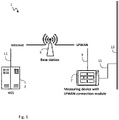
- Fig. 1 shows schematically a meter reading system 1 comprising a head-end system (HES) 3, a base station 5 of a Low Power Wide Area Network (LPWAN), and a measuring device 7 in form of a consumption meter.
- the measuring device 7 may be a electricity meter for registering a consumption of electric power at a utility installation, e.g. a private household, a public facility, or an industry facility.
- the measuring device 7 may alternatively be another kind of consumption meter, an alarm sensor or another kind of monitoring device that is supposed to send regularly information to the HES 3.
- the HES 3 receives and processes information from and/or controls the behaviour of a multitude of measuring devices 7 that are installed in a multitude of utility installations.
- the LPWAN is provided by a multitude of distributed base stations 5 of a public cellular mobile communications network.
- Fig. 1 shows only one of these base stations as the base station 5 the measuring device 7 is currently wirelessly connected with by a connection 9 using a NB-loT or LTE-M technology standard.
- the HES 3 is connected to the base stations 5 of the LPWAN via an internet connection 11, preferably by wire or optic fibre.
- the measuring device 7 Once the measuring device 7 has successfully established the connection 9 to the base station 5, it is able to transfer consumption data or any other data that it is supposed to send to the HES 3.
- the communication may be essentially unidirectional from the measuring device 7 to the HES 3, but preferably bi-directional between the measuring device 7 and the HES 3.
- a bi-directional communication allows the HES 3 not only to receive the data from the measuring device 7, but also to control and update the behaviour of the measuring device 7.
- the measuring device 7 may comprise a microcontroller, e.g. a CPU or an FPGA, a permanent or volatile storage medium, e.g. a RAM, a LPWAN communication module, e.g. a modem, a battery, and preferably a human-machine-interface (HMI), e.g. comprising a display, a touchscreen, a button and/or a switch.
- a sensor module for measuring or detecting a value at a utility installation may be integrated into the measuring device 7 or connected to it by wire or wirelessly. The value may be indicative of a physical quantity, such as an electric current through a power line 13 the sensor module is mounted on.
- the measuring device 7 is configured to continuously, regularly, or sporadically store the measured or detected value. Alternatively, or in addition, the measuring device 7 may be configured to process, e.g. sum up, the measured or detected value and to store the processed value, e.g. a cumulative value or a consumed utility quantity.
- the microcontroller of the measuring device 7 is configured to trigger the LPWAN communication module to send data, e.g. consumption data, according to a pre-determined data transmission schedule, e.g. hourly or daily.
- the HES 3 may request, i.e. poll, the data, i.e. trigger a reading from one or more specific measuring devices 7.
- the UP may receive a consumer complaint about missing electricity.
- the UP may then use the HES to request an extraordinary reading by the measuring device 7 measuring the voltage of each supply phase before sending out a service technician.
- the data may comprise all or parts of the stored measured, detected or processed value and identification data for identifying the measuring device 7 or the sensor module, or the utility installation respectively.
- Fig. 1 shows further a mains electricity line 13 to which the measuring device 7 is connected to by wired connection 15.
- the measuring device 7 is supposed to register an amount of electric energy consumed at a utility installation via the mains electricity line 13.
- the measuring device 7 is powered via the connection 15 by the mains electricity line 13, so that saving battery power is not an issue for the measuring device 7.
- Fig. 2 shows schematically the latency issue that a NTP time request has.
- the measuring device 7 sends a NTP request 17 to an NTP server 19, there is a certain latency, i.e. uplink time (ULT), for the NTP request 17 to reach the NTP server 19.
- An NTP response 21 from the NTP server 19 takes a downlink time (DLT) to reach the measuring device 7.
- the round-trip time (RTT) is the sum of ULT and DLT.
- the measuring device 7 is able to measure RTT by a timer measuring the time between sending the NTP request 17 and receiving the NTP response 21.
- ULT does not affect the received NTP Time and any latency issue with the received NTP Time is due to DLT alone.
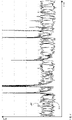
- FIG. 3 shows that the latency issues are worst for the first data exchange after the LPWAN communication module switched from a radio resource control (RRC) state "idle" to "connected” (see. Fig. 3).
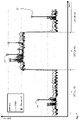
- Figs. 3 and 4 show RTT separately for ULT and DLT.
- ULT is mostly higher than DLT, but they behave unpredictably with high spikes.
- RTT is in general lower, but still both ULT and DLT show unpredictable spikes.
- Fig. 5 shows a differential ULT-DLT as a parentage of RTT over time.
- (ULT-DLT)/RTT shows unpredictable spikes, so that RTT cannot be assumed to be symmetric for correcting the latency issue introduced by DLT.
- the spikes in (ULT-DLT)/RTT correlate with the spikes in RTT. So, if RTT is low, (ULT-DLT)/RTT is low, i.e. RTT is more symmetric. If RTT is high, the (ULT-DLT)/RTT is high, i.e. RTT is less symmetric.
- Fig. 6 shows a schematic diagram of an example of a configuration of the measuring device 7, wherein the configuration may be implemented by a software program installed and executed on a microcontroller of the measuring device 7.
- the microcontroller may be part of the LPWAN communication module or a separate part of the measuring device 7.
- the LPWAN communication module Before the first step 601 of conducting a first "dry run” NTP request, the LPWAN communication module may be in RRC state "idle". The microcontroller of the measuring device 7 may wake up or power-up the LPWAN communication module to switch to RRC state "connected". The NTP response received in the initial dry run 601 is discarded, because latency issues are worst at the beginning of a LPWAN communication as shown in Fig. 3 .
- an RTT baseline is determined based on measuring RTT for a pre-determined number of consecutive NTP requests. The RTT baseline is stored and does not have to be generated from scratch after each wake-up. It is preferably only updated based on a sliding window or as a weighted moving average (WMA).
- WMA weighted moving average
- the discarded NTP response from the dry run is preferably not used for determining the RTT baseline.
- a proper NTP request is sent in step 605.
- the NTP Time received in response to that NTP request is filtered, i.e. discarded if RTT exceeds the RTT baseline by a pre-determined limit. If it is filtered out, the LPWAN communication module may wait and/or retry in step 607 the NTP request until a timeout. After timeout, another dry run may be conducted in step 609 before another proper NTP request 605 is sent.
- the NTP Time received in response to the proper NTP request 605 is always used to update the RTT baseline.
- the RTT baseline can be adjusted to a general step in RTT (see Fig. 7 ), e.g. due to a change in the used communication standard.
- a cellular network time i.e. Cell Time
- the Cell Time is preferably derived from the System Information Block 16 (SIB16) received automatically from the base station 5 on the network layer of the LPWAN communication protocol.
- SIB16 System Information Block 16
- the most trusted time is found according to an algorithm displayed in pseudo programming code.
- the Cell Time is most trusted and used if the Cell time lies within a pre-determined range, e.g. two minutes, about the received NTP Time. This is, because the Cell Time has less latency issues than the NTP Time even after filtering. However, the Cell Time is not trusted if it lies outside of the pre-determined range of two minutes about the NTP Time.
- RTT is below a predetermined threshold, e.g. ten seconds. If so, RTT can be assumed to be symmetric and RTT/2 is added to the NTP Time.
- the adjusted NTP Time i.e. NTP + RTT/2, is then most trusted and used. If RTT is above the threshold of ten seconds, the received NTP Time as such is most trusted and used.
- the current clock time is then set in step 615 to the most trusted time.
- the process may start again at step 601 if the LPWAN communication module was set to RRC state "idle" in the meanwhile. If the LPWAN communication module is still in RRC state "connected", the process may continue with step 607 by waiting or sending a further NTP time request.
- Fig. 7 shows the filtering of the received NTP Time according to RTT in comparison with the adaptive RTT baseline.
- RTT is shown as a solid line
- adaptive RTT baseline being calculated as a weighted moving average (WMA) is shown as a dashed line.
- Outliers 23 of RTT are marked by a circle and filtered out for deviating too much from the adaptive RTT baseline.
- a switch of the communication standard from LTE Cat NB to LTE Cat M1 has the effect that RTT is significantly higher for all NTP time requests. The first few received NTP Times after the switch are discarded, because the RTT baseline was not adjusted yet.
- the RTT baseline is quickly adapted to the higher level, so that received NTP Times are only filtered with reference to the new higher RTT baseline level.
- the communication standard is switched back from LTE Cat M1 to LTE Cat NB, the overall RTT level drops again and none of the first few received NTP Times is filtered out.
- the RTT baseline is set back to the lower RTT level, so that outliers are filtered out again with reference to the lower RTT baseline level.
Landscapes
- Engineering & Computer Science (AREA)
- Computer Networks & Wireless Communication (AREA)
- Signal Processing (AREA)
- Environmental & Geological Engineering (AREA)
- Mobile Radio Communication Systems (AREA)
Priority Applications (3)
| Application Number | Priority Date | Filing Date | Title |
|---|---|---|---|
| EP20212202.4A EP4009656B1 (fr) | 2020-12-07 | 2020-12-07 | Dispositif de mesure stationnaire pour mesurer ou détecter une valeur au niveau d'une installation de service |
| US17/543,641 US12041566B2 (en) | 2020-12-07 | 2021-12-06 | Stationary measuring device for measuring or detecting a value at a utility installation |
| CN202111483009.9A CN114598410B (zh) | 2020-12-07 | 2021-12-07 | 测量或检测公共事业设施处的值的固定测量装置 |
Applications Claiming Priority (1)
| Application Number | Priority Date | Filing Date | Title |
|---|---|---|---|
| EP20212202.4A EP4009656B1 (fr) | 2020-12-07 | 2020-12-07 | Dispositif de mesure stationnaire pour mesurer ou détecter une valeur au niveau d'une installation de service |
Publications (3)
| Publication Number | Publication Date |
|---|---|
| EP4009656A1 true EP4009656A1 (fr) | 2022-06-08 |
| EP4009656C0 EP4009656C0 (fr) | 2023-10-25 |
| EP4009656B1 EP4009656B1 (fr) | 2023-10-25 |
Family
ID=73740281
Family Applications (1)
| Application Number | Title | Priority Date | Filing Date |
|---|---|---|---|
| EP20212202.4A Active EP4009656B1 (fr) | 2020-12-07 | 2020-12-07 | Dispositif de mesure stationnaire pour mesurer ou détecter une valeur au niveau d'une installation de service |
Country Status (3)
| Country | Link |
|---|---|
| US (1) | US12041566B2 (fr) |
| EP (1) | EP4009656B1 (fr) |
| CN (1) | CN114598410B (fr) |
Citations (3)
| Publication number | Priority date | Publication date | Assignee | Title |
|---|---|---|---|---|
| US20170230074A1 (en) * | 2016-02-05 | 2017-08-10 | Apana Inc. | Low power, centralized data collection |
| US20190053013A1 (en) * | 2014-08-01 | 2019-02-14 | Polte Corporation | Network architecture and methods for location services |
| WO2019103696A1 (fr) * | 2017-11-27 | 2019-05-31 | Willowmore Pte. Ltd. | Dispositif de passerelle pour capteurs ou actionneurs ido |
Family Cites Families (5)
| Publication number | Priority date | Publication date | Assignee | Title |
|---|---|---|---|---|
| EP3689045B1 (fr) * | 2017-09-25 | 2022-12-14 | Capacicom Ltd. | Réseau de faible puissance à couverture étendue |
| US11362921B2 (en) * | 2017-12-19 | 2022-06-14 | Qualcomm Incorporated | Systems and methods for multiple round trip time (RTT) estimation in wireless networks |
| CN108494816A (zh) * | 2018-02-06 | 2018-09-04 | 伦图科技(广州)有限公司 | 基于lpwan的数据传输方法、系统、设备以及可读存储介质 |
| US10257798B1 (en) * | 2018-05-18 | 2019-04-09 | OPNT Holding B.V. | Synchronizing clocks in a wireless system |
| GB201900789D0 (en) * | 2019-01-21 | 2019-03-06 | Hoptroff London Ltd | Method for testing time distribution |
-
2020
- 2020-12-07 EP EP20212202.4A patent/EP4009656B1/fr active Active
-
2021
- 2021-12-06 US US17/543,641 patent/US12041566B2/en active Active
- 2021-12-07 CN CN202111483009.9A patent/CN114598410B/zh active Active
Patent Citations (3)
| Publication number | Priority date | Publication date | Assignee | Title |
|---|---|---|---|---|
| US20190053013A1 (en) * | 2014-08-01 | 2019-02-14 | Polte Corporation | Network architecture and methods for location services |
| US20170230074A1 (en) * | 2016-02-05 | 2017-08-10 | Apana Inc. | Low power, centralized data collection |
| WO2019103696A1 (fr) * | 2017-11-27 | 2019-05-31 | Willowmore Pte. Ltd. | Dispositif de passerelle pour capteurs ou actionneurs ido |
Also Published As
| Publication number | Publication date |
|---|---|
| EP4009656C0 (fr) | 2023-10-25 |
| EP4009656B1 (fr) | 2023-10-25 |
| CN114598410B (zh) | 2024-03-01 |
| CN114598410A (zh) | 2022-06-07 |
| US20220182955A1 (en) | 2022-06-09 |
| US12041566B2 (en) | 2024-07-16 |
Similar Documents
| Publication | Publication Date | Title |
|---|---|---|
| AU2008340192B2 (en) | Method and apparatus for monitoring voltage in a meter network | |
| US8855102B2 (en) | Wireless communications providing interoperability between devices capable of communicating at different data rates | |
| US9078050B2 (en) | Techniques for clock recovery in a mobile information collection network following a power outage | |
| US20070103335A1 (en) | Automatic detection of unusual consumption by a utility meter | |
| US20230123451A1 (en) | System and method for detection and alert of energy resource outages | |
| CN115118613A (zh) | 智能流体仪表的计量指标的自动化采集 | |
| CA2781351C (fr) | Communication synchronisee pour emetteur-recepteur en reseau maille | |
| CN114666679A (zh) | 抄表系统中的无线通信方法 | |
| EP4009656B1 (fr) | Dispositif de mesure stationnaire pour mesurer ou détecter une valeur au niveau d'une installation de service | |
| CN114615565B (zh) | 测量或检测公共事业设施处值的电池供电的固定测量装置 | |
| CA3046568C (fr) | Emetteur radio a capteur environnemental d`un systeme de compteur d`energie | |
| JP7003330B1 (ja) | 通信端末、通信システム、省電力制御方法および省電力制御プログラム | |
| JP6968312B1 (ja) | 通信端末、通信システム、省電力制御方法および省電力制御プログラム | |
| CA2727311C (fr) | Communications sans fil permettant l'interoperabilite de dispositifs pouvant communiquer a des debits de donnees differents | |
| HK40085967A (en) | Communication terminal, communication system, power-saving control method, and storage medium | |
| HK40080963A (en) | Communication terminal, communication system, power-saving control method, and storage medium | |
| NZ600893B (en) | Synchronised communication for mesh connected transceiver |
Legal Events
| Date | Code | Title | Description |
|---|---|---|---|
| PUAI | Public reference made under article 153(3) epc to a published international application that has entered the european phase |
Free format text: ORIGINAL CODE: 0009012 |
|
| STAA | Information on the status of an ep patent application or granted ep patent |
Free format text: STATUS: THE APPLICATION HAS BEEN PUBLISHED |
|
| AK | Designated contracting states |
Kind code of ref document: A1 Designated state(s): AL AT BE BG CH CY CZ DE DK EE ES FI FR GB GR HR HU IE IS IT LI LT LU LV MC MK MT NL NO PL PT RO RS SE SI SK SM TR |
|
| STAA | Information on the status of an ep patent application or granted ep patent |
Free format text: STATUS: REQUEST FOR EXAMINATION WAS MADE |
|
| 17P | Request for examination filed |
Effective date: 20220930 |
|
| RBV | Designated contracting states (corrected) |
Designated state(s): AL AT BE BG CH CY CZ DE DK EE ES FI FR GB GR HR HU IE IS IT LI LT LU LV MC MK MT NL NO PL PT RO RS SE SI SK SM TR |
|
| GRAP | Despatch of communication of intention to grant a patent |
Free format text: ORIGINAL CODE: EPIDOSNIGR1 |
|
| STAA | Information on the status of an ep patent application or granted ep patent |
Free format text: STATUS: GRANT OF PATENT IS INTENDED |
|
| INTG | Intention to grant announced |
Effective date: 20230524 |
|
| GRAS | Grant fee paid |
Free format text: ORIGINAL CODE: EPIDOSNIGR3 |
|
| GRAA | (expected) grant |
Free format text: ORIGINAL CODE: 0009210 |
|
| STAA | Information on the status of an ep patent application or granted ep patent |
Free format text: STATUS: THE PATENT HAS BEEN GRANTED |
|
| AK | Designated contracting states |
Kind code of ref document: B1 Designated state(s): AL AT BE BG CH CY CZ DE DK EE ES FI FR GB GR HR HU IE IS IT LI LT LU LV MC MK MT NL NO PL PT RO RS SE SI SK SM TR |
|
| REG | Reference to a national code |
Ref country code: GB Ref legal event code: FG4D |
|
| REG | Reference to a national code |
Ref country code: CH Ref legal event code: EP |
|
| REG | Reference to a national code |
Ref country code: DE Ref legal event code: R096 Ref document number: 602020019760 Country of ref document: DE |
|
| REG | Reference to a national code |
Ref country code: IE Ref legal event code: FG4D |
|
| U01 | Request for unitary effect filed |
Effective date: 20231026 |
|
| U07 | Unitary effect registered |
Designated state(s): AT BE BG DE DK EE FI FR IT LT LU LV MT NL PT SE SI Effective date: 20231102 |
|
| U20 | Renewal fee for the european patent with unitary effect paid |
Year of fee payment: 4 Effective date: 20231211 |
|
| PG25 | Lapsed in a contracting state [announced via postgrant information from national office to epo] |
Ref country code: GR Free format text: LAPSE BECAUSE OF FAILURE TO SUBMIT A TRANSLATION OF THE DESCRIPTION OR TO PAY THE FEE WITHIN THE PRESCRIBED TIME-LIMIT Effective date: 20240126 |
|
| PG25 | Lapsed in a contracting state [announced via postgrant information from national office to epo] |
Ref country code: IS Free format text: LAPSE BECAUSE OF FAILURE TO SUBMIT A TRANSLATION OF THE DESCRIPTION OR TO PAY THE FEE WITHIN THE PRESCRIBED TIME-LIMIT Effective date: 20240225 |
|
| PG25 | Lapsed in a contracting state [announced via postgrant information from national office to epo] |
Ref country code: ES Free format text: LAPSE BECAUSE OF FAILURE TO SUBMIT A TRANSLATION OF THE DESCRIPTION OR TO PAY THE FEE WITHIN THE PRESCRIBED TIME-LIMIT Effective date: 20231025 |
|
| PG25 | Lapsed in a contracting state [announced via postgrant information from national office to epo] |
Ref country code: IS Free format text: LAPSE BECAUSE OF FAILURE TO SUBMIT A TRANSLATION OF THE DESCRIPTION OR TO PAY THE FEE WITHIN THE PRESCRIBED TIME-LIMIT Effective date: 20240225 Ref country code: GR Free format text: LAPSE BECAUSE OF FAILURE TO SUBMIT A TRANSLATION OF THE DESCRIPTION OR TO PAY THE FEE WITHIN THE PRESCRIBED TIME-LIMIT Effective date: 20240126 Ref country code: ES Free format text: LAPSE BECAUSE OF FAILURE TO SUBMIT A TRANSLATION OF THE DESCRIPTION OR TO PAY THE FEE WITHIN THE PRESCRIBED TIME-LIMIT Effective date: 20231025 |
|
| PG25 | Lapsed in a contracting state [announced via postgrant information from national office to epo] |
Ref country code: RS Free format text: LAPSE BECAUSE OF FAILURE TO SUBMIT A TRANSLATION OF THE DESCRIPTION OR TO PAY THE FEE WITHIN THE PRESCRIBED TIME-LIMIT Effective date: 20231025 Ref country code: PL Free format text: LAPSE BECAUSE OF FAILURE TO SUBMIT A TRANSLATION OF THE DESCRIPTION OR TO PAY THE FEE WITHIN THE PRESCRIBED TIME-LIMIT Effective date: 20231025 Ref country code: NO Free format text: LAPSE BECAUSE OF FAILURE TO SUBMIT A TRANSLATION OF THE DESCRIPTION OR TO PAY THE FEE WITHIN THE PRESCRIBED TIME-LIMIT Effective date: 20240125 Ref country code: HR Free format text: LAPSE BECAUSE OF FAILURE TO SUBMIT A TRANSLATION OF THE DESCRIPTION OR TO PAY THE FEE WITHIN THE PRESCRIBED TIME-LIMIT Effective date: 20231025 |
|
| PG25 | Lapsed in a contracting state [announced via postgrant information from national office to epo] |
Ref country code: CZ Free format text: LAPSE BECAUSE OF FAILURE TO SUBMIT A TRANSLATION OF THE DESCRIPTION OR TO PAY THE FEE WITHIN THE PRESCRIBED TIME-LIMIT Effective date: 20231025 |
|
| REG | Reference to a national code |
Ref country code: DE Ref legal event code: R097 Ref document number: 602020019760 Country of ref document: DE |
|
| PG25 | Lapsed in a contracting state [announced via postgrant information from national office to epo] |
Ref country code: SK Free format text: LAPSE BECAUSE OF FAILURE TO SUBMIT A TRANSLATION OF THE DESCRIPTION OR TO PAY THE FEE WITHIN THE PRESCRIBED TIME-LIMIT Effective date: 20231025 |
|
| PG25 | Lapsed in a contracting state [announced via postgrant information from national office to epo] |
Ref country code: SM Free format text: LAPSE BECAUSE OF FAILURE TO SUBMIT A TRANSLATION OF THE DESCRIPTION OR TO PAY THE FEE WITHIN THE PRESCRIBED TIME-LIMIT Effective date: 20231025 Ref country code: SK Free format text: LAPSE BECAUSE OF FAILURE TO SUBMIT A TRANSLATION OF THE DESCRIPTION OR TO PAY THE FEE WITHIN THE PRESCRIBED TIME-LIMIT Effective date: 20231025 Ref country code: RO Free format text: LAPSE BECAUSE OF FAILURE TO SUBMIT A TRANSLATION OF THE DESCRIPTION OR TO PAY THE FEE WITHIN THE PRESCRIBED TIME-LIMIT Effective date: 20231025 Ref country code: CZ Free format text: LAPSE BECAUSE OF FAILURE TO SUBMIT A TRANSLATION OF THE DESCRIPTION OR TO PAY THE FEE WITHIN THE PRESCRIBED TIME-LIMIT Effective date: 20231025 |
|
| REG | Reference to a national code |
Ref country code: CH Ref legal event code: PL |
|
| PG25 | Lapsed in a contracting state [announced via postgrant information from national office to epo] |
Ref country code: MC Free format text: LAPSE BECAUSE OF FAILURE TO SUBMIT A TRANSLATION OF THE DESCRIPTION OR TO PAY THE FEE WITHIN THE PRESCRIBED TIME-LIMIT Effective date: 20231025 |
|
| PG25 | Lapsed in a contracting state [announced via postgrant information from national office to epo] |
Ref country code: MC Free format text: LAPSE BECAUSE OF FAILURE TO SUBMIT A TRANSLATION OF THE DESCRIPTION OR TO PAY THE FEE WITHIN THE PRESCRIBED TIME-LIMIT Effective date: 20231025 |
|
| PLBE | No opposition filed within time limit |
Free format text: ORIGINAL CODE: 0009261 |
|
| STAA | Information on the status of an ep patent application or granted ep patent |
Free format text: STATUS: NO OPPOSITION FILED WITHIN TIME LIMIT |
|
| 26N | No opposition filed |
Effective date: 20240726 |
|
| REG | Reference to a national code |
Ref country code: IE Ref legal event code: MM4A |
|
| PG25 | Lapsed in a contracting state [announced via postgrant information from national office to epo] |
Ref country code: IE Free format text: LAPSE BECAUSE OF NON-PAYMENT OF DUE FEES Effective date: 20231207 |
|
| PG25 | Lapsed in a contracting state [announced via postgrant information from national office to epo] |
Ref country code: CH Free format text: LAPSE BECAUSE OF NON-PAYMENT OF DUE FEES Effective date: 20231231 |
|
| PG25 | Lapsed in a contracting state [announced via postgrant information from national office to epo] |
Ref country code: IE Free format text: LAPSE BECAUSE OF NON-PAYMENT OF DUE FEES Effective date: 20231207 Ref country code: CH Free format text: LAPSE BECAUSE OF NON-PAYMENT OF DUE FEES Effective date: 20231231 |
|
| U20 | Renewal fee for the european patent with unitary effect paid |
Year of fee payment: 5 Effective date: 20241210 |
|
| PG25 | Lapsed in a contracting state [announced via postgrant information from national office to epo] |
Ref country code: CY Free format text: LAPSE BECAUSE OF FAILURE TO SUBMIT A TRANSLATION OF THE DESCRIPTION OR TO PAY THE FEE WITHIN THE PRESCRIBED TIME-LIMIT; INVALID AB INITIO Effective date: 20201207 |
|
| PG25 | Lapsed in a contracting state [announced via postgrant information from national office to epo] |
Ref country code: HU Free format text: LAPSE BECAUSE OF FAILURE TO SUBMIT A TRANSLATION OF THE DESCRIPTION OR TO PAY THE FEE WITHIN THE PRESCRIBED TIME-LIMIT; INVALID AB INITIO Effective date: 20201207 |
|
| GBPC | Gb: european patent ceased through non-payment of renewal fee |
Effective date: 20241207 |
|
| PG25 | Lapsed in a contracting state [announced via postgrant information from national office to epo] |
Ref country code: GB Free format text: LAPSE BECAUSE OF NON-PAYMENT OF DUE FEES Effective date: 20241207 |
|
| PG25 | Lapsed in a contracting state [announced via postgrant information from national office to epo] |
Ref country code: TR Free format text: LAPSE BECAUSE OF FAILURE TO SUBMIT A TRANSLATION OF THE DESCRIPTION OR TO PAY THE FEE WITHIN THE PRESCRIBED TIME-LIMIT Effective date: 20231025 |
|
| U20 | Renewal fee for the european patent with unitary effect paid |
Year of fee payment: 6 Effective date: 20251216 |