EP4009663A1 - Module de haut-parleur et dispositif portable - Google Patents
Module de haut-parleur et dispositif portable Download PDFInfo
- Publication number
- EP4009663A1 EP4009663A1 EP21211632.1A EP21211632A EP4009663A1 EP 4009663 A1 EP4009663 A1 EP 4009663A1 EP 21211632 A EP21211632 A EP 21211632A EP 4009663 A1 EP4009663 A1 EP 4009663A1
- Authority
- EP
- European Patent Office
- Prior art keywords
- vector
- opening
- centroid
- speaker module
- rear opening
- Prior art date
- Legal status (The legal status is an assumption and is not a legal conclusion. Google has not performed a legal analysis and makes no representation as to the accuracy of the status listed.)
- Withdrawn
Links
Images








Classifications
-
- H—ELECTRICITY
- H04—ELECTRIC COMMUNICATION TECHNIQUE
- H04R—LOUDSPEAKERS, MICROPHONES, GRAMOPHONE PICK-UPS OR LIKE ACOUSTIC ELECTROMECHANICAL TRANSDUCERS; ELECTRIC HEARING AIDS; PUBLIC ADDRESS SYSTEMS
- H04R1/00—Details of transducers, loudspeakers or microphones
- H04R1/10—Earpieces; Attachments therefor ; Earphones; Monophonic headphones
- H04R1/1058—Manufacture or assembly
- H04R1/1075—Mountings of transducers in earphones or headphones
-
- H—ELECTRICITY
- H04—ELECTRIC COMMUNICATION TECHNIQUE
- H04R—LOUDSPEAKERS, MICROPHONES, GRAMOPHONE PICK-UPS OR LIKE ACOUSTIC ELECTROMECHANICAL TRANSDUCERS; ELECTRIC HEARING AIDS; PUBLIC ADDRESS SYSTEMS
- H04R1/00—Details of transducers, loudspeakers or microphones
- H04R1/02—Casings; Cabinets ; Supports therefor; Mountings therein
-
- H—ELECTRICITY
- H04—ELECTRIC COMMUNICATION TECHNIQUE
- H04R—LOUDSPEAKERS, MICROPHONES, GRAMOPHONE PICK-UPS OR LIKE ACOUSTIC ELECTROMECHANICAL TRANSDUCERS; ELECTRIC HEARING AIDS; PUBLIC ADDRESS SYSTEMS
- H04R1/00—Details of transducers, loudspeakers or microphones
- H04R1/02—Casings; Cabinets ; Supports therefor; Mountings therein
- H04R1/025—Arrangements for fixing loudspeaker transducers, e.g. in a box, furniture
-
- H—ELECTRICITY
- H04—ELECTRIC COMMUNICATION TECHNIQUE
- H04R—LOUDSPEAKERS, MICROPHONES, GRAMOPHONE PICK-UPS OR LIKE ACOUSTIC ELECTROMECHANICAL TRANSDUCERS; ELECTRIC HEARING AIDS; PUBLIC ADDRESS SYSTEMS
- H04R1/00—Details of transducers, loudspeakers or microphones
- H04R1/20—Arrangements for obtaining desired frequency or directional characteristics
- H04R1/22—Arrangements for obtaining desired frequency or directional characteristics for obtaining desired frequency characteristic only
- H04R1/28—Transducer mountings or enclosures modified by provision of mechanical or acoustic impedances, e.g. resonator, damping means
- H04R1/2803—Transducer mountings or enclosures modified by provision of mechanical or acoustic impedances, e.g. resonator, damping means for loudspeaker transducers
-
- H—ELECTRICITY
- H04—ELECTRIC COMMUNICATION TECHNIQUE
- H04R—LOUDSPEAKERS, MICROPHONES, GRAMOPHONE PICK-UPS OR LIKE ACOUSTIC ELECTROMECHANICAL TRANSDUCERS; ELECTRIC HEARING AIDS; PUBLIC ADDRESS SYSTEMS
- H04R1/00—Details of transducers, loudspeakers or microphones
- H04R1/20—Arrangements for obtaining desired frequency or directional characteristics
- H04R1/32—Arrangements for obtaining desired frequency or directional characteristics for obtaining desired directional characteristic only
- H04R1/34—Arrangements for obtaining desired frequency or directional characteristics for obtaining desired directional characteristic only by using a single transducer with sound reflecting, diffracting, directing or guiding means
- H04R1/345—Arrangements for obtaining desired frequency or directional characteristics for obtaining desired directional characteristic only by using a single transducer with sound reflecting, diffracting, directing or guiding means for loudspeakers
-
- H—ELECTRICITY
- H04—ELECTRIC COMMUNICATION TECHNIQUE
- H04R—LOUDSPEAKERS, MICROPHONES, GRAMOPHONE PICK-UPS OR LIKE ACOUSTIC ELECTROMECHANICAL TRANSDUCERS; ELECTRIC HEARING AIDS; PUBLIC ADDRESS SYSTEMS
- H04R1/00—Details of transducers, loudspeakers or microphones
- H04R1/20—Arrangements for obtaining desired frequency or directional characteristics
- H04R1/32—Arrangements for obtaining desired frequency or directional characteristics for obtaining desired directional characteristic only
- H04R1/40—Arrangements for obtaining desired frequency or directional characteristics for obtaining desired directional characteristic only by combining a number of identical transducers
- H04R1/403—Arrangements for obtaining desired frequency or directional characteristics for obtaining desired directional characteristic only by combining a number of identical transducers loud-speakers
-
- H—ELECTRICITY
- H04—ELECTRIC COMMUNICATION TECHNIQUE
- H04R—LOUDSPEAKERS, MICROPHONES, GRAMOPHONE PICK-UPS OR LIKE ACOUSTIC ELECTROMECHANICAL TRANSDUCERS; ELECTRIC HEARING AIDS; PUBLIC ADDRESS SYSTEMS
- H04R5/00—Stereophonic arrangements
- H04R5/02—Spatial or constructional arrangements of loudspeakers
-
- H—ELECTRICITY
- H04—ELECTRIC COMMUNICATION TECHNIQUE
- H04R—LOUDSPEAKERS, MICROPHONES, GRAMOPHONE PICK-UPS OR LIKE ACOUSTIC ELECTROMECHANICAL TRANSDUCERS; ELECTRIC HEARING AIDS; PUBLIC ADDRESS SYSTEMS
- H04R5/00—Stereophonic arrangements
- H04R5/04—Circuit arrangements, e.g. for selective connection of amplifier inputs/outputs to loudspeakers, for loudspeaker detection, or for adaptation of settings to personal preferences or hearing impairments
-
- H—ELECTRICITY
- H04—ELECTRIC COMMUNICATION TECHNIQUE
- H04R—LOUDSPEAKERS, MICROPHONES, GRAMOPHONE PICK-UPS OR LIKE ACOUSTIC ELECTROMECHANICAL TRANSDUCERS; ELECTRIC HEARING AIDS; PUBLIC ADDRESS SYSTEMS
- H04R1/00—Details of transducers, loudspeakers or microphones
- H04R1/20—Arrangements for obtaining desired frequency or directional characteristics
- H04R1/32—Arrangements for obtaining desired frequency or directional characteristics for obtaining desired directional characteristic only
- H04R1/34—Arrangements for obtaining desired frequency or directional characteristics for obtaining desired directional characteristic only by using a single transducer with sound reflecting, diffracting, directing or guiding means
- H04R1/345—Arrangements for obtaining desired frequency or directional characteristics for obtaining desired directional characteristic only by using a single transducer with sound reflecting, diffracting, directing or guiding means for loudspeakers
- H04R1/347—Arrangements for obtaining desired frequency or directional characteristics for obtaining desired directional characteristic only by using a single transducer with sound reflecting, diffracting, directing or guiding means for loudspeakers for obtaining a phase-shift between the front and back acoustic wave
-
- H—ELECTRICITY
- H04—ELECTRIC COMMUNICATION TECHNIQUE
- H04R—LOUDSPEAKERS, MICROPHONES, GRAMOPHONE PICK-UPS OR LIKE ACOUSTIC ELECTROMECHANICAL TRANSDUCERS; ELECTRIC HEARING AIDS; PUBLIC ADDRESS SYSTEMS
- H04R2201/00—Details of transducers, loudspeakers or microphones covered by H04R1/00 but not provided for in any of its subgroups
- H04R2201/02—Details casings, cabinets or mounting therein for transducers covered by H04R1/02 but not provided for in any of its subgroups
- H04R2201/023—Transducers incorporated in garment, rucksacks or the like
-
- H—ELECTRICITY
- H04—ELECTRIC COMMUNICATION TECHNIQUE
- H04R—LOUDSPEAKERS, MICROPHONES, GRAMOPHONE PICK-UPS OR LIKE ACOUSTIC ELECTROMECHANICAL TRANSDUCERS; ELECTRIC HEARING AIDS; PUBLIC ADDRESS SYSTEMS
- H04R2201/00—Details of transducers, loudspeakers or microphones covered by H04R1/00 but not provided for in any of its subgroups
- H04R2201/40—Details of arrangements for obtaining desired directional characteristic by combining a number of identical transducers covered by H04R1/40 but not provided for in any of its subgroups
-
- H—ELECTRICITY
- H04—ELECTRIC COMMUNICATION TECHNIQUE
- H04R—LOUDSPEAKERS, MICROPHONES, GRAMOPHONE PICK-UPS OR LIKE ACOUSTIC ELECTROMECHANICAL TRANSDUCERS; ELECTRIC HEARING AIDS; PUBLIC ADDRESS SYSTEMS
- H04R2499/00—Aspects covered by H04R or H04S not otherwise provided for in their subgroups
- H04R2499/10—General applications
- H04R2499/15—Transducers incorporated in visual displaying devices, e.g. televisions, computer displays, laptops
-
- H—ELECTRICITY
- H04—ELECTRIC COMMUNICATION TECHNIQUE
- H04R—LOUDSPEAKERS, MICROPHONES, GRAMOPHONE PICK-UPS OR LIKE ACOUSTIC ELECTROMECHANICAL TRANSDUCERS; ELECTRIC HEARING AIDS; PUBLIC ADDRESS SYSTEMS
- H04R5/00—Stereophonic arrangements
- H04R5/033—Headphones for stereophonic communication
- H04R5/0335—Earpiece support, e.g. headbands or neckrests
Definitions
- the disclosure relates to a speaker module, and in particular, relates to a speaker module adapted to be disposed on a wearable device.
- headphones or micro-speakers are used most of the time by a user to listen to sound produced by a wearable device. Due to factors such as personal preferences and differences in body structures, the positions for wearing wearable devices are different. However, it is difficult for the speakers currently available on the market to adapt to these variations of wearing. Whether it is in-ear headphones or over-ear headphones, when being worn, the headphones may produce an insecure feeling of isolation from the outside. Further, the headphones may cause discomfort after being worn for a long period of time because the headphones are attached to the ears. Further, when the sound-emitting components of the headphones are attached to the left and right ears, in order to allow a 3D surround effect to be provided, many spatial sound effects are required to be simulated.
- HMDs head mount displays
- the mainstream head mount displays are equipped with a pair of speakers or multiple speakers, and most of them are designed to be conventional closed-type speakers and feature no directivity function. As such, the sense of reality is reduced, the privacy provided by closed headphones is absent, and the left and right channels obviously interfere with each other.
- the disclosure provides a speaker module in which a sum of sound outputted by the speaker module has directivity.
- the disclosure further provides a wearable device including a speaker module in which a sum of sound outputted by the speaker module has directivity.
- a speaker module provided by the disclosure is adapted to be disposed on a wearable device, and the speaker module includes at least one driving unit and an enclosure.
- the driving unit is configured to produce sound.
- the enclosure contains the driving unit and has a front chamber and a rear chamber, and the front chamber and the rear chamber are individually located at two opposite sides of the driving unit.
- the enclosure has a front opening, a first rear opening, and a second rear opening.
- the front opening communicates with the front chamber.
- the first rear opening and the second rear opening individually communicate with the rear chamber.
- a sum of sound outputted from the front opening, the first rear opening, and the second rear opening has directivity.
- a wearable device provided by the disclosure includes a frame and at least one speaker module.
- the speaker module includes at least one driving unit and an enclosure.
- the driving unit is configured to produce sound.
- the enclosure contains the driving unit and has a front chamber and a rear chamber, and the front chamber and the rear chamber are individually located at two opposite sides of the driving unit.
- the enclosure has a front opening, a first rear opening, and a second rear opening.
- the front opening communicates with the front chamber.
- the first rear opening and the second rear opening individually communicate with the rear chamber.
- a sum of sound outputted from the front opening, the first rear opening, and the second rear opening has directivity.
- a speaker module provided by the disclosure is adapted to be disposed on a wearable device.
- the speaker module includes at least two driving units and an enclosure.
- the two driving units are configured to produce sound.
- the enclosure contains the two driving units and has a front chamber and a rear chamber, and the front chamber and the rear chamber are individually located at two opposite sides of the two driving units.
- the enclosure has a front opening, a first rear opening, and a second rear opening.
- the front opening communicates with the front chamber.
- the first rear opening and the second rear opening individually communicate with the rear chamber.
- a sum of sound outputted from the front opening, the first rear opening, and the second rear opening has directivity.
- the enclosure further includes a front cover, a rear cover, and a partitioning plate.
- the partitioning plate is located between the front cover and the rear cover, and the partitioning plate and the front cover form the front chamber.
- the partitioning plate and the rear cover form the rear chamber.
- the partitioning plate has two slot holes.
- the two driving units are separately arranged in the two slot holes.
- the sum of sound outputted by the speaker module has directivity, so that the deviation caused by the user's wearing variations and the differences in the structures of the human bodies may be reduced.
- the directivity may further isolate voices, making it difficult to hear the voice content outputted by the speaker module from the outside. A private using scenario is therefore created, and the user is allowed to enjoy a realistic listening experience as well as a comfortable using experience.
- a speaker module 100 has an enclosure 110 and at least one driving unit 120.
- the at least one driving unit 120 is arranged in the enclosure 110.
- the enclosure 110 has a front cover 111, a rear cover 112, and a partitioning plate 113 arranged between the front cover 111 and the rear cover 112.
- the partitioning plate 113 has at least one slot hole 113a.
- the partitioning plate 113 and the front cover 111 form a front chamber 114.
- the partitioning plate 113 and the rear cover 112 form a rear chamber 115.
- a number of the at least one driving unit 120 and a number of the at least one slot hole 113a are both two.
- the number of the driving units and the number of the slot holes may also be one or may be greater than three, as long as the number of the slot holes and the number of the driving units are the same, which is not particularly limited.
- the enclosure 110 further includes a front opening 110a, a first rear opening 110b, and a second rear opening 110c.
- the front opening 110a communicates with the front chamber 114, and the first rear opening 110b and the second rear opening 110c individually communicate with the rear chamber 115.
- Each of the driving units 120 has a front surface 121 and a rear surface 122 opposite to each other.
- the front surface 121 faces the front cover 111.
- the rear surface 122 faces the rear cover 112.
- a sound wave transmitted from the front surface 121 is outputted from the front opening 110a.
- a sound wave transmitted from the rear surface 122 is outputted from the first rear opening 110b and the second rear opening 110c. That is, the driving units 120 are arranged between the front chamber 114 and the rear chamber 115, and the front chamber 114 does not communicate with the rear chamber 115.
- a direction D of a sum of sound of the speaker module 100 is formed by vectors formed by the front opening 110a, the first rear opening 110b, and the second rear opening 110c.
- a connecting line between the front opening 110a and the first rear opening 110b forms a first vector b1 directed to the front opening 110a.
- a connecting line between the front opening 110a and the second rear opening 110c forms a second vector b2 directed to the front opening 110a.
- a connecting line between the first front opening 110b and the second rear opening 110c forms a third vector directed to the second rear opening 110c, where the third vector has a normal vector a' away from the driving units 120.
- the normal vector a' has a reverse vector a directed to the driving units 120.
- the first vector b 1, the second vector b2, and the reverse vector a are added to form the direction D of the sum of sound.
- the vectors may also be formed by centroids of the openings.
- a plane surrounded by the front opening 110a has a first centroid C1.
- a plane surrounded by the first rear opening 110b has a second centroid C2.
- a plane surrounded by the second rear opening 110c has a third centroid C3.
- the first centroid C1 and the second centroid C2 form the first vector b 1 in a direction towards the first centroid C1.
- the first centroid C1 and the third centroid C3 form the second vector b2 in a direction towards the first centroid C1.
- the second centroid C2 and the third centroid C3 form the third vector in a direction towards the third centroid C3.
- the third vector has the normal vector a' away from the first centroid C1.
- the normal vector a' has the reverse vector a directed to the first centroid C1.
- the first vector b1, the second vector b2, and the reverse vector a are unit vectors.
- the first vector b1, the second vector b2, and the reverse vector a are added to form the direction D of the sum of sound.
- a speaker module 500 is approximately identical to the speaker module 100. The difference therebetween is that numbers of the front opening and the rear opening of the speaker module 500 are different from that of the speaker module 100.
- an enclosure 510 of the speaker module 500 has two front openings 510a and 510b and three rear openings 510c, 510d, and 510e.
- a front cover 511 and a driving unit 520 form a front chamber 514, and a rear cover 512 and the driving unit 520 form a rear chamber 515.
- the two front openings 510a and 510b individually communicate with the front chamber 514.
- the three rear openings 510c, 510d, and 510e individually communicate with the rear chamber 515.
- connecting lines between the front opening 510a and each of the rear openings 510c, 510d, and 510e has vectors b51, b52, and b53 directed to the front opening 510a.
- Connecting lines between the front opening 510b and each of the rear openings 510c, 510d, and 510e has vectors b54, b55, and b56 directed to the front opening 510b.
- connecting lines between any two rear openings have normal vectors al', a2', and a3'.
- the normal vectors al', a2', and a3' have reverse vectors a1, a2, and a3 directed to the driving unit 520.
- a sum of vectors of the vectors b51, b52, and b53 and the reverse vectors a1, a2, and a3 form a first direction D1.
- a sum of vectors of the vectors b54, b55, and b56 and the reverse vectors a1, a2, and a3 form a second direction D2.
- the first direction D1 and the second direction D2 are added to form a direction D3 of the sum of sound. That is, in the front openings and the rear openings of different numbers, the sum of sound still exhibits directivity.
- the plane formed by the front opening 110a has a normal vector N away from the driving unit 120.
- the normal vector N is perpendicular to the plane formed by the front opening 110a.
- the driving unit 120 has an axis A perpendicular to the front surface 121.
- the axis A and the normal vector N form a geometric plane.
- an angle between the axis A and the normal vector N is less than 90 degrees. That is, the plane formed by the front opening 110a and the axis A are not perpendicular to each other, and the front opening 110a and the front surface 121 are not parallel to each other.
- the first rear opening 110b is a single opening.
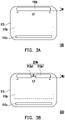
- a speaker module 200 is approximately identical to the speaker module 100 of FIG. 3A .
- the difference therebetween is that a first rear opening 210b of the speaker module 200 includes two secondary openings 210b1.
- each opening has an effective length.
- the effective length is that when a gap is not provided between the openings, the effective length is a length of an opening plus twice a width of the opening. When a gap is provided between the openings, but the gap is less than half of the length of the smallest opening on two adjacent sides or less than the width of the opening, the structural gap may be ignored when the effective length is calculated.
- a gap H between the two secondary openings 210b1 is less than half of a length L2 of the smallest opening on two adjacent sides, the gap H between the two secondary openings 210b may be ignored. That is, a length L1 of the first rear opening 110b of FIG. 3A is identical to the length L2 of the first rear opening 210b of FIG. 3B , and a width W1 of the first rear opening 110b is identical to a width W2 of the first rear opening 210b. Therefore, the effective length of the first rear opening 110b of FIG. 3A and the effective length of the first rear opening 210b of FIG. 3B are the same. Besides, similar to the arrangement in which the first rear opening 210b of FIG.
- 3A may be changed to the secondary openings of the first rear opening 210b of FIG. 3B and the configuration of the effective lengths, similar arrangement of secondary openings and the configuration of the effective lengths may also be applied to the front opening 110a and the second rear opening 110c of FIG. 3A .
- the effective lengths of the front opening 110a, the first rear opening 110b, and the second rear opening 110c of the speaker module 100 are approximately identical.
- the direction D of the sum of sound of the speaker module 100 is related to the sizes and shapes of the openings.
- the direction D of the sum of sound of the speaker module 100 may be accordingly deduced based on the opening with the smallest effective length.
- a connecting line CL is provided between the front opening 110a (e.g., the first centroid C1 of the first front opening 110a) and a human ear reference point (ERP).
- the direction D of the sum of sound outputted by the speaker module 100 is within plus or minus 30 degrees of the connecting line CL. That is, when a listening range of the speaker module 100 is reduced, it may be difficult for the outside to hear the sound outputted by the speaker module 100 clearly.
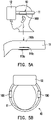
- the speaker module 100 is adapted to be disposed on a wearable device 10.
- the wearable device 10 includes a head mount display (HMD) including a frame 11, a display unit 12, and a pair of speaker modules 100 arranged in the frame 11.
- the front opening 110a, the first rear opening 110b, and the second rear opening 110c are integrated on the frame 11, that is, a portion of the frame 11 forms the enclosure 110.
- the pair of speaker modules 100 may be individually arranged on left and right sides of the frame 11 and are individually close to a pair of ears of a user.
- the front opening 110a and the first rear opening 110b of each of the speaker modules 100 face the user's head and are respectively upwards 45 degrees and downwards 45 degrees with respect to the horizontal plane, so that the direction D of the sum of sound may be optimized.
- a wearable device 20 may also include a frame 21 and one speaker module 100.
- the speaker module 100 may be detachably disposed on the frame 21.
- the wearable device 20 is, for example, an ear-hook device.
- the wearable device 20 is, for example, an ear-hook device.
- a wearable device 30 may include more than three speaker modules 100. These speaker modules 100 are assembled on the wearable device 30 with surround speaker positioning, and the angles of the speaker modules 100 may also be adjusted to improve an effect of surround sound fields.
- the wearable device may also be a speaker surround listening device, a clip-on device, a neck-mounted device, a shoulder-mounted device, a face-mounted device, etc.
- the number of the speaker modules may be one or more than one, but it is not limited thereto.
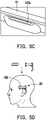
- a wearable device 40 has two speaker modules 400 arranged on left and right sides of a frame 41 of the wearable device 40. Since each of the related speaker modules 400 has only a single opening, when the speaker module 400 on the left side outputs sound, a forward sound wave R1 is generated and diffused around and is then transmitted to the user's right ear, and interference thereby occurs.
- each of the speaker modules 100 of FIG. 5A has the front opening 110a, the first rear opening 110b, and the second rear opening 110c.
- the front opening 110a and the first rear opening 110b are arranged inside the wearable device 10 and face the direction of the user's head at a specific angle, such that the sound outputted by the left speaker module 100 has a forward sound wave R2 and a reverse sound wave R3 exhibiting an opposite phase to the forward sound wave R2.
- the forward sound wave R2 is outputted from the opening 110a.
- the reverse sound wave R3 is outputted from the first rear opening 110b.
- the reverse sound wave R3 and the forward sound wave R2 may cancel each other when meeting at the user's right ear.
- the interference caused by the sound outputted by the left speaker module on the right ear is thereby reduced.
- the sound waves of the right speaker module 100 are transmitted to the left ear, the sound waves cancel each other as well, and that the interference caused by the sound outputted by the right speaker module 100 on the left ear is thereby reduced.
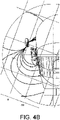
- FIG. 7B is a distribution graph of sound fields of the speaker module 100 of FIG. 1A .
- FIG. 7C is a schematic diagram of the speaker module 100 at a horizontal height of the user's ear.
- wearing positions may be different due to different habits.
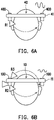
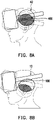
- the oblique areas in FIG. 8A and FIG. 8B are the overlapping areas of the sound fields at different wearing positions. Since the sound outputted by each related speaker module 400 in FIG. 6A does not exhibit directivity, the overlapping areas of the sound fields at different wearing positions may not cover the user's ears, which may cause the quality of the sound to drop. However, since the sums of sound outputted by the speaker modules 100 in FIG. 6B have directivity and are directed to the ears of the user, even if the positions where the wearable device 100 are worn are different, the sound field areas may still be kept to cover the user's ears as much as possible, and the quality of sound is thereby maintained.
- a peak value of the speaker module 400 at a medium-to-high frequency is approximately 3 kHz, as shown in FIG. 9B .
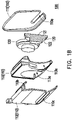
- an inner surface 111a of the front cover 111 of the speaker module 100 has a convex surface 111b.
- the convex surface 111b faces the front surface 121 of the driving unit 120, and in this way, a resonance peak value of the front chamber 114 may be increased, and the medium-to-high frequency of the speaker module 100 is increased.
- the convex surface 111b has a first inclined surface S1 and a second inclined surface S2.
- the first inclined surface S1 is parallel to an abutting surface of the driving unit 120, and an angle between the first inclined surface S1 and the second inclined surface S2 is 20°.
- the second rear opening 110c is aligned with the rear surface 122 of the driving unit 120 and a distance between an inner surface 112a of the rear cover 112 and the driving unit 120 is within 1 mm, so the peak value of the medium-to-high frequency may be increased to more than 5 kHz.
- the angle between the first inclined surface S1 and the second inclined surface S220° may be greater than 20° or less than 20°, as long as the angle between the first inclined surface S1 and the second inclined surface S2 is between 0° and 45°, the resonance peak value may be increased, and the medium-to-high frequency may also be increased.
- a speaker module 300 is approximately identical to the speaker module 100. The difference therebetween is that an enclosure 310 of the speaker module 300 is different from the enclosure 110 of the speaker module 100.
- the enclosure 310 of the speaker module 300 is a mesh shell, and meshes with higher porosities are used for a front opening 310a, a first rear opening 310b, and a second rear opening 310c. Therefore, the directivity of the sum of sound outputted by the speaker module 300 is kept, and the resonance peak value may be increased to be greater than 8 kHz.
- the sum of sound outputted by the speaker module has directivity, so that the deviation caused by the user's wearing variations and the differences in the structures of the human bodies may be reduced.
- the directivity may further isolate voices, making it difficult to hear the voice content outputted by the speaker module from the outside. A private using scenario is therefore created, and the user is allowed to enjoy a realistic listening experience as well as a comfortable using experience.
Landscapes
- Engineering & Computer Science (AREA)
- Physics & Mathematics (AREA)
- Acoustics & Sound (AREA)
- Signal Processing (AREA)
- Health & Medical Sciences (AREA)
- Otolaryngology (AREA)
- Manufacturing & Machinery (AREA)
- Obtaining Desirable Characteristics In Audible-Bandwidth Transducers (AREA)
- Circuit For Audible Band Transducer (AREA)
- Diaphragms For Electromechanical Transducers (AREA)
- Measuring Pulse, Heart Rate, Blood Pressure Or Blood Flow (AREA)
- Details Of Audible-Bandwidth Transducers (AREA)
- Stereophonic Arrangements (AREA)
Applications Claiming Priority (1)
| Application Number | Priority Date | Filing Date | Title |
|---|---|---|---|
| US202063119665P | 2020-12-01 | 2020-12-01 |
Publications (1)
| Publication Number | Publication Date |
|---|---|
| EP4009663A1 true EP4009663A1 (fr) | 2022-06-08 |
Family
ID=79831591
Family Applications (1)
| Application Number | Title | Priority Date | Filing Date |
|---|---|---|---|
| EP21211632.1A Withdrawn EP4009663A1 (fr) | 2020-12-01 | 2021-12-01 | Module de haut-parleur et dispositif portable |
Country Status (4)
| Country | Link |
|---|---|
| US (1) | US11638089B2 (fr) |
| EP (1) | EP4009663A1 (fr) |
| CN (1) | CN114584874B (fr) |
| TW (1) | TWI810730B (fr) |
Families Citing this family (4)
| Publication number | Priority date | Publication date | Assignee | Title |
|---|---|---|---|---|
| TWI869794B (zh) * | 2022-06-13 | 2025-01-11 | 宏達國際電子股份有限公司 | 揚聲模組及穿戴式裝置 |
| US12225363B2 (en) * | 2022-06-13 | 2025-02-11 | Htc Corporation | Speaker module and wearable device |
| CN115914917A (zh) * | 2022-10-24 | 2023-04-04 | 维沃移动通信有限公司 | 电子设备 |
| CN116939424A (zh) * | 2022-10-28 | 2023-10-24 | 深圳市韶音科技有限公司 | 一种开放式耳机 |
Citations (2)
| Publication number | Priority date | Publication date | Assignee | Title |
|---|---|---|---|---|
| WO2019145023A1 (fr) * | 2018-01-24 | 2019-08-01 | Harman Becker Automotive Systems Gmbh | Agencements de casque d'écoute permettant de générer des repères de pavillon auriculaire directionnels naturels |
| US10812896B2 (en) * | 2019-03-21 | 2020-10-20 | Facebook Technologies, Llc | High compliance microspeakers for vibration mitigation in a personal audio device |
Family Cites Families (8)
| Publication number | Priority date | Publication date | Assignee | Title |
|---|---|---|---|---|
| US7433483B2 (en) | 2001-02-09 | 2008-10-07 | Thx Ltd. | Narrow profile speaker configurations and systems |
| JP4853029B2 (ja) | 2006-01-20 | 2012-01-11 | 日本電気株式会社 | 携帯端末、スピーカ、及び携帯端末のスピーカ取付構造 |
| KR101298487B1 (ko) * | 2008-12-10 | 2013-08-22 | 삼성전자주식회사 | 지향성 음향 발생장치 및 방법 |
| JP2012249097A (ja) | 2011-05-27 | 2012-12-13 | Kyocera Corp | 音声出力装置 |
| US10025119B2 (en) | 2015-06-18 | 2018-07-17 | Osterhout Group, Inc. | Mechanical arrangement for head-worn computer |
| DE102016103477A1 (de) * | 2016-02-26 | 2017-08-31 | USound GmbH | Audiosystem mit strahlformenden Lautsprechern sowie Brille mit einem derartigen Audiosystem |
| TWI683580B (zh) * | 2016-12-09 | 2020-01-21 | 美律實業股份有限公司 | 耳機 |
| US10555071B2 (en) | 2018-01-31 | 2020-02-04 | Bose Corporation | Eyeglass headphones |
-
2021
- 2021-12-01 EP EP21211632.1A patent/EP4009663A1/fr not_active Withdrawn
- 2021-12-01 CN CN202111452910.XA patent/CN114584874B/zh active Active
- 2021-12-01 TW TW110144735A patent/TWI810730B/zh active
- 2021-12-01 US US17/539,201 patent/US11638089B2/en active Active
Patent Citations (2)
| Publication number | Priority date | Publication date | Assignee | Title |
|---|---|---|---|---|
| WO2019145023A1 (fr) * | 2018-01-24 | 2019-08-01 | Harman Becker Automotive Systems Gmbh | Agencements de casque d'écoute permettant de générer des repères de pavillon auriculaire directionnels naturels |
| US10812896B2 (en) * | 2019-03-21 | 2020-10-20 | Facebook Technologies, Llc | High compliance microspeakers for vibration mitigation in a personal audio device |
Also Published As
| Publication number | Publication date |
|---|---|
| US11638089B2 (en) | 2023-04-25 |
| US20220174403A1 (en) | 2022-06-02 |
| TW202224448A (zh) | 2022-06-16 |
| CN114584874B (zh) | 2024-12-13 |
| TWI810730B (zh) | 2023-08-01 |
| CN114584874A (zh) | 2022-06-03 |
Similar Documents
| Publication | Publication Date | Title |
|---|---|---|
| EP4009663A1 (fr) | Module de haut-parleur et dispositif portable | |
| US11940669B2 (en) | Glasses | |
| EP3346730B1 (fr) | Dispositif de casque pour reproduction audio 3d | |
| CN114697800A (zh) | 一种发声装置 | |
| US10231052B2 (en) | Acoustic device | |
| CN105981409B (zh) | 会话辅助系统 | |
| US11356762B2 (en) | Headphone arrangements for generating natural directional pinna cues | |
| CN212970035U (zh) | 耳机结构 | |
| US20240323578A1 (en) | Earphones | |
| US20250106543A1 (en) | Open earphone | |
| EP4294046A1 (fr) | Module de haut-parleur et dispositif portable | |
| CN220985822U (zh) | 开放式耳机 | |
| CN216118275U (zh) | 一种眼镜 | |
| US20260046555A1 (en) | Acoustic output devices | |
| KR102842032B1 (ko) | 웨어러블 글래스 템플 장착 스피커 및 그 음 방사 구조 | |
| CN219372564U (zh) | 一种耳机 | |
| RU2803551C1 (ru) | Устройство вывода акустических сигналов | |
| RU2800544C1 (ru) | Звукопроизводящее устройство | |
| CN210835484U (zh) | 头戴智能音响装置,头戴智能设备和用于增强现实的眼镜 | |
| HK40072564A (en) | Sound producing device | |
| CN120166336A (zh) | 一种声学输出装置 | |
| CN121276817A (zh) | 镜腿和智能眼镜 | |
| CN110691289A (zh) | 头戴智能音响装置,头戴智能设备和用于增强现实的眼镜 | |
| HK1229590A1 (en) | Conversation assistance system |
Legal Events
| Date | Code | Title | Description |
|---|---|---|---|
| PUAI | Public reference made under article 153(3) epc to a published international application that has entered the european phase |
Free format text: ORIGINAL CODE: 0009012 |
|
| STAA | Information on the status of an ep patent application or granted ep patent |
Free format text: STATUS: REQUEST FOR EXAMINATION WAS MADE |
|
| STAA | Information on the status of an ep patent application or granted ep patent |
Free format text: STATUS: EXAMINATION IS IN PROGRESS |
|
| 17P | Request for examination filed |
Effective date: 20211201 |
|
| AK | Designated contracting states |
Kind code of ref document: A1 Designated state(s): AL AT BE BG CH CY CZ DE DK EE ES FI FR GB GR HR HU IE IS IT LI LT LU LV MC MK MT NL NO PL PT RO RS SE SI SK SM TR |
|
| 17Q | First examination report despatched |
Effective date: 20220513 |
|
| RBV | Designated contracting states (corrected) |
Designated state(s): AL AT BE BG CH CY CZ DE DK EE ES FI FR GB GR HR HU IE IS IT LI LT LU LV MC MK MT NL NO PL PT RO RS SE SI SK SM TR |
|
| STAA | Information on the status of an ep patent application or granted ep patent |
Free format text: STATUS: THE APPLICATION HAS BEEN WITHDRAWN |
|
| 18W | Application withdrawn |
Effective date: 20240529 |