EP4009746A1 - Procédé de commande d'une source de plasma d'un appareil et appareil - Google Patents
Procédé de commande d'une source de plasma d'un appareil et appareil Download PDFInfo
- Publication number
- EP4009746A1 EP4009746A1 EP21206202.0A EP21206202A EP4009746A1 EP 4009746 A1 EP4009746 A1 EP 4009746A1 EP 21206202 A EP21206202 A EP 21206202A EP 4009746 A1 EP4009746 A1 EP 4009746A1
- Authority
- EP
- European Patent Office
- Prior art keywords
- treated
- plasma
- plasma source
- power output
- condition
- Prior art date
- Legal status (The legal status is an assumption and is not a legal conclusion. Google has not performed a legal analysis and makes no representation as to the accuracy of the status listed.)
- Pending
Links
Images

Classifications
-
- D—TEXTILES; PAPER
- D06—TREATMENT OF TEXTILES OR THE LIKE; LAUNDERING; FLEXIBLE MATERIALS NOT OTHERWISE PROVIDED FOR
- D06M—TREATMENT, NOT PROVIDED FOR ELSEWHERE IN CLASS D06, OF FIBRES, THREADS, YARNS, FABRICS, FEATHERS OR FIBROUS GOODS MADE FROM SUCH MATERIALS
- D06M10/00—Physical treatment of fibres, threads, yarns, fabrics or fibrous goods made from such materials, e.g. by ultrasonic waves, corona discharge, irradiation, electric currents or magnetic fields; Physical treatment combined with treatment with chemical compounds or elements
- D06M10/02—Sonic or ultrasonic waves; Corona discharge
- D06M10/025—Corona discharge or low temperature plasma
-
- H—ELECTRICITY
- H05—ELECTRIC TECHNIQUES NOT OTHERWISE PROVIDED FOR
- H05H—PLASMA TECHNIQUE; PRODUCTION OF ACCELERATED ELECTRICALLY-CHARGED PARTICLES OR OF NEUTRONS; PRODUCTION OR ACCELERATION OF NEUTRAL MOLECULAR OR ATOMIC BEAMS
- H05H2240/00—Testing
- H05H2240/20—Non-thermal plasma
-
- H—ELECTRICITY
- H05—ELECTRIC TECHNIQUES NOT OTHERWISE PROVIDED FOR
- H05H—PLASMA TECHNIQUE; PRODUCTION OF ACCELERATED ELECTRICALLY-CHARGED PARTICLES OR OF NEUTRONS; PRODUCTION OR ACCELERATION OF NEUTRAL MOLECULAR OR ATOMIC BEAMS
- H05H2245/00—Applications of plasma devices
- H05H2245/30—Medical applications
- H05H2245/36—Sterilisation of objects, liquids, volumes or surfaces
-
- H—ELECTRICITY
- H05—ELECTRIC TECHNIQUES NOT OTHERWISE PROVIDED FOR
- H05H—PLASMA TECHNIQUE; PRODUCTION OF ACCELERATED ELECTRICALLY-CHARGED PARTICLES OR OF NEUTRONS; PRODUCTION OR ACCELERATION OF NEUTRAL MOLECULAR OR ATOMIC BEAMS
- H05H2245/00—Applications of plasma devices
- H05H2245/60—Portable devices
Definitions
- the invention relates to a method for controlling a plasma source of a device, in particular a handheld device, and such a device whose plasma source can be controlled using this method.
- Plasmas have been used for some time because of their odor-inactivating and antimicrobial properties.
- the causes of the antimicrobial effect of a plasma lie in the heat generated by the plasma, drying out, shear stress, UV radiation, free radicals and charges.
- solid, liquid or gaseous, plasma is often referred to as the fourth state of aggregation.
- low-pressure plasmas which are also referred to as cold plasmas and which are usually operated at room temperature.
- cold plasmas have been used in medical technology for some time, including in the treatment of poorly healing wounds or wounds that do not heal, for example in so-called plasma pens, in which the antimicrobial effect of cold plasma is used.
- odor components that can be cell components of a biological organism.
- Substances that are particularly relevant to odors include butyric acid, sweat, settled cigarette smoke and others, i.e. generally odors that can be perceived as unpleasant.
- non-odour-relevant molecules such as allergens, protein molecules, prions and the like can be eliminated or destroyed.
- odor components which in the case of cell walls, bacteria, germs, viruses, fungi or other comparable microorganisms mainly consist of carbon compounds, are exposed directly to the plasma, they become negatively charged due to the bombardment with the electrons present in the plasma. Due to the electrostatic repulsion, this leads to mechanical stresses up to the point where the tensile strength is exceeded and the associated destruction of the odor molecules. Low-pressure plasmas are particularly well suited for inactivating odors on textile fabrics or on household surfaces or the like, since thermal damage to such a surface is not to be feared.
- a hand-operated device is understood to be a mobile device that is moved manually by a user—that is, by means of one or both of his hands—during operation of the device over the surface to be treated.
- a hand-held device In contrast to stationary devices, such a hand-held device is typically portable by the user, which means that the device must be matched in terms of mass and dimensions.
- the plasma source of the respective device is typically controlled independently of the nature of the surface to be treated.
- the electrical power output of the plasma source that is required for proper treatment of a textile surface depends on the mesh size of the textile surface such that a large mesh size requires less electrical power output than would be the case with a smaller mesh size. This can be explained by the fact that the reactive particles produced in the plasma can penetrate the material of the textile surface more easily with a larger mesh size than with a smaller mesh size.
- the basic idea of the invention is therefore to adjust an electrical power output from a plasma source of a device for treating a textile surface, which is delivered to a plasma, to a condition of the surface to be treated. This means that the nature of the surface to be treated is taken into account when controlling the plasma source.
- the electrical power output of the plasma source can advantageously be adjusted in such a way that particularly gentle treatment of such sensitive surfaces is made possible.
- “gentle treatment” means a treatment of the textile surface that is particularly low-wear and has a particularly low color impact.
- the electrical power output of the plasma source to the plasma can be reduced if it is recognized that the textile surface to be treated has a large mesh size, which reduces the electrical energy consumption of the device.
- the electrical power output of the plasma source to the plasma can be increased if it is recognized that the textile surface to be treated has a small mesh size, which is necessary in order to treat the material of a textile surface with a small mesh size with the plasma with the desired result .
- the plasma is generated during operation of the device using the plasma source of the device and is applied to the surface to be treated.
- an electrical power output from the plasma source is adapted or tuned at least once to the plasma generated, depending on at least one property of the surface to be treated. This tuning is expediently carried out in the form of an adjustment or a variation of the electrical power output. In this way, an optimum compromise between gentle and at the same time effective treatment can always be advantageously achieved for a wide variety of surfaces to be treated.
- the at least one adjustment of the power output expediently takes place while the device is being moved over the surface to be treated. In this way, the power output can be adapted to the changing nature of the surface.
- a change in the power output therefore particularly preferably takes place when the nature of the surface changes, in particular when the device is moved across the surface.
- the nature of the surface to be treated is specified by a user of the device.
- the condition is expediently specified by the user of the device by means of an assignment to a predefined condition category.
- the condition specified by the user for the method is supplied to the device via an input direction.
- the input device is integrated in the device or part of a separate mobile device that is expediently wireless and coupled to the device for data transmission.
- the electrical power output is preferably tuned incrementally during operation of the device. Power output is particularly preferred matched exactly once. This offers a particularly easy-to-implement possibility of implementing the tuning of the electrical power output of the plasma source to the plasma.
- the nature of the surface to be treated is detected by means of a sensor device scanning the surface, in particular when the device is moved across the surface to be treated.
- the sensor device is preferably integrated in the device or part of a separate mobile device which is coupled to the device in a data-transmitting manner, preferably wirelessly.
- the electrical power output is preferably tuned continuously during operation of the device. In this way, a particularly precise adjustment of the electrical power output from the plasma source to the plasma can advantageously be implemented.
- both the device and the separate mobile device can each have both an input device and a sensor device.
- the electrical power output can then be adjusted either instrumentally or continuously during operation of the device. This offers a particularly flexible possibility of tuning the electrical power output of the plasma source to the plasma.
- the sensor device comprises a photo sensor and alternatively or additionally a camera, an ultrasonic sensor or a mechanical scanning element.
- a sensor device allows a particularly precise and, at the same time, rapid detection of the nature of the surface to be treated.
- the at least one quality of the surface to be treated is expedient, a color and alternatively or additionally a mesh size or a type of textile. Such properties of the surface to be treated are particularly easy to identify.
- the invention also relates to a device for treating a textile surface by means of a plasma.
- the device is hand-guided, so it can be done manually by one users are guided.
- the plasma is preferably a cold plasma.
- the device includes a plasma source for generating and emitting the plasma.
- the plasma source is designed in such a way that an electrical power output can be adapted or varied to the plasma generated.
- the device also includes a control/regulation device that is set up/programmed to carry out a method according to the invention as described above. The advantages of the method according to the invention presented above are therefore also transferred to the device according to the invention.
- the method according to the invention is particularly preferably carried out during operation of the device according to the invention.
- the device has a data interface with a transmitter and a receiver.
- the data interface serves to transmit data, in particular wirelessly.
- the data interface can be based on the Bluetooth or WiFi standard.
- the device can be coupled to a separate mobile device by means of this interface. This means that the computing capacity of the mobile device can advantageously be used in order to carry out the method according to the invention, with which the computing capacity implemented in the device can be reduced as a result.
- a sensor device for scanning the surface to be treated is integrated in the device, by means of which sensor device at least one condition of the surface to be treated can be identified. This allows the electrical power output of the plasma source to be continuously adjusted, which proves to be particularly advantageous when the surface to be treated has a plurality of sections with different properties.
- the device includes an input device, by means of which at least one condition specified by the user of the device can be supplied to the device for controlling the plasma source. This allows a particularly intuitive control of the plasma source and, in order to reduce costs, the typically expensive sensors of the device can be at least partially dispensed with.
- the invention relates to an arrangement which comprises a device according to the invention corresponding to the above description and a separate mobile device.
- the arrangement with the device and the mobile device can be an arrangement with the device and the mobile device.
- the mobile device is coupled to the device in a data-transmitting manner, preferably wirelessly.
- the mobile device has an input device, by means of which at least one property identified by the user of the arrangement can be supplied to the device for controlling the plasma source.
- the mobile device has a sensor device for scanning the surface to be treated, by means of which the nature of the surface to be treated can be identified. This allows the user of the arrangement to operate the device or the arrangement in a particularly convenient manner when treating the textile surface.
- three textile surfaces 3 are shown as an example, which are made differently.
- the three textile surfaces 3 of figure 1 each have at least one quality 5 in which they differ from the other surfaces 3 shown.
- Such a texture 5 of the textile surface 3 is, for example, a color 10, a mesh size 11 or a textile type 12 of the textile surface 3 or its material.
- Each of these properties 5 can define a property category 6 or belong to such a property category 6 in each case.
- the figure 2 illustrates an example of a device 1 according to the invention for the treatment of a textile surface 3, for example one of the surfaces 3 of figure 1 corresponds, by means of a plasma 4.
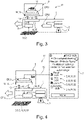
- FIGS. 3 and 4 each illustrate an example of an arrangement 17 according to the invention with an exemplary device 1 according to the invention and with a separate mobile device 8.
- the device 1 is in the figures 2 , 3 and 4 shown in each case in the exemplary implementation of a method according to the invention for controlling a plasma source 2 of the device 1 for treating the textile surface 3 by means of a plasma 4.
- the device 1 is, for example, a handheld device 1.
- the plasma 4 is a cold plasma 4, for example. This means that the electrical power output P of the plasma source 2 can be adjusted.
- the device 1 has a control/regulation device CPU which is set up/programmed to carry out the method according to the invention.
- the plasma 4 is generated by means of the plasma source 2 of the device 1, emitted and applied to the surface 3 to be treated.
- the electrical power output P of the plasma source 2 is matched at least once to the generated plasma 4 as a function of at least one condition 5 of the surface 3 to be treated, ie adjusted.
- the power output can be adjusted if the condition 5 of the condition of the surface 3 changes when the device 1 is moved over the surface 3 .
- device 1 has a data interface 13 with a transmitter 14 and a receiver 15 .
- the transmitter 14 and the receiver 15 can be integrally comprised of a transmitter/receiver unit.
- the data interface 13 is set up for the wireless transmission of data 16, for example.
- the device 13 can be coupled to the separate mobile device 8 of the arrangement 17 by means of the data interface 13 .
- the mobile device 8 can be a smartphone or a tablet computer or the like.
- a sensor device 9 for scanning the surface 3 to be treated is integrated in the device 1, by means of which at least one condition 5 of the surface 3 to be treated can be identified.
- the device 1 can have an input device 7, by means of which at least one condition 5 specified by a user of the device 1 can be supplied to the device 1 for controlling the plasma source 2, but this is not shown in the figures.
- the input device 7 of the device 1 can comprise a touch screen and/or physical buttons and/or a voice input device.
- FIG 4 also shows that in your example, the separate mobile device 8, which is connected to the device 1 in a data-transmitting manner, for example wirelessly, to supply the device 1 with data 16 about the condition 5 of the surface 3 to be treated, has an input device 7. At least one feature 5 identified by the user of the arrangement 17 can be supplied to the device 1 for controlling the plasma source 2 of the device 1 by means of this input device 7 of the mobile device 8 .
- the input device 7 of the mobile device 8 can comprise a touchscreen and/or physical buttons and/or a voice input device.
- the mobile device 8 can have its own sensor device 9 for scanning the surface 3 to be treated, by means of which the condition 5 of the surface 3 to be treated can be identified. This sensor device 9 associated with the mobile device 8 can be a camera integrated in the mobile device 8 .
- the condition 5 of the surface 3 to be treated is specified by a user of the device 1 .
- the condition 5 is specified by the user by means of an assignment to a predefined condition category 6 .
- the condition 5 specified by the user for the method is supplied to the device 1 via the input device 7, which is integrated in the device 1 (not shown) or is part of the separate mobile device 8, for example wirelessly coupled to the device 1 for data transmission.
- the electrical power output P can be tuned incrementally during operation of the device 1 , for example exactly once when the condition 5 recognized by the user is assigned to a condition category 6 .
- the condition 5 of the surface 3 to be treated is detected by means of the sensor device 9 scanning the surface 3 .
- the sensor device 9 is integrated in the device 1, for example.
- the sensor device 9 can be part of the separate mobile device 8 which is coupled to the device 1 for data transmission, but this is not shown in the figures.
- the electrical power output P can be tuned continuously during operation of the device 1 .
- the sensor device 9 includes, for example a photo sensor, a camera, an ultrasonic sensor or a mechanical scanning element or a combination thereof.
- FIG 4 further illustrates that the mobile device 8 of the arrangement 17 comprises a control device CPU.
- a software application can be run on this control/regulation device, by means of which the user of the arrangement 17 can assign the condition 5 of the surface 3 to be treated that he has recognized to a predetermined condition category 6 .
- the control/regulation device CPU of the mobile device 8 and of the device 1 can both be set up/programmed to carry out the method according to the invention and can interact when carrying out the method.
Landscapes
- Engineering & Computer Science (AREA)
- Physics & Mathematics (AREA)
- Plasma & Fusion (AREA)
- Textile Engineering (AREA)
- Chemical Or Physical Treatment Of Fibers (AREA)
- Treatment Of Fiber Materials (AREA)
Applications Claiming Priority (1)
| Application Number | Priority Date | Filing Date | Title |
|---|---|---|---|
| DE102020215102.4A DE102020215102A1 (de) | 2020-12-01 | 2020-12-01 | Verfahren zum Ansteuern einer Plasmaquelle eines Geräts und Gerät |
Publications (1)
| Publication Number | Publication Date |
|---|---|
| EP4009746A1 true EP4009746A1 (fr) | 2022-06-08 |
Family
ID=78516621
Family Applications (1)
| Application Number | Title | Priority Date | Filing Date |
|---|---|---|---|
| EP21206202.0A Pending EP4009746A1 (fr) | 2020-12-01 | 2021-11-03 | Procédé de commande d'une source de plasma d'un appareil et appareil |
Country Status (2)
| Country | Link |
|---|---|
| EP (1) | EP4009746A1 (fr) |
| DE (1) | DE102020215102A1 (fr) |
Citations (11)
| Publication number | Priority date | Publication date | Assignee | Title |
|---|---|---|---|---|
| US20020182101A1 (en) * | 2001-03-27 | 2002-12-05 | Pavel Koulik | Process and device for plasma surface treatment |
| DE102012003940A1 (de) * | 2012-03-01 | 2013-09-05 | Herbert Kannegiesser Gmbh | Verfahren zum Behandeln von Textilien, insbesondere Bekleidungsstücken, in einem Tunnelfinisher |
| DE102012025079A1 (de) * | 2012-08-31 | 2014-03-06 | NorthCo Ventures GmbH & Co. KG | Vorrichtung und Verfahren zur Behandlung von biologischem Gewebe mit einem Niederdruckplasma |
| US20140207053A1 (en) * | 2011-05-05 | 2014-07-24 | Max-Planck-Gesellschaft Zur Foerderung Der Wissenschaften E.V. | Device and method for the plasma treatment of surfaces and use of a device |
| US20150069911A1 (en) * | 2013-09-10 | 2015-03-12 | Reinhausen Plasma Gmbh | Hand-held device and method of plasma treatment of a workpiece with the hand-held device |
| EP3075896A1 (fr) * | 2015-04-01 | 2016-10-05 | Herbert Kannegiesser GmbH | Procede et dispositif de post-traitement de linge |
| CN205814739U (zh) | 2016-05-20 | 2016-12-21 | 金科伟业(中国)有限公司 | 一种便携式灭菌消毒机 |
| CN108771767A (zh) | 2018-08-24 | 2018-11-09 | 深圳市浪尖开物科技有限公司 | 衣柜净化器 |
| DE102018213143A1 (de) | 2018-08-06 | 2020-02-06 | Hyve Innovation Design Gmbh | Aktivierungsvorrichtung und Aktivierungsverfahren einer Plasmaquelle zur Oberflächenbehandlung |
| US20200038673A1 (en) * | 2018-07-31 | 2020-02-06 | L'oreal | Cold plasma generating devices, systems, and methods |
| EP3826434A1 (fr) * | 2019-11-19 | 2021-05-26 | Terraplasma GmbH | Dispositif à plasma |
Family Cites Families (5)
| Publication number | Priority date | Publication date | Assignee | Title |
|---|---|---|---|---|
| DE102010011643B4 (de) | 2010-03-16 | 2024-05-29 | Christian Buske | Vorrichtung und Verfahren zur Plasmabehandlung von lebendem Gewebe |
| DE102017105430A1 (de) | 2017-03-14 | 2018-09-20 | Epcos Ag | Vorrichtung zur Erzeugung eines nichtthermischen Atmosphärendruck-Plasmas und Wirkraum |
| DE102017215843A1 (de) | 2017-09-08 | 2019-03-14 | BSH Hausgeräte GmbH | Handgerät zur Fleckenbehandlung |
| DE102018201314A1 (de) | 2018-01-29 | 2019-08-01 | Siemens Healthcare Gmbh | Verfahren zur Normalisierung von Magnetresonanzbildern |
| DE102018213144A1 (de) | 2018-08-06 | 2020-02-06 | Hyve Innovation Design Gmbh | Nutzerführungsvorrichtung und Nutzerführungsverfahren einer Plasmaquelle zur Oberflächenbehandlung |
-
2020
- 2020-12-01 DE DE102020215102.4A patent/DE102020215102A1/de active Pending
-
2021
- 2021-11-03 EP EP21206202.0A patent/EP4009746A1/fr active Pending
Patent Citations (12)
| Publication number | Priority date | Publication date | Assignee | Title |
|---|---|---|---|---|
| US20020182101A1 (en) * | 2001-03-27 | 2002-12-05 | Pavel Koulik | Process and device for plasma surface treatment |
| US20140207053A1 (en) * | 2011-05-05 | 2014-07-24 | Max-Planck-Gesellschaft Zur Foerderung Der Wissenschaften E.V. | Device and method for the plasma treatment of surfaces and use of a device |
| DE102012003940A1 (de) * | 2012-03-01 | 2013-09-05 | Herbert Kannegiesser Gmbh | Verfahren zum Behandeln von Textilien, insbesondere Bekleidungsstücken, in einem Tunnelfinisher |
| DE102012025079A1 (de) * | 2012-08-31 | 2014-03-06 | NorthCo Ventures GmbH & Co. KG | Vorrichtung und Verfahren zur Behandlung von biologischem Gewebe mit einem Niederdruckplasma |
| US20150069911A1 (en) * | 2013-09-10 | 2015-03-12 | Reinhausen Plasma Gmbh | Hand-held device and method of plasma treatment of a workpiece with the hand-held device |
| EP3075896A1 (fr) * | 2015-04-01 | 2016-10-05 | Herbert Kannegiesser GmbH | Procede et dispositif de post-traitement de linge |
| CN205814739U (zh) | 2016-05-20 | 2016-12-21 | 金科伟业(中国)有限公司 | 一种便携式灭菌消毒机 |
| US20200038673A1 (en) * | 2018-07-31 | 2020-02-06 | L'oreal | Cold plasma generating devices, systems, and methods |
| DE102018213143A1 (de) | 2018-08-06 | 2020-02-06 | Hyve Innovation Design Gmbh | Aktivierungsvorrichtung und Aktivierungsverfahren einer Plasmaquelle zur Oberflächenbehandlung |
| CN108771767A (zh) | 2018-08-24 | 2018-11-09 | 深圳市浪尖开物科技有限公司 | 衣柜净化器 |
| EP3826434A1 (fr) * | 2019-11-19 | 2021-05-26 | Terraplasma GmbH | Dispositif à plasma |
| WO2021099436A1 (fr) * | 2019-11-19 | 2021-05-27 | Terraplasma Gmbh | Dispositif à plasma |
Also Published As
| Publication number | Publication date |
|---|---|
| DE102020215102A1 (de) | 2022-06-02 |
Similar Documents
| Publication | Publication Date | Title |
|---|---|---|
| DE102009049924A1 (de) | Druckwellengerät mit pneumatischem Antrieb | |
| EP2704654A1 (fr) | Dispositif et procédé de traitement der surfaces au plasma, et utilisation dudit dispositif | |
| DE102007046435B3 (de) | Bedieneinrichtung für ein Hörhilfegerät | |
| EP3534983A1 (fr) | Appareil médical | |
| EP1404152A2 (fr) | Dispositif et procédé d'adaptation d'une prothèse auditive | |
| EP2440149B1 (fr) | Dispositif d'alimentation destiné à fournir une tension de sortie hf, appareil chirurgical hf pourvu d'un dispositif d'alimentation correspondant | |
| EP4062715B1 (fr) | Dispositif à plasma | |
| WO2000057672A2 (fr) | Programmateur portatif | |
| EP2076962B1 (fr) | Système de traitement de signal et composants de ce système | |
| EP3494920A2 (fr) | Procédé de commande et/ou réglage d'un dispositif d'entraînement médical pouvant fonctionner avec du gaz sous pression et dispositif d'entraînement de ce type | |
| EP4009746A1 (fr) | Procédé de commande d'une source de plasma d'un appareil et appareil | |
| EP0324490A2 (fr) | Dispositif d'irradiation à grande surface | |
| DE102020215104B4 (de) | Handgeführtes Gerät mit Hochspannungsleistungselektronik | |
| EP2702472A1 (fr) | Élément de commande pour installation d'éclairage | |
| EP4009749A1 (fr) | Procédé de commande d'une source de plasma d'un appareil guidé à la main et appareil guidé à la main | |
| EP1282238A3 (fr) | Appareil électrique avec un élement de commande ayant une unité de transmission sans fils intégré | |
| DE102012003548A1 (de) | Medizinisches Gerät zur Behandlung eines Patienten | |
| DE102014106497A1 (de) | Steuer- oder Regelvorrichtung für eine Wärmekabine | |
| DE102014213967A1 (de) | Vorrichtung zur Hydophilierung von Zahnimplantaten | |
| DE102020213581A1 (de) | Verfahren | |
| DE102020215105A1 (de) | Gerät zur Behandlung eines Gegenstands mit Plasma | |
| EP2249735A1 (fr) | Procédé de commande d'un générateur hf électrochirurgical, et appareil électrochirurgical | |
| EP3797727A1 (fr) | Système et procédé d'introduction d'une main dans un gant jetable ouvert et pour enfiler le gant jetable | |
| EP4256908A2 (fr) | Dispositif de traitement d'un objet par plasma et procédé de fonctionnement | |
| EP4009748A1 (fr) | Boîtier pour un appareil guidé à la main pourvu de source plasma |
Legal Events
| Date | Code | Title | Description |
|---|---|---|---|
| PUAI | Public reference made under article 153(3) epc to a published international application that has entered the european phase |
Free format text: ORIGINAL CODE: 0009012 |
|
| STAA | Information on the status of an ep patent application or granted ep patent |
Free format text: STATUS: THE APPLICATION HAS BEEN PUBLISHED |
|
| AK | Designated contracting states |
Kind code of ref document: A1 Designated state(s): AL AT BE BG CH CY CZ DE DK EE ES FI FR GB GR HR HU IE IS IT LI LT LU LV MC MK MT NL NO PL PT RO RS SE SI SK SM TR |
|
| STAA | Information on the status of an ep patent application or granted ep patent |
Free format text: STATUS: REQUEST FOR EXAMINATION WAS MADE |
|
| 17P | Request for examination filed |
Effective date: 20221208 |
|
| RBV | Designated contracting states (corrected) |
Designated state(s): AL AT BE BG CH CY CZ DE DK EE ES FI FR GB GR HR HU IE IS IT LI LT LU LV MC MK MT NL NO PL PT RO RS SE SI SK SM TR |
|
| STAA | Information on the status of an ep patent application or granted ep patent |
Free format text: STATUS: EXAMINATION IS IN PROGRESS |
|
| 17Q | First examination report despatched |
Effective date: 20250204 |