EP4009920B1 - Ensemble médical pour traiter des anévrismes, procédé de fabrication et système médical pour traiter des anévrismes - Google Patents
Ensemble médical pour traiter des anévrismes, procédé de fabrication et système médical pour traiter des anévrismes Download PDFInfo
- Publication number
- EP4009920B1 EP4009920B1 EP20745132.9A EP20745132A EP4009920B1 EP 4009920 B1 EP4009920 B1 EP 4009920B1 EP 20745132 A EP20745132 A EP 20745132A EP 4009920 B1 EP4009920 B1 EP 4009920B1
- Authority
- EP
- European Patent Office
- Prior art keywords
- covering
- cells
- medical
- free
- cover
- Prior art date
- Legal status (The legal status is an assumption and is not a legal conclusion. Google has not performed a legal analysis and makes no representation as to the accuracy of the status listed.)
- Active
Links
Images


Classifications
-
- A—HUMAN NECESSITIES
- A61—MEDICAL OR VETERINARY SCIENCE; HYGIENE
- A61B—DIAGNOSIS; SURGERY; IDENTIFICATION
- A61B17/00—Surgical instruments, devices or methods
- A61B17/12—Surgical instruments, devices or methods for ligaturing or otherwise compressing tubular parts of the body, e.g. blood vessels or umbilical cord
- A61B17/12022—Occluding by internal devices, e.g. balloons or releasable wires
- A61B17/12099—Occluding by internal devices, e.g. balloons or releasable wires characterised by the location of the occluder
- A61B17/12109—Occluding by internal devices, e.g. balloons or releasable wires characterised by the location of the occluder in a blood vessel
- A61B17/12113—Occluding by internal devices, e.g. balloons or releasable wires characterised by the location of the occluder in a blood vessel within an aneurysm
- A61B17/12118—Occluding by internal devices, e.g. balloons or releasable wires characterised by the location of the occluder in a blood vessel within an aneurysm for positioning in conjunction with a stent
-
- A—HUMAN NECESSITIES
- A61—MEDICAL OR VETERINARY SCIENCE; HYGIENE
- A61B—DIAGNOSIS; SURGERY; IDENTIFICATION
- A61B17/00—Surgical instruments, devices or methods
- A61B17/12—Surgical instruments, devices or methods for ligaturing or otherwise compressing tubular parts of the body, e.g. blood vessels or umbilical cord
- A61B17/12022—Occluding by internal devices, e.g. balloons or releasable wires
- A61B17/12131—Occluding by internal devices, e.g. balloons or releasable wires characterised by the type of occluding device
- A61B17/1214—Coils or wires
- A61B17/12145—Coils or wires having a pre-set deployed three-dimensional shape
-
- A—HUMAN NECESSITIES
- A61—MEDICAL OR VETERINARY SCIENCE; HYGIENE
- A61B—DIAGNOSIS; SURGERY; IDENTIFICATION
- A61B17/00—Surgical instruments, devices or methods
- A61B17/12—Surgical instruments, devices or methods for ligaturing or otherwise compressing tubular parts of the body, e.g. blood vessels or umbilical cord
- A61B17/12022—Occluding by internal devices, e.g. balloons or releasable wires
- A61B17/12131—Occluding by internal devices, e.g. balloons or releasable wires characterised by the type of occluding device
- A61B17/12168—Occluding by internal devices, e.g. balloons or releasable wires characterised by the type of occluding device having a mesh structure
- A61B17/12177—Occluding by internal devices, e.g. balloons or releasable wires characterised by the type of occluding device having a mesh structure comprising additional materials, e.g. thrombogenic, having filaments, having fibers or being coated
-
- A—HUMAN NECESSITIES
- A61—MEDICAL OR VETERINARY SCIENCE; HYGIENE
- A61F—FILTERS IMPLANTABLE INTO BLOOD VESSELS; PROSTHESES; DEVICES PROVIDING PATENCY TO, OR PREVENTING COLLAPSING OF, TUBULAR STRUCTURES OF THE BODY, e.g. STENTS; ORTHOPAEDIC, NURSING OR CONTRACEPTIVE DEVICES; FOMENTATION; TREATMENT OR PROTECTION OF EYES OR EARS; BANDAGES, DRESSINGS OR ABSORBENT PADS; FIRST-AID KITS
- A61F2/00—Filters implantable into blood vessels; Prostheses, i.e. artificial substitutes or replacements for parts of the body; Appliances for connecting them with the body; Devices providing patency to, or preventing collapsing of, tubular structures of the body, e.g. stents
- A61F2/82—Devices providing patency to, or preventing collapsing of, tubular structures of the body, e.g. stents
- A61F2/86—Stents in a form characterised by the wire-like elements; Stents in the form characterised by a net-like or mesh-like structure
- A61F2/90—Stents in a form characterised by the wire-like elements; Stents in the form characterised by a net-like or mesh-like structure characterised by a net-like or mesh-like structure
-
- A—HUMAN NECESSITIES
- A61—MEDICAL OR VETERINARY SCIENCE; HYGIENE
- A61F—FILTERS IMPLANTABLE INTO BLOOD VESSELS; PROSTHESES; DEVICES PROVIDING PATENCY TO, OR PREVENTING COLLAPSING OF, TUBULAR STRUCTURES OF THE BODY, e.g. STENTS; ORTHOPAEDIC, NURSING OR CONTRACEPTIVE DEVICES; FOMENTATION; TREATMENT OR PROTECTION OF EYES OR EARS; BANDAGES, DRESSINGS OR ABSORBENT PADS; FIRST-AID KITS
- A61F2/00—Filters implantable into blood vessels; Prostheses, i.e. artificial substitutes or replacements for parts of the body; Appliances for connecting them with the body; Devices providing patency to, or preventing collapsing of, tubular structures of the body, e.g. stents
- A61F2/82—Devices providing patency to, or preventing collapsing of, tubular structures of the body, e.g. stents
- A61F2002/823—Stents, different from stent-grafts, adapted to cover an aneurysm
-
- A—HUMAN NECESSITIES
- A61—MEDICAL OR VETERINARY SCIENCE; HYGIENE
- A61F—FILTERS IMPLANTABLE INTO BLOOD VESSELS; PROSTHESES; DEVICES PROVIDING PATENCY TO, OR PREVENTING COLLAPSING OF, TUBULAR STRUCTURES OF THE BODY, e.g. STENTS; ORTHOPAEDIC, NURSING OR CONTRACEPTIVE DEVICES; FOMENTATION; TREATMENT OR PROTECTION OF EYES OR EARS; BANDAGES, DRESSINGS OR ABSORBENT PADS; FIRST-AID KITS
- A61F2210/00—Particular material properties of prostheses classified in groups A61F2/00 - A61F2/26 or A61F2/82 or A61F9/00 or A61F11/00 or subgroups thereof
- A61F2210/0076—Particular material properties of prostheses classified in groups A61F2/00 - A61F2/26 or A61F2/82 or A61F9/00 or A61F11/00 or subgroups thereof multilayered, e.g. laminated structures
-
- A—HUMAN NECESSITIES
- A61—MEDICAL OR VETERINARY SCIENCE; HYGIENE
- A61F—FILTERS IMPLANTABLE INTO BLOOD VESSELS; PROSTHESES; DEVICES PROVIDING PATENCY TO, OR PREVENTING COLLAPSING OF, TUBULAR STRUCTURES OF THE BODY, e.g. STENTS; ORTHOPAEDIC, NURSING OR CONTRACEPTIVE DEVICES; FOMENTATION; TREATMENT OR PROTECTION OF EYES OR EARS; BANDAGES, DRESSINGS OR ABSORBENT PADS; FIRST-AID KITS
- A61F2250/00—Special features of prostheses classified in groups A61F2/00 - A61F2/26 or A61F2/82 or A61F9/00 or A61F11/00 or subgroups thereof
- A61F2250/0014—Special features of prostheses classified in groups A61F2/00 - A61F2/26 or A61F2/82 or A61F9/00 or A61F11/00 or subgroups thereof having different values of a given property or geometrical feature, e.g. mechanical property or material property, at different locations within the same prosthesis
- A61F2250/0023—Special features of prostheses classified in groups A61F2/00 - A61F2/26 or A61F2/82 or A61F9/00 or A61F11/00 or subgroups thereof having different values of a given property or geometrical feature, e.g. mechanical property or material property, at different locations within the same prosthesis differing in porosity
Definitions
- the invention relates to a medical set for the treatment of aneurysms according to the preamble of patent claim 1. Furthermore, the invention relates to a manufacturing method according to claim 11 and a medical system according to claim 12.
- WO 2014/177634 A1 describes a highly flexible stent comprising a compressible and expandable lattice structure, wherein the lattice structure is formed as a single piece.
- the lattice structure comprises closed cells, each defined by four lattice elements.
- the lattice structure has at least one cell ring comprising between three and six cells.
- US 2018/0193026 A1 The study deals with a device for covering aneurysms with a mesh structure that can be transported to the treatment site via a catheter.
- the mesh structure is provided with a sheath that also covers the openings of the mesh structure, thus isolating the aneurysm from blood flow.
- the sheath limits the compressibility of the mesh structure and carries the risk of rupture if the mesh structure is subjected to severe deformation.
- the applicant's practice also discloses stents with lattice structures made of a single wire.
- the wire is interwoven to form a tubular mesh.
- the wire is deflected to form atraumatic loops.
- the axial ends can be flared in a funnel shape.
- the known medical device is particularly suitable for the treatment of aneurysms in small, cerebral blood vessels.
- Such blood vessels have a very small cross-sectional diameter and are often highly tortuous.
- the known stent is designed to be highly flexible, so that on the one hand it can be compressed to a very small cross-sectional diameter and on the other hand it has a high bending flexibility, which enables it to be introduced into small cerebral blood vessels.
- stents that span the aneurysm and shield it from blood flow within the blood vessel.
- stents with a covering that seals off the stent cells, thus preventing blood flow into the aneurysm and perfusion of the blood vessel's side branches.
- the webs of the lattice structure are integrally connected to one another and delimit the inner cells and the edge cells.
- the edge cells form a closed edge cell ring at one longitudinal end of the lattice structure, for example, at a distal and/or proximal longitudinal end of the lattice structure.
- the edge cell ring is connected to the inner cells only on one side.
- the edge cell ring can be understood as a ring of circumferentially adjacent cells, in particular edge cells.
- the lattice structure can fundamentally be designed as a one-piece lattice structure.
- the wire mesh of the lattice structure can consist of a single wire that is deflected and returned at the longitudinal ends of the mesh structure.
- the wire can be interwoven with itself to form the mesh structure.
- the mesh structure can also consist of multiple interwoven wires.
- the multiple wires can be deflected and returned at one axial longitudinal end, while the opposite axial longitudinal end can have open wire ends. It is also possible for the interwoven wires to have open wire ends at both axial longitudinal ends.
- the wire can have an X-ray-visible core material and a sheath material made of a shape memory alloy.
- the cover has at least 10 pores with a size of at least 15 ⁇ m2 over an area of 100,000 ⁇ m2 .
- the minimum pore size can be adjusted, in particular by the duration of the electrospinning process. This combination of a certain minimum number of pores and a minimum pore size has proven particularly beneficial in practice for ensuring sufficient blood permeability of the cover while simultaneously maintaining a good covering effect.
- the grid structure is prepared. Then, the covering is applied to all inner cells, specifically using an electrospinning process.
- At least one inner cell is cut free using a cutting tool, with the cutting tool being guided along the webs of the inner cell to be cut free. This completely removes the covering from the inner cell.
- the cutting tool can be a mechanical cutting tool, such as a scalpel.
- the cutting tool is a laser cutting tool, so that the cover is removed along the webs using a laser beam, thus cutting out the inner cell.
- the The cutting device can also be a device that ensures that at least one inner cell is free of covering by etching.
- edges of the cover on the cover-free inner cells are reworked. This can preferably be done thermally, for example, using a soldering iron, by rough machining the edges in a first step at a first temperature and then fine machining the edges at a temperature lower than the first temperature.
- a further subordinate aspect of the invention relates to a medical system with a medical set, which is in particular the medical set already described above, so that the medical set has a main catheter and a covering device which can be moved through the main catheter to a treatment site for covering an aneurysm.
- the covering device is connected or connectable to a transport wire. Furthermore, the covering device has a self-expanding lattice structure comprising webs that are integrally connected to one another and delimit inner cells and edge cells.
- the edge cells form a closed edge cell ring along the circumference of the lattice structure at one longitudinal end of the lattice structure.
- the edge cell ring is connected to inner cells only on one side, i.e., on the side oriented toward the inner cells.
- the medical system has at least one embolization agent for placement in the aneurysm.
- the embolization agent is preferably formed by a plastically deformable wire, in particular by a coil or by a liquid. Such embodiments of the embolization agent have proven particularly suitable with regard to the treatment of aneurysms.
- the medical system further comprises an additional catheter for delivering the embolizing agent into the aneurysm, wherein the additional catheter is independent of the main catheter and/or movable relative to the main catheter.
- the Fig. 1 The schematically illustrated medical set 2 is used to treat aneurysms 4 and is in Fig. 1 shown in a state arranged within a vessel 6.
- the medical set 2 comprises a main catheter 8 and a covering device 12 movable through the main catheter 8 to a treatment site 10.
- the treatment site 10 is preferably the location along the vessel 6 where the aneurysm 4 is formed.
- the covering device 12 serves to temporarily or permanently cover the aneurysm 4, wherein the covering device 12 comprises a self-expanding lattice structure 14 made of webs 16 (cf. Fig. 2 ).
- the lattice structure 14 is preferably made of a shape memory material in view of its self-expandability.
- the covering device 12 is permanently or detachably mechanically connected to a transport wire 15 that can be moved within the main catheter 8.
- a transport wire 15 that can be moved within the main catheter 8.
- the lattice structure 14 can be perfused by blood in a longitudinal axial direction, i.e. in and against a flow direction F.
- the grid structure 14 is arranged in particular within the vessel 6 in such a way that the cover 26 is placed at a level with an opening 30 of the aneurysm 4, so that the latter is covered by the cover 26, wherein at the same time, blood flow through the vessel 6 is not stopped.
- the cover 26 is thus in the embodiment according to Fig. 1 essentially tubular, in particular in the form of a hollow cylinder.
- the cover 26 is preferably porous with large pores 28 (cf. Fig. 3 ) and permeable to blood, so that a nutrient supply to the cells covered by the cover 26 is still ensured.
- the cover 26 can also be porous and impermeable to blood.
- the cover 26 serves in this case, in particular when placing an embolization agent 36 (cf. Fig. 4 ) within the aneurysm 4, means that the embolizing agent 40 cannot escape from the aneurysm 4 after placement until the blood within the aneurysm 4 has clotted due to the embolizing agent 36 and the aneurysm 4 is thus reliably closed.
- the cover 26 is formed as an electrospun cover 26.
- X-ray markers 32 are also provided in the medical set 2 and especially in the grid structure 14.
- the X-ray markers 32 are preferably located at the cell tips of edge cells 20 (cf. Fig. 2 ) of the lattice structure 14.
- the X-ray markers 56 can be formed as X-ray-visible sleeves, for example made of platinum or gold, which are crimped onto the cell tips of the edge cells 20.
- FIG. 2 A close-up of a preferred embodiment of the covering device 12 according to the invention is shown.
- the webs 16 are integrally, i.e. monolithically, connected to one another and delimit inner cells 18 and edge cells 20.
- all cells, in particular inner cells 18 and edge cells 20 are each delimited by four webs, which together form a diamond shape. These cells, enclosed on all sides, are referred to as closed cells.
- the edge cells 20 form a closed edge cell ring 24 (three edge cells 20 of the edge cell ring 24 are shown circled) in the circumferential direction at a longitudinal end 22 of the lattice structure 14, which is connected to inner cells 18 on only one side.
- the grid structure 14 is provided with the cover 26 made of a fabric which has irregularly sized pores 28 (cf. Fig. 3 ). At least one inner cell 18, in Fig. 1 (in the image plane at the right edge of the grid structure 14) three inner cells 18 are formed without any cover.
- the design of the cover 26 is shown in the scanning electron microscope image according to Fig. 3 clearly visible. It can be seen that the cover 26 has several irregularly sized pores 28, each delimited by threads 34. The electrospinning process creates several threads 34 that are irregularly aligned with each other. This is how the pores 28 are formed. Fig. 3 also that the pores 28 have a comparatively small pore size, although some pores 28 are sufficiently large to ensure, for example, blood permeability. Specifically, Fig. 3 four pores 28 are graphically highlighted, which have a size of more than 30 ⁇ m 2 . The density of the pores 28 with a size of more than 30 ⁇ m 2 shows that the cover has at least 10 such pores 28 on an area of 100,000 ⁇ m 2 .
- the high flexibility of the cover 26 in combination with the high flexibility of the grid structure 14 results in the provision of a covering device 12 that can be introduced into a (blood) vessel 6 through very small delivery catheters.
- delivery catheters can be used that have a size of 6 French, in particular no more than 5 French, in particular no more than 4 French, in particular no more than 3 French, in particular no more than 2 French.
- the covering device according to the exemplary embodiments described here can be used with catheters that have an inner diameter of no more than 1.6 mm, in particular no more than 1.0 mm, in particular no more than 0.7 mm, in particular no more than 0.4 mm.
- the layer thickness of the cover 26 is at most 10 ⁇ m, in particular at most 8 ⁇ m, in particular at most 6 ⁇ m, in particular at most 4 ⁇ m. At most 4, in particular at most 3, in particular at most 2, threads 34 intersect. Generally, crossing points are provided within the electrospun structure of the cover 26, at which only 2 threads 34 intersect.
- the lattice structure 10 preferably has a cross-sectional diameter between 2.5 mm and 8 mm, in particular between 4.5 mm and 6 mm.
- Fig. 4 shows a schematically illustrated embodiment of a medical system according to the invention during a temporary implantation of the covering device (12) at a treatment site 10.
- the medical system comprises the above-mentioned medical set 2 with the main catheter 8 and the covering device 12, which has the grid structure 14 and the cover 26.
- the design of the cover 26 corresponds to the above-mentioned embodiment according to Fig. 1 .
- the medical system further comprises an embolization agent 36, which is formed, for example, by a plastically deformable wire 38 or a liquid.
- the embolization agent 36 is placed within the aneurysm 4 using an additional catheter 40, which is also part of the medical system.
- the additional catheter 40 is arranged essentially parallel to, i.e., next to, the medical set 2 within the vessel 6.
- the additional catheter 40, and specifically a tip of the additional catheter 40 is then "pushed" between a vessel wall and the cover 26 into the aneurysm 4 in order to place the embolization agent 36 in the form of the plastically deformable wire 38 (also referred to as a "coil").
- the cover 26 prevents the embolization agent 36 from escaping from the aneurysm 4 during and—in the case of permanent implantation—also subsequently, for example, due to blood flow.
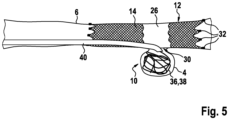
- FIG. 5 a schematically illustrated embodiment of a medical system according to the invention is shown with a permanent implantation of the covering device (12) at a treatment site 10.
- the covering device 12 according to Fig. 5 each has open longitudinal ends and is thus essentially cylindrical, i.e., tubular, in order not to influence blood flow through the vessel.
- the cover device 12 in the embodiment according to Fig. 5 thus serves as a flow diverter.
Landscapes
- Health & Medical Sciences (AREA)
- Life Sciences & Earth Sciences (AREA)
- Surgery (AREA)
- Engineering & Computer Science (AREA)
- Biomedical Technology (AREA)
- Animal Behavior & Ethology (AREA)
- Veterinary Medicine (AREA)
- Vascular Medicine (AREA)
- Public Health (AREA)
- Heart & Thoracic Surgery (AREA)
- General Health & Medical Sciences (AREA)
- Molecular Biology (AREA)
- Medical Informatics (AREA)
- Nuclear Medicine, Radiotherapy & Molecular Imaging (AREA)
- Reproductive Health (AREA)
- Cardiology (AREA)
- Oral & Maxillofacial Surgery (AREA)
- Transplantation (AREA)
- Neurosurgery (AREA)
- Surgical Instruments (AREA)
- Prostheses (AREA)
Claims (15)
- Ensemble médical (2) pour le traitement d'anévrismes (4) avec un cathéter principal (8), un dispositif de recouvrement (12) pouvant être déplacé à travers le cathéter principal (8) jusqu'à un site de traitement (10) pour recouvrir un anévrisme (4), le dispositif de recouvrement (12) est relié ou reliable à un fil de transport (15) et comprenant une structure en treillis auto-expansible (14) composée de bandes (16) reliées d'un seul tenant les unes aux autres et délimitant les cellules internes (18) et les cellules périphériques (20), les cellules périphériques (20) formant à une extrémité longitudinale (22) de la structure en treillis (14) un anneau de cellules périphériques fermé (24) qui n'est relié que par un côté aux cellules intérieures (18),
caractérisé en ce que la structure en treillis (14) est pourvue d'un couvercle (26) formée d'un tissu qui présente des pores grossiers irréguliers (28), au moins une cellule intérieure (18) de la structure en treillis (14) étant au moins partiellement, en particulier majoritairement, exempte de couvercle. - Ensemble médical (2) selon la revendication 1, caractérisé en ce que le couvercle (26) est composé d'un tissu électrofilé.
- Ensemble médical (2) selon la revendication 1 ou 2, caractérisé en ce que le dispositif de recouvrement (12) est reliable de manière réversible au fil de transport (15) et est ouvert des deux côtés à l'état déployé et est perméable au sang.
- Ensemble médical (2) selon l'une quelconque des revendications précédentes,
caractérisé en ce que toutes les bandes (16) des cellules intérieures (18) sont associées chacune à une autre cellule intérieure (18) ou cellule périphériques (20) et que les cellules périphériques (20) présentent chacune au moins deux bandes (16) qui ne sont associées à aucune autre cellule intérieure (18) ou cellule périphériques (20). - Ensemble médical (2) selon l'une quelconque des revendications précédentes,
caractérisé en ce que le couvercle (26) se termine sur les bandes (16) de la cellule intérieure (18) sans couvercle, de telle sorte que le couvercle (26) ne dépasse pas dans la cellule intérieure (18) sans couvercle. - Ensemble médical (2) selon l'une des revendications 1 à 4,
caractérisé en ce que le couvercle (26) recouvre au moins partiellement les bandes (16) de la cellule intérieure (18) sans couvercle, de sorte que le couvercle (26) pénètre partiellement dans la cellule intérieure (18) sans couvercle. - Ensemble médical (2) selon l'une quelconque des revendications précédentes,
caractérisé en ce que plusieurs cellules intérieures (18) directement voisines dans la direction circonférentielle de la structure en treillis (14), en particulier toutes les cellules intérieures (18) d'un anneau cellulaire intérieur, sont exemptes de couvercle. - Ensemble médical (2) selon l'une quelconque des revendications précédentes,
caractérisé en ce que plusieurs cellules intérieures (18) directement voisines dans la direction longitudinale de la structure en treillis (14) sont exemptes de couvercle. - Ensemble médical (2) selon l'une quelconque des revendications précédentes,
caractérisé en ce que le couvercle (26) s'étend seulement partiellement, en particulier jusqu'à un maximum de 50 %, en particulier jusqu'à un maximum de 40 %, en particulier jusqu'à un maximum de 30 %, en particulier jusqu'à un maximum de 20 %, sur la circonférence de la structure en treillis (14). - Ensemble médical selon l'une quelconque des revendications précédentes,
caractérisé en ce que le couvercle (26), sur une surface de 100 000 µm2, comprend au moins 10 pores (28), qui ont une taille d'au moins 15 µm2. - Procédé de fabrication d'un ensemble médical (2) selon l'une quelconque des revendications précédentes, le procédé comprenant les étapes consistant à :a. mettre à disposition la structure en treillis (14) ;b. appliquer le couvercle (26) sur toutes les cellules intérieures (18) au moyen d'un procédé d'électrofilage ;c. découpe d'au moins une cellule intérieure (18) au moyen d'un outil de découpe, l'outil de découpe étant guidé le long des bandes (16) de la cellule intérieure (18) à découper, de sorte que la cellule intérieure (18) est au moins partiellement, en particulier majoritairement, exempte de couvercle.
- Système médical avec un ensemble médical (2) selon l'une quelconque des revendications 1 à 9 et avec au moins un agent d'embolisation (36) destiné à être placé dans l'anévrisme (4).
- Système médical selon la revendication 12,
caractérisé en ce que le dispositif de recouvrement (12) est reliable de manière amovible au fil de transport (15) pour une implantation permanente du dispositif de recouvrement (12) sur le site de traitement (10), le dispositif de recouvrement (12) présentant à l'état déployé des extrémités longitudinales ouvertes. - Système médical selon la revendication 12,
caractérisé en ce que le dispositif de recouvrement (12) est relié de manière inséparable au fil de transport (15), pour une implantation temporaire du dispositif de recouvrement (12) sur le site de traitement (10). - Système médical selon l'une quelconque des revendications 12 à 14,
caractérisé en ce qu'il est en outre prévu un cathéter supplémentaire (40) pour introduire l'agent d'embolisation (36) dans l'anévrisme, le cathéter supplémentaire (40) étant indépendant du cathéter principal (8) et/ou mobile par rapport au cathéter principal (8).
Applications Claiming Priority (2)
| Application Number | Priority Date | Filing Date | Title |
|---|---|---|---|
| DE102019121554.4A DE102019121554B4 (de) | 2019-08-09 | 2019-08-09 | Medizinisches Set zur Behandlung von Aneurysmen, Herstellungsverfahren sowie medizinisches System zur Behandlung von Aneurysmen |
| PCT/EP2020/070500 WO2021028161A1 (fr) | 2019-08-09 | 2020-07-21 | Ensemble médical pour traiter des anévrismes, procédé de fabrication et système médical pour traiter des anévrismes |
Publications (2)
| Publication Number | Publication Date |
|---|---|
| EP4009920A1 EP4009920A1 (fr) | 2022-06-15 |
| EP4009920B1 true EP4009920B1 (fr) | 2025-07-09 |
Family
ID=71784014
Family Applications (1)
| Application Number | Title | Priority Date | Filing Date |
|---|---|---|---|
| EP20745132.9A Active EP4009920B1 (fr) | 2019-08-09 | 2020-07-21 | Ensemble médical pour traiter des anévrismes, procédé de fabrication et système médical pour traiter des anévrismes |
Country Status (6)
| Country | Link |
|---|---|
| US (1) | US20220280165A1 (fr) |
| EP (1) | EP4009920B1 (fr) |
| CN (1) | CN114269265A (fr) |
| DE (1) | DE102019121554B4 (fr) |
| ES (1) | ES3042964T3 (fr) |
| WO (1) | WO2021028161A1 (fr) |
Families Citing this family (5)
| Publication number | Priority date | Publication date | Assignee | Title |
|---|---|---|---|---|
| CA2946078C (fr) | 2014-04-30 | 2023-03-14 | Cerus Endovascular Limited | Dispositif d'occlusion |
| US10285711B2 (en) | 2015-12-07 | 2019-05-14 | Cerus Endovascular Limited | Occlusion device |
| EP3782576B1 (fr) | 2016-03-11 | 2025-07-16 | Stryker Ireland Technology Ltd. | Dispositif d'occlusion |
| CA3073232C (fr) | 2017-08-21 | 2023-08-29 | Cerus Endovascular Limited | Dispositif d'occlusion |
| US11406404B2 (en) | 2020-02-20 | 2022-08-09 | Cerus Endovascular Limited | Clot removal distal protection methods |
Family Cites Families (18)
| Publication number | Priority date | Publication date | Assignee | Title |
|---|---|---|---|---|
| US7887575B2 (en) * | 2002-05-22 | 2011-02-15 | Boston Scientific Scimed, Inc. | Stent with segmented graft |
| US7232461B2 (en) * | 2003-10-29 | 2007-06-19 | Cordis Neurovascular, Inc. | Neck covering device for an aneurysm |
| US8435285B2 (en) * | 2003-11-25 | 2013-05-07 | Boston Scientific Scimed, Inc. | Composite stent with inner and outer stent elements and method of using the same |
| US20050137677A1 (en) * | 2003-12-17 | 2005-06-23 | Rush Scott L. | Endovascular graft with differentiable porosity along its length |
| US8915952B2 (en) * | 2004-03-31 | 2014-12-23 | Merlin Md Pte Ltd. | Method for treating aneurysms |
| US8500751B2 (en) * | 2004-03-31 | 2013-08-06 | Merlin Md Pte Ltd | Medical device |
| WO2007088549A2 (fr) * | 2006-02-03 | 2007-08-09 | Design & Performance - Cyprus Limited | Ensemble de greffe implantable et traitement d'anévrisme |
| CA2642250A1 (fr) * | 2006-02-13 | 2007-08-23 | Merlin Md Pte Ltd | Dispositif endovasculaire avec membrane |
| WO2008151204A1 (fr) * | 2007-06-04 | 2008-12-11 | Sequent Medical Inc. | Procédés et dispositifs pour le traitement de défauts vasculaires |
| DE102011012501A1 (de) * | 2011-02-25 | 2012-08-30 | Phenox Gmbh | Implantat mit Faservlies |
| US20120253377A1 (en) * | 2011-03-31 | 2012-10-04 | Codman & Shurtleff, Inc. | Modifiable occlusion device |
| DE102013113271B4 (de) * | 2012-12-17 | 2023-03-02 | Acandis Gmbh | Medizinisches Implantat, Behandlungssystem mit einem derartigen Implantat und Verfahren zum Herstellen eines Implantats |
| DE102013104550B4 (de) | 2013-05-03 | 2021-07-01 | Acandis Gmbh | Medizinische Vorrichtung zur Einfuhr in ein Körperhohlorgan |
| US11154302B2 (en) * | 2014-03-31 | 2021-10-26 | DePuy Synthes Products, Inc. | Aneurysm occlusion device |
| EP3307211B1 (fr) * | 2015-06-11 | 2024-10-30 | Beijing Advanced Medical Technologies, Ltd. Inc. | Endoprothèse structurée à cellules fermée |
| WO2018112203A1 (fr) * | 2016-12-14 | 2018-06-21 | eLum Technologies, Inc. | Endoprothèses électrofilées, déflecteurs d'écoulement et dispositifs d'occlusion et leurs procédés de fabrication |
| CN110381855B (zh) * | 2017-01-06 | 2023-07-04 | 因赛普特有限责任公司 | 用于动脉瘤治疗装置的抗血栓涂层 |
| US11065096B2 (en) * | 2017-10-12 | 2021-07-20 | Loyola University Chicago | Thromboembolic protective flow-diverting, common carotid to external carotid intravascular stent |
-
2019
- 2019-08-09 DE DE102019121554.4A patent/DE102019121554B4/de active Active
-
2020
- 2020-07-21 ES ES20745132T patent/ES3042964T3/es active Active
- 2020-07-21 EP EP20745132.9A patent/EP4009920B1/fr active Active
- 2020-07-21 WO PCT/EP2020/070500 patent/WO2021028161A1/fr not_active Ceased
- 2020-07-21 US US17/632,687 patent/US20220280165A1/en active Pending
- 2020-07-21 CN CN202080056663.9A patent/CN114269265A/zh active Pending
Also Published As
| Publication number | Publication date |
|---|---|
| CN114269265A (zh) | 2022-04-01 |
| ES3042964T3 (en) | 2025-11-24 |
| EP4009920A1 (fr) | 2022-06-15 |
| WO2021028161A1 (fr) | 2021-02-18 |
| DE102019121554A1 (de) | 2021-02-11 |
| US20220280165A1 (en) | 2022-09-08 |
| DE102019121554B4 (de) | 2025-07-10 |
Similar Documents
| Publication | Publication Date | Title |
|---|---|---|
| EP4009920B1 (fr) | Ensemble médical pour traiter des anévrismes, procédé de fabrication et système médical pour traiter des anévrismes | |
| EP4009919B1 (fr) | Kit médical et système médical destinés au traitement d'anévrismes | |
| EP2613743B1 (fr) | Implant destiné à influencer le débit sanguin en cas de malformations artérioveineuses | |
| EP3764928B1 (fr) | Dispositif de thrombectomie | |
| DE102019121562B4 (de) | Medizinische Vorrichtung zur Behandlung von Aneurysmen | |
| EP4231961B1 (fr) | Implant médical pour le traitement d'anévrismes | |
| DE102011011869A1 (de) | Implantat | |
| EP4076294B1 (fr) | Ensemble médical, système médical et dispositif de recouvrement destiné au traitement de l'anévrisme | |
| DE102018131269B4 (de) | Medizinische Vorrichtung zur Einfuhr in ein Körperhohlorgan und Herstellungsverfahren | |
| DE102019135498B4 (de) | Medizinisches System zur Behandlung von Stenosen in intrakraniellen Gefäßen | |
| WO2019174991A1 (fr) | Fermeture temporaire de collets d'anévrisme | |
| WO2013167492A1 (fr) | Prothèse vasculaire intraluminale à fenestration in situ | |
| DE102013006503A1 (de) | Implantat | |
| DE102021132725A1 (de) | Implantat zur Behandlung von Aneurysmen im Bereich von Bifurkationen | |
| DE102019121559B4 (de) | Medizinische Vorrichtung zur Einfuhr in ein Körperhohlorgan sowie Verfahren zur Herstellung einer medizinischen Vorrichtung | |
| DE102023119308A1 (de) | Medizinisches Implantat | |
| WO2026052645A1 (fr) | Implant médical |
Legal Events
| Date | Code | Title | Description |
|---|---|---|---|
| STAA | Information on the status of an ep patent application or granted ep patent |
Free format text: STATUS: UNKNOWN |
|
| STAA | Information on the status of an ep patent application or granted ep patent |
Free format text: STATUS: THE INTERNATIONAL PUBLICATION HAS BEEN MADE |
|
| PUAI | Public reference made under article 153(3) epc to a published international application that has entered the european phase |
Free format text: ORIGINAL CODE: 0009012 |
|
| STAA | Information on the status of an ep patent application or granted ep patent |
Free format text: STATUS: REQUEST FOR EXAMINATION WAS MADE |
|
| 17P | Request for examination filed |
Effective date: 20220302 |
|
| AK | Designated contracting states |
Kind code of ref document: A1 Designated state(s): AL AT BE BG CH CY CZ DE DK EE ES FI FR GB GR HR HU IE IS IT LI LT LU LV MC MK MT NL NO PL PT RO RS SE SI SK SM TR |
|
| DAV | Request for validation of the european patent (deleted) | ||
| DAX | Request for extension of the european patent (deleted) | ||
| P01 | Opt-out of the competence of the unified patent court (upc) registered |
Effective date: 20230603 |
|
| GRAP | Despatch of communication of intention to grant a patent |
Free format text: ORIGINAL CODE: EPIDOSNIGR1 |
|
| STAA | Information on the status of an ep patent application or granted ep patent |
Free format text: STATUS: GRANT OF PATENT IS INTENDED |
|
| RIC1 | Information provided on ipc code assigned before grant |
Ipc: A61F 2/82 20130101ALN20250106BHEP Ipc: A61B 17/12 20060101ALI20250106BHEP Ipc: A61F 2/90 20130101AFI20250106BHEP |
|
| RIC1 | Information provided on ipc code assigned before grant |
Ipc: A61F 2/82 20130101ALN20250121BHEP Ipc: A61B 17/12 20060101ALI20250121BHEP Ipc: A61F 2/90 20130101AFI20250121BHEP |
|
| INTG | Intention to grant announced |
Effective date: 20250205 |
|
| GRAS | Grant fee paid |
Free format text: ORIGINAL CODE: EPIDOSNIGR3 |
|
| GRAA | (expected) grant |
Free format text: ORIGINAL CODE: 0009210 |
|
| STAA | Information on the status of an ep patent application or granted ep patent |
Free format text: STATUS: THE PATENT HAS BEEN GRANTED |
|
| AK | Designated contracting states |
Kind code of ref document: B1 Designated state(s): AL AT BE BG CH CY CZ DE DK EE ES FI FR GB GR HR HU IE IS IT LI LT LU LV MC MK MT NL NO PL PT RO RS SE SI SK SM TR |
|
| REG | Reference to a national code |
Ref country code: GB Ref legal event code: FG4D Free format text: NOT ENGLISH |
|
| REG | Reference to a national code |
Ref country code: CH Ref legal event code: EP |
|
| REG | Reference to a national code |
Ref country code: IE Ref legal event code: FG4D Free format text: LANGUAGE OF EP DOCUMENT: GERMAN |
|
| REG | Reference to a national code |
Ref country code: DE Ref legal event code: R096 Ref document number: 502020011397 Country of ref document: DE |
|
| PGFP | Annual fee paid to national office [announced via postgrant information from national office to epo] |
Ref country code: ES Payment date: 20250922 Year of fee payment: 6 |
|
| PGFP | Annual fee paid to national office [announced via postgrant information from national office to epo] |
Ref country code: DE Payment date: 20250917 Year of fee payment: 6 |
|
| PGFP | Annual fee paid to national office [announced via postgrant information from national office to epo] |
Ref country code: FR Payment date: 20250929 Year of fee payment: 6 |
|
| REG | Reference to a national code |
Ref country code: NL Ref legal event code: MP Effective date: 20250709 |
|
| REG | Reference to a national code |
Ref country code: ES Ref legal event code: FG2A Ref document number: 3042964 Country of ref document: ES Kind code of ref document: T3 Effective date: 20251124 |
|
| PG25 | Lapsed in a contracting state [announced via postgrant information from national office to epo] |
Ref country code: PT Free format text: LAPSE BECAUSE OF FAILURE TO SUBMIT A TRANSLATION OF THE DESCRIPTION OR TO PAY THE FEE WITHIN THE PRESCRIBED TIME-LIMIT Effective date: 20251110 |
|
| PG25 | Lapsed in a contracting state [announced via postgrant information from national office to epo] |
Ref country code: NL Free format text: LAPSE BECAUSE OF FAILURE TO SUBMIT A TRANSLATION OF THE DESCRIPTION OR TO PAY THE FEE WITHIN THE PRESCRIBED TIME-LIMIT Effective date: 20250709 |
|
| PG25 | Lapsed in a contracting state [announced via postgrant information from national office to epo] |
Ref country code: IS Free format text: LAPSE BECAUSE OF FAILURE TO SUBMIT A TRANSLATION OF THE DESCRIPTION OR TO PAY THE FEE WITHIN THE PRESCRIBED TIME-LIMIT Effective date: 20251109 |
|
| PGFP | Annual fee paid to national office [announced via postgrant information from national office to epo] |
Ref country code: GB Payment date: 20251008 Year of fee payment: 6 |
|
| PG25 | Lapsed in a contracting state [announced via postgrant information from national office to epo] |
Ref country code: NO Free format text: LAPSE BECAUSE OF FAILURE TO SUBMIT A TRANSLATION OF THE DESCRIPTION OR TO PAY THE FEE WITHIN THE PRESCRIBED TIME-LIMIT Effective date: 20251009 |
|
| REG | Reference to a national code |
Ref country code: LT Ref legal event code: MG9D |
|
| PG25 | Lapsed in a contracting state [announced via postgrant information from national office to epo] |
Ref country code: FI Free format text: LAPSE BECAUSE OF FAILURE TO SUBMIT A TRANSLATION OF THE DESCRIPTION OR TO PAY THE FEE WITHIN THE PRESCRIBED TIME-LIMIT Effective date: 20250709 |
|
| PGFP | Annual fee paid to national office [announced via postgrant information from national office to epo] |
Ref country code: IT Payment date: 20251003 Year of fee payment: 6 |
|
| PG25 | Lapsed in a contracting state [announced via postgrant information from national office to epo] |
Ref country code: HR Free format text: LAPSE BECAUSE OF FAILURE TO SUBMIT A TRANSLATION OF THE DESCRIPTION OR TO PAY THE FEE WITHIN THE PRESCRIBED TIME-LIMIT Effective date: 20250709 |
|
| PG25 | Lapsed in a contracting state [announced via postgrant information from national office to epo] |
Ref country code: GR Free format text: LAPSE BECAUSE OF FAILURE TO SUBMIT A TRANSLATION OF THE DESCRIPTION OR TO PAY THE FEE WITHIN THE PRESCRIBED TIME-LIMIT Effective date: 20251010 |
|
| PG25 | Lapsed in a contracting state [announced via postgrant information from national office to epo] |
Ref country code: SE Free format text: LAPSE BECAUSE OF FAILURE TO SUBMIT A TRANSLATION OF THE DESCRIPTION OR TO PAY THE FEE WITHIN THE PRESCRIBED TIME-LIMIT Effective date: 20250709 |
|
| PG25 | Lapsed in a contracting state [announced via postgrant information from national office to epo] |
Ref country code: LV Free format text: LAPSE BECAUSE OF FAILURE TO SUBMIT A TRANSLATION OF THE DESCRIPTION OR TO PAY THE FEE WITHIN THE PRESCRIBED TIME-LIMIT Effective date: 20250709 |
|
| PG25 | Lapsed in a contracting state [announced via postgrant information from national office to epo] |
Ref country code: PL Free format text: LAPSE BECAUSE OF FAILURE TO SUBMIT A TRANSLATION OF THE DESCRIPTION OR TO PAY THE FEE WITHIN THE PRESCRIBED TIME-LIMIT Effective date: 20250709 Ref country code: BG Free format text: LAPSE BECAUSE OF FAILURE TO SUBMIT A TRANSLATION OF THE DESCRIPTION OR TO PAY THE FEE WITHIN THE PRESCRIBED TIME-LIMIT Effective date: 20250709 |
|
| PG25 | Lapsed in a contracting state [announced via postgrant information from national office to epo] |
Ref country code: RS Free format text: LAPSE BECAUSE OF FAILURE TO SUBMIT A TRANSLATION OF THE DESCRIPTION OR TO PAY THE FEE WITHIN THE PRESCRIBED TIME-LIMIT Effective date: 20251009 |
|
| REG | Reference to a national code |
Ref country code: CH Ref legal event code: H13 Free format text: ST27 STATUS EVENT CODE: U-0-0-H10-H13 (AS PROVIDED BY THE NATIONAL OFFICE) Effective date: 20260224 |
|
| PG25 | Lapsed in a contracting state [announced via postgrant information from national office to epo] |
Ref country code: LU Free format text: LAPSE BECAUSE OF NON-PAYMENT OF DUE FEES Effective date: 20250721 Ref country code: RO Free format text: LAPSE BECAUSE OF FAILURE TO SUBMIT A TRANSLATION OF THE DESCRIPTION OR TO PAY THE FEE WITHIN THE PRESCRIBED TIME-LIMIT Effective date: 20250709 |
|
| REG | Reference to a national code |
Ref country code: BE Ref legal event code: MM Effective date: 20250731 |
|
| PG25 | Lapsed in a contracting state [announced via postgrant information from national office to epo] |
Ref country code: SM Free format text: LAPSE BECAUSE OF FAILURE TO SUBMIT A TRANSLATION OF THE DESCRIPTION OR TO PAY THE FEE WITHIN THE PRESCRIBED TIME-LIMIT Effective date: 20250709 |
|
| PG25 | Lapsed in a contracting state [announced via postgrant information from national office to epo] |
Ref country code: DK Free format text: LAPSE BECAUSE OF FAILURE TO SUBMIT A TRANSLATION OF THE DESCRIPTION OR TO PAY THE FEE WITHIN THE PRESCRIBED TIME-LIMIT Effective date: 20250709 |
|
| PG25 | Lapsed in a contracting state [announced via postgrant information from national office to epo] |
Ref country code: BE Free format text: LAPSE BECAUSE OF NON-PAYMENT OF DUE FEES Effective date: 20250731 |
|
| PG25 | Lapsed in a contracting state [announced via postgrant information from national office to epo] |
Ref country code: CZ Free format text: LAPSE BECAUSE OF FAILURE TO SUBMIT A TRANSLATION OF THE DESCRIPTION OR TO PAY THE FEE WITHIN THE PRESCRIBED TIME-LIMIT Effective date: 20250709 Ref country code: CH Free format text: LAPSE BECAUSE OF NON-PAYMENT OF DUE FEES Effective date: 20250731 |
|
| PG25 | Lapsed in a contracting state [announced via postgrant information from national office to epo] |
Ref country code: EE Free format text: LAPSE BECAUSE OF FAILURE TO SUBMIT A TRANSLATION OF THE DESCRIPTION OR TO PAY THE FEE WITHIN THE PRESCRIBED TIME-LIMIT Effective date: 20250709 Ref country code: SK Free format text: LAPSE BECAUSE OF FAILURE TO SUBMIT A TRANSLATION OF THE DESCRIPTION OR TO PAY THE FEE WITHIN THE PRESCRIBED TIME-LIMIT Effective date: 20250709 |