EP4009935B1 - Dispositif d'acupuncture automatique, instrument à aiguille et procédé d'acupuncture - Google Patents
Dispositif d'acupuncture automatique, instrument à aiguille et procédé d'acupuncture Download PDFInfo
- Publication number
- EP4009935B1 EP4009935B1 EP21838967.4A EP21838967A EP4009935B1 EP 4009935 B1 EP4009935 B1 EP 4009935B1 EP 21838967 A EP21838967 A EP 21838967A EP 4009935 B1 EP4009935 B1 EP 4009935B1
- Authority
- EP
- European Patent Office
- Prior art keywords
- needle
- gadget
- chamber
- acupuncture
- tube
- Prior art date
- Legal status (The legal status is an assumption and is not a legal conclusion. Google has not performed a legal analysis and makes no representation as to the accuracy of the status listed.)
- Active
Links
Images





Classifications
-
- A—HUMAN NECESSITIES
- A61—MEDICAL OR VETERINARY SCIENCE; HYGIENE
- A61H—PHYSICAL THERAPY APPARATUS, e.g. DEVICES FOR LOCATING OR STIMULATING REFLEX POINTS IN THE BODY; ARTIFICIAL RESPIRATION; MASSAGE; BATHING DEVICES FOR SPECIAL THERAPEUTIC OR HYGIENIC PURPOSES OR SPECIFIC PARTS OF THE BODY
- A61H39/00—Devices for locating or stimulating specific reflex points of the body for physical therapy, e.g. acupuncture
- A61H39/08—Devices for applying needles to such points, i.e. for acupuncture ; Acupuncture needles or accessories therefor
- A61H39/083—Needle tubes
-
- A—HUMAN NECESSITIES
- A61—MEDICAL OR VETERINARY SCIENCE; HYGIENE
- A61H—PHYSICAL THERAPY APPARATUS, e.g. DEVICES FOR LOCATING OR STIMULATING REFLEX POINTS IN THE BODY; ARTIFICIAL RESPIRATION; MASSAGE; BATHING DEVICES FOR SPECIAL THERAPEUTIC OR HYGIENIC PURPOSES OR SPECIFIC PARTS OF THE BODY
- A61H39/00—Devices for locating or stimulating specific reflex points of the body for physical therapy, e.g. acupuncture
- A61H39/08—Devices for applying needles to such points, i.e. for acupuncture ; Acupuncture needles or accessories therefor
-
- A—HUMAN NECESSITIES
- A61—MEDICAL OR VETERINARY SCIENCE; HYGIENE
- A61H—PHYSICAL THERAPY APPARATUS, e.g. DEVICES FOR LOCATING OR STIMULATING REFLEX POINTS IN THE BODY; ARTIFICIAL RESPIRATION; MASSAGE; BATHING DEVICES FOR SPECIAL THERAPEUTIC OR HYGIENIC PURPOSES OR SPECIFIC PARTS OF THE BODY
- A61H39/00—Devices for locating or stimulating specific reflex points of the body for physical therapy, e.g. acupuncture
- A61H39/08—Devices for applying needles to such points, i.e. for acupuncture ; Acupuncture needles or accessories therefor
- A61H39/086—Acupuncture needles
-
- A—HUMAN NECESSITIES
- A61—MEDICAL OR VETERINARY SCIENCE; HYGIENE
- A61H—PHYSICAL THERAPY APPARATUS, e.g. DEVICES FOR LOCATING OR STIMULATING REFLEX POINTS IN THE BODY; ARTIFICIAL RESPIRATION; MASSAGE; BATHING DEVICES FOR SPECIAL THERAPEUTIC OR HYGIENIC PURPOSES OR SPECIFIC PARTS OF THE BODY
- A61H2201/00—Characteristics of apparatus not provided for in the preceding codes
- A61H2201/12—Driving means
- A61H2201/1207—Driving means with electric or magnetic drive
-
- A—HUMAN NECESSITIES
- A61—MEDICAL OR VETERINARY SCIENCE; HYGIENE
- A61H—PHYSICAL THERAPY APPARATUS, e.g. DEVICES FOR LOCATING OR STIMULATING REFLEX POINTS IN THE BODY; ARTIFICIAL RESPIRATION; MASSAGE; BATHING DEVICES FOR SPECIAL THERAPEUTIC OR HYGIENIC PURPOSES OR SPECIFIC PARTS OF THE BODY
- A61H2201/00—Characteristics of apparatus not provided for in the preceding codes
- A61H2201/12—Driving means
- A61H2201/1207—Driving means with electric or magnetic drive
- A61H2201/1215—Rotary drive
-
- A—HUMAN NECESSITIES
- A61—MEDICAL OR VETERINARY SCIENCE; HYGIENE
- A61H—PHYSICAL THERAPY APPARATUS, e.g. DEVICES FOR LOCATING OR STIMULATING REFLEX POINTS IN THE BODY; ARTIFICIAL RESPIRATION; MASSAGE; BATHING DEVICES FOR SPECIAL THERAPEUTIC OR HYGIENIC PURPOSES OR SPECIFIC PARTS OF THE BODY
- A61H2201/00—Characteristics of apparatus not provided for in the preceding codes
- A61H2201/12—Driving means
- A61H2201/1207—Driving means with electric or magnetic drive
- A61H2201/123—Linear drive
-
- A—HUMAN NECESSITIES
- A61—MEDICAL OR VETERINARY SCIENCE; HYGIENE
- A61H—PHYSICAL THERAPY APPARATUS, e.g. DEVICES FOR LOCATING OR STIMULATING REFLEX POINTS IN THE BODY; ARTIFICIAL RESPIRATION; MASSAGE; BATHING DEVICES FOR SPECIAL THERAPEUTIC OR HYGIENIC PURPOSES OR SPECIFIC PARTS OF THE BODY
- A61H2201/00—Characteristics of apparatus not provided for in the preceding codes
- A61H2201/14—Special force transmission means, i.e. between the driving means and the interface with the user
- A61H2201/1481—Special movement conversion means
- A61H2201/149—Special movement conversion means rotation-linear or vice versa
-
- A—HUMAN NECESSITIES
- A61—MEDICAL OR VETERINARY SCIENCE; HYGIENE
- A61H—PHYSICAL THERAPY APPARATUS, e.g. DEVICES FOR LOCATING OR STIMULATING REFLEX POINTS IN THE BODY; ARTIFICIAL RESPIRATION; MASSAGE; BATHING DEVICES FOR SPECIAL THERAPEUTIC OR HYGIENIC PURPOSES OR SPECIFIC PARTS OF THE BODY
- A61H2201/00—Characteristics of apparatus not provided for in the preceding codes
- A61H2201/16—Physical interface with patient
- A61H2201/1602—Physical interface with patient kind of interface, e.g. head rest, knee support or lumbar support
- A61H2201/165—Wearable interfaces
-
- A—HUMAN NECESSITIES
- A61—MEDICAL OR VETERINARY SCIENCE; HYGIENE
- A61H—PHYSICAL THERAPY APPARATUS, e.g. DEVICES FOR LOCATING OR STIMULATING REFLEX POINTS IN THE BODY; ARTIFICIAL RESPIRATION; MASSAGE; BATHING DEVICES FOR SPECIAL THERAPEUTIC OR HYGIENIC PURPOSES OR SPECIFIC PARTS OF THE BODY
- A61H2201/00—Characteristics of apparatus not provided for in the preceding codes
- A61H2201/50—Control means thereof
- A61H2201/5007—Control means thereof computer controlled
Definitions
- the invention generally relates to an automatic acupuncture device, a needle gadget to be used in conjunction with the automatic acupuncture device, and a method to do acupuncture with the automatic acupuncture device.
- Acupuncture has a history of more than 2000 years in China. Traditional Chinese medicine believes that there is Qi and blood in the human body to keep the basic functions. Acupuncture can regulate the Qi and blood and improve health. On the body, there are also meridians and acupuncture points which are more effective to do acupuncture. During acupuncture, an acupuncturist inserts acupuncture needles into a patient's body with certain angles, uses lifting-thrusting and twisting-rotating acupuncture manipulations to enhance acupuncture effect to treat diseases.
- Patents CN108392412A , CN204521567U , CN204910065U , CN109125062A have designed acupuncture robot systems with mechanical arms. Although they can achieve automatic acupuncture function, the designs are complex, the systems are huge, and the prices are high. They are not portable and not suitable for home use.
- Patents CN108743367A , KR9600102433Y1 , KR20384866Y1 , KR201800247777A , TW201012459A , CN108309788B , CN103126883A , WO2006095944A1 , CN203208351U , CN203802802U and CN201692306U have designed another group of acupuncture device, which are in pen shapes or gun shapes. These acupuncture devices are manual acupuncture needle ejectors. When in use, the user holds the device in hand and press a switch to eject a needle out of a needle barrel built in the acupuncture device to insert the needle.
- Patents CN202179694U and CN206508245U are manual acupuncture devices as well.
- an acupuncture needle is packaged with a spring inside a needle tube and the spring is pre-compressed by a movable bolt in the needle tube.
- the user puts the needle device against the human body, pulls the movable bolt and allows the spring to extend from its compressed state, which pushes the needle into the human body.
- This type of acupuncture device needs manual operation and cannot be attached on the body during treatment.
- the needle is exposed outside of the needle tube and can cause injury.
- Patent CN2086142U designed another type of acupuncture device with ejection spring for needle insertion and needle clamper for needle holding. When in use, the user needs to load the needle manually and press a button for needle releasing and insertion. This kind of acupuncture device is complex to operate and cannot be made into wearable devices. Also, the needles are easy to get contaminated.
- Patent CN111150648A presents an automatic acupuncture device which uses negative pressure to drive a piston and push the needle for insertion.
- the design needs to press the instrument repeatedly to create negative pressure. It is inconvenient to use.
- Patent CN107496164A designs an acupuncture device for automatic manipulation. Before use, the user manually loads a needle into the device, manually set the acupuncture depth and other parameters. Then the user powers on the device to insert the needle. The device will do the manipulation automatically.
- the use of this automatic acupuncture device is complex, and the acupuncture needle may touch with various parts of the acupuncture device directly and can use possible cross contamination.
- Patent CN110123629A designs an automatic acupuncture device that allows to choose needles of different sizes. It characterizes with a needle barrel loaded with different sizes of needles in different chambers. A second barrel has an ejector chamber that can align with these different chambers of needles. The insertion of needle itself is manual. This type of device is complex to use and the needles are exposed to the device directly and can cause contamination.
- Patents CN105963132A and CN206239727U present an automatic acupuncture system, including a positioning part, a power system, an acupuncture device, and a drone to carry the acupuncture device to the desired body parts, etc.
- the system is complex and more important, it uses the same acupuncture needle repeatedly, only with spray disinfection.
- CN203790289U discloses an automatic acupuncture device, comprising a case, driving means configured to provide a driving force to move one or more needle drivers linearly so as to push acupuncture needles in needle gadgets into a human body, where each needle gadget includes a needle tube and an acupuncture needle inside the needle tube.
- the present invention proposes an automatic acupuncture device that is portable, convenient to use, with the consideration of safety.
- an automatic acupuncture device of the kind disclosed in CN203790289U which is characterised in that said driving means comprises one or more motors or electromagnets configured to provide said driving force after being powered on , the needle gadget being configured to keep the acupuncture needle with the needle tube before, during and after acupuncture treatment, such that the acupuncture needle is not be exposed to air outside of the needle tube to cause injury, one or more needle gadget chambers being configured to house the needle gadgets, allowing the needle gadgets to be put into or taken out of the needle gadget chambers detachably.
- said driving means comprises one or more motors or electromagnets configured to provide said driving force after being powered on
- the needle gadget being configured to keep the acupuncture needle with the needle tube before, during and after acupuncture treatment, such that the acupuncture needle is not be exposed to air outside of the needle tube to cause injury
- one or more needle gadget chambers being configured to house the needle gadgets, allowing the needle gadgets to be put into or taken out of the needle gadget chambers detachably
- the automatic acupuncture device further comprises one or more locking-releasing structures that are configured to lock the needle gadgets in the needle gadget chambers so that the needle gadgets will not fall out of the needle gadget chambers during acupuncture treatment, and that are also configured to release the needle gadgets from the needle gadget chambers after acupuncture treatment.
- the automatic acupuncture device further comprises a control circuit, which is configured to control device starting, needle insertion, needle manipulations, needle removing, and/or user interface displaying.
- the motor is configured as a rotary motor and its motor shaft rotates when powered on, wherein the automatic acupuncture device further comprises a transmission system that converts a rotary motion to a linear motion.
- the transmission system of the automatic acupuncture device comprises a screw rod connected to the motor shaft; a guide rail or a guide rod; a screw nut around the screw rod that slides along the guide rail or guide rod when the screw rod rotates, to move the needle driver linearly.
- the motor is configured as a linear motor with a needle driver connected on its motor shaft, when powered on, the motor shaft and the needle driver move linearly.
- the motor shaft and therefore the needle driver move linearly as well as rotate, which drives the needle to move linearly and rotate through an uneven surface coupling between the needle driver and the needle top, to perform rotating and thrusting acupuncture manipulation.
- the needle driver is a bar
- the top of the needle tube of the needle gadget has a hole to allow the needle driver entering the needle tube along the direction of the needle, getting in touch with the needle top, and pushing the needle out through the needle tube.
- the needle driver is a bar
- the top of the needle tube of the needle gadget has a hole
- the side of the needle tube has a slit
- the slit and the hole are connected, and when in use, the needle driver enters the needle tube through the hole and the slit, moves down through the slit on the side of needle tube and touches the needle top to push the needle out of the need tube.
- the needle driver is a bar
- the side of the needle tube of the needle gadget has a slit with a width wider than the needle driver, and when in use, the needle driver enters the needle tube through the slit on the side of the needle tube, makes contact with the needle top to move the needle.
- the automatic acupuncture device further comprises an ejector spring in the needle gadget chamber, which is configured as following: when the needle gadget is pushed into the needle gadget chamber, the ejector spring is compressed, and a locking-releasing structure locks the needle gadget in the chamber; when the locking-releasing structure unlocks the needle gadget, the ejector spring extends and pushes out the needle gadget from the needle gadget chamber.
- the locking-releasing structure comprises a locking head
- the needle tube of the needle gadget has a locking notch, and when the needle gadget is pushed into the needle gadget chamber and the locking head is forced into the locking notch of the needle tube, the needle gadget is locked in the chamber.
- the locking-releasing structure is a magnetic piece inside the needle gadget chamber, which attracts ferromagnetic materials attached on the needle tube to lock the needle gadget.
- the locking-releasing structure comprises a sliding button, a flat spring, a mounting point for the flat spring to mount on the device case, a locking head on the flat spring, a needle gadget ejector spring, a locking notch on the needle tube, and the locking-releasing structure works as following: before acupuncture, the needle gadget is pushed in, the locking head is pressed into the locking notch and the needle gadget is locked, meanwhile the ejector spring is compressed; after acupuncture, the sliding button is pushed to flatten the flat spring and bring the locking head out of the locking notch, which allows the compressed ejector spring to eject the needle gadget out the needle gadget chamber.
- the needle gadget chamber has an opening for the needle gadget to enter the chamber
- the locking-releasing structure comprises push plates, push rods, connectors on the push plates to connect with the push rods, locking heads that protrude into the chamber opening at resting state, sliding rods around which the locking heads moves, connector rings on the locking heads to connect with the push rods, push plate springs
- the needle gadget is configured to have a locking notch on the needle tube
- the chamber, the locking-releasing structure and the needle gadget work together as following: when pushing the needle gadget into the chamber opening, the locking heads are pushed away from the chamber; meanwhile the push plate springs are compressed until the locking heads are facing the locking notch and pushed back into the chamber by the compressed push plate springs to lock the needle gadget inside the chamber; when releasing the needle gadget, users push the push plate to move the locking head away from the needle tube locking notch, allowing the ejector spring to eject the needle gadget out.
- the needle gadget chamber has an opening for the needle gadget to enter the chamber
- the locking-releasing structure comprises a rotatable frame, a locking head on the rotatable frame that protrudes into the chamber opening at resting state, a frame spring mounted between the rotatable frame and a mounting point on the case of the automatic acupuncture device, a press button accessible to the user to rotate the frame and release the locking head
- the needle gadget is configured to have a locking notch on the needle tube
- the needle gadget chamber, the locking-releasing structure and the needle gadget work together as following: when pushing the needle gadget into the needle gadget chamber, the locking head will be pushed away; at the same time, the rotatable frame is rotated and the frame spring is stretched or compressed until the locking head is facing the locking notch on the needle tube; the locking head is pulled back or pushed back into the chamber opening by the frame spring and pressed into the locking notch on the needle tube to lock the needle gadget inside the needle gadget chamber; when releasing the needle gadget, users push the press button and rotate the frame to
- the needle gadget chamber has an opening for the needle gadget to enter the chamber
- the locking-releasing structure comprises a locking head, a sliding button which is accessible and movable by users and connected with the locking head, a stopper to restrict the sliding button's motion range, a spring mounted between the sliding button and a mounting point on the case of the device.
- the locking-releasing structure works as following: the locking head protrudes into the needle gadget chamber at resting state; when the needle gadget is pushed into the needle gadget chamber, the needle gadget pushes the locking head and the sliding button away from the needle gadget; meanwhile the spring is compressed by the sliding button until the locking head is facing the locking notch on the needle tube of the needle gadget; the locking head is pressed back into the chamber by the compressed spring and the needle gadget is locked inside the chamber; when releasing the needle gadget, users slide the sliding button in the direction that is away from the needle gadget chamber, which in turn releases the locking head from the needle tube's locking notch.
- the locking-releasing structure comprises a sliding plate, a pull rod, a hook at the tip of the pull rod, a sliding rod on which the sliding plate slides, a spring connecting the sliding plate and the device case, connectors to fix the two ends of the spring, a locking head, connectors to connect the locking head to the sliding plate, a rising groove, a falling groove and a notch island on the sliding plate, a notch on the notch island for the hook to hook on, a guiding peninsula, wherein the rising groove becomes shallower towards the notch island, and the notch becomes deeper again at the end of rising groove, and the locking-releasing structure works as following: when the needle gadget is pushed into the needle gadget chamber for the first time, the sliding plate and the locking head are pushed in; the hook slides towards the notch island along the rising groove; when the needle gadget reaches the bottom of the chamber, the hook reaches the end of the rising groove, falls into the deep notch on the notch island and gets hooked on the notch; at the same time, the locking head is
- the needle driver has a shape of a fork or a clip, which is used to clamp on the needle top to move the needle.
- the device case includes a first case part and a second case part, with the first case part and the second case part movable relative to each other, wherein the second case part houses the needle gadget chamber; when the first case part and the second case part are relatively opened, the needle gadget chamber is exposed and allows the needle gadget to be inserted; after the needle gadget is inserted, the first case part and the second case part are closed and the needle gadget is locked inside the needle gadget chamber for acupuncture treatment.
- the automatic acupuncture device further comprises a rechargeable battery to power the motor or the electromagnet.
- the automatic acupuncture device is in the shape of a cylinder, the diameter of the cylinder is less than 30 mm, and the height is less than 25 mm.
- the needle gadget is completely inserted into the needle gadget chamber from the bottom, side or top surface of the cylinder, and no parts bulge out from the cylinder.
- a needle gadget used with the hereinbefore defined automatic acupuncture device is provided, when the needle gadget is inserted into the needle gadget chamber from the bottom, side or top surface of the acupuncture device, it is completely contained inside the automatic acupuncture device and no parts bulge out from the cylinder.
- the needle gadget comprises a needle tube; an acupuncture needle inside the needle tube, comprising a needle tip, a needle shaft and a needle top with a larger diameter than the needle shaft; a hole on top of the needle tube and/or a slit on side of the needle tube, through which the needle driver of the automatic acupuncture device enters the needle tube and exerts force on the needle top; a needle outlet at bottom of needle tube, through which the needle tip and shaft are pushed out of the needle tube and inserted into human body; a needle-holding spring sheathed outside the needle shaft and enclosed inside the needle tube, between the needle tube bottom and the needle top, which is configured as: before the needle gadget is used, the acupuncture needle is kept inside the needle tube by the needle-holding spring to prevent the needle tip from exposing to air outside of the needle tube and accidently injuring people; during acupuncture treatment, when the needle driver pushes the needle into human body, the needle-holding spring is compressed; after acupuncture treatment, the needle driver removes force from the needle top,
- the needle top has an uneven surface and couples with an uneven surface of the needle driver to transmit the rotary motion from the needle driver to the needle, to perform rotating acupuncture manipulation.
- the diameter of the hole on the needle tube top is smaller than the diameter of the needle top of the acupuncture needle, to prevent the needle from falling out of the needle tube, and the diameter of the needle outlet is smaller than the diameter of the needle-holding spring, to prevent the needle-holding spring from falling out of the needle tube.
- the diameter of the needle tube bottom is larger than that of the rest of the needle tube, and/or the side of the needle tube has a bulging column or indented groove that matches the shape of the needle gadget chamber in an automatic acupuncture device, to control the needle gadget's insertion direction.
- the needle tube has a bulging column or indented groove for a locking head on an automatic acupuncture device to lock the needle gadget inside the automatic acupuncture device when the needle gadget is inserted into the needle gadget chamber of the automatic acupuncture device, to prevent the needle gadget from falling out of the automatic acupuncture device during acupuncture treatment.
- the needle gadget chamber has a larger diameter at the entrance than that of the rest of the chamber, and/or has a bulging column or indented groove on the side to match a groover or column on a needle tube, for the needle gadget insertion direction control.
- the needle tube bottom protrudes into the needle tube a hollow column with an outer diameter smaller than that of the needle-holding spring to allow the needle-holding spring sitting around it and an inner diameter in the center of the column bigger than the needle shaft to allow the needle to pass through, and the hollow column helps to prevent the needle from bending during insertion.
- the needle tube has a ferromagnetic piece and is attracted to a magnet piece inside the needle gadget chamber when being inserted into the chamber, to prevent the needle gadget from falling out of the chamber during acupuncture treatment.
- a method of performing acupuncture with the hereinbefore defined automatic acupuncture device comprises: inserting a needle gadget into a needle gadget chamber of the automatic acupuncture device and locking it inside; attaching the automatic acupuncture device onto human body surface; powering on the automatic acupuncture device automatically or manually; running a computer program stored in a control circuit of the automatic acupuncture device to start a motor or electromagnet, to control a needle driver, to push an acupuncture needle, and/or to perform acupuncture manipulations; allowing the acupuncture needle to stay in human body for a preset period of time; after the preset period of time, controlling the motor or electromagnet to remove force from the needle top and allow a needle-holding spring in the needle gadget to pop out the needle from human body, or to exert a pulling force on the needle top to pull the needle out of human body, or to exert a trigger force to pop out the needle from human body; after the acupuncture treatment, detaching the automatic acupuncture device from the body.
- the method to attach the automatic acupuncture device onto human body surface is to use a double-sided adhesive tape to stick the acupuncture device on to human body and/or use a strap to wear the device onto human body.
- a method of performing acupuncture which is not part of the invention, with the hereinbefore defined automatic acupuncture device may be carried out such that when needles are inserted into the skin of the human body, the needle are inserted in a vibration mode, like mosquitos insert the tips of their mouthparts into human being skin.
- the vibration mode is in a frequency of 0.2-16 Hz.
- the vibration distance is in the range of 0.1mm to 2mm.
- the automatic acupuncture device and the needle gadget being use with the automatic acupuncture device have one or more of the following advantages: 1) automatic; 2) the operation is simple; 3) the automatic acupuncture device and the needle gadget are small and easy to carry; 4) patients can do acupuncture by themselves at any time whenever needed; 5) there is no pain or only slight pain; 6) the needle gadget is disposable, and can be put in or taken out of the automatic acupuncture device detachably, 7) the acupuncture needle is safe: before, during and after the acupuncture, the acupuncture needle is always kept with the needle tube, and will not be exposed to the air outside of the needle tube, to avoid the needle contamination, accidentally sticking into the people or polluting the environment; 8) it can achieve lifting-thrusting and twisting-rotating acupuncture effect.
- the automatic operation of the acupuncture device is achieved through a motor or electromagnet.
- the user only needs to insert the needle gadget into the needle gadget chamber of the automatic acupuncture device and attaches the acupuncture device to a specific part of the body through double-sided adhesive tape or a strap.
- the motor or electromagnet can start to do acupuncture according to a program stored in the control circuit.
- the automatic acupuncture device is in the shape of a cylinder, the diameter of the cylinder is less than 30 mm, and the height is less than 25 mm.
- the cylinder's diameter is 28mm and the height is 21mm. It is designed very small and light and very convenient to wear, carry, store and operate.
- the automatic acupuncture device comprises one motor or one electromagnet, one needle driver, one needle gadget chamber, where one needle driver drives one needle in a needle gadget.
- one needle driver drives one needle in a needle gadget.
- more than one needle gadgets can be inserted into an automatic acupuncture device.
- the needle drivers can be driven by multiple motors or electromagnet, or the needle drivers can be driven by one motor or electromagnet.
- the acupuncture device does not have to have the locking-release structure.
- the needle gadget can be secured inside the acupuncture device through tap or through strap.
- the acupuncture needle is pushed into the skin by a mini-motor or electromagnet to achieve the effect of acupuncture; two modes are preferred: 1), the motor moves the needle driver and the needle driver pushes the needle into the human body, which completes the insertion action; the acupuncture needle is ejected out from the human body by a spring attached to the needle, which is compressed during needle insertion; 2), the needle driver is made into a shape of a fork or a clip, which clamps on the needle top and moves the needle to do acupuncture; this type of automatic acupuncture device can both insert and remove needles.
- Electromagnetic acupuncture uses electromagnet to generate magnetic force and moves the needle through needle driver.
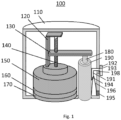
- Fig. 1 shows a structural diagram of an automatic acupuncture device 100 according to an embodiment of the present invention.
- the automatic acupuncture device includes: a case 110; a motor 150, which is configured to exert force to move a needle driver after powered on; a needle driver 180, which is configured to move linearly under the force of a motor to insert the acupuncture needle in a needle gadget into the human body; the needle gadget that includes a needle tube and an acupuncture needle inside the needle tube; and a needle gadget chamber 190, which is configured to house the needle gadget; and a locking-releasing structure 191-198, which is configured to lock the needle gadget inside the needle gadget chamber, so that the needle gadget will not fall out of the needle gadget chamber during acupuncture, and which is also configured to release the needle gadget from the needle gadget chamber after acupuncture treatment.
- the motor is preferably a mini-motor and there is a screw rod 140 connected to its shaft.
- the mini-motor When the mini-motor is powered on, its rotating shaft drives the screw rod to rotate, and the rechargeable battery 160 supplies power to the mini-motor.
- the rechargeable battery can be charged through USB charging or through wireless charging. If the wireless charging is adopted, a wireless charging receiver should be added to the acupuncture device.
- the automatic acupuncture device also includes a guide rail 120, a screw nut 130, a screw rod 140 connected with the motor shaft, a rechargeable battery 160, and a control circuit 170.
- the control circuit 170 controls the device starting, needle insertion, needle removing, needle manipulation and/or user interface displaying.
- the automatic acupuncture device uses a rotary motor.
- the screw rod 140 is coupled with a screw nut 130.
- the screw nut moves linearly on the screw rod when the screw rod rotates.
- One end of the screw nut is connected with a needle driver 180, which moves up and down with the screw nut, to insert the acupuncture needle into the skin or allow the removal of the needle.
- the guide rail 120 makes the screw nut 130 sliding more stably and prevents the screw nut 130 from rotating with the screw rod.
- the acupuncture device also includes a locking-releasing structure 191-198 for locking and releasing the needle gadget, which will be explained in detail in conjunction with Fig. 2 .
- the whole acupuncture device is enclosed in the case 110.
- 190 is the top of the chamber for the needle gadget.
- the automatic acupuncture device is in the shape of a cylinder, the diameter of the cylinder is less than 30 mm, and the height is less than 25 mm.
- the cylinder's diameter is 28mm and the height is 21mm. It is very small, light and convenient to wear, carry, store and operate.
- the needle gadget is also very small.
- the diameter of the needle tube of the needle gadget is less than 4mm.
- the diameter of the needle tube bottom is less than 10mm.
- the length of the needle tube is less than 18mm.
- the diameter of the needle tube is 2mm.
- the needle tube bottom has a diameter of 6.6mm. Then length of the needle tube is 14mm.
- the automatic acupuncture device comprises one motor or one electromagnet, one needle driver, one needle gadget chamber, where one needle driver drives one needle in a needle gadget.
- more than one needle gadgets can be inserted into an automatic acupuncture device and can be moved by multiple needle drivers.
- the needle drivers can be driven by multiple motors or electromagnet, or the needle drivers can be driven by one motor or electromagnet.
- the automatic acupuncture device is operated by small motor or electromagnet.
- the user inserts the needle gadget into the needle gadget chamber of the acupuncture device and attaches the acupuncture device on the body through double-sided tape or through a strap.
- the motor or electromagnet then starts the acupuncture treatment according to specific signal (timer or physiological signal detected from the body).
- specific signal timer or physiological signal detected from the body.
- the acupuncture device does not have to have the locking-release structure.
- the needle gadget can be secured inside an acupuncture device through tap or through strap.
- the device When operating the automatic acupuncture device described above, the users do not need to hold it. Instead, the device is attached on the human body through double-sided tape or a strap.
- Figs. 2A and 2B show the internal structure of the needle gadget chamber presented in Fig. 1 , and the schematic diagram of the locking-releasing structure.
- the structure shown in the figure includes a needle driver 180, the needle gadget chamber 190, the spring pusher 194, sliding button 192 for the spring pusher, vertical connecting rod 191 for the spring pusher, horizontal connecting rod 193 for the spring pusher, the flat spring 196, the fixing head 195 for the flat spring, the locking head 197 on the flat spring, the slot spring 198 for the spring pusher, the needle gadget ejector spring 210, needle tube top 215, the hole on the needle tube top 216, the needle top 220, the side of the needle tube 225, the needle-holding spring 230, the needle shaft 235, the needle tip 256, the wall of the needle gadget chamber 237, the needle tube locking notch 240, the needle tube bottom 245, the opening of the needle gadget chamber 250 and the needle outlet of the needle tube 255.
- the needle driver 180 is connected with the screw rod 140 of the motor through the screw nut 130 in Fig. 1 .
- the driving head 180 drives the needle by pushing the needle top 220.
- the diameter of the needle top 220 is larger than that of the hole on the needle tube top 216, to prevent the needle from falling out of the needle tube 225.
- the acupuncture needle shaft 235 and the needle top 220 are connected.
- the needle-holding spring 230 is around the needle shaft and stays between the needle top and the bottom of the needle tube.
- the needle-holding spring 230 is compressed by needle driver 180, and the acupuncture needle shaft 235 is pushed out of the needle tube outlet 255 and inserted into the human body.
- the needle driver 180 removes the force from the needle top and the compressed needle-holding spring 230 extends and pops the acupuncture needle out of the skin.
- the design of such a needle gadget keeps the acupuncture needle always with the needle tube.
- the needle-holding spring Before and after use, the needle-holding spring always presses the needle top onto the needle tube top, and the needle tip hides inside the needle tube to prevent it from accidentally sticking people. Because the needle has a tip end and a top end and requires to be inserted in correct direction, in this embodiment, a needle tube bottom 245 is designed with larger diameter than the rest of the needle tube 225, to ensure that the needle gadget being inserted into the needle gadget chamber in correct direction. In addition, to lock the needle gadget so that it does not fall out during acupuncture, a locking head 197 and a needle tube locking notch 240 are designed. When pushing the needle gadget in, the locking head is pressed into the locking notch and the needle gadget is locked, and at the same time, the ejector spring 210 is compressed.
- the user pushes the sliding button 192 to move the spring pusher 194, which in turn presses on the flat spring 196, and force the locking head 197 out of the locking notch 240.
- the compressed ejector spring 210 then ejects the needle gadget out.
- 191 and 913 are the vertical and horizontal connecting rods between the spring pusher 194 and the sliding button 192.
- the ejector spring 210 is fixed on the top of the needle gadget chamber.
- 198 is a spring in the slot where the sliding button 192 moves.
- the fixing head 195 fixes the flat spring 196 on wall 237 of the acupuncture device case.
- Fig. 2B is the schematic diagram of the needle gadget chamber when the needle gadget is ejected by the ejector spring 210. At this time, the locking head 197 is pushed out of the locking notch and the needle gadget chamber.
- Fig. 2C and Fig. 2D show another schematic diagram of the needle gadget, the needle gadget chamber, and the locking-releasing structure according to an embodiment of the invention. They are similar to Figs. 2A and 2B , except the following two differences: 1) the locking notch 241 does not protrude into the inner space of the needle tube, but only slightly cuts into the side of the needle tube; and 2) the needle tube bottom protrudes into the needle tube a hollow column 258 with an outer diameter smaller than the needle-holding spring and an inner diameter slightly larger than the needle shaft, which has two main advantages: 1) stabilize the needle-holding spring, 2) prevent the bending of acupuncture needle during insertion.
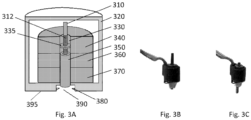
- Fig. 3 shows a schematic diagram of another automatic acupuncture device according to an embodiment of the invention, including linear motor 340, motor shaft 310 with thread 312, screw nut 335 fixed inside the motor.
- the motor shaft rotates in the screw nut to generate linear motion.
- the automatic acupuncture device also includes a case 320, a needle gadget chamber 350, a rechargeable battery 360, a control circuit 370, an opening of the needle gadget chamber 390, locking heads 380 and the bottom part of the case 395.
- This design uses a linear motor.
- the motor shaft moves linearly and push the needle to do acupuncture.
- Figs. 3B and 3C show an example of a real linear motor.
- Fig. 3B shows the motor with the motor shaft at a higher position
- Fig. 3C shows the motor with the motor shaft at a lower position.
- Fig. 4A-4D show detail schematic diagrams of the needle gadget chamber presented in Fig. 3 , including the needle gadget chamber ( Fig. 4A ), the needle gadget ( Fig. 4B ), the needle driver which is a continuation of the motor shaft ( Fig. 4C ), and the acupuncture needle with needle-holding spring ( Fig. 4D ).
- the components shown in the figures include a motor shaft 310, threads on the shaft 312, an uneven surface 315 of needle driver, needle top 440, uneven surface 445 of the needle top, the needle gadget chamber side wall 350, the needle gadget chamber top 410, ejector spring 420, the needle tube top 430, the needle tube bottom 470, the indent on the needle tube bottom 490 and the needle outlet 480.
- the acupuncture needle includes a needle top 440, a needle shaft 460, a needle tip 461, and a needle-holding spring 450, an uneven surface 445 on the needle top 440, which matches with the uneven surface 315 on the needle driver in Fig. 4C and transmits the rotary motion from the needle driver to the needle to perform rotating acupuncture manipulation.
- Fig. 4B is a needle gadget composed of an acupuncture needle and a needle tube. The needle tip is always hidden inside the needle tube by the needle-holding spring before or after the needle gadget is used, to avoid accidentally sticking people's skin.
- the diameter of the hole on the needle tube top 430 is smaller than that of the needle top 440 to prevent the needle from falling out.
- the diameter of the needle-holding spring 450 is only a little smaller than that of the needle tube, which allows the needle-holding spring fit into the needle tube to prevent the spring from bending during compression.
- the hole on the needle gadget chamber top is for the needle driver to enter the needle tube.
- the needle driver pushes the acupuncture needle into the human body and at the same time, compresses the ejector spring.
- the needle driver removes the force exerted on the needle top and the compressed needle-holding spring extends to pop the needle out of the body.
- the ejector spring 420 ejects the needle gadget from the needle gadget chamber when the locking head is released from the needle tube locking notch and unlock the needle gadget.
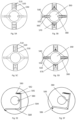
- Figs. 5A to 5D show a schematic diagram of another locking mechanism for the needle gadget according to another embodiment of the invention.
- Figs. 5A and 5C show the bottom view of the automatic acupuncture device
- Figs. 5B and 5D show the inside surface of the bottom piece of the automatic acupuncture device case, including push plates 510, push rods 530, connectors on the push plate 520 to connect with the push rods, locking heads 380 (also marked in Fig. 3 ) protruding into the needle gadget chamber opening 390 at resting state, locking head chambers 540, sliding rods 550 around which the locking head moves, connector rings 560 on the locking heads to connect with the push rods, and push plate springs 570.
- Figs. 5A and 5C show the bottom view of the automatic acupuncture device
- Figs. 5B and 5D show the inside surface of the bottom piece of the automatic acupuncture device case, including push plates 510, push rods 530, connectors on the push plate 520 to connect
- FIGS. 5A and 5B show the schematic diagram in which the locking heads 380 protrude into the chamber opening 390
- Figs. 5C and 5D show the schematic diagram in which the locking heads are completely pushed into locking head chambers 540.
- the locking heads 380 are pushed out of the chambers by the needle tube bottom 470 (shown in Fig. 4 ).
- the push plate springs 570 are compressed under the force transmitted through the push rods 530.
- the indent 490 at the needle tube bottom 470 are facing the locking heads 380, the locking heads are rebounded again under the action of the push plate springs 570, are pressed into the indent 490 and the needle gadget is locked.
- the locking heads 380 move on the sliding rods 550, which is fixed in the locking head chambers 540.
- the push rods 530 are connected to the locking heads through connector rings 560, and the push rods can rotate on the rings.
- the push rods 530 are connected to the push plates 510 through the connectors 520, and the push rods can also rotate on the connectors.
- Figs. 5E-5F show another schematic diagram of the working principle of the locking head 380 used in Fig. 3 .
- the locking-releasing structure comprises a rotatable frame 580, a locking head 380 on the frame that protrudes into the chamber opening at resting state, a frame spring 582, a connector for the frame 584 to connect to the case, connectors (581, 583) to connect the spring to the case and the frame, a press button 585 connected with the frame to move the locking head, a button chamber 586.
- the needle gadget is configured to have a locking notch on the needle tube. When pushing the needle gadget into the needle gadget chamber, the needle tube pushes the locking head away.
- Fig. 5E shows a state when the locking head is present in the chamber opening.
- Fig. 5F shows a state when the locking head is pulled back.
- Figs. 5G-5H show another schematic diagram of the working principle of a locking head 380 used in Fig. 3 .
- the locking head 380 has an enlarged part 594 that is used to be stopped by a stopper 592 to restrict its motion range.
- the stopper 592 is fixed on the device case.
- a spring 596 is connected between the locking head and a mounting point 598 built on the device case.
- 599 shows an enlarged side view of the locking head with the stopper 592 and a sliding button. At rest state, the spring pushes the locking head inside the needle gadget chamber.
- the user pushes the slider 597 to the direction way from the needle gadget chamber, the locking head is pulled out of the needle gadget chamber and the spring is compressed.
- Fig. 6 shows a schematic design of another automatic acupuncture device according to an embodiment of the present invention. This diagram is similar to Fig. 3 , except that a different locking-releasing structure is used with a self-locking chamber 670, but without locking head 380.
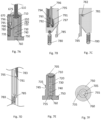
- Fig. 7A shows a detailed design of the self-locking chamber 670 presented in Fig.6 and the needle gadget 720, according to an embodiment of the present invention.
- the design includes a sliding plate 795, a sliding rod 675 for the sliding plate to slide up and down, a pull rod 796, a hook 792 at the tip of the pull rod, a spring 780 connecting the sliding plate and the device case, connectors (770, 790) for the two ends of the spring, a locking head 785, connectors (781, 782) connecting the locking head to the sliding plate.
- the sliding plate 795 comprises a rising groove 791, a falling groove 793, a notch island 794, a deep notch 792 on the notch island for the hook to hook on, and a guiding peninsula 797.
- the rising groove 791 becomes shallower along the way towards the notch island.
- the notch 792 is deeper than the neighboring rising groove.
- the pull rod When the needle gadget is pushed to the end of the needle gadget chamber, the pull rod reaches the end of the rising groove and then suddenly falls into the deep notch 792 on the notch island, gets hooked there. At this moment, the force pushing the needle gadget can be removed, the needle gadget is locked and can be used for acupuncture.
- the hook When the needle gadget is pushed for the second time, the hook will be released from the deep notch and enter the falling groove 793 when bump into the guiding peninsula 797.
- the spring 780 pulls the sliding plate toward the bottom of the acupuncture device, the locking head 785 breaks from the locking notch 745 on the needle tube and the needle gadget is pushed out of the needle gadget chamber on the pushing edge 735 by the sliding plate and taken out by the user.
- FIG. 7B is an enlarged view of the sliding plate and its accessories presented in Fig. 7A.
- Fig. 7C is the back view of Fig. 7B , showing the connection structure between the locking head and the sliding plate.
- Fig. 7D is the side view of Fig. 7B , which shows how the locking head is pushed up by slope 783 and leans towards the sliding plate during the pushing in process.
- Fig. 7E shows a needle gadget comprising a needle tube and a needle.
- the needle tube bottom 750 restrict the insertion direction for the needle gadget.
- the pushing edge 735 pushes the sliding plate 795 when pushing the needle gadget into the needle gadget chamber.
- the needle gadget also includes the needle tube top 705, the needle tube bottom 750, the inner surface of the needle tube bottom 755, the needle tip 760, the needle-holding spring 740, the needle shaft 730, the needle tube 720, and the needle top 710.
- Fig. 7F is the top view of the needle tube without acupuncture needle, which mainly shows the structural relationship between the pushing edge 735 and the needle tube top 705.
- the needle gadget is very compact, as a small cylinder with a diameter of 2 mm and a height of 14 mm.
- the needle After the needle gadget is manufactured and shipped out from factories, according to the embodiment of the present invention, the needle will be always kept with the needle tube of the needle gadget. Before, during and after acupuncture, the acupuncture needle will never be exposed to the air outside the needle tube, thereby preventing accidental injury to people and is environmentally friendly.
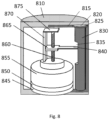
- Fig. 8 shows a schematic design of another automatic acupuncture device according to an embodiment of the present invention.
- This design includes cases 810 and 815, a needle gadget chamber opening 820, a chamber groove 825 to restrict the needle gadget insertion direction, a needle gadget chamber 830, a chamber slit 835 for needle driver to enter the chamber, a needle driver 840, a control circuit board 845, a rechargeable battery 850, a motor 855, a screw rod 860 connected with the motor shaft, a screw nut 865, a guide rail 870, and an end plate 875.
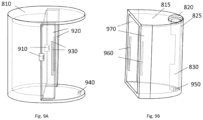
- Fig. 9 shows a detailed design of the cases in Fig. 8 according to an embodiment of the present invention.
- the cases consist of two parts.
- the case 810 is for a motor, a control circuit, and a rechargeable battery.
- the case 815 is for the needle gadget chamber 830.
- the case 810 and 815 can slide relative to each other but cannot be detached. When the clamping strips 930 and 960 encounter, it is the maximum distance that the two cases can be opened, which makes the needle gadget chamber opening 820 exposed and allows the needle gadget being inserted.
- the cases 810 and 815 are closed, and the clamping plate 910 clamps on the clamping strip 960 to prevent the two case parts from being opened.
- the plates 920 and 970 overlap and the needle outlets 940 and 950 are aligned, allowing the acupuncture needle being pushed out for acupuncture.
- the diameter of the chamberopening 820 is slightly larger than the rest of the chamber, and there is a long groove 825 on the side of the chamber. Together they limit the insertion direction of the needle gadget.
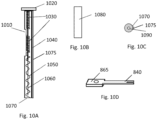
- Figs. 10A-10D show the needle gadget used with the automatic acupuncture device presented in Fig. 8 .
- the needle gadget includes a needle tube bottom 1070, a needle outlet 1090, a bulging column 1075 to limit insertion orientation, a needle 1060, a needle-holding spring 1050, a needle tube 1040, a needle top 1030, a needle tube top 1020, a needle tube slit 1010 for a needle driver to enter the needle tube.
- the needle tube slit is generally sealed by a single-sided tape 1080 to prevent dust from entering the needle tube and contaminating the needle.
- the needle driver 840 is connected to the screw rod 860 by a screw nut 865, which moves up and down with the rotation of the screw rod.
- the end of the needle driver 840 has a fork shape to clamp on the needle top 1030, to drive the needle up and down.
- Fig. 11A shows a design scheme of an automatic acupuncture device driven by an electromagnet according to an embodiment of the present invention.
- 1110 is the case of the automatic acupuncture device
- 1130 is the battery
- 1120 is an electromagnet, one end of which is connected with a needle driver 1140
- 1150 is the needle gadget chamber
- 1160 is the control circuit
- 1170 is the chamber opening.
- Fig. 11B shows the needle gadget chamber and the needle gadget.
- 1145 is the top of the needle gadget chamber
- 1155 is a magnetic material fixed inside of 1145.
- 1165 is a ferromagnetic material fixed on the top of the needle tube. 1155 and 1165 form the locking-releasing structure for the automatic acupuncture device.
- the needle gadget When the needle gadget is inserted into the needle gadget chamber, it is attracted by 1155 through 1165, and is locked inside the needle gadget chamber.
- a small bump can be designed on the needle tube bottom to push or pull out the needle gadget.
- 1115 is the side of the needle tube
- 1125 is the side wall of the needle gadget chamber
- 1175 is the needle top
- 1195 is the needle shaft
- 1185 is the needle-holding spring
- 1135 is the needle outlet at the needle tube bottom.
- the needle driver When powered on, the needle driver is pushed away from the electromagnet to push acupuncture needle into the skin. To remove needle, the electromagnet is powered off, and the needle driver will return to its original position.
- the design of a needle gadget being similarto the previous designs, the needle can be pulled out through its own needle-holding spring, once the needle driver removes the force on the needle top.
- Fig. 12A shows another design of the automatic acupuncture device and a needle gadget according to another embodiment of the invention.
- the motor part is similar to that in Fig. 8 .
- the differences are the needle driver 1215, the needle gadget chamber 1210, the needle gadget and the case.
- the needle driver always stays inside the needle gadget chamber.
- the device case is a whole piece instead of two pieces (as shown in Fig. 9 ).
- Fig. 12B shows the schematic diagram of the needle gadget chamber, in which 1220 is the slit on the side wall of the needle gadget chamber 1210.
- 1211 is an ejector spring
- 1212 is a block.
- Fig. 12C is the schematic diagram of a needle gadget.
- 1230 is the needle tube top
- 1235 is the needle top
- 1240 is the needle-holding spring
- 1245 is the needle shaft
- 1255 is the locking notch on the needle tube
- 1260 is the needle tube bottom
- 1250 is the openings on the needle tube, designed to let the needle driver enter the needle tube.
- Fig. 12D is the bottom view of the automatic acupuncture device.
- 1225 is the case
- 1270 is the needle gadget chamber
- 1265 is the needle gadget chamber opening. The fact that 1270 is not exactly in the center of 1265 is to define the insertion direction of the needle gadget.
- Fig. 12C is the schematic diagram of a needle gadget.
- 1230 is the needle tube top
- 1235 is the needle top
- 1240 is the needle-holding spring
- 1245 is the needle shaft
- 1255 is the locking notch on the needle tube
- 1260 is the needle tube bottom
- 1250 is the openings on the needle tube
- Fig. 12E shows a needle driver 1215
- Fig. 12F shows the top view of Fig. 12C , showing the shape of needle tube bottom 1260 that matches the needle gadget chamber opening 1265
- Fig. 12G shows the ejector spring 1211 in a larger view with a block 1212 attached to the bottom.
- the block has a notch 1213 where the needle driver stays.
- the needle driver is at the top of the block notch 1213.
- the needle gadget When the needle gadget is inserted into the needle gadget chamber, it pushes the block 1212, compress the ejector spring 1211 and the needle driver relatively moves down the notch.
- the needle driver will be at the bottom of the block notch 1213.
- the locking-releasing structure for this design can adopt any locking-releasing structure presented in other places of this invention.
- the insertion direction of the needle gadget can also be defined through other methods, such as the bulging column 1075 shown in Fig. 10A
- Figs. 13A-13B show a scenario diagram of an automatic acupuncture device attached on the skin according to an embodiment of the present invention.
- a needle outlet 1315 at the bottom of the automatic acupuncture device 1310.
- the center of the double-side tape also has a hole in the center, matching the needle outlet.
- Release paper 1330 is used on the double-sided tape before using to protect the tape.
- Figs. 13C and 13D are schematic diagrams showing how an automatic acupuncture device attaches on the skin according to an embodiment of the present invention.
- 1340 is a strap that can fasten the automatic acupuncture device 1310 around the body part and attach it on to the skin.
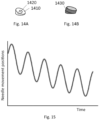
- Figs. 14A and 14B show an accessory of the automatic acupuncture device according to the embodiment of the invention, which is used to facilitate the acupuncture needle to insert into the body at different angles.
- Fig. 14A shows a cylinder with a slope at one end. The two planes of the cylinder are covered with tape, the inclined plane sticks to the skin, and the opposite side 1410 adheres to the automatic acupuncture device. The hole in the center 1420 is for the needle insertion.
- Fig. 14B is another design. This design adds a wall 1430 on the design of Fig. 14A , which allows the automatic acupuncture device to be placed right in the middle of the outer wall, for easier alignment.
- a method to do acupuncture with an automatic acupuncture device is provide.
- the needle When insert a needle into the skin of the human body, the needle is inserted in a vibration mode, in a way mosquito inserts the tip of its mouthpart into human being skin.
- the vibration frequency is in the range of 0.2 to 30 Hz.
- the insertion in a vibration mode consists of three phase, that is, starting phase, middle phase and ending phase.
- the frequency in the starting phase is bigger than frequency in the middle phase, and frequency in the middle phase is bigger than frequency in the ending phase.
- the vibration mode in the starting phase, is in a frequency of 10 to 15 Hz, in the middle phase, the vibration mode is in a frequency of 6 to 8 Hz, and in the ending phase, the vibration mode is in a frequency of 3 to 5 Hz.
- the vibration modes and the corresponding frequencies are consistent with the modes and frequencies that mosquitos insert their proboscis into human beings, which minimizes the acupuncture needle insertion and manipulation pain.
- the vibration distance is in the range of 0.1mm to 2mm.
- Fig. 15 shows the vibration mode with which an acupuncture needle is inserted into the body.
- an acupuncture needle In such a way to insert the acupuncture needle, people will barely feel the pain, just like mosquito bites the body. People will not feel it much.
Landscapes
- Health & Medical Sciences (AREA)
- Rehabilitation Therapy (AREA)
- Epidemiology (AREA)
- Pain & Pain Management (AREA)
- Physical Education & Sports Medicine (AREA)
- Life Sciences & Earth Sciences (AREA)
- Animal Behavior & Ethology (AREA)
- General Health & Medical Sciences (AREA)
- Public Health (AREA)
- Veterinary Medicine (AREA)
- Finger-Pressure Massage (AREA)
Claims (14)
- Dispositif d'acupuncture automatique, comprenant :un boîtier (110, 320, 810, 1225) ;un moyen d'entraînement (150, 180, 340, 1140) configuré pour fournir une force d'entraînement afin de mettre en mouvement un ou plusieurs dispositifs d'entraînement d'aiguille linéairement de façon à pousser des aiguilles d'acupuncture dans des instruments à aiguille (720) dans un corps humain, où chaque instrument à aiguille inclut un tube d'aiguille et une aiguille d'acupuncture à l'intérieur du tube d'aiguille (225, 720, 1040, 1260),caractériséen ce que ledit moyen d'entraînement comprend un ou plusieurs moteurs ou électroaimants configurés pour fournir ladite force d'entraînement après avoir été mis sous tension, l'instrument à aiguille étant configuré pour maintenir l'aiguille d'acupuncture avec le tube d'aiguille avant, pendant et après le traitement d'acupuncture, de sorte que l'aiguille d'acupuncture ne soit pas exposée à l'air à l'extérieur du tube d'aiguille pour causer des blessures, une ou plusieurs chambres d'instrument à aiguille (190, 250, 350, 830, 1160, 1210) étant configurées pour loger les instruments à aiguille,permettant de placer les instruments à aiguille dans les chambres d'instrument à aiguille ou de les sortir de celles-ci de manière amovible.
- Dispositif d'acupuncture automatique selon la revendication 1, comprenant en outre une ou plusieurs structures de verrouillage-libération (191 à 198)
qui sont configurées pour verrouiller les instruments à aiguille dans les chambres d'instrument à aiguille de sorte que les instruments à aiguille ne tombent pas des chambres d'instrument à aiguille pendant le traitement d'acupuncture, et les une ou plusieurs structures de verrouillage-libération sont en outre configurées pour libérer les instruments à aiguille des chambres d'instrument à aiguille après le traitement d'acupuncture. - Dispositif d'acupuncture automatique selon la revendication 1, comprenant en outre un circuit de commande (170, 370, 1160),
qui est configuré pour commander l'initialisation de dispositif, l'insertion d'aiguille, la manipulation d'aiguille, l'enlèvement d'aiguille ou l'affichage d'interface utilisateur. - Dispositif d'acupuncture automatique selon la revendication 1, dans lequel les moteurs sont configurés comme des moteurs rotatifs et des arbres de moteur tournent lorsqu'ils sont sous tension, et le dispositif d'acupuncture automatique comprenant en outre des systèmes de transmission qui convertissent des mouvements rotatifs en mouvements linéaires.
- Dispositif d'acupuncture automatique selon la revendication 1, dans lequel le dispositif d'entraînement d'aiguille est une barre, un sommet du tube d'aiguille de l'instrument à aiguille a un trou, un côté du tube d'aiguille a une fente (1010), la fente et le trou sont raccordés, et, lorsqu'il est utilisé, le dispositif d'entraînement d'aiguille entre dans le tube d'aiguille à travers le trou et la fente, entre en contact avec le sommet d'aiguille, et se met en mouvement vers le bas à travers la fente sur le côté du tube d'aiguille pour pousser l'aiguille hors du tube nécessaire.
- Dispositif d'acupuncture automatique selon la revendication 2, comprenant en outre un ressort d'éjecteur (210, 420, 1211) dans la chambre d'instrument à aiguille, qui est configuré comme suit : lorsque l'instrument à aiguille est poussé dans la chambre d'instrument à aiguille, le ressort d'éjecteur est comprimé, et une structure de verrouillage-libération verrouille l'instrument à aiguille dans la chambre d'instrument à aiguille ; lorsque la structure de verrouillage-libération déverrouille l'instrument à aiguille, le ressort d'éjecteur s'étend et pousse l'instrument à aiguille hors de la chambre d'instrument à aiguille.
- Dispositif d'acupuncture automatique selon la revendication 2, dans lequel la structure de verrouillage-libération comprend une tête de verrouillage (197, 380, 785), et le tube d'aiguille de l'instrument à aiguille a une encoche de verrouillage (240, 745),
et lorsque l'instrument à aiguille est poussé dans la chambre d'instrument à aiguille, la tête de verrouillage est forcée dans l'encoche de verrouillage du tube d'aiguille et l'instrument à aiguille est verrouillé dans la chambre d'instrument à aiguille. - Dispositif d'acupuncture automatique selon la revendication 2, dans lequel la chambre d'instrument à aiguille a une ouverture pour que l'instrument à aiguille entre dans la chambre d'instrument à aiguille, la structure de verrouillage-libération comprend une tête de verrouillage, un bouton coulissant qui est accessible et mobile par des utilisateurs et raccordé à la tête de verrouillage, un bouchon pour restreindre la plage de mouvement du bouton coulissant, un ressort raccordant le bouton coulissant à un point de montage sur le boîtier, l'instrument à aiguille étant configuré pour avoir une encoche de verrouillage sur le tube d'aiguille, et dans lequel la structure de verrouillage-libération fonctionne comme suit :la tête de verrouillage fait saillie dans la chambre d'instrument à aiguille à l'état de repos ;lorsque l'instrument à aiguille est poussé dans la chambre d'instrument à aiguille, l'instrument à aiguille repousse la tête de verrouillage et le bouton coulissant et le ressort est comprimé par le bouton coulissant jusqu'à ce que la tête de verrouillage soit en face de l'encoche de verrouillage sur le tube d'aiguille de l'instrument à aiguille ;et la tête de verrouillage est enfoncée dans l'encoche de tube d'aiguille sur le tube d'aiguille par le ressort comprimé et l'instrument à aiguille est verrouillé à l'intérieur de la chambre d'instrument à aiguille ;lors de la libération de l'instrument à aiguille, les utilisateurs poussent le bouton coulissant dans une direction qui est à l'opposé de la chambre d'instrument à aiguille, ce qui libère à son tour la tête de verrouillage à l'opposé de l'encoche de verrouillage du tube d'aiguille.
- Dispositif d'acupuncture automatique selon la revendication 2, dans lequel la structure de verrouillage-libération comprend une plaque coulissante (795), une tige de traction (796), un crochet (792) à la pointe de la tige de traction, une tige coulissante (675) sur laquelle coulisse la plaque coulissante, un ressort (780) raccordant la plaque coulissante et le boîtier de dispositif, des raccords pour fixer les deux extrémités du ressort, une tête de verrouillage (785), des raccords (781, 782) pour raccorder la tête de verrouillage à la plaque coulissante, une rainure montante (791) et une rainure descendante (793) sur la plaque coulissante, un îlot d'encoche (794), une encoche (792) sur l'îlot d'encoche pour que le crochet s'y accroche, une péninsule de guidage (797),
dans lequel la rainure ascendante devient moins profonde vers l'encoche sur l'îlot d'encoche, et l'encoche redevient plus profonde à la fin de la rainure ascendante, et la structure de verrouillage-libération fonctionne comme suit :lorsque l'instrument à aiguille est poussé dans la chambre d'instrument à aiguille pour la première fois, la plaque coulissante et la tête de verrouillage sont poussées à l'intérieur ; le crochet est poussé vers l'îlot d'encoche le long de la rainure ascendante ; lorsque l'instrument à aiguille atteint le fond de la chambre d'instrument à aiguille, le crochet atteint l'extrémité de la rainure ascendante, tombe dans l'encoche profonde sur l'îlot d'encoche et se retrouve accroché sur l'encoche ; en même temps, la tête de verrouillage est poussée dans une encoche de verrouillage sur le tube d'aiguille, verrouille l'instrument à aiguille dans la chambre d'instrument à aiguille et le ressort est étiré ;lorsque la force de poussée est libérée de l'instrument à aiguille, l'instrument à aiguille restera dans la chambre d'instrument à aiguille pour le traitement d'acupuncture ;lorsque l'instrument à aiguille est poussé une deuxième fois après le traitement d'acupuncture, le crochet est libéré de l'encoche et guidé dans la rainure descendante ;en même temps, le ressort étiré recule la plaque coulissante vers le fond du dispositif d'acupuncture, libère la tête de verrouillage de l'encoche de verrouillage et retire l'instrument à aiguille pour que l'utilisateur puisse la sortir complètement. - Instrument à aiguille selon le dispositif d'acupuncture automatique de l'une quelconque des revendications précédentes, dans lequel
lorsque l'instrument à aiguille est inséré dans la chambre d'instrument à aiguille à partir de la surface de fond, de côté ou de sommet du dispositif d'acupuncture, comprenant :le tube d'aiguille ;une aiguille d'acupuncture à l'intérieur du tube d'aiguille, comprenant une pointe d'aiguille, un arbre d'aiguille et un sommet d'aiguille d'un diamètre supérieur à celui de l'arbre d'aiguille ;un trou au sommet du tube d'aiguille ou une fente sur un côté du tube d'aiguille, par lequel le dispositif d'entraînement d'aiguille du dispositif d'acupuncture automatique entre dans le tube d'aiguille et exerce une force sur le sommet d'aiguille ;une sortie d'aiguille au niveau d'un fond du tube d'aiguille, par laquelle la pointe et l'arbre d'aiguille sont poussés hors du tube d'aiguille et insérés dans un corps humain ;un ressort de retenue d'aiguille enfermé à l'intérieur du tube d'aiguille, entre le fond de tube d'aiguille et le sommet d'aiguille, qui est configuré comme suit : avant l'utilisation de l'instrument à aiguille, l'aiguille d'acupuncture est maintenue à l'intérieur du tube d'aiguille par le ressort de retenue d'aiguille afin d'éviter que la pointe d'aiguille ne soit exposée à l'air à l'extérieur du tube d'aiguille et ne blesse accidentellement des personnes ; pendant le traitement d'acupuncture, lorsque le dispositif d'entraînement d'aiguille pousse l'aiguille dans le corps humain, le ressort de retenue d'aiguille est comprimé ; après le traitement d'acupuncture, le dispositif d'entraînement d'aiguille enlève la force du sommet d'aiguille, et le ressort de retenue d'aiguille s'étend et enfonce l'aiguille de nouveau dans le tube d'aiguille. - Instrument à aiguille selon la revendication 10, dans lequel un diamètre du fond de tube d'aiguille est plus grand que celui du reste du tube d'aiguille, ou le côté du tube d'aiguille a une colonne bombée ou une rainure indentée qui concorde avec une forme de la chambre d'instrument à aiguille dans le dispositif d'acupuncture automatique, afin de commander la direction d'insertion de l'instrument à aiguille.
- Instrument à aiguille selon la revendication 10, dans lequel le tube d'aiguille a une colonne bombée ou une rainure indentée pour qu'une tête de verrouillage sur le dispositif d'acupuncture automatique verrouille l'instrument à aiguille à l'intérieur du dispositif d'acupuncture automatique lorsque l'instrument à aiguille est inséré dans la chambre d'instrument à aiguille du dispositif d'acupuncture automatique, afin d'éviter que l'instrument à aiguille ne tombe du dispositif d'acupuncture automatique pendant le traitement d'acupuncture.
- Dispositif d'acupuncture automatique selon la revendication 1, dans lequel la chambre d'instrument à aiguille a un diamètre plus grand au niveau d'une entrée que celui d'un reste de la chambre d'instrument à aiguille, ou a une colonne bombée ou une rainure indentée sur un côté pour concorder avec un rainurage ou une colonne sur un tube d'aiguille, pour la commande de direction d'insertion d'instrument à aiguille.
- Instrument à aiguille selon la revendication 10, dans lequel le fond de tube d'aiguille fait saillie dans le tube d'aiguille une colonne creuse avec un diamètre externe plus petit que celui du ressort de retenue d'aiguille pour permettre au ressort de retenue d'aiguille de s'asseoir autour et un diamètre interne dans un centre de la colonne plus grand que l'arbre d'aiguille pour permettre à l'aiguille de passer à travers, la colonne creuse contribue à éviter que l'aiguille d'acupuncture ne se courbe pendant l'insertion.
Applications Claiming Priority (3)
| Application Number | Priority Date | Filing Date | Title |
|---|---|---|---|
| US17/067,880 US11504299B2 (en) | 2020-10-12 | 2020-10-12 | Automatic acupuncture device, needle gadget and acupuncture method |
| US17/223,086 US20210244614A1 (en) | 2020-10-12 | 2021-04-06 | Automatic acupuncture device, needle gadget and acupuncture method |
| PCT/US2021/030639 WO2022081208A1 (fr) | 2020-10-12 | 2021-05-04 | Dispositif d'acupuncture automatique, instrument à aiguille et procédé d'acupuncture |
Publications (4)
| Publication Number | Publication Date |
|---|---|
| EP4009935A1 EP4009935A1 (fr) | 2022-06-15 |
| EP4009935A4 EP4009935A4 (fr) | 2022-08-31 |
| EP4009935C0 EP4009935C0 (fr) | 2024-09-18 |
| EP4009935B1 true EP4009935B1 (fr) | 2024-09-18 |
Family
ID=77177877
Family Applications (1)
| Application Number | Title | Priority Date | Filing Date |
|---|---|---|---|
| EP21838967.4A Active EP4009935B1 (fr) | 2020-10-12 | 2021-05-04 | Dispositif d'acupuncture automatique, instrument à aiguille et procédé d'acupuncture |
Country Status (4)
| Country | Link |
|---|---|
| US (1) | US20210244614A1 (fr) |
| EP (1) | EP4009935B1 (fr) |
| JP (1) | JP7325874B2 (fr) |
| WO (1) | WO2022081208A1 (fr) |
Families Citing this family (5)
| Publication number | Priority date | Publication date | Assignee | Title |
|---|---|---|---|---|
| CN113576891B (zh) * | 2020-04-30 | 2024-09-24 | 道鑛有限公司 | 指掌保健装置 |
| CN114469727A (zh) * | 2022-03-23 | 2022-05-13 | 北京林业大学 | 一种全自动针灸仪机械结构 |
| CN118680821B (zh) * | 2024-08-29 | 2024-12-03 | 伊金霍洛旗梦香种养殖有限公司 | 一种针对动物的针灸治疗装置 |
| CN119405529B (zh) * | 2025-01-06 | 2025-03-14 | 长春中医药大学 | 一种中医针灸科用自动插入皮肤的恒温针灸针 |
| CN119405530B (zh) * | 2025-01-06 | 2025-03-25 | 山东惠浦医疗科技有限公司 | 一种用于中医针灸用辅助进针装置及其使用方法 |
Family Cites Families (32)
| Publication number | Priority date | Publication date | Assignee | Title |
|---|---|---|---|---|
| FR2571251B1 (fr) * | 1984-08-07 | 1989-12-15 | Scieller Jean Xavier | Dispositif modulaire a distributeur pour l'application indolore d'aiguilles d'acupuncture steriles |
| CN2086142U (zh) | 1991-03-19 | 1991-10-09 | 吴冬青 | 自动针灸注射器 |
| US5735868A (en) * | 1996-05-01 | 1998-04-07 | Lee; Young H. | Intramuscular stimulator |
| US6423014B1 (en) * | 2000-09-29 | 2002-07-23 | University Of Vermont | Therapeutic and diagnostic needling device and method |
| JP2003225282A (ja) * | 2002-01-31 | 2003-08-12 | Yong Hee Lee | 穿孔補助器を備えた筋肉内刺激装置 |
| KR200384866Y1 (ko) | 2005-03-09 | 2005-05-19 | 주식회사 네오닥터 | 자동식 자침기 |
| KR100553006B1 (ko) | 2005-03-09 | 2006-02-20 | 주식회사 네오닥터 | 자동식 자침기 |
| US10219832B2 (en) * | 2007-06-29 | 2019-03-05 | Actuated Medical, Inc. | Device and method for less forceful tissue puncture |
| JP5102655B2 (ja) * | 2008-03-06 | 2012-12-19 | 山下 冨士夫 | 小型電動鍼治療装置 |
| TWI350749B (en) | 2008-09-18 | 2011-10-21 | Univ Nat Chunghsing | Automatic acupuncture apparatus |
| CN201692306U (zh) | 2010-06-28 | 2011-01-05 | 宋玉玲 | 一种自动针灸器 |
| CN202179694U (zh) | 2011-08-13 | 2012-04-04 | 朱玉景 | 一种自动针灸器 |
| CN203208351U (zh) | 2013-03-22 | 2013-09-25 | 屠家凯 | 一种连续自动针灸进针器 |
| CN103126883B (zh) | 2013-03-22 | 2015-03-18 | 屠家凯 | 一种连续自动针灸进针器 |
| KR101559212B1 (ko) * | 2013-12-26 | 2015-10-13 | 한국 한의학 연구원 | 침술 장치 |
| CN203790289U (zh) * | 2014-03-31 | 2014-08-27 | 雷同 | 一种针灸枪 |
| CN203802802U (zh) | 2014-04-23 | 2014-09-03 | 李泉红 | 一种针灸自动进针器 |
| CN204521567U (zh) | 2015-02-02 | 2015-08-05 | 李春田 | 一种智能中医针灸治疗仪 |
| CN204910065U (zh) | 2015-09-09 | 2015-12-30 | 张毅 | 一种新型针灸治疗仪 |
| CN206239727U (zh) | 2016-07-08 | 2017-06-13 | 吴正红 | 自动针灸设备 |
| CN105963132B (zh) | 2016-07-08 | 2019-02-12 | 吴正红 | 自动针灸设备 |
| KR101847548B1 (ko) | 2016-08-31 | 2018-04-10 | 동의대학교 산학협력단 | 자동 침 시술장치 |
| KR101909615B1 (ko) * | 2016-11-15 | 2018-10-18 | 주식회사 파이룩스 | 피부자극 겸용 문신용 니들 |
| CN206508245U (zh) | 2016-11-21 | 2017-09-22 | 姬海棠 | 一种新型神经内科临床用针灸针 |
| CN107737012A (zh) * | 2017-04-12 | 2018-02-27 | 王皓 | 一种温针艾灸器 |
| CN107496164A (zh) | 2017-07-12 | 2017-12-22 | 深圳市人民医院 | 一种自动针灸仪 |
| CN108392412B (zh) | 2018-01-12 | 2019-09-27 | 上海交通大学 | 一种针灸机器人系统 |
| CN108309788B (zh) | 2018-02-23 | 2020-03-17 | 北京官针堂医学研究院 | 一种自动针灸笔 |
| CN108743367A (zh) | 2018-06-01 | 2018-11-06 | 广州市健齿生物科技有限公司 | 一种用于针灸全自动连续进针的装置 |
| CN109125062B (zh) | 2018-09-27 | 2020-07-24 | 嘉兴美年大健康管理有限公司 | 一种自动针灸仪 |
| CN110123629B (zh) | 2019-05-21 | 2021-05-11 | 常利群 | 一种针灸骨缝的自动针灸设备 |
| CN111150648A (zh) | 2020-01-16 | 2020-05-15 | 杨盈 | 一种自动出针的针灸装置 |
-
2021
- 2021-04-06 US US17/223,086 patent/US20210244614A1/en not_active Abandoned
- 2021-05-04 EP EP21838967.4A patent/EP4009935B1/fr active Active
- 2021-05-04 WO PCT/US2021/030639 patent/WO2022081208A1/fr not_active Ceased
- 2021-05-04 JP JP2022522674A patent/JP7325874B2/ja active Active
Also Published As
| Publication number | Publication date |
|---|---|
| EP4009935A4 (fr) | 2022-08-31 |
| EP4009935A1 (fr) | 2022-06-15 |
| US20210244614A1 (en) | 2021-08-12 |
| JP7325874B2 (ja) | 2023-08-15 |
| EP4009935C0 (fr) | 2024-09-18 |
| WO2022081208A1 (fr) | 2022-04-21 |
| JP2022547337A (ja) | 2022-11-11 |
Similar Documents
| Publication | Publication Date | Title |
|---|---|---|
| US11504299B2 (en) | Automatic acupuncture device, needle gadget and acupuncture method | |
| EP4009935B1 (fr) | Dispositif d'acupuncture automatique, instrument à aiguille et procédé d'acupuncture | |
| US5647851A (en) | Method and apparatus for vibrating an injection device | |
| JP5944827B2 (ja) | 肌刺激器 | |
| WO2004004809A1 (fr) | Dispositif d'administration automatique medical | |
| JP2009545342A (ja) | 挿入デバイス | |
| KR100589077B1 (ko) | 의료용 주사액 주입기 | |
| EP3493864A1 (fr) | Système d'injection d'implant / médicament à base de boîtier de sécurité | |
| CN203425240U (zh) | 一种针灸进针器 | |
| KR101368920B1 (ko) | 의료용 약물 주입장치 | |
| CN201752522U (zh) | 自用型注射器 | |
| KR200478011Y1 (ko) | 매선실 탄성 삽입 도구 | |
| CN217186339U (zh) | 一种埋线针刀装置 | |
| CN119345027A (zh) | 一种适于揿针医疗应用的装载式连续施针装置 | |
| CN215275094U (zh) | 注射器以及注射平台 | |
| WO1998028032A1 (fr) | Mecanisme d'insertion d'aiguille | |
| CN216022483U (zh) | 一种用于美容的无痛注射美肤仪 | |
| CN209967055U (zh) | 一种进针仪 | |
| CN221655428U (zh) | 一种能够自动撤针的助针器 | |
| CN2488473Y (zh) | 医用弹射器 | |
| CN222033381U (zh) | 一种用于激活毛囊活性的中胚导入纳米微针装置 | |
| CN204091995U (zh) | 无痛真空采血器 | |
| CN117717477A (zh) | 一种便携式耳针注射回收装置 | |
| JP2001190666A (ja) | デスポーザル無針注射器システム | |
| CN105582612B (zh) | 缓释针具 |
Legal Events
| Date | Code | Title | Description |
|---|---|---|---|
| STAA | Information on the status of an ep patent application or granted ep patent |
Free format text: STATUS: UNKNOWN |
|
| STAA | Information on the status of an ep patent application or granted ep patent |
Free format text: STATUS: THE INTERNATIONAL PUBLICATION HAS BEEN MADE |
|
| PUAI | Public reference made under article 153(3) epc to a published international application that has entered the european phase |
Free format text: ORIGINAL CODE: 0009012 |
|
| STAA | Information on the status of an ep patent application or granted ep patent |
Free format text: STATUS: THE APPLICATION HAS BEEN PUBLISHED |
|
| AK | Designated contracting states |
Kind code of ref document: A1 Designated state(s): AL AT BE BG CH CY CZ DE DK EE ES FI FR GB GR HR HU IE IS IT LI LT LU LV MC MK MT NL NO PL PT RO RS SE SI SK SM TR |
|
| A4 | Supplementary search report drawn up and despatched |
Effective date: 20220728 |
|
| RIC1 | Information provided on ipc code assigned before grant |
Ipc: A61M 5/32 20060101ALI20220722BHEP Ipc: A61M 5/158 20060101ALI20220722BHEP Ipc: A61H 39/04 20060101ALI20220722BHEP Ipc: A61H 39/00 20060101ALI20220722BHEP Ipc: A61H 39/08 20060101AFI20220722BHEP |
|
| STAA | Information on the status of an ep patent application or granted ep patent |
Free format text: STATUS: REQUEST FOR EXAMINATION WAS MADE |
|
| 17P | Request for examination filed |
Effective date: 20220907 |
|
| RBV | Designated contracting states (corrected) |
Designated state(s): AL AT BE BG CH CY CZ DE DK EE ES FI FR GB GR HR HU IE IS IT LI LT LU LV MC MK MT NL NO PL PT RO RS SE SI SK SM TR |
|
| DAV | Request for validation of the european patent (deleted) | ||
| DAX | Request for extension of the european patent (deleted) | ||
| GRAP | Despatch of communication of intention to grant a patent |
Free format text: ORIGINAL CODE: EPIDOSNIGR1 |
|
| STAA | Information on the status of an ep patent application or granted ep patent |
Free format text: STATUS: GRANT OF PATENT IS INTENDED |
|
| INTG | Intention to grant announced |
Effective date: 20240531 |
|
| GRAS | Grant fee paid |
Free format text: ORIGINAL CODE: EPIDOSNIGR3 |
|
| GRAA | (expected) grant |
Free format text: ORIGINAL CODE: 0009210 |
|
| STAA | Information on the status of an ep patent application or granted ep patent |
Free format text: STATUS: THE PATENT HAS BEEN GRANTED |
|
| AK | Designated contracting states |
Kind code of ref document: B1 Designated state(s): AL AT BE BG CH CY CZ DE DK EE ES FI FR GB GR HR HU IE IS IT LI LT LU LV MC MK MT NL NO PL PT RO RS SE SI SK SM TR |
|
| REG | Reference to a national code |
Ref country code: GB Ref legal event code: FG4D |
|
| REG | Reference to a national code |
Ref country code: CH Ref legal event code: EP |
|
| REG | Reference to a national code |
Ref country code: IE Ref legal event code: FG4D |
|
| REG | Reference to a national code |
Ref country code: DE Ref legal event code: R096 Ref document number: 602021019102 Country of ref document: DE |
|
| U01 | Request for unitary effect filed |
Effective date: 20241011 |
|
| U07 | Unitary effect registered |
Designated state(s): AT BE BG DE DK EE FI FR IT LT LU LV MT NL PT RO SE SI Effective date: 20241114 |
|
| PG25 | Lapsed in a contracting state [announced via postgrant information from national office to epo] |
Ref country code: NO Free format text: LAPSE BECAUSE OF FAILURE TO SUBMIT A TRANSLATION OF THE DESCRIPTION OR TO PAY THE FEE WITHIN THE PRESCRIBED TIME-LIMIT Effective date: 20241218 |
|
| PG25 | Lapsed in a contracting state [announced via postgrant information from national office to epo] |
Ref country code: GR Free format text: LAPSE BECAUSE OF FAILURE TO SUBMIT A TRANSLATION OF THE DESCRIPTION OR TO PAY THE FEE WITHIN THE PRESCRIBED TIME-LIMIT Effective date: 20241219 |
|
| PG25 | Lapsed in a contracting state [announced via postgrant information from national office to epo] |
Ref country code: HR Free format text: LAPSE BECAUSE OF FAILURE TO SUBMIT A TRANSLATION OF THE DESCRIPTION OR TO PAY THE FEE WITHIN THE PRESCRIBED TIME-LIMIT Effective date: 20240918 |
|
| PG25 | Lapsed in a contracting state [announced via postgrant information from national office to epo] |
Ref country code: RS Free format text: LAPSE BECAUSE OF FAILURE TO SUBMIT A TRANSLATION OF THE DESCRIPTION OR TO PAY THE FEE WITHIN THE PRESCRIBED TIME-LIMIT Effective date: 20241218 |
|
| PG25 | Lapsed in a contracting state [announced via postgrant information from national office to epo] |
Ref country code: RS Free format text: LAPSE BECAUSE OF FAILURE TO SUBMIT A TRANSLATION OF THE DESCRIPTION OR TO PAY THE FEE WITHIN THE PRESCRIBED TIME-LIMIT Effective date: 20241218 Ref country code: NO Free format text: LAPSE BECAUSE OF FAILURE TO SUBMIT A TRANSLATION OF THE DESCRIPTION OR TO PAY THE FEE WITHIN THE PRESCRIBED TIME-LIMIT Effective date: 20241218 Ref country code: HR Free format text: LAPSE BECAUSE OF FAILURE TO SUBMIT A TRANSLATION OF THE DESCRIPTION OR TO PAY THE FEE WITHIN THE PRESCRIBED TIME-LIMIT Effective date: 20240918 Ref country code: GR Free format text: LAPSE BECAUSE OF FAILURE TO SUBMIT A TRANSLATION OF THE DESCRIPTION OR TO PAY THE FEE WITHIN THE PRESCRIBED TIME-LIMIT Effective date: 20241219 |
|
| PG25 | Lapsed in a contracting state [announced via postgrant information from national office to epo] |
Ref country code: IS Free format text: LAPSE BECAUSE OF FAILURE TO SUBMIT A TRANSLATION OF THE DESCRIPTION OR TO PAY THE FEE WITHIN THE PRESCRIBED TIME-LIMIT Effective date: 20250118 |
|
| PG25 | Lapsed in a contracting state [announced via postgrant information from national office to epo] |
Ref country code: SM Free format text: LAPSE BECAUSE OF FAILURE TO SUBMIT A TRANSLATION OF THE DESCRIPTION OR TO PAY THE FEE WITHIN THE PRESCRIBED TIME-LIMIT Effective date: 20240918 |
|
| PG25 | Lapsed in a contracting state [announced via postgrant information from national office to epo] |
Ref country code: ES Free format text: LAPSE BECAUSE OF FAILURE TO SUBMIT A TRANSLATION OF THE DESCRIPTION OR TO PAY THE FEE WITHIN THE PRESCRIBED TIME-LIMIT Effective date: 20240918 |
|
| PG25 | Lapsed in a contracting state [announced via postgrant information from national office to epo] |
Ref country code: CZ Free format text: LAPSE BECAUSE OF FAILURE TO SUBMIT A TRANSLATION OF THE DESCRIPTION OR TO PAY THE FEE WITHIN THE PRESCRIBED TIME-LIMIT Effective date: 20240918 Ref country code: PL Free format text: LAPSE BECAUSE OF FAILURE TO SUBMIT A TRANSLATION OF THE DESCRIPTION OR TO PAY THE FEE WITHIN THE PRESCRIBED TIME-LIMIT Effective date: 20240918 |
|
| PG25 | Lapsed in a contracting state [announced via postgrant information from national office to epo] |
Ref country code: SK Free format text: LAPSE BECAUSE OF FAILURE TO SUBMIT A TRANSLATION OF THE DESCRIPTION OR TO PAY THE FEE WITHIN THE PRESCRIBED TIME-LIMIT Effective date: 20240918 |
|
| U20 | Renewal fee for the european patent with unitary effect paid |
Year of fee payment: 5 Effective date: 20250428 |
|
| PLBE | No opposition filed within time limit |
Free format text: ORIGINAL CODE: 0009261 |
|
| STAA | Information on the status of an ep patent application or granted ep patent |
Free format text: STATUS: NO OPPOSITION FILED WITHIN TIME LIMIT |
|
| 26N | No opposition filed |
Effective date: 20250619 |
|
| U1N | Appointed representative for the unitary patent procedure changed after the registration of the unitary effect |
Representative=s name: MURGITROYD & COMPANY; GB |
|
| REG | Reference to a national code |
Ref country code: CH Ref legal event code: H13 Free format text: ST27 STATUS EVENT CODE: U-0-0-H10-H13 (AS PROVIDED BY THE NATIONAL OFFICE) Effective date: 20251223 |
|
| PG25 | Lapsed in a contracting state [announced via postgrant information from national office to epo] |
Ref country code: CH Free format text: LAPSE BECAUSE OF NON-PAYMENT OF DUE FEES Effective date: 20250531 |
|
| PG25 | Lapsed in a contracting state [announced via postgrant information from national office to epo] |
Ref country code: MC Free format text: LAPSE BECAUSE OF FAILURE TO SUBMIT A TRANSLATION OF THE DESCRIPTION OR TO PAY THE FEE WITHIN THE PRESCRIBED TIME-LIMIT Effective date: 20240918 |
|
| PGFP | Annual fee paid to national office [announced via postgrant information from national office to epo] |
Ref country code: GB Payment date: 20260317 Year of fee payment: 6 |
|
| PG25 | Lapsed in a contracting state [announced via postgrant information from national office to epo] |
Ref country code: IE Free format text: LAPSE BECAUSE OF NON-PAYMENT OF DUE FEES Effective date: 20250504 |