EP4010421B1 - Additif terpolymère de propylène-alpha-oléfine-diène pour améliorer la pégosité du caoutchouc - Google Patents
Additif terpolymère de propylène-alpha-oléfine-diène pour améliorer la pégosité du caoutchouc Download PDFInfo
- Publication number
- EP4010421B1 EP4010421B1 EP20765388.2A EP20765388A EP4010421B1 EP 4010421 B1 EP4010421 B1 EP 4010421B1 EP 20765388 A EP20765388 A EP 20765388A EP 4010421 B1 EP4010421 B1 EP 4010421B1
- Authority
- EP
- European Patent Office
- Prior art keywords
- polymer
- phr
- rubber
- pedm
- present disclosure
- Prior art date
- Legal status (The legal status is an assumption and is not a legal conclusion. Google has not performed a legal analysis and makes no representation as to the accuracy of the status listed.)
- Active
Links
Images

Classifications
-
- C—CHEMISTRY; METALLURGY
- C08—ORGANIC MACROMOLECULAR COMPOUNDS; THEIR PREPARATION OR CHEMICAL WORKING-UP; COMPOSITIONS BASED THEREON
- C08L—COMPOSITIONS OF MACROMOLECULAR COMPOUNDS
- C08L23/00—Compositions of homopolymers or copolymers of unsaturated aliphatic hydrocarbons having only one carbon-to-carbon double bond; Compositions of derivatives of such polymers
- C08L23/02—Compositions of homopolymers or copolymers of unsaturated aliphatic hydrocarbons having only one carbon-to-carbon double bond; Compositions of derivatives of such polymers not modified by chemical after-treatment
- C08L23/16—Ethylene-propylene or ethylene-propylene-diene copolymers
-
- C—CHEMISTRY; METALLURGY
- C08—ORGANIC MACROMOLECULAR COMPOUNDS; THEIR PREPARATION OR CHEMICAL WORKING-UP; COMPOSITIONS BASED THEREON
- C08J—WORKING-UP; GENERAL PROCESSES OF COMPOUNDING; AFTER-TREATMENT NOT COVERED BY SUBCLASSES C08B, C08C, C08F, C08G or C08H
- C08J3/00—Processes of treating or compounding macromolecular substances
- C08J3/20—Compounding polymers with additives, e.g. colouring
- C08J3/22—Compounding polymers with additives, e.g. colouring using masterbatch techniques
-
- C—CHEMISTRY; METALLURGY
- C08—ORGANIC MACROMOLECULAR COMPOUNDS; THEIR PREPARATION OR CHEMICAL WORKING-UP; COMPOSITIONS BASED THEREON
- C08J—WORKING-UP; GENERAL PROCESSES OF COMPOUNDING; AFTER-TREATMENT NOT COVERED BY SUBCLASSES C08B, C08C, C08F, C08G or C08H
- C08J3/00—Processes of treating or compounding macromolecular substances
- C08J3/20—Compounding polymers with additives, e.g. colouring
- C08J3/22—Compounding polymers with additives, e.g. colouring using masterbatch techniques
- C08J3/226—Compounding polymers with additives, e.g. colouring using masterbatch techniques using a polymer as a carrier
-
- C—CHEMISTRY; METALLURGY
- C08—ORGANIC MACROMOLECULAR COMPOUNDS; THEIR PREPARATION OR CHEMICAL WORKING-UP; COMPOSITIONS BASED THEREON
- C08K—Use of inorganic or non-macromolecular organic substances as compounding ingredients
- C08K3/00—Use of inorganic substances as compounding ingredients
- C08K3/02—Elements
- C08K3/04—Carbon
-
- C—CHEMISTRY; METALLURGY
- C08—ORGANIC MACROMOLECULAR COMPOUNDS; THEIR PREPARATION OR CHEMICAL WORKING-UP; COMPOSITIONS BASED THEREON
- C08L—COMPOSITIONS OF MACROMOLECULAR COMPOUNDS
- C08L9/00—Compositions of homopolymers or copolymers of conjugated diene hydrocarbons
- C08L9/06—Copolymers with styrene
-
- B—PERFORMING OPERATIONS; TRANSPORTING
- B65—CONVEYING; PACKING; STORING; HANDLING THIN OR FILAMENTARY MATERIAL
- B65G—TRANSPORT OR STORAGE DEVICES, e.g. CONVEYORS FOR LOADING OR TIPPING, SHOP CONVEYOR SYSTEMS OR PNEUMATIC TUBE CONVEYORS
- B65G15/00—Conveyors having endless load-conveying surfaces, i.e. belts and like continuous members, to which tractive effort is transmitted by means other than endless driving elements of similar configuration
- B65G15/30—Belts or like endless load-carriers
- B65G15/32—Belts or like endless load-carriers made of rubber or plastics
-
- C—CHEMISTRY; METALLURGY
- C08—ORGANIC MACROMOLECULAR COMPOUNDS; THEIR PREPARATION OR CHEMICAL WORKING-UP; COMPOSITIONS BASED THEREON
- C08J—WORKING-UP; GENERAL PROCESSES OF COMPOUNDING; AFTER-TREATMENT NOT COVERED BY SUBCLASSES C08B, C08C, C08F, C08G or C08H
- C08J2409/00—Characterised by the use of homopolymers or copolymers of conjugated diene hydrocarbons
- C08J2409/06—Copolymers with styrene
-
- C—CHEMISTRY; METALLURGY
- C08—ORGANIC MACROMOLECULAR COMPOUNDS; THEIR PREPARATION OR CHEMICAL WORKING-UP; COMPOSITIONS BASED THEREON
- C08J—WORKING-UP; GENERAL PROCESSES OF COMPOUNDING; AFTER-TREATMENT NOT COVERED BY SUBCLASSES C08B, C08C, C08F, C08G or C08H
- C08J2423/00—Characterised by the use of homopolymers or copolymers of unsaturated aliphatic hydrocarbons having only one carbon-to-carbon double bond; Derivatives of such polymers
- C08J2423/02—Characterised by the use of homopolymers or copolymers of unsaturated aliphatic hydrocarbons having only one carbon-to-carbon double bond; Derivatives of such polymers not modified by chemical after treatment
- C08J2423/16—Ethene-propene or ethene-propene-diene copolymers
Definitions
- the present disclosure relates to rubber compounds suitable for making industrial conveyor belts and power transmission belts.
- Power transmission belts include V-belts, flat belts, toothed or synchronous belts and multi-ribbed belts.
- Power transmission belt construction and conveyor belt construction typically include an elastomeric belt body, spiraled or helically wound tension cord or other textile tensile member embedded in the belt body, and often other textile reinforcements embedded in the belt body or covering one or more of the belt surfaces.
- the elastomeric belt body may include one or more vulcanized rubber compounds.
- the primary component of the rubber compounds have traditionally included synthetic rubbers like styrene butadiene rubber (SBR).
- Tack (aka., rubber-to-rubber tack, build tack, or green tack) is the force required to separate two identical composition samples (e.g., rubber specimens) or a rubber specimen with another substrate such as textile.
- the inherent tack in the rubber compound is primarily used to maintain the sheets in contact and avoid entrapment of air between sheets. Then, the rubber is cured or vulcanized to produce the layered structure used when producing the desired belts. Synthetic rubbers typically do not have sufficient inherent tack, which becomes worse when fillers like carbon black are included in the compound. Insufficient tack in the rubber composition before curing can cause layer separation during curing and manufacturing and/or belt failure during operation.
- tackifiers like hydrocarbon resins and phenolic resins have been included in the rubber compounds.
- these tackifiers are typically lower molecular weight polymers with a relatively high glass transition temperature, which can result in higher hysteresis/energy dissipation that is detrimental to the rolling resistance of the belt product.
- the cure properties can be significantly influenced by the addition of a tackifier.
- International Patent Application Publication WO 2018/190940 describes elastomeric compositions comprising 5-30 phr of a PEDM terpolymer, and 70-95 phr of an ethylene-based copolymer.
- International Patent Application Publication WO 2016/053541 describes tire tread compositions comprising 5-75 wt% of a diene elastomer; and 5-30 wt% of a PEDM terpolymer having a heat of fusion from 0-80 J/g and containing 1-10 wt% diene, 13-40 wt% ethylene, and 15-85 wt% propylene.
- International Patent Application Publication WO 2019/112728 describes compositions for use in corner molding applications comprising 5-20 phr of a PEDM terpolymer and 80-95 phr of an ethylene-based copolymer different from the PEDM terpolymer.
- International Patent Application Publication WO 2016/053542 describes tire tread compositions comprising 5-75 wt% of a diene elastomer and 5-30 wt% of a low-crystalline PEDM terpolymer.
- the present disclosure relates to rubber compounds suitable for making industrial conveyor belts and power transmission belts. More specifically, the rubber compounds described herein include propylene- ⁇ -olefin-diene (PE(D)M) terpolymers as a tackifier.
- P(D)M propylene- ⁇ -olefin-diene
- composition according to claim 1 is provided herein.
- the present disclosure includes rubber compounds with improved tack and maintained rolling resistance properties by incorporating a PE(D)M polymer in the rubber compound. More specifically, the rubber compounds described herein comprise 100 phr rubber and 1 phr to 30 phr of a PE(D)M polymer.
- the PE(D)M polymer has a propylene content of 75 wt% to 95 wt%, a C2 or C4-C20 ⁇ -olefin content of 5 wt% to 25 wt%, and a diene content of 2.5 wt% to 20 wt%.
- copolymer is meant to include polymers having two or more monomers.
- polymer as used herein includes, but is not limited to, homopolymers, copolymers, terpolymers, etc., and alloys and blends thereof.
- terpolymer refers to a polymer synthesized from three different monomers. Terpolymers may be produced (1) by mixing all three monomers at the same time or (2) by sequential introduction of the different comonomers. The mixing of comonomers may be done in one, two, or possibly three different reactors in series and/or in parallel.
- polymer as used herein also includes impact, block, graft, random, and alternating copolymers.
- polymer shall further include all possible geometrical configurations unless otherwise specifically stated. Such configurations may include isotactic, syndiotactic and random ( i.e. , atactic) symmetries.
- the term "monomer” or “comonomer,” as used herein, can refer to the monomer used to form the polymer (i.e. , the unreacted chemical compound in the form prior to polymerization) and can also refer to the monomer after it has been incorporated into the polymer, also referred to herein as a "[monomer]-derived unit".
- a polymer described as comprising propylene monomers, ethylene monomers, and diene monomers would readily be identified by one skilled in the art as a polymer comprising propylene-derived unit, ethylene-derived unit, and diene-derived unit.
- propylene- ⁇ -olefin-diene terpolymer as used herein includes a polymer derived from propylene, an ⁇ -olefin (preferably ethylene), and diene monomers.
- Propylene- ⁇ -olefin-diene terpolymers may be referred to by the shorthand PE(D)M or PEDM, even though ⁇ -olefins instead of, or in addition to, ethylene are contemplated as comonomers in such terpolymers, and/or polyenes instead of, or in addition to, dienes are contemplated.
- phr means “parts per hundred parts rubber,” where the “rubber” is the total rubber content of the composition.
- the identified rubber contributes to the total rubber content and not the PE(D)M. Unless specified otherwise, phr should be taken as phr on a weight basis.
- tensile strength means the amount of stress applied to a sample to break the sample. It can be expressed in Pascals or pounds per square inch (psi). ASTM D412-16 can be used to determine tensile strength of a polymer.
- Mooney viscosity as used herein is the Mooney viscosity of a polymer or polymer composition.
- the polymer composition analyzed for determining Mooney viscosity should be substantially devoid of solvent.
- the sample may be placed on a boiling-water steam table in a hood to evaporate a large fraction of the solvent and unreacted monomers, and then, dried in a vacuum oven overnight (12 hours, 90°C) prior to testing, in accordance with laboratory analysis techniques, or the sample for testing may be taken from a devolatilized polymer (i.e., the polymer post-devolatilization in industrial-scale processes).
- Mooney viscosity is measured using a Mooney viscometer according to ASTM D1646-17, but with the following modifications/clarifications of that procedure.
- sample polymer is pressed between two hot plates of a compression press prior to testing.
- the plate temperature is 125°C +/- 10°C instead of the 50 +/- 5°C recommended in ASTM D1646-17, because 50°C is unable to cause sufficient massing.
- ASTM D1646-17 allows for several options for die protection, should any two options provide conflicting results, PET 36 micron should be used as the die protection.
- ASTM D1646-17 does not indicate a sample weight in Section 8; thus, to the extent results may vary based upon sample weight, Mooney viscosity determined using a sample weight of 21.5 +/- 2.7 g in the D1646-17 Section 8 procedures will govern.
- the rest procedures before testing set forth in D1646-17 Section 8 are 23 +/- 3°C for 30 min in air; Mooney values as reported herein were determined after resting at 24 +/- 3°C for 30 min in air. Samples are placed on either side of a rotor according to the ASTM D1646-17 test method; torque required to turn the viscometer motor at 2 rpm is measured by a transducer for determining the Mooney viscosity.
- Mooney Units (ML, 1+4 @ 125°C), where M is the Mooney viscosity number, L denotes large rotor (defined as ML in ASTM D1646-17), 1 is the pre-heat time in minutes, 4 is the sample run time in minutes after the motor starts, and 125°C is the test temperature.
- Mooney viscosity of 90 determined by the aforementioned method would be reported as a Mooney viscosity of 90 MU (ML, 1+4 @ 125°C).
- the Mooney viscosity may be reported as 90 MU; in such instance, it should be assumed that the just-described method is used to determine such viscosity, unless otherwise noted.
- a lower test temperature may be used (e.g., 100°C), in which case Mooney is reported as Mooney Viscosity (ML, 1+4 @ 100°C), or @ T°C where T is the test temperature.
- hydrocarbyl radical is defined to be a radical, which contains hydrogen atoms and up to 50 carbon atoms and which may be linear, branched, or cyclic, and when cyclic, aromatic or nonaromatic.
- substituted hydrocarbyl examples include -CH 2 CH 2 -O-CH 3 and -CH 2 -NMe 2 where the radical is bonded via the carbon atom, but would not include groups where the radical is bonded through the heteroatom such as -OCH 2 CH 3 or -NMe 2 .
- Silylcarbyl radicals are radicals in which one or more hydrocarbyl hydrogen atoms have been substituted with at least one SiR* 3 containing group or where at least one -Si(R*) 2 -has been inserted within the hydrocarbyl radical where R* is independently a hydrocarbyl or halocarbyl radical, and two or more R* may join together to form a substituted or unsubstituted saturated, partially unsaturated or aromatic cyclic or polycyclic ring structure.
- Germylcarbyl radicals are radicals in which one or more hydrocarbyl hydrogen atoms have been substituted with at least one GeR* 3 containing group or where at least one - Ge(R*) 2 - has been inserted within the hydrocarbyl radical where R* is independently a hydrocarbyl or halocarbyl radical, and two or more R* may join together to form a substituted or unsubstituted saturated, partially unsaturated or aromatic cyclic or polycyclic ring structure. Substituted germylcarbyl radicals are only bonded via a carbon or germanium atom.
- Halocarbyl radicals are radicals in which one or more hydrocarbyl hydrogen atoms have been substituted with at least one halogen (e.g., F, Cl, Br, I) or halogen-containing group (e.g., CF 3 ).
- halogen e.g., F, Cl, Br, I
- halogen-containing group e.g., CF 3
- R* may join together to form a substituted or unsubstituted saturated, partially unsaturated or aromatic cyclic or polycyclic ring structure.
- Substituted halocarbyl radicals are only bonded via a carbon atom.
- a heteroatom is an atom other than carbon or hydrogen.
- aryl or "aryl group” means a monocyclic or polycyclic aromatic ring and the substituted variants thereof, including phenyl, naphthyl, 2-methyl-phenyl, xylyl, 4-bromo-xylyl.
- heteroaryl is an aryl group where a ring carbon atom (or two or three ring carbon atoms) has been replaced with a heteroatom, such as N, O, or S.
- substituted aryl means: 1) an aryl group where a hydrogen has been replaced by a substituted or unsubstituted hydrocarbyl group, a substituted or unsubstituted halocarbyl group, a substituted or unsubstituted silylcarbyl group, or a substituted or unsubstituted germylcarbyl group.
- substituted heteroaryl means: 1) a heteroaryl group where a hydrogen has been replaced by a substituted or unsubstituted hydrocarbyl group, a substituted or unsubstituted halocarbyl group, a substituted or unsubstituted silylcarbyl group, or a substituted or unsubstituted germylcarbyl group.
- Mn is number average molecular weight
- Mw is weight average molecular weight
- Mz is z average molecular weight
- wt.% is weight percent
- mol% is mol percent.
- Molecular weight distribution also referred to as polydispersity, is defined to be Mw divided by Mn. Unless otherwise noted, all molecular weight units (e.g., Mw, Mn, Mz) are g/mol.
- Me is methyl
- Et is ethyl
- Pr is propyl
- cPr is cyclopropyl
- nPr is n-propyl
- iPr is isopropyl
- Bu is butyl
- nBu is normal butyl
- iBu is isobutyl
- sBu is sec-butyl
- tBu is tert-butyl
- Oct octyl
- Ph is phenyl
- Bn is benzyl
- Cp is cyclopentadienyl
- Ind is indenyl
- Flu fluorenyl
- MAO is methylalumoxane.
- a “catalyst system” is the combination of at least one catalyst compound, at least one activator, an optional co-activator, and an optional support material.
- catalyst systems when catalyst systems are described as comprising neutral stable forms of the components, it is well understood by one of ordinary skill in the art, that the ionic form of the component is the form that reacts with the monomers to produce polymers.
- catalyst system includes both neutral and ionic forms of the components of a catalyst system, such as the catalyst compounds.
- the catalyst may be described as a catalyst precursor, a pre-catalyst, a pre-catalyst compound, a metallocene catalyst compound, a metallocene catalyst, or a transition metal compound, and these terms are used interchangeably.
- a metallocene catalyst is defined as an organometallic transition metal compound with at least one ⁇ -bound cyclopentadienyl moiety (or substituted cyclopentadienyl moiety) bound to a transition metal.
- substituted means that one or more hydrogen atoms have been replaced with a hydrocarbyl, heteroatom (such as a halide), or a heteroatom containing group, (such as silylcarbyl, germylcarbyl, halocarbyl, etc.).
- a hydrocarbyl such as a halide
- a heteroatom containing group such as silylcarbyl, germylcarbyl, halocarbyl, etc.
- methyl cyclopentadiene (Cp) is a Cp group substituted with a methyl group.
- Two or more adjacent hydrogen atoms may be replaced by a hydrocarbdiyl to form a multi-ring cyclopentadienyl moiety for example, indenyl, fluorenyl, tetrahydro-s-indacenyl and the like.
- alkoxides include those where the alkyl group is a C 1 to C 10 hydrocarbyl.
- the alkyl group may be straight chain, branched, or cyclic.
- the alkyl group may be saturated or unsaturated.
- the alkyl group may comprise at least one aromatic group.
- Numerical ranges used herein include the numbers recited in the range. For example, the numerical range "from 1 wt% to 10 wt%" includes 1 wt% and 10 wt% within the recited range.
- the rubber compounds of the present disclosure comprise 100 phr rubber and 1 phr to 30 phr (e.g., 1 phr to 5 phr, or 5 phr to 10 phr, or 10 phr to 20 phr, or 20 phr to 30 phr, or 7 phr to 15 phr, or 17 phr to 25 phr) of one or more PE(D)M polymers.
- the rubber compounds also include additives like fillers (e.g., carbon black and/or mineral fillers), process oils, processing aids, curing agents, vulcanization accelerators, and other additives.
- the rubbers are butadiene copolymers, isoprene copolymers and the mixtures of these elastomers.
- Such copolymers are chosen from the group consisting of butadiene/styrene copolymers (SBR), isoprene/butadiene copolymers (BIR), isoprene/styrene copolymers (SIR), and isoprene/butadiene/styrene copolymers (SBIR).
- a preferred rubber is an SBR.
- the SBR may be prepared by emulsion or solution polymerization.
- the SBR may have a moderate styrene content of 10 wt% to 60 wt% (e.g., 10 wt% to 30 wt%, or 30 wt% to 60 wt%), a content of vinyl bonds of the butadiene part of from 15 wt% to 70 wt%, and a content of trans-1,4-bonds of from 15 mol% to 75 mol%.
- the SBR preferably has a Tg of -55°C to -10°C (e.g., -55°C to -35°C, or -35°C to -10°C).
- the SBR preferably has a Mooney viscosity at 100°C of 30 to 120 (e.g., 40 to 80, or 60 to 120).
- Examples of commercially available SBRs from JSR Corporation include, but are not limited to, JSR 1500 (25 wt % styrene), JSR 1502 (25 wt % styrene), JSR 1503 (25 wt % styrene), JSR 1507 (25 wt % styrene), JSR 0202 (45 wt % styrene), JSR SL552 (25 wt % styrene), JSR SL574 (15 wt % styrene), JSR SL563 (20 wt % styrene), JSR 0051, JSR 0061, or the like.
- PE(D)M polymers suitable for use in the rubber compounds described herein preferably have a propylene content of 75 wt% to 95 wt% (e.g., 80 wt% to 95 wt%), a C2 or C4-C20 ⁇ -olefin content of 5 wt% to 25 wt%, and a diene content of 2.5 wt% to 20 wt% (e.g., 5 wt% to 15 wt%, or 10 wt% to 20 wt%).
- the rubber compounds described herein can comprise a single PE(D)M polymer or a mixture of two or more PE(D)M polymers (e.g., a dual reactor product).
- Suitable C2 or C4-C20 ⁇ -olefins may include, but are not limited to, ethylene, butylene, pentylene, hexylene, heptylene, octylene, nonylene, decylene, undecylene, dodecylene, and the like, and branched isomers thereof. Ethylene is particularly preferred. Combinations of C2 or C4-C20 ⁇ -olefins may be used.
- Suitable dienes may be conjugated or non-conjugated.
- the dienes are non-conjugated.
- Suitable dienes may include, but are not limited to, 5-ethylidene-2-norbornene (ENB); 1,4-hexadiene; 5-methylene-2-norbornene (MNB); 1,6-octadiene; 5-methyl-1,4-hexadiene; 3,7-dimethyl-1,6-octadiene; 1,3-cyclopentadiene; 1,4-cyclohexadiene; vinyl norbornene (VNB); dicyclopendadiene (DCPD); and combinations thereof.
- the diene is ENB or VNB.
- Wt.% of C 2 , wt.% of C 3 -C 20 olefin and wt.% of diene can be measured by 13 CNMR.
- Wt.% numbers throughout this document are uncorrected numbers wherein wt.% of C 2 plus wt.% of C 3 -C 20 olefin equals 100%, unless specifically referred to as being corrected.
- FTIR is used to measure ethylene, using ASTM D3900; and typically ASTM D6047 for diene content.
- the former provides uncorrected C 2 wt.% values.
- the mole fractions of ethylene, C 3 -C 20 olefin, and diene are calculated using the following equations A, B, and C, respectively:
- Mw diene Mw diene where "Mw(C 2 )" is the molecular weight of ethylene in g/mol, "Mw(C 3 -C 20 olefin)” is the molecular weight of the C 3 -C 20 olefin in g/mol, “Mw(diene)” is the molecular weight of diene in g/mol, and "wt.% C 2 " is corrected wt.% of C 2 .
- PE(D)M polymers of the present disclosure may have a weight average molecular weight (Mw) of 5,000,000 or less, a number average molecular weight (Mn) of 3,000,000 or less, and/or a z-average molecular weight (Mz) of 10,000,000 or less.
- Mw weight average molecular weight
- Mn number average molecular weight
- Mz z-average molecular weight
- the molecular weight distribution of the PE(D)M polymers may have two or more modes (e.g., bimodal).
- the distributions and the moments of molecular weight can be determined by using a Gel Permeation Chromatography (GPC)
- PE(D)M polymers of the present disclosure may have an Mw of from 5,000 g/mol to 5,000,000 g/mol, or from 10,000 g/mol to 1,000,000 g/mol, or from 20,000 g/mol to 500,000 g/mol, or from 50,000 g/mol to 400,000 g/mol.
- the PE(D)M polymer may have an Mn of 2,500 g/mol to 2,500,000 g/mol, or from 5,000 g/mol to 500,000 g/mol, or from 10,000 g/mol to 250,000 g/mol, or from 25,000 g/mol to 200,000 g/mol.
- the PE(D)M polymer may have an Mz of 10,000 g/mol to 7,000,000 g/mol, or from 50,000 g/mol to 1,000,000 g/mol, or from 80,000 g/mol to 700,000 g/mol, or from 100,000 g/mol to 500,000 g/mol.
- the molecular weight distribution of the PE(D)M polymers may have two or more modes (e.g., bimodal) with each mode being characterized by one of the foregoing Mw, Mn, and/or Mz values.
- a PE(D)M polymer may have an PDI from 1.8 to 3.
- the Mw, Mn and Mz will be defined as measured by a light scattering (LS) detector.
- the ratio of Mw/Mn of PE(D)M polymers of the present disclosure is from 1.5 to 3.0, or from 1.75 to 2.5.
- PE(D)M polymers of the present disclosure may have a density from 0.85 g/cm 3 to 0.92 g/cm 3 , or from 0.87 g/cm 3 to 0.90 g/cm 3 , or from 0.88 g/cm 3 to 0.89 g/cm 3 , at room temperature as measured per the ASTM D1505-10 test method.
- PE(D)M polymers of the present disclosure may have a melt flow rate (MFR, 2.16 kg weight at 230°C), equal to or greater than 0.2 g/10min as measured according to the ASTM D1238-13.
- the MFR (2.16 kg at 230°C) is from 0.1 g/10min to 100 g/10min, or from 1 g/10min to 100 g/10min, or from 2 g/10min to 30 g/10min, or from 5 g/10min to 30 g/10min, or from 10 g/10min to 30 g/10min, or from 10 g/10min to 25 g/10min, or from 0.5 g/10min to 10g/10min, or from 0.5 g/10min to 5 g/10min, or from 5 g/10min to 10 g/10min.
- PE(D)M polymers of the present disclosure have a Mooney viscosity (ML, 1+4 @ 125°C) of less than 100 MU, or less than 75 MU, or less than 60 MU, or less than 30 MU, or less than 20 MU, or less than 15 MU, for example about 14 MU.
- the Mooney viscosity further is within the range from 1 MU, 5 MU, 10 MU, or 12 MU to 20 MU, 25 MU, or 30 MU.
- PE(D)M polymers of the present disclosure have a heat of fusion (H f ) of less than 1 J/g.
- PE(D)M polymers are amorphous.
- PE(D)M polymers can have atactic propylene sequences.
- the PE(D)M polymer can have a glass transition temperature (Tg) from -40°C to -2°C, or from -35°C to -3°C.
- Tg glass transition temperature
- the PE(D)M polymers can have a H f of less than 1 J/g and syndiotactic r diads where the percentage of r diads is low enough to still be substantially amorphous (i.e., have the low H f ).
- H f and Tg can be determined by differential scanning calorimetry (DSC).
- PE(D)M polymers of the present disclosure preferably have atactic polypropylene sequences. Also or instead, they are preferably amorphous, meaning they will exhibit no melting peak when subjected to differential scanning calorimetry (DSC) testing. Alternatively, PE(D)M polymers may exhibit minor melting peak, such that they may be observed to have Hf ⁇ 1 J/g according to the DSC methodology described herein. Further, where a PE(D)M exhibits any melting peak, such peak may be a single peak, or the PE(D)M may show secondary melting peaks adjacent to the principal peak. For purposes herein, such secondary melting peaks are considered together as a single melting point, with the highest of these peaks (relative to baseline as described herein) being considered as the melting point of the PE(D)M polymer.
- the crystallinity of PEDM terpolymers may be expressed in terms of percentage of crystallinity (i.e., %crystallinity), as determined according to the DSC procedure described herein.
- %crystallinity percentage of crystallinity
- a PEDM according to various other embodiments exhibits any crystallinity, it preferably has a %crystallinity of from 0.1% to 5%, preferably 0.1% to 3%.
- the degree of crystallinity is determined by dividing (i) heat of fusion measured by (ii) the heat of fusion for 100% crystalline polyethylene, which has the value of 293 J/g ( B. Wunderlich, Thermal Analysis, Academic Press, 1990, pp. 417-431 ).
- the tacticity of an ⁇ -olefin-ethylene-diene polymer is measured by 13 C NMR.
- Polypropylene microstructure is determined by 13 C-NMR spectroscopy, including the concentration of isotactic and syndiotactic diads ([m] and [r]), triads ([mm] and [rr]), and pentads ([mmmm] and [rrrr]).
- the "propylene tacticity index”, expressed herein as [m/r], is calculated as defined in H.N. Cheng, Macromolecules, 17, p. 1950 (1984 ).
- [m/r] is 0 to less than 1.0
- the polymer is generally described as syndiotactic
- when [m/r] is 1.0 the polymer is atactic
- when [m/r] is greater than 1.0 the polymer is generally described as isotactic.
- the [m/r] region from 0 to 1.0 is a continuum with polymers having a value closer to zero being more syndiotactic and those having a value closer to one being more atactic like.
- the phrases "propylene tacticity index", "tacticity index” and "C 3+ olefin tacticity index” are used interchangeably.
- the "propylene tacticity index" [m/r] of an ⁇ -olefin-ethylene-diene polymer of the present disclosure is greater than 0.30, alternatively greater than 0.40, alternatively greater than 0.50, and with an upper limit of 1.2, alternatively 1.1, alternatively, 1.0, alternatively 0.9.
- the crystallinity of PE(D)M polymers may be expressed in terms of percentage of crystallinity (i.e. , %crystallinity), as determined according to the DSC procedure described herein.
- PE(D)M polymers may be amorphous (and may therefore be said to have 0% crystallinity), if PE(D)M polymers exhibit any crystallinity, it preferably has a %crystallinity of from 0.1% to 5%, preferably 0.1% to 3%.
- a PE(D)M may be considered amorphous when it has Hf ⁇ 1 J/g, or alternatively when it exhibits no discernable melting peak, both observations being taken from a first melt in the above-described DSC procedure.
- PEDM terpolymers described herein may have a Hf, as measured from the first heating cycle after annealing for example at 140 °C for 5 minutes and then aging at room temperature for 1 hour, or 1 day, or 1 week, or 4 weeks, by the DSC procedure described herein of ⁇ 1 J/g.
- PE(D)M polymers can have a glass transition temperature (Tg), as determined by the DSC procedure described herein, from -45°C to -2°C, or from -40°C to -25°C, -40°C to - 20°C, -35°C to -25°C, -40°C to -15°C, or -35°C to -15°C; or alternatively from -20°C to -2°C, or from -15°C to -2°C, or from -10°C to -2°C, or from -5°C to -2°C.
- Tg glass transition temperature
- the PEDM terpolymers of the present disclosure may have a Tg (°C) greater than or equal to -7.386-(87.98*E)+(294*D) and less than or equal to -1.386-(87.98*E)+(294*D) wherein E is the mole fraction of ethylene in the polymer and D is the mole fraction of diene in the polymer.
- the PEDM terpolymers of the present disclosure may have a Tg (°C) greater than or equal to -6.886-(87.98*E)+(294*D) and less than or equal to -1.886-(87.98*E)+(294*D) wherein E is the mole fraction of ethylene in the polymer and D is the mole fraction of diene in the polymer.
- the PEDM terpolymers may be made by a polymerization process including contacting propylene, a C2, C4-12 ⁇ -olefin (such as ethylene), and diene (such as ENB) with a catalyst system comprising an activator, optional support, and a catalyst compound.
- the catalyst compound, optional support and activator may be combined in any order, and are combined typically prior to contacting the catalyst system with the monomers.
- Polymerization processes of the present disclosure can be carried out in any suitable manner, such as any suitable suspension, homogeneous, bulk, solution, slurry, or gas phase polymerization process. Such processes can be run in a batch, semi-batch, or continuous mode. Gas phase polymerization processes and slurry processes are preferred. Additional description of processes for making the PEDM terpolymers is described in PCT/US2019/022738, filed March 18, 2019 , and PCT/US2019/022764, filed on March 18, 2019 .
- the catalyst compound, optional support and activator may be combined in any order, and are combined typically prior to contacting the catalyst system with the monomer.
- the catalyst compound is represented by formula (I): T y Cp' m MG n X q (I) wherein:
- M is a group 4 transition metal (preferably Hf, Ti and/or Zr, preferably Ti).
- JR i z-y is cyclododecyl amido, t-butyl amido, and or 1-adamantyl amido.
- each X is, independently, selected from hydrocarbyl radicals having from 1 to 20 carbon atoms, aryls, hydrides, amides, alkoxides, sulfides, phosphides, halides, dienes, amines, phosphines, ethers, and a combination thereof, (two X's may form a part of a fused ring or a ring system), preferably each X is independently selected from halides, aryls and C 1 to C 5 alkyl groups, preferably each X is a benzyl, methyl, ethyl, propyl, butyl, pentyl, or chloro group.
- the Cp' group may be substituted with a combination of substituent groups R.
- R includes one or more of hydrogen, or linear, branched alkyl radicals, or alkenyl radicals, alkynyl radicals, cycloalkyl radicals or aryl radicals, acyl radicals, alkoxy radicals, aryloxy radicals, alkylthio radicals, dialkylamino radicals, alkoxycarbonyl radicals, aryloxycarbonyl radicals, carbamoyl radicals, alkyl- or dialkylcarbamoyl radicals, acyloxy radicals, acylamino radicals, arylamino radicals, straight, branched or cyclic, alkylene radicals, or combination thereof.
- substituent groups R have up to 50 non-hydrogen atoms, preferably from 1 to 30 carbon, that can also be substituted with halogens or heteroatoms or the like, provided that when Cp' is tetrahydro-s-indacenyl: 1) the 3 and/or 4 position is not aryl or substituted aryl, 2) the 3-position is not substituted with a group 15 or 16 heteroatom, 3) there are no additional rings fused to the tetrahydroindacenyl ligand, T is not bonded to the 2-position, and 5) the 5, 6, or 7-position (preferably the 6 position) is geminally disubstituted, preferably with two C 1 -C 10 alkyl groups.
- Non-limiting examples of alkyl substituents R include methyl, ethyl, propyl, butyl, pentyl, hexyl, cyclopentyl, cyclohexyl, benzyl or phenyl groups and the like, including all their isomers, for example, tertiary butyl, isopropyl and the like.
- hydrocarbyl radicals include fluoromethyl, fluoroethyl, difluoroethyl, iodopropyl, bromohexyl chlorobenzyl and hydrocarbyl substituted organometalloid radicals including trimethylsilyl, trimethylgermyl, methyldiethylsilyl and the like; and halocarbyl-substituted organometalloid radicals including tris(trifluoromethyl)silyl, methylbis(difluoromethyl)silyl, bromomethyldimethylgermyl and the like; and disubstituted boron radicals including dimethylboron for example; and disubstituted pnictogen radicals including dimethylamine, dimethylphosphine, diphenylamine, methylphenylphosphine, chalcogen radicals including methoxy, ethoxy, propoxy, phenoxy, methylsulfide and ethylsulfide.
- Non-hydrogen substituents R include the atoms carbon, silicon, boron, aluminum, nitrogen, phosphorus, oxygen, tin, sulfur, germanium and the like, including olefins such as, but not limited to, olefinically unsaturated substituents including vinyl-terminated ligands, for example but-3-enyl, prop-2-enyl, hex-5-enyl and the like.
- the substituent(s) R are, independently, hydrocarbyl groups, heteroatoms, or heteroatom containing groups, such as methyl, ethyl, propyl, butyl, pentyl, hexyl, heptyl, octyl, nonyl, decyl, undecyl, dodecyl or an isomer thereof, or a C 1 to C 20 hydrocarbyl substituted with an N, O, S and or P heteroatom or heteroatom containing group (typically having up to 12 atoms, including the N, O, S and P heteroatoms), provided that when Cp' is tetrahydro-s-indacenyl, the 3 and/or 4 position are not aryl or substituted aryl, the 3 position is not substituted with a group 15 or 16 heteroatom, and there are no additional rings fused to the tetrahydroindacenyl ligand, T is not bonded to the
- the Cp' group is tetrahydro- as -indacenyl or tetrahydro-s-indacenyl which may be substituted.
- T is a bridging group containing at least one group 13, 14, 15, or 16 element, in particular boron or a group 14, 15 or 16 element.
- Preferred examples for the bridging group T include -CH 2 -, -CH 2 CH 2 -, -SiMe 2 -, -SiPh 2 -, -Si(Me)(Ph)-, -Si(CH 2 ) 3 -, -Si(CH 2 ) 4 -, -O-, -S-, -N(Ph)-, -P(Ph)-, -N(Me)-, -P(Me)-, -N(Et)-, -N(Pr)-, -N(Bu)-, -P(Et)-, -P(Pr)-, -(Me) 2 SiOSi(Me) 2 -, and -P(Bu)-.
- R* is not aryl. In some embodiments, R* is not aryl or substituted aryl.
- the catalyst compound is one or more bridged transition metal compounds represented by formula (II):
- the catalyst compound is one or more bridged transition metal compounds represented by formula (III):
- y is 1 and T is (CR 8 R 9 ) x , SiR 8 R 9 or GeR 8 R 9 where x is 1 or 2, R 8 and R 9 are independently selected from hydrogen or substituted or unsubstituted hydrocarbyl, halocarbyl, silylcarbyl and germylcarbyl and R 8 and R 9 may optionally be bonded together to form a ring structure.
- each R 2 , R 3 , R 6 , and R 7 is independently hydrogen, or a C 1 -C 50 substituted or unsubstituted hydrocarbyl, halocarbyl, silylcarbyl or germylcarbyl, preferably methyl, ethyl, propyl, butyl, pentyl, hexyl, heptyl, octyl, nonyl, decyl, undecyl, and dodecyl or an isomer thereof.
- each R 2 , R 3 , R 4 , and R 7 is independently hydrogen, or a C 1 -C 50 substituted or unsubstituted hydrocarbyl, halocarbyl, silylcarbyl or germylcarbyl, preferably methyl, ethyl, propyl, butyl, pentyl, hexyl, heptyl, octyl, nonyl, decyl, undecyl, and dodecyl or an isomer thereof.
- each R a or R d is independently selected from methyl, ethyl, propyl, butyl, pentyl, hexyl, heptyl, octyl, nonyl, decyl, and isomers thereof, preferably methyl and ethyl, preferably methyl.
- each R b , R c , R e or R f is independently selected from hydrogen, methyl, ethyl, propyl, butyl, pentyl, hexyl, heptyl, octyl, nonyl, decyl, and isomers thereof, preferably hydrogen or methyl, preferably hydrogen.
- each R a is independently selected from methyl, ethyl, propyl, butyl, pentyl, hexyl, heptyl, octyl, nonyl, decyl, and isomers thereof, preferably methyl and ethyl, preferably methyl
- each R b and R c are independently selected from hydrogen, methyl, ethyl, propyl, butyl, pentyl, hexyl, heptyl, octyl, nonyl, decyl, and isomers thereof, preferably hydrogen or methyl, preferably hydrogen.
- each R d is independently selected from hydrogen, methyl, ethyl, propyl, butyl, pentyl, hexyl, heptyl, octyl, nonyl, decyl, and isomers thereof, preferably methyl and ethyl, preferably methyl
- each R e and R f are independently selected from hydrogen, methyl, ethyl, propyl, butyl, pentyl, hexyl, heptyl, octyl, nonyl, decyl, and isomers thereof, preferably hydrogen or methyl, preferably hydrogen.
- each R a , R b and R c are independently selected from hydrogen, methyl, ethyl, propyl, butyl, pentyl, hexyl, heptyl, octyl, nonyl, decyl, and isomers thereof, preferably hydrogen or methyl.
- each R d , R e and R f are independently selected from hydrogen, methyl, ethyl, propyl, butyl, pentyl, hexyl, heptyl, octyl, nonyl, decyl, and isomers thereof, preferably hydrogen or methyl.
- R' is a C 1 -C 100 substituted or unsubstituted hydrocarbyl, halocarbyl, or silylcarbyl, preferably methyl, ethyl, propyl, butyl, pentyl, hexyl, heptyl, octyl, nonyl, decyl, undecyl, dodecyl, phenyl or an isomer thereof, preferably t-butyl, neopentyl, cyclohexyl, cyclooctyl, cyclododecyl, adamantyl, or norbornyl.
- T is CR 8 R 9 , R 8 R 9 C-CR 8 R 9 , SiR 8 R 9 or GeR 8 R 9 where R 8 and R 9 are independently selected from hydrogen or substituted or unsubstituted hydrocarbyl, halocarbyl, silylcarbyl and R 8 and R 9 may optionally be bonded together to form a ring structure, preferably each R 8 and R 9 is independently methyl, ethyl, propyl, butyl, pentyl, hexyl, heptyl, octyl, nonyl, decyl, benzyl, phenyl, methylphenyl or an isomer thereof, preferably methyl, ethyl, propyl, butyl, or hexyl.
- preferred bridges include substituted or unsubstituted phen-1,2-diyl, cyclohex-1,2-diyl, cyclopentamethylenesilylene, cyclotetramethylenesilylene, cyclotrimethylenesilylene and dibenzo[ b,d ]silolyl. Additionally, optionally any one or more adjacent R 8 and/or R 9 may join to form a substituted or unsubstituted, saturated, partially unsaturated or aromatic, cyclic or polycyclic substituent along with R'.
- At least one of R 8 or R 9 is not aryl. In at least one embodiment of the present disclosure, R 8 is not aryl. In at least one embodiment of the present disclosure, R 9 is not aryl. In at least one embodiment of the present disclosure, R 8 and R 9 are not aryl.
- R 8 and R 9 are independently C 1 -C 10 alkyl, such as methyl, ethyl, propyl, butyl, pentyl, hexyl, heptyl, octyl, nonyl, decyl, or an isomer thereof.
- each R 2 , R 3 , R 4 , and R 7 is independently hydrogen or hydrocarbyl.
- Each R 2 , R 3 , R 4 , and R 7 can be independently hydrogen or a C 1 -C 10 alkyl, such as methyl, ethyl, propyl, butyl, pentyl, hexyl, heptyl, octyl, nonyl, decyl, or an isomer thereof.
- each R 2 , R 3 , R 6 , and R 7 is independently hydrogen or hydrocarbyl.
- Each R 2 , R 3 , R 6 , and R 7 can be independently hydrogen or a C 1 -C 10 alkyl, preferably methyl, ethyl, propyl, butyl, pentyl, hexyl, heptyl, octyl, nonyl, decyl, or an isomer thereof.
- R 2 is a C 1 -C 10 alkyl and R 3 , R 4 , and R 7 are hydrogen.
- R 2 is a C 1 -C 10 alkyl and R 3 , R 6 , and R 7 are hydrogen.
- R 2 , R 3 , R 4 , and R 7 are hydrogen. In at least one embodiment of the present disclosure, R 2 , R 3 , R 6 , and R 7 are hydrogen.
- R 2 is methyl, ethyl, or an isomer of propyl, butyl, pentyl or hexyl
- R 3 , R 4 , and R 7 are hydrogen.
- R 2 is methyl, ethyl, or an isomer of propyl, butyl, pentyl or hexyl
- R 3 , R 6 , and R 7 are hydrogen.
- R 2 is methyl and R 3 , R 4 , and R 7 are hydrogen. In at least one embodiment of the present disclosure, R 2 is methyl and R 3 , R 6 , and R 7 are hydrogen.
- R 3 is hydrogen. In at least one embodiment of the present disclosure, R 2 is hydrogen.
- R 2 and each R a is independently a C 1 -C 10 alkyl and R 3 , R 4 , R 7 and each R b and R c are hydrogen.
- R 2 and each R d is a C 1 -C 10 alkyl and R 3 , R 6 , R 7 and each R e and R f are hydrogen.
- R 2 and each R a is independently a methyl, ethyl, propyl, butyl, pentyl, hexyl, heptyl, octyl, nonyl, decyl, or an isomer thereof, and R 3 , R 4 , R 7 and each R b and R c are hydrogen.
- R 2 and each R d is a methyl, ethyl, propyl, butyl, pentyl, hexyl, heptyl, octyl, nonyl, decyl, or an isomer thereof, and R 3 , R 6 , R 7 and each R e and R f are hydrogen.
- R' is C 1 -C 100 or C 1 -C 30 substituted or unsubstituted hydrocarbyl.
- R' is C 1 -C 30 substituted or unsubstituted alkyl (linear, branched, or cyclic), aryl, alkaryl, or heterocyclic group. In at least one embodiment of the present disclosure, R' is C 1 -C 30 linear, branched or cyclic alkyl group.
- R' is methyl, ethyl, or any isomer of propyl, butyl, pentyl, hexyl, heptyl, octyl, nonyl, decyl, undecyl, or dodecyl. In at least one embodiment of the present disclosure, R' is a cyclic or polycyclic hydrocarbyl.
- R' is selected from tert-butyl, neopentyl, cyclohexyl, cycloheptyl, cyclooctyl, cyclononyl, cyclodecyl, cycloundecyl, cyclododecyl, adamantyl, and norbornyl. In at least one embodiment, R' is tert-butyl.
- R i is selected from tert-butyl, neopentyl, cyclohexyl, cycloheptyl, cyclooctyl, cyclononyl, cyclodecyl, cycloundecyl, cyclododecyl, adamantyl, and norbornyl.
- R i is tert-butyl.
- T is selected from diphenylmethylene, dimethylmethylene, 1,2-ethylene, phen-1,2-diyl, cyclohex-1,2-diyl cyclotrimethylenesilylene, cyclotetramethylenesilylene, cyclopentamethylenesilylene, dibenzo[b,d]silolyl, dimethylsilylene, diethylsilylene, methylethylsilylene, and dipropylsilylene.
- each R a is independently methyl, ethyl, propyl, butyl, pentyl or hexyl. In at least one embodiment of the present disclosure, each R a is independently methyl or ethyl. Each R a can be methyl.
- each R d is independently methyl, ethyl, propyl, butyl, pentyl or hexyl. In at least one embodiment of the present disclosure, each R d is independently methyl or ethyl. Each R d can be methyl.
- each R d and each R e and R f are independently hydrogen, methyl, ethyl, propyl, butyl, pentyl or hexyl. In at least one embodiment of the present disclosure, each R d is independently hydrogen, methyl, or ethyl.
- each R b and R c is hydrogen. In at least one embodiment of the present disclosure, each R e and R f is hydrogen.
- each X is hydrocarbyl, halocarbyl, or substituted hydrocarbyl or halocarbyl.
- X is methyl, benzyl, or halo where halo includes fluoro, chloro, bromo and iodido.
- both X are joined together to form a C 4 -C 20 diene ligand such as 1,3-butadiene, 1,3-pentadiene, 2-methyl-1,3-pentadiene, 2,4-dimethylpentadiene and the like.
- R 3 and/or R 4 are not aryl or substituted aryl, 2) R 3 is not directly bonded to a group 15 or 16 heteroatom, and 3) adjacent R 4 , R c , R a , R b , or R 7 do not join together to form a fused ring system, and 4) each R a is a C 1 to C 10 alkyl (preferably methyl, ethyl, propyl, butyl, pentyl, hexyl, heptyl, octyl, nonyl, decyl, or an isomer thereof).
- T of any of formulas (I)-(III) is represented by the formula ER g 2 or (ER g 2 ) 2 , where E is C, Si, or Ge, and each R g is, independently, hydrogen, halogen, C 1 to C 20 hydrocarbyl (such as methyl, ethyl, propyl, butyl, pentyl, hexyl, heptyl, octyl, nonyl, decyl, undecyl, or dodecyl) or a C 1 to C 20 substituted hydrocarbyl, and two R g can form a cyclic structure including aromatic, partially saturated, or saturated cyclic or fused ring system.
- C 1 to C 20 hydrocarbyl such as methyl, ethyl, propyl, butyl, pentyl, hexyl, heptyl, octyl, nonyl, decyl, undecyl, or dodecyl
- T is a bridging group comprising carbon or silica, such as dialkylsilyl, preferably T is selected from -CH 2 -, -CH 2 CH 2 -, -C(CH 3 ) 2 -, Si(Me) 2 , cyclotrimethylenesilylene (-Si(CH 2 ) 3 -), cyclopentamethylenesilylene (-Si(CH 2 ) 5 -) and cyclotetramethylenesilylene (-Si(CH 2 ) 4 -).
- a catalyst compound is one or more of:
- a catalyst system can include two or more different transition metal compounds.
- one transition metal compound is considered different from another if they differ by at least one atom.
- Me 2 Si(2,7,7-Me 3 -3,6,7,8-tetrahydro- as -indacen-3-yl)(cyclohexylamido)TiCl 2 is different from Me 2 Si(2,7,7-Me 3 -3,6,7,8-tetrahydro- as -indacen-3-yl)(n-butylamido)TiCl 2 " which is different from Me 2 Si(2,7,7-Me 3 -3,6,7,8-tetrahydro- as -indacen-3-yl)(n-butylamido)HfCl 2 .
- formulae I through III are referred to as mono-tetrahydroindacenyl compounds, precatalysts and/or catalysts.
- one mono-tetrahydroindacenyl compound as described herein is used in the catalyst system.
- activator includes a compound which can activate any one of the catalyst compounds described above by converting the neutral catalyst compound to a catalytically active catalyst compound cation.
- Non-limiting activators include alumoxanes, aluminum alkyls, ionizing activators, which may be neutral or ionic, and conventional-type cocatalysts.
- Preferred activators typically include non-coordinating anion compounds, alumoxane compounds, modified alumoxane compounds, and ionizing anion precursor compounds that abstract a reactive, ⁇ -bound, metal ligand making the metal complex cationic and providing a charge-balancing noncoordinating or weakly coordinating anion.
- Alumoxane activators are utilized as activators in the catalyst systems described herein.
- Alumoxanes are generally oligomeric compounds containing -Al(R 1 )-O- sub-units, where R 1 is an alkyl group.
- Examples of alumoxanes include methylalumoxane (MAO), modified methylalumoxane (MMAO), ethylalumoxane and isobutylalumoxane.
- Alkylalumoxanes and modified alkylalumoxanes are suitable as catalyst activators, particularly when the abstractable ligand is an alkyl, halide, alkoxide or amide.
- alumoxanes Mixtures of different alumoxanes and modified alumoxanes may also be used. It may be preferable to use a visually clear methylalumoxane.
- a cloudy or gelled alumoxane can be filtered to produce a clear solution or clear alumoxane can be decanted from the cloudy solution.
- a useful alumoxane is a modified methyl alumoxane (MMAO) cocatalyst type 3A (commercially available from Akzo Chemicals, Inc. under the trade name Modified Methylalumoxane type 3A, covered under patent number U.S. Patent No. 5,041,584 ).
- MMAO modified methyl alumoxane
- the activator is an alumoxane (modified or unmodified)
- some embodiments select the maximum amount of activator typically at up to a 5000-fold molar excess Al/M over the catalyst compound (per metal catalytic site).
- the minimum activator-to-catalyst-compound is a 1:1 molar ratio. Alternate preferred ranges include from 1:1 to 500:1, alternately from 1:1 to 200:1, alternately from 1:1 to 100:1, or alternately from 1:1 to 50:1.
- Non-coordinating anion activators may also be used herein.
- the term "non-coordinating anion” means an anion which either does not coordinate to a cation or which is only weakly coordinated to a cation thereby remaining sufficiently labile to be displaced by a neutral Lewis base.
- “Compatible” non-coordinating anions are those which are not degraded to neutrality when the initially formed complex decomposes. Further, the anion will not transfer an anionic substituent or fragment to the cation so as to cause it to form a neutral transition metal compound and a neutral by-product from the anion.
- Non-coordinating anions useful in accordance with the present disclosure are those that are compatible, stabilize the transition metal cation in the sense of balancing its ionic charge at +1, and yet retain sufficient lability to permit displacement during polymerization.
- an ionizing activator neutral or ionic, such as tri (n-butyl) ammonium tetrakis (pentafluorophenyl) borate, N,N-dimethylanilinium tetrakis(pentafluorophenyl)borate, N-dimethylanilinium tetrakis(perfluoronaphthyl)borate, a tris perfluorophenyl boron metalloid precursor or a tris perfluoronaphthyl boron metalloid precursor, polyhalogenated heteroborane anions ( WO 98/43983 ), boric acid ( U.S. Patent No.
- the catalyst systems of the present disclosure can include at least one non-coordinating anion (NCA) activator.
- NCA non-coordinating anion
- the catalyst systems may include NCAs which either do not coordinate to a cation or which only weakly coordinate to a cation thereby remaining sufficiently labile to be displaced during polymerization.
- boron containing NCA activators represented by the formula below can be used: Z d + (A d- ) where: Z is (L-H) or a reducible Lewis acid; L is a neutral Lewis base; H is hydrogen; (L-H) is a Bronsted acid; A d- is a boron containing non-coordinating anion having the charge d-; d is 1, 2, or 3.
- the cation component, Z d + may include Bronsted acids such as protons or protonated Lewis bases or reducible Lewis acids capable of protonating or abstracting a moiety, such as an alkyl or aryl, from the bulky ligand metallocene containing transition metal catalyst precursor, resulting in a cationic transition metal species.
- the activating cation Z d + may also be a moiety such as silver, tropylium, carboniums, ferroceniums and mixtures, preferably carboniums and ferroceniums. Most preferably Z d + is triphenyl carbonium.
- Preferred reducible Lewis acids can be any triaryl carbonium (where the aryl can be substituted or unsubstituted, such as those represented by the formula: (Ar 3 C + ), where Ar is aryl or aryl substituted with a heteroatom, a C 1 to C 40 hydrocarbyl, or a substituted C 1 to C 40 hydrocarbyl), preferably the reducible Lewis acids as "Z" include those represented by the formula: (Ph 3 C), where Ph is a substituted or unsubstituted phenyl, preferably substituted with C 1 to C 40 hydrocarbyls or substituted a C 1 to C 40 hydrocarbyls, preferably C 1 to C 20 alkyls or aromatics or substituted C 1 to C 20 alkyls or aromatics, preferably Z is a triphenylcarbonium.
- Z d + is the activating cation (L-H) d + , it is preferably a Bronsted acid, capable of donating a proton to the transition metal catalytic precursor resulting in a transition metal cation, including ammoniums, oxoniums, phosphoniums, silyliums, and mixtures thereof, preferably ammoniums of methylamine, aniline, dimethylamine, diethylamine, N-methylaniline, diphenylamine, trimethylamine, triethylamine, N,N-dimethylaniline, methyldiphenylamine, pyridine, p-bromo N,N-dimethylaniline, p-nitro-N,N-dimethylaniline, phosphoniums from triethylphosphine, triphenylphosphine, and diphenylphosphine, oxomiuns from ethers such as dimethyl ether diethyl ether, tetrahydr
- each Q is a fluorinated hydrocarbyl group having 1 to 20 carbon atoms, more preferably each Q is a fluorinated aryl group, and most preferably each Q is a pentafluoryl aryl group.
- suitable A d- also include diboron compounds as disclosed in U.S. Patent No. 5,447,895 .
- boron compounds which may be used as an activating cocatalyst are the compounds described as (and particularly those specifically listed as) activators in US 8,658,556 .
- the ionic activator Z d + (A d- ) is one or more of N,N-dimethylanilinium tetrakis(pentafluorophenyl)borate, N,N-dimethylanilinium tetrakis(perfluoronaphthyl)borate, N,N-dimethylanilinium tetrakis(perfluorobiphenyl)borate, N,N-dimethylanilinium tetrakis(3,5-bis(trifluoromethyl)phenyl)borate, triphenylcarbenium tetrakis(perfluoronaphthyl)borate, triphenylcarbenium tetrakis(perfluorobiphenyl)borate, triphenylcarbenium tetrakis(3,5-bis(trifluoromethyl)phenyl)borate, or triphenylcarbenium tetra(perfluorophenyl
- Bulky activator refers to anionic activators represented by the formula: or where: each R 1 is, independently, a halide, preferably a fluoride; Ar is substituted or unsubstituted aryl group (preferably a substituted or unsubstituted phenyl), preferably substituted with C 1 to C 40 hydrocarbyls, preferably C 1 to C 20 alkyls or aromatics; each R 2 is, independently, a halide, a C 6 to C 20 substituted aromatic hydrocarbyl group or a siloxy group of the formula -O-Si-R a , where R a is a C 1 to C 20 hydrocarbyl or hydrocarbylsilyl group (preferably R 2 is a fluoride or a perfluorinated phenyl group); each R 3 is a halide, C 6 to C 20 substituted aromatic hydrocarbyl group or a siloxy group of
- (Ar 3 C) d + is (Ph 3 C) d + , where Ph is a substituted or unsubstituted phenyl, preferably substituted with C 1 to C 40 hydrocarbyls or substituted C 1 to C 40 hydrocarbyls, preferably C 1 to C 20 alkyls or aromatics or substituted C 1 to C 20 alkyls or aromatics.
- Molecular volume is used herein as an approximation of spatial steric bulk of an activator molecule in solution. Comparison of substituents with differing molecular volumes allows the substituent with the smaller molecular volume to be considered “less bulky” in comparison to the substituent with the larger molecular volume. Conversely, a substituent with a larger molecular volume may be considered “more bulky” than a substituent with a smaller molecular volume.
- Molecular volume may be calculated as reported in " A Simple “Back of the Envelope” Method for Estimating the Densities and Molecular Volumes of Liquids and Solids," Journal of Chemical Education, Vol. 71, No. 11, November 1994, pp. 962-964 .
- V s is the sum of the relative volumes of the constituent atoms, and is calculated from the molecular formula of the substituent using the following table of relative volumes. For fused rings, the V s is decreased by 7.5% per fused ring.
- one or more of the NCA activators is chosen from the activators described in U.S. Patent No. 6,211,105 .
- Preferred activators include N,N-dimethylanilinium tetrakis(perfluoronaphthyl)borate, N,N-dimethylanilinium tetrakis(perfluorobiphenyl)borate, N,N-dimethylanilinium tetrakis(perfluorophenyl)borate, N,N-dimethylanilinium tetrakis(3,5-bis(trifluoromethyl)phenyl)borate, triphenylcarbenium tetrakis(perfluoronaphthyl)borate, triphenylcarbenium tetrakis(perfluorobiphenyl)borate, triphenylcarbenium tetrakis(3,5-bis(trifluoromethyl)phenyl)borate, triphenylcarbenium tetrakis(perfluorophenyl)borate, Me 3 NH + ][B(C 6 F 5 ) 4
- the activator comprises a triaryl carbonium (such as triphenylcarbenium tetraphenylborate, triphenylcarbenium tetrakis(pentafluorophenyl)borate, triphenylcarbenium tetrakis-(2,3,4,6-tetrafluorophenyl)borate, triphenylcarbenium tetrakis(perfluoronaphthyl)borate, triphenylcarbenium tetrakis(perfluorobiphenyl)borate, triphenylcarbenium tetrakis(3,5-bis(trifluoromethyl)phenyl)borate).
- a triaryl carbonium such as triphenylcarbenium tetraphenylborate, triphenylcarbenium tetrakis(pentafluorophenyl)borate, triphenylcarbenium tetrakis-(2,3,4,6-tetra
- the activator comprises one or more of trialkylammonium tetrakis(pentafluorophenyl)borate, N,N-dialkylanilinium tetrakis(pentafluorophenyl)borate, N,N-dimethyl-(2,4,6-trimethylanilinium) tetrakis(pentafluorophenyl)borate, trialkylammonium tetrakis-(2,3,4,6-tetrafluorophenyl) borate, N,N-dialkylanilinium tetrakis-(2,3,4,6-tetrafluorophenyl)borate, trialkylammonium tetrakis(perfluoronaphthyl)borate, N,N-dialkylanilinium tetrakis(perfluoronaphthyl)borate, trialkylammonium tetrakis(perfluorobiphenyl)borate,
- N,N-dimethylanilinium tetrakis(perfluoronaphthyl)borate is the preferred activator.
- the typical NCA activator-to-catalyst ratio e.g., all NCA activators-to-catalyst ratio is about a 1:1 molar ratio.
- Alternate preferred ranges include from 0.1:1 to 100:1, alternately from 0.5:1 to 200:1, alternately from 1:1 to 500:1 alternately from 1:1 to 1000:1.
- a particularly useful range is from 0.5:1 to 10:1, preferably 1:1 to 5:1.
- Activators useful herein also include those described in US 7,247,687 at column 169, line 50 to column 174, line 43, particularly column 172, line 24 to column 173, line 53.
- the catalyst compounds can be combined with combinations of alumoxanes and NCA's (see for example, US 5,153,157 , US 5,453,410 , EP 0 573 120 B1 , WO 94/07928 , and WO 95/14044 which discuss the use of an alumoxane in combination with an ionizing activator).
- Aluminum alkyl or organoaluminum compounds which may be utilized as scavengers or co-activators include, for example, trimethylaluminum, triethylaluminum, triisobutylaluminum, tri-n-hexylaluminum, tri-n-octylaluminum, and diethyl zinc.
- Useful chain transfer agents that may also be used herein are typically a compound represented by the formula AlR 3 , ZnR 2 (where each R is, independently, a C 1 -C 8 aliphatic radical, preferably methyl, ethyl, propyl, butyl, pentyl, hexyl octyl or an isomer thereof) or a combination thereof, such as diethyl zinc, trimethylaluminum, triisobutylaluminum, trioctylaluminum, or a combination thereof.
- the catalyst compounds described herein may be supported (with or without an activator) by any method effective to support other coordination catalyst systems, effective meaning that the catalyst so prepared can be used for oligomerizing or polymerizing olefin in a heterogeneous process.
- the catalyst precursor, activator, co-activator if needed, suitable solvent, and support may be added in any order or simultaneously.
- the complex and activator may be combined in solvent to form a solution.
- the support is added, and the mixture is stirred for 1 minute to 10 hours.
- the total solution volume may be greater than the pore volume of the support, but some embodiments limit the total solution volume below that needed to form a gel or slurry (about 90% to 400%, preferably about 100-200% of the pore volume).
- the residual solvent is removed under vacuum, typically at ambient temperature and over 10-16 hours. But greater or lesser times and temperatures are possible.
- the complex may also be supported absent the activator; in that case, the activator (and co-activator if needed) is added to a polymerization process's liquid phase. Additionally, two or more different complexes may be supported on the same support. Likewise, two or more activators or an activator and co-activator may be supported on the same support.
- Suitable solid particle supports are typically comprised of polymeric or refractory oxide materials, each being preferably porous.
- a support material can have an average particle size greater than 10 ⁇ m for use in embodiments of the present disclosure.
- VA support material can be a porous support material, such as, talc, inorganic oxides, inorganic chlorides, for example magnesium chloride and resinous support materials such as polystyrene polyolefin or polymeric compounds or any other organic support material and the like.
- a support material can be an inorganic oxide material including group-2, -3, -4, -5, -13, or -14 metal or metalloid oxides.
- a catalyst support materials can be silica, alumina, silica-alumina, and their mixtures.
- inorganic oxides may serve either alone or in combination with the silica, alumina, or silica-alumina. These are magnesia, titania, zirconia, and the like.
- Lewis acidic materials such as montmorillonite and similar clays may also serve as a support. In this case, the support can optionally double as the activator component, however, an additional activator may also be used.
- the support material may be pretreated by any number of methods.
- inorganic oxides may be calcined, chemically treated with dehydroxylating agents such as aluminum alkyls and the like, or both.
- polymeric carriers will also be suitable in accordance with the present disclosure, see for example the descriptions in WO 95/15815 and US 5,427,991 .
- the methods disclosed may be used with the catalyst complexes, activators or catalyst systems of the present disclosure to adsorb or absorb them on the polymeric supports, particularly if made up of porous particles, or may be chemically bound through functional groups bound to or in the polymer chains.
- Useful supports typically have a surface area of from 10-700 m 2 /g, a pore volume of 0.1-4.0 cc/g and an average particle size of 10-500 ⁇ m. Some embodiments select a surface area of 50-500 m 2 /g, a pore volume of 0.5-3.5 cc/g, or an average particle size of 20-200 ⁇ m. Other embodiments select a surface area of 100-400 m 2 /g, a pore volume of 0.8-3.0 cc/g, and an average particle size of 30-100 ⁇ m. Useful supports typically have a pore size of 10-1000 Angstroms, alternatively 50-500 Angstroms, or 75-350 Angstroms.
- the catalyst complexes described herein are generally deposited on the support at a loading level of 10-100 micromoles of complex per gram of solid support; alternately 20-80 micromoles of complex per gram of solid support; or 40-60 micromoles of complex per gram of support. But greater or lesser values may be used provided that the total amount of solid complex does not exceed the support's pore volume.
- catalyst complexes and catalyst systems described herein may be present on a fluorided support, e.g. a support, desirably particulate and porous, which has been treated with at least one inorganic fluorine containing compound.
- the fluorided support composition can be a silicon dioxide support wherein a portion of the silica hydroxyl groups has been replaced with fluorine or fluorine containing compounds.
- a useful support herein is a silica support treated with ammonium hexafluorosilicate and/or ammonium tetrafluoroborate fluorine compounds.
- the fluorine concentration present on the support is in the range of from 0.1 to 25 wt%, alternately 0.19 to 19 wt%, alternately from 0.6 to 3.5 wt %, based upon the weight of the support.
- the catalyst system comprises fluorided silica, alkylalumoxane activator, and the bridged monocyclopentadienyl group 4 transition metal compound, where the fluorided support has not been calcined at a temperature of 400°C or more.
- the catalyst compound may be present on a support at 1 to 100 ⁇ mol/g supported catalyst, preferably 20-60 ⁇ mol/g supported catalyst.
- the present disclosure also relates to metallocene catalyst systems comprising the reaction product of at least three components: (1) one or more bridged metallocenes having one tetrahydroindacenyl group; (2) one or more alkylalumoxane or NCA activator; and (3) one or more fluorided support compositions, where the fluorided support composition has not been calcined at 400 °C or more, preferably the fluorided support composition has been calcined at a temperature of 100°C to 395°C, alternately 125°C to 350°C, alternately 150°C to 300°C).
- the fluorided supports described herein are prepared by combining a solution of polar solvent (such as water) and fluorinating agent (such as SiF 4 or (NH 4 ) 2 SiF 6 ) with a slurry of support (such as a toluene slurry of silica), then drying until it is free flowing, and optionally, calcining (typically at temperatures over 100°C for at least 1 hour).
- polar solvent such as water
- fluorinating agent such as SiF 4 or (NH 4 ) 2 SiF 6
- a slurry of support such as a toluene slurry of silica
- rubber compounds of the present disclosure may further include one or more additives (e.g., curatives, crosslinking agents, fillers, process oils, plasticizers, compatibilizers, crosslinkers, and the like).
- additives e.g., curatives, crosslinking agents, fillers, process oils, plasticizers, compatibilizers, crosslinkers, and the like.
- Curative e.g., crosslinking agents or vulcanizing agents
- Suitable vulcanization activators include, but are not limited to, zinc oxide, stearic acid, and the like. These activators may be mixed in amounts ranging from 0.1 phr to 20 phr. Different vulcanization activators may be present in different amounts.
- the zinc oxide may be present in an amount from 1 phr to 20 phr, or from 2.5 phr to 10 phr, or about 5 phr, while stearic acid may preferably be employed in amounts ranging from 0.1 phr to 5 phr, or 0.1 phr to 2 phr, or about 1.5 phr.
- Any suitable vulcanizing agent known in the art may be used.
- curing agents as described in Col. 19, line 35 to Col. 20, line 30 of U.S. Patent No. 7,915,354 , (e.g., sulfur, peroxide-based curing agents (e.g., VULCUP TM 40 KE available from Arkema of Colombes, France), resin curing agents, silanes, and hydrosilane curing agents).
- Other examples include phenolic resin curing agents (e.g., as described in U.S. Patent No. 5,750,625 ).
- Cure co-agents may also be included (e.g., zinc dimethacrylate (ZDMA) (DYMALINK TM 708, available from Cray Valley) or those described in the description of U.S. Patent No. 7,915,354 ).
- additives may be chosen from any known additives useful for rubber compounds described herein include, but are not limited to , one or more of:
- the rubber compounds of the present disclosure may be characterized by Picma tack.
- Picma tack is a measure of the tack between two surfaces.
- two unvulcanized calendered rubber sheets are kept in contact under constant load for a specified time. The force required to pull the sheets apart is measured as tack. Unless otherwise specified the two layers of uncured rubber are the same composition.
- a Picma Tack Tester, Type PI available from Toyoseiki
- the sheets were prepared by roll milling at 80°C and the nip-gap is adjusted to achieve a sheet of 2.0 mm ⁇ 0.1 mm.
- a first sheet was secured to a cylinder weight sample holder, and the sample in which the first sheet contacted was a second sheet.
- the contact time was 30 seconds, the rate of extension was 25 mm/min, and the applied dead weight was 500 gram-force (4.9 N).
- the measurements were performed at 23°C.
- the rubber compounds of the present disclosure may have a Picma tack of 1.3 kgf or greater, or 1.3 kgf to 2.0 kgf, or 1.4 kgf to 1.7 kgf.
- the change in elastic modulus ( ⁇ G') as a function of strain can also be used to characterize the rubber compounds of the present disclosure that include fillers.
- ⁇ G' provides an indication of how well fillers are incorporated into rubber compounds.
- the elastic modulus was measured herein at 100°C and 0.5 Hz frequency with a Rubber Processing Analyzer (RPA) 2000, available from Alpha Technologies Co.
- the rubber compounds of the present disclosure may have a ⁇ G' of 0.4 Pa or less, or 0.3 Pa to 0.4 Pa, or 0.35 Pa to 0.4 Pa.
- Rubber compounds of the present disclosure may be formed by combining the rubber, PE(D)M, and additives using any suitable method known in the rubber compounding art or rubber blending art.
- the method of compounding the polymers may be to melt-blend the rubber and the PE(D)M in a batch mixer, such as a BANBURY TM or BARBENDER TM mixer.
- compounding may include melt blending the rubber and the PE(D)M polymer in an extruder, such as a single-screw extruder or a twin-screw extruder. Extrusion technology for polymer blends is well known in the art, and is described in more detail in, for example, PLASTICS EXTRUSION TECHNOLOGY, F. Hensen, Ed. (Hanser, 1988), pp. 26-37 , and in POLYPROPYLENE HANDBOOK, E. P. Moore, Jr. Ed. (Hanser, 1996), pp. 304-348 .
- the rubber and the PE(D)M polymer may also be blended or compounded by a combination of methods including, but not limited to, solution blending, melt mixing, compounding in a shear mixer, and the like, and combinations thereof. For example, dry blending followed by melt blending in an extruder, or batch mixing of some components followed by melt blending with other components in an extruder.
- the rubber and the PE(D)M polymer may also be blended using a double-cone blender, ribbon blender, or other suitable blender, or in a Farrel Continuous Mixer (FCM TM ).
- the rubber, the PE(D)M polymer, and additives may be blended in varying orders, which in some instances may alter the properties of the resultant composition.
- a master batch that comprises the rubber, the PE(D)M polymer, and additives may be produced at a first temperature. Then, the curatives and/or crosslinking agents may be mixed into the master batch at a second temperature that is lower than the first temperature.
- the master batch may be produced by mixing together in one step the rubber, the PE(D)M polymer, and the additives (except curatives and crosslinking agents) until the additives are incorporated (e.g., producing a homogeneous blend). This is referred to herein as a first pass method or first pass blending. After the first pass blending produces the master batch, the curatives and/or crosslinking agents may be mixed into the master batch to produce the final blend.
- a two-step mixing process may be used to produce the master batch.
- the master batch may be produced by mixing the rubber with the additives (except curatives and crosslinking agents) until the additives are incorporated into the rubber (e.g., producing a homogeneous blend). Then, the resultant blend is mixed with the PE(D)M and the curatives and/or crosslinking agents. This is referred to herein as a second pass method or a second pass blending.
- the curatives and/or crosslinking agents may be mixed into the master batch after addition of the PE(D)M in the second pass to produce the final blend.
- mixing the rubber/additive (except curatives and crosslinking agents) blend with the PE(D)M may be done in mixer or other suitable system without removing the rubber/additive blend from the mixer (i.e., first pass blending) to produce the master batch.
- the rubber/additive (except curatives and crosslinking agents) blend may be removed from a mixer or other suitable system for producing the blend, and, then, mixed with the PE(D)M in a mixer or other suitable system (i.e., second pass blending) to produce the master batch.
- the homogeneous mixture may be achieved by mixing for a certain time that corresponds to producing a homogeneous mixture.
- a mixing parameter of the rubber and the chosen additives may change when a homogeneous mixture is achieved. For example, when mixing carbon black (an exemplary filler) with the rubber, the torque may reach a maximum, steady-state where no to minimal appreciable increases in torque are observed.
- compositions of the present disclosure may be used as one or more components of a conveyor belt and/or transmission belt (e.g., V-belt, a flat belt, a toothed or synchronous belt, or multi-ribbed belt).
- a conveyor belt and/or transmission belt e.g., V-belt, a flat belt, a toothed or synchronous belt, or multi-ribbed belt.
- Conveyor belts can be manufactured as a layered composition of calendared sheets of rubber compounds of the present disclosure, other rubbers, and reinforcing fabrics (e.g., polyester fabrics and polyamide fabrics).
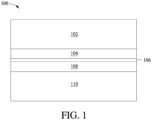
- FIG. 1 illustrates an example conveyor belt construction 100 comprising, in order, a cover rubber layer 102, a first adhesive rubber layer 104, a reinforcing fabric 106, a second adhesive rubber layer 108, and a bottom rubber layer 110.
- the first adhesive rubber layer 104 and/or the second adhesive rubber layer 108 may be calendared sheets of rubber compounds that include PE(D)M polymers described in the present disclosure.
- Manufacturing generally proceeds by layering the above layers (or other desired layer order) using a calendaring process. Then, the calendared layered structure is cured. High tack in the adhesive layers improves fusion between adjacent layers and mitigates the formation of air bubbles between layers.
- Suitable additional polymers for use in the cover and bottom layers include, but are not limited to, polyurethane elastomers (including as well polyurethane/urea elastomers and so-called millable gums) (PU), polychloroprene rubber (CR), acrylonitrile butadiene rubber (NBR), hydrogenated NBR (HNBR), styrene-butadiene rubber (SBR), alkylated chlorosulfonated polyethylene (ACSM), polyepichlorohydrin, polybutadiene rubber (BR), natural rubber (NR), and ethylene alpha olefin elastomers such as ethylene propylene copolymers (EPM), ethylene propylene diene terpolymers (EPDM), ethylene octene copolymers (EOM), ethylene butene copolymers (EBM), ethylene octene diene terpolymers (EODM); ethylene butene diene terpoly
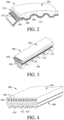
- FIG. 2 is a fragmented perspective view of a transmission belt.
- synchronous belt 200 includes elastomeric main body portion 202 and sheave contact portion 204 positioned along the inner periphery of main body portion 202.
- Main body portion 202 comprises one or more rubber compounds that include PE(D)M polymers described in the present disclosure.
- Sheave contact portion 204 is configured to form alternating transverse projections 206 and troughs 208 configured to couple with a transverse-grooved pulley or sprocket.
- Tensile layer 210 is positioned within main body portion 202 for providing support and strength to belt 200.
- Tensile layer 210 includes a plurality of tensile cords 212 disposed longitudinally along the length of main body portion 212.
- Cords 212 comprise any suitable material, such as one or more of cotton, rayon, polyamide, polyester, aramid, steel, glass, carbon, polyketone, basalt, boron, or discontinuous fibers oriented for low load carrying capability.
- Said cords 212 may be untreated or have a surface treatment.
- Said surface treatment may be a coating physically on or chemically bonded to the surface of the cords 212.
- the term "coating" does not imply 100% coverage but can be any amount of coverage.
- the coating are used to enhance the bonding or tack between the generally polar cords and the generally nonpolar rubbers.
- coatings on the surface of the cords 212 can include, but are not limited to, polymers or small molecules that are dip coated, spray coated, or extruded on the surface.
- polymers comprising amine or amide moieties may chemically bond to hydroxyl groups of rayon and polyester cords. Heat may be used to facilitate chemical reactions between cord surfaces and coatings.
- a PE(D)M e.g., a PE(D)M described herein
- SBR polymer e.g., a SBR polymer described herein
- the PEDM component in the coating may be a PE(D)M polymer comprising 65 wt% to 97.5 wt% propylene, 2.5 wt% to 35 wt% ⁇ -olefin, and 0.2 wt% to 20 wt% diene, said wt% based on the weight of the PE(D)M terpolymer, at an amount of from 1 phr to 100 phr.
- the SBR polymer component in the coating may have an amount of from 0 phr to 99 phr.
- Said PE(D)M polymer and SBR polymer in the coating does not necessarily have to be the same as the PE(D)M in the compositions described herein (e.g., PE(D)M polymer optionally with SBR polymer).
- Reinforcing fabric 214 is disposed on projections 206 and troughs 208 and to form a sheave contact portion.
- Reinforcing fabric 214 may be of any suitable configuration such as a conventional weave consisting of warp and weft threads at an angle, or may include warp threads held together by space pick cords, or a knitted or braided configuration, or a nonwoven fabric. Suitable fabrics include one or more of cotton, polyester, polyamide, acrylic, aramid, polyketone, hemp, jute, or fiberglass.
- Said fabric 214 may be untreated or have a surface treatment. Said surface treatment may be a coating physically on or chemically bonded to the surface of the fabric 214.
- coating does not imply 100% coverage but can be any amount of coverage.
- the coating physical or chemical, are used to enhance the bonding or tack between the generally polar fabric and the generally nonpolar rubbers.
- coatings on the surface of the fabric 214 can include, but are not limited to, polymers or small molecules that are calendared, extruded, dip coated, or spray coated on the surface.
- polymers comprising amine or amide moieties may chemically bond to hydroxyl groups of polyester fabric. Heat may be used to facilitate chemical reactions or physical bonding between fabric surfaces and coatings.
- a PE(D)M may be a component of the coating optionally with a SBR polymer (e.g., a SBR polymer described herein).
- the PEDM component in the coating may be a PE(D)M polymer comprising 65 wt% to 97.5 wt% propylene, 2.5 wt% to 35 wt% ⁇ -olefin, and 0.2 wt% to 20 wt% diene, said wt% based on the weight of the PE(D)M terpolymer, at an amount of from 1 phr to 100 phr.
- the SBR polymer component in the coating may have an amount of from 0 phr to 99 phr.
- Said PE(D)M polymer and SBR polymer in the coating does not necessarily have to be the same as the PE(D)M in the compositions described herein (e.g., PE(D)M polymer optionally with SBR polymer).
- FIG. 3 is a fragmented perspective view of a transmission belt.
- notched V-belt 300 includes elastomeric body portion 302 and tensile layer 304 comprising cords 306.
- Main body portion 302 comprises one or more rubber compounds that include PE(D)M polymers described in the present disclosure.
- Cords 306 comprise any suitable material, such as one or more of cotton, rayon, polyamide, polyester, aramid, steel, glass, carbon, polyketone, basalt, boron, or discontinuous fibers oriented for low load carrying capability.
- V-belt 300 includes sheave contact portion 308 having two juxtaposed sides of the belt, designed to wedge into a V-sheave.
- V-belt 300 includes troughs 310 and projections 312. Included in the category of V-belts are those V-belts designed for continuously variable transmission (“CVT”) applications, which often exhibit a belt body relatively wider than the belt thickness.
- CVT continuously variable transmission
- FIG. 4 is a fragmented perspective view of a transmission belt.
- multi-V-ribbed belt 400 includes main body portion 402 and also tensile reinforcement member 404 comprising cords 406.
- Main body portion 402 comprises one or more rubber compounds that include PE(D)M polymers described in the present disclosure.
- Longitudinally grooved sheave contact portion 408 comprises a plurality of projections 410 alternating with a plurality of troughs 412 which together define driving surfaces 414 of the belt 400.
- the respective sheave contact portion is coupleable/coupled with the respective main body portion and may be formed from the same material or layered with different material.
- rubber compounds that include PE(D)M polymers described in the present disclosure that form the main belt body portion may further comprise any suitable polymer.
- suitable additional polymers include polyurethane elastomers (including as well polyurethane/urea elastomers and so-called millable gums) (PU), polychloroprene rubber (CR), acrylonitrile butadiene rubber (NBR), hydrogenated NBR (HNBR), styrene-butadiene rubber (SBR), alkylated chlorosulfonated polyethylene (ACSM), polyepichlorohydrin, polybutadiene rubber (BR), natural rubber (NR), and ethylene alpha olefin elastomers such as ethylene propylene copolymers (EPM), ethylene propylene diene terpolymers (EPDM), ethylene octene copolymers (EOM), ethylene butene
- EPM ethylene propylene copolymers
- EPDM ethylene propylene
- Mooney viscosity can be determined by ASTM D1646-17 ((1+4), 125°C, 2 s -1 shear rate). Melt Flow Rate (MFR) is measured according to ASTM D1238-13 test method, at 230° C and 2.16 kg load, and is expressed as dg/min or g/ 10 min. Ethylene content is determined using FTIR according the ASTM D3900-17 and is not corrected for diene content. ENB is determined using FTIR according to ASTM D6047-17.
- the distributions and the moments of molecular weight are determined by using a high temperature Gel Permeation Chromatography (Polymer Char GPC-IR) equipped with a multiple-channel band-filter based Infrared detector IR5, an 18-angle Wyatt Dawn Heleos light scattering detector and a 4-capillary viscometer with Wheatstone bridge configuration.
- Gel Permeation Chromatography Polymer Char GPC-IR
- IR5 multiple-channel band-filter based Infrared detector
- IR5 18-angle Wyatt Dawn Heleos light scattering detector
- 4-capillary viscometer with Wheatstone bridge configuration.
- Three Agilent PLgel 10- ⁇ m Mixed-B LS columns are used to provide polymer separation.
- TCB Aldrich reagent grade 1,2,4-trichlorobenzene
- BHT butylated hydroxytoluene
- the TCB mixture is filtered through a 0.1- ⁇ m Teflon filter and degassed with an online degasser before entering the GPC instrument.
- the nominal flow rate is 1.0 ml/min and the nominal injection volume is 200 ⁇ L.
- the whole system including transfer lines, columns, and viscometer detector are contained in ovens maintained at 145°C.
- the polymer sample is weighed and sealed in a standard vial with 80- ⁇ L flow marker (Heptane) added to it.
- polymer After loading the vial in the autosampler, polymer is automatically dissolved in the instrument with 8 ml added TCB solvent. The polymer is dissolved at 160°C with continuous shaking for about 2 hour for the polypropylene samples.
- the mass recovery is calculated from the ratio of the integrated area of the concentration chromatography over elution volume and the injection mass which is equal to the predetermined concentration multiplied by injection loop volume.
- the conventional molecular weight (IR MW) is determined by combining universal calibration relationship with the column calibration which is performed with a series of monodispersed polystyrene (PS) standards ranging from 700 to 10M gm/mole.
- PSD monodispersed polystyrene
- concentrations are expressed in g/cm 3
- molecular weight is expressed in g/mole
- intrinsic viscosity is expressed in dL/g unless otherwise noted.
- ⁇ R( ⁇ ) is the measured excess Rayleigh scattering intensity at scattering angle ⁇
- c is the polymer concentration determined from the IR5 analysis
- a 2 is the second virial coefficient
- P( ⁇ ) is the form factor for a monodisperse random coil
- (dn/dc) 0.1048 for ethylene-propylene copolymers
- (dn/dc) 0.1048 - 0.0016ENB for EPDM comprising ENB as the diene, where ENB is the ENB content in wt% in the ethylene-propylene-diene terpolymer.
- ENB is taken as weight percent of total non-conjugated polyenes.
- a high temperature Polymer Char viscometer which has four capillaries arranged in a Wheatstone bridge configuration with two pressure transducers, is used to determine specific viscosity.
- One transducer measures the total pressure drop across the detector, and the other, positioned between the two sides of the bridge, measures a differential pressure.
- the specific viscosity, ⁇ s for the solution flowing through the viscometer is calculated from their outputs.
- DSC Differential Scanning Calorimetry
- Tg glass transition temperature
- Tm melting temperature
- Hf heat of fusion
- Samples weighing approximately 5-10 mg were kept in an aluminum sample pan and hermetically sealed. These were gradually heated to 200°C at a rate of 10°C/minute and thereafter, held at 200°C for 2 minutes. They were subsequently cooled to -90°C at a rate of 10°C/minute and held isothermally for 2 minutes at -90°C. This was followed by a second heating cycle wherein the samples were heated to 200 °C at 10 °C/minute. Both the first and second cycle thermal events were recorded.
- the thermal output recorded as the area under the melting peak of the sample, is a measure of the heat of fusion and may be expressed in Joules per gram of polymer.
- the melting point is recorded as the temperature of the greatest heat absorption within the range of melting of the sample relative to a baseline measurement for the increasing heat capacity of the polymer as a function of temperature.
- the percent crystallinity is calculated using the formula: [area under the curve (in J/g) / H° (in J/g)] * 100, where H° is the ideal heat of fusion for a perfect crystal of the homopolymer of the major monomer component.
- H° is the ideal heat of fusion for a perfect crystal of the homopolymer of the major monomer component.
- Tg was determined from the second heating cycle of by DSC.
- the 13 C solution NMR was performed on a 10 mm cryoprobe with a field strength of at least 600 MHz solvent mixture of ODCB (ortho-dichlorobenzene) and benzene-d6 (C 6 D 6 ) (90:10) at 120° C with a flip angle of 90° and inverse gated decoupling with a 20 second delay.
- Sample preparation (polymer dissolution) was performed at 140°C where 0.20 grams of polymer was dissolved in an appropriate amount of solvent to give a final polymer solution volume of 3 ml. Chemical shifts were referenced to the solvent signal at 127.2 ppm.
- the tacticity is calculated from integrating the CH 3 region of the propylene unit where the regions are defined as: mm region 21.20-20.5 ppm mr region 20.5-19.75 ppm rr region 19.75-18.7 ppm
- the "propylene tacticity index”, expressed herein as [m/r], is calculated from the corrected integral regions as described above.
- [m/r] is 0 to less than 1.0, the polymer is generally described as syndiotactic, when [m/r] is 1.0 the polymer is atactic, and when [m/r] is greater than 1.0 the polymer is generally described as isotactic.
- the PE(D)M polymers were made by a polymerization process described in PCT/US2019/022738, filed March 18, 2019 , and PCT/US2019/022764, filed on March 18, 2019 ".
- PE(D)M Polymers Sample C2 by FTIR (wt%) ENB by FTIR (wt%) ML (1+4) at 125° C (MU) MFR (g/10 min, at 230°C) M n (LS) (g/mol) M w (LS) (g/mol) M w / M n T g (°C) PEDM-1 4.6 2.8 15 7.1 82,537 167,793 2.03 -6.2 PEDM-2 9.7 2.7 17 7.2 78,064 164,111 2.10 -13.6 PEDM-3 15.3 2.8 15 6.8 73,360 154,333 2.10 -18.1 Table 1.
- PE(D)M Polymers (continued) Sample M z (LS) (g/mol) mm mr rr m r m/r PEDM-1 265403 0.18 0.30 0.52 0.33 0.67 0.50 PEDM-2 263810 0.20 0.20 0.60 0.30 0.70 0.43 PEDM-3 246268
- the PE(D)M polymers were used in preparing elastomeric compounds according to Table 2. Control samples used no additional polymer in place of the PE(D)M polymers or used a phenolic resin tackifier (SP1068, available from Schenectady Chemicals) in place of the PE(D)M polymers.
- SP1068 phenolic resin tackifier
- Compound ML at 100 °C was measured by the ASTM D1646-17 method.
- Moving Die Rheometer (MDR) was measured by the ASTM D5289 method.
- Mechanical properties, including hardness, tensile strength, and elongation were measured by the ASTM D412 method.
- Abrasion resistance (DIN) test method was based on DIN 53516.
- the Picma tack test was used to measure tack of two uncured (i.e., green) flat compound surfaces (Table 3). Samples were prepared using compression molding at 100°C for 2 minutes with a thickness of 2 mm. Mylar film was used on the mold surface to avoid compounds sticking to mold. Table 3 Compound C1 C2 E1 E2 E3 Picma tack (kgf) 1.05 1.20 1.52 1.49 1.56
- the compounds comprising PE(D)M-1, PE(D)M-2, and PE(D)M-3 exhibit greater Picma tack than the control samples.
- Table 4 provides the physical properties of the compounds (1) after curing (9 minutes at 160°C in air ) or (2) after curing (9 minutes at 160°C in air) and then aging (168 hours at 125°C in air).
- Table 4 Compound C1 C2 E1 E2 E3 Curing Properties MH - ML (dN.m) 12.15 10.84 10.82 10.55 10.80 t90 (min) 6.79 6.50 6.76 6.85 6.72 ts2 (min) 3.47 3.16 3.54 3.62 3.55 Physical Properties - cured Hardness (Shore A) 62 62 60 59 59 100% modulus (MPa) 2.2 2.0 2.0 2.0 2.0 2.0 2.0 2.0
- Tensile strength (% retention) 76 59 73 73 72 Elongation at break (%
- the example compounds comprising PE(D)M While the physical properties of the example compounds comprising PE(D)M are comparable to the control compounds after curing, the example compounds retained more of their physical properties as compared to the C2 control compound, which comprises the phenolic resin tackifier. Further, the percent retention of physical properties is comparable to that of the C1 control compound. However, as illustrated in Table 3, the Picma tack values for the example compounds comprising PE(D)M are greater than either of the two control compounds.
- Table 5 Compound C1 C2 E1 E2 E3 ML(1+4) at 100°C (MU) 57.6 53.0 52.7 53.7 53.1
- FIG. 5 is a plot of elastic modulus (G') as a function of strain where lower elastic modulus values at lower strain indicate a better dispersion of carbon black in the compound. From FIG. 1 , each of the example compounds comprising PE(D)M have a reduced elastic modulus at strains ranging from 0.1% to 1% as compared to the control compound C1. Accordingly, the carbon black filler is better dispersed in the example compounds comprising PE(D)M.
Landscapes
- Chemical & Material Sciences (AREA)
- Health & Medical Sciences (AREA)
- Chemical Kinetics & Catalysis (AREA)
- Medicinal Chemistry (AREA)
- Polymers & Plastics (AREA)
- Organic Chemistry (AREA)
- Compositions Of Macromolecular Compounds (AREA)
- Addition Polymer Or Copolymer, Post-Treatments, Or Chemical Modifications (AREA)
Claims (12)
- Composition comprenant :100 parties en poids pour cent parties en poids de caoutchouc (phr) d'un caoutchouc choisi dans le groupe constitué par les copolymères butadiène/styrène, les copolymères isoprène/butadiène, les copolymères isoprène/styrène et les copolymères isoprène/butadiène/styrène, et leurs mélanges ;1 phr à 30 phr d'un polymère propylène-α-oléfine-diène (PEDM) comprenant 75 % en poids à 95 % en poids de propylène, 5 % en poids à 25 % en poids d'α-oléfine en C2 ou C4-C20, et 2,5 % en poids à 20 % en poids de diène, la teneur en monomère étant déterminée selon les procédés décrits dans la description aux paragraphes [0053]-[0056], lesdits % en poids étant basés sur le poids du polymère PEDM, dans laquelle les nombres de % en poids sont des nombres non corrigés dans laquelle % en poids en C2 plus % en poids d'α-oléfine en C3-C20 est égal à 100 % en poids, et dans laquelle le polymère PEDM a (a) une viscosité Mooney (ML(1+4) à 125 °C, vitesse de cisaillement 2s-1) telle que mesurée selon la norme ASTM D1646-17 de 1 à 100, (b) un indice de fluidité à l'état fondu de 0,1 g/min à 100 g/min tel que mesuré selon la norme ASTM D1238-13 à 230 °C et une charge de 2,16 kg, (c) un rapport poids moléculaire moyen en poids sur poids moléculaire n-moyen (Mw/Mn) de 1,5 à 3,0, et (d) une chaleur de fusion (Hf) inférieure à 1 J/g.
- Composition selon la revendication 1, dans laquelle le caoutchouc comprend un caoutchouc styrène-butadiène.
- Composition élastomère selon l'une quelconque des revendications précédentes, dans laquelle le polymère PEDM a une Tg de polymère (°C) supérieure ou égale à - 7,386-(87,98*E)+(294*D) et inférieure ou égale à -1,386-(87,98*E)+(294*D) où E est la fraction molaire d'éthylène dans le polymère et D est la fraction molaire de diène dans le polymère.
- Composition selon l'une quelconque des revendications précédentes, dans laquelle le polymère PEDM a un poids moléculaire moyen en nombre de 70 000 g/mole à 150 000 g/mole.
- Composition selon l'une quelconque des revendications précédentes, dans laquelle le polymère PEDM a un poids moléculaire moyen en poids de 150 000 g/mole à 320 000 g/mole.
- Composition selon l'une quelconque des revendications précédentes, dans laquelle le polymère PEDM a un indice de polydispersité de 2,0 à 2,6.
- Composition selon l'une quelconque des revendications précédentes, dans laquelle le polymère PEDM a une température de transition vitreuse de -45 °C à -2 °C.
- Composition selon l'une quelconque des revendications précédentes, dans laquelle la composition a un collant Picma de 1,3 kgf à 2,0 kgf.
- Procédé comprenant :
la production d'un mélange maître à une première température, le mélange maître comprenant :100 parties en poids pour cent parties en poids de caoutchouc (phr) d'un caoutchouc choisi dans le groupe constitué par les copolymères butadiène/styrène, les copolymères isoprène/butadiène, les copolymères isoprène/styrène et les copolymères isoprène/butadiène/styrène, et leurs mélanges ;1 phr à 30 phr d'un polymère propylène-α-oléfine-diène (PEDM) comprenant 75 % en poids à 95 % en poids de propylène, 5 % en poids à 25 % en poids d'α-oléfine en C2 ou C4-C20, et 2,5 % en poids à 20 % en poids de diène, la teneur en monomère étant déterminée selon les procédés décrits dans la description aux paragraphes [0053]-[0056], lesdits % en poids étant basés sur le poids du polymère PEDM, dans laquelle les nombres de % en poids sont des nombres non corrigés dans laquelle % en poids en C2 plus % en poids d'α-oléfine en C3-C20 est égal à 100 % en poids, et dans laquelle le polymère PEDM a (a) une viscosité Mooney (ML(1+4) à 125 °C, vitesse de cisaillement 2s-1) telle que mesurée selon la norme ASTM D1646-17 de 1 à 100, (b) un indice de fluidité à l'état fondu de 0,1 g/min à 100 g/min tel que mesuré selon la norme ASTM D1238-13 à 230 °C et une charge de 2,16 kg, (c) un rapport poids moléculaire moyen en poids sur poids moléculaire n-moyen (Mw/Mn) de 1,5 à 3,0, et (d) une chaleur de fusion (Hf) inférieure à 1 J/g ; etun additif choisi dans le groupe constitué par : une charge, une huile de traitement, un plastifiant, un agent de compatibilité, un agent de réticulation, et toute combinaison de ceux-ci ; etle mélange d'un agent de durcissement et/ou d'un agent de réticulation dans le mélange maître à une seconde température qui est inférieure à la première température. - Procédé selon la revendication 9, dans lequel la production du mélange maître comprend :
le mélange du caoutchouc et de l'additif jusqu'à ce que l'additif soit incorporé avant d'ajouter le PEDM. - Procédé selon l'une quelconque des revendications 9 à 10, dans lequel le polymère PEDM a un poids moléculaire moyen en nombre de 70 000 g/mole à 150 000 g/mole.
- Procédé selon l'une quelconque des revendications 9 à 11, dans lequel le polymère PEDM a un poids moléculaire moyen en poids de 150 000 g/mole à 320 000 g/mole.
Applications Claiming Priority (2)
| Application Number | Priority Date | Filing Date | Title |
|---|---|---|---|
| US201962882629P | 2019-08-05 | 2019-08-05 | |
| PCT/US2020/044406 WO2021025977A1 (fr) | 2019-08-05 | 2020-07-31 | Additif terpolymère de propylène-alpha-oléfine-diène pour améliorer la pégosité du caoutchouc |
Publications (2)
| Publication Number | Publication Date |
|---|---|
| EP4010421A1 EP4010421A1 (fr) | 2022-06-15 |
| EP4010421B1 true EP4010421B1 (fr) | 2025-05-21 |
Family
ID=72340401
Family Applications (1)
| Application Number | Title | Priority Date | Filing Date |
|---|---|---|---|
| EP20765388.2A Active EP4010421B1 (fr) | 2019-08-05 | 2020-07-31 | Additif terpolymère de propylène-alpha-oléfine-diène pour améliorer la pégosité du caoutchouc |
Country Status (4)
| Country | Link |
|---|---|
| US (1) | US20220267580A1 (fr) |
| EP (1) | EP4010421B1 (fr) |
| CN (1) | CN114450336B (fr) |
| WO (1) | WO2021025977A1 (fr) |
Family Cites Families (31)
| Publication number | Priority date | Publication date | Assignee | Title |
|---|---|---|---|---|
| US3615972A (en) | 1967-04-28 | 1971-10-26 | Dow Chemical Co | Expansible thermoplastic polymer particles containing volatile fluid foaming agent and method of foaming the same |
| JPS56112950A (en) * | 1980-02-12 | 1981-09-05 | Showa Electric Wire & Cable Co Ltd | Electrically insulating composition |
| US5153157A (en) | 1987-01-30 | 1992-10-06 | Exxon Chemical Patents Inc. | Catalyst system of enhanced productivity |
| US5041584A (en) | 1988-12-02 | 1991-08-20 | Texas Alkyls, Inc. | Modified methylaluminoxane |
| ES2108861T3 (es) | 1991-11-25 | 1998-01-01 | Exxon Chemical Patents Inc | Composiciones cataliticas polionicas de metales de transicion. |
| JP3275078B2 (ja) | 1992-01-06 | 2002-04-15 | ザ ダウ ケミカル カンパニー | オレフィンの重合法 |
| BE1005957A5 (fr) | 1992-06-05 | 1994-04-05 | Solvay | Procede de preparation d'un systeme catalytique, procede de (co)polymerisation d'olefines et (co)polymeres d'au moins une olefine. |
| DE69312306T2 (de) | 1992-10-02 | 1997-11-13 | Dow Chemical Co | Aufträger homogener komplexkatalysator für olefinpolymerisation |
| DE69434709T2 (de) | 1993-06-07 | 2006-10-19 | Mitsui Chemicals, Inc. | Propylenelastomere |
| EP0729477B1 (fr) | 1993-11-19 | 1999-10-27 | Exxon Chemical Patents Inc. | Systemes catalyseurs de polymerisation, production et utilisation de ces systemes |
| US5498582A (en) | 1993-12-06 | 1996-03-12 | Mobil Oil Corporation | Supported metallocene catalysts for the production of polyolefins |
| US5447895A (en) | 1994-03-10 | 1995-09-05 | Northwestern University | Sterically shielded diboron-containing metallocene olefin polymerization catalysts |
| EP0728773B1 (fr) | 1995-02-21 | 1998-11-04 | Mitsubishi Chemical Corporation | Catalyseurs de polymérisation d'oléfines et procédé pour la préparation des polymères d'oléfine utilisant ces catalyseurs |
| WO1998043983A1 (fr) | 1997-04-03 | 1998-10-08 | Colorado State University Research Foundation | Compositions a anions monoheteroborane polyhalogenes |
| US5750625A (en) | 1997-06-09 | 1998-05-12 | Advanced Elastomer Systems, L.P. | Phenolic resin curatives which form nonstaining thermoplastic elastomers |
| JP4460768B2 (ja) | 1998-02-24 | 2010-05-12 | 松本油脂製薬株式会社 | 熱膨張性マイクロカプセルとその製造方法及びその利用方法 |
| WO1999046320A1 (fr) | 1998-03-13 | 1999-09-16 | Matsumoto Yushi-Seiyaku Co., Ltd. | Microcapsules thermo-expansibles et leur procede d'utilisation |
| US6147173A (en) | 1998-11-13 | 2000-11-14 | Univation Technologies, Llc | Nitrogen-containing group 13 anionic complexes for olefin polymerization |
| EP1330479B2 (fr) | 2000-10-30 | 2015-01-21 | ExxonMobil Chemical Patents Inc. | Polymeres greffes modifies sur la base de nouveaux copolymeres ethylene-propylene |
| US6582633B2 (en) | 2001-01-17 | 2003-06-24 | Akzo Nobel N.V. | Process for producing objects |
| EP1521758B1 (fr) | 2002-07-17 | 2006-05-24 | Exxonmobil Chemical Patents Inc. | Catalyseurs metalliques a transition tardive destines a la polymerisation et a l'oligomerisation d'olefines |
| AU2003291627A1 (en) * | 2002-09-20 | 2004-04-08 | Exxonmobil Chemical Patents Inc. | Supercritical polymerization process and polymers produced therefrom |
| US7579408B2 (en) * | 2004-03-17 | 2009-08-25 | Dow Global Technologies Inc. | Thermoplastic vulcanizate comprising interpolymers of ethylene/α-olefins |
| US9061900B2 (en) * | 2005-12-16 | 2015-06-23 | Bridgestone Corporation | Combined use of liquid polymer and polymeric nanoparticles for rubber applications |
| WO2008016467A1 (fr) | 2006-08-01 | 2008-02-07 | Exxonmobil Chemical Patents Inc. | Élastomères éthylène-alpha-oléfine multimodaux et procédé de fabrication |
| US8658556B2 (en) | 2011-06-08 | 2014-02-25 | Exxonmobil Chemical Patents Inc. | Catalyst systems comprising multiple non-coordinating anion activators and methods for polymerization therewith |
| SG11201702214WA (en) * | 2014-09-30 | 2017-04-27 | Exxonmobil Chemical Patents Inc | Propylene-ethylene-diene terpolymer additives for improved tire tread performance |
| EP3201270B1 (fr) * | 2014-09-30 | 2018-10-24 | ExxonMobil Chemical Patents Inc. | Compositions amorphes de terpolymère de propylène-éthylène-diène à faible teneur en éthylène |
| WO2018190940A1 (fr) * | 2017-04-14 | 2018-10-18 | Exxonmobil Chemical Patents Inc. | Compositions élastomères comprenant du pedm et de l'epr |
| EP3720908B1 (fr) * | 2017-12-08 | 2023-06-21 | ExxonMobil Chemical Patents Inc. | Compositions de terpolymère élastomère destinées à des applications de moulures de coins |
| CN108841090A (zh) * | 2018-07-17 | 2018-11-20 | 宁国市正道橡塑零部件有限公司 | 一种epdm/天然橡胶并用耐老化橡胶及其制备方法 |
-
2020
- 2020-07-31 CN CN202080067156.5A patent/CN114450336B/zh active Active
- 2020-07-31 EP EP20765388.2A patent/EP4010421B1/fr active Active
- 2020-07-31 WO PCT/US2020/044406 patent/WO2021025977A1/fr not_active Ceased
- 2020-07-31 US US17/626,604 patent/US20220267580A1/en active Pending
Also Published As
| Publication number | Publication date |
|---|---|
| WO2021025977A1 (fr) | 2021-02-11 |
| CN114450336A (zh) | 2022-05-06 |
| CN114450336B (zh) | 2024-01-09 |
| US20220267580A1 (en) | 2022-08-25 |
| EP4010421A1 (fr) | 2022-06-15 |
Similar Documents
| Publication | Publication Date | Title |
|---|---|---|
| EP3999586B1 (fr) | Copolymère à base d'éthylène et compositions de propylène-alpha-oléfine-diène destinées à être utilisées dans des produits stratifiés | |
| EP3768734B1 (fr) | Compositions de terpolymère de propylène-alpha-oléfine-diène élastomère | |
| EP3609934B1 (fr) | Compositions comprenant epdm et epr | |
| US11466149B2 (en) | Preparation of bimodal rubber, thermoplastic vulcanizates, and articles made therefrom | |
| US10894841B2 (en) | Processes for producing high propylene content PEDM having low glass transition temperatures using tetrahydroindacenyl catalyst systems | |
| EP3827033B1 (fr) | Préparation de caoutchouc bimodal, de vulcanisats thermoplastiques et articles fabriqués à partir de ceux-ci | |
| CN109641989B (zh) | 双金属茂催化剂共聚物组合物 | |
| CN111868116A (zh) | 乙烯-α-烯烃-非共轭多烯共聚物、其制造方法及用途 | |
| EP3768740B1 (fr) | Procédés de production de pedm à teneur élevée en propylène à l'aide de systèmes de catalyseur de tétrahydroindacényle | |
| EP4010421B1 (fr) | Additif terpolymère de propylène-alpha-oléfine-diène pour améliorer la pégosité du caoutchouc | |
| CN111032772B (zh) | 用于交联应用的乙烯共聚物共混物 | |
| US12503529B2 (en) | Polymers of 4-substituted hexadiene and processes for production thereof | |
| US20260098139A1 (en) | Foamable branched polypropylene compositions and foamed products produced therefrom | |
| WO2022146634A1 (fr) | Ionomères à base de polyoléfine et production correspondante | |
| WO2021188361A1 (fr) | Copolymères linéaires alpha-oléfine et leurs copolymères d'impact |
Legal Events
| Date | Code | Title | Description |
|---|---|---|---|
| STAA | Information on the status of an ep patent application or granted ep patent |
Free format text: STATUS: UNKNOWN |
|
| STAA | Information on the status of an ep patent application or granted ep patent |
Free format text: STATUS: THE INTERNATIONAL PUBLICATION HAS BEEN MADE |
|
| PUAI | Public reference made under article 153(3) epc to a published international application that has entered the european phase |
Free format text: ORIGINAL CODE: 0009012 |
|
| STAA | Information on the status of an ep patent application or granted ep patent |
Free format text: STATUS: REQUEST FOR EXAMINATION WAS MADE |
|
| 17P | Request for examination filed |
Effective date: 20220208 |
|
| AK | Designated contracting states |
Kind code of ref document: A1 Designated state(s): AL AT BE BG CH CY CZ DE DK EE ES FI FR GB GR HR HU IE IS IT LI LT LU LV MC MK MT NL NO PL PT RO RS SE SI SK SM TR |
|
| DAV | Request for validation of the european patent (deleted) | ||
| DAX | Request for extension of the european patent (deleted) | ||
| STAA | Information on the status of an ep patent application or granted ep patent |
Free format text: STATUS: EXAMINATION IS IN PROGRESS |
|
| 17Q | First examination report despatched |
Effective date: 20231222 |
|
| GRAP | Despatch of communication of intention to grant a patent |
Free format text: ORIGINAL CODE: EPIDOSNIGR1 |
|
| STAA | Information on the status of an ep patent application or granted ep patent |
Free format text: STATUS: GRANT OF PATENT IS INTENDED |
|
| INTG | Intention to grant announced |
Effective date: 20241010 |
|
| GRAJ | Information related to disapproval of communication of intention to grant by the applicant or resumption of examination proceedings by the epo deleted |
Free format text: ORIGINAL CODE: EPIDOSDIGR1 |
|
| STAA | Information on the status of an ep patent application or granted ep patent |
Free format text: STATUS: EXAMINATION IS IN PROGRESS |
|
| INTC | Intention to grant announced (deleted) | ||
| GRAP | Despatch of communication of intention to grant a patent |
Free format text: ORIGINAL CODE: EPIDOSNIGR1 |
|
| STAA | Information on the status of an ep patent application or granted ep patent |
Free format text: STATUS: GRANT OF PATENT IS INTENDED |
|
| INTG | Intention to grant announced |
Effective date: 20250103 |
|
| P01 | Opt-out of the competence of the unified patent court (upc) registered |
Free format text: CASE NUMBER: APP_67120/2024 Effective date: 20241219 |
|
| GRAS | Grant fee paid |
Free format text: ORIGINAL CODE: EPIDOSNIGR3 |
|
| GRAA | (expected) grant |
Free format text: ORIGINAL CODE: 0009210 |
|
| STAA | Information on the status of an ep patent application or granted ep patent |
Free format text: STATUS: THE PATENT HAS BEEN GRANTED |
|
| AK | Designated contracting states |
Kind code of ref document: B1 Designated state(s): AL AT BE BG CH CY CZ DE DK EE ES FI FR GB GR HR HU IE IS IT LI LT LU LV MC MK MT NL NO PL PT RO RS SE SI SK SM TR |
|
| REG | Reference to a national code |
Ref country code: GB Ref legal event code: FG4D |
|
| REG | Reference to a national code |
Ref country code: CH Ref legal event code: EP |
|
| REG | Reference to a national code |
Ref country code: DE Ref legal event code: R096 Ref document number: 602020051657 Country of ref document: DE |
|
| REG | Reference to a national code |
Ref country code: IE Ref legal event code: FG4D |
|
| REG | Reference to a national code |
Ref country code: NL Ref legal event code: MP Effective date: 20250521 |
|
| PG25 | Lapsed in a contracting state [announced via postgrant information from national office to epo] |
Ref country code: ES Free format text: LAPSE BECAUSE OF FAILURE TO SUBMIT A TRANSLATION OF THE DESCRIPTION OR TO PAY THE FEE WITHIN THE PRESCRIBED TIME-LIMIT Effective date: 20250521 Ref country code: FI Free format text: LAPSE BECAUSE OF FAILURE TO SUBMIT A TRANSLATION OF THE DESCRIPTION OR TO PAY THE FEE WITHIN THE PRESCRIBED TIME-LIMIT Effective date: 20250521 Ref country code: PT Free format text: LAPSE BECAUSE OF FAILURE TO SUBMIT A TRANSLATION OF THE DESCRIPTION OR TO PAY THE FEE WITHIN THE PRESCRIBED TIME-LIMIT Effective date: 20250922 |
|
| PGFP | Annual fee paid to national office [announced via postgrant information from national office to epo] |
Ref country code: DE Payment date: 20250728 Year of fee payment: 6 |
|
| REG | Reference to a national code |
Ref country code: LT Ref legal event code: MG9D |
|
| PG25 | Lapsed in a contracting state [announced via postgrant information from national office to epo] |
Ref country code: NO Free format text: LAPSE BECAUSE OF FAILURE TO SUBMIT A TRANSLATION OF THE DESCRIPTION OR TO PAY THE FEE WITHIN THE PRESCRIBED TIME-LIMIT Effective date: 20250821 Ref country code: GR Free format text: LAPSE BECAUSE OF FAILURE TO SUBMIT A TRANSLATION OF THE DESCRIPTION OR TO PAY THE FEE WITHIN THE PRESCRIBED TIME-LIMIT Effective date: 20250822 |
|
| PG25 | Lapsed in a contracting state [announced via postgrant information from national office to epo] |
Ref country code: NL Free format text: LAPSE BECAUSE OF FAILURE TO SUBMIT A TRANSLATION OF THE DESCRIPTION OR TO PAY THE FEE WITHIN THE PRESCRIBED TIME-LIMIT Effective date: 20250521 Ref country code: PL Free format text: LAPSE BECAUSE OF FAILURE TO SUBMIT A TRANSLATION OF THE DESCRIPTION OR TO PAY THE FEE WITHIN THE PRESCRIBED TIME-LIMIT Effective date: 20250521 |
|
| PG25 | Lapsed in a contracting state [announced via postgrant information from national office to epo] |
Ref country code: BG Free format text: LAPSE BECAUSE OF FAILURE TO SUBMIT A TRANSLATION OF THE DESCRIPTION OR TO PAY THE FEE WITHIN THE PRESCRIBED TIME-LIMIT Effective date: 20250521 |
|
| PGFP | Annual fee paid to national office [announced via postgrant information from national office to epo] |
Ref country code: GB Payment date: 20250722 Year of fee payment: 6 |
|
| PG25 | Lapsed in a contracting state [announced via postgrant information from national office to epo] |
Ref country code: HR Free format text: LAPSE BECAUSE OF FAILURE TO SUBMIT A TRANSLATION OF THE DESCRIPTION OR TO PAY THE FEE WITHIN THE PRESCRIBED TIME-LIMIT Effective date: 20250521 |
|
| PGFP | Annual fee paid to national office [announced via postgrant information from national office to epo] |
Ref country code: FR Payment date: 20250725 Year of fee payment: 6 |
|
| PG25 | Lapsed in a contracting state [announced via postgrant information from national office to epo] |
Ref country code: RS Free format text: LAPSE BECAUSE OF FAILURE TO SUBMIT A TRANSLATION OF THE DESCRIPTION OR TO PAY THE FEE WITHIN THE PRESCRIBED TIME-LIMIT Effective date: 20250821 |
|
| PG25 | Lapsed in a contracting state [announced via postgrant information from national office to epo] |
Ref country code: IS Free format text: LAPSE BECAUSE OF FAILURE TO SUBMIT A TRANSLATION OF THE DESCRIPTION OR TO PAY THE FEE WITHIN THE PRESCRIBED TIME-LIMIT Effective date: 20250921 |
|
| PG25 | Lapsed in a contracting state [announced via postgrant information from national office to epo] |
Ref country code: LV Free format text: LAPSE BECAUSE OF FAILURE TO SUBMIT A TRANSLATION OF THE DESCRIPTION OR TO PAY THE FEE WITHIN THE PRESCRIBED TIME-LIMIT Effective date: 20250521 |
|
| REG | Reference to a national code |
Ref country code: AT Ref legal event code: MK05 Ref document number: 1796738 Country of ref document: AT Kind code of ref document: T Effective date: 20250521 |
|
| PG25 | Lapsed in a contracting state [announced via postgrant information from national office to epo] |
Ref country code: AT Free format text: LAPSE BECAUSE OF FAILURE TO SUBMIT A TRANSLATION OF THE DESCRIPTION OR TO PAY THE FEE WITHIN THE PRESCRIBED TIME-LIMIT Effective date: 20250521 Ref country code: DK Free format text: LAPSE BECAUSE OF FAILURE TO SUBMIT A TRANSLATION OF THE DESCRIPTION OR TO PAY THE FEE WITHIN THE PRESCRIBED TIME-LIMIT Effective date: 20250521 Ref country code: SM Free format text: LAPSE BECAUSE OF FAILURE TO SUBMIT A TRANSLATION OF THE DESCRIPTION OR TO PAY THE FEE WITHIN THE PRESCRIBED TIME-LIMIT Effective date: 20250521 |
|
| PG25 | Lapsed in a contracting state [announced via postgrant information from national office to epo] |
Ref country code: CZ Free format text: LAPSE BECAUSE OF FAILURE TO SUBMIT A TRANSLATION OF THE DESCRIPTION OR TO PAY THE FEE WITHIN THE PRESCRIBED TIME-LIMIT Effective date: 20250521 |
|
| PG25 | Lapsed in a contracting state [announced via postgrant information from national office to epo] |
Ref country code: EE Free format text: LAPSE BECAUSE OF FAILURE TO SUBMIT A TRANSLATION OF THE DESCRIPTION OR TO PAY THE FEE WITHIN THE PRESCRIBED TIME-LIMIT Effective date: 20250521 |
|
| PG25 | Lapsed in a contracting state [announced via postgrant information from national office to epo] |
Ref country code: SK Free format text: LAPSE BECAUSE OF FAILURE TO SUBMIT A TRANSLATION OF THE DESCRIPTION OR TO PAY THE FEE WITHIN THE PRESCRIBED TIME-LIMIT Effective date: 20250521 Ref country code: RO Free format text: LAPSE BECAUSE OF FAILURE TO SUBMIT A TRANSLATION OF THE DESCRIPTION OR TO PAY THE FEE WITHIN THE PRESCRIBED TIME-LIMIT Effective date: 20250521 |
|
| PG25 | Lapsed in a contracting state [announced via postgrant information from national office to epo] |
Ref country code: IT Free format text: LAPSE BECAUSE OF FAILURE TO SUBMIT A TRANSLATION OF THE DESCRIPTION OR TO PAY THE FEE WITHIN THE PRESCRIBED TIME-LIMIT Effective date: 20250521 |
|
| REG | Reference to a national code |
Ref country code: CH Ref legal event code: H13 Free format text: ST27 STATUS EVENT CODE: U-0-0-H10-H13 (AS PROVIDED BY THE NATIONAL OFFICE) Effective date: 20260224 Ref country code: DE Ref legal event code: R097 Ref document number: 602020051657 Country of ref document: DE |
|
| PG25 | Lapsed in a contracting state [announced via postgrant information from national office to epo] |
Ref country code: LU Free format text: LAPSE BECAUSE OF NON-PAYMENT OF DUE FEES Effective date: 20250731 |
|
| REG | Reference to a national code |
Ref country code: BE Ref legal event code: MM Effective date: 20250731 |
|
| PLBE | No opposition filed within time limit |
Free format text: ORIGINAL CODE: 0009261 |
|
| STAA | Information on the status of an ep patent application or granted ep patent |
Free format text: STATUS: NO OPPOSITION FILED WITHIN TIME LIMIT |
|
| REG | Reference to a national code |
Ref country code: CH Ref legal event code: L10 Free format text: ST27 STATUS EVENT CODE: U-0-0-L10-L00 (AS PROVIDED BY THE NATIONAL OFFICE) Effective date: 20260402 |
|
| PG25 | Lapsed in a contracting state [announced via postgrant information from national office to epo] |
Ref country code: BE Free format text: LAPSE BECAUSE OF NON-PAYMENT OF DUE FEES Effective date: 20250731 |