EP4011740B1 - Procédé et dispositif pour déterminer un comportement de conduite et pour contrôler l'entraînement d'un véhicule - Google Patents
Procédé et dispositif pour déterminer un comportement de conduite et pour contrôler l'entraînement d'un véhicule Download PDFInfo
- Publication number
- EP4011740B1 EP4011740B1 EP22168668.6A EP22168668A EP4011740B1 EP 4011740 B1 EP4011740 B1 EP 4011740B1 EP 22168668 A EP22168668 A EP 22168668A EP 4011740 B1 EP4011740 B1 EP 4011740B1
- Authority
- EP
- European Patent Office
- Prior art keywords
- driving
- target
- parameter
- driving parameter
- vehicle
- Prior art date
- Legal status (The legal status is an assumption and is not a legal conclusion. Google has not performed a legal analysis and makes no representation as to the accuracy of the status listed.)
- Active
Links
Images

Classifications
-
- B—PERFORMING OPERATIONS; TRANSPORTING
- B60—VEHICLES IN GENERAL
- B60W—CONJOINT CONTROL OF VEHICLE SUB-UNITS OF DIFFERENT TYPE OR DIFFERENT FUNCTION; CONTROL SYSTEMS SPECIALLY ADAPTED FOR HYBRID VEHICLES; ROAD VEHICLE DRIVE CONTROL SYSTEMS FOR PURPOSES NOT RELATED TO THE CONTROL OF A PARTICULAR SUB-UNIT
- B60W40/00—Estimation or calculation of non-directly measurable driving parameters for road vehicle drive control systems not related to the control of a particular sub unit, e.g. by using mathematical models
- B60W40/08—Estimation or calculation of non-directly measurable driving parameters for road vehicle drive control systems not related to the control of a particular sub unit, e.g. by using mathematical models related to drivers or passengers
- B60W40/09—Driving style or behaviour
-
- B—PERFORMING OPERATIONS; TRANSPORTING
- B60—VEHICLES IN GENERAL
- B60W—CONJOINT CONTROL OF VEHICLE SUB-UNITS OF DIFFERENT TYPE OR DIFFERENT FUNCTION; CONTROL SYSTEMS SPECIALLY ADAPTED FOR HYBRID VEHICLES; ROAD VEHICLE DRIVE CONTROL SYSTEMS FOR PURPOSES NOT RELATED TO THE CONTROL OF A PARTICULAR SUB-UNIT
- B60W60/00—Drive control systems specially adapted for autonomous road vehicles
- B60W60/001—Planning or execution of driving tasks
- B60W60/0011—Planning or execution of driving tasks involving control alternatives for a single driving scenario, e.g. planning several paths to avoid obstacles
-
- B—PERFORMING OPERATIONS; TRANSPORTING
- B60—VEHICLES IN GENERAL
- B60W—CONJOINT CONTROL OF VEHICLE SUB-UNITS OF DIFFERENT TYPE OR DIFFERENT FUNCTION; CONTROL SYSTEMS SPECIALLY ADAPTED FOR HYBRID VEHICLES; ROAD VEHICLE DRIVE CONTROL SYSTEMS FOR PURPOSES NOT RELATED TO THE CONTROL OF A PARTICULAR SUB-UNIT
- B60W40/00—Estimation or calculation of non-directly measurable driving parameters for road vehicle drive control systems not related to the control of a particular sub unit, e.g. by using mathematical models
- B60W40/02—Estimation or calculation of non-directly measurable driving parameters for road vehicle drive control systems not related to the control of a particular sub unit, e.g. by using mathematical models related to ambient conditions
- B60W40/06—Road conditions
-
- B—PERFORMING OPERATIONS; TRANSPORTING
- B60—VEHICLES IN GENERAL
- B60W—CONJOINT CONTROL OF VEHICLE SUB-UNITS OF DIFFERENT TYPE OR DIFFERENT FUNCTION; CONTROL SYSTEMS SPECIALLY ADAPTED FOR HYBRID VEHICLES; ROAD VEHICLE DRIVE CONTROL SYSTEMS FOR PURPOSES NOT RELATED TO THE CONTROL OF A PARTICULAR SUB-UNIT
- B60W60/00—Drive control systems specially adapted for autonomous road vehicles
- B60W60/001—Planning or execution of driving tasks
- B60W60/0013—Planning or execution of driving tasks specially adapted for occupant comfort
-
- B—PERFORMING OPERATIONS; TRANSPORTING
- B60—VEHICLES IN GENERAL
- B60W—CONJOINT CONTROL OF VEHICLE SUB-UNITS OF DIFFERENT TYPE OR DIFFERENT FUNCTION; CONTROL SYSTEMS SPECIALLY ADAPTED FOR HYBRID VEHICLES; ROAD VEHICLE DRIVE CONTROL SYSTEMS FOR PURPOSES NOT RELATED TO THE CONTROL OF A PARTICULAR SUB-UNIT
- B60W60/00—Drive control systems specially adapted for autonomous road vehicles
- B60W60/001—Planning or execution of driving tasks
- B60W60/0015—Planning or execution of driving tasks specially adapted for safety
-
- B—PERFORMING OPERATIONS; TRANSPORTING
- B60—VEHICLES IN GENERAL
- B60W—CONJOINT CONTROL OF VEHICLE SUB-UNITS OF DIFFERENT TYPE OR DIFFERENT FUNCTION; CONTROL SYSTEMS SPECIALLY ADAPTED FOR HYBRID VEHICLES; ROAD VEHICLE DRIVE CONTROL SYSTEMS FOR PURPOSES NOT RELATED TO THE CONTROL OF A PARTICULAR SUB-UNIT
- B60W60/00—Drive control systems specially adapted for autonomous road vehicles
- B60W60/001—Planning or execution of driving tasks
- B60W60/0015—Planning or execution of driving tasks specially adapted for safety
- B60W60/0016—Planning or execution of driving tasks specially adapted for safety of the vehicle or its occupants
-
- B—PERFORMING OPERATIONS; TRANSPORTING
- B60—VEHICLES IN GENERAL
- B60W—CONJOINT CONTROL OF VEHICLE SUB-UNITS OF DIFFERENT TYPE OR DIFFERENT FUNCTION; CONTROL SYSTEMS SPECIALLY ADAPTED FOR HYBRID VEHICLES; ROAD VEHICLE DRIVE CONTROL SYSTEMS FOR PURPOSES NOT RELATED TO THE CONTROL OF A PARTICULAR SUB-UNIT
- B60W60/00—Drive control systems specially adapted for autonomous road vehicles
- B60W60/005—Handover processes
- B60W60/0051—Handover processes from occupants to vehicle
-
- G—PHYSICS
- G06—COMPUTING OR CALCULATING; COUNTING
- G06F—ELECTRIC DIGITAL DATA PROCESSING
- G06F9/00—Arrangements for program control, e.g. control units
- G06F9/06—Arrangements for program control, e.g. control units using stored programs, i.e. using an internal store of processing equipment to receive or retain programs
-
- B—PERFORMING OPERATIONS; TRANSPORTING
- B60—VEHICLES IN GENERAL
- B60W—CONJOINT CONTROL OF VEHICLE SUB-UNITS OF DIFFERENT TYPE OR DIFFERENT FUNCTION; CONTROL SYSTEMS SPECIALLY ADAPTED FOR HYBRID VEHICLES; ROAD VEHICLE DRIVE CONTROL SYSTEMS FOR PURPOSES NOT RELATED TO THE CONTROL OF A PARTICULAR SUB-UNIT
- B60W50/00—Details of control systems for road vehicle drive control not related to the control of a particular sub-unit, e.g. process diagnostic or vehicle driver interfaces
- B60W2050/0001—Details of the control system
- B60W2050/0002—Automatic control, details of type of controller or control system architecture
- B60W2050/0004—In digital systems, e.g. discrete-time systems involving sampling
- B60W2050/0005—Processor details or data handling, e.g. memory registers or chip architecture
-
- B—PERFORMING OPERATIONS; TRANSPORTING
- B60—VEHICLES IN GENERAL
- B60W—CONJOINT CONTROL OF VEHICLE SUB-UNITS OF DIFFERENT TYPE OR DIFFERENT FUNCTION; CONTROL SYSTEMS SPECIALLY ADAPTED FOR HYBRID VEHICLES; ROAD VEHICLE DRIVE CONTROL SYSTEMS FOR PURPOSES NOT RELATED TO THE CONTROL OF A PARTICULAR SUB-UNIT
- B60W50/00—Details of control systems for road vehicle drive control not related to the control of a particular sub-unit, e.g. process diagnostic or vehicle driver interfaces
- B60W2050/0062—Adapting control system settings
- B60W2050/0075—Automatic parameter input, automatic initialising or calibrating means
- B60W2050/0082—Automatic parameter input, automatic initialising or calibrating means for initialising the control system
-
- B—PERFORMING OPERATIONS; TRANSPORTING
- B60—VEHICLES IN GENERAL
- B60W—CONJOINT CONTROL OF VEHICLE SUB-UNITS OF DIFFERENT TYPE OR DIFFERENT FUNCTION; CONTROL SYSTEMS SPECIALLY ADAPTED FOR HYBRID VEHICLES; ROAD VEHICLE DRIVE CONTROL SYSTEMS FOR PURPOSES NOT RELATED TO THE CONTROL OF A PARTICULAR SUB-UNIT
- B60W2540/00—Input parameters relating to occupants
- B60W2540/043—Identity of occupants
-
- B—PERFORMING OPERATIONS; TRANSPORTING
- B60—VEHICLES IN GENERAL
- B60W—CONJOINT CONTROL OF VEHICLE SUB-UNITS OF DIFFERENT TYPE OR DIFFERENT FUNCTION; CONTROL SYSTEMS SPECIALLY ADAPTED FOR HYBRID VEHICLES; ROAD VEHICLE DRIVE CONTROL SYSTEMS FOR PURPOSES NOT RELATED TO THE CONTROL OF A PARTICULAR SUB-UNIT
- B60W2540/00—Input parameters relating to occupants
- B60W2540/30—Driving style
-
- B—PERFORMING OPERATIONS; TRANSPORTING
- B60—VEHICLES IN GENERAL
- B60W—CONJOINT CONTROL OF VEHICLE SUB-UNITS OF DIFFERENT TYPE OR DIFFERENT FUNCTION; CONTROL SYSTEMS SPECIALLY ADAPTED FOR HYBRID VEHICLES; ROAD VEHICLE DRIVE CONTROL SYSTEMS FOR PURPOSES NOT RELATED TO THE CONTROL OF A PARTICULAR SUB-UNIT
- B60W2556/00—Input parameters relating to data
-
- B—PERFORMING OPERATIONS; TRANSPORTING
- B60—VEHICLES IN GENERAL
- B60W—CONJOINT CONTROL OF VEHICLE SUB-UNITS OF DIFFERENT TYPE OR DIFFERENT FUNCTION; CONTROL SYSTEMS SPECIALLY ADAPTED FOR HYBRID VEHICLES; ROAD VEHICLE DRIVE CONTROL SYSTEMS FOR PURPOSES NOT RELATED TO THE CONTROL OF A PARTICULAR SUB-UNIT
- B60W2556/00—Input parameters relating to data
- B60W2556/10—Historical data
-
- B—PERFORMING OPERATIONS; TRANSPORTING
- B60—VEHICLES IN GENERAL
- B60W—CONJOINT CONTROL OF VEHICLE SUB-UNITS OF DIFFERENT TYPE OR DIFFERENT FUNCTION; CONTROL SYSTEMS SPECIALLY ADAPTED FOR HYBRID VEHICLES; ROAD VEHICLE DRIVE CONTROL SYSTEMS FOR PURPOSES NOT RELATED TO THE CONTROL OF A PARTICULAR SUB-UNIT
- B60W2556/00—Input parameters relating to data
- B60W2556/40—High definition maps
-
- B—PERFORMING OPERATIONS; TRANSPORTING
- B60—VEHICLES IN GENERAL
- B60W—CONJOINT CONTROL OF VEHICLE SUB-UNITS OF DIFFERENT TYPE OR DIFFERENT FUNCTION; CONTROL SYSTEMS SPECIALLY ADAPTED FOR HYBRID VEHICLES; ROAD VEHICLE DRIVE CONTROL SYSTEMS FOR PURPOSES NOT RELATED TO THE CONTROL OF A PARTICULAR SUB-UNIT
- B60W2556/00—Input parameters relating to data
- B60W2556/45—External transmission of data to or from the vehicle
- B60W2556/50—External transmission of data to or from the vehicle of positioning data, e.g. GPS [Global Positioning System] data
-
- B—PERFORMING OPERATIONS; TRANSPORTING
- B60—VEHICLES IN GENERAL
- B60W—CONJOINT CONTROL OF VEHICLE SUB-UNITS OF DIFFERENT TYPE OR DIFFERENT FUNCTION; CONTROL SYSTEMS SPECIALLY ADAPTED FOR HYBRID VEHICLES; ROAD VEHICLE DRIVE CONTROL SYSTEMS FOR PURPOSES NOT RELATED TO THE CONTROL OF A PARTICULAR SUB-UNIT
- B60W30/00—Purposes of road vehicle drive control systems not related to the control of a particular sub-unit, e.g. of systems using conjoint control of vehicle sub-units
- B60W30/18—Propelling the vehicle
- B60W30/18009—Propelling the vehicle related to particular drive situations
- B60W30/18145—Cornering
-
- B—PERFORMING OPERATIONS; TRANSPORTING
- B60—VEHICLES IN GENERAL
- B60W—CONJOINT CONTROL OF VEHICLE SUB-UNITS OF DIFFERENT TYPE OR DIFFERENT FUNCTION; CONTROL SYSTEMS SPECIALLY ADAPTED FOR HYBRID VEHICLES; ROAD VEHICLE DRIVE CONTROL SYSTEMS FOR PURPOSES NOT RELATED TO THE CONTROL OF A PARTICULAR SUB-UNIT
- B60W30/00—Purposes of road vehicle drive control systems not related to the control of a particular sub-unit, e.g. of systems using conjoint control of vehicle sub-units
- B60W30/18—Propelling the vehicle
- B60W30/18009—Propelling the vehicle related to particular drive situations
- B60W30/18163—Lane change; Overtaking manoeuvres
Definitions
- the present invention relates to an autonomous driving technology in the field of artificial intelligence and, in particular, a method and an apparatus for determining a behavioral driving habit and controlling vehicle driving.
- Vehicles with autonomous driving capabilities are gradually being applied to actual traffic scenarios.
- an autonomous driving mode a user does not need to manipulate a vehicle, but only needs to pay attention to changes of road environment and perform a temporal takeover in some emergencies, so that the user's driving fatigue can be alleviated and the driving safety can be improved.
- a unified autonomous driving strategy is employed for an autonomous driving vehicle. For example, taking a vehicle-following scenario as an example, a fixed parameter for a vehicle-following distance is set in an autonomous driving system of a vehicle. In this way, the vehicle keeps a same vehicle-following distance from a preceding vehicle during vehicle-following driving.
- WO 2016/016756 A1 discloses methods for communicating a ranking characterizing a portion of a roadway include: (a) ranking at least one segment of a roadway based on an amount of deviation between a true driving behavior on the at least one segment of the roadway and an expected driving behavior predefined for the at least one segment of the roadway, and (b) communicating the ranking to a client.
- WO 2021/019407 A1 discloses an automotive active lane change assist (HCLA) designed to cause a motor vehicle to carry out autonomous-driving lane change manoeuvres and to customize the autonomous-driving lane change manoeuvres based on manual-driving lane change habits of a driver of the motor vehicle learnt during one or different manual-driving sessions of the motor vehicle.
- HCLA automotive active lane change assist
- the automotive active lane change assist is further designed to customize the autonomous -driving lane change manoeuvres based on manual-driving lane change habits of a driver of the motor vehicle #t by determining one or different autonomous-driving lane change settings for one or different drivers of the motor vehicle and for one or different types or categories of roads along which the motor vehicle can carry out autonomous-driving lane change manoeuvres.
- the unified autonomous driving strategy can hardly meet driving preferences of different users, resulting in the users' feeling that vehicles cannot be driven according to their expectations, thereby affecting user experience.
- the present invention provides a method and an apparatus for determining a behavioral driving habit and controlling vehicle driving.
- the present invention is set out in the appended set out claims.
- a method for determining a behavioral driving habit comprising the features of claim 1.
- a method for controlling vehicle driving comprising the features of claim 8.
- an apparatus for determining a behavioral driving habit comprising the features of claim 12.
- an apparatus for controlling vehicle driving including:
- a vehicle with navigation-assisted driving functions can autonomously drive on a highway or even an urban road according to a navigation route preset by a user, and the user only needs to pay attention to changes of road environment and perform a temporal takeover in some emergencies and on some unavailable roads.
- the vehicles with autonomous driving capabilities can greatly alleviate user fatigue during long-distance driving or driving on congested roads, and meanwhile improve driving safety.
- a unified autonomous driving strategy is employed for a current autonomous driving vehicle. For example, taking a vehicle-following scenario as an example, a parameter of a fixed vehicle-following distance is set in an autonomous driving system of a vehicle. In this way, the vehicle keeps a same vehicle-following distance from a preceding vehicle during vehicle-following driving.
- different users have different behavioral driving habits. Some people prefer a closer vehicle-following distance, while some people prefer a longer vehicle-following distance. Therefore, the unified autonomous driving strategy can hardly meet driving preferences of different users, resulting in the users' feeling that vehicles cannot be driven according to their expectations, thereby affecting user experience.
- the vehicle is driven according to a relatively conservative autonomous driving strategy, such as a relatively long vehicle-following distance, a relatively low speed, a relatively low lane-changing frequency or no lane-changing, a relatively low overtaking frequency or no overtaking, etc.
- a relatively conservative autonomous driving strategy such as a relatively long vehicle-following distance, a relatively low speed, a relatively low lane-changing frequency or no lane-changing, a relatively low overtaking frequency or no overtaking, etc.
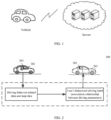
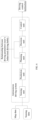
- FIG. 1 is a schematic diagram illustrating a kind of system architecture to which an embodiment of the present invention may be applicable.
- the system architecture includes a vehicle and a server therein.
- the vehicle and the server can be connected via a network.
- the network may be any type of network, e.g., a wired or wireless local area network, a wide area network such as the Internet, a cellular network, a satellite network, or a combination thereof.
- the server may be any type of server or server cluster, such as a network or cloud server, an application server, a backend server, or a combination thereof.
- the server may be a data analysis server, a content server, a traffic information server, a map and point of interest server, a location server, or the like.
- the server may be a cloud server, also known as a cloud computing server or a cloud host, which is a host product in a cloud computing service system to overcome defects of difficult management and weak business scalability existing in a traditional physical host and a VPS service ("Virtual Private Server", or "VPS" for short).
- the server may also be a server of a distributed system, or a server combined with a blockchain.
- FIG. 2 is a schematic diagram illustrating an application scenario to which an embodiment of the present invention may be applicable.
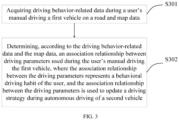
- a user 201 may collect data related to driving behavior of the user 201 and map data while driving a vehicle 202. Based on the collected data, the user's behavioral driving habit may be determined. The behavioral driving habit may provide the user 201 with a personalized driving experience when the user 201 is in autonomous driving or riding in a vehicle 203.
- the vehicle 203 will follow a preset unified autonomous driving strategy during autonomous driving, or select a gear among several limited gears (for example: the aggressive gear, the ordinary gear, and the conservative gear), whereas the driving style provided in this manner cannot meet personalized driving requirements from different users.
- a behavioral driving habit of the user 201 is determined according to the driving behavior-related data collected by the user 201 during manual driving the vehicle 202 and the map data, and the vehicle 203 is guided to perform autonomous driving according to the behavioral driving habit of the user 201, therefore, the autonomous driving process of the vehicle 203 is rendered to be like a situation where the user 201 performs driving by himself/herself, thereby improving a driving experience of the user 201.
- the behavioral driving habit of the user 201 may be expressed with an association relationship between driving parameters used during manual driving the vehicle 202 by the user 201, where the driving parameter may be a parameter from "driving behavior-related data and map data".
- the driving parameter may also be a parameter required in the autonomous driving strategy.
- the driving parameter may be, but is not limited to: a vehicle-following distance, a lane-changing frequency, a steering avoidance range, a lateral distance, horizontal control, accelerator pedal control, or brake pedal control.
- the vehicle 203 may be a fully autonomous driving vehicle or a highly autonomous driving vehicle. If the vehicle 203 is a partially autonomous driving vehicle or a driving-assisted vehicle, the user 201 may be the driver of the vehicle. If the vehicle 203 is a fully autonomous driving vehicle or a highly autonomous driving vehicle, the user 201 may be a passenger of the vehicle 203, and the user 201 may sit in the driver seat, the passenger seat or the rear seat of the vehicle.
- the vehicle status information refers to information for describing driving status of the first vehicle, including but not limited to: a distance to a preceding vehicle (a distance between the first vehicle and the preceding vehicle), a lateral distance (a distance between the first vehicle and a side vehicle), a speed of the first vehicle, an acceleration of the first vehicle, a location of the first vehicle, etc.
- the vehicle status information may be collected by a sensor installed in a unit associated with the first vehicle. For example, the distance to the preceding vehicle and the lateral distance may be collected by millimeter wave radar and/or a camera.
- the acceleration of the first vehicle may be collected by an acceleration sensor, and the location of the first vehicle may be collected by a positioning apparatus.
- the speed of the first vehicle may be obtained by reading data from a dashboard.
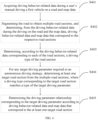
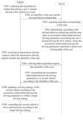
- S302 determining, according to the driving behavior-related data and the map data, an association relationship between driving parameters used during the user's manual driving the first vehicle, where the association relationship between the driving parameters represents a behavioral driving habit of the user, and the association relationship between the driving parameters is used to update a driving strategy during autonomous driving of a second vehicle.
- the association relationship between the driving parameters used during the user's manual driving the first vehicle is obtained by learning the aforementioned driving behavior-related data and the map data. It should be noted that a specific learning process is not limited in the present embodiment. For several possible implementations, reference may be made to the detailed description of the subsequent embodiments.
- the driving parameter in the present embodiment is a parameter from "driving behavior-related data and map data".
- the driving parameter is also a parameter required in the autonomous driving strategy.
- the driving parameter may be, but is not limited to: a vehicle-following distance, a lane-changing frequency, a steering avoidance range, a lateral distance, horizontal control, accelerator pedal control, or brake pedal control.
- the target driving parameter may be a driving parameter required in the autonomous driving strategy. Then, a driving parameter relationship corresponding to the respective target driving parameter according to the driving behavior-related data and the map data is determined.
- the behavioral driving habit of the user may be identified by learning the driving behavior-related data during the user's manual driving the first vehicle and the map data, furthermore, an autonomous driving strategy of a second vehicle may be updated according to the behavioral driving habit of the user, so that the autonomous driving process of the second vehicle is rendered to be like a situation where the user performs driving by himself/herself, thereby improving a driving experience of the user and meeting personalized autonomous driving requirements from different users.
- the road may be segmented according to road section information of the road in a map to obtain multiple road sections.
- each road section may have a length of 200 meters, or each road section may have a length of 1 kilometer.
- the driving behavior-related data may also be mapped to a map, and then driving trajectories of the first vehicle may be combined and segmented according to road section information of the road on the map and a change of driving status of the first vehicle to obtain multiple road sections. In this way, after the road is divided into the multiple road sections, driving behavior-related data and map data that correspond to each road section may be obtained.
- the method may further include: for any road section of the multiple road sections, determining, according to driving behavior-related data and map data that correspond to the road section, whether the user has a preset dangerous driving behavior in the road section, where the preset dangerous driving behavior includes, but is not limited to: sudden braking, sharp turning, speeding, peccancy driving, or the like. If there is the preset dangerous behavior, the driving behavior-related data and the map data that correspond to the road section should be deleted. Therefore, the data corresponding to the road section is prevented from being involved in a subsequent learning process, thereby ensuring the safety of a subsequently learned behavioral driving habit of the user.
- the driving type of the road section is divided into two: one is the user manipulation type, that is, the user actively initiates a change in driving status; and the other is the driving maintenance type, that is, the first vehicle is maintained in stable driving status.
- the driving parameter relationship corresponding to the "vehicle-following distance" determined through the aforementioned S401 to S405 indicates that the user is accustomed to keeping a very short distance to a preceding vehicle
- the driving parameter relationship corresponding to the "vehicle-following distance” may be deleted, or the driving parameter relationship corresponding to the "vehicle-following distance” may be processed.
- the learned driving parameter relationship does not contain the relationship between the first target driving parameter and the preset reference driving parameter since some specific scenarios do not exist in the collected manual driving data.
- the relationship between the first target driving parameter and the preset reference driving parameter may be supplemented in the driving parameter relationship.
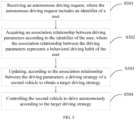
- the method for controlling vehicle driving includes: receiving an autonomous driving request, where the autonomous driving request includes an identifier of a user; acquiring an association relationship between driving parameters according to the identifier of the user, where the association relationship between the driving parameters represents a behavioral driving habit of the user; updating, according to the association relationship between the driving parameters, a driving strategy of a vehicle, e.g. the above-described second vehicle, to obtain a target driving strategy; and controlling the vehicle to drive autonomously according to the target driving strategy.
- the vehicle after acquiring an association relationship between driving parameters, the vehicle will update the autonomous driving system according to the association relationship between the driving parameters.
- the planning unit and the decision unit of the autonomous driving system will receive the association relationship between the driving parameters.
- the planning unit and the decision unit will update original autonomous driving strategy in a form of overwriting original driving parameters and/or newly adding driving parameters, so that there is an updated target driving strategy in the autonomous driving system.
- the autonomous driving system controls the vehicle according to the updated target driving strategy.
- the first vehicle collects driving behavior-related data during a user's manual driving the first vehicle on a road.
- S702 the first vehicle transmits an identifier of the user and the driving behavior-related data to the server.
- S703 the server acquires map data corresponding to the road.
- S704 the server determines, according to the driving behavior-related data and the map data, an association relationship between driving parameters used during the user's manual driving the first vehicle, where the association relationship between the driving parameters represents a behavioral driving habit of the user.
- the second vehicle transmits a behavioral driving habit acquisition request to the server, where the behavioral driving habit acquisition request includes the identifier of the user.
- S707 the server transmits the association relationship between the driving parameters to the second vehicle according to the identifier of the user.
- S708 the second vehicle updates a driving strategy of the second vehicle according to the association relationship between the driving parameters to obtain a target driving strategy.
- S709 the second vehicle is controlled by the second vehicle to drive autonomously according to the target driving strategy.
- FIG. 8 is a schematic structural diagram illustrating an apparatus for determining a behavioral driving habit according to an embodiment of the present invention.
- the apparatus in the present embodiment may be in a form of software and/or hardware.
- the apparatus may be provided in a vehicle, for example, the apparatus may be provided in an on-board unit or in a vehicle-mounted device.
- the apparatus may also be provided in a server.
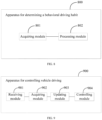
- an apparatus 800 for determining a behavioral driving habit includes: an acquiring module 801 and a processing module 802.
- the acquiring module 801 is configured to acquire driving behavior-related data during a user's manual driving a first vehicle on a road and map data.
- the processing module 802 is configured to determine, according to the driving behavior-related data and the map data, an association relationship between driving parameters used during the user's manual driving the first vehicle, where the association relationship between the driving parameters represents a behavioral driving habit of the user, and the association relationship between the driving parameters is used to update a driving strategy during autonomous driving of a second vehicle.
- the processing module 802 includes:
- the road includes multiple road sections, and a type of each of the driving parameters is a user manipulation type or a driving maintenance type; the second determining unit includes:
- the second determining subunit is specifically configured to:
- the second determining subunit is specifically configured to:
- the second determining unit further includes:
- the fourth determining subunit is specifically configured to: determine, according to the driving behavior-related data corresponding to the road section, whether the vehicle has a preset driving behavior in the road section, where the preset driving behavior includes at least one of: lane-changing, overtaking, turning and braking;
- the second determining unit further includes: a deleting subunit, configured to determine for any road section of the multiple road sections, according to driving behavior-related data and map data that correspond to the road section, whether the user has a preset dangerous driving behavior in the road section; and if yes, delete the driving behavior-related data and the map data that correspond to the road section.
- a deleting subunit configured to determine for any road section of the multiple road sections, according to driving behavior-related data and map data that correspond to the road section, whether the user has a preset dangerous driving behavior in the road section; and if yes, delete the driving behavior-related data and the map data that correspond to the road section.
- the processing module 802 further includes a processing unit configured to:
- the apparatus provided in the present embodiment can be used to implement the method for determining a behavioral driving habit in the aforementioned method embodiments; implementation principles and technical effects therebetween are similar, and details will not be described here again.
- FIG. 9 is a schematic structural diagram illustrating an apparatus for controlling vehicle driving according to an embodiment of the present invention.
- the apparatus in the present embodiment may be in a form of software and/or hardware.
- the apparatus may be provided in a vehicle, for example, the apparatus may be provided in an on-board unit or in a vehicle-mounted device.
- an apparatus 900 for controlling vehicle driving according to the present embodiment includes: a receiving module 901, an acquiring module 902, an updating module 903 and a controlling module 904.
- the receiving module 901 is configured to receive an autonomous driving request, where the autonomous driving request includes an identifier of a user.
- the acquiring module 902 is configured to acquire an association relationship between driving parameters according to the identifier of the user, where the association relationship between the driving parameters represents a behavioral driving habit of the user.
- the controlling module 904 is configured to control the vehicle to drive autonomously according to the target driving strategy.
- the acquiring module 902 includes:
- the association relationship between the driving parameters is obtained using the method for determining a behavioral driving habit according to the aforementioned embodiments.
- the apparatus provided in the present embodiment can be used to implement the method for controlling vehicle driving in the aforementioned method embodiments; implementation principles and technical effects therebetween are similar, and details will not be described here again.
- the present invention also provides an electronic device and a readable storage medium.
- the electronic device may be an on-board unit in a vehicle or other vehicle-mounted device.
- the electronic device may also be a server.
- the present invention also provides a computer program product, where the computer program product includes a computer program stored in a readable storage medium, at least one processor of an electronic device may read the computer program from the readable medium storage, and the at least one processor executes the computer program to enable the electronic device to execute the solution provided in any one of the aforementioned embodiments.
- the present invention further provides a computer program stored in a readable storage medium, where at least one processor of an electronic device can read the computer program from the readable storage medium, and the at least one processor executes the computer program to enable the electronic device to execute the solution according to any one of the aforementioned embodiments.
- FIG. 10 shows a schematic block diagram illustrating an exemplary electronic device 1000 which can be used to implement an embodiment of the present invention.
- the electronic device is intended to represent various forms of digital computers, such as a laptop computer, a desktop computer, a workstation, a personal digital assistant, a server, a blade server, a mainframe computer and other suitable computers.
- the electronic device may also represent various forms of mobile apparatuses, such as a personal digital assistant, a cellular phone, a smart phone, a wearable device and other similar computing apparatuses.
- the components shown herein, their connections and relationships, and their functions are merely exemplary, and are not intended to limit the implementation of the present invention described and/or required herein.
- the electronic device 1000 includes a computing unit 1001, which may perform various appropriate actions and processes according to a computer program stored in a read-only memory (ROM) 1002 or a computer program loaded from a storage unit 1008 to a random access memory (RAM) 1003.
- ROM read-only memory
- RAM random access memory
- various programs and data required for operations of the electronic device 1000 may also be stored.
- the computing unit 1001, the ROM 1002 and the RAM 1003 are connected to each other through a bus 1004.
- An input/output (I/O) interface 1005 is also connected to the bus 1004.
- the I/O interface 1005 Multiple components in the electronic device 1000 are connected to the I/O interface 1005, and the components include: an input unit 1006, such as a keyboard, a mouse, etc.; an output unit 1007, such as various types of displays, speakers, etc.; the storage unit 1008, such as a magnetic disk, an optical disc, etc.; and a communication unit 1009, such as a network card, a modem, a wireless communication transceiver, etc.
- the communication unit 1009 allows the electronic device 1000 to exchange information/data with other devices over a computer network such as Internet and/or various telecommunication networks.
- the computing unit 1001 may be various general-purpose and/or special-purpose processing components with processing and computing capabilities. Some examples of the computing unit 1001 include, but are not limited to, central processing units (CPU), graphic processing units (GPU), various dedicated artificial intelligence (AI) computing chips, various computing units that run machine learning model algorithms, digital signal processors (DSP), and also any appropriate processors, controllers, microcontrollers, etc.
- the computing unit 1001 executes each method and process described above, for example, the method for determining a behavioral driving habit or the method for controlling a vehicle driving.
- Various implementations of the systems and technologies described above herein may be implemented in digital electronic circuit systems, integrated circuit systems, field programmable gate arrays (FPGA), application specific integrated circuits (ASIC), application specific standard parts (ASSP), system-on-chips (SOC), complex programmable logic devices (CPLD), computer hardware, firmware, software, and/or their combination.
- FPGA field programmable gate arrays
- ASIC application specific integrated circuits
- ASSP application specific standard parts
- SOC system-on-chips
- CPLD complex programmable logic devices
- computer hardware firmware, software, and/or their combination.
- the programmable processor may be a special-purpose or general-purpose programmable processor, can receive data and instructions from a storage system, at least one input apparatus and at least one output apparatus, and transmit the data and instructions to the storage system, the at least one input apparatus and the at least one output apparatus.
- the machine-readable medium may be a tangible medium, which may contain or store a program for an instruction execution system, apparatus, or device to use or to be used in combination with the instruction execution system, apparatus, or device.
- the machine-readable medium may be a machine-readable signal medium or a machine-readable storage medium.
- the machine-readable medium may include, but is not limited to, an electronic, magnetic, optical, electromagnetic, infrared, or semiconductor system, apparatus, or device, or any suitable combination of the foregoing.
- machine-readable storage medium More specific examples of the machine-readable storage medium would include an electrically connected portable computer disk based on one or more wires, a hard disk, a random access memory (RAM), a read-only memory (ROM), an erasable programmable read-only memory (EPROM or flash memory), an optical fiber, a portable compact disk read-only memory (CD-ROM), an optical storage device, a magnetic storage device, or any suitable combination of the foregoing.
- RAM random access memory
- ROM read-only memory
- EPROM or flash memory erasable programmable read-only memory
- CD-ROM portable compact disk read-only memory
- magnetic storage device or any suitable combination of the foregoing.
- the systems and techniques described herein can be implemented on a computer, where the computer has: a display apparatus for displaying information to users (for example, a CRT (cathode ray tube) or LCD (liquid crystal display) monitor); and a keyboard and a pointing apparatus (for example, a mouse or a trackball) through which the users can provide input to the computer.
- a display apparatus for displaying information to users
- a keyboard and a pointing apparatus for example, a mouse or a trackball
- Other kinds of apparatuses can also be used to provide interaction with the users; for example, a feedback provided to the users may be any form of sensory feedback (for example, visual feedback, auditory feedback, or tactile feedback); and can receive inputs from the users in any form (including acoustic input, voice input, or tactile input).
Landscapes
- Engineering & Computer Science (AREA)
- Automation & Control Theory (AREA)
- Transportation (AREA)
- Mechanical Engineering (AREA)
- Physics & Mathematics (AREA)
- Human Computer Interaction (AREA)
- Mathematical Physics (AREA)
- Software Systems (AREA)
- Theoretical Computer Science (AREA)
- General Engineering & Computer Science (AREA)
- General Physics & Mathematics (AREA)
- Traffic Control Systems (AREA)
- Navigation (AREA)
- Control Of Driving Devices And Active Controlling Of Vehicle (AREA)
Claims (12)
- Procédé de détermination d'une habitude comportementale de conduite, comprenant :l'acquisition (S301) de données liées au comportement de conduite pendant une conduite manuelle d'un utilisateur d'un premier véhicule sur une route et de données cartographiques ; etla détermination (S302), en fonction des données liées au comportement de conduite et des données cartographiques, d'une relation d'association entre des paramètres de conduite utilisés pendant la conduite manuelle de l'utilisateur du premier véhicule, dans lequel la relation d'association entre les paramètres de conduite représente une habitude comportementale de conduite de l'utilisateur, et la relation d'association entre les paramètres de conduite est utilisée pour mettre à jour une stratégie de conduite pendant une conduite autonome d'un second véhicule ;dans lequel la détermination (S302), en fonction des données liées au comportement de conduite et des données cartographiques, de la relation d'association entre les paramètres de conduite utilisée pendant la conduite manuelle de l'utilisateur du premier véhicule comprend :la détermination d'au moins un paramètre de conduite cible en fonction de la stratégie de conduite ; etla détermination d'une relation de paramètre de conduite correspondant au paramètre de conduite cible respectif en fonction des données liées au comportement de conduite et des données cartographiques ;dans lequel une relation de paramètre de conduite correspondant à un paramètre de conduite cible comprend le paramètre de conduite cible, au moins un paramètre de conduite de référence correspondant au paramètre de conduite cible et une relation entre le paramètre de conduite cible et le au moins un paramètre de conduite de référence ;caractérisé en ce que la route comprend de multiples sections de route, et un type de chacun des paramètres de conduite est un type manipulation d'utilisateur ou un type maintien de conduite, dans lequel le type manipulation d'utilisateur signifie que l'utilisateur amorce activement une modification d'un état de conduite, et le type maintien de conduite signifie que le premier véhicule est maintenu dans un état de conduite stable ;pour un quelconque paramètre de conduite cible du au moins un paramètre de conduite cible, la détermination de la relation de paramètre de conduite correspondant au paramètre de conduite cible en fonction des données liées au comportement de conduite et des donnée cartographique comprend :la détermination (S404) d'au moins une section de route cible parmi les multiples sections de route, dans lequel un type de conduite correspondant à la section de route cible concorde avec un type du paramètre de conduite cible ; etla détermination (S405) de la relation de paramètre de conduite correspondant au paramètre de conduite cible en fonction des données liées au comportement de conduite et des données cartographiques qui correspondent à la au moins une section de route cible.
- Procédé selon la revendication 1, dans lequel la détermination (S405) de la relation de paramètre de conduite correspondant au paramètre de conduite cible en fonction des données liées au comportement de conduite et des données cartographiques qui correspondent à la au moins une section de route cible comprend :l'extraction, à partir des données liées au comportement de conduite et des données cartographiques qui correspondent à chaque section de route cible, d'une valeur du paramètre de conduite cible, et la détermination, en fonction de la valeur du paramètre de conduite cible et d'une valeur d'un autre paramètre de conduite à partir de la section de route cible, d'une relation entre le paramètre de conduite cible et l'autre paramètre de conduite à partir de la section de route cible ; etla détermination de la relation de paramètre de conduite correspondant au paramètre de conduite cible en fonction de la relation déterminée à partir de la au moins une section de route cible.
- Procédé selon la revendication 1, dans lequel la détermination (S405) de la relation de paramètre de conduite correspondant au paramètre de conduite cible en fonction des données liées au comportement de conduite et des données cartographiques qui correspondent à la au moins une section de route cible comprend :la détermination d'au moins un paramètre de conduite de référence en fonction du paramètre de conduite cible ;l'extraction, à partir des données liées au comportement de conduite et des données cartographiques qui correspondent à chaque section de route cible, d'une valeur du paramètre de conduite cible et d'une valeur du au moins un paramètre de conduite de référence correspondant au paramètre de conduite cible, et la détermination d'une relation entre le paramètre de conduite cible et le au moins un paramètre de conduite de référence en fonction de la valeur du paramètre de conduite cible et de la valeur du au moins un paramètre de conduite de référence correspondant au paramètre de conduite cible ; etla détermination de la relation de paramètre de conduite correspondant au paramètre de conduite cible en fonction de la relation déterminée à partir de la au moins une section de route cible.
- Procédé selon la revendication 1, avant la détermination de la au moins une section de route cible parmi les multiples sections de route, comprenant en outre :la segmentation (S402) de la route pour obtenir les multiples sections de route ;la détermination (S402), à partir des données liées au comportement de conduite pendant la conduite sur la route et des données cartographiques, de données liées au comportement de conduite et de données cartographiques qui correspondent aux sections de route respectives ; etla détermination (S403), en fonction des données liées au comportement de conduite correspondant à chacune des sections de route, d'un type de conduite de la section de route.
- Procédé selon la revendication 4, dans lequel la détermination (S403), en fonction des données liées au comportement de conduite correspondant à chacune des sections de route, du type de conduite de la section de route comprend :la détermination, en fonction des données liées au comportement de conduite correspondant à la section de route, pour établir si le premier véhicule présente un comportement de conduite prédéfini dans la section de route, dans lequel le comportement de conduite prédéfini comprend au moins un parmi : un changement de voie, un dépassement, un virage et un freinage ;si tel est le cas, la détermination que le type de conduite de la section de route est le type manipulation d'utilisateur ; etdans le cas contraire, la détermination que le type de conduite de la section de route est le type maintien de conduite.
- Procédé selon la revendication 4, suite à la détermination (S402), à partir des données liées au comportement de conduite pendant la conduite sur la route et des données cartographiques, de données liées au comportement de conduite et de données cartographiques qui correspondent aux sections de route respectives, comprenant en outre :pour une quelconque section de route des multiples sections de route, la détermination, en fonction des données liées au comportement de conduite et des données cartographiques qui correspondent à la section de route, pour établir si l'utilisateur présente un comportement de conduite dangereux prédéfini dans la section de route ; etsi tel est le cas, la suppression des données liées au comportement de conduite et des données cartographiques qui correspondent à la section de route.
- Procédé selon l'une quelconque des revendications 1 à 6, suite à la détermination de la relation de paramètre de conduite correspondant au paramètre de conduite cible respectif en fonction des données liées au comportement de conduite et des données cartographiques, comprenant en outre :si une habitude comportementale de conduite représentée par une relation de paramètre de conduite correspondant à un premier paramètre de conduite cible présente une sécurité inférieure à un seuil prédéfini, la suppression de la relation de paramètre de conduite correspondant au premier paramètre de conduite cible, ou le traitement de la relation de paramètre de conduite correspondant au premier paramètre de conduite cible pour permettre à une habitude de comportement de conduite représentée par une relation de paramètre de conduite traitée correspondant au premier paramètre de conduite cible de présenter une sécurité supérieure ou égale au seuil prédéfini ; ou,si la relation de paramètre de conduite correspondant au premier paramètre de conduite cible ne tient pas compte d'un paramètre de conduite de référence prédéfini, le traitement de la relation de paramètre de conduite correspondant au premier paramètre de conduite cible avec un modèle prédéfini pour permettre à une relation de paramètre de conduite traitée correspondant au premier paramètre de conduite cible de tenir compte du paramètre de conduite de référence prédéfini et d'une relation entre le premier paramètre de conduite cible et le paramètre de conduite de référence prédéfini ;dans lequel le premier paramètre de conduite cible est l'un quelconque du au moins un paramètre de conduite cible.
- Procédé de commande de conduite de véhicule, comprenant :la réception (S501, S705) d'une demande de conduite autonome, dans lequel la demande de conduite autonome comprend un identifiant d'un utilisateur ;l'acquisition (S502) d'une relation d'association entre des paramètres de conduite en fonction de l'identifiant de l'utilisateur, dans lequel la relation d'association entre les paramètres de conduite représente une habitude comportementale de conduite de l'utilisateur ;la mise à jour (S503, S708), en fonction de la relation d'association entre les paramètres de conduite, d'une stratégie de conduite d'un second véhicule pour obtenir une stratégie de conduite cible ; etla commande (S504, S709) du second véhicule pour qu'il se déplace de façon autonome en fonction de la stratégie de conduite cible ;dans lequel la relation d'association entre les paramètres de conduite est obtenue en utilisant le procédé selon l'une quelconque des revendications 1 à 7.
- Procédé selon la revendication 8, dans lequel la relation d'association entre les paramètres de conduite comprend : une relation de paramètre de conduite correspondant à au moins un paramètre de conduite cible ; pour un quelconque paramètre de conduite cible du au moins un paramètre de conduite cible, la mise à jour (S503, S708), en fonction de la relation d'association entre les paramètres de conduite, de la stratégie de conduite du second véhicule comprend :
la substitution d'une valeur du paramètre de conduite cible dans la stratégie de conduite du second véhicule par une relation de paramètre de conduite correspondant au paramètre de conduite cible. - Procédé selon la revendication 9, dans lequel une relation de paramètre de conduite correspondant à un paramètre de conduite cible comprend le paramètre de conduite cible, au moins un paramètre de conduite de référence correspondant au paramètre de conduite cible et une relation entre le paramètre de conduite cible et le au moins un paramètre de conduite de référence ;la commande (S504, S709) du second véhicule pour qu'il se déplace de façon autonome en fonction de la stratégie de conduite cible comprend ;l'acquisition d'une valeur du au moins un paramètre de conduite de référence correspondant au paramètre de conduite cible en fonction de données de conduite en temps réel du second véhicule et de données cartographiques ;la détermination d'une valeur du paramètre de conduite cible en fonction de la valeur du au moins un paramètre de conduite de référence correspondant au paramètre de conduite cible et de la relation ; etla commande du second véhicule pour qu'il se déplace de façon autonome en fonction de la valeur du paramètre de conduite cible.
- Procédé selon la revendication 8, dans lequel l'acquisition (S502) de la relation d'association entre les paramètres de conduite en fonction de l'identifiant de l'utilisateur comprend :la transmission d'une demande d'acquisition d'habitude comportementale de conduite à un serveur, dans lequel la demande d'acquisition d'habitude comportementale de conduite comprend l'identifiant de l'utilisateur ; etla réception de la relation d'association entre les paramètres de conduite en provenance du serveur.
- Appareil pour déterminer une habitude comportementale de conduite, comprenant :un module d'acquisition (801), configuré pour acquérir des données liées au comportement de conduite pendant une conduite manuelle d'un utilisateur d'un premier véhicule sur une route et des données cartographiques ; etun module de traitement (802), configuré pour déterminer, en fonction des données liées au comportement de conduite et des données cartographiques, une relation d'association entre des paramètres de conduite utilisés pendant la conduite manuelle de l'utilisateur du premier véhicule, dans lequel la relation d'association entre les paramètres de conduite représente une habitude comportementale de conduite de l'utilisateur, et la relation d'association entre les paramètres de conduite est utilisée pour mettre à jour une stratégie de conduite pendant une conduite autonome d'un second véhicule ;dans lequel le module de traitement (802) comprend :une première unité de détermination, configurée pour déterminer au moins un paramètre de conduite cible en fonction de la stratégie de conduite ; etune seconde unité de détermination, configurée pour déterminer une relation de paramètre de conduite correspondant au paramètre de conduite cible respectif en fonction des données liées au comportement de conduite et des données cartographiques ;dans lequel une relation de paramètre de conduite correspondant à un paramètre de conduite cible comprend le paramètre de conduite cible, au moins un paramètre de conduite de référence correspondant au paramètre de conduite cible et une relation entre le paramètre de conduite cible et le au moins un paramètre de conduite de référence ;caractérisé en ce que la route comprend de multiples sections de route, et un type de chacun des paramètres de conduite est un type manipulation d'utilisateur ou un type maintien de conduite, dans lequel le type manipulation d'utilisateur signifie que l'utilisateur amorce activement une modification d'un état de conduite, et le type maintien de conduite signifie que le premier véhicule est maintenu dans un état de conduite stable ;dans lequel pour un quelconque paramètre de conduite cible du au moins un paramètre de conduite cible, la seconde unité de détermination comprend :une première sous-unité de détermination, configurée pour déterminer au moins une section de route cible parmi les multiples sections de route, dans lequel un type de conduite correspondant à la section de route cible concorde avec un type du paramètre de conduite cible ; etune seconde sous-unité de détermination, configurée pour déterminer la relation de paramètre de conduite correspondant au paramètre de conduite cible en fonction des données liées au comportement de conduite et des données cartographiques qui correspondent à la au moins une section de route cible.
Applications Claiming Priority (1)
| Application Number | Priority Date | Filing Date | Title |
|---|---|---|---|
| CN202110414488.2A CN113071505B (zh) | 2021-04-16 | 2021-04-16 | 驾驶行为习惯的确定、车辆行驶控制方法、装置及设备 |
Publications (3)
| Publication Number | Publication Date |
|---|---|
| EP4011740A2 EP4011740A2 (fr) | 2022-06-15 |
| EP4011740A3 EP4011740A3 (fr) | 2023-01-04 |
| EP4011740B1 true EP4011740B1 (fr) | 2023-12-20 |
Family
ID=76617943
Family Applications (1)
| Application Number | Title | Priority Date | Filing Date |
|---|---|---|---|
| EP22168668.6A Active EP4011740B1 (fr) | 2021-04-16 | 2022-04-15 | Procédé et dispositif pour déterminer un comportement de conduite et pour contrôler l'entraînement d'un véhicule |
Country Status (5)
| Country | Link |
|---|---|
| US (1) | US20220242448A1 (fr) |
| EP (1) | EP4011740B1 (fr) |
| JP (1) | JP2022088548A (fr) |
| KR (1) | KR20220054755A (fr) |
| CN (1) | CN113071505B (fr) |
Families Citing this family (19)
| Publication number | Priority date | Publication date | Assignee | Title |
|---|---|---|---|---|
| US11727794B2 (en) * | 2018-03-14 | 2023-08-15 | Micron Technology, Inc. | Systems and methods for evaluating and sharing human driving style information with proximate vehicles |
| US10997429B2 (en) | 2018-04-11 | 2021-05-04 | Micron Technology, Inc. | Determining autonomous vehicle status based on mapping of crowdsourced object data |
| JP7215391B2 (ja) | 2019-10-15 | 2023-01-31 | トヨタ自動車株式会社 | 自動運転車両の車両制御システム及び車両制御装置 |
| CN113654568B (zh) * | 2021-08-09 | 2024-02-20 | 广州大学 | 基于车辆刹车次数的导航方法、装置、介质和设备 |
| KR102588450B1 (ko) * | 2021-11-02 | 2023-10-13 | 주식회사 오비고 | 특정 사용자의 자율주행 경험 만족도 제고를 위한 자율주행 알고리즘 개인화 방법 및 장치 |
| CN113895464B (zh) * | 2021-12-07 | 2022-04-08 | 武汉理工大学 | 融合个性化驾驶风格的智能车驾驶地图生成方法及系统 |
| CN117270383A (zh) * | 2022-06-14 | 2023-12-22 | 上汽通用汽车有限公司 | 用于车辆的自学习方法和系统 |
| KR102620416B1 (ko) * | 2022-07-13 | 2024-01-03 | 국민대학교산학협력단 | 운전자의 핸들 파지 여부에 따라 스티어링 휠을 제어하기 위한 방법 |
| KR102527164B1 (ko) * | 2022-07-13 | 2023-04-28 | 국민대학교산학협력단 | 운전자의 핸들 파지 여부에 따라 복수의 주행 모드를 제공하기 위한 방법 |
| EP4441574A4 (fr) * | 2022-07-27 | 2025-03-19 | Sagar Defence Engineering Private Limited | Module de commande et de contrôle d'auto-apprentissage pour la navigation (genisys) et système associé |
| CN115480870B (zh) * | 2022-09-09 | 2025-11-11 | 智己汽车科技有限公司 | 基于中央计算平台的车辆驾驶场景切换方法及设备 |
| CN115848380A (zh) * | 2022-12-26 | 2023-03-28 | 斑马网络技术有限公司 | 车载情景模式实现方法、装置、设备及存储介质 |
| US12583482B2 (en) | 2023-01-12 | 2026-03-24 | Woven By Toyota, Inc. | Systems and methods for mode confusion avoidance |
| CN116373890B (zh) * | 2023-04-24 | 2024-06-25 | 公安部道路交通安全研究中心 | 车辆自动驾驶合规性的监测方法、监测系统和存储介质 |
| CN116302010B (zh) * | 2023-05-22 | 2023-07-28 | 安徽中科星驰自动驾驶技术有限公司 | 自动驾驶系统升级包生成方法、装置、计算机设备及介质 |
| US20250027789A1 (en) | 2023-07-19 | 2025-01-23 | Toyota Motor North America, Inc. | Validating application response with vehicle operation |
| US12345327B1 (en) | 2024-07-02 | 2025-07-01 | Ford Global Technologies, Llc | Vehicle transmission control system |
| CN118820852B (zh) * | 2024-07-04 | 2026-03-10 | 奇瑞新能源汽车股份有限公司 | 车辆行驶数据的处理方法、装置、存储介质及程序产品 |
| CN118928373B (zh) * | 2024-09-27 | 2025-07-25 | 小米汽车科技有限公司 | 车辆控制方法、装置、车辆、存储介质及程序产品 |
Family Cites Families (13)
| Publication number | Priority date | Publication date | Assignee | Title |
|---|---|---|---|---|
| US9189897B1 (en) * | 2014-07-28 | 2015-11-17 | Here Global B.V. | Personalized driving ranking and alerting |
| CN107368069B (zh) * | 2014-11-25 | 2020-11-13 | 浙江吉利汽车研究院有限公司 | 基于车联网的自动驾驶控制策略的生成方法与生成装置 |
| CN107249954B (zh) * | 2014-12-29 | 2020-07-10 | 罗伯特·博世有限公司 | 用于使用个性化驾驶简档操作自主车辆的系统和方法 |
| EP3357778B1 (fr) * | 2015-09-30 | 2022-10-26 | Sony Group Corporation | Dispositif de commande de conduite, procédé de commande de conduite, et programme |
| CN106184223A (zh) * | 2016-09-28 | 2016-12-07 | 北京新能源汽车股份有限公司 | 一种自动驾驶控制方法、装置及汽车 |
| CN108288312A (zh) * | 2017-03-06 | 2018-07-17 | 腾讯科技(深圳)有限公司 | 驾驶行为确定方法及装置 |
| WO2019122951A1 (fr) * | 2017-12-18 | 2019-06-27 | PlusAI Corp | Procédé et système de planification de voie de circulation de type humain dans des véhicules à conduite autonome |
| WO2020005894A1 (fr) * | 2018-06-25 | 2020-01-02 | Allstate Insurance Company | Configuration logique de systèmes de commande de véhicule sur la base de profils de conducteur |
| CN108827334A (zh) * | 2018-08-09 | 2018-11-16 | 北京智行者科技有限公司 | 一种自动驾驶方法 |
| CN109085837B (zh) * | 2018-08-30 | 2023-03-24 | 阿波罗智能技术(北京)有限公司 | 车辆控制方法、装置、计算机设备及存储介质 |
| US11458974B2 (en) * | 2019-07-08 | 2022-10-04 | Toyota Motor Engineering & Manufacturing North America, Inc. | Fleet-based average lane change and driver-specific behavior modelling for autonomous vehicle lane change operation |
| IT201900013086A1 (it) * | 2019-07-26 | 2021-01-26 | Fiat Ricerche | Personalizzazione del cambio di corsia di marcia in guida autonoma degli autoveicoli sulla base delle abitudini di guida dei conducenti |
| CN112389451A (zh) * | 2019-08-14 | 2021-02-23 | 大众汽车(中国)投资有限公司 | 用于提供个性化驾驶体验的方法、设备、介质以及车辆 |
-
2021
- 2021-04-16 CN CN202110414488.2A patent/CN113071505B/zh not_active Expired - Fee Related
-
2022
- 2022-03-30 JP JP2022055045A patent/JP2022088548A/ja not_active Ceased
- 2022-04-14 US US17/720,437 patent/US20220242448A1/en not_active Abandoned
- 2022-04-15 EP EP22168668.6A patent/EP4011740B1/fr active Active
- 2022-04-15 KR KR1020220047046A patent/KR20220054755A/ko not_active Abandoned
Also Published As
| Publication number | Publication date |
|---|---|
| KR20220054755A (ko) | 2022-05-03 |
| EP4011740A2 (fr) | 2022-06-15 |
| CN113071505B (zh) | 2024-02-13 |
| US20220242448A1 (en) | 2022-08-04 |
| CN113071505A (zh) | 2021-07-06 |
| EP4011740A3 (fr) | 2023-01-04 |
| JP2022088548A (ja) | 2022-06-14 |
Similar Documents
| Publication | Publication Date | Title |
|---|---|---|
| EP4011740B1 (fr) | Procédé et dispositif pour déterminer un comportement de conduite et pour contrôler l'entraînement d'un véhicule | |
| EP3960577B1 (fr) | Procédé et appareil de contrôle de commande de véhicule | |
| CN111123933B (zh) | 车辆轨迹规划的方法、装置、智能驾驶域控制器和智能车 | |
| EP4129789A1 (fr) | Procédé et dispositif de reconnaissance du comportement de conduite d'un véhicule | |
| CN107531244B (zh) | 信息处理系统、信息处理方法、以及记录介质 | |
| CN114771533B (zh) | 自动驾驶车辆的控制方法、装置、设备、车辆及介质 | |
| JP7241972B2 (ja) | ユーザの運転の好みに適応した自動運転車の制御 | |
| EP4074569A1 (fr) | Procédé de détermination de caractéristique de conduite automatique, appareil, dispositif, support et produit-programme | |
| CN115265537B (zh) | 具有交通状态检测机制的导航系统及其操作方法 | |
| CN114771534B (zh) | 自动驾驶车辆的控制方法、训练方法、车辆、设备及介质 | |
| US20190315342A1 (en) | Preference adjustment of autonomous vehicle performance dynamics | |
| US20230242153A1 (en) | Customization and safety verification of autonomous vehicle driving behavior | |
| US20230192077A1 (en) | Adjustment of object trajectory uncertainty by an autonomous vehicle | |
| CN114802250B (zh) | 数据处理方法、装置、设备、自动驾驶车辆及介质 | |
| WO2016170773A1 (fr) | Procédé d'assistance à la conduite, et dispositif d'assistance à la conduite, dispositif de commande de conduite automatique, véhicule, et programme d'assistance à la conduite au moyen dudit procédé | |
| EP4501729B1 (fr) | Procédé de prise de décision de changement de voie, dispositif et support de stockage | |
| WO2023125849A1 (fr) | Procédé et système d'interaction d'affichage pour réglage de distance de suivi de véhicule à régulateur de vitesse adaptatif, procédé et appareil de calcul de distance de freinage, ainsi que véhicule et support | |
| CN115571165B (zh) | 车辆控制方法、装置、电子设备和计算机可读介质 | |
| US12153121B2 (en) | Unified radar perception architecture | |
| CN117953609A (zh) | 自动驾驶车辆的事故数据处理方法、装置、设备和介质 | |
| EP3965017B1 (fr) | Distillation de connaissances pour véhicules autonomes | |
| KR102571986B1 (ko) | 자동차의 운전 행동을 조정하기 위한 방법 | |
| CN119937564B (zh) | 基于伴游车组的控制方法、控制装置、车辆和可读存储介质 | |
| US12586387B2 (en) | Object tracking for vehicle | |
| EP4597467A1 (fr) | Dispositif et procédé de traitement d'informations, système d'aide à la conduite |
Legal Events
| Date | Code | Title | Description |
|---|---|---|---|
| PUAI | Public reference made under article 153(3) epc to a published international application that has entered the european phase |
Free format text: ORIGINAL CODE: 0009012 |
|
| STAA | Information on the status of an ep patent application or granted ep patent |
Free format text: STATUS: REQUEST FOR EXAMINATION WAS MADE |
|
| 17P | Request for examination filed |
Effective date: 20220415 |
|
| AK | Designated contracting states |
Kind code of ref document: A2 Designated state(s): AL AT BE BG CH CY CZ DE DK EE ES FI FR GB GR HR HU IE IS IT LI LT LU LV MC MK MT NL NO PL PT RO RS SE SI SK SM TR |
|
| PUAL | Search report despatched |
Free format text: ORIGINAL CODE: 0009013 |
|
| AK | Designated contracting states |
Kind code of ref document: A3 Designated state(s): AL AT BE BG CH CY CZ DE DK EE ES FI FR GB GR HR HU IE IS IT LI LT LU LV MC MK MT NL NO PL PT RO RS SE SI SK SM TR |
|
| RIC1 | Information provided on ipc code assigned before grant |
Ipc: B60W 50/00 20060101ALN20221129BHEP Ipc: B60W 30/18 20120101ALN20221129BHEP Ipc: B60W 40/09 20120101ALI20221129BHEP Ipc: B60W 60/00 20200101AFI20221129BHEP |
|
| GRAP | Despatch of communication of intention to grant a patent |
Free format text: ORIGINAL CODE: EPIDOSNIGR1 |
|
| STAA | Information on the status of an ep patent application or granted ep patent |
Free format text: STATUS: GRANT OF PATENT IS INTENDED |
|
| RIC1 | Information provided on ipc code assigned before grant |
Ipc: B60W 50/00 20060101ALN20230821BHEP Ipc: B60W 30/18 20120101ALN20230821BHEP Ipc: B60W 40/09 20120101ALI20230821BHEP Ipc: B60W 60/00 20200101AFI20230821BHEP |
|
| INTG | Intention to grant announced |
Effective date: 20230927 |
|
| GRAS | Grant fee paid |
Free format text: ORIGINAL CODE: EPIDOSNIGR3 |
|
| GRAA | (expected) grant |
Free format text: ORIGINAL CODE: 0009210 |
|
| STAA | Information on the status of an ep patent application or granted ep patent |
Free format text: STATUS: THE PATENT HAS BEEN GRANTED |
|
| P01 | Opt-out of the competence of the unified patent court (upc) registered |
Effective date: 20231106 |
|
| AK | Designated contracting states |
Kind code of ref document: B1 Designated state(s): AL AT BE BG CH CY CZ DE DK EE ES FI FR GB GR HR HU IE IS IT LI LT LU LV MC MK MT NL NO PL PT RO RS SE SI SK SM TR |
|
| REG | Reference to a national code |
Ref country code: GB Ref legal event code: FG4D |
|
| REG | Reference to a national code |
Ref country code: DE Ref legal event code: R096 Ref document number: 602022001357 Country of ref document: DE |
|
| REG | Reference to a national code |
Ref country code: CH Ref legal event code: EP |
|
| REG | Reference to a national code |
Ref country code: IE Ref legal event code: FG4D |
|
| PG25 | Lapsed in a contracting state [announced via postgrant information from national office to epo] |
Ref country code: GR Free format text: LAPSE BECAUSE OF FAILURE TO SUBMIT A TRANSLATION OF THE DESCRIPTION OR TO PAY THE FEE WITHIN THE PRESCRIBED TIME-LIMIT Effective date: 20240321 |
|
| REG | Reference to a national code |
Ref country code: LT Ref legal event code: MG9D |
|
| PG25 | Lapsed in a contracting state [announced via postgrant information from national office to epo] |
Ref country code: LT Free format text: LAPSE BECAUSE OF FAILURE TO SUBMIT A TRANSLATION OF THE DESCRIPTION OR TO PAY THE FEE WITHIN THE PRESCRIBED TIME-LIMIT Effective date: 20231220 |
|
| REG | Reference to a national code |
Ref country code: NL Ref legal event code: MP Effective date: 20231220 |
|
| PG25 | Lapsed in a contracting state [announced via postgrant information from national office to epo] |
Ref country code: ES Free format text: LAPSE BECAUSE OF FAILURE TO SUBMIT A TRANSLATION OF THE DESCRIPTION OR TO PAY THE FEE WITHIN THE PRESCRIBED TIME-LIMIT Effective date: 20231220 |
|
| PG25 | Lapsed in a contracting state [announced via postgrant information from national office to epo] |
Ref country code: LT Free format text: LAPSE BECAUSE OF FAILURE TO SUBMIT A TRANSLATION OF THE DESCRIPTION OR TO PAY THE FEE WITHIN THE PRESCRIBED TIME-LIMIT Effective date: 20231220 Ref country code: GR Free format text: LAPSE BECAUSE OF FAILURE TO SUBMIT A TRANSLATION OF THE DESCRIPTION OR TO PAY THE FEE WITHIN THE PRESCRIBED TIME-LIMIT Effective date: 20240321 Ref country code: FI Free format text: LAPSE BECAUSE OF FAILURE TO SUBMIT A TRANSLATION OF THE DESCRIPTION OR TO PAY THE FEE WITHIN THE PRESCRIBED TIME-LIMIT Effective date: 20231220 Ref country code: ES Free format text: LAPSE BECAUSE OF FAILURE TO SUBMIT A TRANSLATION OF THE DESCRIPTION OR TO PAY THE FEE WITHIN THE PRESCRIBED TIME-LIMIT Effective date: 20231220 Ref country code: BG Free format text: LAPSE BECAUSE OF FAILURE TO SUBMIT A TRANSLATION OF THE DESCRIPTION OR TO PAY THE FEE WITHIN THE PRESCRIBED TIME-LIMIT Effective date: 20240320 |
|
| REG | Reference to a national code |
Ref country code: AT Ref legal event code: MK05 Ref document number: 1642243 Country of ref document: AT Kind code of ref document: T Effective date: 20231220 |
|
| PG25 | Lapsed in a contracting state [announced via postgrant information from national office to epo] |
Ref country code: NL Free format text: LAPSE BECAUSE OF FAILURE TO SUBMIT A TRANSLATION OF THE DESCRIPTION OR TO PAY THE FEE WITHIN THE PRESCRIBED TIME-LIMIT Effective date: 20231220 |
|
| PG25 | Lapsed in a contracting state [announced via postgrant information from national office to epo] |
Ref country code: SE Free format text: LAPSE BECAUSE OF FAILURE TO SUBMIT A TRANSLATION OF THE DESCRIPTION OR TO PAY THE FEE WITHIN THE PRESCRIBED TIME-LIMIT Effective date: 20231220 Ref country code: RS Free format text: LAPSE BECAUSE OF FAILURE TO SUBMIT A TRANSLATION OF THE DESCRIPTION OR TO PAY THE FEE WITHIN THE PRESCRIBED TIME-LIMIT Effective date: 20231220 Ref country code: NO Free format text: LAPSE BECAUSE OF FAILURE TO SUBMIT A TRANSLATION OF THE DESCRIPTION OR TO PAY THE FEE WITHIN THE PRESCRIBED TIME-LIMIT Effective date: 20240320 Ref country code: NL Free format text: LAPSE BECAUSE OF FAILURE TO SUBMIT A TRANSLATION OF THE DESCRIPTION OR TO PAY THE FEE WITHIN THE PRESCRIBED TIME-LIMIT Effective date: 20231220 Ref country code: LV Free format text: LAPSE BECAUSE OF FAILURE TO SUBMIT A TRANSLATION OF THE DESCRIPTION OR TO PAY THE FEE WITHIN THE PRESCRIBED TIME-LIMIT Effective date: 20231220 Ref country code: HR Free format text: LAPSE BECAUSE OF FAILURE TO SUBMIT A TRANSLATION OF THE DESCRIPTION OR TO PAY THE FEE WITHIN THE PRESCRIBED TIME-LIMIT Effective date: 20231220 |
|
| PG25 | Lapsed in a contracting state [announced via postgrant information from national office to epo] |
Ref country code: IS Free format text: LAPSE BECAUSE OF FAILURE TO SUBMIT A TRANSLATION OF THE DESCRIPTION OR TO PAY THE FEE WITHIN THE PRESCRIBED TIME-LIMIT Effective date: 20240420 |
|
| PG25 | Lapsed in a contracting state [announced via postgrant information from national office to epo] |
Ref country code: CZ Free format text: LAPSE BECAUSE OF FAILURE TO SUBMIT A TRANSLATION OF THE DESCRIPTION OR TO PAY THE FEE WITHIN THE PRESCRIBED TIME-LIMIT Effective date: 20231220 Ref country code: AT Free format text: LAPSE BECAUSE OF FAILURE TO SUBMIT A TRANSLATION OF THE DESCRIPTION OR TO PAY THE FEE WITHIN THE PRESCRIBED TIME-LIMIT Effective date: 20231220 |
|
| PG25 | Lapsed in a contracting state [announced via postgrant information from national office to epo] |
Ref country code: SK Free format text: LAPSE BECAUSE OF FAILURE TO SUBMIT A TRANSLATION OF THE DESCRIPTION OR TO PAY THE FEE WITHIN THE PRESCRIBED TIME-LIMIT Effective date: 20231220 |
|
| PG25 | Lapsed in a contracting state [announced via postgrant information from national office to epo] |
Ref country code: SM Free format text: LAPSE BECAUSE OF FAILURE TO SUBMIT A TRANSLATION OF THE DESCRIPTION OR TO PAY THE FEE WITHIN THE PRESCRIBED TIME-LIMIT Effective date: 20231220 Ref country code: SK Free format text: LAPSE BECAUSE OF FAILURE TO SUBMIT A TRANSLATION OF THE DESCRIPTION OR TO PAY THE FEE WITHIN THE PRESCRIBED TIME-LIMIT Effective date: 20231220 Ref country code: RO Free format text: LAPSE BECAUSE OF FAILURE TO SUBMIT A TRANSLATION OF THE DESCRIPTION OR TO PAY THE FEE WITHIN THE PRESCRIBED TIME-LIMIT Effective date: 20231220 Ref country code: IT Free format text: LAPSE BECAUSE OF FAILURE TO SUBMIT A TRANSLATION OF THE DESCRIPTION OR TO PAY THE FEE WITHIN THE PRESCRIBED TIME-LIMIT Effective date: 20231220 Ref country code: IS Free format text: LAPSE BECAUSE OF FAILURE TO SUBMIT A TRANSLATION OF THE DESCRIPTION OR TO PAY THE FEE WITHIN THE PRESCRIBED TIME-LIMIT Effective date: 20240420 Ref country code: EE Free format text: LAPSE BECAUSE OF FAILURE TO SUBMIT A TRANSLATION OF THE DESCRIPTION OR TO PAY THE FEE WITHIN THE PRESCRIBED TIME-LIMIT Effective date: 20231220 Ref country code: CZ Free format text: LAPSE BECAUSE OF FAILURE TO SUBMIT A TRANSLATION OF THE DESCRIPTION OR TO PAY THE FEE WITHIN THE PRESCRIBED TIME-LIMIT Effective date: 20231220 Ref country code: AT Free format text: LAPSE BECAUSE OF FAILURE TO SUBMIT A TRANSLATION OF THE DESCRIPTION OR TO PAY THE FEE WITHIN THE PRESCRIBED TIME-LIMIT Effective date: 20231220 |
|
| PG25 | Lapsed in a contracting state [announced via postgrant information from national office to epo] |
Ref country code: PL Free format text: LAPSE BECAUSE OF FAILURE TO SUBMIT A TRANSLATION OF THE DESCRIPTION OR TO PAY THE FEE WITHIN THE PRESCRIBED TIME-LIMIT Effective date: 20231220 Ref country code: PT Free format text: LAPSE BECAUSE OF FAILURE TO SUBMIT A TRANSLATION OF THE DESCRIPTION OR TO PAY THE FEE WITHIN THE PRESCRIBED TIME-LIMIT Effective date: 20240422 |
|
| PG25 | Lapsed in a contracting state [announced via postgrant information from national office to epo] |
Ref country code: PT Free format text: LAPSE BECAUSE OF FAILURE TO SUBMIT A TRANSLATION OF THE DESCRIPTION OR TO PAY THE FEE WITHIN THE PRESCRIBED TIME-LIMIT Effective date: 20240422 Ref country code: PL Free format text: LAPSE BECAUSE OF FAILURE TO SUBMIT A TRANSLATION OF THE DESCRIPTION OR TO PAY THE FEE WITHIN THE PRESCRIBED TIME-LIMIT Effective date: 20231220 |
|
| REG | Reference to a national code |
Ref country code: DE Ref legal event code: R097 Ref document number: 602022001357 Country of ref document: DE |
|
| PG25 | Lapsed in a contracting state [announced via postgrant information from national office to epo] |
Ref country code: DK Free format text: LAPSE BECAUSE OF FAILURE TO SUBMIT A TRANSLATION OF THE DESCRIPTION OR TO PAY THE FEE WITHIN THE PRESCRIBED TIME-LIMIT Effective date: 20231220 |
|
| PLBE | No opposition filed within time limit |
Free format text: ORIGINAL CODE: 0009261 |
|
| STAA | Information on the status of an ep patent application or granted ep patent |
Free format text: STATUS: NO OPPOSITION FILED WITHIN TIME LIMIT |
|
| PG25 | Lapsed in a contracting state [announced via postgrant information from national office to epo] |
Ref country code: SI Free format text: LAPSE BECAUSE OF FAILURE TO SUBMIT A TRANSLATION OF THE DESCRIPTION OR TO PAY THE FEE WITHIN THE PRESCRIBED TIME-LIMIT Effective date: 20231220 |
|
| PG25 | Lapsed in a contracting state [announced via postgrant information from national office to epo] |
Ref country code: SI Free format text: LAPSE BECAUSE OF FAILURE TO SUBMIT A TRANSLATION OF THE DESCRIPTION OR TO PAY THE FEE WITHIN THE PRESCRIBED TIME-LIMIT Effective date: 20231220 Ref country code: DK Free format text: LAPSE BECAUSE OF FAILURE TO SUBMIT A TRANSLATION OF THE DESCRIPTION OR TO PAY THE FEE WITHIN THE PRESCRIBED TIME-LIMIT Effective date: 20231220 |
|
| REG | Reference to a national code |
Ref country code: DE Ref legal event code: R119 Ref document number: 602022001357 Country of ref document: DE |
|
| PG25 | Lapsed in a contracting state [announced via postgrant information from national office to epo] |
Ref country code: MC Free format text: LAPSE BECAUSE OF FAILURE TO SUBMIT A TRANSLATION OF THE DESCRIPTION OR TO PAY THE FEE WITHIN THE PRESCRIBED TIME-LIMIT Effective date: 20231220 |
|
| 26N | No opposition filed |
Effective date: 20240923 |
|
| PG25 | Lapsed in a contracting state [announced via postgrant information from national office to epo] |
Ref country code: MC Free format text: LAPSE BECAUSE OF FAILURE TO SUBMIT A TRANSLATION OF THE DESCRIPTION OR TO PAY THE FEE WITHIN THE PRESCRIBED TIME-LIMIT Effective date: 20231220 |
|
| PG25 | Lapsed in a contracting state [announced via postgrant information from national office to epo] |
Ref country code: LU Free format text: LAPSE BECAUSE OF NON-PAYMENT OF DUE FEES Effective date: 20240415 |
|
| REG | Reference to a national code |
Ref country code: BE Ref legal event code: MM Effective date: 20240430 |
|
| PG25 | Lapsed in a contracting state [announced via postgrant information from national office to epo] |
Ref country code: LU Free format text: LAPSE BECAUSE OF NON-PAYMENT OF DUE FEES Effective date: 20240415 |
|
| PG25 | Lapsed in a contracting state [announced via postgrant information from national office to epo] |
Ref country code: DE Free format text: LAPSE BECAUSE OF NON-PAYMENT OF DUE FEES Effective date: 20241105 |
|
| PG25 | Lapsed in a contracting state [announced via postgrant information from national office to epo] |
Ref country code: BE Free format text: LAPSE BECAUSE OF NON-PAYMENT OF DUE FEES Effective date: 20240430 |
|
| PG25 | Lapsed in a contracting state [announced via postgrant information from national office to epo] |
Ref country code: FR Free format text: LAPSE BECAUSE OF NON-PAYMENT OF DUE FEES Effective date: 20240430 |
|
| PG25 | Lapsed in a contracting state [announced via postgrant information from national office to epo] |
Ref country code: FR Free format text: LAPSE BECAUSE OF NON-PAYMENT OF DUE FEES Effective date: 20240430 Ref country code: DE Free format text: LAPSE BECAUSE OF NON-PAYMENT OF DUE FEES Effective date: 20241105 Ref country code: BE Free format text: LAPSE BECAUSE OF NON-PAYMENT OF DUE FEES Effective date: 20240430 |
|
| PG25 | Lapsed in a contracting state [announced via postgrant information from national office to epo] |
Ref country code: IE Free format text: LAPSE BECAUSE OF NON-PAYMENT OF DUE FEES Effective date: 20240415 |
|
| PG25 | Lapsed in a contracting state [announced via postgrant information from national office to epo] |
Ref country code: CY Free format text: LAPSE BECAUSE OF FAILURE TO SUBMIT A TRANSLATION OF THE DESCRIPTION OR TO PAY THE FEE WITHIN THE PRESCRIBED TIME-LIMIT; INVALID AB INITIO Effective date: 20220415 |
|
| PG25 | Lapsed in a contracting state [announced via postgrant information from national office to epo] |
Ref country code: HU Free format text: LAPSE BECAUSE OF FAILURE TO SUBMIT A TRANSLATION OF THE DESCRIPTION OR TO PAY THE FEE WITHIN THE PRESCRIBED TIME-LIMIT; INVALID AB INITIO Effective date: 20220415 |
|
| REG | Reference to a national code |
Ref country code: CH Ref legal event code: H13 Free format text: ST27 STATUS EVENT CODE: U-0-0-H10-H13 (AS PROVIDED BY THE NATIONAL OFFICE) Effective date: 20251125 |
|
| PG25 | Lapsed in a contracting state [announced via postgrant information from national office to epo] |
Ref country code: CH Free format text: LAPSE BECAUSE OF NON-PAYMENT OF DUE FEES Effective date: 20250430 |