EP4012009A1 - Lubrifiant solide de type sec - Google Patents
Lubrifiant solide de type sec Download PDFInfo
- Publication number
- EP4012009A1 EP4012009A1 EP21205566.9A EP21205566A EP4012009A1 EP 4012009 A1 EP4012009 A1 EP 4012009A1 EP 21205566 A EP21205566 A EP 21205566A EP 4012009 A1 EP4012009 A1 EP 4012009A1
- Authority
- EP
- European Patent Office
- Prior art keywords
- fiber
- lubricant
- liquid
- product
- disposed
- Prior art date
- Legal status (The legal status is an assumption and is not a legal conclusion. Google has not performed a legal analysis and makes no representation as to the accuracy of the status listed.)
- Granted
Links
Images




Classifications
-
- C—CHEMISTRY; METALLURGY
- C10—PETROLEUM, GAS OR COKE INDUSTRIES; TECHNICAL GASES CONTAINING CARBON MONOXIDE; FUELS; LUBRICANTS; PEAT
- C10M—LUBRICATING COMPOSITIONS; USE OF CHEMICAL SUBSTANCES EITHER ALONE OR AS LUBRICATING INGREDIENTS IN A LUBRICATING COMPOSITION
- C10M171/00—Lubricating compositions characterised by purely physical criteria, e.g. containing as base-material, thickener or additive, ingredients which are characterised exclusively by their numerically specified physical properties, i.e. containing ingredients which are physically well-defined but for which the chemical nature is either unspecified or only very vaguely indicated
- C10M171/06—Particles of special shape or size
-
- C—CHEMISTRY; METALLURGY
- C08—ORGANIC MACROMOLECULAR COMPOUNDS; THEIR PREPARATION OR CHEMICAL WORKING-UP; COMPOSITIONS BASED THEREON
- C08K—Use of inorganic or non-macromolecular organic substances as compounding ingredients
- C08K9/00—Use of pretreated ingredients
- C08K9/04—Ingredients treated with organic substances
- C08K9/06—Ingredients treated with organic substances with silicon-containing compounds
-
- C—CHEMISTRY; METALLURGY
- C10—PETROLEUM, GAS OR COKE INDUSTRIES; TECHNICAL GASES CONTAINING CARBON MONOXIDE; FUELS; LUBRICANTS; PEAT
- C10M—LUBRICATING COMPOSITIONS; USE OF CHEMICAL SUBSTANCES EITHER ALONE OR AS LUBRICATING INGREDIENTS IN A LUBRICATING COMPOSITION
- C10M161/00—Lubricating compositions characterised by the additive being a mixture of a macromolecular compound and a non-macromolecular compound, each of these compounds being essential
-
- B—PERFORMING OPERATIONS; TRANSPORTING
- B65—CONVEYING; PACKING; STORING; HANDLING THIN OR FILAMENTARY MATERIAL
- B65G—TRANSPORT OR STORAGE DEVICES, e.g. CONVEYORS FOR LOADING OR TIPPING, SHOP CONVEYOR SYSTEMS OR PNEUMATIC TUBE CONVEYORS
- B65G47/00—Article or material-handling devices associated with conveyors; Methods employing such devices
- B65G47/34—Devices for discharging articles or materials from conveyor
- B65G47/44—Arrangements or applications of hoppers or chutes
-
- C—CHEMISTRY; METALLURGY
- C08—ORGANIC MACROMOLECULAR COMPOUNDS; THEIR PREPARATION OR CHEMICAL WORKING-UP; COMPOSITIONS BASED THEREON
- C08K—Use of inorganic or non-macromolecular organic substances as compounding ingredients
- C08K5/00—Use of organic ingredients
- C08K5/01—Hydrocarbons
-
- C—CHEMISTRY; METALLURGY
- C08—ORGANIC MACROMOLECULAR COMPOUNDS; THEIR PREPARATION OR CHEMICAL WORKING-UP; COMPOSITIONS BASED THEREON
- C08K—Use of inorganic or non-macromolecular organic substances as compounding ingredients
- C08K7/00—Use of ingredients characterised by shape
- C08K7/02—Fibres or whiskers
-
- C—CHEMISTRY; METALLURGY
- C08—ORGANIC MACROMOLECULAR COMPOUNDS; THEIR PREPARATION OR CHEMICAL WORKING-UP; COMPOSITIONS BASED THEREON
- C08L—COMPOSITIONS OF MACROMOLECULAR COMPOUNDS
- C08L1/00—Compositions of cellulose, modified cellulose or cellulose derivatives
- C08L1/02—Cellulose; Modified cellulose
-
- C—CHEMISTRY; METALLURGY
- C10—PETROLEUM, GAS OR COKE INDUSTRIES; TECHNICAL GASES CONTAINING CARBON MONOXIDE; FUELS; LUBRICANTS; PEAT
- C10M—LUBRICATING COMPOSITIONS; USE OF CHEMICAL SUBSTANCES EITHER ALONE OR AS LUBRICATING INGREDIENTS IN A LUBRICATING COMPOSITION
- C10M177/00—Special methods of preparation of lubricating compositions; Chemical modification by after-treatment of components or of the whole of a lubricating composition, not covered by other classes
-
- C—CHEMISTRY; METALLURGY
- C08—ORGANIC MACROMOLECULAR COMPOUNDS; THEIR PREPARATION OR CHEMICAL WORKING-UP; COMPOSITIONS BASED THEREON
- C08K—Use of inorganic or non-macromolecular organic substances as compounding ingredients
- C08K2201/00—Specific properties of additives
- C08K2201/016—Additives defined by their aspect ratio
-
- C—CHEMISTRY; METALLURGY
- C08—ORGANIC MACROMOLECULAR COMPOUNDS; THEIR PREPARATION OR CHEMICAL WORKING-UP; COMPOSITIONS BASED THEREON
- C08K—Use of inorganic or non-macromolecular organic substances as compounding ingredients
- C08K2201/00—Specific properties of additives
- C08K2201/018—Additives for biodegradable polymeric composition
-
- C—CHEMISTRY; METALLURGY
- C10—PETROLEUM, GAS OR COKE INDUSTRIES; TECHNICAL GASES CONTAINING CARBON MONOXIDE; FUELS; LUBRICANTS; PEAT
- C10M—LUBRICATING COMPOSITIONS; USE OF CHEMICAL SUBSTANCES EITHER ALONE OR AS LUBRICATING INGREDIENTS IN A LUBRICATING COMPOSITION
- C10M2209/00—Organic macromolecular compounds containing oxygen as ingredients in lubricant compositions
- C10M2209/10—Macromolecular compoundss obtained otherwise than by reactions only involving carbon-to-carbon unsaturated bonds
- C10M2209/102—Polyesters
-
- C—CHEMISTRY; METALLURGY
- C10—PETROLEUM, GAS OR COKE INDUSTRIES; TECHNICAL GASES CONTAINING CARBON MONOXIDE; FUELS; LUBRICANTS; PEAT
- C10M—LUBRICATING COMPOSITIONS; USE OF CHEMICAL SUBSTANCES EITHER ALONE OR AS LUBRICATING INGREDIENTS IN A LUBRICATING COMPOSITION
- C10M2209/00—Organic macromolecular compounds containing oxygen as ingredients in lubricant compositions
- C10M2209/12—Polysaccharides, e.g. cellulose, biopolymers
-
- C—CHEMISTRY; METALLURGY
- C10—PETROLEUM, GAS OR COKE INDUSTRIES; TECHNICAL GASES CONTAINING CARBON MONOXIDE; FUELS; LUBRICANTS; PEAT
- C10M—LUBRICATING COMPOSITIONS; USE OF CHEMICAL SUBSTANCES EITHER ALONE OR AS LUBRICATING INGREDIENTS IN A LUBRICATING COMPOSITION
- C10M2217/00—Organic macromolecular compounds containing nitrogen as ingredients in lubricant compositions
- C10M2217/04—Macromolecular compounds from nitrogen-containing monomers obtained otherwise than by reactions only involving carbon-to-carbon unsaturated bonds
-
- C—CHEMISTRY; METALLURGY
- C10—PETROLEUM, GAS OR COKE INDUSTRIES; TECHNICAL GASES CONTAINING CARBON MONOXIDE; FUELS; LUBRICANTS; PEAT
- C10M—LUBRICATING COMPOSITIONS; USE OF CHEMICAL SUBSTANCES EITHER ALONE OR AS LUBRICATING INGREDIENTS IN A LUBRICATING COMPOSITION
- C10M2227/00—Organic non-macromolecular compounds containing atoms of elements not provided for in groups C10M2203/00, C10M2207/00, C10M2211/00, C10M2215/00, C10M2219/00 or C10M2223/00 as ingredients in lubricant compositions
- C10M2227/04—Organic non-macromolecular compounds containing atoms of elements not provided for in groups C10M2203/00, C10M2207/00, C10M2211/00, C10M2215/00, C10M2219/00 or C10M2223/00 as ingredients in lubricant compositions having a silicon-to-carbon bond, e.g. organo-silanes
-
- C—CHEMISTRY; METALLURGY
- C10—PETROLEUM, GAS OR COKE INDUSTRIES; TECHNICAL GASES CONTAINING CARBON MONOXIDE; FUELS; LUBRICANTS; PEAT
- C10N—INDEXING SCHEME ASSOCIATED WITH SUBCLASS C10M RELATING TO LUBRICATING COMPOSITIONS
- C10N2020/00—Specified physical or chemical properties or characteristics, i.e. function, of component of lubricating compositions
- C10N2020/01—Physico-chemical properties
- C10N2020/055—Particles related characteristics
- C10N2020/061—Coated particles
-
- C—CHEMISTRY; METALLURGY
- C10—PETROLEUM, GAS OR COKE INDUSTRIES; TECHNICAL GASES CONTAINING CARBON MONOXIDE; FUELS; LUBRICANTS; PEAT
- C10N—INDEXING SCHEME ASSOCIATED WITH SUBCLASS C10M RELATING TO LUBRICATING COMPOSITIONS
- C10N2020/00—Specified physical or chemical properties or characteristics, i.e. function, of component of lubricating compositions
- C10N2020/01—Physico-chemical properties
- C10N2020/055—Particles related characteristics
- C10N2020/063—Fibrous forms
-
- C—CHEMISTRY; METALLURGY
- C10—PETROLEUM, GAS OR COKE INDUSTRIES; TECHNICAL GASES CONTAINING CARBON MONOXIDE; FUELS; LUBRICANTS; PEAT
- C10N—INDEXING SCHEME ASSOCIATED WITH SUBCLASS C10M RELATING TO LUBRICATING COMPOSITIONS
- C10N2020/00—Specified physical or chemical properties or characteristics, i.e. function, of component of lubricating compositions
- C10N2020/01—Physico-chemical properties
- C10N2020/081—Biodegradable compounds
-
- C—CHEMISTRY; METALLURGY
- C10—PETROLEUM, GAS OR COKE INDUSTRIES; TECHNICAL GASES CONTAINING CARBON MONOXIDE; FUELS; LUBRICANTS; PEAT
- C10N—INDEXING SCHEME ASSOCIATED WITH SUBCLASS C10M RELATING TO LUBRICATING COMPOSITIONS
- C10N2030/00—Specified physical or chemical properties which is improved by the additive characterising the lubricating composition, e.g. multifunctional additives
- C10N2030/06—Oiliness; Film-strength; Anti-wear; Resistance to extreme pressure
-
- C—CHEMISTRY; METALLURGY
- C10—PETROLEUM, GAS OR COKE INDUSTRIES; TECHNICAL GASES CONTAINING CARBON MONOXIDE; FUELS; LUBRICANTS; PEAT
- C10N—INDEXING SCHEME ASSOCIATED WITH SUBCLASS C10M RELATING TO LUBRICATING COMPOSITIONS
- C10N2050/00—Form in which the lubricant is applied to the material being lubricated
- C10N2050/08—Solids
Definitions
- a product dispensing and/or distribution system can be used to dispense or distribute a target product.
- an agricultural planter may comprise a hopper filled with target seed that is dispensing and plated into a field during operation.
- a cosmetic or pharmaceutical dispensing system may be used during production of a target product; and a food ingredient dispending system may be used to dispense a target ingredient during production of a particular food item.
- the various products can be subjected to friction and mechanical stresses that lead to clumping, jamming, doming, and other flow-related problems, which can lead to undesired dispensing issues.
- a dry-type lubricant for use in a dry product hopper to help improve dry product flow and to improve anti-jamming properties of the dry product.
- the addition of a dry lubricant can help mitigate jamming, and can improve flow of the product.
- a lubricant can provide lubrication properties when mechanical stress is applied, such as weight or pressure applied by the product stacked in the hopper, or when electrostatic charges are generated by friction.
- the mechanical stress can result in water moving from inside the lubricant to the outside of the lubricant, which provides anti-jamming properties and improves flow of the product in the hopper.
- the surface properties of the lubricant may provide for dissipation of the charge build-up.
- a lubricant for use in a hopper fed system can comprise a hydrophilic fiber having a width to length aspect ratio of at least greater than 1. Further, a plurality of hydrophobic particles can be respectively disposed on the surface of the fiber, resulting in a fiber surface exhibiting amphiphobic properties.
- the fiber can operably absorb water, and releases the absorbed water to the surface of the fiber under mechanical stress. This can result in the water being disposed on the surface of the fiber, thereby operably providing lubrication to a product in a hopper to improve flow and anti-jamming characteristics of the product in the hopper.
- the fibers can comprise a positive charge.
- a plurality of particle disposed on the surface of the fiber can comprise a negative charge.
- the combination of the positively charged fiber and negatively charged particles provides for the lubricant to operably mitigate charges that may build up on a surface of a flowing product when subjected to friction, by discharging the electrostatic charge from either the surface of the fiber or the attached particles.
- the dissipation of charges can provide for improved flow and mitigate doming, jamming and other product flow issues in a dispensing or distribution system.
- the fibers can comprise a negative charge.
- the plurality of particle disposed on the surface of the fiber can comprise a positive charge, to achieve a similar result.
- a lubricant can be devised for use in a dry product hopper to help improve dry product flow and to improve anti-jamming properties of the dry product. That is, for example, some dry products are susceptible to jamming in a hopper, and/or may not flow effectively during dispensing from the hopper.
- a dry product such as a seed, can jam together to form a blockage that can slow down dispensing of the product from the hopper.
- the addition of a dry lubricant can help mitigate jamming and can improve flow of the product.
- a lubricant can provide lubrication properties when mechanical stress is applied, such as weight or pressure applied by the product stacked in the hopper. In this implementation, the mechanical stress can result in water moving from inside the lubricant to the outside of the lubricant, which provides anti-jamming properties and improves flow of the product in the hopper.
- a lubricant may be desirable to improve flow of a product, such as seed, fertilizer, or some other pellet-shaped product, from the hopper to a dispensing or output location.
- a product such as seed, fertilizer, or some other pellet-shaped product
- a lubricant product that comprise a relatively thin aspect ratio (e.g., greater than 1 length to width; length greater than width), such as a fiber
- a relatively thin aspect ratio e.g., greater than 1 length to width; length greater than width
- a fiber can distribute stress forces linearly to help spread out the stress forces.
- certain cross-section shapes of a fiber lubricant may provide improved stress force distribution over others. For example, while rectangular, or other polygonal cross-sectional shapes may provide for good stress re-distribution, a cylindrical cross-section shape may provide superior stress force distribution, and therefore, improved lubricity.
- a lubricant can comprise a fiber 102 that has a width to length aspect ratio of at least greater than 1 length to width. That is, for example, the length of the fiber 102 can be at least greater than the width of the fiber.
- the width to length aspect ratio can comprise a ratio in the range from 1:1.1 to 1:15 (e.g., 1:4). In other implementation, the width to length aspect ratio may be higher than 1:15, or lower than 1:1.1. As an example, the length to width aspect ratio may be determined by the type of fiber 102, the source of the fiber 102, and/or the method of processing the fiber 102.
- the fiber can comprise a natural biodegradable polymer, such as cellulose, starch, lignin, collagen, silk, and/or protein.
- the fiber can comprise (e.g., or further comprise) a synthetic biodegradable polymers such as polyglycolic acid (PGA), polylactic acid (PLA), polycaprolactone (PCL), polydioxanone (PDS), and/or polyhydroxybutyrate (PHB).
- PGA polyglycolic acid
- PLA polylactic acid
- PCL polycaprolactone
- PDS polydioxanone
- PHS polyhydroxybutyrate
- the fiber comprises hydrophilic properties, such that water (e.g., or other appropriate liquid) is attracted to the fiber, and may be absorbed by the fiber.
- the fiber may comprise reactive moieties, such as hydroxyl groups, disposed on the surface of the fiber.
- fibers that provide similar properties may be used instead of or in conjunction with these fibers.
- the fiber(s) can be selected based upon the intended use. That is, for example, biodegradable fibers of a certain type may be used in a seed planter based on the properties of the seeds, the type of equipment used, and the environment.
- food safe fibers may be chosen for use in food product manufacture or dispensing systems; and those that are safe for use, and approved by an appropriate agency, could be used in cosmetic or pharmaceutical manufacture or dispensing.
- the lubricant can further comprise a plurality of hydrophobic particles 104 respectively disposed on the surface of the fiber 102.
- the resulting fiber has a fiber surface that exhibits amphiphobic properties. That is, for example, the lubricant fiber 102 can display both hydrophilic and hydrophobic properties.
- a cellulose base of the fiber 102 may be hydrophilic, while the hydrophobic particles 104 disposed on the surface are hydrophobic.
- a liquid 150, such as water that is disposed in the core of the cellulose fiber can be expressed to the surface under pressure and disposed as a thin layer on the surface of the fiber 102, such as disposed between and/or around the hydrophobic particles 104.
- the lubricant can be utilized in a product dispenser, and when the lubricant is subjected to mechanical stress, it may provide lubricity to the product, to improve flow of the product in and from the dispenser.
- liquids e.g., other than water
- other liquids may be used to provide lubrication as appropriate, such as glycol, glycerine, oils, and low melting-point solids (e.g., waxes) that can be readily adsorbed from the core of the fiber to the surface.
- glycol and glycerine may be useful in humid environments where over hydration with water can result in clustering of the lubricant and/or product.
- the liquid disposed in the core of the fiber can be Newtonian or non-Newtonian, which can be determined by the magnitude of stress that is needed to trigger the adsorption of the liquid to the surface from the core.
- the liquid can comprise an apriori physisorbed, low-modulus material that can be tuned to be released to the surface of the fiber based on the magnitude of stress provided. That is, for example, the lubricity of the fiber can be autonomously self-adjusted based on the magnitude of stress by releasing such a material to the surface to alter the surface chemistry and increase lubricity. In this example, the alteration of the surface chemistry can be reversed upon reduction of the stress, thereby absorbing the material into the core of the fiber, and reverting the surface to an amphiphobic state (e.g., 140 of FIGURE 1 ).
- an amphiphobic state e.g. 140 of FIGURE 1
- lubricant, lubrication, and/or lubricity are used to describe properties that include, but are not limited to, minimizing and/or mitigating friction for the product being dispensed. That is, between individual product particles, the product and a container in which they are held or dispensed, the product and other parts of a dispensing systems, such as tubes/piping/plumbing, valves, dispensing mechanicals, and/or other parts where jamming, doming, clumping, clustering, flow disruption, or otherwise a perturbed flow of the product through the system may occur.
- a dispensing systems such as tubes/piping/plumbing, valves, dispensing mechanicals, and/or other parts where jamming, doming, clumping, clustering, flow disruption, or otherwise a perturbed flow of the product through the system may occur.
- Lubrication can be provided by the fiber properties, a liquid disposed on the surface of the fiber, by the amphiphobic properties of the lubricant, and/or by mitigating a static electric charge build-up (e.g., charge dissipation) in the product or parts of the dispensing system in which the product traverses.
- a static electric charge build-up e.g., charge dissipation
- FIGURE 1 illustrates four example phases 100, 120, 140, 160 of one implementation of the innovation described herein.
- the fibers 102 e.g., cellulose fibers
- the fibers 122 have been treated ( R H ), as will be discussed below, to form the hydrophobic particles 104 on the surface of the fibers 102.
- the hydrophobic particles 104 can be disposed at a first distance d 1 from each other, and the fiber 102 can have a first width r 1 .
- the fibers 102 have not been treated with additional liquid such as water.
- the fibers have been treated with water 150, such that the water 150 is absorbed into the fiber body 152, as the fiber body can be hydrophilic.
- the particles 104 can be disposed at a second distance d 2 from each other, and the fiber 102 can have a second width r 2 .
- the second distance d 2 can be greater than the first distance d 1
- the second width r 2 can be greater than the first width r 1 , which may be due the absorption of the water 150.
- the fibers 102 are subjected to stress (e.g., ⁇ xy ), which results in the water 150 being expressed to the surface of the fiber 102 from the body 152 of the fiber 102.
- the water 150 can be disposed between hydrophobic particles 104, on the surface of the fiber 102.
- the particles 104 can be disposed at a third distance d 3 from each other, and the fiber 102 can have a third width r 3 .
- the third distance d 3 can be greater than the first distance d 1 , and less than the second distance d 2 .
- the third width r 3 can be greater than the first width r 1 , and less than the second width r 2 .
- the water 150 has been adsorbed to the surface due to stress ( ⁇ xy ) applied to the fibers 102, essentially expressing the water internally from the fibers 102 to the surface, thereby reducing the fiber width ( r ) and particle distance ( d ).
- treated fibers that comprise hydrophobic particles disposed on the fibers' surfaces can be exposed to water such that the water is absorbed into the treated fibers.
- the now water-absorbed, treated fibers may be used as a lubricant in a product dispenser to improve the product flow in the dispenser. That is, a target product, such as a seed, food product, pharmaceutical, etc. can be introduced into a product dispenser, such as a seed hopper on a planter, in combination with a desired amount of the water-absorbed, treated fibers lubricant.
- a desired amount of the lubricant used with the product can be dependent on a size of the product, size of the product dispenser, configuration of the product dispenser, and/or the amount of product in the dispenser.
- lubricant may be combined with a target product in a central seed dispenser.
- more lubricant may be utilized for non-spherical seeds (e.g., corn) where an increase in jamming may occur, and less lubricant may be utilized for spherical seeds (e.g., soybean) where less jamming is likely to occur.
- the dosage of lubricant can be dependent on the shape and size of the seed, the desired flow speed of the seed output, and/or the type of equipment used.
- stress may be applied to the lubricant at locations in the dispenser where the product is exposed to stress or is likely to exhibit doming, funnel flow, and/or jamming. Such locations may comprise the walls of the dispenser, at a bottom of the dispenser, at a narrowing point in the dispenser, at sharp angles in the dispenser, etc.
- the apriori absorbed liquid can be exuded to the surface between and around the hydrophobic particles, improving lubricity between components of the product, improving flow and mitigating jamming/doming of the product.
- a high aspect ratio of length to width can provide a large surface area, particularly in a cylindrically-shaped fiber leading to redistribution of otherwise localized mechanical stress.
- the hydrophilic particles are relatively randomly spaced on the surface of the fiber.
- the adsorbed liquid is dispersed on the surface of the fiber with the hydrophilic particle to create a slippery (e.g., almost oil-like) surface. This provides an increased surface lubrication, allowing the product to flow with respect to each other, to mitigate jamming and doming, to improve product flow, for example.
- the hydrophilic particles can comprise oligomers, such as polymers that have few repeating molecules.
- FIGURES 2A, 2B, 2C, and 2D are a component diagrams illustrating one example process for creating the oligomers on the surface of a fiber, such as a cellulose fiber 202.
- a cellulose fiber 202 comprises hydroxyl groups 204 on its surface.
- adsorbed water 206 is disposed on the surface of the fiber 202.
- Alkyl-silane 208 can be introduced to the fiber, such as by using an appropriate carrier, which will be described in more detail below.
- the hydroxyl groups 204 and adsorbed water 206 react with the introduced alkyl-silane 208 to attach to the surface of the fiber 202, releasing hydrochloric acid 210 as condensation with the adsorbed water 206 in a vapor phase.
- the silane molecules 212 react with adsorbed water 206 to form an oligomer 212
- oligomerized silane molecules 214 reacts with surface hydroxyl groups of the cellulose to attach to the fiber 202.
- the resulting oligomerized silane molecules 214 can form hydrophobic particles as a polymer on the surface of the fiber.
- respective polymer particles can grow further, into a three-dimensional polymeric particle above the surface, as more adsorbed water is locally removed in this process by the silane 212.
- absorbed water in the core of the cellulose fiber 202 can be expressed to the surface, resulting in continued growth of the particles in the presence of unreacted alkyl-silane 208 with the carrier.
- substantially randomly disposed hydrophobic particles can be formed on, and attached to the surface of the fiber 202.
- the number and size of the resulting hydrophobic particles may be tuned to a desired result by controlling an amount of available surface water and an amount or concentration of alkyl-silane 208 in the carrier that is used to introduce it to the fiber surface.
- Number and size of the hydrophobic particles can be tuned by using the carrier to tune amount of surface adsorbed water that is available to react with the alkyl-silane.
- the respective hydrophobic particles rise to height of from thirty to one-hundred and thirty nanometers from the surface of the fiber 202.
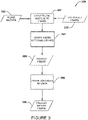
- FIGURE 3 is a flow diagram that illustrates one example implementation of a method 300 for producing a lubricant that may be used to improve product flow in a dispenser.
- the example method 300 begins at 302, where a silane mixture 350 is introduced to a batch of untreated fibers 352.
- the silane mixture 350 can be sprayed onto the untreated fibers 352 to lightly saturate the fibers 352.
- the saturated fibers can be mixed to provide for a more uniform coverage of the silane mixture 350 among the fibers 352, resulting in treated fibers 354.
- the silane mixture 350 can be introduced in the gas phase with an active or inert carrier (e.g., nitrogen) leading to chemical vapor deposition of the reactant.
- an active or inert carrier e.g., nitrogen
- the spraying and mixing process can optionally be performed a plurality of times (e.g., two or more) in order to provide for a more uniform coating of the fibers.
- the coated fibers in between respective spraying and mixing procedures, can optionally be allowed to, at least partially, dry.
- the drying time may be dependent on the amount of fibers being treated and the environmental conditions of the treatment (e.g., humidity, atmospheric pressure, temperature, etc.).
- this spraying, mixing and drying process may be performed at normal room temperature, at normal atmospheric conditions, or can be performed at an elevated temperature of up to 95 °C under reduced atmospheric pressure.
- the treated fiber can be hydrated or infused with an appropriate liquid or low-modulus component.
- this step can be optional, as the treated fibers 354 may be considered as a lubricant.
- the hydration/liquid infusion step may not be part of the process (e.g., but may be added later if needed), such as where high stresses on the product in the container are likely (e.g., where high flow rates are used, such as when a planter is moving at >7.5 mph).
- the fibers can be wetted/infused by spray application of and appropriate liquid, such as water. Further, the wetted/infused, treated fibers can be mixed thoroughly to promote homogenization of the hydration/infusion.
- an appropriate amount of liquid can be sprayed onto the treated fibers to provide for a light coverage, and the fibers can be thoroughly mixed at least until a desired amount of hydration/infusion is achieved.
- the wetted, treated fibers can be mixed in a mechanical blender/mixer to provide for an appropriate consistency.
- the hydrated fiber can be at least partially dried, for example, by being left in the open air (e.g., for five to twenty minutes), which may evaporate some of the bound water/liquid, if any.
- the hydration of the treated fibers results in treated fibers with liquid absorbed into the body of the fibers, as treated, wetted fibers 356.
- the treated fibers 354 may be hydrated by being allowed to absorb water as water vapor (e.g., in a more humid environment), resulting in the treated, wetted fibers 356.
- the treated, wetted fibers comprise substantially randomly, surface disposed hydrophobic particles, with water absorbed in the body of the fiber.
- the treated wetted fibers can be used as a lubricant that is mixed with a product in a product dispenser.
- the silane mixture can comprise trichloro-octyl-silane mixed with an appropriate (e.g., inert, non-polar), carrier fluid, such as hexane.
- an appropriate (e.g., inert, non-polar), carrier fluid such as hexane.
- surface energy between the non-polar carrier fluid and water on the fiber surface can be used to control the polymerization/oligomerization of the silane, as described above.
- the attached hydrophobic particles can grow in height with the evaporation of the non-polar carrier fluid.
- control of water interaction with the silane can be achieved by displacement of capillary water by the non-polar carrier fluid.
- the concentration of the silane can be controlled by the hydrophobicity (e.g., leading to a beading up) of the non-polar carrier fluid into small droplets of the silane mixture on the surface of the bound water (e.g., part of the adsorbed water layer).
- the silane mixture can comprise a mixture of trichloro-octyl-silane and an inert or non-polar carrier, such as hexane or a similar fluid.
- the silane mixture can comprise a ratio of trichloro-octyl-silane to non-polar carrier of one to ten (1:10).
- four milliliters of silane can be mixed with forty milliliters of n-hexane to produce the silane mixture.
- the silane mixture can comprise a ratio range of trichloro-octyl-silane to non-polar carrier from one to five (1:5) to one to fifteen (1:15).
- trichloro-octyl-silane to non-polar carrier may be used, dependent on the desired resulting hydrophobic particle arrangement (e.g., amount, distance, height, size), the type of fiber used, the type of non-polar carrier used, and the target product using the lubricant.
- FIGURE 4 is a flow diagram illustrating one implementation of an example method 400 for producing an untreated fiber that can be used in producing the treated, wetted fibers (e.g., 356).
- the untreated fiber comprises cellulose.
- a bulk fiber stock 450 e.g., cellulose-based raw material
- a cellulose-base product such as wood, plant fiber, paper, etc. comprising a desirable fiber type can be obtained as a bulk fiber stock 450.
- the bulk cellulose-based product can be broken down to smaller, appropriate sizes.
- bulk paper can be torn, cut or otherwise sized into pieces that are manageable for the next step (e.g., paper torn/cut into 2 inch squares).
- a next step e.g., paper torn/cut into 2 inch squares.
- an exact size is not needed, as long as pieces are easy to handle for the blending step.
- smaller pieces may allow fibers to absorb water more rapidly and easily, thus easing the blending step.
- the sized stock 452 can be soaked in water at least until the sized pieces are appropriately (e.g., fully) wetted.
- the heated water can be used (e.g., as hot as practicable), which facilitate the breakdown of the fiber bundles in the sized stock 452.
- the sized stock 452 can be agitated (e.g., mixed) in the water to improve and speed the soaking process.
- the soaked stock product 454, the soaked stock 454 can be blended into a fine slurry. For example, the blending should result in few or no large pieces, resulting in the fine slurry of cellulose fiber.
- the soaked stock 454 can be blended in an appropriate container for an appropriate amount of time (e.g., two to ten minutes), using a bladed blender (e.g., using an electric or air driven motor) that spins at or greater than ⁇ 15,000 RPM.
- a bladed blender e.g., using an electric or air driven motor
- spins at or greater than ⁇ 15,000 RPM e.g., using an electric or air driven motor
- the resulting slurry 456 can be drained of excess water.
- the slurring 456 can be placed in a sieve to drain the water, could be pressed in a filter press, or otherwise have the water at least substantially removed.
- the drained slurry can be further dried.
- the drained slurry can be subjected to air drying, oven drying, or some other appropriate drying process. In this implementation, the aggressiveness of drying can be tuned to the speed needed for the process, and/or production requirements.
- the resulting dried fiber stock can be fluffed.
- the dried fiber stock from step 410 may consist of semi-hard clumps of the broken-down fibers.
- the clumps of the broken-down fibers can be blended or otherwise run through a fluffing apparatus to produce a fiber material having cotton-ball like consistency.
- the clumps of the broken-down fibers can be run in a batch process, or continually fluffed in a processing line as needed. As an example, longer blending or fluffing can yield a more consistent product and helps remove any clumps.
- the resulting product is an untreated fiber stock 458 that may be used in the treating process (e.g., method 300).
- FIGURE 5 illustrates alternative implementations of example processes for creating the particles on the surface of a fiber.
- This example implementation illustrates formation of the hydrophobic particles without pre-oligomerization 510, and with pre-oligomerization 524.
- respective molecules e.g., silane
- a first reactive group 502 may be capable of forming at least one bond with a molecule in a second reactive group, disposed on the surface of the fiber 506.
- the first reactive group 502 can form one bond, respectively, with the second reactive group 504 to form a group of particles 508, such comprising hydrophobic tails.
- there is no pre-oligomerization and there may also be incomplete coverage of the surface with the first reactive group 502 molecules.
- the molecules of the first reactive group 502 may form bonds with more than one 512 of the second reactive group molecules 504, and may oligomerize after bonding, to form the group of particles 512 with hydrophobic tails.
- a pre-oligomerized first reactive group 516 can react with the second reactive group 506 to form the hydrophobic particles 518 with single bond attachments, and/or 522 with multiple bond attachments. Further, as illustrated, in the pre-oligomerized bonding 524, the resulting surface may have incomplete coverage, and/or may oligomerize further to form larger hydrophobic particles.
- a lubricant used to facilitate flow of a product in a hopper or dispenser can comprise a fiber that acquires a positive charge when subjected to friction. Further, in this implementation, the lubricant can comprise a plurality of particles disposed on the surface of the fibers, where the particles acquire a negative charge when subjected to friction.
- the combination of the positively charged fiber and negatively charged particles provides for the lubricant to operably mitigate charges that may build up on a surface of a flowing product subjected to friction, or on one or more portions of the dispensing system equipment (e.g., piping, etc.), by discharging the electrostatic charge from either the surface of the fiber or the attached particles.
- the flowing product can be rendered substantially neutral to improve flow and mitigate jamming, clumping, doming, funneling, or other flow issues, by reducing the electrostatic charge generated by the flow of the product.
- this can help with dispensing (e.g., singulation or reducing dispersal) of certain powdered materials (e.g., cosmetics, pharmaceuticals), and/or other products that have surfaces susceptible to generating electrostatic charges under friction (e.g., beets, canola (rape seeds)).
- powdered materials e.g., cosmetics, pharmaceuticals
- other products that have surfaces susceptible to generating electrostatic charges under friction (e.g., beets, canola (rape seeds)).
- an opposite arrangement of fiber and particle can also be utilized. That, for example, is the fiber can be negatively charged (e.g. wool, fur or nylon) while the particles can be positively charge (e.g. silicon oxide particles obtained by using SiCl4).
- the fiber can comprise a natural, biodegradable material, such as cellulose, which has a weak positive charge.
- the resulting particles can present a hydrocarbon surface; or a fluorinated surface. Additionally, the particles can comprise diametrically charging tails such that a net charge of the particle is zero.
- the make up of the particle may be tuned to a target use (e.g., situation, product, equipment, environments, etc.) such that the resulting particle is designed to reduce the amount of electrostatic charge that can build up in the target product, and can be dissipated. That is, for example, the molecule used in the creation of the particle on the surface of the fiber can be selected to generate a desired resulting particle. As an example, the 'tail' part of these particles can affect how they assemble and densify. In some implementations, when the tail comprises a simple hydrocarbon the molecules can pack into dense sphere.
- the structure can have one or more alkyl chains for example when the tail comprises a dialkyl unit.
- the resulting particles are packed less densely, which may allow for a particle of different densities (e.g., the chains don't pack very well when you have more than one of them per the group attaching on the surface, as described in FIGURE 5 ). For example, this leads to particles that are 'soft," which may not build up a large electrostatic charge with friction.
- the tail of the molecules of the first reactive group e.g., 502, 516) can be adjusted for a desired result, in order to tune the mechanical properties or charging properties of resulting particles (e.g., 508, 512, 518, 522).
- FIGURE 6 is a component diagram illustrating one implementation where the dry-type lubricant, as described herein, may be utilized.
- a dispensing device 600 e.g., seeder
- the hopper 602 can be filled with a target product 604, such as seed.
- the lubricant 606, as described herein can be mixed with the product 604 in the hopper. In this way for example, the lubricant 606 can improve flow of the product 604 inside the hopper 602, to mitigate jamming and doming.
- the example dispensing device 600 can comprise a metering unit 610 that meters the product 604, various tubing 612, 614, and a depositing device 616.
- the lubricant may further improve flow of the product 604 through the metering device 608, the tubing 612, 614, to and out of the depositing device 616.
- exemplary is used herein to mean serving as an example, instance or illustration. Any aspect or design described herein as “exemplary” is not necessarily to be construed as advantageous over other aspects or designs. Rather, use of the word exemplary is intended to present concepts in a concrete fashion.
- the term “or” is intended to mean an inclusive “or” rather than an exclusive “or.” That is, unless specified otherwise, or clear from context, "X employs A or B” is intended to mean any of the natural inclusive permutations. That is, if X employs A; X employs B; or X employs both A and B, then "X employs A or B" is satisfied under any of the foregoing instances.
- At least one of A and B and/or the like generally means A or B or both A and B.
- the articles “a” and “an” as used in this application and the appended claims may generally be construed to mean “one or more” unless specified otherwise or clear from context to be directed to a singular form.
Landscapes
- Chemical & Material Sciences (AREA)
- Chemical Kinetics & Catalysis (AREA)
- Organic Chemistry (AREA)
- Health & Medical Sciences (AREA)
- Medicinal Chemistry (AREA)
- Polymers & Plastics (AREA)
- Oil, Petroleum & Natural Gas (AREA)
- General Chemical & Material Sciences (AREA)
- Mechanical Engineering (AREA)
- Engineering & Computer Science (AREA)
- Treatments For Attaching Organic Compounds To Fibrous Goods (AREA)
- Lubricants (AREA)
- Nonwoven Fabrics (AREA)
Applications Claiming Priority (1)
| Application Number | Priority Date | Filing Date | Title |
|---|---|---|---|
| US17/110,939 US11613630B2 (en) | 2020-12-03 | 2020-12-03 | Solid dry-type lubricant |
Publications (2)
| Publication Number | Publication Date |
|---|---|
| EP4012009A1 true EP4012009A1 (fr) | 2022-06-15 |
| EP4012009B1 EP4012009B1 (fr) | 2024-12-18 |
Family
ID=78709199
Family Applications (1)
| Application Number | Title | Priority Date | Filing Date |
|---|---|---|---|
| EP21205566.9A Active EP4012009B1 (fr) | 2020-12-03 | 2021-10-29 | Lubrifiant solide de type sec |
Country Status (7)
| Country | Link |
|---|---|
| US (2) | US11613630B2 (fr) |
| EP (1) | EP4012009B1 (fr) |
| CN (1) | CN114736727B (fr) |
| AR (1) | AR124077A1 (fr) |
| AU (1) | AU2021261825A1 (fr) |
| BR (1) | BR102021018497A2 (fr) |
| CA (1) | CA3135527A1 (fr) |
Families Citing this family (1)
| Publication number | Priority date | Publication date | Assignee | Title |
|---|---|---|---|---|
| CN116855303B (zh) * | 2023-07-06 | 2023-12-29 | 中国矿业大学 | 一种抗高水压生态型盾尾密封油脂 |
Citations (5)
| Publication number | Priority date | Publication date | Assignee | Title |
|---|---|---|---|---|
| CA879053A (en) * | 1971-08-24 | Owens-Corning Fiberglas Corporation | Treated glass fibers and fabrics formed thereof | |
| US20050025967A1 (en) * | 1998-03-03 | 2005-02-03 | Lawton Ernest L. | Fiber product coated with particles to adjust the friction of the coating and the interfilament bonding |
| EP3138676A1 (fr) * | 2015-09-04 | 2017-03-08 | ETH Zurich | Feuille de placage en bois insectifuge et revêtement de surface de papier |
| US9724342B2 (en) * | 2010-07-16 | 2017-08-08 | Exelixis, Inc. | C-met modulator pharmaceutical compositions |
| US20170306183A1 (en) * | 2014-10-31 | 2017-10-26 | Massachusetts, University Of | Fabrication of micro- and nano-particle coated materials |
Family Cites Families (7)
| Publication number | Priority date | Publication date | Assignee | Title |
|---|---|---|---|---|
| US5432000A (en) * | 1989-03-20 | 1995-07-11 | Weyerhaeuser Company | Binder coated discontinuous fibers with adhered particulate materials |
| US7887893B2 (en) * | 2006-12-12 | 2011-02-15 | The Board Of Trustees Of The Leland Stanford Junior University | Bacterial poly(hydroxy alkanoate) polymer and natural fiber composites |
| CA2703443A1 (fr) * | 2009-05-15 | 2010-11-15 | The Clorox Company | Procede d'agglomeration par lit de sechage et produit resultant |
| CN103080139B (zh) * | 2010-09-06 | 2015-03-11 | 住友精化株式会社 | 吸水性树脂及其制造方法 |
| WO2015196039A1 (fr) | 2014-06-19 | 2015-12-23 | The University Of Massachusetts | Nanostructures à rapport d'aspect élevé et procédés de préparation |
| US9850623B2 (en) * | 2014-11-26 | 2017-12-26 | Sally KRIGSTIN | Water, grease and heat resistant bio-based products and method of making same |
| ES2681746B1 (es) * | 2017-03-13 | 2019-08-12 | Bioinicia S L | Procedimiento de adhesion de particulas sobre un sustrato inerte |
-
2020
- 2020-12-03 US US17/110,939 patent/US11613630B2/en active Active
-
2021
- 2021-09-17 BR BR102021018497-3A patent/BR102021018497A2/pt unknown
- 2021-10-22 CA CA3135527A patent/CA3135527A1/fr active Pending
- 2021-10-29 EP EP21205566.9A patent/EP4012009B1/fr active Active
- 2021-11-01 AU AU2021261825A patent/AU2021261825A1/en active Pending
- 2021-11-17 AR ARP210103170A patent/AR124077A1/es active IP Right Grant
- 2021-12-01 CN CN202111454562.XA patent/CN114736727B/zh active Active
-
2023
- 2023-03-28 US US18/191,531 patent/US12122901B2/en active Active
Patent Citations (5)
| Publication number | Priority date | Publication date | Assignee | Title |
|---|---|---|---|---|
| CA879053A (en) * | 1971-08-24 | Owens-Corning Fiberglas Corporation | Treated glass fibers and fabrics formed thereof | |
| US20050025967A1 (en) * | 1998-03-03 | 2005-02-03 | Lawton Ernest L. | Fiber product coated with particles to adjust the friction of the coating and the interfilament bonding |
| US9724342B2 (en) * | 2010-07-16 | 2017-08-08 | Exelixis, Inc. | C-met modulator pharmaceutical compositions |
| US20170306183A1 (en) * | 2014-10-31 | 2017-10-26 | Massachusetts, University Of | Fabrication of micro- and nano-particle coated materials |
| EP3138676A1 (fr) * | 2015-09-04 | 2017-03-08 | ETH Zurich | Feuille de placage en bois insectifuge et revêtement de surface de papier |
Also Published As
| Publication number | Publication date |
|---|---|
| US11613630B2 (en) | 2023-03-28 |
| CN114736727A (zh) | 2022-07-12 |
| US20230287200A1 (en) | 2023-09-14 |
| US20220177676A1 (en) | 2022-06-09 |
| AR124077A1 (es) | 2023-02-08 |
| CA3135527A1 (fr) | 2022-06-03 |
| CN114736727B (zh) | 2025-08-19 |
| US12122901B2 (en) | 2024-10-22 |
| EP4012009B1 (fr) | 2024-12-18 |
| BR102021018497A2 (pt) | 2022-11-29 |
| AU2021261825A1 (en) | 2022-06-23 |
Similar Documents
| Publication | Publication Date | Title |
|---|---|---|
| Nooeaid et al. | Eco-friendly polyvinyl alcohol/polylactic acid core/shell structured fibers as controlled-release fertilizers for sustainable agriculture | |
| US12122901B2 (en) | Solid dry-type lubricant | |
| CA2588793C (fr) | Procede et appareil pour enduire un produit a liberation controlee dans un tambour rotatif | |
| EP1221839B1 (fr) | Microbilles hydrogel possedant une couche secondaire | |
| JP2000501692A (ja) | 徐放性植物栄養剤 | |
| WO1996003979A1 (fr) | Appareil et procede de preparation de formes solides a liberation lente du principe actif | |
| CN107075427A (zh) | 包装组合物 | |
| CN100509922C (zh) | 制备吸收性聚合物的两步混合方法 | |
| CA2839535C (fr) | Graines enduites | |
| AU2013314957A1 (en) | Compositions and methods for double encapsulation of a volatile compound | |
| JP2019084522A (ja) | 被覆粒状物の製造方法、粒状混合物、および植物の栽培方法 | |
| CN119923356A (zh) | 用于在易腐物品中控释递送的载体体系的体系和方法 | |
| US11180429B2 (en) | Fertilizer coating method | |
| KR20190120219A (ko) | 흡수성 수지, 토양 보수재, 및 농원예 재료 | |
| EP3565660A1 (fr) | Appareil et processus de formation de particules | |
| KR101892731B1 (ko) | 구형 세라믹 과립 및 이의 제조방법 | |
| CN111777884B (zh) | 一种抗菌智能卡及其制作方法 | |
| CN109221107A (zh) | 一种缓释农药颗粒剂及其制备方法 | |
| US10358532B2 (en) | Method for producing a non-porous composite material that is water-absorbent and lipid-absorbent for active liquid compositions | |
| EP0731735B1 (fr) | Dispositif d'enrobage du type à cuvette | |
| Pan et al. | Melt dispersion technique for preparing paraffin wax microspheres for cellulose encapsulation | |
| Pizzetti et al. | On the Role of Fertilizer Concentration in Bicontinuous Structures Stabilized by Nanoparticles for the Controlled Delivery of Urea | |
| Pereira et al. | PREPARATION OF POLYMER PARTICLES WITH COTTONSEED OIL AND HERCYNITE BY PRECIPITATION USING AN ATOMIZATION APPARATUS | |
| KR820002204B1 (ko) | 피복 입상비료의 제조방법 | |
| Arrieta et al. | Encapsulated slow-release fertilizers: A |
Legal Events
| Date | Code | Title | Description |
|---|---|---|---|
| PUAI | Public reference made under article 153(3) epc to a published international application that has entered the european phase |
Free format text: ORIGINAL CODE: 0009012 |
|
| STAA | Information on the status of an ep patent application or granted ep patent |
Free format text: STATUS: THE APPLICATION HAS BEEN PUBLISHED |
|
| AK | Designated contracting states |
Kind code of ref document: A1 Designated state(s): AL AT BE BG CH CY CZ DE DK EE ES FI FR GB GR HR HU IE IS IT LI LT LU LV MC MK MT NL NO PL PT RO RS SE SI SK SM TR |
|
| STAA | Information on the status of an ep patent application or granted ep patent |
Free format text: STATUS: REQUEST FOR EXAMINATION WAS MADE |
|
| 17P | Request for examination filed |
Effective date: 20221215 |
|
| RBV | Designated contracting states (corrected) |
Designated state(s): AL AT BE BG CH CY CZ DE DK EE ES FI FR GB GR HR HU IE IS IT LI LT LU LV MC MK MT NL NO PL PT RO RS SE SI SK SM TR |
|
| STAA | Information on the status of an ep patent application or granted ep patent |
Free format text: STATUS: EXAMINATION IS IN PROGRESS |
|
| 17Q | First examination report despatched |
Effective date: 20240219 |
|
| GRAP | Despatch of communication of intention to grant a patent |
Free format text: ORIGINAL CODE: EPIDOSNIGR1 |
|
| STAA | Information on the status of an ep patent application or granted ep patent |
Free format text: STATUS: GRANT OF PATENT IS INTENDED |
|
| INTG | Intention to grant announced |
Effective date: 20240709 |
|
| GRAS | Grant fee paid |
Free format text: ORIGINAL CODE: EPIDOSNIGR3 |
|
| GRAA | (expected) grant |
Free format text: ORIGINAL CODE: 0009210 |
|
| STAA | Information on the status of an ep patent application or granted ep patent |
Free format text: STATUS: THE PATENT HAS BEEN GRANTED |
|
| AK | Designated contracting states |
Kind code of ref document: B1 Designated state(s): AL AT BE BG CH CY CZ DE DK EE ES FI FR GB GR HR HU IE IS IT LI LT LU LV MC MK MT NL NO PL PT RO RS SE SI SK SM TR |
|
| REG | Reference to a national code |
Ref country code: CH Ref legal event code: EP |
|
| REG | Reference to a national code |
Ref country code: DE Ref legal event code: R096 Ref document number: 602021023501 Country of ref document: DE |
|
| REG | Reference to a national code |
Ref country code: IE Ref legal event code: FG4D |
|
| REG | Reference to a national code |
Ref country code: LT Ref legal event code: MG9D |
|
| PG25 | Lapsed in a contracting state [announced via postgrant information from national office to epo] |
Ref country code: HR Free format text: LAPSE BECAUSE OF FAILURE TO SUBMIT A TRANSLATION OF THE DESCRIPTION OR TO PAY THE FEE WITHIN THE PRESCRIBED TIME-LIMIT Effective date: 20241218 |
|
| PG25 | Lapsed in a contracting state [announced via postgrant information from national office to epo] |
Ref country code: FI Free format text: LAPSE BECAUSE OF FAILURE TO SUBMIT A TRANSLATION OF THE DESCRIPTION OR TO PAY THE FEE WITHIN THE PRESCRIBED TIME-LIMIT Effective date: 20241218 |
|
| PG25 | Lapsed in a contracting state [announced via postgrant information from national office to epo] |
Ref country code: BG Free format text: LAPSE BECAUSE OF FAILURE TO SUBMIT A TRANSLATION OF THE DESCRIPTION OR TO PAY THE FEE WITHIN THE PRESCRIBED TIME-LIMIT Effective date: 20241218 |
|
| PG25 | Lapsed in a contracting state [announced via postgrant information from national office to epo] |
Ref country code: NO Free format text: LAPSE BECAUSE OF FAILURE TO SUBMIT A TRANSLATION OF THE DESCRIPTION OR TO PAY THE FEE WITHIN THE PRESCRIBED TIME-LIMIT Effective date: 20250318 |
|
| REG | Reference to a national code |
Ref country code: NL Ref legal event code: MP Effective date: 20241218 |
|
| PG25 | Lapsed in a contracting state [announced via postgrant information from national office to epo] |
Ref country code: LV Free format text: LAPSE BECAUSE OF FAILURE TO SUBMIT A TRANSLATION OF THE DESCRIPTION OR TO PAY THE FEE WITHIN THE PRESCRIBED TIME-LIMIT Effective date: 20241218 Ref country code: GR Free format text: LAPSE BECAUSE OF FAILURE TO SUBMIT A TRANSLATION OF THE DESCRIPTION OR TO PAY THE FEE WITHIN THE PRESCRIBED TIME-LIMIT Effective date: 20250319 |
|
| PG25 | Lapsed in a contracting state [announced via postgrant information from national office to epo] |
Ref country code: RS Free format text: LAPSE BECAUSE OF FAILURE TO SUBMIT A TRANSLATION OF THE DESCRIPTION OR TO PAY THE FEE WITHIN THE PRESCRIBED TIME-LIMIT Effective date: 20250318 |
|
| PG25 | Lapsed in a contracting state [announced via postgrant information from national office to epo] |
Ref country code: NL Free format text: LAPSE BECAUSE OF FAILURE TO SUBMIT A TRANSLATION OF THE DESCRIPTION OR TO PAY THE FEE WITHIN THE PRESCRIBED TIME-LIMIT Effective date: 20241218 |
|
| REG | Reference to a national code |
Ref country code: AT Ref legal event code: MK05 Ref document number: 1752267 Country of ref document: AT Kind code of ref document: T Effective date: 20241218 |
|
| PG25 | Lapsed in a contracting state [announced via postgrant information from national office to epo] |
Ref country code: SM Free format text: LAPSE BECAUSE OF FAILURE TO SUBMIT A TRANSLATION OF THE DESCRIPTION OR TO PAY THE FEE WITHIN THE PRESCRIBED TIME-LIMIT Effective date: 20241218 |
|
| PG25 | Lapsed in a contracting state [announced via postgrant information from national office to epo] |
Ref country code: PL Free format text: LAPSE BECAUSE OF FAILURE TO SUBMIT A TRANSLATION OF THE DESCRIPTION OR TO PAY THE FEE WITHIN THE PRESCRIBED TIME-LIMIT Effective date: 20241218 |
|
| PG25 | Lapsed in a contracting state [announced via postgrant information from national office to epo] |
Ref country code: ES Free format text: LAPSE BECAUSE OF FAILURE TO SUBMIT A TRANSLATION OF THE DESCRIPTION OR TO PAY THE FEE WITHIN THE PRESCRIBED TIME-LIMIT Effective date: 20241218 |
|
| PG25 | Lapsed in a contracting state [announced via postgrant information from national office to epo] |
Ref country code: IS Free format text: LAPSE BECAUSE OF FAILURE TO SUBMIT A TRANSLATION OF THE DESCRIPTION OR TO PAY THE FEE WITHIN THE PRESCRIBED TIME-LIMIT Effective date: 20250418 |
|
| PG25 | Lapsed in a contracting state [announced via postgrant information from national office to epo] |
Ref country code: PT Free format text: LAPSE BECAUSE OF FAILURE TO SUBMIT A TRANSLATION OF THE DESCRIPTION OR TO PAY THE FEE WITHIN THE PRESCRIBED TIME-LIMIT Effective date: 20250421 |
|
| PG25 | Lapsed in a contracting state [announced via postgrant information from national office to epo] |
Ref country code: EE Free format text: LAPSE BECAUSE OF FAILURE TO SUBMIT A TRANSLATION OF THE DESCRIPTION OR TO PAY THE FEE WITHIN THE PRESCRIBED TIME-LIMIT Effective date: 20241218 |
|
| PG25 | Lapsed in a contracting state [announced via postgrant information from national office to epo] |
Ref country code: AT Free format text: LAPSE BECAUSE OF FAILURE TO SUBMIT A TRANSLATION OF THE DESCRIPTION OR TO PAY THE FEE WITHIN THE PRESCRIBED TIME-LIMIT Effective date: 20241218 Ref country code: RO Free format text: LAPSE BECAUSE OF FAILURE TO SUBMIT A TRANSLATION OF THE DESCRIPTION OR TO PAY THE FEE WITHIN THE PRESCRIBED TIME-LIMIT Effective date: 20241218 |
|
| PG25 | Lapsed in a contracting state [announced via postgrant information from national office to epo] |
Ref country code: SK Free format text: LAPSE BECAUSE OF FAILURE TO SUBMIT A TRANSLATION OF THE DESCRIPTION OR TO PAY THE FEE WITHIN THE PRESCRIBED TIME-LIMIT Effective date: 20241218 |
|
| PG25 | Lapsed in a contracting state [announced via postgrant information from national office to epo] |
Ref country code: CZ Free format text: LAPSE BECAUSE OF FAILURE TO SUBMIT A TRANSLATION OF THE DESCRIPTION OR TO PAY THE FEE WITHIN THE PRESCRIBED TIME-LIMIT Effective date: 20241218 |
|
| PG25 | Lapsed in a contracting state [announced via postgrant information from national office to epo] |
Ref country code: IT Free format text: LAPSE BECAUSE OF FAILURE TO SUBMIT A TRANSLATION OF THE DESCRIPTION OR TO PAY THE FEE WITHIN THE PRESCRIBED TIME-LIMIT Effective date: 20241218 |
|
| PG25 | Lapsed in a contracting state [announced via postgrant information from national office to epo] |
Ref country code: SE Free format text: LAPSE BECAUSE OF FAILURE TO SUBMIT A TRANSLATION OF THE DESCRIPTION OR TO PAY THE FEE WITHIN THE PRESCRIBED TIME-LIMIT Effective date: 20241218 |
|
| REG | Reference to a national code |
Ref country code: DE Ref legal event code: R097 Ref document number: 602021023501 Country of ref document: DE |
|
| PG25 | Lapsed in a contracting state [announced via postgrant information from national office to epo] |
Ref country code: DK Free format text: LAPSE BECAUSE OF FAILURE TO SUBMIT A TRANSLATION OF THE DESCRIPTION OR TO PAY THE FEE WITHIN THE PRESCRIBED TIME-LIMIT Effective date: 20241218 |
|
| PLBE | No opposition filed within time limit |
Free format text: ORIGINAL CODE: 0009261 |
|
| STAA | Information on the status of an ep patent application or granted ep patent |
Free format text: STATUS: NO OPPOSITION FILED WITHIN TIME LIMIT |
|
| 26N | No opposition filed |
Effective date: 20250919 |
|
| PGFP | Annual fee paid to national office [announced via postgrant information from national office to epo] |
Ref country code: DE Payment date: 20250919 Year of fee payment: 5 |
|
| PGFP | Annual fee paid to national office [announced via postgrant information from national office to epo] |
Ref country code: FR Payment date: 20251027 Year of fee payment: 5 |