EP4012013A1 - Vorbehandlungsplatte für zellkryokonservierung - Google Patents
Vorbehandlungsplatte für zellkryokonservierung Download PDFInfo
- Publication number
- EP4012013A1 EP4012013A1 EP20850279.9A EP20850279A EP4012013A1 EP 4012013 A1 EP4012013 A1 EP 4012013A1 EP 20850279 A EP20850279 A EP 20850279A EP 4012013 A1 EP4012013 A1 EP 4012013A1
- Authority
- EP
- European Patent Office
- Prior art keywords
- circular segment
- treatment solution
- recess
- indication
- cell
- Prior art date
- Legal status (The legal status is an assumption and is not a legal conclusion. Google has not performed a legal analysis and makes no representation as to the accuracy of the status listed.)
- Pending
Links
Images



Classifications
-
- A—HUMAN NECESSITIES
- A01—AGRICULTURE; FORESTRY; ANIMAL HUSBANDRY; HUNTING; TRAPPING; FISHING
- A01N—PRESERVATION OF BODIES OF HUMANS OR ANIMALS OR PLANTS OR PARTS THEREOF; BIOCIDES, e.g. AS DISINFECTANTS, AS PESTICIDES OR AS HERBICIDES; PEST REPELLANTS OR ATTRACTANTS; PLANT GROWTH REGULATORS
- A01N1/00—Preservation of bodies of humans or animals, or parts thereof
- A01N1/10—Preservation of living parts
- A01N1/12—Chemical aspects of preservation
- A01N1/122—Preservation or perfusion media
- A01N1/125—Freeze protecting agents, e.g. cryoprotectants or osmolarity regulators
-
- A—HUMAN NECESSITIES
- A01—AGRICULTURE; FORESTRY; ANIMAL HUSBANDRY; HUNTING; TRAPPING; FISHING
- A01N—PRESERVATION OF BODIES OF HUMANS OR ANIMALS OR PLANTS OR PARTS THEREOF; BIOCIDES, e.g. AS DISINFECTANTS, AS PESTICIDES OR AS HERBICIDES; PEST REPELLANTS OR ATTRACTANTS; PLANT GROWTH REGULATORS
- A01N1/00—Preservation of bodies of humans or animals, or parts thereof
- A01N1/10—Preservation of living parts
- A01N1/14—Mechanical aspects of preservation; Apparatus or containers therefor
- A01N1/142—Apparatus
-
- C—CHEMISTRY; METALLURGY
- C12—BIOCHEMISTRY; BEER; SPIRITS; WINE; VINEGAR; MICROBIOLOGY; ENZYMOLOGY; MUTATION OR GENETIC ENGINEERING
- C12M—APPARATUS FOR ENZYMOLOGY OR MICROBIOLOGY; APPARATUS FOR CULTURING MICROORGANISMS FOR PRODUCING BIOMASS, FOR GROWING CELLS OR FOR OBTAINING FERMENTATION OR METABOLIC PRODUCTS, i.e. BIOREACTORS OR FERMENTERS
- C12M45/00—Means for pre-treatment of biological substances
- C12M45/22—Means for packing or storing viable microorganisms
-
- A—HUMAN NECESSITIES
- A01—AGRICULTURE; FORESTRY; ANIMAL HUSBANDRY; HUNTING; TRAPPING; FISHING
- A01N—PRESERVATION OF BODIES OF HUMANS OR ANIMALS OR PLANTS OR PARTS THEREOF; BIOCIDES, e.g. AS DISINFECTANTS, AS PESTICIDES OR AS HERBICIDES; PEST REPELLANTS OR ATTRACTANTS; PLANT GROWTH REGULATORS
- A01N1/00—Preservation of bodies of humans or animals, or parts thereof
- A01N1/10—Preservation of living parts
- A01N1/14—Mechanical aspects of preservation; Apparatus or containers therefor
- A01N1/146—Non-refrigerated containers specially adapted for transporting or storing living parts whilst preserving
- A01N1/147—Carriers for immersion in cryogenic fluid for slow freezing or vitrification
-
- A—HUMAN NECESSITIES
- A01—AGRICULTURE; FORESTRY; ANIMAL HUSBANDRY; HUNTING; TRAPPING; FISHING
- A01N—PRESERVATION OF BODIES OF HUMANS OR ANIMALS OR PLANTS OR PARTS THEREOF; BIOCIDES, e.g. AS DISINFECTANTS, AS PESTICIDES OR AS HERBICIDES; PEST REPELLANTS OR ATTRACTANTS; PLANT GROWTH REGULATORS
- A01N1/00—Preservation of bodies of humans or animals, or parts thereof
- A01N1/10—Preservation of living parts
- A01N1/16—Physical preservation processes
- A01N1/162—Temperature processes, e.g. following predefined temperature changes over time
-
- C—CHEMISTRY; METALLURGY
- C12—BIOCHEMISTRY; BEER; SPIRITS; WINE; VINEGAR; MICROBIOLOGY; ENZYMOLOGY; MUTATION OR GENETIC ENGINEERING
- C12M—APPARATUS FOR ENZYMOLOGY OR MICROBIOLOGY; APPARATUS FOR CULTURING MICROORGANISMS FOR PRODUCING BIOMASS, FOR GROWING CELLS OR FOR OBTAINING FERMENTATION OR METABOLIC PRODUCTS, i.e. BIOREACTORS OR FERMENTERS
- C12M21/00—Bioreactors or fermenters specially adapted for specific uses
- C12M21/06—Bioreactors or fermenters specially adapted for specific uses for in vitro fertilization
-
- C—CHEMISTRY; METALLURGY
- C12—BIOCHEMISTRY; BEER; SPIRITS; WINE; VINEGAR; MICROBIOLOGY; ENZYMOLOGY; MUTATION OR GENETIC ENGINEERING
- C12M—APPARATUS FOR ENZYMOLOGY OR MICROBIOLOGY; APPARATUS FOR CULTURING MICROORGANISMS FOR PRODUCING BIOMASS, FOR GROWING CELLS OR FOR OBTAINING FERMENTATION OR METABOLIC PRODUCTS, i.e. BIOREACTORS OR FERMENTERS
- C12M99/00—Subject matter not otherwise provided for in other groups of this subclass
Definitions
- the present invention relates to a cell cryopreservation pretreatment operation plate for use in cryopreservation of living cells including eggs such as mammalian ova and embryos, sperms, and stem cells such as hematopoietic stem cells and pluripotent stem cells.
- Cryopreservation of mammalian embryos enables preservation of genetic resources of specific breeds and species. It is also effective for maintaining animal species that stand on the verge of extinction. In addition, it is also useful for treatment of human infertility.
- JP 2000-189155A Patent Document 1
- a cryopreservation container such as a frozen straw, frozen vial, or frozen tube that has been sterilized
- the cryopreservation container is hermetically sealed and then rapidly cooled by contact with liquid nitrogen.
- Patent Document 2 JP 2002-315573A , WO 02/085110 A1 .
- Patent Document 2 discloses an egg cryopreservation tool 1 including a main body 2 made of a cold-resistant material, an egg adhesion holding strip 3 attached to one end of the main body 2 and made of a material that is flexible, transparent, and resistant to liquid nitrogen, and a cylindrical member 4 detachably attached to the main body 2 in a manner capable of covering the egg adhesion holding strip 3, sealed at one end, and made of a cold-resistant material.
- JP 2017-118884A has proposed a cell treatment container for use in cell treatments using a treatment solution, including a treatment of embryos immediately before transfer.
- the vitrification preservation method is a technique utilizing the principle that the freezing point of an aqueous solution is lowered when it contains a cryoprotective agent such as glycerol or ethylene glycol, whereby the formation of ice crystals is inhibited even at temperatures below the freezing point.
- a cryoprotective agent such as glycerol or ethylene glycol
- this solution is rapidly cooled in liquid nitrogen, it can be solidified without forming ice crystals. Since water turns to a glassy solid without causing crystallization, this technique is called "vitrification".
- the eggs need to be pretreated.
- the intended use of the treatment container of Patent Document 3 is not pretreatments for vitrification freezing but treatments such as a treatment of embryos immediately before transfer.
- Containers dedicated to pretreatments for the above-described vitrification freezing have not been provided heretofore.
- an ordinary petri dish, multi-well petri dish, center-well dish, and the like are used at each clinic with efforts to complete transfer operations in a short time while avoiding the occurrence of errors as much as possible.
- a cell cryopreservation pretreatment operation plate comprising:
- a cell cryopreservation pretreatment operation plate comprising:
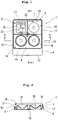
- a cell cryopreservation pretreatment operation plate having the basic configuration of the cell cryopreservation pretreatment operation plate according to the present invention includes a planar operation portion 2, a first recess 14 for storing a low-concentration treatment solution that contains a cell membrane-permeable cryoprotectant at a low concentration, a second recess 15 for storing a high-concentration treatment solution that contains a cell membrane-permeable cryoprotectant at a high concentration, a third recess 16 for storing a high-concentration treatment solution that contains a cell membrane-permeable cryoprotectant at a high concentration, and a fourth recess 18 for storing discarded solutions.
- the planar operation portion 2 includes, on a surface thereof, a first circular segment 21 for placing a cell membrane-permeable cryoprotectant-free treatment solution, a second circular segment for placing the low-concentration treatment solution, and a third circular segment for placing the low-concentration treatment solution.
- the first circular segment 21, the second circular segment 22, and the third circular segment 23 are located close to each other.
- the cell cryopreservation pretreatment operation plate having the basic configuration of the cell cryopreservation pretreatment operation plate according to the present invention may be as follows.
- a cell cryopreservation pretreatment operation plate includes a planar operation portion 2, a first recess 14 for storing a treatment solution, a second recess 15 for storing a treatment solution, a third recess 16 for storing a treatment solution, and a fourth recess 18 for storing discarded treatment solutions.
- the planar operation portion 2 includes, on a surface thereof, a first circular segment 21 for placing a treatment solution, a second circular segment 22 for placing a treatment solution, and a third circular segment 23 for placing a treatment solution.
- the first circular segment 21, the second circular segment 22, and the third circular segment 23 are located close to each other.
- the cell cryopreservation pretreatment operation plate having the basic configuration of the cell cryopreservation pretreatment operation plate according to the present invention may be as follows.
- This cell cryopreservation pretreatment operation plate includes a planar operation portion 2, a first recess 14 for storing a treatment solution, a second recess 15 for storing a treatment solution, a third recess 16 for storing a treatment solution, and a fourth recess 18 for storing discarded treatment solutions.
- the planar operation portion 2 includes, on a surface thereof, a first circular segment 21 for placing a treatment solution, a second circular segment 22 for placing a treatment solution, and a third circular segment 23 for placing a treatment solution.
- the first circular segment 21, the second circular segment 22, and the third circular segment 23 are located close to each other.
- the planar operation portion 2 further includes a first indication portion 26 in which the name and the amount of the treatment solution to be placed on the first circular segment 21 are indicated, a second indication portion 27 in which the name and the amount of the treatment solution to be placed on the second circular segment 22 are indicated, and a third indication portion 28 in which the name and the amount of the treatment solution to be placed on the third circular segment 23 are indicated.
- the cell cryopreservation pretreatment operation plate 1 further includes a fourth indication portion 29 in which the name and the amount of the treatment solution to be contained in the first recess 14 are indicated.
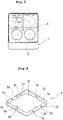
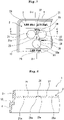
- the cell cryopreservation pretreatment operation plate 1 shown in FIGs. 1 to 4 includes a lower surrounding wall 4, a surrounding side wall 3 extending upward from the lower surrounding wall 4, a bottom 6 located inside the surrounding side wall 3, and an upper surface portion 12 provided at one end portion of the lower surrounding wall 4.
- the lower surrounding wall 4 is substantially rectangular and larger than the surrounding side wall 3b, and on an upper surface of a portion of the lower surrounding wall 4 protruding from the surrounding side wall 3, the above-described upper surface portion 12, which is horizontally elongated, and a narrow U-shaped flat portion 13 that connects the lower end of both side portions and the back side portion of the surrounding side wall 3 to the upper end of the lower surrounding wall 4 are provided.
- the lower surrounding wall 4 is a rectangular surrounding wall with curved corners.
- One end portion of the lower surrounding wall, specifically, the lower end portion (on the front side) in FIG. 1 of the lower surrounding wall has the upper surface portion 12 jointed to the upper end of the lower surrounding wall 4.
- the upper surface portion 12 is flat, and characters and the like can be written on the surface thereof with a writing tool.
- the upper surface portion 12 preferably has a rough surface, specifically a satin-finished surface. This makes writing on the surface with a writing tool or the like easier and also helps visual recognition of the written characters and the like.
- the cell cryopreservation pretreatment operation plate 1 has the surrounding side wall 3 extending upward from a portion of the lower surrounding wall 4 excluding the upper surface portion 12. Also, the narrow U-shaped flat portion 13 that connects the lower end of both side portions and the back side portion of the surrounding side wall 3 to the upper end of the lower surrounding wall 4 is provided. Thus, between the lower surrounding wall 4 and the surrounding side wall 3, a step is formed by the upper surface portion 12 and the flat portion 13. The upper surface of this step serves as a placement portion for a lid 5. As shown in FIG. 3 , the surrounding side wall 3 is formed so as to be higher than the upper surface portion 12. In this example, as shown in FIGs. 1 to 4 , the surrounding side wall 3 is a rectangular surrounding wall with curved corners.
- a planar operation portion 2 Inside the surrounding side wall 3, a planar operation portion 2, a first recess 14 for storing a treatment solution, a second recess 15 for storing a treatment solution, a third recess 16 for storing a treatment solution, and a fourth recess 18 for storing discarded treatment solutions are provided.
- the planar operation portion 2 is provided at a position slightly lower than the upper end of the surrounding side wall 3 and is substantially rectangular.
- a second planar portion 17 is provided, and the first recess 14 is formed in the second planar portion 17.
- the second planar portion 17 is provided adjacent to the planar operation portion 2, and the upper surface thereof is substantially level with the upper surface of the planar operation portion 2.
- the first recess 14 is formed in the central portion of the second planar portion 17.
- the first recess 14 has a flat bottom surface in a small circular shape and a tapered side surface whose diameter decreases toward the bottom surface.
- the first recess 14 has an inverted truncated cone shape (the cross-sectional area thereof decreases toward the bottom surface).
- the first recess 14 is a recess for storing a cell treatment solution. Specifically, it is a recess for storing a low-concentration treatment solution that contains a cell membrane-permeable cryoprotectant at a low concentration.
- this cell cryopreservation pretreatment operation plate 1 includes a first protruding portion 41 protruding upward from the bottom 6 inside the surrounding side wall 3, and the second recess 15 is formed in the first protruding portion 41. Further, the cell cryopreservation pretreatment operation plate 1 of this example includes a second protruding portion 42 protruding upward from the bottom 6 inside the surrounding side wall 3, and the third recess 16 is formed in the second protruding portion 42.
- the second recess 15 and the third recess 16 each have a flat bottom surface in a small circular shape and a tapered side surface whose diameter decreases toward the bottom surface.
- the second recess 15 and the third recess 16 each have an inverted truncated cone shape (the cross-sectional area thereof decreases toward the bottom surface).
- the height of the surrounding side wall 3, in other words, the distance from the upper end of the surrounding side wall 3 to the planar operation portion 2, the second planar portion 17, the upper end of the first protruding portion 41 (the first recess 15), and the upper end of the second protruding portion 42 (the first recess 16) is preferably 1 to 5 mm and particularly preferably 1.5 to 4 mm.
- the second recess 15 is a recess for storing a cell treatment solution, and specifically is a recess for storing a high-concentration treatment solution that contains a cell membrane-permeable cryoprotectant at a high concentration.
- the third recess 16 is a recess for storing a cell treatment solution, and specifically is a recess for storing a high-concentration treatment solution that contains a cell membrane-permeable cryoprotectant at a high concentration.
- the concentration of the cell membrane-permeable cryoprotectant in the treatment solution to be stored in the second recess 15 may be different from the concentration of the cell membrane-permeable cryoprotectant in the treatment solution to be stored in the third recess 16.
- this cell cryopreservation pretreatment operation plate 1 includes the fourth recess 18 for storing discarded solutions.
- the fourth recess 18 is a recess formed by the side surfaces of the protruding portions 41 and 42, the inner surface of the surrounding side wall, and the bottom 6.
- the planar operation portion 2 includes, on a surface thereof, a first circular segment 21 for placing a treatment solution, a second circular portion 22 for placing a treatment solution, and a third circular segment 23 for placing a treatment solution.
- the first circular segment 21 is a circular segment for placing a cell membrane-permeable cryoprotectant-free treatment solution.
- the second circular segment 22 is a circular segment for placing a treatment solution that contains a cell membrane-permeable cryoprotectant at a low concentration
- the third circular segment 23 is a circular segment for placing a treatment solution that contains a cell membrane-permeable cryoprotectant at a low concentration.
- the size (diameter) of each of the circular segments 21, 22, and 23 is preferably 3 to 8 mm and particularly preferably 4 to 7 mm.
- the area of each of the circular segments 21, 22, and 23 is preferably 7 to 50 mm 2 and particularly preferably 12 to 40 mm 2 .
- each of the circular segments 21, 22, and 23 has approximately the same size, their sizes may be different from each other. Also, each of the circular segments 21, 22, and 23 is preferably such that a predetermined amount of the treatment solution can be placed thereon.
- the amount of the treatment solution capable of being placed thereon is preferably 10 to 50 ⁇ L and particularly preferably 15 to 25 ⁇ L.
- the first circular segment 21, the second circular segment 22, and the third circular segment 23 are located close to each other.
- the distance between the first circular segment 21 and the second circular segment 22 is preferably 1 to 5 mm and particularly preferably 1.5 to 3 mm.
- the third circular segment 23 is located close to the first circular segment 21 and the second circular segment 22 and is spaced apart from them by approximately the same distance.
- the third circular segment 23 is preferably located on the front side of the midpoint between the first circular segment 21 and the second circular segment 22.
- the distance between the third circular segment 23 and each of the first circular segment 21 and the second circular segment 22 is preferably 1 to 5 mm and particularly preferably 1.5 to 3 mm.
- an outer edge 21a of the first circular segment 21, an outer edge 22a of the second circular segment 22, and an outer edge 23a of the third circular segment 23 are preferably annular grooves.
- the above-described outer edges 21a, 22a, and 23a may be annular ribs.
- the planar operation portion 2 has a first indication portion 26 in which the name and the amount of the treatment solution to be placed on the first circular segment 21 are indicated.
- "BS" in the indication portion 26 is an abbreviation of "Basic Solution”, which refers to a cell membrane-permeable cryoprotectant-free treatment solution. This is to inform an operator that the treatment solution to be placed on the first circular segment 21 is a cell membrane-permeable cryoprotectant-free treatment solution, and "20 ⁇ L" indicated beside “BS” is to inform an operator of the amount of the treatment solution to be placed.
- BS cell membrane-permeable cryoprotectant-free treatment solution
- a basal cell culture medium e.g., a cell culture medium containing HEPES [4-(2-HydroxyEthyl)-1-PiperazineEthaneSulfonic acid]
- a cell membrane-permeable cryoprotectant it is suitable to use, for example, a basal cell culture medium (e.g., a cell culture medium containing HEPES [4-(2-HydroxyEthyl)-1-PiperazineEthaneSulfonic acid]) that does not contain a cell membrane-permeable cryoprotectant and contains compounds considered necessary, such as, for example: one type or two or more types of cell membrane-impermeable cryoprotectants selected from sucrose, trehalose, Percoll, polyethylene glycol, polyvinyl pyrrolidone, bovine serum albumin, Ficoll, and at least one type of water-soluble cellulose selected from the group
- this cell cryopreservation pretreatment operation plate 1 has a second indication portion 27 in which the name and the amount of the treatment solution to be placed on the second circular segment 22 are indicated.
- "ES" in the indication portion 27 is an abbreviation of "Equilibration Solution”, which refers to a low-concentration treatment solution that contains a cell membrane-permeable cryoprotectant at a low concentration. This is to inform an operator that the treatment solution to be placed on the second circular segment 22 is a low-concentration treatment solution, and "20 ⁇ L" indicated beside “ES” is to inform an operator of the amount of the treatment solution to be placed.
- this cell cryopreservation pretreatment operation plate 1 has a third indication portion 28 in which the name and the amount of the treatment solution to be placed on the third circular segment 23 are indicated.
- "ES" in the indication portion 28 is an abbreviation of "Equilibration Solution”, which refers to a low-concentration treatment solution that contains a cell membrane-permeable cryoprotectant at a low concentration. This is to inform an operator that the treatment solution to be placed on the third circular segment 23 is a low-concentration treatment solution, and "20 ⁇ L" indicated beside “ES” is to inform an operator of the amount of the treatment solution to be placed.
- ES low-concentration treatment solution that contains a cell membrane-permeable cryoprotectant at a low concentration
- a basal cell culture medium e.g., a cell culture medium containing HEPES [4-(2-HydroxyEthyl)-1-PiperazineEthaneSulfonic acid]
- a membrane-permeable cryoprotectant such as glycerol, propylene glycol, dimethylsulfoxide (DMSO), ethylene glycol, or butanediol at a low concentration
- DMSO dimethylsulfoxide
- ethylene glycol or butanediol at a low concentration
- a cell membrane-impermeable cryoprotectant such as sucrose, trehalose, Percoll, polyethylene glycol, polyvinyl pyrrolidone, bovine serum albumin, Ficoll, hydroxypropyl cellulose, hydroxypropy
- This ES also may contain an antibiotic such as gentamicin.
- the content of the cell membrane-permeable cryoprotectant in this ES is preferably 20% to 70% and particularly preferably 30% to 60% of the content of a cell membrane-permeable cryoprotectant in "VS" (high-concentration treatment solution that contains a cell membrane-permeable cryoprotectant at a high concentration) to be described below.
- this cell cryopreservation pretreatment operation plate 1 has a fourth indication portion 29 in which the name and the amount of the treatment solution to be stored in the first recess 14 are indicated.
- "ES" in the indication portion 29 is an abbreviation of "Equilibration Solution”, which refers to a low-concentration treatment solution that contains a cell membrane-permeable cryoprotectant at a low concentration. This is to inform an operator that the treatment solution to be stored in (injected into) the first recess 14 is a low-concentration treatment solution, and "300 ⁇ L" indicated beside “ES” is to inform an operator of the amount of the treatment solution to be injected.
- the cell cryopreservation pretreatment operation plate may also have a fifth indication portion 43 in which the name and the amount of a treatment solution to be stored in the second recess 15 are indicated and a sixth indication portion 44 in which the name and the amount of a treatment solution to be stored in the third recess 16 are indicated.
- the cell cryopreservation pretreatment operation plate may be configured such that the fourth recess is divided into a recess 18a on the second recess side and a recess 18b on the third recess side by a partition 46.
- VS in each of the indication portions 43 and 44 is an abbreviation of "Vitrification Solution”, which refers to a high-concentration treatment solution that contains a cell membrane-permeable cryoprotectant at a high concentration. This is to inform an operator that the treatment solution to be stored in (injected into) the second recess 15 and the third recess 16 is a high-concentration treatment solution, and "300 ⁇ L" indicated beside “VS” is to inform an operator of the amount of the treatment solution to be injected.
- Vitrification Solution refers to a high-concentration treatment solution that contains a cell membrane-permeable cryoprotectant at a high concentration.
- VS high-concentration treatment solution that contains a cell membrane-permeable cryoprotectant at a high concentration
- a basal cell culture medium e.g., a cell culture medium containing HEPES [4-(2-HydroxyEthyl)-1-PiperazineEthaneSulfonic acid]
- a cell membrane-permeable cryoprotectant such as glycerol, propylene glycol, dimethylsulfoxide (DMSO), ethylene glycol, or butanediol at a high concentration
- DMSO dimethylsulfoxide
- ethylene glycol or butanediol at a high concentration
- a cell membrane-impermeable cryoprotectant such as sucrose, trehalose, Percoll, polyethylene glycol, polyvinyl pyrrolidone, bovine serum albumin, Ficoll, hydroxypropyl cellulose, hydroxyprop
- This VS also may contain an antibiotic such as gentamicin.
- the content of the cell membrane-permeable cryoprotectant in this VS is preferably 1.5 to 3 times and particularly preferably 1.7 to 2.5 times the content of the cell membrane-permeable cryoprotectant in the above-described "ES" (low-concentration treatment solution that contains a cell membrane-permeable cryoprotectant at a low concentration).
- the planar operation portion 2 includes, on the surface thereof, a first arrow indication 24 extending from the second circular segment 22 toward the first circular segment 21 and a second arrow indication 25 extending from the third circular segment 23 toward the first arrow indication 24.
- the second arrow indication 25 may extend toward the first circular segment 21.
- the planar operation portion 2 includes, on the surface thereof, a first step order indication (1) near the first arrow indication and a second step order indication (2) near the second arrow indication. Also, as shown in FIG. 1 , the second planar portion 17 includes a third step order indication (3). Further, the cell cryopreservation pretreatment operation plate 1 of this example includes a first step time indication near the first step order indication (1), a second step time indication near the second step order indication (2), and a third step time indication near the third step order indication (3).
- the second planar portion 17 with the first recess 14 is located next to (on the right side of) the planar operation portion 2, and the second recess 15, the third recess 16, and the fourth recess 18 are located on the front side of the planar operation portion 2 and the second planar portion 17, whereby a rectangular operation surface is formed.
- the central portion of the rectangular operation surface includes an operation sequence indication 45 (1, 2, 3, 4) that indicates the order of operations to be performed in the planar operation portion 2, the first recess 14, the second recess 15, and the third recess 16, respectively. In the operation sequence indication, 3 and 4 are interchangeable.
- the cell cryopreservation pretreatment operation plate preferably includes a lid 5 for covering the planar operation portion 2, the first recess 14, the second recess 15, and the third recess 16 at the same time.
- the lid 5 in this example is configured to cover the above-described rectangular operation surface entirely, and the upper surface portion 12 is exposed in the state where the lid 5 is fitted onto the plate. Accordingly, the lid 5 does not interfere with operations such as writing characters on the upper surface portion 12.
- the lid 5 in this example has a top plate portion 51 and a surrounding side wall 52 extending downward from the top plate portion 51.
- the surrounding side wall 52 includes a plurality of sets of opposing slits 53 on its side surfaces. Further, opposing ribs 54 are provided on the inner upper surface of the lid 5.
- the cell cryopreservation pretreatment operation plate 1 and the lid 5 are made of a synthetic resin material.
- the cell cryopreservation pretreatment operation plate 1 and the lid 5 desirably have high transparency, and accordingly, a transparent hard synthetic resin is suitably used.
- a transparent hard synthetic resin it is preferable to use a styrene resin such as polystyrene or SBS, polycarbonate, an acrylonitrile resin, polyolefin such as polypropylene or polyethylene, polyvinyl chloride, or a polyester resin such as PMMA (polymethyl methacrylate), polyethylene terephthalate, or polybutylene terephthalate.
- FIG. 11 a cell cryopreservation pretreatment operation plate 1b shown in FIG. 11 will be described.
- the basic configuration of this plate 1b is the same as that of the above-described plate 1. The differences between them are positions where a second recess 15, a third recess 16, and a fourth recess 18 are arranged relative to a planar operation portion 2 and a first recess 14.
- a second planar portion 17 with the first recess 14 is located next to (on the right side of) the planar operation portion 2, and the second recess 15, the third recess 16, and the fourth recess 18 are located next to (on the right side of) the second planar portion 17, whereby a horizontally elongated rectangular operation surface is formed.
- a lower surrounding wall 4a and a surrounding side wall 3a are also horizontally elongated rectangular, and an upper surface portion 12 is also horizontally elongated.
- the plate 1b also includes a narrow flat portion 13 that connects the lower end of both side portions and the back side portion of the surrounding side wall 3a to the upper end of the lower surrounding wall 4a. Further, this plate 1b also includes an operation sequence indication (1, 2, 3, 4) that indicates the order of operations to be performed in the planar operation portion 2, the first recess 14, the second recess 15, and the third recess 16, respectively.
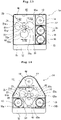
- FIG. 12 a cell cryopreservation pretreatment operation plate 1c according to an example of the present invention shown in FIG. 12 will be described.
- the basic configuration of this plate 1c is the same as that of the above-described plate 1. The differences between them are the configuration of a planar operation portion 2 and positions where the planar operation portion 2, a first recess 14, a second recess 15, a third recess 16, and a fourth recess 18 are arranged.
- the planar operation portion 2a is larger than the planar operation portion 2 of the above-described plate 1.
- the planar operation portion 2a includes, on a surface thereof, a first circular segment 21, a second circular segment 22, a third circular segment 23, an enlarged first circular segment 61 enclosing the first circular segment 21, an enlarged second circular segment 62 enclosing the second circular segment 22, and an enlarged third circular segment 63 enclosing the third circular segment 23.
- the sizes, arrangement, and the like of the first circular segment 21, the second circular segment 22, and the third circular segment 23 are the same as those in the above-described plate 1.
- the enlarged first circular segment 61 has a larger diameter than the first circular segment 21, and encloses the first circular segment 21 in such a manner that the first circular segment 21 is located inside the enlarged first circular segment 61 and closer to or in contact with the outer edge of the enlarged first circular segment 61 rather than concentrically located in the enlarged first circular segment 61.
- the enlarged second circular segment 62 has a larger diameter than the second circular segment 22, and encloses the second circular segment 22 in such a manner that the second circular segment 22 is located inside the enlarged second circular segment 62 and closer to or in contact with the outer edge of the enlarged second circular segment 62 rather than concentrically located in the enlarged second circular segment 62.
- the enlarged third circular segment 63 has a larger diameter than the third circular segment 23, and encloses the third circular segment 23 in such a manner that the third circular segment 23 is located inside the enlarged third circular segment 63 and closer to or in contact with the outer edge of the enlarged third circular segment 63 rather than concentrically located in the enlarged third circular segment 63.
- Outer edges 21a, 22a, 23a, 61a, 62a, and 63a of the first circular segment 21, the enlarged first circular segment 61, the second circular segment 22, the enlarged second circular segment 62, the third circular segment 23, and the enlarged third circular segment 63 are annular grooves.
- the above-described outer edges may be annular ribs.
- the enlarged first circular segment 61 is a circular segment for placing a cell membrane-permeable cryoprotectant-free treatment solution.
- the enlarged second circular segment 62 is a circular segment for placing a treatment solution that contains a cell membrane-permeable cryoprotectant at a low concentration.
- the enlarged third circular segment 63 is a circular segment for placing a treatment solution that contains a cell membrane-permeable cryoprotectant at a low concentration.
- the diameters of the enlarged circular segments 61, 62, and 63 are preferably 1.5 to 3 times and particularly preferably 1.7 to 2.5 times the diameters of the circular segments 21, 22, and 23, respectively.
- the areas of the enlarged circular segments 61, 62, and 63 are preferably 2 to 10 times and particularly preferably 3 to 7 times the areas of the circular segments 21, 22, and 23, respectively.
- the planar operation portion 2a includes a first indication portion 26a in which the name and the amounts (two amounts) of the treatment solution to be placed on the first circular segment 21 and the enlarged first circular segment 61 are indicated.
- "BS” in the indication portion 26a is an abbreviation of "Basic Solution”, which refers to a cell membrane-permeable cryoprotectant-free treatment solution.
- “20 ⁇ L” indicated near “BS” is to inform an operator of the amount of the treatment solution to be placed on the first circular segment 21, and "100 ⁇ L” also indicated near “BS” is to inform an operator of the amount of the treatment solution to be placed on the enlarged first circular segment 61.
- the enlarged first circular segment 61 is used when treating a plurality of cells at the same time, and the first circular segment 21 is used when treating a single cell.
- the planar operation portion 2a includes a second indication portion 27a in which the name and the amounts (two amounts) of the treatment solution to be placed on the second circular segment 22 and the enlarged second circular segment 62 are indicated.
- "ES” in the indication portion 27a indicates a low-concentration treatment solution that contains a cell membrane-permeable cryoprotectant at a low concentration.
- "20 ⁇ L” indicated near “ES” is to inform an operator of the amount of the treatment solution to be placed on the second circular segment 22, and "100 ⁇ L” also indicated near “ES” is to inform an operator of the amount of the treatment solution to be placed on the enlarged second circular segment 62.
- the enlarged second circular segment 62 is used when treating a plurality of cells at the same time, and the second circular segment 22 is used when treating a single cell.
- the planar operation portion 2a includes a third indication portion 28a in which the name and the amounts (two amounts) of the treatment solution to be placed on the third circular segment 23 and the enlarged third circular segment 63 are indicated.
- "ES” in the indication portion 28a refers to a low-concentration treatment solution that contains a cell membrane-permeable cryoprotectant at a low concentration.
- "20 ⁇ L” indicated near “ES” is to inform an operator of the amount of the treatment solution to be placed on the third circular segment 23, and "100 ⁇ L” also indicated near “ES” is to inform an operator of the amount of the treatment solution to be placed on the enlarged third circular segment 63.
- the enlarged third circular segment 63 is used when treating a plurality of cells at the same time, and the third circular segment 23 is used when treating a single cell.
- the first recess 14, the second recess 15, the third recess 16, and the fourth recess 18 are arranged on the front side of the planar operation portion 2a.
- the plate 1c of this example also indicates the name and the amount of the treatment solution to be stored in (injected into) each of the first recess 14, the second recess 15, and the third recess 16.
- the planar operation portion 2, the first recess 14, the second recess 15, the third recess 16, and the fourth recess 18 are surrounded by a surrounding side wall 3b, and the upper surfaces of them are located slightly below the upper end of the surrounding side wall 3b.
- a lower surrounding wall 4b is also substantially rectangular, and similarly to the plate 1, the lower surrounding wall 4b is larger than the surrounding side wall 3b, and on an upper surface of a portion of the lower surrounding wall 4b protruding from the surrounding side wall 3b, a horizontally elongated upper surface portion 12 and a narrow flat portion 13 that connects the lower end of both side portions and the back side portion of the surrounding side wall 3b to the upper end of the lower surrounding wall 4b are provided.
- FIG. 13 a cell cryopreservation pretreatment operation plate 1d of the example of the present invention shown in FIG. 13 will be described.
- the basic configuration of this plate 1d is the same as that of the above-described plate 1c. The differences between them are positions where a planar operation portion 2b, a first recess 14, a second recess 15, a third recess 16, and a fourth recess 18 are arranged.
- the first recess 14, the second recess 15, and the third recess 16 are arranged in this order from the back side, and the fourth recess 18 is provided so as to surround the second recess 15 and the third recess 16.
- the plate 1d of this example also indicates the name and the amount of the treatment solution to be stored in (injected into) each of the first recess 14, the second recess 15, and the third recess 16.
- a lower surrounding wall 4c is also substantially rectangular, and similarly to the plate 1, the lower surrounding wall 4c is larger than the surrounding side wall 3c, and on an upper surface of a portion of the lower surrounding wall 4c protruding from the surrounding side wall 3c, a horizontally elongated upper surface portion 12 and a narrow flat portion 13 that connects the lower end of both side portions and the back side portion of the surrounding side wall 3c to the upper end of the lower surrounding wall 4c are provided.
- FIG. 14 a cell cryopreservation pretreatment operation plate 1e of the example of the present invention shown in FIG. 14 will be described.
- the basic configuration of this plate 1e is the same as that of the above-described plate 1c. The differences between them are positions where a planar operation portion 2c, a first recess 14, a second recess 15, a third recess 16, and fourth recesses 18a and 18b are arranged.
- a lower surrounding wall 4d and a surrounding side wall 3d are each substantially pentagonal with the back side thereof being substantially triangular, and similarly to the plate 1, the lower surrounding wall 4d is larger than the surrounding side wall 3d, and on an upper surface of a portion of the lower surrounding wall 4d protruding from the surrounding side wall 3d, a horizontally elongated upper surface portion 12 and a narrow flat portion 13 that connects the lower end of both side portions and the back side portion of the surrounding side wall 3b to the upper end of the lower surrounding wall 4b are provided.
- the first recess 14 is arranged on the back side of the planar operation portion 2c.
- the second recess 15 and the fourth recess 18a are arranged in one (left) side portion on the front side of the planar operation portion 2c.
- the third recess 16 and the fourth recess 18b are arranged in the other (right) side portion on the front side of the planar operation portion 2c.
- the plate 1e of this example also indicates the name and the amount of the treatment solution to be stored in (injected into) each of the first recess 14, the second recess 15, and the third recess 16.
- the planar operation portion 2c, the first recess 14, the second recess 15, the third recess 16, and the fourth recesses 18a and 18b are surrounded by the surrounding side wall 3d, and the upper surfaces of them are located slightly below the upper end of the surrounding side wall 3d.
- a cell to be cryopreserved e.g., an embryo
- BS cell membrane-permeable cryoprotectant-free treatment solution
- ES low-concentration treatment solution that contains a cell membrane-permeable cryoprotectant at a low concentration
- VS high-concentration treatment solution that contains a cell membrane-permeable cryoprotectant at a high concentration
- a predetermined amount (300 ⁇ L) of ES as indicated in the indication portion 29 is injected into the first recess 14 of the plate 1
- predetermined amounts (300 ⁇ L) of VS are injected into the second recess 15 and the third recess 16
- a proper amount (20 ⁇ L) of BS as indicated in the indication portion 26 is placed (dropped) on the first circular portion 21
- a proper amount (20 ⁇ L) of ES as indicated in the indication portion 27 is placed (dropped) on the second circular portion 22
- a proper amount (20 ⁇ L) of ES as indicated in the indication portion 28 is placed (dropped) on the third circular portion 23.
- the cell to be cryopreserved is collected with a micropipette or the like, and transferred to the BS placed on the first circular segment 21.
- the second circular segment 22 and the first circular portion 21 are connected to each other using the member (e.g., pipette) used for the transfer.
- the member e.g., pipette
- the second circular segment 22 and the first circular segment 21 are in communication with each other.
- the cell is allowed to stand for 3 minutes.
- the ES is gradually mixed with the BS containing the transferred cell in the first circular segment 21, thereby providing a mixed portion where the concentration of the low-concentration treatment solution in the treatment solution surrounding the cell has increased.
- the third circular segment 23 is connected to the above-described mixed portion using the member (e.g., pipette) used for the transfer.
- the member e.g., pipette
- the second circular segment 22, the first circular segment 21, and the third circular segment 23 are in communication with each other.
- the cell is allowed to stand for 3 minutes.
- the plate 1 of this example is configured such that the planar operation portion 2 includes, on the surface thereof, the first circular segment 21 for placing a cell membrane-permeable cryoprotectant-free treatment solution, the second circular segment 22 for placing a low-concentration treatment solution, and the third circular segment 23 for placing a low-concentration treatment solution, and the first circular segment, the second circular segment, and the third circular segment are located close to each other.
- the above-described preparation for the equilibration and also operations for the equilibration can be carried out easily and reliably.
- the cell having undergone the first step of the equilibration on the planar operation portion 2 in the above-described manner is then aspirated with the micropipette or the like, and placed on the surface of the ES injected in the first recess 14. Thereafter, the cell is allowed to stand for 9 minutes.
- the cell placed on the surface of the ES is an embryo, it can be observed that the embryo shrinks while sinking within 30 seconds, and the operator waits for full recovery of the volume of the embryo that has once shrunk largely. The second step of equilibration is thus completed.
- the cell in the first recess 14 is aspirated with the micropipette or the like and then placed on the surface of the second recess 15 storing the VS injected thereto.
- the amount of the ES solution brought to the VS solution in the second recess 15 should be made as small as possible.
- the ES remaining in the micropipette is discarded in the fourth recess 18 for storing discarded treatment solutions.
- the micropipette is rinsed with the VS in the first recess 14 by aspirating fresh VS from the edge of the second recess 15 and then discarding the VS.
- sufficient pipetting Vigorously expelling the embryo from the pipette into the VS and then quickly stirring the solution around the embryo several times) is performed while changing the position such that the pipetting is performed at about three different sites.
- the cell is subjected to replacement of extracellular ES with the VS in the first recess 14 until shimmering due to the presence of the ES is no longer visible.
- the third step of equilibration is thus completed.
- the VS in the micropipette is discarded in the fourth recess 18 for storing discarded treatment solutions, and fresh VS injected in the third recess 16 is aspirated.
- the cell in the second recess 15 is aspirated with the micropipette containing the aspirated fresh VS, and the cell is introduced into the third recess 16 storing the VS injected therein.
- Sufficient pipetting Vigorously expelling the embryo from the pipette into the VS and then quickly stirring the solution around the embryo several times
- the operator checks whether the cell has shrunk to be flat in shape owing to dehydration. The equilibration is thus completed.
- the cell to be cryopreserved is collected at the tip of the micropipette, and under a microscope, the cell and a small amount of VS are placed on a living cell holding portion (not shown) of a living cell cryopreservation tool (not shown).
- the living cell holding portion with the cell of the living cell cryopreservation tool is immersed in liquid nitrogen prepared beforehand to freeze (vitrify) the cell.
- the living cell cryopreservation tool with the cell is inserted into a cylindrical member (not shown), and this cylindrical housing member with the living cell cryopreservation tool contained therein is then stored in a storage container (not shown). Subsequently, the storage container is placed in a liquid nitrogen tank for storage.
- the cell cryopreservation pretreatment operation plate of the present invention is as described below.
- a proper amount of a cell membrane-permeable cryoprotectant-free treatment solution is placed (dropped) on the first circular segment, a proper amount of a low-concentration treatment solution is placed (dropped) on the second circular segment, and a proper amount of a low-concentration treatment solution is placed (dropped) on the third circular segment.
- the cell to be cryopreserved is then transferred to the cell membrane-permeable cryoprotectant-free treatment solution, and subsequently, the second circular segment and the first circular segment are connected to each other using the member (e.g., pipette) used for the transfer.
- the low-concentration treatment solution is gradually mixed with the cryoprotectant-free treatment solution, whereby the concentration of the low-concentration treatment solution in the treatment solution surrounding the cell to be cryopreserved increases.
- the member e.g., pipette
- the low-concentration treatment solution is gradually mixed with the mixed portion, whereby the concentration of the low-concentration treatment solution in the treatment solution surrounding the cell to be cryopreserved increases gradually.
- the above-described preparation for equilibration and also a favorable equilibration treatment can be carried out easily and reliably with the configuration in which the planar operation portion includes, on the surface thereof, the first circular segment for placing a cell membrane-permeable cryoprotectant-free treatment solution, the second circular segment for placing a low-concentration treatment solution, and the third circular segment for placing a low-concentration treatment solution, and the first circular segment, the second circular segment, and the third circular segment are located close to each other.
- the enlarged circular segments are used when treating a plurality of cells at the same time, and the smaller circular segments inside the enlarged circular segments are used when treating a single cell.
- the circular segments and the enlarged circular segments can be used appropriately depending on the number of cells to be treated.
- Embodiments of the above-described cell cryopreservation pretreatment operation plate are as described below.
- planar operation portion includes, on the surface thereof, a first arrow indication extending from the second circular segment toward the first circular segment and a second arrow indication extending from the third circular segment toward the first arrow indication or toward the first circular segment.
- planar operation portion includes a first indication portion in which the name and the amounts of the treatment solution to be placed on the first circular segment and the enlarged first circular segment are indicated, a second indication portion in which the name and the amounts of the treatment solution to be placed on the second circular segment and the enlarged second circular segment are indicated, and a third indication portion in which the name and the amounts of the treatment solution to be placed on the third circular segment and the enlarged third circular segment are indicated.
- a cell cryopreservation pretreatment operation plate comprising:
- Embodiments of the above-described cell cryopreservation pretreatment operation plate are as described below.
Landscapes
- Life Sciences & Earth Sciences (AREA)
- Health & Medical Sciences (AREA)
- Engineering & Computer Science (AREA)
- Wood Science & Technology (AREA)
- Zoology (AREA)
- General Health & Medical Sciences (AREA)
- Environmental Sciences (AREA)
- Dentistry (AREA)
- Chemical & Material Sciences (AREA)
- Bioinformatics & Cheminformatics (AREA)
- Organic Chemistry (AREA)
- Biomedical Technology (AREA)
- Biochemistry (AREA)
- General Engineering & Computer Science (AREA)
- Sustainable Development (AREA)
- Genetics & Genomics (AREA)
- Microbiology (AREA)
- Biotechnology (AREA)
- Molecular Biology (AREA)
- Micro-Organisms Or Cultivation Processes Thereof (AREA)
- Physics & Mathematics (AREA)
- Thermal Sciences (AREA)
Applications Claiming Priority (2)
| Application Number | Priority Date | Filing Date | Title |
|---|---|---|---|
| JP2019143967 | 2019-08-05 | ||
| PCT/JP2020/029814 WO2021025017A1 (ja) | 2019-08-05 | 2020-08-04 | 細胞凍結前処理作業用プレート |
Publications (2)
| Publication Number | Publication Date |
|---|---|
| EP4012013A1 true EP4012013A1 (de) | 2022-06-15 |
| EP4012013A4 EP4012013A4 (de) | 2022-10-19 |
Family
ID=74503007
Family Applications (1)
| Application Number | Title | Priority Date | Filing Date |
|---|---|---|---|
| EP20850279.9A Pending EP4012013A4 (de) | 2019-08-05 | 2020-08-04 | Vorbehandlungsplatte für zellkryokonservierung |
Country Status (4)
| Country | Link |
|---|---|
| US (1) | US12402620B2 (de) |
| EP (1) | EP4012013A4 (de) |
| JP (1) | JP7607339B2 (de) |
| WO (1) | WO2021025017A1 (de) |
Cited By (1)
| Publication number | Priority date | Publication date | Assignee | Title |
|---|---|---|---|---|
| WO2025094904A1 (en) * | 2023-10-31 | 2025-05-08 | Asada Ladies Clinic | Dish with multiple wells |
Families Citing this family (2)
| Publication number | Priority date | Publication date | Assignee | Title |
|---|---|---|---|---|
| CN215775135U (zh) | 2021-03-03 | 2022-02-11 | 深圳拜尔洛克生物技术有限公司 | 用于生物组织冷冻保存或解冻复苏的芯片 |
| ES3065902T3 (en) * | 2021-07-21 | 2026-05-08 | Kitazato Corp | Biological cell processing work plate and biological cell pre-freezing processing work kit |
Family Cites Families (12)
| Publication number | Priority date | Publication date | Assignee | Title |
|---|---|---|---|---|
| JP2000189155A (ja) | 1998-12-25 | 2000-07-11 | Livestock Improvement Association Of Japan Inc | 哺乳動物胚または卵子の保存方法並びに凍結胚または卵子の融解希釈方法 |
| JP4373025B2 (ja) | 2001-04-18 | 2009-11-25 | 株式会社北里サプライ | 卵凍結保存用具および筒状部材保持器具 |
| WO2010003423A2 (en) * | 2008-07-05 | 2010-01-14 | Unisense Fertilitech A/S | One to one identification system |
| JP4724854B2 (ja) * | 2009-02-09 | 2011-07-13 | 大日本印刷株式会社 | 細胞培養容器 |
| US9169460B2 (en) * | 2009-05-19 | 2015-10-27 | Lifeglobal Group Llc | Flooding dish and method for changing media in the dish in the preparation of mammalian specimen culture and for cryo-preservation, freezing, vitrification and the thawing and warming of such specimens |
| JP6349847B2 (ja) * | 2013-03-26 | 2018-07-04 | 大日本印刷株式会社 | 細胞培養容器 |
| AU2014276229B2 (en) * | 2013-06-07 | 2019-11-21 | Corning Incorporated | Culture vessel and culture method |
| JP6330278B2 (ja) * | 2013-09-11 | 2018-05-30 | 大日本印刷株式会社 | 培養容器 |
| US20150329814A1 (en) * | 2014-05-16 | 2015-11-19 | Michael D. Cecchi | Apparatus for long-term uninterrupted safe culturing of embryos, biological specimens in a controlled environment having improved imaging capabilities |
| JP2016099547A (ja) * | 2014-11-25 | 2016-05-30 | 大日本印刷株式会社 | 表示部材、培養容器、及び培養容器キット |
| JP6123963B1 (ja) | 2015-05-25 | 2017-05-10 | 大日本印刷株式会社 | 細胞処理容器 |
| JP6597118B2 (ja) * | 2015-09-25 | 2019-10-30 | 大日本印刷株式会社 | 細胞挙動評価用基板、細胞挙動評価用容器及び細胞挙動評価方法 |
-
2020
- 2020-08-04 EP EP20850279.9A patent/EP4012013A4/de active Pending
- 2020-08-04 JP JP2021537319A patent/JP7607339B2/ja active Active
- 2020-08-04 WO PCT/JP2020/029814 patent/WO2021025017A1/ja not_active Ceased
-
2022
- 2022-02-04 US US17/592,785 patent/US12402620B2/en active Active
Cited By (1)
| Publication number | Priority date | Publication date | Assignee | Title |
|---|---|---|---|---|
| WO2025094904A1 (en) * | 2023-10-31 | 2025-05-08 | Asada Ladies Clinic | Dish with multiple wells |
Also Published As
| Publication number | Publication date |
|---|---|
| US20220151223A1 (en) | 2022-05-19 |
| JPWO2021025017A1 (de) | 2021-02-11 |
| WO2021025017A1 (ja) | 2021-02-11 |
| JP7607339B2 (ja) | 2024-12-27 |
| EP4012013A4 (de) | 2022-10-19 |
| US12402620B2 (en) | 2025-09-02 |
Similar Documents
| Publication | Publication Date | Title |
|---|---|---|
| US12402620B2 (en) | Cell cryopreservation pretreatment operation plate | |
| JP6846054B2 (ja) | 液中操作型ガラス化凍結保存方法 | |
| JP6114185B2 (ja) | 改良された顕微操作ならびに保管装置および方法 | |
| JP5278978B2 (ja) | 動物の胚または卵子のガラス化保存用細管 | |
| KR101934031B1 (ko) | 생체세포 동결 보존 도구 | |
| US9944892B2 (en) | Structure for culturing cells | |
| Parmegiani et al. | Rapid warming increases survival of slow-frozen sibling oocytes: a step towards a single warming procedure irrespective of the freezing protocol? | |
| JP4665589B2 (ja) | 細胞培養用容器 | |
| US20150313211A1 (en) | A Method of Vitrification | |
| CN211558618U (zh) | 细胞冻存容器 | |
| US20220361483A1 (en) | Fixture of cryopreservation jig and freezing and thawing method using said fixture | |
| Crook et al. | Cryobanking pluripotent stem cells | |
| CN210929356U (zh) | 一种封闭式卵巢组织冷冻装置 | |
| Vajta et al. | Disadvantages and benefits of vitrification | |
| WO2010124663A2 (en) | Method for adding, removing or exchange a liquid medium in culturing biological cells and culture device | |
| JP2021023296A (ja) | 細胞凍結前処理作業用プレート | |
| JP3173617U (ja) | 細胞凍結作業用具 | |
| EP4375358B1 (de) | Arbeitsplatte zur verarbeitung biologischer zellen und arbeitskit zur verarbeitung zum vorgefrieren biologischer zellen | |
| Schiewe | Quality Control Factors Influencing the Successful and Reliable Implementation of Oocyte and Embryo | |
| Amer et al. | Cryopreservation of rare ejaculate and testicular spermatozoa, a novel simple technique; the culture dish slice freezing: A pilot study. | |
| Talwar | Intracytoplasm Sperm 11 Injection and Troubleshooting |
Legal Events
| Date | Code | Title | Description |
|---|---|---|---|
| STAA | Information on the status of an ep patent application or granted ep patent |
Free format text: STATUS: THE INTERNATIONAL PUBLICATION HAS BEEN MADE |
|
| PUAI | Public reference made under article 153(3) epc to a published international application that has entered the european phase |
Free format text: ORIGINAL CODE: 0009012 |
|
| STAA | Information on the status of an ep patent application or granted ep patent |
Free format text: STATUS: REQUEST FOR EXAMINATION WAS MADE |
|
| 17P | Request for examination filed |
Effective date: 20220301 |
|
| AK | Designated contracting states |
Kind code of ref document: A1 Designated state(s): AL AT BE BG CH CY CZ DE DK EE ES FI FR GB GR HR HU IE IS IT LI LT LU LV MC MK MT NL NO PL PT RO RS SE SI SK SM TR |
|
| A4 | Supplementary search report drawn up and despatched |
Effective date: 20220921 |
|
| RIC1 | Information provided on ipc code assigned before grant |
Ipc: C12M 1/00 20060101AFI20220915BHEP |
|
| DAV | Request for validation of the european patent (deleted) | ||
| DAX | Request for extension of the european patent (deleted) |