EP4012247B1 - Druckbehälter und herstellungsverfahren dafür - Google Patents
Druckbehälter und herstellungsverfahren dafür Download PDFInfo
- Publication number
- EP4012247B1 EP4012247B1 EP20849458.3A EP20849458A EP4012247B1 EP 4012247 B1 EP4012247 B1 EP 4012247B1 EP 20849458 A EP20849458 A EP 20849458A EP 4012247 B1 EP4012247 B1 EP 4012247B1
- Authority
- EP
- European Patent Office
- Prior art keywords
- resin
- pressure vessel
- layer
- composite layer
- impregnated fiber
- Prior art date
- Legal status (The legal status is an assumption and is not a legal conclusion. Google has not performed a legal analysis and makes no representation as to the accuracy of the status listed.)
- Active
Links
Images


Classifications
-
- F—MECHANICAL ENGINEERING; LIGHTING; HEATING; WEAPONS; BLASTING
- F17—STORING OR DISTRIBUTING GASES OR LIQUIDS
- F17C—VESSELS FOR CONTAINING OR STORING COMPRESSED, LIQUEFIED OR SOLIDIFIED GASES; FIXED-CAPACITY GAS-HOLDERS; FILLING VESSELS WITH, OR DISCHARGING FROM VESSELS, COMPRESSED, LIQUEFIED, OR SOLIDIFIED GASES
- F17C1/00—Pressure vessels, e.g. gas cylinder, gas tank, replaceable cartridge
- F17C1/02—Pressure vessels, e.g. gas cylinder, gas tank, replaceable cartridge involving reinforcing arrangements
- F17C1/04—Protecting sheathings
- F17C1/06—Protecting sheathings built-up from wound-on bands or filamentary material, e.g. wires
-
- B—PERFORMING OPERATIONS; TRANSPORTING
- B29—WORKING OF PLASTICS; WORKING OF SUBSTANCES IN A PLASTIC STATE IN GENERAL
- B29C—SHAPING OR JOINING OF PLASTICS; SHAPING OF MATERIAL IN A PLASTIC STATE, NOT OTHERWISE PROVIDED FOR; AFTER-TREATMENT OF THE SHAPED PRODUCTS, e.g. REPAIRING
- B29C70/00—Shaping composites, i.e. plastics material comprising reinforcements, fillers or preformed parts, e.g. inserts
- B29C70/04—Shaping composites, i.e. plastics material comprising reinforcements, fillers or preformed parts, e.g. inserts comprising reinforcements only, e.g. self-reinforcing plastics
- B29C70/28—Shaping operations therefor
- B29C70/30—Shaping by lay-up, i.e. applying fibres, tape or broadsheet on a mould, former or core; Shaping by spray-up, i.e. spraying of fibres on a mould, former or core
- B29C70/32—Shaping by lay-up, i.e. applying fibres, tape or broadsheet on a mould, former or core; Shaping by spray-up, i.e. spraying of fibres on a mould, former or core on a rotating mould, former or core
-
- F—MECHANICAL ENGINEERING; LIGHTING; HEATING; WEAPONS; BLASTING
- F17—STORING OR DISTRIBUTING GASES OR LIQUIDS
- F17C—VESSELS FOR CONTAINING OR STORING COMPRESSED, LIQUEFIED OR SOLIDIFIED GASES; FIXED-CAPACITY GAS-HOLDERS; FILLING VESSELS WITH, OR DISCHARGING FROM VESSELS, COMPRESSED, LIQUEFIED, OR SOLIDIFIED GASES
- F17C1/00—Pressure vessels, e.g. gas cylinder, gas tank, replaceable cartridge
-
- F—MECHANICAL ENGINEERING; LIGHTING; HEATING; WEAPONS; BLASTING
- F17—STORING OR DISTRIBUTING GASES OR LIQUIDS
- F17C—VESSELS FOR CONTAINING OR STORING COMPRESSED, LIQUEFIED OR SOLIDIFIED GASES; FIXED-CAPACITY GAS-HOLDERS; FILLING VESSELS WITH, OR DISCHARGING FROM VESSELS, COMPRESSED, LIQUEFIED, OR SOLIDIFIED GASES
- F17C1/00—Pressure vessels, e.g. gas cylinder, gas tank, replaceable cartridge
- F17C1/16—Pressure vessels, e.g. gas cylinder, gas tank, replaceable cartridge constructed of plastics materials
-
- F—MECHANICAL ENGINEERING; LIGHTING; HEATING; WEAPONS; BLASTING
- F17—STORING OR DISTRIBUTING GASES OR LIQUIDS
- F17C—VESSELS FOR CONTAINING OR STORING COMPRESSED, LIQUEFIED OR SOLIDIFIED GASES; FIXED-CAPACITY GAS-HOLDERS; FILLING VESSELS WITH, OR DISCHARGING FROM VESSELS, COMPRESSED, LIQUEFIED, OR SOLIDIFIED GASES
- F17C13/00—Details of vessels or of the filling or discharging of vessels
- F17C13/002—Details of vessels or of the filling or discharging of vessels for vessels under pressure
-
- F—MECHANICAL ENGINEERING; LIGHTING; HEATING; WEAPONS; BLASTING
- F17—STORING OR DISTRIBUTING GASES OR LIQUIDS
- F17C—VESSELS FOR CONTAINING OR STORING COMPRESSED, LIQUEFIED OR SOLIDIFIED GASES; FIXED-CAPACITY GAS-HOLDERS; FILLING VESSELS WITH, OR DISCHARGING FROM VESSELS, COMPRESSED, LIQUEFIED, OR SOLIDIFIED GASES
- F17C13/00—Details of vessels or of the filling or discharging of vessels
- F17C13/12—Arrangements or mounting of devices for preventing or minimising the effect of explosion ; Other safety measures
-
- B—PERFORMING OPERATIONS; TRANSPORTING
- B29—WORKING OF PLASTICS; WORKING OF SUBSTANCES IN A PLASTIC STATE IN GENERAL
- B29L—INDEXING SCHEME ASSOCIATED WITH SUBCLASS B29C, RELATING TO PARTICULAR ARTICLES
- B29L2031/00—Other particular articles
- B29L2031/712—Containers; Packaging elements or accessories, Packages
- B29L2031/7154—Barrels, drums, tuns, vats
- B29L2031/7156—Pressure vessels
-
- F—MECHANICAL ENGINEERING; LIGHTING; HEATING; WEAPONS; BLASTING
- F17—STORING OR DISTRIBUTING GASES OR LIQUIDS
- F17C—VESSELS FOR CONTAINING OR STORING COMPRESSED, LIQUEFIED OR SOLIDIFIED GASES; FIXED-CAPACITY GAS-HOLDERS; FILLING VESSELS WITH, OR DISCHARGING FROM VESSELS, COMPRESSED, LIQUEFIED, OR SOLIDIFIED GASES
- F17C2201/00—Vessel construction, in particular geometry, arrangement or size
- F17C2201/01—Shape
- F17C2201/0104—Shape cylindrical
-
- F—MECHANICAL ENGINEERING; LIGHTING; HEATING; WEAPONS; BLASTING
- F17—STORING OR DISTRIBUTING GASES OR LIQUIDS
- F17C—VESSELS FOR CONTAINING OR STORING COMPRESSED, LIQUEFIED OR SOLIDIFIED GASES; FIXED-CAPACITY GAS-HOLDERS; FILLING VESSELS WITH, OR DISCHARGING FROM VESSELS, COMPRESSED, LIQUEFIED, OR SOLIDIFIED GASES
- F17C2201/00—Vessel construction, in particular geometry, arrangement or size
- F17C2201/01—Shape
- F17C2201/0104—Shape cylindrical
- F17C2201/0109—Shape cylindrical with exteriorly curved end-piece
-
- F—MECHANICAL ENGINEERING; LIGHTING; HEATING; WEAPONS; BLASTING
- F17—STORING OR DISTRIBUTING GASES OR LIQUIDS
- F17C—VESSELS FOR CONTAINING OR STORING COMPRESSED, LIQUEFIED OR SOLIDIFIED GASES; FIXED-CAPACITY GAS-HOLDERS; FILLING VESSELS WITH, OR DISCHARGING FROM VESSELS, COMPRESSED, LIQUEFIED, OR SOLIDIFIED GASES
- F17C2201/00—Vessel construction, in particular geometry, arrangement or size
- F17C2201/05—Size
- F17C2201/056—Small (<1 m3)
-
- F—MECHANICAL ENGINEERING; LIGHTING; HEATING; WEAPONS; BLASTING
- F17—STORING OR DISTRIBUTING GASES OR LIQUIDS
- F17C—VESSELS FOR CONTAINING OR STORING COMPRESSED, LIQUEFIED OR SOLIDIFIED GASES; FIXED-CAPACITY GAS-HOLDERS; FILLING VESSELS WITH, OR DISCHARGING FROM VESSELS, COMPRESSED, LIQUEFIED, OR SOLIDIFIED GASES
- F17C2201/00—Vessel construction, in particular geometry, arrangement or size
- F17C2201/05—Size
- F17C2201/058—Size portable (<30 l)
-
- F—MECHANICAL ENGINEERING; LIGHTING; HEATING; WEAPONS; BLASTING
- F17—STORING OR DISTRIBUTING GASES OR LIQUIDS
- F17C—VESSELS FOR CONTAINING OR STORING COMPRESSED, LIQUEFIED OR SOLIDIFIED GASES; FIXED-CAPACITY GAS-HOLDERS; FILLING VESSELS WITH, OR DISCHARGING FROM VESSELS, COMPRESSED, LIQUEFIED, OR SOLIDIFIED GASES
- F17C2203/00—Vessel construction, in particular walls or details thereof
- F17C2203/01—Reinforcing or suspension means
- F17C2203/011—Reinforcing means
-
- F—MECHANICAL ENGINEERING; LIGHTING; HEATING; WEAPONS; BLASTING
- F17—STORING OR DISTRIBUTING GASES OR LIQUIDS
- F17C—VESSELS FOR CONTAINING OR STORING COMPRESSED, LIQUEFIED OR SOLIDIFIED GASES; FIXED-CAPACITY GAS-HOLDERS; FILLING VESSELS WITH, OR DISCHARGING FROM VESSELS, COMPRESSED, LIQUEFIED, OR SOLIDIFIED GASES
- F17C2203/00—Vessel construction, in particular walls or details thereof
- F17C2203/06—Materials for walls or layers thereof; Properties or structures of walls or their materials
- F17C2203/0602—Wall structures; Special features thereof
- F17C2203/0604—Liners
-
- F—MECHANICAL ENGINEERING; LIGHTING; HEATING; WEAPONS; BLASTING
- F17—STORING OR DISTRIBUTING GASES OR LIQUIDS
- F17C—VESSELS FOR CONTAINING OR STORING COMPRESSED, LIQUEFIED OR SOLIDIFIED GASES; FIXED-CAPACITY GAS-HOLDERS; FILLING VESSELS WITH, OR DISCHARGING FROM VESSELS, COMPRESSED, LIQUEFIED, OR SOLIDIFIED GASES
- F17C2203/00—Vessel construction, in particular walls or details thereof
- F17C2203/06—Materials for walls or layers thereof; Properties or structures of walls or their materials
- F17C2203/0602—Wall structures; Special features thereof
- F17C2203/0609—Straps, bands or ribbons
-
- F—MECHANICAL ENGINEERING; LIGHTING; HEATING; WEAPONS; BLASTING
- F17—STORING OR DISTRIBUTING GASES OR LIQUIDS
- F17C—VESSELS FOR CONTAINING OR STORING COMPRESSED, LIQUEFIED OR SOLIDIFIED GASES; FIXED-CAPACITY GAS-HOLDERS; FILLING VESSELS WITH, OR DISCHARGING FROM VESSELS, COMPRESSED, LIQUEFIED, OR SOLIDIFIED GASES
- F17C2203/00—Vessel construction, in particular walls or details thereof
- F17C2203/06—Materials for walls or layers thereof; Properties or structures of walls or their materials
- F17C2203/0634—Materials for walls or layers thereof
- F17C2203/0658—Synthetics
- F17C2203/066—Plastics
-
- F—MECHANICAL ENGINEERING; LIGHTING; HEATING; WEAPONS; BLASTING
- F17—STORING OR DISTRIBUTING GASES OR LIQUIDS
- F17C—VESSELS FOR CONTAINING OR STORING COMPRESSED, LIQUEFIED OR SOLIDIFIED GASES; FIXED-CAPACITY GAS-HOLDERS; FILLING VESSELS WITH, OR DISCHARGING FROM VESSELS, COMPRESSED, LIQUEFIED, OR SOLIDIFIED GASES
- F17C2203/00—Vessel construction, in particular walls or details thereof
- F17C2203/06—Materials for walls or layers thereof; Properties or structures of walls or their materials
- F17C2203/0634—Materials for walls or layers thereof
- F17C2203/0658—Synthetics
- F17C2203/0663—Synthetics in form of fibers or filaments
-
- F—MECHANICAL ENGINEERING; LIGHTING; HEATING; WEAPONS; BLASTING
- F17—STORING OR DISTRIBUTING GASES OR LIQUIDS
- F17C—VESSELS FOR CONTAINING OR STORING COMPRESSED, LIQUEFIED OR SOLIDIFIED GASES; FIXED-CAPACITY GAS-HOLDERS; FILLING VESSELS WITH, OR DISCHARGING FROM VESSELS, COMPRESSED, LIQUEFIED, OR SOLIDIFIED GASES
- F17C2203/00—Vessel construction, in particular walls or details thereof
- F17C2203/06—Materials for walls or layers thereof; Properties or structures of walls or their materials
- F17C2203/0634—Materials for walls or layers thereof
- F17C2203/0658—Synthetics
- F17C2203/0663—Synthetics in form of fibers or filaments
- F17C2203/067—Synthetics in form of fibers or filaments helically wound
-
- F—MECHANICAL ENGINEERING; LIGHTING; HEATING; WEAPONS; BLASTING
- F17—STORING OR DISTRIBUTING GASES OR LIQUIDS
- F17C—VESSELS FOR CONTAINING OR STORING COMPRESSED, LIQUEFIED OR SOLIDIFIED GASES; FIXED-CAPACITY GAS-HOLDERS; FILLING VESSELS WITH, OR DISCHARGING FROM VESSELS, COMPRESSED, LIQUEFIED, OR SOLIDIFIED GASES
- F17C2209/00—Vessel construction, in particular methods of manufacturing
- F17C2209/21—Shaping processes
- F17C2209/2154—Winding
-
- F—MECHANICAL ENGINEERING; LIGHTING; HEATING; WEAPONS; BLASTING
- F17—STORING OR DISTRIBUTING GASES OR LIQUIDS
- F17C—VESSELS FOR CONTAINING OR STORING COMPRESSED, LIQUEFIED OR SOLIDIFIED GASES; FIXED-CAPACITY GAS-HOLDERS; FILLING VESSELS WITH, OR DISCHARGING FROM VESSELS, COMPRESSED, LIQUEFIED, OR SOLIDIFIED GASES
- F17C2223/00—Handled fluid before transfer, i.e. state of fluid when stored in the vessel or before transfer from the vessel
- F17C2223/01—Handled fluid before transfer, i.e. state of fluid when stored in the vessel or before transfer from the vessel characterised by the phase
- F17C2223/0107—Single phase
- F17C2223/0123—Single phase gaseous, e.g. CNG, GNC
-
- F—MECHANICAL ENGINEERING; LIGHTING; HEATING; WEAPONS; BLASTING
- F17—STORING OR DISTRIBUTING GASES OR LIQUIDS
- F17C—VESSELS FOR CONTAINING OR STORING COMPRESSED, LIQUEFIED OR SOLIDIFIED GASES; FIXED-CAPACITY GAS-HOLDERS; FILLING VESSELS WITH, OR DISCHARGING FROM VESSELS, COMPRESSED, LIQUEFIED, OR SOLIDIFIED GASES
- F17C2260/00—Purposes of gas storage and gas handling
- F17C2260/04—Reducing risks and environmental impact
- F17C2260/042—Reducing risk of explosion
-
- Y—GENERAL TAGGING OF NEW TECHNOLOGICAL DEVELOPMENTS; GENERAL TAGGING OF CROSS-SECTIONAL TECHNOLOGIES SPANNING OVER SEVERAL SECTIONS OF THE IPC; TECHNICAL SUBJECTS COVERED BY FORMER USPC CROSS-REFERENCE ART COLLECTIONS [XRACs] AND DIGESTS
- Y02—TECHNOLOGIES OR APPLICATIONS FOR MITIGATION OR ADAPTATION AGAINST CLIMATE CHANGE
- Y02E—REDUCTION OF GREENHOUSE GAS [GHG] EMISSIONS, RELATED TO ENERGY GENERATION, TRANSMISSION OR DISTRIBUTION
- Y02E60/00—Enabling technologies; Technologies with a potential or indirect contribution to GHG emissions mitigation
- Y02E60/30—Hydrogen technology
- Y02E60/32—Hydrogen storage
Definitions
- the present invention relates to a method of manufacturing a pressure vessel that achieves improvement in flame retardancy and fire safety through structural characteristics thereof.
- a pressure vessel means a closed container that receives a constant fluid pressure on an inner or outer surface of the container.
- Such a pressure vessel is typically used as a fluid handling vessel for various chemical processes.
- Fluid handling containers in chemical processes include towers, reactors, mixing tanks, heat exchangers, and storage containers as facilities for storing, separating, transporting, and mixing fluids for chemical processes, such as evaporation, absorption, distillation, drying, adsorption, and the like.
- a typical pressure vessel is manufactured by forming a nozzle boss and a liner connected thereto using a metallic material, followed by winding or stacking fibers around the nozzle boss and the line.
- the pressure vessel formed of the metallic material has problems, such as difficulty in weight reduction, low corrosion resistance, low moldability, and high manufacturing costs, due to characteristics of metal.
- a synthetic resin can be used as the liner of the pressure vessel.
- the liner formed of the synthetic resin is reinforced by forming a fiber layer on the liner through a loop winding method in which fibers are wound almost at right angles to an axis of a body of the liner, a helical winding method in which fibers are wound in an oblique direction to the axis of the body of the liner, or the like, as known in the art.
- the background technique of the present invention is disclosed in Korean Patent Laid-open Publication No. 10-2002-0095773 .
- JP 2012 096381 A discloses the features of the preamble of claim 1.
- the resin-impregnated fiber may be wound to have a ratio of width to winding pitch in the range of 1:0.2 to 1:1.5.
- the plastic liner may include at least one thermoplastic resin selected from among a Nylon resin, an ethylene vinyl alcohol resin, a polyamide resin, a polyester resin, a polyolefin resin, a polycarbonate resin, a polyphenylene ether resin, and a polystyrene resin.
- a thermoplastic resin selected from among a Nylon resin, an ethylene vinyl alcohol resin, a polyamide resin, a polyester resin, a polyolefin resin, a polycarbonate resin, a polyphenylene ether resin, and a polystyrene resin.
- the flame retardant composite resin layer may have a thickness of 0.1 ⁇ m to 5 ⁇ m.
- Another embodiment of the present invention relates to a method of manufacturing a pressure vessel as defined in claim 1.
- the flame retardant composite resin layer may be formed under a winding tension of 500 g to 10,000 g.
- the thermosetting resin may include at least one selected from among an epoxy resin, a urethane resin, a phenolic resin, and an acrylic resin.
- One embodiment relates to a pressure vessel including: a plastic liner; and a flame retardant composite resin layer formed on the plastic liner, wherein the flame retardant composite resin layer includes a first composite layer having resin-impregnated fiber aligned in a first direction and a second composite layer having resin-impregnated fiber aligned in a second direction different from the first direction; the resin-impregnated fiber aligned in the first direction and the resin-impregnated fiber aligned in the second direction form a contact region and an open region therebetween; and the contact region and the open region are formed in an area ratio of 1: 0.2 to 1.5.
- FIG. 1 is a view of a pressure vessel 1.
- the pressure vessel 1 includes a plastic liner 10 and a flame retardant composite resin layer 20 formed on the plastic liner.
- the pressure vessel 1 may be provided with at least one nozzle boss 30 coupled to the plastic liner 10 and defining a path through which fluid is supplied to the pressure vessel 1 or discharged therefrom.
- the plastic liner 10 may be formed of any plastic materials so long as the plastic materials are neither eroded by nor react with a target fluid. By use of a suitable plastic material, it is possible to achieve further improvement in weight reduction, pressure resistance and fire safety of the pressure vessel while reducing manufacturing costs thereof.
- the plastic liner 10 may have any shape so long as the plastic liner 10 can be applied to the pressure vessel.
- the plastic liner may have a cylindrical shape with a dome shape at at least one end thereof. This structure is advantageous in uniform winding of a composite material, such as resin-impregnated fiber, on an outer peripheral surface of the plastic liner, and further improves pressure resistance of the pressure vessel.
- the plastic liner 10 may have any thickness satisfying the manufacturing standards for the pressure vessel, which are consistent with the purpose of use thereof.
- the plastic liner may have a thickness of 0.5 mm to 10 mm, more specifically 1 mm to 8 mm.
- the plastic vessel can further reduce a minute variation in volume caused by the fluid in the plastic vessel while realizing good mechanical strength of the plastic vessel.
- the plastic liner may have a thickness of 0.5 mm, 1 mm, 2 mm, 3 mm, 4 mm, 5 mm, 6 mm, 7 mm, 8 mm, 9 mm, or 10 mm.
- the flame retardant composite resin layer 20 is formed on the outer surface of the plastic liner 10 and serves to reinforce and support the plastic liner while imparting chemical flame retardancy to the plastic liner.
- the flame retardant composite resin layer 20 serves to further improve insulating properties of the plastic vessel through structural characteristics in which a contact region and an open region have controlled areas, unlike a typical pressure vessel in the art.
- the flame retardant composite resin layer 20 includes an insulating layer, thereby suppressing damage to the flame retardant composite resin layer 20 while preventing detrimental local damage thereto upon generation of a fire.
- the pressure vessel can effectively reduce the risk of explosion even when a device, such as a safety valve, additionally provided to the pressure vessel does not work, while achieving significant improvement in fire safety.
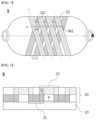
- FIG. 2 is a view of a fiber alignment structure of the flame retardant composite resin layer 20 according to the present invention.
- the flame retardant composite resin layer 20 includes a first composite layer 21 having resin-impregnated fiber aligned in a first direction; and a second composite layer 22 having resin-impregnated fiber aligned in a second direction different from the first direction.
- alignment means that the resin-impregnated fiber constituting a composite layer is wound along the outer peripheral surface of the plastic liner 10 plural times.
- the flame retardant composite resin layer 20 is wound around the entirety of the plastic vessel including not only a cylinder part of the plastic liner but also both dome-shaped ends of the pressure vessel.
- the resin-impregnated fiber may be prepared by impregnating fiber with a resin and may be wound in a band shape.
- the resin-impregnated fiber forms a contact region and an open region therebetween by different alignment directions thereof.
- the flame retardant composite resin layer 20 is formed to have an area ratio of the contact region to the open region in the range of 1:0 to 1:1.5, specifically 1:0.2 to 1:1.5, whereby an insulating layer can be structurally formed in the flame retardant composite resin layer 20. If the area ratio of the contact region to the open region exceeds 1:1.5, it is difficult to form a uniform insulating layer due to an excessive area of the open region.
- FIG. 3 is a view showing the contact region and the open region in the flame retardant composite resin layer according to the present invention.
- the contact region refers to an area of a segment Q where the resin-impregnated fiber 21 of the first composite layer overlaps the resin-impregnated fiber 22 of the second composite layer on the plastic liner 10.
- the open region refers to an area of a segment P where the resin-impregnated fibers of the first composite layer and the second composite layer are not formed on the plastic liner 10.
- a difference in alignment angle between the first direction in which the first composite layer 21 is aligned and the second direction in which the second composite layer 22 is aligned may be in the range of 5 degrees to 90 degrees, specifically 10 degrees to 80 degrees, more specifically 20 degrees to 60 degrees. Within this range, it is advantageous to control the areas of the contact region and the open region in the flame retardant composite resin layer.
- the resin-impregnated fiber may be wound to have a ratio of width to winding pitch in the range of 1:0 to 1:1.5, specifically 1:0.2 to 1:1.5.
- the ratio of width to winding pitch of the resin-impregnated fiber of the first composite layer 21 may be the same as or different from the ratio of width to winding pitch of the resin-impregnated fiber of the second composite layer 22.
- the resin-impregnated fiber for the first composite layer 21 may be the same as or different from the resin-impregnated fiber for the second composite layer 22.
- the resin-impregnated fiber may be prepared by impregnating at least one of carbon fiber and glass fiber with a thermosetting resin.
- the thermosetting resin may be selected from among any thermosetting resins applicable to the pressure vessel.
- the thermosetting resin may include at least one selected from among an epoxy resin, a urethane resin, a phenolic resin and an acrylic resin.
- the flame retardant composite resin layer 20 can realize good flame retardancy of the pressure vessel while securing light weight and mechanical strength of the pressure vessel, and can further improve adhesion between the first composite layer and the second composite layer and between the plastic liner 10 and the flame retardant composite resin layer 20.
- the resin-impregnated fiber may be cured after winding.
- curing is sequentially performed for the first composite layer 21 and the second composite layer 22
- the first composite layer 21 may have the same degree of curing as or a different degree of curing from the second composite layer 22.
- the resin-impregnated fiber may be impregnated with 20 vol% or more of the resin.
- the pressure vessel can achieve further improvement in insulating properties and other properties.
- the resin may he impregnated in an amount of 20 vol% to 99 vol%.
- the flame retardant composite resin layer 20 may have any thickness satisfying the manufacturing standards for the pressure vessel, which are consistent with the purpose of use thereof. Specifically, the flame retardant composite resin layer 20 may have a thickness of 0.1 mm to 5 mm, more specifically 0.5 mm to 3 mm. Within this range, the plastic vessel can further reduce a minute variation in volume caused by the flame retardant composite resin layer while realizing good mechanical strength.
- the flame retardant composite resin layer may have a thickness of 0.1 mm, 0.2 mm, 0.3 mm, 0.4 mm, 0.5 mm, 0.6 mm, 0.7 mm, 0.8 mm, 0.9 mm, 1 mm, 1.5 mm, 2 mm, 2.5 mm, 3 mm, 3.5 mm, 4 mm, 4.5 mm, or 5 mm.
- the flame retardant composite resin layer may have a thickness of 0.1 ⁇ m to 5 ⁇ m.
- the plastic vessel can further reduce a minute variation in volume caused by the flame retardant composite resin layer while realizing good mechanical strength.
- the flame retardant composite resin layer may have a thickness of 0.1 ⁇ m to 5 ⁇ m, more specifically 0.5 ⁇ m to 3 ⁇ m.
- the flame retardant composite resin layer may have a thickness of 0.1 ⁇ m, 0.2 ⁇ m, 0.3 ⁇ m, 0.4 ⁇ m, 0.5 ⁇ m, 0.6 ⁇ m, 0.7 ⁇ m, 0.8 ⁇ m, 0.9 ⁇ m, 1 ⁇ m, 1.5 ⁇ m, 2 ⁇ m, 2.5 ⁇ m, 3 ⁇ m, 3.5 ⁇ m, 4 ⁇ m, 4.5 ⁇ m, or 5 ⁇ m.
- the flame retardant composite resin layer 20 formed on the outer surface of the plastic liner reinforces and supports the plastic liner while imparting chemical flame retardancy to the plastic liner and further improving insulating properties of the plastic vessel through the structural characteristics in which the contact region and the open region of the flame retardant composite resin layer 20 have controlled areas, thereby further suppressing possibility of fire generation while preventing explosion of the pressure vessel upon fire generation. As a result, the pressure vessel can more effectively realize fire safety.
- the present invention relates to a method of manufacturing a pressure vesse as defined in claim 1.
- a pressure vessel for details of the pressure vessel, reference is made to the above description.
- FIG. 4 is a view of a first composite layer according to one embodiment of the present invention.
- the first composite layer is formed by winding the resin-impregnated fiber for the first composite layer along an outer peripheral surface of the plastic liner 10 plural times.
- the resin-impregnated fiber may be wound to have a ratio of width W1 to winding pitch D1 in the range of 1:0 to 1:1.5, specifically 1:0.2 to 1:1.5. Within this range, the pressure vessel can reduce the weight while satisfying fire safety through control of the areas of the contact region and the open region in the flame retardant composite resin layer.
- the width W1 and the winding pitch D1 of the resin-impregnated fiber mean distances measured in a direction y perpendicular to a central axis direction x of the resin-impregnated fiber.
- the first composite layer is cured after winding.
- the degree of curing the first composite layer is not particularly limited. Specifically, the first composite layer may have a curing degree of 10% to 90%, more specifically 10% to 60%.
- FIG. 5 is a view of a second composite layer according to one embodiment of the present invention.
- the second composite layer is formed by winding the resin-impregnated fiber for the second composite layer along an outer peripheral surface of the first composite layer formed on the plastic liner 10 plural times.
- the width W1 and the winding pitch D1 of the resin-impregnated fiber mean distances measured in the direction y perpendicular to the central axis direction x of the resin-impregnated fiber.
- the second composite layer is cured after winding.
- the degree of curing the second composite layer is not particularly limited. Specifically, the second composite layer may have a curing degree of 10% to 100%, more specifically 50% to 90%.
- the flame retardant composite resin layer may be formed under a winding tension of 500 g to 10,000 g.
- the winding tension may be in the range of 1,000 g to 8,000 g, more specifically 1,500 g to 5,000 g. Within this range, it is more advantageous to control the areas of the contact region and the open region.
- FIG. 6 is a sectional view of a flame retardant composite resin layer according to one embodiment of the present invention.
- FIG. 6 shows a cross-section of the pressure vessel taken along the center of a major axis in FIG. 3 .
- the flame retardant composite resin layer 20 includes an insulating layer formed through alignment of the contact region Q and the open region P of the first composite layer and the second composite layer.
- the flame retardant composite resin layer 20 has a multilayer structure of the first composite layer and the second composite layer in the contact region Q, thereby further improving pressure resistance in an axial direction and a radial direction while achieving thickness reduction of the pressure vessel. Further, since the area of the open region P of the first composite layer and the second composite layer is controlled, the pressure vessel can achieve further improvement in shape uniformity.
Landscapes
- Engineering & Computer Science (AREA)
- Mechanical Engineering (AREA)
- General Engineering & Computer Science (AREA)
- Chemical & Material Sciences (AREA)
- Composite Materials (AREA)
- Filling Or Discharging Of Gas Storage Vessels (AREA)
Claims (4)
- Verfahren zur Herstellung eines Druckbehälters, umfassend:Bilden einer flammhemmenden Verbundharzschicht (20) durch Aufwickeln von harzimprägnierter Faser auf eine Außenfläche einer Kunststoffauskleidung (10),wobei die flammhemmende Verbundharzschicht (20) eine erste Verbundschicht (21) mit harzimprägnierter Faser, die in einer ersten Richtung ausgerichtet ist, und eine zweite Verbundschicht (22) mit harzimprägnierter Faser, die in einer zweiten Richtung ausgerichtet ist, die sich von der ersten Richtung unterscheidet, umfasst, die erste Verbundschicht nach Aufwickeln gehärtet wird und die zweite Verbundschicht nach Aufwickeln gehärtet wird,dadurch gekennzeichnet, dassdas Härten nacheinander für die erste Verbundschicht und die zweite Verbundschicht durchgeführt wird;die harzimprägnierte Faser, die in der ersten Richtung ausgerichtet ist, und die harzimprägnierte Faser, die in der zweiten Richtung ausgerichtet ist, einen Kontaktbereich und einen offenen Bereich dazwischen bilden; undder Kontaktbereich und der offene Bereich in einem Flächenverhältnis von 1:0,2 bis 1:1,5 gebildet sind.
- Verfahren zur Herstellung eines Druckbehälters nach Anspruch 1, wobei die harzimprägnierte Faser mit 20 Vol.-% oder mehr des Harzes imprägniert ist.
- Verfahren zur Herstellung eines Druckbehälters nach Anspruch 1, wobei die Kunststoffauskleidung (10) zumindest ein thermoplastisches Harz ausgewählt aus einem Nylonharz, einem Ethylenvinylalkoholharz, einem Polyamidharz, einem Polyesterharz, einem Polyolefinharz, einem Polycarbonatharz, einem Polyphenylenetherharz und einem Polystyrolharz umfasst.
- Verfahren zur Herstellung eines Druckbehälters nach Anspruch 1, wobei die harzimprägnierte Faser durch Imprägnieren von zumindest einem von Kohlefaser und Glasfaser mit einem wärmehärtbaren Harz gefertigt wird.
Applications Claiming Priority (2)
| Application Number | Priority Date | Filing Date | Title |
|---|---|---|---|
| KR1020190095898A KR102173842B1 (ko) | 2019-08-07 | 2019-08-07 | 압력용기 및 이의 제조 방법 |
| PCT/KR2020/006297 WO2021025267A1 (ko) | 2019-08-07 | 2020-05-13 | 압력용기 및 이의 제조 방법 |
Publications (4)
| Publication Number | Publication Date |
|---|---|
| EP4012247A1 EP4012247A1 (de) | 2022-06-15 |
| EP4012247A4 EP4012247A4 (de) | 2022-10-05 |
| EP4012247C0 EP4012247C0 (de) | 2025-06-25 |
| EP4012247B1 true EP4012247B1 (de) | 2025-06-25 |
Family
ID=73249553
Family Applications (1)
| Application Number | Title | Priority Date | Filing Date |
|---|---|---|---|
| EP20849458.3A Active EP4012247B1 (de) | 2019-08-07 | 2020-05-13 | Druckbehälter und herstellungsverfahren dafür |
Country Status (6)
| Country | Link |
|---|---|
| US (1) | US20220282834A1 (de) |
| EP (1) | EP4012247B1 (de) |
| KR (1) | KR102173842B1 (de) |
| CN (1) | CN114286745A (de) |
| HU (1) | HUE073178T2 (de) |
| WO (1) | WO2021025267A1 (de) |
Families Citing this family (2)
| Publication number | Priority date | Publication date | Assignee | Title |
|---|---|---|---|---|
| US12358365B1 (en) * | 2021-05-07 | 2025-07-15 | Agility Fuel Systems Llc | Vehicles having composite interwoven gas containment assemblies |
| WO2026015702A1 (en) * | 2024-07-10 | 2026-01-15 | Braindrip, Llc | Overwrapped composite vessels for the storage and transmission of gases |
Family Cites Families (17)
| Publication number | Priority date | Publication date | Assignee | Title |
|---|---|---|---|---|
| KR20020095773A (ko) | 2001-06-15 | 2002-12-28 | 윤광준 | 복합재료 압력용기 및 그 제조방법 |
| US7763137B2 (en) * | 2003-02-03 | 2010-07-27 | Kyushu University, National University Corporation | Pressure shell, high-pressure tank provided with the pressure shell, manufacturing method of the high-pressure tank and manufacturing apparatus of the high-pressure tank |
| EP1520683B1 (de) * | 2003-10-01 | 2008-02-27 | Fuji Jukogyo Kabushiki Kaisha | Verfahren zur Herstellung eines Druckbehälters |
| JP2006300139A (ja) * | 2005-04-18 | 2006-11-02 | Nissan Motor Co Ltd | 高圧ガス貯蔵容器 |
| JP2008032088A (ja) * | 2006-07-27 | 2008-02-14 | Toyota Motor Corp | タンク |
| JP4832251B2 (ja) * | 2006-10-26 | 2011-12-07 | エバック株式会社 | 合成樹脂製ホースの製造方法 |
| US8931661B2 (en) * | 2009-04-01 | 2015-01-13 | Nissan Motor Co., Ltd. | Structure and manufacturing method for pressure vessel |
| JP2012096381A (ja) * | 2010-10-29 | 2012-05-24 | Toyota Motor Corp | 高圧タンクの製造方法 |
| JP5621631B2 (ja) * | 2011-02-02 | 2014-11-12 | トヨタ自動車株式会社 | 高圧タンクの製造方法、および、高圧タンク |
| KR20130039878A (ko) * | 2011-10-13 | 2013-04-23 | 현대비에스앤씨 (주) | 와인딩 지그, 가스 탱크 및 가스 탱크 제조 방법 |
| JP6223108B2 (ja) * | 2013-10-09 | 2017-11-01 | 三菱重工業株式会社 | 圧力容器及びその製造方法 |
| KR101855874B1 (ko) * | 2014-04-25 | 2018-06-01 | 일진복합소재 주식회사 | 압력 용기 |
| EP3447357A1 (de) * | 2015-05-26 | 2019-02-27 | Nissan Motor Co., Ltd. | Hochdruckgasbehälter |
| JP6356172B2 (ja) * | 2016-03-15 | 2018-07-11 | 本田技研工業株式会社 | 高圧タンク |
| JP6757581B2 (ja) * | 2016-03-24 | 2020-09-23 | 美津濃株式会社 | 繊維強化部材 |
| KR101846733B1 (ko) * | 2016-11-07 | 2018-04-06 | 현대자동차주식회사 | 섬유강화 복합재 압력 용기 및 그 제조 방법 |
| JP7035976B2 (ja) * | 2018-11-15 | 2022-03-15 | トヨタ自動車株式会社 | 高圧タンクおよびその取付け構造 |
-
2019
- 2019-08-07 KR KR1020190095898A patent/KR102173842B1/ko active Active
-
2020
- 2020-05-13 CN CN202080060574.1A patent/CN114286745A/zh active Pending
- 2020-05-13 HU HUE20849458A patent/HUE073178T2/hu unknown
- 2020-05-13 WO PCT/KR2020/006297 patent/WO2021025267A1/ko not_active Ceased
- 2020-05-13 EP EP20849458.3A patent/EP4012247B1/de active Active
- 2020-05-13 US US17/633,301 patent/US20220282834A1/en not_active Abandoned
Also Published As
| Publication number | Publication date |
|---|---|
| EP4012247C0 (de) | 2025-06-25 |
| CN114286745A (zh) | 2022-04-05 |
| WO2021025267A1 (ko) | 2021-02-11 |
| EP4012247A1 (de) | 2022-06-15 |
| US20220282834A1 (en) | 2022-09-08 |
| KR102173842B1 (ko) | 2020-11-05 |
| EP4012247A4 (de) | 2022-10-05 |
| HUE073178T2 (hu) | 2026-01-28 |
Similar Documents
| Publication | Publication Date | Title |
|---|---|---|
| US7086553B2 (en) | Fibre-reinforced pressure vessel and method of manufacturing fibre-reinforced pressure vessel | |
| US8074826B2 (en) | Damage and leakage barrier in all-composite pressure vessels and storage tanks | |
| US11472135B2 (en) | Method for manufacturing high-pressure tank | |
| JP4588307B2 (ja) | 耐圧容器製造方法 | |
| JP5238577B2 (ja) | 複合容器及び複合容器の製造方法 | |
| TW202124873A (zh) | 高壓櫃及用於製造高壓櫃之方法 | |
| US11098851B2 (en) | High-pressure tank and attachment structure thereof | |
| KR20140027121A (ko) | 고압용 하이브리드 압력용기 | |
| US20160348839A1 (en) | High-pressure composite vessel and the method of manufacturing high-pressure composite vessel | |
| KR102347694B1 (ko) | 압력 용기의 제조 방법 | |
| KR102039001B1 (ko) | 고압 탱크 | |
| EP4012247B1 (de) | Druckbehälter und herstellungsverfahren dafür | |
| CN111503265B (zh) | 高压罐及制造高压罐的方法 | |
| US11529780B2 (en) | Manufacturing method for high-pressure tank | |
| US11821586B2 (en) | Manufacturing method of high-pressure tank | |
| JP7351077B2 (ja) | 高圧タンク | |
| CN115596987B (zh) | 高压罐和制造高压罐的方法 | |
| US12404973B2 (en) | Tank | |
| US20260055847A1 (en) | Pressure vessel assembly | |
| US20240068618A1 (en) | High-pressure tank and manufacturing method of high-pressure tank | |
| JP7655289B2 (ja) | 高圧タンクの製造方法 | |
| JP7761620B2 (ja) | タンク、及び、タンクの製造方法 | |
| US20260055846A1 (en) | Pressure vessel assembly and pressure vessel protector | |
| EP4353455A1 (de) | Verfahren zum wickeln von filament und damit hergestellter druckbehälter | |
| KR102925289B1 (ko) | 보스 보강 와인딩이 적용된 고압용기 및 그 제조방법 |
Legal Events
| Date | Code | Title | Description |
|---|---|---|---|
| STAA | Information on the status of an ep patent application or granted ep patent |
Free format text: STATUS: THE INTERNATIONAL PUBLICATION HAS BEEN MADE |
|
| PUAI | Public reference made under article 153(3) epc to a published international application that has entered the european phase |
Free format text: ORIGINAL CODE: 0009012 |
|
| STAA | Information on the status of an ep patent application or granted ep patent |
Free format text: STATUS: REQUEST FOR EXAMINATION WAS MADE |
|
| 17P | Request for examination filed |
Effective date: 20220225 |
|
| AK | Designated contracting states |
Kind code of ref document: A1 Designated state(s): AL AT BE BG CH CY CZ DE DK EE ES FI FR GB GR HR HU IE IS IT LI LT LU LV MC MK MT NL NO PL PT RO RS SE SI SK SM TR |
|
| A4 | Supplementary search report drawn up and despatched |
Effective date: 20220902 |
|
| RIC1 | Information provided on ipc code assigned before grant |
Ipc: B29C 70/32 20060101ALI20220829BHEP Ipc: F17C 13/12 20060101ALI20220829BHEP Ipc: F17C 1/06 20060101AFI20220829BHEP |
|
| DAV | Request for validation of the european patent (deleted) | ||
| DAX | Request for extension of the european patent (deleted) | ||
| STAA | Information on the status of an ep patent application or granted ep patent |
Free format text: STATUS: EXAMINATION IS IN PROGRESS |
|
| 17Q | First examination report despatched |
Effective date: 20240523 |
|
| GRAP | Despatch of communication of intention to grant a patent |
Free format text: ORIGINAL CODE: EPIDOSNIGR1 |
|
| STAA | Information on the status of an ep patent application or granted ep patent |
Free format text: STATUS: GRANT OF PATENT IS INTENDED |
|
| INTG | Intention to grant announced |
Effective date: 20250131 |
|
| GRAS | Grant fee paid |
Free format text: ORIGINAL CODE: EPIDOSNIGR3 |
|
| GRAA | (expected) grant |
Free format text: ORIGINAL CODE: 0009210 |
|
| STAA | Information on the status of an ep patent application or granted ep patent |
Free format text: STATUS: THE PATENT HAS BEEN GRANTED |
|
| AK | Designated contracting states |
Kind code of ref document: B1 Designated state(s): AL AT BE BG CH CY CZ DE DK EE ES FI FR GB GR HR HU IE IS IT LI LT LU LV MC MK MT NL NO PL PT RO RS SE SI SK SM TR |
|
| REG | Reference to a national code |
Ref country code: GB Ref legal event code: FG4D |
|
| REG | Reference to a national code |
Ref country code: CH Ref legal event code: EP |
|
| REG | Reference to a national code |
Ref country code: CH Ref legal event code: EP |
|
| REG | Reference to a national code |
Ref country code: IE Ref legal event code: FG4D |
|
| REG | Reference to a national code |
Ref country code: DE Ref legal event code: R096 Ref document number: 602020053460 Country of ref document: DE |
|
| U01 | Request for unitary effect filed |
Effective date: 20250718 |
|
| U07 | Unitary effect registered |
Designated state(s): AT BE BG DE DK EE FI FR IT LT LU LV MT NL PT RO SE SI Effective date: 20250728 |
|
| PG25 | Lapsed in a contracting state [announced via postgrant information from national office to epo] |
Ref country code: GR Free format text: LAPSE BECAUSE OF FAILURE TO SUBMIT A TRANSLATION OF THE DESCRIPTION OR TO PAY THE FEE WITHIN THE PRESCRIBED TIME-LIMIT Effective date: 20250926 |
|
| PG25 | Lapsed in a contracting state [announced via postgrant information from national office to epo] |
Ref country code: HR Free format text: LAPSE BECAUSE OF FAILURE TO SUBMIT A TRANSLATION OF THE DESCRIPTION OR TO PAY THE FEE WITHIN THE PRESCRIBED TIME-LIMIT Effective date: 20250625 |
|
| PG25 | Lapsed in a contracting state [announced via postgrant information from national office to epo] |
Ref country code: RS Free format text: LAPSE BECAUSE OF FAILURE TO SUBMIT A TRANSLATION OF THE DESCRIPTION OR TO PAY THE FEE WITHIN THE PRESCRIBED TIME-LIMIT Effective date: 20250925 |
|
| PG25 | Lapsed in a contracting state [announced via postgrant information from national office to epo] |
Ref country code: IS Free format text: LAPSE BECAUSE OF FAILURE TO SUBMIT A TRANSLATION OF THE DESCRIPTION OR TO PAY THE FEE WITHIN THE PRESCRIBED TIME-LIMIT Effective date: 20251025 |
|
| PG25 | Lapsed in a contracting state [announced via postgrant information from national office to epo] |
Ref country code: SM Free format text: LAPSE BECAUSE OF FAILURE TO SUBMIT A TRANSLATION OF THE DESCRIPTION OR TO PAY THE FEE WITHIN THE PRESCRIBED TIME-LIMIT Effective date: 20250625 |
|
| PG25 | Lapsed in a contracting state [announced via postgrant information from national office to epo] |
Ref country code: PL Free format text: LAPSE BECAUSE OF FAILURE TO SUBMIT A TRANSLATION OF THE DESCRIPTION OR TO PAY THE FEE WITHIN THE PRESCRIBED TIME-LIMIT Effective date: 20250625 |
|
| PG25 | Lapsed in a contracting state [announced via postgrant information from national office to epo] |
Ref country code: SK Free format text: LAPSE BECAUSE OF FAILURE TO SUBMIT A TRANSLATION OF THE DESCRIPTION OR TO PAY THE FEE WITHIN THE PRESCRIBED TIME-LIMIT Effective date: 20250625 |
|
| REG | Reference to a national code |
Ref country code: HU Ref legal event code: AG4A Ref document number: E073178 Country of ref document: HU |
|
| PG25 | Lapsed in a contracting state [announced via postgrant information from national office to epo] |
Ref country code: ES Free format text: LAPSE BECAUSE OF FAILURE TO SUBMIT A TRANSLATION OF THE DESCRIPTION OR TO PAY THE FEE WITHIN THE PRESCRIBED TIME-LIMIT Effective date: 20250625 |
|
| PGFP | Annual fee paid to national office [announced via postgrant information from national office to epo] |
Ref country code: NO Payment date: 20260324 Year of fee payment: 7 |
|
| PGFP | Annual fee paid to national office [announced via postgrant information from national office to epo] |
Ref country code: CZ Payment date: 20260330 Year of fee payment: 7 |
|
| PLBE | No opposition filed within time limit |
Free format text: ORIGINAL CODE: 0009261 |
|
| STAA | Information on the status of an ep patent application or granted ep patent |
Free format text: STATUS: NO OPPOSITION FILED WITHIN TIME LIMIT |