EP4012386B1 - Identification d'objets en 3d - Google Patents
Identification d'objets en 3d Download PDFInfo
- Publication number
- EP4012386B1 EP4012386B1 EP20383072.4A EP20383072A EP4012386B1 EP 4012386 B1 EP4012386 B1 EP 4012386B1 EP 20383072 A EP20383072 A EP 20383072A EP 4012386 B1 EP4012386 B1 EP 4012386B1
- Authority
- EP
- European Patent Office
- Prior art keywords
- spectral data
- gemstone
- latent space
- data set
- neural network
- Prior art date
- Legal status (The legal status is an assumption and is not a legal conclusion. Google has not performed a legal analysis and makes no representation as to the accuracy of the status listed.)
- Active
Links
Images




Classifications
-
- G—PHYSICS
- G06—COMPUTING OR CALCULATING; COUNTING
- G06N—COMPUTING ARRANGEMENTS BASED ON SPECIFIC COMPUTATIONAL MODELS
- G06N3/00—Computing arrangements based on biological models
- G06N3/02—Neural networks
- G06N3/08—Learning methods
-
- G—PHYSICS
- G01—MEASURING; TESTING
- G01N—INVESTIGATING OR ANALYSING MATERIALS BY DETERMINING THEIR CHEMICAL OR PHYSICAL PROPERTIES
- G01N21/00—Investigating or analysing materials by the use of optical means, i.e. using sub-millimetre waves, infrared, visible or ultraviolet light
- G01N21/17—Systems in which incident light is modified in accordance with the properties of the material investigated
- G01N21/25—Colour; Spectral properties, i.e. comparison of effect of material on the light at two or more different wavelengths or wavelength bands
- G01N21/31—Investigating relative effect of material at wavelengths characteristic of specific elements or molecules, e.g. atomic absorption spectrometry
- G01N21/35—Investigating relative effect of material at wavelengths characteristic of specific elements or molecules, e.g. atomic absorption spectrometry using infrared light
- G01N21/3563—Investigating relative effect of material at wavelengths characteristic of specific elements or molecules, e.g. atomic absorption spectrometry using infrared light for analysing solids; Preparation of samples therefor
-
- G—PHYSICS
- G01—MEASURING; TESTING
- G01N—INVESTIGATING OR ANALYSING MATERIALS BY DETERMINING THEIR CHEMICAL OR PHYSICAL PROPERTIES
- G01N21/00—Investigating or analysing materials by the use of optical means, i.e. using sub-millimetre waves, infrared, visible or ultraviolet light
- G01N21/84—Systems specially adapted for particular applications
- G01N21/87—Investigating jewels
-
- G—PHYSICS
- G06—COMPUTING OR CALCULATING; COUNTING
- G06N—COMPUTING ARRANGEMENTS BASED ON SPECIFIC COMPUTATIONAL MODELS
- G06N3/00—Computing arrangements based on biological models
- G06N3/02—Neural networks
- G06N3/04—Architecture, e.g. interconnection topology
- G06N3/045—Combinations of networks
-
- G—PHYSICS
- G06—COMPUTING OR CALCULATING; COUNTING
- G06N—COMPUTING ARRANGEMENTS BASED ON SPECIFIC COMPUTATIONAL MODELS
- G06N3/00—Computing arrangements based on biological models
- G06N3/02—Neural networks
- G06N3/04—Architecture, e.g. interconnection topology
- G06N3/0464—Convolutional networks [CNN, ConvNet]
-
- G—PHYSICS
- G06—COMPUTING OR CALCULATING; COUNTING
- G06N—COMPUTING ARRANGEMENTS BASED ON SPECIFIC COMPUTATIONAL MODELS
- G06N3/00—Computing arrangements based on biological models
- G06N3/02—Neural networks
- G06N3/08—Learning methods
- G06N3/09—Supervised learning
-
- G—PHYSICS
- G01—MEASURING; TESTING
- G01N—INVESTIGATING OR ANALYSING MATERIALS BY DETERMINING THEIR CHEMICAL OR PHYSICAL PROPERTIES
- G01N21/00—Investigating or analysing materials by the use of optical means, i.e. using sub-millimetre waves, infrared, visible or ultraviolet light
- G01N21/17—Systems in which incident light is modified in accordance with the properties of the material investigated
- G01N21/25—Colour; Spectral properties, i.e. comparison of effect of material on the light at two or more different wavelengths or wavelength bands
- G01N21/31—Investigating relative effect of material at wavelengths characteristic of specific elements or molecules, e.g. atomic absorption spectrometry
- G01N21/35—Investigating relative effect of material at wavelengths characteristic of specific elements or molecules, e.g. atomic absorption spectrometry using infrared light
- G01N2021/3595—Investigating relative effect of material at wavelengths characteristic of specific elements or molecules, e.g. atomic absorption spectrometry using infrared light using FTIR
-
- G—PHYSICS
- G01—MEASURING; TESTING
- G01N—INVESTIGATING OR ANALYSING MATERIALS BY DETERMINING THEIR CHEMICAL OR PHYSICAL PROPERTIES
- G01N21/00—Investigating or analysing materials by the use of optical means, i.e. using sub-millimetre waves, infrared, visible or ultraviolet light
- G01N21/84—Systems specially adapted for particular applications
- G01N21/88—Investigating the presence of flaws or contamination
- G01N21/8851—Scan or image signal processing specially adapted therefor, e.g. for scan signal adjustment, for detecting different kinds of defects, for compensating for structures, markings, edges
- G01N2021/8883—Scan or image signal processing specially adapted therefor, e.g. for scan signal adjustment, for detecting different kinds of defects, for compensating for structures, markings, edges involving the calculation of gauges, generating models
-
- G—PHYSICS
- G01—MEASURING; TESTING
- G01N—INVESTIGATING OR ANALYSING MATERIALS BY DETERMINING THEIR CHEMICAL OR PHYSICAL PROPERTIES
- G01N21/00—Investigating or analysing materials by the use of optical means, i.e. using sub-millimetre waves, infrared, visible or ultraviolet light
- G01N21/84—Systems specially adapted for particular applications
- G01N21/85—Investigating moving fluids or granular solids
-
- G—PHYSICS
- G01—MEASURING; TESTING
- G01N—INVESTIGATING OR ANALYSING MATERIALS BY DETERMINING THEIR CHEMICAL OR PHYSICAL PROPERTIES
- G01N21/00—Investigating or analysing materials by the use of optical means, i.e. using sub-millimetre waves, infrared, visible or ultraviolet light
- G01N21/84—Systems specially adapted for particular applications
- G01N21/88—Investigating the presence of flaws or contamination
- G01N21/8851—Scan or image signal processing specially adapted therefor, e.g. for scan signal adjustment, for detecting different kinds of defects, for compensating for structures, markings, edges
Definitions
- the specification relates to a method and apparatus for identification of 3D objects based on spectroscopy and machine learning.
- the 3D object may be a gemstone such as a diamond.
- WO 2007/069242 A1 discloses a method comprising illuminating at least part of a diamond with light, obtaining a plurality of spectral data sets for a plurality of respective regions of the diamond using a spectroscopy technique, and determining, at a data processing apparatus, a colour grade of the diamond.
- the method may be advantageously applied to gemstone (e.g. diamond) identification. It allows identification of diamonds (or other gemstones) irrespective of their surface quality, e.g. whether they are rough or polished. Furthermore, identification result(s) obtained by the method may establish the relationship between gemstones and may allow a "family tree" to be constructed based on an original raw gemstone which was subsequently cut into a number of smaller units. In this way, techniques described in this specification allow traceability of diamonds or other gemstones throughout the entire gemstone production and distribution process.
- gemstone e.g. diamond
- spectroscopically obtaining spectral data for a region of a 3D object may comprise obtaining spectral data for electromagnetic radiation transmitted by, scattered by, or reflected from the region.
- spectroscopically obtaining spectral data for a region may comprise obtaining spectral data for luminescence (for example fluorescence) from the region due to its illumination by electromagnetic radiation.
- spectroscopically obtaining spectral data may comprise obtaining spectral data for inelastically scattered electromagnetic radiation generated by a nonlinear process (e.g. a Raman process or harmonic generation) which occurs in the region due to its illumination by electromagnetic radiation.
- the 3D object may comprise a material which is transparent to the electromagnetic radiation.
- the 3D object may comprise a gemstone such as a diamond.
- the electromagnetic radiation may comprise mid-infrared light which may for example comprise one or more wavelengths in the range 2 ⁇ m to 2 ⁇ m.
- the electromagnetic radiation may comprise visible light, for example in embodiments in which luminescence spectra are acquired.
- the electromagnetic radiation may comprise near-infrared light, for example in cases in which spectra from second (or higher) harmonic generation processes are acquired.
- spectroscopy refers to techniques which analyse the interaction between electromagnetic radiation and a 3D object as a function of wavelength or frequency. Such interaction may include for example, reflection, absorption, luminescence, elastic or inelastic scattering etc.
- a spectroscopy arrangement may analyse the spectrum of electromagnetic radiation after interaction with the 3D object in order to determine spectral data, for example by using a spectrometer.
- a spectrometer is not used; instead spectral data is obtained by varying the wavelength of the source of electromagnetic radiation (e.g. a tunable laser), and a detector is used to detect the intensity of the electromagnetic radiation at each wavelength, after it has interacted with the 3D object.
- spectral data is obtained by varying the wavelength of the source of electromagnetic radiation (e.g. a tunable laser), and a detector is used to detect the intensity of the electromagnetic radiation at each wavelength, after it has interacted with the 3D object.
- Various example implementations described in this specification relate to a method for identifying 3D-objects using computer-aided spatially distributed spectral analysis.
- the method may involve multiple spectral measurements at various points of a given 3D object so that a 3D map of the distributed spectral data can be constructed.
- the constructed 3D map acts as a "fingerprint" which can be distinguished from a "fingerprint” of another object using a neural network trained for this purpose.
- identifying a given object may involve performing only a limited number of spectral measurements and then using the trained neural network to identify the object with an identification accuracy which may in some cases be greater than 99.9%.
- the method includes (i) acquisition of multiple spectra (e.g. absorption, reflection or luminescence spectra or frequency converted spectra due to nonlinear interaction) from different probe volumes and (ii) analysis of the recorded data using an algorithm based on neural networks trained such that the "distance" between measurements for the same 3D object are minimised while the "distance” between measurements for different 3D objects are maximised.
- spectra e.g. absorption, reflection or luminescence spectra or frequency converted spectra due to nonlinear interaction
- the method may be advantageously applied to gemstone (e.g. diamond) identification as it allows the initial creation of a 3D spectral map of rough gemstone extracted from the mine pit and then to trace not only the entire gemstone through the production process but also to identify and trace its cut-outs.
- gemstone e.g. diamond
- Reference herein to identifying (or identification of) a 3D object herein should not understood as being limited to identifying that the 3D object is the same as a known object, and may include identifying that the object is associated with another object (for example identifying that a cut diamond is related to a particular original rough gemstone), or identifying that the object belongs to a particular class of objects (e.g. to a family of cuts from raw gemstone).
- identifying that the object is associated with another object (for example identifying that a cut diamond is related to a particular original rough gemstone), or identifying that the object belongs to a particular class of objects (e.g. to a family of cuts from raw gemstone).
- Such a class of objects may be related in that, for example, they share a common origin and consequentially have one or more similar physical properties which can be detected by techniques described herein.
- the method produces an identification result which quantifies the extent to which the 3D object is related to a reference object.
- natural diamond may contain defects formed by atoms of nitrogen or hydrogen substituting atoms of carbon and impurities of sub-micrometre scale containing chemical elements such as boron, phosphorous, chromium and many others.
- Each of the above chemical elements has its own, very often unique light absorption spectrum and therefore optical spectra of gemstones in general and diamonds in particular strongly depend on the chemical composition of impurities and defects in the crystal lattice. Since the detailed chemical composition of magma droplets is largely random, it would be reasonable to assume that every raw gemstone has its own and unique optical spectrum associated with slightly different content of the magma droplets. It would be also reasonable to assume that the chemical composition of the droplets marginally varies across individual gemstones and the bigger the gemstone the bigger the variation of the chemical content.
- FTIR Fourier transform infrared spectroscopy
- fingerprint signals from specific regions of a gemstone may be "washed out” and become less detectable because of signal contributions from other regions of the gemstones not containing such fingerprints.
- this may not include the defects fingerprints that distinguish the gemstone.
- two gemstones may not be distinguishable using spectroscopic means such as FTIR, at least partially because defects and inclusions generating signals with characteristic fingerprints (identification signatures), are not uniformly distributed.
- a similar issue occurs when trying to identify the provenance of a gemstone. For example, imagine an initial gemstone divided into pieces. On the one hand, each piece may generate an average signal for the whole volume with different fingerprints from that of the original parent gemstone. On the other hand, if only a limited volume is probed, only the pieces containing a portion of the limited volume may generate a similar signal.
- some implementations described in this specification describe the use of multiple spectral measurements at different locations (different probe volumes distributed over the entire volume) of the same gemstone so as to construct a spatial spectral 3D map, and then using machine learning to identify gemstones from a given database by its spectral characteristics.
- a 3D map of multiple probe volumes as described herein, it is possible to overcome the identification issues of "whole volume” and "limited volume” probing described above. In particular, this maintains the high signal quality of the case of limited probe volume including the defect or inclusion generating fingerprint while also taking advantage of information from a large volume of the gems, reducing in this way the probability of missing fingerprint signals. It is thus more suitable for identification of a gemstone including determining its provenance. With respect to determining provenance, consider a gemstone divided into pieces. If the parent gemstone has been probed in a sufficiently large number of specific limited volumes, the likelihood that each piece contains at least a fingerprinting signature that was detected in the parent gemstone is high
- absorption can affect both reflected light scattered from the gemstone and transmission light through the gemstone. Therefore reflected scattered light, transmitted light or both can be used to record the spatial absorption map of the gemstone..
- reflecting the light at the back surface of an object is equivalent to measure in double pass transmission, apart from scattered reflected light collected at the same time.
- different techniques can be used, from translating the relative position of the gemstone with respect to a limited spot size beam, to rotating the gemstones with respect to a beam that is mainly scattered by a layer under the surface, or a beam interacting with the entire gemstone thickness and using apertures for achieving a spatially selected mapping.
- the approach described in this specification does not change the internal structure or shape of a gemstone and does not create new defects. It is very fast and suitable for both mine pit environment and high street outlets. Using this method it is possible to trace gemstone evolution from raw gemstone extracted from a mine pit to a finished polished article embedded into a suitable frame. Further, it allows a family tree to be developed based on an original large raw gemstone which was subsequently cut into a number of smaller units as described in more detail below.
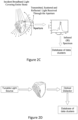
- FIGs 1-3 schematically illustrate a method for obtaining spectral data for one or more regions of a gemstone 10.
- a broadband source 20 of electromagnetic radiation is configured to illuminate a probe volume of the gemstone 10 with incident light 30.
- the broadband source may comprise a laser source which generates a broadband output including infrared light. Suitable laser sources are known to those skilled in the art and will not be described in any further detail here.
- the incident light 30 partially reflects and scatters from the surface and a thin layer close to the surface to produce scattered light 40, and partially passes through the gemstone 10 to produce transmitted light 50.
- the scattered and/or transmitted light which carries information about the unique properties of the gemstone under investigation may be spectrally analysed through Fourier Transformation (FT) spectroscopy.
- FT Fourier Transformation
- a suitable spectrometer 60 may be positioned to detect and analyse either the scattered light 40 or the transmitted light 50, or both, so as to provide spectral data.
- FTIR Fourier-transform infrared spectroscopy
- Figures 2(A) and 2(B) it is particularly advantageous that Fourier-transform infrared spectroscopy (FTIR) is used in either transmission or reflection mode as illustrated in Figures 2(A) and 2(B) .
- FTIR Fourier-transform infrared spectroscopy
- Suitable spectrometers for FTIR spectroscopy are known per se to those skilled in the art and will not be described here.
- the light from the broadband source may also be moved across the sample in addition to or as an alternative to moving the gemstone.
- a beam may be used which interacts with the entire gemstone thickness and apertures may be used to achieve a spatially selected mapping. This is illustrated in Figure 2(C) .
- a tunable source e.g. a quantum cascade laser or a optical parametric oscillator
- a detector rather than a spectrometer
- the wavelength of the tunable source may be varied over the desired range so as to obtain the spectral data.
- the spectral data points represent relative intensity values at different wavelengths within the bandwidth F.
- the number of such measurements M depends on gemstone dimensions and spotsize of the illumination beam at the gemstone surface For example, for a gemstone diameter of 5mm and a writing beam size of 200um, about 200 spectral measurements may be taken.
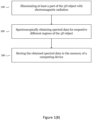
- Figure 1(B) summarises the data acquisition process according to an example embodiment.
- step 100 at least part of the 3D object is illuminated with electromagnetic radiation.
- step 200 spectral data is spectroscopically obtained for respective different regions of the 3D object.
- step 300 the obtained spectral data is stored in the memory of a computing device.
- Figure 10 is a schematic example of a system/apparatus for performing such processing.
- the system/apparatus shown is an example of a computing device. It will be appreciated by the skilled person that other types of computing devices/systems may alternatively be used to implement the methods described herein, such as a distributed computing system.
- the apparatus (or system) 1000 comprises one or more processors 1020.
- the one or more processors control operation of other components of the system/apparatus 1000.
- the one or more processors 1020 may, for example, comprise a general purpose processor.
- the one or more processors 1020 may be a single core device or a multiple core device.
- the one or more processors 1020 may comprise a central processing unit (CPU) or a graphical processing unit (GPU).
- the one or more processors 1020 may comprise specialised processing hardware, for instance a RISC processor or programmable hardware with embedded firmware. Multiple processors may be included.
- the system/apparatus comprises a working or volatile memory 1040.
- the one or more processors may access the volatile memory 1040 in order to process data and may control the storage of data in memory.
- the volatile memory 1040 may comprise RAM of any type, for example Static RAM (SRAM), Dynamic RAM (DRAM), or it may comprise Flash memory, such as an SD-Card.
- the system/apparatus comprises a non-volatile memory 1060.
- the non-volatile memory 906 stores a set of operation instructions 1080 for controlling the operation of the processors 902 in the form of computer readable instructions.
- the non-volatile memory 906 may be a memory of any kind such as a Read Only Memory (ROM), a Flash memory or a magnetic drive memory.
- the non-volatile memory 1060 may also be used to store the data acquired using the data acquisition process summarised in Figure 1(B) .
- the one or more processors 1020 are configured to execute operating instructions 1080 to cause the system/apparatus to perform any of the methods described herein.
- the operating instructions 1080 may comprise code (i.e. drivers) relating to the hardware components of the system/apparatus 1000, as well as code relating to the basic operation of the system/apparatus 1000.
- the one or more processors 1002 execute one or more instructions of the operating instructions 1008, which are stored permanently or semi-permanently in the non-volatile memory 1006, using the volatile memory 1004 to temporarily store data generated during execution of said operating instructions 1008.
- Implementations of the methods described herein may be realised as in digital electronic circuitry, integrated circuitry, specially designed ASICs (application specific integrated circuits), computer hardware, firmware, software, and/or combinations thereof.
- ASICs application specific integrated circuits
- These may include computer program products (such as software stored on e.g. magnetic discs, optical disks, memory, Programmable Logic Devices) comprising computer readable instructions that, when executed by a computer, such as that described in relation to Figure 9 , cause the computer to perform one or more of the methods described herein.
- spectral data obtained for a set of gemstones may be used to train a machine learning model.
- the data acquisition process summarised in Figure 1(B) may be repeated for each of the N gemstones and the resulting data may be represented in 3D space as is schematically shown in Figure 3 .
- each gemstone, say S1, S2, S3 ... Sn, from the above set of N gemstones is now digitally represented by a spatial spectral map (SSM) in the "optical frequency - writings" (FW) plane. All the above SSMs form a data cluster for the gemstones set which can be stored in a computer memory. This data cluster may then be used to train a neural network to distinguish data from various FW planes.
- SSM spatial spectral map
- Siamese neural networks are known per se and will not be described in detail here.
- An overview of the architecture of an exemplary Siamese neural network is illustrated in Figure 4 .
- the network 400 comprises a first subnetwork 410 comprising first and second hidden layers and an output layer 418. Each of these layers comprises one or more nonlinear units in the form of neurons 412.
- a neuron has an associated sets of parameters (e.g. weights and biases) which determine the output of the neuron based on its inputs, and employs a suitable activation function (e.g.
- the first subnetwork 410 also includes an input layer 416 configured to receive a set of spectral data points representing a spectrum (e.g. an FTIR spectrum) as described above.
- the input layer 416 may include a node for each spectral data point of the received spectral data, so that each node of the input layer receives a different spectral data point as input. The input layer 416 passes these values as inputs to each neuron of the first hidden layer.
- the input layer may comprise 912 nodes
- the first and second hidden layers may each comprise 128 nodes (i.e. neurons).
- the output layer may also comprise 128 nodes (i.e. neurons).
- 128 nodes i.e. neurons
- the network 400 also includes a second subnetwork 420 which is identical to the first subnetwork 410.
- the second subnetwork comprises a second set of fully connected neural network layers which has the same structure as the first subnetwork 410.
- the second subnetwork includes an input layer 426 configured to receive a set of spectral data points representing a spectrum (e.g. FTIR spectrum), and an output layer 428.
- a spectrum e.g. FTIR spectrum
- the parameters associated with the corresponding neurons in each subnetwork 410, 420 are also the same because they are constrained to be the same during training (see below).
- the first subnetwork 410 receives, at its input layer, spectral data in the form of a respective set of spectral data points for a particular spectrum, e.g. an FTIR spectrum captured for a particular probe volume of a particular gemstone.
- the number of spectral data points may be denoted by Q, and thus the spectral data may be represented by a vector having Q dimensions, wherein each component of the vector corresponds to a different spectral data point.
- the second subnetwork 420 receives, at its input layer, spectral data in the form of a set of spectral data point for another spectrum, which again may comprise an FTIR spectrum have Q data points and may thus also be represented by a vector having Q dimensions.
- the first subnetwork 410 (and therefore also the second subnetwork 420) is configured during training of the neural network 400 to learn a transformation from Q dimensional space (i.e. the space of FTIR spectra represented by Q-dimensional vectors which may be input into the first subnetwork 410) to a lower R-dimensional space(latent space) in such a way that Euclidian distances in R-dimensional space represent a measure of similarity between spectra.
- Q dimensional space i.e. the space of FTIR spectra represented by Q-dimensional vectors which may be input into the first subnetwork 410
- R-dimensional space(latent space) in such a way that Euclidian distances in R-dimensional space represent a measure of similarity between spectra.
- R is the size (i.e. number of neurons) in each output layer 418, 428.
- the transformation is such that different measurements for the same gemstone form a close cluster of points with small Euclidian intra-cluster distance d i and which is much smaller than that between clusters for different gemstones (inter-cluster distance D e ).
- the neural network 400 finds the optimum latent space that maximise D e and minimises d i . This is schematically illustrated in Figure 5 .
- the neural network 400 is configured by its training such that the Euclidean distance between the outputs of the first and second subnetworks represents a measure of similarity between the two received FTIR spectra.
- This Euclidean distance may be denoted by "d” and may comprise a number between 0 and infinity.
- the network 400 may be trained so that values of d closer to zero (i.e. short distances) are generated when the received spectra are similar, while values of d closer to 1 (i.e. longer distances) are generated when the received spectra are different.
- the parameters of the neurons (weights and biases) of the network 400 form the trainable parameters of the network which are adjusted during training based on an objective function as described in more detail below.
- the neural network may be trained using pairs of spectral measurements, where each spectral measurement comprises spectra data including a plurality of spectral data points, the spectral data points representing relative intensity values at different wavelengths as discussed above.
- each training data item comprises a labelled measurement pair.
- the Siamese neural network may be trained using the labelled training items using a supervised learning approach.
- the use of supervised learning to train a Siamese neural network is known per se to those skilled in the art and will not be described in detail here.
- the trainable parameters of the neural network are first initialised, e.g. randomly or in accordance with a particular initialisation scheme.
- the neural network 400 then processes the training data items by processing the first measurements of each pair using the first subnetwork 410 and the second measurement in each pair using the second subnetwork 420.
- the Euclidean distance d is then calculated between the output of the first subnetwork 410 and the second subnetwork 420. If d is less than 0.5 then an identification result of "1" (similar) is output, and if d is greater than or equal to 0.5 then an identification result of "0" (dissimilar) is output.
- the identification result outputs are compared with the respective labels using a suitable loss function and the parameters of the subnetworks 410 and 420 are updated based on the loss function.
- the two subnetworks 410 are identical and remain identical during training. In practice only one subnetwork is trained but its parameters are used for both the first and second subnetworks.
- loss functions suitable for training Siamese neural network will be apparent to those skilled in the art - suitable examples include contrastive loss, triplet loss and quadruplet loss.
- a suitable training algorithm such as stochastic gradient descent or other gradient-based method may be used to adjust the trainable parameters of the neural network to minimise the loss function, thereby training the neural network based on the training data items.
- gradient-based techniques involve calculation of the gradient of the loss function, which may be calculated using the backpropagation technique which is known to those skilled in the art and will not be described here.
- the Adam optimizer may be used with a learning rate of 1e-4 and contrastive loss may be used.
- a batch size of 32 may be used and the neural network may be trained for 250 epochs.
- contrastive loss reference is directed to R. Hadsell, S. Chopra and Y. LeCun, "Dimensionality Reduction by Learning an Invariant Mapping," 2006 IEEE Computer Society Conference on Computer Vision and Pattern Recognition (CVPR'06), New York, NY, USA, 2006, pp. 1735-1742, doi: 10.1109/CVPR.2006.100 .
- the trained neural network may be tested using additional spectral measurements which may be obtained using the data acquisition summarised Figure 1(B) .
- M4 and M5 represent new spectral data which the neural network did not process during training.
- test items are:
- Each cell is the result of 6 comparisons. Taking the top left corner as an example these are:
- the neural network should output "1" for each comparison since they are all coming from the same stone.
- the result may be different, e.g. 5 "1”s and 1 "0".
- the result may for example be: S1-M4, S1-M5 S2-M4 S2-M5 S1-M1 S1-M2 S1-M3 83.3 % 0 % S2-M1 S2-M2 S2-M3 16.7 % 100 %
- the diagonal should be 100 % and the rest 0 %, but in practice there may be some deviation from that ideal case e.g. as shown.
- the process of identifying an unknown gemstone using the trained neural network is in essence the same as the testing process described above. It begins with a reading process in which data is acquired for the gemstone under test using the data acquisition process summarised in Figure 1(B) , resulting in a number of FTIR spectra (i.e. a number of "readings") for different regions of the stone.
- the unknown gemstone may then be compared with a reference gemstone for which FTIR spectra were previously obtained for various probe regions of the reference stone.
- the number of spectra recorded for the reference gemstone is denoted here by M.
- Figure 6 illustrates the neural network 600 after it has been trained by the process described above with reference to Figure 4 .
- the first subnetwork 610 of the trained neural network 600 receives one of the FTIR spectra for the reference gemstone and the second subnetwork 620 receives one of the FTIR spectra for the unknown stone.
- the input layer 616 of the first subnetwork 610 may include a node for each spectral data point of the FTIR spectum that it receives, so that each node of the input layer 616 receives a different spectral data point as input.
- the input layer 626 of the second subnetwork 620 may include a node for each spectral data point of the FTIR spectrum that it receives.
- the resulting model output from the trained neural network 600 comprises a distance d. If the distance d is less than 0.5, then a result of 1 is stored for the spectral comparison, and if the distance d is greater than or equal to 0.5, then a result of 0 is stored for the spectral comparison.
- the identification result is derived from the model outputs generated by comparing each of the r spectral data sets for the unknown stone with the M previously stored spectral data sets for the reference gemstone.
- Figure 7 summarises the gemstone identification process according to an example embodiment.
- step 710 at least part of the gemstone under test is illuminated with electromagnetic radiation.
- step 720 spectral data is spectroscopically obtained for one or more regions of the gemstone under test.
- step 730 the trained machine learning is used to generate an identification result by comparing the obtained spectral data with stored spectral data for one or more regions of the reference stone.
- Figure 8 illustrate 4 gemstones S11, S12, S21, S22 which are derived from a larger original gemstone S0 via two intermediates S1, S2. A further gemstone S3 is also shown, which is standalone in that it is not related by origin to S0.
- the gemstones S0, S1, S2, S11, S12, S21, S22 have undergone FTIR measurement as summarised in Figure 1(B) at each stage from the original gemstone S0 to the second split.
- the gemstone S3 has also undergone FTIR measurement using the same method. Since each gemstone has been previously through the FTIR measurement procedure ("writing" process), each is associated with a spatial spectral map which represents a stored "fingerprint" for that gemstone.
- the collection of such spatial spectral maps may be included in a data cluster similar to that shown in Figure 3 , thereby forming a spectral fingerprint database of known gemstones.
- the selected gemstone may be compared to the gemstones for which spectral fingerprints are available in the database using the process summarised in Figure 1(B) to attempt to identify the gemstone and its relationship to other gemstones represented in the database.
- the gemstones represented in the database act as reference objects to which the selected gemstone is compared.
- a small number FTIR measurements may be performed on the selected gemstone ("reading" process) using the process summarised in Figure 1(B) .
- the selected gemstone is then compared with each gemstone for which a spectral fingerprint is available in the database, using a machine learning model as described above with reference to Figure 7 , thereby to obtain an identification score for the selected gemstone relative to each gemstone represented in the database.
- FIG 9(A) illustrates a table (so-called "matching table") in which the identification scores may be entered.
- Each cell in the above table represents a degree of proximity of gemstones from the dataset.
- the diagonal cells should therefore in theory represent a 100% match, with a 0% match for unrelated gemstones.. If there is a relationship between gemstones, then depending on the relationship the number in cells may range from 80% for a direct relationship (parent-child Sj->Sji or sibling-sibling - Sjm->Sjn) to 40% for grandparent-child. If there is no relation between the gemstones then cell value is zero.
- the techniques described in this specification allow identification scores to be determined for a selected gemstone relative a plurality of gemstones for which spectral fingerprints are available, thereby not only determining whether the selected gemstone is a match for a gemstone in the database (if present), but also determining the relationship between the selected gemstone and other gemstones in the database, thereby placing the selected gemstone within its "family tree".
- the method allows identification of diamonds irrespective of their surface quality, e.g. whether they are rough or polished. In this way, the described techniques allow traceability of diamonds or other gemstones throughout the entire gemstone production and distribution process.
- the training data used to train the machine learning model for determining the identification results for the stones shown in Figure 8 may be based on FTIR measurement data obtained from those same gemstones. That is, the training data may include pairs of stored "fingerprint” data obtained during the "writing process” for the gemstones shown in Figure 8 , labelled depending on the relationship between measurement pairs, as discussed above.
- a model trained using only data derived from the stones S0, S1, S11 and S12 may be used to predict the relationship between stone S2 and S1, for example.
- a model trained using only data derived from the stones S0, S1, S11 and S12 may be used to predict the relationship between stone S2 and S1, for example.
- a Siamese neural network may be advantageously used to identify 3D objects as described above, other neural network architectures may alternatively be used in some embodiments.
- the described techniques find particular utility and advantage in the context of gemstone (e.g. diamond) identification, this specification is not limited to identification of gemstones and various other types of 3D object may be identified using the techniques described here.
- the 3D object may in some instances comprise a transparent object but this is not essential; the 3D object may be any suitable physical entity.
Landscapes
- Physics & Mathematics (AREA)
- Engineering & Computer Science (AREA)
- General Health & Medical Sciences (AREA)
- Health & Medical Sciences (AREA)
- Life Sciences & Earth Sciences (AREA)
- General Physics & Mathematics (AREA)
- Theoretical Computer Science (AREA)
- Immunology (AREA)
- Chemical & Material Sciences (AREA)
- Pathology (AREA)
- Biochemistry (AREA)
- Analytical Chemistry (AREA)
- General Engineering & Computer Science (AREA)
- Artificial Intelligence (AREA)
- Biophysics (AREA)
- Mathematical Physics (AREA)
- Software Systems (AREA)
- Biomedical Technology (AREA)
- Computing Systems (AREA)
- Molecular Biology (AREA)
- Computational Linguistics (AREA)
- Data Mining & Analysis (AREA)
- Evolutionary Computation (AREA)
- Spectroscopy & Molecular Physics (AREA)
- Computer Vision & Pattern Recognition (AREA)
- Signal Processing (AREA)
- Investigating Materials By The Use Of Optical Means Adapted For Particular Applications (AREA)
- Prostheses (AREA)
- Apparatus For Radiation Diagnosis (AREA)
- Length Measuring Devices By Optical Means (AREA)
Claims (8)
- Appareil, comprenant :un agencement de spectroscopie pour obtenir une pluralité d'ensembles de données spectrales pour une pluralité de zones respectives d'un objet 3D, l'agencement de spectroscopie comprenant une source (20) de rayonnement électromagnétique conçue pour éclairer au moins une partie de l'objet 3D ;un ou plusieurs processeurs (1020) ; etun ou plusieurs supports lisibles par ordinateur stockant :un modèle d'apprentissage machine entraîné conçu pour traiter les ensembles de données spectrales obtenus afin de générer une pluralité de sorties de modèle respectives à partir desquelles un résultat d'identification est dérivé, chaque sortie de modèle comprenant une position dans l'espace latent pour un ensemble de données spectrales respectif, le modèle d'apprentissage machine entraîné comprenant un modèle de réseau neuronal qui a été entraîné pour minimiser une distance d'espace latent entre des mesures pour le même objet et pour maximiser une distance d'espace latent entre des mesures pour différents objets, etdes instructions lisibles par ordinateur (1080), qui, lorsqu'elles sont exécutées par le ou les processeurs, génèrent le résultat d'identification à l'aide du modèle d'apprentissage machine entraîné, ladite génération du résultat d'identification comprenant, pour chacun de la pluralité d'ensembles de données spectrales obtenus, la comparaison de la position dans l'espace latent pour l'ensemble de données spectrales obtenu avec des positions dans l'espace latent pour une pluralité d'ensembles de données spectrales stockés pour une pluralité de zones d'un objet 3D de référence, ledit résultat d'identification quantifiant ainsi un degré auquel l'objet 3D est lié à l'objet 3D de référence.
- Appareil selon la revendication 1, ledit modèle d'apprentissage machine entraîné comprenant un réseau neuronal siamois conçu pour recevoir les données spectrales pour une zone de l'objet 3D, ledit réseau neuronal siamois comprenant :un premier ensemble d'une ou plusieurs couches de réseau neuronal pour traiter un premier ensemble de données spectrales afin de déterminer une représentation de l'espace latent du premier ensemble de données spectrales, ledit premier ensemble de données spectrales comprenant l'un desdits ensembles de données spectrales stockés, etun second ensemble d'une ou plusieurs couches de réseau neuronal pour traiter le second ensemble de données spectrales afin de déterminer une représentation de l'espace latent pour le second ensemble de données spectrales, ledit second ensemble de données spectrales comprenant l'un desdits ensembles de données spectrales obtenus,ladite génération du résultat d'identification à l'aide du modèle d'apprentissage machine entraîné comprenant la détermination d'une mesure de distance entre la représentation de l'espace latent du premier ensemble de données spectrales et la représentation de l'espace latent du second ensemble de données spectrales.
- Appareil selon la revendication 1 ou la revendication 2, ladite source comprenant une source à large bande et ledit agencement de spectroscopie comprenant un analyseur de spectre pour obtenir la pluralité d'ensembles de données spectrales pour la pluralité de zones respectives de l'objet 3D.
- Appareil selon l'une quelconque des revendications précédentes, ladite source de rayonnement électromagnétique étant conçue pour générer une lumière infrarouge moyen.
- Procédé, comprenant :l'éclairage (710) d'au moins une partie d'un objet 3D avec un rayonnement électromagnétique ;l'obtention (720) d'une pluralité d'ensembles de données spectrales pour une pluralité de zones respectives de l'objet 3D, à l'aide d'une technique de spectroscopie, etla génération (730), au niveau d'un appareil de traitement de données, d'un résultat d'identification pour l'objet 3D à l'aide d'un modèle d'apprentissage machine entraîné, comprenant le traitement des ensembles de données spectrales obtenus à l'aide du modèle d'apprentissage machine entraîné pour générer une pluralité de sorties de modèle respectives à partir desquelles le résultat d'identification est dérivé, chaque sortie de modèle comprenant une position dans l'espace latent pour un ensemble de données spectrales respectif, le modèle d'apprentissage machine entraîné comprenant un réseau neuronal qui a été entraîné pour minimiser une distance d'espace latent entre des mesures pour le même objet et pour maximiser une distance d'espace latent entre des mesures pour différents objets, ladite génération du résultat d'identification comprenant, pour chacun de la pluralité d'ensembles de données spectrales obtenus, la comparaison de la position dans l'espace latent pour l'ensemble de données spectrales obtenu avec des positions dans l'espace latent pour une pluralité d'ensembles de données stockés pour une pluralité de zones d'un objet 3D de référence, ledit résultat d'identification quantifiant ainsi un degré auquel l'objet 3D est lié à l'objet 3D de référence.
- Procédé selon la revendication 5, ledit objet 3D comprenant un matériau qui est transparent au rayonnement électromagnétique.
- Procédé selon la revendication 5 ou la revendication 6, ledit objet 3D étant une pierre précieuse telle qu'un diamant.
- Procédé selon l'une quelconque des revendications 5 à 7, comprenant l'éclairage d'au moins une partie d'un objet 3D à l'aide d'une source à large bande conçue pour générer de la lumière infrarouge, ladite obtention par spectroscopie de données spectrales pour une ou plusieurs zones de l'objet 3D comprenant l'analyse spectrale du rayonnement transmis ou réfléchi à l'aide de spectroscopie infrarouge à transformée de Fourier.
Priority Applications (7)
| Application Number | Priority Date | Filing Date | Title |
|---|---|---|---|
| EP20383072.4A EP4012386B1 (fr) | 2020-12-09 | 2020-12-09 | Identification d'objets en 3d |
| EP21834786.2A EP4260050A1 (fr) | 2020-12-09 | 2021-12-08 | Identification d'objets 3d |
| PCT/EP2021/084839 WO2022122847A1 (fr) | 2020-12-09 | 2021-12-08 | Identification d'objets 3d |
| US18/250,757 US11898963B2 (en) | 2020-12-09 | 2021-12-08 | Identifying 3D objects |
| IL303179A IL303179B2 (en) | 2020-12-09 | 2021-12-08 | Identifying three-dimensional objects |
| ZA2023/05338A ZA202305338B (en) | 2020-12-09 | 2023-05-16 | Identifying 3d objects |
| US18/402,009 US20240133821A1 (en) | 2020-12-09 | 2024-01-02 | Identifying 3D Objects |
Applications Claiming Priority (1)
| Application Number | Priority Date | Filing Date | Title |
|---|---|---|---|
| EP20383072.4A EP4012386B1 (fr) | 2020-12-09 | 2020-12-09 | Identification d'objets en 3d |
Publications (2)
| Publication Number | Publication Date |
|---|---|
| EP4012386A1 EP4012386A1 (fr) | 2022-06-15 |
| EP4012386B1 true EP4012386B1 (fr) | 2023-07-05 |
Family
ID=73834425
Family Applications (2)
| Application Number | Title | Priority Date | Filing Date |
|---|---|---|---|
| EP20383072.4A Active EP4012386B1 (fr) | 2020-12-09 | 2020-12-09 | Identification d'objets en 3d |
| EP21834786.2A Withdrawn EP4260050A1 (fr) | 2020-12-09 | 2021-12-08 | Identification d'objets 3d |
Family Applications After (1)
| Application Number | Title | Priority Date | Filing Date |
|---|---|---|---|
| EP21834786.2A Withdrawn EP4260050A1 (fr) | 2020-12-09 | 2021-12-08 | Identification d'objets 3d |
Country Status (5)
| Country | Link |
|---|---|
| US (2) | US11898963B2 (fr) |
| EP (2) | EP4012386B1 (fr) |
| IL (1) | IL303179B2 (fr) |
| WO (1) | WO2022122847A1 (fr) |
| ZA (1) | ZA202305338B (fr) |
Family Cites Families (20)
| Publication number | Priority date | Publication date | Assignee | Title |
|---|---|---|---|---|
| US4125770A (en) | 1975-01-03 | 1978-11-14 | Lang Andrew R | Diamond identification |
| US20030223054A1 (en) | 2002-05-29 | 2003-12-04 | Natural Crystal Information Systems | Method and apparatus for identifying gemstones |
| US6786733B2 (en) | 2002-10-15 | 2004-09-07 | Overseas Diamonds Inc. | Computer-implemented method of and system for teaching an untrained observer to evaluate a gemstone |
| US7557917B1 (en) | 2004-05-08 | 2009-07-07 | Collectors Universe, Inc. | System and method for analysis of gemstones |
| EP1630549A1 (fr) | 2004-08-26 | 2006-03-01 | Ivo Jacobs | Procédé de traçabilité de pierres précieuses |
| EP1969353A1 (fr) * | 2005-12-12 | 2008-09-17 | Platform Development&Investment Ltd. | Évaluation de la couleur d'un diamant |
| JP5986646B2 (ja) | 2012-02-07 | 2016-09-06 | マテリアリティクス,エルエルシー | 試料を分析する方法およびシステム |
| WO2014150696A1 (fr) | 2013-03-15 | 2014-09-25 | Materialytics, LLC | Procédés et systèmes d'analyse d'échantillons |
| WO2016125164A2 (fr) * | 2015-02-05 | 2016-08-11 | Verifood, Ltd. | Applications d'un système de spectrométrie |
| US11232553B2 (en) | 2017-02-27 | 2022-01-25 | Parikh Holdings LLC | System, method and computer program product for security analysis of jewelry items |
| US10552950B2 (en) * | 2017-05-25 | 2020-02-04 | International Business Machines Corporation | Mapping and encoding gemological features |
| US11003933B2 (en) * | 2017-08-15 | 2021-05-11 | Noblis, Inc. | Multispectral anomaly detection |
| US10970765B2 (en) * | 2018-02-15 | 2021-04-06 | Adobe Inc. | Generating user-customized items using a visually-aware image generation network |
| GB2577928A (en) | 2018-10-11 | 2020-04-15 | Univ Oxford Innovation Ltd | Laser method and apparatus for analysing crystals |
| EP3671660B1 (fr) * | 2018-12-20 | 2025-06-18 | Dassault Systèmes | Conception d'un objet modélisé 3d par l'intermédiaire d'une interaction de l'utilisateur |
| US11551348B2 (en) * | 2019-04-09 | 2023-01-10 | KLA Corp. | Learnable defect detection for semiconductor applications |
| US11507778B2 (en) * | 2020-01-27 | 2022-11-22 | Fujifilm Business Innovation Corp. | System and method for automated learning from sensors |
| EP3859603A1 (fr) * | 2020-01-28 | 2021-08-04 | Alitheon, Inc. | Prise d'empreintes digitales numériques basée sur la profondeur |
| WO2021194774A1 (fr) * | 2020-03-27 | 2021-09-30 | Gemological Institute Of America, Inc. (Gia) | Spectroscopie de balayage assistée par imagerie pour identification de pierres précieuses |
| US20230281791A1 (en) * | 2020-08-03 | 2023-09-07 | Inspekto A.M.V Ltd | Adaptive system and method for inspection of imaged items |
-
2020
- 2020-12-09 EP EP20383072.4A patent/EP4012386B1/fr active Active
-
2021
- 2021-12-08 WO PCT/EP2021/084839 patent/WO2022122847A1/fr not_active Ceased
- 2021-12-08 EP EP21834786.2A patent/EP4260050A1/fr not_active Withdrawn
- 2021-12-08 US US18/250,757 patent/US11898963B2/en active Active
- 2021-12-08 IL IL303179A patent/IL303179B2/en unknown
-
2023
- 2023-05-16 ZA ZA2023/05338A patent/ZA202305338B/en unknown
-
2024
- 2024-01-02 US US18/402,009 patent/US20240133821A1/en not_active Abandoned
Also Published As
| Publication number | Publication date |
|---|---|
| EP4260050A1 (fr) | 2023-10-18 |
| ZA202305338B (en) | 2024-01-31 |
| IL303179B2 (en) | 2024-02-01 |
| IL303179B1 (en) | 2023-10-01 |
| US20230393078A1 (en) | 2023-12-07 |
| US11898963B2 (en) | 2024-02-13 |
| IL303179A (en) | 2023-07-01 |
| EP4012386A1 (fr) | 2022-06-15 |
| WO2022122847A1 (fr) | 2022-06-16 |
| US20240133821A1 (en) | 2024-04-25 |
Similar Documents
| Publication | Publication Date | Title |
|---|---|---|
| CN101532954B (zh) | 一种用红外光谱结合聚类分析鉴定中药材的方法 | |
| Xu et al. | Nondestructive detection of total soluble solids in grapes using VMD‐RC and hyperspectral imaging | |
| CN113408616B (zh) | 基于pca-uve-elm的光谱分类方法 | |
| CN118624535B (zh) | 一种灯光色温低下的卷烟现场真伪测试方法 | |
| CN115015120B (zh) | 一种傅里叶红外光谱仪及其温漂在线校正方法 | |
| CN114062306B (zh) | 一种近红外光谱数据分段预处理方法 | |
| Fang et al. | Hyperspectral wavelength selection and integration for bruise detection of korla pears | |
| Cui et al. | Identification of maize seed varieties based on near infrared reflectance spectroscopy and chemometrics | |
| He et al. | Fast discrimination of apple varieties using Vis/NIR spectroscopy | |
| Wang et al. | Nondestructive identification and classification of starch types based on multispectral techniques coupled with chemometrics | |
| Li et al. | A novel hyperspectral imaging and modeling method for the component identification of woven fabrics | |
| CN104965973A (zh) | 一种苹果霉心病多因子无损检测判别模型及其建立方法 | |
| CN119269425A (zh) | 一种基于光谱学的中草药成分识别方法及系统 | |
| Hao et al. | Improving prediction model robustness with virtual sample construction for near-infrared spectra analysis | |
| Dupuy et al. | Chemometric analysis of combined NIR and MIR spectra to characterize French olives | |
| Liu et al. | Combining transfer learning and hyperspectral imaging to identify bruises of pears across different bruise types | |
| Cai et al. | Deep metric learning framework combined with Gramian angular difference field image generation for Raman spectra classification based on a handheld Raman spectrometer | |
| Tripathi et al. | Identification of mango variety using near infrared spectroscopy | |
| Liao et al. | Amino-acid classification based on terahertz absorption spectroscopy with Gaussian process and maximum likelihood | |
| Song et al. | Rapid detection of imperfect maize kernels based on spectral and image features fusion | |
| Hu et al. | Non-destructive predictions of sugar contents in litchis based on near-infrared spectroscopy and stochastic configuration network | |
| Liu et al. | Stability analysis of hyperspectral band selection algorithms based on neighborhood rough set theory for classification | |
| EP4012386B1 (fr) | Identification d'objets en 3d | |
| Liu et al. | Deep learning‐based ultra‐fast identification of Raman spectra with low signal‐to‐noise ratio | |
| Bi et al. | Research on explainable classification and model updating of maize kernels from different years based on multimodal data-driven approaches |
Legal Events
| Date | Code | Title | Description |
|---|---|---|---|
| STAA | Information on the status of an ep patent application or granted ep patent |
Free format text: STATUS: EXAMINATION IS IN PROGRESS |
|
| PUAI | Public reference made under article 153(3) epc to a published international application that has entered the european phase |
Free format text: ORIGINAL CODE: 0009012 |
|
| 17P | Request for examination filed |
Effective date: 20210810 |
|
| AK | Designated contracting states |
Kind code of ref document: A1 Designated state(s): AL AT BE BG CH CY CZ DE DK EE ES FI FR GB GR HR HU IE IS IT LI LT LU LV MC MK MT NL NO PL PT RO RS SE SI SK SM TR |
|
| GRAP | Despatch of communication of intention to grant a patent |
Free format text: ORIGINAL CODE: EPIDOSNIGR1 |
|
| STAA | Information on the status of an ep patent application or granted ep patent |
Free format text: STATUS: GRANT OF PATENT IS INTENDED |
|
| INTG | Intention to grant announced |
Effective date: 20230117 |
|
| GRAS | Grant fee paid |
Free format text: ORIGINAL CODE: EPIDOSNIGR3 |
|
| GRAA | (expected) grant |
Free format text: ORIGINAL CODE: 0009210 |
|
| STAA | Information on the status of an ep patent application or granted ep patent |
Free format text: STATUS: THE PATENT HAS BEEN GRANTED |
|
| AK | Designated contracting states |
Kind code of ref document: B1 Designated state(s): AL AT BE BG CH CY CZ DE DK EE ES FI FR GB GR HR HU IE IS IT LI LT LU LV MC MK MT NL NO PL PT RO RS SE SI SK SM TR |
|
| P01 | Opt-out of the competence of the unified patent court (upc) registered |
Effective date: 20230528 |
|
| REG | Reference to a national code |
Ref country code: CH Ref legal event code: EP |
|
| REG | Reference to a national code |
Ref country code: AT Ref legal event code: REF Ref document number: 1585279 Country of ref document: AT Kind code of ref document: T Effective date: 20230715 |
|
| REG | Reference to a national code |
Ref country code: DE Ref legal event code: R096 Ref document number: 602020013286 Country of ref document: DE |
|
| REG | Reference to a national code |
Ref country code: IE Ref legal event code: FG4D |
|
| REG | Reference to a national code |
Ref country code: NL Ref legal event code: FP |
|
| REG | Reference to a national code |
Ref country code: LT Ref legal event code: MG9D |
|
| REG | Reference to a national code |
Ref country code: AT Ref legal event code: MK05 Ref document number: 1585279 Country of ref document: AT Kind code of ref document: T Effective date: 20230705 |
|
| PG25 | Lapsed in a contracting state [announced via postgrant information from national office to epo] |
Ref country code: GR Free format text: LAPSE BECAUSE OF FAILURE TO SUBMIT A TRANSLATION OF THE DESCRIPTION OR TO PAY THE FEE WITHIN THE PRESCRIBED TIME-LIMIT Effective date: 20231006 |
|
| PG25 | Lapsed in a contracting state [announced via postgrant information from national office to epo] |
Ref country code: ES Free format text: LAPSE BECAUSE OF FAILURE TO SUBMIT A TRANSLATION OF THE DESCRIPTION OR TO PAY THE FEE WITHIN THE PRESCRIBED TIME-LIMIT Effective date: 20230705 |
|
| PG25 | Lapsed in a contracting state [announced via postgrant information from national office to epo] |
Ref country code: IS Free format text: LAPSE BECAUSE OF FAILURE TO SUBMIT A TRANSLATION OF THE DESCRIPTION OR TO PAY THE FEE WITHIN THE PRESCRIBED TIME-LIMIT Effective date: 20231105 |
|
| PG25 | Lapsed in a contracting state [announced via postgrant information from national office to epo] |
Ref country code: SE Free format text: LAPSE BECAUSE OF FAILURE TO SUBMIT A TRANSLATION OF THE DESCRIPTION OR TO PAY THE FEE WITHIN THE PRESCRIBED TIME-LIMIT Effective date: 20230705 Ref country code: RS Free format text: LAPSE BECAUSE OF FAILURE TO SUBMIT A TRANSLATION OF THE DESCRIPTION OR TO PAY THE FEE WITHIN THE PRESCRIBED TIME-LIMIT Effective date: 20230705 Ref country code: PT Free format text: LAPSE BECAUSE OF FAILURE TO SUBMIT A TRANSLATION OF THE DESCRIPTION OR TO PAY THE FEE WITHIN THE PRESCRIBED TIME-LIMIT Effective date: 20231106 Ref country code: NO Free format text: LAPSE BECAUSE OF FAILURE TO SUBMIT A TRANSLATION OF THE DESCRIPTION OR TO PAY THE FEE WITHIN THE PRESCRIBED TIME-LIMIT Effective date: 20231005 Ref country code: LV Free format text: LAPSE BECAUSE OF FAILURE TO SUBMIT A TRANSLATION OF THE DESCRIPTION OR TO PAY THE FEE WITHIN THE PRESCRIBED TIME-LIMIT Effective date: 20230705 Ref country code: LT Free format text: LAPSE BECAUSE OF FAILURE TO SUBMIT A TRANSLATION OF THE DESCRIPTION OR TO PAY THE FEE WITHIN THE PRESCRIBED TIME-LIMIT Effective date: 20230705 Ref country code: IS Free format text: LAPSE BECAUSE OF FAILURE TO SUBMIT A TRANSLATION OF THE DESCRIPTION OR TO PAY THE FEE WITHIN THE PRESCRIBED TIME-LIMIT Effective date: 20231105 Ref country code: HR Free format text: LAPSE BECAUSE OF FAILURE TO SUBMIT A TRANSLATION OF THE DESCRIPTION OR TO PAY THE FEE WITHIN THE PRESCRIBED TIME-LIMIT Effective date: 20230705 Ref country code: GR Free format text: LAPSE BECAUSE OF FAILURE TO SUBMIT A TRANSLATION OF THE DESCRIPTION OR TO PAY THE FEE WITHIN THE PRESCRIBED TIME-LIMIT Effective date: 20231006 Ref country code: FI Free format text: LAPSE BECAUSE OF FAILURE TO SUBMIT A TRANSLATION OF THE DESCRIPTION OR TO PAY THE FEE WITHIN THE PRESCRIBED TIME-LIMIT Effective date: 20230705 Ref country code: ES Free format text: LAPSE BECAUSE OF FAILURE TO SUBMIT A TRANSLATION OF THE DESCRIPTION OR TO PAY THE FEE WITHIN THE PRESCRIBED TIME-LIMIT Effective date: 20230705 Ref country code: AT Free format text: LAPSE BECAUSE OF FAILURE TO SUBMIT A TRANSLATION OF THE DESCRIPTION OR TO PAY THE FEE WITHIN THE PRESCRIBED TIME-LIMIT Effective date: 20230705 |
|
| PG25 | Lapsed in a contracting state [announced via postgrant information from national office to epo] |
Ref country code: PL Free format text: LAPSE BECAUSE OF FAILURE TO SUBMIT A TRANSLATION OF THE DESCRIPTION OR TO PAY THE FEE WITHIN THE PRESCRIBED TIME-LIMIT Effective date: 20230705 |
|
| REG | Reference to a national code |
Ref country code: DE Ref legal event code: R097 Ref document number: 602020013286 Country of ref document: DE |
|
| PG25 | Lapsed in a contracting state [announced via postgrant information from national office to epo] |
Ref country code: SM Free format text: LAPSE BECAUSE OF FAILURE TO SUBMIT A TRANSLATION OF THE DESCRIPTION OR TO PAY THE FEE WITHIN THE PRESCRIBED TIME-LIMIT Effective date: 20230705 Ref country code: RO Free format text: LAPSE BECAUSE OF FAILURE TO SUBMIT A TRANSLATION OF THE DESCRIPTION OR TO PAY THE FEE WITHIN THE PRESCRIBED TIME-LIMIT Effective date: 20230705 Ref country code: EE Free format text: LAPSE BECAUSE OF FAILURE TO SUBMIT A TRANSLATION OF THE DESCRIPTION OR TO PAY THE FEE WITHIN THE PRESCRIBED TIME-LIMIT Effective date: 20230705 Ref country code: DK Free format text: LAPSE BECAUSE OF FAILURE TO SUBMIT A TRANSLATION OF THE DESCRIPTION OR TO PAY THE FEE WITHIN THE PRESCRIBED TIME-LIMIT Effective date: 20230705 Ref country code: CZ Free format text: LAPSE BECAUSE OF FAILURE TO SUBMIT A TRANSLATION OF THE DESCRIPTION OR TO PAY THE FEE WITHIN THE PRESCRIBED TIME-LIMIT Effective date: 20230705 Ref country code: SK Free format text: LAPSE BECAUSE OF FAILURE TO SUBMIT A TRANSLATION OF THE DESCRIPTION OR TO PAY THE FEE WITHIN THE PRESCRIBED TIME-LIMIT Effective date: 20230705 |
|
| PLBE | No opposition filed within time limit |
Free format text: ORIGINAL CODE: 0009261 |
|
| STAA | Information on the status of an ep patent application or granted ep patent |
Free format text: STATUS: NO OPPOSITION FILED WITHIN TIME LIMIT |
|
| PG25 | Lapsed in a contracting state [announced via postgrant information from national office to epo] |
Ref country code: IT Free format text: LAPSE BECAUSE OF FAILURE TO SUBMIT A TRANSLATION OF THE DESCRIPTION OR TO PAY THE FEE WITHIN THE PRESCRIBED TIME-LIMIT Effective date: 20230705 |
|
| 26N | No opposition filed |
Effective date: 20240408 |
|
| PG25 | Lapsed in a contracting state [announced via postgrant information from national office to epo] |
Ref country code: SI Free format text: LAPSE BECAUSE OF FAILURE TO SUBMIT A TRANSLATION OF THE DESCRIPTION OR TO PAY THE FEE WITHIN THE PRESCRIBED TIME-LIMIT Effective date: 20230705 |
|
| PG25 | Lapsed in a contracting state [announced via postgrant information from national office to epo] |
Ref country code: LU Free format text: LAPSE BECAUSE OF NON-PAYMENT OF DUE FEES Effective date: 20231209 |
|
| PG25 | Lapsed in a contracting state [announced via postgrant information from national office to epo] |
Ref country code: MC Free format text: LAPSE BECAUSE OF FAILURE TO SUBMIT A TRANSLATION OF THE DESCRIPTION OR TO PAY THE FEE WITHIN THE PRESCRIBED TIME-LIMIT Effective date: 20230705 |
|
| PG25 | Lapsed in a contracting state [announced via postgrant information from national office to epo] |
Ref country code: MC Free format text: LAPSE BECAUSE OF FAILURE TO SUBMIT A TRANSLATION OF THE DESCRIPTION OR TO PAY THE FEE WITHIN THE PRESCRIBED TIME-LIMIT Effective date: 20230705 Ref country code: LU Free format text: LAPSE BECAUSE OF NON-PAYMENT OF DUE FEES Effective date: 20231209 |
|
| REG | Reference to a national code |
Ref country code: IE Ref legal event code: MM4A |
|
| PG25 | Lapsed in a contracting state [announced via postgrant information from national office to epo] |
Ref country code: IE Free format text: LAPSE BECAUSE OF NON-PAYMENT OF DUE FEES Effective date: 20231209 |
|
| PG25 | Lapsed in a contracting state [announced via postgrant information from national office to epo] |
Ref country code: IE Free format text: LAPSE BECAUSE OF NON-PAYMENT OF DUE FEES Effective date: 20231209 |
|
| PG25 | Lapsed in a contracting state [announced via postgrant information from national office to epo] |
Ref country code: BG Free format text: LAPSE BECAUSE OF FAILURE TO SUBMIT A TRANSLATION OF THE DESCRIPTION OR TO PAY THE FEE WITHIN THE PRESCRIBED TIME-LIMIT Effective date: 20230705 |
|
| PG25 | Lapsed in a contracting state [announced via postgrant information from national office to epo] |
Ref country code: BG Free format text: LAPSE BECAUSE OF FAILURE TO SUBMIT A TRANSLATION OF THE DESCRIPTION OR TO PAY THE FEE WITHIN THE PRESCRIBED TIME-LIMIT Effective date: 20230705 |
|
| PGFP | Annual fee paid to national office [announced via postgrant information from national office to epo] |
Ref country code: CH Payment date: 20250101 Year of fee payment: 5 |
|
| PG25 | Lapsed in a contracting state [announced via postgrant information from national office to epo] |
Ref country code: CY Free format text: LAPSE BECAUSE OF FAILURE TO SUBMIT A TRANSLATION OF THE DESCRIPTION OR TO PAY THE FEE WITHIN THE PRESCRIBED TIME-LIMIT; INVALID AB INITIO Effective date: 20201209 |
|
| PG25 | Lapsed in a contracting state [announced via postgrant information from national office to epo] |
Ref country code: HU Free format text: LAPSE BECAUSE OF FAILURE TO SUBMIT A TRANSLATION OF THE DESCRIPTION OR TO PAY THE FEE WITHIN THE PRESCRIBED TIME-LIMIT; INVALID AB INITIO Effective date: 20201209 |
|
| PG25 | Lapsed in a contracting state [announced via postgrant information from national office to epo] |
Ref country code: TR Free format text: LAPSE BECAUSE OF FAILURE TO SUBMIT A TRANSLATION OF THE DESCRIPTION OR TO PAY THE FEE WITHIN THE PRESCRIBED TIME-LIMIT Effective date: 20230705 |
|
| REG | Reference to a national code |
Ref country code: CH Ref legal event code: U11 Free format text: ST27 STATUS EVENT CODE: U-0-0-U10-U11 (AS PROVIDED BY THE NATIONAL OFFICE) Effective date: 20260101 |
|
| PGFP | Annual fee paid to national office [announced via postgrant information from national office to epo] |
Ref country code: GB Payment date: 20251217 Year of fee payment: 6 |
|
| PGFP | Annual fee paid to national office [announced via postgrant information from national office to epo] |
Ref country code: NL Payment date: 20251219 Year of fee payment: 6 Ref country code: FR Payment date: 20251229 Year of fee payment: 6 |
|
| PGFP | Annual fee paid to national office [announced via postgrant information from national office to epo] |
Ref country code: BE Payment date: 20251219 Year of fee payment: 6 |
|
| REG | Reference to a national code |
Ref country code: CH Ref legal event code: R17 Free format text: ST27 STATUS EVENT CODE: U-0-0-R10-R17 (AS PROVIDED BY THE NATIONAL OFFICE) Effective date: 20260409 |
|
| PGFP | Annual fee paid to national office [announced via postgrant information from national office to epo] |
Ref country code: DE Payment date: 20251230 Year of fee payment: 6 |