EP4012620A1 - Verfahren zum automatisches lernen durch übertragung - Google Patents
Verfahren zum automatisches lernen durch übertragung Download PDFInfo
- Publication number
- EP4012620A1 EP4012620A1 EP21213450.6A EP21213450A EP4012620A1 EP 4012620 A1 EP4012620 A1 EP 4012620A1 EP 21213450 A EP21213450 A EP 21213450A EP 4012620 A1 EP4012620 A1 EP 4012620A1
- Authority
- EP
- European Patent Office
- Prior art keywords
- target
- neural network
- network
- layer
- artificial neural
- Prior art date
- Legal status (The legal status is an assumption and is not a legal conclusion. Google has not performed a legal analysis and makes no representation as to the accuracy of the status listed.)
- Withdrawn
Links
Images



Classifications
-
- G—PHYSICS
- G06—COMPUTING OR CALCULATING; COUNTING
- G06N—COMPUTING ARRANGEMENTS BASED ON SPECIFIC COMPUTATIONAL MODELS
- G06N3/00—Computing arrangements based on biological models
- G06N3/02—Neural networks
- G06N3/08—Learning methods
-
- G—PHYSICS
- G06—COMPUTING OR CALCULATING; COUNTING
- G06N—COMPUTING ARRANGEMENTS BASED ON SPECIFIC COMPUTATIONAL MODELS
- G06N3/00—Computing arrangements based on biological models
- G06N3/02—Neural networks
- G06N3/04—Architecture, e.g. interconnection topology
- G06N3/045—Combinations of networks
-
- G—PHYSICS
- G06—COMPUTING OR CALCULATING; COUNTING
- G06N—COMPUTING ARRANGEMENTS BASED ON SPECIFIC COMPUTATIONAL MODELS
- G06N3/00—Computing arrangements based on biological models
- G06N3/02—Neural networks
- G06N3/04—Architecture, e.g. interconnection topology
- G06N3/0464—Convolutional networks [CNN, ConvNet]
-
- G—PHYSICS
- G06—COMPUTING OR CALCULATING; COUNTING
- G06N—COMPUTING ARRANGEMENTS BASED ON SPECIFIC COMPUTATIONAL MODELS
- G06N3/00—Computing arrangements based on biological models
- G06N3/02—Neural networks
- G06N3/04—Architecture, e.g. interconnection topology
- G06N3/048—Activation functions
-
- G—PHYSICS
- G06—COMPUTING OR CALCULATING; COUNTING
- G06N—COMPUTING ARRANGEMENTS BASED ON SPECIFIC COMPUTATIONAL MODELS
- G06N3/00—Computing arrangements based on biological models
- G06N3/02—Neural networks
- G06N3/08—Learning methods
- G06N3/09—Supervised learning
-
- G—PHYSICS
- G06—COMPUTING OR CALCULATING; COUNTING
- G06N—COMPUTING ARRANGEMENTS BASED ON SPECIFIC COMPUTATIONAL MODELS
- G06N3/00—Computing arrangements based on biological models
- G06N3/02—Neural networks
- G06N3/08—Learning methods
- G06N3/096—Transfer learning
Definitions
- the invention relates to the field of automatic learning methods and in particular that of artificial neural networks.
- the invention relates more specifically to the field of automatic transfer learning, which aims to transfer knowledge from a source task to a target task.
- the general issue of transfer learning can be seen as the ability of a system to recognize and apply knowledge, learned from previous tasks, to new tasks or domains that share similarities.
- transfer learning consists, for example, in learning to solve a particular problem from a network that has previously learned to solve a more general problem.
- a problem to be solved consists in optimizing a pre-learned network to solve a general problem in order to adapt it to a more specific problem and this by limiting the resources.
- computational both in terms of computation time allocated to learning the particular problem and memory resources to store the data used to perform the learning.
- an objective sought in this field is to be able to carry out automatic learning for a particular problem by benefiting from the learning of a network for a more general problem and thus by limiting the complexity of implementing the learning of the particular problem.
- Another problem lies in the availability of large amounts of training data which are generally required to perform efficient machine learning.
- training data can be expensive to acquire and is not always available in large quantities.
- training data can be expensive to acquire and is not always available in large quantities.
- a pre-trained network is a neural network whose parameters (network weights or synaptic coefficients, in particular) have been determined after learning on a predefined learning database and to solve a given problem. .
- it may be a classification problem.
- a network pre-trained to recognize cars in a scene can be used later to solve a more specific problem of classifying the types of cars identified.
- a similar problem is to select the training data that best adapts the performance of the pre-trained network to solve the initial problem.
- the optimization of the pre-trained network with the aim of solving a specific problem must be carried out in such a way as to limit the number of operations and the memory space occupied.
- the known solutions generally consist in carrying out classical learning, by means of a back-propagation algorithm based on a gradient method, for at least the last hidden layer of the neural network pre -learned by adapting the last layer of the network to the specific new problem to be solved.
- This method has the disadvantage of being expensive in operations and in memory space because it requires carrying out a complete learning of at least the last hidden layer and this for all the pre-learned networks and/or all the new data of learning available.
- the invention aims to solve the various aforementioned problems by proposing an optimization criterion which aims to determine the parameters of the last hidden layer of a pre-learned network for a source problem, from new learning data used to solve a target problem.
- the invention consists in replacing a conventional learning of the network by an update of the synaptic weights of the last layer from the new learning data and from the target problem.
- the invention applies advantageously to classification problems.
- the invention thus allows the selection, with a reduced processing cost, of the pre-learned network and/or of the learning data making it possible to solve the target problem with the best performance.
- the method according to the invention further comprises a step of replacing the last layer of the artificial neural network trained by a layer specific to the second target classification problem.
- the specific layer is a layer based on the softmax function.
- the target learning data of the second set are propagated from the input of said network to its last layer hidden so as to be able to extract said representations.
- the artificial neural network is trained for several sets of source learning data, in order to produce several trained neural networks, the update of the synaptic weights is carried out for each trained neural network and the method further comprises a step of selecting the trained neural network which exhibits the best performance for solving the second target classification problem.
- the second set of target training data (is of smaller size than a set of source training data.
- the updating of the synaptic weights is carried out for several sets of target learning data
- the second target problem is identical to the first source problem
- the method further comprises a step of selecting the the target training dataset that achieves the worst performance in solving the second target classification problem.
- the method according to the invention further comprises a new step of training the artificial neural network from the set of target training data selected or from a combination of the set of data selected target training dataset and the source training dataset.
- the last hidden layer of the network of artificial neurons comprises an odd activation function, for example a hyperbolic tangent function.
- the invention also relates to a computing device for implementing an artificial neural network having learned to solve a target classification problem using a learning transfer method according to the invention.
- the invention also relates to a computer program comprising instructions for the execution of the method according to the invention, when the program is executed by a processor as well as a recording medium readable by a processor on which is recorded a program comprising instructions for the execution of the method according to the invention, when the program is executed by a processor.
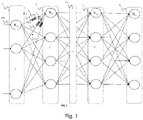
- the figure 1 represents a general diagram of an artificial neural network, for example a convolutional neural network.
- a neural network is conventionally composed of several layers C e ,C l ,C l+i ,C L ,C s of interconnected neurons.
- the network comprises at least one input layer C e and an output layer C s and several intermediate layers C l , C l +i , C L , also called hidden layers.
- the neurons N i,e of the input layer C e receive input data.
- the input data can be of different natures depending on the targeted application.
- the input data is pixels of an image.
- a neural network has the general function of learning to solve a given problem, for example a problem of classification, regression, recognition, identification.
- a neural network is, for example, used in the field of image classification or image recognition or more generally the recognition of characteristics which may be visual, audio, textual.
- Each neuron of a layer is connected, by its input and/or its output, to all the neurons of the preceding or following layer. More generally, a neuron can only be connected to part of the neurons of another layer, in particular in the case of a convolutional network.
- the connections between two neurons N i,e , N i,l of two successive layers are made through artificial synapses S 1 , S 2 , S 3 which can be produced, in particular, by digital memories or by memristive devices.
- Synapse coefficients are optimized through a neural network learning mechanism. The learning mechanism aims to train the neural network to solve a defined problem.
- This mechanism comprises two distinct phases, a first phase of propagation of data from the input layer to the output layer and a second phase of back-propagation of errors from the output layer to the input layer with, for each layer, an update of the synapse weights.
- the errors calculated by the output neurons at the end of the data propagation phase are linked to the problem to be solved. It is, in a way general, to determine an error between the value of an output neuron and an expected value or a target value depending on the problem to be solved.
- learning data for example reference images or sequences of images
- Each neuron implements, during this first phase, a function of integrating the data received which consists, in the case of a convolutional network, of calculating a sum of the data received weighted by the coefficients of the synapses.
- each neuron performs a convolution operation on a convolution filter size corresponding to the size of the submatrix of neurons of the previous layer to which it is connected.
- Each neuron then propagates the result of the convolution to the neurons in the next layer.
- the integration function that it performs may vary.
- the neurons N i,s of the output layer C s perform additional processing in that they calculate an error between the output value of the neuron N i,s and an expected value or a target value which corresponds to the state end of the neuron of the output layer that one wishes to obtain in relation to the learning input data and the problem to be solved by the network. For example, if the network has to solve a classification problem, the expected end state of a neuron corresponds to the class it is supposed to identify in the input data.
- each particular problem to be solved is associated with one or more cost function(s) or objective function to be optimized (by minimization or maximization).
- One objective of the error back-propagation phase is to search for network parameters that optimize (eg minimize) the objective function.
- the objective function depends on the data propagated between each layer of the network from the input layer but also on other parameters, for example the identifiers of the classes to which the data belong in the case of a classification problem.
- the neurons of the output layer C s transmit the calculated errors to the neurons of the previous layer C l+1 which calculate a local error from the back-propagated error of the previous layer and in turn transmit this local error to the previous layer C l .
- each neuron calculates, from the local error, an update value of the weights of the synapses to which it is connected and updates the synapses. The process continues for each layer of neurons up to the penultimate layer which is responsible for updating the weights of the synapses which connect it to the input layer C e .
- the figure 1 represents an example of a neural network given by way of non-limiting illustration.
- each intermediate layer of a network can be totally or partially connected to another layer.
- Network input data can be organized in the form of matrices.
- the network can be configured to output a score or classification information or any other type of output suitable for the problem to be solved.
- a neural network can be configured to recognize the objects extracted from the images and classify them according to different predefined classes or categories.
- the problem solved by the network is then a classification problem.
- a classification problem can also be applied to textual data, documents, Internet pages, audio data.
- the problem to be solved by the neural network can be very diverse in nature. It may be a problem of classifying elements into different categories in order to learn to recognize these elements.
- the problem can also consist of the approximation of an unknown function or of an accelerated modeling of a known but complex function to calculate or even a problem of regression or prediction.
- the present invention is more particularly applicable to a classification problem.
- the source network of the type described in section figure 1 , which is pre-trained on one or more training data sets to solve a source classification problem.
- the source problem consists in identifying, in a scene captured via one or more image(s), the presence of cars.
- this source problem consists in classifying the objects present in the scene according to different categories, one of them being the car category.
- one or more databases of training images are used which are used to train the network, in the manner described above, so as to optimize the synaptic weights of all the layers so that the network learns to classify objects corresponding to cars.
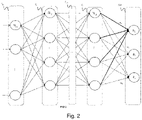
- the picture 2 schematizes a second neural network, called the target network, which aims to learn how to solve a target classification problem, which is generally more specific than the source classification problem.
- the target problem is to classify cars according to their type or brand.
- a general goal of transfer-based machine learning is to exploit the optimized source network of the figure 1 to exploit its knowledge in order to solve the target problem and this, without carrying out a complete training on the same quantity of training data as for the source network.
- the output layer SM of the target network obtained contains as many output neurons a1, a2, a3 as there are categories associated with the target problem (for example corresponding to the different categories of cars that it is desired to classify).
- One objective of the invention is to carry out the adaptation of the source network into the target network without carrying out the partial learning, that is to say without using a complete back-propagation algorithm.
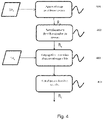
- the figure 4 illustrates, on a flowchart, the steps for implementing an automatic learning transfer method according to a first embodiment of the invention.
- the first step 401 consists, as explained above for the figure 1 , to carry out complete learning or training of the source neural network R S from a set of source learning data DA S with the aim of solving a source classification problem.
- the second step 402 consists in replacing the last layer of the source network R S by a layer specific to the target problem, in order to generate an architecture of a target network R c
- the target network R c differs from the source network R S only by its last layer.
- the last layer of the target network is based on the SoftMax function as shown in picture 3 .
- the picture 3 represents, in a non-limiting example, the last two layers of a target network R c , that is to say the final SoftMax layer and the last hidden layer C L .
- the SoftMax layer comprises three neurons a1,a2,a3 associated with three categories of the target classification problem. Each of these three neurons is linked to a vector of synaptic weights w 1 ,w 2 ,w 3 .
- the third step 403 takes as input a new set of training data intended to be used to solve the target classification problem.
- this new data set is reduced in size compared to the first source training data set.
- the source training data corresponds to a more general source problem and is therefore available in greater quantity.
- these are publicly available databases such as ImageNet databases or other public databases for training neural networks for classification.
- the third step 403 consists in propagating the target learning data from the input of the target network up to the last hidden layer C L then in extracting the representations of these data from this last hidden layer.
- the extracted representations correspond to the features x1,x2,x3,x4,x5.
- a fourth step 404 the updated values of the synaptic weights w 1 ,w 2 ,w 3 of the last layer are calculated as being proportional to the normalized centered average of the representations x1 ,x2,x3, x4,x5 and belonging to each respective class a1,a2,a3.
- the target training data used is labeled according to the category to which it belongs. These labels are propagated with the data until the last hidden layer.
- the proposed approximation is in particular valid for a final layer based on the SoftMax function and for odd activation functions (eg hyperbolic tangent, sine or linear) for the last hidden layer of the network.
- odd activation functions eg hyperbolic tangent, sine or linear
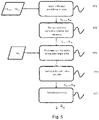
- the figure 5 describes a second embodiment of the invention which aims to select the most suitable neural network for the target problem to be solved from among several pre-learned networks for a source problem.
- a problem to solve consists in determining which pre-trained network for which training database is the most suitable to solve the target problem.
- the source neural network is trained to solve the source problem for several sets of learning data DA S1 ,..., DA SN .
- several source neural networks having different architectures are trained for different sets of training data DA S1 ,..., DA SN .
- Step 402 is applied to each pre-trained network by replacing the last layer with a layer specific to the target problem. Steps 403 and 404 of the method described in figure 4 to each network to obtain several target networks R c1 ,..., R cN from the same set of target training data DA C .
- a final step 405 the classification performances of all the target networks R c1 ,..., R cN are compared and the target network R ci which presents the best performances for solving the target problem is retained.
- Step 405 is, for example, carried out by using labeled test data and by executing an inference phase of each target network for this test data.
- the SoftMax layer of the target network calculates a probability or a classification score (as illustrated in picture 3 ).
- the best performing target network is the one that provides the most reliable classification scores for the same test data.
- this second embodiment makes it possible to select the pre-learned network best suited to the target problem without the need to carry out complete learning of the last layer of each pre-learned network.
- the figure 6 describes a third embodiment of the invention, the objective of which is to select, among several sets of target training data available, the one which best makes it possible to improve the training of the pre-learned network in order to solve the target problem.
- the target problem is identical to the source problem and therefore the last layer of the target network contains as many neurons as the last layer of the source network (unlike the previous embodiments).
- An objective of this third embodiment is to determine which target training data set is most likely to modify the pre-trained model of the source network. In order to avoid redoing a complete training of the source network for each new set of target training data available, the target network is used to determine a criterion for selecting the most relevant target training data.
- step 401 is identical to that described in figure 4 and is run for a single source training data set to produce a pre-trained source network model R S .
- Step 402 consists of replacing the last layer of the source network with a SoftMax layer but this new layer comprises as many neurons as the last layer of the source network so as to address the same source problem.
- Steps 403,404 are executed for several sets of target training data DA c1 , .., DA cN .
- This scenario corresponds to a situation where new target training data is acquired over time and is available to update the source network. For example, in the case of a autonomous car, it can constantly acquire new images of its environment which can constitute new learning data.
- step 404 several target networks R c1 ,..., R cN are obtained corresponding to each set of target training data.
- a final step 605 is then applied to select the target network, and therefore the associated target training data set which makes it possible to deviate the most from the initially pre-learned model to generate the source network Rs.
- an inference phase is executed for each target network and the classification scores determined by the SoftMax layer are compared.
- the target network makes it possible to obtain a good classification score while the calculation of the weights of the last layer is based on a normalized centered mean criterion, then this means that the data used to update these weights are not very new compared to the source data.
- An advantage of this third embodiment is that it avoids carrying out a complete new training of the source network for each new training data set available when these new data are regularly available over time.
- the invention makes it possible to define a criterion to evaluate the novelty of the new data available in order to select only this data to carry out a complete new learning of the source network.
- the figure 7 represents a comparative example of performances obtained for a conventional learning method by back-propagation and for a method according to the invention.
- the diagram of the figure 7 represents the classification performance as a function of the quantity of data tested over time respectively for the two aforementioned methods, during learning and during a test phase.
- the curves 701,711 correspond to the performances obtained during learning respectively with a back-propagation method (701) and with a method according to the invention (711).
- the curves 702,712 correspond to the performances obtained during an inference phase with test data for a network learned respectively with a back-propagation method (702) and with a method according to the invention (712).
- the results of the figure 7 are obtained with a network whose last hidden layer comprises an activation function of the hyperbolic tangent type.
- the curves of the diagram of the figure 7 show that the invention makes it possible to obtain classification performances similar to those obtained with conventional learning.
- the invention can be implemented as a computer program comprising instructions for its execution.
- the computer program may be recorded on a processor-readable recording medium.
- references to a computer program which, when executed, performs any of the functions previously described, is not limited to an application program running on a single host computer. Rather, the terms computer program and software are used herein in a general sense to refer to any type of computer code (e.g., application software, firmware, microcode, or other form of computer instruction) which can be used to program one or more processors for implement aspects of the techniques described herein.
- the computing means or resources can in particular be distributed (“ Cloud computing ”), possibly using peer-to-peer technologies.
- the software code may be executed on any suitable processor (e.g., a microprocessor) or processor core or set of processors, whether provided in a single computing device or distributed among multiple computing devices (e.g. example as possibly accessible in the environment of the device).
- the executable code of each program allowing the programmable device to implement the processes according to the invention can be stored, for example, in the hard disk or in ROM.
- the program or programs can be loaded into one of the storage means of the device before being executed.
- the central unit can control and direct the execution of the instructions or portions of software code of the program or programs according to the invention, instructions which are stored in the hard disk or in the ROM or else in the other aforementioned storage elements.
- the target neural network can be implemented on a computing device based, for example, on an embedded processor.
- the processor may be a generic processor, a specific processor, an application-specific integrated circuit (also known as an ASIC for "Application-Specific Integrated Circuit") or an array of field-programmable gates (also known as the English name of FPGA for “Field-Programmable Gate Array”).
- the computing device may use one or more dedicated electronic circuits or a general purpose circuit.
- the technique of the invention can be implemented on a reprogrammable calculation machine (a processor or a microcontroller for example) executing a program comprising a sequence of instructions, or on a dedicated calculation machine (for example a set of gates such as an FPGA or an ASIC, or any other hardware module).
- the invention applies in many fields in which there is a need to solve a classification problem.
- the invention applies to the analysis of image or video data or more generally multimedia to solve a classification problem.
- the network input data is multimedia data.
- the invention can be implemented in embedded devices, comprising several silicon layers respectively dedicated to the acquisition of input data (for example image, or video) and to calculations relating to the neural network.
- the invention applies to any problem of classifying objects among data. For example, it may involve classifying images or audio sequences or textual data according to their content.
Landscapes
- Engineering & Computer Science (AREA)
- Theoretical Computer Science (AREA)
- Physics & Mathematics (AREA)
- General Health & Medical Sciences (AREA)
- Computing Systems (AREA)
- Biomedical Technology (AREA)
- Biophysics (AREA)
- Computational Linguistics (AREA)
- Data Mining & Analysis (AREA)
- Evolutionary Computation (AREA)
- Life Sciences & Earth Sciences (AREA)
- Molecular Biology (AREA)
- Artificial Intelligence (AREA)
- General Engineering & Computer Science (AREA)
- General Physics & Mathematics (AREA)
- Mathematical Physics (AREA)
- Software Systems (AREA)
- Health & Medical Sciences (AREA)
- Image Analysis (AREA)
- Manipulator (AREA)
- Feedback Control In General (AREA)
Applications Claiming Priority (1)
| Application Number | Priority Date | Filing Date | Title |
|---|---|---|---|
| FR2013155A FR3117647A1 (fr) | 2020-12-14 | 2020-12-14 | Méthode d’apprentissage automatique par transfert |
Publications (1)
| Publication Number | Publication Date |
|---|---|
| EP4012620A1 true EP4012620A1 (de) | 2022-06-15 |
Family
ID=76034661
Family Applications (1)
| Application Number | Title | Priority Date | Filing Date |
|---|---|---|---|
| EP21213450.6A Withdrawn EP4012620A1 (de) | 2020-12-14 | 2021-12-09 | Verfahren zum automatisches lernen durch übertragung |
Country Status (2)
| Country | Link |
|---|---|
| EP (1) | EP4012620A1 (de) |
| FR (1) | FR3117647A1 (de) |
Cited By (1)
| Publication number | Priority date | Publication date | Assignee | Title |
|---|---|---|---|---|
| CN114998659A (zh) * | 2022-06-17 | 2022-09-02 | 北京大学 | 随时间在线训练脉冲神经网络模型的图像数据分类方法 |
Citations (2)
| Publication number | Priority date | Publication date | Assignee | Title |
|---|---|---|---|---|
| US20190311258A1 (en) * | 2018-04-05 | 2019-10-10 | Microsoft Technology Licensing, Llc | Data dependent model initialization |
| US20200134469A1 (en) * | 2018-10-30 | 2020-04-30 | Samsung Sds Co., Ltd. | Method and apparatus for determining a base model for transfer learning |
-
2020
- 2020-12-14 FR FR2013155A patent/FR3117647A1/fr active Pending
-
2021
- 2021-12-09 EP EP21213450.6A patent/EP4012620A1/de not_active Withdrawn
Patent Citations (2)
| Publication number | Priority date | Publication date | Assignee | Title |
|---|---|---|---|---|
| US20190311258A1 (en) * | 2018-04-05 | 2019-10-10 | Microsoft Technology Licensing, Llc | Data dependent model initialization |
| US20200134469A1 (en) * | 2018-10-30 | 2020-04-30 | Samsung Sds Co., Ltd. | Method and apparatus for determining a base model for transfer learning |
Non-Patent Citations (1)
| Title |
|---|
| XUHONG LI ET AL: "Explicit Inductive Bias for Transfer Learning with Convolutional Networks", ARXIV.ORG, CORNELL UNIVERSITY LIBRARY, 201 OLIN LIBRARY CORNELL UNIVERSITY ITHACA, NY 14853, 5 February 2018 (2018-02-05), XP081235499 * |
Cited By (2)
| Publication number | Priority date | Publication date | Assignee | Title |
|---|---|---|---|---|
| CN114998659A (zh) * | 2022-06-17 | 2022-09-02 | 北京大学 | 随时间在线训练脉冲神经网络模型的图像数据分类方法 |
| CN114998659B (zh) * | 2022-06-17 | 2024-05-24 | 北京大学 | 随时间在线训练脉冲神经网络模型的图像数据分类方法 |
Also Published As
| Publication number | Publication date |
|---|---|
| FR3117647A1 (fr) | 2022-06-17 |
Similar Documents
| Publication | Publication Date | Title |
|---|---|---|
| EP3238137B1 (de) | Semantische darstellung des inhalts eines bildes | |
| Fawaz | Deep learning for time series classification | |
| WO2020208153A1 (fr) | Procede de definition d'un chemin | |
| EP4099228A1 (de) | Verbessertes maschinelles lernen ohne anmerkungen durch adaptive gruppierungen in offenen klassensätzen | |
| EP4632689A1 (de) | Verfahren zum trainieren eines maschinenlernmodells zur entdeckung von objekten in einer bildsequenz | |
| EP3633552A1 (de) | Verfahren zum lernen von parametern in einem neuronalen netzwerk mit konvolution und zum erkennen von wichtigen elementen, die auf einem bild sichtbar sind | |
| EP4162409A1 (de) | Verfahren zur erzeugung eines entscheidungsunterstützungssystems und zugehörige systeme | |
| EP0454535B1 (de) | Neuronales Klassifikationssystem and -verfahren | |
| EP3966739B1 (de) | Automatisches bildanalyseverfahren zur automatischen erkennung von mindestens einer seltenen eigenschaft | |
| EP4012620A1 (de) | Verfahren zum automatisches lernen durch übertragung | |
| FR3120966A1 (fr) | Classification de pannes inconnues dans un système de communications électroniques | |
| EP4012619A1 (de) | Verfahren zur kompression eines künstlichen neuronalen netzes | |
| EP4242921A1 (de) | Verfahren, computerprogramm und vorrichtung zum trainieren eines convolutional neural network mit dynamischer architektur für die semantische bildsegmentierung | |
| EP3920101A1 (de) | Methode zur reduzierung der grösse eines künstlichen neuronalen netzes | |
| WO2019211367A1 (fr) | Procede de generation automatique de reseaux de neurones artificiels et procede d'evaluation d'un risque associe | |
| EP4453896A1 (de) | Vorrichtung und verfahren zur verarbeitung von bilddaten eines menschlichen gesichts | |
| EP3815001A1 (de) | Modellierungsverfahren zur überprüfung der ergebnisse eines künstlichen neuronalen netzes und andere zugehörige verfahren | |
| Arlot | Contributions to statistical learning theory: estimator selection and change-point detection | |
| EP4553786A1 (de) | Verfahren zum maschinellen lernen eines multimedia-datenvorhersagemodells und verfahren zum erkennen von anomalien aus einem solchen modell | |
| WO2024184324A1 (fr) | Système de réseaux neuronaux par distillation, procédés d'entrainement améliorés | |
| FR3155338A1 (fr) | Procédé et dispositif de détermination d’appartenance aux données d’apprentissage utilisées pour l’entraînement d’un modèle de classification de données par apprentissage machine | |
| EP4322061A1 (de) | Elektronische vorrichtung und datenverarbeitungsverfahren mit mindestens einem selbstadaptiven künstlichen intelligenzmodell mit lokalem lernen, elektronisches system und computerprogramm dafür | |
| EP4575900A1 (de) | Verfahren zur bestimmung eines unsicherheitsintervalls in zusammenhang mit einer vorhersage eines regressionsaufgabenplans | |
| WO2024184506A1 (fr) | Système et procédé combiné de sélection, d'annotation et d'entraînement via un modèle d'apprentissage automatique partagé | |
| EP4592898A1 (de) | Verfahren zur bestimmung einer robusten vorhersage und eines zertifizierungsintervalls in zusammenhang mit einem regressionsaufgabenpunkt |
Legal Events
| Date | Code | Title | Description |
|---|---|---|---|
| PUAI | Public reference made under article 153(3) epc to a published international application that has entered the european phase |
Free format text: ORIGINAL CODE: 0009012 |
|
| STAA | Information on the status of an ep patent application or granted ep patent |
Free format text: STATUS: REQUEST FOR EXAMINATION WAS MADE |
|
| 17P | Request for examination filed |
Effective date: 20211209 |
|
| AK | Designated contracting states |
Kind code of ref document: A1 Designated state(s): AL AT BE BG CH CY CZ DE DK EE ES FI FR GB GR HR HU IE IS IT LI LT LU LV MC MK MT NL NO PL PT RO RS SE SI SK SM TR |
|
| RAP3 | Party data changed (applicant data changed or rights of an application transferred) |
Owner name: COMMISSARIAT A L'ENERGIE ATOMIQUE ET AUX ENERGIESALTERNATIVES |
|
| STAA | Information on the status of an ep patent application or granted ep patent |
Free format text: STATUS: EXAMINATION IS IN PROGRESS |
|
| 17Q | First examination report despatched |
Effective date: 20250226 |
|
| STAA | Information on the status of an ep patent application or granted ep patent |
Free format text: STATUS: THE APPLICATION IS DEEMED TO BE WITHDRAWN |
|
| 18D | Application deemed to be withdrawn |
Effective date: 20250627 |