EP4013592B1 - Maschine zum führen und halten von fäden und verwendungsverfahren - Google Patents
Maschine zum führen und halten von fäden und verwendungsverfahren Download PDFInfo
- Publication number
- EP4013592B1 EP4013592B1 EP20735435.8A EP20735435A EP4013592B1 EP 4013592 B1 EP4013592 B1 EP 4013592B1 EP 20735435 A EP20735435 A EP 20735435A EP 4013592 B1 EP4013592 B1 EP 4013592B1
- Authority
- EP
- European Patent Office
- Prior art keywords
- filaments
- guide roller
- comb
- guidance
- machine
- Prior art date
- Legal status (The legal status is an assumption and is not a legal conclusion. Google has not performed a legal analysis and makes no representation as to the accuracy of the status listed.)
- Active
Links
Images



Classifications
-
- B—PERFORMING OPERATIONS; TRANSPORTING
- B29—WORKING OF PLASTICS; WORKING OF SUBSTANCES IN A PLASTIC STATE IN GENERAL
- B29C—SHAPING OR JOINING OF PLASTICS; SHAPING OF MATERIAL IN A PLASTIC STATE, NOT OTHERWISE PROVIDED FOR; AFTER-TREATMENT OF THE SHAPED PRODUCTS, e.g. REPAIRING
- B29C43/00—Compression moulding, i.e. applying external pressure to flow the moulding material; Apparatus therefor
- B29C43/32—Component parts, details or accessories; Auxiliary operations
- B29C43/34—Feeding the material to the mould or the compression means
-
- B—PERFORMING OPERATIONS; TRANSPORTING
- B29—WORKING OF PLASTICS; WORKING OF SUBSTANCES IN A PLASTIC STATE IN GENERAL
- B29C—SHAPING OR JOINING OF PLASTICS; SHAPING OF MATERIAL IN A PLASTIC STATE, NOT OTHERWISE PROVIDED FOR; AFTER-TREATMENT OF THE SHAPED PRODUCTS, e.g. REPAIRING
- B29C43/00—Compression moulding, i.e. applying external pressure to flow the moulding material; Apparatus therefor
- B29C43/22—Compression moulding, i.e. applying external pressure to flow the moulding material; Apparatus therefor of articles of indefinite length
- B29C43/24—Calendering
-
- B—PERFORMING OPERATIONS; TRANSPORTING
- B29—WORKING OF PLASTICS; WORKING OF SUBSTANCES IN A PLASTIC STATE IN GENERAL
- B29C—SHAPING OR JOINING OF PLASTICS; SHAPING OF MATERIAL IN A PLASTIC STATE, NOT OTHERWISE PROVIDED FOR; AFTER-TREATMENT OF THE SHAPED PRODUCTS, e.g. REPAIRING
- B29C43/00—Compression moulding, i.e. applying external pressure to flow the moulding material; Apparatus therefor
- B29C43/22—Compression moulding, i.e. applying external pressure to flow the moulding material; Apparatus therefor of articles of indefinite length
- B29C43/28—Compression moulding, i.e. applying external pressure to flow the moulding material; Apparatus therefor of articles of indefinite length incorporating preformed parts or layers, e.g. compression moulding around inserts or for coating articles
-
- B—PERFORMING OPERATIONS; TRANSPORTING
- B29—WORKING OF PLASTICS; WORKING OF SUBSTANCES IN A PLASTIC STATE IN GENERAL
- B29C—SHAPING OR JOINING OF PLASTICS; SHAPING OF MATERIAL IN A PLASTIC STATE, NOT OTHERWISE PROVIDED FOR; AFTER-TREATMENT OF THE SHAPED PRODUCTS, e.g. REPAIRING
- B29C70/00—Shaping composites, i.e. plastics material comprising reinforcements, fillers or preformed parts, e.g. inserts
- B29C70/04—Shaping composites, i.e. plastics material comprising reinforcements, fillers or preformed parts, e.g. inserts comprising reinforcements only, e.g. self-reinforcing plastics
- B29C70/06—Fibrous reinforcements only
- B29C70/10—Fibrous reinforcements only characterised by the structure of fibrous reinforcements, e.g. hollow fibres
- B29C70/16—Fibrous reinforcements only characterised by the structure of fibrous reinforcements, e.g. hollow fibres using fibres of substantial or continuous length
- B29C70/20—Fibrous reinforcements only characterised by the structure of fibrous reinforcements, e.g. hollow fibres using fibres of substantial or continuous length oriented in a single direction, e.g. roofing or other parallel fibres
-
- B—PERFORMING OPERATIONS; TRANSPORTING
- B29—WORKING OF PLASTICS; WORKING OF SUBSTANCES IN A PLASTIC STATE IN GENERAL
- B29D—PRODUCING PARTICULAR ARTICLES FROM PLASTICS OR FROM SUBSTANCES IN A PLASTIC STATE
- B29D30/00—Producing pneumatic or solid tyres or parts thereof
- B29D30/06—Pneumatic tyres or parts thereof (e.g. produced by casting, moulding, compression moulding, injection moulding, centrifugal casting)
- B29D30/38—Textile inserts, e.g. cord or canvas layers, for tyres; Treatment of inserts prior to building the tyre
-
- B—PERFORMING OPERATIONS; TRANSPORTING
- B65—CONVEYING; PACKING; STORING; HANDLING THIN OR FILAMENTARY MATERIAL
- B65H—HANDLING THIN OR FILAMENTARY MATERIAL, e.g. SHEETS, WEBS, CABLES
- B65H57/00—Guides for filamentary materials; Supports therefor
- B65H57/16—Guides for filamentary materials; Supports therefor formed to maintain a plurality of filaments in spaced relation
-
- B—PERFORMING OPERATIONS; TRANSPORTING
- B29—WORKING OF PLASTICS; WORKING OF SUBSTANCES IN A PLASTIC STATE IN GENERAL
- B29C—SHAPING OR JOINING OF PLASTICS; SHAPING OF MATERIAL IN A PLASTIC STATE, NOT OTHERWISE PROVIDED FOR; AFTER-TREATMENT OF THE SHAPED PRODUCTS, e.g. REPAIRING
- B29C43/00—Compression moulding, i.e. applying external pressure to flow the moulding material; Apparatus therefor
- B29C43/32—Component parts, details or accessories; Auxiliary operations
- B29C43/34—Feeding the material to the mould or the compression means
- B29C2043/3405—Feeding the material to the mould or the compression means using carrying means
- B29C2043/3422—Feeding the material to the mould or the compression means using carrying means rollers
-
- B—PERFORMING OPERATIONS; TRANSPORTING
- B29—WORKING OF PLASTICS; WORKING OF SUBSTANCES IN A PLASTIC STATE IN GENERAL
- B29C—SHAPING OR JOINING OF PLASTICS; SHAPING OF MATERIAL IN A PLASTIC STATE, NOT OTHERWISE PROVIDED FOR; AFTER-TREATMENT OF THE SHAPED PRODUCTS, e.g. REPAIRING
- B29C70/00—Shaping composites, i.e. plastics material comprising reinforcements, fillers or preformed parts, e.g. inserts
- B29C70/04—Shaping composites, i.e. plastics material comprising reinforcements, fillers or preformed parts, e.g. inserts comprising reinforcements only, e.g. self-reinforcing plastics
- B29C70/06—Fibrous reinforcements only
- B29C70/10—Fibrous reinforcements only characterised by the structure of fibrous reinforcements, e.g. hollow fibres
- B29C70/16—Fibrous reinforcements only characterised by the structure of fibrous reinforcements, e.g. hollow fibres using fibres of substantial or continuous length
-
- B—PERFORMING OPERATIONS; TRANSPORTING
- B29—WORKING OF PLASTICS; WORKING OF SUBSTANCES IN A PLASTIC STATE IN GENERAL
- B29D—PRODUCING PARTICULAR ARTICLES FROM PLASTICS OR FROM SUBSTANCES IN A PLASTIC STATE
- B29D30/00—Producing pneumatic or solid tyres or parts thereof
- B29D30/06—Pneumatic tyres or parts thereof (e.g. produced by casting, moulding, compression moulding, injection moulding, centrifugal casting)
- B29D30/38—Textile inserts, e.g. cord or canvas layers, for tyres; Treatment of inserts prior to building the tyre
- B29D2030/381—Textile inserts, e.g. cord or canvas layers, for tyres; Treatment of inserts prior to building the tyre the inserts incorporating reinforcing parallel cords; manufacture thereof
-
- B—PERFORMING OPERATIONS; TRANSPORTING
- B29—WORKING OF PLASTICS; WORKING OF SUBSTANCES IN A PLASTIC STATE IN GENERAL
- B29K—INDEXING SCHEME ASSOCIATED WITH SUBCLASSES B29B, B29C OR B29D, RELATING TO MOULDING MATERIALS OR TO MATERIALS FOR MOULDS, REINFORCEMENTS, FILLERS OR PREFORMED PARTS, e.g. INSERTS
- B29K2021/00—Use of unspecified rubbers as moulding material
-
- B—PERFORMING OPERATIONS; TRANSPORTING
- B29—WORKING OF PLASTICS; WORKING OF SUBSTANCES IN A PLASTIC STATE IN GENERAL
- B29K—INDEXING SCHEME ASSOCIATED WITH SUBCLASSES B29B, B29C OR B29D, RELATING TO MOULDING MATERIALS OR TO MATERIALS FOR MOULDS, REINFORCEMENTS, FILLERS OR PREFORMED PARTS, e.g. INSERTS
- B29K2105/00—Condition, form or state of moulded material or of the material to be shaped
- B29K2105/06—Condition, form or state of moulded material or of the material to be shaped containing reinforcements, fillers or inserts
- B29K2105/08—Condition, form or state of moulded material or of the material to be shaped containing reinforcements, fillers or inserts of continuous length, e.g. cords, rovings, mats, fabrics, strands or yarns
- B29K2105/10—Cords, strands or rovings, e.g. oriented cords, strands or rovings
- B29K2105/101—Oriented
-
- B—PERFORMING OPERATIONS; TRANSPORTING
- B29—WORKING OF PLASTICS; WORKING OF SUBSTANCES IN A PLASTIC STATE IN GENERAL
- B29K—INDEXING SCHEME ASSOCIATED WITH SUBCLASSES B29B, B29C OR B29D, RELATING TO MOULDING MATERIALS OR TO MATERIALS FOR MOULDS, REINFORCEMENTS, FILLERS OR PREFORMED PARTS, e.g. INSERTS
- B29K2105/00—Condition, form or state of moulded material or of the material to be shaped
- B29K2105/24—Condition, form or state of moulded material or of the material to be shaped crosslinked or vulcanised
- B29K2105/246—Uncured, e.g. green
-
- B—PERFORMING OPERATIONS; TRANSPORTING
- B65—CONVEYING; PACKING; STORING; HANDLING THIN OR FILAMENTARY MATERIAL
- B65H—HANDLING THIN OR FILAMENTARY MATERIAL, e.g. SHEETS, WEBS, CABLES
- B65H2404/00—Parts for transporting or guiding the handled material
- B65H2404/10—Rollers
- B65H2404/11—Details of cross-section or profile
- B65H2404/111—Details of cross-section or profile shape
-
- B—PERFORMING OPERATIONS; TRANSPORTING
- B65—CONVEYING; PACKING; STORING; HANDLING THIN OR FILAMENTARY MATERIAL
- B65H—HANDLING THIN OR FILAMENTARY MATERIAL, e.g. SHEETS, WEBS, CABLES
- B65H2701/00—Handled material; Storage means
- B65H2701/30—Handled filamentary material
- B65H2701/36—Wires
Definitions
- the invention relates to a process of aligning filaments in a calender line in which multiple filaments, extending in a warp direction and aligned in the form of a ply, are covered with rubber to make reinforced rubber plies for producing tires.
- the invention also relates to a guiding and retention machine using such a process.
- Tires are therefore composed of reinforced rubber plies having different types of rubber compounds with reinforcements of filaments or strips embedded in the rubber material.
- the nature of the filaments and the nature of the rubber are chosen according to the desired final characteristics.
- the term "filament” includes, without limitation, metallic (such as steel wire, film or cable), synthetic or textile reinforcing elements (or “reinforcements”).
- a reinforced rubber sheet 10 has a plurality of continuous metal wires 12 having a common geometry.
- the wires 12 are laid parallel to each other and extend longitudinally between opposite ends of a rubber layer 14. After calendering, the wires 12 are evenly spaced from one another and also evenly positioned so that a center C 12 of each wire remains collinear along a defined longitudinal axis X through the thickness of the rubber layer 14.
- the longitudinal and vertical alignment of the wires 12 is ensured in such a way that a maximum tolerance for a displacement D 12 , measured between each wire center C 12 and the longitudinal axis X of the rubber layer 14, does not exceed a predetermined tolerance for the particular rubber layer being assembled (they are "aligned” and in “alignment”).
- the resulting plies are cut to size and assembled to form a tire blank.
- known creel systems support a plurality of spools held in uniform rows, with each spool supporting a filament-wound material (or "filament").
- filament-wound material or "filament”
- a plurality of filaments must be guided and maintained as they are fed to the rubber products.
- Each of the filaments is therefore moved to known guide and application rollers for positioning in a ply in a state where all filaments are aligned at predetermined intervals (as shown in Figure 1 ).
- Such a guide roller includes circumferential grooves that are formed at a predetermined pitch in an axial direction.
- the guide roller is brought into contact, at a certain pressure, with an application roller having circumferential grooves corresponding to the grooves of the guide roller.
- the filaments are mounted in a state in which the rubber material covers the already aligned filaments.
- DD205849A1 discloses a solution wherein two parallel creel systems prepare a new set of filaments while another set is running. While the disclosed solution introduces a timesaving benefit, such benefit is lost due to the need for operator management of the positioning of the filaments in the grooves of the guide roller.
- DE1938494A1 discloses a method using only a comb to maintain the intervals between the warp threads of a cord fabric web.
- the disclosed solution is not as efficient as solutions using grooved rolls, and it lacks any disclosure that facilitates quick and easy insertion of the filaments in the grooves of a roller.
- Rodolfo Comerio Srl includes a group of cylinders with a first working cylinder (“first cylinder”) and a second working cylinder (“second cylinder") that are located on each side of the substrate and define a gap for the substrate.
- first cylinder first working cylinder
- second cylinder second working cylinder
- a first adjustment device acts on the first cylinder to move it along an adjustment direction away from, or towards, the second cylinder.
- the group of cylinders also includes at least a first counter cylinder for calendering and spreading an elastomer on the surface of the first working cylinder.
- the first counter cylinder arranged adjacent to the first working cylinder rotates in the opposite direction to the first working cylinder.
- a second adjusting device acts on the first counter-cylinder to impart a thrust force of the first counter-cylinder in a predetermined direction toward the first working cylinder.
- the first and second working cylinders exert a thrust on the substrate to apply the elastomer to the substrate and to couple the elastomer to the substrate.
- Such a machine also includes a hydrostatic support for the first working cylinder to slide in the direction of adjustment and to hydrostatically support the thrust exerted by the first counter-cylinder (see publication EP3345736B1 ).
- none of the proposed solutions discloses the guiding and maintenance of the filaments by means of a preparation comb(s) mounted on the guide roller(s), ensuring a quick placement of the filaments in the grooves of the guide rollers (i.e., a filament "anti-jump” maintenance function). Furthermore, none of the proposed solutions discloses one or more mobile guide rollers that, by moving towards a corresponding application roller, permits formation of an anti-jumping box of filaments by capture (or “imprisonment") and to maintain the positioning at the desired pitch whatever the traction. Thus, the disclosed invention combines the benefits of both functions for the purpose of facilitating the preparation and controlling the placement of filaments before and during a calendering process.
- the invention relates to a guiding and maintenance machine for positioning filaments at a predetermined pitch in a calendering cycle that carries out the manufacture of plies using the filaments.
- the guiding and maintenance machine includes a cylinder group that includes a guide roller having a predetermined diameter and a longitudinal axis about which the guide roller rotates, the guide roller having a plurality of circumferential grooves defined on a circumferential surface of the guide roller in correspondence with the number of filaments to be aligned during a guiding and holding process.
- the cylinder group also includes an application roller having a predetermined diameter and a longitudinal axis about which the application roller rotates, the application roller having a plurality of circumferential grooves defined on a circumferential surface thereof in correspondence with the number of grooves of the guide roller.
- the guiding and maintenance machine includes at least one preparation comb with a support having a predetermined length between two opposite ends and a predetermined width between a front surface and a top surface from which a plurality of teeth extend, the teeth having a predetermined uniform height and being aligned and parallel along the length of the support.
- the teeth are positioned at a pitch in correspondence with the grooves of the guide roller so that the preparation comb feeds the filaments from a supply creel to the guide roller, these being positioned at a predetermined pitch outside the guide roller.
- the guide roller is movable relative to the application roller between an open position, in which the filaments are fed to the guide roller, and a closed position, in which the guide roller approaches the application roller to capture the filaments between the respective grooves of the guide roller and the application roller.
- the guiding and maintenance machine includes a pair of preparation combs having at least one mobile comb and at least one fixed comb mounted in alignment with a preparation zone such that the teeth of the mobile comb and those of the teeth of the fixed comb are aligned to allow the passage of filaments through the pair of preparation combs from the supply creel to the guiding and maintenance machine.
- the mobile comb is positioned between the preparation zone and the guide roller in such a way that the pitches between the teeth of the mobile comb are aligned with the corresponding grooves in the guide roller.
- the mobile comb is installed either tangentially or perpendicularly to the circumferential surface of the guide roller.
- the pitch of the teeth is at least 0.7 mm and at most 1.4 mm.
- the invention also relates to a calendering system for making reinforced rubber plies, the calendering system including:
- the calendering system further includes a preparation zone having a pair of preparation combs with at least one mobile comb and at least one fixed comb mounted in alignment such that the teeth of the mobile comb and the teeth of the fixed comb are aligned to allow the passage of the filaments through the pair of preparation combs from the outlet of the supply creel to the guiding and maintenance machine.
- the invention also relates to a guiding and maintenance process performed by the disclosed system during a calendering cycle, the process including the following steps:
- the step of conveying the filament includes a step of simultaneously pulling a mobile comb and the filaments to the guide roller of the guiding and maintenance machine.
- the pulling of the mobile comb is carried out in such a way that the pitches between the teeth of the mobile comb are aligned with the corresponding grooves of the guide roller.
- the pulling of the mobile comb is carried out such that the mobile comb is installed either tangentially or perpendicularly to the circumferential surface of the guide roller.
- the process further includes a step of transferring the filaments, in an aligned state and positioned in the grooves of the guide roller, to the grooves of the application roller.
- the process also includes a step of maintaining the mobile comb in the installed position.
- the process also includes a step of returning the mobile comb to the preparation zone after the end of a calendering cycle.
- a mode of realization of a guiding and maintenance machine (or “machine”) 100 of the invention is represented with one or more preparation combs 200 supplied with the machine (an embodiment of a preparation comb 200 is shown in Figure 2 and described in the following description).
- the machine 100 can be part of a calendering system (or "system") 300 that performs a calendering cycle to form reinforced rubber plies (for example, such as the ply 10 shown in Figure 1 ).
- An example of such a system is represented by, and described in relation to, Figure 6 .
- the plies coming out of the machine 100 include different types of rubber compounds with reinforcing filaments embedded in the rubber material.
- suitable filaments include, without limitation, micro10 alloy carbon steel wires (0.9% carbon and 0.2% chromium) of the UHT type having a tensile strength (R m ) of approximately 3650 MPa (breaking force of 258 N) and a total elongation at break (A t ) of 2.3% (R n , and A t being measured under tension in accordance with ISO 15 6892 of 1984).
- Each filament may be any individual steel reinforcement having a cross-sectional dimension (either diameter or thickness) greater than 100 ⁇ m.
- the filaments can have any suitable cross-sectional geometry.
- This diene elastomer can be selected from polybutadienes (BR), natural rubber (NR), synthetic polyisoprenes (IR), butadiene copolymers, isoprene copolymers and mixtures of these elastomers, such copolymers being selected from butadiene-styrene copolymers (SBR), isoprene-butadiene copolymers (BIR), isoprene-styrene copolymers (SIR), and isoprene-butadiene-styrene copolymers (SBIR).
- SBR butadiene-styrene copolymers
- BIR isoprene-butadiene copolymers
- SIR isoprene-styrene copolymers
- SBIR isoprene-butadiene-styrene copolymers
- a rubber composition selected for the rubber ply may contain one or more diene elastomers and one or more additives commonly used in rubber matrices for the manufacture of tires.
- Such fillers include, without limitation, carbon black, silica, coupling agents, anti-aging agents, antioxidants, plasticizers, extender oils, plasticizing resins having a high glass transition temperature (above 30°C), agents improving the processability of the raw compositions, tackifying resins, anti-reversion agents, methylene acceptors and donors, reinforcing resins, known adhesion promoter systems of the metal salt type and a crosslinking or vulcanization system.
- a person of skill in the art understands how to adjust the formulation of the rubber composition to obtain the desired properties for a specific tire.
- the machine 100 includes a group of grooved cylinders that apply several filaments 50 to a rubber ply arranged on a calender roller 302 (shown in Figures 7 to 11 ) of a calendering machine of the system 300.
- the calendering machine is selected from commercially available calendering machines, including the types disclosed by patent EP3345736 and proposed by Rodolfo Comerio Srl.
- the filaments 50 are applied to the rubber ply so that they are aligned parallel to each other at a predetermined density (see Figures 3, 4 and 5 ).
- the cylinder group of the machine 100 includes a guide roller 102 with a predetermined diameter and with a longitudinal axis around which the guide roller rotates.
- Several circumferential grooves 102a are defined on a circumferential surface 102b of the guide roller corresponding to the number of filaments 50 that must be aligned during a guiding and maintenance process (see Figures 4 and 5 ).
- the filaments 50 arrive at the guide roller 102 in advance of their application to the rubber ply waiting on the calender cylinder 302.
- the cylinder group of the machine 100 also includes an application roller 104 with a predetermined diameter and a longitudinal axis around which the guide roller rotates.
- an application roller 104 with a predetermined diameter and a longitudinal axis around which the guide roller rotates.
- Several circumferential grooves 104a are defined on the circumferential surface 104b of the application roller corresponding to the number of grooves of the guide roller 102 (see Figures 4 and 5 ).
- grooves 102a, 104a shown in the figures is given as an example and is not limited to the number of grooves shown.
- the number, density and/or geometry of the grooves 102a, 104a can be adapted according to the characteristics of the filaments and/or the properties of the rubber ply.
- the two rollers 102, 104 are positioned face to face on either side of the filaments 50 to transfer the filaments between the grooves 102a of the guide roller 102 and the grooves 104a of the application roller 104, this transfer being done without loss of alignment of the filaments.
- the opening and closing of the guide roller 102 can be realized by known means (e.g., by a rotary closing device or its known equivalents).
- the opening and/or closing of the guide roller can be performed automatically or manually to ensure the positioning of the filaments 50 during a guiding and maintenance process of a calendering cycle.
- the filaments 50 are introduced into the comb 200 from a supply creel 304 of the system 300 incorporating the machine 100 and at least one comb 200.
- the supply creel 304 supports a plurality of spools 305 held in uniform rows, and each spool 305 supports a filament 50.
- Each filament 50 is carried in a known manner by a guide from the spools 305 to an outlet 304a of the supply creel.
- the supply creel 304 is selected from commercially available supply creels.
- the filaments 50 are transferred from the outlet 304a of the supply creel 304 to a preparation zone 308 incorporating at least one comb 200.
- the preparation zone 308 can be arranged anywhere along a path between the outlet 304a of the supply creel 304 and the machine 100, and that one or more combs 200 can be installed in relation to the machine 100 to guide the filaments 50 directly to the corresponding grooves 102a of the guide roller 102.
- one or more combs can be installed tangentially adjacent to the circumferential surface 102b of the guide roller 102.
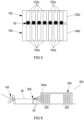
- this Figure 3 represents a top view of the alignment, realized by the comb 200, of the filaments 50 and the grooves 102a of the guide roller 102 of the machine 100 during a guiding and maintenance process.
- the function of the comb 200 is to prepare the filaments 50 for positioning at the desired pitch outside of the guide roller 102 ("positioning").
- the function of the comb 200 is also to accompany the filaments 50 from the supply creel 304 to the guide roller 102 in this positioning.
- one or more combs 200 allow guidance of the filaments 50 to the grooves of the guide roller and maintenance of this positioning during the use of the filaments.
- the guidance and maintenance of the filaments 50 by means of the comb (or combs) 200 installed in relation to the guide roller 102 ensure rapid and accurate positioning of the filaments in the corresponding grooves 102a of the guide roller 102.
- FIGS. 4 and 5 represent a schematic top view of the guide roller 102 of the machine 100 in the open position ( Figure 4 ) and in the closed position ( Figure 5 ) in relation to the application roller 104.
- the filaments 50 individually feed the grooves 102a of the guide roller 102 during a guiding and maintenance process.
- the guide roller 102 moves closer to the application roller 104 to capture (or "trap") the filaments 50 between the respective grooves 102a, 104a of the guide roller 102 and the application roller 104.
- the guide roller 102 moves sufficiently close to the application roller 104 to form an anti-jump cage (or "box") that prevents the filaments 50 from exiting the grooves 104a of the application roller.
- the guide roller 102 is therefore used to guide and maintain the filaments 50 onto the application roller 104 with the necessary restraint. The positioning of the filaments 50 at the desired pitch is thus maintained regardless of the traction.
- the guiding and maintenance process includes a step of feeding the filaments 50 to a comb or combs 200.
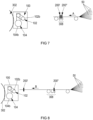
- the feeding of the filaments 50 is carried out in a known manner from the outlet 304a of the supply creel 304 to the preparation zone 308 of the system 300 (see arrow A in Figure 7 ).
- a mobile comb 200' and a fixed 200" comb are mounted in alignment with the preparation zone 308 (i.e., the teeth 204 of both combs are aligned to allow the filaments 50 to pass through both combs).
- the fixed comb 200" initially prepares the filaments 50 for positioning at the desired pitch so that the mobile comb 200' can accompany the filaments to the guide roller 102 in this positioning.
- the guiding and maintenance process also includes a step of conveying the filaments 50 that arrive from the feed creel 304 to the guide roller 102 of the machine 100 (see Figure 8 ).
- This step includes a step of pulling the mobile comb 200' and the filaments 50 simultaneously towards the machine 100 (see arrow B in Figure 8 ).
- the filaments 50 are guided to the machine 100 with their position maintained.
- the fixed comb 200" continues the upstream preparation of the filaments in order to maintain the filament positioning throughout the guiding and maintenance process.
- the pulling of the mobile comb 200' is realized up to the guide roller 102, where it is installed.
- the mobile comb 200' is installed tangentially to the circumferential surface 102b of the guide roller (see Figure 9 ). In an embodiment of the process, the mobile comb 200' is installed perpendicularly to the circumferential surface 102b of the guide roller (see Figure 11 ). In both embodiments, the pitches between the teeth 204 of the mobile comb 200' are aligned with the corresponding grooves 102a of the guide roller 102.
- the guiding and maintenance process also includes, as part of the alignment, a step of inserting the filaments 50 into the corresponding grooves 102a of the guide roller 102 of the machine 100 (see Figure 9 ).
- This step is carried out with the filaments 50 maintained in their position by the mobile comb 200' (see Figure 3 that represents a diagram of the positioning carried out during this step).
- the filaments 50 are first inserted into the grooves 102a on one side of the upper surface 202d of the mobile comb 200'.
- the guide roller remains in the open position during this step (see Figure 4 ).
- the application roller 104 must be opposite to the upper surface 102d of the mobile comb 200' (see Figure 10 ).
- the guiding and maintenance process further includes a step of moving the guide roller 102 from the open position (shown in Figure 4 ) to the closed position (shown in Figure 5 ) (see arrow C in Figure 11 ).
- the filaments 50 are captured (or "trapped") between the guide roller 102 and the application roller 104 to prevent filament jumping.
- the filaments 50 are then transferred, aligned and positioned in the grooves 102a of the guide roller 102 and the grooves 104a of the application roller 104 so that the respective filaments enter the corresponding grooves 104a of the application roller 104 while remaining aligned (see arrow D in Figure 11 ). It is desirable to keep the mobile comb 200' in the installed position (either tangential or perpendicular).
- the guiding and maintenance process of the invention may include a step of returning the mobile comb 200' to the preparation zone 308. This step is carried out after the end of the calendering cycle. During this step, the mobile comb 200' returns to its initial position next to the fixed comb 200" while waiting for the start of a calendering cycle.
- the guiding and maintenance process can be part of a calendering cycle that further includes a step of introducing the aligned filaments 50 from the machine 100 to the calender cylinder 302 of the calendering machine (see Figure 11 ). During this step, a rubber ply is already deposited on a working surface of the calender cylinder 302 awaiting the production of a ply reinforced by the filaments 50. The machine 100 ensures the correct positioning of the filaments 50 to create such a ply at the end of the calendering cycle. At the end of the calendering cycle, one or more plies can be produced, that can be used, for example, as a carcass ply or as a breaker ply intended to reinforce a tire crown, lower than the tread.
- the finished product may be used in a downstream process (that may be, for example, a palletizing process, a shaping process, and/or another process).
- a downstream process that may be, for example, a palletizing process, a shaping process, and/or another process.
- the machine 100 incorporating the comb(s) 200 ensures the planarity of the continuous plies of reinforced rubber before the final assembly of the tire blank.
- a guiding and maintenance process of the invention (and also a cycle of the calendering process of which this process is a part) can be controlled by PLC and can include pre-programming of management information.
- a process setting can be defined using the properties of the filaments fed to the comb 200 and the machine 100.
- a process setting can also be defined using the properties of a rubber ply waiting at the calender cylinder 302.
- the machine 100 may receive voice commands or other audio data representing, for example, the current state of the guidance and maintenance process in progress relative to the intended state.
- the response may be generated in audible, visual, tactile (e.g., using a haptic interface) and/or virtual and/or augmented form.
- the process may include a step of training the machine 100 (or training a system that incorporates the machine 100, including the system 300) to recognize representative characteristics of the filaments 50 leaving the supply creel 304 (for example, diameter and tensile strength values) and to compare them with target values.
- This step may include a step of training the machine 100 to recognize non-equivalences between the compared values.
- Each training step includes a classification generated by means of machine learning. This classification may include, without limitation, the parameters of the filament materials, the parameters of the plies produced, the duration of the calendering cycles and the values expected at the end of a cycle in progress (for example, the value of the space between the aligned filaments in a ply, etc.).
- the machine 100 incorporating the comb 200 is suitable for processing a variety of filaments for use in a variety of rubber compounds without reducing industrial productivity.
- the invention is aimed at reducing time and labor during the operation of inserting multiple filaments into grooves of a guide roller and an application roller in order to align them in a calendering system.
- the invention enables the rapid and ergonomic positioning of any type of filament at a controlled pitch for use in a calendering cycle that performs the manufacture of plies.
- the machine 100 and the comb 200 together form a device that prevents any variation of the pitch and any jump between the filaments with an easy and ergonomic preparation in time, with the aim of forming a reinforced ply of the desired width at the desired density.
Landscapes
- Engineering & Computer Science (AREA)
- Mechanical Engineering (AREA)
- Textile Engineering (AREA)
- Chemical & Material Sciences (AREA)
- Composite Materials (AREA)
- Moulding By Coating Moulds (AREA)
- Casting Or Compression Moulding Of Plastics Or The Like (AREA)
Claims (15)
- Führungs- und Wartungsmaschine (100) zum Positionieren von Fäden (50) in einem vorbestimmten Abstand während eines Kalanderzyklus, der die Herstellung von Lagen unter Verwendung der Fäden bewirkt, wobei die Führungs- und Wartungsmaschine eine Zylindergruppe umfasst, die eine Führungswalze (102) mit einem vorbestimmten Durchmesser und einer Längsachse, um die sich die Führungswalze dreht, enthält, wobei die Führungswalze eine Vielzahl von Umfangsrillen (102a) aufweist, die auf einer Umfangsfläche (102b) der Führungswalze entsprechend der Anzahl von Fäden (50), die während eines Führungs- und Wartungsprozesses auszurichten sind, definiert sind, wobei die Zylindergruppe auch eine Auftragswalze (104) mit einem vorbestimmten Durchmesser und einer Längsachse umfasst, um die sich die Auftragswalze dreht, wobei die Auftragswalze eine Vielzahl von Umfangsrillen (104a) aufweist, die auf einer Umfangsfläche (104b) der Auftragswalze entsprechend der Anzahl der Rillen (102a) der Führungswalze (102) definiert sind, dadurch gekennzeichnet, dass:die Führungs- und Wartungsmaschine (100) mindestens einen Vorbereitungskamm (200) umfasst, der einen Träger (202) mit einer vorbestimmten Länge zwischen zwei gegenüberliegenden Enden (202a, 202b) und einer vorbestimmten Breite zwischen einer vorderen Fläche (202c) und einer oberen Fläche (202d) aufweist, von der sich eine Vielzahl von Zähnen (204) erstreckt, wobei die Zähne (204) eine vorbestimmte einheitliche Höhe aufweisen und entlang der Länge des Trägers (202) ausgerichtet und parallel sind, wobei die Zähne in einem Abstand angeordnet sind, der den Rillen (102a) der Führungswalze (102) entspricht;sodass der Vorbereitungskamm (200) die Fäden (50) von einem Vorratsgestell (304) der Führungswalze (102) zuführt, wobei die Fäden in einem vorbestimmten Abstand außerhalb der Führungswalze (102) positioniert sind;und dass die Führungswalze relativ zur Auftragswalze zwischen einer offenen Position, in der die Fäden der Führungswalze zugeführt werden, und einer geschlossenen Position bewegbar ist, in der sich die Führungswalze der Auftragswalze nähert, um die Fäden zwischen den jeweiligen Rillen (102a, 104a) der Führungswalze (102) und der Auftragswalze (104) einzufangen.
- Führungs- und Wartungsmaschine (100) nach Anspruch 1, umfassend ein Paar Vorbereitungskämme (200) mit mindestens einem beweglichen Kamm (200') und mindestens einem festen Kamm (200"), die in Ausrichtung mit einer Vorbereitungszone (308) so montiert sind, dass die Zähne (204) des beweglichen Kamms und die Zähne des festen Kamms ausgerichtet sind, um den Durchgang der Fäden (50) durch das Paar Vorbereitungskämme vom Vorratsgestell (304) zur Führungs- und Wartungsmaschine (100) zu ermöglichen.
- Führungs- und Wartungsmaschine (100) nach Anspruch 2, wobei der bewegliche Kamm zwischen der Vorbereitungszone (308) und der Führungswalze (102) so positioniert ist, dass die Abstände zwischen den Zähnen (204) des beweglichen Kamms (200') mit den entsprechenden Rillen (102a) der Führungswalze (102) ausgerichtet sind.
- Führungs- und Wartungsmaschine (100) nach Anspruch 3, wobei der bewegliche Kamm (200') entweder tangential oder rechtwinklig zur Umfangsfläche (102b) der Führungswalze (102) installiert ist.
- Führungs- und Wartungsmaschine (100) nach einem der Ansprüche 1 bis 4, wobei der Abstand zwischen den Zähnen (204) mindestens 0,7 mm und höchstens 1,4 mm beträgt.
- Kalandersystem (300) zur Herstellung verstärkter Gummilagen, wobei das Kalandersystem umfasst:die Führungs- und Wartungsmaschine (100) nach einem der Ansprüche 1 bis 5;ein Vorratsgestell (304), das eine Vielzahl von Spulen (305) trägt, die in gleichmäßigen Reihen angeordnet sind, wobei jede Spule einen Faden (50) trägt und jeder Faden von den Spulen zu einem Auslass (304a) des Vorratsgestells zur Führungs- und Wartungsmaschine (100) geführt wird; undeine Kalandermaschine mit einer Kalanderwalze (302), auf der mindestens eine Gummilage angeordnet ist, um die Lagen mit den Fäden (50) ausgerichtet und parallel zueinander mit einer vorbestimmten Dichte zu bilden.
- Kalandersystem (300) nach Anspruch 6, ferner umfassend eine Vorbereitungszone (308) mit einem Paar Vorbereitungskämme, die mindestens einen beweglichen Kamm (200') und mindestens einen festen Kamm (200") umfassen, die so ausgerichtet montiert sind, dass die Zähne (204) des beweglichen Kamms und die Zähne des festen Kamms ausgerichtet sind, um den Durchgang der Fäden (50) durch das Paar Vorbereitungskämme vom Auslass (304a) des Vorratsgestells (304) zur Führungs- und Wartungsmaschine (100) zu ermöglichen.
- Verfahren zur Führung und Wartung, das durch das Kalandersystem (300) nach Anspruch 6 oder Anspruch 7 während eines Kalanderzyklus durchgeführt wird, wobei das Verfahren die folgenden Schritte umfasst:einen Schritt des Zuführens der Fäden (50) zu einem oder mehreren Kämmen (200) vom Auslass (304a) des Vorratsgestells (304) zur Führungs- und Wartungsmaschine (100);einen Schritt des Transportierens der Fäden (50) zwischen dem Vorratsgestell (304) und der Führungswalze (102) der Maschine (100);einen Schritt des Einführens der Fäden (50) in die entsprechenden Rillen (102a) der Führungswalze (102) der Führungs- und Wartungsmaschine (100); undeinen Schritt des Bewegens der Führungswalze (102) zwischen der offenen Position und der geschlossenen Position, um die Fäden (50) zwischen der Führungswalze (102) und der Auftragswalze (104) einzufangen, sodass die jeweiligen Fäden in die entsprechenden Rillen (104a) der Auftragswalze (10') gelangen, während der ausgerichtete Zustand der Fäden beibehalten wird.
- Verfahren nach Anspruch 8, wobei der Schritt des Transportierens der Fäden (50) einen Schritt des gleichzeitigen Ziehens eines beweglichen Kamms (200') und der Fäden (50) in Richtung der Führungswalze (102) der Führungs- und Wartungsmaschine (100) umfasst.
- Verfahren nach Anspruch 9, bei dem das Ziehen des beweglichen Kamms (200') so ausgeführt wird, dass die Abstände zwischen den Zähnen (204) des beweglichen Kamms (200') mit den entsprechenden Rillen (102a) der Führungswalze (102) ausgerichtet sind.
- Verfahren nach Anspruch 10, wobei das Ziehen des beweglichen Kamms (200') so ausgeführt wird, dass der bewegliche Kamm (200') entweder tangential oder rechtwinklig zur Umfangsfläche (102b) der Führungswalze (102) installiert wird.
- Verfahren nach Anspruch 10 oder 11, ferner umfassend einen Schritt des Übertragens der Fäden (50) in einem ausgerichteten Zustand und positioniert in den Rillen (102a) der Führungswalze (102) zu den Rillen (104a) der Auftragswalze (104).
- Verfahren nach einem der Ansprüche 10 bis 12, ferner umfassend einen Schritt des Beibehaltens des beweglichen Kamms (200') in einer installierten Position.
- Verfahren nach Anspruch 13, ferner umfassend einen Schritt des Zurückführens des bewegbaren Kamms (200') in die Vorbereitungszone (308) nach Abschluss eines Kalanderzyklus.
- Kalanderzyklus, der das Verfahren nach einem der Ansprüche 8 bis 14 umfasst, wobei der Kalanderzyklus ferner einen Schritt des Zuführens der durch die Führungs- und Wartungsmaschine (100) ausgerichteten Fäden (50) zum Kalanderzylinder (302) der Kalandermaschine umfasst.
Applications Claiming Priority (2)
| Application Number | Priority Date | Filing Date | Title |
|---|---|---|---|
| FR1909159 | 2019-08-12 | ||
| PCT/EP2020/069057 WO2021028120A1 (en) | 2019-08-12 | 2020-07-07 | Filament guiding and retention machine and method of use |
Publications (2)
| Publication Number | Publication Date |
|---|---|
| EP4013592A1 EP4013592A1 (de) | 2022-06-22 |
| EP4013592B1 true EP4013592B1 (de) | 2024-12-04 |
Family
ID=68733341
Family Applications (1)
| Application Number | Title | Priority Date | Filing Date |
|---|---|---|---|
| EP20735435.8A Active EP4013592B1 (de) | 2019-08-12 | 2020-07-07 | Maschine zum führen und halten von fäden und verwendungsverfahren |
Country Status (4)
| Country | Link |
|---|---|
| US (1) | US12558822B2 (de) |
| EP (1) | EP4013592B1 (de) |
| CN (2) | CN114302805A (de) |
| WO (1) | WO2021028120A1 (de) |
Families Citing this family (1)
| Publication number | Priority date | Publication date | Assignee | Title |
|---|---|---|---|---|
| DE102021205119A1 (de) * | 2021-05-20 | 2022-11-24 | Continental Reifen Deutschland Gmbh | Rillenwalze, Vorrichtung zur Einbettung von Festigkeitsträgern aus Stahl in eine Kautschukmischungsbahn und Verwendungen dieser Vorrichtung |
Family Cites Families (20)
| Publication number | Priority date | Publication date | Assignee | Title |
|---|---|---|---|---|
| DE205849C (de) | ||||
| GB649335A (en) | 1947-02-26 | 1951-01-24 | Us Rubber Co | Improvements in apparatus for making wire tyre fabric |
| CH509837A (de) | 1968-08-07 | 1971-03-31 | Semperit Ag | Verfahren zur ein- oder beidseitigen Beschichtung einer aus Cordfäden bestehenden Kette |
| SU459350A1 (ru) | 1972-10-04 | 1975-02-05 | Научно-Исследовательский Конструкторско-Технологический Институт Шинной Промышленности | Нитераспределительное устройство |
| GB1440081A (en) | 1972-11-06 | 1976-06-23 | Goodyear Tire & Rubber | Structures of reinforced elastomeric material |
| DD205849A1 (de) * | 1982-06-01 | 1984-01-11 | Ulrich Cremer | Vorrichtung fuer die parallele zufuehrung von verstaerkungselementen in einen kalanderspalt |
| EP0557615A1 (de) | 1992-01-23 | 1993-09-01 | Bridgestone Corporation | Verfahren und Vorrichtung zur Herstellung von verstärkten Elastomerstreifen |
| JPH0679759U (ja) | 1993-04-14 | 1994-11-08 | 鐘紡株式会社 | 張力均一化装置 |
| FR2725153A1 (fr) | 1994-09-29 | 1996-04-05 | Sedepro | Renforcement d'une matrice en materiau caoutchouteux par des fils |
| FR2729976A1 (fr) | 1995-02-01 | 1996-08-02 | Michelin & Cie | Procede et dispositif pour appliquer un fil sur un support |
| US5810271A (en) | 1997-08-04 | 1998-09-22 | Rjs Corporation | Roller board and method for loading the same |
| US20050048280A1 (en) | 2003-08-29 | 2005-03-03 | Stamper Rodney Gene | Apparatus and process for making a tape useful as a tire cap ply |
| DE112005003640B4 (de) * | 2005-07-20 | 2014-03-06 | Toyo Tire & Rubber Co., Ltd. | Cordausrichtungsverfahren in einer Kalandrierlinie sowie Vorrichtung hierfür |
| US20070122605A1 (en) | 2005-11-30 | 2007-05-31 | Downing Daniel R | Apparatus and method of manufacturing reduced gauge tire ply |
| JP5552344B2 (ja) | 2010-03-17 | 2014-07-16 | 株式会社ブリヂストン | コード入り帯状ゴム部材の製造方法および装置 |
| EP3124196B1 (de) | 2015-07-28 | 2019-12-18 | Comerc International S.R.L. | Stahlseilaufbringungsvorrichtung, vorrichtung und verfahren zur stahlseilgummibeschichtung |
| KR102037587B1 (ko) | 2015-10-30 | 2019-10-28 | 가부시키가이샤 아이에이치아이 | 와이어 갱신 장치 및 와이어 갱신 방법 |
| EP3345736B1 (de) | 2017-01-05 | 2019-05-01 | Rodolfo Comerio Srl | Kalandriermaschine zur herstellung von mehrschichtigen produkten wie elastomerbeschichteten textil- oder metal-gewebe |
| FR3099890A1 (fr) | 2019-08-12 | 2021-02-19 | Compagnie Generale Des Etablissements Michelin | Machine de Guidage et de Maintien des Fils et Méthode d’Utilisation |
| CN116583475B (zh) | 2020-11-26 | 2025-09-05 | 米其林集团总公司 | 用于牵引和传送线材的系统以及使用方法 |
-
2020
- 2020-07-07 CN CN202080057074.2A patent/CN114302805A/zh active Pending
- 2020-07-07 EP EP20735435.8A patent/EP4013592B1/de active Active
- 2020-07-07 WO PCT/EP2020/069057 patent/WO2021028120A1/en not_active Ceased
- 2020-07-07 CN CN202411924548.5A patent/CN119682097A/zh active Pending
- 2020-07-07 US US17/634,573 patent/US12558822B2/en active Active
Also Published As
| Publication number | Publication date |
|---|---|
| US12558822B2 (en) | 2026-02-24 |
| CN119682097A (zh) | 2025-03-25 |
| WO2021028120A1 (en) | 2021-02-18 |
| CN114302805A (zh) | 2022-04-08 |
| EP4013592A1 (de) | 2022-06-22 |
| US20220266483A1 (en) | 2022-08-25 |
Similar Documents
| Publication | Publication Date | Title |
|---|---|---|
| CN102770264B (zh) | 用于制造具有钢绳芯的输送带的设备和方法 | |
| EP0467560B1 (de) | Verfahren und Vorrichtung zum Formen eines mit Seilen verstärkten Gummibandes | |
| EP4013593B1 (de) | Filamentführungs- und -wartungsmaschine und verfahren zur verwendung | |
| EP3124196B1 (de) | Stahlseilaufbringungsvorrichtung, vorrichtung und verfahren zur stahlseilgummibeschichtung | |
| JP2011111329A (ja) | Ud層を製造するための装置および方法 | |
| KR20080090533A (ko) | 합성사를 용융 방사 및 권취하기 위한 장치 | |
| EP4013592B1 (de) | Maschine zum führen und halten von fäden und verwendungsverfahren | |
| KR101110446B1 (ko) | 코드로 보강된 고무시트의 제조장치 및 제조방법 | |
| EP1174236B1 (de) | Methode und einrichtung zur produktion von nicht vulkanisiertem gummi/stahl draht | |
| US7779882B2 (en) | Apparatus and method for manufacturing rubber sheet with reinforced cord | |
| EP4251551B1 (de) | System zum ziehen und übertragen von drähten und verfahren zur verwendung | |
| IT201800007455A1 (it) | Processo ed un apparato per realizzare pneumatici per ruote di veicoli | |
| CN210797074U (zh) | 一种控制层型结构钢帘线芯股应力的装置 | |
| EP2342070B1 (de) | Verfahren und vorrichtung zum bau von reifen | |
| EP4196341B1 (de) | Steuerung des aufrollens und schneidens von gummifolien in einer reifenherstellungsanlage | |
| US2038328A (en) | Manufacture of rubberized fabrics | |
| IT201800007457A1 (it) | Apparato e processo per realizzare pneumatici per ruote di veicoli | |
| EP3842212B1 (de) | Verfahren und vorrichtung zur herstellung eines gummibeschichteten kords | |
| FR3103130A3 (fr) | Système d’Imbrication Incorporant des Peignes de Préparation pour les Râteliers | |
| KR101923295B1 (ko) | 캡플라이 압출장치 | |
| JP2017080976A (ja) | タイヤ補強用のゴムシート、同ゴムシートの製造方法、及び同ゴムシートを用いたタイヤ |
Legal Events
| Date | Code | Title | Description |
|---|---|---|---|
| STAA | Information on the status of an ep patent application or granted ep patent |
Free format text: STATUS: UNKNOWN |
|
| STAA | Information on the status of an ep patent application or granted ep patent |
Free format text: STATUS: THE INTERNATIONAL PUBLICATION HAS BEEN MADE |
|
| PUAI | Public reference made under article 153(3) epc to a published international application that has entered the european phase |
Free format text: ORIGINAL CODE: 0009012 |
|
| STAA | Information on the status of an ep patent application or granted ep patent |
Free format text: STATUS: REQUEST FOR EXAMINATION WAS MADE |
|
| 17P | Request for examination filed |
Effective date: 20220314 |
|
| AK | Designated contracting states |
Kind code of ref document: A1 Designated state(s): AL AT BE BG CH CY CZ DE DK EE ES FI FR GB GR HR HU IE IS IT LI LT LU LV MC MK MT NL NO PL PT RO RS SE SI SK SM TR |
|
| DAV | Request for validation of the european patent (deleted) | ||
| DAX | Request for extension of the european patent (deleted) | ||
| GRAP | Despatch of communication of intention to grant a patent |
Free format text: ORIGINAL CODE: EPIDOSNIGR1 |
|
| STAA | Information on the status of an ep patent application or granted ep patent |
Free format text: STATUS: GRANT OF PATENT IS INTENDED |
|
| INTG | Intention to grant announced |
Effective date: 20240726 |
|
| GRAS | Grant fee paid |
Free format text: ORIGINAL CODE: EPIDOSNIGR3 |
|
| GRAA | (expected) grant |
Free format text: ORIGINAL CODE: 0009210 |
|
| STAA | Information on the status of an ep patent application or granted ep patent |
Free format text: STATUS: THE PATENT HAS BEEN GRANTED |
|
| AK | Designated contracting states |
Kind code of ref document: B1 Designated state(s): AL AT BE BG CH CY CZ DE DK EE ES FI FR GB GR HR HU IE IS IT LI LT LU LV MC MK MT NL NO PL PT RO RS SE SI SK SM TR |
|
| REG | Reference to a national code |
Ref country code: CH Ref legal event code: EP |
|
| REG | Reference to a national code |
Ref country code: DE Ref legal event code: R096 Ref document number: 602020042482 Country of ref document: DE |
|
| REG | Reference to a national code |
Ref country code: IE Ref legal event code: FG4D |
|
| REG | Reference to a national code |
Ref country code: LT Ref legal event code: MG9D |
|
| REG | Reference to a national code |
Ref country code: NL Ref legal event code: MP Effective date: 20241204 |
|
| PG25 | Lapsed in a contracting state [announced via postgrant information from national office to epo] |
Ref country code: HR Free format text: LAPSE BECAUSE OF FAILURE TO SUBMIT A TRANSLATION OF THE DESCRIPTION OR TO PAY THE FEE WITHIN THE PRESCRIBED TIME-LIMIT Effective date: 20241204 |
|
| PG25 | Lapsed in a contracting state [announced via postgrant information from national office to epo] |
Ref country code: FI Free format text: LAPSE BECAUSE OF FAILURE TO SUBMIT A TRANSLATION OF THE DESCRIPTION OR TO PAY THE FEE WITHIN THE PRESCRIBED TIME-LIMIT Effective date: 20241204 |
|
| PG25 | Lapsed in a contracting state [announced via postgrant information from national office to epo] |
Ref country code: BG Free format text: LAPSE BECAUSE OF FAILURE TO SUBMIT A TRANSLATION OF THE DESCRIPTION OR TO PAY THE FEE WITHIN THE PRESCRIBED TIME-LIMIT Effective date: 20241204 |
|
| PG25 | Lapsed in a contracting state [announced via postgrant information from national office to epo] |
Ref country code: ES Free format text: LAPSE BECAUSE OF FAILURE TO SUBMIT A TRANSLATION OF THE DESCRIPTION OR TO PAY THE FEE WITHIN THE PRESCRIBED TIME-LIMIT Effective date: 20241204 |
|
| PG25 | Lapsed in a contracting state [announced via postgrant information from national office to epo] |
Ref country code: NO Free format text: LAPSE BECAUSE OF FAILURE TO SUBMIT A TRANSLATION OF THE DESCRIPTION OR TO PAY THE FEE WITHIN THE PRESCRIBED TIME-LIMIT Effective date: 20250304 |
|
| PG25 | Lapsed in a contracting state [announced via postgrant information from national office to epo] |
Ref country code: LV Free format text: LAPSE BECAUSE OF FAILURE TO SUBMIT A TRANSLATION OF THE DESCRIPTION OR TO PAY THE FEE WITHIN THE PRESCRIBED TIME-LIMIT Effective date: 20241204 Ref country code: GR Free format text: LAPSE BECAUSE OF FAILURE TO SUBMIT A TRANSLATION OF THE DESCRIPTION OR TO PAY THE FEE WITHIN THE PRESCRIBED TIME-LIMIT Effective date: 20250305 |
|
| PG25 | Lapsed in a contracting state [announced via postgrant information from national office to epo] |
Ref country code: RS Free format text: LAPSE BECAUSE OF FAILURE TO SUBMIT A TRANSLATION OF THE DESCRIPTION OR TO PAY THE FEE WITHIN THE PRESCRIBED TIME-LIMIT Effective date: 20250304 |
|
| PG25 | Lapsed in a contracting state [announced via postgrant information from national office to epo] |
Ref country code: NL Free format text: LAPSE BECAUSE OF FAILURE TO SUBMIT A TRANSLATION OF THE DESCRIPTION OR TO PAY THE FEE WITHIN THE PRESCRIBED TIME-LIMIT Effective date: 20241204 |
|
| REG | Reference to a national code |
Ref country code: AT Ref legal event code: MK05 Ref document number: 1747693 Country of ref document: AT Kind code of ref document: T Effective date: 20241204 |
|
| PG25 | Lapsed in a contracting state [announced via postgrant information from national office to epo] |
Ref country code: SM Free format text: LAPSE BECAUSE OF FAILURE TO SUBMIT A TRANSLATION OF THE DESCRIPTION OR TO PAY THE FEE WITHIN THE PRESCRIBED TIME-LIMIT Effective date: 20241204 |
|
| PG25 | Lapsed in a contracting state [announced via postgrant information from national office to epo] |
Ref country code: PL Free format text: LAPSE BECAUSE OF FAILURE TO SUBMIT A TRANSLATION OF THE DESCRIPTION OR TO PAY THE FEE WITHIN THE PRESCRIBED TIME-LIMIT Effective date: 20241204 |
|
| PG25 | Lapsed in a contracting state [announced via postgrant information from national office to epo] |
Ref country code: IS Free format text: LAPSE BECAUSE OF FAILURE TO SUBMIT A TRANSLATION OF THE DESCRIPTION OR TO PAY THE FEE WITHIN THE PRESCRIBED TIME-LIMIT Effective date: 20250404 |
|
| PG25 | Lapsed in a contracting state [announced via postgrant information from national office to epo] |
Ref country code: PT Free format text: LAPSE BECAUSE OF FAILURE TO SUBMIT A TRANSLATION OF THE DESCRIPTION OR TO PAY THE FEE WITHIN THE PRESCRIBED TIME-LIMIT Effective date: 20250404 |
|
| PG25 | Lapsed in a contracting state [announced via postgrant information from national office to epo] |
Ref country code: EE Free format text: LAPSE BECAUSE OF FAILURE TO SUBMIT A TRANSLATION OF THE DESCRIPTION OR TO PAY THE FEE WITHIN THE PRESCRIBED TIME-LIMIT Effective date: 20241204 |
|
| PG25 | Lapsed in a contracting state [announced via postgrant information from national office to epo] |
Ref country code: RO Free format text: LAPSE BECAUSE OF FAILURE TO SUBMIT A TRANSLATION OF THE DESCRIPTION OR TO PAY THE FEE WITHIN THE PRESCRIBED TIME-LIMIT Effective date: 20241204 Ref country code: AT Free format text: LAPSE BECAUSE OF FAILURE TO SUBMIT A TRANSLATION OF THE DESCRIPTION OR TO PAY THE FEE WITHIN THE PRESCRIBED TIME-LIMIT Effective date: 20241204 |
|
| PG25 | Lapsed in a contracting state [announced via postgrant information from national office to epo] |
Ref country code: SK Free format text: LAPSE BECAUSE OF FAILURE TO SUBMIT A TRANSLATION OF THE DESCRIPTION OR TO PAY THE FEE WITHIN THE PRESCRIBED TIME-LIMIT Effective date: 20241204 |
|
| PG25 | Lapsed in a contracting state [announced via postgrant information from national office to epo] |
Ref country code: CZ Free format text: LAPSE BECAUSE OF FAILURE TO SUBMIT A TRANSLATION OF THE DESCRIPTION OR TO PAY THE FEE WITHIN THE PRESCRIBED TIME-LIMIT Effective date: 20241204 |
|
| PG25 | Lapsed in a contracting state [announced via postgrant information from national office to epo] |
Ref country code: IT Free format text: LAPSE BECAUSE OF FAILURE TO SUBMIT A TRANSLATION OF THE DESCRIPTION OR TO PAY THE FEE WITHIN THE PRESCRIBED TIME-LIMIT Effective date: 20241204 |
|
| REG | Reference to a national code |
Ref country code: DE Ref legal event code: R097 Ref document number: 602020042482 Country of ref document: DE |
|
| PG25 | Lapsed in a contracting state [announced via postgrant information from national office to epo] |
Ref country code: SE Free format text: LAPSE BECAUSE OF FAILURE TO SUBMIT A TRANSLATION OF THE DESCRIPTION OR TO PAY THE FEE WITHIN THE PRESCRIBED TIME-LIMIT Effective date: 20241204 |
|
| PG25 | Lapsed in a contracting state [announced via postgrant information from national office to epo] |
Ref country code: DK Free format text: LAPSE BECAUSE OF FAILURE TO SUBMIT A TRANSLATION OF THE DESCRIPTION OR TO PAY THE FEE WITHIN THE PRESCRIBED TIME-LIMIT Effective date: 20241204 |
|
| PGFP | Annual fee paid to national office [announced via postgrant information from national office to epo] |
Ref country code: DE Payment date: 20250722 Year of fee payment: 6 |
|
| PLBE | No opposition filed within time limit |
Free format text: ORIGINAL CODE: 0009261 |
|
| STAA | Information on the status of an ep patent application or granted ep patent |
Free format text: STATUS: NO OPPOSITION FILED WITHIN TIME LIMIT |
|
| REG | Reference to a national code |
Ref country code: CH Ref legal event code: L10 Free format text: ST27 STATUS EVENT CODE: U-0-0-L10-L00 (AS PROVIDED BY THE NATIONAL OFFICE) Effective date: 20251015 |
|
| PGFP | Annual fee paid to national office [announced via postgrant information from national office to epo] |
Ref country code: FR Payment date: 20250725 Year of fee payment: 6 |
|
| 26N | No opposition filed |
Effective date: 20250905 |
|
| REG | Reference to a national code |
Ref country code: CH Ref legal event code: H13 Free format text: ST27 STATUS EVENT CODE: U-0-0-H10-H13 (AS PROVIDED BY THE NATIONAL OFFICE) Effective date: 20260224 |
|
| PG25 | Lapsed in a contracting state [announced via postgrant information from national office to epo] |
Ref country code: LU Free format text: LAPSE BECAUSE OF NON-PAYMENT OF DUE FEES Effective date: 20250707 |
|
| GBPC | Gb: european patent ceased through non-payment of renewal fee |
Effective date: 20250707 |
|
| REG | Reference to a national code |
Ref country code: BE Ref legal event code: MM Effective date: 20250731 |
|
| PG25 | Lapsed in a contracting state [announced via postgrant information from national office to epo] |
Ref country code: GB Free format text: LAPSE BECAUSE OF NON-PAYMENT OF DUE FEES Effective date: 20250707 |
|
| PG25 | Lapsed in a contracting state [announced via postgrant information from national office to epo] |
Ref country code: BE Free format text: LAPSE BECAUSE OF NON-PAYMENT OF DUE FEES Effective date: 20250731 |