EP4014723A1 - Procédé et système de production d'un produit laitier uht - Google Patents
Procédé et système de production d'un produit laitier uht Download PDFInfo
- Publication number
- EP4014723A1 EP4014723A1 EP20214838.3A EP20214838A EP4014723A1 EP 4014723 A1 EP4014723 A1 EP 4014723A1 EP 20214838 A EP20214838 A EP 20214838A EP 4014723 A1 EP4014723 A1 EP 4014723A1
- Authority
- EP
- European Patent Office
- Prior art keywords
- milk
- temperature
- homogenizing
- uht
- heating
- Prior art date
- Legal status (The legal status is an assumption and is not a legal conclusion. Google has not performed a legal analysis and makes no representation as to the accuracy of the status listed.)
- Pending
Links
Images

Classifications
-
- A—HUMAN NECESSITIES
- A23—FOODS OR FOODSTUFFS; TREATMENT THEREOF, NOT COVERED BY OTHER CLASSES
- A23B—PRESERVATION OF FOODS, FOODSTUFFS OR NON-ALCOHOLIC BEVERAGES; CHEMICAL RIPENING OF FRUIT OR VEGETABLES
- A23B11/00—Preservation of milk or dairy products
- A23B11/10—Preservation of milk or milk preparations
- A23B11/12—Preservation of milk or milk preparations by heating
- A23B11/13—Preservation of milk or milk preparations by heating the materials being loose unpacked
- A23B11/133—Preservation of milk or milk preparations by heating the materials being loose unpacked and progressively transported through the apparatus
- A23B11/137—Preservation of milk or milk preparations by heating the materials being loose unpacked and progressively transported through the apparatus in direct contact with the heating medium, e.g. steam
-
- A—HUMAN NECESSITIES
- A01—AGRICULTURE; FORESTRY; ANIMAL HUSBANDRY; HUNTING; TRAPPING; FISHING
- A01J—MANUFACTURE OF DAIRY PRODUCTS
- A01J11/00—Apparatus for treating milk
- A01J11/16—Homogenising milk
-
- A—HUMAN NECESSITIES
- A23—FOODS OR FOODSTUFFS; TREATMENT THEREOF, NOT COVERED BY OTHER CLASSES
- A23B—PRESERVATION OF FOODS, FOODSTUFFS OR NON-ALCOHOLIC BEVERAGES; CHEMICAL RIPENING OF FRUIT OR VEGETABLES
- A23B11/00—Preservation of milk or dairy products
- A23B11/10—Preservation of milk or milk preparations
- A23B11/12—Preservation of milk or milk preparations by heating
- A23B11/13—Preservation of milk or milk preparations by heating the materials being loose unpacked
- A23B11/133—Preservation of milk or milk preparations by heating the materials being loose unpacked and progressively transported through the apparatus
-
- A—HUMAN NECESSITIES
- A23—FOODS OR FOODSTUFFS; TREATMENT THEREOF, NOT COVERED BY OTHER CLASSES
- A23C—DAIRY PRODUCTS, e.g. MILK, BUTTER OR CHEESE; MILK OR CHEESE SUBSTITUTES; PREPARATION THEREOF
- A23C7/00—Other dairy technology
- A23C7/04—Removing unwanted substances other than lactose or milk proteins from milk
- A23C7/046—Removing unwanted substances other than lactose or milk proteins from milk by centrifugation without using chemicals, e.g. bactofugation; re-use of bactofugate
Definitions
- Dairy products e.g. milk
- the two common methods of heat treatment of milk are pasteurization and Ultra-High Temperature (UHT) processes.
- pasteurization processes milk is typically heated to a temperature below 100oC.
- Pasteurized milk has a typical shelf life of two weeks and needs to be kept refrigerated while being distributed and stored.
- UHT processes milk is typically heated to a temperature above 135oC.
- UHT milk has a typical shelf life of six to nine months if kept unopened and at ambient conditions. Once UHT milk is opened, it needs to be refrigerated and consumed typically within seven days.
- a method for producing a UHT milk product comprising feeding milk into a first homogenizing device, homogenizing the milk by the first homogenizing device at a first temperature and at a first pressure, feeding the milk into a heating device, heating the milk by the heating device to a second temperature, the second temperature being higher than the first temperature, feeding the milk into a second homogenizing device, and homogenizing the milk by the second homogenizing device at a third temperature and at a second pressure, the third temperature being lower than the second temperature, thereby producing the UHT milk product.
- the steps of homogenizing the milk by the first and the second homogenizing devices allow for reducing a size of particles, for example fat globules, in the UHT milk product.
- the steps of homogenizing hence contribute to increasing shelf life as well as stabilizing the UHT milk product against sedimentation during storage.
- the steps of homogenizing the milk improve sensory properties of the UHT milk product such as viscosity, taste and texture.
- the step of heating the milk by the heating device to the second temperature allows for reducing microorganisms in the milk.
- the step of heating the milk by the heating device to the second temperature allows for forming a UHT milk product.
- the step of heating the milk by the heating device to the second temperature also contributes to stabilization of the UHT milk product against sedimentation during storage.
- the first homogenizing device is arranged upstream the heating device.
- the second homogenizing device is arranged downstream the heating device. Therefore, such double homogenizing step further improves an emulsion stability of the UHT milk product.
- the NIZO value an index obtained by the NIZO method by NIZO Food Research BV used to measure homogenization efficiency
- the present inventive concept allows for increasing the shelf life of the UHT milk product while preserving the emulsion stability of the UHT milk product.
- the UHT milk product may be stored and/or distributed at ambient conditions for a longer time, compared to conventionally produced UHT milk products.
- the inventive concept in turn allows for producing a UHT milk product in a more environmental-friendly manner and with a lower cost by at least reducing the amount of spoiled UHT milk products which are thrown away due to passing their end of shell life.
- milk is hereby meant a dairy product such as fresh (raw) milk, pasteurized milk, standardized milk, or recombined milk.
- the first temperature and/or the third temperature of the respective first and the second homogenizing device may be in the range of 70 to 95oC, particularly 80 to 95oC, more particularly above 80 °C in the stated range.
- the first pressure and/or the second pressure of the respective first and the second homogenizing device may be in the range of 200 to 800 bar, particularly 400 to 800 bar, more particularly above 400 bar in the stated range.
- the first and the third temperatures may be selected in relation to the respective first and the second pressure of the first and the second homogenizing device, respectively. This in turn provides flexibility and an improved control of the double homogenizing step i.e. on reducing the size of particles, improving stabilization and sensory properties of the UHT milk product.
- the second temperature may be in the range of 135 to 150o C. This may in turn improve the reduction of microorganisms in the UHT milk product.
- the heating device may be any conventional and commercially available heating device, used in the conventional UHT process.
- the heating device may heat the milk in a manner which per se is known in the art.
- the heating device may heat the milk in a direct manner e.g. by steam injection or steam infusion.
- the heating device may heat the milk in an indirect manner e.g. by a plate-type and/or tubular heat exchanger.
- the heating device may comprise a plurality of direct and indirect heaters. It may further comprise at least one holding tube to keep the milk at the heated temperature for a defined time like a few seconds known in the art in relation to the temperature value.
- the milk may be held for a shorter time, compared to a second temperature of 135o C.
- This provides flexibility and an improved control of the step of heating the milk i.e. an improved control of reducing microorganisms in the UHT milk product.
- the method may further comprise, prior to feeding the milk into the first homogenizing device, feeding the milk through a first bactofugation device.
- the step of feeding the milk through the first bactofugation device may reduce somatic cells in the UHT milk product.
- the step of feeding the milk to the first bactofugation device may further reduce microorganisms in the UHT milk product.
- the step of feeding the milk through the first bactofugation device may hence further improve microbiological status by decreasing microbiological load and somatic cell count. Thereby, the step of feeding the milk through the first bactofugation device may also increase the shelf life of the UHT milk product.
- the step of heating the milk by the heating device to the second temperature may comprise heating the milk by an indirect heat exchanger.
- the milk may not come into direct contact with the heat source but may instead be heated by an indirect heat exchanger.
- the step of heating the milk by the heating device to the second temperature may comprise direct heating of the milk i.e. that the milk may come into direct contact with the heat source.
- the method may further comprise, subsequent to the step of heating the milk by the heating device, cooling the milk by a first cooling device from the second temperature to the third temperature. This may in turn facilitate the step of homogenizing the milk by the second homogenizing device at the third temperature.
- the method may further comprise, prior to the step of feeding the milk into the first homogenizing device, pre-heating the milk by a pre-heating device to the first temperature. This may in turn facilitates the step of homogenizing the milk by the first homogenizing device at the first temperature.
- the step of pre-heating the milk may allow for further reducing microorganisms in the milk.
- a further pre-heating may be performed before standardization of fresh milk, if the milk fed into the first homogenizing device is a standardized milk.
- pre-heating temperature may be 45-50o C, particularly 48o C.
- This part of the invention may also comprise the step of further pre-heating the milk before standardization of fresh milk, if the milk fed into the first bactofugation device is a standardized milk.
- the method may further comprise, subsequent to the step of homogenizing the milk by the second homogenizing device, cooling the UHT milk product by a second cooling device to a temperature below 10o C.
- the step of cooling the UHT milk product may bring the UHT milk product into ambient temperature. This may in turn further improve the emulsion stability of the UHT milk product. In addition, this may facilitate storing and/or packaging of the UHT milk product.
- the method may further comprise, subsequent to the step of homogenizing the milk by the second homogenizing device, filling the UHT milk product into an aseptic storage and/or aseptic package.
- the UHT milk product may be filled into e.g. sterilized containers under sterile conditions. This in turn facilitates provision of shelf-stable UHT milk products that do not need refrigeration.
- the UHT milk products may be stored and/or distributed.
- This part of the invention may also comprise the step of cooling the UHT milk product by a second cooling device to a temperature below 10o C before the step of filling the UHT milk product into an aseptic storage and/or aseptic package.
- the system may further comprise a first bactofugation device, arranged upstream the first homogenizing device.
- the first bactofugation device may provide the same or corresponding advantages as those mentioned in relation to the first aspect.
- the milk fed to the first bactofugation device may be a dairy product such as fresh (raw) milk, pasteurized milk, standardized milk or recombined milk. If the milk is standardized milk, the pre-heating performed before the standardization as mentioned above may have a temperature 45-50o C, particularly 48o C. At least one bactofugation device may be used after the standardization; or at a cream line of the standardization after separation of the fresh milk; or on a skimmed milk line of the standardization after separation of the fresh milk.
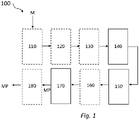
- the pre-heating device 130 may be a plate type heat exchanger.
- the pre-heating device 130 may comprise a plurality of heat exchangers of different types.
- the pre-heating device 130 may pre-heat the milk M to the first temperature in the range of 70 to 95o C, particularly 80 to 95oC, more particularly above 80 oC in the stated range.
- Fig. 1 further shows that the system 100 comprises a first homogenizing device 140.
- Fig. 1 shows that the first homogenizing device 140 is arranged downstream the pre-heating device 130.
- the first homogenizing device 140 may be any conventional and commercially available homogenizing device, used in conventional UHT processes.
- the first homogenizing device 140 is configured to homogenize 230 milk M at the first temperature.
- the first temperature may be in the range of 70 to 95o C, particularly 80 to 95oC, more particularly above 80oC in the stated range.
- the first homogenizing device 140 is configured to homogenize 230 milk M at a first pressure.
- the first pressure may be in the range of 200 to 800 bar, particularly 400 to 800 bar, more particularly above 400 bar in the stated range.
- Fig. 1 further shows that the system 100 comprises a heating device 150.
- Fig. 1 shows that the heating device 150 is arranged downstream the first homogenizing device 140.
- the heating device 150 is configured to heat 240 the milk M to a second temperature.
- the heating device 150 may be any conventional and commercially available heating device, used in the conventional UHT process.
- the heating device 150 may heat 240 the milk M in a manner which per se is known in the art.
- the heating device 150 may heat the milk M in a direct manner e.g. by steam injection or steam infusion.
- the heating device 150 may heat the milk M in an indirect manner e.g. by a plate-type and/or tubular heat exchanger.
- the heating device 150 may comprise a plurality of direct and indirect heaters.
- the second temperature is higher than the first temperature.
- the second temperature may be in the range of 135 to 150o C.
- the heating device 150 may further comprise at least one holding tube to keep the milk at the heated temperature for a defined time like
- Fig. 1 further shows that the system 100 comprises a second homogenizing device 170.
- Fig. 1 shows that the second homogenizing device 170 is arranged downstream the heating device 150.
- the second homogenizing device 170 may be any conventional and commercially available homogenizing device, used in the conventional UHT process.
- the second homogenizing device 170 is configured to homogenize 255 the milk M at a third temperature.
- the third temperature is lower than the second temperature.
- the third temperature may be in the range of 70 to 95o C, particularly 80 to 95oC, more particularly above 80 oC in the stated range.
- the second homogenizing device 170 is configured to homogenize 255 the milk M at a second pressure.
- the second pressure may be in the range of 200 to 800 bar, particularly 400 to 800 bar, more particularly above 400 bar in the stated range. At least one of the first or the second pressure may be above 400 bar. For instance, the first pressure may be 300 bar and the second pressure may be 450 bar, or vice versa.
- Fig. 1 further shows that the UHT milk product MP is produced at an outlet of the second homogenizing device 170.
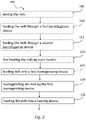
- Fig. 2 illustrates a block scheme of a method 200 for producing a UHT milk product MP.
- the method 200 may comprise storing 205 milk M e.g. raw milk at a temperature below 4o C, preferably below 2o C.
- the method 200 may further comprises feeding 210 the milk M through a first bactofugation device 110.
- the method 200 may further comprises, subsequent to feeding 210 the milk M through the first bactofugation device 110, feeding 215 the milk M through a second bactofugation device 120.
- the method 200 may further comprise pre-heating 220 the milk M by a pre-heating device 130 to a first temperature.
- the method 200 further comprises feeding 225 the milk M into a first homogenizing device 140.
- the step of feeding 225 the milk M into the first homogenizing device 140 may be performed in a manner which per se is known in the art.
- the steps of feeding 210 the milk M through the first bactofugation device 110, feeding 215 the milk M through the second bactofugation device 120, and pre-heating 220 the milk M by the pre-heating device 130 may be performed prior to the step of feeding 225 the milk M into the first homogenizing device 140.
- Fig. 2 further shows that the method 200 further comprises homogenizing 230 the milk M by the first homogenizing device 140.
- the first homogenizing device 140 may be, as described above.
- the first homogenizing device 140 may homogenize 230 the milk M, as described above.
- the step of homogenizing 230 the milk M by the first homogenizing device 140 is performed at a first temperature.
- the first temperature may be in the range of 70 to 95o C, particularly 80 to 95oC, more particularly above 80 oC in the stated range.
- the step of homogenizing 230 the milk M by the first homogenizing device 140 is performed at a first pressure.
- the first pressure may be in the range of 200 to 800 bar, particularly 400 to 800 bar, more particularly above 400 bar in the stated range.
- the method 200 further comprises feeding 235 the milk M into a heating device 150.
- the method 200 further comprises heating 240 the milk M by the heating device 150 to a second temperature.
- the second temperature may be higher than the first temperature.
- the second temperature may be in the range of 135 to 150o C.
- the step of heating 240 the milk M by the heating device 150 to the second temperature may comprise heating 240 the milk M by an indirect heat exchanger.
- the method 200 may further comprise subsequent to the step of heating 240 the milk M by the heating device 150, cooling 245 the milk M by a first cooling device 160.
- the step of cooling 245 the milk M by the first cooling device 160 may cool the milk M from the second temperature to a third temperature.
- the third temperature may be in the range of 70 to 95o C, particularly 80 to 95oC, more particularly above 80 oC in the stated range.
- Fig. 3 further shows that the method 200 further comprises feeding 250 the milk M into a second homogenizing device 170.
- the step of feeding 250 the milk M into the second homogenizing device 170 may be performed in a manner which per se is known in the art.
- the method 200 further comprises homogenizing 255 the milk M by the second homogenizing device 170.
- the second homogenizing device 170 may be, as described above.
- the second homogenizing device 170 may homogenize 255 the milk M, as described above.
- the step of homogenizing 255 the milk M by the second homogenizing device 170 is performed at the third temperature.
- the third temperature is lower than the second temperature.
- the third temperature may be in the range of 70 to 95o C, particularly 80 to 95oC, more particularly above 80 oC in the stated range.
- the method 200 may further comprise subsequent to the step of homogenizing 255 the milk M by the second homogenizing device 170, filling 265 the UHT milk product MP into an aseptic storage and/or aseptic package.
- the step of filling 265 the UHT milk product MP into the aseptic storage and/or aseptic package may be performed subsequent to the step of cooling 260 the UHT milk product MP.
- the step of filling 265 the UHT milk product MP into the aseptic storage and/or aseptic package may be performed in a manner which per se is known in the art.
Landscapes
- Life Sciences & Earth Sciences (AREA)
- Engineering & Computer Science (AREA)
- Chemical & Material Sciences (AREA)
- Food Science & Technology (AREA)
- Polymers & Plastics (AREA)
- Wood Science & Technology (AREA)
- Zoology (AREA)
- Animal Husbandry (AREA)
- Environmental Sciences (AREA)
- Dairy Products (AREA)
Priority Applications (1)
| Application Number | Priority Date | Filing Date | Title |
|---|---|---|---|
| EP20214838.3A EP4014723A1 (fr) | 2020-12-17 | 2020-12-17 | Procédé et système de production d'un produit laitier uht |
Applications Claiming Priority (1)
| Application Number | Priority Date | Filing Date | Title |
|---|---|---|---|
| EP20214838.3A EP4014723A1 (fr) | 2020-12-17 | 2020-12-17 | Procédé et système de production d'un produit laitier uht |
Publications (1)
| Publication Number | Publication Date |
|---|---|
| EP4014723A1 true EP4014723A1 (fr) | 2022-06-22 |
Family
ID=73855240
Family Applications (1)
| Application Number | Title | Priority Date | Filing Date |
|---|---|---|---|
| EP20214838.3A Pending EP4014723A1 (fr) | 2020-12-17 | 2020-12-17 | Procédé et système de production d'un produit laitier uht |
Country Status (1)
| Country | Link |
|---|---|
| EP (1) | EP4014723A1 (fr) |
Cited By (1)
| Publication number | Priority date | Publication date | Assignee | Title |
|---|---|---|---|---|
| CN119394068A (zh) * | 2025-01-02 | 2025-02-07 | 内蒙古蒙牛乳业(集团)股份有限公司 | 换热组件、乳制品降温系统及乳制品生产线 |
Citations (4)
| Publication number | Priority date | Publication date | Assignee | Title |
|---|---|---|---|---|
| US6060105A (en) * | 1996-10-04 | 2000-05-09 | Nestec S.A. | Preparation of a concentrated-milk-base flavoring agent |
| WO2010085957A2 (fr) * | 2009-01-27 | 2010-08-05 | Arla Foods Amba | Lait et produits laitiers à longue durée de conservation et procédé et laiterie industrielle assurant leur traitement |
| WO2013089563A1 (fr) * | 2011-12-15 | 2013-06-20 | Tine Sa | Procédé de production de lait ou de produits laitiers |
| CN111743057A (zh) * | 2019-03-28 | 2020-10-09 | 香港格凌宝健康食品科技有限公司 | 一种无添加剂的椰子汁饮料及其制备方法 |
-
2020
- 2020-12-17 EP EP20214838.3A patent/EP4014723A1/fr active Pending
Patent Citations (4)
| Publication number | Priority date | Publication date | Assignee | Title |
|---|---|---|---|---|
| US6060105A (en) * | 1996-10-04 | 2000-05-09 | Nestec S.A. | Preparation of a concentrated-milk-base flavoring agent |
| WO2010085957A2 (fr) * | 2009-01-27 | 2010-08-05 | Arla Foods Amba | Lait et produits laitiers à longue durée de conservation et procédé et laiterie industrielle assurant leur traitement |
| WO2013089563A1 (fr) * | 2011-12-15 | 2013-06-20 | Tine Sa | Procédé de production de lait ou de produits laitiers |
| CN111743057A (zh) * | 2019-03-28 | 2020-10-09 | 香港格凌宝健康食品科技有限公司 | 一种无添加剂的椰子汁饮料及其制备方法 |
Non-Patent Citations (1)
| Title |
|---|
| FRAHM CHRISTIAN ET AL: "Neues Separations-Verfahren zur Doppelentkeimung für die verlängerte Haltbarkeit von Trinkmilch", 31 August 2013 (2013-08-31), pages 1 - 16, XP055808244, Retrieved from the Internet <URL:https://www.gea.com/en/binaries/BRO-DA-WhitePaper-prolong-DE-2013-08_tcm11-28656.pdf> [retrieved on 20210527] * |
Cited By (1)
| Publication number | Priority date | Publication date | Assignee | Title |
|---|---|---|---|---|
| CN119394068A (zh) * | 2025-01-02 | 2025-02-07 | 内蒙古蒙牛乳业(集团)股份有限公司 | 换热组件、乳制品降温系统及乳制品生产线 |
Similar Documents
| Publication | Publication Date | Title |
|---|---|---|
| US8329237B2 (en) | Methods for heat treatment of milk | |
| CN209473504U (zh) | 一种用于生产液态乳制品的生产装置 | |
| US4921717A (en) | UHT concentrated milk and product and process of making | |
| EP2099310A1 (fr) | Procédé pour la production de lait moyenne-longue conservation et appareil pour la mise en uvre de ce procédé | |
| CN101026963A (zh) | 热稳定的浓缩乳产品 | |
| US7186430B2 (en) | UHT pasteurizer with regeneration | |
| US9198456B2 (en) | Apparatus and method for heating and sterilizing liquid food | |
| CN102469802A (zh) | 用于制备可更久保质的鲜奶的方法 | |
| US20170258103A1 (en) | Processes for producing treated milk products | |
| US20010026825A1 (en) | Ultra-high temperature milk concentrate package and method of producing same | |
| EP4014723A1 (fr) | Procédé et système de production d'un produit laitier uht | |
| EP1389914B2 (fr) | Conditionnement de lait concentre pasteurise a ultra-haute temperature et procede de production de ce dernier | |
| US12439932B2 (en) | Method and a system for producing a UHT milk product by direct UHT heating | |
| SE0900826A1 (sv) | Metod för framställning av en yoghurtbaserad produkt | |
| JP5268817B2 (ja) | 加工乳又は乳飲料の製造方法 | |
| CN113194732A (zh) | 酸乳和酸奶的生产 | |
| CN121220379A (zh) | 牧厂一体化牛奶生产方法及系统 | |
| AU2001261302B2 (en) | Ultra-high temperature milk concentrate package and method of producing same | |
| KR20080103101A (ko) | 초고온 우유 농축물의 제조방법 | |
| Khetra | S kkkkkS 15-19, ttTTS | |
| WO2021224110A1 (fr) | Procédé de production de produit laitier acidifié | |
| HK1064003B (en) | Ultra-high temperature milk concentrate package and method of producing same | |
| MXPA99008400A (en) | A method of producing uht milk with improved flavour qualities | |
| AU2001261302A1 (en) | Ultra-high temperature milk concentrate package and method of producing same |
Legal Events
| Date | Code | Title | Description |
|---|---|---|---|
| PUAI | Public reference made under article 153(3) epc to a published international application that has entered the european phase |
Free format text: ORIGINAL CODE: 0009012 |
|
| STAA | Information on the status of an ep patent application or granted ep patent |
Free format text: STATUS: THE APPLICATION HAS BEEN PUBLISHED |
|
| AK | Designated contracting states |
Kind code of ref document: A1 Designated state(s): AL AT BE BG CH CY CZ DE DK EE ES FI FR GB GR HR HU IE IS IT LI LT LU LV MC MK MT NL NO PL PT RO RS SE SI SK SM TR |
|
| STAA | Information on the status of an ep patent application or granted ep patent |
Free format text: STATUS: REQUEST FOR EXAMINATION WAS MADE |
|
| 17P | Request for examination filed |
Effective date: 20221222 |
|
| RBV | Designated contracting states (corrected) |
Designated state(s): AL AT BE BG CH CY CZ DE DK EE ES FI FR GB GR HR HU IE IS IT LI LT LU LV MC MK MT NL NO PL PT RO RS SE SI SK SM TR |
|
| STAA | Information on the status of an ep patent application or granted ep patent |
Free format text: STATUS: EXAMINATION IS IN PROGRESS |
|
| 17Q | First examination report despatched |
Effective date: 20240515 |