EP4014949B1 - Verfahren zur herstellung eines keramischen mehrschichtrohlings - Google Patents
Verfahren zur herstellung eines keramischen mehrschichtrohlings Download PDFInfo
- Publication number
- EP4014949B1 EP4014949B1 EP21155464.7A EP21155464A EP4014949B1 EP 4014949 B1 EP4014949 B1 EP 4014949B1 EP 21155464 A EP21155464 A EP 21155464A EP 4014949 B1 EP4014949 B1 EP 4014949B1
- Authority
- EP
- European Patent Office
- Prior art keywords
- layer
- additional layers
- ceramic material
- oxide
- ceramic
- Prior art date
- Legal status (The legal status is an assumption and is not a legal conclusion. Google has not performed a legal analysis and makes no representation as to the accuracy of the status listed.)
- Active
Links
Images
Classifications
-
- B—PERFORMING OPERATIONS; TRANSPORTING
- B28—WORKING CEMENT, CLAY, OR STONE
- B28B—SHAPING CLAY OR OTHER CERAMIC COMPOSITIONS; SHAPING SLAG; SHAPING MIXTURES CONTAINING CEMENTITIOUS MATERIAL, e.g. PLASTER
- B28B1/00—Producing shaped prefabricated articles from the material
- B28B1/14—Producing shaped prefabricated articles from the material by simple casting, the material being neither forcibly fed nor positively compacted
- B28B1/16—Producing shaped prefabricated articles from the material by simple casting, the material being neither forcibly fed nor positively compacted for producing layered articles
-
- A—HUMAN NECESSITIES
- A61—MEDICAL OR VETERINARY SCIENCE; HYGIENE
- A61C—DENTISTRY; APPARATUS OR METHODS FOR ORAL OR DENTAL HYGIENE
- A61C13/00—Dental prostheses; Making same
- A61C13/0003—Making bridge-work, inlays, implants or the like
- A61C13/0022—Blanks or green, unfinished dental restoration parts
-
- A—HUMAN NECESSITIES
- A61—MEDICAL OR VETERINARY SCIENCE; HYGIENE
- A61K—PREPARATIONS FOR MEDICAL, DENTAL OR TOILETRY PURPOSES
- A61K6/00—Preparations for dentistry
- A61K6/80—Preparations for artificial teeth, for filling teeth or for capping teeth
- A61K6/802—Preparations for artificial teeth, for filling teeth or for capping teeth comprising ceramics
- A61K6/804—Preparations for artificial teeth, for filling teeth or for capping teeth comprising ceramics comprising manganese oxide
-
- A—HUMAN NECESSITIES
- A61—MEDICAL OR VETERINARY SCIENCE; HYGIENE
- A61K—PREPARATIONS FOR MEDICAL, DENTAL OR TOILETRY PURPOSES
- A61K6/00—Preparations for dentistry
- A61K6/80—Preparations for artificial teeth, for filling teeth or for capping teeth
- A61K6/802—Preparations for artificial teeth, for filling teeth or for capping teeth comprising ceramics
- A61K6/813—Preparations for artificial teeth, for filling teeth or for capping teeth comprising ceramics comprising iron oxide
-
- A—HUMAN NECESSITIES
- A61—MEDICAL OR VETERINARY SCIENCE; HYGIENE
- A61K—PREPARATIONS FOR MEDICAL, DENTAL OR TOILETRY PURPOSES
- A61K6/00—Preparations for dentistry
- A61K6/80—Preparations for artificial teeth, for filling teeth or for capping teeth
- A61K6/802—Preparations for artificial teeth, for filling teeth or for capping teeth comprising ceramics
- A61K6/818—Preparations for artificial teeth, for filling teeth or for capping teeth comprising ceramics comprising zirconium oxide
-
- A—HUMAN NECESSITIES
- A61—MEDICAL OR VETERINARY SCIENCE; HYGIENE
- A61K—PREPARATIONS FOR MEDICAL, DENTAL OR TOILETRY PURPOSES
- A61K6/00—Preparations for dentistry
- A61K6/80—Preparations for artificial teeth, for filling teeth or for capping teeth
- A61K6/802—Preparations for artificial teeth, for filling teeth or for capping teeth comprising ceramics
- A61K6/822—Preparations for artificial teeth, for filling teeth or for capping teeth comprising ceramics comprising rare earth metal oxides
-
- B—PERFORMING OPERATIONS; TRANSPORTING
- B28—WORKING CEMENT, CLAY, OR STONE
- B28B—SHAPING CLAY OR OTHER CERAMIC COMPOSITIONS; SHAPING SLAG; SHAPING MIXTURES CONTAINING CEMENTITIOUS MATERIAL, e.g. PLASTER
- B28B11/00—Apparatus or processes for treating or working the shaped or preshaped articles
- B28B11/24—Apparatus or processes for treating or working the shaped or preshaped articles for curing, setting or hardening
- B28B11/243—Setting, e.g. drying, dehydrating or firing ceramic articles
-
- C—CHEMISTRY; METALLURGY
- C04—CEMENTS; CONCRETE; ARTIFICIAL STONE; CERAMICS; REFRACTORIES
- C04B—LIME, MAGNESIA; SLAG; CEMENTS; COMPOSITIONS THEREOF, e.g. MORTARS, CONCRETE OR LIKE BUILDING MATERIALS; ARTIFICIAL STONE; CERAMICS; REFRACTORIES; TREATMENT OF NATURAL STONE
- C04B35/00—Shaped ceramic products characterised by their composition; Ceramics compositions; Processing powders of inorganic compounds preparatory to the manufacturing of ceramic products
- C04B35/01—Shaped ceramic products characterised by their composition; Ceramics compositions; Processing powders of inorganic compounds preparatory to the manufacturing of ceramic products based on oxide ceramics
- C04B35/03—Shaped ceramic products characterised by their composition; Ceramics compositions; Processing powders of inorganic compounds preparatory to the manufacturing of ceramic products based on oxide ceramics based on magnesium oxide, calcium oxide or oxide mixtures derived from dolomite
- C04B35/04—Shaped ceramic products characterised by their composition; Ceramics compositions; Processing powders of inorganic compounds preparatory to the manufacturing of ceramic products based on oxide ceramics based on magnesium oxide, calcium oxide or oxide mixtures derived from dolomite based on magnesium oxide
-
- C—CHEMISTRY; METALLURGY
- C04—CEMENTS; CONCRETE; ARTIFICIAL STONE; CERAMICS; REFRACTORIES
- C04B—LIME, MAGNESIA; SLAG; CEMENTS; COMPOSITIONS THEREOF, e.g. MORTARS, CONCRETE OR LIKE BUILDING MATERIALS; ARTIFICIAL STONE; CERAMICS; REFRACTORIES; TREATMENT OF NATURAL STONE
- C04B35/00—Shaped ceramic products characterised by their composition; Ceramics compositions; Processing powders of inorganic compounds preparatory to the manufacturing of ceramic products
- C04B35/01—Shaped ceramic products characterised by their composition; Ceramics compositions; Processing powders of inorganic compounds preparatory to the manufacturing of ceramic products based on oxide ceramics
- C04B35/03—Shaped ceramic products characterised by their composition; Ceramics compositions; Processing powders of inorganic compounds preparatory to the manufacturing of ceramic products based on oxide ceramics based on magnesium oxide, calcium oxide or oxide mixtures derived from dolomite
- C04B35/057—Shaped ceramic products characterised by their composition; Ceramics compositions; Processing powders of inorganic compounds preparatory to the manufacturing of ceramic products based on oxide ceramics based on magnesium oxide, calcium oxide or oxide mixtures derived from dolomite based on calcium oxide
-
- C—CHEMISTRY; METALLURGY
- C04—CEMENTS; CONCRETE; ARTIFICIAL STONE; CERAMICS; REFRACTORIES
- C04B—LIME, MAGNESIA; SLAG; CEMENTS; COMPOSITIONS THEREOF, e.g. MORTARS, CONCRETE OR LIKE BUILDING MATERIALS; ARTIFICIAL STONE; CERAMICS; REFRACTORIES; TREATMENT OF NATURAL STONE
- C04B35/00—Shaped ceramic products characterised by their composition; Ceramics compositions; Processing powders of inorganic compounds preparatory to the manufacturing of ceramic products
- C04B35/01—Shaped ceramic products characterised by their composition; Ceramics compositions; Processing powders of inorganic compounds preparatory to the manufacturing of ceramic products based on oxide ceramics
- C04B35/48—Shaped ceramic products characterised by their composition; Ceramics compositions; Processing powders of inorganic compounds preparatory to the manufacturing of ceramic products based on oxide ceramics based on zirconium or hafnium oxides, zirconates, zircon or hafnates
-
- C—CHEMISTRY; METALLURGY
- C04—CEMENTS; CONCRETE; ARTIFICIAL STONE; CERAMICS; REFRACTORIES
- C04B—LIME, MAGNESIA; SLAG; CEMENTS; COMPOSITIONS THEREOF, e.g. MORTARS, CONCRETE OR LIKE BUILDING MATERIALS; ARTIFICIAL STONE; CERAMICS; REFRACTORIES; TREATMENT OF NATURAL STONE
- C04B35/00—Shaped ceramic products characterised by their composition; Ceramics compositions; Processing powders of inorganic compounds preparatory to the manufacturing of ceramic products
- C04B35/50—Shaped ceramic products characterised by their composition; Ceramics compositions; Processing powders of inorganic compounds preparatory to the manufacturing of ceramic products based on rare-earth compounds
-
- C—CHEMISTRY; METALLURGY
- C04—CEMENTS; CONCRETE; ARTIFICIAL STONE; CERAMICS; REFRACTORIES
- C04B—LIME, MAGNESIA; SLAG; CEMENTS; COMPOSITIONS THEREOF, e.g. MORTARS, CONCRETE OR LIKE BUILDING MATERIALS; ARTIFICIAL STONE; CERAMICS; REFRACTORIES; TREATMENT OF NATURAL STONE
- C04B35/00—Shaped ceramic products characterised by their composition; Ceramics compositions; Processing powders of inorganic compounds preparatory to the manufacturing of ceramic products
- C04B35/622—Forming processes; Processing powders of inorganic compounds preparatory to the manufacturing of ceramic products
- C04B35/64—Burning or sintering processes
- C04B35/645—Pressure sintering
-
- A—HUMAN NECESSITIES
- A61—MEDICAL OR VETERINARY SCIENCE; HYGIENE
- A61C—DENTISTRY; APPARATUS OR METHODS FOR ORAL OR DENTAL HYGIENE
- A61C13/00—Dental prostheses; Making same
- A61C13/08—Artificial teeth; Making same
- A61C13/082—Cosmetic aspects, e.g. inlays; Determination of the colour
-
- A—HUMAN NECESSITIES
- A61—MEDICAL OR VETERINARY SCIENCE; HYGIENE
- A61C—DENTISTRY; APPARATUS OR METHODS FOR ORAL OR DENTAL HYGIENE
- A61C13/00—Dental prostheses; Making same
- A61C13/08—Artificial teeth; Making same
- A61C13/083—Porcelain or ceramic teeth
-
- C—CHEMISTRY; METALLURGY
- C04—CEMENTS; CONCRETE; ARTIFICIAL STONE; CERAMICS; REFRACTORIES
- C04B—LIME, MAGNESIA; SLAG; CEMENTS; COMPOSITIONS THEREOF, e.g. MORTARS, CONCRETE OR LIKE BUILDING MATERIALS; ARTIFICIAL STONE; CERAMICS; REFRACTORIES; TREATMENT OF NATURAL STONE
- C04B2235/00—Aspects relating to ceramic starting mixtures or sintered ceramic products
- C04B2235/02—Composition of constituents of the starting material or of secondary phases of the final product
- C04B2235/30—Constituents and secondary phases not being of a fibrous nature
- C04B2235/32—Metal oxides, mixed metal oxides, or oxide-forming salts thereof, e.g. carbonates, nitrates, (oxy)hydroxides, chlorides
- C04B2235/3205—Alkaline earth oxides or oxide forming salts thereof, e.g. beryllium oxide
- C04B2235/3206—Magnesium oxides or oxide-forming salts thereof
-
- C—CHEMISTRY; METALLURGY
- C04—CEMENTS; CONCRETE; ARTIFICIAL STONE; CERAMICS; REFRACTORIES
- C04B—LIME, MAGNESIA; SLAG; CEMENTS; COMPOSITIONS THEREOF, e.g. MORTARS, CONCRETE OR LIKE BUILDING MATERIALS; ARTIFICIAL STONE; CERAMICS; REFRACTORIES; TREATMENT OF NATURAL STONE
- C04B2235/00—Aspects relating to ceramic starting mixtures or sintered ceramic products
- C04B2235/02—Composition of constituents of the starting material or of secondary phases of the final product
- C04B2235/30—Constituents and secondary phases not being of a fibrous nature
- C04B2235/32—Metal oxides, mixed metal oxides, or oxide-forming salts thereof, e.g. carbonates, nitrates, (oxy)hydroxides, chlorides
- C04B2235/3205—Alkaline earth oxides or oxide forming salts thereof, e.g. beryllium oxide
- C04B2235/3208—Calcium oxide or oxide-forming salts thereof, e.g. lime
-
- C—CHEMISTRY; METALLURGY
- C04—CEMENTS; CONCRETE; ARTIFICIAL STONE; CERAMICS; REFRACTORIES
- C04B—LIME, MAGNESIA; SLAG; CEMENTS; COMPOSITIONS THEREOF, e.g. MORTARS, CONCRETE OR LIKE BUILDING MATERIALS; ARTIFICIAL STONE; CERAMICS; REFRACTORIES; TREATMENT OF NATURAL STONE
- C04B2235/00—Aspects relating to ceramic starting mixtures or sintered ceramic products
- C04B2235/02—Composition of constituents of the starting material or of secondary phases of the final product
- C04B2235/30—Constituents and secondary phases not being of a fibrous nature
- C04B2235/32—Metal oxides, mixed metal oxides, or oxide-forming salts thereof, e.g. carbonates, nitrates, (oxy)hydroxides, chlorides
- C04B2235/3224—Rare earth oxide or oxide forming salts thereof, e.g. scandium oxide
- C04B2235/3229—Cerium oxides or oxide-forming salts thereof
-
- C—CHEMISTRY; METALLURGY
- C04—CEMENTS; CONCRETE; ARTIFICIAL STONE; CERAMICS; REFRACTORIES
- C04B—LIME, MAGNESIA; SLAG; CEMENTS; COMPOSITIONS THEREOF, e.g. MORTARS, CONCRETE OR LIKE BUILDING MATERIALS; ARTIFICIAL STONE; CERAMICS; REFRACTORIES; TREATMENT OF NATURAL STONE
- C04B2235/00—Aspects relating to ceramic starting mixtures or sintered ceramic products
- C04B2235/02—Composition of constituents of the starting material or of secondary phases of the final product
- C04B2235/30—Constituents and secondary phases not being of a fibrous nature
- C04B2235/32—Metal oxides, mixed metal oxides, or oxide-forming salts thereof, e.g. carbonates, nitrates, (oxy)hydroxides, chlorides
- C04B2235/3231—Refractory metal oxides, their mixed metal oxides, or oxide-forming salts thereof
- C04B2235/3244—Zirconium oxides, zirconates, hafnium oxides, hafnates, or oxide-forming salts thereof
- C04B2235/3246—Stabilised zirconias, e.g. YSZ or cerium stabilised zirconia
-
- C—CHEMISTRY; METALLURGY
- C04—CEMENTS; CONCRETE; ARTIFICIAL STONE; CERAMICS; REFRACTORIES
- C04B—LIME, MAGNESIA; SLAG; CEMENTS; COMPOSITIONS THEREOF, e.g. MORTARS, CONCRETE OR LIKE BUILDING MATERIALS; ARTIFICIAL STONE; CERAMICS; REFRACTORIES; TREATMENT OF NATURAL STONE
- C04B2235/00—Aspects relating to ceramic starting mixtures or sintered ceramic products
- C04B2235/60—Aspects relating to the preparation, properties or mechanical treatment of green bodies or pre-forms
- C04B2235/602—Making the green bodies or pre-forms by moulding
- C04B2235/6027—Slip casting
-
- C—CHEMISTRY; METALLURGY
- C04—CEMENTS; CONCRETE; ARTIFICIAL STONE; CERAMICS; REFRACTORIES
- C04B—LIME, MAGNESIA; SLAG; CEMENTS; COMPOSITIONS THEREOF, e.g. MORTARS, CONCRETE OR LIKE BUILDING MATERIALS; ARTIFICIAL STONE; CERAMICS; REFRACTORIES; TREATMENT OF NATURAL STONE
- C04B2235/00—Aspects relating to ceramic starting mixtures or sintered ceramic products
- C04B2235/70—Aspects relating to sintered or melt-casted ceramic products
- C04B2235/74—Physical characteristics
- C04B2235/75—Products with a concentration gradient
-
- C—CHEMISTRY; METALLURGY
- C04—CEMENTS; CONCRETE; ARTIFICIAL STONE; CERAMICS; REFRACTORIES
- C04B—LIME, MAGNESIA; SLAG; CEMENTS; COMPOSITIONS THEREOF, e.g. MORTARS, CONCRETE OR LIKE BUILDING MATERIALS; ARTIFICIAL STONE; CERAMICS; REFRACTORIES; TREATMENT OF NATURAL STONE
- C04B2235/00—Aspects relating to ceramic starting mixtures or sintered ceramic products
- C04B2235/70—Aspects relating to sintered or melt-casted ceramic products
- C04B2235/96—Properties of ceramic products, e.g. mechanical properties such as strength, toughness, wear resistance
- C04B2235/9646—Optical properties
- C04B2235/9661—Colour
Definitions
- the present invention relates to a method for producing a ceramic multilayer blank comprising at least a first layer of a first ceramic material and at least a second layer of a second ceramic material, wherein the first layer and the second layer are made of ceramic materials of different compositions, which are filled in pourable condition layer-by-layer into a mold and thereafter they are pressed and then sintered.
- US 8 936 848 B2 discloses a blank of zirconium dioxide that is used for the preparation of a tooth replacement and comprises a number of layers of different chemical compositions. The individual layers thereby have different percentages of yttrium oxide.
- a body of zirconium dioxide exhibits a decrease or increase in chromaticity along a straight line in the L*a*b* color space.
- a blank of zirconium dioxide for the preparation of dental objects in accordance with WO 2014/062375 A1 has at least two material regions which have different proportions of tetragonal and cubic crystal phases, wherein in one of the regions the ratio is greater than 1 and in the other region the ratio is lower than 1.
- EP 2 371 344 A1 relates to a ceramic body which is enriched with a stabilizing agent from the surface to a desired depth.
- WO2016/071301 A1 discloses to use erbium oxide as pink colorant in a ceramic multilayered blank.
- EP 3698752 A1 discloses a multilayered ceramic blank where the layers are structured with alternating elevations and valleys.
- WO2019/035467 A1 discloses a multilayered dental blank with a structured surface of the first layer that is gingiva colored.
- Zirconium dioxide is used as a ceramic material to produce dental restorations.
- a framework can be milled, for example, from a blank of zirconium dioxide and can then be sintered.
- a veneer is applied manually to the framework, wherein at least one incisor material is applied manually and fused. All of these process steps are time-consuming.
- the present invention accordingly provides a method for producing a ceramic multilayer blank as defined in claim 1.
- substantially free means in the context of the present invention a concentration of less than 0.0005 weight percent, preferably less than 0.0003 weight percent, and more preferably less than 0.0001 weight percent.
- the ceramic multilayer blank further comprises a plurality of additional layers, wherein each of said additional layers is made of a ceramic material, which has a different composition than the first layer, and which has a different or identical composition than the second layer;
- the surface of the respective layer is structured in such a way that elevations and depressions are provided.
- the ceramic multilayer blank comprises two to five, preferably two to four, more preferably three, additional layers, wherein each of said additional layers is made of a ceramic material, which has a different composition than the first layer, and which has a different or identical composition than the second layer.
- the ceramic material of the second layer and/or the ceramic material of all additional layers comprises at least one oxide of the elements Mn, Co, Fe, Tb, Pr and Er; and/or wherein the ceramic material of the first layer further comprises at least one oxide of the elements Mn, Co, Fe, Tb and Pr.
- the ceramic material of the first layer and/or the ceramic material of the second layer and/or the ceramic material of the third layer and/or the ceramic material of all additional layers of the ceramic multilayer blank further comprises between 0.0005 and 0.02 wt%, preferably between 0.0005 and 0.01 wt%, and more preferably between 0.0005 and 0.05 wt% of an oxide of the element Mn; and/or the ceramic material of the first layer and/or the ceramic material of the second layer and/or the ceramic material of the third layer and/or the ceramic material of all additional layers of the ceramic multilayer blank further comprises between 0.0005 and 0.1 wt%, preferably between 0.0005 and 0.07 wt%, and more preferably between 0.0005 and 0.05 wt% of an oxide of the element Co.
- the content of the at least one oxide of the element Mn in the respective ceramic material of the respective layer of the multilayer blank is continuously increasing from the second layer to the third layer; or from the second layer via the first of the additional layers continuously further to the last of the additional layers.
- the content of the at least one oxide of the element Mn is continuously increasing by totally 1 to 50 ppm, preferably by 1 to 30 ppm, and more preferably by 1 to 10 ppm; from the second layer to the third layer; or from the second layer to the last of the additional layers; wherein the ceramic multilayer blank is substantially, preferably completely, free of any oxide of the element Co.
- the content of the at least one oxide of the element Co in the respective ceramic material of the respective layer of the multilayer blank is continuously increasing from the second layer to the third layer; or from the second layer via the first of the additional layers continuously further to the last of the additional layers.
- the content of the at least one oxide of the element Co is continuously increasing by totally 1 to 100 ppm, preferably by 1 to 60 ppm, and more preferably by 1 to 30 ppm; from the second layer to the third layer; or from the second layer to the last of the additional layers; wherein the ceramic multilayer blank is substantially, preferably completely, free of any oxide of the element Mn.
- the content of the oxides of the elements Mn and Co in the respective ceramic material of the respective layer of the multilayer blank is continuously increasing from the second layer to the third layer; or from the second layer via the first of the additional layers continuously further to the last of the additional layers.
- the content of the oxides of the elements Mn and Co is continuously increasing for the oxide of the element Mn by totally 1 to 35 ppm, preferably by 1 to 20 ppm, and more preferably by 1 to 6 ppm; while continuously increasing for the oxide of the element Co by totally 1 to 70 ppm, preferably by 1 to 40 ppm, and more preferably by 1 to 20 ppm; from the second layer to the third layer; or from the second layer to the last of the additional layers.
- the content of the oxides of the elements Mn and Co in the respective ceramic material of the respective layer of the multilayer blank is continuously increasing from the second layer to the third layer; or from the second layer via the first of the additional layers continuously further to the last of the additional layers; and the content of the oxides of the elements Fe, Tb, Pr and Er in the respective ceramic material of the respective layer of the multilayer blank is continuously decreasing from the second layer to the third layer; or from the second layer via the first of the additional layers continuously further to the last of the additional layers.
- the ceramic material of all layers of the ceramic multilayer blank comprises zirconium dioxide doped with yttrium oxide (Y2O3), calcium oxide (CaO), magnesium oxide (MgO) and/or cerium oxide (CeO2), wherein the zirconium dioxide is doped with yttrium oxide, wherein the percentage of yttrium oxide in the second, third and/or additional layers is between 1 wt% and 15 wt%, preferably between 2 wt% and 11 wt%, and more preferably between 2.5 wt% and 10 wt%.
- the ceramic material of all layers of the ceramic multilayer blank comprises zirconium dioxide doped with yttrium oxide (Y2O3), calcium oxide (CaO), magnesium oxide (MgO) and/or cerium oxide (CeO2), wherein the zirconium dioxide is doped with yttrium oxide, wherein the percentage of yttrium oxide in the pink colored layer is between 0.3 wt% and 10.5 wt%, preferably between 0.6 wt% and 7.5 wt%, and more preferably between 0.75 wt% and 7 wt%.
- the method outlined above defines that after subsequently filling of a first and a second layer, the second layer is provided with a surface structure such that when viewed along its surface comprises regions of different heights , i.e., it does not have a uniform fill height, and a third layer or a first additional layer that differs from the second layer in its composition is then filled into the mold.
- an intermediate layer with a different composition compared to the second layer is filled into the mold on top of the second layer and both layers are mixed before the third layer or the first additional layer is then filled into the die.
- the material of the intermediate layer is mixed with the material of the third layer or the first additional layer starting from the free surface of the intermediate layer over a height, which is twice or approximately twice the height of the intermediate layer.
- the material of the intermediate layer is in particular provided for the material of the intermediate layer to be the same material as that used for the third layer or the first additional layer.
- a first and a second layer of material in pourable condition is filled into a mold.
- the material of the second layer may be a tooth-colored zirconium dioxide granular material that, for example, has a bulk density between 1g/cm 3 and 1.4 g/cm 3 , preferably in the range between 1.15 g/cm 3 and 1.35 g/cm 3 .
- the surface is smoothed, and then to shape or form a structure that has depressions (valleys) and elevations which in particular extend parallel to one another, in particular however, concentric or parallel to one another.
- the structure is formed through an element that moves relative to the second layer, in particular rotates relative to the second layer, that in particular with a wave-like, comb-like or saw-tooth-like section structures the second layer in its surface region.
- a wave-like, comb-like or saw-tooth-like section structures the second layer in its surface region.
- the structure is to be formed such that the volume of the elevations is equal to, or approximately equal to, that of the depressions or valleys.
- the saw-tooth-like element preferably has V-shaped teeth that are symmetrical in shape and has flanks that enclose an angle between 15° and 45°.
- the distance between neighbouring teeth i.e., the distance from peak to peak, should be between 1 mm and 4 mm, preferably between 1mm and 3mm.
- the pourable third or first additional ceramic material is then filled into the mold, and increases in quantity starting from the troughs that form the valleys of the structure, so that as a consequence, there is a virtually constant increase in the percentage of the third layer or the first additional layer across the height of the elevations.
- the layers are compressed to achieve an approximate density in the region of 3 g/cm 3 .
- Pre-sintering is then carried out at a temperature between 700°C and 1100°C, in particular in the range between 800°C and 1000°C for a time between, for example, 100 and 150 minutes.
- the blank so produced is then worked, for example, through milling and/or grinding to yield a desired dental restoration that is then sintered until a final density can be attained that for zirconium dioxide, for example, is in the range 6.0 to 6.1 g/cm 3 .
- Complete/final sintering to full density is carried out, for example, for a time between 10 minutes and 250 minutes at a temperature in the range 1300°C to 1600°C. Complete sintering may also be carried out at a somewhat higher temperature. If sintering is carried out at a temperature that is, for example, 100°C higher than that given by the manufacturer of the starting material, then this is referred to as over-sintering, with a sintering time corresponding to that given for complete sintering.
- Complete sintering is in particular carried out in the range 1350°C to 1550°C, wherein densities between 6.0 and 6.1g/cm 3 , in particular between 6.04 and 6.09 g/cm 3 can be achieved.
- the penetration of the second and, the third or the additional, layers results in the advantage that different physical and optical properties can be achieved across the height of the blank.
- a tooth-colored edge region can be obtained after complete sintering, across the transition region formed by the penetrating second and, third layer or first additional layer, materials, in which the intensity (a synonym to this expression "intensity” in the sense of the present invention is the expression "chroma”) of the tooth color decreases continuously and at the same time the translucency increases in the desired manner.
- the dental restoration is then produced from the blank, in particular by milling, taking into account the course of the layer, wherein the dental restoration is "laid” in the blank such that the tooth incisor extends in the region of the third layer or the first additional layer.
- a continuous transition between the second and, the third or the additional, layers is provided on the basis of the teaching of the invention, so that color/translucency decreases or increases continuously and also the bending strength can be adjusted in such a way that the region of the dental restoration, which is subject to an extensive loading, has a higher bending strength than the regions which are not so heavily loaded.
- the possibility of mixing the second and, the third or the additional, layer materials is provided by rotating an element, in particular, about an axis extending along the longitudinal axis of the mold, in order to achieve the structure, which is also referred to as a wave-like or saw-tooth-like structure, by displacing material of the surface of the layer.
- a pressure element which acts on the second layer in the direction of the surface and which has, in particular, elevations extending in its surface with depressions extending between them so that the negative form of the element, also referred to as a stamp, is impressed into the surface of the second layer.
- the ceramic material of the third layer or the first additional layer is filled and then smoothed to press the layers together and then pre-sinter the pressed object.
- the invention is also characterized in that the second and, the third layer or the first additional layer, are mutually penetrated in their superposed regions across a height H which is a 1/15 to a quarter, in particular 1/10 to 1/5, of the total height of the second and, third layer or first additional, layers.
- the second layer should have a height in an unstructured state which corresponds approximately to 1/2 to 2/3 of the sum of the second and, third layer or first additional, layers.
- a first layer of a first ceramic material and a second layer of a second ceramic material are filled in pourable condition layer-by-layer into a mold.
- the first layer and the second layer are made of ceramic materials of different compositions; wherein the first layer is a pink colored layer, wherein the first ceramic material comprises 2 to 25 wt%, preferably 4 to 17 wt%, and more preferably 5 to 12 wt%, erbium oxide; and wherein the second layer is a first tooth-colored layer, wherein the ceramic material of the second layer consists predominantly of zirconium dioxide.
- the filling height of the second layer corresponds approximately to 1/2 to 2/3 blank height of second and, third or all additional, layers before pressing.
- the surface is then structured by a specially structured element or a stamp, wherein the structure can be designed such that there is a continuous transition of the properties from the second material to the second and, third layer or first additional, material. Also, the surface geometry of the second layer can be aligned with the diffusion coefficients of the layer materials.
- a rotating element is used which is lowered into the mold, i.e., into the mold, in which the second layer is located, and then is immersed into the second layer to the extent required.
- the surface is selectively structured by rotating the element, which is structured on the layer side like a wave-like or comb-like element.
- the surface may be structured by a press plunger with a suitable geometry.
- the mold is filled with the second and the, third or first additional, ceramic material.
- the usual pressing of the ceramic materials and pre-sintering then takes place.
- the intermediate layer may, for example, have a height of 1/10 to 1/5 of the total height of the second and, the third or the additional, layers to be filled into the mold.
- the intermediate layer material is then mixed with the second layer. In this case, mixing takes place with an element which at least penetrates into the second layer to a depth which corresponds to the height of the intermediate layer.
- a layer corresponding to the previously described third or first additional layer is filled into the mold.
- the ceramic materials are then pressed to a blank and pre-sintered to obtain, in particular, a dental restoration from the blank so produced by milling.
- a further processing step is complete sintering to full density.
- the material of the intermediate layer should be that of the third or first additional layer.
- the above method of the present invention has been found suitable for the production of a full or a partial denture, an implant supported superstructure, or an implant supported denture.
- the inventive method can therefore (as described above) be applied to provide a multilayer blank, which is presintered or full sintered at the end of the inventive method.
- the inventive method provides thereby a ceramic multilayer blank, which is used by a skilled person to digitally position a required dental restoration as listed above in the blank, wherein it has to be paid attention to position the future area of the human gingiva completely inside of the first ceramic layer of the blank while the future dentin area shall be positioned entirely in the other layers (second and third ceramic layer; or second and additional layers) of the blank.
- the skilled person After having produced the dental restoration out of the blank, the skilled person has still to subsequent work in the transition area of the human gingiva to the dentin area by applying stains or glaze materials before finally glazing the dental restoration.
- the present invention thus addresses the problem of provide a method to produce a pink colored ceramic material for dental restoration applications wherein said pink colored ceramic material shall be as similar as possible to human gingiva.
- first layer of a first ceramic material is not explicitly illustrated in all Figures even when foreseen in all embodiments of the present invention.
- a first layer of a first ceramic material is always filled first in pourable condition into a mold, wherein the first ceramic material comprises 2 to 25 wt%, preferably 4 to 17 wt%, and more preferably 5 to 12 wt%, erbium oxide.
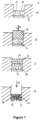
- a second material 14 is filled subsequently on the top of the surface of the first layer of the first ceramic material into the mold (other synonym for the expression “mold” is the expression "die") 10 of a press 12.
- a third or first additional layer 24 is filled into the die 10 ( Fig. 1 c) , wherein the total height of the layers 14 and 24 is equal to twice the height of the layer 14 in the unstructured state without restriction of the teaching according to the invention.
- the second layer 14 preferably has a height which corresponds to half the total height H of the second and, the third or first additional layer, 14, 24, then the height of the second layer 14 can also be 1/2 H to 2/3 H and thus that of the third or first additional layer 24 1/3 H to 1/2 H.
- the smoothed surface is then structured according to step b).
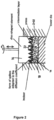
- a disc-shaped or plate-shaped or web-shaped element 16 is used, which in the example embodiment has a toothed geometry on the layer side, so that a corresponding negative structure is formed in the surface 18 of the layer 14 by displacing material.
- This structure is represented by concentrically extending elevations and surrounding valleys.
- the distance between the elevation (peak) and the valley (depression), i.e., the clear distance between the projection 20 and the valley bottom 22 according to Figure 2 should be approximately 1/5 of the height of all layers.
- the structure is formed such that the volume of the elevations is equal to or approximately equal to the volume of the depressions or valleys.
- the layers 14, 24 are pressed by means of a stamp 30, with a pressure between 1000 bar and 3000 bar.
- the pourable material i.e., in the state in which it is filled into the die 10, has a bulk density between 1 g/cm 3 and 1.4 g/cm 3 . After pressing, the density is approximately between 3.0 and 3.5 g/cm 3 .
- a density of up to 2 g/cm 3 is obtained in the transition region between the unmixed regions of the second and the, third or first additional, layers 14, 24 before the layers 14 and 24 are compacted.
- the transition region can also be referred to as middle layer 28.
- the produced blank is ejected from the mold 10 and pre-sintered in the customary manner at a temperature of between 800°C and 1000°C for a period of time between 100 minutes and 150 minutes.
- a blank or a dental restoration is to be prepared which provides a largely continuous transition between a second layer and a third or first additional layer.
- a first layer of a first ceramic material is filled first in pourable condition into a mold, wherein the first ceramic material comprises 2 to 25 wt%, preferably 4 to 17 wt%, and more preferably 5 to 12 wt%, erbium oxide.
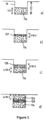
- a second ceramic material which corresponds to the layer 14 according to Figure 1 , is filled subsequently into a die 10.
- the corresponding layer in Figure 3a is indicated by the numeral 114.
- the height of this layer may be half the height of the total layers which are filled into the die 10.
- a layer 127 with a thickness which in the example embodiment is 1/10 of the total height of the layers is then applied to the layer 114.
- the material of the layer 127 can correspond to that of the third or first additional layer 24 according to Figure 1 .
- the layer 127 is then mixed with a surface region of the layer 114 over a depth corresponding to the thickness of the layer 127. This forms an intermediate layer 128 having a thickness of 2/10 of the total height of the layers.
- a further layer 124 which corresponds to the third or first additional layer 24 according to Figure 1 , is then applied to the intermediate layer 128.
- the height of the layer 124 in the example embodiment is thus 4/10 of the total height H.
- the layers 124, 128, 114 are then pressed together in accordance with the example embodiment of Figure 1 to enable performance of the process steps pre-sintering, working and complete sintering as described. Working can naturally be carried out after complete sintering.
Landscapes
- Engineering & Computer Science (AREA)
- Chemical & Material Sciences (AREA)
- Health & Medical Sciences (AREA)
- Ceramic Engineering (AREA)
- Oral & Maxillofacial Surgery (AREA)
- Manufacturing & Machinery (AREA)
- Structural Engineering (AREA)
- General Health & Medical Sciences (AREA)
- Veterinary Medicine (AREA)
- Public Health (AREA)
- Animal Behavior & Ethology (AREA)
- Life Sciences & Earth Sciences (AREA)
- Epidemiology (AREA)
- Materials Engineering (AREA)
- Organic Chemistry (AREA)
- Plastic & Reconstructive Surgery (AREA)
- Mechanical Engineering (AREA)
- Dentistry (AREA)
- Composite Materials (AREA)
- Inorganic Chemistry (AREA)
- Dental Prosthetics (AREA)
- Dental Preparations (AREA)
- Laminated Bodies (AREA)
- Compositions Of Oxide Ceramics (AREA)
Claims (14)
- Verfahren zur Herstellung eines keramischen Mehrschichtrohlings zur Herstellung einer Voll- oder Teilprothese, eines implantatgestützten Aufbaus oder einer implantatgestützten Prothese, umfassend mindestens eine erste Schicht aus einem ersten keramischen Material und mindestens eine zweite Schicht aus einem zweiten keramischen Material, wobei die erste Schicht und die zweite Schicht aus keramischen Materialien unterschiedlicher Zusammensetzungen bestehen, die in schüttfähigem Zustand schichtweise in eine Form gefüllt und danach gepresst und anschließend gesintert werden, wobeidie erste Schicht eine pinkfarbene Schicht ist,wobei das erste keramische Material 2 bis 25 Gew.-%, bevorzugt 4 bis 17 Gew.-% und mehr bevorzugt 5 bis 12 Gew.-% Erbiumoxid umfasst,dadurch gekennzeichnet, dass der keramische Mehrschichtrohling weiter eine Vielzahl von zusätzlichen Schichten umfasst, wobei jede der genannten zusätzlichen Schichten aus einem keramischen Material besteht, das eine andere Zusammensetzung als die erste Schicht hat und das eine andere oder identische Zusammensetzung wie die zweite Schicht hat;wobei nach dem Einfüllen der zweiten Schicht des zweiten keramischen Materials in schüttfähigem Zustand die Oberfläche der zweiten Schicht so strukturiert wird, dass die zweite Schicht, wenn man über ihre Oberfläche blickt, sich von Bereich zu Bereich in ihrer Höhe unterscheidet, und dann als die erste der genannten zusätzlichen Schichten eine Schicht eines keramischen Materials der genannten zusätzlichen Schichten in schüttfähigem Zustand in die Form gefüllt wird;wobei nach dem Einfüllen der ersten der genannten zusätzlichen Schichten aus einem keramischen Material der genannten zusätzlichen Schichten in schüttfähigem Zustand die Oberfläche der ersten der genannten zusätzlichen Schichten so strukturiert wird, dass sich die erste der genannten zusätzlichen Schichten, wenn man sie über ihre Oberfläche betrachtet, von Bereich zu Bereich in ihrer Höhe unterscheidet, und dann als zweite der genannten zusätzlichen Schichten eine Schicht aus einem keramischen Material der genannten zusätzlichen Schichten in schüttfähigem Zustand in die Form gefüllt wird;wobei, wenn die zweite der genannten zusätzlichen Schichten nicht die letzte zusätzliche Schicht ist, der genannte Verfahrensschritt wiederholt wird, bis alle zusätzlichen Schichten in schüttfähigem Zustand in die Form gefüllt sind,wobei das Verfahren weiter einen Schritt der digitalen Positionierung der Voll- oder Teilprothese, des implantatgestützten Aufbaus oder der implantatgestützten Prothese in dem keramischen Mehrschichtrohling umfasst, wobei darauf zu achten ist, dass der zukünftige Bereich der menschlichen Gingiva vollständig innerhalb der ersten keramischen Schicht des Rohlings positioniert wird, während der zukünftige Dentinbereich vollständig in den anderen Schichten des Rohlings positioniert werden soll.
- Verfahren nach Anspruch 1, dadurch gekennzeichnet, dass die Oberfläche der jeweiligen Schicht so strukturiert wird, dass Erhebungen und Vertiefungen vorgesehen sind.
- Verfahren nach Anspruch 1 oder 2, dadurch gekennzeichnet, dass der keramische Mehrschichtrohling zwei bis fünf, bevorzugt zwei bis vier, mehr bevorzugt drei, zusätzliche Schichten umfasst, wobei jede der genannten zusätzlichen Schichten aus einem keramischen Material besteht, das eine andere Zusammensetzung hat als die erste Schicht und das eine andere oder identische Zusammensetzung hat wie die zweite Schicht.
- Verfahren nach Anspruch 1, dadurch gekennzeichnet, dass das keramische Material der zweiten Schicht und/oder das keramische Material aller zusätzlichen Schichten mindestens ein Oxid der Elemente Mn, Co, Fe, Tb, Pr und Er umfasst; und/oder wobei das keramische Material der ersten Schicht weiter mindestens ein Oxid der Elemente Mn, Co, Fe, Tb und Pr umfasst.
- Verfahren nach Anspruch 4, dadurch gekennzeichnet, dass das keramische Material der ersten Schicht und/oder das keramische Material der zweiten Schicht und/oder das keramische Material der dritten Schicht und/oder das keramische Material aller zusätzlichen Schichten des keramischen Mehrschichtrohlings weiter zwischen 0,0005 und 0,02 Gew.-%, bevorzugt zwischen 0,0005 und 0,01 Gew.-% und mehr bevorzugt zwischen 0,0005 und 0,05 Gew.-% eines Oxids des Elements Mn umfasst; und/oder
das keramische Material der ersten Schicht und/oder das keramische Material der zweiten Schicht und/oder das keramische Material der dritten Schicht und/oder das keramische Material aller zusätzlichen Schichten des keramischen Mehrschichtrohlings weiter zwischen 0,0005 und 0,1 Gew.-%, bevorzugt zwischen 0,0005 und 0,07 Gew.% und mehr bevorzugt zwischen 0,0005 und 0,05 Gew.-% eines Oxids des Elements Co umfasst. - Verfahren nach Anspruch 5, dadurch gekennzeichnet, dass der Gehalt des mindestens einen Oxids des Elements Mn in dem jeweiligen keramischen Material der jeweiligen Schicht des Mehrschichtrohlings von der zweiten Schicht zur dritten Schicht; oder von der zweiten Schicht über die erste der zusätzlichen Schichten kontinuierlich weiter zur letzten der zusätzlichen Schichten kontinuierlich ansteigt.
- Verfahren nach Anspruch 6, dadurch gekennzeichnet, dass der Gehalt des mindestens einen Oxids des Elements Mn von der zweiten Schicht zur dritten Schicht; oder von der zweiten Schicht zur letzten der zusätzlichen Schichten kontinuierlich um insgesamt 1 bis 50 ppm, bevorzugt um 1 bis 30 ppm und mehr bevorzugt um 1 bis 10 ppm ansteigt; wobei die Konzentration eines Oxids des Elements Co in dem keramischen Mehrschichtrohling geringer als 0,0005 Gew.-% ist.
- Verfahren nach Anspruch 5, dadurch gekennzeichnet, dass der Gehalt des mindestens einen Oxids des Elements Co in dem jeweiligen keramischen Material der jeweiligen Schicht des Mehrschichtrohlings von der zweiten Schicht zur dritten Schicht; oder von der zweiten Schicht über die erste der zusätzlichen Schichten kontinuierlich weiter zur letzten der zusätzlichen Schichten kontinuierlich ansteigt.
- Verfahren nach Anspruch 8, dadurch gekennzeichnet, dass der Gehalt des mindestens einen Oxids des Elements Co von der zweiten Schicht zur dritten Schicht; oder von der zweiten Schicht zur letzten der zusätzlichen Schichten kontinuierlich um insgesamt 1 bis 100 ppm, bevorzugt um 1 bis 60 ppm und mehr bevorzugt um 1 bis 30 ppm ansteigt; wobei die Konzentration jedes Oxids des Elements Mn in dem keramischen Mehrschichtrohling geringer als 0,0005 Gew.-% ist.
- Verfahren nach Anspruch 5, dadurch gekennzeichnet, dass der Gehalt der Oxide der Elemente Mn und Co im jeweiligen keramischen Material der jeweiligen Schicht des Mehrschichtrohlings von der zweiten Schicht zur dritten Schicht; oder von der zweiten Schicht über die erste der zusätzlichen Schichten kontinuierlich weiter zur letzten der zusätzlichen Schichten kontinuierlich ansteigt.
- Verfahren nach Anspruch 10, dadurch gekennzeichnet, dass der Gehalt der Oxide der Elemente Mn und Co für das Oxid des Elements Mn von der zweiten Schicht bis zur dritten Schicht; oder von der zweiten Schicht bis zur letzten der zusätzlichen Schichten kontinuierlich um insgesamt 1 bis 35 ppm, bevorzugt um 1 bis 20 ppm und mehr bevorzugt um 1 bis 6 ppm ansteigt; während er für das Oxid des Elements Co kontinuierlich um insgesamt 1 bis 70 ppm, bevorzugt um 1 bis 40 ppm und mehr bevorzugt um 1 bis 20 ppm ansteigt.
- Verfahren nach Anspruch 5, dadurch gekennzeichnet, dass der Gehalt der Oxide der Elemente Mn und Co im jeweiligen keramischen Material der jeweiligen Schicht des Mehrschichtrohlings von der zweiten Schicht zur dritten Schicht; oder von der zweiten Schicht über die erste der zusätzlichen Schichten kontinuierlich weiter zur letzten der zusätzlichen Schichten kontinuierlich ansteigt; und
der Gehalt der Oxide der Elemente Fe, Tb, Pr und Er im jeweiligen keramischen Material der jeweiligen Schicht des Mehrschichtrohlings von der zweiten Schicht zur dritten Schicht; oder von der zweiten Schicht über die erste der zusätzlichen Schichten kontinuierlich weiter zur letzten der zusätzlichen Schichten kontinuierlich abnimmt. - Verfahren nach einem der vorhergehenden Ansprüche, dadurch gekennzeichnet, dass das keramische Material aller Schichten des keramischen Mehrschichtrohlings mit Yttriumoxid (Y2O3), Calciumoxid (CaO), Magnesiumoxid (MgO) und/oder Ceroxid (CeO2) dotiertes Zirkoniumdioxid umfasst, wobei das Zirkoniumdioxid mit Yttriumoxid dotiert ist, wobei der prozentuale Anteil an Yttriumoxid in der zweiten, dritten und/oder den zusätzlichen Schichten zwischen 1 Gew.-% und 15 Gew.-%, bevorzugt zwischen 2 Gew.-% und 11 Gew.-% und mehr bevorzugt zwischen 2,5 Gew.-% und 10 Gew.-% ist.
- Verfahren nach einem der vorhergehenden Ansprüche, dadurch gekennzeichnet, dass das keramische Material aller Schichten des keramischen Mehrschichtrohlings Zirkoniumdioxid umfasst, das mit Yttriumoxid (Y2O3), Calciumoxid (CaO), Magnesiumoxid (MgO) und/oder Ceroxid (CeO2) dotiert ist, wobei das Zirkoniumdioxid mit Yttriumoxid dotiert ist, wobei der prozentuale Anteil an Yttriumoxid in der pinkfarbenen Schicht zwischen 0,3 Gew.-% und 10,5 Gew.-%, bevorzugt zwischen 0,6 Gew.-% und 7,5 Gew.-% und mehr bevorzugt zwischen 0,75 Gew.-% und 7 Gew.-% ist.
Applications Claiming Priority (1)
| Application Number | Priority Date | Filing Date | Title |
|---|---|---|---|
| US202063125456P | 2020-12-15 | 2020-12-15 |
Publications (2)
| Publication Number | Publication Date |
|---|---|
| EP4014949A1 EP4014949A1 (de) | 2022-06-22 |
| EP4014949B1 true EP4014949B1 (de) | 2024-07-31 |
Family
ID=74844654
Family Applications (1)
| Application Number | Title | Priority Date | Filing Date |
|---|---|---|---|
| EP21155464.7A Active EP4014949B1 (de) | 2020-12-15 | 2021-02-05 | Verfahren zur herstellung eines keramischen mehrschichtrohlings |
Country Status (6)
| Country | Link |
|---|---|
| US (1) | US20220184847A1 (de) |
| EP (1) | EP4014949B1 (de) |
| JP (1) | JP2024501480A (de) |
| CA (1) | CA3204591A1 (de) |
| ES (1) | ES2989496T3 (de) |
| WO (1) | WO2022132647A1 (de) |
Families Citing this family (4)
| Publication number | Priority date | Publication date | Assignee | Title |
|---|---|---|---|---|
| EP3610827B1 (de) * | 2018-08-17 | 2021-06-16 | DENTSPLY SIRONA Inc. | Verfahren zur herstellung eines rohlings sowie rohling |
| EP4134042B1 (de) * | 2021-08-10 | 2025-05-21 | Ivoclar Vivadent AG | Dentaler rohling und herstellung eine dentalen teilprothese aus einem dentalen rohling |
| WO2024263302A1 (en) * | 2023-06-20 | 2024-12-26 | Harvest Dental Products, Llc | Light curing and sinterable composite, systems and methods for adding aesthetic features to a dental ceramic base |
| US12558204B1 (en) * | 2025-02-25 | 2026-02-24 | The Argen Corporation | Apparatus and method for manufacturing a dental milling block with a graduated color and/or translucency profile |
Citations (1)
| Publication number | Priority date | Publication date | Assignee | Title |
|---|---|---|---|---|
| WO2019035467A1 (ja) * | 2017-08-16 | 2019-02-21 | 株式会社ジーシー | 義歯用ブロック |
Family Cites Families (13)
| Publication number | Priority date | Publication date | Assignee | Title |
|---|---|---|---|---|
| EP2371344A1 (de) | 2010-03-31 | 2011-10-05 | Straumann Holding AG | Körper aus Keramikmaterial |
| US8936848B2 (en) | 2012-02-23 | 2015-01-20 | B&D Dental Corp | Non-pre-colored multi-layer zirconia dental blank that has a gradual change in translucency through a thickness after sintering |
| EP2909029A1 (de) | 2012-10-17 | 2015-08-26 | 3M Innovative Properties Company | Dentaler zirkoniumfräsblock mit mehreren abschnitten, verfahren zur herstellung und verwendung davon |
| US11690700B2 (en) * | 2014-05-08 | 2023-07-04 | Cagenix, Inc. | Dental framework and prosthesis |
| US9962247B2 (en) * | 2014-06-23 | 2018-05-08 | Tosoh Corporation | Colored translucent zirconia sintered body and powder, and application thereof |
| WO2016071301A1 (en) * | 2014-11-03 | 2016-05-12 | Pritidenta Gmbh | Technology for precolorization of spray dried granulate, process for the preparation and uses thereof, and coloring solution |
| DE102015122861A1 (de) * | 2015-12-28 | 2017-06-29 | Degudent Gmbh | Verfahren zur Herstellung eines Rohlings, Rohling sowie eine dentale Restauration |
| DE102015122865A1 (de) * | 2015-12-28 | 2017-06-29 | Degudent Gmbh | Verfahren zur Herstellung einer dentalen Restauration |
| JP2017148374A (ja) * | 2016-02-26 | 2017-08-31 | 京セラ株式会社 | ジルコニア仮焼体およびジルコニア焼結体 |
| DE102016106370A1 (de) * | 2016-03-23 | 2017-09-28 | Degudent Gmbh | Verfahren zur Herstellung eines eingefärbten Rohlings sowie Rohling |
| JP7721247B2 (ja) * | 2018-03-20 | 2025-08-12 | 株式会社松風 | イットリア含有量の異なる多層構造ジルコニア |
| EP3610827B1 (de) * | 2018-08-17 | 2021-06-16 | DENTSPLY SIRONA Inc. | Verfahren zur herstellung eines rohlings sowie rohling |
| US11124457B2 (en) * | 2019-02-15 | 2021-09-21 | Tosoh Corporation | Pink zirconia sintered body and manufacturing method of the same |
-
2021
- 2021-02-05 EP EP21155464.7A patent/EP4014949B1/de active Active
- 2021-02-05 ES ES21155464T patent/ES2989496T3/es active Active
- 2021-12-13 WO PCT/US2021/063118 patent/WO2022132647A1/en not_active Ceased
- 2021-12-13 US US17/549,481 patent/US20220184847A1/en active Pending
- 2021-12-13 CA CA3204591A patent/CA3204591A1/en active Pending
- 2021-12-13 JP JP2023535857A patent/JP2024501480A/ja active Pending
Patent Citations (2)
| Publication number | Priority date | Publication date | Assignee | Title |
|---|---|---|---|---|
| WO2019035467A1 (ja) * | 2017-08-16 | 2019-02-21 | 株式会社ジーシー | 義歯用ブロック |
| US20210128283A1 (en) * | 2017-08-16 | 2021-05-06 | Gc Corporation | Denture block |
Also Published As
| Publication number | Publication date |
|---|---|
| US20220184847A1 (en) | 2022-06-16 |
| ES2989496T3 (es) | 2024-11-26 |
| CA3204591A1 (en) | 2022-06-23 |
| WO2022132647A1 (en) | 2022-06-23 |
| EP4014949A1 (de) | 2022-06-22 |
| JP2024501480A (ja) | 2024-01-12 |
Similar Documents
| Publication | Publication Date | Title |
|---|---|---|
| AU2019275538B2 (en) | Blank and dental restoration | |
| EP4014949B1 (de) | Verfahren zur herstellung eines keramischen mehrschichtrohlings | |
| EP3389555B1 (de) | Verfahren zur herstellung eines zahnersatzes | |
| RU2719944C1 (ru) | Способ изготовления окрашенной заготовки для зубной реставрации (варианты), заготовка и зубная реставрация, изготовленная из такой заготовки (варианты) | |
| US20250275839A1 (en) | Blank and method for manufacturing the same | |
| HK40005331A (en) | A method to manufacture a colored blank, and blank |
Legal Events
| Date | Code | Title | Description |
|---|---|---|---|
| PUAI | Public reference made under article 153(3) epc to a published international application that has entered the european phase |
Free format text: ORIGINAL CODE: 0009012 |
|
| STAA | Information on the status of an ep patent application or granted ep patent |
Free format text: STATUS: THE APPLICATION HAS BEEN PUBLISHED |
|
| AK | Designated contracting states |
Kind code of ref document: A1 Designated state(s): AL AT BE BG CH CY CZ DE DK EE ES FI FR GB GR HR HU IE IS IT LI LT LU LV MC MK MT NL NO PL PT RO RS SE SI SK SM TR |
|
| STAA | Information on the status of an ep patent application or granted ep patent |
Free format text: STATUS: REQUEST FOR EXAMINATION WAS MADE |
|
| 17P | Request for examination filed |
Effective date: 20221122 |
|
| RBV | Designated contracting states (corrected) |
Designated state(s): AL AT BE BG CH CY CZ DE DK EE ES FI FR GB GR HR HU IE IS IT LI LT LU LV MC MK MT NL NO PL PT RO RS SE SI SK SM TR |
|
| STAA | Information on the status of an ep patent application or granted ep patent |
Free format text: STATUS: EXAMINATION IS IN PROGRESS |
|
| 17Q | First examination report despatched |
Effective date: 20231024 |
|
| TPAC | Observations filed by third parties |
Free format text: ORIGINAL CODE: EPIDOSNTIPA |
|
| REG | Reference to a national code |
Ref country code: DE Ref legal event code: R079 Ipc: A61K0006813000 Ref country code: DE Ref legal event code: R079 Ref document number: 602021016314 Country of ref document: DE Free format text: PREVIOUS MAIN CLASS: A61K0006818000 Ipc: A61K0006813000 |
|
| GRAP | Despatch of communication of intention to grant a patent |
Free format text: ORIGINAL CODE: EPIDOSNIGR1 |
|
| STAA | Information on the status of an ep patent application or granted ep patent |
Free format text: STATUS: GRANT OF PATENT IS INTENDED |
|
| RIC1 | Information provided on ipc code assigned before grant |
Ipc: A61C 13/083 20060101ALN20240515BHEP Ipc: A61C 13/08 20060101ALN20240515BHEP Ipc: A61C 13/00 20060101ALI20240515BHEP Ipc: A61K 6/822 20200101ALI20240515BHEP Ipc: A61K 6/804 20200101ALI20240515BHEP Ipc: A61K 6/818 20200101ALI20240515BHEP Ipc: A61K 6/813 20200101AFI20240515BHEP |
|
| GRAS | Grant fee paid |
Free format text: ORIGINAL CODE: EPIDOSNIGR3 |
|
| RIC1 | Information provided on ipc code assigned before grant |
Ipc: A61C 13/083 20060101ALN20240523BHEP Ipc: A61C 13/08 20060101ALN20240523BHEP Ipc: A61C 13/00 20060101ALI20240523BHEP Ipc: A61K 6/822 20200101ALI20240523BHEP Ipc: A61K 6/804 20200101ALI20240523BHEP Ipc: A61K 6/818 20200101ALI20240523BHEP Ipc: A61K 6/813 20200101AFI20240523BHEP |
|
| GRAA | (expected) grant |
Free format text: ORIGINAL CODE: 0009210 |
|
| STAA | Information on the status of an ep patent application or granted ep patent |
Free format text: STATUS: THE PATENT HAS BEEN GRANTED |
|
| INTG | Intention to grant announced |
Effective date: 20240607 |
|
| AK | Designated contracting states |
Kind code of ref document: B1 Designated state(s): AL AT BE BG CH CY CZ DE DK EE ES FI FR GB GR HR HU IE IS IT LI LT LU LV MC MK MT NL NO PL PT RO RS SE SI SK SM TR |
|
| REG | Reference to a national code |
Ref country code: CH Ref legal event code: EP Ref country code: GB Ref legal event code: FG4D |
|
| REG | Reference to a national code |
Ref country code: DE Ref legal event code: R096 Ref document number: 602021016314 Country of ref document: DE |
|
| REG | Reference to a national code |
Ref country code: IE Ref legal event code: FG4D |
|
| REG | Reference to a national code |
Ref country code: NL Ref legal event code: FP |
|
| REG | Reference to a national code |
Ref country code: SE Ref legal event code: TRGR |
|
| REG | Reference to a national code |
Ref country code: LT Ref legal event code: MG9D |
|
| REG | Reference to a national code |
Ref country code: ES Ref legal event code: FG2A Ref document number: 2989496 Country of ref document: ES Kind code of ref document: T3 Effective date: 20241126 |
|
| PG25 | Lapsed in a contracting state [announced via postgrant information from national office to epo] |
Ref country code: PT Free format text: LAPSE BECAUSE OF FAILURE TO SUBMIT A TRANSLATION OF THE DESCRIPTION OR TO PAY THE FEE WITHIN THE PRESCRIBED TIME-LIMIT Effective date: 20241202 |
|
| REG | Reference to a national code |
Ref country code: AT Ref legal event code: UEP Ref document number: 1707814 Country of ref document: AT Kind code of ref document: T Effective date: 20240731 |
|
| PG25 | Lapsed in a contracting state [announced via postgrant information from national office to epo] |
Ref country code: PT Free format text: LAPSE BECAUSE OF FAILURE TO SUBMIT A TRANSLATION OF THE DESCRIPTION OR TO PAY THE FEE WITHIN THE PRESCRIBED TIME-LIMIT Effective date: 20241202 |
|
| P01 | Opt-out of the competence of the unified patent court (upc) registered |
Free format text: CASE NUMBER: APP_62623/2024 Effective date: 20241125 |
|
| PG25 | Lapsed in a contracting state [announced via postgrant information from national office to epo] |
Ref country code: NO Free format text: LAPSE BECAUSE OF FAILURE TO SUBMIT A TRANSLATION OF THE DESCRIPTION OR TO PAY THE FEE WITHIN THE PRESCRIBED TIME-LIMIT Effective date: 20241031 |
|
| PG25 | Lapsed in a contracting state [announced via postgrant information from national office to epo] |
Ref country code: GR Free format text: LAPSE BECAUSE OF FAILURE TO SUBMIT A TRANSLATION OF THE DESCRIPTION OR TO PAY THE FEE WITHIN THE PRESCRIBED TIME-LIMIT Effective date: 20241101 Ref country code: FI Free format text: LAPSE BECAUSE OF FAILURE TO SUBMIT A TRANSLATION OF THE DESCRIPTION OR TO PAY THE FEE WITHIN THE PRESCRIBED TIME-LIMIT Effective date: 20240731 Ref country code: PL Free format text: LAPSE BECAUSE OF FAILURE TO SUBMIT A TRANSLATION OF THE DESCRIPTION OR TO PAY THE FEE WITHIN THE PRESCRIBED TIME-LIMIT Effective date: 20240731 |
|
| PG25 | Lapsed in a contracting state [announced via postgrant information from national office to epo] |
Ref country code: BG Free format text: LAPSE BECAUSE OF FAILURE TO SUBMIT A TRANSLATION OF THE DESCRIPTION OR TO PAY THE FEE WITHIN THE PRESCRIBED TIME-LIMIT Effective date: 20240731 |
|
| PG25 | Lapsed in a contracting state [announced via postgrant information from national office to epo] |
Ref country code: LV Free format text: LAPSE BECAUSE OF FAILURE TO SUBMIT A TRANSLATION OF THE DESCRIPTION OR TO PAY THE FEE WITHIN THE PRESCRIBED TIME-LIMIT Effective date: 20240731 |
|
| PG25 | Lapsed in a contracting state [announced via postgrant information from national office to epo] |
Ref country code: IS Free format text: LAPSE BECAUSE OF FAILURE TO SUBMIT A TRANSLATION OF THE DESCRIPTION OR TO PAY THE FEE WITHIN THE PRESCRIBED TIME-LIMIT Effective date: 20241130 |
|
| PG25 | Lapsed in a contracting state [announced via postgrant information from national office to epo] |
Ref country code: HR Free format text: LAPSE BECAUSE OF FAILURE TO SUBMIT A TRANSLATION OF THE DESCRIPTION OR TO PAY THE FEE WITHIN THE PRESCRIBED TIME-LIMIT Effective date: 20240731 |
|
| PG25 | Lapsed in a contracting state [announced via postgrant information from national office to epo] |
Ref country code: RS Free format text: LAPSE BECAUSE OF FAILURE TO SUBMIT A TRANSLATION OF THE DESCRIPTION OR TO PAY THE FEE WITHIN THE PRESCRIBED TIME-LIMIT Effective date: 20241031 |
|
| PG25 | Lapsed in a contracting state [announced via postgrant information from national office to epo] |
Ref country code: RS Free format text: LAPSE BECAUSE OF FAILURE TO SUBMIT A TRANSLATION OF THE DESCRIPTION OR TO PAY THE FEE WITHIN THE PRESCRIBED TIME-LIMIT Effective date: 20241031 Ref country code: PL Free format text: LAPSE BECAUSE OF FAILURE TO SUBMIT A TRANSLATION OF THE DESCRIPTION OR TO PAY THE FEE WITHIN THE PRESCRIBED TIME-LIMIT Effective date: 20240731 Ref country code: NO Free format text: LAPSE BECAUSE OF FAILURE TO SUBMIT A TRANSLATION OF THE DESCRIPTION OR TO PAY THE FEE WITHIN THE PRESCRIBED TIME-LIMIT Effective date: 20241031 Ref country code: LV Free format text: LAPSE BECAUSE OF FAILURE TO SUBMIT A TRANSLATION OF THE DESCRIPTION OR TO PAY THE FEE WITHIN THE PRESCRIBED TIME-LIMIT Effective date: 20240731 Ref country code: IS Free format text: LAPSE BECAUSE OF FAILURE TO SUBMIT A TRANSLATION OF THE DESCRIPTION OR TO PAY THE FEE WITHIN THE PRESCRIBED TIME-LIMIT Effective date: 20241130 Ref country code: HR Free format text: LAPSE BECAUSE OF FAILURE TO SUBMIT A TRANSLATION OF THE DESCRIPTION OR TO PAY THE FEE WITHIN THE PRESCRIBED TIME-LIMIT Effective date: 20240731 Ref country code: GR Free format text: LAPSE BECAUSE OF FAILURE TO SUBMIT A TRANSLATION OF THE DESCRIPTION OR TO PAY THE FEE WITHIN THE PRESCRIBED TIME-LIMIT Effective date: 20241101 Ref country code: FI Free format text: LAPSE BECAUSE OF FAILURE TO SUBMIT A TRANSLATION OF THE DESCRIPTION OR TO PAY THE FEE WITHIN THE PRESCRIBED TIME-LIMIT Effective date: 20240731 Ref country code: BG Free format text: LAPSE BECAUSE OF FAILURE TO SUBMIT A TRANSLATION OF THE DESCRIPTION OR TO PAY THE FEE WITHIN THE PRESCRIBED TIME-LIMIT Effective date: 20240731 |
|
| PG25 | Lapsed in a contracting state [announced via postgrant information from national office to epo] |
Ref country code: RO Free format text: LAPSE BECAUSE OF FAILURE TO SUBMIT A TRANSLATION OF THE DESCRIPTION OR TO PAY THE FEE WITHIN THE PRESCRIBED TIME-LIMIT Effective date: 20240731 Ref country code: DK Free format text: LAPSE BECAUSE OF FAILURE TO SUBMIT A TRANSLATION OF THE DESCRIPTION OR TO PAY THE FEE WITHIN THE PRESCRIBED TIME-LIMIT Effective date: 20240731 Ref country code: SM Free format text: LAPSE BECAUSE OF FAILURE TO SUBMIT A TRANSLATION OF THE DESCRIPTION OR TO PAY THE FEE WITHIN THE PRESCRIBED TIME-LIMIT Effective date: 20240731 |
|
| PG25 | Lapsed in a contracting state [announced via postgrant information from national office to epo] |
Ref country code: EE Free format text: LAPSE BECAUSE OF FAILURE TO SUBMIT A TRANSLATION OF THE DESCRIPTION OR TO PAY THE FEE WITHIN THE PRESCRIBED TIME-LIMIT Effective date: 20240731 |
|
| PGFP | Annual fee paid to national office [announced via postgrant information from national office to epo] |
Ref country code: AT Payment date: 20250417 Year of fee payment: 5 Ref country code: CH Payment date: 20250301 Year of fee payment: 5 |
|
| PG25 | Lapsed in a contracting state [announced via postgrant information from national office to epo] |
Ref country code: CZ Free format text: LAPSE BECAUSE OF FAILURE TO SUBMIT A TRANSLATION OF THE DESCRIPTION OR TO PAY THE FEE WITHIN THE PRESCRIBED TIME-LIMIT Effective date: 20240731 |
|
| PG25 | Lapsed in a contracting state [announced via postgrant information from national office to epo] |
Ref country code: SK Free format text: LAPSE BECAUSE OF FAILURE TO SUBMIT A TRANSLATION OF THE DESCRIPTION OR TO PAY THE FEE WITHIN THE PRESCRIBED TIME-LIMIT Effective date: 20240731 |
|
| REG | Reference to a national code |
Ref country code: DE Ref legal event code: R097 Ref document number: 602021016314 Country of ref document: DE |
|
| PLBE | No opposition filed within time limit |
Free format text: ORIGINAL CODE: 0009261 |
|
| STAA | Information on the status of an ep patent application or granted ep patent |
Free format text: STATUS: NO OPPOSITION FILED WITHIN TIME LIMIT |
|
| 26N | No opposition filed |
Effective date: 20250501 |
|
| PG25 | Lapsed in a contracting state [announced via postgrant information from national office to epo] |
Ref country code: MC Free format text: LAPSE BECAUSE OF FAILURE TO SUBMIT A TRANSLATION OF THE DESCRIPTION OR TO PAY THE FEE WITHIN THE PRESCRIBED TIME-LIMIT Effective date: 20240731 |
|
| REG | Reference to a national code |
Ref country code: SE Ref legal event code: EUG |
|
| REG | Reference to a national code |
Ref country code: NL Ref legal event code: MM Effective date: 20250301 |
|
| PG25 | Lapsed in a contracting state [announced via postgrant information from national office to epo] |
Ref country code: LU Free format text: LAPSE BECAUSE OF NON-PAYMENT OF DUE FEES Effective date: 20250205 |
|
| PG25 | Lapsed in a contracting state [announced via postgrant information from national office to epo] |
Ref country code: NL Free format text: LAPSE BECAUSE OF NON-PAYMENT OF DUE FEES Effective date: 20250301 |
|
| REG | Reference to a national code |
Ref country code: BE Ref legal event code: MM Effective date: 20250228 |
|
| PG25 | Lapsed in a contracting state [announced via postgrant information from national office to epo] |
Ref country code: BE Free format text: LAPSE BECAUSE OF NON-PAYMENT OF DUE FEES Effective date: 20250228 |
|
| PG25 | Lapsed in a contracting state [announced via postgrant information from national office to epo] |
Ref country code: IE Free format text: LAPSE BECAUSE OF NON-PAYMENT OF DUE FEES Effective date: 20250205 |
|
| PGFP | Annual fee paid to national office [announced via postgrant information from national office to epo] |
Ref country code: GB Payment date: 20260122 Year of fee payment: 6 |
|
| PGFP | Annual fee paid to national office [announced via postgrant information from national office to epo] |
Ref country code: ES Payment date: 20260302 Year of fee payment: 6 |
|
| PGFP | Annual fee paid to national office [announced via postgrant information from national office to epo] |
Ref country code: DE Payment date: 20260121 Year of fee payment: 6 |
|
| PGFP | Annual fee paid to national office [announced via postgrant information from national office to epo] |
Ref country code: IT Payment date: 20260121 Year of fee payment: 6 |
|
| PGFP | Annual fee paid to national office [announced via postgrant information from national office to epo] |
Ref country code: FR Payment date: 20260121 Year of fee payment: 6 |