EP4015577A1 - Epoxidharzzusammensetzung, gasbarrierefolie und laminat - Google Patents
Epoxidharzzusammensetzung, gasbarrierefolie und laminat Download PDFInfo
- Publication number
- EP4015577A1 EP4015577A1 EP20851953.8A EP20851953A EP4015577A1 EP 4015577 A1 EP4015577 A1 EP 4015577A1 EP 20851953 A EP20851953 A EP 20851953A EP 4015577 A1 EP4015577 A1 EP 4015577A1
- Authority
- EP
- European Patent Office
- Prior art keywords
- epoxy resin
- resin composition
- gas barrier
- group
- curing agent
- Prior art date
- Legal status (The legal status is an assumption and is not a legal conclusion. Google has not performed a legal analysis and makes no representation as to the accuracy of the status listed.)
- Granted
Links
Images

Classifications
-
- C—CHEMISTRY; METALLURGY
- C08—ORGANIC MACROMOLECULAR COMPOUNDS; THEIR PREPARATION OR CHEMICAL WORKING-UP; COMPOSITIONS BASED THEREON
- C08G—MACROMOLECULAR COMPOUNDS OBTAINED OTHERWISE THAN BY REACTIONS ONLY INVOLVING UNSATURATED CARBON-TO-CARBON BONDS
- C08G59/00—Polycondensates containing more than one epoxy group per molecule; Macromolecules obtained by polymerising compounds containing more than one epoxy group per molecule using curing agents or catalysts which react with the epoxy groups
- C08G59/18—Macromolecules obtained by polymerising compounds containing more than one epoxy group per molecule using curing agents or catalysts which react with the epoxy groups ; e.g. general methods of curing
- C08G59/40—Macromolecules obtained by polymerising compounds containing more than one epoxy group per molecule using curing agents or catalysts which react with the epoxy groups ; e.g. general methods of curing characterised by the curing agents used
- C08G59/50—Amines
- C08G59/56—Amines together with other curing agents
-
- B—PERFORMING OPERATIONS; TRANSPORTING
- B32—LAYERED PRODUCTS
- B32B—LAYERED PRODUCTS, i.e. PRODUCTS BUILT-UP OF STRATA OF FLAT OR NON-FLAT, e.g. CELLULAR OR HONEYCOMB, FORM
- B32B15/00—Layered products comprising a layer of metal
- B32B15/04—Layered products comprising a layer of metal comprising metal as the main or only constituent of a layer, which is next to another layer of the same or of a different material
- B32B15/08—Layered products comprising a layer of metal comprising metal as the main or only constituent of a layer, which is next to another layer of the same or of a different material of synthetic resin
- B32B15/085—Layered products comprising a layer of metal comprising metal as the main or only constituent of a layer, which is next to another layer of the same or of a different material of synthetic resin comprising polyolefins
-
- B—PERFORMING OPERATIONS; TRANSPORTING
- B32—LAYERED PRODUCTS
- B32B—LAYERED PRODUCTS, i.e. PRODUCTS BUILT-UP OF STRATA OF FLAT OR NON-FLAT, e.g. CELLULAR OR HONEYCOMB, FORM
- B32B15/00—Layered products comprising a layer of metal
- B32B15/20—Layered products comprising a layer of metal comprising aluminium or copper
-
- B—PERFORMING OPERATIONS; TRANSPORTING
- B32—LAYERED PRODUCTS
- B32B—LAYERED PRODUCTS, i.e. PRODUCTS BUILT-UP OF STRATA OF FLAT OR NON-FLAT, e.g. CELLULAR OR HONEYCOMB, FORM
- B32B27/00—Layered products comprising a layer of synthetic resin
- B32B27/06—Layered products comprising a layer of synthetic resin as the main or only constituent of a layer, which is next to another layer of the same or of a different material
- B32B27/08—Layered products comprising a layer of synthetic resin as the main or only constituent of a layer, which is next to another layer of the same or of a different material of synthetic resin
-
- B—PERFORMING OPERATIONS; TRANSPORTING
- B32—LAYERED PRODUCTS
- B32B—LAYERED PRODUCTS, i.e. PRODUCTS BUILT-UP OF STRATA OF FLAT OR NON-FLAT, e.g. CELLULAR OR HONEYCOMB, FORM
- B32B27/00—Layered products comprising a layer of synthetic resin
- B32B27/32—Layered products comprising a layer of synthetic resin comprising polyolefins
-
- B—PERFORMING OPERATIONS; TRANSPORTING
- B32—LAYERED PRODUCTS
- B32B—LAYERED PRODUCTS, i.e. PRODUCTS BUILT-UP OF STRATA OF FLAT OR NON-FLAT, e.g. CELLULAR OR HONEYCOMB, FORM
- B32B27/00—Layered products comprising a layer of synthetic resin
- B32B27/36—Layered products comprising a layer of synthetic resin comprising polyesters
-
- B—PERFORMING OPERATIONS; TRANSPORTING
- B32—LAYERED PRODUCTS
- B32B—LAYERED PRODUCTS, i.e. PRODUCTS BUILT-UP OF STRATA OF FLAT OR NON-FLAT, e.g. CELLULAR OR HONEYCOMB, FORM
- B32B27/00—Layered products comprising a layer of synthetic resin
- B32B27/38—Layered products comprising a layer of synthetic resin comprising epoxy resins
-
- B—PERFORMING OPERATIONS; TRANSPORTING
- B32—LAYERED PRODUCTS
- B32B—LAYERED PRODUCTS, i.e. PRODUCTS BUILT-UP OF STRATA OF FLAT OR NON-FLAT, e.g. CELLULAR OR HONEYCOMB, FORM
- B32B7/00—Layered products characterised by the relation between layers; Layered products characterised by the relative orientation of features between layers, or by the relative values of a measurable parameter between layers, i.e. products comprising layers having different physical, chemical or physicochemical properties; Layered products characterised by the interconnection of layers
- B32B7/04—Interconnection of layers
- B32B7/12—Interconnection of layers using interposed adhesives or interposed materials with bonding properties
-
- B—PERFORMING OPERATIONS; TRANSPORTING
- B32—LAYERED PRODUCTS
- B32B—LAYERED PRODUCTS, i.e. PRODUCTS BUILT-UP OF STRATA OF FLAT OR NON-FLAT, e.g. CELLULAR OR HONEYCOMB, FORM
- B32B9/00—Layered products comprising a layer of a particular substance not covered by groups B32B11/00 - B32B29/00
-
- B—PERFORMING OPERATIONS; TRANSPORTING
- B32—LAYERED PRODUCTS
- B32B—LAYERED PRODUCTS, i.e. PRODUCTS BUILT-UP OF STRATA OF FLAT OR NON-FLAT, e.g. CELLULAR OR HONEYCOMB, FORM
- B32B9/00—Layered products comprising a layer of a particular substance not covered by groups B32B11/00 - B32B29/00
- B32B9/005—Layered products comprising a layer of a particular substance not covered by groups B32B11/00 - B32B29/00 comprising one layer of ceramic material, e.g. porcelain, ceramic tile
-
- B—PERFORMING OPERATIONS; TRANSPORTING
- B32—LAYERED PRODUCTS
- B32B—LAYERED PRODUCTS, i.e. PRODUCTS BUILT-UP OF STRATA OF FLAT OR NON-FLAT, e.g. CELLULAR OR HONEYCOMB, FORM
- B32B9/00—Layered products comprising a layer of a particular substance not covered by groups B32B11/00 - B32B29/00
- B32B9/04—Layered products comprising a layer of a particular substance not covered by groups B32B11/00 - B32B29/00 comprising such particular substance as the main or only constituent of a layer, which is next to another layer of the same or of a different material
- B32B9/045—Layered products comprising a layer of a particular substance not covered by groups B32B11/00 - B32B29/00 comprising such particular substance as the main or only constituent of a layer, which is next to another layer of the same or of a different material of synthetic resin
-
- C—CHEMISTRY; METALLURGY
- C08—ORGANIC MACROMOLECULAR COMPOUNDS; THEIR PREPARATION OR CHEMICAL WORKING-UP; COMPOSITIONS BASED THEREON
- C08G—MACROMOLECULAR COMPOUNDS OBTAINED OTHERWISE THAN BY REACTIONS ONLY INVOLVING UNSATURATED CARBON-TO-CARBON BONDS
- C08G59/00—Polycondensates containing more than one epoxy group per molecule; Macromolecules obtained by polymerising compounds containing more than one epoxy group per molecule using curing agents or catalysts which react with the epoxy groups
- C08G59/18—Macromolecules obtained by polymerising compounds containing more than one epoxy group per molecule using curing agents or catalysts which react with the epoxy groups ; e.g. general methods of curing
- C08G59/20—Macromolecules obtained by polymerising compounds containing more than one epoxy group per molecule using curing agents or catalysts which react with the epoxy groups ; e.g. general methods of curing characterised by the epoxy compounds used
- C08G59/22—Di-epoxy compounds
- C08G59/28—Di-epoxy compounds containing acyclic nitrogen atoms
-
- C—CHEMISTRY; METALLURGY
- C08—ORGANIC MACROMOLECULAR COMPOUNDS; THEIR PREPARATION OR CHEMICAL WORKING-UP; COMPOSITIONS BASED THEREON
- C08G—MACROMOLECULAR COMPOUNDS OBTAINED OTHERWISE THAN BY REACTIONS ONLY INVOLVING UNSATURATED CARBON-TO-CARBON BONDS
- C08G59/00—Polycondensates containing more than one epoxy group per molecule; Macromolecules obtained by polymerising compounds containing more than one epoxy group per molecule using curing agents or catalysts which react with the epoxy groups
- C08G59/18—Macromolecules obtained by polymerising compounds containing more than one epoxy group per molecule using curing agents or catalysts which react with the epoxy groups ; e.g. general methods of curing
- C08G59/40—Macromolecules obtained by polymerising compounds containing more than one epoxy group per molecule using curing agents or catalysts which react with the epoxy groups ; e.g. general methods of curing characterised by the curing agents used
- C08G59/50—Amines
-
- C—CHEMISTRY; METALLURGY
- C08—ORGANIC MACROMOLECULAR COMPOUNDS; THEIR PREPARATION OR CHEMICAL WORKING-UP; COMPOSITIONS BASED THEREON
- C08G—MACROMOLECULAR COMPOUNDS OBTAINED OTHERWISE THAN BY REACTIONS ONLY INVOLVING UNSATURATED CARBON-TO-CARBON BONDS
- C08G59/00—Polycondensates containing more than one epoxy group per molecule; Macromolecules obtained by polymerising compounds containing more than one epoxy group per molecule using curing agents or catalysts which react with the epoxy groups
- C08G59/18—Macromolecules obtained by polymerising compounds containing more than one epoxy group per molecule using curing agents or catalysts which react with the epoxy groups ; e.g. general methods of curing
- C08G59/40—Macromolecules obtained by polymerising compounds containing more than one epoxy group per molecule using curing agents or catalysts which react with the epoxy groups ; e.g. general methods of curing characterised by the curing agents used
- C08G59/50—Amines
- C08G59/5033—Amines aromatic
-
- C—CHEMISTRY; METALLURGY
- C08—ORGANIC MACROMOLECULAR COMPOUNDS; THEIR PREPARATION OR CHEMICAL WORKING-UP; COMPOSITIONS BASED THEREON
- C08G—MACROMOLECULAR COMPOUNDS OBTAINED OTHERWISE THAN BY REACTIONS ONLY INVOLVING UNSATURATED CARBON-TO-CARBON BONDS
- C08G65/00—Macromolecular compounds obtained by reactions forming an ether link in the main chain of the macromolecule
- C08G65/34—Macromolecular compounds obtained by reactions forming an ether link in the main chain of the macromolecule from hydroxy compounds or their metallic derivatives
- C08G65/38—Macromolecular compounds obtained by reactions forming an ether link in the main chain of the macromolecule from hydroxy compounds or their metallic derivatives derived from phenols
- C08G65/40—Macromolecular compounds obtained by reactions forming an ether link in the main chain of the macromolecule from hydroxy compounds or their metallic derivatives derived from phenols from phenols (I) and other compounds (II), e.g. OH-Ar-OH + X-Ar-X, where X is halogen atom, i.e. leaving group
- C08G65/42—Phenols and polyhydroxy ethers
-
- C—CHEMISTRY; METALLURGY
- C08—ORGANIC MACROMOLECULAR COMPOUNDS; THEIR PREPARATION OR CHEMICAL WORKING-UP; COMPOSITIONS BASED THEREON
- C08J—WORKING-UP; GENERAL PROCESSES OF COMPOUNDING; AFTER-TREATMENT NOT COVERED BY SUBCLASSES C08B, C08C, C08F, C08G or C08H
- C08J7/00—Chemical treatment or coating of shaped articles made of macromolecular substances
- C08J7/04—Coating
- C08J7/042—Coating with two or more layers, where at least one layer of a composition contains a polymer binder
- C08J7/0423—Coating with two or more layers, where at least one layer of a composition contains a polymer binder with at least one layer of inorganic material and at least one layer of a composition containing a polymer binder
-
- C—CHEMISTRY; METALLURGY
- C08—ORGANIC MACROMOLECULAR COMPOUNDS; THEIR PREPARATION OR CHEMICAL WORKING-UP; COMPOSITIONS BASED THEREON
- C08J—WORKING-UP; GENERAL PROCESSES OF COMPOUNDING; AFTER-TREATMENT NOT COVERED BY SUBCLASSES C08B, C08C, C08F, C08G or C08H
- C08J7/00—Chemical treatment or coating of shaped articles made of macromolecular substances
- C08J7/04—Coating
- C08J7/048—Forming gas barrier coatings
-
- C—CHEMISTRY; METALLURGY
- C08—ORGANIC MACROMOLECULAR COMPOUNDS; THEIR PREPARATION OR CHEMICAL WORKING-UP; COMPOSITIONS BASED THEREON
- C08J—WORKING-UP; GENERAL PROCESSES OF COMPOUNDING; AFTER-TREATMENT NOT COVERED BY SUBCLASSES C08B, C08C, C08F, C08G or C08H
- C08J7/00—Chemical treatment or coating of shaped articles made of macromolecular substances
- C08J7/04—Coating
- C08J7/06—Coating with compositions not containing macromolecular substances
-
- C—CHEMISTRY; METALLURGY
- C08—ORGANIC MACROMOLECULAR COMPOUNDS; THEIR PREPARATION OR CHEMICAL WORKING-UP; COMPOSITIONS BASED THEREON
- C08K—Use of inorganic or non-macromolecular organic substances as compounding ingredients
- C08K3/00—Use of inorganic substances as compounding ingredients
- C08K3/01—Use of inorganic substances as compounding ingredients characterized by their specific function
- C08K3/013—Fillers, pigments or reinforcing additives
-
- C—CHEMISTRY; METALLURGY
- C08—ORGANIC MACROMOLECULAR COMPOUNDS; THEIR PREPARATION OR CHEMICAL WORKING-UP; COMPOSITIONS BASED THEREON
- C08K—Use of inorganic or non-macromolecular organic substances as compounding ingredients
- C08K3/00—Use of inorganic substances as compounding ingredients
- C08K3/02—Elements
- C08K3/08—Metals
-
- C—CHEMISTRY; METALLURGY
- C08—ORGANIC MACROMOLECULAR COMPOUNDS; THEIR PREPARATION OR CHEMICAL WORKING-UP; COMPOSITIONS BASED THEREON
- C08K—Use of inorganic or non-macromolecular organic substances as compounding ingredients
- C08K3/00—Use of inorganic substances as compounding ingredients
- C08K3/18—Oxygen-containing compounds, e.g. metal carbonyls
- C08K3/20—Oxides; Hydroxides
- C08K3/22—Oxides; Hydroxides of metals
-
- C—CHEMISTRY; METALLURGY
- C08—ORGANIC MACROMOLECULAR COMPOUNDS; THEIR PREPARATION OR CHEMICAL WORKING-UP; COMPOSITIONS BASED THEREON
- C08K—Use of inorganic or non-macromolecular organic substances as compounding ingredients
- C08K3/00—Use of inorganic substances as compounding ingredients
- C08K3/34—Silicon-containing compounds
- C08K3/36—Silica
-
- C—CHEMISTRY; METALLURGY
- C08—ORGANIC MACROMOLECULAR COMPOUNDS; THEIR PREPARATION OR CHEMICAL WORKING-UP; COMPOSITIONS BASED THEREON
- C08K—Use of inorganic or non-macromolecular organic substances as compounding ingredients
- C08K5/00—Use of organic ingredients
- C08K5/04—Oxygen-containing compounds
- C08K5/09—Carboxylic acids; Metal salts thereof; Anhydrides thereof
-
- C—CHEMISTRY; METALLURGY
- C08—ORGANIC MACROMOLECULAR COMPOUNDS; THEIR PREPARATION OR CHEMICAL WORKING-UP; COMPOSITIONS BASED THEREON
- C08K—Use of inorganic or non-macromolecular organic substances as compounding ingredients
- C08K5/00—Use of organic ingredients
- C08K5/36—Sulfur-, selenium-, or tellurium-containing compounds
- C08K5/41—Compounds containing sulfur bound to oxygen
- C08K5/42—Sulfonic acids; Derivatives thereof
-
- C—CHEMISTRY; METALLURGY
- C08—ORGANIC MACROMOLECULAR COMPOUNDS; THEIR PREPARATION OR CHEMICAL WORKING-UP; COMPOSITIONS BASED THEREON
- C08L—COMPOSITIONS OF MACROMOLECULAR COMPOUNDS
- C08L63/00—Compositions of epoxy resins; Compositions of derivatives of epoxy resins
-
- C—CHEMISTRY; METALLURGY
- C09—DYES; PAINTS; POLISHES; NATURAL RESINS; ADHESIVES; COMPOSITIONS NOT OTHERWISE PROVIDED FOR; APPLICATIONS OF MATERIALS NOT OTHERWISE PROVIDED FOR
- C09D—COATING COMPOSITIONS, e.g. PAINTS, VARNISHES OR LACQUERS; FILLING PASTES; CHEMICAL PAINT OR INK REMOVERS; INKS; CORRECTING FLUIDS; WOODSTAINS; PASTES OR SOLIDS FOR COLOURING OR PRINTING; USE OF MATERIALS THEREFOR
- C09D163/00—Coating compositions based on epoxy resins; Coating compositions based on derivatives of epoxy resins
-
- C—CHEMISTRY; METALLURGY
- C09—DYES; PAINTS; POLISHES; NATURAL RESINS; ADHESIVES; COMPOSITIONS NOT OTHERWISE PROVIDED FOR; APPLICATIONS OF MATERIALS NOT OTHERWISE PROVIDED FOR
- C09D—COATING COMPOSITIONS, e.g. PAINTS, VARNISHES OR LACQUERS; FILLING PASTES; CHEMICAL PAINT OR INK REMOVERS; INKS; CORRECTING FLUIDS; WOODSTAINS; PASTES OR SOLIDS FOR COLOURING OR PRINTING; USE OF MATERIALS THEREFOR
- C09D7/00—Features of coating compositions, not provided for in group C09D5/00; Processes for incorporating ingredients in coating compositions
- C09D7/40—Additives
- C09D7/60—Additives non-macromolecular
- C09D7/61—Additives non-macromolecular inorganic
-
- B—PERFORMING OPERATIONS; TRANSPORTING
- B32—LAYERED PRODUCTS
- B32B—LAYERED PRODUCTS, i.e. PRODUCTS BUILT-UP OF STRATA OF FLAT OR NON-FLAT, e.g. CELLULAR OR HONEYCOMB, FORM
- B32B2255/00—Coating on the layer surface
- B32B2255/06—Coating on the layer surface on metal layer
-
- B—PERFORMING OPERATIONS; TRANSPORTING
- B32—LAYERED PRODUCTS
- B32B—LAYERED PRODUCTS, i.e. PRODUCTS BUILT-UP OF STRATA OF FLAT OR NON-FLAT, e.g. CELLULAR OR HONEYCOMB, FORM
- B32B2255/00—Coating on the layer surface
- B32B2255/10—Coating on the layer surface on synthetic resin layer or on natural or synthetic rubber layer
-
- B—PERFORMING OPERATIONS; TRANSPORTING
- B32—LAYERED PRODUCTS
- B32B—LAYERED PRODUCTS, i.e. PRODUCTS BUILT-UP OF STRATA OF FLAT OR NON-FLAT, e.g. CELLULAR OR HONEYCOMB, FORM
- B32B2255/00—Coating on the layer surface
- B32B2255/20—Inorganic coating
-
- B—PERFORMING OPERATIONS; TRANSPORTING
- B32—LAYERED PRODUCTS
- B32B—LAYERED PRODUCTS, i.e. PRODUCTS BUILT-UP OF STRATA OF FLAT OR NON-FLAT, e.g. CELLULAR OR HONEYCOMB, FORM
- B32B2255/00—Coating on the layer surface
- B32B2255/26—Polymeric coating
-
- B—PERFORMING OPERATIONS; TRANSPORTING
- B32—LAYERED PRODUCTS
- B32B—LAYERED PRODUCTS, i.e. PRODUCTS BUILT-UP OF STRATA OF FLAT OR NON-FLAT, e.g. CELLULAR OR HONEYCOMB, FORM
- B32B2255/00—Coating on the layer surface
- B32B2255/28—Multiple coating on one surface
-
- B—PERFORMING OPERATIONS; TRANSPORTING
- B32—LAYERED PRODUCTS
- B32B—LAYERED PRODUCTS, i.e. PRODUCTS BUILT-UP OF STRATA OF FLAT OR NON-FLAT, e.g. CELLULAR OR HONEYCOMB, FORM
- B32B2307/00—Properties of the layers or laminate
- B32B2307/40—Properties of the layers or laminate having particular optical properties
- B32B2307/412—Transparent
-
- B—PERFORMING OPERATIONS; TRANSPORTING
- B32—LAYERED PRODUCTS
- B32B—LAYERED PRODUCTS, i.e. PRODUCTS BUILT-UP OF STRATA OF FLAT OR NON-FLAT, e.g. CELLULAR OR HONEYCOMB, FORM
- B32B2307/00—Properties of the layers or laminate
- B32B2307/70—Other properties
- B32B2307/724—Permeability to gases, adsorption
- B32B2307/7242—Non-permeable
-
- B—PERFORMING OPERATIONS; TRANSPORTING
- B32—LAYERED PRODUCTS
- B32B—LAYERED PRODUCTS, i.e. PRODUCTS BUILT-UP OF STRATA OF FLAT OR NON-FLAT, e.g. CELLULAR OR HONEYCOMB, FORM
- B32B2307/00—Properties of the layers or laminate
- B32B2307/70—Other properties
- B32B2307/724—Permeability to gases, adsorption
- B32B2307/7242—Non-permeable
- B32B2307/7244—Oxygen barrier
-
- B—PERFORMING OPERATIONS; TRANSPORTING
- B32—LAYERED PRODUCTS
- B32B—LAYERED PRODUCTS, i.e. PRODUCTS BUILT-UP OF STRATA OF FLAT OR NON-FLAT, e.g. CELLULAR OR HONEYCOMB, FORM
- B32B2307/00—Properties of the layers or laminate
- B32B2307/70—Other properties
- B32B2307/748—Releasability
-
- B—PERFORMING OPERATIONS; TRANSPORTING
- B32—LAYERED PRODUCTS
- B32B—LAYERED PRODUCTS, i.e. PRODUCTS BUILT-UP OF STRATA OF FLAT OR NON-FLAT, e.g. CELLULAR OR HONEYCOMB, FORM
- B32B2439/00—Containers; Receptacles
- B32B2439/70—Food packaging
-
- B—PERFORMING OPERATIONS; TRANSPORTING
- B32—LAYERED PRODUCTS
- B32B—LAYERED PRODUCTS, i.e. PRODUCTS BUILT-UP OF STRATA OF FLAT OR NON-FLAT, e.g. CELLULAR OR HONEYCOMB, FORM
- B32B2439/00—Containers; Receptacles
- B32B2439/80—Medical packaging
-
- C—CHEMISTRY; METALLURGY
- C08—ORGANIC MACROMOLECULAR COMPOUNDS; THEIR PREPARATION OR CHEMICAL WORKING-UP; COMPOSITIONS BASED THEREON
- C08J—WORKING-UP; GENERAL PROCESSES OF COMPOUNDING; AFTER-TREATMENT NOT COVERED BY SUBCLASSES C08B, C08C, C08F, C08G or C08H
- C08J2367/00—Characterised by the use of polyesters obtained by reactions forming a carboxylic ester link in the main chain; Derivatives of such polymers
- C08J2367/02—Polyesters derived from dicarboxylic acids and dihydroxy compounds
-
- C—CHEMISTRY; METALLURGY
- C08—ORGANIC MACROMOLECULAR COMPOUNDS; THEIR PREPARATION OR CHEMICAL WORKING-UP; COMPOSITIONS BASED THEREON
- C08J—WORKING-UP; GENERAL PROCESSES OF COMPOUNDING; AFTER-TREATMENT NOT COVERED BY SUBCLASSES C08B, C08C, C08F, C08G or C08H
- C08J2463/00—Characterised by the use of epoxy resins; Derivatives of epoxy resins
-
- C—CHEMISTRY; METALLURGY
- C08—ORGANIC MACROMOLECULAR COMPOUNDS; THEIR PREPARATION OR CHEMICAL WORKING-UP; COMPOSITIONS BASED THEREON
- C08K—Use of inorganic or non-macromolecular organic substances as compounding ingredients
- C08K3/00—Use of inorganic substances as compounding ingredients
- C08K3/18—Oxygen-containing compounds, e.g. metal carbonyls
- C08K3/20—Oxides; Hydroxides
- C08K3/22—Oxides; Hydroxides of metals
- C08K2003/2227—Oxides; Hydroxides of metals of aluminium
Definitions
- the present invention relates to an epoxy resin composition, and a gas barrier film and laminate in which the epoxy resin composition is used.
- Packaging materials used for food products, pharmaceuticals, cosmetics, precision electronic components, and the like require high oxygen barrier properties and water vapor barrier properties to prevent deterioration of the contents.
- Oxygen barrier properties of thermoplastic films are typically not so high, and thus means for imparting gas barrier properties to the films have been studied, including a method for forming a gas barrier layer of various types, such as a polyvinylidene chloride (PVDC) layer or a polyvinyl alcohol (PVA) layer, and a method for vapor-depositing an inorganic substance, such as alumina (Al 2 O 3 ) or silica (SiO 2 ).
- PVDC polyvinylidene chloride
- PVA polyvinyl alcohol
- an inorganic substance such as alumina (Al 2 O 3 ) or silica (SiO 2 ).
- Films having a PVDC layer formed as a gas barrier layer are transparent and exhibit good barrier properties. However, when incinerated as general wastes, those films may generate organic substances, such as acid gases, and thus a transition to other materials is desired due to environmental concerns. Films in which a PVA layer is formed exhibit excellent gas barrier properties under low humidity but are highly hygroscopic, causing a problem in that the gas barrier properties rapidly decreases at a relative humidity of approximately 70% or higher.
- An inorganic vapor-deposited film which is a thermoplastic film on which an inorganic substance, such as alumina or silica, is vapor-deposited, is transparent and has good gas barrier properties, and does not cause such problems described above.
- an inorganic substance such as alumina or silica
- Patent Documents 1 to 3 As a method for improving the bending resistance of the gas barrier film or laminate including a layer on which an inorganic substance is vapor-deposited, a method for forming a layer made from a cured product of an epoxy resin composition containing a predetermined epoxy resin and a predetermined amine-based curing agent as a main component has been proposed (Patent Documents 1 to 3).
- Patent Document 4 discloses a gas barrier film having a certain layer structure that includes a substrate film having vapor-deposited inorganic layer and a cured resin layer, the cured resin layer including a cured product of an epoxy resin composition containing an epoxy resin, a certain epoxy resin curing agent, and non-spherical inorganic particles.
- This gas barrier film exhibits improved gas barrier properties and has bending resistance better than known gas barrier films having a vapor-deposited inorganic layer.
- Patent Document 5 discloses a gas barrier resin composition containing an epoxy resin, an epoxy resin curing agent, and a specific curing accelerator, and also containing a prescribed amount of a predetermined amine-derived skeletal structure in a cured product that is to be formed, and indicates that the gas barrier resin composition exhibits high gas barrier properties in a wide range of curing conditions.
- a gas barrier layer including a cured product of a predetermined epoxy resin composition on a substrate is known to enhance the improving effect of the gas barrier properties.
- Patent Document 6 describes that in a laminate film obtained by laminating at least a substrate, a primer layer, an adhesive layer, and a sealant layer in this order, using a primer composition containing a specific polyester resin to form the primer layer, and using an adhesive containing an epoxy resin composition as a main component to form the adhesive layer enable to produce a laminate film that excels in adhesiveness over time and maintains excellent laminate strength and heat seal strength even when stored for a long period of time.
- Patent Documents 1 to 6 each disclose an epoxy resin composition in which an amine-based epoxy resin curing agent is used, but according to research by the present inventors in recent years, it has been discovered that the adhesiveness to inorganic substances, and particularly to alumina, of the cured product of an epoxy resin composition in which an amine-based epoxy resin curing agent is used is unstable.
- an object of the present invention is to provide an epoxy resin composition that contains an amine-based curing agent as an epoxy resin curing agent, and enables to form a cured product that exhibits high gas barrier properties and excels in adhesiveness to inorganic substances such as alumina, and to provide a gas barrier film and laminate in which the epoxy resin composition is used.
- the present inventors have discovered that with respect to an epoxy resin composition containing an epoxy resin, an epoxy resin curing agent including an amine-based curing agent, and an acidic compound, the problems described above can be solved by setting a ratio between a molar equivalent of basic nitrogen in the epoxy resin composition and a molar equivalent of an acid group derived from the acidic compound to a predetermined range.
- the present invention relates to the following.
- a cured product having high gas barrier properties, and having good adhesion to inorganic substances such as alumina in particular can be formed.
- a gas barrier film and laminate having a cured resin layer formed on a substrate having at least one surface constituted of an inorganic substance, the cured resin layer being a cured product of the epoxy resin composition exhibit high gas barrier properties and interlayer adhesiveness, and are suitable for packaging material applications, for example.
- the epoxy resin composition of the present invention is an epoxy resin composition including an epoxy resin, an epoxy resin curing agent containing an amine-based curing agent, and an acidic compound, and is characterized in that a ratio of (basic nitrogen/ acid groups) is from 0.10 to 3.0, which is a ratio of a molar equivalent of basic nitrogen in the epoxy resin composition to a molar equivalent of acid groups derived from the acidic compound.
- the epoxy resin composition of the present invention can form a cured product having high gas barrier properties and good adhesion to inorganic substances such as alumina in particular.
- the reason for this is not clear but is assumed to be as follows.
- the adhesiveness of a cured product of an epoxy resin composition to inorganic substances, and particularly alumina is unstable, and among such cured products, this tendency is remarkable when an amine-based epoxy resin curing agent is used.
- the present inventors have discovered that by adding a predetermined amount of an acidic compound to an epoxy resin composition in which an amine-based epoxy resin curing agent is used, the amine in the epoxy resin composition is neutralized, and the adhesiveness of the obtained cured product to inorganic substances such as alumina is improved.
- the "molar equivalent of basic nitrogen in the epoxy resin composition” means the molar equivalent of basic nitrogen derived from primary to tertiary amines in the epoxy resin composition as determined by measuring the total amine value, and the basic nitrogen includes not only the basic nitrogen derived from primary to tertiary amines in the amine-based curing agent, but also, for example, the basic nitrogen derived from primary to tertiary amines in the epoxy resin.
- the molar equivalent of the basic nitrogen in the epoxy resin composition can be measured by the method described in the examples.
- the "molar equivalent of acid groups derived from the acidic compound” means the molar equivalent of proton-releasing groups of the acidic compound blended in the epoxy resin composition.
- Examples of the proton-releasing groups include sulfonic acid groups, carboxy groups, and phosphoric acid groups.
- the ratio (basic nitrogen/acid group) of the molar equivalent of basic nitrogen in the epoxy resin composition of the present invention to the molar equivalent of acid groups derived from the acidic compound is 3.0 or less, preferably 2.5 or less, more preferably 2.0 or less, even more preferably 1.5 or less, and yet even more preferably 1.0 or less. Furthermore, from the viewpoints of forming a cured product with good adhesion to inorganic substances and maintaining high gas barrier properties, the ratio thereof is 0.10 or more, preferably 0.20 or more, more preferably 0.30 or more, even more preferably 0.40 or more, and yet even more preferably 0.50 or more.
- the molar equivalent ratio (basic nitrogen/acid group) in the epoxy resin composition can be specifically determined by the method described in the examples.
- the pH of the epoxy resin composition at 25°C is preferably 7.5 or less, more preferably 7.2 or less, and even more preferably 7.0 or less, and is preferably 3.5 or more, more preferably 4.0 or more, and even more preferably 4.5 or more
- the pH of the epoxy resin composition at 25°C can be measured specifically by the method described in the examples.
- the epoxy resin used in the epoxy resin composition of the present invention may be a saturated or unsaturated aliphatic compound or alicyclic compound, an aromatic compound, or a heterocyclic compound, but in consideration of the manifestation of high gas barrier properties, an epoxy resin containing an aromatic ring or an alicyclic structure in the molecule is preferable.
- the epoxy resin include at least one resin selected from epoxy resins having a glycidylamino group derived from meta-xylylenediamine, epoxy resins having a glycidylamino group derived from para-xylylenediamine, epoxy resins having a glycidylamino group derived from 1,3-bis(aminomethyl) cyclohexane, epoxy resins having a glycidylamino group derived from 1,4-bis(aminomethyl) cyclohexane, epoxy resins having a glycidylamino group derived from diaminodiphenylmethane, epoxy resins having a glycidylamino group and/or a glycidyloxy group derived from a para-aminophenol, epoxy resins having a glycidyloxy group derived from bisphenol A, epoxy resins having a glycidyloxy group derived from bisphenol F, epoxy resins having
- the epoxy resin is preferably one having, as a main component, at least one component selected from the group consisting of an epoxy resin having a glycidylamino group derived from meta-xylylenediamine, an epoxy resin having a glycidylamino group derived from para-xylylenediamine, and an epoxy resin having a glycidyloxy group derived from bisphenol F, and is more preferably one having, as a main component, an epoxy resin having a glycidylamino group derived from meta-xylylenediamine.
- main component here means that other components may be included within a range that does not depart from the spirit of the present invention, and also means a component that is included in an amount of preferably from 50 to 100 mass%, more preferably from 70 to 100 mass%, and even more preferably from 90 to 100 mass% relative to the total amount.
- the epoxy resin is obtained by a reaction of various alcohols, phenols, and amines with an epihalohydrin.
- an epoxy resin having a glycidylamino group derived from meta-xylylenediamine is obtained by adding epichlorohydrin to meta-xylylenediamine.
- Meta-xylylenediamine has four amino hydrogens, and therefore mono-, di-, tri- and tetraglycidyl compounds are produced.
- the number of glycidyl groups can be changed by changing the reaction ratio between the meta-xylylenediamine and the epichlorohydrin.
- an epoxy resin having primarily four glycidyl groups is obtained by carrying out an addition reaction of approximately four-fold moles of epichlorohydrin to meta-xylylenediamine.
- the epoxy resin is synthesized by reacting an epihalohydrin with various alcohols, phenols, and amines in the presence of an alkali such as sodium hydroxide at a temperature from 20 to 140°C, preferably at a temperature from 50 to 120°C in the case of alcohols and phenols, and preferably at a temperature from 20 to 70°C in the case of amines, and then separating the alkali halide that is produced.
- an epoxy resin having four glycidyl groups is to be primarily obtained, an excess amount of the epihalohydrin is used with respect to the various alcohols, phenols, and amines.
- the number average molecular weight of the epoxy resin that is produced differs depending on the molar ratio of the epihalohydrin to the various alcohols, phenols, and amines but is preferably from 100 to 4000, more preferably from 200 to 1000, and even more preferably from 200 to 500.
- the epoxy resin curing agent used in the epoxy resin composition of the present invention contains an amine-based curing agent from the viewpoint of achieving high gas barrier properties.
- the amine-based curing agent a polyamine or a modified product thereof conventionally used as an epoxy resin curing agent can be used.
- the amine-based curing agent is preferably a polyamine modified product, is more preferably at least one selected from the group consisting of the following amine-based curing agents (i) and amine-based curing agents (ii), and is more preferably the following amine-based curing agent (i):
- the amine-based curing agent (i) is a reaction product between the component (A) and the component (B) below:
- the component (A) is used from the viewpoint of gas barrier properties, and meta-xylylenediamine is preferable in terms of the gas-barrier property.
- One component (A) may be used alone, or two of the components (A) may be mixed and used.
- the component (B) is at least one selected from the group consisting of unsaturated carboxylic acids represented by Formula (1) and derivatives thereof, and from the viewpoint of gas-barrier properties, in Formula (1), R 1 is preferably a hydrogen atom or an alkyl group having from 1 to 8 carbons, more preferably a hydrogen atom or an alkyl group having from 1 to 3 carbons, even more preferably a hydrogen atom or a methyl group, and yet even more preferably a hydrogen atom.
- R 2 is preferably a hydrogen atom or an alkyl group having from 1 to 8 carbons, more preferably a hydrogen atom or an alkyl group having from 1 to 3 carbons, even more preferably a hydrogen atom or a methyl group, and yet even more preferably a hydrogen atom.
- Examples of the derivatives of the unsaturated carboxylic acids represented by Formula (1) include esters, amides, acid anhydrides, and acid chlorides of the unsaturated carboxylic acids.
- the ester of the unsaturated carboxylic acid is preferably an alkyl ester, and in terms of obtaining good reactivity, the alkyl has preferably from 1 to 6 carbons, more preferably from 1 to 3 carbons, and even more preferably from 1 to 2 carbons.
- Examples of the unsaturated carboxylic acids represented by Formula (1) above and the derivatives thereof include unsaturated carboxylic acids, such as acrylic acid, methacrylic acid, ⁇ -ethylacrylic acid, ⁇ -propylacrylic acid, ⁇ -isopropylacrylic acid, ⁇ -n-butylacrylic acid, ⁇ -t-butylacrylic acid, ⁇ -pentylacrylic acid, ⁇ -phenylacrylic acid, ⁇ -benzylacrylic acid, crotonic acid, 2-pentenoic acid, 2-hexenoic acid, 4-methyl-2-pentenoic acid, 2-heptenoic acid, 4-methyl-2-hexenoic acid, 5-methyl-2-hexenoic acid, 4,4-dimethyl-2-pentenoic acid, 4-phenyl-2-butenoic acid, cinnamic acid, o-methyl cinnamic acid, m-methyl cinnamic acid, p-methyl cin
- the component (B) is preferably at least one selected from the group consisting of acrylic acid, methacrylic acid, crotonic acid, and derivatives of these acids, and more preferably at least one selected from the group consisting of acrylic acid, methacrylic acid, crotonic acid, and alkyl esters of these acids, even more preferably at least one selected from the group consisting of acrylic acid, methacrylic acid, and alkyl esters of these acids, still more preferably alkyl esters of acrylic acid, and still even more preferably methyl acrylate.
- One component (B) may be used alone, or two or more in combination may be used.
- the reaction between the component (A) and the component (B) is carried out by mixing the component (A) and the component (B) under a temperature condition of from 0 to 100°C and more preferably from 0 to 70°C, and then carrying out, at a temperature condition of from 100 to 300°C and preferably from 130 to 250°C, a Michael addition reaction and an amide group formation reaction by dehydration, de-alcoholization, and deamination.
- the pressure inside a reaction device can be reduced at the final stage of the reaction as necessary.
- a non-reactive solvent can be used to dilute as necessary.
- a catalyst such as a phosphite ester, can be added as a dehydrating agent or a dealcoholizing agent.
- the reaction is performed by mixing the component (A) and the component (B) under conditions of 0 to 150°C and preferably 0 to 100°C, and then performing Michael addition reaction and the amide group formation reaction.
- the pressure inside a reaction device can be reduced at the final stage of the reaction as necessary.
- a non-reactive solvent can be used to dilute as necessary.
- a tertiary amine such as pyridine, picoline, lutidine, or trialkylamine, can be added.
- the amide group moiety formed by the reaction between the component (A) and the component (B) has high cohesive force, and thus the cured resin layer formed using the epoxy resin curing agent that is the reaction product obtained from the reaction between the component (A) and the component (B) exhibits high gas barrier properties and good adhesiveness.
- the reaction molar ratio of the component (B) to the component (A), [(B)/(A)], is preferably in a range from 0.3 to 1.0.
- the reaction molar ratio is 0.3 or more, a sufficient amount of the amide groups is produced in the epoxy resin curing agent, and high levels of gas barrier properties and adhesiveness are exhibited.
- the reaction molar ratio is in a range of 1.0 or less, the amount of amino groups necessary for reaction with the epoxy groups in the epoxy resin is sufficient, and excellent heat resistance and excellent solubility in organic solvents and water are exhibited.
- reaction molar ratio [(B)/(A)] of the component (B) to the component (A) is more preferably in a range from 0.6 to 1.0.
- the amine-based curing agent may also be a reaction product of the components (A) and (B), and at least one compound selected from the group consisting of the following components (C), (D) and (E).
- R 3 represents a hydrogen atom, an alkyl group having from 1 to 7 carbons and which may have a hydroxyl group, or an aryl group having from 6 to 12 carbons, and R 3 is preferably an alkyl group having from 1 to 3 carbons or a phenyl group.
- Examples of derivatives of the monovalent carboxylic acid represented by R 3 -COOH include esters, amides, acid anhydrides, and acid chlorides of the carboxylic acid.
- the ester of the carboxylic acid is preferably an alkyl ester, and the number of carbons of the alkyl is preferably from 1 to 6, more preferably from 1 to 3, and even more preferably 1 or 2.
- component (C) examples include monovalent carboxylic acids such as formic acid, acetic acid, propionic acid, butyric acid, lactic acid, glycolic acid, and benzoic acid, and derivatives thereof.
- component (C) one may be used alone, or two or more may be used in combination.
- the cyclic carbonate of the component (D) is used as necessary, from the viewpoints of reducing the reactivity between the epoxy resin curing agent and the epoxy resin and improving workability, and is preferably a cyclic carbonate of a six-membered ring or less from the viewpoint of reactivity with the component (A).
- Examples include ethylene carbonate, propylene carbonate, glycerin carbonate, 1,2-butylene carbonate, vinylene carbonate, 4-vinyl-1,3-dioxolan-2-one, 4-methoxymethyl-1,3-dioxolan-2-one, and 1,3-dioxan-2-one.
- at least one selected from the group consisting of ethylene carbonate, propylene carbonate, and glycerin carbonate is preferable.
- component (D) one may be used alone, or two or more may be used in combination.
- the mono-epoxy compound which is the component (E), is a mono-epoxy compound having from 2 to 20 carbons, and is used as necessary, from the viewpoints of reducing the reactivity between the epoxy resin curing agent and the epoxy resin and improving workability.
- the component (E) is preferably a mono-epoxy compound having from 2 to 10 carbons and is more preferably a compound represented by Formula (2) below: in Formula (2), R 4 represents a hydrogen atom, an alkyl group having from 1 to 8 carbons, an aryl group, or R 5 -O-CH 2 -, and R 5 represents a phenyl group or a benzyl group.
- Examples of the mono-epoxy compound represented by Formula (2) include ethylene oxide, propylene oxide, 1,2-butylene oxide, styrene oxide, phenylglycidyl ether, and benzylglycidyl ether.
- component (E) one may be used alone, or two or more may be used in combination.
- any one compound selected from the group consisting of the components (C), (D), and (E) may be used alone, or a combination of two or more may be used.
- the amine-based curing agent may be a reaction product that is obtained by reacting, in addition to the components (A) to (E), another component within a scope that does not hinder the effect of the present invention.
- the other component referred to here include aromatic dicarboxylic acids or derivatives thereof.
- the usage amount of the "other component” is preferably 30 mass% or less, more preferably 10 mass% or less, and even more preferably 5 mass% or less of the total amount of the reaction components constituting the amine-based curing agent.
- the reaction product of the components (A) and (B) and the at least one compound selected from the group consisting of the components (C), (D), and (E) is obtained by using at least one compound selected from the group consisting of the components (C), (D), and (E) in combination with the component (B) and reacting this combination with the component (A), which is a polyamine compound.
- the reaction may be performed by adding the components (B) to (E) in any order and reacting with the component (A), or by mixing the components (B) to (E) and then reacting the mixture with the component (A).
- the reaction between the component (A) and the component (C) can be carried out under the same conditions as those of the reaction between the component (A) and the component (B).
- the components (B) and (C) may be mixed and then reacted with the component (A), or the components (A) and (B) may be first reacted and then further reacted with the component (C).
- the components (A) and (B) are first reacted, and then further reacted with the component (D) and/or the component (E).
- the reaction between the component (A) and the component (D) and/or the component (E) is carried out by mixing the component (A) and the component (D) and/or the component (E) at a temperature of from 25 to 200°C, and then implementing an addition reaction at a temperature of from 30 to 180°C and preferably from 40 to 170°C.
- a catalyst such as sodium methoxide, sodium ethoxide, and potassium t-butoxide can be used.
- the component (D) and/or the component (E) may be melted or diluted with a non-reactive solvent and used in order to facilitate the reaction.
- the reaction molar ratio [(B)/(A)] of the component (B) to the component (A) is, for the same reason as described above, preferably in a range from 0.3 to 1.0, and more preferably in a range from 0.6 to 1.0.
- reaction molar ratio [ ⁇ (C) + (D) + (E) ⁇ /(A)] of the components (C), (D), and (E) to the component (A) is preferably in a range from 0.05 to 3.1, more preferably in a range from 0.07 to 2.5, and even more preferably in a range from 0.1 to 2.0.
- reaction molar ratio [ ⁇ (B) + (C) + (D) + (E) ⁇ /(A)] of the components (B) to (E) to the component (A) is preferably in a range from 0.35 to 2.5 and more preferably in a range from 0.35 to 2.0.
- the amine-based curing agent (ii) is a reaction product between epichlorohydrin and at least one selected from the group consisting of meta-xylylenediamine and para-xylylenediamine.
- the amine-based curing agent (ii) preferably contains a compound represented by Formula (3) below as a main component.
- main component refers to a component having a content of 50 mass% or more when the total constituent components in the amine-based curing agent (ii) is 100 mass%.
- A represent a 1,3-phenylene group or a 1,4-phenylene group, and n is a number of 1 to 12.
- A is more preferably a 1,3-phenylene group.
- the content of the compound represented by Formula (3) above in the amine-based curing agent (ii) is preferably 60 mass% or more, more preferably 70 mass% or more, even more preferably 75 mass% or more, and yet even more preferably 85 mass% or more. Furthermore, the upper limit is 100 mass%.
- the content of the compound represented by Formula (3) above in the amine-based curing agent (ii) and the composition of the compound represented by Formula (3) above can be determined by GC analysis and gel permeation chromatography (GPC) analysis.
- the amine-based curing agent (ii) is obtained by subjecting epichlorohydrin and at least one type of compound (hereinafter, also referred to as a "raw material diamine") selected from the group consisting of meta-xylylenediamine and para-xylylenediamine to an addition reaction.
- a raw material diamine selected from the group consisting of meta-xylylenediamine and para-xylylenediamine
- the addition reaction between epichlorohydrin and the raw material diamine can be carried out by a known method, and the method thereof is not particularly limited, but from the viewpoint of reaction efficiency, the reaction is preferably carried out in the presence of a basic catalyst.
- the basic catalyst is preferably an alkali metal hydroxide, more preferably one or more types selected from the group consisting of potassium hydroxide and sodium hydroxide, and is even more preferably sodium hydroxide.
- the amount of epichlorohydrin and the raw material diamine used in the addition reaction is such that the molar ratio of the raw material diamine to 1 mol of epichlorohydrin is preferably from 1.5 to 12 mol, more preferably from 1.5 to 6.0 mol, and even more preferably from 1.8 to 3.0 mol.
- the epoxy resin curing agent used in the present invention may contain a curing agent component other than an amine-based curing agent, but from the viewpoint of obtaining high gas barrier properties, the content of the amine-based curing agent is preferably high. From the viewpoint of obtaining high gas barrier properties, the content of the amine-based curing agent in the epoxy resin curing agent is preferably 50 mass% or more, more preferably 70 mass% or more, even more preferably 80 mass% or more, and yet even more preferably 90 mass% or more. Furthermore, the upper limit is 100 mass%.
- the compounding ratio of the epoxy resin and the epoxy resin curing agent in the epoxy resin composition may be within the standard compounding range that is ordinarily used for a case in which an epoxy resin reaction product is produced through a reaction between an epoxy resin and an epoxy resin curing agent.
- the ratio of (number of active amine hydrogens in the epoxy resin curing agent)/(number of epoxy groups in the epoxy resin), which is the ratio of the number of active amine hydrogens in the epoxy resin curing agent to the number of epoxy groups in the epoxy resin is preferably in a range from 0.2 to 12.0.
- the above ratio is more preferably in a range from 0.4 to 10.0, even more preferably in a range from 0.6 to 8.0, yet even more preferably more than 1.0 and 5.0 or less, and particularly preferably in a range from 1.1 to 3.5.
- the acidic compound used in the epoxy resin composition of the present invention is not particularly limited as long as it is an acid compound having a proton-releasing group.
- the acidic compound include at least one selected from the group consisting of sulfonic acid compounds, carboxylic acid compounds, and phosphoric acid compounds. These acidic compounds may be organic acids or inorganic acids, but organic acids are preferable, at least one selected from the group consisting of sulfonic acid compounds and carboxylic acid compounds is more preferable, and carboxylic acid compounds are even more preferable.
- the acidic compound may be a hydrate.
- the acid value of the acidic compound is preferably from 120 to 1300 mgKOH/g, more preferably from 150 to 800 mgKOH/g, and even more preferably from 200 to 650 mgKOH/g.
- the content of the acidic compound in the epoxy resin composition is preferably low.
- the acid value of the acidic compound is 120 mgKOH/g or more, the usage amount of the acidic compound required to improve adhesiveness can be reduced, and furthermore, high gas barrier properties are easily maintained in the obtained cured product.
- the acid value of the acidic compound is 1300 mgKOH/g or less, volatilization and the like of the acidic compound can be suppressed, and preparation of the epoxy resin composition is facilitated.
- the acidic compound is preferably a monovalent acid.
- the acidic compound used in the present invention is preferably at least one selected from the group consisting of p-toluenesulfonic acid, dodecylbenzene sulfonic acid, lactic acid, salicylic acid, 2-acrylamido-2-methylpropane sulfonic acid, and phosphoric acid.
- the acidic compound is more preferably at least one selected from the group consisting of p-toluenesulfonic acid, lactic acid, and salicylic acid, and from the viewpoint of a high level of safety, lactic acid is even more preferable.
- the content of the acidic compound in the epoxy resin composition of the present invention is not particularly limited as long as the ratio (basic nitrogen/acid group) of the molar equivalent of basic nitrogen in the epoxy resin composition to the molar equivalent of acid groups derived from the acidic compound is in a range from 0.10 to 3.0, but with respect to 100 parts by mass of the nonvolatile content other than the acidic compound in the epoxy resin composition, the content of the acidic compound is preferably from 20 to 120 parts by mass, more preferably from 25 to 120 parts by mass, even more preferably from 30 to 120 parts by mass, yet even more preferably from 35 to 100 parts by mass, still even more preferably from 40 to 100 parts by mass, and even further preferably from 50 to 90 parts by mass.
- the content of the acidic compound is within the range described above, adhesion of the obtained cured product to an inorganic substance can be improved. Furthermore, high gas barrier properties can be maintained if the content of the acidic compound is 120 parts by mass or less per 100 parts by mass of the nonvolatile content other than the acidic compound in the epoxy resin composition. Moreover, mixing with the epoxy resin composition is facilitated, and elution or the like of the acidic compound can be suppressed.
- the epoxy resin composition of the present invention can further contain non-spherical inorganic particles.
- the epoxy resin composition of the present invention By configuring the epoxy resin composition of the present invention to contain non-spherical inorganic particles, an effect of suppressing blocking can be obtained when the epoxy resin composition is used in the formation of a cured resin layer of a gas barrier film to be described later, and gas barrier properties and bending resistance of the gas barrier film can be improved.
- the shape of the non-spherical inorganic particle is any three-dimensional shape other than spherical shape (substantially true spherical shape), and examples include plate shape, scale shape, column shape, chain shape, and fibrous shape.
- a plurality of plate-shaped or scale-shaped inorganic particles may be laminated in a layer.
- the inorganic particle is preferably a plate-shaped, scale-shaped, column-shaped, or chain-shaped inorganic particle, more preferably a plate-shaped, scale-shaped, or column-shaped inorganic particle, and even more preferably a plate-shaped or scale-shaped inorganic particle.
- the inorganic substance constituting the non-spherical inorganic particle examples include silica, alumina, isinglass (mica), talc, aluminum, bentonite, and smectite.
- the inorganic substance is preferably at least one selected from the group consisting of silica, alumina, and mica, and is more preferably at least one selected from the group consisting of silica and alumina.
- the non-spherical inorganic particles may be surface treated as necessary for the purpose of increasing dispersibility in the epoxy resin composition and improving the transparency of the cured product.
- the non-spherical inorganic particle is preferably coated with an organic-based material, and in terms of improving gas barrier properties, bending resistance, and transparency, at least one selected from the group consisting of silica and alumina coated with an organic-based material is more preferred. From the viewpoint of improving gas barrier properties and bending resistance, silica coated with an organic-based material is even more preferred, and from the viewpoint of transparency, alumina coated with an organic-based material is even more preferred.
- the average particle size of the non-spherical inorganic particle is preferably from 1 to 2000 nm, more preferably from 1 to 1500 nm, even more preferably from 1 to 1000 nm, still more preferably from 1 to 800 nm, still even more preferably from 1 to 500 nm, still even more preferably from 5 to 300 nm, still even more preferably from 5 to 200 nm, still even more preferably from 5 to 100 nm, and still even more preferably from 8 to 70 nm.
- the non-spherical inorganic particle with an average particle size of 1 nm or more is easy to prepare, and the non-spherical inorganic particle with an average particle size of 2000 nm or less provides good gas barrier properties, good bending resistance, and good transparency.
- the average particle size is the average particle size of the primary particle.
- the aspect ratio of the non-spherical inorganic particle is preferably from 2 to 700 and more preferably from 3 to 500. With the aspect ratio of 2 or more, good gas barrier properties are easily exhibited.
- the average particle size and the aspect ratio of the non-spherical inorganic particle are determined, for example, by observing using a scanning electron microscope (SEM) or a transmission electron microscope (TEM) and averaging measured values at three or more points.
- the average particle size and the aspect ratio of the non-spherical inorganic particle present in the cured resin layer can be determined, for example, by embedding, with an epoxy resin, the gas barrier film having a cured resin layer, then ion milling the film cross-section using an ion milling device to prepare a sample for cross-sectional observation, and observing and measuring a cross-section of a cured resin layer portion of the resulting sample in the same manner as described above.
- the average particle size of the non-spherical inorganic particles is less than 100 nm and the measurement of the average particle size by the above method is difficult, the average particle size can also be measured, for example, by the BET method.
- the method for producing the non-spherical inorganic particle is not particularly limited, and a well-known method can be used.
- the present invention it is preferable to prepare a dispersion liquid of the non-spherical inorganic particles and blend the dispersion liquid into the resin composition.
- the dispersion medium of the non-spherical inorganic particle dispersion liquid is not particularly limited, and water or an organic solvent can be used.
- the organic solvent is preferably a polar solvent.
- Examples include protic polar solvents, such as methanol, ethanol, 1-propanol, 2-propanol, 1-butanol, 2-butanol, 2-methoxyethanol, 2-ethoxyethanol, 2-propoxyethanol, 2-butoxyethanol, 1-methoxy-2-propanol, 1-ethoxy-2-propanol, and 1-propoxy-2-propanol; aprotic polar solvents, such as N,N-dimethylformamide, N,N-dimethylacetamide, dimethyl sulfoxide, and N-methylpyrrolidone.
- protic polar solvents such as methanol, ethanol, 1-propanol, 2-propanol, 1-butanol, 2-butanol, 2-methoxyethanol, 2-ethoxyethanol, 2-propoxyethanol, 2-butoxyethanol, 1-methoxy-2-propanol, 1-ethoxy-2-propanol, and 1-propoxy-2-propanol
- aprotic polar solvents such as
- the dispersion medium is preferably at least one selected from the group consisting of water and a protic polar solvent, and in terms of dispersibility of the particles and miscibility of the dispersion liquid and the epoxy resin composition, the dispersion medium is more preferably a protic polar solvent and even more preferably at least one selected from the group consisting of methanol, ethanol, 1-propanol, and 2-propanol.
- the content of the non-spherical inorganic particles in the epoxy resin composition relative to 100 parts by mass of the total amount of the epoxy resin and the epoxy resin curing agent is preferably from 0.5 to 10.0 parts by mass, more preferably from 1.0 to 8.0 parts by mass, even more preferably from 1.5 to 7.5 parts by mass, and still more preferably from 3.0 to 7.0 parts by mass. If the content of the non-spherical inorganic particles in the epoxy resin composition is 0.5 parts by mass or more relative to 100 parts by mass of the total amount of the epoxy resin and the epoxy resin curing agent, the effects of improving the gas barrier properties and bending resistance of the gas barrier film obtained using the epoxy resin composition are favorable. Furthermore, when the content thereof is 10.0 parts by mass or less, the transparency of the obtained gas barrier film is also favorable.
- the epoxy resin composition may contain an additive, such as a thermosetting resin, a wetting agent, a tackifier, a coupling agent, an antifoaming agent, a curing accelerator, a rustproofing additive, a pigment, and an oxygen scavenger within a range that does not impair the effects of the present invention.
- an additive such as a thermosetting resin, a wetting agent, a tackifier, a coupling agent, an antifoaming agent, a curing accelerator, a rustproofing additive, a pigment, and an oxygen scavenger within a range that does not impair the effects of the present invention.
- examples of the coupling agent include silane coupling agents, titanatebased coupling agents, and aluminate-based coupling agents, and from the viewpoint of improving adhesion of the obtained cured product to an inorganic thin film layer, a silane coupling agent is preferable.
- the silane coupling agent examples include a silane coupling agent having a vinyl group, a silane coupling agent having an amino group, a silane coupling agent having an epoxy group, a silane coupling agent having a (meth)acryl group, and a silane coupling agent having a mercapto group.
- the silane coupling agent is preferably one selected from the group consisting of a silane coupling agent having an amino group and a silane coupling agent having an epoxy group.
- silane coupling agent having an amino group examples include 3-aminopropyltrimethoxysilane, 3-aminopropylmethyldimethoxysilane, 3-aminopropyltriethoxysilane, 3 -aminopropylmethyldiethoxysilane, N-( ⁇ -aminoethyl)- ⁇ -aminopropyltrimethoxysilane, N-( ⁇ -aminoethyl)- ⁇ -aminopropylmethyldimethoxysilane, N-( ⁇ -aminoethyl)- ⁇ -aminopropyltriethoxysilane, N-( ⁇ -aminoethyl)- ⁇ -aminopropylmethyldiethoxysilane, N-phenyl-3-aminopropyltrimethoxysilane, and N-phenyl-3-aminopropylmethyldimethoxysilane, and one can be used, or two or more can be combined and
- silane coupling agent having an epoxy group examples include 3-glycidyloxypropyltrimethoxysilane, 3-glycidyloxypropyltriethoxysilane, 3-glycidyloxypropylmethyldimethoxysilane, 3-glycidyloxypropylmethyldiethoxysilane, and 2-(3,4-epoxycyclohexyl)ethyltrimethoxysilane, and one can be used, or two or more can be combined and used.
- the total content of these additives in the epoxy resin composition relative to 100 parts by mass of the total amount of the epoxy resin and the epoxy resin curing agent is preferably 20.0 parts by mass or less and more preferably from 0.001 to 15.0 parts by mass.
- the total content of the epoxy resin, the epoxy resin curing agent, and the acidic compound in the solid content of the epoxy resin composition is preferably 60 mass% or more, more preferably 70 mass% or more, even more preferably 80 mass% or more, and yet even more preferably 85 mass% or more, and the upper limit is 100 mass%.
- the "solid content of the epoxy resin composition” means components excluding the water and organic solvent in the epoxy resin composition.
- the organic solvent used in the epoxy resin composition is preferably a non-reactive solvent.
- a non-reactive solvent ethyl acetate, butyl acetate, methyl isobutyl ketone, toluene, and the like can be used.
- the epoxy resin composition can be prepared, for example, by blending a given amount each of the epoxy resin, the epoxy resin curing agent, the acidic compound, and the dispersion liquid of the non-spherical inorganic particles and other additives used as necessary, and the solvent, and then stirring and mixing using a well-known method and apparatus.
- the order in which the components are mixed is not particularly limited, but when non-spherical inorganic particles are to be used, preferably, the dispersion liquid of non-spherical inorganic particles and the solvent component are mixed first in order to improve dispersibility of the non-spherical inorganic particles in the epoxy resin composition, after which the epoxy resin curing agent or solution thereof, the epoxy resin, and the acidic compound are added in order.
- the dispersibility of the non-spherical inorganic particles is favorably maintained by gradually increasing the solid content concentration in the liquid containing the non-spherical inorganic particles from a low concentration state.
- the cured product of the epoxy resin composition of the present invention has excellent gas barrier properties and good adhesion to inorganic substances such as alumina.
- a cured resin layer formed of the cured product functions as a gas barrier layer having excellent gas barrier properties. Therefore, use of the epoxy resin composition of the present invention is also suitable in gas barrier packaging materials, gas barrier adhesives, and the like, in addition to the gas barrier films and laminates described below.
- the method for forming the cured product by curing the epoxy resin composition of the present invention is not particularly limited, and a well-known method can be used. More specifically, one embodiment of the method is described with regard to a method for producing the gas barrier film.
- the gas barrier film of the present invention is characterized by having a substrate for which at least one surface contains an inorganic substance (hereinafter, also referred to simply as a "substrate”), and a cured resin layer that is a cured product of the epoxy resin composition (hereinafter, also referred to simply as a "cured resin layer").
- a substrate for which at least one surface contains an inorganic substance hereinafter, also referred to simply as a "substrate”
- cured resin layer that is a cured product of the epoxy resin composition
- the gas barrier film of the present invention has high gas barrier properties and results in a film having high interlayer adhesion between the surface containing an inorganic substance of the substrate and the cured resin layer.
- the gas barrier film may be any gas barrier film having the substrate and at least one cured resin layer, but preferably has the cured resin layer on the surface of the inorganic substance side of the substrate. Materials constituting the gas barrier film of the present invention will be described below.
- the substrate constituting the gas barrier film of the present invention need only be a substrate having at least one surface constituted of an inorganic substance.
- the inorganic substance include silicon, aluminum, magnesium, calcium, zinc, tin, nickel, titanium, zirconium, carbon, or oxides, carbides, nitrides, and oxynitrides of these.
- the inorganic substance is more preferably at least one selected from the group consisting of silicon oxide (silica), aluminum, and aluminum oxide (alumina), and from the viewpoint of effectively exhibiting the effects of the present invention, aluminum oxide (alumina) is even more preferable.
- the substrate examples include a metal foil such as an aluminum foil, and a film having an inorganic thin film layer on at least one surface of a base film.
- the film having an inorganic thin film layer on at least one surface of a base film is any film having at least one inorganic thin film layer, and may have two or more inorganic thin film layers. However, in terms of bending resistance of the gas barrier film and productivity, the film preferably has an inorganic thin film layer on only one surface of the base film.
- the base film is preferably a transparent plastic film.
- examples include polyolefin-based films, such as those of low density polyethylene, high density polyethylene, linear low density polyethylene, and polypropylene; polyester-based films, such as those of polyethylene terephthalate, polyethylene naphthalate, and polybutylene terephthalate; polyamide-based films, such as those of nylon 6, nylon 6,6, and poly meta-xylene adipamide (N-MXD6); polyimide-based films; biodegradable films, such as those of polylactic acid; polyacrylonitrile-based films; poly(meth)acrylic-based films; polystyrene-based films; polycarbonate-based films; ethylenevinyl acetate copolymer saponified substance (EVOH)-based films, and polyvinyl alcohol-based films.
- polyolefin-based films such as those of low density polyethylene, high density polyethylene, linear low density polyethylene, and polypropylene
- polyester-based films
- the base film is preferably a film selected from the group consisting of a polyolefin-based film, a polyester-based film, a polyamide-based film, and a polyimide-based film, more preferably a polyester-based film, and even more preferably a polyethylene terephthalate (PET) film.
- a film selected from the group consisting of a polyolefin-based film, a polyester-based film, a polyamide-based film, and a polyimide-based film more preferably a polyester-based film, and even more preferably a polyethylene terephthalate (PET) film.
- PET polyethylene terephthalate
- the film may be stretched in a uniaxial direction or biaxial direction.
- the inorganic thin film layer is provided to impart gas barrier properties to the gas barrier film, and can exhibit high gas barrier properties even when the thickness is thin.
- the inorganic thin film layer can include an inorganic thin film layer made from a metal foil, and an inorganic thin film layer formed by a vapor deposition method, but from the viewpoint of obtaining high transparency, the inorganic thin film layer is preferably one formed by vapor deposition.
- the inorganic substance constituting the inorganic thin film layer is not particularly limited as long as it is an inorganic substance that can form a gas barrier thin film on the base film, and examples include the abovementioned silicon, aluminum, magnesium, calcium, zinc, tin, nickel, titanium, zirconium, carbon, or oxides, carbides, nitrides, and oxynitrides thereof.
- the inorganic substance is preferably at least one selected from the group consisting of silicon oxides (silica), aluminum, and aluminum oxides (alumina), and from the viewpoint of forming a thin film having high gas barrier properties and transparency, the inorganic substance is more preferably at least one selected from the group consisting of silicon oxides and aluminum oxides, and in terms of gas barrier properties, silicon oxides are more preferable.
- the cured resin layer which is a cured product of the epoxy resin composition of the present invention, exhibits good adhesion even to an inorganic thin film layer formed of an aluminum oxide for which such adhesion has been conventionally difficult to achieve.
- the inorganic substance constituting the inorganic thin film layer is preferably an aluminum oxide.
- One of the inorganic substances above may be used alone, or two or more may be used in combination.
- the thickness of the inorganic thin film layer is preferably 5 nm or more in terms of obtaining high gas barrier properties. In addition, in terms of transparency and bending resistance, the thickness is preferably 100 nm or less and more preferably 50 nm or less. The thickness above is a thickness per layer of the inorganic thin film layer.
- the method for forming the inorganic thin film layer is not particularly limited, and as vapor deposition methods, examples include well-known vapor deposition methods including physical vapor deposition methods, such as a vacuum deposition method, a sputtering method, and an ion plating method; and chemical vapor deposition methods, such as a plasma chemical vapor deposition method, a thermal chemical vapor deposition method, and a photochemical vapor deposition method. Furthermore, the inorganic thin film layer can be formed by bonding a metal foil such as aluminum to the base film.
- the thickness of the substrate is not particularly limited and can be selected, as appropriate, in accordance with the application, but in terms of gas barrier properties and strength, the thickness is preferably from 5 to 300 ⁇ m, more preferably from 5 to 100 ⁇ m, even more preferably from 8 to 50 ⁇ m, and yet even more preferably from 10 to 40 ⁇ m.
- the cured resin layer of the gas barrier film of the present invention is a cured product of the epoxy resin composition described above.
- the method for curing the epoxy resin composition is not particularly limited, and curing is implemented by a known method at a temperature and concentration of the epoxy resin composition sufficient for obtaining the cured product thereof.
- the curing temperature can be selected, for example, in a range of from 10 to 140°C.
- the thickness of the cured resin layer is preferably 0.1 ⁇ m or more, more preferably 0.2 ⁇ m or more, and even more preferably 0.5 ⁇ m or more.
- the thickness of the cured resin layer is preferably 20 ⁇ m or less, more preferably 10 ⁇ m or less, even more preferably 8.0 ⁇ m or less, still more preferably 5.0 ⁇ m or less, still even more preferably 3.5 ⁇ m or less, still further preferably 2.0 ⁇ m or less, and yet even more preferably 1.0 ⁇ m or less.
- the thickness above is a thickness per layer of the cured resin layer.
- the gas barrier film of the present invention may be any gas barrier film of a structure having the substrate and at least one cured resin layer.
- the gas barrier film of the present invention preferably has a structure in which only one surface of the substrate is constituted of an inorganic substance, and only one cured resin layer is provided.
- the cured resin layer and the surface constituted of an inorganic substance of the substrate are preferably adjacent to each other.
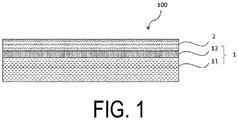
- FIG. 1 is a cross-sectional schematic view illustrating an embodiment of the gas barrier film of the present invention.
- a gas barrier film 100 is provided with a substrate 1 having an inorganic thin film layer 12 on one surface of a base film 11, and a cured resin layer 2 provided on a surface on the inorganic thin film layer 12 side.
- the inorganic thin film layer 12 and the cured resin layer 2 are adjacent to each other.
- the gas barrier film of the present invention preferably has no film other than the substrate.
- the gas barrier film of the present invention is not limited to the layer structure of FIG. 1 and may have, for example, two or more cured resin layers.
- the gas barrier film illustrated in FIG. 1 may be structured to have a primer layer, a protective layer, or the like between the substrate 1 and the cured resin layer 2 or on the upper surface (the surface not adjacent to the substrate 1) of the cured resin layer 2.
- a method for producing the gas barrier film of the present invention is not particularly limited, and a well-known method can be used.
- Examples of the method for producing the gas barrier film of the structure of FIG. 1 include a method of coating, at a desired thickness, the epoxy resin composition for forming a cured resin layer onto a surface of an inorganic thin film layer side of a substrate having the inorganic thin film layer formed on one surface of a base film, and then curing the epoxy resin composition to thereby form a cured resin layer.
- Examples of the coating method for coating the epoxy resin composition include bar coating, Meyer bar coating, air knife coating, gravure coating, reverse gravure coating, micro gravure coating, micro reverse gravure coating, die coating, slot die coating, vacuum die coating, dip coating, spin coating, roll coating, spray coating, and coating with a brush.
- bar coating, roll coating, or spray coating is preferred, and gravure coating, reverse gravure coating, micro gravure coating, or micro reverse gravure coating is industrially preferred.
- a step (drying step) of volatilizing the solvent is implemented as necessary.
- Conditions in the drying step can be appropriately selected, but the drying can be performed, for example, at a drying temperature of 60 to 180°C and a drying time of 5 to 180 seconds.
- the epoxy resin composition is cured to form a cured resin layer.
- the curing temperature can be selected, for example, in a range of from 10 to 140°C, and is preferably in a range of from 10 to 80°C.
- the curing time can be selected, for example, in a range from 0.5 to 200 hours, and is preferably in a range from 2 to 100 hours.
- the gas barrier film of the present invention has excellent gas barrier properties.
- the oxygen transmission rate of the gas barrier film at 23°C and a relative humidity of 60% varies depending on the barrier properties of the substrate that is used but is preferably 2 cc/m 2 ⁇ day ⁇ atm or less, more preferably 1.5 cc/m 2 ⁇ day ⁇ atm or less, and even more preferably 1 cc/m 2 ⁇ day ⁇ atm or less.
- the oxygen transmission rate of the gas barrier film is specifically determined by a method described in Examples.
- a laminate of the present invention has the gas barrier film of the present invention and a thermoplastic resin layer.
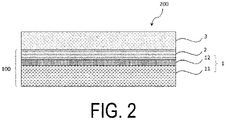
- a preferred structure of the laminate include a structure in which the thermoplastic resin layer is laminated on a surface of the cured resin layer side in the gas barrier film of the present invention (a surface (upper surface) of the cured resin layer 2 side in the gas barrier film 100 of FIG. 1 ) or on the opposite surface of the cured resin layer 2 side (a surface (lower surface) of the base film 11 side in the gas barrier film 100 of FIG. 1 ).
- the laminate may further include an optional layer, such as a primer layer, an ink layer, an adhesive layer, a surface protective layer, or a vapor-deposited layer, laminated between the gas barrier film and the thermoplastic resin layer.
- an optional layer such as a primer layer, an ink layer, an adhesive layer, a surface protective layer, or a vapor-deposited layer, laminated between the gas barrier film and the thermoplastic resin layer.
- the laminate of the present invention may have two or more layers each of the gas barrier film and the thermoplastic resin layer of the present invention.
- thermoplastic resin film is preferably used.
- the thermoplastic resin film is preferably a transparent plastic film exemplified with regard to the base film constituting the substrate.
- the surface of the thermoplastic resin film may be subjected to a surface treatment, such as a flame treatment or a corona discharge treatment.
- a film containing an ultraviolet absorber, a colorant, or the like, or a film having a primer layer, an ink layer, a surface protective layer, a vapor-deposited layer, or the like on the surface can also be used.
- the thickness of the thermoplastic resin layer is preferably from 10 to 300 ⁇ m and is more preferably from 10 to 100 ⁇ m.
- Examples of a preferred layer structure of the laminate of the present invention include a structure in which the gas barrier film and the thermoplastic resin film are directly laminated and a structure in which the gas barrier film and the thermoplastic resin film are laminated with an adhesive layer interposed between these films.
- An example of a structure in which the gas barrier film and the thermoplastic resin film are directly laminated includes a structure in which a substrate constituting the gas barrier film and the thermoplastic resin film are laminated with a cured resin layer made from the epoxy resin composition interposed therebetween ( FIG. 2 ).
- FIG. 2 is a cross-sectional schematic view illustrating an embodiment of the laminate of the present invention.
- a laminate 200 is formed by arranging and laminating the substrate 1 and a thermoplastic resin film 3 in a manner facing each other with the cured resin layer 2 interposed between.
- the laminate 200 is structured with the substrate 1 including the base film 11 and the inorganic thin film layer 12, the cured resin layer 2, and the thermoplastic resin film 3 laminated in this order.
- FIG. 3 is a cross-sectional schematic view illustrating an embodiment of the laminate of the present invention.
- a laminate 300 is formed by arranging and laminating the surface of the cured resin layer 2 side of the gas barrier film 100 and the thermoplastic resin film 3 in a manner facing each other with an adhesive layer 4 interposed therebetween, and the laminate 300 is structured with the substrate 1 including the base film 11 and the inorganic thin film layer 12, the cured resin layer 2, the adhesive layer 4, and the thermoplastic resin film 3 laminated in this order.
- the method for producing the laminate is not particularly limited.
- Examples of a method for producing a laminate in which the gas barrier film and the thermoplastic resin film are directly laminated include a method of coating the epoxy resin composition described above onto the surface containing an inorganic substance of the substrate constituting the gas barrier film, then immediately bonding the thermoplastic resin film to the coated surface using a nip roll or the like, and subsequently curing the epoxy resin composition by the method described above.
- the epoxy resin composition constituting the cured resin layer also functions as an adhesive layer to adhere the substrate of the gas barrier film and the thermoplastic resin film.
- Examples of a method for producing a laminate in which the gas barrier film and the thermoplastic resin film are laminated with an adhesive layer interposed between these films include a method of coating an adhesive that is to constitute the adhesive layer onto one surface of the gas barrier film produced by the method described above or onto one surface of the thermoplastic resin film, and then bonding the other film to laminate the films.
- the adhesive constituting the adhesive layer a well-known adhesive, such as a urethane-based adhesive, an acrylic-based adhesive, or an epoxy-based adhesive, can be used.
- the thickness of the adhesive layer is not particularly limited, but in terms of achieving both adhesion and transparency, the thickness is preferably from 0.1 to 30 ⁇ m, more preferably from 1 to 20 ⁇ m, and even more preferably from 2 to 20 ⁇ m.
- the gas barrier film and laminate of the present invention are excellent in gas barrier properties and bending resistance and thus are suitable for packaging material applications for protecting food products, pharmaceuticals, cosmetics, precision electronic components, or the like.
- the gas barrier film and laminate of the present invention may be used as they are as packaging materials or may be further laminated with another layer or film and used.
- An equivalent weight A1 (g/equivalent) of basic nitrogen of the epoxy resin used in the epoxy resin composition of each example, an equivalent weight A2 (g/equivalent) of basic nitrogen of the epoxy resin curing agent, and an equivalent weight A3 (g/equivalent) of the acid group of the acidic compound were each calculated.
- a compounded amount B1 (g) of the epoxy resin in the epoxy resin composition a compounded amount B2 (g) of the epoxy resin curing agent, and a compounded amount B3 (g) of the acidic compound, (B1/A1 + B2/A2) was divided by (B3/A3), and the calculated value was used as the molar equivalent ratio (basic nitrogen/acid group).
- the calculation of the equivalent weight A2 of the basic nitrogen of the epoxy resin curing agent also included the basic nitrogen derived from additives or the like in an epoxy resin curing agent solution.
- the equivalent weight A1 (g/equivalent) of the basic nitrogen of the epoxy resin and the equivalent weight A2 (g/equivalent) of the basic nitrogen of the epoxy resin curing agent were obtained by determining the total amine value (mgKOH/g) using a potentiometric titrator ("AT-610" available from Kyoto Electronic Manufacturing Co., Ltd.) and acetic acid as diluting solvent for the sample and a 0.1N perchloric acid/acetic acid solution as a titration solvent, and then calculating the equivalent weight of the basic nitrogen from the amine value.
- the pH at 25°C was measured using a portable pH meter ("D-72LAB", available from Horiba, Ltd.).
- a pH electrode for low-conductivity aqueous/non-aqueous solvents (“6377-10D” available from Horiba, Ltd.) was used as the electrode.
- the thickness was measured using a multilayer film thickness measuring device ("DC-8200" available from Gunze Limited).
- Oxygen transmission rate (cc/m 2 ⁇ day ⁇ atm)
- the oxygen transmission rates of the substrates used in each of the examples and of the gas barrier films obtained in each of the examples were measured using an oxygen transmission rate measuring device ("OX-TRAN 2/21" available from Modern Controls Inc.) at a temperature of 23°C and a relative humidity of 60%.
- OX-TRAN 2/21 available from Modern Controls Inc.
- the peel strength at a peel rate of 300 mm/min was measured by a T-peel test in accordance with the method stipulated by JIS K6854-3:1999.
- a reaction vessel was charged with 1 mol of meta-xylylenediamine (MXDA). The temperature was raised to 60°C under a nitrogen stream, and 0.93 mol of methyl acrylate was added dropwise over 1 hour. The temperature was increased to 165°C while generated methanol was distilled off, and the temperature was then maintained at 165°C for 2.5 hours, and thereby an amine-based curing agent was obtained.
- MXDA meta-xylylenediamine
- the equivalent weight (in terms of nonvolatile content) of the basic nitrogen of the epoxy resin curing agent solution B was 84 g/equivalent.
- the compounded amount of the p-toluenesulfonic acid monohydrate per 100 parts by mass of nonvolatile content other than the p-toluenesulfonic acid monohydrate in the epoxy resin composition was 40 parts by mass.
- a bar coater No. 3 was used to coat the obtained epoxy resin composition onto an alumina vapor deposited surface of an alumina vapor deposited PET (Barrialox 1011HG (no coating) available from Toray Advanced Film Co., Ltd., thickness: 12 ⁇ m, oxygen transmission rate: 2.2 cc/(m 2 ⁇ day ⁇ atm)) having an aluminum oxide (alumina) vapor deposited on one surface of PET.
- the epoxy resin composition was heated and dried for 60 seconds at 120°C (thickness after drying: approximately 0.5 ⁇ m), and then cured by heating for two days at 40°C, and a gas barrier film made from a substrate and a cured resin layer was produced.
- a urethane adhesive (“TOMOFLEX AD-502" available from Toyo-Morton, Ltd.) was coated onto the surface of this cured resin layer using a bar coater No. 12 and dried at 80°C for 10 seconds, and an adhesive layer was formed (thickness after drying: approximately 3 ⁇ m).
- the urethane adhesive used was prepared by adding 1.05 g of a curing agent CAT-RT85 and 16.9 g of ethyl acetate as a solvent to 15 g of a primary agent AD-502 and stirring the mixture well.
- An epoxy resin composition was prepared by the same method as Example 1 with the exception that the compounded amount of the methanol in Example 1 was changed to 35.9 g, and the compounded amount of the p-toluenesulfonic acid monohydrate was changed to 1.60 g.
- a gas barrier film and a laminate were prepared, and the peel strength was measured. The results are shown in Table 1.
- An epoxy resin composition was prepared by the same method as Example 1 with the exception that the compounded amount of the methanol in Example 1 was changed to 41.9 g, and the compounded amount of the p-toluenesulfonic acid monohydrate was changed to 2.24 g.
- a gas barrier film and a laminate were prepared, and the peel strength was measured. The results are shown in Table 1.
- An epoxy resin composition was prepared by the same method as Example 1 with the exception that the compounded amount of the methanol in Example 1 was changed to 21.6 g, and p-toluenesulfonic acid monohydrate was not added. In addition, a gas barrier film and a laminate were prepared, and the peel strength was measured. The results are shown in Table 1.
- An epoxy resin composition was prepared by the same method as Example 1 with the exception that the compounded amount of the methanol in Example 1 was changed to 24.4 g, and the compounded amount of the p-toluenesulfonic acid monohydrate was changed to 0.32 g.
- a gas barrier film and a laminate were prepared, and the peel strength was measured. The results are shown in Table 1.
- An epoxy resin composition was prepared by the same method as Example 1 with the exception that the compounded amount of the methanol in Example 1 was changed to 27.4 g, and the compounded amount of the p-toluenesulfonic acid monohydrate was changed to 0.64 g.
- a gas barrier film and a laminate were prepared, and the peel strength was measured. The results are shown in Table 1.
- An epoxy resin composition was prepared by the same method as Example 1 with the exception that the compounded amount of the methanol in Example 1 was changed to 30.2 g, and the compounded amount of the p-toluenesulfonic acid monohydrate was changed to 0.96 g.
- a gas barrier film and a laminate were prepared, and the peel strength was measured. The results are shown in Table 1.
- An epoxy resin composition was prepared by the same method as Example 1 with the exception that 1.28 g (1.15 g as an active amount) of a lactic acid (LA, acid value of 622 mgKOH/g) aqueous solution ("Lactic Acid 90F" available from Musashino Chemical Laboratory, Ltd., solid content concentration: 90 mass%) was compounded as an acidic compound in place of the p-toluenesulfonic acid monohydrate in Example 1, and the compounded amount of methanol was changed to 29.5 g.
- a gas barrier film and a laminate were prepared, and the peel strength was measured. The results are shown in Table 1.
- An epoxy resin composition was prepared by the same method as Example 4 with the exception that the compounded amount of the methanol in Example 4 was changed to 32.0g, and the compounded amount of the lactic acid aqueous solution was changed to 1.60 g.
- a gas barrier film and a laminate were prepared, and the peel strength was measured. The results are shown in Table 1.
- An epoxy resin composition was prepared by the same method as Example 4 with the exception that the compounded amount of the methanol in Example 4 was changed to 36.9 g, and the compounded amount of the lactic acid aqueous solution was changed to 1.93 g.
- a gas barrier film and a laminate were prepared, and the peel strength was measured. The results are shown in Table 1.
- An epoxy resin composition was prepared by the same method as Example 4 with the exception that the compounded amount of the methanol in Example 4 was changed to 41.9 g, and the compounded amount of the lactic acid aqueous solution was changed to 2.57 g.
- a gas barrier film and a laminate were prepared, and the peel strength was measured. The results are shown in Table 1.
- An epoxy resin composition was prepared by the same method as Example 4 with the exception that the compounded amount of the methanol in Example 4 was changed to 47.4 g, and the compounded amount of the lactic acid aqueous solution was changed to 3.20 g.
- a gas barrier film and a laminate were prepared, and the peel strength was measured. The results are shown in Table 1.
- An epoxy resin composition was prepared by the same method as Example 4 with the exception that the compounded amount of the methanol in Example 4 was changed to 41.9 g, and the compounded amount of the lactic acid aqueous solution was changed to 0.32 g.
- a gas barrier film and a laminate were prepared, and the peel strength was measured. The results are shown in Table 1.
- An epoxy resin composition was prepared by the same method as Example 1 with the exception that 1.92 g of salicylic acid (SA, acid value of 406 mgKOH/g) was compounded as an acidic compound in place of the p-toluenesulfonic acid mononhydrate in Example 1, and the compounded amount of methanol was changed to 38.9 g.
- SA salicylic acid
- methanol p-toluenesulfonic acid mononhydrate
- methanol methanol
- a gas barrier film and a laminate were prepared, and the peel strength was measured. The results are shown in Table 1.
- An epoxy resin composition was prepared by the same method as Example 9 with the exception that the compounded amount of the methanol in Example 9 was changed to 44.4 g, and the compounded amount of the salicylic acid was changed to 2.56 g.
- a gas barrier film and a laminate were prepared, and the peel strength was measured. The results are shown in Table 1.
- An epoxy resin composition was prepared by the same method as Example 9 with the exception that the compounded amount of the methanol in Example 9 was changed to 50.4 g, and the compounded amount of the salicylic acid was changed to 3.20 g.
- a gas barrier film and a laminate were prepared, and the peel strength was measured. The results are shown in Table 1.
- An epoxy resin composition was prepared by the same method as Example 9 with the exception that the compounded amount of the methanol in Example 9 was changed to 24.4 g, and the compounded amount of the salicylic acid was changed to 0.32 g.
- a gas barrier film and a laminate were prepared, and the peel strength was measured. The results are shown in Table 1.
- a peel strength improvement rate in relation to Comparative Example 1 for Examples 1 to 11 and Comparative Examples 2 to 6 is also shown in Table 1.
- LA lactic acid
- a gas barrier film and a laminate were prepared by the same method as in Example 1 with the exception that the epoxy resin composition obtained as described above was used, and the peel strength was measured. The results are shown in Table 1.
- Epoxy resin compositions were prepared by the same method as Example 12 with the exception that the compounded amount of the lactic acid aqueous solution in Example 12 was changed such that the active amount of lactic acid was the amount shown in Table 1.
- gas barrier films and laminates were prepared, and the peel strength was measured. The results are shown in Table 1.
- a gas barrier film and a laminate were prepared, and the peel strength was measured. The results are shown in Table 1.
- An epoxy resin composition was prepared by the same method as Example 15 with the exception that the compounded amount of the methanol in Example 15 was changed to 32.9 g, and the compounded amount of the lactic acid aqueous solution was changed to 2.08g.
- a gas barrier film and a laminate were prepared, and the peel strength was measured. The results are shown in Table 1.
- An epoxy resin composition was prepared by the same method as Example 15 with the exception that the compounded amount of the methanol in Example 15 was changed to 37.1 g, and the compounded amount of the lactic acid aqueous solution was changed to 2.61 g.
- a gas barrier film and a laminate were prepared, and the peel strength was measured. The results are shown in Table 1.
- An epoxy resin composition was prepared by the same method as Example 15 with the exception that the compounded amount of the methanol in Example 15 was changed to 16.2 g, and a lactic acid aqueous solution was not added. In addition, a gas barrier film and a laminate were prepared, and the peel strength was measured. The results are shown in Table 1.
- An epoxy resin composition was prepared by the same method as Example 15 with the exception that the compounded amount of the methanol in Example 15 was changed to 18.4 g, and the compounded amount of the lactic acid aqueous solution was changed to 0.26 g. In addition, a gas barrier film and a laminate were prepared, and the peel strength was measured. The results are shown in Table 1.
- a peel strength improvement rate in relation to Comparative Example 10 for Examples 15 to 17 and Comparative Example 11 is also shown in Table 1.
- LA lactic acid
- a bar coater No. 8 was used to coat the obtained epoxy resin composition onto an alumina vapor deposited surface of an alumina vapor deposited PET (Barrialox 1011HG (no coating) available from Toray Advanced Film Co., Ltd., thickness: 12 ⁇ m) having an aluminum oxide (alumina) vapor deposited on one surface of PET.
- the epoxy resin composition was dried by heating at 80°C for 30 seconds (thickness after drying: approximately 3 ⁇ m).
- a polypropylene film (“P1146" available from Toyobo Co., Ltd.) having a thickness of 50 ⁇ m was immediately bonded thereon using a nip roll, and heated for two days at 40°C, and a laminate was obtained.
- Example 18 The preparation of an epoxy resin composition and the fabrication of a laminate were implemented by the same method as in Example 18 with the exception that the lactic acid aqueous solution of Example 18 was not added.
- the peel strength was also measured by the method described above. The results are shown in Table 2.
- a gas barrier film and a laminate were prepared, and the peel strength was measured. The results are shown in Table 2.
- Example 19 The preparation of an epoxy resin composition and the fabrication of a laminate were implemented by the same method as in Example 19 with the exception that the lactic acid aqueous solution of Example 19 was not added.
- the peel strength was also measured by the method described above. The results are shown in Table 2.
- a cured product having high gas barrier properties, and having good adhesion to inorganic substances such as alumina in particular can be formed.
- a gas barrier film and laminate having a cured resin layer formed on a substrate having at least one surface constituted of an inorganic substance, the cured resin layer being a cured product of the epoxy resin composition exhibit high gas barrier properties and interlayer adhesiveness, and are suitable for packaging material applications, for example.
Landscapes
- Chemical & Material Sciences (AREA)
- Organic Chemistry (AREA)
- Health & Medical Sciences (AREA)
- Chemical Kinetics & Catalysis (AREA)
- Medicinal Chemistry (AREA)
- Polymers & Plastics (AREA)
- Engineering & Computer Science (AREA)
- Ceramic Engineering (AREA)
- Inorganic Chemistry (AREA)
- Life Sciences & Earth Sciences (AREA)
- Materials Engineering (AREA)
- Wood Science & Technology (AREA)
- Laminated Bodies (AREA)
- Epoxy Resins (AREA)
- Compositions Of Macromolecular Compounds (AREA)
Applications Claiming Priority (2)
| Application Number | Priority Date | Filing Date | Title |
|---|---|---|---|
| JP2019148906 | 2019-08-14 | ||
| PCT/JP2020/027176 WO2021029170A1 (ja) | 2019-08-14 | 2020-07-13 | エポキシ樹脂組成物、ガスバリア性フィルム及び積層体 |
Publications (3)
| Publication Number | Publication Date |
|---|---|
| EP4015577A1 true EP4015577A1 (de) | 2022-06-22 |
| EP4015577A4 EP4015577A4 (de) | 2022-09-28 |
| EP4015577B1 EP4015577B1 (de) | 2025-02-26 |
Family
ID=74571082
Family Applications (1)
| Application Number | Title | Priority Date | Filing Date |
|---|---|---|---|
| EP20851953.8A Active EP4015577B1 (de) | 2019-08-14 | 2020-07-13 | Epoxidharzzusammensetzung, gasbarrierefolie und laminat |
Country Status (7)
| Country | Link |
|---|---|
| US (1) | US12281195B2 (de) |
| EP (1) | EP4015577B1 (de) |
| JP (1) | JP6912012B2 (de) |
| KR (1) | KR20220047765A (de) |
| CN (1) | CN114222796B (de) |
| TW (1) | TWI856137B (de) |
| WO (1) | WO2021029170A1 (de) |
Cited By (1)
| Publication number | Priority date | Publication date | Assignee | Title |
|---|---|---|---|---|
| EP4523911A4 (de) * | 2022-05-11 | 2025-09-03 | Mitsubishi Gas Chemical Co | Sauerstoffabsorbierendes material und verfahren zur lagerung eines artikels |
Families Citing this family (3)
| Publication number | Priority date | Publication date | Assignee | Title |
|---|---|---|---|---|
| JP7848455B2 (ja) * | 2021-09-16 | 2026-04-21 | Toppanホールディングス株式会社 | ガスバリア積層体及び包装袋 |
| JP7848454B2 (ja) * | 2021-09-16 | 2026-04-21 | Toppanホールディングス株式会社 | ガスバリア積層体及び包装袋 |
| WO2025128797A1 (en) | 2023-12-13 | 2025-06-19 | Blue Evolution, Inc | Ecofriendly, biodegradable biological polysaccharide composition for packaging materials |
Family Cites Families (23)
| Publication number | Priority date | Publication date | Assignee | Title |
|---|---|---|---|---|
| US4264758A (en) | 1979-11-02 | 1981-04-28 | Texaco Development Corporation | Novel epoxy curing system |
| US4331582A (en) * | 1980-01-14 | 1982-05-25 | Hitco | Epoxy latent catalyst |
| KR100923609B1 (ko) | 2001-09-05 | 2009-10-23 | 미츠비시 가스 가가쿠 가부시키가이샤 | 가스 차단성 라미네이트용 접착제 및 라미네이트 필름 |
| JP4117451B2 (ja) | 2002-04-10 | 2008-07-16 | 三菱瓦斯化学株式会社 | 耐屈曲性に優れたガスバリア性積層フィルム |
| JP4314916B2 (ja) | 2003-07-11 | 2009-08-19 | 三菱瓦斯化学株式会社 | ガスバリア性コートフィルム |
| JP2005002353A (ja) | 2004-09-17 | 2005-01-06 | Asahi Kasei Chemicals Corp | 水性樹脂組成物 |
| JP4929769B2 (ja) * | 2005-10-04 | 2012-05-09 | 三菱瓦斯化学株式会社 | ガスバリア性樹脂組成物、塗料および接着剤 |
| US8088559B2 (en) * | 2005-11-18 | 2012-01-03 | Agfa Graphics Nv | Method of making a photopolymer printing plate |
| US8128782B2 (en) * | 2007-05-21 | 2012-03-06 | Mitsubishi Gas Chemical Company, Inc. | Amine epoxy resin curing agent, gas barrier epoxy resin composition comprising the curing agent, coating agent, and adhesive agent for laminate |
| JP5320924B2 (ja) | 2007-10-05 | 2013-10-23 | 三菱瓦斯化学株式会社 | ガスバリア性積層体 |
| JP5257148B2 (ja) | 2009-03-03 | 2013-08-07 | 三菱瓦斯化学株式会社 | ガスバリア性樹脂組成物、塗料および接着剤 |
| JP5966511B2 (ja) | 2012-03-29 | 2016-08-10 | 三菱瓦斯化学株式会社 | ラミネートフィルム |
| JP6137502B2 (ja) | 2012-04-27 | 2017-05-31 | 三菱瓦斯化学株式会社 | エポキシ樹脂硬化剤、エポキシ樹脂組成物、及びガスバリア性接着剤、並びにガスバリア性積層体 |
| HK1204795A1 (en) * | 2012-04-27 | 2015-12-04 | Mitsubishi Gas Chemical Company, Inc. | Epoxy resin curing agent, epoxy resin composition, gas barrier adhesive agent, and gas barrier laminate body |
| US10323126B2 (en) * | 2012-11-28 | 2019-06-18 | Hitachi Chemical Company, Ltd. | Siloxane compound, modified imide resin, thermosetting resin composition, prepreg, film with resin, laminated plate, multilayer printed wiring board, and semiconductor package |
| US10273379B2 (en) * | 2013-02-08 | 2019-04-30 | Kuraray Co., Ltd. | Multilayer structure and method for producing same |
| JP2016097596A (ja) | 2014-11-21 | 2016-05-30 | 三菱瓦斯化学株式会社 | ガスバリア性コートフィルム |
| WO2017106596A1 (en) | 2015-12-18 | 2017-06-22 | 3M Innovative Properties Company | Curable epoxy compositions and methods for accelerating the curing of epoxy compositions |
| WO2017179359A1 (ja) | 2016-04-12 | 2017-10-19 | 三菱瓦斯化学株式会社 | エポキシ樹脂硬化剤、エポキシ樹脂組成物、炭素繊維強化複合材 |
| CN110035893A (zh) * | 2016-12-09 | 2019-07-19 | 三菱瓦斯化学株式会社 | 阻气性薄膜 |
| PL3983469T3 (pl) * | 2019-06-14 | 2025-09-01 | Sika Technology Ag | Utwardzona dwuskładnikowa kompozycja epoksydowa |
| EP4015409A4 (de) * | 2019-08-14 | 2022-10-05 | Mitsubishi Gas Chemical Company, Inc. | Verpackungsmaterial mit gasbarriere |
| EP4130092A4 (de) * | 2020-04-01 | 2023-08-23 | Mitsubishi Gas Chemical Company, Inc. | Prepreg, faserverstärktes verbundmaterial, hochdruckgasspeicher, verfahren zur herstellung eines prepregs und verfahren zur herstellung eines hochdruckgasspeicherbehälters |
-
2020
- 2020-07-13 JP JP2020568834A patent/JP6912012B2/ja active Active
- 2020-07-13 KR KR1020227004203A patent/KR20220047765A/ko active Pending
- 2020-07-13 CN CN202080056687.4A patent/CN114222796B/zh active Active
- 2020-07-13 WO PCT/JP2020/027176 patent/WO2021029170A1/ja not_active Ceased
- 2020-07-13 EP EP20851953.8A patent/EP4015577B1/de active Active
- 2020-07-13 US US17/634,431 patent/US12281195B2/en active Active
- 2020-07-14 TW TW109123649A patent/TWI856137B/zh active
Cited By (1)
| Publication number | Priority date | Publication date | Assignee | Title |
|---|---|---|---|---|
| EP4523911A4 (de) * | 2022-05-11 | 2025-09-03 | Mitsubishi Gas Chemical Co | Sauerstoffabsorbierendes material und verfahren zur lagerung eines artikels |
Also Published As
| Publication number | Publication date |
|---|---|
| WO2021029170A1 (ja) | 2021-02-18 |
| EP4015577A4 (de) | 2022-09-28 |
| US12281195B2 (en) | 2025-04-22 |
| CN114222796B (zh) | 2023-08-08 |
| EP4015577B1 (de) | 2025-02-26 |
| US20220315694A1 (en) | 2022-10-06 |
| JPWO2021029170A1 (ja) | 2021-09-13 |
| JP6912012B2 (ja) | 2021-07-28 |
| CN114222796A (zh) | 2022-03-22 |
| KR20220047765A (ko) | 2022-04-19 |
| TWI856137B (zh) | 2024-09-21 |
| TW202112878A (zh) | 2021-04-01 |
Similar Documents
| Publication | Publication Date | Title |
|---|---|---|
| EP3552821B1 (de) | Gasbarrierenfilm | |
| EP4015577B1 (de) | Epoxidharzzusammensetzung, gasbarrierefolie und laminat | |
| EP1352933B1 (de) | Flexibler Gassperrfilm | |
| US11814471B2 (en) | Gas barrier packaging material | |
| JP5257148B2 (ja) | ガスバリア性樹脂組成物、塗料および接着剤 | |
| JP2004027014A (ja) | ガスバリア性樹脂組成物、塗料および接着剤 | |
| EP4249248A1 (de) | Epoxidharzzusammensetzung, gasbarriere-mehrschichtfolie und verpackungsmaterial | |
| JP2011068835A (ja) | ガスバリア性コートフィルム | |
| JP5636638B2 (ja) | アミン系エポキシ樹脂硬化剤およびエポキシ樹脂組成物 | |
| EP3808784B1 (de) | Durch aktinische strahlung härtbare harzzusammensetzung, gassperrschicht und mehrschichtstruktur | |
| JP2003300271A (ja) | 耐屈曲性に優れたガスバリア性積層フィルム | |
| JP2010270272A (ja) | ガスバリア性樹脂組成物、塗料および接着剤 |
Legal Events
| Date | Code | Title | Description |
|---|---|---|---|
| STAA | Information on the status of an ep patent application or granted ep patent |
Free format text: STATUS: THE INTERNATIONAL PUBLICATION HAS BEEN MADE |
|
| PUAI | Public reference made under article 153(3) epc to a published international application that has entered the european phase |
Free format text: ORIGINAL CODE: 0009012 |
|
| STAA | Information on the status of an ep patent application or granted ep patent |
Free format text: STATUS: REQUEST FOR EXAMINATION WAS MADE |
|
| 17P | Request for examination filed |
Effective date: 20220202 |
|
| AK | Designated contracting states |
Kind code of ref document: A1 Designated state(s): AL AT BE BG CH CY CZ DE DK EE ES FI FR GB GR HR HU IE IS IT LI LT LU LV MC MK MT NL NO PL PT RO RS SE SI SK SM TR |
|
| RIC1 | Information provided on ipc code assigned before grant |
Ipc: C09D 163/00 20060101ALI20220817BHEP Ipc: C08G 59/56 20060101ALI20220817BHEP Ipc: C08K 5/17 20060101ALI20220817BHEP Ipc: C08K 3/013 20180101ALI20220817BHEP Ipc: C08G 59/50 20060101ALI20220817BHEP Ipc: B32B 27/38 20060101ALI20220817BHEP Ipc: B32B 9/00 20060101ALI20220817BHEP Ipc: C08L 63/00 20060101AFI20220817BHEP |
|
| A4 | Supplementary search report drawn up and despatched |
Effective date: 20220826 |
|
| DAV | Request for validation of the european patent (deleted) | ||
| DAX | Request for extension of the european patent (deleted) | ||
| GRAP | Despatch of communication of intention to grant a patent |
Free format text: ORIGINAL CODE: EPIDOSNIGR1 |
|
| STAA | Information on the status of an ep patent application or granted ep patent |
Free format text: STATUS: GRANT OF PATENT IS INTENDED |
|
| INTG | Intention to grant announced |
Effective date: 20240920 |
|
| GRAS | Grant fee paid |
Free format text: ORIGINAL CODE: EPIDOSNIGR3 |
|
| GRAA | (expected) grant |
Free format text: ORIGINAL CODE: 0009210 |
|
| STAA | Information on the status of an ep patent application or granted ep patent |
Free format text: STATUS: THE PATENT HAS BEEN GRANTED |
|
| P01 | Opt-out of the competence of the unified patent court (upc) registered |
Free format text: CASE NUMBER: APP_67333/2024 Effective date: 20241219 |
|
| AK | Designated contracting states |
Kind code of ref document: B1 Designated state(s): AL AT BE BG CH CY CZ DE DK EE ES FI FR GB GR HR HU IE IS IT LI LT LU LV MC MK MT NL NO PL PT RO RS SE SI SK SM TR |
|
| REG | Reference to a national code |
Ref country code: GB Ref legal event code: FG4D |
|
| REG | Reference to a national code |
Ref country code: CH Ref legal event code: EP |
|
| REG | Reference to a national code |
Ref country code: DE Ref legal event code: R096 Ref document number: 602020046935 Country of ref document: DE |
|
| REG | Reference to a national code |
Ref country code: IE Ref legal event code: FG4D |
|
| REG | Reference to a national code |
Ref country code: NL Ref legal event code: MP Effective date: 20250226 |
|
| PG25 | Lapsed in a contracting state [announced via postgrant information from national office to epo] |
Ref country code: RS Free format text: LAPSE BECAUSE OF FAILURE TO SUBMIT A TRANSLATION OF THE DESCRIPTION OR TO PAY THE FEE WITHIN THE PRESCRIBED TIME-LIMIT Effective date: 20250526 |
|
| PG25 | Lapsed in a contracting state [announced via postgrant information from national office to epo] |
Ref country code: FI Free format text: LAPSE BECAUSE OF FAILURE TO SUBMIT A TRANSLATION OF THE DESCRIPTION OR TO PAY THE FEE WITHIN THE PRESCRIBED TIME-LIMIT Effective date: 20250226 |
|
| PG25 | Lapsed in a contracting state [announced via postgrant information from national office to epo] |
Ref country code: PL Free format text: LAPSE BECAUSE OF FAILURE TO SUBMIT A TRANSLATION OF THE DESCRIPTION OR TO PAY THE FEE WITHIN THE PRESCRIBED TIME-LIMIT Effective date: 20250226 |
|
| PG25 | Lapsed in a contracting state [announced via postgrant information from national office to epo] |
Ref country code: ES Free format text: LAPSE BECAUSE OF FAILURE TO SUBMIT A TRANSLATION OF THE DESCRIPTION OR TO PAY THE FEE WITHIN THE PRESCRIBED TIME-LIMIT Effective date: 20250226 |
|
| PGFP | Annual fee paid to national office [announced via postgrant information from national office to epo] |
Ref country code: GB Payment date: 20250529 Year of fee payment: 6 |
|
| REG | Reference to a national code |
Ref country code: LT Ref legal event code: MG9D |
|
| PG25 | Lapsed in a contracting state [announced via postgrant information from national office to epo] |
Ref country code: NO Free format text: LAPSE BECAUSE OF FAILURE TO SUBMIT A TRANSLATION OF THE DESCRIPTION OR TO PAY THE FEE WITHIN THE PRESCRIBED TIME-LIMIT Effective date: 20250526 Ref country code: IS Free format text: LAPSE BECAUSE OF FAILURE TO SUBMIT A TRANSLATION OF THE DESCRIPTION OR TO PAY THE FEE WITHIN THE PRESCRIBED TIME-LIMIT Effective date: 20250626 |
|
| PG25 | Lapsed in a contracting state [announced via postgrant information from national office to epo] |
Ref country code: NL Free format text: LAPSE BECAUSE OF FAILURE TO SUBMIT A TRANSLATION OF THE DESCRIPTION OR TO PAY THE FEE WITHIN THE PRESCRIBED TIME-LIMIT Effective date: 20250226 |
|
| PG25 | Lapsed in a contracting state [announced via postgrant information from national office to epo] |
Ref country code: HR Free format text: LAPSE BECAUSE OF FAILURE TO SUBMIT A TRANSLATION OF THE DESCRIPTION OR TO PAY THE FEE WITHIN THE PRESCRIBED TIME-LIMIT Effective date: 20250226 |
|
| PG25 | Lapsed in a contracting state [announced via postgrant information from national office to epo] |
Ref country code: PT Free format text: LAPSE BECAUSE OF FAILURE TO SUBMIT A TRANSLATION OF THE DESCRIPTION OR TO PAY THE FEE WITHIN THE PRESCRIBED TIME-LIMIT Effective date: 20250626 Ref country code: LV Free format text: LAPSE BECAUSE OF FAILURE TO SUBMIT A TRANSLATION OF THE DESCRIPTION OR TO PAY THE FEE WITHIN THE PRESCRIBED TIME-LIMIT Effective date: 20250226 |
|
| PGFP | Annual fee paid to national office [announced via postgrant information from national office to epo] |
Ref country code: FR Payment date: 20250610 Year of fee payment: 6 |
|
| PG25 | Lapsed in a contracting state [announced via postgrant information from national office to epo] |
Ref country code: GR Free format text: LAPSE BECAUSE OF FAILURE TO SUBMIT A TRANSLATION OF THE DESCRIPTION OR TO PAY THE FEE WITHIN THE PRESCRIBED TIME-LIMIT Effective date: 20250527 Ref country code: BG Free format text: LAPSE BECAUSE OF FAILURE TO SUBMIT A TRANSLATION OF THE DESCRIPTION OR TO PAY THE FEE WITHIN THE PRESCRIBED TIME-LIMIT Effective date: 20250226 |
|
| REG | Reference to a national code |
Ref country code: AT Ref legal event code: MK05 Ref document number: 1770603 Country of ref document: AT Kind code of ref document: T Effective date: 20250226 |
|
| PG25 | Lapsed in a contracting state [announced via postgrant information from national office to epo] |
Ref country code: SE Free format text: LAPSE BECAUSE OF FAILURE TO SUBMIT A TRANSLATION OF THE DESCRIPTION OR TO PAY THE FEE WITHIN THE PRESCRIBED TIME-LIMIT Effective date: 20250226 |
|
| PG25 | Lapsed in a contracting state [announced via postgrant information from national office to epo] |
Ref country code: SM Free format text: LAPSE BECAUSE OF FAILURE TO SUBMIT A TRANSLATION OF THE DESCRIPTION OR TO PAY THE FEE WITHIN THE PRESCRIBED TIME-LIMIT Effective date: 20250226 |
|
| PG25 | Lapsed in a contracting state [announced via postgrant information from national office to epo] |
Ref country code: DK Free format text: LAPSE BECAUSE OF FAILURE TO SUBMIT A TRANSLATION OF THE DESCRIPTION OR TO PAY THE FEE WITHIN THE PRESCRIBED TIME-LIMIT Effective date: 20250226 |
|
| PGFP | Annual fee paid to national office [announced via postgrant information from national office to epo] |
Ref country code: DE Payment date: 20250528 Year of fee payment: 6 |
|
| PGFP | Annual fee paid to national office [announced via postgrant information from national office to epo] |
Ref country code: IT Payment date: 20250623 Year of fee payment: 6 |
|
| PG25 | Lapsed in a contracting state [announced via postgrant information from national office to epo] |
Ref country code: AT Free format text: LAPSE BECAUSE OF FAILURE TO SUBMIT A TRANSLATION OF THE DESCRIPTION OR TO PAY THE FEE WITHIN THE PRESCRIBED TIME-LIMIT Effective date: 20250226 |
|
| PG25 | Lapsed in a contracting state [announced via postgrant information from national office to epo] |
Ref country code: EE Free format text: LAPSE BECAUSE OF FAILURE TO SUBMIT A TRANSLATION OF THE DESCRIPTION OR TO PAY THE FEE WITHIN THE PRESCRIBED TIME-LIMIT Effective date: 20250226 Ref country code: CZ Free format text: LAPSE BECAUSE OF FAILURE TO SUBMIT A TRANSLATION OF THE DESCRIPTION OR TO PAY THE FEE WITHIN THE PRESCRIBED TIME-LIMIT Effective date: 20250226 |
|
| PG25 | Lapsed in a contracting state [announced via postgrant information from national office to epo] |
Ref country code: RO Free format text: LAPSE BECAUSE OF FAILURE TO SUBMIT A TRANSLATION OF THE DESCRIPTION OR TO PAY THE FEE WITHIN THE PRESCRIBED TIME-LIMIT Effective date: 20250226 |
|
| PG25 | Lapsed in a contracting state [announced via postgrant information from national office to epo] |
Ref country code: SK Free format text: LAPSE BECAUSE OF FAILURE TO SUBMIT A TRANSLATION OF THE DESCRIPTION OR TO PAY THE FEE WITHIN THE PRESCRIBED TIME-LIMIT Effective date: 20250226 |
|
| REG | Reference to a national code |
Ref country code: DE Ref legal event code: R097 Ref document number: 602020046935 Country of ref document: DE |
|
| PLBE | No opposition filed within time limit |
Free format text: ORIGINAL CODE: 0009261 |
|
| STAA | Information on the status of an ep patent application or granted ep patent |
Free format text: STATUS: NO OPPOSITION FILED WITHIN TIME LIMIT |
|
| REG | Reference to a national code |
Ref country code: CH Ref legal event code: L10 Free format text: ST27 STATUS EVENT CODE: U-0-0-L10-L00 (AS PROVIDED BY THE NATIONAL OFFICE) Effective date: 20260107 |
|
| 26N | No opposition filed |
Effective date: 20251127 |
|
| REG | Reference to a national code |
Ref country code: CH Ref legal event code: H13 Free format text: ST27 STATUS EVENT CODE: U-0-0-H10-H13 (AS PROVIDED BY THE NATIONAL OFFICE) Effective date: 20260224 |
|
| PG25 | Lapsed in a contracting state [announced via postgrant information from national office to epo] |
Ref country code: LU Free format text: LAPSE BECAUSE OF NON-PAYMENT OF DUE FEES Effective date: 20250713 |
|
| REG | Reference to a national code |
Ref country code: BE Ref legal event code: MM Effective date: 20250731 |
|
| PG25 | Lapsed in a contracting state [announced via postgrant information from national office to epo] |
Ref country code: BE Free format text: LAPSE BECAUSE OF NON-PAYMENT OF DUE FEES Effective date: 20250731 |
|
| PG25 | Lapsed in a contracting state [announced via postgrant information from national office to epo] |
Ref country code: CH Free format text: LAPSE BECAUSE OF NON-PAYMENT OF DUE FEES Effective date: 20250731 |