EP4016323A1 - Verfahren zur synchronen verarbeitung und zugehörige vorrichtung - Google Patents
Verfahren zur synchronen verarbeitung und zugehörige vorrichtung Download PDFInfo
- Publication number
- EP4016323A1 EP4016323A1 EP21774939.9A EP21774939A EP4016323A1 EP 4016323 A1 EP4016323 A1 EP 4016323A1 EP 21774939 A EP21774939 A EP 21774939A EP 4016323 A1 EP4016323 A1 EP 4016323A1
- Authority
- EP
- European Patent Office
- Prior art keywords
- node device
- synchronization
- blocks
- framework
- node
- Prior art date
- Legal status (The legal status is an assumption and is not a legal conclusion. Google has not performed a legal analysis and makes no representation as to the accuracy of the status listed.)
- Pending
Links
Images




Classifications
-
- G—PHYSICS
- G06—COMPUTING OR CALCULATING; COUNTING
- G06F—ELECTRIC DIGITAL DATA PROCESSING
- G06F16/00—Information retrieval; Database structures therefor; File system structures therefor
- G06F16/20—Information retrieval; Database structures therefor; File system structures therefor of structured data, e.g. relational data
- G06F16/23—Updating
- G06F16/2365—Ensuring data consistency and integrity
-
- G—PHYSICS
- G06—COMPUTING OR CALCULATING; COUNTING
- G06F—ELECTRIC DIGITAL DATA PROCESSING
- G06F16/00—Information retrieval; Database structures therefor; File system structures therefor
- G06F16/20—Information retrieval; Database structures therefor; File system structures therefor of structured data, e.g. relational data
- G06F16/21—Design, administration or maintenance of databases
- G06F16/211—Schema design and management
- G06F16/212—Schema design and management with details for data modelling support
-
- H—ELECTRICITY
- H04—ELECTRIC COMMUNICATION TECHNIQUE
- H04L—TRANSMISSION OF DIGITAL INFORMATION, e.g. TELEGRAPHIC COMMUNICATION
- H04L9/00—Cryptographic mechanisms or cryptographic arrangements for secret or secure communications; Network security protocols
- H04L9/50—Cryptographic mechanisms or cryptographic arrangements for secret or secure communications; Network security protocols using hash chains, e.g. blockchains or hash trees
-
- G—PHYSICS
- G06—COMPUTING OR CALCULATING; COUNTING
- G06F—ELECTRIC DIGITAL DATA PROCESSING
- G06F16/00—Information retrieval; Database structures therefor; File system structures therefor
- G06F16/20—Information retrieval; Database structures therefor; File system structures therefor of structured data, e.g. relational data
- G06F16/27—Replication, distribution or synchronisation of data between databases or within a distributed database system; Distributed database system architectures therefor
-
- G—PHYSICS
- G06—COMPUTING OR CALCULATING; COUNTING
- G06F—ELECTRIC DIGITAL DATA PROCESSING
- G06F21/00—Security arrangements for protecting computers, components thereof, programs or data against unauthorised activity
- G06F21/60—Protecting data
- G06F21/64—Protecting data integrity, e.g. using checksums, certificates or signatures
-
- G—PHYSICS
- G06—COMPUTING OR CALCULATING; COUNTING
- G06Q—INFORMATION AND COMMUNICATION TECHNOLOGY [ICT] SPECIALLY ADAPTED FOR ADMINISTRATIVE, COMMERCIAL, FINANCIAL, MANAGERIAL OR SUPERVISORY PURPOSES; SYSTEMS OR METHODS SPECIALLY ADAPTED FOR ADMINISTRATIVE, COMMERCIAL, FINANCIAL, MANAGERIAL OR SUPERVISORY PURPOSES, NOT OTHERWISE PROVIDED FOR
- G06Q30/00—Commerce
- G06Q30/06—Buying, selling or leasing transactions
-
- G—PHYSICS
- G06—COMPUTING OR CALCULATING; COUNTING
- G06Q—INFORMATION AND COMMUNICATION TECHNOLOGY [ICT] SPECIALLY ADAPTED FOR ADMINISTRATIVE, COMMERCIAL, FINANCIAL, MANAGERIAL OR SUPERVISORY PURPOSES; SYSTEMS OR METHODS SPECIALLY ADAPTED FOR ADMINISTRATIVE, COMMERCIAL, FINANCIAL, MANAGERIAL OR SUPERVISORY PURPOSES, NOT OTHERWISE PROVIDED FOR
- G06Q40/00—Finance; Insurance; Tax strategies; Processing of corporate or income taxes
- G06Q40/02—Banking, e.g. interest calculation or account maintenance
-
- G—PHYSICS
- G06—COMPUTING OR CALCULATING; COUNTING
- G06Q—INFORMATION AND COMMUNICATION TECHNOLOGY [ICT] SPECIALLY ADAPTED FOR ADMINISTRATIVE, COMMERCIAL, FINANCIAL, MANAGERIAL OR SUPERVISORY PURPOSES; SYSTEMS OR METHODS SPECIALLY ADAPTED FOR ADMINISTRATIVE, COMMERCIAL, FINANCIAL, MANAGERIAL OR SUPERVISORY PURPOSES, NOT OTHERWISE PROVIDED FOR
- G06Q40/00—Finance; Insurance; Tax strategies; Processing of corporate or income taxes
- G06Q40/04—Trading; Exchange, e.g. stocks, commodities, derivatives or currency exchange
-
- G—PHYSICS
- G06—COMPUTING OR CALCULATING; COUNTING
- G06Q—INFORMATION AND COMMUNICATION TECHNOLOGY [ICT] SPECIALLY ADAPTED FOR ADMINISTRATIVE, COMMERCIAL, FINANCIAL, MANAGERIAL OR SUPERVISORY PURPOSES; SYSTEMS OR METHODS SPECIALLY ADAPTED FOR ADMINISTRATIVE, COMMERCIAL, FINANCIAL, MANAGERIAL OR SUPERVISORY PURPOSES, NOT OTHERWISE PROVIDED FOR
- G06Q2220/00—Business processing using cryptography
Definitions
- This application relates to the field of blockchain technologies, and specifically, to blockchain-based synchronization processing.
- the node device When a node device in a blockchain network performs blockchain synchronization processing, the node device obtains required blocks one by one from other node devices (such as consensus node devices or synchronization node devices) in the blockchain network.
- other node devices such as consensus node devices or synchronization node devices
- Embodiments of this application provide a synchronization processing method and a related apparatus, which can effectively improve the synchronization processing efficiency.
- an embodiment of this application provides a synchronization processing method, performed by a first node device in a blockchain network, the blockchain network including a candidate node set, the candidate node set including a plurality of candidate node devices connected to the first node device, and the method including:
- an embodiment of this application provides a synchronization processing apparatus, disposed in a first node device in a blockchain network, the blockchain network including a candidate node set, the candidate node set including a plurality of candidate node devices connected to the first node device, and the synchronization processing apparatus including:
- an embodiment of this application provides a synchronization processing device, the synchronization processing device being a first node device in a blockchain network, the blockchain network including a candidate node set, the candidate node set including a plurality of candidate node devices connected to the first node device, and the synchronization processing device including an input device and an output device, and further including:
- an embodiment of this application provides a computer storage medium, storing one or more instructions, the one or more instructions being suitable for being loaded by a processor to perform the synchronization processing method according to the foregoing aspect.
- an embodiment of this application provides a computer program product including instructions, the computer program product, when run on a computer, causing the computer to perform the synchronization processing method according to the foregoing aspect.
- the first node device when performing synchronization processing, obtains a framework set and a synchronization task set, the framework set being used for storing M blocks to be synchronized by the first node device; selects a second node device from a candidate node set, the second node device being at least one candidate node device in the candidate node set; concurrently transmits synchronization tasks in the synchronization task set to the second node device, so that the second node device performs the synchronization tasks and returns the M blocks; and then fills the M blocks into the frameworks in the framework set.
- synchronization tasks corresponding to a plurality of frameworks can be concurrently transmitted during one synchronization processing, so that more blocks can be synchronized at one time based on the plurality of frameworks, which improves the synchronization processing efficiency.
- Blockchain is a set of decentralized infrastructure with distributed storage characteristics.
- the blockchain is a data structure including data blocks in a chronological order in a manner similar to a linked list, which can safely store sequential data that can be verified in a system, and cryptographically ensure that the data cannot be tampered with or forged.
- FIG. 1 is an infrastructure diagram of a blockchain according to an exemplary embodiment of this application.
- an infrastructure of the blockchain mainly includes a total of five layered structures 101 to 105 in a bottom-up order.
- Types of the blockchain may include: a public blockchain, a private blockchain, and a consortium blockchain.
- the public blockchain is open to the public, and anyone can join and access the blockchain. Blocks on the public blockchain can be viewed by anyone, and anyone can initiate transactions on the public blockchain and can participate in a consensus process of the public blockchain at any time.
- the private blockchain is only used inside a private organization, and read and write permissions and an accounting permission on the blockchain are made according to rules of the private organization.
- the private blockchain is usually used for data management and auditing inside an enterprise. Only consortium members can participate in the consortium blockchain, and read and write permissions and an accounting permission on the blockchain are made according to consortium rules.
- the consortium blockchain is generally used in scenarios such as inter-institutional transactions, settlement, or clearing.
- FIG. 3 is a schematic architectural diagram of a blockchain network according to an exemplary embodiment of this application.
- the blockchain network includes a plurality of node devices (7 node devices are used in the figure as an example for description).
- a node device 1 and a node device 2 are consensus node devices
- a node device 3 to a node device 7 are all synchronization node devices.
- the consensus node device is a node device that can not only perform a block synchronization process, but also participate in a block consensus process.
- the synchronization node device is a node device that can only perform the block synchronization process but cannot participate in the block consensus process.
- the blockchain is a distributed application mode, and each node device in the blockchain network stores one blockchain.
- the node device 1 stores a blockchain 1 in a storage space of the node device 1
- the node device 2 stores a blockchain 2 in a storage space of the node device 2
- the node device 3 stores a blockchain 3 in a storage space of the node device 3, and so on. Due to differences in network connection performances, differences in processing performances, and time differences in joining the blockchain network, there are differences between the blockchains stored in the node devices in the blockchain network, and the node devices in the blockchain network need to perform synchronization or other means to maintain the consistency between the blockchains stored in the node devices.
- n is a positive integer
- a node device n+1 is newly added to the blockchain network.
- no block has been stored in a storage space of the node device n+1, and a block height of a blockchain n+1 of the node device n+1 is 0.
- the node device n may have stored 10001 blocks, and a block height of the blockchain n stored in a storage space of the node device n may be 10000.
- the node device n+1 lags behind the node device n, and the node device n+1 needs to perform a block synchronization process to obtain all blocks between the block height 0 and the block height 10000 to update the blockchain n+1 of the node device n+1 to catch up with the node device n.
- a new block generated in the blockchain network needs to be reached consensus by the consensus node device first. After consensus is reached, the consensus node device adds the new block to the blockchain locally stored in the consensus node device.
- the synchronization node device in the blockchain network obtains the new block from the consensus node device and adds the new block to the blockchain locally stored in the synchronization node device to complete the block synchronization process. Based on this, it is generally recognized that the blockchain stored in the consensus node device is the longest (or most complete) blockchain in the blockchain network, and the blockchain stored in the consensus node device can be used as a reference blockchain during the synchronization processing.
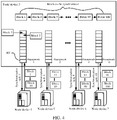
- FIG. 4 is a schematic structural diagram of a framework according to an exemplary embodiment of this application.
- the framework is a data structure.
- One framework includes a plurality of data units 401, and each data unit is configured to store a block.
- the synchronization processing of the node device 3 may include the following step (1) to step (4):
- the framework set includes a total of 10 frameworks, each framework includes 10 data units 401, and the data units 401 are reserved for storing synchronization blocks after the node device 3 obtains the synchronization blocks.
- the framework 1 includes 10 data units 401, the data units are sequentially arranged, the first data unit is configured to store a block 1, the second data unit is configured to store a block 2, and so on.
- the quantities of data units included in the frameworks may be the same.
- each framework may include 10 data units.
- the quantities of data units included in the frameworks may also be different. For example, in FIG.
- the framework 1 may include 10 data units
- a framework 2 may include 5 data units
- a framework 3 may include 15 data units, and the like.
- the node device 3 can set the quantity of the frameworks and the quantity of the data units included in the framework according to an actual situation.
- the actual situation herein may include but is not limited to: the quantity and processing capabilities of the node devices in a candidate node set, an actual concurrent transmission processing capability of the node device 3, or the like.
- the framework 1 corresponds to a synchronization task 1
- the framework 2 corresponds to a synchronization task 2
- the framework 3 corresponds to a synchronization task 3, and so on.
- the synchronization task corresponding to each framework is used for indicating to return a plurality of blocks used by the framework for storage.
- the synchronization task 1 corresponding to the framework 1 is used for indicating to return the block 1 to a block 10 used by the framework 1 for storage to the node device 3.
- the synchronization task 2 corresponding to the framework 2 is used for indicating to return a block 11 to a block 20 used by the framework 2 for storage to the node device 3.
- the synchronization task carries indication information
- the indication information may include indexes of blocks corresponding to the first and last two data units in the framework.
- the index herein may be a hash value of the block, or a generation timestamp of the block, or a block height corresponding to the block.
- another node device after receiving the synchronization task, another node device returns the two blocks in the framework and all the blocks between the two blocks to the node device 3 according to the indexes of the two blocks in the indication information.
- the indication information may also include indexes of all blocks used by the framework for storage, so that after receiving the synchronization task, another node device returns all needed blocks to the node device 3 according to the indexes of all the needed blocks.
- the second node device is at least one node device that is in a blockchain network and that is connected to a first node device and configured to perform a synchronization task.
- a candidate node set is determined, where the candidate node set includes a candidate node device directly connected to the node device 3.
- the candidate node set of the node device 3 includes the node device 1 and the node device 4 to the node device 7.
- the node device 1 is a consensus node device and further needs to perform a consensus task. Therefore, to avoid imposing processing burden on the node device 1, and to improve the synchronization efficiency, the node device 4 to the node device 7 can be selected from the candidate node set as the second node device to perform the synchronization task.
- the corresponding second node device is matched for each synchronization task, where the matching mainly has the following policies:
- One synchronization task is performed by one node device, and one node device can perform a plurality of synchronization tasks.
- policies are not exhaustive, and the embodiments of this application may also be applied to other policies, for example: a random matching policy, that is, one of the plurality of second node devices can be randomly selected to perform a synchronization task; and in another example, a weighted average policy, that is, weights can be set for a plurality of impact factors (a storage status factor, a trust degree factor, and a processing performance factor) respectively, and one of the plurality of second node devices can be selected in a weighted average manner to perform the synchronization task.
- a random matching policy that is, one of the plurality of second node devices can be randomly selected to perform a synchronization task
- a weighted average policy that is, weights can be set for a plurality of impact factors (a storage status factor, a trust degree factor, and a processing performance factor) respectively, and one of the plurality of second no
- the second node device selected to perform a synchronization task can obtain the block from another node device (for example, the consensus node device) in the blockchain network and return the block to the first node device.
- the synchronization task 1 requires to synchronize the block 1 to the block 10.
- the node device 4 is selected to perform the synchronization task 1, but the node device 4 does not store the block 1 to the block 10. Therefore, the node device 4 can obtain the block 1 to the block 10 from the consensus node device and return the block 1 to the block 10 to the first node device.
- the node device 3 can concurrently transmit the 10 synchronization tasks at one time, and the second node devices (that is, node device 4, node device 5, node device 6, and node device 7) can internally perform the synchronization tasks in a serial or parallel manner.
- the blocks required by the node device 3 are returned to the node device 3, so that the node device 3 can obtain the to-be-synchronized block during one synchronization processing.
- the block 1 to the block 10 returned by the node device 4 performing the synchronization task 1 are filled into the data units of the framework 1; and a block 21 to a block 30 returned by the node device 4 performing the synchronization task 3 are filled into the data units of the framework 3.
- the first node device can sequentially (for example, in an order of generation timestamps of the blocks) add the blocks stored in the frameworks to a local blockchain of the first node device, thereby achieving an update of the local blockchain of the first node device.
- a synchronization task adopts any policy but does not match the second node device that needs to perform the synchronization task correspondingly, for example, no node device in the candidate node set completely stores the blocks required by a framework, it is possible that the framework is not properly constructed, and it can be considered to rebuild the framework and re-update the synchronization task. Certainly, it can also be compatible with an existing synchronization manner, and the blocks required by the framework corresponding to the synchronization task that does not match the node device are synchronized one by one.
- the synchronization processing solution for framework filling is based on one synchronization task corresponding to one framework, which can synchronize the plurality of blocks at one time, effectively improving the synchronization processing efficiency. Further, synchronization tasks corresponding to a plurality of frameworks can be concurrently transmitted during one synchronization processing, so that more blocks can be synchronized at one time based on the plurality of frameworks, which further improves the synchronization processing efficiency.
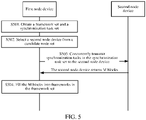
- FIG. 5 is a flowchart of a synchronization processing method according to an exemplary embodiment of this application.
- the method is performed by a first node device in a blockchain network, and the first node device may be any node device in the blockchain network. Subsequent embodiments of this application are described by using an example in which the first node device is the node device 3 in the blockchain network shown in FIG. 3 .
- the blockchain network includes a candidate node set, and the candidate node set includes a plurality of candidate node devices connected to the first node device.
- the method includes the following steps S501 to S504:
- the framework set includes P frameworks
- the synchronization task set includes P synchronization tasks
- one framework corresponds to one synchronization task.
- M and P both are positive integers.
- the any framework is represented as a target framework.
- the target framework includes N data units, the N data units are configured to store N blocks to be synchronized by the first node device, the N blocks are in one-to-one correspondence to the N data units, and N is a positive integer and N ⁇ M.
- the N data units in the target framework are sequentially arranged, and the N blocks are consecutive blocks in the blockchain network.
- An i th data unit among the N data units is configured to store an i th block among the N blocks; and i is a positive integer and 1 ⁇ i ⁇ N.
- the target framework may be any one of a framework 1 to a framework 10.
- the target framework being the framework 1 as an example, N is 10, the first data unit of the target framework is configured to store a block 1, the second data unit of the target framework is a block 2, and so on.
- the target framework corresponds to a target synchronization task, the target synchronization task carries indication information, and the indication information may include indexes of blocks corresponding to the first and last two data units in the target framework.
- the index herein may be a hash value of the block, or a generation timestamp of the block, or a block height corresponding to the block.
- the indication information may also include indexes of all blocks used by the target framework for storage.
- the target synchronization task may include indication information, and the indication information may include indexes of the block 1 and the block 10 and may also include indexes of the block 1 to the block 10.
- a sequential arrangement of the data units of the target framework is only an example, and the data units of the target framework may also be arranged out of order.
- the N blocks stored in the target framework may not be consecutive blocks; or, the data units in the target framework may not sequentially store the N blocks.
- the indication information included in the target synchronization task may only need to include indexes of the N blocks.
- the second node device is at least one node device that is in the candidate node set and that is configured to perform a synchronization task.
- the foregoing policy may be used to select the second node device, and the policy may include but is not limited to any one of the following:
- the second node device is selected according to a storage status matching manner, a processing performance matching manner, and a trust degree matching manner.
- the concurrent transmission herein includes one-time concurrent transmission and concurrent transmission in batches.
- the so-called one-time concurrent transmission means that the first node device can transmit all synchronization tasks in the synchronization task set to the second node device at one time, so that all needed blocks can be synchronized at one time.
- the so-called concurrent transmission in batches means that the first node device divides the synchronization tasks in the synchronization task set into batches, and concurrently transmits the synchronization tasks in batches.
- a batch division manner may be, for example, according to an order of the blocks, and a batch of a synchronization task corresponding to a block with a former index is prior to a batch of a synchronization task corresponding to a block with a later index.
- a filling process is a process of storing the block in the corresponding data unit.
- the first node device sequentially fills the M blocks returned by the second node device into the data units of the frameworks.
- the target framework corresponds to the target synchronization task
- the target framework is any one in the framework set
- the target synchronization task is any one in the synchronization task set.
- a target second node device is a second node device selected for the target synchronization task in S502.
- the target second node device After the target synchronization task is transmitted to the target second node device through S503, the target second node device performs the target synchronization task and returns the N blocks to the first node device; and the first node device respectively fills the N blocks into the N data units of the target framework.
- the first node device when performing synchronization processing, obtains a framework set and a synchronization task set, the framework set being used for storing M blocks to be synchronized by the first node device; selects a second node device from a candidate node set, the second node device being at least one candidate node device in the candidate node set; concurrently transmits synchronization tasks in the synchronization task set to the second node device, so that the second node device performs the synchronization tasks and returns the M blocks; and then fills the M blocks into the frameworks in the framework set.
- the plurality of blocks can be synchronized at one time, effectively improving the synchronization processing efficiency.
- Synchronization tasks corresponding to a plurality of frameworks can be concurrently transmitted during one synchronization processing, so that more blocks can be synchronized at one time based on the plurality of frameworks, which further improves the synchronization processing efficiency.
- FIG. 6 is a flowchart of another synchronization processing method according to an exemplary embodiment of this application.
- the method is performed by a first node device in a blockchain network, and the first node device may be any node device in the blockchain network. Subsequent embodiments of this application are described by using an example in which the first node device is the node device 3 in the blockchain network shown in FIG. 3 .
- the blockchain network includes a candidate node set, and the candidate node set includes a plurality of candidate node devices connected to the first node device.
- the method includes the following steps S601 to S608:
- the reference blockchain refers to the longest (or most complete) blockchain in blockchains stored in node devices in the blockchain network, and usually is a blockchain stored in a consensus node device.
- the block height is used for indicating the quantity of blocks connected on the blockchain.
- the block height is an identifier of the block, and may be used for indicating a position of the block in the blockchain.
- a block height of a founding block in the blockchain is 0 by default, a block height of the first block after the founding block is 1 (the first block is referred to as a block 1 for short), a block height of the second block after the founding block is 2 (the second block is referred to as a block 2), and so on.
- a block height of a current block of the reference blockchain is 100 (the current block may be referred to as a block 100 for short), which means that 100 blocks have been stacked on the founding block, that is, the quantity of the blocks on the reference blockchain formed between the founding block and the block 100 is 101.
- S602. Determine M blocks by which the block height of the reference blockchain and the block height of the first blockchain differ as blocks to be synchronized by the first node device, where M is a positive integer.
- the framework set includes P frameworks, where P is a positive integer.
- P is a positive integer.
- the second node device can be selected from the candidate node set according to a storage status matching manner.
- the selection process in S605 may include the following steps s21 to s22: s21. Receive block storage statements of the candidate node devices in the candidate node set.
- the block storage statements include a block storage status of the candidate node device. For example, if a block storage statement of a candidate node device includes indexes of a block 1 to a block 10, it indicates that the candidate node device states that the candidate node device stores the block 1 to the block 10.
- s22 Select at least one candidate node device from the candidate node set as the second node device according to the block storage statements of the candidate node devices in the candidate node set.
- the node device that states that the node device stores the block indicated by the synchronization task can be determined as the second node device that performs the synchronization task, so as to ensure that the second node device can perform the synchronization task and can return the block indicated by the synchronization task.
- the second node device is selected according to the block storage status, which can increase the probability of the synchronization task being successfully performed and increase the success rate of synchronization processing.
- the second node device can be selected from the candidate node set according to a processing performance matching manner.
- the selection process in S605 may include the following steps s23 to s24:
- the processing performance includes but is not limited to a CPU processing speed, a concurrent transmission processing capacity, a network bandwidth resource, or the like.
- the performance threshold may be set according to an actual situation.
- the performance threshold may be an average value of processing performances of the candidate node devices in the candidate node set, that is, at least one candidate node device whose processing performance is higher than the average value can be determined as the second node device.
- the second node device can be selected from the candidate node set according to a trust degree matching manner.
- the selection process in S605 may include the following steps s25 to s26:
- the trust degree is used for describing a degree of trustworthiness of the node device, and the higher the trust degree, the more reliable the node device.
- the trust threshold may be set according to an actual situation.
- the trust threshold may be 5 points, and at least one candidate node device with a score of the trust degree higher than 5 points can be determined as the second node device.
- the second node device is selected according to the trust degree, which can prevent some malicious nodes from interfering with the synchronization processing and enhance the security of the synchronization processing.
- the first node device can sequentially (for example, in an order of generation timestamps of the blocks) add the blocks stored in the frameworks to a local blockchain of the first node device, thereby achieving an update of the local blockchain of the first node device.
- the first node device uses the target framework as an example, the first node device reads N blocks sequentially stored in N data units from the target framework, and adds the read N blocks to the first blockchain locally stored in the first node device.
- the framework is a data structure. After the N blocks are stored in the target framework, the N blocks are sequentially read and added to the first blockchain locally stored in the first node device, so that the N blocks are successfully updated on the first blockchain.
- the first node device can complete synchronization of all the blocks and catch up with another node device in the blockchain network in time.
- the first node device when performing synchronization processing, obtains a framework set and a synchronization task set, the framework set being used for storing M blocks to be synchronized by the first node device; selects a second node device from the candidate node set; concurrently transmits synchronization tasks in the synchronization task set to the second node device, so that the second node device performs the synchronization tasks and returns the M blocks; and then fills the M blocks into the frameworks in the framework set.
- the plurality of blocks can be synchronized at one time, effectively improving the synchronization processing efficiency.
- Synchronization tasks corresponding to a plurality of frameworks can be concurrently transmitted during one synchronization processing, so that more blocks can be synchronized at one time based on the plurality of frameworks, which further improves the synchronization processing efficiency.
- FIG. 7 is a schematic structural diagram of a synchronization processing apparatus according to an exemplary embodiment of this application.
- the synchronization processing apparatus is disposed in a first node device in a blockchain network.
- the synchronization processing apparatus may be a computer program (including program code) running in the first node device.
- the synchronization processing apparatus may be application software in the first node device.
- the synchronization processing apparatus may be configured to perform corresponding steps in the embodiments shown in FIG. 5 to FIG. 6 .
- the first node device may be any node device in the blockchain network.
- the first node device is a node device in the blockchain network shown in FIG. 3 .
- the blockchain network includes a candidate node set, and the candidate node set includes a plurality of candidate node devices connected to the first node device.
- the synchronization processing apparatus includes:
- the framework set includes a target framework, and the target framework is any one of the P frameworks; and the target framework includes N data units, the N data units are configured to store N blocks to be synchronized by the first node device, the N blocks are in a one-to-one correspondence to the N data units, and N is a positive integer and N ⁇ M.
- the N data units in the target framework are sequentially arranged, and the N blocks are consecutive blocks in the blockchain network.
- An i th data unit among the N data units is configured to store an i th block among the N blocks; and i is a positive integer and 1 ⁇ i ⁇ N.
- a target second node device is any one of the second node devices; the target second node device is configured to perform a target synchronization task corresponding to the target framework, and return the N blocks to the first node device; and a specific manner for the first node device to fill the N blocks into the target framework is: respectively filling the N blocks into the N data units of the target framework.
- the processing unit 702 is further configured to: read the N blocks stored in the N data units from the target framework, and sequentially add the read N blocks to a first blockchain locally stored in the first node device.
- processing unit 702 is specifically configured to:
- processing unit 702 is specifically configured to:
- processing unit 702 is specifically configured to:
- the obtaining unit 701 is specifically configured to:
- the units of the synchronization processing apparatus shown in FIG. 7 may be separately or wholly combined into one or several other units, or one (or more) of the units herein may further be divided into a plurality of units of smaller functions. In this way, same operations can be implemented, and implementation of the technical effects of the embodiments of this application is not affected.
- the foregoing units are divided based on logical functions.
- a function of one unit may also be implemented by a plurality of units, or functions of a plurality of units are implemented by one unit.
- the synchronization processing apparatus may also include other units.
- the functions may also be cooperatively implemented by other units and may be cooperatively implemented by a plurality of units.
- a computer program (including program code) that can perform the steps in the corresponding methods shown in FIG. 5 to FIG. 6 may be run on a general computing device, such as a computer, which include processing elements and storage elements such as a central processing unit (CPU), a random access memory (RAM), and a read-only memory (ROM), to construct the synchronization processing apparatus shown in FIG. 7 , and implement the synchronization processing method in the embodiments of this application.
- the computer program may be recorded in, for example, a computer readable recording medium, and may be loaded into the foregoing computing device by using the computer readable recording medium, and run on the computing device.
- the first node device when performing synchronization processing, obtains a framework set and a synchronization task set, the framework set being used for storing M blocks to be synchronized by the first node device; selects a second node device from a candidate node set, the second node device being at least one candidate node device in the candidate node set; concurrently transmits synchronization tasks in the synchronization task set to the second node device, so that the second node device performs the synchronization tasks and returns the M blocks; and then fills the M blocks into the frameworks in the framework set.
- the plurality of blocks can be synchronized at one time, effectively improving the synchronization processing efficiency.
- Synchronization tasks corresponding to a plurality of frameworks can be concurrently transmitted during one synchronization processing, so that more blocks can be synchronized at one time based on the plurality of frameworks, which further improves the synchronization processing efficiency.
- FIG. 8 is a schematic structural diagram of a synchronization processing device according to an exemplary embodiment of this application.
- This synchronization processing device is a first node device in a blockchain network, and the first node device may be any node device in the blockchain network.
- the first node device is a node device in the blockchain network shown in FIG. 3 .
- the blockchain network includes a candidate node set, and the candidate node set includes a plurality of candidate node devices connected to the first node device.
- the synchronization processing device includes at least a processor 801, an input device 802, an output device 803, and a computer storage medium 804.
- the processor 801, the input device 802, the output device 803, and the computer storage medium 804 may be connected by a bus or in another manner.
- the computer storage medium 804 may be stored in a memory of the synchronization processing device.
- the computer storage medium 804 is configured to store a computer program.
- the computer program includes program instructions.
- the processor 801 is configured to execute the program instructions stored in the computer storage medium 804.
- the processor 801 (or referred to as a central processing unit (CPU)) is a computing core and a control core of the synchronization processing device, is suitable for implementing one or more instructions, and is specifically suitable for loading and executing one or more instructions to implement a corresponding method procedure or a corresponding function provided in the embodiments of this application.
- the embodiments of this application further provide a computer storage medium (memory), and the computer storage medium is a memory device in the synchronization processing device and is configured to store programs and data.
- the computer storage medium herein may include an internal storage medium of the synchronization processing device and certainly may also include an extended storage medium supported by the synchronization processing device.
- the computer storage medium provides storage space, and the storage space stores an operating system of the synchronization processing device.
- the storage space further stores one or more instructions suitable for being loaded and executed by the processor 801.
- the instructions may be one or more computer programs (including program code).
- the computer storage medium herein may be a high-speed RAM or a non-volatile memory, for example, at least one magnetic disk memory.
- the computer storage medium may further be at least one computer storage medium located away from the foregoing processor.
- One or more instructions are stored in the computer storage medium; and one or more second instructions stored in the computer storage medium may be loaded and executed by the processor 801 to implement corresponding steps of the method in the foregoing embodiments related to the synchronization processing method.
- the one or more second instructions in the computer storage medium are loaded by the processor 801 to perform the following steps:
- the framework set includes a target framework, and the target framework is any one of the P frameworks; and the target framework includes N data units, the N data units are configured to store N blocks to be synchronized by the first node device, the N blocks are in a one-to-one correspondence to the N data units, and N is a positive integer and N ⁇ M.
- the N data units in the target framework are sequentially arranged, and the N blocks are consecutive blocks in the blockchain network.
- an i th data unit among the N data units is configured to store an i th block among the N blocks; and i is a positive integer and 1 ⁇ i ⁇ N.
- a target second node device is any one of the second node devices; the target second node device is configured to perform a target synchronization task corresponding to the target framework, and return the N blocks to the first node device; and a specific manner for the first node device to fill the N blocks into the target framework is: respectively filling the N blocks into the N data units of the target framework.
- the one or more instructions in the computer storage medium are loaded and executed by the processor 801 to further perform following step: reading the N blocks stored in the N data units from the target framework, and sequentially add the read N blocks to a first blockchain locally stored in the first node device.
- the first node device when performing synchronization processing, obtains a framework set and a synchronization task set, the framework set being used for storing M blocks to be synchronized by the first node device; selects a second node device from a candidate node set, the second node device being at least one candidate node device in the candidate node set; concurrently transmits synchronization tasks in the synchronization task set to the second node device, so that the second node device performs the synchronization tasks and returns the M blocks; and then fills the M blocks into the frameworks in the framework set.
- the plurality of blocks can be synchronized at one time, effectively improving the synchronization processing efficiency.
- Synchronization tasks corresponding to a plurality of frameworks can be concurrently transmitted during one synchronization processing, so that more blocks can be synchronized at one time based on the plurality of frameworks, which further improves the synchronization processing efficiency.
- An embodiment of this application further provides a computer program product including instructions, the instructions, when run on a computer, causing the computer to perform the method according to the foregoing embodiments.
Landscapes
- Engineering & Computer Science (AREA)
- Theoretical Computer Science (AREA)
- Business, Economics & Management (AREA)
- Physics & Mathematics (AREA)
- General Physics & Mathematics (AREA)
- Accounting & Taxation (AREA)
- Finance (AREA)
- Databases & Information Systems (AREA)
- General Engineering & Computer Science (AREA)
- Data Mining & Analysis (AREA)
- Computer Security & Cryptography (AREA)
- Development Economics (AREA)
- Marketing (AREA)
- Economics (AREA)
- General Business, Economics & Management (AREA)
- Strategic Management (AREA)
- Technology Law (AREA)
- Computing Systems (AREA)
- Computer Networks & Wireless Communication (AREA)
- Signal Processing (AREA)
- Health & Medical Sciences (AREA)
- Bioethics (AREA)
- General Health & Medical Sciences (AREA)
- Computer Hardware Design (AREA)
- Software Systems (AREA)
- Information Retrieval, Db Structures And Fs Structures Therefor (AREA)
Applications Claiming Priority (2)
| Application Number | Priority Date | Filing Date | Title |
|---|---|---|---|
| CN202010212529.5A CN111444203B (zh) | 2020-03-24 | 2020-03-24 | 一种同步处理方法、装置、设备及介质 |
| PCT/CN2021/075370 WO2021190179A1 (zh) | 2020-03-24 | 2021-02-05 | 一种同步处理方法和相关装置 |
Publications (2)
| Publication Number | Publication Date |
|---|---|
| EP4016323A1 true EP4016323A1 (de) | 2022-06-22 |
| EP4016323A4 EP4016323A4 (de) | 2022-11-30 |
Family
ID=71629527
Family Applications (1)
| Application Number | Title | Priority Date | Filing Date |
|---|---|---|---|
| EP21774939.9A Pending EP4016323A4 (de) | 2020-03-24 | 2021-02-05 | Verfahren zur synchronen verarbeitung und zugehörige vorrichtung |
Country Status (5)
| Country | Link |
|---|---|
| US (1) | US12099482B2 (de) |
| EP (1) | EP4016323A4 (de) |
| JP (1) | JP7553554B2 (de) |
| CN (1) | CN111444203B (de) |
| WO (1) | WO2021190179A1 (de) |
Families Citing this family (5)
| Publication number | Priority date | Publication date | Assignee | Title |
|---|---|---|---|---|
| CN111444203B (zh) * | 2020-03-24 | 2021-09-28 | 腾讯科技(深圳)有限公司 | 一种同步处理方法、装置、设备及介质 |
| CN116340900A (zh) | 2021-12-24 | 2023-06-27 | 华为终端有限公司 | 应用权限同步方法及相关设备 |
| CN114338724B (zh) * | 2021-12-31 | 2024-08-27 | 支付宝(杭州)信息技术有限公司 | 一种区块同步方法、装置、电子设备和存储介质 |
| CN115086350B (zh) * | 2022-06-13 | 2024-01-19 | 亿度科创(深圳)有限公司 | 一种区块链节点数据同步方法、设备及存储介质 |
| CN115587142B (zh) * | 2022-09-08 | 2026-02-03 | 浙江大学 | 一种区块链结构存储架构优化方法和装置 |
Family Cites Families (17)
| Publication number | Priority date | Publication date | Assignee | Title |
|---|---|---|---|---|
| CN100533392C (zh) | 2005-03-30 | 2009-08-26 | 李晓波 | 一种同步处理方法及其装置 |
| CN107196900B (zh) * | 2017-03-24 | 2020-04-24 | 创新先进技术有限公司 | 一种共识校验的方法及装置 |
| CN107332876B (zh) * | 2017-05-31 | 2020-05-08 | 深圳前海微众银行股份有限公司 | 区块链状态的同步方法及装置 |
| CN107908472A (zh) * | 2017-09-30 | 2018-04-13 | 平安科技(深圳)有限公司 | 数据同步装置、方法及计算机可读存储介质 |
| US11018850B2 (en) * | 2017-12-26 | 2021-05-25 | Akamai Technologies, Inc. | Concurrent transaction processing in a high performance distributed system of record |
| KR102384351B1 (ko) * | 2018-05-09 | 2022-04-06 | 삼성에스디에스 주식회사 | 블록체인 기반 시스템에서의 블록 생성 방법 |
| CN108848184B (zh) * | 2018-06-29 | 2020-08-28 | 北京金山安全软件有限公司 | 一种基于信任机制的区块链节点同步方法及装置 |
| CN109361734B (zh) * | 2018-09-18 | 2021-04-20 | 百度在线网络技术(北京)有限公司 | 一种区块链的数据处理方法、装置、设备及介质 |
| CN109274754B (zh) * | 2018-10-11 | 2021-05-04 | 上海保险交易所股份有限公司 | 用于在区块链网络中同步数据的方法、设备和存储介质 |
| CN109522362B (zh) * | 2018-10-17 | 2020-09-15 | 北京瑞卓喜投科技发展有限公司 | 基于区块链数据的非完全数据同步方法、系统及设备 |
| CN109586934A (zh) * | 2018-12-27 | 2019-04-05 | 链极智能科技(上海)有限公司 | 一种区块链底层网络交易同步优化方法 |
| US11080144B2 (en) * | 2019-01-25 | 2021-08-03 | Coinbase, Inc. | System and method for managing blockchain nodes |
| CN110011788B (zh) * | 2019-04-10 | 2020-12-25 | 深圳市网心科技有限公司 | 一种基于区块链的数据处理方法、系统及相关设备 |
| CN110569305B (zh) * | 2019-08-27 | 2021-09-03 | 网易(杭州)网络有限公司 | 区块同步方法、装置、介质和计算设备 |
| CN110430087B (zh) * | 2019-09-16 | 2022-04-05 | 上海保险交易所股份有限公司 | 区块链热升级的架构设计与实现 |
| CN110851535B (zh) * | 2019-11-18 | 2021-07-13 | 腾讯科技(深圳)有限公司 | 基于区块链的数据处理方法、装置、存储介质及终端 |
| CN111444203B (zh) * | 2020-03-24 | 2021-09-28 | 腾讯科技(深圳)有限公司 | 一种同步处理方法、装置、设备及介质 |
-
2020
- 2020-03-24 CN CN202010212529.5A patent/CN111444203B/zh active Active
-
2021
- 2021-02-05 WO PCT/CN2021/075370 patent/WO2021190179A1/zh not_active Ceased
- 2021-02-05 EP EP21774939.9A patent/EP4016323A4/de active Pending
- 2021-02-05 JP JP2022523680A patent/JP7553554B2/ja active Active
-
2022
- 2022-04-14 US US17/721,231 patent/US12099482B2/en active Active
Also Published As
| Publication number | Publication date |
|---|---|
| US12099482B2 (en) | 2024-09-24 |
| CN111444203B (zh) | 2021-09-28 |
| JP2022553963A (ja) | 2022-12-27 |
| JP7553554B2 (ja) | 2024-09-18 |
| CN111444203A (zh) | 2020-07-24 |
| WO2021190179A1 (zh) | 2021-09-30 |
| EP4016323A4 (de) | 2022-11-30 |
| US20220237153A1 (en) | 2022-07-28 |
Similar Documents
| Publication | Publication Date | Title |
|---|---|---|
| US12099482B2 (en) | Synchronization processing method and related apparatus | |
| US12256004B2 (en) | Maintaining blocks of a blockchain in a partitioned blockchain network | |
| US20230353357A1 (en) | Traceable key block-chain ledger | |
| US11190525B2 (en) | Blockchain system and permission management method thereof | |
| David et al. | Gearbox: Optimal-size shard committees by leveraging the safety-liveness dichotomy | |
| EP4300323B1 (de) | Datenverarbeitungsverfahren und -vorrichtung für ein blockchain-netzwerk, computervorrichtung, computerlesbares speichermedium und computerprogrammprodukt | |
| US11157487B2 (en) | Trusted storage method and system based on directed acyclic graph structure | |
| US20230370285A1 (en) | Block-chain-based data processing method, computer device, computer-readable storage medium | |
| CN111061769A (zh) | 一种区块链系统的共识方法及相关设备 | |
| CN111444204B (zh) | 一种同步处理方法、装置、设备及介质 | |
| CN110941676B (zh) | 一种配置方法、装置、设备及介质 | |
| US20230138816A1 (en) | System and method to reach consensus in a multi-chain iot environment | |
| US12348654B2 (en) | Blockchain-based methods and apparatuses for processing data, devices and readable storage mediums | |
| CN112417052B (zh) | 区块链网络中的数据同步方法、装置、设备及存储介质 | |
| CN111444206B (zh) | 一种同步处理方法、装置、设备及介质 | |
| EP4700630A1 (de) | Verfahren und vorrichtung zur blockdatenverarbeitung sowie elektronische vorrichtung und speichermedium | |
| US12586064B2 (en) | Blockchain provision system and method using non-competitive consensus algorithm and micro-chain architecture to ensure transaction processing speed, scalability, and security suitable for commercial services | |
| HK40025930B (en) | Synchronization processing method and apparatus, device and medium | |
| HK40025930A (en) | Synchronization processing method and apparatus, device and medium | |
| Takakubo et al. | UnionChain: Graph-based Shard Partitioning for Scalable Smart Contract Execution | |
| Beckmann | ‘Enhancing the scalability of a sharded blockchain | |
| HK40026367A (en) | Synchronization processing method and apparatus, device, and medium | |
| HK40026367B (en) | Synchronization processing method and apparatus, device, and medium | |
| CN116661674A (zh) | 一种数据压缩方法、区块同步方法及相关设备 | |
| HK40026372B (en) | Synchronization processing method and apparatus, device, and medium |
Legal Events
| Date | Code | Title | Description |
|---|---|---|---|
| STAA | Information on the status of an ep patent application or granted ep patent |
Free format text: STATUS: THE INTERNATIONAL PUBLICATION HAS BEEN MADE |
|
| PUAI | Public reference made under article 153(3) epc to a published international application that has entered the european phase |
Free format text: ORIGINAL CODE: 0009012 |
|
| STAA | Information on the status of an ep patent application or granted ep patent |
Free format text: STATUS: REQUEST FOR EXAMINATION WAS MADE |
|
| 17P | Request for examination filed |
Effective date: 20220318 |
|
| AK | Designated contracting states |
Kind code of ref document: A1 Designated state(s): AL AT BE BG CH CY CZ DE DK EE ES FI FR GB GR HR HU IE IS IT LI LT LU LV MC MK MT NL NO PL PT RO RS SE SI SK SM TR |
|
| RAP3 | Party data changed (applicant data changed or rights of an application transferred) |
Owner name: TENCENT TECHNOLOGY (SHENZHEN) COMPANY LIMITED |
|
| REG | Reference to a national code |
Ref country code: DE Ref legal event code: R079 Free format text: PREVIOUS MAIN CLASS: G06F0016230000 Ipc: H04L0009000000 |
|
| A4 | Supplementary search report drawn up and despatched |
Effective date: 20221103 |
|
| RIC1 | Information provided on ipc code assigned before grant |
Ipc: H04L 9/00 20220101AFI20221027BHEP |
|
| DAV | Request for validation of the european patent (deleted) | ||
| DAX | Request for extension of the european patent (deleted) | ||
| STAA | Information on the status of an ep patent application or granted ep patent |
Free format text: STATUS: EXAMINATION IS IN PROGRESS |
|
| 17Q | First examination report despatched |
Effective date: 20240610 |