EP4016556B1 - Matériau magnétique au néodyme-fer-bore, son procédé de préparation et son application - Google Patents
Matériau magnétique au néodyme-fer-bore, son procédé de préparation et son application Download PDFInfo
- Publication number
- EP4016556B1 EP4016556B1 EP20871375.0A EP20871375A EP4016556B1 EP 4016556 B1 EP4016556 B1 EP 4016556B1 EP 20871375 A EP20871375 A EP 20871375A EP 4016556 B1 EP4016556 B1 EP 4016556B1
- Authority
- EP
- European Patent Office
- Prior art keywords
- alloy
- neodymium
- iron
- magnetic material
- boron magnetic
- Prior art date
- Legal status (The legal status is an assumption and is not a legal conclusion. Google has not performed a legal analysis and makes no representation as to the accuracy of the status listed.)
- Active
Links
Images
Classifications
-
- H—ELECTRICITY
- H01—ELECTRIC ELEMENTS
- H01F—MAGNETS; INDUCTANCES; TRANSFORMERS; SELECTION OF MATERIALS FOR THEIR MAGNETIC PROPERTIES
- H01F1/00—Magnets or magnetic bodies characterised by the magnetic materials therefor; Selection of materials for their magnetic properties
- H01F1/01—Magnets or magnetic bodies characterised by the magnetic materials therefor; Selection of materials for their magnetic properties of inorganic materials
- H01F1/03—Magnets or magnetic bodies characterised by the magnetic materials therefor; Selection of materials for their magnetic properties of inorganic materials characterised by their coercivity
- H01F1/032—Magnets or magnetic bodies characterised by the magnetic materials therefor; Selection of materials for their magnetic properties of inorganic materials characterised by their coercivity of hard-magnetic materials
- H01F1/04—Magnets or magnetic bodies characterised by the magnetic materials therefor; Selection of materials for their magnetic properties of inorganic materials characterised by their coercivity of hard-magnetic materials metals or alloys
- H01F1/047—Alloys characterised by their composition
- H01F1/053—Alloys characterised by their composition containing rare earth metals
- H01F1/055—Alloys characterised by their composition containing rare earth metals and magnetic transition metals, e.g. SmCo5
- H01F1/057—Alloys characterised by their composition containing rare earth metals and magnetic transition metals, e.g. SmCo5 and IIIa elements, e.g. Nd2Fe14B
- H01F1/0571—Alloys characterised by their composition containing rare earth metals and magnetic transition metals, e.g. SmCo5 and IIIa elements, e.g. Nd2Fe14B in the form of particles, e.g. rapid quenched powders or ribbon flakes
-
- B—PERFORMING OPERATIONS; TRANSPORTING
- B22—CASTING; POWDER METALLURGY
- B22F—WORKING METALLIC POWDER; MANUFACTURE OF ARTICLES FROM METALLIC POWDER; MAKING METALLIC POWDER; APPARATUS OR DEVICES SPECIALLY ADAPTED FOR METALLIC POWDER
- B22F9/00—Making metallic powder or suspensions thereof
- B22F9/02—Making metallic powder or suspensions thereof using physical processes
- B22F9/023—Hydrogen absorption
-
- C—CHEMISTRY; METALLURGY
- C22—METALLURGY; FERROUS OR NON-FERROUS ALLOYS; TREATMENT OF ALLOYS OR NON-FERROUS METALS
- C22C—ALLOYS
- C22C33/00—Making ferrous alloys
- C22C33/02—Making ferrous alloys by powder metallurgy
- C22C33/0207—Using a mixture of pre-alloyed powders or a master alloy
-
- C—CHEMISTRY; METALLURGY
- C22—METALLURGY; FERROUS OR NON-FERROUS ALLOYS; TREATMENT OF ALLOYS OR NON-FERROUS METALS
- C22C—ALLOYS
- C22C33/00—Making ferrous alloys
- C22C33/02—Making ferrous alloys by powder metallurgy
- C22C33/0257—Making ferrous alloys by powder metallurgy characterised by the range of the alloying elements
-
- C—CHEMISTRY; METALLURGY
- C22—METALLURGY; FERROUS OR NON-FERROUS ALLOYS; TREATMENT OF ALLOYS OR NON-FERROUS METALS
- C22C—ALLOYS
- C22C33/00—Making ferrous alloys
- C22C33/02—Making ferrous alloys by powder metallurgy
- C22C33/0257—Making ferrous alloys by powder metallurgy characterised by the range of the alloying elements
- C22C33/0278—Making ferrous alloys by powder metallurgy characterised by the range of the alloying elements with at least one alloying element having a minimum content above 5%
-
- C—CHEMISTRY; METALLURGY
- C22—METALLURGY; FERROUS OR NON-FERROUS ALLOYS; TREATMENT OF ALLOYS OR NON-FERROUS METALS
- C22C—ALLOYS
- C22C38/00—Ferrous alloys, e.g. steel alloys
- C22C38/002—Ferrous alloys, e.g. steel alloys containing In, Mg, or other elements not provided for in one single group C22C38/001 - C22C38/60
-
- C—CHEMISTRY; METALLURGY
- C22—METALLURGY; FERROUS OR NON-FERROUS ALLOYS; TREATMENT OF ALLOYS OR NON-FERROUS METALS
- C22C—ALLOYS
- C22C38/00—Ferrous alloys, e.g. steel alloys
- C22C38/005—Ferrous alloys, e.g. steel alloys containing rare earths, i.e. Sc, Y, Lanthanides
-
- C—CHEMISTRY; METALLURGY
- C22—METALLURGY; FERROUS OR NON-FERROUS ALLOYS; TREATMENT OF ALLOYS OR NON-FERROUS METALS
- C22C—ALLOYS
- C22C38/00—Ferrous alloys, e.g. steel alloys
- C22C38/06—Ferrous alloys, e.g. steel alloys containing aluminium
-
- C—CHEMISTRY; METALLURGY
- C22—METALLURGY; FERROUS OR NON-FERROUS ALLOYS; TREATMENT OF ALLOYS OR NON-FERROUS METALS
- C22C—ALLOYS
- C22C38/00—Ferrous alloys, e.g. steel alloys
- C22C38/10—Ferrous alloys, e.g. steel alloys containing cobalt
-
- C—CHEMISTRY; METALLURGY
- C22—METALLURGY; FERROUS OR NON-FERROUS ALLOYS; TREATMENT OF ALLOYS OR NON-FERROUS METALS
- C22C—ALLOYS
- C22C38/00—Ferrous alloys, e.g. steel alloys
- C22C38/12—Ferrous alloys, e.g. steel alloys containing tungsten, tantalum, molybdenum, vanadium, or niobium
-
- C—CHEMISTRY; METALLURGY
- C22—METALLURGY; FERROUS OR NON-FERROUS ALLOYS; TREATMENT OF ALLOYS OR NON-FERROUS METALS
- C22C—ALLOYS
- C22C38/00—Ferrous alloys, e.g. steel alloys
- C22C38/14—Ferrous alloys, e.g. steel alloys containing titanium or zirconium
-
- C—CHEMISTRY; METALLURGY
- C22—METALLURGY; FERROUS OR NON-FERROUS ALLOYS; TREATMENT OF ALLOYS OR NON-FERROUS METALS
- C22C—ALLOYS
- C22C38/00—Ferrous alloys, e.g. steel alloys
- C22C38/16—Ferrous alloys, e.g. steel alloys containing copper
-
- C—CHEMISTRY; METALLURGY
- C22—METALLURGY; FERROUS OR NON-FERROUS ALLOYS; TREATMENT OF ALLOYS OR NON-FERROUS METALS
- C22C—ALLOYS
- C22C38/00—Ferrous alloys, e.g. steel alloys
- C22C38/18—Ferrous alloys, e.g. steel alloys containing chromium
- C22C38/32—Ferrous alloys, e.g. steel alloys containing chromium with boron
-
- H—ELECTRICITY
- H01—ELECTRIC ELEMENTS
- H01F—MAGNETS; INDUCTANCES; TRANSFORMERS; SELECTION OF MATERIALS FOR THEIR MAGNETIC PROPERTIES
- H01F1/00—Magnets or magnetic bodies characterised by the magnetic materials therefor; Selection of materials for their magnetic properties
- H01F1/01—Magnets or magnetic bodies characterised by the magnetic materials therefor; Selection of materials for their magnetic properties of inorganic materials
- H01F1/03—Magnets or magnetic bodies characterised by the magnetic materials therefor; Selection of materials for their magnetic properties of inorganic materials characterised by their coercivity
- H01F1/032—Magnets or magnetic bodies characterised by the magnetic materials therefor; Selection of materials for their magnetic properties of inorganic materials characterised by their coercivity of hard-magnetic materials
- H01F1/04—Magnets or magnetic bodies characterised by the magnetic materials therefor; Selection of materials for their magnetic properties of inorganic materials characterised by their coercivity of hard-magnetic materials metals or alloys
- H01F1/047—Alloys characterised by their composition
- H01F1/053—Alloys characterised by their composition containing rare earth metals
- H01F1/055—Alloys characterised by their composition containing rare earth metals and magnetic transition metals, e.g. SmCo5
- H01F1/057—Alloys characterised by their composition containing rare earth metals and magnetic transition metals, e.g. SmCo5 and IIIa elements, e.g. Nd2Fe14B
-
- H—ELECTRICITY
- H01—ELECTRIC ELEMENTS
- H01F—MAGNETS; INDUCTANCES; TRANSFORMERS; SELECTION OF MATERIALS FOR THEIR MAGNETIC PROPERTIES
- H01F1/00—Magnets or magnetic bodies characterised by the magnetic materials therefor; Selection of materials for their magnetic properties
- H01F1/01—Magnets or magnetic bodies characterised by the magnetic materials therefor; Selection of materials for their magnetic properties of inorganic materials
- H01F1/03—Magnets or magnetic bodies characterised by the magnetic materials therefor; Selection of materials for their magnetic properties of inorganic materials characterised by their coercivity
- H01F1/032—Magnets or magnetic bodies characterised by the magnetic materials therefor; Selection of materials for their magnetic properties of inorganic materials characterised by their coercivity of hard-magnetic materials
- H01F1/04—Magnets or magnetic bodies characterised by the magnetic materials therefor; Selection of materials for their magnetic properties of inorganic materials characterised by their coercivity of hard-magnetic materials metals or alloys
- H01F1/047—Alloys characterised by their composition
- H01F1/053—Alloys characterised by their composition containing rare earth metals
- H01F1/055—Alloys characterised by their composition containing rare earth metals and magnetic transition metals, e.g. SmCo5
- H01F1/057—Alloys characterised by their composition containing rare earth metals and magnetic transition metals, e.g. SmCo5 and IIIa elements, e.g. Nd2Fe14B
- H01F1/0571—Alloys characterised by their composition containing rare earth metals and magnetic transition metals, e.g. SmCo5 and IIIa elements, e.g. Nd2Fe14B in the form of particles, e.g. rapid quenched powders or ribbon flakes
- H01F1/0573—Alloys characterised by their composition containing rare earth metals and magnetic transition metals, e.g. SmCo5 and IIIa elements, e.g. Nd2Fe14B in the form of particles, e.g. rapid quenched powders or ribbon flakes obtained by reduction or by hydrogen decrepitation or embrittlement
-
- H—ELECTRICITY
- H01—ELECTRIC ELEMENTS
- H01F—MAGNETS; INDUCTANCES; TRANSFORMERS; SELECTION OF MATERIALS FOR THEIR MAGNETIC PROPERTIES
- H01F1/00—Magnets or magnetic bodies characterised by the magnetic materials therefor; Selection of materials for their magnetic properties
- H01F1/01—Magnets or magnetic bodies characterised by the magnetic materials therefor; Selection of materials for their magnetic properties of inorganic materials
- H01F1/03—Magnets or magnetic bodies characterised by the magnetic materials therefor; Selection of materials for their magnetic properties of inorganic materials characterised by their coercivity
- H01F1/032—Magnets or magnetic bodies characterised by the magnetic materials therefor; Selection of materials for their magnetic properties of inorganic materials characterised by their coercivity of hard-magnetic materials
- H01F1/04—Magnets or magnetic bodies characterised by the magnetic materials therefor; Selection of materials for their magnetic properties of inorganic materials characterised by their coercivity of hard-magnetic materials metals or alloys
- H01F1/047—Alloys characterised by their composition
- H01F1/053—Alloys characterised by their composition containing rare earth metals
- H01F1/055—Alloys characterised by their composition containing rare earth metals and magnetic transition metals, e.g. SmCo5
- H01F1/057—Alloys characterised by their composition containing rare earth metals and magnetic transition metals, e.g. SmCo5 and IIIa elements, e.g. Nd2Fe14B
- H01F1/0571—Alloys characterised by their composition containing rare earth metals and magnetic transition metals, e.g. SmCo5 and IIIa elements, e.g. Nd2Fe14B in the form of particles, e.g. rapid quenched powders or ribbon flakes
- H01F1/0575—Alloys characterised by their composition containing rare earth metals and magnetic transition metals, e.g. SmCo5 and IIIa elements, e.g. Nd2Fe14B in the form of particles, e.g. rapid quenched powders or ribbon flakes pressed, sintered or bonded together
- H01F1/0577—Alloys characterised by their composition containing rare earth metals and magnetic transition metals, e.g. SmCo5 and IIIa elements, e.g. Nd2Fe14B in the form of particles, e.g. rapid quenched powders or ribbon flakes pressed, sintered or bonded together sintered
-
- H—ELECTRICITY
- H01—ELECTRIC ELEMENTS
- H01F—MAGNETS; INDUCTANCES; TRANSFORMERS; SELECTION OF MATERIALS FOR THEIR MAGNETIC PROPERTIES
- H01F41/00—Apparatus or processes specially adapted for manufacturing or assembling magnets, inductances or transformers; Apparatus or processes specially adapted for manufacturing materials characterised by their magnetic properties
- H01F41/02—Apparatus or processes specially adapted for manufacturing or assembling magnets, inductances or transformers; Apparatus or processes specially adapted for manufacturing materials characterised by their magnetic properties for manufacturing cores, coils, or magnets
- H01F41/0253—Apparatus or processes specially adapted for manufacturing or assembling magnets, inductances or transformers; Apparatus or processes specially adapted for manufacturing materials characterised by their magnetic properties for manufacturing cores, coils, or magnets for manufacturing permanent magnets
-
- H—ELECTRICITY
- H01—ELECTRIC ELEMENTS
- H01F—MAGNETS; INDUCTANCES; TRANSFORMERS; SELECTION OF MATERIALS FOR THEIR MAGNETIC PROPERTIES
- H01F41/00—Apparatus or processes specially adapted for manufacturing or assembling magnets, inductances or transformers; Apparatus or processes specially adapted for manufacturing materials characterised by their magnetic properties
- H01F41/02—Apparatus or processes specially adapted for manufacturing or assembling magnets, inductances or transformers; Apparatus or processes specially adapted for manufacturing materials characterised by their magnetic properties for manufacturing cores, coils, or magnets
- H01F41/0253—Apparatus or processes specially adapted for manufacturing or assembling magnets, inductances or transformers; Apparatus or processes specially adapted for manufacturing materials characterised by their magnetic properties for manufacturing cores, coils, or magnets for manufacturing permanent magnets
- H01F41/0266—Moulding; Pressing
-
- B—PERFORMING OPERATIONS; TRANSPORTING
- B22—CASTING; POWDER METALLURGY
- B22F—WORKING METALLIC POWDER; MANUFACTURE OF ARTICLES FROM METALLIC POWDER; MAKING METALLIC POWDER; APPARATUS OR DEVICES SPECIALLY ADAPTED FOR METALLIC POWDER
- B22F9/00—Making metallic powder or suspensions thereof
- B22F9/02—Making metallic powder or suspensions thereof using physical processes
- B22F9/04—Making metallic powder or suspensions thereof using physical processes starting from solid material, e.g. by crushing, grinding or milling
- B22F2009/044—Making metallic powder or suspensions thereof using physical processes starting from solid material, e.g. by crushing, grinding or milling by jet milling
-
- B—PERFORMING OPERATIONS; TRANSPORTING
- B22—CASTING; POWDER METALLURGY
- B22F—WORKING METALLIC POWDER; MANUFACTURE OF ARTICLES FROM METALLIC POWDER; MAKING METALLIC POWDER; APPARATUS OR DEVICES SPECIALLY ADAPTED FOR METALLIC POWDER
- B22F2999/00—Aspects linked to processes or compositions used in powder metallurgy
-
- C—CHEMISTRY; METALLURGY
- C22—METALLURGY; FERROUS OR NON-FERROUS ALLOYS; TREATMENT OF ALLOYS OR NON-FERROUS METALS
- C22C—ALLOYS
- C22C2202/00—Physical properties
- C22C2202/02—Magnetic
Definitions
- the present disclosure specifically relates to a neodymium-iron-boron magnetic material, a preparation method therefor and an application thereof.
- Neodymium iron boron (Nd-Fe-B) magnetic materials with Nd 2 Fe 14 B as the main component have a relatively high residual magnetic flux density (Br), intrinsic coercivity (Hcj) and maximum magnetic energy product (BHmax), and have an excellent comprehensive magnetic performance, and they have been used in drive motors for new energy vehicles, air conditioner compressors, industrial servo motors, etc.
- Neodymium-iron-boron materials have a low Curie temperature point and poor temperature stability, and cannot meet the requirements of high operating temperatures (> 200 °C) in many new application fields.
- the Br of sintered Nd-Fe-B permanent magnetic materials has been close to 90% or more of the theoretical value of the magnetic properties, while the Hcj of the sintered Nd-Fe-B permanent magnetic materials is only 12% of the anisotropic field of Nd 2 Fe 14 B. It can be seen that the Hcj of the sintered Nd-Fe-B permanent magnetic materials has a relatively great potential for improvement. A large number of studies have shown that the Hcj of Nd-Fe-B permanent magnetic materials is relatively sensitive to the microstructure of the magnet. During production, it is common to add the heavy rare earth Dy or Tb to replace Nd in order to improve the anisotropic field of the magnet.
- CN 104 269 238 discloses a high-performance sintered neodymium-iron-boron magnet comprises 85-97wt% of main-phase alloy Rex Fe rest MzBy and 3-15wt% of crystal boundary rich rare earth alloy RESNJ Fe rest; Rex in the main-phase alloy is one or two of light rare earth Nd and Pr; and RES in the crystal boundary rich rare earth alloy comprises one or more than one of Nd, Dy and Tb and at least comprises one or two of heavy rare earth elements comprising Dy and Tb.
- the preparation method comprises the following steps of respectively performing burdening, smelting, casting and hydrogen decrepitation according to ingredients of the main-phase alloy and ingredients of the crystal boundary rich rare earth phase alloy; performing airflow grinding on crystal boundary rich rare earth phase alloy powder screened by hydrogen decrepitation into fine powder with the size of 2.5-3.5 micrometers; mixing crystal boundary rich rare earth subjected to airflow grinding and main-phase alloy hydrogen decrepitation powder to a scale; performing airflow grinding on the mixture to obtain powder with the size of 2.8-3.0 micrometers; weighing the powder; feeding the powder in molds; performing magnetic-field orientation and compression molding on the powder; maintaining pressure of the powder and standing; and sintering green bodies in a vacuum furnace. Heavy rare earth comprising Dy and Tb is distributed to a crystal boundary of the main-phase alloy, so that the preparation cost of the high-performance magnet is low.
- US 2017/018342 relates to an R-T-B sintered magnet characterized in that the composition represented by formula (1) satisfies conditions (2) through (9).
- the technical problem to be solved by the present disclosure is to provide a neodymium-iron-boron magnetic material, a preparation method therefor and an application thereof, in order to overcome the defect of relatively low Hcj of a neodymium-iron-boron magnetic material obtained from a neodymium-iron-boron magnet in the prior art.
- the Hcj and Br of the neodymium-iron-boron magnetic material of the present application are both relatively high, and the absolute value of the temperature coefficient of Br and the absolute value of the temperature coefficient of Hcj are relatively low.
- the present disclosure solves the above-mentioned technical problem by means of the following technical solutions.
- the present disclosure provides a neodymium-iron-boron magnetic material, comprising, by mass percentage, the following components:
- the content of R is preferably 30.15-31 wt.%, e.g. 30.1-30.6 wt.%, more preferably 30.4-30.5 wt.%, e.g. 30.42 wt.% or 30.48 wt.%, with the percentage referring to the mass percentage relative to the neodymium-iron-boron magnetic material.
- R may also include light rare earth elements conventional in the art, e.g. Pr.
- the content of Nd is preferably 27-28 wt.%, e.g. 27.13 wt.% or 27.44 wt.%, with the percentage referring to the mass percentage relative to the neodymium-iron-boron magnetic material.
- the mass percentage of RH in R is 9.7-13 wt.%, more preferably 9.7-11 wt.%, preferably 9.7 wt.%.
- the content of RH is preferably 2.8-4 wt.%, more preferably 2.9-3.4 wt.%, e.g. 2.98 wt.% or 3.35 wt.%, with the percentage referring to the mass percentage relative to the neodymium-iron-boron magnetic material.
- the content of Cu is preferably 0.05-0.16 wt.%, e.g. 0.05 wt.% or 0.15 wt.%, with the percentage referring to the mass percentage relative to the neodymium-iron-boron magnetic material.
- the content of Co is preferably 1.48-2.7 wt.%, e.g. 1.49 wt.%, 1.51 wt.% or 2.6 wt.%, preferably 1.49-1.51 wt.%, with the percentage referring to the mass percentage relative to the neodymium-iron-boron magnetic material.
- the content of Ga is preferably 0.2-0.26 wt.%, e.g. 0.2 wt.% or 0.25 wt.%, with the percentage referring to the mass percentage relative to the neodymium-iron-boron magnetic material.
- the content of N is preferably 0.26-0.3 wt.%, e.g. 0.26 wt.%, 0.27 wt.% or 0.3 wt.%, with the percentage referring to the mass percentage relative to the neodymium-iron-boron magnetic material.
- the type of N is preferably one or more of Zr, Ti.
- the content of Al is preferably 0.46-0.5 wt.% or 0.02-0.04 wt.%, e.g. 0.03 wt.%, 0.45 wt.% or 0.46 wt.%, with the percentage referring to the mass percentage relative to the neodymium-iron-boron magnetic material.
- the content of B is preferably 0.98-0.99 wt.%, more preferably 0.99 wt.%, with the percentage referring to the mass percentage relative to the neodymium-iron-boron magnetic material.
- the content of Fe is preferably 64-66 wt.%, e.g. 64.86 wt.%, 65.7 wt.%, 65.72 wt.% or 65.74 wt.%, with the percentage referring to the mass percentage relative to the neodymium-iron-boron magnetic material.
- the mass ratio of Tb to Co is preferably (1-15) : 1, e.g. 3.35 : 1.49 or 2 : 1, more preferably (1-3) : 1.
- the neodymium-iron-boron magnetic material preferably further comprises Mn.
- the content of Mn is preferably less than or equal to 0.035 wt.%, exclusive of 0 wt.%, preferably 0.01-0.035 wt.%, e.g. 0.03 wt.%, with the percentage referring to the mass percentage relative to the neodymium-iron-boron magnetic material.
- the neodymium-iron-boron magnetic material comprises, by mass percentage, the following components: 27-28 wt.% of Nd, 2.8-4 wt.% of Tb, 0.05-0.16 wt.% of Cu, 1.48-2.7 wt.% of Co, 0.2-0.26 wt.% of Ga, 0.25-0.3 wt.% of N, 0.46-0.5 wt.% or 0.02-0.04 wt.% of Al, 0.98-0.99 wt.% of B, and 64-66 wt.% of Fe, with the percentage referring to the mass percentage relative to the neodymium-iron-boron magnetic material, wherein N is Zr and/or Ti; Tb accounts for 9.7-13 wt.% of the total mass of Nd and Tb, and the mass ratio of Tb to Co is (1-15) : 1.
- the neodymium-iron-boron magnetic material comprises, by mass percentage, the following components: 27-28 wt.% of Nd, 2.8-4 wt.% of Tb, 0.05-0.16 wt.% of Cu, 1.48-2.7 wt.% of Co, 0.2-0.26 wt.% of Ga, 0.25-0.3 wt.% of N, 0.46-0.5 wt.% or 0.02-0.04 wt.% of Al, 0.98-0.99 wt.% of B, 64-66 wt.% of Fe, and 0.01-0.035 wt.% of Mn, with the percentage referring to the mass percentage relative to the neodymium-iron-boron magnetic material, wherein N is Zr and/or Ti; Tb accounts for 9.7-13 wt.% of the total mass of Nd and Tb, and the mass ratio of Tb to Co is (1-15) : 1.
- the neodymium-iron-boron magnetic material comprises, by mass percentage, the following components: 27-28 wt.% of Nd, 2.9-3.4 wt.% of Tb, 0.05-0.16 wt.% of Cu, 1.48-2.7 wt.% of Co, 0.2-0.26 wt.% of Ga, 0.26-0.3 wt.% of N, 0.46-0.5 wt.% or 0.02-0.04 wt.% of Al, 0.98-0.99 wt.% of B, and 64-66 wt.% of Fe, with the percentage referring to the mass percentage relative to the neodymium-iron-boron magnetic material, wherein N is Zr and/or Ti; Tb accounts for 9.7-11 wt.% of the total mass of Nd and Tb, and the mass ratio of Tb to Co is (1-3) : 1.
- the neodymium-iron-boron magnetic material comprises, by mass percentage, the following components: 27-28 wt.% of Nd, 2.9-3.4 wt.% of Tb, 0.05-0.16 wt.% of Cu, 1.48-2.7 wt.% of Co, 0.2-0.26 wt.% of Ga, 0.26-0.3 wt.% of N, 0.46-0.5 wt.% or 0.02-0.04 wt.% of Al, 0.98-0.99 wt.% of B, 64-66 wt.% of Fe, and 0.01-0.035 wt.% of Mn, with the percentage referring to the mass percentage relative to the neodymium-iron-boron magnetic material, wherein N is Zr and/or Ti; Tb accounts for 9.7-11 wt.% of the total mass of Nd and Tb, and the mass ratio of Tb to Co is (1-3) : 1.
- the neodymium-iron-boron magnetic material is preferably composed of, by mass percentage, the following components: 27.44 wt.% of Nd, 2.98 wt.% of Tb, 0.15 wt.% of Cu, 1.49 wt.% of Co, 0.25 wt.% of Ga, 0.27 wt.% of Zr, 0.46 wt.% of Al, 0.99 wt.% of B, and 65.72 wt.% of Fe, with the percentage referring to the mass percentage relative to the neodymium-iron-boron magnetic material, with the balance being inevitable impurities.
- the neodymium-iron-boron magnetic material is preferably composed of, by mass percentage, the following components: 27.13 wt.% of Nd, 3.35 wt.% of Tb, 0.15 wt.% of Cu, 1.49 wt.% of Co, 0.25 wt.% of Ga, 0.26 wt.% of Zr, 0.45 wt.% of Al, 0.99 wt.% of B, and 65.74 wt.% of Fe, with the percentage referring to the mass percentage relative to the neodymium-iron-boron magnetic material, with the balance being inevitable impurities.
- the neodymium-iron-boron magnetic material is preferably composed of, by mass percentage, the following components: 27.44 wt.% of Nd, 2.98 wt.% of Tb, 0.15 wt.% of Cu, 1.49 wt.% of Co, 0.25 wt.% of Ga, 0.27 wt.% of Ti, 0.46 wt.% of Al, 0.99 wt.% of B, and 65.70 wt.% of Fe, with the percentage referring to the mass percentage relative to the neodymium-iron-boron magnetic material, with the balance being inevitable impurities.
- the neodymium-iron-boron magnetic material is preferably composed of, by mass percentage, the following components: 27.44 wt.% of Nd, 2.98 wt.% of Tb, 0.15 wt.% of Cu, 1.49 wt.% of Co, 0.25 wt.% of Ga, 0.27 wt.% of Zr, 0.46 wt.% of Al, 0.99 wt.% of B, 65.72 wt.% of Fe, and 0.03 wt.% of Mn, with the percentage referring to the mass percentage relative to the neodymium-iron-boron magnetic material, with the balance being inevitable impurities.
- the neodymium-iron-boron magnetic material is preferably composed of, by mass percentage, the following components: 27.44 wt.% of Nd, 2.98 wt.% of Tb, 0.15 wt.% of Cu, 2.6 wt.% of Co, 0.25 wt.% of Ga, 0.27 wt.% of Zr, 0.46 wt.% of Al, 0.99 wt.% of B, and 64.86 wt.% of Fe, with the percentage referring to the mass percentage relative to the neodymium-iron-boron magnetic material.
- the neodymium-iron-boron magnetic material is preferably composed of, by mass percentage, the following components: 27.44 wt.% of Nd, 2.98 wt.% of Tb, 0.15 wt.% of Cu, 1.49 wt.% of Co, 0.25 wt.% of Ga, 0.3 wt.% of Zr, 0.46 wt.% of Al, 0.99 wt.% of B, and 65.72 wt.% of Fe, with the percentage referring to the mass percentage relative to the neodymium-iron-boron magnetic material, with the balance being inevitable impurities.
- the neodymium-iron-boron magnetic material is preferably composed of, by mass percentage, the following components: 27.44 wt.% of Nd, 2.98 wt.% of Tb, 0.15 wt.% of Cu, 1.49 wt.% of Co, 0.25 wt.% of Ga, 0.27 wt.% of Zr, 0.03 wt.% of Al, 0.99 wt.% of B, and 65.72 wt.% of Fe, with the percentage referring to the mass percentage relative to the neodymium-iron-boron magnetic material, with the balance being inevitable impurities.
- the neodymium-iron-boron magnetic material is preferably composed of, by mass percentage, the following components: 27.44 wt.% of Nd, 2.98 wt.% of Tb, 0.05 wt.% of Cu, 1.49 wt.% of Co, 0.25 wt.% of Ga, 0.27 wt.% of Zr, 0.46 wt.% of Al, 0.99 wt.% of B, and 65.72 wt.% of Fe, with the percentage referring to the mass percentage relative to the neodymium-iron-boron magnetic material, with the balance being inevitable impurities.
- the neodymium-iron-boron magnetic material is preferably composed of, by mass percentage, the following components: 27.44 wt.% of Nd, 2.98 wt.% of Tb, 0.15 wt.% of Cu, 1.49 wt.% of Co, 0.2 wt.% of Ga, 0.27 wt.% of Zr, 0.46 wt.% of Al, 0.99 wt.% of B, and 65.72 wt.% of Fe, with the percentage referring to the mass percentage relative to the neodymium-iron-boron magnetic material, with the balance being inevitable impurities.
- Tb is distributed at the grain boundary and the central portion of grains in the neodymium-iron-boron magnetic material; preferably, the content of Tb distributed at the grain boundary is higher than the content of Tb distributed in the central portion of the grains.
- the expression “at the crystal” refers to the separation between two main phases.
- N is distributed at the grain boundary.
- Co is distributed in a grain boundary triangular region.
- the distribution of Tb does not overlap the distribution of Co.
- the grain boundary triangular region refers to a gap formed between three grains, and the grains refer to the grains of the neodymium-iron-boron magnetic material.
- Nd is neodymium
- Fe ferrum
- B boron
- Tb terbium
- Co cobalt
- Cu cuprum
- Ga gallium
- Al aluminum
- Mn manganese
- Zr zirconium
- Ti titanium
- Nb niobium
- Hf hafnium
- the present disclosure further provides a primary alloy for preparing a neodymium-iron-boron magnetic material, wherein the composition of the primary alloy is Nd a -Fe b -B c -Tb d -Co c -Cu f -Ga g -Al x -Mn y -N h , wherein a, b, c, d, e, f, g, h, x and y refer to the mass fraction of each element in the primary alloy, a is 26-30 wt.%, b is 64-68 wt.%, c is 0.96-1.1 wt.%, d is 0.5-5 wt.%, e is 0.5-2.6 wt.%, f is 0.05-0.3 wt.%, g is 0.05-0.3 wt.%, x is less than or equal to 0.04 wt.%, exclusive of 0 wt.%, or 0.46-
- a is preferably 28-29 wt.%, e.g. 28.46 wt.%, with the percentage referring to the mass percentage relative to the primary alloy.
- b is preferably 65.5-67.5 wt.%, e.g. 65.62 wt.%, 66.63 wt.%, 66.7 wt.%, 66.73 wt.%, 66.78 wt.%, 66.83 wt.% or 67.16 wt.%, with the percentage referring to the mass percentage relative to the primary alloy.
- c is preferably 0.98-1 wt.%, e.g. 0.99 wt.%, with the percentage referring to the mass percentage relative to the primary alloy.
- d is preferably 1-1.5 wt.%, more preferably 1.1-1.3 wt.%, e.g. 1.2 wt.% or 1.3 wt.%, with the percentage referring to the mass percentage relative to the primary alloy.
- e is preferably 1.4-2.6 wt.%, e.g. 1.49 wt.% or 2.6 wt.%, with the percentage referring to the mass percentage relative to the primary alloy.
- f is preferably 0.05-0.16 wt.%, e.g. 0.05 wt.% or 0.15 wt.%, with the percentage referring to the mass percentage relative to the primary alloy.
- g is preferably 0.1-0.25 wt.%, e.g. 0.2 wt.% or 0.25 wt.%, with the percentage referring to the mass percentage relative to the primary alloy.
- h is preferably 0.25-0.3 wt.%, e.g. 0.27 wt.% or 0.3 wt.%, with the percentage referring to the mass percentage relative to the primary alloy.
- x is preferably 0.02-0.04 wt.% or 0.45-0.47 wt.%, e.g. 0.03 wt.% or 0.46 wt.%, with the percentage referring to the mass percentage relative to the primary alloy.
- y is preferably 0.02-0.04 wt.%, e.g. 0.03 wt.%, with the percentage referring to the mass percentage relative to the primary alloy.
- the composition of the primary alloy is preferably Nd a -Fe b -B c -Tb d -Co c -Cu f -Ga g -Al x -Mn y -N h , wherein a, b, c, d, e, f, g, h, x and y refer to the mass fraction of each element in the primary alloy, a is 28-29 wt.%, b is 65.5-67.5 wt.%, c is 0.98-1 wt.%, d is 1-1.5 wt.%, e is 1.4-2.6 wt.%, f is 0.05-0.16 wt.%, g is 0.1-0.25 wt.%, x is 0.02-0.04 wt.% or 0.45-0.47 wt.%, y is 0.02-0.04 wt.%, and h is 0.25-0.3 wt.%,
- the composition of the primary alloy is preferably Nd 28.46 Fe 66.73 B 0.99 Tb 1.2 Co 1.49 Cu 0.15 Ga 0.25 Zr 0.27 Al 0.46 , wherein the numerical value of the subscript is the mass percentage of each element in the primary alloy.
- the composition of the primary alloy is preferably Nd 28.46 Fe 66.63 B 0.99 Tb 1.3 Co 1.49 Cu 0.15 Ga 0.25 Zr 0.27 Al 0.46 , wherein the numerical value of the subscript is the mass percentage of each element in the primary alloy.
- the composition of the primary alloy is preferably Nd 28.46 Fe 66.73 B 0.99 Tb 1.2 Co 1.49 Cu 0.15 Ga 0.25 Ti 0.27 Al 0.46 , wherein the numerical value of the subscript is the mass percentage of each element in the primary alloy.
- the composition of the primary alloy is preferably Nd 28.46 Fe 66.7 B 0.99 Tb 1.2 Co 1.49 Cu 0.15 Ga 0.25 Zr 0.27 Al 0.46 Mn 0.03 , wherein the numerical value of the subscript is the mass percentage of each element in the primary alloy.
- the composition of the primary alloy is preferably Nd 28.46 Fe 65.62 B 0.99 Tb 1.2 Co 2.6 Cu 0.15 Ga 0.25 Zr 0.27 Al 0.46 , wherein the numerical value of the subscript is the mass percentage of each element in the primary alloy.
- the composition of the primary alloy is preferably Nd 28.46 Fe 67.16 B 0.99 Tb 1.2 Co 1.49 Cu 0.15 Ga 0.25 Zr 0.27 Al 0.03 , wherein the numerical value of the subscript is the mass percentage of each element in the primary alloy.
- the composition of the primary alloy is preferably Nd 28.46 Fe 66.83 B 0.99 Tb 1.2 Co 1.49 Cu 0.05 Ga 0.25 Zr 0.27 Al 0.46 , wherein the numerical value of the subscript is the mass percentage of each element in the primary alloy.
- the composition of the primary alloy is preferably Nd 28.46 Fe 66.78 B 0.99 Tb 1.2 Co 1.49 Cu 0.15 Ga 0.2 Zr 0.27 Al 0.46 , wherein the numerical value of the subscript is the mass percentage of each element in the primary alloy.
- the preparation method for the primary alloy can be a conventional preparation method in the art, and usually involves: (1) preparing a primary alloy solution containing the above-mentioned components; and (2) passing the primary alloy solution through rotating rollers and cooling same to form a primary alloy casting strip.
- step (2) the cooling is generally cooling to 700-900 °C.
- step (2) after being formed, the primary alloy casting strip is generally collected by means of a collector and cooled to 50 °C or less.
- the present disclosure further provides an auxiliary alloy for preparing a neodymium-iron-boron magnetic material, wherein the composition of the auxiliary alloy is Nd i -Fe j -B k -Tb l -Co m -Cu n -Ga o -Al r -Mn t -N p , wherein i, j, k, 1, m, n, o, p, r and t refer to the mass fraction of each element in the auxiliary alloy, i is 5-30 wt.%, j is 59-65 wt.%, k is 0.98-1 wt.%, l is 5-25 wt.%, m is 0.5-2.7 wt.%, n is 0.05-0.3 wt.%, o is 0.05-0.3 wt.%, r is less than or equal to 0.04 wt.%, exclusive of 0 wt.%, or 0.46-0.6
- i is preferably 15-25 wt.%, more preferably 19-21 wt.%, e.g. 20 wt.%, with the percentage referring to the mass percentage relative to the auxiliary alloy.
- j is preferably 59-61 wt.%, e.g. 59.25 wt.%, 60.33 wt.%, 60.36 wt.%, 60.39 wt.%, 60.41 wt.%, 60.46 wt.% or 60.79 wt.%, with the percentage referring to the mass percentage relative to the auxiliary alloy.
- k is preferably 0.98-0.99 wt.%, e.g. 0.99 wt.%, with the percentage referring to the mass percentage relative to the auxiliary alloy.
- l is preferably 15-20 wt.%, e.g. 16 wt.%, with the percentage referring to the mass percentage relative to the auxiliary alloy.
- m is preferably 1.45-2.6 wt.%, e.g. 1.49 wt.% or 2.6 wt.%, with the percentage referring to the mass percentage relative to the auxiliary alloy.
- n is preferably 0.05-0.16 wt.%, e.g. 0.05 wt.% or 0.15 wt.%, with the percentage referring to the mass percentage relative to the auxiliary alloy.
- o is preferably 0.2-0.26 wt.%, e.g. 0.2 wt.% or 0.25 wt.%, with the percentage referring to the mass percentage relative to the auxiliary alloy.
- r is preferably 0.02-0.04 wt.% or 0.46-0.47 wt.%, e.g. 0.03 wt.% or 0.46 wt.%, with the percentage referring to the mass percentage relative to the auxiliary alloy.
- t is preferably 0.01-0.04 wt.%, e.g. 0.03 wt.%, with the percentage referring to the mass percentage relative to the auxiliary alloy.
- p is preferably 0.26-0.3wt%, e.g. 0.27 wt.% or 0.3 wt.%, with the percentage referring to the mass percentage relative to the auxiliary alloy.
- the composition of the auxiliary alloy is preferably Nd i -Fe j -B k -Tb l -Co m -Cu n -Ga o -Al r -Mn t -N p , wherein i, j, k, 1, m, n, o, p, r and t refer to the mass fraction of each element in the auxiliary alloy, i is 19-21 wt.%, j is 59-61 wt.%, k is 0.98-0.99 wt.%, l is 15-20 wt.%, m is 1.45-2.6 wt.%, n is 0.05-0.16 wt.%, o is 0.2-0.26, r is 0.02-0.04 wt.% or 0.46-0.47 wt.%, t is 0-0.04 wt.%, and p is 0.26-0.3 wt.%, with the percentage referring to
- the composition of the auxiliary alloy is preferably Nd 20 Fe 60.36 B 0.99 Tb 16 Co 1.49 Cu 0.15 Ga 0.25 Zr 0.3 Al 0.46 , wherein the numerical value of the subscript is the mass percentage of each element in the auxiliary alloy.
- the composition of the auxiliary alloy is preferably Nd 20 Fe 60.39 B 0.99 Tb 16 Co 1.49 Cu 0.15 Ga 0.25 Ti 0.27 Al 0.46 , wherein the numerical value of the subscript is the mass percentage of each element in the auxiliary alloy.
- the composition of the auxiliary alloy is preferably Nd 20 Fe 60.33 B 0.99 Tb 16 Co 1.49 Cu 0.15 Ga 0.25 Zr 0.3 Al 0.46 Mn 0.03 , wherein the numerical value of the subscript is the mass percentage of each element in the auxiliary alloy.
- the composition of the auxiliary alloy is preferably Nd 20 Fe 59.25 B 0.99 Tb 16 Co 2.6 Cu 0.15 Ga 0.25 Zr 0.3 Al 0.46 , wherein the numerical value of the subscript is the mass percentage of each element in the auxiliary alloy.
- the composition of the auxiliary alloy is preferably Nd 20 Fe 60.79 B 0.99 Tb 16 Co 1.49 Cu 0.15 Ga 0.25 Zr 0.3 Al 0.03 , wherein the numerical value of the subscript is the mass percentage of each element in the auxiliary alloy.
- the composition of the auxiliary alloy is preferably Nd 20 Fe 60.46 B 0.99 Tb 16 Co 1.49 Cu 0.05 Ga 0.25 Zr 0.3 Al 0.46 , wherein the numerical value of the subscript is the mass percentage of each element in the auxiliary alloy.
- the composition of the auxiliary alloy is preferably Nd 20 Fe 60.41 B 0.99 Tb 16 Co 1.49 Cu 0.15 Ga 0.2 Zr 0.3 Al 0.46 , wherein the numerical value of the subscript is the mass percentage of each element in the auxiliary alloy.
- the preparation method for the auxiliary alloy can be a conventional preparation method in the art, and usually involves: (1) preparing an auxiliary alloy solution containing the above-mentioned components; and (2) passing the auxiliary alloy solution through rotating rollers and cooling same to form an auxiliary alloy casting strip.
- step (2) the cooling is generally cooling to 700-900 °C.
- step (2) after being formed, the auxiliary alloy casting strip is generally collected by means of a collector and cooled to 50 °C or less.
- the present disclosure further provides a method for preparing a neodymium-iron-boron magnetic material, wherein the neodymium-iron-boron magnetic material can be prepared by subjecting the primary alloy and auxiliary alloy prepared above to a dual alloy method, with the mass ratio of the primary alloy to the auxiliary alloy being (6-30) : 1.
- the mass ratio of the primary alloy to the auxiliary alloy is preferably (6-15) : 1, more preferably (6-8) : 1, e.g. 88 : 12 or 86 : 14.
- the preparation process of the dual alloy method generally involves uniformly mixing the primary alloy and the auxiliary alloy to obtain a mixed alloy powder, and subjecting the mixed alloy powder successively to sintering and aging.
- the uniformly mixing is conventional in the art, and generally involves mixing the primary alloy and the auxiliary alloy before hydrogen decrepitation and jet milling treatments, or separately subjecting the primary alloy and the auxiliary alloy to hydrogen decrepitation and jet milling treatments before uniformly mixing.
- the operating conditions of the hydrogen decrepitation treatment can be conventional in the art, and the hydrogen decrepitation treatment preferably involves saturated hydrogen absorption at a hydrogen pressure of 0.067-0.098 MPa, and dehydrogenation at 480-530 °C and more preferably at 510-530 °C.
- the mixing time is preferably 3 hours or more, more preferably 3-6 hours.
- the equipment for carrying out the mixing treatment may be conventional in the art, preferably a three-dimensional mixing machine.
- the operation and conditions of the jet milling treatment may be conventional in the art.
- the particle size of the powder treated by the jet milling treatment is between 3.7 ⁇ m and 4.2 ⁇ m, more preferably 3.7-4 ⁇ m.
- the operation and conditions of the sintering treatment may be conventional in the art.
- the sintering temperature is preferably 1050-1085 °C, more preferably 1070-1085 °C, and the sintering time is 4-7 hours.
- the aging treatment may be conventional in the art.
- the temperature of the aging treatment is usually 460-520 °C, and the time of the aging treatment is usually 4-10 hours.
- the present disclosure further provides a neodymium-iron-boron magnetic material prepared by the above-mentioned preparation method.
- the present disclosure further provides an application of the neodymium-iron-boron magnetic material as an electronic component in a motor.
- the motor is preferably a drive motor for new energy vehicles, an air conditioner compressor, or an industrial servo motor.
- the reagents and raw materials used in the present disclosure are all commercially available.
- the positive progressive effects of the present disclosure lie in that the Hcj and Br of the magnetic material of the present application are both relatively high, and the temperature coefficients of Br and Hcj are relatively low, wherein the Hcj can reach 2132 kA/m or more, and the Br can reach 1.339T or more; in addition, the temperature coefficient of Br
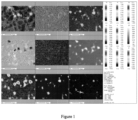
- Figure 1 is the element distribution in the microstructure of the neodymium-iron-boron magnetic material in Example 7.
- the raw materials for preparing a neodymium-iron-boron magnetic material in this example were a primary alloy of Nd 28.46 Fe 66.73 B 0.99 Tb 1.2 Co 1.49 Cu 0.15 Ga 0.25 Zr 0.27 Al 0.46 , and an auxiliary alloy of Nd 20 Fe 60.36 B 0.99 Tb 16 Co 1.49 Cu 0.15 Ga 0.25 Zr 0.3 Al 0.46 , wherein the numerical value of the subscript was the mass percentage of each element in the primary alloy or auxiliary alloy; and the mass ratio of the primary alloy to the auxiliary alloy was 88 : 12.
- the preparation process for the primary alloy involved: (1) preparing the elements for the primary alloy as shown in Table 1 into a primary alloy solution; (2) passing the primary alloy solution through rotating rollers and cooling same to a temperature ranging from 700 °C to 900 °C to form a primary alloy casting strip with a uniform thickness; and (3) collecting the primary alloy casting strip by means of a collector and cooling same to 50 °C or less.
- the preparation process for the auxiliary alloy involved: (1) preparing the elements for the auxiliary alloy as shown in Table 1 into an auxiliary alloy solution; (2) passing the auxiliary alloy solution through rotating rollers and cooling same to a temperature ranging from 700 °C to 900 °C to form an auxiliary alloy casting strip with a uniform thickness; and (3) collecting the auxiliary alloy casting strip by means of a collector and cooling same to 50 °C or less.
- the preparation process for the neodymium-iron-boron magnetic material in this example involved: using a dual alloy method, wherein the primary alloy and auxiliary alloy shown in Table 1 were firstly mixed in proportion and then successively subjected to hydrogen decrepitation, a jet milling treatment, and mixing to obtain a mixed alloy powder, wherein the hydrogen decrepitation involved saturated hydrogen absorption at a hydrogen pressure of 0.067 MPa and dehydrogenation at 510 °C; and the mixing involved treatment in a three-dimensional mixer for 3 hours, and the particle size of the mixed alloy powder resulting from the jet milling treatment was 3.7 ⁇ m.
- Examples 2-12 and Comparative Examples 1-6 involved respectively preparing the primary alloys and auxiliary alloys from the raw materials shown in Table 1, wherein the preparation processes for the primary alloys and auxiliary alloys were the same as in Example 1.
- Example 2-12 and Comparative Examples 1-6 were prepared into neodymium-iron-boron magnetic materials by means of the preparation processes shown in Table 2, and the parameters not involved in Table 2 were the same as those in Example 1.
- Magnetic performance evaluation The neodymium-iron-boron magnetic material was tested for magnetic performance by NIM-10000H BH bulk rare earth permanent magnet nondestructive measurement system from The National Institute of Metrology of China. Table 4 showed the test results of magnetic performance. Table 4 No.
- FE-EPMA detection A vertical alignment plane of the neodymium-iron-boron magnetic material was polished, and tested by means of a field emission-electron probe micro-analyser (FE-EPMA) (JEOL, 8530F). Firstly, the distributions of the elements such as Tb and Co in the magnet were determined by FE-EPMA surface scanning, and then the contents of the elements such as Tb and Co in the key phases were determined by FE-EPMA single-point quantitative analysis. The test conditions were an accelerating voltage of 15 kV and a probe beam current of 50 nA.
- the microstructure of the neodymium-iron-boron magnetic material of Example 7 has the following characteristics: (1) according to the distribution law of the Tb-rich phase (as marked by a in the figure), it is speculated that the outer layer of the main phase has a Tb-rich shell layer; (2) Zr or the other high melting point elements are enriched at the grain boundary, as shown by the mark b in the figure; and (3) Co is enriched in the grain boundary triangular region, so does Tb; however, the enrichment regions of the two do not overlap, wherein the Co-enriched region is marked as c-Co, and the Tb-enriched region is marked as c-Tb.
Landscapes
- Chemical & Material Sciences (AREA)
- Engineering & Computer Science (AREA)
- Metallurgy (AREA)
- Materials Engineering (AREA)
- Mechanical Engineering (AREA)
- Organic Chemistry (AREA)
- Power Engineering (AREA)
- Crystallography & Structural Chemistry (AREA)
- Inorganic Chemistry (AREA)
- Manufacturing & Machinery (AREA)
- Hard Magnetic Materials (AREA)
- Soft Magnetic Materials (AREA)
- Manufacture Of Metal Powder And Suspensions Thereof (AREA)
- Powder Metallurgy (AREA)
- Manufacturing Cores, Coils, And Magnets (AREA)
Claims (10)
- Matériau magnétique au néodyme-fer-bore, comprenant, en pourcentage massique, les composants suivants : 29,5-31,5 % en poids de R, avec HR > 1,5 % en poids,0,05-0,25 % en poids de Cu,0,42-2,6 % en poids de Co,0,20-0,3 % en poids de Ga,0,25-0,3 % en poids de N, comprenant un ou plusieurs éléments parmi Zr et Ti,0,46-0,6 % en poids de Al ou Al ≤ 0,04 % en poids, mais pas égal à 0 % en poids,0,98-1 % en poids de B,64-68 % en poids de Fe,où R est un élément de terre rare et comprend au moins du Nd et du RH, et RH est un élément de terre rare lourd et comprend du Tb ;le rapport de masse de Tb sur Co est inférieur ou égal à 15, mais pas égal à 0.
- Matériau magnétique au néodyme-fer-bore selon la revendication 1, dans lequel la teneur en R est de 30,15 à 31 % en poids, de préférence de 30,1 à 30,6 % en poids, plus préférablement de 30,42 % en poids ou de 30,48 % en poids ; et/ou, R comprend en outre un élément de terre rare léger, de préférence du Pr ;et/ou, la teneur en Nd est de 27-28 % en poids, plus préférablement 27,13 % en poids ou 27,44 % en poids ;et/ou, le pourcentage massique de RH dans R est de 9,7 à 13 % en poids, plus préférablement de 9,7 à 11 % en poids, de préférence de 9,7 % en poids ;et/ou, la teneur en RH est de 2,8-4 % en poids, plus préférablement de 2,9-3,4 % en poids, plus préférablement de 2,98 % en poids ou 3,35 % en poids ;et/ou, la teneur en Cu est de 0,05-0,16 % en poids, de préférence 0,05 % en poids ou 0,15 % en poids ;et/ou, la teneur en Co est de 1,48-2,7 % en poids, de préférence 1,49 % en poids, 1,51 % en poids ou 2,6 % en poids, de préférence 1,48-1,51 % en poids ;et/ou, la teneur en Ga est de 0,2-0,26 % en poids, de préférence 0,2 % en poids ou 0,25 % en poids ;et/ou, la teneur en N est de 0,26-0,3 % en poids, de préférence 0,26 % en poids, 0,27 % en poids ou 0,3 % en poids ;et/ou, le type de N est un ou plusieurs parmi Zr, Ti ;et/ou, la teneur en Al est de 0,46-0,5 % en poids ou 0,02-0,04 % en poids, de préférence 0,03 % en poids, 0,45 % en poids ou 0,46 % en poids ;et/ou, la teneur en B est de 0,98-0,99 % en poids, de préférence 0,99 % en poids ;et/ou, la teneur en Fe est de 64-66 % en poids, de préférence 64, 86 % en poids, 65,7 % en poids, 65,72 % en poids ou 65,74 % en poids ;et/ou, le rapport de masse de Tb sur Co est (1-15) : 1, de préférence (1-3) : 1 ; plus préférablement 3,35 : 1,49 ou 2 : 1 ;et/ou, le matériau magnétique au néodyme-fer-bore comprend en outre du Mn ;et/ou, Tb est distribué au niveau du joint de grain et de la partie centrale des grains dans le matériau magnétique au néodyme-fer-bore ; de préférence, la teneur en Tb distribué au niveau du joint de grain est supérieure à la teneur en Tb distribué dans la partie centrale des grains ;et/ou, N est distribué au niveau du joint de grain ;et/ou, Co est distribué dans une région triangulaire de joint de grain ;et/ou, dans la région triangulaire de joint de grain du matériau magnétique au néodyme-fer-bore, la distribution de Tb ne chevauche pas la distribution de Co.
- Matériau magnétique au néodyme-fer-bore selon la revendication 2, dans lequel la teneur en Mn est inférieure ou égale à 0,035 % en poids, mais pas égale à 0 % en poids, de préférence 0,01-0,035 % en poids, plus préférablement 0,03 % en poids.
- Matériau magnétique au néodyme-fer-bore selon la revendication 1, dans lequel le matériau magnétique au néodyme-fer-bore comprend, en pourcentage massique, les composants suivants : 27-28 % en poids de Nd, 2,8-4 % en poids de Tb, 0,05-0,16 % en poids de Cu, 1,48-2,7 % en poids de Co, 0,2-0,26 % en poids de Ga, 0,25-0,3 % en poids de N, 0,46-0,5 % en poids ou 0,02-0,04 % en poids de Al, 0,98-0,99 % en poids de B et 64-66 % en poids de Fe, le pourcentage se référant au pourcentage massique relatif au matériau magnétique au néodyme-fer-bore ; N est Zr et/ou Ti ; Tb représente 9,7-13 % en poids de la masse totale de Nd et Tb, et le rapport de masse de Tb sur Co est (1-15) : 1 ;de préférence, le matériau magnétique au néodyme-fer-bore comprend, en pourcentage massique, les composants suivants : 27-28 % en poids de Nd, 2,8-4 % en poids de Tb, 0,05-0,16 % en poids de Cu, 1,48-2,7 % en poids de Co, 0,2-0,26 % en poids de Ga, 0,25-0,3 % en poids de N, 0,46-0,5 % en poids ou 0,02-0,04 % en poids de Al, 0,98-0,99 % en poids de B, 64-66 % en poids de Fe, et 0,01-0,035 % en poids de Mn, le pourcentage se référant au pourcentage massique relatif au matériau magnétique au néodyme-fer-bore ; N est Zr et/ou Ti ; Tb représente 9,7-13 % en poids de la masse totale de Nd et Tb, et le rapport de masse de Tb sur Co est (1-15) : 1 ;plus préférablement, le matériau magnétique au néodyme-fer-bore comprend, en pourcentage massique, les composants suivants : 27-28 % en poids de Nd, 2,9-3,4 % en poids de Tb, 0,05-0,16 % en poids de Cu, 1,48-2,7 % en poids de Co, 0,2-0,26 % en poids de Ga, 0,26-0,3 % en poids de N, 0,46-0,5 % en poids ou 0,02-0,04 % en poids de Al, 0,98-0,99 % en poids de B et 64-66 % en poids de Fe, le pourcentage se référant au pourcentage massique relatif au matériau magnétique au néodyme-fer-bore ; N est Zr et/ou Ti ; Tb représente 9,7-11 % en poids de la masse totale de Nd et Tb, le rapport de masse de Tb sur Co est (1-3) : 1 ; de préférence, le matériau magnétique au néodyme-fer-bore comprend, en pourcentage massique, les composants suivants : 27-28 % en poids de Nd, 2,9-3,4 % en poids de Tb, 0,05-0,16 % en poids de Cu, 1,48-2,7 % en poids de Co, 0,2-0,26 % en poids de Ga, 0,26-0,3 % en poids de N, 0,46-0,5 % en poids ou 0,02-0,04 % en poids de Al, 0,98-0,99 % en poids de B, 64-66 % en poids de Fe, et 0,01-0,035 % en poids de Mn, le pourcentage se référant au pourcentage massique relatif au matériau magnétique au néodyme-fer-bore ; N est Zr et/ou Ti ; Tb représente 9,7-11 % en poids de la masse totale de Nd et Tb, et le rapport de masse de Tb sur Co est (1-3) : 1.
- Alliage primaire pour la préparation d'un matériau magnétique au néodyme-fer-bore, dans lequel la composition de l'alliage primaire est Nda-Feb-Bc-Tbd-Coe-Cuf-Gag-Alx-Mny-Nh, où a, b, c, d, e, f, g, h, x et y se réfèrent à la fraction massique de chaque élément dans l'alliage primaire, a est de 26-30 % en poids, b est de 64-68 % en poids, c est de 0,96-1,1 % en poids, d est de 0,5-5 % en poids, e est de 0,5-2,6 % en poids, f est de 0,05-0,3 % en poids, g est de 0,05-0,3 % en poids, x est inférieur ou égal à 0,04 % en poids, mais pas égal à 0 % en poids, ou de 0,46-0,6 % en poids, y est de 0-0,04 % en poids, et h est de 0,2-0,5 % en poids, avec le pourcentage se référant au pourcentage massique relatif à l'alliage primaire ;
de préférence, a est de 28-29 % en poids, plus préférablement de 28,46 % en poids ; et/ou b est de 65,5-67,5 % en poids, de préférence 65,62 % en poids, 66,63 % en poids, 66,7 % en poids, 66,73 % en poids, 66,78 % en poids, 66,83 % en poids ou 67,16 % en poids ; et/ou c est de 0,98-1 % en poids, de préférence 0,99 % en poids ; et/ou d est de 1-1,5 % en poids, de préférence 1,1-1,3 % en poids, plus préférablement 1,2 % en poids ou 1,3 % en poids ; et/ou e est de 1,4-2,6 % en poids, de préférence 1,49 % en poids ou 2,6 % en poids ; et/ou f est 0,05-0,16 % en poids, de préférence 0,05 % en poids ou 0,15 % en poids ; et/ou g est de 0,1-0,25 % en poids, de préférence 0,2 % en poids ou 0,25 % en poids ; et/ou h est de 0,25-0,3 % en poids, de préférence 0,27 % en poids ; et/ou x est de 0,02-0,04 % en poids ou 0,45-0,47 % en poids, de préférence 0,03 % en poids ou 0,46 % en poids ; et/ou y est de 0,02-0,04 % en poids, de préférence 0,03 % en poids, avec le pourcentage se référant au pourcentage massique relatif à l'alliage primaire. - Alliage primaire selon la revendication 5, dans lequel la composition de l'alliage primaire est Nda-Feb-Bc-Tbd-Coe-Cuf-Gag-Alx-Mny-Nh, où a, b, c, d, e, f, g, h, x et y se réfèrent à la fraction massique de chaque élément dans l'alliage primaire, a est de 28-29 % en poids, b est de 65,5-67,5 % en poids, c est de 0,98-1 % en poids, d est de 1-1,5 % en poids, e est de 1,4-2,6 % en poids, f est de 0,05-0,16 % en poids, g est de 0,1-0,25 % en poids, x est de 0,02-0,04 % en poids ou 0,45-0,47 % en poids, y est de 0,02-0,04 % en poids, h est de 0,25-0,3 % en poids, avec le pourcentage se référant au pourcentage massique relatif à l'alliage primaire.
- Alliage auxiliaire pour la préparation d'un matériau magnétique au néodyme-fer-bore, dans lequel la composition de l'alliage auxiliaire est Ndi-Fej-Bk-Tbl-Com-Cun-Gao-Alr-Mnt-Np, où i, j, k, l, m, n, o, p, r et t se réfèrent à la fraction massique de chaque élément dans l'alliage auxiliaire, i est de 5-30 % en poids, j est de 59-65 % en poids, k est de 0,98-1 % en poids, l est de 5-25 % en poids, m est de 0,5-2,7 % en poids, n est de 0,05-0,3 % en poids, o est de 0,05-0,3 % en poids, r est inférieur ou égal à 0,04 % en poids, mais pas égal à 0 % en poids, ou de 0,46-0,6 % en poids, t est de 0-0,04 % en poids, et p est de 0-0,5 % en poids, avec le pourcentage se référant au pourcentage massique relatif à l'alliage auxiliaire ;de préférence, i est de 15-25 % en poids, de préférence 19-21 % en poids ; et/ou j est de 59-61 % en poids, de préférence 59,25 % en poids, 60,33 % en poids, 60,36 % en poids, 60,39 % en poids, 60,41 % en poids, 60,46 % en poids ou 60,79 % en poids ; et/ou k est de 0,98-0,99 % en poids ; et/ou l est de 15-20 % en poids, de préférence 16 % en poids ; et/ou m est de 1,45-2,6 % en poids, de préférence 1,49 % en poids ou 2,6 % en poids ; et/ou n est de 0,05-0,16 % en poids, de préférence 0,05 % en poids ou 0,15 % en poids ; et/ou o est de 0,2-0,26 % en poids, de préférence 0,2 % en poids ou 0,25 % en poids ; et/ou r est de 0,01-0,04 % en poids ou 0,46-0,47 % en poids, de préférence 0,03 % en poids ou 0,46 % en poids ; et/ou t est de 0,01-0,04 % en poids, de préférence 0,03 % en poids ; et/ou p est de 0,26-0,3 % en poids, de préférence 0,27 % en poids ou 0,3 % en poids ;plus préférablement, la composition de l'alliage auxiliaire est Ndi-Fej-Bk-Tbl-Com-Cun-Gao-Alr-Mnt-Np, où i, j, k, l, m, n, o, p, r et t se réfèrent à la fraction massique de chaque élément dans l'alliage auxiliaire, i est de 19-21 % en poids, j est de 59-61 % en poids, k est de 0,98-0,99 % en poids, l est de 15-20 % en poids, m est de 1,45-2,6 % en poids, n est de 0,05-0,16 % en poids, o est de 0,2-0,26 % en poids, r est de 0,01-0,04 % en poids ou 0,46-0,47 % en poids, t est de 0-0,04 % en poids et p est de 0,26-0,3 % en poids.
- Procédé de préparation d'un matériau magnétique au néodyme-fer-bore, dans lequel le matériau magnétique au néodyme-fer-bore est préparé à partir d'un alliage primaire selon la revendication 5 ou 6 et de l'alliage auxiliaire selon la revendication 7 au moyen d'un procédé à double alliage, dans lequel le rapport de masse de l'alliage primaire sur l'alliage auxiliaire est de (6-30) : 1, de préférence (6-15) : 1, plus préférablement (6-8) : 1 ;de préférence, le processus de préparation du procédé à double alliage consiste à mélanger uniformément l'alliage primaire et l'alliage auxiliaire pour obtenir une poudre d'alliage mixte, et à soumettre la poudre d'alliage mixte successivement au frittage et au vieillissement ; de préférence, le mélange uniforme consiste à mélanger l'alliage primaire et l'alliage auxiliaire avant les traitements de décrépitation à l'hydrogène et de broyage par jet, ou à soumettre séparément l'alliage primaire et l'alliage auxiliaire à des traitements de décrépitation à l'hydrogène et de broyage par jet avant de mélanger uniformément ;plus préférablement, la décrépitation à l'hydrogène implique une absorption d'hydrogène saturé à une pression d'hydrogène de 0,067-0,098 MPa et une déshydrogénation à 480-530 °C ; plus préférablement, la taille des particules de la poudre broyée par jet est comprise entre 3,7 µm et 4,2 µm ; plus préférablement, la température de frittage est de préférence de 1050-1085 °C, plus préférablement de 1070-1085 °C, et la durée de frittage est de 4-7 heures ; plus préférablement, la température du traitement de vieillissement est de 460-520 °C, et la durée du traitement de vieillissement est de 4-10 heures.
- Matériau magnétique au néodyme-fer-bore obtenu par le procédé de préparation selon la revendication 8.
- Application du matériau magnétique au néodyme-fer-bore selon l'une quelconque des revendications 1 à 4 et 9 en tant que composant électronique dans un moteur, dans laquelle le moteur est de préférence un moteur d'entraînement pour véhicules à énergie nouvelle, un compresseur de climatiseur ou un servomoteur industriel.
Applications Claiming Priority (2)
| Application Number | Priority Date | Filing Date | Title |
|---|---|---|---|
| CN201910943538.9A CN110556223B (zh) | 2019-09-30 | 2019-09-30 | 一种钕铁硼磁体材料及其制备方法和应用 |
| PCT/CN2020/100571 WO2021063061A1 (fr) | 2019-09-30 | 2020-07-07 | Matériau magnétique au néodyme-fer-bore, son procédé de préparation et son application |
Publications (4)
| Publication Number | Publication Date |
|---|---|
| EP4016556A1 EP4016556A1 (fr) | 2022-06-22 |
| EP4016556A4 EP4016556A4 (fr) | 2022-10-12 |
| EP4016556C0 EP4016556C0 (fr) | 2024-08-28 |
| EP4016556B1 true EP4016556B1 (fr) | 2024-08-28 |
Family
ID=68742132
Family Applications (1)
| Application Number | Title | Priority Date | Filing Date |
|---|---|---|---|
| EP20871375.0A Active EP4016556B1 (fr) | 2019-09-30 | 2020-07-07 | Matériau magnétique au néodyme-fer-bore, son procédé de préparation et son application |
Country Status (6)
| Country | Link |
|---|---|
| US (1) | US12614652B2 (fr) |
| EP (1) | EP4016556B1 (fr) |
| JP (1) | JP7330365B2 (fr) |
| KR (1) | KR102589815B1 (fr) |
| CN (1) | CN110556223B (fr) |
| WO (1) | WO2021063061A1 (fr) |
Families Citing this family (12)
| Publication number | Priority date | Publication date | Assignee | Title |
|---|---|---|---|---|
| CN110556223B (zh) * | 2019-09-30 | 2021-07-02 | 厦门钨业股份有限公司 | 一种钕铁硼磁体材料及其制备方法和应用 |
| CN110942878B (zh) * | 2019-12-24 | 2021-03-26 | 厦门钨业股份有限公司 | 一种r-t-b系永磁材料及其制备方法和应用 |
| CN110993234B (zh) * | 2019-12-24 | 2021-06-25 | 厦门钨业股份有限公司 | 高Cu高Al的钕铁硼磁体及其制备方法 |
| CN111081443B (zh) * | 2020-01-07 | 2023-05-09 | 福建省长汀金龙稀土有限公司 | 一种r-t-b系永磁材料及其制备方法和应用 |
| CN111223628B (zh) * | 2020-02-26 | 2022-02-01 | 厦门钨业股份有限公司 | 钕铁硼磁体材料、原料组合物、制备方法、应用 |
| CN115083708B (zh) * | 2021-03-10 | 2025-12-23 | 福建省金龙稀土股份有限公司 | 一种钕铁硼磁体及其制备方法 |
| CN115083709B (zh) * | 2021-03-10 | 2025-07-04 | 金龙稀土新材料(包头)有限公司 | 复合主相系钕铁硼磁体材料及其制备方法 |
| CN115083707B (zh) * | 2021-03-10 | 2024-08-30 | 福建省金龙稀土股份有限公司 | 主辅合金系钕铁硼磁体材料及其制备方法 |
| EP4105951A4 (fr) * | 2021-04-30 | 2024-02-28 | JL Mag Rare-Earth Co., Ltd. | Aimant néodyme-fer-bore fritté et son procédé de préparation |
| CN114373593B (zh) * | 2022-03-18 | 2022-07-05 | 宁波科宁达工业有限公司 | 一种r-t-b磁体及其制备方法 |
| CN115083714B (zh) * | 2022-07-06 | 2025-03-25 | 烟台正海磁性材料股份有限公司 | 一种高矫顽力Nd-Fe-B系烧结磁体及其制备方法和应用 |
| CN120261096B (zh) * | 2025-06-05 | 2025-08-26 | 北京中科三环高技术股份有限公司 | 钕铁硼磁体及其制备方法 |
Family Cites Families (25)
| Publication number | Priority date | Publication date | Assignee | Title |
|---|---|---|---|---|
| JP2741508B2 (ja) * | 1988-02-29 | 1998-04-22 | 住友特殊金属株式会社 | 磁気異方性焼結磁石とその製造方法 |
| JP4766452B2 (ja) * | 2005-03-16 | 2011-09-07 | Tdk株式会社 | 希土類永久磁石 |
| JP5120710B2 (ja) * | 2008-06-13 | 2013-01-16 | 日立金属株式会社 | RL−RH−T−Mn−B系焼結磁石 |
| EP2660829A4 (fr) * | 2010-12-27 | 2017-11-29 | TDK Corporation | Corps magnétique |
| JP6201446B2 (ja) | 2012-06-22 | 2017-09-27 | Tdk株式会社 | 焼結磁石 |
| CN103887028B (zh) * | 2012-12-24 | 2017-07-28 | 北京中科三环高技术股份有限公司 | 一种烧结钕铁硼磁体及其制造方法 |
| CN103903824B (zh) * | 2012-12-27 | 2017-08-04 | 比亚迪股份有限公司 | 一种稀土永磁材料及其制备方法 |
| CN103714939B (zh) * | 2013-12-13 | 2016-05-25 | 钢铁研究总院 | La-Fe基双硬磁主相磁体及其制备方法 |
| US20170018342A1 (en) * | 2014-02-28 | 2017-01-19 | Hitachi Metals, Ltd. | R-t-b based sintered magnet and method for producing same |
| CN103996524B (zh) * | 2014-05-11 | 2017-02-22 | 沈阳中北通磁科技股份有限公司 | 一种含La和Ce的钕铁硼稀土永磁体的制造方法 |
| CN105206366B (zh) * | 2014-06-12 | 2017-12-05 | 有研稀土新材料股份有限公司 | 稀土永磁粉、其制备方法、包含其的粘结磁体及器件 |
| CN104240886B (zh) * | 2014-09-12 | 2017-01-11 | 沈阳中北通磁科技股份有限公司 | 一种含Tb的多主相钕铁硼永磁铁及制造方法 |
| CN104252939B (zh) * | 2014-09-12 | 2016-10-05 | 沈阳中北通磁科技股份有限公司 | 一种具有复合主相的钕铁硼永磁铁及其制造方法 |
| CN104269238B (zh) * | 2014-09-30 | 2017-02-22 | 宁波科田磁业有限公司 | 一种高性能烧结钕铁硼磁体和制备方法 |
| JP6582940B2 (ja) * | 2015-03-25 | 2019-10-02 | Tdk株式会社 | R−t−b系希土類焼結磁石及びその製造方法 |
| JP6493138B2 (ja) * | 2015-10-07 | 2019-04-03 | Tdk株式会社 | R−t−b系焼結磁石 |
| JP6536816B2 (ja) * | 2015-10-14 | 2019-07-03 | Tdk株式会社 | R−t−b系焼結磁石およびモータ |
| EP3179487B1 (fr) * | 2015-11-18 | 2021-04-28 | Shin-Etsu Chemical Co., Ltd. | Aimant fritté r (fe-co)-b aux terres rares et procédé de fabrication |
| CN105655076B (zh) | 2016-04-06 | 2017-10-24 | 湖北汽车工业学院 | 驱动电机用多主相高矫顽力钕铁硼永磁材料及其制备方法 |
| CN107275024B (zh) * | 2016-04-08 | 2018-11-23 | 沈阳中北通磁科技股份有限公司 | 一种含有氮化物相的高性能钕铁硼永磁铁及制造方法 |
| CN106782974A (zh) | 2016-12-26 | 2017-05-31 | 浙江中科磁业有限公司 | 一种钕铁硼磁体的制备方法 |
| CN107393711A (zh) * | 2017-07-12 | 2017-11-24 | 浙江中科磁业有限公司 | 一种高矫顽力磁体的制备方法 |
| CN108831650B (zh) * | 2018-06-21 | 2020-10-23 | 宁波可可磁业股份有限公司 | 一种钕铁硼磁体及其制备方法 |
| JP7139920B2 (ja) * | 2018-12-03 | 2022-09-21 | Tdk株式会社 | R‐t‐b系永久磁石 |
| CN110556223B (zh) * | 2019-09-30 | 2021-07-02 | 厦门钨业股份有限公司 | 一种钕铁硼磁体材料及其制备方法和应用 |
-
2019
- 2019-09-30 CN CN201910943538.9A patent/CN110556223B/zh active Active
-
2020
- 2020-07-07 EP EP20871375.0A patent/EP4016556B1/fr active Active
- 2020-07-07 WO PCT/CN2020/100571 patent/WO2021063061A1/fr not_active Ceased
- 2020-07-07 KR KR1020227006942A patent/KR102589815B1/ko active Active
- 2020-07-07 JP JP2022513458A patent/JP7330365B2/ja active Active
- 2020-07-07 US US17/636,931 patent/US12614652B2/en active Active
Also Published As
| Publication number | Publication date |
|---|---|
| KR102589815B1 (ko) | 2023-10-16 |
| EP4016556C0 (fr) | 2024-08-28 |
| US12614652B2 (en) | 2026-04-28 |
| CN110556223B (zh) | 2021-07-02 |
| WO2021063061A1 (fr) | 2021-04-08 |
| KR20220041900A (ko) | 2022-04-01 |
| JP7330365B2 (ja) | 2023-08-21 |
| EP4016556A4 (fr) | 2022-10-12 |
| CN110556223A (zh) | 2019-12-10 |
| JP2022543490A (ja) | 2022-10-12 |
| EP4016556A1 (fr) | 2022-06-22 |
| US20220359107A1 (en) | 2022-11-10 |
Similar Documents
| Publication | Publication Date | Title |
|---|---|---|
| EP4016556B1 (fr) | Matériau magnétique au néodyme-fer-bore, son procédé de préparation et son application | |
| EP0239031B1 (fr) | Procede de preparation d'une poudre magnetique pour un aimant lie a alimentation anisotropique | |
| DE102016101890B4 (de) | R-T-B-basierter gesinterter Magnet | |
| KR100449447B1 (ko) | 희토류/철/붕소계 영구자석 합금 조성물 | |
| EP4044202B1 (fr) | Procédé de préparation d'un aimant ndfeb fritté à coercivité élevée | |
| KR102632991B1 (ko) | 네오디뮴철붕소 자성체 재료, 원료조성물과 제조방법 및 응용 | |
| DE68917213T2 (de) | Gesinterter Nd-Fe-B-Magnet und sein Herstellungsverfahren. | |
| EP2779179B1 (fr) | Particules d'aimant aux terres rares à base R-T-B, procédé de production de particules d'aimant aux terres rares à base R-T-B et aimant lié | |
| EP4439594A1 (fr) | Aimant néodyme-fer-bore ainsi que son procédé de préparation et son utilisation | |
| EP0657899B1 (fr) | Poudres à base de fer à aimantation permanente pour aimants à liant, et aimants de cela | |
| CN102360655A (zh) | 含钇的钕铁硼永磁材料 | |
| CN113782292A (zh) | 一种具有改进温度稳定性的钇铈基稀土永磁材料 | |
| CN113782330A (zh) | 镧铈添加钕铁硼磁体的制备方法 | |
| EP4316695A1 (fr) | Poudre magnétique anisotrope à base de terres rares et procédé pour sa production | |
| JP2017183318A (ja) | R−t−b系焼結磁石 | |
| KR100204256B1 (ko) | 자기적 이방성 및 내식성이 우수한 희토류-에프이-비 계영구자석분말 및 접합자석 | |
| TWI807658B (zh) | 一種r-t-b系永磁材料及其製備方法和應用 | |
| CN111430090A (zh) | 一种钕铁硼磁体材料及其制备方法和应用 | |
| EP4307325A1 (fr) | Matériau magnétique de néodyme-fer-bore à base d'alliages principal et auxiliaire et son procédé de préparation | |
| WO2018101409A1 (fr) | Aimant fritté à base de terres rares | |
| EP2645381B1 (fr) | Procédé de production de particules d'aimant de terres rares R-T-B | |
| CN116230348B (zh) | 一种高耐蚀低温度系数烧结Nd-Fe-B系永磁材料及制备方法 | |
| CN115312282B (zh) | 一种细晶粒高矫顽力钕铁硼永磁材料及其制备方法 | |
| KR102718290B1 (ko) | 네오디뮴철붕소 자성체 및 그 제조방법 | |
| JP7748212B2 (ja) | R-t-b系永久磁石およびモータ |
Legal Events
| Date | Code | Title | Description |
|---|---|---|---|
| STAA | Information on the status of an ep patent application or granted ep patent |
Free format text: STATUS: THE INTERNATIONAL PUBLICATION HAS BEEN MADE |
|
| PUAI | Public reference made under article 153(3) epc to a published international application that has entered the european phase |
Free format text: ORIGINAL CODE: 0009012 |
|
| STAA | Information on the status of an ep patent application or granted ep patent |
Free format text: STATUS: REQUEST FOR EXAMINATION WAS MADE |
|
| 17P | Request for examination filed |
Effective date: 20220315 |
|
| AK | Designated contracting states |
Kind code of ref document: A1 Designated state(s): AL AT BE BG CH CY CZ DE DK EE ES FI FR GB GR HR HU IE IS IT LI LT LU LV MC MK MT NL NO PL PT RO RS SE SI SK SM TR |
|
| RAP1 | Party data changed (applicant data changed or rights of an application transferred) |
Owner name: FUJIAN CHANGTING GOLDEN DRAGON RARE-EARTH CO., LTD. |
|
| A4 | Supplementary search report drawn up and despatched |
Effective date: 20220914 |
|
| RIC1 | Information provided on ipc code assigned before grant |
Ipc: C22C 38/16 20060101ALI20220908BHEP Ipc: C22C 38/14 20060101ALI20220908BHEP Ipc: C22C 38/10 20060101ALI20220908BHEP Ipc: C22C 38/06 20060101ALI20220908BHEP Ipc: C22C 38/00 20060101ALI20220908BHEP Ipc: H01F 41/02 20060101ALI20220908BHEP Ipc: H01F 1/057 20060101AFI20220908BHEP |
|
| DAV | Request for validation of the european patent (deleted) | ||
| DAX | Request for extension of the european patent (deleted) | ||
| GRAP | Despatch of communication of intention to grant a patent |
Free format text: ORIGINAL CODE: EPIDOSNIGR1 |
|
| STAA | Information on the status of an ep patent application or granted ep patent |
Free format text: STATUS: GRANT OF PATENT IS INTENDED |
|
| RAP3 | Party data changed (applicant data changed or rights of an application transferred) |
Owner name: FUJIAN GOLDEN DRAGON RARE-EARTH CO., LTD. |
|
| RIC1 | Information provided on ipc code assigned before grant |
Ipc: B22F 9/04 20060101ALN20240208BHEP Ipc: C22C 33/02 20060101ALI20240208BHEP Ipc: B22F 9/02 20060101ALI20240208BHEP Ipc: C22C 38/16 20060101ALI20240208BHEP Ipc: C22C 38/14 20060101ALI20240208BHEP Ipc: C22C 38/10 20060101ALI20240208BHEP Ipc: C22C 38/06 20060101ALI20240208BHEP Ipc: C22C 38/00 20060101ALI20240208BHEP Ipc: H01F 41/02 20060101ALI20240208BHEP Ipc: H01F 1/057 20060101AFI20240208BHEP |
|
| INTG | Intention to grant announced |
Effective date: 20240304 |
|
| GRAS | Grant fee paid |
Free format text: ORIGINAL CODE: EPIDOSNIGR3 |
|
| GRAA | (expected) grant |
Free format text: ORIGINAL CODE: 0009210 |
|
| STAA | Information on the status of an ep patent application or granted ep patent |
Free format text: STATUS: THE PATENT HAS BEEN GRANTED |
|
| AK | Designated contracting states |
Kind code of ref document: B1 Designated state(s): AL AT BE BG CH CY CZ DE DK EE ES FI FR GB GR HR HU IE IS IT LI LT LU LV MC MK MT NL NO PL PT RO RS SE SI SK SM TR |
|
| REG | Reference to a national code |
Ref country code: CH Ref legal event code: EP |
|
| REG | Reference to a national code |
Ref country code: DE Ref legal event code: R096 Ref document number: 602020036855 Country of ref document: DE |
|
| REG | Reference to a national code |
Ref country code: IE Ref legal event code: FG4D |
|
| U01 | Request for unitary effect filed |
Effective date: 20240913 |
|
| U07 | Unitary effect registered |
Designated state(s): AT BE BG DE DK EE FI FR IT LT LU LV MT NL PT RO SE SI Effective date: 20241004 |
|
| PG25 | Lapsed in a contracting state [announced via postgrant information from national office to epo] |
Ref country code: NO Free format text: LAPSE BECAUSE OF FAILURE TO SUBMIT A TRANSLATION OF THE DESCRIPTION OR TO PAY THE FEE WITHIN THE PRESCRIBED TIME-LIMIT Effective date: 20241128 |
|
| PG25 | Lapsed in a contracting state [announced via postgrant information from national office to epo] |
Ref country code: PL Free format text: LAPSE BECAUSE OF FAILURE TO SUBMIT A TRANSLATION OF THE DESCRIPTION OR TO PAY THE FEE WITHIN THE PRESCRIBED TIME-LIMIT Effective date: 20240828 Ref country code: GR Free format text: LAPSE BECAUSE OF FAILURE TO SUBMIT A TRANSLATION OF THE DESCRIPTION OR TO PAY THE FEE WITHIN THE PRESCRIBED TIME-LIMIT Effective date: 20241129 |
|
| PG25 | Lapsed in a contracting state [announced via postgrant information from national office to epo] |
Ref country code: IS Free format text: LAPSE BECAUSE OF FAILURE TO SUBMIT A TRANSLATION OF THE DESCRIPTION OR TO PAY THE FEE WITHIN THE PRESCRIBED TIME-LIMIT Effective date: 20241228 |
|
| PG25 | Lapsed in a contracting state [announced via postgrant information from national office to epo] |
Ref country code: HR Free format text: LAPSE BECAUSE OF FAILURE TO SUBMIT A TRANSLATION OF THE DESCRIPTION OR TO PAY THE FEE WITHIN THE PRESCRIBED TIME-LIMIT Effective date: 20240828 |
|
| PG25 | Lapsed in a contracting state [announced via postgrant information from national office to epo] |
Ref country code: ES Free format text: LAPSE BECAUSE OF FAILURE TO SUBMIT A TRANSLATION OF THE DESCRIPTION OR TO PAY THE FEE WITHIN THE PRESCRIBED TIME-LIMIT Effective date: 20240828 Ref country code: RS Free format text: LAPSE BECAUSE OF FAILURE TO SUBMIT A TRANSLATION OF THE DESCRIPTION OR TO PAY THE FEE WITHIN THE PRESCRIBED TIME-LIMIT Effective date: 20241128 |
|
| PG25 | Lapsed in a contracting state [announced via postgrant information from national office to epo] |
Ref country code: RS Free format text: LAPSE BECAUSE OF FAILURE TO SUBMIT A TRANSLATION OF THE DESCRIPTION OR TO PAY THE FEE WITHIN THE PRESCRIBED TIME-LIMIT Effective date: 20241128 Ref country code: PL Free format text: LAPSE BECAUSE OF FAILURE TO SUBMIT A TRANSLATION OF THE DESCRIPTION OR TO PAY THE FEE WITHIN THE PRESCRIBED TIME-LIMIT Effective date: 20240828 Ref country code: NO Free format text: LAPSE BECAUSE OF FAILURE TO SUBMIT A TRANSLATION OF THE DESCRIPTION OR TO PAY THE FEE WITHIN THE PRESCRIBED TIME-LIMIT Effective date: 20241128 Ref country code: IS Free format text: LAPSE BECAUSE OF FAILURE TO SUBMIT A TRANSLATION OF THE DESCRIPTION OR TO PAY THE FEE WITHIN THE PRESCRIBED TIME-LIMIT Effective date: 20241228 Ref country code: HR Free format text: LAPSE BECAUSE OF FAILURE TO SUBMIT A TRANSLATION OF THE DESCRIPTION OR TO PAY THE FEE WITHIN THE PRESCRIBED TIME-LIMIT Effective date: 20240828 Ref country code: GR Free format text: LAPSE BECAUSE OF FAILURE TO SUBMIT A TRANSLATION OF THE DESCRIPTION OR TO PAY THE FEE WITHIN THE PRESCRIBED TIME-LIMIT Effective date: 20241129 Ref country code: ES Free format text: LAPSE BECAUSE OF FAILURE TO SUBMIT A TRANSLATION OF THE DESCRIPTION OR TO PAY THE FEE WITHIN THE PRESCRIBED TIME-LIMIT Effective date: 20240828 |
|
| PG25 | Lapsed in a contracting state [announced via postgrant information from national office to epo] |
Ref country code: SM Free format text: LAPSE BECAUSE OF FAILURE TO SUBMIT A TRANSLATION OF THE DESCRIPTION OR TO PAY THE FEE WITHIN THE PRESCRIBED TIME-LIMIT Effective date: 20240828 |
|
| PG25 | Lapsed in a contracting state [announced via postgrant information from national office to epo] |
Ref country code: CZ Free format text: LAPSE BECAUSE OF FAILURE TO SUBMIT A TRANSLATION OF THE DESCRIPTION OR TO PAY THE FEE WITHIN THE PRESCRIBED TIME-LIMIT Effective date: 20240828 |
|
| PG25 | Lapsed in a contracting state [announced via postgrant information from national office to epo] |
Ref country code: SK Free format text: LAPSE BECAUSE OF FAILURE TO SUBMIT A TRANSLATION OF THE DESCRIPTION OR TO PAY THE FEE WITHIN THE PRESCRIBED TIME-LIMIT Effective date: 20240828 |
|
| PLBE | No opposition filed within time limit |
Free format text: ORIGINAL CODE: 0009261 |
|
| STAA | Information on the status of an ep patent application or granted ep patent |
Free format text: STATUS: NO OPPOSITION FILED WITHIN TIME LIMIT |
|
| 26N | No opposition filed |
Effective date: 20250530 |
|
| U20 | Renewal fee for the european patent with unitary effect paid |
Year of fee payment: 6 Effective date: 20250728 |
|
| REG | Reference to a national code |
Ref country code: CH Ref legal event code: H13 Free format text: ST27 STATUS EVENT CODE: U-0-0-H10-H13 (AS PROVIDED BY THE NATIONAL OFFICE) Effective date: 20260224 |
|
| GBPC | Gb: european patent ceased through non-payment of renewal fee |
Effective date: 20250707 |
|
| PG25 | Lapsed in a contracting state [announced via postgrant information from national office to epo] |
Ref country code: GB Free format text: LAPSE BECAUSE OF NON-PAYMENT OF DUE FEES Effective date: 20250707 |
|
| PG25 | Lapsed in a contracting state [announced via postgrant information from national office to epo] |
Ref country code: CH Free format text: LAPSE BECAUSE OF NON-PAYMENT OF DUE FEES Effective date: 20250731 |