EP4016628A2 - Appareil d'affichage - Google Patents
Appareil d'affichage Download PDFInfo
- Publication number
- EP4016628A2 EP4016628A2 EP21201100.1A EP21201100A EP4016628A2 EP 4016628 A2 EP4016628 A2 EP 4016628A2 EP 21201100 A EP21201100 A EP 21201100A EP 4016628 A2 EP4016628 A2 EP 4016628A2
- Authority
- EP
- European Patent Office
- Prior art keywords
- transistor
- layer
- electrode
- gate electrode
- semiconductor layer
- Prior art date
- Legal status (The legal status is an assumption and is not a legal conclusion. Google has not performed a legal analysis and makes no representation as to the accuracy of the status listed.)
- Pending
Links
- 239000010410 layer Substances 0.000 claims abstract description 328
- 239000004065 semiconductor Substances 0.000 claims abstract description 173
- 239000011229 interlayer Substances 0.000 claims abstract description 50
- 239000010409 thin film Substances 0.000 claims abstract description 29
- 239000000463 material Substances 0.000 claims abstract description 24
- 239000000758 substrate Substances 0.000 claims abstract description 24
- XUIMIQQOPSSXEZ-UHFFFAOYSA-N Silicon Chemical compound [Si] XUIMIQQOPSSXEZ-UHFFFAOYSA-N 0.000 claims abstract description 18
- 229910052710 silicon Inorganic materials 0.000 claims abstract description 18
- 239000010703 silicon Substances 0.000 claims abstract description 18
- 239000003990 capacitor Substances 0.000 claims description 42
- 239000010936 titanium Substances 0.000 description 20
- VYPSYNLAJGMNEJ-UHFFFAOYSA-N Silicium dioxide Chemical compound O=[Si]=O VYPSYNLAJGMNEJ-UHFFFAOYSA-N 0.000 description 12
- XLOMVQKBTHCTTD-UHFFFAOYSA-N Zinc monoxide Chemical compound [Zn]=O XLOMVQKBTHCTTD-UHFFFAOYSA-N 0.000 description 12
- 239000010949 copper Substances 0.000 description 12
- 229910052814 silicon oxide Inorganic materials 0.000 description 12
- 101000641959 Homo sapiens Villin-1 Proteins 0.000 description 10
- RTAQQCXQSZGOHL-UHFFFAOYSA-N Titanium Chemical compound [Ti] RTAQQCXQSZGOHL-UHFFFAOYSA-N 0.000 description 10
- 102100033419 Villin-1 Human genes 0.000 description 10
- 229910052719 titanium Inorganic materials 0.000 description 10
- PXHVJJICTQNCMI-UHFFFAOYSA-N Nickel Chemical compound [Ni] PXHVJJICTQNCMI-UHFFFAOYSA-N 0.000 description 9
- KDLHZDBZIXYQEI-UHFFFAOYSA-N Palladium Chemical compound [Pd] KDLHZDBZIXYQEI-UHFFFAOYSA-N 0.000 description 9
- BASFCYQUMIYNBI-UHFFFAOYSA-N platinum Chemical compound [Pt] BASFCYQUMIYNBI-UHFFFAOYSA-N 0.000 description 9
- 102100020903 Ezrin Human genes 0.000 description 8
- 101000854648 Homo sapiens Ezrin Proteins 0.000 description 8
- 239000011368 organic material Substances 0.000 description 8
- TWNQGVIAIRXVLR-UHFFFAOYSA-N oxo(oxoalumanyloxy)alumane Chemical compound O=[Al]O[Al]=O TWNQGVIAIRXVLR-UHFFFAOYSA-N 0.000 description 8
- 239000002356 single layer Substances 0.000 description 8
- 229910052782 aluminium Inorganic materials 0.000 description 7
- XAGFODPZIPBFFR-UHFFFAOYSA-N aluminium Chemical compound [Al] XAGFODPZIPBFFR-UHFFFAOYSA-N 0.000 description 7
- 238000010586 diagram Methods 0.000 description 7
- 229910010272 inorganic material Inorganic materials 0.000 description 7
- 239000011147 inorganic material Substances 0.000 description 7
- RYGMFSIKBFXOCR-UHFFFAOYSA-N Copper Chemical compound [Cu] RYGMFSIKBFXOCR-UHFFFAOYSA-N 0.000 description 6
- 229910052581 Si3N4 Inorganic materials 0.000 description 6
- 239000011651 chromium Substances 0.000 description 6
- 229910052802 copper Inorganic materials 0.000 description 6
- 239000010931 gold Substances 0.000 description 6
- 239000011777 magnesium Substances 0.000 description 6
- HQVNEWCFYHHQES-UHFFFAOYSA-N silicon nitride Chemical compound N12[Si]34N5[Si]62N3[Si]51N64 HQVNEWCFYHHQES-UHFFFAOYSA-N 0.000 description 6
- 230000004888 barrier function Effects 0.000 description 5
- 238000005538 encapsulation Methods 0.000 description 5
- 239000010408 film Substances 0.000 description 5
- 150000004767 nitrides Chemical class 0.000 description 5
- ZOKXTWBITQBERF-UHFFFAOYSA-N Molybdenum Chemical compound [Mo] ZOKXTWBITQBERF-UHFFFAOYSA-N 0.000 description 4
- 239000004642 Polyimide Substances 0.000 description 4
- BQCADISMDOOEFD-UHFFFAOYSA-N Silver Chemical compound [Ag] BQCADISMDOOEFD-UHFFFAOYSA-N 0.000 description 4
- GWEVSGVZZGPLCZ-UHFFFAOYSA-N Titan oxide Chemical compound O=[Ti]=O GWEVSGVZZGPLCZ-UHFFFAOYSA-N 0.000 description 4
- 239000011575 calcium Substances 0.000 description 4
- 239000007789 gas Substances 0.000 description 4
- CJNBYAVZURUTKZ-UHFFFAOYSA-N hafnium(iv) oxide Chemical compound O=[Hf]=O CJNBYAVZURUTKZ-UHFFFAOYSA-N 0.000 description 4
- 239000012535 impurity Substances 0.000 description 4
- 229910052750 molybdenum Inorganic materials 0.000 description 4
- 239000011733 molybdenum Substances 0.000 description 4
- BPUBBGLMJRNUCC-UHFFFAOYSA-N oxygen(2-);tantalum(5+) Chemical compound [O-2].[O-2].[O-2].[O-2].[O-2].[Ta+5].[Ta+5] BPUBBGLMJRNUCC-UHFFFAOYSA-N 0.000 description 4
- 230000002093 peripheral effect Effects 0.000 description 4
- 229920001721 polyimide Polymers 0.000 description 4
- 229910052709 silver Inorganic materials 0.000 description 4
- 239000004332 silver Substances 0.000 description 4
- 239000011701 zinc Substances 0.000 description 4
- 239000011787 zinc oxide Substances 0.000 description 4
- VYZAMTAEIAYCRO-UHFFFAOYSA-N Chromium Chemical compound [Cr] VYZAMTAEIAYCRO-UHFFFAOYSA-N 0.000 description 3
- FYYHWMGAXLPEAU-UHFFFAOYSA-N Magnesium Chemical compound [Mg] FYYHWMGAXLPEAU-UHFFFAOYSA-N 0.000 description 3
- 229910052779 Neodymium Inorganic materials 0.000 description 3
- 229910007541 Zn O Inorganic materials 0.000 description 3
- 229910052804 chromium Inorganic materials 0.000 description 3
- 239000011521 glass Substances 0.000 description 3
- PCHJSUWPFVWCPO-UHFFFAOYSA-N gold Chemical compound [Au] PCHJSUWPFVWCPO-UHFFFAOYSA-N 0.000 description 3
- 229910052737 gold Inorganic materials 0.000 description 3
- UQEAIHBTYFGYIE-UHFFFAOYSA-N hexamethyldisiloxane Chemical compound C[Si](C)(C)O[Si](C)(C)C UQEAIHBTYFGYIE-UHFFFAOYSA-N 0.000 description 3
- 229910003437 indium oxide Inorganic materials 0.000 description 3
- PJXISJQVUVHSOJ-UHFFFAOYSA-N indium(iii) oxide Chemical compound [O-2].[O-2].[O-2].[In+3].[In+3] PJXISJQVUVHSOJ-UHFFFAOYSA-N 0.000 description 3
- 229910052741 iridium Inorganic materials 0.000 description 3
- GKOZUEZYRPOHIO-UHFFFAOYSA-N iridium atom Chemical compound [Ir] GKOZUEZYRPOHIO-UHFFFAOYSA-N 0.000 description 3
- 229910052749 magnesium Inorganic materials 0.000 description 3
- 229910052751 metal Inorganic materials 0.000 description 3
- 239000002184 metal Substances 0.000 description 3
- 238000000034 method Methods 0.000 description 3
- QEFYFXOXNSNQGX-UHFFFAOYSA-N neodymium atom Chemical compound [Nd] QEFYFXOXNSNQGX-UHFFFAOYSA-N 0.000 description 3
- 229910052759 nickel Inorganic materials 0.000 description 3
- 229910052763 palladium Inorganic materials 0.000 description 3
- 229910052697 platinum Inorganic materials 0.000 description 3
- 239000002952 polymeric resin Substances 0.000 description 3
- 238000007789 sealing Methods 0.000 description 3
- 229920003002 synthetic resin Polymers 0.000 description 3
- OYPRJOBELJOOCE-UHFFFAOYSA-N Calcium Chemical compound [Ca] OYPRJOBELJOOCE-UHFFFAOYSA-N 0.000 description 2
- 229920008347 Cellulose acetate propionate Polymers 0.000 description 2
- PXGOKWXKJXAPGV-UHFFFAOYSA-N Fluorine Chemical compound FF PXGOKWXKJXAPGV-UHFFFAOYSA-N 0.000 description 2
- WHXSMMKQMYFTQS-UHFFFAOYSA-N Lithium Chemical compound [Li] WHXSMMKQMYFTQS-UHFFFAOYSA-N 0.000 description 2
- 239000004697 Polyetherimide Substances 0.000 description 2
- 239000004734 Polyphenylene sulfide Substances 0.000 description 2
- UMIVXZPTRXBADB-UHFFFAOYSA-N benzocyclobutene Chemical compound C1=CC=C2CCC2=C1 UMIVXZPTRXBADB-UHFFFAOYSA-N 0.000 description 2
- 229910052791 calcium Inorganic materials 0.000 description 2
- JAONJTDQXUSBGG-UHFFFAOYSA-N dialuminum;dizinc;oxygen(2-) Chemical compound [O-2].[O-2].[O-2].[O-2].[O-2].[Al+3].[Al+3].[Zn+2].[Zn+2] JAONJTDQXUSBGG-UHFFFAOYSA-N 0.000 description 2
- 239000011737 fluorine Substances 0.000 description 2
- 229910052731 fluorine Inorganic materials 0.000 description 2
- 239000001257 hydrogen Substances 0.000 description 2
- 229910052739 hydrogen Inorganic materials 0.000 description 2
- 125000004435 hydrogen atom Chemical class [H]* 0.000 description 2
- 229910052738 indium Inorganic materials 0.000 description 2
- APFVFJFRJDLVQX-UHFFFAOYSA-N indium atom Chemical compound [In] APFVFJFRJDLVQX-UHFFFAOYSA-N 0.000 description 2
- AMGQUBHHOARCQH-UHFFFAOYSA-N indium;oxotin Chemical compound [In].[Sn]=O AMGQUBHHOARCQH-UHFFFAOYSA-N 0.000 description 2
- 238000002347 injection Methods 0.000 description 2
- 239000007924 injection Substances 0.000 description 2
- 230000010354 integration Effects 0.000 description 2
- 229910052744 lithium Inorganic materials 0.000 description 2
- 238000004519 manufacturing process Methods 0.000 description 2
- 239000007769 metal material Substances 0.000 description 2
- 238000009832 plasma treatment Methods 0.000 description 2
- 239000004033 plastic Substances 0.000 description 2
- 229920003023 plastic Polymers 0.000 description 2
- 229910021420 polycrystalline silicon Inorganic materials 0.000 description 2
- 229920001601 polyetherimide Polymers 0.000 description 2
- 229920000139 polyethylene terephthalate Polymers 0.000 description 2
- 239000005020 polyethylene terephthalate Substances 0.000 description 2
- 229920000642 polymer Polymers 0.000 description 2
- 229920000069 polyphenylene sulfide Polymers 0.000 description 2
- WFKWXMTUELFFGS-UHFFFAOYSA-N tungsten Chemical compound [W] WFKWXMTUELFFGS-UHFFFAOYSA-N 0.000 description 2
- 229910052721 tungsten Inorganic materials 0.000 description 2
- 239000010937 tungsten Substances 0.000 description 2
- 125000001637 1-naphthyl group Chemical group [H]C1=C([H])C([H])=C2C(*)=C([H])C([H])=C([H])C2=C1[H] 0.000 description 1
- LOIBXBUXWRVJCF-UHFFFAOYSA-N 4-(4-aminophenyl)-3-phenylaniline Chemical compound C1=CC(N)=CC=C1C1=CC=C(N)C=C1C1=CC=CC=C1 LOIBXBUXWRVJCF-UHFFFAOYSA-N 0.000 description 1
- GYHNNYVSQQEPJS-UHFFFAOYSA-N Gallium Chemical compound [Ga] GYHNNYVSQQEPJS-UHFFFAOYSA-N 0.000 description 1
- 229920001609 Poly(3,4-ethylenedioxythiophene) Polymers 0.000 description 1
- 229920012266 Poly(ether sulfone) PES Polymers 0.000 description 1
- ATJFFYVFTNAWJD-UHFFFAOYSA-N Tin Chemical compound [Sn] ATJFFYVFTNAWJD-UHFFFAOYSA-N 0.000 description 1
- NIXOWILDQLNWCW-UHFFFAOYSA-N acrylic acid group Chemical group C(C=C)(=O)O NIXOWILDQLNWCW-UHFFFAOYSA-N 0.000 description 1
- QVGXLLKOCUKJST-UHFFFAOYSA-N atomic oxygen Chemical compound [O] QVGXLLKOCUKJST-UHFFFAOYSA-N 0.000 description 1
- HKQOBOMRSSHSTC-UHFFFAOYSA-N cellulose acetate Chemical compound OC1C(O)C(O)C(CO)OC1OC1C(CO)OC(O)C(O)C1O.CC(=O)OCC1OC(OC(C)=O)C(OC(C)=O)C(OC(C)=O)C1OC1C(OC(C)=O)C(OC(C)=O)C(OC(C)=O)C(COC(C)=O)O1.CCC(=O)OCC1OC(OC(=O)CC)C(OC(=O)CC)C(OC(=O)CC)C1OC1C(OC(=O)CC)C(OC(=O)CC)C(OC(=O)CC)C(COC(=O)CC)O1 HKQOBOMRSSHSTC-UHFFFAOYSA-N 0.000 description 1
- 229910010293 ceramic material Inorganic materials 0.000 description 1
- 239000003086 colorant Substances 0.000 description 1
- 150000001875 compounds Chemical class 0.000 description 1
- XCJYREBRNVKWGJ-UHFFFAOYSA-N copper(II) phthalocyanine Chemical compound [Cu+2].C12=CC=CC=C2C(N=C2[N-]C(C3=CC=CC=C32)=N2)=NC1=NC([C]1C=CC=CC1=1)=NC=1N=C1[C]3C=CC=CC3=C2[N-]1 XCJYREBRNVKWGJ-UHFFFAOYSA-N 0.000 description 1
- 230000007547 defect Effects 0.000 description 1
- AJNVQOSZGJRYEI-UHFFFAOYSA-N digallium;oxygen(2-) Chemical compound [O-2].[O-2].[O-2].[Ga+3].[Ga+3] AJNVQOSZGJRYEI-UHFFFAOYSA-N 0.000 description 1
- 230000000694 effects Effects 0.000 description 1
- 230000005669 field effect Effects 0.000 description 1
- 229910052733 gallium Inorganic materials 0.000 description 1
- 229910001195 gallium oxide Inorganic materials 0.000 description 1
- 230000005525 hole transport Effects 0.000 description 1
- RHZWSUVWRRXEJF-UHFFFAOYSA-N indium tin Chemical compound [In].[Sn] RHZWSUVWRRXEJF-UHFFFAOYSA-N 0.000 description 1
- 238000007641 inkjet printing Methods 0.000 description 1
- 239000002346 layers by function Substances 0.000 description 1
- 239000004973 liquid crystal related substance Substances 0.000 description 1
- 239000011159 matrix material Substances 0.000 description 1
- IBHBKWKFFTZAHE-UHFFFAOYSA-N n-[4-[4-(n-naphthalen-1-ylanilino)phenyl]phenyl]-n-phenylnaphthalen-1-amine Chemical compound C1=CC=CC=C1N(C=1C2=CC=CC=C2C=CC=1)C1=CC=C(C=2C=CC(=CC=2)N(C=2C=CC=CC=2)C=2C3=CC=CC=C3C=CC=2)C=C1 IBHBKWKFFTZAHE-UHFFFAOYSA-N 0.000 description 1
- 239000001301 oxygen Substances 0.000 description 1
- 229910052760 oxygen Inorganic materials 0.000 description 1
- 230000035515 penetration Effects 0.000 description 1
- IEQIEDJGQAUEQZ-UHFFFAOYSA-N phthalocyanine Chemical compound N1C(N=C2C3=CC=CC=C3C(N=C3C4=CC=CC=C4C(=N4)N3)=N2)=C(C=CC=C2)C2=C1N=C1C2=CC=CC=C2C4=N1 IEQIEDJGQAUEQZ-UHFFFAOYSA-N 0.000 description 1
- 229920000058 polyacrylate Polymers 0.000 description 1
- 229920001230 polyarylate Polymers 0.000 description 1
- 239000004417 polycarbonate Substances 0.000 description 1
- 229920000515 polycarbonate Polymers 0.000 description 1
- 239000011112 polyethylene naphthalate Substances 0.000 description 1
- -1 polyethylene terephthalate Polymers 0.000 description 1
- 229920002098 polyfluorene Polymers 0.000 description 1
- 239000002861 polymer material Substances 0.000 description 1
- 239000011241 protective layer Substances 0.000 description 1
- 238000007650 screen-printing Methods 0.000 description 1
- 239000000565 sealant Substances 0.000 description 1
- 125000006850 spacer group Chemical group 0.000 description 1
- 239000000126 substance Substances 0.000 description 1
- 238000001931 thermography Methods 0.000 description 1
- 229910001887 tin oxide Inorganic materials 0.000 description 1
- TVIVIEFSHFOWTE-UHFFFAOYSA-K tri(quinolin-8-yloxy)alumane Chemical compound [Al+3].C1=CN=C2C([O-])=CC=CC2=C1.C1=CN=C2C([O-])=CC=CC2=C1.C1=CN=C2C([O-])=CC=CC2=C1 TVIVIEFSHFOWTE-UHFFFAOYSA-K 0.000 description 1
- 238000001771 vacuum deposition Methods 0.000 description 1
- YVTHLONGBIQYBO-UHFFFAOYSA-N zinc indium(3+) oxygen(2-) Chemical compound [O--].[Zn++].[In+3] YVTHLONGBIQYBO-UHFFFAOYSA-N 0.000 description 1
Images







Classifications
-
- H—ELECTRICITY
- H10—SEMICONDUCTOR DEVICES; ELECTRIC SOLID-STATE DEVICES NOT OTHERWISE PROVIDED FOR
- H10K—ORGANIC ELECTRIC SOLID-STATE DEVICES
- H10K59/00—Integrated devices, or assemblies of multiple devices, comprising at least one organic light-emitting element covered by group H10K50/00
- H10K59/10—OLED displays
- H10K59/12—Active-matrix OLED [AMOLED] displays
- H10K59/121—Active-matrix OLED [AMOLED] displays characterised by the geometry or disposition of pixel elements
- H10K59/1213—Active-matrix OLED [AMOLED] displays characterised by the geometry or disposition of pixel elements the pixel elements being TFTs
-
- H—ELECTRICITY
- H10—SEMICONDUCTOR DEVICES; ELECTRIC SOLID-STATE DEVICES NOT OTHERWISE PROVIDED FOR
- H10D—INORGANIC ELECTRIC SEMICONDUCTOR DEVICES
- H10D86/00—Integrated devices formed in or on insulating or conducting substrates, e.g. formed in silicon-on-insulator [SOI] substrates or on stainless steel or glass substrates
- H10D86/40—Integrated devices formed in or on insulating or conducting substrates, e.g. formed in silicon-on-insulator [SOI] substrates or on stainless steel or glass substrates characterised by multiple TFTs
- H10D86/421—Integrated devices formed in or on insulating or conducting substrates, e.g. formed in silicon-on-insulator [SOI] substrates or on stainless steel or glass substrates characterised by multiple TFTs having a particular composition, shape or crystalline structure of the active layer
- H10D86/423—Integrated devices formed in or on insulating or conducting substrates, e.g. formed in silicon-on-insulator [SOI] substrates or on stainless steel or glass substrates characterised by multiple TFTs having a particular composition, shape or crystalline structure of the active layer comprising semiconductor materials not belonging to the Group IV, e.g. InGaZnO
-
- H—ELECTRICITY
- H10—SEMICONDUCTOR DEVICES; ELECTRIC SOLID-STATE DEVICES NOT OTHERWISE PROVIDED FOR
- H10D—INORGANIC ELECTRIC SEMICONDUCTOR DEVICES
- H10D86/00—Integrated devices formed in or on insulating or conducting substrates, e.g. formed in silicon-on-insulator [SOI] substrates or on stainless steel or glass substrates
- H10D86/40—Integrated devices formed in or on insulating or conducting substrates, e.g. formed in silicon-on-insulator [SOI] substrates or on stainless steel or glass substrates characterised by multiple TFTs
- H10D86/441—Interconnections, e.g. scanning lines
-
- H—ELECTRICITY
- H10—SEMICONDUCTOR DEVICES; ELECTRIC SOLID-STATE DEVICES NOT OTHERWISE PROVIDED FOR
- H10D—INORGANIC ELECTRIC SEMICONDUCTOR DEVICES
- H10D86/00—Integrated devices formed in or on insulating or conducting substrates, e.g. formed in silicon-on-insulator [SOI] substrates or on stainless steel or glass substrates
- H10D86/40—Integrated devices formed in or on insulating or conducting substrates, e.g. formed in silicon-on-insulator [SOI] substrates or on stainless steel or glass substrates characterised by multiple TFTs
- H10D86/451—Integrated devices formed in or on insulating or conducting substrates, e.g. formed in silicon-on-insulator [SOI] substrates or on stainless steel or glass substrates characterised by multiple TFTs characterised by the compositions or shapes of the interlayer dielectrics
-
- H—ELECTRICITY
- H10—SEMICONDUCTOR DEVICES; ELECTRIC SOLID-STATE DEVICES NOT OTHERWISE PROVIDED FOR
- H10D—INORGANIC ELECTRIC SEMICONDUCTOR DEVICES
- H10D86/00—Integrated devices formed in or on insulating or conducting substrates, e.g. formed in silicon-on-insulator [SOI] substrates or on stainless steel or glass substrates
- H10D86/40—Integrated devices formed in or on insulating or conducting substrates, e.g. formed in silicon-on-insulator [SOI] substrates or on stainless steel or glass substrates characterised by multiple TFTs
- H10D86/471—Integrated devices formed in or on insulating or conducting substrates, e.g. formed in silicon-on-insulator [SOI] substrates or on stainless steel or glass substrates characterised by multiple TFTs having different architectures, e.g. having both top-gate and bottom-gate TFTs
-
- H—ELECTRICITY
- H10—SEMICONDUCTOR DEVICES; ELECTRIC SOLID-STATE DEVICES NOT OTHERWISE PROVIDED FOR
- H10D—INORGANIC ELECTRIC SEMICONDUCTOR DEVICES
- H10D86/00—Integrated devices formed in or on insulating or conducting substrates, e.g. formed in silicon-on-insulator [SOI] substrates or on stainless steel or glass substrates
- H10D86/40—Integrated devices formed in or on insulating or conducting substrates, e.g. formed in silicon-on-insulator [SOI] substrates or on stainless steel or glass substrates characterised by multiple TFTs
- H10D86/481—Integrated devices formed in or on insulating or conducting substrates, e.g. formed in silicon-on-insulator [SOI] substrates or on stainless steel or glass substrates characterised by multiple TFTs integrated with passive devices, e.g. auxiliary capacitors
-
- H—ELECTRICITY
- H10—SEMICONDUCTOR DEVICES; ELECTRIC SOLID-STATE DEVICES NOT OTHERWISE PROVIDED FOR
- H10D—INORGANIC ELECTRIC SEMICONDUCTOR DEVICES
- H10D86/00—Integrated devices formed in or on insulating or conducting substrates, e.g. formed in silicon-on-insulator [SOI] substrates or on stainless steel or glass substrates
- H10D86/40—Integrated devices formed in or on insulating or conducting substrates, e.g. formed in silicon-on-insulator [SOI] substrates or on stainless steel or glass substrates characterised by multiple TFTs
- H10D86/60—Integrated devices formed in or on insulating or conducting substrates, e.g. formed in silicon-on-insulator [SOI] substrates or on stainless steel or glass substrates characterised by multiple TFTs wherein the TFTs are in active matrices
-
- H—ELECTRICITY
- H10—SEMICONDUCTOR DEVICES; ELECTRIC SOLID-STATE DEVICES NOT OTHERWISE PROVIDED FOR
- H10K—ORGANIC ELECTRIC SOLID-STATE DEVICES
- H10K59/00—Integrated devices, or assemblies of multiple devices, comprising at least one organic light-emitting element covered by group H10K50/00
- H10K59/10—OLED displays
- H10K59/12—Active-matrix OLED [AMOLED] displays
- H10K59/121—Active-matrix OLED [AMOLED] displays characterised by the geometry or disposition of pixel elements
- H10K59/1216—Active-matrix OLED [AMOLED] displays characterised by the geometry or disposition of pixel elements the pixel elements being capacitors
-
- H—ELECTRICITY
- H10—SEMICONDUCTOR DEVICES; ELECTRIC SOLID-STATE DEVICES NOT OTHERWISE PROVIDED FOR
- H10K—ORGANIC ELECTRIC SOLID-STATE DEVICES
- H10K59/00—Integrated devices, or assemblies of multiple devices, comprising at least one organic light-emitting element covered by group H10K50/00
- H10K59/10—OLED displays
- H10K59/12—Active-matrix OLED [AMOLED] displays
- H10K59/124—Insulating layers formed between TFT elements and OLED elements
-
- H—ELECTRICITY
- H10—SEMICONDUCTOR DEVICES; ELECTRIC SOLID-STATE DEVICES NOT OTHERWISE PROVIDED FOR
- H10K—ORGANIC ELECTRIC SOLID-STATE DEVICES
- H10K59/00—Integrated devices, or assemblies of multiple devices, comprising at least one organic light-emitting element covered by group H10K50/00
- H10K59/10—OLED displays
- H10K59/12—Active-matrix OLED [AMOLED] displays
- H10K59/131—Interconnections, e.g. wiring lines or terminals
Definitions
- the present disclosure generally relates to a display apparatus, and more particularly, to a display apparatus driven via a thin-film transistor including a silicon semiconductor and a thin-film transistor including an oxide semiconductor.
- a display apparatus includes a display element and a driving circuit controlling an electrical signal applied to the display element.
- the driving circuit includes a thin-film transistor (TFT), a storage capacitor, and a plurality of lines.
- One or more embodiments include a display apparatus that is driven via a thin-film transistor including a silicon semiconductor and a thin-film transistor including an oxide semiconductor to thereby reduce power consumption of the display apparatus and also allow a high integration degree of the display apparatus.
- a display apparatus includes a substrate including a display area in which a display element is arranged, a first thin-film transistor arranged in the display area and including a first semiconductor layer including a silicon semiconductor and a first gate electrode insulated from the first semiconductor layer, a first interlayer insulating layer covering the first gate electrode, a second thin-film transistor disposed on the first interlayer insulating layer and including a second semiconductor layer and a second gate electrode insulated from the second semiconductor layer, the second semiconductor layer including an oxide semiconductor, and an upper electrode arranged on the first interlayer insulating layer and including a same material as that of the second semiconductor layer and overlapping at least a portion of the first gate electrode.
- the second gate electrode may be termed as an upper gate electrode.
- the display apparatus may further include a lower electrode arranged on a same layer as the first gate electrode, wherein the lower electrode and the upper electrode constitute a capacitor.
- the first gate electrode and the lower electrode may be integrally formed.
- At least a portion of the upper electrode may be imparted with conductivity.
- An opening having a closed shape may be formed in the upper electrode.
- the display apparatus may further include a first gate insulating layer covering the first semiconductor layer.
- the second thin-film transistor may further include a third gate electrode disposed on the first gate insulating layer, and the third gate electrode may at least partially overlap the second semiconductor layer.
- the third gate electrode may be termed as a lower gate electrode.
- the display apparatus may further include a second gate insulating layer disposed between the second semiconductor layer and the second gate electrode.
- the display apparatus may further include a second interlayer insulating layer on the second gate electrode.
- the display apparatus may further include a first electrode arranged on the second gate insulating layer.
- the display apparatus may further include a second electrode disposed on the second interlayer insulating layer and including one end electrically connected to the upper electrode and another end electrically connected to the first electrode.
- the display apparatus may further include a planarization layer covering the second electrode, wherein the display element includes an organic light-emitting diode arranged on the planarization layer.
- a display apparatus includes a substrate including a display area in which a display element is arranged, a first thin-film transistor arranged in the display area and including a first semiconductor layer and a first gate electrode insulated from the first semiconductor layer, the first semiconductor including a silicon semiconductor, a first interlayer insulating layer covering the first gate electrode, and a capacitor including a lower electrode on a same layer as the first gate electrode and an upper electrode that is arranged on the first interlayer insulating layer, at least partially overlaps the lower electrode, and includes an oxide semiconductor.
- the first gate electrode and the lower electrode may be integrally formed.
- At least a portion of the upper electrode may be imparted with conductivity.
- the display apparatus may further include a second thin-film transistor on the first interlayer insulating layer and including a second semiconductor layer and a second gate electrode insulated from the second semiconductor layer, the second semiconductor layer including an oxide semiconductor.
- the second gate electrode may be termed as an upper gate electrode.
- the display apparatus may further include a second interlayer insulating layer disposed on the second gate electrode.
- the display apparatus may further include a first electrode disposed on a same layer as the second gate electrode, and a second electrode disposed on the second interlayer insulating layer and having one end electrically connected to the upper electrode and another end electrically connected to the first electrode.
- the upper electrode and the second semiconductor layer may include the same material.
- the second thin-film transistor may further include a third gate electrode disposed on a same layer as the first gate electrode, and the third gate electrode may at least partially overlap the second semiconductor layer.
- the third gate electrode may be termed as a lower gate electrode.
- a and/or B refers to A, B, or A and B.
- at least one of A and B refers to A, B, or A and B.
- a line when a line is described as "extending in a first direction or a second direction,” it means that the line extends not only in a straight line but also in a zigzag line or a curve in the first or second direction.
- on a plane refers to a view of an object viewed from above
- on a cross-section refers to a view of a vertical cross-section of an object viewed from a side.
- overlapping when referred to as “overlapping,” this includes overlapping "on a plane” and "on a cross-section.”
- FIG. 1 is a view schematically illustrating a display apparatus according to an embodiment.
- a display apparatus 1 may be implemented as an electronic device such as a smartphone, a mobile phone, a navigation device, a game player, a TV, a head unit for vehicles, a notebook computer, a laptop computer, a tablet computer, a personal media player (PMP), a personal digital assistant (PDA), or the like.
- the electronic device may be a flexible device.
- a substrate 100 may be divided into a display area DA on which an image is displayed and a peripheral area PA arranged around the display area DA.
- the substrate 100 may include various materials such as glass, metal, or plastic.
- the substrate 100 may include a flexible material.
- the flexible material refers to a substrate that is easily bent and curved and is foldable or rollable.
- the substrate 100 including a flexible material may include super-slim glass, metal, or plastic.
- Pixels PX including various display elements such as an organic light-emitting diode (OLED) may be arranged in the display area DA of the substrate 100.
- the pixels PX are provided in a plural number, and the plurality of pixels PX may be arranged in various forms such as a stripe arrangement, a pentile arrangement, or a mosaic arrangement to realize an image.
- the display area DA when viewing the display area DA from a top plan, may have a rectangular shape as illustrated in FIG. 1 .
- the display area DA may have a polygonal shape such as a triangle, a pentagon, a hexagon, or the like, or a circular shape, an oval shape, or an amorphous shape, or the like.
- the peripheral area PA of the substrate 100 is an area around the display area DA, where an image is not displayed.
- Various lines configured to transfer an electrical signal to be applied to the display area DA, a printed circuit board or a driver integrated circuit (IC) chip may be located in the peripheral area PA.
- IC driver integrated circuit
- the display apparatus 1 including an organic light-emitting diode as a display element will be described.
- the embodiments may be applied to a display apparatus 1 of various types such as a liquid crystal display apparatus, an electrophoretic display apparatus, an inorganic electroluminescent (EL) display apparatus, or the like.
- FIG. 2 is an equivalent circuit diagram of a pixel included in a display apparatus according to an embodiment.
- a pixel PX may include a plurality of transistors, for example, first through seventh transistors T1, T2, T3, T4, T5, T6, and T7, a first capacitor Cst, a second capacitor Cbt, an organic light-emitting diode OLED as a display element, and signal lines connected to the above elements, first and second initialization voltage lines VIL1 and VIL2, and a power voltage line PL.
- the signal lines may include a data line DL, a first scan line SL1, a second scan line SL2, a third scan line SL3, a fourth scan line SL4, and an emission control line EL.
- at least one of the signal lines, the first and second initialization voltage lines VIL1 and VIL2, and/or the power voltage line PL may be shared among neighboring pixels.
- the power voltage line PL may be configured to transfer a first power voltage ELVDD to the first transistor T1.
- the first initialization voltage line VIL1 may be configured to transfer, to the pixel PX, a first initialization voltage Vint1 initializing a voltage of a gate electrode of the first transistor T1.
- the second initialization voltage line VIL2 may be configured to transfer, to the pixel PX, a second initialization voltage Vint2 initializing an anode (e.g., a pixel electrode) of the organic light-emitting diode OLED.
- the first scan line SL1, the second scan line SL2, the third scan line SL3, the fourth scan line SL4, the emission control line EL, and the first and second initialization voltage lines VIL1 and VIL2 may extend in a first direction D1 and be arranged in each row and apart from each other.
- the data line DL and the power voltage line PL may extend in a second direction D2 and be arranged in each column and apart from each other.
- the third transistor T3 and the fourth transistor T4 from among the first through seventh transistors T1, T2, T3, T4, T5, T6, and T7 are implemented as an n-channel metal-oxide-semiconductor field-effect transistor (MOSFET) (NMOS), and the other transistors are implemented as a p-channel MOSFET (PMOS).
- MOSFET metal-oxide-semiconductor field-effect transistor
- PMOS p-channel MOSFET
- the first transistor T1 may be connected to the power voltage line PL via the fifth transistor T5 to and electrically connected to the organic light-emitting diode OLED via the sixth transistor T6.
- the first transistor T1 acts as a driving transistor, and may receive a data signal DATA according to a switching operation of the second transistor T2 to supply a driving current I oled to the organic light-emitting diode OLED.
- the second transistor T2 may be connected to the first scan line SL1 and the data line DL and connected to the power voltage line PL via the fifth transistor T5.
- the second transistor T2 may be turned on according to a first scan signal Sn received via the first scan line SL1 to perform a switching operation of transferring the data signal DATA transferred to the data line DL, to a node N1.
- the third transistor T3 may be connected to the fourth scan line SL4 and to the organic light-emitting diode OLED via the sixth transistor T6 to be connected.
- the third transistor T3 is turned on according to a fourth scan signal Sn' received via the fourth scan line SL4 to diode-connect the first transistor T1.
- the fourth transistor T4 is connected to the third scan line SL3, which is a previous scan line, and the first initialization voltage line VIL1, and is turned on according to a third scan signal Sn-1, which is a previous scan signal and received via the third scan line SL3, to transfer the first initialization voltage Vint1 from the first initialization voltage line VIL1 to the gate electrode of the first transistor T1, thereby initializing a voltage of the gate electrode of the first transistor T1.
- the fifth transistor T5 and the sixth transistor T6 are connected to the emission control line EL, and are simultaneously turned on according to an emission control signal En received via the emission control line EL to form a current path such that the driving current I OLED may flow in a direction from the power voltage line PL to the organic light-emitting diode OLED.
- the seventh transistor T7 is connected to the second scan line SL2, which is a next scan line, and the second initialization voltage line VIL2, and is turned on according to a second scan signal Sn+1, which is a next scan signal and received via the second scan line SL2, to transfer, to the organic light-emitting diode OLED, the second initialization voltage Vint2 from the second initialization voltage line VIL2, thereby initializing the anode (e.g., a pixel electrode) of the organic light-emitting diode OLED.
- the seventh transistor T7 may be omitted.
- the first capacitor Cst may include a first lower electrode CE1 and a first upper electrode CE2.
- the first lower electrode CE1 may be connected to the gate electrode of the first transistor T1, and the first upper electrode CE2 may be connected to the power voltage line PL.
- the first capacitor Cst may maintain a voltage applied to the gate electrode of the first transistor T1 by storing and maintaining a voltage corresponding to a difference between voltages of two ends of the power voltage line PL and the gate electrode of the first transistor T1.
- the second capacitor Cbt may include a second lower electrode CE3 and a second upper electrode CE4.
- the second lower electrode CE3 may be connected to the first scan line SL1 and a gate electrode of the second transistor T2.
- the second upper electrode CE4 may be connected to the gate electrode of the first transistor T1 and the first lower electrode CE1 of the first capacitor Cst.
- the second capacitor Cbt may be a boosting capacitor, and when the first scan signal Sn of the first scan line SL1 is a voltage turning off the second transistor T2, the second capacitor Cbt may increase a voltage of a node N2 to reduce a voltage displaying black (a black voltage).
- the organic light-emitting diode OLED may include the pixel electrode (e.g., an anode) and an opposite electrode (e.g., a cathode), and the opposite electrode may receive a second power voltage ELVSS.
- the organic light-emitting diode OLED may receive the driving current I OLED from the first transistor T1 to emit light, thereby displaying an image.
- the fourth transistor T4 is turned on in accordance with the third scan signal Sn-1, and the gate electrode of the first transistor T1 is initialized by the first initialization voltage Vint1 supplied from the first initialization voltage line VIL1.
- the second transistor T2 and the third transistor T3 are turned on in accordance with the first scan signal Sn and the fourth scan signal Sn'.
- the first transistor T1 is diode-connected by the turned-on third transistor T3 and is biased in a forward direction.
- a voltage, for which a threshold voltage Vth of the first transistor T1 is compensated for in the data signal DATA supplied from the data line DL is applied to the gate electrode of the first transistor T1.
- the first power voltage ELVDD and a compensated voltage are applied to both ends of the first capacitor Cst, and a charge corresponding to a voltage difference between the both ends of the first capacitor Cst is stored in the first capacitor Cst.
- the fifth transistor T5 and the sixth transistor T6 are turned on according to the emission control signal En supplied from the emission control line EL.
- the driving current I OLED according to a voltage difference between a voltage of the gate electrode of the first transistor T1 and the first power voltage ELVDD is generated, and the driving current I OLED is supplied to the organic light-emitting diode OLED via the sixth transistor T6.
- the seventh transistor T7 is turned on in accordance with the second scan signal Sn+1, and the anode (e.g., the pixel electrode) of the organic light-emitting diode OLED is initialized by the second initialization voltage Vint2 supplied from the second initialization voltage line VIL2.
- At least one of the plurality of transistors T1, T2, T3, T4, T5, T6, and T7 may include a semiconductor layer including an oxide, and the others may include a semiconductor layer including a silicon.
- a first transistor that directly affects a brightness of a display apparatus is configured to include a semiconductor layer including polycrystalline silicon having high reliability, and a high-resolution display apparatus may be implemented, accordingly.
- an oxide semiconductor has a high carrier mobility and a low leakage current, and thus a voltage drop thereof is not great despite a long driving time. That is, even at low-frequency driving, changes in colors of an image due to a voltage drop is not great, and thus low-frequency driving may be performed.
- the oxide semiconductor has a small leakage current as described above, at least one of the third transistor T3 and the fourth transistor T4, which is connected to the gate electrode of the first transistor T1, may be formed of an oxide semiconductor to prevent a leakage current that may flow to the gate electrode of the first transistor T1 and also reduce power consumption.
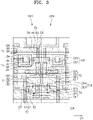
- FIG. 3 is a schematic layout diagram showing locations of a plurality or transistors and capacitors arranged in a pair of pixel circuits of a display apparatus according to an embodiment.
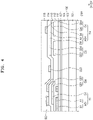
- FIG. 4 is a cross-sectional view schematically illustrating a display apparatus according to an embodiment.
- FIG. 5 is a cross-sectional view schematically illustrating a display apparatus according to an embodiment.
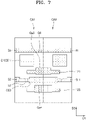
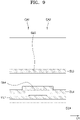
- FIGS. 6 , 7 , 8 , and 9 are layout diagrams showing components that form the plurality of transistors and the capacitors of FIG. 3 , in each of layers.
- FIG. 4 corresponds to a cross-sectional view of the components of FIG. 3 taken alone line I-I' of FIG. 3
- FIG. 5 corresponds to a cross-sectional view of the components of FIG. 3 taken along line II-II' of FIG. 3 .
- FIG. 3 a pair of pixels PX arranged in adjacent columns and in a same row are illustrated.
- a pixel circuit of a pixel arranged in a left pixel area CA1 and a pixel circuit of a pixel arranged in a right pixel area CA2 are bilaterally symmetrical.
- the pixel circuit may include the first transistor T1, the second transistor T2, the third transistor T3, the fourth transistor T4, the fifth transistor T5, the sixth transistor T6, the seventh transistor T7, the first capacitor Cst, and the second capacitor Cbt.
- the first transistor T1, the second transistor T2, the fifth transistor T5, the sixth transistor T6, and the seventh transistor T7 may include a thin-film transistor including a silicon semiconductor.
- one of the first transistor T1, the second transistor T2, the fifth transistor T5, the sixth transistor T6, and the seventh transistor T7 may be referred to as a first thin-film transistor with a first semiconductor layer including a silicon semiconductor.
- the third transistor T3 and the fourth transistor T4 may include a thin-film transistor including an oxide semiconductor.
- one of the third transistor T3 and the fourth transistor T4, especially the fourth transistor T4 may be referred to as a second thin-film transistor with a second semiconductor layer including an oxide semiconductor.
- Semiconductor layers of the first transistor T1, the second transistor T2, the fifth transistor T5, the sixth transistor T6, and the seventh transistor T7 may be arranged on a same layer and include a same material.
- the semiconductor layer may include a polycrystalline silicon.
- the semiconductor layers of the first transistor T1, the second transistor T2, the fifth transistor T5, the sixth transistor T6, and the seventh transistor T7 may be connected to each other and curved in various shapes.
- Each of the semiconductor layers of the first transistor T1, the second transistor T2, the fifth transistor T5, the sixth transistor T6, and the seventh transistor T7 may include a channel area and a source area and a drain area on two sides of the channel area.
- the source area and the drain area may be doped with an impurity, and the impurity may include an N-type impurity or a P-type impurity.
- the source area and the drain area may respectively correspond to a source electrode and a drain electrode.
- the source area and the drain area may be exchanged according to properties of a transistor.
- the terms, the 'source area' and the 'drain area,' will be used instead of the source electrode or the drain electrode.
- the first transistor T1 may include a first semiconductor layer AS1 and a first gate electrode G1.
- the first semiconductor layer AS1 may include a first channel area A1 and a first source area S1 and a first drain area D1 on two sides of the first channel area A1.
- the first semiconductor layer has a curved shape such that the first channel area A1 is longer than the other channel areas A2, A3, A4, A5, A6, and A7.
- the first semiconductor layer has a shape with multiple bends, such as 'S,' 'M,' 'W,' a relatively long channel length may be formed in a relatively small space.
- the first channel area A1 is relatively long, a driving range of a gate voltage applied to the first gate electrode G1 is extended, thereby finely controlling gradation of light emitted from the organic light-emitting diode OLED and improving display quality.
- the first semiconductor layer may have a linear shape instead of a bent shape.
- the first gate electrode G1 is an island type and may overlap the first channel area A1 with respect to a first gate insulating layer 112 (see FIG. 4 ) disposed therebetween.
- the first capacitor Cst may be arranged to overlap the first transistor T1.
- the first capacitor Cst may include the first lower electrode CE1 and the first upper electrode CE2.
- the first gate electrode G1 may have a function not only as a control electrode with respect to the first transistor T1 but also as the first lower electrode CE1 of the first capacitor Cst. That is, the first gate electrode G1 and the first lower electrode CE1 may be formed integrally.
- the first gate electrode G1 and the first lower electrode CE1 may be included as separate components and arranged apart from each other.
- the first upper electrode CE2 of the first capacitor Cst may be included to overlap the first lower electrode CE1 with a first interlayer insulating layer 113 ( FIG. 4 ) therebetween.
- the first interlayer insulating layer 113 may act as a dielectric layer of the first capacitor Cst.
- the second transistor T2 may include a second semiconductor layer and a second gate electrode G2.
- the second semiconductor layer may include a second channel area A2 and a second source area S2 and a second drain area D2 on two sides of the second channel area A2.
- the second source area S2 may be electrically connected to the data line DL ( FIG. 2 ) or the power voltage line PL ( FIG. 2 ), and the second drain area D2 may be connected to the first source area S1.
- the second gate electrode G2 may be included as a portion of the first scan line SL1 ( FIG. 2 ).
- the fifth transistor T5 may include a fifth semiconductor layer and a fifth gate electrode G5.
- the fifth semiconductor layer may include a fifth channel area A5 and a fifth source area S5 and a fifth drain area D5 on two sides of the fifth channel area A5.
- the fifth source area S5 may be electrically connected to the data line DL ( FIG. 2 ) or the power voltage line PL ( FIG. 2 ), and the fifth drain area D5 may be connected to the first source area S1.
- the fifth gate electrode G5 may be included as a portion of the emission control line EL ( FIG. 2 ).
- the sixth transistor T6 may include a sixth semiconductor layer and a sixth gate electrode G6.
- the sixth semiconductor layer may include a sixth channel area A6 and a sixth source area S6 and a sixth drain area D6 on two sides of the sixth channel area A6.
- the sixth source area S6 may be connected to the first drain area D1, and the sixth drain area D6 may be electrically connected to a pixel electrode 310 ( FIG. 12 ) of the organic light-emitting diode OLED.
- the sixth gate electrode G6 may be included as a portion of the emission control line EL ( FIG. 7 ).
- the seventh transistor T7 may include a seventh semiconductor layer and a seventh gate electrode G7.
- the seventh semiconductor layer may include a seventh channel area A7 and a seventh source area S7 and a seventh drain area D7 on two sides of the seventh channel area A7.
- the seventh source area S7 may be electrically connected to the second initialization voltage line VIL2 ( FIG. 2 ), and the seventh drain area D7 may be connected to the sixth drain area D6.
- the seventh gate electrode G7 may be included as a portion of the first scan line SL1 ( FIG. 7 ).
- the second gate insulating layer 114 ( FIG. 4 ) may be arranged on the first, second, and fifth through seventh transistors T1, T2, T5, T6, and T7 including a silicon semiconductor.
- the third and fourth transistors T3 and T4 including an oxide semiconductor may be arranged on the first interlayer insulating layer 113 ( FIG. 4 ).
- the semiconductor layers of the third transistor T3 and the fourth transistor T4 may be arranged on a same layer and may include a same material.
- the semiconductor layers may be formed of an oxide semiconductor.
- the semiconductor layers may include a channel area and a source area and a drain area on two sides of the channel area.
- the source area and the drain area may be areas having a carrier density increased by plasma processing.
- the source area and the drain area may respectively correspond to a source electrode and a drain electrode.
- the terms the 'source area' and the 'drain area' will be used instead of the source electrode or the drain electrode.
- the third transistor T3 may include a third semiconductor layer including an oxide semiconductor and a third gate electrode G3.
- the third semiconductor layer may include a third channel area A3 and a third source area S3 and a third drain area D3 on two sides of the third channel area A3.
- the third source area S3 may be electrically connected to the first gate electrode G1.
- the third source area S3 may be connected to a fourth drain area D4 arranged on a same layer as the source area D3.
- the third drain area D3 may be electrically connected to the first semiconductor layer AS1 of the first transistor T1 and the sixth semiconductor layer of the sixth transistor T6.
- the third gate electrode G3 may be included as a portion of the fourth scan line SL4 ( FIG. 9 ).
- the fourth transistor T4 may include a fourth semiconductor layer AO4 including an oxide semiconductor and a fourth gate electrode G4.
- the fourth semiconductor layer AO4 may include a fourth channel area A4 and a fourth source area S4 and the fourth drain area D4 on two sides of the fourth channel area A4.
- the fourth source area S4 may be electrically connected to the first initialization voltage line VIL1, and the fourth drain area D4 may be electrically connected to the first gate electrode G1.
- the fourth gate electrode G4 may be included as a portion of the third scan line SL3 ( FIG. 9 ).
- the second gate insulating layer 114 ( FIGS. 4 and 5 ) may be arranged between the third semiconductor layer and the third gate electrode G3 and arranged between the fourth semiconductor layer AO4 and the fourth gate electrode G4 to correspond to each channel area.
- the second lower electrode CE3 of the second capacitor Cbt may be included as a portion of the first scan line SL1 ( FIG. 7 ) to be connected to the second gate electrode G2.
- the second upper electrode CE4 of the second capacitor Cbt may be arranged to overlap the second lower electrode CE3, and may include an oxide semiconductor.
- the second upper electrode CE4 may be arranged on the same layer as the third semiconductor layer of the third transistor T3 and the fourth semiconductor layer AO4 of the fourth transistor T4, and may be an area between the third semiconductor layer and the fourth semiconductor layer AO4.
- the second upper electrode CE4 may extend from the fourth semiconductor layer AO4.
- the second upper electrode CE4 may extend from the third semiconductor layer.
- a second interlayer insulating layer 115 may be arranged on either the third transistor T3 or the fourth transistor T4 including an oxide semiconductor.
- FIGS. 4 and 5 illustrate cross-sections of the display apparatus 1 corresponding to the first transistor T1, the third transistor T3, the fourth transistor T4, the fifth transistor T5, the sixth transistor T6, the first capacitor Cst, and the second capacitor Cbt illustrated in FIG. 3 , and some elements may be omitted therein.
- the substrate 100 may include a glass material, a ceramic material, a metal material, or a flexible or bendable material.
- the substrate 100 may include a polymer resin such as polyethersulfone (PES), polyacrylate, polyetherimide (PEI), polyethylene naphthalate (PEN), polyethylene terephthalate (PET), polyphenylene sulfide (PPS), polyarylate, polyimide (PI), polycarbonate (PC), or cellulose acetate propionate (CAP).
- PES polyethersulfone
- PEI polyacrylate
- PEI polyetherimide
- PEN polyethylene naphthalate
- PET polyethylene terephthalate
- PPS polyphenylene sulfide
- PI polyimide
- PC polycarbonate
- CAP cellulose acetate propionate
- the substrate 100 may have a single-layer or multi-layer structure of the material, and when substrate 100 has a multi-layer structure, an inorganic layer may be further included.
- the substrate 100 may include a first base layer 101, a first barrier layer 103, a second base layer 105, and a second barrier layer 107.
- the first base layer 101 and the second base layer 105 may each include a polymer resin.
- the first base layer 101 and the second base layer 105 may include a transparent polymer resin.
- the first barrier layer 103 and the second barrier layer 107 may be barrier layers preventing penetration of external foreign substances, and may be a single-layer or multi-layer structure including an inorganic material such as silicon nitride (SiN x ) or silicon oxide (SiOx).
- a buffer layer 111 may be arranged on the substrate 100.
- the buffer layer 111 may have a function of increasing a level of flatness of an upper surface of the substrate 100, and the buffer layer 111 may include an oxide layer such as silicon oxide (SiO x ), and/or a nitride layer such as silicon nitride (SiN x ), or a silicon oxynitride (SiON).
- a semiconductor layer AS of the first transistor T1, the second transistor T2, the fifth transistor T5, the sixth transistor T6, and the seventh transistor T7 may be arranged on the buffer layer 111.
- the semiconductor layer AS may include the first channel area A1, the first source area S1, and the first drain area D1, which are a first semiconductor layer AS1 of the first transistor T1, the second channel area A2, the second source area S2, and the second drain area D2, which are a second semiconductor layer of the second transistor T2, and the fifth channel area A5, the fifth source area S5, and the fifth drain area D5, which are a fifth semiconductor layer AS5 of the fifth transistor T5, the sixth channel area A6, the sixth source area S6, and the sixth drain area D6, which are a sixth semiconductor layer AS6 of the sixth transistor T6, and the seventh channel area A7, the seventh source area S7, and the seventh drain area D7, which are a seventh semiconductor layer of the seventh transistor T7.
- each channel area, each source area, and each drain area of the first through seventh transistor T1 through T7 may be portions of the semiconductor layer AS.
- the semiconductor layer of the seventh transistor T7 may be a portion of a semiconductor layer extended from a previous row.
- the first gate insulating layer 112 may be disposed on the semiconductor layer AS.
- the first gate insulating layer 112 may include an inorganic material including an oxide or a nitride.
- the first gate insulating layer 112 may include at least one of silicon oxide (SiO 2 ), silicon nitride (SiN x ), silicon oxynitride (SiON), aluminum oxide (Al 2 O 3 ), titanium oxide (TiO 2 ), tantalum oxide (Ta 2 O 5 ), hafnium oxide (HfO 2 ), and zinc oxide (ZnO).
- the first gate electrode G1 of the first transistor T1, the second gate electrode G2 of the second transistor T2, the fifth gate electrode G5 of the fifth transistor T5, the sixth gate electrode G6 of the sixth transistor T6, and the seventh gate electrode G7 of the seventh transistor T7 may be arranged on the first gate insulating layer 112.
- the first scan line SL1 and the emission control line EL may extend and be arranged on the first gate insulating layer 112 in the first direction D1.
- a portion of the first scan line SL1 may be the second lower electrode CE3 of the second capacitor Cbt.
- a first conductive layer 121 and a second conductive layer 123 that include a same material as that of the first, second, fifth, sixth, and seventh gate electrodes G1, G2, G5, G6, and G7 of the first, second, fifth, sixth, and seventh transistors T1, T2, T5, T6, and T7 may extend and be arranged on the first gate insulating layer 112 in the first direction D1.
- a portion of the first conductive layer 121 overlapping a third semiconductor layer AO3 of the third transistor T3 may be a lower gate electrode Ga3 of the third transistor T3.
- a portion of the second conductive layer 123 overlapping a fourth semiconductor layer AO4 of the fourth transistor T4 may be a lower gate electrode Ga4 of the fourth transistor T4.
- the lower gate electrode Ga3 of the third transistor T3 may be arranged to overlap the third semiconductor layer AO3 of the third transistor T3 to protect the third semiconductor layer AO3 of the third transistor T3. Also, the lower gate electrode Ga4 of the fourth transistor T4 may be arranged to overlap the fourth semiconductor layer AO4 of the fourth transistor T4 to protect the fourth semiconductor layer AO4 of the fourth transistor T4.
- the first gate electrode G1 of the first transistor T1 may have an island shape. That is, the first gate electrode G1 of the first transistor T1 is freely floating so that first gate electrode G1 of the first transistor T1 is not connected with fifth gate electrode G5 of the fifth transistor T5 or the first conductive layer 121 etc.
- the second gate electrode G2 of the second transistor T2 may be a portion of the first scan line SL1 crossing the semiconductor layer AS.
- the seventh gate electrode G7 of the seventh transistor T7 may be a portion of the first scan line SL1 crossing the semiconductor layer AS or a portion of the second scan line SL2 ( FIG. 3 ) which is a first scan line of a next row. In FIG.
- the seventh gate electrode G7 of the seventh transistor T7 of a pixel arranged in a previous row is a portion of the first scan line SL1 crossing the semiconductor layer AS is illustrated.
- the fifth gate electrode G5 of the fifth transistor T5 and the sixth gate electrode G6 of the sixth transistor T6 may be portions of the emission control line EL crossing the semiconductor layer AS.
- the first gate electrode G1 of the first transistor T1 may have a function not only as a control electrode with respect to the first transistor T1 but also the first lower electrode CE1 of the first capacitor Cst.
- the first, second, fifth, sixth, and seventh gate electrodes G1, G2, G5, G6, and G7 of the first transistor T1, the second transistor T2, the fifth transistor T5, the sixth transistor T6, and the seventh transistor T7 may include aluminum (Al), platinum (Pt), and palladium (Pd), silver (Ag), magnesium (Mg), gold (Au), nickel (Ni), neodymium (Nd), iridium (Ir), chromium (Cr), lithium (Li), calcium (Ca), molybdenum (Mo), titanium (Ti), tungsten (W), and copper (Cu), and may be formed in a single-layer or multi-layer structure including one or more of the above materials.
- the first conductive layer 121 and the second conductive layer 123 may include a same material as that of the first, second, fifth, sixth, and seventh gate electrodes G1, G2, G5, G6, and G7 of the first transistor T1, the second transistor T2, the fifth transistor T5, and the sixth transistor T6, and the seventh transistor T7.
- the first interlayer insulating layer 113 may be arranged on the first, second, fifth, sixth, and seventh gate electrodes G1, G2, G5, G6, and G7.
- the first interlayer insulating layer 113 may include an inorganic material including an oxide or a nitride.
- the first interlayer insulating layer 113 may include at least one of silicon oxide (SiO 2 ), silicon nitride (SiN x ), silicon oxynitride (SiON), aluminum oxide (Al 2 O 3 ), titanium oxide (TiO 2 ), tantalum oxide (Ta 2 O 5 ), hafnium oxide (HfO 2 ), and zinc oxide (ZnO).
- a semiconductor layer AO including an oxide semiconductor may be arranged on the first interlayer insulating layer 113.
- the semiconductor layer AO may include a Zn oxide-based material, and may include Zn oxide, In-Zn oxide, Ga-In-Zn oxide, or the like.
- the semiconductor layer AO may include an In-Ga-Zn-O (IGZO), In-Sn-Zn-O (ITZO) or In-Ga-Sn-Zn-O (IGTZO) semiconductor including a metal such as indium (In), gallium (Ga), and tin (Sn) in ZnO.
- IGZO In-Ga-Zn-O
- ITZO In-Sn-Zn-O
- IGTZO In-Ga-Sn-Zn-O
- Each of the third semiconductor layer AO3 of the third transistor T3 and the fourth semiconductor layer AO4 of the fourth transistor T4 may include a channel area and a source area and a drain area which are disposed on both ends of the channel area.
- the source area and the drain area of the third transistor T3 and the fourth transistor T4 may be formed by imparting conductivity to an oxide semiconductor by adjusting a carrier concentration of the oxide semiconductor.
- the source area and drain area of each of the third transistor T3 and the fourth transistor T4 may be formed by increasing a carrier concentration of an oxide by performing plasma treatment on the oxide semiconductor by using a hydrogen (H)-based gas, a fluorine (F)-based gas, or a combination thereof.
- the semiconductor layer AO may include the third channel area A3, the third source area S3, and the third drain area D3, which are the third semiconductor layer AO3 of the third transistor T3, and the fourth channel area A4, the fourth source area S4, and the fourth drain area D4, which are the fourth semiconductor layer AO4 of the fourth transistor T4. That is, each channel area, each source area, and each drain area of the third transistor T3 and the fourth transistor T4 may be portions of the semiconductor layer AO.
- the semiconductor layer AO may include the second upper electrode CE4 of the second capacitor Cbt.
- the second upper electrode CE4 of the second capacitor Cbt may be located between the third semiconductor layer AO3 of the third transistor T3 and the fourth semiconductor layer AO4 of the fourth transistor T4 on a plan view.
- the second upper electrode CE4 may extend from the third semiconductor layer AO3 of the third transistor T3 or the fourth semiconductor layer AO4 of the fourth transistor T4. That is, the second upper electrode CE4 may include an oxide semiconductor and may be arranged on the first interlayer insulating layer 113.
- the first interlayer insulating layer 113 may be arranged between the second lower electrode CE3 and the second upper electrode CE4 of the second capacitor Cbt, and the first interlayer insulating layer 113 may act as a dielectric layer of the second capacitor Cbt.
- first upper electrode CE2 may be arranged on the first interlayer insulating layer 113 to overlap the first lower electrode CE1.
- a plurality of openings SOP is defined in the first upper electrode CE2.
- the opening SOP may be formed by removing a portion of the first upper electrode CE2 and may have a closed shape. In an example, the opening SOP may have a square shape. However, in other examples, the opening SOP may have different shapes such as s circle or triangle.
- the first interlayer insulating layer 113 may act as a dielectric layer of the first capacitor Cst.
- the first upper electrodes CE2 of adjacent pixels may be connected to each other by a bridge 141.
- the bridge 141 may be a portion protruding from the first upper electrode CE2 in the first direction D1 and may be integrally formed with the first upper electrode CE2. That is, the bridge 141 is connectedly disposed between two first upper electrodes CE2.
- the first upper electrode CE2 may include a same material as the semiconductor layer AO. According to an embodiment, the first upper electrode CE2 may be provided where a conductivity is imparted thereto by adjusting a carrier concentration of an oxide semiconductor. For example, the first upper electrode CE2 may be formed by increasing a carrier concentration of an oxide semiconductor through plasma treatment using a hydrogen (H)-based gas, a fluorine (F)-based gas, or a combination thereof on the oxide semiconductor.
- H hydrogen
- F fluorine
- the second gate insulating layer 114 may be arranged above the semiconductor layer AO and the first upper electrode CE2.
- the second gate insulating layer 114 may include an inorganic material including an oxide or a nitride.
- the second gate insulating layer 114 may include at least one of silicon oxide (SiO 2 ), silicon nitride (SiN x ), silicon oxynitride (SiON), aluminum oxide (Al 2 O 3 ), titanium oxide (TiO 2 ), tantalum oxide (Ta 2 O 5 ), hafnium oxide (HfO 2 ), and zinc oxide (ZnO).
- the first initialization voltage line VIL1, the third scan line SL3, and the fourth scan line SL4 may be arranged on the second gate insulating layer 114.
- a portion of the third scan line SL3 overlapping the semiconductor layer AO may be an upper gate electrode Gb3 of the third transistor T3.
- a portion of the fourth scan line SL4 overlapping the semiconductor layer AO may be an upper gate electrode Gb4 of the fourth transistor T4. That is, the third transistor T3 and the fourth transistor T4 may have a double gate structure including control electrodes on and below the semiconductor layer, respectively.
- the upper gate electrode Gb3 of the third transistor T3 and the upper gate electrode Gb4 of the fourth transistor T4 may be arranged on the second gate insulating layer 114, and may have a single-layer or multi-layer structure including at least one of molybdenum (Mo), copper (Cu), titanium (Ti), and the like.
- the second interlayer insulating layer 115 may be arranged to cover the third transistor T3 and the fourth transistor T4.
- the second interlayer insulating layer 115 may be arranged on the upper gate electrode Gb3 of the third transistor T3 and the upper gate electrode Gb4 of the fourth transistor T4.
- the second interlayer insulating layer 115 may include an inorganic material including an oxide or a nitride.
- the second interlayer insulating layer 115 may include at least one of silicon oxide (SiO 2 ), silicon nitride (SiN x ), silicon oxynitride (SiON), aluminum oxide (Al 2 O 3 ), titanium oxide (TiO 2 ), tantalum oxide (Ta 2 O 5 ), hafnium oxide (HfO 2 ), and zinc oxide (ZnO 2 ).
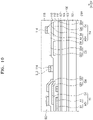
- FIG. 10 is a cross-sectional view schematically illustrating a display apparatus according to an embodiment.
- FIG. 10 is a schematic cross-sectional view of the display apparatus taken along line II' of FIG. 3 .
- the embodiment of FIG. 10 is different from the embodiment of FIG. 4 in that the second gate insulating layer 114 is patterned in a form corresponding to electrodes arranged thereon.
- like reference numerals as those of FIG. 4 denote like components, and thus, repeated description thereof will be omitted.
- the third scan line SL3 and the fourth scan line SL4 may be arranged to at least partially overlap the semiconductor layer AO.
- the second gate insulating layer 114 may be arranged between the third scan line SL3 and the fourth scan line SL4 and the semiconductor layer AO.
- the second gate insulating layer 114 may be patterned in a shape corresponding to the third scan line SL3 and the fourth scan line SL4 arranged thereon.
- the second gate insulating layer 114 may be patterned in a shape corresponding to the upper gate electrode Gb3 of the third transistor T3. In addition, the second gate insulating layer 114 may be patterned in a shape corresponding to the upper gate electrode Gb4 of the fourth transistor T4.
- FIG. 11 is a cross-sectional view schematically illustrating a display apparatus according to an embodiment.
- FIG. 11 is a schematic cross-sectional view of the display apparatus taken along line I-I' of FIG. 3 .
- the embodiment of FIG. 11 is different from the embodiment of FIG. 4 in that a first electrode 250 is further arranged on the second gate insulating layer 114, and the first upper electrode CE2 and the first electrode 250 are electrically connected to each other via a second electrode 260 arranged on the second interlayer insulating layer 115.
- like reference numerals as those of FIG. 4 denote like components, and thus, repeated description thereof will be omitted.
- the first initialization voltage line VIL1, the third scan line SL3, and the fourth scan line SL4 may be arranged on the second gate insulating layer 114.
- a portion of the third scan line SL3 overlapping the semiconductor layer AO may be the upper gate electrode Gb3 of the third transistor T3.
- a portion of the fourth scan line SL4 overlapping the semiconductor layer AO may be the upper gate electrode Gb4 of the fourth transistor T4. That is, the third transistor T3 and the fourth transistor T4 may have a double gate structure including control electrodes on and below the semiconductor layer, respectively.
- the upper gate electrode Gb3 of the third transistor T3 and the upper gate electrode Gb4 of the fourth transistor T4 may be arranged on the second gate insulating layer 114, and may have a single-layer or multi-layer structure including at least one of molybdenum (Mo), copper (Cu), titanium (Ti), and the like.
- the first electrode 250 may be arranged on the second gate insulating layer 114.
- the first electrode 250 may include the same material as those of the upper gate electrode Gb3 of the third transistor T3 and the upper gate electrode Gb4 of the fourth transistor T4.
- the second interlayer insulating layer 115 may be arranged on the upper gate electrode Gb3 of the third transistor T3, the upper gate electrode Gb4 of the fourth transistor T4, and the first electrode 250.
- the second electrode 260 may be arranged on the second interlayer insulating layer 115.
- the second electrode 260 may have a single-layer or multi-layer structure including at least one of aluminum (Al), copper (Cu), and titanium (Ti), or the like. According to an embodiment, the second electrode 260 may be provided as a triple layer of titanium, aluminum, and titanium (Ti/Al/Ti) that are sequentially arranged.
- An end of the second electrode 260 may be electrically connected to the first upper electrode CE2 of the first capacitor Cst through a contact hole 261 formed in the second gate insulating layer 114 and the second interlayer insulating layer 115.
- the other end of the second electrode 260 may be electrically connected to the first electrode 250 through a contact hole 263 formed in the second interlayer insulating layer 115.
- a resistance of the first upper electrode CE2 may increase.
- the first upper electrode CE2 includes an oxide semiconductor, to which conductivity is imparted, a resistance of the first upper electrode CE2 may increase compared to when the first upper electrode CE2 includes a metal material such as aluminum (Al), platinum (Pt), palladium (Pd), silver (Ag), magnesium (Mg), gold (Au), nickel (Ni), neodymium (Nd), iridium (Ir), chromium (Cr), lithium (Li), calcium (Ca), molybdenum (Mo), titanium (Ti), tungsten (W), or copper (Cu).
- a metal material such as aluminum (Al), platinum (Pt), palladium (Pd), silver (Ag), magnesium (Mg), gold (Au), nickel (Ni), neodymium (Nd), iridium (Ir), chromium (Cr), lithium (Li), calcium (Ca), molybdenum (Mo), titanium (
- the resistance of the first upper electrode CE2 may be reduced.
- FIG. 12 is a cross-sectional view schematically illustrating a display apparatus according to an embodiment.
- FIG. 12 is a schematic cross-sectional view of the display apparatus taken along line I-I' of FIG. 3 .
- FIG. 12 is a diagram for describing a stack structure on the second interlayer insulating layer 115.
- like reference numerals as those of FIG. 4 denote like components, and thus, repeated description thereof will be omitted.
- a third conductive layer 280 may be arranged on the second interlayer insulating layer 115 and may be in direct contact with the second interlayer insulating layer 115.
- the third conductive layer 280 may be at least one of the power voltage line PL ( FIG. 2 ), the data line DL ( FIG. 2 ), a node connection line, and a connection electrode.
- the third conductive layer 280 may have a single-layer or multi-layer structure including at least one of aluminum (Al), copper (Cu), and titanium (Ti), or the like.
- the third conductive layer 280 may include a triple layer of titanium, aluminum, and titanium (Ti/Al/Ti) that are sequentially arranged.
- a first planarization layer 118 may be arranged on the third conductive layer 280.
- a fourth conductive layer 290 may be arranged on the first planarization layer 118 and may be in direct contact with the first planarization layer 118.
- the fourth conductive layer 290 may be at least one of the power voltage line PL ( FIG. 2 ), the data line DL ( FIG. 2 ), a node connection line, and a connection electrode.
- the data line DL ( FIG. 2 ) may be arranged on the second interlayer insulating layer 115, and the power voltage line PL ( FIG. 2 ) may be arranged on the first planarization layer 118.
- the power voltage line PL ( FIG. 2 ) may be arranged on the second interlayer insulating layer 115 and the data line DL ( FIG. 2 ) may be arranged on the first planarization layer 118.
- a second planarization layer 119 may be arranged on the fourth conductive layer 290.
- the first planarization layer 118 and the second planarization layer 119 may include an organic material such as acrylic, benzocyclobutene (BCB), polyimide, or hexamethyldisiloxane (HMDSO).
- the first planarization layer 118 and the second planarization layer 119 may include an inorganic material.
- the first planarization layer 118 and the second planarization layer 119 may act as a protective layer covering the first through seventh transistors T1 to T7, and upper portions of the first planarization layer 118 and the second planarization layer 119 may be flattened.
- the first planarization layer 118 and the second planarization layer 119 may be provided as a single layer or multiple layers.
- An organic light-emitting diode OLED may be arranged on the second planarization layer 119.
- the organic light-emitting diode OLED may include the pixel electrode 310, an intermediate layer 320, and an opposite electrode 330.
- the pixel electrode 310 may be arranged on the second planarization layer 119 and may be in direct contact with the second planarization layer 119.
- the pixel electrode 310 may include a conductive oxide such as indium tin oxide (ITO), indium zinc oxide (IZO), zinc oxide (ZnO), indium oxide (In 2 O 3 ), indium gallium oxide (IGO), or aluminum zinc oxide (AZO).
- the pixel electrode 310 may include a reflective layer including silver (Ag), magnesium (Mg), aluminum (Al), platinum (Pt), palladium (Pd), gold (Au), nickel (Ni), neodymium (Nd), iridium (Ir), chromium (Cr), or a compound thereof.
- the pixel electrode 310 may have a structure having layers including ITO, IZO, ZnO, or In 2 O 3 above or below the above-described reflective layer.
- the pixel electrode 310 may have a structure in which indium tin oxide (ITO)/silver (Ag)/indium tin oxide (ITO) are sequentially stacked.
- a pixel defining layer 120 may be arranged on the second planarization layer 119.
- An opening corresponding to each pixel is defined in the pixel defining layer 120. That is, an opening, through which at least a portion of the pixel electrode 310 is exposed, thereby defining a pixel.
- the pixel defining layer 120 may increase a distance between an edge of the pixel electrode 310 and the opposite electrode 330 above the pixel electrode 310 to thereby perform a function of preventing an arc or the like at the edge of the pixel electrode 310.
- the pixel defining layer 120 may include an organic material such as polyimide or HMDSO.
- the intermediate layer 320 of the organic light-emitting diode OLED may include a low molecular weight organic material or a polymer organic material.
- a hole injection layer (HIL), a hole transport layer (HTL), an emission layer (EML), an electron transport layer (ETL), an electron injection layer (EIL), or the like may be stacked in a single or complex structure, and the intermediate layer 320 may include various organic materials includingcopper phthalocyanine (CuPc), N,N-di(naphthalen-1-yl)-N,N'-di Phenyl-benzidine (N,N'-Di(naphthalene-1-yl)-N,N'-diphenyl-benzidine (NPB), tris-8-hydroxyquinoline aluminum (Alq3), or the like.
- CuPc copper phthalocyanine
- NPB N,N-di(naphthalen-1-yl)-N,N'-di Phenyl-benzidine
- the intermediate layer 320 When the intermediate layer 320 includes a polymer organic material, it may have a structure including an HTL and an EML.
- the HTL may include PEDOT
- the EML may include a polymer material such as poly-phenylvinylene (PPV)-based material and polyfluorene-based material.
- the intermediate layer 320 may be formed by screen printing, inkjet printing, laser induced thermal imaging (LITI), or the like.
- the intermediate layer 320 is not necessarily limited thereto, and may have other various structures.
- the intermediate layer 320 may include a layer that is integrally formed over the plurality of pixel electrodes 310, or may include a layer patterned to correspond to each of the plurality of pixel electrodes 310.
- the opposite electrode 330 may be formed integrally with respect to a plurality of organic light-emitting diodes to correspond to the plurality of pixel electrodes 310.
- an encapsulation layer (not shown) or a sealing substrate (not shown) may be arranged on the organic light-emitting diode OLED to protect the organic light-emitting diode OLED.
- the encapsulation layer (not shown) may cover the display area DA and extend beyond the display area DA.
- the encapsulation layer may include an inorganic film layer including at least one inorganic material and an organic film layer including at least one organic material.
- a thin-film encapsulation layer may be provided in a structure in which a first inorganic film layer, an organic film layer, and a second inorganic film layer are sequentially stacked.
- the sealing substrate (not shown) may be arranged to face the substrate 100 and bonded to the substrate 100 by using a sealing member such as a sealant or frit in the peripheral area PA.
- a spacer (not shown) for preventing mask imprinting may be further included on the pixel defining layer 120, and various functional layers such as a polarizing layer, a black matrix, a color filter that are used to reduce external light reflection, and/or a touch screen layer including a touch electrode may be provided on the encapsulation layer.
- a lower gate electrode of a second thin-film transistor including an oxide semiconductor is arranged on a same layer as a gate electrode of a first thin-film transistor including a silicon semiconductor, and an upper electrode of a capacitor includes an oxide semiconductor, to which conductivity is imparted. Accordingly, the manufacturing costs of a display apparatus may be reduced as a number of insulating layers and lines and thus a number of masks used in a process are reduced, and also, a number of operations of the manufacturing process of the display apparatus and a process defect ratio may be reduced, accordingly.
- a resistance of the upper electrode may be reduced.
- a driving circuit driving a display element is configured to include a first thin-film transistor including a silicon semiconductor and a second thin-film transistor including an oxide semiconductor, a high-resolution display apparatus with low power consumption may be provided.
Landscapes
- Engineering & Computer Science (AREA)
- Microelectronics & Electronic Packaging (AREA)
- Physics & Mathematics (AREA)
- Geometry (AREA)
- Devices For Indicating Variable Information By Combining Individual Elements (AREA)
- Electroluminescent Light Sources (AREA)
- Liquid Crystal (AREA)
- Thin Film Transistor (AREA)
Applications Claiming Priority (1)
| Application Number | Priority Date | Filing Date | Title |
|---|---|---|---|
| KR1020200178926A KR20220088596A (ko) | 2020-12-18 | 2020-12-18 | 표시 장치 |
Publications (2)
| Publication Number | Publication Date |
|---|---|
| EP4016628A2 true EP4016628A2 (fr) | 2022-06-22 |
| EP4016628A3 EP4016628A3 (fr) | 2022-08-03 |
Family
ID=78402028
Family Applications (1)
| Application Number | Title | Priority Date | Filing Date |
|---|---|---|---|
| EP21201100.1A Pending EP4016628A3 (fr) | 2020-12-18 | 2021-10-06 | Appareil d'affichage |
Country Status (4)
| Country | Link |
|---|---|
| US (3) | US11839112B2 (fr) |
| EP (1) | EP4016628A3 (fr) |
| KR (1) | KR20220088596A (fr) |
| CN (1) | CN114649375A (fr) |
Families Citing this family (2)
| Publication number | Priority date | Publication date | Assignee | Title |
|---|---|---|---|---|
| KR20220131436A (ko) * | 2021-03-18 | 2022-09-28 | 삼성디스플레이 주식회사 | 표시 장치 |
| CN114724514B (zh) * | 2022-05-20 | 2024-01-23 | 京东方科技集团股份有限公司 | 像素驱动电路、其驱动方法、显示面板及显示装置 |
Family Cites Families (13)
| Publication number | Priority date | Publication date | Assignee | Title |
|---|---|---|---|---|
| WO2011039907A1 (fr) * | 2009-10-02 | 2011-04-07 | シャープ株式会社 | Dispositif à semiconducteur et procédé pour sa fabrication |
| KR102038076B1 (ko) * | 2013-04-04 | 2019-10-30 | 삼성디스플레이 주식회사 | 유기 발광 표시 장치 |
| US9818765B2 (en) | 2013-08-26 | 2017-11-14 | Apple Inc. | Displays with silicon and semiconducting oxide thin-film transistors |
| US9412799B2 (en) | 2013-08-26 | 2016-08-09 | Apple Inc. | Display driver circuitry for liquid crystal displays with semiconducting-oxide thin-film transistors |
| US10985196B2 (en) | 2014-02-24 | 2021-04-20 | Lg Display Co., Ltd. | Thin film transistor substrate with intermediate insulating layer and display using the same |
| KR102251176B1 (ko) | 2014-02-24 | 2021-05-11 | 엘지디스플레이 주식회사 | 박막 트랜지스터 기판 및 이를 이용한 표시장치 |
| KR102233669B1 (ko) * | 2014-07-28 | 2021-03-31 | 삼성디스플레이 주식회사 | 표시 기판, 표시 기판의 제조 방법 및 표시 기판을 포함하는 유기 발광 표시 장치 |
| JP2018170324A (ja) | 2017-03-29 | 2018-11-01 | 株式会社ジャパンディスプレイ | 表示装置 |
| JP2019129281A (ja) | 2018-01-26 | 2019-08-01 | 株式会社ジャパンディスプレイ | 表示装置及びその製造方法 |
| KR102652448B1 (ko) | 2018-03-13 | 2024-03-29 | 삼성디스플레이 주식회사 | 디스플레이 장치 |
| KR102538000B1 (ko) * | 2018-03-29 | 2023-05-31 | 삼성디스플레이 주식회사 | 디스플레이 장치 |
| US11895870B2 (en) | 2020-07-17 | 2024-02-06 | Wuhan China Star Optoelectronics Semiconductor Display Technology Co., Ltd. | Display panel and display device |
| CN111785759B (zh) | 2020-07-17 | 2025-04-29 | 武汉华星光电半导体显示技术有限公司 | 显示面板及显示装置 |
-
2020
- 2020-12-18 KR KR1020200178926A patent/KR20220088596A/ko active Pending
-
2021
- 2021-07-08 US US17/370,857 patent/US11839112B2/en active Active
- 2021-10-06 EP EP21201100.1A patent/EP4016628A3/fr active Pending
- 2021-12-01 CN CN202111453919.2A patent/CN114649375A/zh active Pending
-
2023
- 2023-12-04 US US18/528,652 patent/US12238971B2/en active Active
-
2025
- 2025-01-17 US US19/026,370 patent/US20250169284A1/en active Pending
Also Published As
| Publication number | Publication date |
|---|---|
| US12238971B2 (en) | 2025-02-25 |
| US11839112B2 (en) | 2023-12-05 |
| EP4016628A3 (fr) | 2022-08-03 |
| US20240107810A1 (en) | 2024-03-28 |
| CN114649375A (zh) | 2022-06-21 |
| US20250169284A1 (en) | 2025-05-22 |
| KR20220088596A (ko) | 2022-06-28 |
| US20220199724A1 (en) | 2022-06-23 |
Similar Documents
| Publication | Publication Date | Title |
|---|---|---|
| US12069895B2 (en) | Display Apparatus having shielding electrode overlapping connection line | |
| US11715418B2 (en) | Display apparatus | |
| KR102654921B1 (ko) | 디스플레이 장치 | |
| US11903266B2 (en) | Display apparatus including a thin-film transistor including a silicon semiconductor and a thin-film transistor including an oxide semiconductor | |
| US10868096B2 (en) | Display device | |
| US11328665B2 (en) | Pixel and display device including the same | |
| US11296238B2 (en) | Thin-film transistor substrate and display apparatus comprising the same | |
| US20250169284A1 (en) | Display apparatus | |
| CN113809122A (zh) | 显示装置 | |
| US11853132B2 (en) | Display apparatus | |
| KR102900839B1 (ko) | 표시장치 | |
| US12501774B2 (en) | Display apparatus | |
| KR20220108885A (ko) | 표시 장치 | |
| US20240324288A1 (en) | Display apparatus | |
| CN112490267A (zh) | 显示装置 |
Legal Events
| Date | Code | Title | Description |
|---|---|---|---|
| PUAI | Public reference made under article 153(3) epc to a published international application that has entered the european phase |
Free format text: ORIGINAL CODE: 0009012 |
|
| STAA | Information on the status of an ep patent application or granted ep patent |
Free format text: STATUS: THE APPLICATION HAS BEEN PUBLISHED |
|
| AK | Designated contracting states |
Kind code of ref document: A2 Designated state(s): AL AT BE BG CH CY CZ DE DK EE ES FI FR GB GR HR HU IE IS IT LI LT LU LV MC MK MT NL NO PL PT RO RS SE SI SK SM TR |
|
| PUAL | Search report despatched |
Free format text: ORIGINAL CODE: 0009013 |
|
| AK | Designated contracting states |
Kind code of ref document: A3 Designated state(s): AL AT BE BG CH CY CZ DE DK EE ES FI FR GB GR HR HU IE IS IT LI LT LU LV MC MK MT NL NO PL PT RO RS SE SI SK SM TR |
|
| RIC1 | Information provided on ipc code assigned before grant |
Ipc: H01L 27/12 20060101AFI20220629BHEP |
|
| STAA | Information on the status of an ep patent application or granted ep patent |
Free format text: STATUS: REQUEST FOR EXAMINATION WAS MADE |
|
| 17P | Request for examination filed |
Effective date: 20230201 |
|
| RBV | Designated contracting states (corrected) |
Designated state(s): AL AT BE BG CH CY CZ DE DK EE ES FI FR GB GR HR HU IE IS IT LI LT LU LV MC MK MT NL NO PL PT RO RS SE SI SK SM TR |
|
| P01 | Opt-out of the competence of the unified patent court (upc) registered |
Effective date: 20230516 |
|
| STAA | Information on the status of an ep patent application or granted ep patent |
Free format text: STATUS: EXAMINATION IS IN PROGRESS |
|
| 17Q | First examination report despatched |
Effective date: 20241008 |