EP4018416B1 - Procédés et appareil pour une estimation de mouvement efficace - Google Patents
Procédés et appareil pour une estimation de mouvement efficace Download PDFInfo
- Publication number
- EP4018416B1 EP4018416B1 EP20761429.8A EP20761429A EP4018416B1 EP 4018416 B1 EP4018416 B1 EP 4018416B1 EP 20761429 A EP20761429 A EP 20761429A EP 4018416 B1 EP4018416 B1 EP 4018416B1
- Authority
- EP
- European Patent Office
- Prior art keywords
- motion estimation
- group
- pixels
- frame
- priority
- Prior art date
- Legal status (The legal status is an assumption and is not a legal conclusion. Google has not performed a legal analysis and makes no representation as to the accuracy of the status listed.)
- Active
Links
Images





Classifications
-
- G—PHYSICS
- G06—COMPUTING OR CALCULATING; COUNTING
- G06T—IMAGE DATA PROCESSING OR GENERATION, IN GENERAL
- G06T1/00—General purpose image data processing
- G06T1/20—Processor architectures; Processor configuration, e.g. pipelining
-
- G—PHYSICS
- G06—COMPUTING OR CALCULATING; COUNTING
- G06T—IMAGE DATA PROCESSING OR GENERATION, IN GENERAL
- G06T7/00—Image analysis
- G06T7/20—Analysis of motion
-
- A—HUMAN NECESSITIES
- A63—SPORTS; GAMES; AMUSEMENTS
- A63F—CARD, BOARD, OR ROULETTE GAMES; INDOOR GAMES USING SMALL MOVING PLAYING BODIES; VIDEO GAMES; GAMES NOT OTHERWISE PROVIDED FOR
- A63F13/00—Video games, i.e. games using an electronically generated display having two or more dimensions
- A63F13/50—Controlling the output signals based on the game progress
- A63F13/52—Controlling the output signals based on the game progress involving aspects of the displayed game scene
-
- A—HUMAN NECESSITIES
- A63—SPORTS; GAMES; AMUSEMENTS
- A63F—CARD, BOARD, OR ROULETTE GAMES; INDOOR GAMES USING SMALL MOVING PLAYING BODIES; VIDEO GAMES; GAMES NOT OTHERWISE PROVIDED FOR
- A63F2300/00—Features of games using an electronically generated display having two or more dimensions, e.g. on a television screen, showing representations related to the game
- A63F2300/50—Features of games using an electronically generated display having two or more dimensions, e.g. on a television screen, showing representations related to the game characterized by details of game servers
- A63F2300/53—Features of games using an electronically generated display having two or more dimensions, e.g. on a television screen, showing representations related to the game characterized by details of game servers details of basic data processing
- A63F2300/538—Features of games using an electronically generated display having two or more dimensions, e.g. on a television screen, showing representations related to the game characterized by details of game servers details of basic data processing for performing operations on behalf of the game client, e.g. rendering
-
- G—PHYSICS
- G06—COMPUTING OR CALCULATING; COUNTING
- G06T—IMAGE DATA PROCESSING OR GENERATION, IN GENERAL
- G06T2207/00—Indexing scheme for image analysis or image enhancement
- G06T2207/20—Special algorithmic details
- G06T2207/20021—Dividing image into blocks, subimages or windows
Definitions
- the present disclosure relates generally to processing systems and, more particularly, to one or more techniques for graphics processing.
- GPUs graphics processing unit
- Such computing devices may include, for example, computer workstations, mobile phones such as so-called smartphones, embedded systems, personal computers, tablet computers, and video game consoles.
- GPUs execute a graphics processing pipeline that includes one or more processing stages that operate together to execute graphics processing commands and output a frame.
- a central processing unit (CPU) may control the operation of the GPU by issuing one or more graphics processing commands to the GPU.
- Modern day CPUs are typically capable of concurrently executing multiple applications, each of which may need to utilize the GPU during execution.
- a device that provides content for visual presentation on a display generally includes a GPU.
- a GPU of a device is configured to perform the processes in a graphics processing pipeline.
- graphics processing pipeline For the advent of wireless communication and smaller, handheld devices, there has developed an increased need for improved graphics processing.
- US2018/260961 describes how to select feature points to improve image capture over multiple images.
- a first image is divided into a plurality of regions.
- a feature point is extracted from each of the regions.
- the feature point is tracked among a plurality of images to detect a motion vector.
- a notable target of the first image is estimated.
- a priority level of setting of a tracking feature for each of the regions for tracking motion of the notable target is calculated and the tracking feature point is set to any of the regions based on the priority level.
- Performing high quality motion estimation can be a significant cost when deploying frame extrapolation solutions in virtual reality (VR), augmented reality (AR), extended reality (XR), or gaming applications. In these applications, regions farther from the focal point of an image may be deemed less important than image regions closer to the focal point of the image.
- motion estimation quality can be scaled based on the distance from a focal point of an image.
- aspects of the present disclosure can perform motion estimation based on the distance from a focal point of an image. For instance, aspects of the present disclosure can determine a motion estimation priority for one or more regions in a frame, where each of the one or more regions can include a corresponding motion vector. Aspects of the present disclosure can also adjust a quality of each corresponding motion vector based on the motion estimation priority. Aspects of the present disclosure can also perform a motion estimation for each of the one or more regions based on the quality of the corresponding motion vector.
- processors include microprocessors, microcontrollers, graphics processing units (GPUs), general purpose GPUs (GPGPUs), central processing units (CPUs), application processors, digital signal processors (DSPs), reduced instruction set computing (RISC) processors, systems-on-chip (SOC), baseband processors, application specific integrated circuits (ASICs), field programmable gate arrays (FPGAs), programmable logic devices (PLDs), state machines, gated logic, discrete hardware circuits, and other suitable hardware configured to perform the various functionality described throughout this disclosure.
- processors include microprocessors, microcontrollers, graphics processing units (GPUs), general purpose GPUs (GPGPUs), central processing units (CPUs), application processors, digital signal processors (DSPs), reduced instruction set computing (RISC) processors, systems-on-chip (SOC), baseband processors, application specific integrated circuits (ASICs), field programmable gate arrays (FPGAs), programmable logic devices (PLDs), state machines, gated logic
- One or more processors in the processing system may execute software.
- Software can be construed broadly to mean instructions, instruction sets, code, code segments, program code, programs, subprograms, software components, applications, software applications, software packages, routines, subroutines, objects, executables, threads of execution, procedures, functions, etc., whether referred to as software, firmware, middleware, microcode, hardware description language, or otherwise.
- the term application may refer to software.
- one or more techniques may refer to an application, i.e., software, being configured to perform one or more functions.
- the application may be stored on a memory, e.g., on-chip memory of a processor, system memory, or any other memory.
- Hardware described herein such as a processor may be configured to execute the application.
- the application may be described as including code that, when executed by the hardware, causes the hardware to perform one or more techniques described herein.
- the hardware may access the code from a memory and execute the code accessed from the memory to perform one or more techniques described herein.
- components are identified in this disclosure.
- the components may be hardware, software, or a combination thereof.
- the components may be separate components or sub-components of a single component.
- Computer-readable media includes computer storage media. Storage media may be any available media that can be accessed by a computer.
- such computer-readable media can comprise a random access memory (RAM), a read-only memory (ROM), an electrically erasable programmable ROM (EEPROM), optical disk storage, magnetic disk storage, other magnetic storage devices, combinations of the aforementioned types of computer-readable media, or any other medium that can be used to store computer executable code in the form of instructions or data structures that can be accessed by a computer.
- this disclosure describes techniques for having a graphics processing pipeline in a single device or multiple devices, improving the rendering of graphical content, and/or reducing the load of a processing unit, i.e., any processing unit configured to perform one or more techniques described herein, such as a GPU.
- a processing unit i.e., any processing unit configured to perform one or more techniques described herein, such as a GPU.
- this disclosure describes techniques for graphics processing in any device that utilizes graphics processing. Other example benefits are described throughout this disclosure.
- instances of the term “content” may refer to “graphical content,” “image,” and vice versa. This is true regardless of whether the terms are being used as an adjective, noun, or other parts of speech.
- the term “graphical content” may refer to a content produced by one or more processes of a graphics processing pipeline.
- the term “graphical content” may refer to a content produced by a processing unit configured to perform graphics processing.
- the term “graphical content” may refer to a content produced by a graphics processing unit.
- instances of the term “content” may refer to graphical content or display content.
- the term “graphical content” may refer to a content generated by a processing unit configured to perform graphics processing.
- the term “graphical content” may refer to content generated by one or more processes of a graphics processing pipeline.
- the term “graphical content” may refer to content generated by a graphics processing unit.
- the term “display content” may refer to content generated by a processing unit configured to perform displaying processing.
- display content may refer to content generated by a display processing unit. Graphical content may be processed to become display content.
- a graphics processing unit may output graphical content, such as a frame, to a buffer (which may be referred to as a framebuffer).
- a display processing unit may read the graphical content, such as one or more frames from the buffer, and perform one or more display processing techniques thereon to generate display content.
- a display processing unit may be configured to perform composition on one or more rendered layers to generate a frame.
- a display processing unit may be configured to compose, blend, or otherwise combine two or more layers together into a single frame.
- a display processing unit may be configured to perform scaling, e.g., upscaling or downscaling, on a frame.
- a frame may refer to a layer.
- a frame may refer to two or more layers that have already been blended together to form the frame, i.e., the frame includes two or more layers, and the frame that includes two or more layers may subsequently be blended.
- FIG. 1 is a block diagram that illustrates an example content generation system 100 configured to implement one or more techniques of this disclosure.
- the content generation system 100 includes a device 104.
- the device 104 may include one or more components or circuits for performing various functions described herein.
- one or more components of the device 104 may be components of an SOC.
- the device 104 may include one or more components configured to perform one or more techniques of this disclosure.
- the device 104 may include a processing unit 120, and a system memory 124.
- the device 104 can include a number of optional components, e.g., a communication interface 126, a transceiver 132, a receiver 128, a transmitter 130, a display processor 127, and one or more displays 131.
- the display 131 may refer to the one or more displays 131.
- the display 131 may include a single display or multiple displays.
- the display 131 may include a first display and a second display.
- the first display may be a left-eye display and the second display may be a right-eye display.
- the first and second display may receive different frames for presentment thereon.
- the first and second display may receive the same frames for presentment thereon.
- the results of the graphics processing may not be displayed on the device, e.g., the first and second display may not receive any frames for presentment thereon. Instead, the frames or graphics processing results may be transferred to another device. In some aspects, this can be referred to as split-rendering.
- the processing unit 120 may include an internal memory 121.
- the processing unit 120 may be configured to perform graphics processing, such as in a graphics processing pipeline 107.
- the device 104 may include a display processor, such as the display processor 127, to perform one or more display processing techniques on one or more frames generated by the processing unit 120 before presentment by the one or more displays 131.
- the display processor 127 may be configured to perform display processing.
- the display processor 127 may be configured to perform one or more display processing techniques on one or more frames generated by the processing unit 120.
- the one or more displays 131 may be configured to display or otherwise present frames processed by the display processor 127.
- the one or more displays 131 may include one or more of: a liquid crystal display (LCD), a plasma display, an organic light emitting diode (OLED) display, a projection display device, an augmented reality display device, a virtual reality display device, a head-mounted display, or any other type of display device.
- LCD liquid crystal display
- OLED organic light emitting diode
- a projection display device an augmented reality display device, a virtual reality display device, a head-mounted display, or any other type of display device.
- Memory external to the processing unit 120 may be accessible to the processing unit 120.
- the processing unit 120 may be configured to read from and/or write to external memory, such as the system memory 124.
- the processing unit 120 may be communicatively coupled to the system memory 124 over a bus. In some examples, the processing unit 120 may be communicatively coupled to each other over the bus or a different connection.
- the internal memory 121 or the system memory 124 may include one or more volatile or non-volatile memories or storage devices.
- internal memory 121 or the system memory 124 may include RAM, SRAM, DRAM, erasable programmable ROM (EPROM), electrically erasable programmable ROM (EEPROM), flash memory, a magnetic data media or an optical storage media, or any other type of memory.
- the internal memory 121 or the system memory 124 may be a non-transitory storage medium according to some examples.
- the term “non-transitory” may indicate that the storage medium is not embodied in a carrier wave or a propagated signal. However, the term “non-transitory” should not be interpreted to mean that internal memory 121 or the system memory 124 is non-movable or that its contents are static. As one example, the system memory 124 may be removed from the device 104 and moved to another device. As another example, the system memory 124 may not be removable from the device 104.
- the processing unit 120 may be a central processing unit (CPU), a graphics processing unit (GPU), a general purpose GPU (GPGPU), or any other processing unit that may be configured to perform graphics processing.
- the processing unit 120 may be integrated into a motherboard of the device 104.
- the processing unit 120 may be present on a graphics card that is installed in a port in a motherboard of the device 104, or may be otherwise incorporated within a peripheral device configured to interoperate with the device 104.
- the processing unit 120 may include one or more processors, such as one or more microprocessors, GPUs, application specific integrated circuits (ASICs), field programmable gate arrays (FPGAs), arithmetic logic units (ALUs), digital signal processors (DSPs), discrete logic, software, hardware, firmware, other equivalent integrated or discrete logic circuitry, or any combinations thereof. If the techniques are implemented partially in software, the processing unit 120 may store instructions for the software in a suitable, non-transitory computer-readable storage medium, e.g., internal memory 121, and may execute the instructions in hardware using one or more processors to perform the techniques of this disclosure. Any of the foregoing, including hardware, software, a combination of hardware and software, etc., may be considered to be one or more processors.
- processors such as one or more microprocessors, GPUs, application specific integrated circuits (ASICs), field programmable gate arrays (FPGAs), arithmetic logic units (ALUs), digital signal processors (DSPs),
- the content generation system 100 can include an optional communication interface 126.
- the communication interface 126 may include a receiver 128 and a transmitter 130.
- the receiver 128 may be configured to perform any receiving function described herein with respect to the device 104. Additionally, the receiver 128 may be configured to receive information, e.g., eye or head position information, rendering commands, or location information, from another device.
- the transmitter 130 may be configured to perform any transmitting function described herein with respect to the device 104. For example, the transmitter 130 may be configured to transmit information to another device, which may include a request for content.
- the receiver 128 and the transmitter 130 may be combined into a transceiver 132. In such examples, the transceiver 132 may be configured to perform any receiving function and/or transmitting function described herein with respect to the device 104.
- the graphics processing pipeline 107 may include a determination component 198 configured to determine a motion estimation priority for one or more regions in a frame.
- each of the one or more regions can include at least one group of pixels.
- the determination component 198 can be configured to adjust a quality of a motion estimation procedure for each group of pixels based on the motion estimation priority of the region including the group of pixels.
- the determination component 198 can also be configured to perform the motion estimation procedure for each of the at least one group of pixels to generate a motion vector for the at least one group of pixels based on the adjusted quality of the motion estimation procedure.
- the determination component 198 can also be configured to extrapolate a new frame from the frame based on the motion vector for each group of pixels.
- a device such as the device 104, may refer to any device, apparatus, or system configured to perform one or more techniques described herein.
- a device may be a server, a base station, user equipment, a client device, a station, an access point, a computer, e.g., a personal computer, a desktop computer, a laptop computer, a tablet computer, a computer workstation, or a mainframe computer, an end product, an apparatus, a phone, a smart phone, a server, a video game platform or console, a handheld device, e.g., a portable video game device or a personal digital assistant (PDA), a wearable computing device, e.g., a smart watch, an augmented reality device, or a virtual reality device, a non-wearable device, a display or display device, a television, a television set-top box, an intermediate network device, a digital media player, a video streaming device, a content streaming device, an in-car computer,
- PDA personal digital
- FIG. 2 illustrates an example GPU 200 in accordance with one or more techniques of this disclosure.
- GPU 200 includes command processor (CP) 210, draw call packets 212, vertex fetcher (VFD) 220, vertex shader (VS) 222, vertex cache (VPC) 224, triangle setup engine (TSE) 226, rasterizer (RAS) 228, Z process engine (ZPE) 230, pixel interpolator (PI) 232, fragment shader (FS) 234, render backend (RB) 236, L2 cache (UCHE) 238, and system memory 240.
- FIG. 2 displays that GPU 200 includes processing units 220-238, GPU 200 can include a number of additional processing units. Additionally, processing units 220-238 are merely an example and any combination or order of processing units can be used by GPUs according to the present disclosure.
- GPU 200 also includes command buffer 250, context register packets 260, and context states 261.
- a GPU can process multiple types of data in a GPU pipeline.
- a GPU can process two types of data or data packets, e.g., context register packets and draw call data.
- a GPU can utilize a CP, e.g., CP 210, or hardware accelerator to parse a command buffer into context register packets, e.g., context register packets 260, and/or draw call data packets, e.g., draw call packets 212.
- the CP 210 can then send the context register packets 260 or draw call data packets 212 through separate paths to the processing units or blocks in the GPU.
- the command buffer 250 can alternate different states of context registers and draw calls.
- a command buffer can be structured as follows: context register of context N, draw call(s) of context N, context register of context N+1, and draw call(s) of context N+1.
- Motion estimation is the process of analyzing multiple two dimensional (2D) images and producing motion vectors which describe the movement of regions from one image to the other.
- motion estimation is a method of estimating the motion experienced during consecutive frames, e.g., during virtual reality (VR), augmented reality (AR), extended reality (XR), and/or gaming applications.
- Motion estimation can produce motion vectors that can describe how objects or groups of pixels move within certain sections of an image.
- Motion vectors can have a variety of uses including video compression, post-processing effects, such as motion blur, and frame extrapolation or interpolation.
- VR or AR systems can utilize motion estimation in order to extrapolate frames from previously rendered content. By doing so, this may allow the GPU to render frames at a reduced rate, where the extrapolated frames are displayed to the user in the place of rendered content.
- Motion estimation can be useful because in VR or AR systems there is a strong drive to reduce the rendering workload, e.g., at the GPU.
- Frame extrapolation is a method to increase the frame rate of VR, AR, XR, and/or gaming applications. For instance, frame extrapolation can estimate the motion between two previously rendered frames and extrapolate a new frame based on the detected motion.
- aspects of the present disclosure can render at a lower frame rate, perform motion estimation on the rendered frames, and then use the motion estimation to extrapolate content. This content can then be interspersed with other content to produce a higher frame rate.
- Some aspects of mobile AR, VR, XR, or gaming applications may have demanding constraints for both power and performance efficiency. Accordingly, these applications may have constraints to both increase performance and decrease power utilized.
- motion estimation can be performed on previously rendered content used to extrapolate frames. In turn, this can allow frame rendering to process at a reduced framerate. For example, to help decrease the performance and power, every other frame can be rendered, rather than rendering every frame. Motion estimation can then be performed between the frames. In some aspects, motion estimation can be performed between the rendered frames, and this can produce information regarding how objects or groups of pixels of an image have moved. Using the motion estimation and a previously rendered frame, a frame can be extrapolated instead of being rendered.
- the cost of performing high quality motion estimation can also be a significant overhead, e.g., when deploying frame extrapolation solutions. So motion estimation also can utilize resources and/or require a high cost. In turn, when performing frame extrapolation, the costs of motion estimation can reduce the power and performance gains of the reduced framerate. Accordingly, although the framerate may be improved there may also be an increase in the amount of resources to perform the motion estimation.
- Some aspects of performing motion estimation may not require a uniform quality of motion estimation throughout an image. There can be several contributing factors motivating the need for non-uniform quality of motion estimation. For instance, lenses on AR or VR devices can have a reduced optical clarity around the edges. So in the center of the lens a picture can be clear, but the image may be blurry near the periphery of the lenses.
- barrel distortion can cause over-rendering in the periphery of an image, such that images near the periphery of the display may end up over represented.
- a standard projection of a map may have the pole region represented overly large.
- the human eye perceives a high resolution in a very narrow region near the center of the eye, which is a small fovea region. So near the fovea may include the most acuity and outside the fovea may be more course.
- the motion estimation workload can be scaled along with the aforementioned parameters, where the highest quality motion estimation may occur near the center of the image, intermediate quality motion estimation can occur in the middle of the image, and in some aspects, no motion estimation may be performed near the periphery of the image. So aspects of the present disclosure can use the aforementioned parameters when performing motion estimation, such as by adjusting the motion estimation to focus computing resources on the regions near the focal point, and/or decrease the computation for the regions outside the focal point.
- the motion estimation quality can also be scaled based on distance from the focal point, e.g., as the lower quality or lack of motion estimation may not be perceivable near the periphery regions. So aspects of the present disclosure can introduce varying levels of computation applied across different regions of an image based on a focal point of an eye.
- aspects of the present disclosure can include a number of parameters which may be included in adjusting the motion estimation quality. For instance, aspects of the present disclosure can determine whether to perform motion estimation for a certain region or not perform motion estimation. So aspects of the present disclosure may not perform motion estimation in the peripheral regions and perform motion estimation in the center region. In regions where motion estimation is not performed, a motion vector for a group of pixels in the region may be set to a constant such as zero. In some implementations, the constant for the region may be based on an average motion vector of a region where motion estimation is performed.
- the density of motion vectors produced may be a factor when adjusting the motion estimation quality.
- one vector may correspond to a certain amount of pixels, e.g., an 8 by 8 block of pixels, or one vector may correspond to a single pixel.
- the motion vectors that are produced to describe the motion of the pixels in the image may depend on how the motion estimation is performed. As such, there may be different levels of granularity in the motion estimation. So the granularity of the motion estimation can be varied across different regions of an image. For example, a higher priority region may use a smaller group of pixels (e.g, a 4 by 4 block of pixels) whereas a lower priority region may use a larger group of pixels (e.g., a 16 by 16 block of pixels).
- a search window can be utilized during motion estimation. For instance, there may be a particular size of search window around each point from which motion estimation is performed. So if a point is in one portion of an image, e.g., the upper left corner of an image, a search window may be utilized around that point, such that the candidate positions for motion estimation are within that particular region of the image.
- aspects of the present disclosure may have varying sizes of search windows at the periphery of an image or the center of the image. For instance, the center of the image may have a larger search window compared to the periphery of the image. So the search window size for each potential vector can be adjusted across different regions of the image.
- the search window can control the largest magnitude of motion vector that can be produced. For instance, algorithms may perform block matching, such that a block from a first image is compared to a corresponding block in a subsequent image. Through various computations, the blocks can be matched, which can provide information regarding how a region has moved from frame to frame or image to image.
- the search window can determine how far away from the location in the first image to search for a matching block in the subsequent image. Accordingly, in some instances, in order to reduce workload, a smaller search window may be utilized for lower priority regions, as larger search windows may be more resource intensive.
- inclusion or omission of multi-pass algorithms with motion vector refinement can be utilized during motion estimation.
- Some motion estimation approaches may have multiple passes or multiple stages in an algorithm. There may be a hierarchical structure where motion estimation is started at a low resolution, and then performed at higher resolutions during subsequent steps. Accordingly, the motion estimation can be refined and the resolution can be increased. So there can be multiple stages where a course search is performed, and then there are refinement stages and/or vector filtering. In some implementations, the coarse search may be performed for lower priority regions and the refinement stages and/or vector filtering may be performed for only the higher priority regions.
- aspects of the present disclosure can also change the algorithm for motion estimation depending on the region, e.g., more thorough algorithms near the focal point, and a simpler algorithm near the periphery.
- a block size of motion estimation can utilize a sum of absolute differences (SAD) or sum of squared differences (SSD) operation as a block matching operation.
- Algorithms utilized for the motion estimation can perform a block matching operation.
- the SAD and/or SSD operation can determine how well these blocks match each other.
- Aspects of the present disclosure can also vary the size of the blocks used based on the region of the image. Accordingly, larger blocks can be utilized for the center areas with higher priority and smaller blocks can be utilized for peripheral areas with lower priority.
- filtering can be performed during the motion search and/or performed on a certain pass of motion vectors, e.g., the final motion vectors.
- there may be noise in the motion estimation which may need to be filtered.
- Filtering may also consume processing resources.
- aspects of the present disclosure can perform more thorough filtering at regions of greater importance, e.g., higher priority regions near the center of an image, and less thorough filtering at regions of lesser importance, e.g., lower priority regions near the peripheral regions of an image.
- a quality evaluation can be performed with a viewer and frame extrapolation unity test application.
- a multiple level parameter selection may be performed, such as a full quality motion estimation or no motion estimation.
- a full motion estimation can be performed, e.g., in a circular region with a radius at 75% of the distance from the lens center to eye buffer edge.
- the quality may not be visibly impacted, such that animation may remain smooth in the center lens area where the clarity is high.
- these aforementioned motion estimation approaches may result in a reduction in motion estimation workload, e.g., a 56% reduction in motion estimation workload.
- adding eye tracking may provide a further workload reduction, as the high quality region can follow a user's fovea region, which can allow for more aggressive motion estimation parameters.
- FIG. 3 is a diagram 300 illustrating regions of a frame 302.
- the regions may be defined based on a center of the frame. Where eye tracking is used, the regions may be defined based on a focal point of an eye. For example, the regions may be defined as generally circular or annular concentric regions.
- a central region 310 may be located at the center of the frame or the focal point of an eye. The central region 310 may be assigned a highest motion estimation priority.
- a peripheral region 340 may be located near a periphery of the frame. For example, points within the peripheral region 340 may be located a distance from the center of the frame or the focal point that is greater than a threshold distance. In some implementations, the threshold distance may be 75% of a distance from the center of the frame to an eye buffer edge.
- the peripheral region 340 may be assigned a lowest motion estimation priority.
- the regions may include one or more intermediate regions located between the central region 310 and the peripheral region 340.
- a first intermediate region 320 may surround the central region 310 and a second intermediate region 330 may surround the first intermediate region 320.
- each intermediate region may be defined by a threshold distance from the center of the frame or the focal point of the eye.
- the intermediate regions may have descending motion estimation priority for regions further from the center of the frame or the focal point of the eye.
- the order of motion estimation priority may be: central region 310, first intermediate region 320, second intermediate region 330, peripheral region 340.
- a motion vector quality or motion estimation quality may be assigned to each region based on the order of motion estimation priority.
- FIGs. 4A and 4B illustrate motion vectors in example frames 400 and 410, respectively, in accordance with one or more techniques of this disclosure.
- FIG. 4A illustrates motion vectors in frame 400 that do not utilize the aforementioned motion estimation processes of the present disclosure.
- FIG. 4B illustrates motion vectors in frame 410 that utilize the aforementioned motion estimation processes of the present disclosure.
- motion vectors are estimated for groups of pixels across the frame 400.
- the motion vectors are only estimated for groups of pixels within a central region 412.
- the motion vectors for groups of pixels within a peripheral region 414 may be set to a constant value (e.g., 0 for no motion).
- the estimated motion vectors are more focused near areas of greater importance, e.g., near the center of the frame 410. That is, the motion vectors may be estimated for each group of pixels within the central region 412 near the center of the frame 410. Accordingly, motion of the groups of pixels in the central region 412 may be more accurate when performing frame extrapolation. To a user, movement of objects represented in the frame 410 may appear as smooth as movement of objects in the frame 400. Estimation of the motion vectors for the frame 410, however, may consume significantly fewer resources than estimation of the motion vectors for the frame 400.
- aspects of the present disclosure provide for estimation of motion vectors and the associated use of computing resources to be more focused near areas of greater importance, e.g., near the center of an image. Further, aspects of the present disclosure may reduce the amount of motion estimation performed at areas of lesser importance, e.g., areas near the periphery of an image, thereby reducing motion estimation workload and improving framerate and/or reducing power consumption.
- FIGs. 5A , 5B , and 5C illustrate results of an example implementation using different motion estimation techniques for different regions.
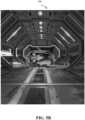
- FIG. 5A is a photograph of an example of an image 500 generated based on the motion vectors of FIG. 4A
- FIG. 5B is a photograph of an image 510 generated based on the motion vectors of FIG. 4B
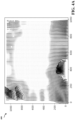
- FIG. 5C is a heat map 520 showing areas of difference between FIG. 5A and FIG. 5B .
- the differences between FIG. 5A and 5B would be difficult to spot by a user, especially when viewed as one of a series of frames. As illustrated in FIG. 5C , the differences are only in the peripheral region, where a user is unlikely to be focused. Accordingly, the disclosed techniques of using reduced motion estimation for peripheral regions may provide significant reductions in use of processing resources while not significantly diminishing perceived quality.
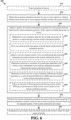
- FIG. 6 illustrates an example flowchart of an example method 600 in accordance with one or more techniques of this disclosure.
- the method 600 may be performed by a GPU or apparatus for graphics processing.
- Optional blocks are shown with dashed lines.
- the method 600 may optionally include tracking a position of an eye.
- the apparatus may include an eye tracker having one or more sensors directed at an eye of the user to determine the position of the eye.
- the eye tracker may determine a focal point of the eye on a display.
- the eye tracker may determine a corresponding point within a frame.
- the processing unit 120 and/or the determination component 198 may receive an indication of a position of the eye with respect to the frame.
- the method 600 may include determining a motion estimation priority for one or more regions in a frame, wherein each of the one or more regions includes at least one group of pixels.
- the apparatus including the processing unit 120 and/or the determination component 198 can determine a motion estimation priority for one or more regions in a frame, as described in connection with the examples in FIGs. 4A and 4B .
- each of the one or more regions can include a group of pixels.
- the one or more regions may include a central region and a peripheral region.
- the one or more regions include at least one intermediate region between the central region and the peripheral region.
- the one or more regions in the frame are defined with respect to the position of the eye.
- the method 600 may include adjusting a quality of a motion estimation procedure for each group of pixels based on the motion estimation priority of the region including the group of pixels.
- the apparatus including the processing unit 120 and/or the determination component 198 can adjust the quality of the motion estimation procedure for each group of pixels based on the motion estimation priority, as described in connection with the examples in FIGs. 4A and 4B .
- the block 630 may optionally include determining to set a constant value for the at least one group of pixels in a region having a lowest motion estimation priority.
- the block 630 may optionally include setting a size of the at least one group of pixels based on the motion estimation priority.
- the block 630 may optionally include adjusting a size of a search window to be covered during the motion estimation procedure based on the motion estimation priority.
- the block 630 may optionally include determining inclusion or omission of a multi-pass algorithm with motion vector refinement in the motion estimation procedure based on the motion estimation priority.
- the block 630 may optionally include determining a block size for a SAD operation or a SSD operation based on the motion estimation priority. In some implementations, at sub-block 642, the block 630 may optionally include adjusting an amount of filtering performed during motion search filtering or performed on final motion vectors based on the motion estimation priority. In an aspect, the block 630 may include two or more of sub-blocks 632, 634, 636, 638, 640, or 642 in combination.
- the method 600 may include performing the motion estimation procedure for each of the at least one group of pixels to generate a motion vector for the at least one group of pixels based on the adjusted quality of the motion estimation procedure.
- the apparatus including the processing unit 120 and/or the determination component 198 can also perform the motion estimation procedure for each of the one or more regions based on the adjusted quality of the of the motion estimation procedure, as described in connection with the examples in FIGs. 4A and 4B .
- the method 600 may optionally include extrapolating a new frame from the frame based on the motion vector for each group of pixels.
- the processing unit 120 and/or the determination component 198 may extrapolate a new frame (e.g., image 510) from the frame based on the motion vector for each group of pixels.
- a method or apparatus for graphics processing may be a GPU or some other processor that can perform graphics processing.
- the apparatus may be the processing unit 120 within the device 104, or may be some other hardware within device 104 or another device.
- the apparatus may include means for tracking a position of an eye.
- the apparatus may include means for determining a motion estimation priority for one or more regions in a frame.
- the apparatus can also include means for adjusting a quality a motion estimation procedure for each group of pixels based on the motion estimation priority of the region including the group of pixels.
- the apparatus can also include means for performing the motion estimation procedure for each of the at least one group of pixels to generate a motion vector for the at least one group of pixels based on the adjusted quality of the motion estimation procedure.
- the apparatus can also include means for extrapolating a new frame from the frame based on the motion vector for each group of pixels.
- the described graphics processing techniques can be accomplished at a low cost compared to other graphics processing techniques.
- the graphics processing techniques herein can improve or speed up the data processing or execution of GPUs.
- the graphics processing techniques herein can improve a GPU's resource or data utilization and/or resource efficiency.
- aspects of the present disclosure can improve the motion estimation of a GPU, which can in turn improve the accuracy and efficiency of the GPU. Aspects of the present disclosure can also improve the accuracy of motion estimation.
- the functions described herein may be implemented in hardware, software, firmware, or any combination thereof.
- processing unit has been used throughout this disclosure, such processing units may be implemented in hardware, software, firmware, or any combination thereof. If any function, processing unit, technique described herein, or other module is implemented in software, the function, processing unit, technique described herein, or other module may be stored on or transmitted over as one or more instructions or code on a computer-readable medium.
- Computer-readable media may include computer data storage media or communication media including any medium that facilitates transfer of a computer program from one place to another. In this manner, computer-readable media generally may correspond to (1) tangible computer-readable storage media, which is non-transitory or (2) a communication medium such as a signal or carrier wave.
- Data storage media may be any available media that can be accessed by one or more computers or one or more processors to retrieve instructions, code and/or data structures for implementation of the techniques described in this disclosure.
- such computer-readable media can comprise RAM, ROM, EEPROM, CD-ROM or other optical disk storage, magnetic disk storage or other magnetic storage devices,.
- Disk and disc includes compact disc (CD), laser disc, optical disc, digital versatile disc (DVD), floppy disk and Blu-ray disc where disks usually reproduce data magnetically, while discs reproduce data optically with lasers. Combinations of the above should also be included within the scope of computer-readable media.
- a computer program product may include a computer-readable medium.
- the code may be executed by one or more processors, such as one or more digital signal processors (DSPs), general purpose microprocessors, application specific integrated circuits (ASICs), arithmetic logic units (ALUs), field programmable logic arrays (FPGAs), or other equivalent integrated or discrete logic circuitry.
- DSPs digital signal processors
- ASICs application specific integrated circuits
- ALUs arithmetic logic units
- FPGAs field programmable logic arrays
- processors such as one or more digital signal processors (DSPs), general purpose microprocessors, application specific integrated circuits (ASICs), arithmetic logic units (ALUs), field programmable logic arrays (FPGAs), or other equivalent integrated or discrete logic circuitry.
- DSPs digital signal processors
- ASICs application specific integrated circuits
- ALUs arithmetic logic units
- FPGAs field programmable logic arrays
- the techniques of this disclosure may be implemented in a wide variety of devices or apparatuses, including a wireless handset, an integrated circuit (IC) or a set of ICs, e.g., a chip set.
- IC integrated circuit
- Various components, modules or units are described in this disclosure to emphasize functional aspects of devices configured to perform the disclosed techniques, but do not necessarily need realization by different hardware units. Rather, as described above, various units may be combined in any hardware unit or provided by a collection of interoperative hardware units, including one or more processors as described above, in conjunction with suitable software and/or firmware.
Landscapes
- Engineering & Computer Science (AREA)
- Physics & Mathematics (AREA)
- General Physics & Mathematics (AREA)
- Theoretical Computer Science (AREA)
- Multimedia (AREA)
- Computer Vision & Pattern Recognition (AREA)
- Processing Or Creating Images (AREA)
- Image Analysis (AREA)
- Controls And Circuits For Display Device (AREA)
Claims (15)
- Procédé de traitement graphique (600) mis en œuvre par ordinateur, comprenant :la détermination (620) d'une priorité d'estimation de mouvement pour une ou plusieurs régions dans une image, dans lequel chacune des une ou plusieurs régions comprend au moins un groupe de pixels, dans lequel la priorité d'estimation de mouvement pour une région est basée sur l'emplacement de la région par rapport au centre de l'image ou l'emplacement de la région par rapport à un point focal de l'œil d'un utilisateur regardant l'image ;la sélection (630) de paramètres pour une procédure d'estimation de mouvement pour chaque groupe de pixels sur la base de la priorité d'estimation de mouvement de la région comportant le groupe de pixels, les paramètres sélectionnés ajustant la qualité de l'estimation de mouvement entre les une ou plusieurs régions ;la réalisation (650), pour chacun de l'au moins un groupe de pixels, de la procédure d'estimation de mouvement à l'aide des paramètres sélectionnés respectifs pour générer un vecteur de mouvement ;l'extrapolation (660) d'une nouvelle image à partir de l'image sur la base des vecteurs de mouvement pour chaque groupe de pixels ; etl'utilisation de l'image extrapolée au lieu du rendu d'une image respective pour réduire la fréquence d'images de rendu.
- Procédé selon la revendication 1, dans lequel les une ou plusieurs régions comportent une région centrale et une région périphérique.
- Procédé selon la revendication 2, dans lequel les une ou plusieurs régions comportent au moins une région intermédiaire entre la région centrale et la région périphérique.
- Procédé selon la revendication 1, comprenant en outre :
le suivi (610) d'une position de l'œil d'un utilisateur regardant l'image, dans lequel les une ou plusieurs régions dans l'image sont définies par rapport à la position de l'œil de l'utilisateur. - Procédé selon la revendication 1, dans lequel la sélection de paramètres (630) pour une procédure d'estimation de mouvement pour chaque groupe de pixels sur la base de la priorité d'estimation de mouvement de la région comportant le groupe de pixels comprend une détermination (632) pour régler une valeur de constante pour le vecteur de mouvement pour l'au moins un groupe de pixels dans une région ayant la priorité d'estimation de mouvement la plus faible.
- Procédé selon la revendication 1, dans lequel la sélection de paramètres (630) pour une procédure d'estimation de mouvement pour chaque groupe de pixels sur la base de la priorité d'estimation de mouvement de la région comportant le groupe de pixels comprend le réglage (634) d'une densité de vecteurs de mouvement en réglant une taille de l'au moins un groupe de pixels sur la base de la priorité d'estimation de mouvement.
- Procédé selon la revendication 1, dans lequel la sélection de paramètres (630) pour une procédure d'estimation de mouvement pour chaque groupe de pixels sur la base de la priorité d'estimation de mouvement de la région comportant le groupe de pixels comprend l'ajustement (636) d'une taille d'une fenêtre de recherche utilisée comme positions candidates pour l'estimation de mouvement pour une région sur la base de la priorité d'estimation de mouvement.
- Procédé selon la revendication 1, dans lequel la sélection de paramètres (630) pour une procédure d'estimation de mouvement pour chaque groupe de pixels sur la base de la priorité d'estimation de mouvement de la région comportant le groupe de pixels comprend la détermination (638) d'une résolution pour une estimation de vecteur de mouvement sur la base de la priorité d'estimation de mouvement et la réalisation d'un affinement d'une recherche grossière initiale et/ou d'un filtrage vectoriel pour les régions ayant une priorité d'estimation de mouvement plus élevée.
- Procédé selon la revendication 1, dans lequel la sélection de paramètres (630) pour une procédure d'estimation de mouvement pour chaque groupe de pixels sur la base de la priorité d'estimation de mouvement de la région comportant le groupe de pixels comprend la détermination (640) d'une taille de bloc pour une procédure d'estimation de mouvement basée sur l'appariement de blocs, l'appariement de blocs utilisant une opération de somme de différences absolues, SAD, ou une opération de somme de différences au carré, SSD.
- Procédé selon la revendication 1, dans lequel la sélection de paramètres (630) pour une procédure d'estimation de mouvement pour chaque groupe de pixels sur la base de la priorité d'estimation de mouvement de la région comportant le groupe de comprend l'ajustement (642) d'une quantité de filtrage réalisée durant la procédure d'estimation de mouvement sur la base de la priorité d'estimation de mouvement.
- Appareil de traitement de données pour un traitement graphique, comprenant :un moyen de détermination d'une priorité d'estimation de mouvement pour une ou plusieurs régions d'une image, dans lequel chacune des une ou plusieurs régions comporte au moins un groupe de pixels, dans lequel la priorité d'estimation de mouvement pour une région est basée sur l'emplacement de la région par rapport au centre de l'image ou l'emplacement de la région par rapport à un point focal de l'œil d'un utilisateur regardant l'image ;un moyen de sélection de paramètres pour une procédure d'estimation de mouvement pour chaque groupe de pixels sur la base de la priorité d'estimation de mouvement de la région comportant le groupe de pixels, les paramètres sélectionnés ajustant la qualité de l'estimation de mouvement entre les une ou plusieurs régions ;un moyen de réalisation, pour chacun de l'au moins un groupe de pixels, de la procédure d'estimation de mouvement à l'aide des paramètres respectifs sélectionnés pour générer un vecteur de mouvement ;un moyen d'extrapolation d'une nouvelle image à partir de l'image sur la base du vecteur de mouvement pour chaque groupe de pixels ; etun moyen d'utilisation de l'image extrapolée au lieu du rendu d'une image correspondante pour réduire la fréquence d'images de rendu.
- Appareil selon la revendication 11, comprenant en outre un moyen de suivi d'une position de l'œil d'un utilisateur regardant l'image, dans lequel les une ou plusieurs régions de l'image sont définies par rapport à la position de l'œil de l'utilisateur.
- Dispositif selon la revendication 11, dans lequel le moyen de sélection de paramètres pour une procédure d'estimation de mouvement pour chaque groupe de pixels sur la base de la priorité d'estimation de mouvement de la région comportant le groupe de pixels est configuré pour :
déterminer de régler une valeur constante pour l'au moins un groupe de pixels dans une région ayant la priorité d'estimation de mouvement la plus faible. - Dispositif selon la revendication 11, dans lequel le moyen de sélection de paramètres pour une procédure d'estimation de mouvement pour chaque groupe de pixels sur la base de la priorité d'estimation de mouvement de la région comportant le groupe de pixels est configuré pour :
régler une taille de l'au moins un groupe de pixels sur la base de la priorité d'estimation de mouvement, ou régler une taille d'une fenêtre de recherche à couvrir durant la procédure d'estimation de mouvement sur la base de la priorité d'estimation de mouvement. - Support lisible par ordinateur non transitoire comprenant des instructions qui, à leur exécution par un ordinateur, amènent l'ordinateur à entreprendre le procédé selon l'une quelconque des revendications 1 à 10.
Applications Claiming Priority (3)
| Application Number | Priority Date | Filing Date | Title |
|---|---|---|---|
| US201962888974P | 2019-08-19 | 2019-08-19 | |
| US16/987,983 US11315211B2 (en) | 2019-08-19 | 2020-08-07 | Methods and apparatus for efficient motion estimation |
| PCT/US2020/045671 WO2021034532A1 (fr) | 2019-08-19 | 2020-08-10 | Procédés et appareil pour une estimation de mouvement efficace |
Publications (3)
| Publication Number | Publication Date |
|---|---|
| EP4018416A1 EP4018416A1 (fr) | 2022-06-29 |
| EP4018416B1 true EP4018416B1 (fr) | 2025-06-11 |
| EP4018416C0 EP4018416C0 (fr) | 2025-06-11 |
Family
ID=74646295
Family Applications (1)
| Application Number | Title | Priority Date | Filing Date |
|---|---|---|---|
| EP20761429.8A Active EP4018416B1 (fr) | 2019-08-19 | 2020-08-10 | Procédés et appareil pour une estimation de mouvement efficace |
Country Status (5)
| Country | Link |
|---|---|
| US (1) | US11315211B2 (fr) |
| EP (1) | EP4018416B1 (fr) |
| CN (1) | CN114245904B (fr) |
| TW (1) | TW202111663A (fr) |
| WO (1) | WO2021034532A1 (fr) |
Families Citing this family (1)
| Publication number | Priority date | Publication date | Assignee | Title |
|---|---|---|---|---|
| US11367199B2 (en) * | 2020-06-12 | 2022-06-21 | Adobe Inc. | System for automatic object mask and hotspot tracking |
Citations (1)
| Publication number | Priority date | Publication date | Assignee | Title |
|---|---|---|---|---|
| US10708597B2 (en) * | 2018-02-01 | 2020-07-07 | Microsoft Technology Licensing, Llc | Techniques for extrapolating image frames |
Family Cites Families (20)
| Publication number | Priority date | Publication date | Assignee | Title |
|---|---|---|---|---|
| CA2079434A1 (fr) * | 1991-09-30 | 1993-03-31 | Derek Andrew | Estimation de vecteurs de mouvement et codage et stockage d'images animees |
| US6671321B1 (en) * | 1999-08-31 | 2003-12-30 | Mastsushita Electric Industrial Co., Ltd. | Motion vector detection device and motion vector detection method |
| US7050502B2 (en) * | 2001-09-18 | 2006-05-23 | Matsushita Electric Industrial Co., Ltd. | Method and apparatus for motion vector detection and medium storing method program directed to the same |
| US6798741B2 (en) * | 2001-12-05 | 2004-09-28 | Riverstone Networks, Inc. | Method and system for rate shaping in packet-based computer networks |
| US7760968B2 (en) * | 2004-01-16 | 2010-07-20 | Nvidia Corporation | Video image processing with processing time allocation |
| JP4142600B2 (ja) * | 2004-03-03 | 2008-09-03 | 日本電信電話株式会社 | 動きベクトル推定方法,動きベクトル推定装置,動きベクトル推定プログラムおよび動きベクトル推定プログラム記録媒体 |
| EP1755342A1 (fr) * | 2005-08-19 | 2007-02-21 | Thomson Licensing | Méthode et dispositif de calcul itératif de paramètres de mouvement pour une séquence d'images à partir de vecteurs de mouvement de blocs |
| US7965774B2 (en) * | 2006-01-06 | 2011-06-21 | International Business Machines Corporation | Method for visual signal extrapolation or interpolation |
| CN101271587B (zh) * | 2008-02-25 | 2010-09-08 | 北京理工大学 | 一种基于过渡光贴图的光照和阴影绘制方法 |
| CN102202164B (zh) * | 2011-05-20 | 2013-03-20 | 长安大学 | 基于运动估计的道路视频稳定方法 |
| US9032467B2 (en) * | 2011-08-02 | 2015-05-12 | Google Inc. | Method and mechanism for efficiently delivering visual data across a network |
| US9423994B2 (en) * | 2012-02-22 | 2016-08-23 | Citrix Systems, Inc. | Hierarchical display |
| EP3054685A1 (fr) * | 2015-02-04 | 2016-08-10 | Thomson Licensing | Estimation de mouvement hiérarchique et segmentation vidéo en présence de plus d'un objet mobile dans un bloc |
| EP3440495A1 (fr) * | 2016-04-08 | 2019-02-13 | Google LLC | Codage de données d'image au niveau d'un dispositif visiocasque en fonction d'informations de pose |
| US10482648B2 (en) * | 2016-12-13 | 2019-11-19 | Qualcomm Incorporated | Scene-based foveated rendering of graphics content |
| JP6894725B2 (ja) | 2017-03-09 | 2021-06-30 | キヤノン株式会社 | 画像処理装置及びその制御方法、プログラム、記憶媒体 |
| US10152822B2 (en) * | 2017-04-01 | 2018-12-11 | Intel Corporation | Motion biased foveated renderer |
| CN118612461A (zh) * | 2017-11-23 | 2024-09-06 | 英特尔公司 | 自适应中心凹形编码器以及全局运动预测因子 |
| US20190045193A1 (en) * | 2018-06-29 | 2019-02-07 | Intel Corporation | Region-based motion estimation and modeling for accurate region-based motion compensation for efficient video processing or coding |
| CN109120940B (zh) * | 2018-08-02 | 2021-07-13 | 辽宁师范大学 | 自适应因子的视频缩放运动估计方法 |
-
2020
- 2020-08-07 US US16/987,983 patent/US11315211B2/en active Active
- 2020-08-10 WO PCT/US2020/045671 patent/WO2021034532A1/fr not_active Ceased
- 2020-08-10 EP EP20761429.8A patent/EP4018416B1/fr active Active
- 2020-08-10 CN CN202080056213.XA patent/CN114245904B/zh active Active
- 2020-08-12 TW TW109127337A patent/TW202111663A/zh unknown
Patent Citations (1)
| Publication number | Priority date | Publication date | Assignee | Title |
|---|---|---|---|---|
| US10708597B2 (en) * | 2018-02-01 | 2020-07-07 | Microsoft Technology Licensing, Llc | Techniques for extrapolating image frames |
Also Published As
| Publication number | Publication date |
|---|---|
| EP4018416A1 (fr) | 2022-06-29 |
| CN114245904B (zh) | 2025-08-05 |
| US11315211B2 (en) | 2022-04-26 |
| CN114245904A (zh) | 2022-03-25 |
| EP4018416C0 (fr) | 2025-06-11 |
| TW202111663A (zh) | 2021-03-16 |
| WO2021034532A1 (fr) | 2021-02-25 |
| US20210056661A1 (en) | 2021-02-25 |
Similar Documents
| Publication | Publication Date | Title |
|---|---|---|
| US11455705B2 (en) | Asynchronous space warp for remotely rendered VR | |
| WO2021231016A1 (fr) | Procédés et appareil pour la gestion d'atlas d'un contenu de réalité augmentée | |
| US12518496B2 (en) | Methods and apparatus for saliency based frame color enhancement | |
| EP3857516B1 (fr) | Mélange de cases voisines | |
| US12567161B2 (en) | Methods and apparatus for occlusion handling techniques | |
| US20200380700A1 (en) | Methods and apparatus for detecting motion estimation | |
| EP4018416B1 (fr) | Procédés et appareil pour une estimation de mouvement efficace | |
| US20200364926A1 (en) | Methods and apparatus for adaptive object space shading | |
| US12079951B2 (en) | Fuzzy logic-based pattern matching and corner filtering for display scaler | |
| US11748842B2 (en) | Methods and apparatus for content shifting in foveated rendering | |
| US11875452B2 (en) | Billboard layers in object-space rendering | |
| CN119866504A (zh) | 通过共享gpu硬件并发生成图块可见性信息 | |
| US11615537B2 (en) | Methods and apparatus for motion estimation based on region discontinuity | |
| US20260073623A1 (en) | Gaussian synthesis for spatial frames | |
| KR20260051371A (ko) | 분할 렌더링을 위한 적응형 포비티드 코딩 | |
| TW202510570A (zh) | 用於分割演現之適應性注視點寫碼 | |
| WO2024155355A1 (fr) | Instruction de recherche de fenêtre de mise en correspondance de blocs à l'aide d'un pipeline de texture d'unité de traitement graphique (gpu) |
Legal Events
| Date | Code | Title | Description |
|---|---|---|---|
| STAA | Information on the status of an ep patent application or granted ep patent |
Free format text: STATUS: UNKNOWN |
|
| STAA | Information on the status of an ep patent application or granted ep patent |
Free format text: STATUS: THE INTERNATIONAL PUBLICATION HAS BEEN MADE |
|
| PUAI | Public reference made under article 153(3) epc to a published international application that has entered the european phase |
Free format text: ORIGINAL CODE: 0009012 |
|
| STAA | Information on the status of an ep patent application or granted ep patent |
Free format text: STATUS: REQUEST FOR EXAMINATION WAS MADE |
|
| 17P | Request for examination filed |
Effective date: 20220131 |
|
| AK | Designated contracting states |
Kind code of ref document: A1 Designated state(s): AL AT BE BG CH CY CZ DE DK EE ES FI FR GB GR HR HU IE IS IT LI LT LU LV MC MK MT NL NO PL PT RO RS SE SI SK SM TR |
|
| DAV | Request for validation of the european patent (deleted) | ||
| DAX | Request for extension of the european patent (deleted) | ||
| GRAP | Despatch of communication of intention to grant a patent |
Free format text: ORIGINAL CODE: EPIDOSNIGR1 |
|
| STAA | Information on the status of an ep patent application or granted ep patent |
Free format text: STATUS: GRANT OF PATENT IS INTENDED |
|
| INTG | Intention to grant announced |
Effective date: 20250109 |
|
| GRAS | Grant fee paid |
Free format text: ORIGINAL CODE: EPIDOSNIGR3 |
|
| GRAA | (expected) grant |
Free format text: ORIGINAL CODE: 0009210 |
|
| STAA | Information on the status of an ep patent application or granted ep patent |
Free format text: STATUS: THE PATENT HAS BEEN GRANTED |
|
| AK | Designated contracting states |
Kind code of ref document: B1 Designated state(s): AL AT BE BG CH CY CZ DE DK EE ES FI FR GB GR HR HU IE IS IT LI LT LU LV MC MK MT NL NO PL PT RO RS SE SI SK SM TR |
|
| REG | Reference to a national code |
Ref country code: GB Ref legal event code: FG4D |
|
| REG | Reference to a national code |
Ref country code: CH Ref legal event code: EP |
|
| REG | Reference to a national code |
Ref country code: IE Ref legal event code: FG4D |
|
| REG | Reference to a national code |
Ref country code: DE Ref legal event code: R096 Ref document number: 602020052628 Country of ref document: DE |
|
| U01 | Request for unitary effect filed |
Effective date: 20250630 |
|
| U07 | Unitary effect registered |
Designated state(s): AT BE BG DE DK EE FI FR IT LT LU LV MT NL PT RO SE SI Effective date: 20250704 |
|
| U20 | Renewal fee for the european patent with unitary effect paid |
Year of fee payment: 6 Effective date: 20250710 |
|
| PG25 | Lapsed in a contracting state [announced via postgrant information from national office to epo] |
Ref country code: ES Free format text: LAPSE BECAUSE OF FAILURE TO SUBMIT A TRANSLATION OF THE DESCRIPTION OR TO PAY THE FEE WITHIN THE PRESCRIBED TIME-LIMIT Effective date: 20250611 |
|
| PG25 | Lapsed in a contracting state [announced via postgrant information from national office to epo] |
Ref country code: NO Free format text: LAPSE BECAUSE OF FAILURE TO SUBMIT A TRANSLATION OF THE DESCRIPTION OR TO PAY THE FEE WITHIN THE PRESCRIBED TIME-LIMIT Effective date: 20250911 Ref country code: GR Free format text: LAPSE BECAUSE OF FAILURE TO SUBMIT A TRANSLATION OF THE DESCRIPTION OR TO PAY THE FEE WITHIN THE PRESCRIBED TIME-LIMIT Effective date: 20250912 |
|
| PGFP | Annual fee paid to national office [announced via postgrant information from national office to epo] |
Ref country code: GB Payment date: 20250710 Year of fee payment: 6 |
|
| PG25 | Lapsed in a contracting state [announced via postgrant information from national office to epo] |
Ref country code: HR Free format text: LAPSE BECAUSE OF FAILURE TO SUBMIT A TRANSLATION OF THE DESCRIPTION OR TO PAY THE FEE WITHIN THE PRESCRIBED TIME-LIMIT Effective date: 20250611 |
|
| PG25 | Lapsed in a contracting state [announced via postgrant information from national office to epo] |
Ref country code: RS Free format text: LAPSE BECAUSE OF FAILURE TO SUBMIT A TRANSLATION OF THE DESCRIPTION OR TO PAY THE FEE WITHIN THE PRESCRIBED TIME-LIMIT Effective date: 20250911 |
|
| PGFP | Annual fee paid to national office [announced via postgrant information from national office to epo] |
Ref country code: IE Payment date: 20250709 Year of fee payment: 6 |
|
| PG25 | Lapsed in a contracting state [announced via postgrant information from national office to epo] |
Ref country code: IS Free format text: LAPSE BECAUSE OF FAILURE TO SUBMIT A TRANSLATION OF THE DESCRIPTION OR TO PAY THE FEE WITHIN THE PRESCRIBED TIME-LIMIT Effective date: 20251011 |
|
| PG25 | Lapsed in a contracting state [announced via postgrant information from national office to epo] |
Ref country code: SM Free format text: LAPSE BECAUSE OF FAILURE TO SUBMIT A TRANSLATION OF THE DESCRIPTION OR TO PAY THE FEE WITHIN THE PRESCRIBED TIME-LIMIT Effective date: 20250611 |
|
| PG25 | Lapsed in a contracting state [announced via postgrant information from national office to epo] |
Ref country code: CZ Free format text: LAPSE BECAUSE OF FAILURE TO SUBMIT A TRANSLATION OF THE DESCRIPTION OR TO PAY THE FEE WITHIN THE PRESCRIBED TIME-LIMIT Effective date: 20250611 |
|
| PG25 | Lapsed in a contracting state [announced via postgrant information from national office to epo] |
Ref country code: PL Free format text: LAPSE BECAUSE OF FAILURE TO SUBMIT A TRANSLATION OF THE DESCRIPTION OR TO PAY THE FEE WITHIN THE PRESCRIBED TIME-LIMIT Effective date: 20250611 |
|
| PG25 | Lapsed in a contracting state [announced via postgrant information from national office to epo] |
Ref country code: SK Free format text: LAPSE BECAUSE OF FAILURE TO SUBMIT A TRANSLATION OF THE DESCRIPTION OR TO PAY THE FEE WITHIN THE PRESCRIBED TIME-LIMIT Effective date: 20250611 |
|
| REG | Reference to a national code |
Ref country code: CH Ref legal event code: H13 Free format text: ST27 STATUS EVENT CODE: U-0-0-H10-H13 (AS PROVIDED BY THE NATIONAL OFFICE) Effective date: 20260324 |
|
| PG25 | Lapsed in a contracting state [announced via postgrant information from national office to epo] |
Ref country code: MC Free format text: LAPSE BECAUSE OF FAILURE TO SUBMIT A TRANSLATION OF THE DESCRIPTION OR TO PAY THE FEE WITHIN THE PRESCRIBED TIME-LIMIT Effective date: 20250611 |
|
| PLBE | No opposition filed within time limit |
Free format text: ORIGINAL CODE: 0009261 |
|
| STAA | Information on the status of an ep patent application or granted ep patent |
Free format text: STATUS: NO OPPOSITION FILED WITHIN TIME LIMIT |
|
| PG25 | Lapsed in a contracting state [announced via postgrant information from national office to epo] |
Ref country code: CH Free format text: LAPSE BECAUSE OF NON-PAYMENT OF DUE FEES Effective date: 20250831 |
|
| REG | Reference to a national code |
Ref country code: CH Ref legal event code: L10 Free format text: ST27 STATUS EVENT CODE: U-0-0-L10-L00 (AS PROVIDED BY THE NATIONAL OFFICE) Effective date: 20260423 |