EP4018743B1 - Einstellen eines anderen bandbreitenteils früher in einem verbindungsaufbauverfahren zu einem drahtlosen netzwerk durch ein benutzergerät beim übergang von einem ruhemodus oder inaktiven zustand - Google Patents
Einstellen eines anderen bandbreitenteils früher in einem verbindungsaufbauverfahren zu einem drahtlosen netzwerk durch ein benutzergerät beim übergang von einem ruhemodus oder inaktiven zustand Download PDFInfo
- Publication number
- EP4018743B1 EP4018743B1 EP19942569.5A EP19942569A EP4018743B1 EP 4018743 B1 EP4018743 B1 EP 4018743B1 EP 19942569 A EP19942569 A EP 19942569A EP 4018743 B1 EP4018743 B1 EP 4018743B1
- Authority
- EP
- European Patent Office
- Prior art keywords
- user equipment
- bandwidth part
- selected bandwidth
- wireless network
- network
- Prior art date
- Legal status (The legal status is an assumption and is not a legal conclusion. Google has not performed a legal analysis and makes no representation as to the accuracy of the status listed.)
- Active
Links
Images



Classifications
-
- H—ELECTRICITY
- H04—ELECTRIC COMMUNICATION TECHNIQUE
- H04W—WIRELESS COMMUNICATION NETWORKS
- H04W72/00—Local resource management
- H04W72/04—Wireless resource allocation
- H04W72/044—Wireless resource allocation based on the type of the allocated resource
- H04W72/0453—Resources in frequency domain, e.g. a carrier in FDMA
-
- H—ELECTRICITY
- H04—ELECTRIC COMMUNICATION TECHNIQUE
- H04L—TRANSMISSION OF DIGITAL INFORMATION, e.g. TELEGRAPHIC COMMUNICATION
- H04L5/00—Arrangements affording multiple use of the transmission path
- H04L5/0091—Signalling for the administration of the divided path, e.g. signalling of configuration information
- H04L5/0092—Indication of how the channel is divided
-
- H—ELECTRICITY
- H04—ELECTRIC COMMUNICATION TECHNIQUE
- H04W—WIRELESS COMMUNICATION NETWORKS
- H04W52/00—Power management, e.g. Transmission Power Control [TPC] or power classes
- H04W52/02—Power saving arrangements
- H04W52/0209—Power saving arrangements in terminal devices
- H04W52/0212—Power saving arrangements in terminal devices managed by the network, e.g. network or access point is leader and terminal is follower
-
- H—ELECTRICITY
- H04—ELECTRIC COMMUNICATION TECHNIQUE
- H04W—WIRELESS COMMUNICATION NETWORKS
- H04W68/00—User notification, e.g. alerting and paging, for incoming communication, change of service or the like
- H04W68/02—Arrangements for increasing efficiency of notification or paging channel
-
- H—ELECTRICITY
- H04—ELECTRIC COMMUNICATION TECHNIQUE
- H04W—WIRELESS COMMUNICATION NETWORKS
- H04W48/00—Access restriction; Network selection; Access point selection
- H04W48/20—Selecting an access point
-
- H—ELECTRICITY
- H04—ELECTRIC COMMUNICATION TECHNIQUE
- H04W—WIRELESS COMMUNICATION NETWORKS
- H04W68/00—User notification, e.g. alerting and paging, for incoming communication, change of service or the like
- H04W68/005—Transmission of information for alerting of incoming communication
-
- H—ELECTRICITY
- H04—ELECTRIC COMMUNICATION TECHNIQUE
- H04W—WIRELESS COMMUNICATION NETWORKS
- H04W76/00—Connection management
- H04W76/20—Manipulation of established connections
- H04W76/27—Transitions between radio resource control [RRC] states
-
- Y—GENERAL TAGGING OF NEW TECHNOLOGICAL DEVELOPMENTS; GENERAL TAGGING OF CROSS-SECTIONAL TECHNOLOGIES SPANNING OVER SEVERAL SECTIONS OF THE IPC; TECHNICAL SUBJECTS COVERED BY FORMER USPC CROSS-REFERENCE ART COLLECTIONS [XRACs] AND DIGESTS
- Y02—TECHNOLOGIES OR APPLICATIONS FOR MITIGATION OR ADAPTATION AGAINST CLIMATE CHANGE
- Y02D—CLIMATE CHANGE MITIGATION TECHNOLOGIES IN INFORMATION AND COMMUNICATION TECHNOLOGIES [ICT], I.E. INFORMATION AND COMMUNICATION TECHNOLOGIES AIMING AT THE REDUCTION OF THEIR OWN ENERGY USE
- Y02D30/00—Reducing energy consumption in communication networks
- Y02D30/70—Reducing energy consumption in communication networks in wireless communication networks
Definitions
- This invention relates generally to wireless networks and, more specifically, relates to bandwidth part (BWP) assignment by the network node for a connection establishment process of the UE to the wireless network.
- BWP bandwidth part
- a carrier Bandwidth Part is a contiguous set of physical resource blocks, selected from a contiguous subset of common resource blocks on a given carrier.
- the carrier has some total bandwidth, and the BWPs are part of that.
- a limited number e.g., four
- BWPs in uplink (UL) and downlink (DL) can be assigned to a User Equipment (UE).
- UE User Equipment
- the network can configure a wider BWP (e.g., wider than an initial BWP) when the network has received the UE's context/capabilities, but at earliest in the RRCResume message (in the INACTIVE state) or RRCReconfiguration (in the IDLE state) in connection procedures. Because the NW does not know which BWPs the UE can support earlier than at these times, it is not possible to have wider BWP applied, e.g., already ready for use for msg3 (e.g., using an RRCResumeRequest or RRCSetupRequest message).
- a wider BWP e.g., wider than an initial BWP
- RRCResume message in the INACTIVE state
- RRCReconfiguration in the IDLE state
- the message msg3 is a message in a Random Access Channel (RACH) procedure where the UE is performing an initial access or reconnection to the network.
- RACH Random Access Channel
- MEDIATEK INC "FURTHER CLARIFICATION ON BWP CONFIGURATION IN RRC”, 3GPP DRAFT; R2-1800648 3RD GENERATION PARTNERSHIP PROJECT (3GPP), MOBILE COMPETENCE CENTRE ; 650, ROUTE DES LUCIOLES ; F-06921 SOPHIA-ANTIPOLIS CEDEX, VOL. RAN WG2, NO.
- VANCOUVER VANCOUVER, CANADA; 20180122 - 20180126 12 JANUARY 2018 (2018-01-12), XP051386271 , DISCLOSES FURTHER CLARIFICATION ON THE CONCEPT OF INITIAL ACTIVE BWP AND WELL AS THE REMAINING ISSUES ARE DISCUSSED.
- the exemplary embodiments herein describe techniques for setting a higher BWP earlier in a connection establishment process to a wireless network. Additional description of these techniques is presented after a system into which the exemplary embodiments may be used is described.
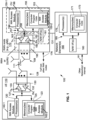
- FIG. 1 this figure shows a block diagram of one possible and non-limiting exemplary system in which the exemplary embodiments may be practiced.
- a user equipment (UE) 110 radio access network (RAN) node 170, and network element(s) 190 are illustrated.
- a user equipment (UE) 110 is in wireless communication with a wireless network 100.
- a UE is a wireless, typically mobile device that can access a wireless network.
- the UE 110 includes one or more processors 120, one or more memories 125, and one or more transceivers 130 interconnected through one or more buses 127. Each of the one or more transceivers 130 includes a receiver, Rx, 132 and a transmitter, Tx, 133.
- the one or more buses 127 may be address, data, or control buses, and may include any interconnection mechanism, such as a series of lines on a motherboard or integrated circuit, fiber optics or other optical communication equipment, and the like.
- the one or more transceivers 130 are connected to one or more antennas 128.
- the one or more memories 125 include computer program code 123.
- the UE 110 includes a NW access module 140, comprising one of or both parts 140-1 and/or 140-2, which may be implemented in a number of ways.
- the NW access module 140 may be implemented in hardware as NW access module 140-1, such as being implemented as part of the one or more processors 120.
- the NW access module 140-1 may be implemented also as an integrated circuit or through other hardware such as a programmable gate array.
- the NW access module 140 may be implemented as NW access module 140-2, which is implemented as computer program code 123 and is executed by the one or more processors 120.
- the one or more memories 125 and the computer program code 123 may be configured to, with the one or more processors 120, cause the user equipment 110 to perform one or more of the operations as described herein.
- the UE 110 communicates with RAN node 170 via a wireless link 111.
- the RAN node 170 is a base station that provides access by wireless devices such as the UE 110 to the wireless network 100.
- the RAN node 170 may be, for instance, a base station for 5G, also called New Radio (NR).
- the RAN node 170 may be a NG-RAN node, which is defined as either a gNB or an ng-eNB.
- a gNB is a node providing NR user plane and control plane protocol terminations towards the UE, and connected via the NG interface to a 5GC (e.g., the network element(s) 190).
- the ng-eNB is a node providing E-UTRA user plane and control plane protocol terminations towards the UE, and connected via the NG interface to the 5GC.
- the NG-RAN node may include multiple gNBs, which may also include a central unit (CU) (gNB-CU) 196 and distributed unit(s) (DUs) (gNB-DUs), of which DU 195 is shown.
- the DU may include or be coupled to and control a radio unit (RU).
- the gNB-CU is a logical node hosting RRC, SDAP and PDCP protocols of the gNB or RRC and PDCP protocols of the en-gNB that controls the operation of one or more gNB-DUs.
- the gNB-CU terminates the F1 interface connected with the gNB-DU.
- the F1 interface is illustrated as reference 198, although reference 198 also illustrates a link between remote elements of the RAN node 170 and centralized elements of the RAN node 170, such as between the gNB-CU 196 and the gNB-DU 195.
- the gNB-DU is a logical node hosting RLC, MAC and PHY layers of the gNB or en-gNB, and its operation is partly controlled by gNB-CU.
- One gNB-CU supports one or multiple cells.
- One cell is supported by only one gNB-DU.
- the gNB-DU terminates the F1 interface 198 connected with the gNB-CU.
- the DU 195 is considered to include the transceiver 160, e.g., as part of an RU, but some examples of this may have the transceiver 160 as part of a separate RU, e.g., under control of and connected to the DU 195.
- the RAN node 170 may also be an eNB (evolved NodeB) base station, for LTE (long term evolution), or any other suitable base station.
- eNB evolved NodeB
- the RAN node 170 includes one or more processors 152, one or more memories 155, one or more network interfaces (N/W I/F(s)) 161, and one or more transceivers 160 interconnected through one or more buses 157.
- Each of the one or more transceivers 160 includes a receiver, Rx, 162 and a transmitter, Tx, 163.
- the one or more transceivers 160 are connected to one or more antennas 158.
- the one or more memories 155 include computer program code 153.
- the CU 196 may include the processor(s) 152, memories 155, and network interfaces 161. Note that the DU 195 may also contain its own memory/memories and processor(s), and/or other hardware, but these are not shown.
- the RAN node 170 includes a NW access module 150, comprising one of or both parts 150-1 and/or 150-2, which may be implemented in a number of ways.
- the NW access module 150 may be implemented in hardware as NW access module 150-1, such as being implemented as part of the one or more processors 152.
- the NW access module 150-1 may be implemented also as an integrated circuit or through other hardware such as a programmable gate array.
- the NW access module 150 may be implemented as NW access module 150-2, which is implemented as computer program code 153 and is executed by the one or more processors 152.
- the one or more memories 155 and the computer program code 153 are configured to, with the one or more processors 152, cause the RAN node 170 to perform one or more of the operations as described herein.
- the functionality of the NW access module 150 may be distributed, such as being distributed between the DU 195 and the CU 196, or be implemented solely in the DU 195.
- the one or more network interfaces 161 communicate over a network such as via the links 176 and 131.
- Two or more RAN nodes 170 communicate using, e.g., link 176.
- the link 176 may be wired or wireless or both and may implement, e.g., an Xn interface for 5G, an X2 interface for LTE, or other suitable interface for other standards.
- the one or more buses 157 may be address, data, or control buses, and may include any interconnection mechanism, such as a series of lines on a motherboard or integrated circuit, fiber optics or other optical communication equipment, wireless channels, and the like.
- the one or more transceivers 160 may be implemented as a remote radio head (RRH) 195 for LTE or a distributed unit (DU) 195 for gNB implementation for 5G, with the other elements of the RAN node 170 possibly being physically in a different location from the RRH/DU, and the one or more buses 157 could be implemented in part as, e.g., fiber optic cable or other suitable network connection to connect the other elements (e.g., a central unit (CU), gNB-CU) of the RAN node 170 to the RRH/DU 195.
- Reference 198 also indicates those suitable network link(s).
- the wireless network 100 may include a network element or elements 190 that may include core network functionality, and which provides connectivity via a link or links 181 with a further network, such as a telephone network and/or a data communications network (e.g., the Internet).
- a further network such as a telephone network and/or a data communications network (e.g., the Internet).
- core network functionality for 5G may include access and mobility management function(s) (AMF(s)) and/or user plane functions (UPF(s)) and/or session management function(s) (SMF(s)).
- AMF(s) access and mobility management function(s)
- UPF(s) user plane functions
- SMF(s) session management function
- Such core network functionality for LTE may include MME (Mobility Management Entity)/SGW (Serving Gateway) functionality. These are merely exemplary functions that may be supported by the network element(s) 190, and note that both 5G and LTE functions might be supported.
- the RAN node 170 is coupled via a link 131 to a network element 190.
- the link 131 may be implemented as, e.g., an NG interface for 5G, or an S1 interface for LTE, or other suitable interface for other standards.
- the network element 190 includes one or more processors 175, one or more memories 171, and one or more network interfaces (N/W I/F(s)) 180, interconnected through one or more buses 185.
- the one or more memories 171 include computer program code 173.
- the one or more memories 171 and the computer program code 173 are configured to, with the one or more processors 175, cause the network element 190 to perform one or more operations.
- the wireless network 100 may implement network virtualization, which is the process of combining hardware and software network resources and network functionality into a single, software-based administrative entity, a virtual network.
- Network virtualization involves platform virtualization, often combined with resource virtualization.
- Network virtualization is categorized as either external, combining many networks, or parts of networks, into a virtual unit, or internal, providing network-like functionality to software containers on a single system. Note that the virtualized entities that result from the network virtualization are still implemented, at some level, using hardware such as processors 152 or 175 and memories 155 and 171, and also such virtualized entities create technical effects.
- the computer readable memories 125, 155, and 171 may be of any type suitable to the local technical environment and may be implemented using any suitable data storage technology, such as semiconductor based memory devices, flash memory, magnetic memory devices and systems, optical memory devices and systems, fixed memory and removable memory.
- the computer readable memories 125, 155, and 171 may be means for performing storage functions.
- the processors 120, 152, and 175 may be of any type suitable to the local technical environment, and may include one or more of general purpose computers, special purpose computers, microprocessors, digital signal processors (DSPs) and processors based on a multi-core processor architecture, as non-limiting examples.
- the processors 120, 152, and 175 may be means for performing functions, such as controlling the UE 110, RAN node 170, and other functions as described herein.
- the various embodiments of the user equipment 110 can include, but are not limited to, cellular telephones such as smart phones, tablets, personal digital assistants (PDAs) having wireless communication capabilities, portable computers having wireless communication capabilities, image capture devices such as digital cameras having wireless communication capabilities, gaming devices having wireless communication capabilities, music storage and playback appliances having wireless communication capabilities, Internet appliances (including Internet of Things devices) permitting wireless Internet access and possibly browsing, tablets with wireless communication capabilities, as well as portable units or terminals that incorporate combinations of such functions.
- PDAs personal digital assistants
- portable computers having wireless communication capabilities
- image capture devices such as digital cameras having wireless communication capabilities
- gaming devices having wireless communication capabilities
- music storage and playback appliances having wireless communication capabilities
- Internet appliances including Internet of Things devices permitting wireless Internet access and possibly browsing, tablets with wireless communication capabilities, as well as portable units or terminals that incorporate combinations of such functions.
- the network can configure a wider BWP (e.g., wider than an initial BWP) when the network has received the UE's context/capabilities, but at earliest in the RRCResume message (in the INACTIVE state) or RRCReconfiguration (in the IDLE state) in connection procedures. Because the NW does not know which BWPs the UE can support earlier than at these times, it was not previously possible to have wider BWP applied earlier in this process such as already available for use for msg3, as this is part of a connection (e.g., RACH) procedure.
- a connection e.g., RACH
- the exemplary embodiments set a wider BWP earlier (e.g., than currently performed) in a connection establishment process to a wireless network.
- An introduction to these concepts is presented now and more detail is provided below. As an introduction, the following are examples of how to configure a wider BWP as early as practical in a connection procedure.
- this selection of BWP may be based on one or more of the following multiple considerations: incoming data type; required quality for connection; and the like.
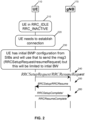
- FIG. 2 this figure is a signaling diagram of an existing procedure for connection of a UE from an idle state or inactive state to connect to a wireless network which requires the UE to use an initial BWP which is limited in bandwidth.
- the UE is in an RRC idle (also IDLE or RRC_IDLE) state or inactive (also INACTIVE or RRC_INACTIVE) state. See block 210.
- the UE determines it needs to establish a connection with the network 100. This determination could be made because the UE has data to send, paging, signaling.
- Signaling here means other signaling different from paging in downlink, which also can trigger UE to establish connection to network.
- the UE has an initial BWP configuration (previously received) from one or more system information blocks (SIBs) and will use this BWP configuration to send the msg3 (e.g., RRCSetupRequest or ResumeRequest), but this is limited to the initial BW in the initial BWP.
- Block 240 illustrates the transmission by the UE of the RRCSetupRequest or ResumeRequest (also known as msg3)
- block 250 illustrates the gNB 170 sending an RRCSetup or RRCResume to the UE
- block 260 illustrates the UE 110 sending an RRCSetupComplete or RRCResumeComplete. This ends the connection process.
- this figure is a signaling diagram for a BWP provided in paging option, in accordance with an exemplary embodiment.
- the UE is in an idle state or an inactive state in block 210.
- the gNB 170 sends paging to the UE 110 in step 320.
- the paging includes a selected (e.g., optimized) BWP based on, e.g., UE capabilities (capas) or NW deployment, the latter where the enabling feature is controlled by the NW.
- Step 240-1 uses a wider BWP as compared with the initial BWP used in step 240 in FIG. 2 , and steps 250, and 260 are assumed to be the same as previously described. Note that the paging in step 320 causes the UE to establish a connection to the network.
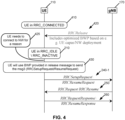
- FIG. 4 this figure is a signaling diagram for a BWP provided in a release message option, in accordance with an exemplary embodiment.
- the UE starts in the connected (also CONNECTED or RRC_CONNECTED) state in block 410, and the gNB 170 sends a release message (e.g., RRCRelease) in reference 420.
- the release message includes a selected (e.g., optimized) BWP based on, e.g., UE capas or NW deployment.
- the release message also causes the UE to transition from the connected state to one of the idle state or the inactive state (see block 210).
- the UE needs to connect to the NW for a reason, such as to transmit data.
- the UE uses the BWP provided in the release message to send the msg3 (RRCSetupRequest/RRCResumeRequest).
- Step 240-1 uses a wider BWP as compared with the initial BWP used in step 240 in FIG. 2 , and steps 250, and 260 are assumed to be the same as previously described.
- this figure is a signaling diagram for a BWP provided in system information option, in accordance with an exemplary embodiment.
- the UE starts in an idle state or an inactive state (block 210).
- the UE reads SIB(s) from a cell (belonging to the gNB 170) and gets knowledge of possible BWPs (e.g., broadcast in the SIB(s)) to be applied in this cell.
- this example has the gNB 170 broadcasting to multiple (e.g., all) UEs in a cell.
- the UE needs to establish connection to the wireless network 100 for a reason.
- the UE supporting the new proposed feature will use a new, wider BWP provided in the SIB(s) (and not the SIB with the initial, narrower BWP), if the UE also supports the proposed and selected wider BWP.
- the UE 110 will send the RRCSetupRequest or ResumeRequest message in step 240-1 (using a wider BWP than used in the initial BWP used in step 240 of FIG. 2 ), and the other steps 250, and 260 are assumed to be the same as previously described.
- FIG. 6 this figure is a logic flow diagram performed by a network node for setting a wider BWP earlier in a connection establishment process to a wireless network.
- This figure further illustrates the operation of an exemplary method or methods, a result of execution of computer program instructions embodied on a computer readable memory, functions performed by logic implemented in hardware, and/or interconnected means for performing functions in accordance with exemplary embodiments.
- the NW access module 150 may include multiples ones of the blocks in FIG. 6 , where each included block is an interconnected means for performing the function in the block.
- the blocks in FIG. 6 are assumed to be performed by a network node such as (e.g., or under control of) a base station such as gNB 170, e.g., under control of the NW access module 150 at least in part.
- the gNB 170 sends an initial bandwidth part to a UE in system information.
- the initial BWP is the BWP that would be used by the UE except for the techniques presented herein, which supply a wider BWP to the UE. That is, the bandwidth (BW) of the supplied BWP is wider than the BW of the (narrower) initial BWP.
- the eNB 170 selects a selected bandwidth part based on one or more of the following: incoming data type or required quality for connection or UE power saving state.
- the gNB 170 sends the selected bandwidth part to be used by the user equipment during a connection procedure used to connect the user equipment to the wireless network after the user equipment enters an idle or inactive state.
- the selected bandwidth part is different from (e.g., wider or smaller than) an initial bandwidth part that would have been used by the user equipment during the connection procedure, e.g., as sent in block 605.
- the typical scenario is that the selected BWP is wider than the initial BWP.
- this idea may be extended to the other use case, for example, a smaller BWP case, which may be useful, e.g., for UE power saving.
- the selected BWP could be sent via the following: sent in paging (block 620, see FIG.
- the gNB 170 receives a message from the UE for connection to the wireless network using the selected bandwidth part (e.g., using msg3).
- the gNB 170 completes the connection process, e.g., using steps 250 and 260 previously described.
- FIG. 6 also illustrates another example, where in block 611 the gNB 170 selects multiple BWPs that might be used by the UE 110.
- the gNB 170 sends indications of multiple BWPs to the UE 110. The idea is to let the UE select one of the multiple BWPs, and the gNB 170 needs to monitor (see block 636) all these BWPs to identify which is used for msg3 and to receive (block 635) the message.
- the NW knows if UE is using default (e.g. UE not supporting new feature) or wider BWP allowed in this cell via at least these two options:
- the network monitors all selected multiple BWPs to determine which one is used, and this is one possible technique.
- the network also can get help from the UE, e.g., where the UE indicates the selected BWP index in MSG1, or uses dedicated RACH resource allocated to each BWP.
- FIG. 7 is a logic flow diagram performed by a UE for setting a wider BWP earlier in a connection establishment process to a wireless network. This figure further illustrates the operation of an exemplary method or methods, a result of execution of computer program instructions embodied on a computer readable memory, functions performed by logic implemented in hardware, and/or interconnected means for performing functions in accordance with exemplary embodiments.
- the NW access module 140 may include multiples ones of the blocks in FIG. 7 , where each included block is an interconnected means for performing the function in the block.
- the blocks in FIG. 7 are assumed to be performed by the UE 110, e.g., under control of the NW access module 140 at least in part.
- the UE 110 receives an initial bandwidth part from a network node in system information. This is the initial, narrower BWP.
- the UE 110 receives a selected bandwidth part to be used by the user equipment during a connection procedure used to connect the user equipment to the wireless network after the user equipment enters an idle or inactive state.
- the selected bandwidth part is different from (e.g., wider or smaller than) an initial bandwidth part that would have been used by the user equipment during the connection procedure and that was delivered to the UE in block 705.
- the receiving may be performed in paging (after transition to idle/inactive mode), see block 720 and FIG. 3 .
- the receiving may also be performed in a release message (prior to transition to idle/inactive mode), see block 725 and FIG. 4 .
- the receiving may be performed in broadcast in system information (after transition to idle/inactive mode), see block 730 and FIG. 5 .
- the UE 110 sends a message to the wireless network using the selected bandwidth part (e.g., using msg3).
- the UE 110 completes the connection process, e.g., using steps 250 and 260 previously described.
- FIG. 7 also illustrates another example also illustrated by FIG. 6 , where in block 716, as part of the receiving in block 715, the UE 110 receives indications of multiple BWPs to be used by the UE 110.
- the idea is to let the UE select (block 718) one of the multiple BWPs indicated in block 716, and the UE sends the message (e.g., msg3) on the selected BW in block 736.
- the gNB 170 needs to monitor (see block 636 of FIG. 6 ) all these BWPs to identify which is used for msg3 and to receive (block 735) the message.
- Example 1 A method, comprising:
- Example 2 The method of example 1, wherein the initial bandwidth part was previously supplied to the user equipment by the network node in system information.
- Example 3 The method of any of examples 1 or 2, further comprising, prior to the sending, selecting the selected bandwidth part based on one or more of the following: incoming data type or required quality for connection or power saving state of the user equipment.
- Example 4 The method of any of examples 1 to 3, wherein:
- Example 5 The method of any of examples 1 to 4, wherein sending the selected bandwidth part or parts to be used by the user equipment further comprises sending the selected bandwidth part or parts in a paging message after the user equipment has entered one of an idle state or an inactive state.
- Example 6 The method of any of examples 1 to 4, wherein sending the selected bandwidth part or parts to be used by the user equipment further comprises sending the selected bandwidth part or parts in a release message used to cause the user equipment to transition from a connected state to one of an idle state or an inactive state.
- Example 7 The method of any of examples 1 to 4, wherein sending the selected bandwidth part or parts to be used by the user equipment further comprises sending the selected bandwidth part in system information.
- Example 8 The method of example 4, wherein the sending multiple selected bandwidth part parts further comprises including a validity time over which one or more of the multiple selected bandwidth parts may be used.
- Example 9 The method of either example 4 or example 8, wherein the sending multiple selected bandwidth part further comprises including an area in which the one or more of the multiple selected bandwidth parts may be used.
- Example 10 The method of any of examples 8 or 9, wherein the sending multiple selected bandwidth part is performed by one of the following: broadcasting the multiple selected bandwidth parts in system information; sending the multiple selected bandwidth parts in one or more paging messages; or sending the multiple selected bandwidth parts in one or more release messages.
- Example 11 The method of any of examples 1 to 9, wherein the selected bandwidth part is one of the following: wider than initial bandwidth part; or smaller than the initial bandwidth part.
- Example 12 A method, comprising:
- Example 13 The method of example 12, wherein the initial bandwidth part was previously received by the user equipment and sent by the network node in system information.
- Example 14 The method of any of examples 12 or 13, wherein:
- Example 15 The method of example 14, wherein the user equipment performs one of the following: performing an access via one or more associated dedicated resources, or sending an indication from the user equipment of the one selected bandwidth part in one or more resources.
- Example 16 The method of any of examples 12 to 15, wherein receiving the selected bandwidth part or parts to be used by the user equipment further comprises receiving the selected bandwidth part or parts in a paging message after the user equipment has entered one of an idle state or an inactive state.
- Example 17 The method of any of examples 12 to 14, wherein receiving the selected bandwidth part or parts to be used by the user equipment further comprises receiving the selected bandwidth part or parts in a release message used to cause the user equipment to transition from a connected state to one of an idle state or an inactive state.
- Example 18 The method of any of examples 12 to 14, wherein receiving the selected bandwidth part or parts to be used by the user equipment further comprises receiving the selected bandwidth part in system information.
- Example 19 The method of example 14, wherein the receiving the multiple selected bandwidth part or parts further comprises receiving a validity time over which one or more of the multiple bandwidth parts may be used, and performing the selecting the one selected bandwidth part and the sending the message based on the validity time.
- Example 20 The method of either example 14 or example 19, wherein the receiving the multiple selected bandwidth parts further comprises receiving an area in which the one or more of the multiple bandwidth parts may be used, and performing the selecting the one selected bandwidth part and the sending the message based on the area.
- Example 21 The method of any of examples 19 or 20, wherein the receiving the multiple selected bandwidth part is performed by one of the following: receiving in a broadcast the multiple selected bandwidth parts in system information; receiving the multiple selected bandwidth parts in one or more paging messages; or receiving the multiple selected bandwidth parts in one or more release messages.
- Example 22 The method of any of examples 12 to 21, wherein the selected bandwidth part is one of the following: wider than initial bandwidth part; or smaller than the initial bandwidth part.
- Example 23 A computer program, comprising code for performing the methods of any of examples 1 to 22, when the computer program is run on a computer.
- Example 24 The computer program according to example 23, wherein the computer program is a computer program product comprising a computer-readable medium bearing computer program code embodied therein for use with the computer.
- Example 25 The computer program according to example 23, wherein the computer program is directly loadable into an internal memory of the computer.
- Example 26 An apparatus, comprising:
- Example 27 The apparatus of example 23, wherein the initial bandwidth part was previously supplied to the user equipment by the network node in system information.
- Example 28 The apparatus of any of examples 23 or 27, further comprising means, performed prior to the means for sending, for selecting the selected bandwidth part based on one or more of the following: incoming data type or required quality for connection or power saving state of the user equipment.
- Example 29 The apparatus of any of examples 23 to 28, wherein:
- Example 30 The apparatus of any of examples 23 to 29, wherein the means for sending the selected bandwidth part or parts to be used by the user equipment further comprises means for sending the selected bandwidth part or parts in a paging message after the user equipment has entered one of an idle state or an inactive state.
- Example 31 The apparatus of any of examples 23 to 29, wherein means for sending the selected bandwidth part or parts to be used by the user equipment further comprises means for sending the selected bandwidth part or parts in a release message used to cause the user equipment to transition from a connected state to one of an idle state or an inactive state.
- Example 32 The apparatus of any of examples 23 to 29, wherein the means for sending the selected bandwidth part or parts to be used by the user equipment further comprises means for sending the selected bandwidth part in system information.
- Example 33 The apparatus of example 29, wherein the means for sending multiple selected bandwidth part parts further comprises means for including a validity time over which one or more of the multiple selected bandwidth parts may be used.
- Example 34 The apparatus of either example 29 or example 33, wherein the means for sending multiple selected bandwidth part further comprises means for including an area in which the one or more of the multiple selected bandwidth parts may be used.
- Example 35 The apparatus of any of examples 33 or 34, wherein the means for sending multiple selected bandwidth part is performed by performing one of the following: broadcasting the multiple selected bandwidth parts in system information; sending the multiple selected bandwidth parts in one or more paging messages; or sending the multiple selected bandwidth parts in one or more release messages.
- Example 36 The apparatus of any of examples 23 to 36, wherein the selected bandwidth part is one of the following: wider than initial bandwidth part; or smaller than the initial bandwidth part.
- Example 37 A base station comprising any of the apparatus of examples 26 to 36.
- Example 38 An apparatus, comprising:
- Example 39 The apparatus of example 38, wherein the initial bandwidth part was previously received by the user equipment and sent by the network node in system information.
- Example 40 The apparatus of any of examples 38 or 39, wherein:
- Example 41 The apparatus of example 40, wherein the user equipment operates one of the following: means for performing an access via one or more associated dedicated resources, or means for sending an indication from the user equipment of the one selected bandwidth part in one or more resources.
- Example 42 The apparatus of any of examples 38 to 41, wherein the means for receiving the selected bandwidth part or parts to be used by the user equipment further comprises means for receiving the selected bandwidth part or parts in a paging message after the user equipment has entered one of an idle state or an inactive state.
- Example 43 The apparatus of any of examples 38 to 40, wherein the means for receiving the selected bandwidth part or parts to be used by the user equipment further comprises means for receiving the selected bandwidth part or parts in a release message used to cause the user equipment to transition from a connected state to one of an idle state or an inactive state.
- Example 44 The apparatus of any of examples 38 to 40, wherein the means for receiving the selected bandwidth part or parts to be used by the user equipment further comprises means for receiving the selected bandwidth part in system information.
- Example 45 The apparatus of example 40, wherein the means for receiving the multiple selected bandwidth part or parts further comprises means for receiving a validity time over which one or more of the multiple bandwidth parts may be used, and means for performing the selecting the one selected bandwidth part and the sending the message based on the validity time.
- Example 46 The apparatus of either example 40 or example 45, wherein the means for receiving the multiple selected bandwidth parts further comprises means for receiving an area in which the one or more of the multiple bandwidth parts may be used, and means for performing the selecting the one selected bandwidth part and the sending the message based on the area.
- Example 47 The apparatus of any of examples 19 or 20, wherein the means for receiving the multiple selected bandwidth part is performed by one of the following: receiving in a broadcast the multiple selected bandwidth parts in system information; receiving the multiple selected bandwidth parts in one or more paging messages; or receiving the multiple selected bandwidth parts in one or more release messages.
- Example 48 The apparatus of any of examples 38 to 47, wherein the selected bandwidth part is one of the following: wider than initial bandwidth part; or smaller than the initial bandwidth part.
- Example 49 A user equipment comprising any of the apparatus of examples 38 to 48.
- Example 50 A wireless communication system comprising any of the apparatus of examples 26 to 36 and any of the apparatus of examples 38 to 48.
- Example 51 An apparatus, comprising:
- Example 52 The apparatus of example 51, wherein the at least one memory and the computer program code are further configured, with the at least one processor, to cause the apparatus to perform operations in any of the methods of examples 2 to 11.
- Example 53 An apparatus, comprising:
- Example 54 The apparatus of example 53, wherein the at least one memory and the computer program code are further configured, with the at least one processor, to cause the apparatus to perform operations in any of the methods of examples 12 to 22.
- a technical effect and advantage of one or more of the example embodiments disclosed herein is a maximum BWP used as soon as possible, which means connected sessions last a minimum time resulting in reduced power consumption and application perceived delays.
- Another technical effect and advantage of one or more of the example embodiments disclosed herein is the msg3 size can be larger, which means that a lot of enhancements potential is opened. Via frequency diversity, also the performance on msg3 (at least in interference limited scenarios) can be improved.
- Another technical effect and advantage of one or more of the example embodiments disclosed herein includes avoiding BWP switching time. That is, the first setting of the initial BWP then the subsequent setting of the wider BWP takes time in the UE to get the new BWP active, and the instant techniques avoid this time.
- circuitry may refer to one or more or all of the following:
- circuitry also covers an implementation of merely a hardware circuit or processor (or multiple processors) or portion of a hardware circuit or processor and its (or their) accompanying software and/or firmware.
- circuitry also covers, for example and if applicable to the particular claim element, a baseband integrated circuit or processor integrated circuit for a mobile device or a similar integrated circuit in server, a cellular network device, or other computing or network device.
- Embodiments herein may be implemented in software (executed by one or more processors), hardware (e.g., an application specific integrated circuit), or a combination of software and hardware.
- the software e.g., application logic, an instruction set
- a "computer-readable medium” may be any media or means that can contain, store, communicate, propagate or transport the instructions for use by or in connection with an instruction execution system, apparatus, or device, such as a computer, with one example of a computer described and depicted, e.g., in FIG. 1 .
- a computer-readable medium may comprise a computer-readable storage medium (e.g., memories 125, 155, 171 or other device) that may be any media or means that can contain, store, and/or transport the instructions for use by or in connection with an instruction execution system, apparatus, or device, such as a computer.
- a computer-readable storage medium does not comprise propagating signals.
- the different functions discussed herein may be performed in a different order and/or concurrently with each other. Furthermore, if desired, one or more of the above-described functions may be optional or may be combined.
Landscapes
- Engineering & Computer Science (AREA)
- Signal Processing (AREA)
- Computer Networks & Wireless Communication (AREA)
- Mobile Radio Communication Systems (AREA)
Claims (7)
- Verfahren, das Folgendes umfasst:Broadcasting (605) eines anfänglichen Bandbreitenteils durch einen Netzwerkknoten in Systeminformationen in einem drahtlosen Netzwerk an eine Teilnehmereinrichtung;wobei das Verfahren ferner Folgendes umfasst:Auswählen (610) von mindestens einem Bandbreitenteil durch den Netzwerkknoten auf Basis eines eingehenden Datentyps und/oder einer erforderlichen Qualität für eine aufzubauende Verbindung;Senden (615) einer Anzeige des mindestens einen ausgewählten Bandbreitenteils, der von einer Teilnehmereinrichtung während einer Verbindungsaufbauprozedur zu verwenden ist, um die Teilnehmereinrichtung mit dem drahtlosen Netzwerk zu verbinden, durch den Netzwerkknoten an die Teilnehmereinrichtung, wobei der mindestens eine ausgewählte Bandbreitenteil breiter ist als der anfängliche Bandbreitenteil und wobei der mindestens eine ausgewählte Bandbreitenteil via Paging (620) oder Systeminformationen (630) nach einem Übergang der Teilnehmereinrichtung in einen Ruhe-/inaktiven Zustand oder in einer Freigabenachricht (Block 625) vor dem Übergang der Teilnehmereinrichtung in den Ruhe-/inaktiven Zustand gesendet wird, wobei der breitere Bandbreitenteil für eine msg3-Nachricht einer Direktzugriffsprozedur verwendet wird, undin Reaktion auf das Empfangen der msg3-Nachricht für eine Verbindungsaufbauprozedur im ausgewählten Bandbreitenteil durch den Netzwerkknoten von der Teilnehmereinrichtung Durchführen (640) eines Verbindungsaufbaus.
- Verfahren nach Anspruch 1, wobei:das Senden des ausgewählten Bandbreitenteils, der von der Teilnehmereinrichtung zu verwenden ist, ferner das Senden von mehreren ausgewählten Bandbreitenteilen umfasst; unddas Empfangen der msg3-Nachricht ferner Folgendes umfasst:Überwachen von allen ausgewählten mehreren Bandbreitenteilen, oderDetektieren eines Teilnehmereinrichtungszugriffs via eine oder mehrere verknüpfte dedizierte Ressourcen, oderEmpfangen einer Anzeige des ausgewählten gewählten Bandbreitenteils in einer oder mehreren Ressourcen von der Teilnehmereinrichtung.
- Verfahren nach Anspruch 1 oder 2, wobei die msg3-Nachricht eine Nachricht einer Direktzugriffskanal(RACH)-Prozedur ist, in der die Teilnehmereinrichtung einen anfänglichen Zugriff auf das Netzwerk oder eine Neuverbindung mit demselben durchführt.
- Verfahren, das Folgendes umfasst:Empfangen eines anfänglichen Bandbreitenteils durch eine Teilnehmereinrichtung in Systeminformationen von einem Netzwerkknoten in einem drahtlosen Netzwerk;wobei das Verfahren ferner Folgendes umfasst:Empfangen einer Anzeige von mindestens einem ausgewählten Bandbreitenteil, der von einer Teilnehmereinrichtung während einer Verbindungsaufbauprozedur zu verwenden ist, um die Teilnehmereinrichtung mit dem drahtlosen Netzwerk zu verbinden, wobei der mindestens eine ausgewählte Bandbreitenteil breiter ist als der anfängliche Bandbreitenteil und wobei der mindestens eine ausgewählte Bandbreitenteil via Paging (620) oder Systeminformationen (630) nach einem Übergang der Teilnehmereinrichtung in einen Ruhe-/inaktiven Zustand oder in einer Freigabenachricht (Block 625) vor dem Übergang der Teilnehmereinrichtung in den Ruhe-/inaktiven Zustand empfangen wird, wobei der breitere Bandbreitenteil für eine msg3-Nachricht einer Direktzugriffsprozedur verwendet wird, undSenden der msg3-Nachricht für einen Verbindungsaufbau zum drahtlosen Netzwerk unter Verwendung des ausgewählten Bandbreitenteils durch die Teilnehmereinrichtung zum Netzwerkknoten.
- Verfahren nach Anspruch 4, wobei:das Empfangen der Anzeige des ausgewählten Bandbreitenteils ferner das Empfangen von mehreren ausgewählten Bandbreitenteilen, unddas Auswählen von einem der mehreren ausgewählten Bandbreitenteile umfasst.
- Vorrichtung, die Folgendes umfasst:mindestens einen Prozessor; undmindestens einen Speicher, der einen Computerprogrammcode beinhaltet,wobei der mindestens eine Speicher und der Computerprogrammcode dazu ausgelegt sind, die Vorrichtung mit dem mindestens einen Prozessor zu veranlassen, Folgendes durchzuführen:Broadcasting (605) eines anfänglichen Bandbreitenteils durch einen Netzwerkknoten in Systeminformationen in einem drahtlosen Netzwerk an eine Teilnehmereinrichtung;wobei die Vorrichtung ferner dazu ausgelegt ist, Folgendes durchzuführen:Auswählen (610) von mindestens einem Bandbreitenteil durch den Netzwerkknoten auf Basis eines eingehenden Datentyps und/oder einer erforderlichen Qualität für eine aufzubauende Verbindung;Senden (615) einer Anzeige von mindestens einem ausgewählten Bandbreitenteil, der von einer Teilnehmereinrichtung während einer Verbindungsaufbauprozedur zu verwenden ist, um die Teilnehmereinrichtung mit dem drahtlosen Netzwerk zu verbinden, durch den Netzwerkknoten an die Teilnehmereinrichtung, wobei der mindestens eine ausgewählte Bandbreitenteil breiter ist als der anfängliche Bandbreitenteil und wobei der mindestens eine ausgewählte Bandbreitenteil via Paging (620) oder Systeminformationen (630) nach einem Übergang der Teilnehmereinrichtung in einen Ruhe-/inaktiven Zustand oder in einer Freigabenachricht (Block 625) vor dem Übergang der Teilnehmereinrichtung in den Ruhe-/inaktiven Zustand gesendet wird, wobei der breitere Bandbreitenteil für eine msg3-Nachricht einer Direktzugriffsprozedur verwendet wird, undin Reaktion auf das Empfangen der msg3-Nachricht für eine Verbindungsaufbauprozedur im ausgewählten Bandbreitenteil durch den Netzwerkknoten von der Teilnehmereinrichtung Durchführen (640) eines Verbindungsaufbaus.
- Vorrichtung, die Folgendes umfasst:mindestens einen Prozessor; undmindestens einen Speicher, der einen Computerprogrammcode beinhaltet,wobei der mindestens eine Speicher und der Computerprogrammcode dazu ausgelegt sind, die Vorrichtung mit dem mindestens einen Prozessor zu veranlassen, Folgendes durchzuführen:Empfangen eines anfänglichen Bandbreitenteils durch eine Teilnehmereinrichtung in Systeminformationen von einem Netzwerkknoten in einem drahtlosen Netzwerk;wobei die Vorrichtung ferner dazu ausgelegt ist, Folgendes durchzuführen:Empfangen einer Anzeige von mindestens einem ausgewählten Bandbreitenteil, der von einer Teilnehmereinrichtung während einer Verbindungsaufbauprozedur zu verwenden ist, um die Teilnehmereinrichtung mit dem drahtlosen Netzwerk zu verbinden, wobei der mindestens eine ausgewählte Bandbreitenteil breiter ist als der anfängliche Bandbreitenteil und wobei der mindestens eine ausgewählte Bandbreitenteil via Paging (620) oder Systeminformationen (630) nach einem Übergang der Teilnehmereinrichtung in einen Ruhe-/inaktiven Zustand oder in einer Freigabenachricht (Block 625) vor dem Übergang der Teilnehmereinrichtung in den Ruhe-/inaktiven Zustand empfangen wird, wobei der breitere Bandbreitenteil für eine msg3-Nachricht einer Direktzugriffsprozedur verwendet wird, undSenden und der msg3-Nachricht für einen Verbindungsaufbau zum drahtlosen Netzwerk unter Verwendung des ausgewählten Bandbreitenteils durch die Teilnehmereinrichtung an den Netzwerkknoten.
Applications Claiming Priority (1)
| Application Number | Priority Date | Filing Date | Title |
|---|---|---|---|
| PCT/CN2019/101830 WO2021031163A1 (en) | 2019-08-21 | 2019-08-21 | Setting a different bwp earlier in a connection establishment process to a wireless network by a ue when transitioning from an idle or inactive state |
Publications (3)
| Publication Number | Publication Date |
|---|---|
| EP4018743A1 EP4018743A1 (de) | 2022-06-29 |
| EP4018743A4 EP4018743A4 (de) | 2023-04-26 |
| EP4018743B1 true EP4018743B1 (de) | 2024-09-04 |
Family
ID=74659992
Family Applications (1)
| Application Number | Title | Priority Date | Filing Date |
|---|---|---|---|
| EP19942569.5A Active EP4018743B1 (de) | 2019-08-21 | 2019-08-21 | Einstellen eines anderen bandbreitenteils früher in einem verbindungsaufbauverfahren zu einem drahtlosen netzwerk durch ein benutzergerät beim übergang von einem ruhemodus oder inaktiven zustand |
Country Status (4)
| Country | Link |
|---|---|
| US (2) | US12238804B2 (de) |
| EP (1) | EP4018743B1 (de) |
| CN (1) | CN114270980B (de) |
| WO (1) | WO2021031163A1 (de) |
Families Citing this family (3)
| Publication number | Priority date | Publication date | Assignee | Title |
|---|---|---|---|---|
| US12580713B2 (en) * | 2020-04-08 | 2026-03-17 | Qualcomm Incorporated | Updating bandwidth part width from default configuration |
| CN114173322A (zh) * | 2020-09-10 | 2022-03-11 | 华为技术有限公司 | 一种通信方法及装置 |
| WO2022211688A1 (en) * | 2021-03-31 | 2022-10-06 | Telefonaktiebolaget Lm Ericsson (Publ) | Radio network node and method performed in a communication network |
Citations (1)
| Publication number | Priority date | Publication date | Assignee | Title |
|---|---|---|---|---|
| EP3528561A1 (de) * | 2018-02-15 | 2019-08-21 | Panasonic Intellectual Property Corporation of America | Benutzergerät und basisstation mit beteiligung an verbesserten paging-verfahren |
Family Cites Families (15)
| Publication number | Priority date | Publication date | Assignee | Title |
|---|---|---|---|---|
| EP3342206B1 (de) | 2015-08-24 | 2024-10-30 | Nokia Solutions and Networks Oy | Netzwerküberlastungssteuerung über funkrufverfahren |
| US10849022B2 (en) | 2017-03-17 | 2020-11-24 | Ofinno, Llc | Cell selection of inactive state wireless device |
| WO2018190678A1 (ko) * | 2017-04-14 | 2018-10-18 | 엘지전자 주식회사 | 무선 통신 시스템에서 초기 접속을 수행하는 방법 및 장치 |
| EP3641393B1 (de) * | 2017-06-16 | 2023-08-09 | Electronics and Telecommunications Research Institute | Verfahren zur konfiguration der bandbreite zur unterstützung eines breitbandträgers in einem kommunikationssystem |
| AU2018314077B2 (en) * | 2017-08-10 | 2023-02-02 | Samsung Electronics Co., Ltd. | Apparatus and method of system information transmission and reception on a carrier supporting multiple bandwidth parts |
| CN109561471B (zh) * | 2017-09-25 | 2020-05-15 | 展讯通信(上海)有限公司 | 指示及配置bwp参数的方法、基站、用户设备及可读介质 |
| CN109587789B (zh) * | 2017-09-28 | 2021-09-24 | 维沃移动通信有限公司 | 随机接入方法、移动终端及网络设备 |
| US10602506B2 (en) * | 2017-09-28 | 2020-03-24 | Apple Inc. | Activation of secondary cell containing bandwidth parts |
| CN111543069B (zh) * | 2017-11-14 | 2024-06-07 | 诺基亚技术有限公司 | 空闲模式和非活动模式下的bwp处理 |
| TWI674811B (zh) * | 2017-11-16 | 2019-10-11 | 財團法人資訊工業策進會 | 用於行動通訊系統之使用者裝置及基地台 |
| KR102352684B1 (ko) * | 2017-11-16 | 2022-01-18 | 삼성전자주식회사 | 무선통신 시스템에서 통신 방법 및 장치 |
| US20200396044A1 (en) | 2017-12-28 | 2020-12-17 | Lg Electronics Inc. | Method for switching a bandwidth part (bwp) for configured ul resources in wireless communication system and a device therefor |
| US10701734B2 (en) | 2017-12-28 | 2020-06-30 | Asustek Computer Inc. | Method and apparatus of selecting bandwidth part for random access (RA) procedure in a wireless communication system |
| CN110475294B (zh) * | 2018-08-10 | 2020-08-07 | 华为技术有限公司 | 一种通信方法、装置及系统 |
| US20220078681A1 (en) * | 2019-02-08 | 2022-03-10 | Sony Group Corporation | Bandwidth part flexibility for unlicensed nr access |
-
2019
- 2019-08-21 EP EP19942569.5A patent/EP4018743B1/de active Active
- 2019-08-21 US US17/636,071 patent/US12238804B2/en active Active
- 2019-08-21 CN CN201980099500.6A patent/CN114270980B/zh active Active
- 2019-08-21 WO PCT/CN2019/101830 patent/WO2021031163A1/en not_active Ceased
-
2025
- 2025-01-16 US US19/024,648 patent/US12363786B2/en active Active
Patent Citations (1)
| Publication number | Priority date | Publication date | Assignee | Title |
|---|---|---|---|---|
| EP3528561A1 (de) * | 2018-02-15 | 2019-08-21 | Panasonic Intellectual Property Corporation of America | Benutzergerät und basisstation mit beteiligung an verbesserten paging-verfahren |
Also Published As
| Publication number | Publication date |
|---|---|
| EP4018743A1 (de) | 2022-06-29 |
| US12238804B2 (en) | 2025-02-25 |
| CN114270980B (zh) | 2025-06-13 |
| EP4018743A4 (de) | 2023-04-26 |
| US20220287138A1 (en) | 2022-09-08 |
| CN114270980A (zh) | 2022-04-01 |
| US12363786B2 (en) | 2025-07-15 |
| US20250159754A1 (en) | 2025-05-15 |
| WO2021031163A1 (en) | 2021-02-25 |
Similar Documents
| Publication | Publication Date | Title |
|---|---|---|
| EP3310120B1 (de) | Schnelle aktivierung von mehrfachkonnektivität unter verwendung von uplink-signalen | |
| EP3537789B1 (de) | Funkrufverfahren, basisstation und endgerät | |
| EP3338478B1 (de) | Steuerung der relais-ue-benutzung | |
| US12363786B2 (en) | Setting a different BWP earlier in a connection establishment process to a wireless network by a UE when transitioning from an idle or inactive state | |
| EP3815428B1 (de) | Verbesserte systeminformationsbereitstellung | |
| US12532380B2 (en) | Early state handling assistance for efficient RRC state change | |
| EP3090599B1 (de) | Verfahren und vorrichtungen für einen nähebasierten dienst | |
| CN117099388A (zh) | Rrm测量活动报告和使用 | |
| US20230300831A1 (en) | Selection mechanism and use of multiple ul transmission schemes | |
| US11109436B2 (en) | Rejection of connection re-establishment | |
| WO2023082035A1 (en) | Nr udc -flexible drb switch | |
| CN113826419B (zh) | 提供和使用隐式PSCell | |
| WO2022042948A1 (en) | Early pdcch / cg activation based on survival time | |
| US20250203702A1 (en) | Communication method and communication apparatus | |
| CN111434179A (zh) | 用于随机接入的方法和装置 | |
| EP4613039A1 (de) | Verfahren zur inter-plmn-zellenneuauswahl in rrc_inaktiv ohne übergang zu rrc_verbundener oder zu rrc_ruhe | |
| JP2025535966A (ja) | 通信ネットワークにアクセスするための方法および装置 | |
| EP3791626A1 (de) | Bewahrung der auswahl eines funknetzsystems |
Legal Events
| Date | Code | Title | Description |
|---|---|---|---|
| STAA | Information on the status of an ep patent application or granted ep patent |
Free format text: STATUS: THE INTERNATIONAL PUBLICATION HAS BEEN MADE |
|
| PUAI | Public reference made under article 153(3) epc to a published international application that has entered the european phase |
Free format text: ORIGINAL CODE: 0009012 |
|
| STAA | Information on the status of an ep patent application or granted ep patent |
Free format text: STATUS: REQUEST FOR EXAMINATION WAS MADE |
|
| 17P | Request for examination filed |
Effective date: 20220321 |
|
| AK | Designated contracting states |
Kind code of ref document: A1 Designated state(s): AL AT BE BG CH CY CZ DE DK EE ES FI FR GB GR HR HU IE IS IT LI LT LU LV MC MK MT NL NO PL PT RO RS SE SI SK SM TR |
|
| DAV | Request for validation of the european patent (deleted) | ||
| DAX | Request for extension of the european patent (deleted) | ||
| A4 | Supplementary search report drawn up and despatched |
Effective date: 20230327 |
|
| RIC1 | Information provided on ipc code assigned before grant |
Ipc: H04W 68/00 20090101ALN20230321BHEP Ipc: H04W 48/20 20090101ALN20230321BHEP Ipc: H04W 72/0453 20230101ALI20230321BHEP Ipc: H04W 76/10 20180101ALI20230321BHEP Ipc: H04W 72/04 20090101AFI20230321BHEP |
|
| GRAP | Despatch of communication of intention to grant a patent |
Free format text: ORIGINAL CODE: EPIDOSNIGR1 |
|
| STAA | Information on the status of an ep patent application or granted ep patent |
Free format text: STATUS: GRANT OF PATENT IS INTENDED |
|
| RIC1 | Information provided on ipc code assigned before grant |
Ipc: H04W 68/00 20090101ALN20240417BHEP Ipc: H04W 48/20 20090101ALN20240417BHEP Ipc: H04W 72/0453 20230101ALI20240417BHEP Ipc: H04W 76/10 20180101ALI20240417BHEP Ipc: H04W 72/04 20090101AFI20240417BHEP |
|
| INTG | Intention to grant announced |
Effective date: 20240506 |
|
| RIC1 | Information provided on ipc code assigned before grant |
Ipc: H04W 68/00 20090101ALN20240419BHEP Ipc: H04W 48/20 20090101ALN20240419BHEP Ipc: H04W 72/0453 20230101ALI20240419BHEP Ipc: H04W 76/10 20180101ALI20240419BHEP Ipc: H04W 72/04 20090101AFI20240419BHEP |
|
| GRAS | Grant fee paid |
Free format text: ORIGINAL CODE: EPIDOSNIGR3 |
|
| GRAA | (expected) grant |
Free format text: ORIGINAL CODE: 0009210 |
|
| STAA | Information on the status of an ep patent application or granted ep patent |
Free format text: STATUS: THE PATENT HAS BEEN GRANTED |
|
| AK | Designated contracting states |
Kind code of ref document: B1 Designated state(s): AL AT BE BG CH CY CZ DE DK EE ES FI FR GB GR HR HU IE IS IT LI LT LU LV MC MK MT NL NO PL PT RO RS SE SI SK SM TR |
|
| REG | Reference to a national code |
Ref country code: GB Ref legal event code: FG4D |
|
| REG | Reference to a national code |
Ref country code: CH Ref legal event code: EP |
|
| REG | Reference to a national code |
Ref country code: IE Ref legal event code: FG4D |
|
| REG | Reference to a national code |
Ref country code: DE Ref legal event code: R096 Ref document number: 602019058552 Country of ref document: DE |
|
| REG | Reference to a national code |
Ref country code: LT Ref legal event code: MG9D |
|
| REG | Reference to a national code |
Ref country code: NL Ref legal event code: MP Effective date: 20240904 |
|
| PG25 | Lapsed in a contracting state [announced via postgrant information from national office to epo] |
Ref country code: NO Free format text: LAPSE BECAUSE OF FAILURE TO SUBMIT A TRANSLATION OF THE DESCRIPTION OR TO PAY THE FEE WITHIN THE PRESCRIBED TIME-LIMIT Effective date: 20241204 |
|
| PG25 | Lapsed in a contracting state [announced via postgrant information from national office to epo] |
Ref country code: PL Free format text: LAPSE BECAUSE OF FAILURE TO SUBMIT A TRANSLATION OF THE DESCRIPTION OR TO PAY THE FEE WITHIN THE PRESCRIBED TIME-LIMIT Effective date: 20240904 Ref country code: GR Free format text: LAPSE BECAUSE OF FAILURE TO SUBMIT A TRANSLATION OF THE DESCRIPTION OR TO PAY THE FEE WITHIN THE PRESCRIBED TIME-LIMIT Effective date: 20241205 Ref country code: FI Free format text: LAPSE BECAUSE OF FAILURE TO SUBMIT A TRANSLATION OF THE DESCRIPTION OR TO PAY THE FEE WITHIN THE PRESCRIBED TIME-LIMIT Effective date: 20240904 |
|
| PG25 | Lapsed in a contracting state [announced via postgrant information from national office to epo] |
Ref country code: BG Free format text: LAPSE BECAUSE OF FAILURE TO SUBMIT A TRANSLATION OF THE DESCRIPTION OR TO PAY THE FEE WITHIN THE PRESCRIBED TIME-LIMIT Effective date: 20240904 |
|
| PG25 | Lapsed in a contracting state [announced via postgrant information from national office to epo] |
Ref country code: LV Free format text: LAPSE BECAUSE OF FAILURE TO SUBMIT A TRANSLATION OF THE DESCRIPTION OR TO PAY THE FEE WITHIN THE PRESCRIBED TIME-LIMIT Effective date: 20240904 |
|
| PG25 | Lapsed in a contracting state [announced via postgrant information from national office to epo] |
Ref country code: HR Free format text: LAPSE BECAUSE OF FAILURE TO SUBMIT A TRANSLATION OF THE DESCRIPTION OR TO PAY THE FEE WITHIN THE PRESCRIBED TIME-LIMIT Effective date: 20240904 |
|
| PG25 | Lapsed in a contracting state [announced via postgrant information from national office to epo] |
Ref country code: ES Free format text: LAPSE BECAUSE OF FAILURE TO SUBMIT A TRANSLATION OF THE DESCRIPTION OR TO PAY THE FEE WITHIN THE PRESCRIBED TIME-LIMIT Effective date: 20240904 Ref country code: RS Free format text: LAPSE BECAUSE OF FAILURE TO SUBMIT A TRANSLATION OF THE DESCRIPTION OR TO PAY THE FEE WITHIN THE PRESCRIBED TIME-LIMIT Effective date: 20241204 |
|
| PG25 | Lapsed in a contracting state [announced via postgrant information from national office to epo] |
Ref country code: RS Free format text: LAPSE BECAUSE OF FAILURE TO SUBMIT A TRANSLATION OF THE DESCRIPTION OR TO PAY THE FEE WITHIN THE PRESCRIBED TIME-LIMIT Effective date: 20241204 Ref country code: PL Free format text: LAPSE BECAUSE OF FAILURE TO SUBMIT A TRANSLATION OF THE DESCRIPTION OR TO PAY THE FEE WITHIN THE PRESCRIBED TIME-LIMIT Effective date: 20240904 Ref country code: NO Free format text: LAPSE BECAUSE OF FAILURE TO SUBMIT A TRANSLATION OF THE DESCRIPTION OR TO PAY THE FEE WITHIN THE PRESCRIBED TIME-LIMIT Effective date: 20241204 Ref country code: LV Free format text: LAPSE BECAUSE OF FAILURE TO SUBMIT A TRANSLATION OF THE DESCRIPTION OR TO PAY THE FEE WITHIN THE PRESCRIBED TIME-LIMIT Effective date: 20240904 Ref country code: HR Free format text: LAPSE BECAUSE OF FAILURE TO SUBMIT A TRANSLATION OF THE DESCRIPTION OR TO PAY THE FEE WITHIN THE PRESCRIBED TIME-LIMIT Effective date: 20240904 Ref country code: GR Free format text: LAPSE BECAUSE OF FAILURE TO SUBMIT A TRANSLATION OF THE DESCRIPTION OR TO PAY THE FEE WITHIN THE PRESCRIBED TIME-LIMIT Effective date: 20241205 Ref country code: FI Free format text: LAPSE BECAUSE OF FAILURE TO SUBMIT A TRANSLATION OF THE DESCRIPTION OR TO PAY THE FEE WITHIN THE PRESCRIBED TIME-LIMIT Effective date: 20240904 Ref country code: ES Free format text: LAPSE BECAUSE OF FAILURE TO SUBMIT A TRANSLATION OF THE DESCRIPTION OR TO PAY THE FEE WITHIN THE PRESCRIBED TIME-LIMIT Effective date: 20240904 Ref country code: BG Free format text: LAPSE BECAUSE OF FAILURE TO SUBMIT A TRANSLATION OF THE DESCRIPTION OR TO PAY THE FEE WITHIN THE PRESCRIBED TIME-LIMIT Effective date: 20240904 |
|
| REG | Reference to a national code |
Ref country code: AT Ref legal event code: MK05 Ref document number: 1721719 Country of ref document: AT Kind code of ref document: T Effective date: 20240904 |
|
| PG25 | Lapsed in a contracting state [announced via postgrant information from national office to epo] |
Ref country code: NL Free format text: LAPSE BECAUSE OF FAILURE TO SUBMIT A TRANSLATION OF THE DESCRIPTION OR TO PAY THE FEE WITHIN THE PRESCRIBED TIME-LIMIT Effective date: 20240904 |
|
| PG25 | Lapsed in a contracting state [announced via postgrant information from national office to epo] |
Ref country code: PT Free format text: LAPSE BECAUSE OF FAILURE TO SUBMIT A TRANSLATION OF THE DESCRIPTION OR TO PAY THE FEE WITHIN THE PRESCRIBED TIME-LIMIT Effective date: 20250106 Ref country code: IS Free format text: LAPSE BECAUSE OF FAILURE TO SUBMIT A TRANSLATION OF THE DESCRIPTION OR TO PAY THE FEE WITHIN THE PRESCRIBED TIME-LIMIT Effective date: 20250104 |
|
| PG25 | Lapsed in a contracting state [announced via postgrant information from national office to epo] |
Ref country code: RO Free format text: LAPSE BECAUSE OF FAILURE TO SUBMIT A TRANSLATION OF THE DESCRIPTION OR TO PAY THE FEE WITHIN THE PRESCRIBED TIME-LIMIT Effective date: 20240904 Ref country code: SM Free format text: LAPSE BECAUSE OF FAILURE TO SUBMIT A TRANSLATION OF THE DESCRIPTION OR TO PAY THE FEE WITHIN THE PRESCRIBED TIME-LIMIT Effective date: 20240904 |
|
| PG25 | Lapsed in a contracting state [announced via postgrant information from national office to epo] |
Ref country code: AT Free format text: LAPSE BECAUSE OF FAILURE TO SUBMIT A TRANSLATION OF THE DESCRIPTION OR TO PAY THE FEE WITHIN THE PRESCRIBED TIME-LIMIT Effective date: 20240904 Ref country code: EE Free format text: LAPSE BECAUSE OF FAILURE TO SUBMIT A TRANSLATION OF THE DESCRIPTION OR TO PAY THE FEE WITHIN THE PRESCRIBED TIME-LIMIT Effective date: 20240904 |
|
| PG25 | Lapsed in a contracting state [announced via postgrant information from national office to epo] |
Ref country code: CZ Free format text: LAPSE BECAUSE OF FAILURE TO SUBMIT A TRANSLATION OF THE DESCRIPTION OR TO PAY THE FEE WITHIN THE PRESCRIBED TIME-LIMIT Effective date: 20240904 |
|
| PG25 | Lapsed in a contracting state [announced via postgrant information from national office to epo] |
Ref country code: SK Free format text: LAPSE BECAUSE OF FAILURE TO SUBMIT A TRANSLATION OF THE DESCRIPTION OR TO PAY THE FEE WITHIN THE PRESCRIBED TIME-LIMIT Effective date: 20240904 Ref country code: IT Free format text: LAPSE BECAUSE OF FAILURE TO SUBMIT A TRANSLATION OF THE DESCRIPTION OR TO PAY THE FEE WITHIN THE PRESCRIBED TIME-LIMIT Effective date: 20240904 |
|
| REG | Reference to a national code |
Ref country code: DE Ref legal event code: R097 Ref document number: 602019058552 Country of ref document: DE |
|
| PG25 | Lapsed in a contracting state [announced via postgrant information from national office to epo] |
Ref country code: DK Free format text: LAPSE BECAUSE OF FAILURE TO SUBMIT A TRANSLATION OF THE DESCRIPTION OR TO PAY THE FEE WITHIN THE PRESCRIBED TIME-LIMIT Effective date: 20240904 |
|
| PLBE | No opposition filed within time limit |
Free format text: ORIGINAL CODE: 0009261 |
|
| STAA | Information on the status of an ep patent application or granted ep patent |
Free format text: STATUS: NO OPPOSITION FILED WITHIN TIME LIMIT |
|
| 26N | No opposition filed |
Effective date: 20250605 |
|
| PG25 | Lapsed in a contracting state [announced via postgrant information from national office to epo] |
Ref country code: SE Free format text: LAPSE BECAUSE OF FAILURE TO SUBMIT A TRANSLATION OF THE DESCRIPTION OR TO PAY THE FEE WITHIN THE PRESCRIBED TIME-LIMIT Effective date: 20240904 |
|
| PGFP | Annual fee paid to national office [announced via postgrant information from national office to epo] |
Ref country code: GB Payment date: 20250703 Year of fee payment: 7 |
|
| REG | Reference to a national code |
Ref country code: DE Ref legal event code: R119 Ref document number: 602019058552 Country of ref document: DE |
|
| REG | Reference to a national code |
Ref country code: CH Ref legal event code: H13 Free format text: ST27 STATUS EVENT CODE: U-0-0-H10-H13 (AS PROVIDED BY THE NATIONAL OFFICE) Effective date: 20260324 |
|
| PG25 | Lapsed in a contracting state [announced via postgrant information from national office to epo] |
Ref country code: MC Free format text: LAPSE BECAUSE OF FAILURE TO SUBMIT A TRANSLATION OF THE DESCRIPTION OR TO PAY THE FEE WITHIN THE PRESCRIBED TIME-LIMIT Effective date: 20240904 |
|
| PG25 | Lapsed in a contracting state [announced via postgrant information from national office to epo] |
Ref country code: LU Free format text: LAPSE BECAUSE OF NON-PAYMENT OF DUE FEES Effective date: 20250821 |
|
| PG25 | Lapsed in a contracting state [announced via postgrant information from national office to epo] |
Ref country code: CH Free format text: LAPSE BECAUSE OF NON-PAYMENT OF DUE FEES Effective date: 20250831 |