EP4019100A1 - Composition photodurcissable et produit dentaire - Google Patents
Composition photodurcissable et produit dentaire Download PDFInfo
- Publication number
- EP4019100A1 EP4019100A1 EP20880670.3A EP20880670A EP4019100A1 EP 4019100 A1 EP4019100 A1 EP 4019100A1 EP 20880670 A EP20880670 A EP 20880670A EP 4019100 A1 EP4019100 A1 EP 4019100A1
- Authority
- EP
- European Patent Office
- Prior art keywords
- meth
- acrylic monomer
- photocurable composition
- equal
- cured product
- Prior art date
- Legal status (The legal status is an assumption and is not a legal conclusion. Google has not performed a legal analysis and makes no representation as to the accuracy of the status listed.)
- Pending
Links
Images


Classifications
-
- C—CHEMISTRY; METALLURGY
- C08—ORGANIC MACROMOLECULAR COMPOUNDS; THEIR PREPARATION OR CHEMICAL WORKING-UP; COMPOSITIONS BASED THEREON
- C08F—MACROMOLECULAR COMPOUNDS OBTAINED BY REACTIONS ONLY INVOLVING CARBON-TO-CARBON UNSATURATED BONDS
- C08F290/00—Macromolecular compounds obtained by polymerising monomers on to polymers modified by introduction of aliphatic unsaturated end or side groups
- C08F290/02—Macromolecular compounds obtained by polymerising monomers on to polymers modified by introduction of aliphatic unsaturated end or side groups on to polymers modified by introduction of unsaturated end groups
- C08F290/06—Polymers provided for in subclass C08G
- C08F290/062—Polyethers
-
- A—HUMAN NECESSITIES
- A61—MEDICAL OR VETERINARY SCIENCE; HYGIENE
- A61K—PREPARATIONS FOR MEDICAL, DENTAL OR TOILETRY PURPOSES
- A61K6/00—Preparations for dentistry
- A61K6/60—Preparations for dentistry comprising organic or organo-metallic additives
- A61K6/62—Photochemical radical initiators
-
- A—HUMAN NECESSITIES
- A61—MEDICAL OR VETERINARY SCIENCE; HYGIENE
- A61C—DENTISTRY; APPARATUS OR METHODS FOR ORAL OR DENTAL HYGIENE
- A61C7/00—Orthodontics, i.e. obtaining or maintaining the desired position of teeth, e.g. by straightening, evening, regulating, separating, or by correcting malocclusions
- A61C7/08—Mouthpiece-type retainers or positioners, e.g. for both the lower and upper arch
-
- A—HUMAN NECESSITIES
- A61—MEDICAL OR VETERINARY SCIENCE; HYGIENE
- A61K—PREPARATIONS FOR MEDICAL, DENTAL OR TOILETRY PURPOSES
- A61K6/00—Preparations for dentistry
- A61K6/80—Preparations for artificial teeth, for filling teeth or for capping teeth
- A61K6/884—Preparations for artificial teeth, for filling teeth or for capping teeth comprising natural or synthetic resins
- A61K6/887—Compounds obtained by reactions only involving carbon-to-carbon unsaturated bonds
-
- A—HUMAN NECESSITIES
- A63—SPORTS; GAMES; AMUSEMENTS
- A63B—APPARATUS FOR PHYSICAL TRAINING, GYMNASTICS, SWIMMING, CLIMBING, OR FENCING; BALL GAMES; TRAINING EQUIPMENT
- A63B71/00—Games or sports accessories not covered in groups A63B1/00 - A63B69/00
- A63B71/08—Body-protectors for players or sportsmen, i.e. body-protecting accessories affording protection of body parts against blows or collisions
- A63B71/10—Body-protectors for players or sportsmen, i.e. body-protecting accessories affording protection of body parts against blows or collisions for the head
-
- B—PERFORMING OPERATIONS; TRANSPORTING
- B33—ADDITIVE MANUFACTURING TECHNOLOGY
- B33Y—ADDITIVE MANUFACTURING, i.e. MANUFACTURING OF THREE-DIMENSIONAL [3D] OBJECTS BY ADDITIVE DEPOSITION, ADDITIVE AGGLOMERATION OR ADDITIVE LAYERING, e.g. BY 3D PRINTING, STEREOLITHOGRAPHY OR SELECTIVE LASER SINTERING
- B33Y80/00—Products made by additive manufacturing
-
- C—CHEMISTRY; METALLURGY
- C08—ORGANIC MACROMOLECULAR COMPOUNDS; THEIR PREPARATION OR CHEMICAL WORKING-UP; COMPOSITIONS BASED THEREON
- C08F—MACROMOLECULAR COMPOUNDS OBTAINED BY REACTIONS ONLY INVOLVING CARBON-TO-CARBON UNSATURATED BONDS
- C08F2/00—Processes of polymerisation
- C08F2/46—Polymerisation initiated by wave energy or particle radiation
- C08F2/48—Polymerisation initiated by wave energy or particle radiation by ultraviolet or visible light
- C08F2/50—Polymerisation initiated by wave energy or particle radiation by ultraviolet or visible light with sensitising agents
-
- C—CHEMISTRY; METALLURGY
- C08—ORGANIC MACROMOLECULAR COMPOUNDS; THEIR PREPARATION OR CHEMICAL WORKING-UP; COMPOSITIONS BASED THEREON
- C08F—MACROMOLECULAR COMPOUNDS OBTAINED BY REACTIONS ONLY INVOLVING CARBON-TO-CARBON UNSATURATED BONDS
- C08F22/00—Homopolymers and copolymers of compounds having one or more unsaturated aliphatic radicals each having only one carbon-to-carbon double bond, and at least one being terminated by a carboxyl radical and containing at least one other carboxyl radical in the molecule; Salts, anhydrides, esters, amides, imides or nitriles thereof
- C08F22/02—Acids; Metal salts or ammonium salts thereof, e.g. maleic acid or itaconic acid
-
- C—CHEMISTRY; METALLURGY
- C08—ORGANIC MACROMOLECULAR COMPOUNDS; THEIR PREPARATION OR CHEMICAL WORKING-UP; COMPOSITIONS BASED THEREON
- C08F—MACROMOLECULAR COMPOUNDS OBTAINED BY REACTIONS ONLY INVOLVING CARBON-TO-CARBON UNSATURATED BONDS
- C08F22/00—Homopolymers and copolymers of compounds having one or more unsaturated aliphatic radicals each having only one carbon-to-carbon double bond, and at least one being terminated by a carboxyl radical and containing at least one other carboxyl radical in the molecule; Salts, anhydrides, esters, amides, imides or nitriles thereof
- C08F22/36—Amides or imides
- C08F22/38—Amides
-
- C—CHEMISTRY; METALLURGY
- C08—ORGANIC MACROMOLECULAR COMPOUNDS; THEIR PREPARATION OR CHEMICAL WORKING-UP; COMPOSITIONS BASED THEREON
- C08G—MACROMOLECULAR COMPOUNDS OBTAINED OTHERWISE THAN BY REACTIONS ONLY INVOLVING UNSATURATED CARBON-TO-CARBON BONDS
- C08G18/00—Polymeric products of isocyanates or isothiocyanates
- C08G18/06—Polymeric products of isocyanates or isothiocyanates with compounds having active hydrogen
- C08G18/08—Processes
- C08G18/16—Catalysts
- C08G18/22—Catalysts containing metal compounds
- C08G18/24—Catalysts containing metal compounds of tin
- C08G18/244—Catalysts containing metal compounds of tin tin salts of carboxylic acids
- C08G18/246—Catalysts containing metal compounds of tin tin salts of carboxylic acids containing also tin-carbon bonds
-
- C—CHEMISTRY; METALLURGY
- C08—ORGANIC MACROMOLECULAR COMPOUNDS; THEIR PREPARATION OR CHEMICAL WORKING-UP; COMPOSITIONS BASED THEREON
- C08G—MACROMOLECULAR COMPOUNDS OBTAINED OTHERWISE THAN BY REACTIONS ONLY INVOLVING UNSATURATED CARBON-TO-CARBON BONDS
- C08G18/00—Polymeric products of isocyanates or isothiocyanates
- C08G18/06—Polymeric products of isocyanates or isothiocyanates with compounds having active hydrogen
- C08G18/28—Polymeric products of isocyanates or isothiocyanates with compounds having active hydrogen characterised by the compounds used containing active hydrogen
- C08G18/40—High-molecular-weight compounds
- C08G18/48—Polyethers
- C08G18/4825—Polyethers containing two hydroxy groups
-
- C—CHEMISTRY; METALLURGY
- C08—ORGANIC MACROMOLECULAR COMPOUNDS; THEIR PREPARATION OR CHEMICAL WORKING-UP; COMPOSITIONS BASED THEREON
- C08G—MACROMOLECULAR COMPOUNDS OBTAINED OTHERWISE THAN BY REACTIONS ONLY INVOLVING UNSATURATED CARBON-TO-CARBON BONDS
- C08G18/00—Polymeric products of isocyanates or isothiocyanates
- C08G18/06—Polymeric products of isocyanates or isothiocyanates with compounds having active hydrogen
- C08G18/28—Polymeric products of isocyanates or isothiocyanates with compounds having active hydrogen characterised by the compounds used containing active hydrogen
- C08G18/40—High-molecular-weight compounds
- C08G18/48—Polyethers
- C08G18/4833—Polyethers containing oxyethylene units
-
- C—CHEMISTRY; METALLURGY
- C08—ORGANIC MACROMOLECULAR COMPOUNDS; THEIR PREPARATION OR CHEMICAL WORKING-UP; COMPOSITIONS BASED THEREON
- C08G—MACROMOLECULAR COMPOUNDS OBTAINED OTHERWISE THAN BY REACTIONS ONLY INVOLVING UNSATURATED CARBON-TO-CARBON BONDS
- C08G18/00—Polymeric products of isocyanates or isothiocyanates
- C08G18/06—Polymeric products of isocyanates or isothiocyanates with compounds having active hydrogen
- C08G18/28—Polymeric products of isocyanates or isothiocyanates with compounds having active hydrogen characterised by the compounds used containing active hydrogen
- C08G18/40—High-molecular-weight compounds
- C08G18/48—Polyethers
- C08G18/4854—Polyethers containing oxyalkylene groups having four carbon atoms in the alkylene group
-
- C—CHEMISTRY; METALLURGY
- C08—ORGANIC MACROMOLECULAR COMPOUNDS; THEIR PREPARATION OR CHEMICAL WORKING-UP; COMPOSITIONS BASED THEREON
- C08G—MACROMOLECULAR COMPOUNDS OBTAINED OTHERWISE THAN BY REACTIONS ONLY INVOLVING UNSATURATED CARBON-TO-CARBON BONDS
- C08G18/00—Polymeric products of isocyanates or isothiocyanates
- C08G18/06—Polymeric products of isocyanates or isothiocyanates with compounds having active hydrogen
- C08G18/28—Polymeric products of isocyanates or isothiocyanates with compounds having active hydrogen characterised by the compounds used containing active hydrogen
- C08G18/67—Unsaturated compounds having active hydrogen
- C08G18/671—Unsaturated compounds having only one group containing active hydrogen
- C08G18/672—Esters of acrylic or alkyl acrylic acid having only one group containing active hydrogen
-
- C—CHEMISTRY; METALLURGY
- C08—ORGANIC MACROMOLECULAR COMPOUNDS; THEIR PREPARATION OR CHEMICAL WORKING-UP; COMPOSITIONS BASED THEREON
- C08G—MACROMOLECULAR COMPOUNDS OBTAINED OTHERWISE THAN BY REACTIONS ONLY INVOLVING UNSATURATED CARBON-TO-CARBON BONDS
- C08G18/00—Polymeric products of isocyanates or isothiocyanates
- C08G18/06—Polymeric products of isocyanates or isothiocyanates with compounds having active hydrogen
- C08G18/70—Polymeric products of isocyanates or isothiocyanates with compounds having active hydrogen characterised by the isocyanates or isothiocyanates used
- C08G18/72—Polyisocyanates or polyisothiocyanates
- C08G18/74—Polyisocyanates or polyisothiocyanates cyclic
- C08G18/75—Polyisocyanates or polyisothiocyanates cyclic cycloaliphatic
- C08G18/751—Polyisocyanates or polyisothiocyanates cyclic cycloaliphatic containing only one cycloaliphatic ring
- C08G18/752—Polyisocyanates or polyisothiocyanates cyclic cycloaliphatic containing only one cycloaliphatic ring containing at least one isocyanate or isothiocyanate group linked to the cycloaliphatic ring by means of an aliphatic group
- C08G18/753—Polyisocyanates or polyisothiocyanates cyclic cycloaliphatic containing only one cycloaliphatic ring containing at least one isocyanate or isothiocyanate group linked to the cycloaliphatic ring by means of an aliphatic group containing one isocyanate or isothiocyanate group linked to the cycloaliphatic ring by means of an aliphatic group having a primary carbon atom next to the isocyanate or isothiocyanate group
- C08G18/755—Polyisocyanates or polyisothiocyanates cyclic cycloaliphatic containing only one cycloaliphatic ring containing at least one isocyanate or isothiocyanate group linked to the cycloaliphatic ring by means of an aliphatic group containing one isocyanate or isothiocyanate group linked to the cycloaliphatic ring by means of an aliphatic group having a primary carbon atom next to the isocyanate or isothiocyanate group and at least one isocyanate or isothiocyanate group linked to a secondary carbon atom of the cycloaliphatic ring, e.g. isophorone diisocyanate
-
- C—CHEMISTRY; METALLURGY
- C08—ORGANIC MACROMOLECULAR COMPOUNDS; THEIR PREPARATION OR CHEMICAL WORKING-UP; COMPOSITIONS BASED THEREON
- C08G—MACROMOLECULAR COMPOUNDS OBTAINED OTHERWISE THAN BY REACTIONS ONLY INVOLVING UNSATURATED CARBON-TO-CARBON BONDS
- C08G18/00—Polymeric products of isocyanates or isothiocyanates
- C08G18/06—Polymeric products of isocyanates or isothiocyanates with compounds having active hydrogen
- C08G18/70—Polymeric products of isocyanates or isothiocyanates with compounds having active hydrogen characterised by the isocyanates or isothiocyanates used
- C08G18/72—Polyisocyanates or polyisothiocyanates
- C08G18/74—Polyisocyanates or polyisothiocyanates cyclic
- C08G18/76—Polyisocyanates or polyisothiocyanates cyclic aromatic
- C08G18/7614—Polyisocyanates or polyisothiocyanates cyclic aromatic containing only one aromatic ring
- C08G18/7628—Polyisocyanates or polyisothiocyanates cyclic aromatic containing only one aromatic ring containing at least one isocyanate or isothiocyanate group linked to the aromatic ring by means of an aliphatic group
- C08G18/7642—Polyisocyanates or polyisothiocyanates cyclic aromatic containing only one aromatic ring containing at least one isocyanate or isothiocyanate group linked to the aromatic ring by means of an aliphatic group containing at least two isocyanate or isothiocyanate groups linked to the aromatic ring by means of an aliphatic group having a primary carbon atom next to the isocyanate or isothiocyanate groups, e.g. xylylene diisocyanate or homologues substituted on the aromatic ring
-
- C—CHEMISTRY; METALLURGY
- C08—ORGANIC MACROMOLECULAR COMPOUNDS; THEIR PREPARATION OR CHEMICAL WORKING-UP; COMPOSITIONS BASED THEREON
- C08L—COMPOSITIONS OF MACROMOLECULAR COMPOUNDS
- C08L75/00—Compositions of polyureas or polyurethanes; Compositions of derivatives of such polymers
- C08L75/04—Polyurethanes
- C08L75/14—Polyurethanes having carbon-to-carbon unsaturated bonds
- C08L75/16—Polyurethanes having carbon-to-carbon unsaturated bonds having terminal carbon-to-carbon unsaturated bonds
-
- A—HUMAN NECESSITIES
- A63—SPORTS; GAMES; AMUSEMENTS
- A63B—APPARATUS FOR PHYSICAL TRAINING, GYMNASTICS, SWIMMING, CLIMBING, OR FENCING; BALL GAMES; TRAINING EQUIPMENT
- A63B2209/00—Characteristics of used materials
-
- A—HUMAN NECESSITIES
- A63—SPORTS; GAMES; AMUSEMENTS
- A63B—APPARATUS FOR PHYSICAL TRAINING, GYMNASTICS, SWIMMING, CLIMBING, OR FENCING; BALL GAMES; TRAINING EQUIPMENT
- A63B71/00—Games or sports accessories not covered in groups A63B1/00 - A63B69/00
- A63B71/08—Body-protectors for players or sportsmen, i.e. body-protecting accessories affording protection of body parts against blows or collisions
- A63B71/085—Mouth or teeth protectors
-
- B—PERFORMING OPERATIONS; TRANSPORTING
- B33—ADDITIVE MANUFACTURING TECHNOLOGY
- B33Y—ADDITIVE MANUFACTURING, i.e. MANUFACTURING OF THREE-DIMENSIONAL [3D] OBJECTS BY ADDITIVE DEPOSITION, ADDITIVE AGGLOMERATION OR ADDITIVE LAYERING, e.g. BY 3D PRINTING, STEREOLITHOGRAPHY OR SELECTIVE LASER SINTERING
- B33Y70/00—Materials specially adapted for additive manufacturing
-
- C—CHEMISTRY; METALLURGY
- C08—ORGANIC MACROMOLECULAR COMPOUNDS; THEIR PREPARATION OR CHEMICAL WORKING-UP; COMPOSITIONS BASED THEREON
- C08F—MACROMOLECULAR COMPOUNDS OBTAINED BY REACTIONS ONLY INVOLVING CARBON-TO-CARBON UNSATURATED BONDS
- C08F220/00—Copolymers of compounds having one or more unsaturated aliphatic radicals, each having only one carbon-to-carbon double bond, and only one being terminated by only one carboxyl radical or a salt, anhydride ester, amide, imide or nitrile thereof
- C08F220/02—Monocarboxylic acids having less than ten carbon atoms; Derivatives thereof
- C08F220/10—Esters
- C08F220/12—Esters of monohydric alcohols or phenols
- C08F220/16—Esters of monohydric alcohols or phenols of phenols or of alcohols containing two or more carbon atoms
- C08F220/18—Esters of monohydric alcohols or phenols of phenols or of alcohols containing two or more carbon atoms with acrylic or methacrylic acids
-
- C—CHEMISTRY; METALLURGY
- C08—ORGANIC MACROMOLECULAR COMPOUNDS; THEIR PREPARATION OR CHEMICAL WORKING-UP; COMPOSITIONS BASED THEREON
- C08F—MACROMOLECULAR COMPOUNDS OBTAINED BY REACTIONS ONLY INVOLVING CARBON-TO-CARBON UNSATURATED BONDS
- C08F290/00—Macromolecular compounds obtained by polymerising monomers on to polymers modified by introduction of aliphatic unsaturated end or side groups
- C08F290/02—Macromolecular compounds obtained by polymerising monomers on to polymers modified by introduction of aliphatic unsaturated end or side groups on to polymers modified by introduction of unsaturated end groups
- C08F290/06—Polymers provided for in subclass C08G
- C08F290/067—Polyurethanes; Polyureas
Definitions
- the present disclosure relates to a photocurable composition and a dental product.
- Resins have conventionally been used in various applications, and characteristics that correspond to the applications are needed.
- a mouthpiece that is a dental product is used in treating temporomandibular joint arthrosis and in orthodontic treatments.
- Dental prostheses, appliances that are used within the oral cavity (mouthguards and the like), other dental products (gingiva masks and the like) and the like have become known as dental products in recent years, and various materials are used therefor in accordance with respective applications thereof.
- Patent Document 1 discloses a composition for a mouthguard that is characterized by being formed from A) a styrene block copolymer, B) at least one type of thermoplastic resin selected from the group consisting of alicyclic saturated hydrocarbon resins, terpene resins and aliphatic petroleum resins, and C) at least one type of wax selected from the group consisting of mineral waxes, synthetic waxes, vegetable waxes and animal waxes.
- Patent Document 1 Japanese Patent Application Laid-Open ( JP-A) No. 2003-019240
- a dental product such as a mouthpiece for sports or the like deforms due to frequent use of the product.
- a shape of a product that has deformed after usage is not restored, and cracks, fissures or the like form therein. Therefore, there is the trend that materials that suppress these issues are demanded.
- a dental product such as a mouthpiece for sports or the like, because the adhesiveness of the product is high at the time when the product is used, there are cases in which the handleability of the product suffers.
- Problem A that a first embodiment of the present disclosure solves is the provision of a photocurable composition from which there can be obtained a cured product in which the formation of cracks and fissures is suppressed and that has excellent handleability, and a dental product having a cured product of this photocurable composition.
- an unpleasant sensation may arise due to some type of force being applied to the contacting surfaces of the teeth and the dental product. Frequently, there are also cases in which the aforementioned unpleasant sensation manifests an unpleasant sensation such as pain or the like.
- Problem B that a second embodiment of the present disclosure solves is the provision of a photocurable composition from which there can be obtained a cured product in which unpleasant sensations are suppressed when used for human bodies and that has excellent handleability, and a dental product having a cured product of this photocurable composition.
- Specific means for solving at least one problem among above-described problem A and above-described problem B include the following aspects.
- the first embodiment is exemplified by the photocurable composition of following ⁇ 1>.
- the second embodiment is exemplified by the photocurable composition of following ⁇ 6>.
- a photocurable composition from which is obtained a cured product in which the formation of cracks and fissures is suppressed and that has excellent handleability, and a dental product having a cured product of this photocurable composition.
- a photocurable composition from which is obtained a cured product in which unpleasant sensations are suppressed when used for human bodies and that has excellent handleability, and a dental product having a cured product of this photocurable composition.
- (meth)acrylic monomers is a concept encompassing both acrylic monomers and methacrylic monomers.
- (meth)acryloyloxy group is a concept encompassing both acryloyloxy group and methacryloyloxy group.
- acryloyloxy group or “methacryloyloxy group” is written, it refers only to that type of group, respectively.
- first embodiment and second embodiment are examples of the photocurable composition of the present disclosure.
- Form 1a Following Form 1a, Form 1b and Form 1c are examples of the photocurable composition of the first embodiment.
- Each aspect may satisfy the characteristics of the other forms (e.g., Form 1b and/or Form 1c).
- the photocurable composition relating to Form 1a of the first embodiment contains a (meth)acrylic monomer component and a photopolymerization initiator, and the adhesive force of the cured product is less than or equal to 1.5 N, and the rupture elongation of the cured product is greater than or equal to 20%.
- the inventors of the present disclosure focused on the point of increasing the rupture elongation of a cured product obtained by photocuring a photocurable composition (hereinafter also simply called cured product), for the purpose of suppressing the formation of cracks and fissures in a product.
- the adhesive force of the cured product that is obtained by photocuring the photocurable composition of Form 1a is less than or equal to 1.5 N.
- the aforementioned adhesive force is preferably less than or equal to 1.0 N, and more preferably less than or equal to 0.7 N, and even more preferably less than or equal to 0.35 N.
- the lower limit of the adhesive force of the cured product is not particularly limited, and may be greater than 0 N, or may be greater than or equal to 0.01 N.
- the photocurable composition is shaped to length 20 mm ⁇ width 20 mm ⁇ thickness 2 mm, and a shaped product (layered width 50 ⁇ m) is obtained.
- visible light of a wavelength of 405 nm is illuminated onto the respective layers within a range of 5.0 mJ/cm 2 ⁇ 10 mJ/cm 2 and under the condition of becoming a desired thickness.
- a cured product is obtained.
- the cured product that is obtained is used as the object of measurement of adhesive force.
- a probe which is made of aluminum and whose contact surface area is length 10 mm ⁇ width 10 mm, and a 20 mm ⁇ 20 mm surface of the cured product, are made to contact one another, and are left for 1.0 ⁇ 0.1 seconds under a contact load of 0.98 ⁇ 0.01 N/cm 2 .
- the aforementioned probe is pulled-off from the contact surface in the vertical direction at a speed of 5 mm per second. Then, the maximum load needed at the time of pulling the aforementioned probe off from the contact surface is determined, and is used as the adhesive force (unit: N) of the cured product in the present disclosure.
- the rupture elongation of the cured product obtained by curing the photocurable composition is greater than or equal to 20%.
- the restorability an improvement in the restoring speed, a suppression of the amount of deformation at the time of being restored, and the like
- the restorability an improvement in the restoring speed, a suppression of the amount of deformation at the time of being restored, and the like
- the adhesive force of the cured product is less than or equal to 1.5 N
- the above-described restorability can be improved even more.
- the amount of deformation at the time of the above-described restoring can be suppressed better.
- the rupture elongation of the cured product is preferably greater than or equal to 40%, and more preferably greater than or equal to 60%.
- the upper limit of the rupture elongation may be less than or equal to 110%, or may be less than or equal to 100%, or may be less than or equal to 90%.
- the rupture elongation of the cured product is measured by the following method.
- the photocurable composition is shaped into the shape of a dumbbell-type test piece conforming to ISO 37-2, and a shaped product (layered width 50 ⁇ m) is obtained.
- visible light of a wavelength of 405 nm is illuminated onto the respective layers within a range of 5.0 mJ/cm 2 ⁇ 10 mJ/cm 2 and under the condition of becoming a desired thickness.
- a cured product is obtained.
- the cured product that is obtained is used as the object of measurement of rupture elongation.
- the rupture elongation of the cured product that is the object of measurement is measured in accordance with ISO 37: 2017 by using a tensile testing device and under the condition of a pulling speed of 500 ⁇ 50 mm/minute.
- the hardness of the cured product of Form 1a is preferably greater than or equal to 50.
- the upper limit of the hardness of the cured product is not particularly limited, and may be less than or equal to 99.
- the adhesive force of the cured product can be kept down, and, even if the hardness is less than or equal to 80, the adhesive force of the cured product can be kept down.
- the hardness of the cured product is measured by the following method.
- the photocurable composition is shaped to length 25 mm ⁇ width 25 mm ⁇ thickness 6 mm, and a shaped product (layered width 50 ⁇ m) is obtained.
- visible light of a wavelength of 405 nm is illuminated onto the respective layers within a range of 5.0 mJ/cm 2 ⁇ 10 mJ/cm 2 and under the condition of becoming a desired thickness.
- a cured product is obtained.
- the cured product that is obtained is used as the object of measurement of hardness.
- the hardness of the cured product is measured in accordance with ISO 7619-1: 2010.
- the viscosity at 25°C and 50 rpm (revolutions per minute) measured by using an E-type viscometer is preferably 10 mPa ⁇ s ⁇ 5000 mPa ⁇ s, and more preferably 20 mPa ⁇ s ⁇ 3000 mPa ⁇ s.
- the lower limit of the aforementioned viscosity is more preferably 50 mPa ⁇ s.
- the upper limit of the aforementioned viscosity is more preferably 2000 mPa ⁇ s, and even more preferably 1500 mPa ⁇ s, and particularly preferably 1200 mPa ⁇ s.
- the photocurable composition relating to Form 1b contains a (meth)acrylic monomer component and a photopolymerization initiator, and the adhesive force of the cured product is less than or equal to 1.5 N, and the shock absorbing ability of the cured product is greater than or equal to 20% and less than or equal to 80%.
- the inventors of the present disclosure focused on the shock absorbing ability of a cured product obtained by photocuring a photocurable composition (hereinafter also simply called cured product), from the standpoint of suppressing the formation of cracks and clefts in a product.
- Form 1b the adhesive force of the cured product is similar to the above-described case of Form 1a, and preferred aspects also are similar.
- the shock absorbing ability of the cured product of Form 1b is greater than or equal to 20% and less than or equal to 80%.
- the shock absorbing ability of the cured product be greater than or equal to 20%, the occurrence of breakage (formation of fissures, formation of tears, formation of cracks, and the like) at the cured product can be suppressed.
- the shock absorbing ability of the cured product is preferably greater than or equal to 30%, and more preferably greater than or equal to 40%.
- the shock absorbing ability of the cured product be less than or equal to 80%, the adhesive force of the cured product becoming excessively large can be prevented, and the handleability can thereby be maintained.
- the shock absorbing ability of the cured product is preferably less than or equal to 70%, and more preferably less than or equal to 60%.
- a method of adjusting the value of the shock absorbing ability by adjusting the aromatic ring concentration of the (meth)acrylic monomer component a method of adjusting the value of the shock absorbing ability by adjusting the (meth)acryloyl group concentration (mol/g) of (meth)acrylic monomer (A) that is described later, and the like are examples of methods of adjusting the value of the shock absorbing ability. Details are described hereinafter.
- the method of measuring the shock absorbing ability of the cured product in the present disclosure is as follows.
- the photocurable composition is shaped to length 20 mm ⁇ width 20 mm ⁇ thickness 3 mm, and a shaped product (layered width 50 ⁇ m) is obtained.
- visible light of a wavelength of 405 nm is illuminated onto the respective layers within a range of 5.0 mJ/cm 2 ⁇ 10 mJ/cm 2 and under the condition of becoming a desired thickness.
- Shock absorbing ability of the cured product in the present disclosure means the extent of the decrease in the maximum load measured by a load cell, in a case in which an iron ball is dropped freely onto the cured product.
- A N 0 ⁇ N N 0 ⁇ 100
- A(%) represents the shock absorbing ability
- the photocurable composition relating to Form 1c of the first embodiment contains a (meth)acrylic monomer component and a photopolymerization initiator, and the (meth)acrylic monomer component contains (meth)acrylic monomer (A) having two (meth)acryloyl groups and (meth)acrylic monomer (B) having one (meth)acryloyl group, and the molecular weight per one (meth)acryloyl group in (meth)acrylic monomer (A) is greater than or equal to 300 g/mol, and at least one of (meth)acrylic monomer (A) and (meth)acrylic monomer (B) has an aromatic group.
- the photocurable composition of the first embodiment contains a (meth)acrylic monomer component.
- the (meth)acrylic monomer component is not particularly limited, provided that it contains a (meth)acrylic monomer.
- the (meth)acrylic monomer component contains (meth)acrylic monomer (A) having two (meth)acryloyl groups and (meth)acrylic monomer (B) having one (meth)acryloyl group.
- the (meth)acrylic monomer component preferably has an aromatic group.
- Acryloyl groups are contained in the (meth)acrylic monomer component of the first embodiment.
- acryloyl groups have properties such as hydrophilic property and the like, the adhesive force of a cured product tends to increase in a case in which the cured product is fabricated by using a photocurable composition containing a (meth)acrylic monomer.
- the adhesive force of the cured product that is obtained can be kept down well on the basis of the hydrophobic property of the aromatic groups themselves and the ⁇ - ⁇ interaction between the aromatic groups.
- the adhesive force of the cured product can be kept down better, even if the photocurable composition of the first embodiment uses a (meth)acrylic monomer that contains an acryloyl group that has the possibility of increasing the adhesive force of the cured product.
- the hydrophobic property of aromatic groups is high, due to the photocurable composition of the first embodiment using a (meth)acrylic monomer having an aromatic group, the hygroscopic property of the cured product that is obtained can be decreased, and the rupture elongation of the cured product can be improved well.
- the shock absorbing ability can be improved, and, by keeping the aromatic ring concentration low, the shock absorbing ability can be reduced.
- the aromatic ring concentration in the (meth)acrylic monomer component is preferably greater than or equal to 0.00100 mol/g, and more preferably greater than or equal to 0.00250 mol/g, and even more preferably greater than or equal to 0.00450 mol/g.
- the upper limit of the aromatic ring concentration in the (meth)acrylic monomer component is preferably less than or equal to 0.010 mol/g, and more preferably less than or equal to 0.008 mol/g.
- aromatic group examples include phenyl group, phenylene group, naphthyl group, anthracene group, and the like.
- phenyl groups and phenylene groups are preferable are the aromatic group.
- the (meth)acrylic monomer component in the first embodiment contains (meth)acrylic monomer (A) that has two (meth)acryloyl groups.
- (Meth)acrylic monomer (A) does not have a (meth)acryloyl group other than the two (meth)acryloyl groups.
- One type or two or more types of (meth)acrylic monomer (A) may be used provided that the (meth)acrylic monomer (A) has two (meth)acryloyl groups.
- (meth)acrylic monomer (A) be a (meth)acrylic monomer that has two (meth)acryloyloxy groups.
- (meth)acrylic monomer (A) contain a urethane bond. Due thereto, the rupture elongation of the cured product that is obtained can be improved.
- the number of urethane bonds contained in (meth)acrylic monomer (A) is preferably 1 ⁇ 5, and more preferably 2 ⁇ 4, and even more preferably 2.
- the shock absorbing ability can be improved, and, by making the (meth)acryloyl group equivalent amount small, the shock absorbing ability can be reduced.
- the shock absorbing ability can be improved, and, by making the (meth)acryloyl group concentration (mol/g) of (meth)acrylic monomer (A) large, the shock absorbing ability can be reduced.
- the (meth)acryloyl group concentration (mol/g) in (meth)acrylic monomer (A) is preferably 0.001 mol/g - 0.01 mol/g, and more preferably to 0.001 mol/g - 0.005 mol/g.
- (meth)acrylic monomer (A) contains the compound expressed by following Formula (1).
- (meth)acrylic monomer (A) is the compound expressed by following Formula (1).
- R 1 and R 2 each independently represents a divalent linking group
- R 3 each independently is a methyl group or a hydrogen atom.
- R 1 is preferably a divalent organic group, and is more preferably a divalent organic group that may have one or more selected from the group consisting of an aromatic structure, an alicyclic structure, an ether bond, an ester bond and a urethane bond.
- the divalent organic group preferably contains a divalent chain hydrocarbon group, and more preferably contains a divalent chain hydrocarbon group and at least one group selected from the group consisting of divalent hydrocarbon groups having a ring structure and divalent groups containing a hetero atom.
- Aromatic structures and alicyclic structures are examples of the aforementioned ring structure.
- the divalent chain hydrocarbon group may be saturated or unsaturated, and may have a substituent.
- the divalent chain hydrocarbon group may be a straight-chain or branched-chain alkylene group.
- R 1 in Formula (1) preferably includes an oxyalkylene structure, a polyester structure.
- R 1 in Formula (1) is preferably a divalent chain hydrocarbon group that does not have a substituent.
- the carbon number of the divalent organic group may be, for example, within the range of 5 ⁇ 2500, and is preferably within the range of 5 ⁇ 2000.
- the divalent organic group may include a hetero atom.
- the aforementioned hetero atom include an oxygen atom, a nitrogen atom, and the like.
- examples of the divalent hydrocarbon group having an aromatic structure include arylene group, alkylene arylene group, alkylene arylene alkylene group, arylene alkylene arylene group, and the like.
- examples of the divalent hydrocarbon group having an alicyclic structure are cyclopropylene group, cyclobutylene group, cyclopentylene group, cyclohexylene group, cyclohexenylene group, cycloheptylene group, cyclooctylene group, cyclononylene group, cyclodecylene group, cycloundecylene group, cyclododecylene group, cyclotridecylene group, cyclotetradecylene group, cyclopentadecylene group, cyclooctadecylene group, cycloicosylene group, bicyclohexylene group, norbornylene group, isobornylene group, and adamantylene group.
- R 1 in Formula (1) may have a substituent, and examples of the substituent include a direct chain or bifurcated chain alkyl group of a carbon number of 1 ⁇ 6.
- R 1 is preferably a divalent chain hydrocarbon group, or a group formed from a divalent chain hydrocarbon group and at least one group selected from the group consisting of divalent hydrocarbon groups having an alicyclic structure, divalent hydrocarbon groups having an aromatic structure, and divalent groups containing hetero atoms, and
- R 1 is more preferably a divalent chain hydrocarbon group, or a group formed from a divalent chain hydrocarbon group and at least one group selected from the group consisting of divalent hydrocarbon groups having an alicyclic structure and divalent groups containing hetero atoms.
- the divalent hydrocarbon group having an aromatic structure is preferably the divalent hydrocarbon group expressed by following formula (1-a).
- the divalent hydrocarbon group having an aromatic structure is preferably the divalent hydrocarbon group expressed by following Formula (1-a).
- ⁇ represents a binding site.
- the aforementioned divalent group containing hetero atoms in R 1 preferably includes at least one bond selected from the group consisting of urethane bonds and ether bonds.
- R 2 each independently is preferably a divalent chain hydrocarbon group that may have a substituent.
- Divalent chain hydrocarbon groups that are suitable as R 2 are the same as the divalent chain hydrocarbon groups that are suitable as R 1 .
- the divalent chain hydrocarbon groups that are used as R 2 preferably have a carbon number of 2 ⁇ 6, and more preferably have a carbon number of 2 ⁇ 3.
- the divalent chain hydrocarbon groups that are used as R 2 preferably are a divalent chain hydrocarbon group having a carbon number of 2 ⁇ 6 and not having a substituent, and it is more preferable that the carbon number is 2 ⁇ 3.
- R 2 has a substituent
- substituents are alkyl groups having a carbon number of 1 ⁇ 6 such as methyl group, ethyl group and the like; aryl groups; cycloalkyl groups having a carbon number of 3 ⁇ 6 such as cyclopentyl group, cyclohexyl group and the like; tolyl groups: xylyl groups: cumyl groups; styryl groups: alkoxyphenyl groups such as methoxyphenyl group, ethoxyphenyl group, propoxyphenyl group, and the like.
- (meth)acrylic monomer (A) As the molecular weight of (meth)acrylic monomer (A), a weight average molecular weight of 600 ⁇ 30000 is preferable, and 800 ⁇ 20000 is more preferable, and 1000 ⁇ 5000 is even more preferable.
- the aromatic ring concentration in (meth)acrylic monomer (A) is preferably less than or equal to 0.0020 mol/g, and more preferably less than or equal to 0.0016 mol/g.
- the aromatic ring concentration in (meth)acrylic monomer (A) may be greater than or equal to 0.0010 mol/g for example.
- the molecular weight per one (meth)acryloyl group in (meth)acrylic monomer (A) is preferably greater than or equal to 300 g/mol.
- the molecular weight per one (meth)acryloyl group in (meth)acrylic monomer (A) is more preferably greater than or equal to 600 g/mol.
- the molecular weight per one (meth)acryloyl group in (meth)acrylic monomer (A) is preferably less than or equal to 15000 g/mol, and more preferably less than or equal to 10000 g/mol, and even more preferably less than or equal to 2000 g/mol.
- the molecular weight per one (meth)acryloyl group in (meth)acrylic monomer (A) is preferably 50 g/mol ⁇ 15000 g/mol, and more preferably 150 g/mol ⁇ 10000 g/mol, and even more preferably 250 g/mol ⁇ 2000 g/mol.
- the molecular weight per one (meth)acryloyl group is derived as the mass average value of the molecular weight of each (meth)acrylic monomer.
- the (meth)acrylic monomer component in the first embodiment contain (meth)acrylic monomer (B) that has one (meth)acryloyl group.
- (Meth)acrylic monomer (B) does not have a (meth)acryloyl group other than the one (meth)acryloyl group.
- (meth)acrylic monomer (B) one type or two or more types of acrylic monomers may be used provided that they are acrylic monomers having one (meth)acryloyl group.
- (meth)acrylic monomer (B) contain a ring structure. Due thereto, the hardness of the cured product that is obtained can be improved, and the adhesive force of the cured product that is obtained can be kept down.
- aromatic structures and alicyclic structures are preferable, and aromatic structures are more preferable.
- the number of aromatic rings contained in (meth)acrylic monomer (B) is preferably 1 ⁇ 4, and 2 and 3 are more preferable.
- (meth)acrylic monomer (B) be the compound expressed by following Formula (2) or (3), and the compound expressed by following Formula (2) is more preferable.
- R 6 is a monovalent organic group that may have a ring structure.
- R 7 and R 8 each independently is a monovalent organic group that may have a ring structure, or a hydrogen atom, and R 7 and R 8 may bind together and form a ring.
- (Meth)acrylic monomer (B) is preferably the compound expressed by Formula (2), and R 6 is preferably a monovalent organic group that has a ring structure (or an aromatic ring structure) and a carbon number of 3 ⁇ 30, and is more preferably a monovalent organic group that has a ring structure (or an aromatic ring structure) and a carbon number of 6 ⁇ 20.
- R 6 may be the structure expressed by following Formula (4). ⁇ - L 1 - A (4)
- L 1 is a divalent chain hydrocarbon group of a carbon number of 1 ⁇ 30 that may have a single bond or a hetero atom that is O or N.
- A is a monovalent alicyclic group of a carbon number of 3 ⁇ 30 that may have a hydrogen atom or a hetero atom that is O or N, or is an aryl group of a carbon number of 6 ⁇ 30.
- ⁇ represents a binding site.
- the divalent chain hydrocarbon group of a carbon number of 1 ⁇ 30 that may have a hetero atom that is O or N that is represented by L 1 in Formula (4) may be a straight-chain form or a branched-chain form.
- the carbon number is preferably 1 ⁇ 20, and is more preferably 1 - 10, and is even more preferably 1 ⁇ 8.
- the number of hetero atoms is preferably 1 ⁇ 6, and is more preferably 1 or 2.
- L 1 may have a substituent. Suitable examples of the substituent of L 1 include alkyl groups of a carbon number of 1 - 3, hydroxy groups, and alkyl groups having a carbon number of 1 - 3 and in which one or two of the hydrogen atoms is substituted with a hydroxy group.
- L 1 may contain a urethane bond.
- the number of urethane bonds is 1 or 2.
- Examples of the monovalent alicyclic group of a carbon number of 3 - 20 that may have a hetero atom that is O or N that is represented by A in Formula (4) include cyclopropyl group, cyclobutyl group, cyclopentyl group, cyclohexyl group, cyclohexenyl group, cycloheptyl group, cyclooctyl group, cyclononyl group, cyclodecyl group, cycloundecyl group, cyclododecyl group, cyclotridecyl group, cyclotetradecyl group, cyclopentadecyl group, cyclooctadecyl group, cycloicosyl group, bicyclohexyl group, norbornyl group, isobornyl group, adamantyl group, morpholyl group, piperidino group, piperazino group, and dioxane group.
- Examples of the aromatic structure represented by A in Formula (4) include phenyl structures, biphenyl structures, naphthyl structures, and anthryl structures.
- A may have a substituent.
- substituents of A include are alkyl groups having a carbon number of 1 - 6 such as methyl group, ethyl group and the like; hydroxy groups; alkyl groups having a carbon number of 1 - 6 and in which one or two of the hydrogen atoms are substituted with a hydroxy group; aryl groups; cycloalkyl groups having a carbon number of 3 - 6 such as cyclopentyl group, cyclohexyl group and the like; tolyl groups: xylyl groups: cumyl groups; styryl groups: alkoxyphenyl groups such as methoxyphenyl groups, ethoxyphenyl groups, propoxyphenyl groups, and the like.
- the total carbon number of - L 1 - A is preferably 1 - 30, and more preferably 1 ⁇ 20.
- R 7 and R 8 each independently is a monovalent organic group that may have a ring structure, or a hydrogen atom, and R 7 and R 8 may bind together and form a ring.
- R 7 and R 8 are monovalent hydrocarbon groups of a carbon number of 1 ⁇ 30 that may have a hetero atom that is O or N. This hydrocarbon group may be a straight-chain form or a branched-chain form, and may be saturated or unsaturated, and may have a substituent.
- the carbon number is preferably 1 ⁇ 20, and is more preferably 1 ⁇ 10.
- Examples of the organic group in R 7 and R 8 include alkyl groups of a carbon number of 1 ⁇ 30 such as methyl group, ethyl group, propyl group and the like that may have a hetero atom that is O or N. Among these, it is preferable that either one of R 7 and R 8 is a hydroxyethyl group or a butoxymethyl group, and the other is a hydrogen atom.
- (meth)acrylic monomer (B) in a case in which R 7 and R 8 bind together and form a ring.
- the molecular weight of (meth)acrylic monomer (B) is not particularly limited, but the weight average molecular weight is preferably 80 ⁇ 500, and is more preferably 100 ⁇ 400, and is even more preferably 130 - 320.
- Examples of compounds that are suitable as (meth)acrylic monomer (B) include compounds that are used in the Examples that are described hereafter.
- At least one of (meth)acrylic monomer (A) and (meth)acrylic monomer (B) has a ring structure.
- Examples of the aforementioned ring structure are aromatic groups and alicyclic groups and the like.
- At least one of (meth)acrylic monomer (A) and (meth)acrylic monomer (B) has an aromatic group.
- the photocurable composition of the first embodiment using a (meth)acrylic monomer that has an aromatic group due to the photocurable composition of the first embodiment using a (meth)acrylic monomer that has an aromatic group, the moisture absorbing ability of the cured product that is obtained can be reduced, and the rupture elongation of the cured product can be improved well.
- the total content of (meth)acrylic monomer (A) and (meth)acrylic monomer (B) in the (meth)acrylic monomer component is preferably greater than or equal to 90% by mass, and more preferably greater than or equal to 95% by mass.
- the photocurable composition of the first embodiment may contain acrylic rubber particles.
- the content of the acrylic rubber particles in the photocurable composition of the first embodiment is preferably 0.1% by mass ⁇ 30% by mass.
- the total content of (meth)acrylic monomer (A), (meth)acrylic monomer (B), and the acrylic rubber particles in the (meth)acrylic monomer component is preferably greater than or equal to 90% by mass, and more preferably greater than or equal to 95% by mass.
- Z in following Formula ⁇ which is derived by using the molecular weight (g/mol) of (meth)acrylic monomer (A) per one (meth)acryloyl group [i.e., molecular weight of (meth)acrylic monomer (A) / number of (meth)acryloyl groups in (meth)acrylic monomer (A)] and the aromatic ring concentration (mol/g) in the (meth)acrylic monomer component, is preferably 0.00100 ⁇ 100, and more preferably 0.200 ⁇ 50.
- Z X ⁇ Y
- Z1 in following Formula ⁇ which is derived by using the molecular weight (g/mol) of (meth)acrylic monomer (A) per one (meth)acryloyl group and the aromatic ring concentration (mol/g) in the (meth)acrylic monomer component, is preferably 5 ⁇ 10 3 ⁇ 500 ⁇ 10 4 , and more preferably 1 ⁇ 10 4 ⁇ 100 ⁇ 10 4 .
- the upper limits of the numerical values of these ranges are preferable also from the standpoint of improving the shapeability (e.g., the surface roughness and the like).
- the photocurable composition of the first embodiment preferably satisfies at least one of following (a) and following (b).
- the balance among the adhesive force, the rupture elongation and the shock resistance is good, and moreover, the restorability improves.
- Examples of (meth)acrylic monomer (A-1) in which the molecular weight per one (meth)acryloyl group is greater than or equal to 300 g/mol and is less than or equal to 600 g/mol include AH-600 (manufactured by Kyoeisha Chemical Co., Ltd.), MMD-352 that is described later, and the like.
- Examples of (meth)acrylic monomer (A-2) in which the molecular weight per one (meth)acryloyl group is greater than 600 g/mol and is less than or equal to 15000 g/mol include UA-160TM (manufactured by Shin Nakamura Chemical Co. Ltd.), UA-122P (manufactured by Shin Nakamura Chemical Co.
- the content of (meth)acrylic monomer (A-1), with respect to a total content of 1000 parts by mass of (meth)acrylic monomer (A) and (meth)acrylic monomer (B), is preferably 50 parts by mass ⁇ 450 parts by mass, and more preferably 80 parts by mass - 350 parts by mass, and even more preferably 100 parts by mass ⁇ 250 parts by mass.
- the content of (meth)acrylic monomer (A-2), with respect to a total content of 1000 parts by mass of (meth)acrylic monomer (A) and (meth)acrylic monomer (B), is preferably 200 parts by mass - 850 parts by mass, and more preferably 220 parts by mass - 650 parts by mass, and even more preferably 250 parts by mass - 500 parts by mass.
- the photocurable composition of the first embodiment contains only either one of (meth)acrylic monomer (A-1) and (meth)acrylic monomer (A-2), and in cases in which both are contained, it is preferable for the contents of (meth)acrylic monomer (A-1) and (meth)acrylic monomer (A-2) to fall in the above-described ranges.
- the proportion of the content of (meth)acrylic monomer (A-1) with respect to the total content of (meth)acrylic monomer (A-1) and (meth)acrylic monomer (A-2) is preferably 10% by mass - 70% by mass, and more preferably 15% by mass - 50% by mass, and even more preferably 20% by mass - 40% by mass.
- Examples of (meth)acrylic monomer (B-1) having two aromatic rings are POBA (manufactured by Kyoeisha Chemical Co., Ltd.), HRD01 (manufactured by Nisshoku Techno Fine Chemical Co., Ltd.), M110 (manufactured by Toagosei Co., Ltd.), and the like.
- Examples of (meth)acrylic monomer (B-2) having one aromatic ring are PO-A (manufactured by Kyoeisha Chemical Co., Ltd.), M113 (manufactured by Toagosei Co., Ltd.), P2H-A (manufactured by Kyoeisha Chemical Co., Ltd.), BZ (manufactured by Kyoeisha Chemical Co., Ltd.), M-600A (manufactured by Kyoeisha Chemical Co., Ltd.), PO (manufactured by Kyoeisha Chemical Co., Ltd.), M111 (manufactured by Toagosei Co., Ltd.), and the like.
- the content of (meth)acrylic monomer (B-1), with respect to a total content of 1000 parts by mass of (meth)acrylic monomer (A) and (meth)acrylic monomer (B), is preferably 100 parts by mass - 600 parts by mass, and more preferably 150 parts by mass - 500 parts by mass, and even more preferably 200 parts by mass - 450 parts by mass.
- the content of (meth)acrylic monomer (B-2), with respect to a total content of 1000 parts by mass of (meth)acrylic monomer (A) and (meth)acrylic monomer (B), is preferably 100 parts by mass - 600 parts by mass, and more preferably 150 parts by mass - 500 parts by mass, and even more preferably 200 parts by mass - 450 parts by mass.
- the content of (meth)acrylic monomer (B-1) with respect to the total content of (meth)acrylic monomer (B-1) and (meth)acrylic monomer (B-2) is preferably 20% by mass ⁇ 80% by mass, and more preferably 30% by mass ⁇ 70% by mass, and even more preferably 40% by mass ⁇ 60% by mass.
- the (meth)acrylic monomer component of the first embodiment may contain other additives other than above-described (meth)acrylic monomer (A) and above-described (meth)acrylic monomer (B).
- additives examples include trifunctional (meth)acrylic monomers and the like.
- trifunctional (meth)acrylic monomers can lower the adhesive force of the cured product.
- trifunctional (meth)acrylic monomers because there is the possibility that trifunctional (meth)acrylic monomers will lower the rupture elongation of the cured product, it is preferable that only a small amount thereof be added within a range that is such that the rupture elongation can be maintained.
- the photocurable composition of the first embodiment contains a photopolymerization initiator.
- the photopolymerization initiator is not particularly limited provided that it generates radicals due to the illumination of light, but is preferably a photopolymerization initiator that generates radicals at the wavelength of the light that is used at the time of stereolithography.
- An example of the wavelength of the light that is used at the time of stereolithography is generally 365 nm ⁇ 500 nm, but, in actual practice, 365 nm ⁇ 430 nm is preferable, and 365 nm ⁇ 420 nm is more preferable.
- alkylphenone compounds and acylphosphine oxide compounds are preferable.
- alkylphenone compounds include 1-hydroxycyclohexyl phenyl ketone (Omnirad 184: manufactured by IGM Resins).
- acylphosphine oxide compounds include bis(2,4,6-trimethylbenzoyl)phenylphosphine oxide (Omnirad 819: manufactured by IGM Resins), and 2,4,6-trimethylbenzoyl-diphenyl-phosphine oxide (Omnirad TPO: manufactured by IGM Resins).
- the photocurable composition of the first embodiment may contain only one type of photopolymerization initiator, or may contain two or more types.
- the content (in the case of two or more types, the total content) of the photopolymerization initiator in the photocurable composition of the first embodiment is preferably 0.1% by mass ⁇ 10% by mass, and more preferably 0.2% by mass ⁇ 5% by mass, and even more preferably 0.3% by mass ⁇ 3% by mass.
- the photocurable composition of the first embodiment may contain, as needed, one or more types of other components that are other than (meth)acrylic monomer (A), (meth)acrylic monomer (B), and a photopolymerization initiator.
- the total mass of (meth)acrylic monomer (A), (meth)acrylic monomer (B) and the photopolymerization initiator, with respect to the total amount of the photocurable composition is preferably greater than or equal to 30% by mass, and more preferably greater than or equal to 50% by mass, and even more preferably greater than or equal to 70% by mass, and yet more preferably greater than or equal to 80% by mass, and still yet more preferably greater than or equal to 90% by mass, and particularly preferably greater than or equal to 95% by mass.
- Examples of the other components include monomers other than (meth)acrylic monomer (A) and (meth)acrylic monomer (B).
- the content of the monomer(s) that is/are the other component(s) is, with respect to the total of (meth)acrylic monomer (A) and (meth)acrylic monomer (B), preferably less than or equal to 50% by mass, and more preferably less than or equal to 30% by mass, and even more preferably less than or equal to 20% by mass, and particularly preferably less than or equal to 10% by mass.
- additives such as coloring materials, coupling agents such as silane coupling agents (e.g., 3-acryloxypropyltrimethoxysilane) and the like, rubber agents, ion trapping agents, ion exchange agents, leveling agents, plasticizers, antifoaming agents and the like, and thermal polymerization initiators.
- coupling agents such as silane coupling agents (e.g., 3-acryloxypropyltrimethoxysilane) and the like
- rubber agents ion trapping agents, ion exchange agents, leveling agents, plasticizers, antifoaming agents and the like
- thermal polymerization initiators e.g., thermal polymerization initiators.
- the photocurable composition of the first embodiment contains a thermal polymerization initiator
- photocuring and heat curing can be used in combination.
- thermal polymerization initiator include heat radical generators, amine compounds, and the like.
- the method of preparing the photocurable composition of the first embodiment is not particularly limited, and an example thereof is a method of mixing-together (meth)acrylic monomer (A) and (meth)acrylic monomer (B), and a photopolymerization initiator (and other components as needed).
- the means for mixing the respective components together is not particularly limited, and examples include means such as dissolution by ultrasonic waves, a dual arm type mixer, a roll kneader, a twin-screw extruder, a ball mill kneader, a planetary mixer, and the like.
- the photocurable composition of the present embodiment may be prepared by, after the respective components are mixed together, removing impurities by filtering by a filter, and moreover, carrying out a vacuum defoaming treatment.
- the method of carrying out photocuring by using the photocurable composition of the first embodiment is not particularly limited, and all known methods and devices can be used.
- An example is a method in which by repeating, plural times, a step of forming a thin film that is formed from the photocurable composition of the first embodiment, and a step of illuminating light onto the thin film and obtaining a cured layer, plural cured layers are layered, and a cured product of a desired shape is fabricated.
- the cured product that is obtained may be used as is, or may be further subjected to post-curing by light illumination, heating or the like, or the like, and used after the physical characteristics, the shape stability and the like thereof have been improved.
- the photocurable composition of the first embodiment is preferably used in stereolithography.
- the photocurable composition of the first embodiment can be suitably used in shaping methods that use a 3D printer.
- stereolithography is one type of three-dimensional shaping method using a 3D printer.
- stereolithographic techniques include an SLA (Stereo Lithography Apparatus) technique, a DLP (Digital Light Processing) technique, an inkjet technique, and the like.
- SLA Stepo Lithography Apparatus
- DLP Digital Light Processing
- the photocurable composition of the present embodiment is particularly suited to stereolithography by an SLA technique or a DLP technique.
- An example of an SLA technique is a technique in which a three-dimensional shaped product is obtained by illuminating ultraviolet laser light in the form of spots onto a photocurable composition.
- a dental product or the like by an SLA technique, for example, it suffices to store the photocurable composition of the present embodiment in a container, cure the photocurable composition by selectively illuminating ultraviolet laser light that is in the form of spots such that the desired pattern is obtained on the liquid surface of the photocurable composition, form a cured layer of the desired thickness on a shaping table, and next, repeat a layering operation of lowering the shaping table, supplying the photocurable composition of one layer that is in liquid form onto the cured layer, and carrying out curing in the same way so as to obtain continuous cured layers. Due thereto, a dental product or the like can be fabricated.
- An example of a DLP technique is a technique in which a three-dimensional shaped product is obtained by illuminating light in a planar form onto a photocurable composition.
- Suitable reference can be made to, for example, Japanese Patent No. 5111880 and Japanese Patent No. 5235056 for methods of obtaining a three-dimensional shaped product by a DLP technique.
- a dental product or the like is fabricated by a DLP technique
- the light source a lamp that illuminates light other than laser light such as a high pressure mercury lamp, an ultrahigh pressure mercury lamp, a low pressure mercury lamp or the like, or LEDs or the like, and place a planar drawing mask, at which plural digital micromirror shutters are disposed in a planar form, between the light source and the shaping surface of the photocurable composition, and illuminate light onto the shaping surface of the photocurable composition via the aforementioned planar drawing mask, and successively layer cured layers having predetermined shape patterns. Due thereto, a dental product or the like can be fabricated.
- An example of an inkjet technique is a technique in which a three-dimensional shaped product is obtained by continuously discharging liquid drops of a photocurable composition onto a substrate from an inkjet nozzle, and illuminating light onto the liquid drops that have adhered to the substrate.
- a dental product or the like by an inkjet technique, for example, it suffices to discharge the photocurable composition out onto the substrate from an inkjet nozzle while a head, which has the inkjet nozzle and a light source, is scanned within a plane, and illuminate light onto the discharged photocurable composition such that a cured layer is formed, and repeat these operations such that cured layers are successively layered. Due thereto, a dental product or the like can be fabricated.
- the photocurable composition of the first embodiment is suitably used in fabricating dental products by stereolithography.
- the photocurable composition of the first embodiment is suitably used in fabricating mouthpieces, gingiva masks and lining materials by stereolithography, and is more suitably used suitably in fabricating mouthpieces and gingiva masks.
- the dental product of the first embodiment preferably contains a cured product of the photocurable composition of the first embodiment.
- the dental product that contains a cured product (i.e., a photoshaped product) of the photocurable composition of the first embodiment is not particularly limited, and can be used as artificial teeth, prostheses, medical appliances that are used within the oral cavity, molds (gingiva masks and the like) and the like, and appliances that are used within the oral cavity or molds are preferable, and usage for mouthpieces (in particular, mouthpieces for sports), for gingiva masks and for lining materials is more preferable, and usage for mouthpieces (in particular, mouthpieces for sports) and for gingiva masks is even more preferable. It is preferable to use a cured product of the photocurable composition of the first embodiment in at least a part of the dental product.
- a medical appliance having an excellent usage sensation at the time of use within the oral cavity and sufficient strength and hardness can be manufactured.
- the dental product of the first embodiment is a mouthguard
- the mouthguard is preferably manufactured by stereolithography.
- the mouthguard is preferably manufactured by stereolithography having a step of preparing three-dimensional image data of a mouthguard at which the thickness of the occlusal surface of the central incisor portion is greater than or equal to 1.5 times the thickness of the occlusal surface of the second molar portion.
- the mouthguard of the first embodiment is a photoshaped product, and the thickness of the occlusal surface of the central incisor portion is preferably greater than or equal to 1.5 times the thickness of the occlusal surface of the second molar portion.
- a mouthguard is generally carried out by using a suction molding machine by using a commercially available sheet for a mouthguard.
- the thickness of the occlusal surface of the mouthguard tends to be uniform, and a long time is needed in order to adjust the occlusal surface.
- it is possible to place plural sheets at specific regions and adjust the thicknesses, in fabricating a mouthguard the setting of conditions is difficult, and skill on the part of the worker and a long time are required.
- CAD design is carried out with the thickness of the occlusal surface of the central incisor portion in the three-dimensional image data of the mouthguard being set to be, as compared with the thickness of the occlusal surface of the second molar portion, preferably greater than or equal to 1.5 times and less than or equal to 5 times, and more preferably greater than or equal to 2 times and less than or equal to 4 times, and, by fabricating the mouthguard by stereolithography using a 3D printer, adjustment of the occlusal surface is unnecessary or is simple, and the time for fabricating the mouthguard can be shortened greatly.
- the central incisor portions of the mouthguard are the regions on the mouthguard that correspond to the central incisors of the teeth, and are the regions on the mouthguard that contact the central incisors when the mouthguard is worn.
- the second molar portions of the mouthguard are the regions on the mouthguard that correspond to the second molars of the teeth, and are the regions on the mouthguard that contact the second molars when the mouthguard is worn.
- a central incisor portion and a second molar portion as two parts exist at each of the left and the right at each of the upper jaw and the lower jaw (i.e., there are four parts in total of central incisor portions and second molar portions at each of the upper jaw and the lower jaw).
- the thickness of the occlusal surface of the central incisor portion may be greater than or equal to 1.5 times the thickness of the occlusal surface of the second molar portion, or, at all of the central incisor portions and the second molar portions, the thicknesses of the occlusal surfaces of the central incisor portions may be greater than or equal to 1.5 times the thicknesses of the occlusal surfaces of the second molar portions, or the average value of the thicknesses of the occlusal surfaces of all of the central incisor portions may be greater than or equal to 1.5 times the average value of the thicknesses of the occlusal surfaces of all of the second molar portions.
- the thickness of the occlusal surface of the central incisor portion is greater than or equal to 1.5 times the thickness of the occlusal surface of the second molar portion, at the time of biting, it is easy to make the central incisor contact the mouthguard, and therefore, great adjustment of the bite is unnecessary.
- the thickness of the occlusal surface of the central incisor portion is less than or equal to 5 times the thickness of the occlusal surface of the second molar portion, it is easy to make the second molar contact the mouthguard, and therefore, great adjustment of the bite is unnecessary.
- the thickness of the occlusal surface of the second molar portion is preferably 0.2 mm ⁇ 5 mm, and more preferably 0.5 mm ⁇ 4 mm.
- the strength of the mouthguard can be maintained well.
- the thickness of the occlusal surface of the second molar portion is less than or equal to 5 mm, the extent of opening is suppressed, and the wearer feeling an unpleasant sensation can be suppressed.
- the thickness of the occlusal surface means the thickness of the mouthguard at the occlusal surface of a specific tooth at the time when the mouthguard is worn. Specifically, this means the shortest distance among the distance between the surface contacting the distal end portion of the tooth and the opposing surface that opposes the surface that contacts the distal end portion of that tooth, at a tooth portion of the mouthguard that is a portion that contacts a tooth at the time when the mouthguard is being worn.
- the thickness of the occlusal surface means the thickness of the thinnest portion among the portions of the mouthguard that are bit between a tooth and a tooth at the time when the mouthguard is being worn.
- opposing surface means the surface, at the mouthguard, that opposes the surface that contacts the distal end portion of the tooth.
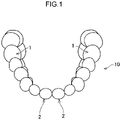
- Fig. 1 is a drawing showing drawing showing the external appearance of a mouthguard for the upper jaw in an embodiment of the present disclosure.
- a mouthguard 10 for the upper jaw in an embodiment of the present disclosure has second molar portions 1 that guard the second molars at the upper jaw side, and central incisor portions 2 that guard the central incisors at the upper jaw side.
- Fig. 2 is a drawing showing the thickness of the mouthguard for the upper jaw at the occlusal surface (planar type) of the central incisor portion.
- Fig. 3 is a drawing showing the thickness of the mouthguard for the upper jaw at the occlusal surface (non-planar type) of the central incisor portion.
- occlusal surface in a case in which the occlusal surface is planar is called occlusal surface (planar type).
- occlusal surface in a case in which the occlusal surface is not planar is called occlusal surface (non-planar type).
- thickness 5 of the occlusal surface at the central incisor portion indicates, at a central incisor portion of the mouthguard 10 for the upper jaw that is a portion that contacts a central incisor at the time when the mouthguard 10 for the upper jaw is being worn, the shortest distance among the distances between surface 3 that contacts the distal end portion of the central incisor, and opposing surface 4 that, at the aforementioned central incisor portion, opposes the surface 3 that contacts the distal end portion of the central incisor.
- Fig. 4 is a drawing showing the thickness of the mouthguard for the upper jaw at the occlusal surface (planar type) of a second molar portion.
- Fig. 5 is a drawing showing the thickness of the mouthguard for the upper jaw at the occlusal surface (non-planar type) of the second molar portion.
- thickness 8 of the occlusal surface at the second molar portion indicates, at a second molar portion of the mouthguard 10 for the upper jaw that is a portion that contacts a second molar at the time when the mouthguard 10 for the upper jaw is being worn, the shortest distance among the distances between surface 6 that contacts the distal end portion of the second molar, and opposing surface 7 that, at the aforementioned second molar portion, opposes the surface 6 that contacts the distal end portion of the second molar.
- the thickness can be freely changed by CAD design. Improvement in the wearing sensation can be devised by carrying out designing such as making only molar portion side surfaces thin, or the like.
- the photocurable composition that is used in the present method of manufacturing a mouthguard is not limited to the photocurable composition of the first embodiment, and any photocurable composition can be used provided that it is a composition that can be photoshaped.
- a mouthguard that is manufactured by the present method of manufacturing a mouthguard indicates an appliance that is used within the oral cavity and is structured so as to cover teeth and gums.
- the manufactured mouthguard is not particularly limited, and a mouthguard for the upper jaw is preferable.
- Form 2a and 2b are examples of the photocurable composition of the second embodiment.
- the photocurable composition relating to Form 2a of the second embodiment contains a (meth)acrylic monomer component and a photopolymerization initiator, and the adhesive force of the cured product is less than or equal to 1.5 N, and the shore A hardness of the cured product is less than or equal to 97.
- the inventors of the present disclosure thought that a cause of unpleasant sensations arising in cases in which a cured product obtained by photocuring a photocurable composition (hereinafter also simply called cured product) is applied to human bodies is the hardness of the cured product.
- a strong occlusal force is imparted via the mouthpiece to the contacting surfaces of the mouthpiece and the upper and lower teeth, due to biting of the teeth. It is thought that, at this time, in a case in which the hardness of the cured product is high, it is easier for the aforementioned occlusal force to be transferred to the teeth, and therefore, an unpleasant sensation such as pain or the like arises.
- the inventors of the present disclosure discovered that, in a case in which the hardness of a cured product is made to be low, the adhesive force of the cured product is high, and this is a cause of deteriorating the handleability.
- the photocurable composition of Form 2a containing a (meth)acrylic monomer component and a photopolymerization initiator, and the adhesive force of the cured product being less than or equal to 1.5 N, and the shore A hardness of the cured product being less than or equal to 97, in a case in which the photocurable composition of the second embodiment is photocured, it is possible to obtain a cured product in which unpleasant sensations at the time of application to human bodies is suppressed and that has excellent handleability.
- the shore A hardness of a cured product of the photocurable composition of Form 2A is less than or equal to 97.
- the adhesive force of the cured product can be kept down even if the hardness of the cured product that is obtained is less than or equal to 97.
- the shore A hardness of the cured product is preferably less than or equal to 95, and more preferably less than or equal to 93.
- the hardness of a cured product of the photocurable composition of Form 2a is preferably greater than or equal to 50.
- the hardness of a cured product of the photocurable composition of Form 2a is more preferably greater than or equal to 66, and even more preferably greater than or equal to 80.
- the hardness of the cured product is measured by the following method.
- the photocurable composition is shaped to length 25 mm ⁇ width 25 mm ⁇ thickness 6 mm, and a shaped product (layered width 50 ⁇ m) is obtained.
- visible light of a wavelength of 405 nm is illuminated onto the respective layers within a range of 5.0 mJ/cm 2 ⁇ 10 mJ/cm 2 and under the condition of becoming a desired thickness.
- a cured product is obtained.
- the cured product that is obtained is used as the object of measurement of hardness.
- the hardness of the cured product is measured in accordance with ISO 7619-1: 2010.
- the rupture elongation of the cured product obtained by curing the photocurable composition is preferably greater than or equal to 10%.
- the restorability an improvement in the restoring speed, a suppression of the amount of deformation at the time of being restored, and the like
- the restorability can be improved even more.
- the amount of deformation at the time of the above-described restoring can be suppressed better.
- the rupture elongation of the cured product is preferably greater than or equal to 20%, and more preferably greater than or equal to 40%, and even more preferably greater than or equal to 60%.
- the rupture elongation of the cured product is measured by the following method.
- the photocurable composition is shaped into the shape of a dumbbell-type test piece conforming to ISO 37-2, and a shaped product (layered width 50 ⁇ m) is obtained.
- visible light of a wavelength of 405 nm is illuminated onto the respective layers within a range of 5.0 mJ/cm 2 ⁇ 10 mJ/cm 2 and under the condition of becoming a desired thickness.
- a cured product is obtained.
- the cured product that is obtained is used as the object of measurement of rupture elongation.
- the rupture elongation of the cured product that is the object of measurement is measured in accordance with ISO 37: 2017 by using a tensile testing device and under the condition of a pulling speed of 500 ⁇ 50 mm/minute.
- the photocurable composition relating to Form 2b of the second embodiment contains a (meth)acrylic monomer component and a photopolymerization initiator, and the (meth)acrylic monomer component contains (meth)acrylic monomer (A) having two (meth)acryloyl groups and (meth)acrylic monomer (B) having one (meth)acryloyl group, and the molecular weight per one (meth)acryloyl group in (meth)acrylic monomer (A) is greater than or equal to 300 g/mol, and at least one of (meth)acrylic monomer (A) and (meth)acrylic monomer (B) has an aromatic group, and the shore A hardness of the cured product is less than or equal to 97.
- At least one of (meth)acrylic monomer (A) and (meth)acrylic monomer (B) has a ring structure.
- At least one of (meth)acrylic monomer (A) and (meth)acrylic monomer (B) has an aromatic group.
- the total content of (meth)acrylic monomer (A) and (meth)acrylic monomer (B) in the (meth)acrylic monomer component is preferably greater than or equal to 90% by mass, and more preferably greater than or equal to 95% by mass.
- the photocurable composition of the second embodiment may contain acrylic rubber particles.
- Z in Formula ⁇ that is put forth in the above-described first embodiment is preferably within the range shown for the term of Formula ⁇ that is put forth in the above-described first embodiment.
- Z1 in Formula ⁇ that is put forth in the above-described first embodiment is preferably within the range shown for the term of Formula ⁇ that is put forth in the above-described first embodiment.
- the photocurable composition of the second embodiment preferably satisfies at least one of (a) and (b) that are put forth in the above-described first embodiment section.
- the (meth)acrylic monomer component of the second embodiment may include other additives other than above-described (meth)acrylic monomer (A) and above-described (meth)acrylic monomer (B).
- the photocurable composition of the second embodiment contains a photopolymerization initiator.
- the photocurable composition of the second embodiment may include, as needed, one or more types of other components that are other than (meth)acrylic monomer (A), (meth)acrylic monomer (B), and a photopolymerization initiator.
- the method of preparing the photocurable composition of the second embodiment is not particularly limited, and an example thereof is a method of mixing-together (meth)acrylic monomer (A) and (meth)acrylic monomer (B), and a photopolymerization initiator (and other components as needed).
- the photocurable composition of the second embodiment is preferably used for stereolithography.
- the photocurable composition of the second embodiment is suitably used in fabricating dental products by stereolithography.
- the photocurable composition of the second embodiment is suitably used in fabricating mouthpieces, gingiva masks and lining materials by stereolithography, and is more suitably used suitably in fabricating mouthpieces and gingiva masks.
- the dental product of the second embodiment is a mouthguard
- the mouthguard is preferably manufactured by stereolithography.
- Examples A are Examples for more specifically describing the first embodiment of the present disclosure.
- a gingiva mask manufactured by NextDent B.V. was used as the photocurable composition.
- the obtained photocurable composition was shaped into the shape of a dumbbell-type test piece conforming to ISO 37-2 by using a 3D printer (Kulzer LLC, CaraPrint 4.0) under the conditions of the wavelength of the visible light being 405 nm and the illuminance of the visible light being 8.0 mJ/cm 2 , and a shaped product (layered width 50 ⁇ m) was obtained.
- a photoshaped product i.e., a cured product
- test piece The rupture elongation of the photoshaped product that was obtained (hereinafter called "test piece") was measured in accordance with ISO 37: 2017. These measurements were carried out by using a tensile testing device (manufactured by Shimadzu Corporation) and under the condition of a pulling speed of 500 ⁇ 50 mm/minute.
- the obtained photocurable composition was shaped to length 25 mm ⁇ width 25 mm ⁇ thickness 6 mm, by using a 3D printer (Kulzer LLC, CaraPrint 4.0) and under the conditions of the wavelength of the visible light being 405 nm and the illuminance of the visible light being 8.0 mJ/cm 2 , and a shaped product (layered width 50 ⁇ m) was obtained.
- a photoshaped product i.e., a cured product
- test piece The shore A hardness of the photoshaped product that was obtained (hereinafter called "test piece") was measured in accordance with ISO 7619-1: 2010. In measuring the hardness, a durometer-type hardness tester (manufactured by Mitutoyo Corporation) was used, and the numerical value after 15 seconds after needle insertion was used as the value of the shore A hardness.
- the obtained photocurable composition was shaped to length 20 mm ⁇ width 20 mm ⁇ thickness 2 mm, by using a 3D printer (Kulzer LLC, CaraPrint 4.0) and under the conditions of the wavelength of the visible light being 405 nm and the illuminance of the visible light being 8.0 mJ/cm 2 , and a shaped product (layered width 50 ⁇ m) was obtained.
- a photoshaped product was obtained.
- test piece The photoshaped product that was obtained (hereinafter called "test piece") was affixed to a sample stand such that there was no slack therein.
- a probe which was made of aluminum and whose contact surface area was length 10 mm ⁇ width 10 mm, and a 20 mm long ⁇ 20 mm wide surface of the test piece, were made to contact one another, and were left for 1.0 ⁇ 0.1 seconds at a contact load of 0.98 ⁇ 0.01 N/cm 2 .
- the aforementioned probe was pulled-off from the contact surface in the vertical direction at a speed of 5 ⁇ 0.5 mm per second. Then, the maximum load needed at the time of pulling the aforementioned probe off from the contact surface was determined, and was used as the adhesive force (unit: N) of the cured product.
- the obtained photocurable composition was shaped to length 20 mm ⁇ width 20 mm ⁇ thickness 3 mm, by using a 3D printer (Kulzer LLC, CaraPrint 4.0) and under the conditions of the wavelength of the visible light being 405 nm and the illuminance of the visible light being 8.0 mJ/cm 2 , and a shaped product (layered width 50 ⁇ m) was obtained.
- a 3D printer Karl LLC, CaraPrint 4.0
- test piece The shock absorbing ability (A (%)) of the photoshaped product that was obtained (hereinafter called "test piece”) was measured by the above-described method.
- the maximum load was measured by using a compact load cell for compression/tension dual use (LMU-200N, manufactured by Imada Co., Ltd.) that was connected to a load output device (ZT Digital Force Gauge, manufactured by Imada Co., Ltd.).
- the measurement of the maximum load was carried out under the condition of a temperature of 23°C on the test piece within the 30 seconds after the test piece had been left for 15 minutes at 37°C.
- the obtained photocurable composition was shaped to length 8 mm ⁇ width 39 mm ⁇ thickness 4 mm, by using a 3D printer (Kulzer LLC, CaraPrint 4.0) and under the conditions of the wavelength of the visible light being 405 nm and the illuminance of the visible light being 8.0 mJ/cm 2 , and a shaped product (layered width 50 ⁇ m) was obtained.
- test piece The photoshaped product that was obtained (hereinafter called “test piece"), and the test piece was curved such that the both ends in the long axis direction (lateral axis direction) of the test piece contacted one another, and was maintained for 10 seconds. Thereafter, the stress was released, and the change in the shape of the test piece was observed and was evaluated in accordance with the following standards.
- test piece After the stress was released, the test piece returned to its original shape in greater than or equal to 0 seconds and less than 1 second.
- test piece After the stress was released, the test piece returned to its original shape in greater than or equal to 1 second and less than 3 seconds.
- test piece After the stress was released, the test piece returned to its original shape in greater than or equal to 3 seconds and less than 10 seconds.
- test piece After the stress was released, the test piece had not returned to its original shape at the point in time of 10 seconds, but breakage and fissures did not occur.
- SUA-01 a compound manufactured by the method put forth in following Manufacturing Example 1A, a urethane diacrylate monomer
- SUA-02 a compound manufactured by the method put forth in following Manufacturing Example 2A, a urethane diacrylate monomer
- SUA-03 a compound manufactured by the method put forth in following Manufacturing Example 3A, a urethane diacrylate monomer
- SUA-04 a compound manufactured by the method put forth in following Manufacturing Example 4A, a urethane diacrylate monomer
- SUA-05 a compound manufactured by the method put forth in following Manufacturing Example 5A, a urethane diacrylate monomer
- MMD-352 a compound manufactured by the method put forth in following Manufacturing Example 6A, a urethane diacrylate monomer
- IPDI isophoron diisocyanate
- DBTDL dibutyltin dilaurate
- MEHQ 2-methoxyphenol
- PEG-1000 molecular weight 1000, manufactured by Toho Chemical Industry Co., Ltd.
- 500 g 500 g (0.50 mol
- the amount that was added dropwise was controlled such that the temperature was less than or equal to 80°C.
- the reaction temperature after the total amount was added dropwise was maintained at 80°C, and the reaction was carried out for 5 hours.
- the internal temperature of the flask was maintained at 60°C, and 116 g (1.00 mol) of HEA (2-hydroxyethyl-acrylate), which had been added to another dropping funnel, was added dropwise over one hour.
- the internal temperature rose due to the reaction heat, and therefore, the amount that was added dropwise was controlled such that the temperature was less than or equal to 80°C.
- the reaction temperature after the total amount was added dropwise was maintained at 80°C, and the reaction was carried out for 5 hours.
- IPDI isophoron diisocyanate
- DBTDL dibutyltin dilaurate
- MEHQ 2-methoxyphenol
- EXCENOL 1020 (molecular weight 1000, manufactured by AGC Chemicals) in an amount of 500 g (0.50 mol) was added dropwise over one hour. During the dropwise addition, the internal temperature rose due to the reaction heat, and therefore, the amount that was added dropwise was controlled such that the temperature was less than or equal to 80°C. The reaction temperature after the total amount was added dropwise was maintained at 80°C, and the reaction was carried out for 5 hours.
- the internal temperature of the flask was maintained at 60°C, and 116 g (1.00 mol) of HEA (2-hydroxyethyl-acrylate), which had been added to another dropping funnel, was added dropwise over one hour.
- the internal temperature rose due to the reaction heat, and therefore, the amount that was added dropwise was controlled such that the temperature was less than or equal to 80°C.
- the reaction temperature after the total amount was added dropwise was maintained at 80°C, and the reaction was carried out for 5 hours.
- IPDI isophoron diisocyanate
- DBTDL dibutyltin dilaurate
- MEHQ 2-methoxyphenol
- PEG-1000 molecular weight 1000, manufactured by Toho Chemical Industry Co., Ltd.
- 500 g 500 g (0.50 mol
- the amount that was added dropwise was controlled such that the temperature was less than or equal to 80°C.
- the reaction temperature after the total amount was added dropwise was maintained at 80°C, and the reaction was carried out for 5 hours.
- the internal temperature of the flask was maintained at 60°C, and 144 g (1.00 mol) of 4HBA (4-hydroxybutyl-acrylate), which had been added to another dropping funnel, was added dropwise over one hour. During the dropwise addition, the internal temperature rose due to the reaction heat, and therefore, the amount that was added dropwise was controlled such that the temperature was less than or equal to 80°C. The reaction temperature after the total amount was added dropwise was maintained at 80°C, and the reaction was carried out for 5 hours.
- 4HBA 4-hydroxybutyl-acrylate
- IPDI isophoron diisocyanate
- DBTDL dibutyltin dilaurate
- MEHQ in amount of 0.43 g (0.05% by weight with respect to the total weight of IPDI, EXCENOL 1020 and 4HBA)
- EXCENOL 1020 (molecular weight 1000, manufactured by AGC Chemicals) in an amount of 500 g (0.50 mol) was added dropwise over one hour. During the dropwise addition, the internal temperature rose due to the reaction heat, and therefore, the amount that was added dropwise was controlled such that the temperature was less than or equal to 80°C. The reaction temperature after the total amount was added dropwise was maintained at 80°C, and the reaction was carried out for 5 hours.
- the internal temperature of the flask was maintained at 60°C, and 144 g (1.00 mol) of 4HBA (4-hydroxybutyl-acrylate), which had been added to another dropping funnel, was added dropwise over one hour. During the dropwise addition, the internal temperature rose due to the reaction heat, and therefore, the amount that was added dropwise was controlled such that the temperature was less than or equal to 80°C. The reaction temperature after the total amount was added dropwise was maintained at 80°C, and the reaction was carried out for 5 hours.
- 4HBA 4-hydroxybutyl-acrylate
- IPDI isophoron diisocyanate
- DBTDL dibutyltin dilaurate
- MEHQ 2-methoxyphenol
- PTMG 1000 molecular weight 1000, manufactured by Mitsubishi Chemical Corporation
- 500 g 500 g (0.50 mol
- the amount that was added dropwise was controlled such that the temperature was less than or equal to 80°C.
- the reaction temperature after the total amount was added dropwise was maintained at 80°C, and the reaction was carried out for 5 hours.
- the internal temperature of the flask was maintained at 60°C, and 144 g (1.00 mol) of 4HBA (4-hydroxybutyl-acrylate), which had been added to another dropping funnel, was added dropwise over one hour.
- the amount that was added dropwise was controlled such that the temperature was less than or equal to 80°C.
- the reaction temperature after the total amount was added dropwise was maintained at 80°C, and the reaction was carried out for 5 hours.
- M-600A phenylglycidyl ether acrylate, manufactured by Kyoeisha Chemical Co., Ltd.
- DBTDL dibutyltin dilaurate
- MEHQ 2-methoxyphenol
- the amount that was added dropwise was controlled such that the temperature was less than or equal to 80°C.
- the reaction temperature after the total amount was added dropwise was maintained at 80°C, and the reaction was carried out for 10 hours.
- Omnirad TPO is manufactured by IGM Resins.
- Omnirad 819 is manufactured by IGM Resins.
- Examples B are Examples for more specifically describing the second embodiment of the present disclosure.
- a Gingiva Mask (manufactured by NextDent B.V.) was used as the photocurable composition.
- the obtained photocurable composition was shaped into the shape of a dumbbell-type test piece conforming to ISO 37-2 by using a 3D printer (Kulzer LLC, CaraPrint 4.0) under the conditions of the wavelength of the visible light being 405 nm and the illuminance of the visible light being 8.0 mJ/cm 2 , and a shaped product (layered width 50 ⁇ m) was obtained.
- a photoshaped product i.e., cured product
- test piece The rupture elongation of the photoshaped product that was obtained (hereinafter called "test piece") was measured in accordance with ISO 37: 2017. These measurements were carried out by using a tensile testing device (manufactured by Shimadzu Corporation) and under the condition of a pulling speed of 500 ⁇ 50 mm/minute.
- the obtained photocurable composition was shaped to length 25 mm ⁇ width 25 mm ⁇ thickness 6 mm, by using a 3D printer (Kulzer LLC, CaraPrint 4.0) and under the conditions of the wavelength of the visible light being 405 nm and the illuminance of the visible light being 8.0 mJ/cm 2 , and a shaped product (layered width 50 ⁇ m) was obtained.
- a photoshaped product i.e., cured product
- test piece The shore A hardness of the photoshaped product that was obtained (hereinafter called "test piece") was measured in accordance with ISO 7619-1: 2010. In measuring the hardness, a durometer-type hardness tester (manufactured by Mitutoyo Corporation) was used, and the numerical value after 15 seconds after needle insertion was used as the value of the shore A hardness.
- the obtained photocurable composition was shaped to length 20 mm ⁇ width 20 mm ⁇ thickness 2 mm, by using a 3D printer (Kulzer LLC, CaraPrint 4.0) and under the conditions of the wavelength of the visible light being 405 nm and the illuminance of the visible light being 8.0 mJ/cm 2 , and a shaped product (layered width 50 ⁇ m) was obtained.
- a photoshaped product was obtained.
- test piece The photoshaped product that was obtained (hereinafter called "test piece") was affixed to a sample stand such that there was no slack therein.
- a probe which was made of aluminum and whose contact surface area was length 10 mm ⁇ width 10 mm, and a 20 mm long ⁇ 20 mm wide surface of the test piece, were made to contact one another, and were left for 1.0 ⁇ 0.1 seconds at a contact load of 0.98 ⁇ 0.01 N/cm 2 .
- the aforementioned probe was pulled-off from the contact surface in the vertical direction at a speed of 5 ⁇ 0.5 mm per second. Then, the maximum load needed at the time of pulling the aforementioned probe off from the contact surface was determined, and was used as the adhesive force (unit: N) of the cured product.
- MMD-352 a compound manufactured by the method put forth in following Manufacturing Example 1B, a urethane diacrylate monomer
- Ebecryl 4859 manufactured by Daicell Allnex Ltd., a urethane diacrylate monomer
- M-600A phenylglycidyl ether acrylate
- DBTDL dibutyltin dilaurate
- MEHQ 2-methoxyphenol
- the amount that was added dropwise was controlled such that the temperature was less than or equal to 80°C.
- the reaction temperature after the total amount was added dropwise was maintained at 80°C, and the reaction was carried out for 10 hours.
- Omnirad TPO is manufactured by IGM Resins.
- Omnirad 819 is manufactured by IGM Resins.
- Plaster casts of the upper and lower jaws and the occlusal state were respectively made into three-dimensional impression data by using a dental scanner for a laboratory (Kulzer LLC, CaraScan 4.0).
- the respective three-dimensional impression data were uploaded to a CAD design (DENTCA Co, DENTCAdesign.com). Designing of the external shape of the mouthguard was carried out by software.
- the thickness of the occlusal surface of the central incisor portions was set to 2.5 mm, and the thickness of the occlusal surface of the second molar portions was set to 1.0 mm (i.e., the thickness of the occlusal surface of the central incisor portions was 2.5 times the thickness of the occlusal surface of the second molar portions), and three-dimensional shaping data of the target mouthguard for the upper jaw was obtained by automatic computation by algorithms of the software.
- the photocurable composition of Example 1A was shaped by using the three-dimensional shaping data for the mouthguard that was obtained as described above, and a shaped product of a mouthguard for the upper jaw was thereby obtained.
- the photocurable composition of Example 1B was shaped by using the three-dimensional shaping data for the mouthguard that was obtained as described above, and a shaped product of a mouthguard was obtained.
- the mouthguards for the upper jaw that were manufactured by the methods of Example 1C and Comparative Example 1C were attached to an articulator in which plaster casts of the upper and lower jaws were mounted, and were evaluated on the basis of the following standards.
Landscapes
- Health & Medical Sciences (AREA)
- Chemical & Material Sciences (AREA)
- Chemical Kinetics & Catalysis (AREA)
- Medicinal Chemistry (AREA)
- Polymers & Plastics (AREA)
- Organic Chemistry (AREA)
- Life Sciences & Earth Sciences (AREA)
- Oral & Maxillofacial Surgery (AREA)
- General Health & Medical Sciences (AREA)
- Animal Behavior & Ethology (AREA)
- Veterinary Medicine (AREA)
- Epidemiology (AREA)
- Public Health (AREA)
- Materials Engineering (AREA)
- Engineering & Computer Science (AREA)
- Manufacturing & Machinery (AREA)
- Plastic & Reconstructive Surgery (AREA)
- Biophysics (AREA)
- Dentistry (AREA)
- Physical Education & Sports Medicine (AREA)
- Polymerisation Methods In General (AREA)
- Macromonomer-Based Addition Polymer (AREA)
- Dental Tools And Instruments Or Auxiliary Dental Instruments (AREA)
Applications Claiming Priority (4)
| Application Number | Priority Date | Filing Date | Title |
|---|---|---|---|
| JP2019195500 | 2019-10-28 | ||
| JP2019195499 | 2019-10-28 | ||
| JP2020071833 | 2020-04-13 | ||
| PCT/JP2020/040460 WO2021085481A1 (fr) | 2019-10-28 | 2020-10-28 | Composition photodurcissable et produit dentaire |
Publications (2)
| Publication Number | Publication Date |
|---|---|
| EP4019100A1 true EP4019100A1 (fr) | 2022-06-29 |
| EP4019100A4 EP4019100A4 (fr) | 2023-09-13 |
Family
ID=75716299
Family Applications (1)
| Application Number | Title | Priority Date | Filing Date |
|---|---|---|---|
| EP20880670.3A Pending EP4019100A4 (fr) | 2019-10-28 | 2020-10-28 | Composition photodurcissable et produit dentaire |
Country Status (5)
| Country | Link |
|---|---|
| US (1) | US12569410B2 (fr) |
| EP (1) | EP4019100A4 (fr) |
| JP (3) | JP7759257B2 (fr) |
| CN (1) | CN114514255B (fr) |
| WO (1) | WO2021085481A1 (fr) |
Families Citing this family (2)
| Publication number | Priority date | Publication date | Assignee | Title |
|---|---|---|---|---|
| WO2023190931A1 (fr) * | 2022-03-30 | 2023-10-05 | クラレノリタケデンタル株式会社 | Composition de résine pour stéréolithographie |
| US20230406984A1 (en) * | 2022-06-15 | 2023-12-21 | Cmc Materials Llc | Uv-curable resins for chemical mechanical polishing pads |
Family Cites Families (35)
| Publication number | Priority date | Publication date | Assignee | Title |
|---|---|---|---|---|
| JPS5111880B1 (fr) | 1970-11-19 | 1976-04-14 | ||
| JPS5235056B2 (fr) | 1973-06-04 | 1977-09-07 | ||
| US5177120A (en) * | 1984-07-31 | 1993-01-05 | Dentsply Research & Development Corp. | Chain extended urethane diacrylate and dental impression formation |
| JPH11349645A (ja) | 1998-06-11 | 1999-12-21 | Mitsubishi Rayon Co Ltd | 活性エネルギー線硬化性樹脂組成物および光学シート |
| US6214522B1 (en) * | 1998-08-28 | 2001-04-10 | Macdermid, Incorporated | Photosensitive resin composition useful in fabricating printing plates |
| JP4320846B2 (ja) * | 1999-06-10 | 2009-08-26 | 旭硝子株式会社 | 光硬化性組成物 |
| JP4409121B2 (ja) | 2001-07-11 | 2010-02-03 | 株式会社ジーシー | マウスガード用組成物 |
| EP2226060B1 (fr) * | 2007-12-28 | 2020-03-04 | Kuraray Noritake Dental Inc. | Ciment pour applications dentaires |
| KR100964642B1 (ko) | 2008-02-22 | 2010-06-21 | 에스화인켐 주식회사 | 고굴절, 고탄성의 프리즘 시트와 이를 위한 조성물 및 그제조 방법 |
| JP5616187B2 (ja) * | 2010-09-29 | 2014-10-29 | 株式会社日本触媒 | 成形体及び成形体用樹脂組成物 |
| JP2015043793A (ja) * | 2013-08-27 | 2015-03-12 | ディーダブルエス エス・アール・エル | 人工歯の製造方法 |
| JP6059356B2 (ja) * | 2013-10-04 | 2017-01-11 | 日本曹達株式会社 | 耐光性を有し、機械強度に優れるアクリル変性pb硬化性組成物 |
| JP5819481B2 (ja) * | 2014-05-29 | 2015-11-24 | 新中村化学工業株式会社 | ウレタン(メタ)アクリレートおよびそれを含有する光硬化性樹脂組成物 |
| JP6379829B2 (ja) * | 2014-08-05 | 2018-08-29 | 日立化成株式会社 | 硬化性樹脂組成物及び硬化物 |
| JP2016107208A (ja) * | 2014-12-05 | 2016-06-20 | 関西ペイント株式会社 | 被膜形成方法 |
| CN107205884B (zh) * | 2015-02-03 | 2020-09-01 | 三井化学株式会社 | 光固化性组合物、义齿基托及带托义齿 |
| US10492888B2 (en) | 2015-07-07 | 2019-12-03 | Align Technology, Inc. | Dental materials using thermoset polymers |
| JP6615000B2 (ja) * | 2016-02-23 | 2019-12-04 | 株式会社トクヤマデンタル | 歯科用接着性組成物 |
| JP6712916B2 (ja) * | 2016-07-11 | 2020-06-24 | 日東電工株式会社 | 粘着シート |
| JP6934475B2 (ja) * | 2016-08-26 | 2021-09-15 | クラレノリタケデンタル株式会社 | 光硬化性樹脂組成物 |
| JP6941759B2 (ja) | 2016-09-09 | 2021-09-29 | Kjケミカルズ株式会社 | (メタ)アクリルアミド変性ポリロタキサン |
| JP6825887B2 (ja) * | 2016-11-28 | 2021-02-03 | 日本曹達株式会社 | 光硬化性組成物およびその硬化物 |
| JP6911420B2 (ja) * | 2017-03-21 | 2021-07-28 | 東洋インキScホールディングス株式会社 | 活性エネルギー線重合性組成物 |
| ES2970716T3 (es) * | 2017-04-04 | 2024-05-30 | Arkema France | Composiciones curables y adhesivos autoadherentes de baja adhesividad preparados a partir de las mismas |
| JP6893834B2 (ja) * | 2017-06-16 | 2021-06-23 | クラレノリタケデンタル株式会社 | 光硬化性樹脂組成物 |
| JP2019026809A (ja) * | 2017-08-03 | 2019-02-21 | 東亞合成株式会社 | 接着用キット及び接着方法 |
| WO2019189566A1 (fr) * | 2018-03-28 | 2019-10-03 | クラレノリタケデンタル株式会社 | Composition de résine photodurcissable |
| JP7127805B2 (ja) | 2018-05-10 | 2022-08-30 | 株式会社Booom | 遊技機 |
| JP7127806B2 (ja) | 2018-05-10 | 2022-08-30 | 株式会社Booom | 遊技機 |
| JP7105102B2 (ja) * | 2018-05-17 | 2022-07-22 | クラレノリタケデンタル株式会社 | 光硬化性樹脂組成物 |
| EP3590489A1 (fr) * | 2018-07-06 | 2020-01-08 | Ivoclar Vivadent AG | Matières dentaires à base de méthacrylates de biphényle monofonction |
| ES2907193T3 (es) * | 2018-10-11 | 2022-04-22 | Dreve Prodimed Gmbh | Material para la producción aditiva de objetos tridimensionales, así como procedimiento para la producción y empleo |
| JP6950665B2 (ja) | 2018-11-02 | 2021-10-13 | 横河電機株式会社 | エンジニアリング装置、エンジニアリング装置の制御方法及びプログラム |
| JP7474200B2 (ja) * | 2018-12-21 | 2024-04-24 | クラレノリタケデンタル株式会社 | 光造形用樹脂組成物 |
| EP3925994A4 (fr) * | 2019-03-29 | 2022-12-21 | Mitsui Chemicals, Inc. | Composition photodurcissable, produit durci et produit dentaire |
-
2020
- 2020-10-28 US US17/639,927 patent/US12569410B2/en active Active
- 2020-10-28 CN CN202080068277.1A patent/CN114514255B/zh active Active
- 2020-10-28 JP JP2021553656A patent/JP7759257B2/ja active Active
- 2020-10-28 WO PCT/JP2020/040460 patent/WO2021085481A1/fr not_active Ceased
- 2020-10-28 EP EP20880670.3A patent/EP4019100A4/fr active Pending
-
2023
- 2023-07-18 JP JP2023117108A patent/JP7744947B2/ja active Active
-
2025
- 2025-04-28 JP JP2025074796A patent/JP2025107275A/ja not_active Withdrawn
Also Published As
| Publication number | Publication date |
|---|---|
| JP7744947B2 (ja) | 2025-09-26 |
| EP4019100A4 (fr) | 2023-09-13 |
| WO2021085481A1 (fr) | 2021-05-06 |
| JP2023143923A (ja) | 2023-10-06 |
| JPWO2021085481A1 (fr) | 2021-05-06 |
| US12569410B2 (en) | 2026-03-10 |
| JP7759257B2 (ja) | 2025-10-23 |
| US20220339077A1 (en) | 2022-10-27 |
| CN114514255B (zh) | 2024-12-13 |
| CN114514255A (zh) | 2022-05-17 |
| JP2025107275A (ja) | 2025-07-17 |
Similar Documents
| Publication | Publication Date | Title |
|---|---|---|
| JP7729853B2 (ja) | ウレタン成分及び単官能性反応性希釈剤を含む光重合性組成物、物品、並びに方法 | |
| US12421336B2 (en) | Orthodontic articles comprising cured free-radically polymerizable composition with improved strength in aqueous environment | |
| EP3658602B1 (fr) | Compositions photopolymérisables comprenant un composant uréthane et un diluant réactif, articles orthodontiques et procédés | |
| US12104000B2 (en) | Photopolymerizable compositions including a polypropylene oxide component, articles, and methods | |
| CN110785158B (zh) | 用于制备牙科复合冠的可固化组合物和制备方法 | |
| US5387105A (en) | Dental image formation and organosiloxane | |
| MacGregor et al. | Recent experiences with denture polymers | |
| KR20180120235A (ko) | 예비성형된 치과용 복합재 크라운, 이의 제조 방법 및 용도 | |
| EP0173085B1 (fr) | Dimethacrylate d'uréthane à chaîne allongée et formation d'une impression de dents | |
| JP2025107275A (ja) | 光硬化性組成物及び歯科用製品 | |
| JP7546413B2 (ja) | 3dプリンタ用歯科用光重合性組成物 | |
| Maleki et al. | Mechanical and physical properties of splint materials for oral appliances produced by additive, subtractive and conventional manufacturing | |
| WO2018234898A1 (fr) | Composition durcissable par rayonnement pour procédés de fabrication additive | |
| CA1271588A (fr) | Formation d'empreintes dentaires et organosiloxane | |
| JP7808184B2 (ja) | 光硬化性組成物、立体造形物、鋳型、硬化物を製造する方法及び有床義歯の製造方法 | |
| US10729622B2 (en) | Process for taking a dental impression and curable composition for use in a dental impressioning and retraction process | |
| WO2023190254A1 (fr) | Composition photodurcissable, objet moulé tridimensionnel, outil à fixer à l'intérieur de la cavité buccale, et outil à fixer à l'intérieur de l'oreille | |
| EP4488299A1 (fr) | Composition photodurcissable, article façonné tridimensionnel et produit dentaire | |
| WO2024117203A1 (fr) | Composition photodurcissable, article moulé tridimensionnel, produit dentaire, et gouttière | |
| EP4722262A1 (fr) | Composition photodurcissable, objet façonné tridimensionnel, moule de coulée, procédé de production d'objet durci et procédé de production de prothèse dentaire | |
| EP4736835A1 (fr) | Composition dentaire polymérisable | |
| JP2006028076A (ja) | 基礎床用レジン組成物 | |
| Alsayed | Effect of interim fixed prosthodontics materials and flowable composite resins on polymerization of polyvinyl siloxane impressions |
Legal Events
| Date | Code | Title | Description |
|---|---|---|---|
| STAA | Information on the status of an ep patent application or granted ep patent |
Free format text: STATUS: THE INTERNATIONAL PUBLICATION HAS BEEN MADE |
|
| PUAI | Public reference made under article 153(3) epc to a published international application that has entered the european phase |
Free format text: ORIGINAL CODE: 0009012 |
|
| STAA | Information on the status of an ep patent application or granted ep patent |
Free format text: STATUS: REQUEST FOR EXAMINATION WAS MADE |
|
| 17P | Request for examination filed |
Effective date: 20220325 |
|
| AK | Designated contracting states |
Kind code of ref document: A1 Designated state(s): AL AT BE BG CH CY CZ DE DK EE ES FI FR GB GR HR HU IE IS IT LI LT LU LV MC MK MT NL NO PL PT RO RS SE SI SK SM TR |
|
| DAV | Request for validation of the european patent (deleted) | ||
| DAX | Request for extension of the european patent (deleted) | ||
| RAP3 | Party data changed (applicant data changed or rights of an application transferred) |
Owner name: MITSUI CHEMICALS, INC. |
|
| REG | Reference to a national code |
Ref country code: DE Ref legal event code: R079 Free format text: PREVIOUS MAIN CLASS: A63B0071100000 Ipc: A61K0006620000 |
|
| A4 | Supplementary search report drawn up and despatched |
Effective date: 20230810 |
|
| RIC1 | Information provided on ipc code assigned before grant |
Ipc: A63B 71/08 20060101ALN20230804BHEP Ipc: C08G 18/67 20060101ALI20230804BHEP Ipc: C08G 18/24 20060101ALI20230804BHEP Ipc: C08F 290/06 20060101ALI20230804BHEP Ipc: C08L 75/16 20060101ALI20230804BHEP Ipc: C08G 18/76 20060101ALI20230804BHEP Ipc: C08G 18/75 20060101ALI20230804BHEP Ipc: C08G 18/48 20060101ALI20230804BHEP Ipc: B33Y 80/00 20150101ALI20230804BHEP Ipc: B33Y 70/00 20200101ALI20230804BHEP Ipc: A61K 6/887 20200101ALI20230804BHEP Ipc: A61C 7/08 20060101ALI20230804BHEP Ipc: A61K 6/62 20200101AFI20230804BHEP |