EP4021807B1 - Ensemble de sièges pour une cabine d'un moyen de transport - Google Patents
Ensemble de sièges pour une cabine d'un moyen de transport Download PDFInfo
- Publication number
- EP4021807B1 EP4021807B1 EP20764969.0A EP20764969A EP4021807B1 EP 4021807 B1 EP4021807 B1 EP 4021807B1 EP 20764969 A EP20764969 A EP 20764969A EP 4021807 B1 EP4021807 B1 EP 4021807B1
- Authority
- EP
- European Patent Office
- Prior art keywords
- seat
- module
- cabin
- modules
- seating
- Prior art date
- Legal status (The legal status is an assumption and is not a legal conclusion. Google has not performed a legal analysis and makes no representation as to the accuracy of the status listed.)
- Active
Links
Images

Classifications
-
- B—PERFORMING OPERATIONS; TRANSPORTING
- B64—AIRCRAFT; AVIATION; COSMONAUTICS
- B64D—EQUIPMENT FOR FITTING IN OR TO AIRCRAFT; FLIGHT SUITS; PARACHUTES; ARRANGEMENT OR MOUNTING OF POWER PLANTS OR PROPULSION TRANSMISSIONS IN AIRCRAFT
- B64D11/00—Passenger or crew accommodation; Flight-deck installations not otherwise provided for
- B64D11/06—Arrangements of seats, or adaptations or details specially adapted for aircraft seats
- B64D11/0601—Arrangement of seats for non-standard seating layouts, e.g. seats staggered horizontally or vertically, arranged in an angled or fishbone layout, or facing in other directions than the direction of flight
-
- B—PERFORMING OPERATIONS; TRANSPORTING
- B64—AIRCRAFT; AVIATION; COSMONAUTICS
- B64D—EQUIPMENT FOR FITTING IN OR TO AIRCRAFT; FLIGHT SUITS; PARACHUTES; ARRANGEMENT OR MOUNTING OF POWER PLANTS OR PROPULSION TRANSMISSIONS IN AIRCRAFT
- B64D11/00—Passenger or crew accommodation; Flight-deck installations not otherwise provided for
- B64D11/06—Arrangements of seats, or adaptations or details specially adapted for aircraft seats
- B64D11/0602—Seat modules, i.e. seat systems including furniture separate from the seat itself
- B64D11/0605—Seat modules, i.e. seat systems including furniture separate from the seat itself including tables or desks
-
- B—PERFORMING OPERATIONS; TRANSPORTING
- B64—AIRCRAFT; AVIATION; COSMONAUTICS
- B64D—EQUIPMENT FOR FITTING IN OR TO AIRCRAFT; FLIGHT SUITS; PARACHUTES; ARRANGEMENT OR MOUNTING OF POWER PLANTS OR PROPULSION TRANSMISSIONS IN AIRCRAFT
- B64D11/00—Passenger or crew accommodation; Flight-deck installations not otherwise provided for
- B64D11/06—Arrangements of seats, or adaptations or details specially adapted for aircraft seats
- B64D11/0639—Arrangements of seats, or adaptations or details specially adapted for aircraft seats with features for adjustment or converting of seats
- B64D11/0643—Adjustable foot or leg rests
-
- B—PERFORMING OPERATIONS; TRANSPORTING
- B64—AIRCRAFT; AVIATION; COSMONAUTICS
- B64D—EQUIPMENT FOR FITTING IN OR TO AIRCRAFT; FLIGHT SUITS; PARACHUTES; ARRANGEMENT OR MOUNTING OF POWER PLANTS OR PROPULSION TRANSMISSIONS IN AIRCRAFT
- B64D11/00—Passenger or crew accommodation; Flight-deck installations not otherwise provided for
- B64D11/06—Arrangements of seats, or adaptations or details specially adapted for aircraft seats
- B64D11/0646—Seats characterised by special features of stationary arms, foot or head rests
Definitions
- the invention relates to a seat arrangement for a cabin of a means of transport, a cabin of a means of transport and a means of transport with a fuselage and at least one cabin formed therein.
- Means of transport such as aircraft, rail vehicles, watercraft, or coaches may have passenger seating areas, which typically feature seat arrangements. Particularly in means of transport for longer journeys, seating arrangements are also known that offer particularly high levels of seating and travel comfort. In addition to the actual seats, the seating arrangements may also include footrests or ottomans with integrated footrests. If the seat is also movable, the seat, together with a footrest, could provide a reclining position.
- Familiar seating arrangements with increased comfort are predominantly found in long-haul commercial aircraft, which have a larger fuselage diameter and thus a relatively large installation space in the cabin. This allows, for example, the realization of two aisles and two outer and one inner passenger seating areas. Seating arrangements for aircraft with smaller Diameters and a cabin with a central aisle are only known with two seating modules.
- US 2017/ 240283 A1 shows, in one illustrative embodiment, a premium seating arrangement for an aircraft cabin having at least three passenger suites, each passenger suite including a seat movable between an upright position and a horizontal bed position, and an ottoman extending a surface area of the bed position.
- the passenger suites may collectively form a nested arrangement capable of nesting with identical passenger suite arrangements longitudinally within the cabin area.
- At least two of the passenger suite ottomans may be longitudinally offset in installation position.
- Each passenger suite in the arrangement has direct aisle access without intervening another passenger suite.
- EP 3 378 770 A1 relates to a seating arrangement comprising a first and a second seat arranged with their backrests facing each other, the first and the second seat being displaceable from a sitting position to a lying position, possibly with the possibility of stopping in any of the intermediate positions, a part of the partition being arranged laterally with respect to the seats, extending laterally on one side of the first and second seats and terminating on one side in a section containing a footrest arranged in front of the respective seat and on the other side at a distance from the respective side of the partition of the seat, so that an entry/exit passage remains free and thus access to the seats, the entry/exit passage leading to a track for reaching the first or the second seat, the partitions, at their respective end forming the entry/exit channel, each providing a footrest on the outside, positioned in front of a third and fourth seat, respectively, which are arranged in the opposite direction with respect to the respective seat arranged on the opposite side of the same partition are arranged, with the third and
- DE 10 2015 105540 A1 describes a passenger seat arrangement for a vehicle cabin, which has at least a first group of passenger seats with a first passenger seat and a second passenger seat, at least one third passenger seat, and an aisle running parallel to a longitudinal axis, wherein the first passenger seat or the third passenger seat is arranged directly on the aisle and with a seating direction parallel to the aisle, wherein a seating direction of the second passenger seat is rotated by a first angle ( ⁇ ) of at least 2° to the seating direction of the first passenger seat and wherein the first group of passenger seats and the third passenger seat are arranged next to one another and have a longitudinal offset (L) to one another along the longitudinal axis.
- ⁇ first angle
- L longitudinal offset
- US 2007/040434 A1 shows a passenger seating assembly including a first seating unit facing in a first direction; a first ottoman having a first support surface positioned to receive the feet of a passenger seated in the first seating unit; a second seating unit facing in a second direction generally opposite the first direction; and a second ottoman disposed laterally adjacent the first ottoman and having a second support surface positioned to receive the feet of a passenger seated in the second seating unit.
- the seat arrangement according to the invention is therefore limited to two outer passenger seating areas separated from each other by a single aisle.
- the special feature of the seat arrangement according to the invention is that both passenger seating areas each have three seat modules arranged next to each other. Due to the offset, in particular of the outer, third seat module in the longitudinal direction This makes it easier for the user to reach this outer seating module. Passing through the first or second seating module is not necessary.
- an ottoman is understood as a built-in component that particularly preferably offers a comfortable place to rest one's feet.
- An ottoman is arranged in front of the seat in question in the direction of travel and has a height or height of a footrest adapted to the height of a seat.
- the ottoman can be permanently arranged on the cabin floor or it can at least be movable to a certain extent along the length of the cabin.
- a storage area for personal belongings could also be provided. It is also conceivable to accommodate electronic installations, such as a screen or components linked to the screen.
- the second seat module could be reached from a gap between two first seat modules placed in front of each other.
- the user could reach the ottoman or the The footrest of the second seating module can be moved lengthwise.
- the ottoman or footrest it might be advisable for the ottoman or footrest to provide a suitable space through which the user can step to the seat of the second seating module. It would also be conceivable to move the ottoman or footrest into a use position and a walk-through position so that the seat of the second seating module is accessible.
- the seating arrangement according to the invention allows for a very compact cabin design with very comfortable seating modules. Space utilization is also particularly good because the second and third seating modules can share the same access between two consecutive first seating modules. Means of transport with only a single aisle can be equipped with two arrangements of three adjacent seating modules each. This can result in significant space savings, which can be utilized, for example, with additional seats or seating modules.
- a laterally outer boundary of the seat of the second seat module is closer to the cabin wall belonging to the respective passenger seating area than a laterally inner boundary of the seat of the adjacent third seat module.
- the outer boundary of the seat of the second seat module can be in a range of approximately 3 inches (approximately 7.6 cm) to approximately 8 inches (approximately 20.3 cm) closer to the cabin wall than the inboard seat boundary of the third seating module. This consequently achieves the greatest possible lateral density, with the combination of a second and a third seating module each having straight outer edges that run parallel to the aisle.
- the second seat module has a foldable footrest designed to release a floor located beneath the footrest as needed to access the seat of the second seat module.
- the foldable footrest facilitates access to the second seat module or the seat located therein.
- the foldability of the footrest does not restrict the comfort of the user.
- the folding function could, for example, be achieved by a hinge on a wall of the second seat module or the adjacent, third seat module. Both the hinge itself and a mechanical stop arranged opposite the hinge could be used to lock or hold the footrest.
- the seat of the first seating module is located longitudinally in front of the seat of the second seating module. This creates an almost straight, i.e., unbent, and intuitively accessible aisle to reach the second and third seating modules.
- the at least one row of seats comprises several rows of seats, with a distance of at least 22 cm between the first seat modules and second seat modules of consecutive rows of seats, so that the second and third seat modules can be reached through a common passageway.
- a passageway width allows for relatively dense staggering in the longitudinal direction while still allowing passage through the gap or space between consecutive seat modules. Since the passageway is bordered on one side by an ottoman or footrest, each of which has a relatively low height, the user's sense of comfort is not restricted.
- the seating modules could preferably have a partition wall surrounding at least part of the respective seat.
- the partition wall significantly improves the privacy of each user, and the feeling of comfort is not compromised despite the number of seating modules.
- the seats of the seating modules each have a seating direction that runs parallel to the longitudinal axis. This distinguishes the seating arrangement according to the invention significantly from other arrangements in which the seating directions partially run diagonally to the adjacent aisle. This eliminates the need to take various measures to allow a user to pass through the aisle.
- the first seating module can have an entrance facing the aisle.
- the first seating module can therefore be easily accessed independently of the other, laterally adjacent seating modules.
- At least one of the ottomans or footrests has a storage compartment or shelf.
- a user's personal belongings can thus be stored in the immediate vicinity, directly in the seat module.
- a shelf could also be used by cabin crew to temporarily store items that need to be put down, for example, when serving food and drinks.
- An extendable table may also be designed to accommodate an IFE unit or a fold-out screen.
- the invention further relates to a cabin for a means of transport with at least one seating arrangement as described above.
- the cabin can be arranged in a fuselage of the means of transport.
- the invention relates to a means of transport with a fuselage and at least one cabin as shown above.
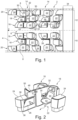
- first seat module 16 which is located inside the cabin 4 and faces the aisle 6. Further outwards and directly adjacent to the first seat module 16 is a second seat module 18. Further outwards is a third seat module 20. All seat modules 16, 18 and 20 each have a seat 22. The first seat module 16 and the third seat module 20 additionally have an ottoman 24. The second seat module 18, however, has a foldable footrest 26.
- the individual seat modules 16, 18 and 20 are not arranged directly next to each other, but are offset from each other in the longitudinal direction x.
- the third seat module 20, which directly adjoins the respective cabin wall 8, is offset in the longitudinal direction x relative to the second seat module 18 such that the seat 22 of the third seat module 20 adjoins the footrest 26 of the second seat module 18 in the transverse direction. This makes it possible to pass from the aisle 6 past the first seat module 16 and the second seat module 18 to the seat 22 of the third seat module 20. Passing through the first seat module 16 and of the second seat module 18 is therefore not necessary.
- a passage width d is provided, which could be relatively narrow. For example, at least 9 inches (approximately 22 cm) is mentioned. This is easily possible, particularly due to the relatively low height of the ottoman 24 of the first seating module 16, because the user walking between two consecutive first seating modules 16 does not feel cramped.
- the seat 22 of the second seat module 18 can also be reached directly from the aisle 6 by pivoting the footrest 26 into a vertical position. To reach the second seat module 18, it is also not necessary to pass through the first seat module 16.
- the particularly advantageous use of space in the cabin 4 is also achieved by the shared use of a passage from the aisle 6 to the second seat module 18 and the third seat module 20.
- the first seating module 16 is also directly and immediately accessible from aisle 6, as an access 28 between the seat 22 and the ottoman 24 leads directly into aisle 6.
- the seats 22 each have two laterally arranged armrests 30.
- the seats 22 of the first seat module 16 and the second seat module 18 are offset from one another in the longitudinal direction such that the armrest 30, which is directed towards the adjacent seat module 16 or 18, is longitudinally connected to the armrest 30 of the seat 22 of the other seat module 16 or 18. Users sitting on the seat 22 can therefore use the armrests 30 comfortably and without being disturbed by the adjacent user.
- the seat 22 is spaced far enough from the seats of the other seat modules 16 and 18 that completely unobstructed use of the armrests 30 is possible there too.
- Each seat module 16, 18, and 20 has a partition wall 32 that surrounds at least part of the respective seat 22 and is suitable for shielding the respective user. This provides the users with a certain degree of privacy, significantly increasing the comfort level of each user.
- At least the partition wall 32 between the aisle-side and middle seats 22 could be formed with an S-shape to improve access to the seats.
- a further advantageous embodiment allows an increase in the available space if an S-shaped partition wall 32 is provided in and immediately in front of the shoulder area of both seats 22 adjacent to a partition wall 32, whereby a constant aisle width between the two partition walls is ensured.
- the ottoman 24 of the third seat module 20 and the footrest 26 of the second seat module 18 have a smaller width than the respective associated seat 22.
- considerable space can be saved in the lateral direction due to the laterally adjacent arrangement of the footrest 26 and the seat 22, without the comfort of an individual user suffering.
- the ottoman 24 of the third seating module 20 is flush with the cabin wall 8.
- the footrest 26, meanwhile, is flush with the ottoman 24 of the first seating module 16.
- the ottoman 24 of the first seating module 16 could therefore have a substantially identical width to the associated seat 22.
- the seats 22 of the first seat module 16 and the second seat module 18 are, as already mentioned above, offset from each other by only a short distance along the longitudinal direction x and are thus arranged practically next to each other.
- the seat 22 of the first seat module 16 is offset slightly forward in the longitudinal direction x.
- Seat widths of approximately 23 inches (approximately 58.5 cm) are provided purely as an example. It is conceivable to reduce the seat widths to approximately 20 inches (approximately 50.8 cm).
- a diagonal extension length l of the individual seat modules 16, 18 and 20 could be approximately 75 inches (approximately 190.5 cm) or more. This extension is a measure of the achievable bed length if the seat modules 16, 18 and 20 can assume a lying position.
- the seats 22 of the individual seat modules 16, 18 and 20 can be moved approximately parallel to the longitudinal direction x, so that a closed lying surface (with pivoted backrest) could be achieved in the individual seat modules 16, 18 and 20.
- the diagonal extension length l could, for example, be in a range of 70 to 78 inches (approximately 177.8 cm to 198.1 cm). These dimensions can be adjusted upwards or downwards by a few centimeters if necessary, depending on individual design criteria.
- a laterally outer boundary of the seat 22 of the second seat module 18 can be closer to the cabin wall belonging to the respective passenger seating area than a laterally inner boundary 25 of the seat 22 of the adjacent third seat module 20.
- the outer boundary 23 of the seat 22 of the second seat module 18 could, as mentioned above, be in a range of approximately 3 inches (approx. 7.6 cm) to approximately 8 inches (approx. 20.3 cm) closer to the cabin wall 8 than the inner boundary 25 of the seat 22 of the third seat module 20. This also achieves very good space utilization in the lateral direction.
- the advantageous staggering also optimizes the transverse direction so that the seating arrangement shown can also be realized in cabins with a width in the range of 3.7 m to 4.5 m.
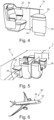
- the foldable footrest 26 is pivotally mounted on the ottoman 24 of the adjacent first seat module 16. It can be folded about a hinge axis 36 into a vertically upward storage position or into a horizontal usage position. If the footrest 26 is folded upward, it can lie flush with a panel 38 of the ottoman 24. This exposes a floor 40 located in front of the seat 22, so that the seat 22 can be reached.
- the seat 22 is shown with a seat surface 42, a backrest 44, and a headrest 46. The seat surface 42 and the backrest 44 could be moved in the longitudinal direction x, so that the seat 22 can assume a flat sitting or lying position.
- Fig. 1 The representation in Fig. 1 is one of many possible embodiments.
- the seat arrangement 2 can also be modified by adjusting axial or lateral distances. This is shown, for example, in the Figures 3a up to 3c shown.
- Fig. 3a For example, in the third seat module 20, the greatest possible distance 52 is provided between the seat 22 and the cabin wall 8. This is equivalent to the greatest possible headroom.
- the passage width d is compared to Fig. 1
- the individual seat modules 16, 18 and 20 are therefore spaced much further apart. This could further improve the comfort, but the space gained is Fig. 1 reduced.
- the larger distances also allow a larger aisle width b to be achieved.
- An extendable table or a segmented table instead of or in combination with the storage surface 56.
- An extendable table may also possibly be provided for mounting an IFE unit or a fold-out screen.
- Figure 6 an aircraft 60 having a fuselage 62 and a cabin 64 formed therein, in which at least one such seating arrangement 2 is provided.
Landscapes
- Engineering & Computer Science (AREA)
- Aviation & Aerospace Engineering (AREA)
- Passenger Equipment (AREA)
- Seats For Vehicles (AREA)
Claims (13)
- Agencement de sièges (2) pour une cabine (4) d'un moyen de transport, présentant :- un couloir (6) agencé dans une direction longitudinale (x) de la cabine (4),- deux parois de cabine (8) espacées l'une de l'autre, orientées au moins par zones parallèlement au couloir (6) et délimitant latéralement la cabine (4),- deux zones de sièges de passagers extérieures (10, 12), qui sont séparées l'une de l'autre par le couloir (6) et adjacentes chacune à l'une des deux parois de cabine (8),les zones de sièges de passagers extérieures (10, 12) présentant au moins une rangée de sièges (14) avec respectivement un premier module de siège (16) situé à l'intérieur, tourné vers le couloir (6), un deuxième module de siège (18) central voisin de celui-ci et un troisième module de siège (20) extérieur, adjacent à la paroi de cabine (8) respective,les premier et troisième modules de siège (16, 18, 20) présentant chacun un siège (22) et un ottoman (26) associé au siège ou un repose-pieds (26) espacé du siège respectif, et le deuxième module de siège (18) présentant un siège (22) et un repose-pieds (26) espacé de ce siège, le troisième module de siège (20) étant décalé dans la direction longitudinale (x) par rapport au deuxième module de siège (18) de telle sorte que le siège (22) du troisième module de siège (20) se raccorde dans la direction transversale au repose-pieds (26) du deuxième module de siège (18),le repose-pieds du deuxième module de siège (18) étant un repose-pieds rabattable (26) qui est configuré pour libérer, si nécessaire, un plancher (40) se trouvant sous le repose-pieds (26) pour atteindre le siège (22) du deuxième module de siège (18), etles sièges (22) des modules de siège (16, 18, 20) présentant chacun une direction de siège qui est parallèle à l'axe longitudinal (x) et qui est dans le même sens.
- Agencement de sièges (2) selon la revendication 1, les ottomans et/ou le repose-pieds (24, 26) des deuxième et troisième modules de siège (18, 20) présentant une largeur inférieure à celle du siège associé (22).
- Agencement de sièges (2) selon la revendication 1 ou 2,
une délimitation extérieure latérale (23) du siège (22) du deuxième module de siège (18) étant plus proche de la paroi de cabine (8) appartenant à la zone de sièges de passagers respective (10, 12) qu'une délimitation intérieure latérale (25) du siège (22) du troisième module de siège voisin (20). - Agencement de sièges (2) selon l'une quelconque des revendications précédentes,
le premier module de siège (16) et le deuxième module de siège (18) étant décalés l'un par rapport à l'autre dans la direction longitudinale (x) de telle sorte que les accoudoirs (30) des sièges (22) de ces deux modules de siège (16, 18) ne se chevauchent essentiellement pas dans la direction longitudinale (x). - Agencement de sièges (2) selon la revendication 4, le siège (22) du premier module de siège (16) étant situé en avant du siège (22) du deuxième module de siège (18) dans la direction longitudinale (x).
- Agencement de sièges (2) selon l'une quelconque des revendications précédentes,l'au moins une rangée de sièges (14) présentant plusieurs rangées de sièges (14),une distance d'au moins 22 cm étant présente entre les premiers modules de siège (16) et les deuxièmes modules de siège (18) de rangées de sièges (14) successives, de telle sorte que le deuxième module de siège (18) et le troisième module de siège (18, 20) peuvent être atteints par un passage commun.
- Agencement de sièges (2) selon l'une quelconque des revendications précédentes,
les modules de siège (16, 18, 20) présentant une paroi de séparation (32) entourant au moins par zones le siège respectif (22). - Agencement de sièges (2) selon l'une quelconque des revendications précédentes,
le premier module de siège (16) présentant un accès (28) orienté vers le couloir (6). - Agencement de sièges (2) selon l'une quelconque des revendications précédentes,
au moins l'un des ottomans (24) ou du repose-pieds (26) présentant un compartiment de rangement et/ou une surface de dépôt (56) et/ou une table. - Cabine (4) pour un moyen de transport, présentant au moins un agencement de sièges (2) selon l'une quelconque des revendications précédentes.
- Cabine (4) selon la revendication 10, la cabine (4) présentant une largeur qui se situe dans une plage de 3,7 à 4,5 m.
- Moyen de transport (60), présentant une coque (62) et au moins une cabine (4) formée dans celle-ci selon la revendication 10 ou 11.
- Moyen de transport (60) selon la revendication 12, le moyen de transport (60) étant un avion commercial.
Applications Claiming Priority (2)
| Application Number | Priority Date | Filing Date | Title |
|---|---|---|---|
| DE102019123321.6A DE102019123321A1 (de) | 2019-08-30 | 2019-08-30 | Sitzanordnung für eine Kabine eines Transportmittels |
| PCT/EP2020/074000 WO2021037995A1 (fr) | 2019-08-30 | 2020-08-27 | Ensemble de sièges pour une cabine d'un moyen de transport |
Publications (2)
| Publication Number | Publication Date |
|---|---|
| EP4021807A1 EP4021807A1 (fr) | 2022-07-06 |
| EP4021807B1 true EP4021807B1 (fr) | 2025-04-16 |
Family
ID=72322433
Family Applications (1)
| Application Number | Title | Priority Date | Filing Date |
|---|---|---|---|
| EP20764969.0A Active EP4021807B1 (fr) | 2019-08-30 | 2020-08-27 | Ensemble de sièges pour une cabine d'un moyen de transport |
Country Status (5)
| Country | Link |
|---|---|
| US (1) | US12065248B2 (fr) |
| EP (1) | EP4021807B1 (fr) |
| CN (1) | CN113950447A (fr) |
| DE (1) | DE102019123321A1 (fr) |
| WO (1) | WO2021037995A1 (fr) |
Families Citing this family (3)
| Publication number | Priority date | Publication date | Assignee | Title |
|---|---|---|---|---|
| FR3134546B1 (fr) * | 2022-04-13 | 2026-04-17 | Airbus Atlantic Sas | Arrangement de sièges pour cabine d’avion monocouloir |
| US12290480B2 (en) * | 2023-03-07 | 2025-05-06 | B/E Aerospace, Inc. | Aft row closet with wheelchair accommodation and bassinet mount |
| FR3149591A1 (fr) * | 2023-06-09 | 2024-12-13 | Safran Seats | Arrangement d'unites de sieges et cabine d'avion comportant un tel arrangement d'unites de sieges |
Family Cites Families (9)
| Publication number | Priority date | Publication date | Assignee | Title |
|---|---|---|---|---|
| GB0316733D0 (en) | 2003-07-17 | 2003-08-20 | Thompson James | Seating for a passenger vehicle |
| US7419214B2 (en) * | 2005-08-22 | 2008-09-02 | Be Aerospace, Inc. | Lounge seating arrangement |
| US8196864B2 (en) | 2008-09-05 | 2012-06-12 | Weber Aircraft Llc | Seating arrangements particularly for passenger aircraft |
| US9409648B2 (en) * | 2014-05-15 | 2016-08-09 | The Boeing Company | Seating arrangement and method |
| DE102015105540A1 (de) | 2015-04-10 | 2016-10-13 | Airbus Operations Gmbh | Raumoptimierte Passagiersitzanordnung für eine Fahrzeugkabine |
| US10661903B2 (en) * | 2016-02-18 | 2020-05-26 | B/E Aerospace Inc. | Aircraft passenger suite seating arrangements with all aisle access |
| US10773804B2 (en) | 2016-02-18 | 2020-09-15 | B/E Aerospace, Inc. | Forward-facing aircraft passenger suite with all aisle access |
| EP3378770B1 (fr) * | 2017-03-20 | 2020-03-04 | Optimares S.p.A. | Agencement de sièges, en particulier pour avion |
| EP3475167A4 (fr) | 2017-04-04 | 2020-03-25 | HAECO Americas, LLC | Système de siège à agencement décalé |
-
2019
- 2019-08-30 DE DE102019123321.6A patent/DE102019123321A1/de active Pending
-
2020
- 2020-08-27 US US17/610,061 patent/US12065248B2/en active Active
- 2020-08-27 EP EP20764969.0A patent/EP4021807B1/fr active Active
- 2020-08-27 WO PCT/EP2020/074000 patent/WO2021037995A1/fr not_active Ceased
- 2020-08-27 CN CN202080040718.7A patent/CN113950447A/zh active Pending
Also Published As
| Publication number | Publication date |
|---|---|
| EP4021807A1 (fr) | 2022-07-06 |
| DE102019123321A1 (de) | 2021-03-04 |
| CN113950447A (zh) | 2022-01-18 |
| WO2021037995A1 (fr) | 2021-03-04 |
| US12065248B2 (en) | 2024-08-20 |
| US20220306298A1 (en) | 2022-09-29 |
Similar Documents
| Publication | Publication Date | Title |
|---|---|---|
| DE69806314T2 (de) | Ruhezone im oberen Bereich der Flugzeugkabine | |
| EP2288539B1 (fr) | Agencement ergonomique et a faible encombrement, de structures sous une zone de repos dans un aeronef | |
| DE10059603B4 (de) | Flugzeugpassagierkabine mit einer Anordnung von Passagiersitzen | |
| DE69725542T3 (de) | Fluggastsitz, drehbar und veränderbar in ein Bett | |
| DE69827725T2 (de) | Rettungsvorrichtung für Ruhezone im oberen Bereich der Flugzeugkabine | |
| DE69708008T2 (de) | Fahrzeugsitz | |
| EP0788970B1 (fr) | Ensemble de sièges, en particulier pour une cabine d'avion | |
| DE60220452T3 (de) | Eine Sitzanordnung und eine Passagier-Unterkunftseinheit für ein Fahrzeug | |
| DE69923925T2 (de) | Unterkunftseinheiten im oberen Bereich der Flugzeugkabine | |
| EP2974961B1 (fr) | Composant de siège, agencement de siège et cabine de passager pour un aéronef | |
| DE102016114124A1 (de) | Sitzanordnung für einen Innenraum bzw. eine Passagierkabine eines Transportmittels sowie ein entsprechendes Transportmittel | |
| EP3109160A1 (fr) | Siège d'avion avec des places assises et inclinables | |
| EP4021807B1 (fr) | Ensemble de sièges pour une cabine d'un moyen de transport | |
| DE102011116519A1 (de) | Flugbegleitersitz, Anordnung mit einem Flugbegleitersitz und Flugzeugbereich | |
| DE3634839A1 (de) | Fahrzeugsitz | |
| CH692979A5 (de) | Sitzeinheit sowie Fahrzeuge, insbesondere Luftfahrzeuge, mit dieser. | |
| EP1127788A1 (fr) | Disposition de passagers dans la cabine d'un aéronef | |
| DE102012014619A1 (de) | Gleitender Flugbegleitersitz | |
| DE102013008291A1 (de) | Erweiterbares Flugzeugmonument | |
| DE102013008309A1 (de) | Modifizierbares Flugzeugmonument | |
| DE102014110820A1 (de) | Sitzanordnung in einer Kabine eines Flugzeugs und Flugzeug mit einer Kabine und einer darin integrierten Sitzanordnung | |
| EP1314643B1 (fr) | Disposition des sièges de passagers dans des véhicules de transport, en particulier dans les cabines d'aéronef | |
| DE102018006514A1 (de) | Sitzgruppenanordnung für eine Passagierkabine eines Flugzeuges | |
| EP3670346B1 (fr) | Agencement de siège d'avion | |
| EP3122631B1 (fr) | Système de siège d'avion |
Legal Events
| Date | Code | Title | Description |
|---|---|---|---|
| STAA | Information on the status of an ep patent application or granted ep patent |
Free format text: STATUS: UNKNOWN |
|
| STAA | Information on the status of an ep patent application or granted ep patent |
Free format text: STATUS: THE INTERNATIONAL PUBLICATION HAS BEEN MADE |
|
| PUAI | Public reference made under article 153(3) epc to a published international application that has entered the european phase |
Free format text: ORIGINAL CODE: 0009012 |
|
| STAA | Information on the status of an ep patent application or granted ep patent |
Free format text: STATUS: REQUEST FOR EXAMINATION WAS MADE |
|
| 17P | Request for examination filed |
Effective date: 20211005 |
|
| AK | Designated contracting states |
Kind code of ref document: A1 Designated state(s): AL AT BE BG CH CY CZ DE DK EE ES FI FR GB GR HR HU IE IS IT LI LT LU LV MC MK MT NL NO PL PT RO RS SE SI SK SM TR |
|
| RAP3 | Party data changed (applicant data changed or rights of an application transferred) |
Owner name: AIRBUS OPERATIONS GMBH |
|
| DAV | Request for validation of the european patent (deleted) | ||
| DAX | Request for extension of the european patent (deleted) | ||
| STAA | Information on the status of an ep patent application or granted ep patent |
Free format text: STATUS: EXAMINATION IS IN PROGRESS |
|
| 17Q | First examination report despatched |
Effective date: 20230908 |
|
| GRAP | Despatch of communication of intention to grant a patent |
Free format text: ORIGINAL CODE: EPIDOSNIGR1 |
|
| STAA | Information on the status of an ep patent application or granted ep patent |
Free format text: STATUS: GRANT OF PATENT IS INTENDED |
|
| INTG | Intention to grant announced |
Effective date: 20241111 |
|
| GRAS | Grant fee paid |
Free format text: ORIGINAL CODE: EPIDOSNIGR3 |
|
| GRAA | (expected) grant |
Free format text: ORIGINAL CODE: 0009210 |
|
| STAA | Information on the status of an ep patent application or granted ep patent |
Free format text: STATUS: THE PATENT HAS BEEN GRANTED |
|
| AK | Designated contracting states |
Kind code of ref document: B1 Designated state(s): AL AT BE BG CH CY CZ DE DK EE ES FI FR GB GR HR HU IE IS IT LI LT LU LV MC MK MT NL NO PL PT RO RS SE SI SK SM TR |
|
| REG | Reference to a national code |
Ref country code: GB Ref legal event code: FG4D Free format text: NOT ENGLISH |
|
| REG | Reference to a national code |
Ref country code: CH Ref legal event code: EP Ref country code: DE Ref legal event code: R096 Ref document number: 502020010846 Country of ref document: DE |
|
| REG | Reference to a national code |
Ref country code: IE Ref legal event code: FG4D Free format text: LANGUAGE OF EP DOCUMENT: GERMAN |
|
| REG | Reference to a national code |
Ref country code: NL Ref legal event code: MP Effective date: 20250416 |
|
| PG25 | Lapsed in a contracting state [announced via postgrant information from national office to epo] |
Ref country code: NL Free format text: LAPSE BECAUSE OF FAILURE TO SUBMIT A TRANSLATION OF THE DESCRIPTION OR TO PAY THE FEE WITHIN THE PRESCRIBED TIME-LIMIT Effective date: 20250416 |
|
| PG25 | Lapsed in a contracting state [announced via postgrant information from national office to epo] |
Ref country code: FI Free format text: LAPSE BECAUSE OF FAILURE TO SUBMIT A TRANSLATION OF THE DESCRIPTION OR TO PAY THE FEE WITHIN THE PRESCRIBED TIME-LIMIT Effective date: 20250416 Ref country code: PT Free format text: LAPSE BECAUSE OF FAILURE TO SUBMIT A TRANSLATION OF THE DESCRIPTION OR TO PAY THE FEE WITHIN THE PRESCRIBED TIME-LIMIT Effective date: 20250818 Ref country code: ES Free format text: LAPSE BECAUSE OF FAILURE TO SUBMIT A TRANSLATION OF THE DESCRIPTION OR TO PAY THE FEE WITHIN THE PRESCRIBED TIME-LIMIT Effective date: 20250416 |
|
| PGFP | Annual fee paid to national office [announced via postgrant information from national office to epo] |
Ref country code: DE Payment date: 20250820 Year of fee payment: 6 |
|
| REG | Reference to a national code |
Ref country code: LT Ref legal event code: MG9D |
|
| PG25 | Lapsed in a contracting state [announced via postgrant information from national office to epo] |
Ref country code: GR Free format text: LAPSE BECAUSE OF FAILURE TO SUBMIT A TRANSLATION OF THE DESCRIPTION OR TO PAY THE FEE WITHIN THE PRESCRIBED TIME-LIMIT Effective date: 20250717 Ref country code: NO Free format text: LAPSE BECAUSE OF FAILURE TO SUBMIT A TRANSLATION OF THE DESCRIPTION OR TO PAY THE FEE WITHIN THE PRESCRIBED TIME-LIMIT Effective date: 20250716 |
|
| PG25 | Lapsed in a contracting state [announced via postgrant information from national office to epo] |
Ref country code: PL Free format text: LAPSE BECAUSE OF FAILURE TO SUBMIT A TRANSLATION OF THE DESCRIPTION OR TO PAY THE FEE WITHIN THE PRESCRIBED TIME-LIMIT Effective date: 20250416 |
|
| PG25 | Lapsed in a contracting state [announced via postgrant information from national office to epo] |
Ref country code: BG Free format text: LAPSE BECAUSE OF FAILURE TO SUBMIT A TRANSLATION OF THE DESCRIPTION OR TO PAY THE FEE WITHIN THE PRESCRIBED TIME-LIMIT Effective date: 20250416 |
|
| PGFP | Annual fee paid to national office [announced via postgrant information from national office to epo] |
Ref country code: GB Payment date: 20250820 Year of fee payment: 6 |
|
| PG25 | Lapsed in a contracting state [announced via postgrant information from national office to epo] |
Ref country code: HR Free format text: LAPSE BECAUSE OF FAILURE TO SUBMIT A TRANSLATION OF THE DESCRIPTION OR TO PAY THE FEE WITHIN THE PRESCRIBED TIME-LIMIT Effective date: 20250416 |
|
| PGFP | Annual fee paid to national office [announced via postgrant information from national office to epo] |
Ref country code: FR Payment date: 20250828 Year of fee payment: 6 |
|
| PG25 | Lapsed in a contracting state [announced via postgrant information from national office to epo] |
Ref country code: RS Free format text: LAPSE BECAUSE OF FAILURE TO SUBMIT A TRANSLATION OF THE DESCRIPTION OR TO PAY THE FEE WITHIN THE PRESCRIBED TIME-LIMIT Effective date: 20250716 |
|
| PG25 | Lapsed in a contracting state [announced via postgrant information from national office to epo] |
Ref country code: IS Free format text: LAPSE BECAUSE OF FAILURE TO SUBMIT A TRANSLATION OF THE DESCRIPTION OR TO PAY THE FEE WITHIN THE PRESCRIBED TIME-LIMIT Effective date: 20250816 |
|
| PG25 | Lapsed in a contracting state [announced via postgrant information from national office to epo] |
Ref country code: LV Free format text: LAPSE BECAUSE OF FAILURE TO SUBMIT A TRANSLATION OF THE DESCRIPTION OR TO PAY THE FEE WITHIN THE PRESCRIBED TIME-LIMIT Effective date: 20250416 |
|
| PG25 | Lapsed in a contracting state [announced via postgrant information from national office to epo] |
Ref country code: DK Free format text: LAPSE BECAUSE OF FAILURE TO SUBMIT A TRANSLATION OF THE DESCRIPTION OR TO PAY THE FEE WITHIN THE PRESCRIBED TIME-LIMIT Effective date: 20250416 Ref country code: SM Free format text: LAPSE BECAUSE OF FAILURE TO SUBMIT A TRANSLATION OF THE DESCRIPTION OR TO PAY THE FEE WITHIN THE PRESCRIBED TIME-LIMIT Effective date: 20250416 |
|
| REG | Reference to a national code |
Ref country code: DE Ref legal event code: R097 Ref document number: 502020010846 Country of ref document: DE |
|
| PG25 | Lapsed in a contracting state [announced via postgrant information from national office to epo] |
Ref country code: CZ Free format text: LAPSE BECAUSE OF FAILURE TO SUBMIT A TRANSLATION OF THE DESCRIPTION OR TO PAY THE FEE WITHIN THE PRESCRIBED TIME-LIMIT Effective date: 20250416 |
|
| PG25 | Lapsed in a contracting state [announced via postgrant information from national office to epo] |
Ref country code: EE Free format text: LAPSE BECAUSE OF FAILURE TO SUBMIT A TRANSLATION OF THE DESCRIPTION OR TO PAY THE FEE WITHIN THE PRESCRIBED TIME-LIMIT Effective date: 20250416 |
|
| PG25 | Lapsed in a contracting state [announced via postgrant information from national office to epo] |
Ref country code: SK Free format text: LAPSE BECAUSE OF FAILURE TO SUBMIT A TRANSLATION OF THE DESCRIPTION OR TO PAY THE FEE WITHIN THE PRESCRIBED TIME-LIMIT Effective date: 20250416 Ref country code: RO Free format text: LAPSE BECAUSE OF FAILURE TO SUBMIT A TRANSLATION OF THE DESCRIPTION OR TO PAY THE FEE WITHIN THE PRESCRIBED TIME-LIMIT Effective date: 20250416 |
|
| PG25 | Lapsed in a contracting state [announced via postgrant information from national office to epo] |
Ref country code: IT Free format text: LAPSE BECAUSE OF FAILURE TO SUBMIT A TRANSLATION OF THE DESCRIPTION OR TO PAY THE FEE WITHIN THE PRESCRIBED TIME-LIMIT Effective date: 20250416 |
|
| PLBE | No opposition filed within time limit |
Free format text: ORIGINAL CODE: 0009261 |
|
| STAA | Information on the status of an ep patent application or granted ep patent |
Free format text: STATUS: NO OPPOSITION FILED WITHIN TIME LIMIT |
|
| REG | Reference to a national code |
Ref country code: CH Ref legal event code: L10 Free format text: ST27 STATUS EVENT CODE: U-0-0-L10-L00 (AS PROVIDED BY THE NATIONAL OFFICE) Effective date: 20260225 |
|
| REG | Reference to a national code |
Ref country code: CH Ref legal event code: H13 Free format text: ST27 STATUS EVENT CODE: U-0-0-H10-H13 (AS PROVIDED BY THE NATIONAL OFFICE) Effective date: 20260324 |
|
| 26N | No opposition filed |
Effective date: 20260119 |
|
| PG25 | Lapsed in a contracting state [announced via postgrant information from national office to epo] |
Ref country code: MC Free format text: LAPSE BECAUSE OF FAILURE TO SUBMIT A TRANSLATION OF THE DESCRIPTION OR TO PAY THE FEE WITHIN THE PRESCRIBED TIME-LIMIT Effective date: 20250416 |
|
| PG25 | Lapsed in a contracting state [announced via postgrant information from national office to epo] |
Ref country code: LU Free format text: LAPSE BECAUSE OF NON-PAYMENT OF DUE FEES Effective date: 20250827 |
|
| PG25 | Lapsed in a contracting state [announced via postgrant information from national office to epo] |
Ref country code: CH Free format text: LAPSE BECAUSE OF NON-PAYMENT OF DUE FEES Effective date: 20250831 |