EP4024908A1 - Procédé, appareil et dispositif de détermination de ressources de domaine temporel et support de stockage - Google Patents
Procédé, appareil et dispositif de détermination de ressources de domaine temporel et support de stockage Download PDFInfo
- Publication number
- EP4024908A1 EP4024908A1 EP20869305.1A EP20869305A EP4024908A1 EP 4024908 A1 EP4024908 A1 EP 4024908A1 EP 20869305 A EP20869305 A EP 20869305A EP 4024908 A1 EP4024908 A1 EP 4024908A1
- Authority
- EP
- European Patent Office
- Prior art keywords
- time domain
- domain resource
- assignment information
- control channel
- resource assignment
- Prior art date
- Legal status (The legal status is an assumption and is not a legal conclusion. Google has not performed a legal analysis and makes no representation as to the accuracy of the status listed.)
- Pending
Links
Images



Classifications
-
- H—ELECTRICITY
- H04—ELECTRIC COMMUNICATION TECHNIQUE
- H04W—WIRELESS COMMUNICATION NETWORKS
- H04W72/00—Local resource management
- H04W72/04—Wireless resource allocation
- H04W72/044—Wireless resource allocation based on the type of the allocated resource
- H04W72/0446—Resources in time domain, e.g. slots or frames
-
- H—ELECTRICITY
- H04—ELECTRIC COMMUNICATION TECHNIQUE
- H04L—TRANSMISSION OF DIGITAL INFORMATION, e.g. TELEGRAPHIC COMMUNICATION
- H04L1/00—Arrangements for detecting or preventing errors in the information received
- H04L1/12—Arrangements for detecting or preventing errors in the information received by using return channel
- H04L1/16—Arrangements for detecting or preventing errors in the information received by using return channel in which the return channel carries supervisory signals, e.g. repetition request signals
- H04L1/18—Automatic repetition systems, e.g. Van Duuren systems
- H04L1/1812—Hybrid protocols; Hybrid automatic repeat request [HARQ]
-
- H—ELECTRICITY
- H04—ELECTRIC COMMUNICATION TECHNIQUE
- H04L—TRANSMISSION OF DIGITAL INFORMATION, e.g. TELEGRAPHIC COMMUNICATION
- H04L5/00—Arrangements affording multiple use of the transmission path
- H04L5/003—Arrangements for allocating sub-channels of the transmission path
- H04L5/0053—Allocation of signalling, i.e. of overhead other than pilot signals
-
- H—ELECTRICITY
- H04—ELECTRIC COMMUNICATION TECHNIQUE
- H04L—TRANSMISSION OF DIGITAL INFORMATION, e.g. TELEGRAPHIC COMMUNICATION
- H04L5/00—Arrangements affording multiple use of the transmission path
- H04L5/0091—Signalling for the administration of the divided path, e.g. signalling of configuration information
- H04L5/0094—Indication of how sub-channels of the path are allocated
-
- H—ELECTRICITY
- H04—ELECTRIC COMMUNICATION TECHNIQUE
- H04W—WIRELESS COMMUNICATION NETWORKS
- H04W72/00—Local resource management
- H04W72/04—Wireless resource allocation
- H04W72/044—Wireless resource allocation based on the type of the allocated resource
- H04W72/0466—Wireless resource allocation based on the type of the allocated resource the resource being a scrambling code
-
- H—ELECTRICITY
- H04—ELECTRIC COMMUNICATION TECHNIQUE
- H04W—WIRELESS COMMUNICATION NETWORKS
- H04W74/00—Wireless channel access
- H04W74/002—Transmission of channel access control information
- H04W74/006—Transmission of channel access control information in the downlink, i.e. towards the terminal
-
- H—ELECTRICITY
- H04—ELECTRIC COMMUNICATION TECHNIQUE
- H04L—TRANSMISSION OF DIGITAL INFORMATION, e.g. TELEGRAPHIC COMMUNICATION
- H04L5/00—Arrangements affording multiple use of the transmission path
- H04L5/003—Arrangements for allocating sub-channels of the transmission path
- H04L5/0053—Allocation of signalling, i.e. of overhead other than pilot signals
- H04L5/0055—Physical resource allocation for ACK/NACK
-
- H—ELECTRICITY
- H04—ELECTRIC COMMUNICATION TECHNIQUE
- H04W—WIRELESS COMMUNICATION NETWORKS
- H04W4/00—Services specially adapted for wireless communication networks; Facilities therefor
- H04W4/06—Selective distribution of broadcast services, e.g. multimedia broadcast multicast service [MBMS]; Services to user groups; One-way selective calling services
-
- H—ELECTRICITY
- H04—ELECTRIC COMMUNICATION TECHNIQUE
- H04W—WIRELESS COMMUNICATION NETWORKS
- H04W72/00—Local resource management
- H04W72/20—Control channels or signalling for resource management
- H04W72/23—Control channels or signalling for resource management in the downlink direction of a wireless link, i.e. towards a terminal
Definitions
- This application relates to the field of communications technologies, and in particular, to a time domain resource determining method and apparatus, a device, and a storage medium.
- a large number of mobile data multimedia services and various high-bandwidth multimedia services such as interactive Internet Protocol Televisions (Internet Protocol Television, IPTV) and mobile televisions (Television, TV), provide highly robust and extremely important communication services, such as multicast communication (group communication) in a case of disasters, public safety networks, and the like that have higher requirements on broadcast/multicast/multicast services.
- These mobile data multimedia services require that multiple users receive the same data at the same time. Compared with common unicast data services, these services are characterized by large data volume, long duration, and sensitivity to latency.
- the 3rd Generation Partnership Project 3rd Generation Partnership Project, 3GPP proposes a multimedia broadcast multicast service (Multimedia Broadcast Multicast Service, MBMS) that supports multicast/broadcast/multicast networks in a cellular system.
- the multimedia broadcast multicast service is a technology for transmitting data from one data source to multiple terminal devices, implementing resource sharing between the core network and the access network, thereby improving the utilization of network resources.
- the MBMS defined in the 3GPP can not only implement low-rate text message multicast and broadcast, but also implement high-speed multimedia service broadcast and multicast, thus providing various video, audio, and multimedia services for subscribers.
- the characteristics of broadcast services enable better efficiency in sending information of public interest, which undoubtedly conforms to the trend of mobile data development in the future and provides a better business prospect for the development of communication technologies.
- 5G new radio supports slot-based scheduling and non-slot-based scheduling, and a time domain location and a time domain length of an NR physical downlink shared channel (Physical Downlink Shared Channel, PDSCH) in a slot are highly flexible.
- a time domain resource assignment (Time domain resource assignment) field in downlink control information (downlink control information, DCI) of a physical downlink control channel (Physical Downlink Control Channel, PDCCH) supports flexibility of scheduling on the PDSCH in time domain. That is, a terminal device obtains, based on a time domain resource assignment field in detected PDCCH DCI, time domain location information of a PDSCH scheduled by the DCI.
- NR provides only a method for determining a time domain resource in a unicast transmission scenario, and does not provide a method for determining a time domain location of a PDSCH in a multicast/broadcast/multicast transmission scenario.
- This application provides a time domain resource determining method and apparatus, device, and storage medium, to determine a time domain location of a PDSCH in a multicast/broadcast/multicast transmission scenario.
- this application provides a time domain resource determining method.
- the method includes: obtaining a group-radio network temporary identifier G-RNTI; detecting a first downlink control channel in a common search space, where the G-RNTI is used for scrambling the first downlink control channel; obtaining first time domain resource assignment information, where there is an association relationship between the first time domain resource assignment information and the G-RNTI; and determining a time domain resource of a first downlink data channel based on the first time domain resource assignment information and the first downlink control channel. Therefore, a time domain location of a PDSCH can be determined in a multicast/broadcast/multicast transmission scenario. Further, a broadcast/multicast/multicast transmission requirement of a terminal device can be met, and the broadcast/multicast/multicast can save transmission resources and effectively avoid transmission congestion.
- the method further includes: obtaining a radio network temporary identifier RNTI dedicated to the terminal device; detecting a second downlink control channel in a terminal device specific search space, where the dedicated RNTI is used for scrambling the second downlink control channel; obtaining second time domain resource assignment information, where there is an association relationship between the second time domain resource assignment information and the dedicated RNTI; and determining a time domain resource of a second downlink data channel based on the second time domain resource assignment information and the second downlink control channel, where a hybrid automatic repeat request HARQ process number on the second downlink control channel is the same as a HARQ process number on the first downlink control channel.
- the network device may retransmit in a unicast manner.
- Unicast retransmission is used, that is, the terminal device uses the time domain resource assignment information corresponding to the RNTI dedicated to the terminal device, to provide a terminal device-specific adaptive resource configuration, and provide link adaptive transmission for the single terminal device. This improves reliability of broadcast/multicast retransmission, and improves a retransmission success rate.
- the determining a time domain resource of a first downlink data channel based on the first time domain resource assignment information and the first downlink control channel includes: determining the time domain resource of the first downlink data channel based on a value of a time domain resource assignment field in the first downlink control channel and the first time domain resource assignment information.
- the first time domain resource assignment information is determined by the network device in any one of the following manners: predefinition, system message configuration, or higher layer signaling configuration.
- the first time domain resource assignment information includes at least one of the following: a time unit offset value, a start and length indicator value SLIV of the first downlink data channel, and a mapping type of the first downlink data channel.
- the time unit offset value is an offset between a second time unit and a first time unit, the first time unit is a time unit for receiving the first downlink control channel, and the second time unit is a time unit for receiving the first downlink data channel.
- the following provides a time domain resource determining method performed by a network device side, and provides a time domain resource determining apparatus, a device, a chip, a storage medium, and a computer program product.
- a time domain resource determining apparatus for effects thereof, refer to effects corresponding to the foregoing time domain resource determining method. Details are not described herein again.
- this application provides a time domain resource determining method.
- the method includes: configuring a group-radio network temporary identifier G-RNTI; sending a first downlink control channel, where the G-RNTI is used for scrambling the first downlink control channel; and sending first time domain resource assignment information to a terminal device, where there is an association relationship between the first time domain resource assignment information and the G-RNTI.
- the method further includes: configuring a radio network temporary identifier RNTI dedicated to the terminal device; sending a second downlink control channel to a terminal device, where the dedicated RNTI is used for scrambling the second downlink control channel; and sending second time domain resource assignment information to the terminal device, where there is an association relationship between the second time domain resource assignment information and the dedicated RNTI.
- a hybrid automatic repeat request HARQ process number on the second downlink control channel is the same as a HARQ process number on the first downlink control channel.
- the first time domain resource assignment information is determined by the network device in any one of the following manners: predefinition, system message configuration, or higher layer signaling configuration.
- the first time domain resource assignment information includes at least one of the following: a time unit offset value, a start and length indicator value SLIV of the first downlink data channel, and a mapping type of the first downlink data channel.
- the time unit offset value is an offset between a second time unit and a first time unit, the first time unit is a time unit for receiving the first downlink control channel, and the second time unit is a time unit for receiving the first downlink data channel.
- this application provides a time domain resource determining apparatus, including:
- this application provides a time domain resource determining apparatus, including:
- this application provides a terminal device, including a memory and a processor, where the memory is configured to store computer instructions, and the processor executes the computer instructions to implement the time domain resource determining method according to the first method or the optional manners of the first method.
- this application provides a network device, including a memory and a processor, where the memory is configured to store computer instructions, and the processor executes the computer instructions to implement the time domain resource determining method according to the second aspect or the optional manners of the second aspect.
- this application provides a chip.
- the chip is configured to implement the time domain resource determining method according to the first aspect or the optional manners of the first aspect.
- this application provides a chip.
- the chip is configured to implement the time domain resource determining method according to the second aspect or the optional manners of the second aspect.
- this application provides a computer storage medium, including computer-executable instructions, where the computer-executable instructions are used to implement the time domain resource determining method according to the first aspect or the optional manners of the first aspect.
- this application provides a computer storage medium, including computer-executable instructions, where the computer-executable instructions are used to implement the time domain resource determining method according to the second aspect or the optional manners of the second aspect.
- this application provides a computer program product, including computer-executable instructions, where the computer-executable instructions are used to implement the time domain resource determining method according to the first aspect or the optional manners of the first aspect.
- this application provides a computer program product, including computer-executable instructions, where the computer-executable instructions are used to implement the time domain resource determining method according to the second aspect or the optional manners of the second aspect.
- this application provides a time domain resource determining method.
- the method includes: A terminal device receives system information, where the system information is used to carry information about an (SC-)MCCH, and the information about the (SC-)MCCH includes time domain resource assignment information related to the (SC-)MCCH.
- the terminal device detects a third downlink control channel in a common search space.
- the terminal device determines a time domain resource of a third downlink data channel based on the time domain resource assignment information related to the (SC-)MCCH and the third downlink control channel (optional).
- the terminal device receives broadcast data on the third downlink data channel.
- a network device may configure the time domain resource assignment information related to the (SC-)MCCH for the terminal device by using the system information, so that time domain resource assignment information of unicast transmission is not used for broadcast/multicast/multicast transmission. This ensures effective broadcast/multicast/multicast transmission.
- this application provides a time domain resource determining method.
- the method includes: A terminal device receives system information, where the system information is used to carry information about an (SC-)MCCH, and the information about the (SC-)MCCH includes time domain resource assignment information related to an (SC-)MTCH.
- the terminal device detects a fourth downlink control channel in a common search space.
- the terminal device determines a time domain resource of a fourth downlink data channel based on the time domain resource assignment information related to the (SC-)MTCH and the fourth downlink control channel (optional).
- the terminal device receives broadcast data on the fourth downlink data channel.
- the network device may configure the time domain resource assignment information related to the (SC-)MTCH for the terminal device by using the system information, so that time domain resource assignment information of unicast transmission is not used for broadcast/multicast/multicast transmission. This ensures effective broadcast/multicast/multicast transmission.
- this application provides a time domain resource determining method.
- the method includes: A terminal device receives (SC-)MCCH information, where the (SC-)MCCH information carries time domain resource assignment information related to an (SC-)MTCH.
- the terminal device detects a fifth downlink control channel in a common search space.
- the terminal device determines a time domain resource of a fifth downlink data channel based on the time domain resource assignment information related to the (SC-)MTCH and the fifth downlink control channel (optional).
- the terminal device receives broadcast data on the fifth downlink data channel.
- the network device may configure the time domain resource assignment information related to the (SC-)MTCH for the terminal device by using the (SC-)MCCH information, so that time domain resource assignment information of unicast transmission is not used for broadcast/multicast/multicast transmission. This ensures effective broadcast/multicast/multicast transmission.
- this application provides a time domain resource determining method and apparatus, a device, and a storage medium.
- the network device configures the first time domain resource assignment information for the terminal device, and the first time domain resource assignment information meets the broadcast/multicast/multicast transmission requirement of the terminal device.
- the network device may further configure the second time domain resource assignment information for the terminal device, so that both a unicast transmission requirement of the terminal device and the broadcast/multicast/multicast transmission requirement of the terminal device are met.
- the broadcast/multicast/multicast can save transmission resources and effectively avoid transmission congestion.
- the network device may retransmit in the unicast manner.
- Unicast retransmission is used, that is, the terminal device uses the time domain resource assignment information corresponding to the RNTI dedicated to the terminal device, to provide the terminal device-specific adaptive resource configuration, and provide link adaptive transmission for the single terminal device. This improves the reliability of broadcast/multicast retransmission, and improves the retransmission success rate.
- the International Telecommunication Union International Telecommunication Union, ITU defines three types of application scenarios for a fifth generation (5 Generation, 5G) mobile communication system and a future mobile communication system: enhanced mobile broadband (Enhanced Mobile Broadband, eMBB), ultra-reliable and low-latency communication (Ultra-Reliable and Low-Latency Communication, URLLC), and massive machine type communications (massive machine type communications, mMTC).
- Enhanced Mobile Broadband, eMBB Enhanced Mobile Broadband
- URLLC Ultra-reliable and low-latency communication
- massive machine type communications massive machine type communications
- Typical eMBB services include ultra-high definition video, augmented reality (Augmented Reality, AR), virtual reality (Virtual Reality, VR), and the like. These services are mainly characterized by large data transmission volume and a high transmission rate.
- Typical URLLC services include wireless control in an industrial manufacturing or production process, motion control and remote repair of unmanned vehicles and unmanned aircrafts, a tactile interaction application such as remote surgery, and the like. These services are mainly characterized by ultra-high reliability, low latency, relatively small data transmission volume, and bursting.
- Typical mMTC services include automatic intelligent power distribution, a smart city, and the like, and are mainly characterized by a large quantity of networking devices, relatively small data transmission volume, and insensitivity of data to a transmission latency. These mMTC terminals need to meet requirements for low costs and very long standby time.
- a large number of mobile data multimedia services and various high-bandwidth multimedia services such as IPTVs and mobile TVs, provide highly robust and extremely important communication services, such as multicast communication in a case of disasters, public safety networks, and the like that impose higher requirements on multicast/broadcast/multicast services.
- These mobile data multimedia services require that multiple users receive the same data at the same time. Compared with common data services, these services are characterized by large data volume, long duration, and sensitivity to latency.
- the 3GPP proposes an MBMS that supports multicast/broadcast/multicast networks in a cellular system.
- the MBMS is a technology for transmitting data from one data source to multiple terminal devices, implementing resource sharing between a core network and an access network.
- the MBMS defined in the 3GPP can not only implement low-rate text message multicast and broadcast, but also implement high-speed multimedia service broadcast and multicast, thus providing various video, audio, and multimedia services for subscribers.
- the characteristics of broadcast services enable better efficiency in sending information of public interest, which undoubtedly conforms to the trend of mobile data development in the future and provides a better business prospect for the development of communication technologies.
- MBSFN Multicast /Broadcast Single Frequency Network
- SC-PTM Single Cell Point to Multipoint
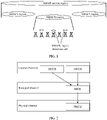
- FIG. 1 is a schematic diagram of an MBSFN service region.
- an MBMS service region generally includes multiple multimedia broadcast single frequency network (Multimedia Broadcast single frequency network, MBSFN) regions, and terminal devices located in a same MBMS service region receive same content.
- MBSFN Multimedia Broadcast single frequency network
- This communication manner may be referred to as a multi-cell broadcast manner.
- Multi-cell broadcast means that the multiple cells transmit same information, which may be utilized by a terminal device to effectively use signal power from multiple cells. This greatly improves coverage. Because a same signal is transmitted in the multiple cells (for example, transmitting the same content and using the same modulation and coding scheme), and transmission time is synchronized between cells, the terminal device receives the signal as if the signal is received from a single cell and has been transmitted in multipath.
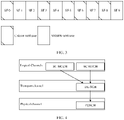
- FIG. 2 is a schematic diagram of channel mapping related to an MBSFN.
- the MBSFN supports two types of logical channels: a multicast traffic channel (Multicast Traffic Channel, MTCH) and a multicast control channel (Multicast Control Channel, MCCH).
- the MTCH is used to transmit MBMS subscriber data. If an MBSFN area provides multiple MBMS services, multiple MTCHs may be configured.
- the MCCH is used to transmit control information related to receiving an MBMS service, including subframe allocation, a modulation and coding scheme, and the like of each multicast channel (Multicast Channel, MCH).
- Each MBSFN has only one MCCH, and one MCCH corresponds to only one MBSFN region.
- the MCCH and MTCH are multiplexed onto a transport channel MCH.
- a transmission format and resource allocation of the MCH are determined by a multi-cell/multicast coordination entity (Multi-cell/Multicast Coordination Entity, MCE), and are sent to the terminal device through the MCCH.
- MCE Multi-cell/Multicast Coordination Entity
- the MCH is mapped onto a physical multicast channel (Physical Multicast Channel, PMCH), and transmitted on an MBSFN subframe. It should be noted that transmission of the MCH is MBSFN region-specific rather than cell-specific. Therefore, PMCH scrambling is also MBSFN region-specific.
- FIG. 3 is a schematic diagram of a relationship between an MBSFN subframe and a unicast subframe in frequency division duplex (Frequency Division Duplexing, FDD).
- FDD Frequency Division Duplexing
- unicast subframes are subframe (Subframe, SF) 0, SF 3, and SF 5 to SF 8
- MBSFN subframes are SF 1, SF 2, SF 4, and SF 9.
- SC-PTM Single-cell MBMS is introduced in Long Term Evolution Advanced (LTE-Advanced, LTE-A). Unlike the MBSFN, the SC-PTM only sends MBMS information to a cell that expects to receive the MBMS information.
- LTE-Advanced Long Term Evolution Advanced
- a process in which a terminal device receives a broadcast message by using the SC-PTM is as follows:
- Step 1 The terminal device receives a system information block (System Information Block, SIB) 20, to obtain information about a single cell multicast control channel (Single Cell Multicast Control Channel, SC-MCCH).
- SIB System Information Block
- SC-MCCH Single Cell Multicast Control Channel
- Step 2 The terminal device receives the single cell multicast control channel (Single Cell Multicast Control Channel, SC-MCCH), where the SC-MCCH is scrambled by using a single cell radio network temporary identifier (Single Cell Radio Network Temporary Identity, SC-RNTI), and the SC-MCCH is used to carry SC-PTM configuration information.
- SC-MCCH Single Cell Multicast Control Channel
- SC-RNTI Single Cell Radio Network Temporary Identity
- a network device sends scheduling information of the SC-MCCH on a PDCCH of a unicast subframe in which the SC-MCCH is located, and the network device sends the SC-MCCH on a PDSCH of the unicast subframe, where the SC-MCCH includes: a mapping relationship between a temporary mobile group identifier (Temporary Mobile Group Identifier, TMGI) of an MBMS service and a group-radio network temporary identifier (Group-Radio Network Temporary Identifier, G-RNTI) of an SC-PTM service on the PDCCH, and information about a time domain location of the SC-PTM service.
- TMGI Temporary Mobile Group Identifier
- G-RNTI Group-Radio Network Temporary Identifier
- Each MBMS service may be uniquely identified by a corresponding TMGI, which may include a Public Land Mobile Network (PLMN) identifier plus a service identifier.
- PLMN Public Land Mobile Network
- Step 3 The terminal device receives a single cell multicast traffic channel (Single cell-Multicast Traffic Channel, SC-MTCH) based on the SC-MCCH, where the SC-MTCH is scrambled by using a G-RNTI.
- FIG. 4 is a schematic diagram of a channel mapping relationship in SC-PTM. As shown in FIG. 4 , logical channels SC-MCCH and SC-MTCH are mapped onto a transport channel downlink shared channel (Downlink shared channel, DL-SCH). The DL-SCH is mapped to a PDSCH.
- SC-MTCH Single cell-Multicast Traffic Channel
- a G-RNTI is used for scrambling a cyclic redundancy check (Cyclic Redundancy Check, CRC) of a PDCCH that is used to schedule a PDSCH carrying SC-MTCH information.
- FIG. 5 is a schematic diagram of a structure of an SC-PTM subframe, and time-frequency domain distribution of a PDCCH, a multicast PDSCH, and a unicast PDSCH is shown in FIG. 5 .
- NR supports slot-based scheduling and non-slot-based scheduling, and a time domain location and a time domain length of an NR PDSCH in a slot are highly flexible.
- the terminal device obtains, based on a time domain resource assignment field in detected PDCCH DCI, time domain location information of a PDSCH scheduled by the DCI.
- the time domain location information includes a slot in which the PDSCH is located, a time domain length of the PDSCH, and a start orthogonal frequency division multiplexing (Orthogonal Frequency Division Multiplexing, OFDM) symbol index of the PDSCH in the slot.
- OFDM Orthogonal frequency division multiplexing
- the terminal device may obtain the location information of the PDSCH from a row whose index number is m+1 in one piece of PDSCH time domain resource allocation (Applicable PDSCH Time Domain Resource Allocation) information.
- the terminal device may obtain the time domain resource assignment information in different cases by using one of the three ways: predefinition, a system message, and higher layer signaling.
- the different cases include different cases of a type of an RNTI that is used for scrambling the DCI and that is detected by the terminal device, a type of a search space in which the terminal device is located, and a higher layer parameter configured for the terminal device.
- the time domain location of the PDSCH carrying a system message may be obtained by using predefined allocation information.
- the allocation information may be obtained by using a parameter pdsch-TimeDomainAllocationList in higher layer signaling pdsch-Config.
- the terminal device searches a terminal device specific search space for a terminal device of the DCI, and also, receives the configuration parameter pdsch-TimeDomainAllocationList in the higher layer signaling pdsch-Config.
- C-RNTI Cell Radio Network Temporary Identifier
- MCS-C-RNTI Modulation and Coding Scheme Cell Radio Network Temporary Identifier
- CS-RNTI Configured Scheduling RNTI
- the C-RNTI, the MCS-C-RNTI, and the CS-RNTI are all RNTIs dedicated to the terminal device. Therefore, PDSCH time domain resource assignment information of each terminal device is independently configured, and may be different. In addition, there may be no common PDSCH time domain resource assignment information in PDSCH time domain resource assignment information configured for multiple terminal devices. If the terminal device is not configured with higher layer signaling pdsch-Config or a parameter pdsch-TimeDomainAllocationList, but receives a system message pdsch-ConfigCommon including a parameter pdsch-TimeDomainAllocationList, the PDSCH time domain resource assignment information is obtained based on the parameter.
- the time domain resource assignment information is common time domain resource assignment information, in other words, the time domain resource assignment information may be applied to all terminal devices in the cell.
- Specific PDSCH time domain resource allocation manners are shown in Table 1. Default A (that is, Table 2 and Table 3), default B (that is, Table 4), and default C (that is, Table 5) represent three time domain resource allocations determined in a predefined manner.
- Table 2 is a default A for normal cyclic prefixes.
- Table 3 is a default A for extended cyclic prefixes.
- Table 5 Row index DMRS- TypeA-Position PDSCH mapping type K0 S L 1 (Note 1) 2, 3 Type B 0 2 2 2 2, 3 Type B 0 4 2 3 2, 3 Type B 0 6 2 4 2, 3 Type B 0 8 2 5 2, 3 Type B 0 10 2 6 Reserved 7 Reserved 8 2, 3 Type B 0 2 4 9 2, 3 Type B 0 4 4 10 2, 3 Type B 0 6 4 11 2, 3 Type B 0 8 4 12 2, 3 Type B 0 10 4 13 (Note 1) 2, 3 Type B 0 2 7 14 (Note 1) 2 Type A 0 2 12 3 Type A 0 3 11 15 (Note 1) 2, 3 Type A 0 0 6 16 (Note 1) 2, 3 Type A 0 2 6 Note 1: The UE may assume that this PDSCH resource allocation is not used, if the PDSCH was scheduled with SI-RNTI in PDCCH TypeO common search space
- a broadcast/multicast/multicast service is sent by a network device to multiple terminal devices.
- Terminal devices that receive the multicast/broadcast/multicast service should receive the same data on the same physical resource.
- each terminal device detects a PDCCH in a specific search space, so as to determine a time domain resource of the PDSCH based on a higher layer parameter configured for the specific terminal device.
- time domain resources of PDSCHs determined by different terminal devices are different. Therefore, it is impossible to send a multicast/broadcast/multicast service on a unified time domain resource. Therefore, a unicast data channel time domain resource allocation manner in the NR architecture is not applicable to multicast/broadcast/multicast services.
- the network device configures, for the terminal device, time domain resource assignment information used for multicast/broadcast/multicast service transmission.
- the time domain resource assignment information is time domain resource assignment information additionally configured by the network device, and is different from the PDSCH time domain resource assignment information predefined in the standards in Table 2 to Table 5, and independent of the PDSCH time domain resource assignment information indicated by the higher layer parameter pdsch-Config including pdsch-Time Domain Allocation List and the PDSCH time domain resource assignment information indicated by the system message pdsch-Config Common including pdsch-Time Domain Allocation List.
- the time domain resource assignment information may be a time domain resource allocation table, a row in a time domain resource allocation table, or a time domain resource allocation set. This is not limited in this application.
- the time domain resource assignment information in this application may be preconfigured by the network device for the terminal device. Based on this, both the terminal device side and the network device side store the time domain resource assignment information. Alternatively, when the terminal device needs to use the time domain resource assignment information, the network device configures the time domain resource assignment information for the terminal device in real time.
- FIG. 6 is a schematic diagram of a mobile communication system according to an embodiment of this application.
- the mobile communication system includes a core network device 610, a network device 620, and at least one terminal device (a terminal device 630 and a terminal device 640 shown in FIG. 6 ).
- the terminal device is connected to the network device in a wireless manner, and the network device is connected to the core network device in a wireless or wired manner.
- the core network device and the network device may be different physical devices independent of each other, or functions of the core network device and logical functions of the network device may be integrated into a same physical device, or a part of functions of the core network device and a part of functions of the network device may be integrated into one physical device.
- the terminal device may be located at a fixed location, or may be mobile.
- FIG. 6 is merely a schematic diagram of a system.
- the system may further include other network devices, for example, a wireless relay device and a wireless backhaul device, which are not shown in FIG. 6 . Quantities of core network devices, network devices, and terminal devices included in the mobile communication system are not limited in this application.
- Network device An entity on a network side that transmits or receives signals.
- the network device in this application may be a base station (Base Transceiver Station, BTS) in Global System of Mobile Communication (Global System of Mobile Communication, GSM) or Code Division Multiple Access (Code Division Multiple Access, CDMA), may be a base station (NodeB, NB) in Wideband Code Division Multiple Access (Wideband Code Division Multiple Access, WCDMA), may be an evolved NodeB (evolved NodeB, eNB) in LTE or evolved Long Term Evolution (evolved Long Term Evolution, eLTE), a next-generation evolved NodeB (next generation-evolved NodeB, ng-eNB), may be an access point (Access Point, AP) or a relay station in a wireless local area network (Wireless Local Area Network, WLAN), may be a gNB in 5G NR, or the like. This is not limited herein.
- BTS Base Transceiver Station
- GSM Global System of
- a terminal device is an entity on a user side that is configured to receive or transmit signals.
- the terminal device may also be referred to as a terminal Terminal, user equipment (User Equipment, UE), a mobile station (Mobile Station, MS), a mobile terminal (Mobile Terminal, MT), or the like.
- the terminal device may be a mobile phone (mobile phone), a tablet computer (Pad), a computer with a wireless transceiver function, a virtual reality (Virtual Reality, VR) terminal device, an augmented reality (Augmented Reality, AR) terminal device, a wireless terminal in industrial control (industrial control), a wireless terminal in self-driving (self-driving), a wireless terminal in remote medical surgery (remote medical surgery), a wireless terminal in a smart grid (smart grid), a wireless terminal in transportation safety (transportation safety), a wireless terminal in a smart city (smart city), a wireless terminal in a smart home (smart home), or the like.
- a specific technology and a specific device form used by the terminal device are not limited in embodiments of this application.
- the network device and the terminal device may be deployed on land, and includes an indoor or outdoor device, a handheld device, or a vehicle-mounted device; may be deployed on water; or may be deployed on an aircraft, an unmanned aerial vehicle, a balloon, or a satellite in the air.
- Application scenarios of the network device and the terminal device are not limited in embodiments of this application.
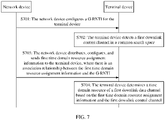
- FIG. 7 is an interaction flowchart of a time domain resource determining method according to an embodiment of this application.
- the method involves network elements including a terminal device and a network device. As shown in FIG. 7 , the method includes the following steps.
- Step S701 A network device configures a G-RNTI for a terminal device.
- the terminal device in an RRC connected mode is configured with an RNTI dedicated to the terminal device (that is, a dedicated RNTI used for unicast transmission, such as a C-RNTI, an MCS-C-RNTI, and a CS-RNTI shown in the last row of Table 1) and is also configured with the G-RNTI used for broadcast/multicast/multicast transmission. Based on this, the terminal device may receive both unicast transmission and broadcast transmission.
- the G-RNTI herein may alternatively be a special identifier (Identifier, ID) or an RNTI, and the G-RNTI is associated with a first downlink control channel.
- the terminal device After being powered on, the terminal device accesses a cell by performing a cell search and a random access process.
- the network device establishes a connection to the terminal device, and the terminal device enters the RRC connected mode.
- the G-RNTI and an RNTI dedicated to the terminal device are configured for the terminal device in the RRC connected mode. It should be understood that configuring the G-RNTI and the RNTI dedicated to the terminal device may alternatively be in another scenario, for example, in a scenario in which the terminal device performs cell handover, and the network device may configure the G-RNTI and the RNTI dedicated to the terminal device for the terminal device.
- the G-RNTI is used for scrambling the first downlink control channel.
- the network device configures, by using higher layer signaling or system information, a same G-RNTI for a group of terminal devices that receive a same broadcast service.
- the broadcast service herein may alternatively be a multicast service or a multicast service.
- the first downlink control channel is a downlink control channel for scheduling broadcast/multicast/multicast transmission, for example, a PDCCH for scheduling broadcast/multicast/multicast transmission, and the first downlink control channel is used to schedule a first downlink data channel.
- the first downlink data channel may be used to carry broadcast/multicast/multicast transmission.
- the RNTI dedicated to the terminal device is used for scrambling a second downlink control channel.
- the terminal device may detect the second downlink control channel in a specific search space or a common search space.
- the second downlink control channel is a downlink control channel for scheduling unicast transmission, for example, a PDCCH for scheduling unicast transmission.
- the second downlink control channel is used to schedule a second downlink data channel, and the second downlink data channel may be a PDSCH for unicast transmission.
- the RNTI dedicated to the terminal device may be a C-RNTI, an MCS-C-RNTI, or a CS-RNTI. These RNTIs are RNTIs dedicated to the terminal device. This is not limited in this application.
- first downlink control channel and the second downlink control channel may be specifically classified in different manners.
- the first downlink control channel and the second downlink control channel may be classified according to different time-frequency resources, different logical locations, or different tree nodes or aggregation levels.
- That the G-RNTI is used for scrambling the first downlink control channel may mean that a CRC generated based on the DCI needs to be attached after DCI on the first downlink control channel, and the G-RNTI is used for scrambling the CRC.
- That the RNTI dedicated to the terminal device is used for scrambling the second downlink control channel means that a CRC generated based on the DCI needs to be attached after DCI on the second downlink control channel, and the RNTI dedicated to the terminal device is used for scrambling the CRC. Therefore, DCI with different functions uses different RNTIs.
- Step S702 The terminal device detects the first downlink control channel in a common search space.
- Step S703 The network device sends first time domain resource assignment information to the terminal device, where there is an association relationship between the first time domain resource assignment information and the G-RNTI.
- step S702 and step S703 are not limited in this application.
- the first time domain resource assignment information is used to determine time domain resource allocation for a broadcast/multicast/multicast transmission PDSCH.
- the second time domain resource assignment information is used to determine time domain resource allocation for a unicast transmission PDSCH, and the terminal device may be configured with both the first time domain resource assignment information and the second time domain resource assignment information.
- the association relationship between the first time domain resource assignment information and the G-RNTI means that the G-RNTI is used for scrambling the first downlink control channel, the first downlink control channel is used to schedule the first downlink data channel, and the first downlink control channel and the first time domain resource assignment information may be used to determine a time domain resource of the first downlink data channel.
- the second time domain resource assignment information and the RNTI dedicated to the terminal device.
- the association relationship means that the RNTI dedicated to the terminal device is used for scrambling the second downlink control channel, the second downlink control channel is used to schedule a second downlink data channel, and the second downlink control channel and the second time domain resource assignment information may be used to determine a time domain resource of the second downlink data channel.
- the network device may allocate the first time domain resource assignment information and the second time domain resource assignment information to the terminal device in the following optional manners:
- Optional manner 1 The network device configures dedicated (additional) first time domain resource assignment information for broadcast/multicast/multicast. That is, the first time domain resource assignment information is not time domain resource assignment information in unicast transmission, and is different from the PDSCH time domain resource assignment information predefined in the standards in Table 2 to Table 5, and independent of the PDSCH time domain resource assignment information indicated by the higher layer parameter pdsch-Config including pdsch-Time Domain Allocation List and the PDSCH time domain resource assignment information indicated by the system message pdsch-Config Common including pdsch-Time Domain Allocation List.
- the network device configures the second time domain resource assignment information for the terminal device by using higher layer signaling.
- the network device may configure, by using RRC signaling, the second time domain resource assignment information related to the RNTI dedicated to the terminal device.
- the second time domain resource assignment information may be a PDSCH time domain resource allocation table.
- the PDSCH time domain resource allocation table includes several rows, and information in each row includes: (1) a time offset value K0, where the time offset value is k if the terminal device receives the second downlink control channel in a time unit n and the second downlink data channel is received in a time unit n+k; (2) Start and Length Indicator Value (Start and Length Indicator Value, SLIV) of the second downlink data channel; and (3) a mapping type of the second downlink data channel.
- a time domain resource assignment field carried in the second downlink control channel scrambled by the RNTI dedicated to the terminal device is used to indicate that a row in the second time domain resource assignment information is used as a time domain resource for sending on the second downlink data channel scheduled by the second downlink control channel.
- the terminal device further obtains the first time domain resource assignment information, where the G-RNTI is used for scrambling a CRC of the first downlink control channel, and a time domain resource occupied for transmission of the first downlink data channel is determined based on the first time domain resource assignment information.
- the network device may configure the first time domain resource assignment information for the terminal device in any one of the following manners: predefinition, system message configuration, or higher layer signaling configuration.
- the first time domain resource assignment information may be a time domain resource allocation table, which includes several rows, and each row includes at least one piece of the following information: (1) Time offset value K0: If the terminal device receives the first downlink control channel in a time unit n (a first time unit), and receives the first downlink data channel in a time unit n+K0 (a second time unit), the time offset value is K0. (2) SLIV value of the first downlink data channel in a time unit: The terminal device may obtain an index value S of a start OFDM symbol of the first downlink data channel in the time unit and a time domain length L of the first downlink data channel based on the SLIV value. The first downlink data channel occupies L consecutive OFDM symbols starting from an OFDM symbol of the index number S. The SLIV value is calculated as follows:
- the time unit may include N OFDM symbols, and N is an integer greater than or equal to 1.
- the time unit is a slot, and one slot includes 14 OFDM symbols.
- the time unit is a mini-slot, and one mini-slot includes less than 14 OFDM symbols.
- Optional manner 2 The network device configures the first time domain resource assignment information for broadcast/multicast/multicast transmission, where the first time domain resource assignment information is time domain resource assignment information common to a cell in unicast transmission.
- the system message pdsch-Config Common includes PDSCH time domain resource assignment information indicated by pdsch-Time Domain Allocation List.
- the network device configures the second time domain resource assignment information for the terminal device by using higher layer signaling.
- the terminal device may configure the first time domain resource assignment information for the terminal device in a system message configuration manner or higher layer signaling configuration manner, where the first time domain resource assignment information is a time domain resource allocation table common to the cell in unicast transmission. That is, all terminal devices in the cell may determine the time domain resource of the first downlink data channel based on the first time domain resource assignment information.
- time domain resource assignment information included in each row of the first time domain resource assignment information is consistent with that described in the optional manner 1. Details are not described herein again.
- Optional manner 3 The network device configures the first time domain resource assignment information for broadcast/multicast/multicast transmission in a predefined manner, where the first time domain resource assignment information is a time domain resource allocation table configured for unicast transmission in a predefined manner.
- the network device configures the second time domain resource assignment information for the terminal device by using higher layer signaling.
- the network device selects one from multiple predefined time domain resource allocation tables as the first time domain resource assignment information.
- time domain resource assignment information included in each row of the first time domain resource assignment information is consistent with that described in the optional manner 1. Details are not described herein again.
- Step S704 The terminal device determines the time domain resource of the first downlink data channel based on the first time domain resource assignment information and the first downlink control channel.
- Step S704 may also be understood as: The terminal device determines the time domain resource of the first downlink data channel based on the first time domain resource assignment information, the first downlink control channel, and the association relationship between the first time domain resource assignment information and the G-RNTI.
- the terminal device detects the first downlink control channel in the common search space. Assuming that a value of a time domain resource assignment field in the first downlink control channel is m, and the first time domain resource assignment information is a time domain resource allocation table, the terminal device may determine the time domain resource of the first downlink data channel from a row whose index number is m+1 in the time domain resource allocation table, that is, determine a location of the time domain resource of the first downlink data channel.
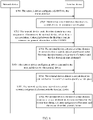
- FIG. 8 is an interaction flowchart of a time domain resource determining method according to another embodiment of this application.
- the method involves network elements including a terminal device and a network device. As shown in FIG. 8 , after step S704, the method further includes the following steps:
- step S707 may be performed before step S705, or may be performed between step S705 and step S706, or may be performed simultaneously with step S705. This is not limited in this application.
- Step S708 The terminal device determines the time domain resource of the second downlink data channel based on the second time domain resource assignment information and the second downlink control channel.
- step S705 to step S708 may be applied to the following scenario:
- the terminal device receives broadcast data on the first downlink data channel.
- the network device may retransmit the broadcast data by using the second downlink data channel.
- the terminal device determines that receiving the broadcast data fails, or the terminal device determines that feedback information needs to be sent to indicate that the terminal device fails to receive the broadcast data.
- the terminal device may send the feedback information to the network device, to indicate that the terminal device fails to receive the broadcast data.
- the terminal device may not send the feedback information to the network device.
- the network device does not receive the feedback information within a preset time period, it is considered that the terminal device does not receive the broadcast data.
- the network device may retransmit the broadcast data in a unicast transmission manner. Because unicast transmission can provide terminal device-specific adaptive parameter configuration, link adaptive transmission is provided for a single terminal device. Retransmission in a unicast manner improves transmission reliability and a success rate. Therefore, in an example of retransmission in the unicast manner, the network device sends the second downlink control channel to the terminal device in the specific search space.
- a HARQ process number on the second downlink control channel is the same as or associated with a HARQ process number on the first downlink control channel.
- HARQ process number on the second downlink control channel is the same as or associated with the HARQ process number on the first downlink control channel enables the terminal device to determine that the second downlink data channel scheduled by the second downlink control channel is used to transmit the broadcast data.
- a new data indicator (new data indicator, NDI) on the second downlink control channel is not inverted.
- the terminal device After the terminal device detects the second downlink control channel in the specific search space, assuming that a value of a time domain resource assignment field in the second downlink control channel is m, and the second time domain resource assignment information is a time domain resource allocation table, in this case, the terminal device may determine the time domain resource of the second downlink data channel from a row whose index number is m+1 in the time domain resource allocation table, and receive the broadcast data on the second downlink data channel.
- the network device configures the first time domain resource assignment information for the terminal device, and the first time domain resource assignment information meets a broadcast/multicast/multicast transmission requirement of the terminal device.
- the network device may further configure the second time domain resource assignment information for the terminal device, so that both a unicast transmission requirement of the terminal device and the broadcast/multicast/multicast transmission requirement of the terminal device are met.
- the broadcast/multicast/multicast can save transmission resources and effectively avoid transmission congestion. Further, for the broadcast/multicast/multicast retransmission problem, if the network device determines that there are few terminal devices that retransmission is to be performed on, the network device may retransmit in the unicast manner.
- Unicast retransmission is used, that is, the terminal device uses the time domain resource assignment information corresponding to the RNTI dedicated to the terminal device, to provide the terminal device-specific adaptive resource configuration, and provide link adaptive transmission for the single terminal device. This improves the reliability of broadcast/multicast retransmission, and improves the retransmission success rate.
- FIG. 9 is an interaction flowchart of a time domain resource determining method according to still another embodiment of this application.
- the method involves network elements including a terminal device and a network device. As shown in FIG. 9 , the method includes the following steps.
- Step S901 A terminal device receives system information, where the system information is used to carry information about an (SC-)MCCH, and the information about the (SC-)MCCH includes time domain resource assignment information related to the (SC-)MCCH.
- the system information further includes an MP (modification period, modification period) and an RP (repetition period, repetition period) of the (SC-)MCCH, and a modification notification.
- MP modification period, modification period
- RP repetition period, repetition period
- the system information may be an SIB20.
- the foregoing system information may be an SIB13.
- the following describes in detail the time domain resource assignment information related to the (SC-)MCCH in different scenarios.
- each cell is associated with a logical channel SC-MCCH.
- Information carried on the SC-MCCH is mapped to a third downlink data channel, where the third downlink data channel is scheduled by a third downlink control channel scrambled by an SC-RNTI.
- the network device may configure time domain resource assignment information related to the SC-MCCH for the terminal device, where the time domain resource assignment information related to the SC-MCCH is used to determine a time domain resource of the third downlink data channel.
- each MBSFN service region is associated with a logical channel MCCH.
- Information carried on the MCCH is mapped onto a physical multicast channel (PMCH), where the physical multicast channel (that is, a third downlink data channel) is scheduled by a third downlink control channel scrambled by an RNTI.
- the network device may configure time domain resource assignment information related to the MCCH for the terminal device, where the time domain resource assignment information related to the MCCH is used to determine a time domain resource of the third downlink data channel.
- time domain resource assignment information related to the (SC-)MCCH refer to the first time domain resource assignment information and the second time domain resource assignment information in the foregoing embodiments. Details are not described herein again.
- the terminal device may be in an idle mode (IDLE mode), an RRC connected mode (RRC connected mode), or an inactive mode (inactive mode). This is not limited in this embodiment.
- Optional step S902 The terminal device detects the third downlink control channel in a common search space.
- the third downlink control channel is used to schedule the third downlink data channel.
- the third downlink data channel may be a PDSCH in the SC-PTM, or may be a PMCH in the MBSFN.
- Step S903 The terminal device determines the time domain resource of the third downlink data channel based on the time domain resource assignment information related to the (SC-)MCCH and the third downlink control channel (optional).
- the terminal device may determine the time domain resource of the third downlink data channel from a row whose index number is m+1 in the time domain resource allocation table related to the (SC-)MCCH.
- Optional step S904 The terminal device receives broadcast data on the third downlink data channel.
- the network device may configure the time domain resource assignment information related to the (SC-)MCCH for the terminal device by using the system information, so that time domain resource assignment information of unicast transmission is not used for broadcast/multicast/multicast transmission. This ensures effective broadcast/multicast/multicast transmission.
- FIG. 10 is an interaction flowchart of a time domain resource determining method according to yet another embodiment of this application.
- the method involves network elements including a terminal device and a network device. As shown in FIG. 10 , the method includes the following steps.
- Step S1001 A terminal device receives system information, where the system information is used to carry information about an (SC-)MCCH, and the information about the (SC-)MCCH further includes time domain resource assignment information related to an (SC-)MTCH.
- system information further includes an MP and an RP of the (SC-)MCCH and a modification notification.
- the system information may be an SIB20.
- the foregoing system information may be an SIB13.
- the following describes in detail the time domain resource assignment information related to the (SC-)MTCH in different scenarios.
- the logical channel SC-MTCH is used to transmit broadcast/multicast/multicast data.
- information about the SC-MTCH is mapped to a fourth downlink data channel for transmission.
- the fourth downlink data channel is scheduled by using a fourth downlink control channel scrambled by a G-RNTI.
- the network device may indicate the time domain resource assignment information related to the SC-MTCH to the terminal device, and the time domain resource assignment information related to the SC-MTCH is carried in the system information.
- the time domain resource assignment information related to the SC-MTCH is used to determine a time domain resource of the fourth downlink data channel.
- information about a logical channel MTCH may be mapped to the fourth downlink data channel (that is, a physical multicast channel PMCH) for transmission.
- the network device may indicate the time domain resource assignment information related to the MTCH to the terminal device, and the time domain resource assignment information related to the MTCH is carried in the system information.
- the time domain resource assignment information related to the MTCH is used to determine the time domain resource of the fourth downlink data channel.
- time domain resource assignment information related to the (SC-)MTCH refer to the first time domain resource assignment information and the second time domain resource assignment information in the foregoing embodiments. Details are not described again.
- the terminal device may be in an idle (IDLE) mode or an RRC connected mode. This is not limited in this embodiment.
- Optional step S1002 The terminal device detects the fourth downlink control channel in a common search space.
- the fourth downlink control channel is used to schedule the fourth downlink data channel.
- the fourth downlink data channel may be a PDSCH in the SC-PTM, or may be a PMCH in the MBSFN.
- Step S1003 The terminal device determines a time domain resource of the fourth downlink data channel based on the time domain resource assignment information related to the (SC-)MTCH and the fourth downlink control channel (optional).
- the terminal device may obtain a row whose index number is m+1 in the time domain resource allocation table, to determine the time domain resource of the fourth downlink data channel.
- Optional step S1004 The terminal device receives broadcast data on the fourth downlink data channel.
- the network device may configure the time domain resource assignment information related to the (SC-)MTCH for the terminal device by using the system information, so that time domain resource assignment information of unicast transmission is not used for broadcast/multicast/multicast transmission. This ensures effective broadcast/multicast/multicast transmission.
- FIG. 11 is an interaction flowchart of a time domain resource determining method according to still yet another embodiment of this application.
- the method involves network elements including a terminal device and a network device. As shown in FIG. 11 , the method includes the following steps.
- Step S1101 A terminal device receives (SC-)MCCH information, where the (SC-)MCCH information carries time domain resource assignment information related to an (SC-)MTCH.
- the following describes in detail the time domain resource assignment information related to the (SC-)MTCH in different scenarios.
- the logical channel SC-MTCH is used to transmit broadcast/multicast/multicast data.
- information about the SC-MTCH is sent on a fifth downlink data channel (PDSCH).
- the fifth downlink data channel is scheduled by using a fifth downlink control channel scrambled by an SC-RNTI.
- the network device may configure the time domain resource assignment information related to the SC-MTCH for the terminal device, where the time domain resource assignment information related to the SC-MTCH is used to determine a time domain resource of the fifth downlink data channel.
- the logical channel MTCH may be mapped to a transport channel MCH, and information about the MCH is sent on the fifth downlink data channel (that is, a physical multicast channel PMCH).
- the network device may configure the time domain resource assignment information related to the MTCH for the terminal device, where the time domain resource assignment information related to the MTCH is used to determine a time domain resource of the fifth downlink data channel.
- time domain resource assignment information related to the (SC-)MTCH refer to the first time domain resource assignment information and the second time domain resource assignment information in the foregoing embodiments. Details are not described again.
- the terminal device may be in an idle (IDLE) mode or an RRC connected mode. This is not limited in this embodiment.
- Optional step S1102 The terminal device detects the fifth downlink control channel in a common search space.
- the fifth downlink control channel is used to schedule the fifth downlink data channel.
- the fifth downlink data channel may be a PDSCH in the SC-PTM, or may be a PMCH in the MBSFN.
- Step S1103 The terminal device determines the time domain resource of the fifth downlink data channel based on the time domain resource assignment information related to the (SC-)MTCH and the fifth downlink control channel (optional).
- the terminal device may obtain a row whose index number is m+1 in the time domain resource allocation table, to determine the time domain resource of the fifth downlink data channel.
- Optional step S 1104 The terminal device receives broadcast data on the fifth downlink data channel.
- the network device may configure the time domain resource assignment information related to the (SC-)MTCH for the terminal device by using the SC-(MCCH) information, so that time domain resource assignment information of unicast transmission is not used for broadcast/multicast/multicast transmission. This ensures effective broadcast/multicast/multicast transmission.
- FIG. 12 is a schematic diagram of a time domain resource determining apparatus according to an embodiment of this application.
- the time domain resource determining apparatus is a part of or an entire terminal device. As shown in FIG. 12 , the apparatus includes:
- the apparatus further includes:
- a hybrid automatic repeat request HARQ process number on the second downlink control channel is the same as a HARQ process number on the first downlink control channel.
- the first determining module 1204 is specifically configured to determine the time domain resource of the first downlink data channel based on a value of a time domain resource assignment field in the first downlink control channel and the first time domain resource assignment information.
- the first time domain resource assignment information is determined by the network device in any one of the following manners: predefinition, system message configuration, or higher layer signaling configuration.
- the first time domain resource assignment information includes at least one of the following: a time unit offset value, a start and length indicator value SLIV of the first downlink data channel, and a mapping type of the first downlink data channel.
- the time unit offset value is an offset between a second time unit and a first time unit, the first time unit is a time unit for receiving the first downlink control channel, and the second time unit is a time unit for receiving the first downlink data channel.
- the time domain resource determining apparatus provided in this embodiment of this application may be configured to perform the time domain resource determining method performed by the terminal device.
- the time domain resource determining apparatus may be configured to perform the time domain resource determining method performed by the terminal device.
- FIG. 13 is a schematic diagram of a time domain resource determining apparatus according to an embodiment of this application.
- the time domain resource determining apparatus is a part of or an entire network device. As shown in FIG. 13 , the apparatus includes:
- the apparatus further includes:
- a hybrid automatic repeat request HARQ process number on the second downlink control channel is the same as a HARQ process number on the first downlink control channel.
- the first time domain resource assignment information is determined by the network device in any one of the following manners: predefinition, system message configuration, or higher layer signaling configuration.
- the first time domain resource assignment information includes at least one of the following: a time unit offset value, a start and length indicator value SLIV of the first downlink data channel, and a mapping type of the first downlink data channel.
- the time unit offset value is an offset between a second time unit and a first time unit, the first time unit is a time unit for receiving the first downlink control channel, and the second time unit is a time unit for receiving the first downlink data channel.
- the time domain resource determining apparatus provided in this embodiment of this application may be configured to perform the time domain resource determining method performed by the network device.
- the time domain resource determining apparatus may be configured to perform the time domain resource determining method performed by the network device.
- FIG. 14 is a schematic diagram of a terminal device according to an embodiment of this application.
- the terminal device includes a memory 1401 and a processor 1402.
- the memory is configured to store computer instructions, so that the processor executes the computer instructions, to implement the time domain resource determining method performed by the terminal device.
- the terminal device further includes a transceiver 1403, configured to implement data transmission with a network device or another device.
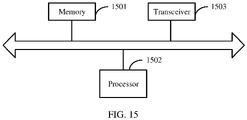
- FIG. 15 is a schematic diagram of a network device according to an embodiment of this application.
- the network device includes a memory 1501 and a processor 1502.
- the memory is configured to store computer instructions, so that the processor executes the computer instructions, to implement the time domain resource determining method performed by the network device.
- the network device further includes a transceiver 1503, configured to implement data transmission with a network device or another device.
- the chip is configured to implement a time domain resource determining method performed by a terminal device.
- a time domain resource determining method performed by a terminal device.
- the chip is configured to implement a time domain resource determining method performed by a network device.
- a time domain resource determining method performed by a network device.
- This application provides a computer storage medium, including computer-executable instructions, where the computer-executable instructions are used to implement a time domain resource determining method performed by a terminal device.
- the computer-executable instructions are used to implement a time domain resource determining method performed by a terminal device.
- This application provides a computer storage medium, including computer-executable instructions, where the computer-executable instructions are used to implement a time domain resource determining method performed by a network device.
- the computer-executable instructions are used to implement a time domain resource determining method performed by a network device.
Landscapes
- Engineering & Computer Science (AREA)
- Signal Processing (AREA)
- Computer Networks & Wireless Communication (AREA)
- Mobile Radio Communication Systems (AREA)
Applications Claiming Priority (2)
| Application Number | Priority Date | Filing Date | Title |
|---|---|---|---|
| CN201910907118.5A CN112637784B (zh) | 2019-09-24 | 2019-09-24 | 时域资源确定方法、装置、设备及存储介质 |
| PCT/CN2020/117305 WO2021057829A1 (fr) | 2019-09-24 | 2020-09-24 | Procédé, appareil et dispositif de détermination de ressources de domaine temporel et support de stockage |
Publications (2)
| Publication Number | Publication Date |
|---|---|
| EP4024908A1 true EP4024908A1 (fr) | 2022-07-06 |
| EP4024908A4 EP4024908A4 (fr) | 2022-10-19 |
Family
ID=75165106
Family Applications (1)
| Application Number | Title | Priority Date | Filing Date |
|---|---|---|---|
| EP20869305.1A Pending EP4024908A4 (fr) | 2019-09-24 | 2020-09-24 | Procédé, appareil et dispositif de détermination de ressources de domaine temporel et support de stockage |
Country Status (4)
| Country | Link |
|---|---|
| US (1) | US12317238B2 (fr) |
| EP (1) | EP4024908A4 (fr) |
| CN (2) | CN116367314A (fr) |
| WO (1) | WO2021057829A1 (fr) |
Cited By (1)
| Publication number | Priority date | Publication date | Assignee | Title |
|---|---|---|---|---|
| US12588100B2 (en) * | 2018-08-09 | 2026-03-24 | Zte Corporation | State transitions for idle mode transmissions using pre-configured dedicated resources |
Families Citing this family (9)
| Publication number | Priority date | Publication date | Assignee | Title |
|---|---|---|---|---|
| US11483855B2 (en) * | 2019-10-02 | 2022-10-25 | Qualcomm Incorporated | Physical resource and transmission parameter configuration without a radio resource control connection |
| WO2021192303A1 (fr) * | 2020-03-27 | 2021-09-30 | 株式会社Nttドコモ | Terminal, procédé de communication sans fil et station de base |
| WO2021230644A1 (fr) * | 2020-05-12 | 2021-11-18 | Lg Electronics Inc. | Transmissions périodiques pour autorisation configurée |
| CN115314842B (zh) * | 2021-05-07 | 2024-06-14 | 展讯通信(上海)有限公司 | 信息分享方法及装置、接入点设备、用户设备 |
| CN115333706B (zh) * | 2021-05-11 | 2025-03-07 | 华为技术有限公司 | 一种控制信道更改信息的确定方法和装置 |
| WO2023077408A1 (fr) * | 2021-11-05 | 2023-05-11 | Nokia Shanghai Bell Co., Ltd. | Attribution de ressources de domaine temporel pour service de diffusion sélective diffusion non sélective |
| WO2023151076A1 (fr) * | 2022-02-14 | 2023-08-17 | Lenovo (Beijing) Limited | Procédé et appareil de réception de retransmission à base de ptp pour multidiffusion |
| CN117014109A (zh) * | 2022-04-25 | 2023-11-07 | 华为技术有限公司 | 一种通信方法及装置 |
| CN114900889B (zh) * | 2022-04-29 | 2025-07-22 | 中国信息通信研究院 | 一种广播信令指示方法和设备 |
Family Cites Families (17)
| Publication number | Priority date | Publication date | Assignee | Title |
|---|---|---|---|---|
| CN104349460B (zh) * | 2013-07-25 | 2019-09-24 | 中兴通讯股份有限公司 | 上下行配置信息通知、获取方法以及基站和用户设备 |
| CN105992376B (zh) * | 2015-02-13 | 2019-01-22 | 中兴通讯股份有限公司 | 一种实现业务调度的方法、系统、基站及用户设备 |
| JP6302135B2 (ja) * | 2015-04-10 | 2018-03-28 | 京セラ株式会社 | 基地局及びユーザ端末 |
| CN105722229B (zh) * | 2016-02-05 | 2019-08-27 | 北京佰才邦技术有限公司 | 信道的选择方法和装置 |
| EP3500035B1 (fr) * | 2016-08-09 | 2022-02-09 | LG Electronics Inc. | Procédé de réception de données dans un système de communication sans fil prenant en charge l'internet des objets à bande étroite, et appareil associé |
| WO2018028497A1 (fr) * | 2016-08-12 | 2018-02-15 | 中兴通讯股份有限公司 | Procédé et dispositif de transmission pour service de multidiffusion |
| CN107920334B (zh) * | 2016-10-10 | 2021-05-18 | 成都鼎桥通信技术有限公司 | Lte系统中提升mbms业务连续性的方法及装置 |
| US10645730B2 (en) * | 2017-04-06 | 2020-05-05 | Huawei Technologies Co., Ltd. | Flexible grant-free resource configuration signaling |
| EP3480977B1 (fr) * | 2017-05-03 | 2022-07-06 | LG Electronics Inc. | Procédé d'émission ou de réception de signal dans un système de communication sans fil et appareil associé |
| CN109842869B (zh) * | 2017-11-17 | 2025-03-07 | 北京三星通信技术研究有限公司 | 调度信息接收的方法及设备 |
| WO2019027262A1 (fr) * | 2017-08-02 | 2019-02-07 | Samsung Electronics Co., Ltd. | Procédé, équipement de réception d'informations de planification, terminal, station de base et procédé d'émission d'informations |
| US11025456B2 (en) * | 2018-01-12 | 2021-06-01 | Apple Inc. | Time domain resource allocation for mobile communication |
| CN110460413B (zh) * | 2018-01-26 | 2020-11-20 | 华为技术有限公司 | 一种通信方法及设备 |
| CN110166186B (zh) * | 2018-02-12 | 2020-11-24 | 电信科学技术研究院有限公司 | 一种确定dci中信息域取值的方法及装置 |
| EP4138502A1 (fr) * | 2018-04-04 | 2023-02-22 | Telefonaktiebolaget LM ERICSSON (PUBL) | Système et procédé pour fournir des attributions de domaine temporel dans un système de communication |
| CN110933748B (zh) * | 2018-09-19 | 2022-06-14 | 华为技术有限公司 | 一种无线通信方法和装置 |
| US11129174B2 (en) * | 2018-09-26 | 2021-09-21 | Qualcomm Incorporated | User equipment groups for group physical downlink control channel communications |
-
2019
- 2019-09-24 CN CN202310145180.1A patent/CN116367314A/zh active Pending
- 2019-09-24 CN CN201910907118.5A patent/CN112637784B/zh active Active
-
2020
- 2020-09-24 WO PCT/CN2020/117305 patent/WO2021057829A1/fr not_active Ceased
- 2020-09-24 EP EP20869305.1A patent/EP4024908A4/fr active Pending
-
2022
- 2022-03-23 US US17/702,273 patent/US12317238B2/en active Active
Cited By (1)
| Publication number | Priority date | Publication date | Assignee | Title |
|---|---|---|---|---|
| US12588100B2 (en) * | 2018-08-09 | 2026-03-24 | Zte Corporation | State transitions for idle mode transmissions using pre-configured dedicated resources |
Also Published As
| Publication number | Publication date |
|---|---|
| US12317238B2 (en) | 2025-05-27 |
| EP4024908A4 (fr) | 2022-10-19 |
| CN112637784A (zh) | 2021-04-09 |
| WO2021057829A1 (fr) | 2021-04-01 |
| CN116367314A (zh) | 2023-06-30 |
| US20220217718A1 (en) | 2022-07-07 |
| CN112637784B (zh) | 2023-02-03 |
Similar Documents
| Publication | Publication Date | Title |
|---|---|---|
| US12317238B2 (en) | Time domain resource determining method and apparatus, device, and storage media | |
| EP3043607B1 (fr) | Procédé et dispositif pour téléavertir un équipement utilisateur | |
| CN107645761B (zh) | 一种系统信息传输方法、用户终端、网络侧设备和系统 | |
| JP5852100B2 (ja) | 無線接続システムにおける端末識別子(stid)割当方法及び装置 | |
| KR101682956B1 (ko) | 기기 간 통신 시스템에서 페이징된 기기에서의 억세스 오버헤드를 감소하기 위한 방법 및 장치 | |
| CN111935821B (zh) | 一种寻呼方法、设备及系统 | |
| CN101998270B (zh) | 多媒体广播多播业务通知方法及装置 | |
| WO2014176935A1 (fr) | Procédé et système d'allocation de ressources de canal d'accès aléatoire | |
| CN116210241B (zh) | Mbs数据传输方法及其装置 | |
| CN107295671A (zh) | 一种下行控制信息的通信方法和装置 | |
| US9814020B2 (en) | Method of transmitting RRC messages in RRC-idle mode | |
| CN102036381B (zh) | 定位业务的子帧的配置方法和装置 | |
| US20240032072A1 (en) | Wireless communication method, terminal device, and network device | |
| CN117882398A (zh) | 一种广播业务的配置方法及装置、终端设备、网络设备 | |
| CN108990149B (zh) | 寻呼配置方法 | |
| CN108512637B (zh) | 一种ue、基站中的用于下行信息传输的方法和装置 | |
| KR20130045323A (ko) | 데이터 전송 방법, 기지국 및 단말기 | |
| KR102689447B1 (ko) | Mbs 데이터 전송 방법 및 그 장치 | |
| CN114727230B (zh) | 信息传输方法及装置 | |
| EP4236139A1 (fr) | Procédé de communication sans fil, dispositif terminal et dispositif de réseau | |
| KR20220016443A (ko) | Mbs 세션 설정 방법 및 그 장치 | |
| EP4718892A1 (fr) | Procédé et appareil de réception d'informations de notification | |
| KR102927750B1 (ko) | eMBMS 기반의 신호 송수신 방법 및 그 장치 | |
| EP4718883A1 (fr) | Procédé et appareil de réception d'informations de notification | |
| CN114071736B (zh) | 传输控制信令的方法和装置 |
Legal Events
| Date | Code | Title | Description |
|---|---|---|---|
| STAA | Information on the status of an ep patent application or granted ep patent |
Free format text: STATUS: THE INTERNATIONAL PUBLICATION HAS BEEN MADE |
|
| PUAI | Public reference made under article 153(3) epc to a published international application that has entered the european phase |
Free format text: ORIGINAL CODE: 0009012 |
|
| STAA | Information on the status of an ep patent application or granted ep patent |
Free format text: STATUS: REQUEST FOR EXAMINATION WAS MADE |
|
| 17P | Request for examination filed |
Effective date: 20220401 |
|
| AK | Designated contracting states |
Kind code of ref document: A1 Designated state(s): AL AT BE BG CH CY CZ DE DK EE ES FI FR GB GR HR HU IE IS IT LI LT LU LV MC MK MT NL NO PL PT RO RS SE SI SK SM TR |
|
| REG | Reference to a national code |
Ref country code: DE Ref legal event code: R079 Free format text: PREVIOUS MAIN CLASS: H04W0004060000 Ipc: H04L0005000000 |
|
| A4 | Supplementary search report drawn up and despatched |
Effective date: 20220916 |
|
| RIC1 | Information provided on ipc code assigned before grant |
Ipc: H04W 72/04 20090101ALI20220912BHEP Ipc: H04L 5/00 20060101AFI20220912BHEP |
|
| DAV | Request for validation of the european patent (deleted) | ||
| DAX | Request for extension of the european patent (deleted) | ||
| STAA | Information on the status of an ep patent application or granted ep patent |
Free format text: STATUS: EXAMINATION IS IN PROGRESS |
|
| 17Q | First examination report despatched |
Effective date: 20250203 |
|
| GRAP | Despatch of communication of intention to grant a patent |
Free format text: ORIGINAL CODE: EPIDOSNIGR1 |
|
| STAA | Information on the status of an ep patent application or granted ep patent |
Free format text: STATUS: GRANT OF PATENT IS INTENDED |
|
| RIC1 | Information provided on ipc code assigned before grant |
Ipc: H04L 5/00 20060101AFI20251007BHEP Ipc: H04W 72/0446 20230101ALI20251007BHEP Ipc: H04W 4/06 20090101ALN20251007BHEP Ipc: H04W 72/23 20230101ALN20251007BHEP |
|
| RIC1 | Information provided on ipc code assigned before grant |
Ipc: H04L 5/00 20060101AFI20251016BHEP Ipc: H04W 72/0446 20230101ALI20251016BHEP Ipc: H04W 4/06 20090101ALN20251016BHEP Ipc: H04W 72/23 20230101ALN20251016BHEP |
|
| INTG | Intention to grant announced |
Effective date: 20251023 |
|
| GRAJ | Information related to disapproval of communication of intention to grant by the applicant or resumption of examination proceedings by the epo deleted |
Free format text: ORIGINAL CODE: EPIDOSDIGR1 |
|
| STAA | Information on the status of an ep patent application or granted ep patent |
Free format text: STATUS: EXAMINATION IS IN PROGRESS |
|
| GRAP | Despatch of communication of intention to grant a patent |
Free format text: ORIGINAL CODE: EPIDOSNIGR1 |
|
| STAA | Information on the status of an ep patent application or granted ep patent |
Free format text: STATUS: GRANT OF PATENT IS INTENDED |
|
| INTC | Intention to grant announced (deleted) | ||
| RIC1 | Information provided on ipc code assigned before grant |
Ipc: H04L 5/00 20060101AFI20260202BHEP Ipc: H04W 72/0446 20230101ALI20260202BHEP Ipc: H04W 4/06 20090101ALN20260202BHEP Ipc: H04W 72/23 20230101ALN20260202BHEP |
|
| INTG | Intention to grant announced |
Effective date: 20260212 |