EP4026813B1 - Surface de cuisson en une plaque vitrocéramique la - Google Patents
Surface de cuisson en une plaque vitrocéramique la Download PDFInfo
- Publication number
- EP4026813B1 EP4026813B1 EP22159057.3A EP22159057A EP4026813B1 EP 4026813 B1 EP4026813 B1 EP 4026813B1 EP 22159057 A EP22159057 A EP 22159057A EP 4026813 B1 EP4026813 B1 EP 4026813B1
- Authority
- EP
- European Patent Office
- Prior art keywords
- glass
- cooking surface
- ceramic plate
- glass ceramic
- color
- Prior art date
- Legal status (The legal status is an assumption and is not a legal conclusion. Google has not performed a legal analysis and makes no representation as to the accuracy of the status listed.)
- Active
Links
Images


Classifications
-
- C—CHEMISTRY; METALLURGY
- C03—GLASS; MINERAL OR SLAG WOOL
- C03C—CHEMICAL COMPOSITION OF GLASSES, GLAZES OR VITREOUS ENAMELS; SURFACE TREATMENT OF GLASS; SURFACE TREATMENT OF FIBRES OR FILAMENTS MADE FROM GLASS, MINERALS OR SLAGS; JOINING GLASS TO GLASS OR OTHER MATERIALS
- C03C10/00—Devitrified glass ceramics, i.e. glass ceramics having a crystalline phase dispersed in a glassy phase and constituting at least 50% by weight of the total composition
- C03C10/0018—Devitrified glass ceramics, i.e. glass ceramics having a crystalline phase dispersed in a glassy phase and constituting at least 50% by weight of the total composition containing SiO2, Al2O3 and monovalent metal oxide as main constituents
- C03C10/0027—Devitrified glass ceramics, i.e. glass ceramics having a crystalline phase dispersed in a glassy phase and constituting at least 50% by weight of the total composition containing SiO2, Al2O3 and monovalent metal oxide as main constituents containing SiO2, Al2O3, Li2O as main constituents
-
- C—CHEMISTRY; METALLURGY
- C03—GLASS; MINERAL OR SLAG WOOL
- C03C—CHEMICAL COMPOSITION OF GLASSES, GLAZES OR VITREOUS ENAMELS; SURFACE TREATMENT OF GLASS; SURFACE TREATMENT OF FIBRES OR FILAMENTS MADE FROM GLASS, MINERALS OR SLAGS; JOINING GLASS TO GLASS OR OTHER MATERIALS
- C03C10/00—Devitrified glass ceramics, i.e. glass ceramics having a crystalline phase dispersed in a glassy phase and constituting at least 50% by weight of the total composition
- C03C10/0036—Devitrified glass ceramics, i.e. glass ceramics having a crystalline phase dispersed in a glassy phase and constituting at least 50% by weight of the total composition containing SiO2, Al2O3 and a divalent metal oxide as main constituents
- C03C10/0045—Devitrified glass ceramics, i.e. glass ceramics having a crystalline phase dispersed in a glassy phase and constituting at least 50% by weight of the total composition containing SiO2, Al2O3 and a divalent metal oxide as main constituents containing SiO2, Al2O3 and MgO as main constituents
-
- C—CHEMISTRY; METALLURGY
- C03—GLASS; MINERAL OR SLAG WOOL
- C03C—CHEMICAL COMPOSITION OF GLASSES, GLAZES OR VITREOUS ENAMELS; SURFACE TREATMENT OF GLASS; SURFACE TREATMENT OF FIBRES OR FILAMENTS MADE FROM GLASS, MINERALS OR SLAGS; JOINING GLASS TO GLASS OR OTHER MATERIALS
- C03C17/00—Surface treatment of glass, not in the form of fibres or filaments, by coating
- C03C17/34—Surface treatment of glass, not in the form of fibres or filaments, by coating with at least two coatings having different compositions
-
- C—CHEMISTRY; METALLURGY
- C03—GLASS; MINERAL OR SLAG WOOL
- C03C—CHEMICAL COMPOSITION OF GLASSES, GLAZES OR VITREOUS ENAMELS; SURFACE TREATMENT OF GLASS; SURFACE TREATMENT OF FIBRES OR FILAMENTS MADE FROM GLASS, MINERALS OR SLAGS; JOINING GLASS TO GLASS OR OTHER MATERIALS
- C03C3/00—Glass compositions
- C03C3/04—Glass compositions containing silica
- C03C3/076—Glass compositions containing silica with 40% to 90% silica, by weight
- C03C3/083—Glass compositions containing silica with 40% to 90% silica, by weight containing aluminium oxide or an iron compound
- C03C3/085—Glass compositions containing silica with 40% to 90% silica, by weight containing aluminium oxide or an iron compound containing an oxide of a divalent metal
- C03C3/087—Glass compositions containing silica with 40% to 90% silica, by weight containing aluminium oxide or an iron compound containing an oxide of a divalent metal containing calcium oxide, e.g. common sheet or container glass
-
- C—CHEMISTRY; METALLURGY
- C03—GLASS; MINERAL OR SLAG WOOL
- C03C—CHEMICAL COMPOSITION OF GLASSES, GLAZES OR VITREOUS ENAMELS; SURFACE TREATMENT OF GLASS; SURFACE TREATMENT OF FIBRES OR FILAMENTS MADE FROM GLASS, MINERALS OR SLAGS; JOINING GLASS TO GLASS OR OTHER MATERIALS
- C03C3/00—Glass compositions
- C03C3/04—Glass compositions containing silica
- C03C3/076—Glass compositions containing silica with 40% to 90% silica, by weight
- C03C3/097—Glass compositions containing silica with 40% to 90% silica, by weight containing phosphorus, niobium or tantalum
-
- F—MECHANICAL ENGINEERING; LIGHTING; HEATING; WEAPONS; BLASTING
- F24—HEATING; RANGES; VENTILATING
- F24C—DOMESTIC STOVES OR RANGES ; DETAILS OF DOMESTIC STOVES OR RANGES, OF GENERAL APPLICATION
- F24C15/00—Details
- F24C15/10—Tops, e.g. hot plates; Rings
Definitions
- the invention relates to a cooking surface made of a lithium aluminum silicate glass ceramic plate with high transparency, which has a top surface and a bottom surface, wherein the bottom surface is at least partially provided with a bottom coating.
- heating surface refers to the glass ceramic plate used for cooking, unlike the "hob.”
- the hob includes the heating element, as well as the controls and display.
- Heat-resistant specialty glasses such as alumino or borosilicate glasses
- alumino or borosilicate glasses are increasingly being used in some established glass-ceramic applications. Additional technical measures such as air cooling for fireplace glass or electronic temperature control for induction-heated cooktops can lower operating temperatures and, in some cases, enable the use of these specialty glasses.
- borosilicate glasses While highly color-neutral, have low thermal stability, making these glasses significantly less suitable for use in comparison to glass-ceramic cooktops. Furthermore, borosilicate glasses have low transmission in the wavelength range > 3300 nm, which is a disadvantage for the use of optical temperature sensors in cooktops.
- the DE 10 2010 035 544 A1 and the DE 10 2011 107 831 A1 reveal transparent glass ceramics with a color value c* ⁇ 3.
- the high transparency is achieved with the DE 10 2010 035 544 A1 to a ZnO content of > 4%, with a light transmission of > 88%.
- DE 10 2011 107 831 A1 attributes the high transparency to small total values for MgO + ZnO ⁇ 2.2 wt.%.
- a disadvantage of these glass-ceramics is that higher contents of the alternative nucleating agents ZrO 2 and/or SnO 2 are required.
- the low or missing proportions of the effective nucleating agent TiO 2 are detrimental to high nucleation rates and thus to the desired short ceramization times.
- the high contents of the nucleating agents ZrO 2 and/or SnO 2 lead to disadvantages in melting and shaping. Melting the raw materials for these components takes longer, which is economically disadvantageous in terms of tank throughput and energy consumption.
- the writing WO 2013/124373 A1 describes the physical decolorization of transparent glass ceramics with high quartz solid solutions as the main crystal phase, which are free of arsenic and Antimony, by additions of 0.005 wt.% - 0.15 wt.% Nd 2 O 3 .
- the principle of physical decolorization is based on the existing absorption bands being neutralized by complementary absorption bands of the decolorizing agent. This naturally leads to greater absorption of light and thus reduces the brightness.
- the example glasses in this document contain high contents of the viscosity-reducing component MgO of 0.44 wt.% to 0.93 wt.%. In addition to the high MgO contents, the comparatively high SnO 2 contents of the example glass-ceramics are detrimental to the color c*.
- Induction-heated cooktops consisting of a transparent, colored glass-ceramic plate are typically coated with a colored underside. Light colors, especially white, are increasingly being used for the underside coating.
- Current glass-ceramics have the disadvantage of shifting the color of the underside coating toward yellowish tones. This results in an undesirable increase in the color component b of the CIELAB system.
- the EP 1 837 314 A1 discloses a transparent, colorless LAS glass-ceramic coated on one side with a full-surface or largely full-surface opaque, colored, temperature-stable coating.
- This glass-ceramic composition also uses Nd 2 O 3 at a concentration of 0.01 wt.% to 0.4 wt.% for overcoloring.
- this LAS glass-ceramic exhibits a slight gray tint, which also impairs the perception of the color of the underside coating.
- the object of the invention is to provide a cooking surface made of a TiO 2 -containing LAS glass ceramic plate, in which the color of the underside coating can be perceived by an observer almost unadulterated through the glass ceramic plate.
- Unadulterated is understood to mean a perception by the human eye in which an observer, i.e. a standard colorimetric observer, detects no difference in the color of the underside coating with and without the glass ceramic plate.
- the colorimetric standard observer is defined in CIE 1931.
- the index T stands for transmission.
- a preferred range for b is 93.5 ⁇ b ⁇ 94.4.
- the brightness or light transmission is determined by the L T * Value in the CIELAB color system or the brightness value Y (brightness) according to the CIE standard color system.
- the CIELAB color model is standardized in DIN EN ISO 11664-4 "Colorimetry - Part 4: CIE 1976 L*a*b* Color space.”
- the German implementation of the international CIE standard is defined in DIN 5033.
- the spectrophotometric measurements are carried out on samples polished on both sides in a spectral range between 380 and 780 nm. From the measured spectral values in the range representing the visible light spectrum, the light transmission is calculated with the choice of standard illuminant and observer angle for the given thickness.
- the coordinates of the CIELAB color system can be calculated in a known way from the color coordinates x, y and the lightness Y* of the CIE color system.
- the determination of the c T * -value of the samples is determined from the spectrophotometric measurements of the transmission with the selected parameters for standard illuminant and observer angle.
- LAS glass-ceramics Another key feature of LAS glass-ceramics is scattering, which is determined by the size of the crystals, their birefringence, and the difference in the refractive indices of the crystals and the residual glass. Sufficient amounts of nucleating agents and sufficient nucleation times during ceramization achieve a high nucleation density, resulting in the growing high-quartz solid solutions with sizes below the wavelength range of visible light. Typically, the average crystallite size of high-quartz solid solutions is in the range of 20 nm to 50 nm. Low crystal birefringence and a good match between the refractive indices of the crystals and the residual glass phase are also required for low scattering. These conditions for high transparency of LAS glass-ceramics are presented in the article " Nanophase Glass-Ceramics", Journal of the American Ceramic Society, Vol. 82, No. 1, pp. 5-16; 1999 by the authors Beall and Pickney .
- the refractive index of the residual glass phase is adjusted by its composition and the cooling rate during ceramization.
- turbidity is the percentage of transmitted light that deviates from the incident light beam by an average of more than 2.5°.
- condition B1a corresponding to condition 1
- the brightness is sufficient L T * the following relationship: 0 , 765 ⁇ c * + 94 , 4 ⁇ L T * ⁇ 0 , 765 ⁇ c T * + 93 , 5
- the values c* and L* can no longer compensate each other to the extent that the human eye no longer perceives the falsification of the color of the underside coating.
- a corridor with an upper limit line, defined by condition B2, is preferably maintained.
- This corridor shows the optimized range for (L*;c*) within the scope of the invention.
- the lower limiting line is advantageous for the color-unadulterated visual perception of the underside coating.
- Transparent LAS glass-ceramics without TiO2 or with very low TiO2 contents can achieve values above the upper limiting line, but have the described technical and economic disadvantages in melting and shaping.
- the index R stands for remission and the index c for "coating".
- the color coordinates of the color coordinate A are preferably determined experimentally.
- the measured values are ⁇ ( ⁇ ) the spectral reflectance and ⁇ ( ⁇ ) the spectral transmittance. They are determined according to DIN 5036-3 1979-11.
- ⁇ ⁇ ( ⁇ ) is the color stimulus function to be evaluated
- x ( ⁇ ) y ( ⁇ ) are the spectral value functions of the CIE 1931 colorimetric standard observer (also known as the CIE 2° colorimetric standard observer).
- k is a normalization constant defined below.
- ⁇ ( ⁇ ) is the spectral reflectance
- ⁇ ( ⁇ ) is the spectral transmittance (according to DIN 5036-3 1979-11)
- S( ⁇ ) is the spectral distribution of the standard illuminant D65.
- ⁇ E Rc , c * ⁇ 0 , 07 ⁇ L R * + 1 , 8 particularly preferred ⁇ E Rc , c * ⁇ 0 , 07 ⁇ L R * + 2 , 2 and in particular ⁇ E Rc , c * ⁇ 0 , 07 ⁇ L R * + 2 , 6 .
- the component TiO2 is an effective nucleating agent, essential for the transparency of glass-ceramics. It leads to high nucleation rates and thus to sufficient nucleation and thus small average crystallite sizes, even with short ceramization times. This makes it possible to obtain glass-ceramics without visually disturbing scattering, even with short ceramization times.
- the TiO 2 content should preferably be more than 1.6 wt.% and up to 2.8 wt.%.
- a minimum TiO 2 content of 1.8 wt.% is preferred. This minimum content is advantageous for reducing ceramization times and avoiding scattering.
- a TiO 2 content of more than 2 wt.% is particularly preferred.
- a maximum of 2.8 wt.% TiO 2 is preferably present to limit the color effect.
- the glass ceramic plate of the cooking surface preferably contains the following components (in % by weight on an oxide basis): Li2O 3 - 4.5 Al2O3 19 - 24 SiO2 62 - 70 TiO2 > 1.6 - 2.8 ZrO2 1 - 2.5 Fe2O3 0.005 - 0.025.
- the oxides Li 2 O, Al 2 O 3 and SiO 2 are or become necessary components of the high quartz and/or keatite solid solution phases within the specified limits.
- the Li2O content is preferably 3 to 4.5 wt.%. This minimum content is necessary to achieve the desired low processing temperature of the glass. It has been shown that at contents higher than 4.5 wt.%, it is difficult to achieve the desired zero thermal expansion of the glass-ceramic. Contents higher than 4.5 wt.% are also disadvantageous with regard to the desired low color c* of the glass-ceramic.
- the Li2O content is preferably less than 4.5 wt.%, more preferably less than 4.2 wt.%, and particularly preferably less than 4 wt.%.
- the minimum content is preferably 3.2 and particularly preferably 3.4 wt.%.
- the Al 2 O 3 content is preferably 19-24 wt.%. Contents higher than 24 wt.% are disadvantageous due to the tendency of mullite to devitrify during shaping. Furthermore, it has been shown that with higher contents, the scatter increases with short ceramization times. A proportion of less than 23 wt.% is therefore preferred.
- the minimum content is 19 wt.% because Al 2 O 3 is advantageous for a low processing temperature and a low color c* of the glass-ceramic.
- the minimum Al 2 O 3 content is preferably at least 20 wt.%.
- the content of the main component SiO 2 should be at least 62 wt.%, because this is advantageous for the required properties of the glass-ceramic, such as low thermal expansion and chemical resistance. Furthermore, the scattering is reduced with short ceramization times. A minimum content of 64 wt.% is particularly advantageous.
- the SiO 2 content should be a maximum of 70 wt.%, because this component determines the processing temperature of the The glass and the melting temperature are increased.
- the SiO 2 content is preferably a maximum of 68 wt.%.
- the ZrO 2 is preferably provided as an additional nucleating agent.
- the ZrO 2 content is preferably 1 to 2.5 wt.%.
- the ZrO 2 content is preferably limited to less than 2.2 wt.% and more preferably to less than 2 wt.%, since higher contents impair the melting behavior of the batch during glass production and can lead to devitrification due to the formation of Zr-containing crystals during shaping. Since the component helps to avoid higher contents of the alternative nucleating agent TiO 2 , it is advantageous for providing a glass-ceramic with a low color c*.
- the minimum ZrO 2 content is preferably 1.6 wt.%.
- the crystallizable glass and the glass-ceramic produced from it should therefore contain a maximum of 0.025 wt.%, preferably up to 0.02 wt.%, of Fe 2 O 3 .
- the refining can be supported by the addition of chemical refining agents such as arsenic, antimony or cerium oxide and refining additives such as manganese oxide, sulfate and halide compounds in total contents preferably up to 2.0 wt.%.
- chemical refining agents such as arsenic, antimony or cerium oxide
- refining additives such as manganese oxide, sulfate and halide compounds in total contents preferably up to 2.0 wt.%.
- the glass ceramic plate preferably contains 0.1 - 2.0 wt.% As 2 O 3 , in particular 0.4 - 2.0 wt.%.
- the alkalis Na2O and K2O lower the melting temperature and processing temperature during glass forming. This accelerates the melting of the poorly soluble raw materials ZrO2 and SiO2 .
- the contents of both must be limited to a maximum of 1.5 wt.% because these components are not incorporated into the crystal phases but remain in the residual glass phase of the glass-ceramic. Excessively high contents impair the crystallization behavior during the conversion of the crystallizable starting glass into the glass-ceramic and adversely affect the time/temperature resistance of the glass-ceramic.
- the Na 2 O content is 0 wt.% or > 0 wt.%, and particularly preferably the glass contains at least 0.05 wt.% Na 2 O.
- the maximum content is preferably 1.5 wt.%, in particular 1 wt.%.
- the Na 2 O content is 0.1 wt.% - 1.5 wt.%.
- the glass ceramic plate preferably contains Na 2 O in a proportion of 0.05 - 1.5 wt.%.
- the K2O content is 0 wt% or >0 wt%, and particularly preferably the glass contains at least 0.05 wt% K2O .
- the maximum content is preferably 1.5 wt%, in particular 1 wt%.
- the K2O content is 0.1 wt% - 1.5 wt%.
- the glass ceramic plate preferably contains K 2 O in a proportion of 0.05 - 1.5 wt.%.
- 0.2 wt.% ⁇ Na 2 O + K 2 O ⁇ 1.5 wt.% (condition B7a).
- the sum of the alkalis Na 2 O + K 2 O is more preferably a maximum of 1.2 wt.%.
- the sum of the alkalis Na 2 O + K 2 O is particularly preferably at least 0.4 wt.% in order to further improve meltability and lower the processing temperature.
- 0.2 wt.% ⁇ Na 2 O + K 2 O ⁇ 1.2 wt.% condition B7b.
- the MgO component is present in both the solid solutions and the residual glass phase and therefore has a strong influence on many properties. This component lowers the melting and processing temperature of the glass, thus promoting economical production.
- the MgO content is at least 0.1 wt.% and particularly preferably at least 0.15 wt.%. In glass-ceramics, this component increases thermal expansion and leads to a particularly detrimental color enhancement. This is attributed to the promotion of the formation of Fe/Ti and Sn/Ti color species.
- the MgO content should be less than 0.5 wt.%, preferably at most 0.4 wt.%, and particularly preferably at most 0.35 wt.%. In a preferred MgO value range of 0.1 wt.% to 0.4 wt.%, the requirements for low color of the glass-ceramic and low processing temperature can be met. bond particularly well together. The thermal expansion of the glass-ceramic can be adjusted to near zero expansion.
- the alkaline earths CaO, SrO, and BaO are not incorporated into the solid solution phases, but remain in the residual glass phase of the glass-ceramic. They are advantageous for lowering melting and processing temperatures. Excessively high concentrations impair nucleation and crystallization behavior during the conversion of crystallizable glass into glass-ceramic and adversely affect the time/temperature resistance of the glass-ceramic.
- the CaO component has proven advantageous for lowering the processing temperature V A and improving devitrification resistance. However, it leads to increased color and scattering with short ceramization times.
- CaO is included in amounts of a maximum of 2 wt.%, preferably a maximum of 1 wt.%.
- the upper limit for the CaO content is particularly preferably less than 0.8 wt.% in order to minimize scattering with short ceramization times.
- CaO is preferably 0 wt.% or > 0 wt.%, particularly preferably ⁇ 0.05 wt.%, further preferably at least 0.1 wt.% and particularly preferably at least 0.3 wt.%.
- a preferred range is 0.04 wt.% to 2 wt.%.
- the glass ceramic plate preferably contains CaO in a proportion of 0.04 - 2 wt.%.
- the BaO content is preferably up to 4 wt.%.
- the SrO content is preferably up to 2 wt.%.
- the BaO content is preferably up to 2.5 wt.%.
- the SrO content is preferably up to 1.5 wt.%.
- a preferred range for BaO is 0.1 wt% to 4 wt%.
- the SrO content is preferably 0 wt.%, particularly preferably > 0 wt.%, in particular ⁇ 0.01 wt.%.
- a preferred range for SrO is 0.01 wt% to 2 wt%.
- the sum of the SrO and BaO contents is 0.5–2.5 wt.% (condition B5). Higher contents are detrimental to the time/temperature resistance of the glass-ceramic.
- the alkalis Na2O , K2O and the alkaline earths CaO, SrO, and BaO accumulate not only in the residual glass phase between the crystals but also on the surface of the glass-ceramic.
- a glassy surface layer approximately 50 to 1000 nm thick is formed, which is almost free of crystals and enriched with these elements, with Li2O being depleted.
- This glassy surface layer has a positive effect on the acid resistance of the glass-ceramic surface.
- minimum contents of both classes of components, i.e. alkalis and alkaline earths are required. Contents higher than the upper limits can lead to greater thicknesses of the glass-ceramic layer, which is detrimental to the strength of the glass-ceramic.
- the glass according to the invention preferably has a sum of the residual glass-forming components Na 2 O + K 2 O + CaO + SrO + BaO (wt.%) of preferably less than 3, preferably less than 2.6, and particularly preferably less than 2.2 wt.%.
- the sum of the components should preferably be more than 1.5 and particularly preferably more than 1.7 wt.%.
- Haze is measured according to ASTM D1003-13 on 4 mm thick polished samples of LAS glass-ceramic.
- the haze value is preferably less than 2.5%, more preferably less than 2%, and most preferably less than 1.8%. Above 2.5%, haze is generally visually disturbing. Values below 2% are preferred because the haze can otherwise become noticeable on dark, for example, black, underside coatings.
- ZnO is preferably 0 wt.% or > 0 wt.%
- a minimum content of 0.5 wt.% is preferred, and more than 1 wt.% is particularly preferred.
- the ZnO content should preferably be between 0.5 wt.% and 3 wt.%.
- the glass ceramic plate preferably contains ZnO in a proportion of 0.5 - 3 wt.%.
- the glass-ceramic plate contains no intentionally added SnO 2 (SnO 2 content equal to 0%), because this component is critical for the color of the glass-ceramic due to the formation of the Sn/Ti color species during crystallization. Only the impurity contents of less than 50 ppm are present.
- the SnO 2 content is limited compared to the prior art and is preferably less than 0.10 wt.%, more preferably less than 0.08 wt.%, and particularly preferably less than 0.05 wt.%. As the SnO 2 content decreases, the color and rolling deposits continuously decrease. A significant improvement in the formation of surface crystals during molding is observed below 0.10 wt.% SnO 2 .
- a minimum content of 0.01 wt.% is preferred for SnO 2 .
- the refining agents arsenic or antimony oxide are not used, the polyvalent tin oxide counteracts the formation of bubbles (reboil) on precious metal components in the melting tank. Even at low contents, the SnO 2 acts as a refining agent and, in combination with technical measures on the melting tank, ensures the required bubble quality.
- the glass and the glass-ceramic produced therefrom preferably contain at least 0.03 wt.% and particularly preferably at least 0.04 wt.% SnO 2 .
- a particularly preferred range taking into account all aspects of low color and economic manufacturing properties, is 0.03 to ⁇ 0.10 wt% SnO 2 .
- P2O5 may be included. Higher contents are detrimental to chemical resistance.
- P2O5 is preferably 0 wt .% or > 0 wt.%.
- a preferred lower limit is 0.01 wt.% and particularly preferably 0.02 wt.%.
- a preferred upper limit is 2 wt.% P2O5 .
- a preferred range is 0.01 wt .% to 2 wt.%.
- the glass ceramic plate preferably contains P 2 O 5 in a proportion of 0.01 wt.% to 2 wt.%.
- the addition of up to 1 wt.% B 2 O 3 also improves meltability and devitrification resistance, but is detrimental to the time/temperature resistance of the glass-ceramic. This also applies to the addition of fluorine. What both components have in common is that they reduce the stability of the high-quartz solid solution, the main crystal phase that is important for transparent glass-ceramics, and promote the transition to the keatite solid solution phase.
- the glass-ceramic preferably contains less than 0.5 and particularly preferably less than 0.2 wt.% B 2 O 3 .
- the glass-ceramic is particularly preferably technically free of B 2 O 3 , i.e. the contents are below 1000 ppm, preferably below 500 and particularly preferably below 100 ppm.
- a preferred upper limit for the addition of fluorine is 0.5 wt.%. More preferably, the content should be less than 0.2 wt.%, more preferably less than 0.1 wt.%, more preferably less than 500 ppm, and most preferably less than 100 ppm.
- the addition of PbO improves meltability and devitrification resistance, but is detrimental to the time/temperature resistance of the glass-ceramic and is undesirable for an environmentally friendly composition.
- the content should preferably be less than 0.1 wt% and more preferably less than 100 ppm. Particularly preferably, no PbO is added, and only the contents resulting from impurities, typically less than 5 ppm, are present.
- the Nd 2 O 3 content can be 0 wt% or > 0 wt%.
- the disturbing color based on Fe/Ti and/or Sn/Ti color complexes is reduced in a preferred embodiment by adding Nd 2 O 3 in amounts of 0.005 wt.% to 0.25 wt.%.
- Nd 2 O 3 in amounts of 0.005 wt.% to 0.25 wt.%.
- the decolorizing effect is slight and preferred lower limits for Nd 2 O 3 are 0.01 wt.%, in particular 0.03 wt.%.
- the brightness is undesirably impaired by the absorption of the Nd bands in the visible light range. Therefore, up to 0.25 wt.% is preferably added.
- a preferred range for Nd 2 O 3 is 0.01 wt.% to 0.25 wt.%.
- CoO in amounts up to 30 ppm, preferably up to 20 ppm, can assist decolorization.
- a CoO content of 0.1 ppm to 20 ppm CoO is preferred. Above 30 ppm, CoO produces a reddish tint in transparent glass-ceramics.
- the condition applies to the components MgO and As 2 O 3 MgO / As 2 O 3 ⁇ 0,8 with As 2 O 3 > 0 wt%.
- the ratio of the components MgO/As 2 O 3 is crucial for combining low color and high brightness of the glass-ceramic with good refining properties and low melting and forming temperatures. This allows for further reduction of the chroma c* and further improvement of the brightness Y of the glass-ceramic with economical production, thus reducing the disadvantage compared to specialty glasses with high brightness values and low color.
- the glass according to the invention has a ratio of the components MgO / As 2 O 3 (both in wt.%) of preferably less than 1 (condition B2a), more preferably less than 0.8 and in particular less than 0.7 and particularly preferably less than 0.5.
- a solvent In order to obtain a colour paste from the silicone resin, the pigments and the fillers that is suitable for screen printing, a solvent must be added in which the silicone resin is dissolved and the pigments and fillers are dissolved. can be dispersed. To optimize wetting of the glass or glass-ceramic substrate, defoamers, wetting agents, and leveling agents can be added to the color paste.
- an incident light beam 10 and a light beam 12 reflected at the underside coating 8 are shown, as they are used for the remission measurements, for example for the measurement of L R * be used.
- Table 1 also lists the properties in the glassy state, such as transformation temperature Tg [°C], processing temperature V A [°C], 10 2 dPas temperature [°C], upper devitrification limit UEL [°C], and devitrification strength V A - UEL.
- transformation temperature Tg [°C] processing temperature
- V A [°C] processing temperature
- 10 2 dPas temperature [°C] upper devitrification limit
- UEL devitrification strength
- the laboratory melts were poured into Pt/Rh crucibles with silica glass inner crucibles and homogenized by stirring at 1600 °C for 60 minutes. Following this homogenization, the glasses were refined for 3 hours at 1640 °C.
- Table 2 shows the properties of the crystallizable glasses after conversion into the transparent glass-ceramic with high quartz solid solutions as the main crystal phase.
- Table 2 shows the properties of the glass-ceramics, namely spectral transmission [%] at 400 nm, infrared transmission [%] at 1600 nm, thermal expansion between 20 °C and 700 °C [10 -6 /K], and the phase content [wt. %] of the main crystal phase, consisting of high-quartz solid solutions, measured by X-ray diffraction, the phase content of the residual glass phase, and the average crystallite size [nm].
- Table 2 also shows the brightness Y measured in transmission from the CIE color system and the brightness L*, as well as the color coordinates a*, b* from the CIELAB system with the value c* as a measure of color (chroma), as well as the haze value as a measure of scattering.
- the transmission measurements were performed on polished panels with a thickness of 4 mm using standard illuminant D65, 2°, using a Perkin-Elmer Lambda 900. From the measured spectral values in the range between 380 nm and 780 nm, which represents the visible light spectrum, the brightness Y was calculated according to DIN 5033 for the selected standard illuminant D65 and an observer angle of 2°. These measurements were also used to calculate the brightness L* and the color coordinates a*, b* from the CIELAB system, as well as the chrominance c*.
- the remission was also measured according to DIN 5033 using these parameters.
- the value L* in remission correlates with the white impression of the glass-ceramic.
- the haze value is measured according to ASTM D1003-13 with standard light C,2° on 4 mm thick polished samples of the LAS glass ceramic using the haze-guard measuring device from BYK Gardner.
- Table 2 also contains the L T * - and c T * Values for the glass ceramics according to the invention, which were produced from glasses 1 - 11 using a ceramization program 1.
- a ceramization program 2 was used in addition to the ceramization program 1.
- the sample is heated to 720 °C in 24 minutes in a laboratory furnace that allows high heating rates. In the temperature range from 720 °C to 800 °C, the heating rate is reduced to ensure sufficient nucleation and to prevent visually disturbing scattering.
- the heating rate is further reduced, as this is where the crystallization of the high-quartz solid solutions takes place.
- the associated shrinkage process must not proceed too quickly, as otherwise the article may become uneven.
- the total time from 800 °C until the maximum temperature of 890 °C is reached is 53 minutes, with a subsequent hold time of 10 minutes.
- the composition of crystals and residual glass is adjusted and the microstructure is homogenized.
- the chemical and physical properties of the glass-ceramic are adjusted. Cooling is controlled up to 600 °C, after which the sample is quenched to room temperature by opening the furnace door.
- ceramization program 2 With ceramization program 2, the overall ceramization time is shortened and the nucleation time is extended.
- the temperature is heated up to 720 °C in the ceramization furnace in 24 minutes. In the temperature range from 720 °C to 800 °C, the heating rate is further reduced to ensure sufficient nucleation and to prevent visually disturbing scattering.
- the total time between 720 °C and 800 °C is 33 minutes. Above 800 °C, the desired high-quartz solid solution phase crystallizes.
- the total time from 800 °C until the maximum temperature of 885 °C is reached is 28 minutes. At the maximum temperature of 885 °C, with a holding time of 10 minutes, the composition of crystals and residual glass is adjusted and the microstructure is homogenized. Cooling is carried out to 800°C in 10 min at a cooling rate of 8.5 °C/min, then the sample is quenched to room temperature by opening the furnace door; in summary:
- Ceramicization program 2 (ceramization time 105 min):
- Comparative Example 16 corresponds to Example 1 from Table 2 in the document discussed in the prior art EP 1 837 314 A and has been crystallized as stated therein.
- G 1 0 , 765 ⁇ c T * + 93 , 5 .
- G 1 describes a preferred limit line for the region of condition B1.
- G 2 0 , 765 ⁇ c T ⁇ + 94 , 4 .
- G 2 describes an upper limit line for the range of condition B1. Both limit lines G 1 and G 2 describe a preferred corridor for the brightness L T ⁇ the glass ceramic plate 2.
- Table 3 contains the ⁇ E Rc,R values for the glass-ceramics 1 - 11 according to the invention and the comparative examples 12 - 17 or the comparative glass 18.
- the underside coatings are designated A, B, C, and D.
- the four underside coatings differ in the color-imparting first layer 9a.
- the materials of the first layer are summarized in Table 4.
- cooking surfaces with underside coatings are particularly important when the underside coatings are white and generally light.
- Light underside coatings are preferred, which, according to the specified calculation rule, have a brightness in remission L Rc ⁇ of greater than 50, more preferably greater than 60 and most preferably greater than 70.
- the chroma c* of the underside coating is preferably less than 10, preferably less than 8.
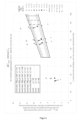
- the values for the brightness L Rc ⁇ and the color coordinates a* and b* of the undercoating are shown in Table 3. Accordingly, undercoatings B, C, and D are preferred examples. For undercoatings with multiple layers, as in Figure 1 shown, the sizes refer to the coloring layer that is in contact with the glass ceramic plate (first layer 9a in Figure 1 ).
- the cooking surface When viewed in remission through the glass ceramic plate, the cooking surface preferably has a brightness L R ⁇ > 50 , more preferably greater than 55 and most preferably greater than 60.
- L R * are Table 3 and the Figure 4 can be found.
- Table 1 Composition and properties of crystallizable glasses Glass No.
- Silicone matrix Fillers solvent Color pigments e.g. methyl silicone resin
- Absorption pigment violet Absorption pigment blue Black Pigment Graphite pigment A 50.0% 10.0% 2.0% 30.0% 8.0% B 58.0% 4.0% 10.0% 10.0% 10.0% 3.0% 1.5% 1.5% 2.0% C 65.0% 2.0% 10.0% 22.0% 1.0% D Color, RAL 9003 (white)
Landscapes
- Chemical & Material Sciences (AREA)
- Engineering & Computer Science (AREA)
- Geochemistry & Mineralogy (AREA)
- Life Sciences & Earth Sciences (AREA)
- Chemical Kinetics & Catalysis (AREA)
- General Chemical & Material Sciences (AREA)
- Materials Engineering (AREA)
- Organic Chemistry (AREA)
- Ceramic Engineering (AREA)
- Crystallography & Structural Chemistry (AREA)
- Dispersion Chemistry (AREA)
- Combustion & Propulsion (AREA)
- Mechanical Engineering (AREA)
- General Engineering & Computer Science (AREA)
- Glass Compositions (AREA)
Claims (15)
- Surface de cuisson (1) constituée d'une plaque vitrocéramique transparente en aluminosilicate de lithium (2) qui présente une surface supérieure (4) et une surface inférieure (6), la surface inférieure (6) étant au moins partiellement pourvue d'un revêtement de face inférieure (8), caractérisée en ce quela vitrocéramique contient des cristaux mixtes de quartz de haute qualité comme phase cristalline principale,en ce que la plaque vitrocéramique (2) d'une épaisseur de 4 mm présente, au passage de la lumière de l'illuminant normalisé D65, une coloration
 en ce que la plaque vitrocéramique présente du TiO2 comme agent de nucléation,en ce que la surface de cuisson (1) présente un lieu de couleur A avec les coordonnées de couleur
 en ce que le revêtement de face inférieure (8) présente un lieu de couleur B avec les coordonnées de couleur
 en ce que les lieux de couleur A et B présentent une distance
 et en ce que pour la distance,
 la coordonnée de couleur

- Surface de cuisson (1) selon la revendication 1, caractérisée en ce que la proportion de TiO2 est > 1,6 - 2,8 % en poids.
- Surface de cuisson (1) selon au moins l'une des revendications précédentes, caractérisée en ce que la plaque vitrocéramique contient les composants suivants (en % en poids sur la base des oxydes) :
Li2O 3 - 4,5 Al2O3 19 - 24 SiO2 62 - 70 TiO2 >1,6 - 2,8 ZrO2 1 - 2,5 Fe2O3 0,005 - 0,025. - Surface de cuisson (1) selon la revendication 3, caractérisée en ce que la plaque vitrocéramique contient du MgO à raison de 0,1 à < 0,5 % en poids.
- Surface de cuisson (1) selon au moins l'une des revendications 3 ou 4, caractérisée en ce que la plaque vitrocéramique contient du SrO à raison de 0,01 à 2 % en poids.
- Surface de cuisson (1) selon l'une des revendications 3 à 5, caractérisée en ce que la plaque vitrocéramique contient du BaO à raison de 0,1 à 4 % en poids.
- Surface de cuisson (1) selon les revendications 5 et 6, caractérisée en ce que, pour les composants BaO et SrO, la condition

- Surface de cuisson (1) selon l'une des revendications 3 à 7, caractérisée en ce que la plaque vitrocéramique contient de l'As2O3 à raison de 0,1 à 2 % en poids, notamment 0,4 à 2 % en poids.
- Surface de cuisson (1) selon l'une des revendications 3 à 8, caractérisée en ce que la plaque vitrocéramique contient du SnO2 à raison de moins de 0,1 % en poids.
- Surface de cuisson (1) selon l'une des revendications 3 à 9, caractérisée en ce que la plaque vitrocéramique contient du Nd2O3 à raison de 0,01 % à 0,25 % en poids.
- Surface de cuisson (1) selon l'une des revendications 3 à 10, caractérisée en ce que la plaque vitrocéramique contient du Fe2O3 à raison de 0,005 % à 0,02 % en poids.
- Surface de cuisson (1) selon l'une des revendications 4 à 11, caractérisée en ce que, pour les composants MgO et As2O3, la condition

- Surface de cuisson (1) selon la revendication 3, caractérisée en ce que la plaque vitrocéramique contient les composants suivants (en % en poids sur la base des oxydes) :
Li2O 3,2 - 4,5 Al2O3 19 - 24 SiO2 62 - 68 Na2O 0 - 1 K2O 0 - 1 Na2O + K2O 0,2 - 1,5 (condition B7a) MgO 0,05 - < 0,5 TiO2 1,8 - 2,8 ZrO2 1 - < 2,2 TiO2 + ZrO2 + SnO2 3,8 - 4,8 (condition B8) Fe2O3 0,007 - 0,02 CaO 0 - 1,5 SrO 0 - 1,5 BaO 0 - 2,5 ZnO 0 - 2,5 P2O5 0 - 4. - Surface de cuisson (1) selon la revendication 3, caractérisée en ce que la plaque vitrocéramique contient les composants suivants (en % en poids sur la base des oxydes) :
Li2O 3,2 - < 4,2 Al2O3 20 - < 23 SiO2 62 - 68 Na2O 0,1 - 1 K2O 0 - 1 Na2O + K2O 0,2 - 1,2 (condition B7b) MgO 0,1 - 0,4 CaO 0,05 - 1 SrO 0 - 1,5 BaO 0 - 2,5 SrO + BaO 0,5 - 2,5 TiO2 1,8 - 2,8 ZrO2 1 - < 2,2 SnO2 0,01 - < 0,10 TiO2 + ZrO2 + SnO2 3,8 - 4,8 (condition B8) Fe2O3 0,008 - 0,02 ZnO 0 - 2,5 B2O3 0 - 1 P2O5 0 - 2. - Surface de cuisson (1) selon l'une des revendications précédentes, caractérisée en ce que le revêtement de la face inférieure (8) est constitué de deux couches (9a, 9b), une première couche colorante (9a) étant appliquée sur la face inférieure de la plaque vitrocéramique (8) et une deuxième couche (9b) étant appliquée sur la première couche (9a).
Applications Claiming Priority (2)
| Application Number | Priority Date | Filing Date | Title |
|---|---|---|---|
| DE102020202597.5A DE102020202597A1 (de) | 2020-02-28 | 2020-02-28 | Kochfläche aus einer LAS-Glaskeramikplatte |
| EP21157920.6A EP3872042A1 (fr) | 2020-02-28 | 2021-02-18 | Surface de cuisson en une plaque vitrocéramique las |
Related Parent Applications (1)
| Application Number | Title | Priority Date | Filing Date |
|---|---|---|---|
| EP21157920.6A Division EP3872042A1 (fr) | 2020-02-28 | 2021-02-18 | Surface de cuisson en une plaque vitrocéramique las |
Publications (2)
| Publication Number | Publication Date |
|---|---|
| EP4026813A1 EP4026813A1 (fr) | 2022-07-13 |
| EP4026813B1 true EP4026813B1 (fr) | 2025-06-25 |
Family
ID=74668735
Family Applications (2)
| Application Number | Title | Priority Date | Filing Date |
|---|---|---|---|
| EP21157920.6A Pending EP3872042A1 (fr) | 2020-02-28 | 2021-02-18 | Surface de cuisson en une plaque vitrocéramique las |
| EP22159057.3A Active EP4026813B1 (fr) | 2020-02-28 | 2021-02-18 | Surface de cuisson en une plaque vitrocéramique la |
Family Applications Before (1)
| Application Number | Title | Priority Date | Filing Date |
|---|---|---|---|
| EP21157920.6A Pending EP3872042A1 (fr) | 2020-02-28 | 2021-02-18 | Surface de cuisson en une plaque vitrocéramique las |
Country Status (5)
| Country | Link |
|---|---|
| EP (2) | EP3872042A1 (fr) |
| JP (1) | JP7705717B2 (fr) |
| KR (1) | KR102944033B1 (fr) |
| CN (1) | CN113321422B (fr) |
| DE (1) | DE102020202597A1 (fr) |
Families Citing this family (5)
| Publication number | Priority date | Publication date | Assignee | Title |
|---|---|---|---|---|
| JP2023093289A (ja) * | 2021-12-22 | 2023-07-04 | 日本電気硝子株式会社 | 調理器用トッププレート |
| WO2023120207A1 (fr) * | 2021-12-22 | 2023-06-29 | 日本電気硝子株式会社 | Plaque supérieure de cuiseur |
| KR102550616B1 (ko) * | 2022-01-18 | 2023-07-04 | 삼성전자주식회사 | 세라믹 글라스 및 이를 적용한 쿡탑 |
| CN119947992A (zh) * | 2023-01-25 | 2025-05-06 | 日本电气硝子株式会社 | 结晶化玻璃 |
| CN115925252B (zh) * | 2023-02-13 | 2023-05-23 | 天津旗滨节能玻璃有限公司 | 超白非晶铝硅氧化物材料及其制备方法以及金属镀膜制品 |
Family Cites Families (20)
| Publication number | Priority date | Publication date | Assignee | Title |
|---|---|---|---|---|
| US3252811A (en) | 1963-12-11 | 1966-05-24 | Corning Glass Works | Glass-ceramic bodies and method of making them |
| JP4000500B2 (ja) * | 1999-08-02 | 2007-10-31 | 日本電気硝子株式会社 | Li2O−Al2O3−SiO2系結晶化ガラス及び結晶性ガラス |
| DE102004024583A1 (de) * | 2004-05-12 | 2005-12-08 | Schott Ag | Transluzente oder opake Kochfläche bestehend aus einer einfärbbaren Glaskeramik sowie deren Verwendung |
| ATE439334T1 (de) | 2006-03-20 | 2009-08-15 | Schott Ag | Transparente, farblose lithium-aluminosilikat- glaskeramikplatte mit blickdichter, farbiger unterseitenbeschichtung |
| ES2306312T3 (es) * | 2006-03-20 | 2008-11-01 | Schott Ag | Vidrio a base de silicato de litio y aluminio ceramizable, que contiene arsenico y antimonio, obtenido por flotacion y detectable optimamente. |
| FR2909374B1 (fr) | 2006-11-30 | 2016-11-25 | Soc En Nom Collectif Dite : Eurokera | Vitroceramiques de beta-quartz, transparentes et incolores, a faible teneur en tio2; articles en lesdites vitroceramiques ; verres precurseurs, procedes d'elaboration |
| FR2909373B1 (fr) | 2006-11-30 | 2009-02-27 | Snc Eurokera Soc En Nom Collec | Vitroceramiques de beta-quartz, transparentes et incolores, exemptes de tio2 ; articles en lesdites vitroceramiques ; verres precurseurs, procedes d'elaboration. |
| DE102008058318B3 (de) | 2008-11-21 | 2010-06-17 | Schott Ag | Kratzfeste Silikonbeschichtung für Kochflächen aus Glas oder Glaskeramik |
| DE102010032113B9 (de) * | 2010-07-23 | 2017-06-22 | Schott Ag | Transparente oder transparente eingefärbte Lithiumaluminiumsilikat-Glaskeramik mit einstellbarer thermischer Ausdehnung und deren Verwendung |
| DE102010035544B4 (de) | 2010-08-27 | 2015-10-15 | Schott Ag | Transparente Glaskeramiken |
| DE102011107831B4 (de) | 2010-09-02 | 2016-08-18 | Schott Ag | Transparente Glaskeramiken |
| DE102012202697A1 (de) | 2012-02-22 | 2013-08-22 | Schott Ag | Transparente farbarme Lithiumaluminiumsilikat-Glaskeramik und deren Verwendung |
| JP2013249221A (ja) * | 2012-05-31 | 2013-12-12 | Nippon Electric Glass Co Ltd | Li2O−Al2O3−SiO2系結晶化ガラス及びその製造方法 |
| FR3008695B1 (fr) | 2013-07-16 | 2021-01-29 | Corning Inc | Verre aluminosilicate dont la composition est exempte de metaux alcalins, convenant comme substrat de plaques de cuisson pour chauffage a induction |
| US9701573B2 (en) | 2013-09-06 | 2017-07-11 | Corning Incorporated | High strength glass-ceramics having lithium disilicate and beta-spodumene structures |
| DE102014222645A1 (de) * | 2014-11-06 | 2016-05-12 | Schott Ag | Hochkristalline Lithiumaluminiumsilikat-Glaskeramik und ihre Verwendung |
| JPWO2016088778A1 (ja) | 2014-12-02 | 2017-09-14 | 旭硝子株式会社 | ガラス板およびそれを用いた加熱器 |
| DE102016208300B3 (de) * | 2016-05-13 | 2017-08-03 | Schott Ag | Kristallisierbares Lithiumaluminiumsilikat-Glas und daraus hergestellte transparente Glaskeramik sowie Verfahren zur Herstellung des Glases und der Glaskeramik und Verwendung der Glaskeramik |
| KR102826738B1 (ko) | 2017-06-05 | 2025-06-27 | 에이지씨 가부시키가이샤 | 강화 유리 |
| FR3069240B1 (fr) | 2017-07-21 | 2021-04-23 | Eurokera | Vitroceramiques de spodumene-beta, blanches, opalescentes ou opaques, a faible teneur en titane, affinees a l'etain |
-
2020
- 2020-02-28 DE DE102020202597.5A patent/DE102020202597A1/de active Pending
-
2021
- 2021-02-18 EP EP21157920.6A patent/EP3872042A1/fr active Pending
- 2021-02-18 EP EP22159057.3A patent/EP4026813B1/fr active Active
- 2021-02-26 JP JP2021030973A patent/JP7705717B2/ja active Active
- 2021-02-26 CN CN202110220098.1A patent/CN113321422B/zh active Active
- 2021-02-26 KR KR1020210026671A patent/KR102944033B1/ko active Active
Also Published As
| Publication number | Publication date |
|---|---|
| JP7705717B2 (ja) | 2025-07-10 |
| CN113321422B (zh) | 2024-07-16 |
| CN113321422A (zh) | 2021-08-31 |
| DE102020202597A1 (de) | 2021-09-02 |
| EP3872042A1 (fr) | 2021-09-01 |
| EP4026813A1 (fr) | 2022-07-13 |
| JP2021138605A (ja) | 2021-09-16 |
| KR20210110520A (ko) | 2021-09-08 |
| KR102944033B1 (ko) | 2026-03-25 |
Similar Documents
| Publication | Publication Date | Title |
|---|---|---|
| EP4026813B1 (fr) | Surface de cuisson en une plaque vitrocéramique la | |
| EP1837312B2 (fr) | Verre de lithium-aluminium-silicate avec cycle court de céramisation | |
| EP1837314B1 (fr) | Plaque de vitrocéramique de lithium aluminium silicate transparente et incolore avec sous-revêtement opaque et coloré | |
| EP3728152B1 (fr) | Vitrocéramique colorée, transparente, à base de silicate de lithium et d'aluminium ainsi que procédé pour la fabrication et utilisation de la vitrocéramique | |
| DE102008050263C5 (de) | Transparente, eingefärbte Kochfläche mit verbesserter farbiger Anzeigefähigkeit und Verfahren zur Herstellung einer solchen Kochfläche | |
| EP2817269B1 (fr) | Vitrocéramique transparente peu colorée à base de silicate de lithium et d'aluminium et utilisation de ladite vitrocéramique | |
| DE69710630T2 (de) | Ein im wesentlichen nickelfreies Kalknatron-Silikatglas mit minderer Durchlässigkeit in den U.V., sichtbaren und infraroten Bereichen | |
| DE60001869T2 (de) | Buntglas enthaltend Eisen- und Molybdänoxide als färbende Komponente | |
| DE202018100558U1 (de) | Eingefärbte transparente Lithiumaluminiumsilikat-Glaskeramik | |
| DE102016208300B3 (de) | Kristallisierbares Lithiumaluminiumsilikat-Glas und daraus hergestellte transparente Glaskeramik sowie Verfahren zur Herstellung des Glases und der Glaskeramik und Verwendung der Glaskeramik | |
| DE102004024583A1 (de) | Transluzente oder opake Kochfläche bestehend aus einer einfärbbaren Glaskeramik sowie deren Verwendung | |
| EP3872044B1 (fr) | Verre de silicate de lithium-aluminium cristallisable et vitrocéramique fabriquée à partir de celui-ci, ainsi que procédé de fabrication du verre et du verre céramique et utilisation du verre céramique | |
| EP3747839B1 (fr) | Vitrocéramique, son procédé de fabrication et son utilisation | |
| WO2015024857A1 (fr) | Procédé de détermination d'une fenêtre de processus et procédé de fabrication d'une vitrocéramique | |
| EP3872043B1 (fr) | Verre de silicate de lithium-aluminium cristallisable et vitrocéramique fabriquée à partir de celui-ci, ainsi que procédé de fabrication du verre et du verre céramique et utilisation du verre céramique | |
| EP4375247B1 (fr) | Vitrocéramique à base d'aluminosilicate de lithium | |
| EP3450411A1 (fr) | Vitroceramique en aluminosilicate de lithium transparente teintée et son utilisation | |
| EP4140964A1 (fr) | Verre à base de silicate de lithium-aluminium cristallisable et vitrocéramique fabriqué à partir de celui-ci, ainsi que procédé de fabrication de la vitrocéramique et utilisation de la vitrocéramique | |
| DE202023104159U1 (de) | Transparente Lithiumaluminiumsilikat-Glaskeramik | |
| EP4495077A1 (fr) | Vitrocéramique transparente à base d'aluminosilicate de lithium | |
| EP4495076A1 (fr) | Vitrocéramique transparente à base d'aluminosilicate de lithium | |
| DE202023104158U1 (de) | Transparente Lithiumaluminiumsilikat-Glaskeramik |
Legal Events
| Date | Code | Title | Description |
|---|---|---|---|
| PUAI | Public reference made under article 153(3) epc to a published international application that has entered the european phase |
Free format text: ORIGINAL CODE: 0009012 |
|
| STAA | Information on the status of an ep patent application or granted ep patent |
Free format text: STATUS: REQUEST FOR EXAMINATION WAS MADE |
|
| 17P | Request for examination filed |
Effective date: 20220228 |
|
| AC | Divisional application: reference to earlier application |
Ref document number: 3872042 Country of ref document: EP Kind code of ref document: P |
|
| AK | Designated contracting states |
Kind code of ref document: A1 Designated state(s): AL AT BE BG CH CY CZ DE DK EE ES FI FR GB GR HR HU IE IS IT LI LT LU LV MC MK MT NL NO PL PT RO RS SE SI SK SM TR |
|
| P01 | Opt-out of the competence of the unified patent court (upc) registered |
Effective date: 20230516 |
|
| GRAP | Despatch of communication of intention to grant a patent |
Free format text: ORIGINAL CODE: EPIDOSNIGR1 |
|
| STAA | Information on the status of an ep patent application or granted ep patent |
Free format text: STATUS: GRANT OF PATENT IS INTENDED |
|
| RIC1 | Information provided on ipc code assigned before grant |
Ipc: C03C 10/00 20060101ALI20250307BHEP Ipc: C03C 3/097 20060101ALI20250307BHEP Ipc: C03C 3/087 20060101AFI20250307BHEP |
|
| INTG | Intention to grant announced |
Effective date: 20250324 |
|
| GRAS | Grant fee paid |
Free format text: ORIGINAL CODE: EPIDOSNIGR3 |
|
| GRAA | (expected) grant |
Free format text: ORIGINAL CODE: 0009210 |
|
| STAA | Information on the status of an ep patent application or granted ep patent |
Free format text: STATUS: THE PATENT HAS BEEN GRANTED |
|
| AC | Divisional application: reference to earlier application |
Ref document number: 3872042 Country of ref document: EP Kind code of ref document: P |
|
| AK | Designated contracting states |
Kind code of ref document: B1 Designated state(s): AL AT BE BG CH CY CZ DE DK EE ES FI FR GB GR HR HU IE IS IT LI LT LU LV MC MK MT NL NO PL PT RO RS SE SI SK SM TR |
|
| REG | Reference to a national code |
Ref country code: GB Ref legal event code: FG4D Free format text: NOT ENGLISH |
|
| REG | Reference to a national code |
Ref country code: CH Ref legal event code: EP |
|
| REG | Reference to a national code |
Ref country code: CH Ref legal event code: EP |
|
| REG | Reference to a national code |
Ref country code: IE Ref legal event code: FG4D Free format text: LANGUAGE OF EP DOCUMENT: GERMAN |
|
| REG | Reference to a national code |
Ref country code: DE Ref legal event code: R096 Ref document number: 502021007874 Country of ref document: DE |
|
| PG25 | Lapsed in a contracting state [announced via postgrant information from national office to epo] |
Ref country code: FI Free format text: LAPSE BECAUSE OF FAILURE TO SUBMIT A TRANSLATION OF THE DESCRIPTION OR TO PAY THE FEE WITHIN THE PRESCRIBED TIME-LIMIT Effective date: 20250625 |
|
| REG | Reference to a national code |
Ref country code: LT Ref legal event code: MG9D |
|
| PG25 | Lapsed in a contracting state [announced via postgrant information from national office to epo] |
Ref country code: NO Free format text: LAPSE BECAUSE OF FAILURE TO SUBMIT A TRANSLATION OF THE DESCRIPTION OR TO PAY THE FEE WITHIN THE PRESCRIBED TIME-LIMIT Effective date: 20250925 Ref country code: GR Free format text: LAPSE BECAUSE OF FAILURE TO SUBMIT A TRANSLATION OF THE DESCRIPTION OR TO PAY THE FEE WITHIN THE PRESCRIBED TIME-LIMIT Effective date: 20250926 |
|
| PG25 | Lapsed in a contracting state [announced via postgrant information from national office to epo] |
Ref country code: BG Free format text: LAPSE BECAUSE OF FAILURE TO SUBMIT A TRANSLATION OF THE DESCRIPTION OR TO PAY THE FEE WITHIN THE PRESCRIBED TIME-LIMIT Effective date: 20250625 |
|
| PG25 | Lapsed in a contracting state [announced via postgrant information from national office to epo] |
Ref country code: HR Free format text: LAPSE BECAUSE OF FAILURE TO SUBMIT A TRANSLATION OF THE DESCRIPTION OR TO PAY THE FEE WITHIN THE PRESCRIBED TIME-LIMIT Effective date: 20250625 |
|
| PG25 | Lapsed in a contracting state [announced via postgrant information from national office to epo] |
Ref country code: RS Free format text: LAPSE BECAUSE OF FAILURE TO SUBMIT A TRANSLATION OF THE DESCRIPTION OR TO PAY THE FEE WITHIN THE PRESCRIBED TIME-LIMIT Effective date: 20250925 |
|
| PG25 | Lapsed in a contracting state [announced via postgrant information from national office to epo] |
Ref country code: LV Free format text: LAPSE BECAUSE OF FAILURE TO SUBMIT A TRANSLATION OF THE DESCRIPTION OR TO PAY THE FEE WITHIN THE PRESCRIBED TIME-LIMIT Effective date: 20250625 |
|
| REG | Reference to a national code |
Ref country code: NL Ref legal event code: MP Effective date: 20250625 |
|
| PG25 | Lapsed in a contracting state [announced via postgrant information from national office to epo] |
Ref country code: NL Free format text: LAPSE BECAUSE OF FAILURE TO SUBMIT A TRANSLATION OF THE DESCRIPTION OR TO PAY THE FEE WITHIN THE PRESCRIBED TIME-LIMIT Effective date: 20250625 |
|
| PG25 | Lapsed in a contracting state [announced via postgrant information from national office to epo] |
Ref country code: PT Free format text: LAPSE BECAUSE OF FAILURE TO SUBMIT A TRANSLATION OF THE DESCRIPTION OR TO PAY THE FEE WITHIN THE PRESCRIBED TIME-LIMIT Effective date: 20251027 |
|
| PG25 | Lapsed in a contracting state [announced via postgrant information from national office to epo] |
Ref country code: IS Free format text: LAPSE BECAUSE OF FAILURE TO SUBMIT A TRANSLATION OF THE DESCRIPTION OR TO PAY THE FEE WITHIN THE PRESCRIBED TIME-LIMIT Effective date: 20251025 |
|
| PG25 | Lapsed in a contracting state [announced via postgrant information from national office to epo] |
Ref country code: SM Free format text: LAPSE BECAUSE OF FAILURE TO SUBMIT A TRANSLATION OF THE DESCRIPTION OR TO PAY THE FEE WITHIN THE PRESCRIBED TIME-LIMIT Effective date: 20250625 |
|
| PG25 | Lapsed in a contracting state [announced via postgrant information from national office to epo] |
Ref country code: CZ Free format text: LAPSE BECAUSE OF FAILURE TO SUBMIT A TRANSLATION OF THE DESCRIPTION OR TO PAY THE FEE WITHIN THE PRESCRIBED TIME-LIMIT Effective date: 20250625 |
|
| PG25 | Lapsed in a contracting state [announced via postgrant information from national office to epo] |
Ref country code: PL Free format text: LAPSE BECAUSE OF FAILURE TO SUBMIT A TRANSLATION OF THE DESCRIPTION OR TO PAY THE FEE WITHIN THE PRESCRIBED TIME-LIMIT Effective date: 20250625 |
|
| PG25 | Lapsed in a contracting state [announced via postgrant information from national office to epo] |
Ref country code: EE Free format text: LAPSE BECAUSE OF FAILURE TO SUBMIT A TRANSLATION OF THE DESCRIPTION OR TO PAY THE FEE WITHIN THE PRESCRIBED TIME-LIMIT Effective date: 20250625 |
|
| PG25 | Lapsed in a contracting state [announced via postgrant information from national office to epo] |
Ref country code: SK Free format text: LAPSE BECAUSE OF FAILURE TO SUBMIT A TRANSLATION OF THE DESCRIPTION OR TO PAY THE FEE WITHIN THE PRESCRIBED TIME-LIMIT Effective date: 20250625 |
|
| PG25 | Lapsed in a contracting state [announced via postgrant information from national office to epo] |
Ref country code: ES Free format text: LAPSE BECAUSE OF FAILURE TO SUBMIT A TRANSLATION OF THE DESCRIPTION OR TO PAY THE FEE WITHIN THE PRESCRIBED TIME-LIMIT Effective date: 20250625 |
|
| PG25 | Lapsed in a contracting state [announced via postgrant information from national office to epo] |
Ref country code: DK Free format text: LAPSE BECAUSE OF FAILURE TO SUBMIT A TRANSLATION OF THE DESCRIPTION OR TO PAY THE FEE WITHIN THE PRESCRIBED TIME-LIMIT Effective date: 20250625 |
|
| PGFP | Annual fee paid to national office [announced via postgrant information from national office to epo] |
Ref country code: DE Payment date: 20260218 Year of fee payment: 6 |
|
| PG25 | Lapsed in a contracting state [announced via postgrant information from national office to epo] |
Ref country code: IT Free format text: LAPSE BECAUSE OF FAILURE TO SUBMIT A TRANSLATION OF THE DESCRIPTION OR TO PAY THE FEE WITHIN THE PRESCRIBED TIME-LIMIT Effective date: 20250625 |
|
| PLBE | No opposition filed within time limit |
Free format text: ORIGINAL CODE: 0009261 |
|
| STAA | Information on the status of an ep patent application or granted ep patent |
Free format text: STATUS: NO OPPOSITION FILED WITHIN TIME LIMIT |