EP4027608A1 - Système et procédé de transmission de données utilisant un protocole dns - Google Patents
Système et procédé de transmission de données utilisant un protocole dns Download PDFInfo
- Publication number
- EP4027608A1 EP4027608A1 EP21165471.0A EP21165471A EP4027608A1 EP 4027608 A1 EP4027608 A1 EP 4027608A1 EP 21165471 A EP21165471 A EP 21165471A EP 4027608 A1 EP4027608 A1 EP 4027608A1
- Authority
- EP
- European Patent Office
- Prior art keywords
- data
- data collection
- string
- client device
- server
- Prior art date
- Legal status (The legal status is an assumption and is not a legal conclusion. Google has not performed a legal analysis and makes no representation as to the accuracy of the status listed.)
- Withdrawn
Links
- 238000000034 method Methods 0.000 title claims description 17
- 238000013480 data collection Methods 0.000 claims abstract description 74
- 239000000284 extract Substances 0.000 claims abstract description 7
- 230000004044 response Effects 0.000 claims description 36
- 230000009471 action Effects 0.000 claims description 5
- 238000004891 communication Methods 0.000 description 3
- 238000012545 processing Methods 0.000 description 3
- 230000005540 biological transmission Effects 0.000 description 2
- 230000008859 change Effects 0.000 description 2
- 230000001788 irregular Effects 0.000 description 2
- 238000005259 measurement Methods 0.000 description 2
- 230000015654 memory Effects 0.000 description 2
- 230000008569 process Effects 0.000 description 2
- 238000012360 testing method Methods 0.000 description 2
- 230000007613 environmental effect Effects 0.000 description 1
- 238000000605 extraction Methods 0.000 description 1
- 238000012986 modification Methods 0.000 description 1
- 230000004048 modification Effects 0.000 description 1
Images



Classifications
-
- H—ELECTRICITY
- H04—ELECTRIC COMMUNICATION TECHNIQUE
- H04L—TRANSMISSION OF DIGITAL INFORMATION, e.g. TELEGRAPHIC COMMUNICATION
- H04L41/00—Arrangements for maintenance, administration or management of data switching networks, e.g. of packet switching networks
- H04L41/08—Configuration management of networks or network elements
- H04L41/0803—Configuration setting
- H04L41/0823—Configuration setting characterised by the purposes of a change of settings, e.g. optimising configuration for enhancing reliability
-
- H—ELECTRICITY
- H04—ELECTRIC COMMUNICATION TECHNIQUE
- H04L—TRANSMISSION OF DIGITAL INFORMATION, e.g. TELEGRAPHIC COMMUNICATION
- H04L67/00—Network arrangements or protocols for supporting network services or applications
- H04L67/01—Protocols
-
- H—ELECTRICITY
- H04—ELECTRIC COMMUNICATION TECHNIQUE
- H04L—TRANSMISSION OF DIGITAL INFORMATION, e.g. TELEGRAPHIC COMMUNICATION
- H04L41/00—Arrangements for maintenance, administration or management of data switching networks, e.g. of packet switching networks
- H04L41/08—Configuration management of networks or network elements
- H04L41/0803—Configuration setting
- H04L41/0823—Configuration setting characterised by the purposes of a change of settings, e.g. optimising configuration for enhancing reliability
- H04L41/0833—Configuration setting characterised by the purposes of a change of settings, e.g. optimising configuration for enhancing reliability for reduction of network energy consumption
-
- H—ELECTRICITY
- H04—ELECTRIC COMMUNICATION TECHNIQUE
- H04L—TRANSMISSION OF DIGITAL INFORMATION, e.g. TELEGRAPHIC COMMUNICATION
- H04L61/00—Network arrangements, protocols or services for addressing or naming
- H04L61/45—Network directories; Name-to-address mapping
- H04L61/4505—Network directories; Name-to-address mapping using standardised directories; using standardised directory access protocols
- H04L61/4511—Network directories; Name-to-address mapping using standardised directories; using standardised directory access protocols using domain name system [DNS]
-
- H—ELECTRICITY
- H04—ELECTRIC COMMUNICATION TECHNIQUE
- H04L—TRANSMISSION OF DIGITAL INFORMATION, e.g. TELEGRAPHIC COMMUNICATION
- H04L67/00—Network arrangements or protocols for supporting network services or applications
- H04L67/50—Network services
- H04L67/56—Provisioning of proxy services
- H04L67/565—Conversion or adaptation of application format or content
-
- H—ELECTRICITY
- H04—ELECTRIC COMMUNICATION TECHNIQUE
- H04L—TRANSMISSION OF DIGITAL INFORMATION, e.g. TELEGRAPHIC COMMUNICATION
- H04L2101/00—Indexing scheme associated with group H04L61/00
- H04L2101/30—Types of network names
- H04L2101/35—Types of network names containing special prefixes
-
- H—ELECTRICITY
- H04—ELECTRIC COMMUNICATION TECHNIQUE
- H04L—TRANSMISSION OF DIGITAL INFORMATION, e.g. TELEGRAPHIC COMMUNICATION
- H04L67/00—Network arrangements or protocols for supporting network services or applications
- H04L67/01—Protocols
- H04L67/12—Protocols specially adapted for proprietary or special-purpose networking environments, e.g. medical networks, sensor networks, networks in vehicles or remote metering networks
Definitions
- the present invention relates to transmitting data using a Domain Name System (DNS) protocol.
- DNS Domain Name System
- a Domain Name System is a hierarchical and decentralized naming system for computers connected to the Internet or a private network.
- a DNS server translates memorized domain names to a numerical IP (Internet Protocol) addresses.
- a computer device connected to a network has defined at least one IP address of a DNS server.
- the computer device intends to communicate with a computer having a particular domain name, it sends a request to the IP address of the domain server, the request containing the domain name (such as www.adbglobal.com) and receives from the DNS server an IP address that is associated by the server with that domain name (such as 123.123.123.123).
- thermometer device may be configured to send the currently measured temperature in short intervals to a remote server.
- this type of data is sent via a dedicated protocol to the server.
- Such protocol typically requires special format of messages, which often includes a header which may be considerably longer than the actual payload conveying the data to be sent to the server.
- the device will first ask the DNS server to resolve the domain address of the data collecting server via the DNS protocol message and then send the data to the data collecting server via another protocol, such as TCP/IP via the special message.
- TCP/IP Transmission of relatively large amount of data as compared to the actual data. Consequently, power processing and bandwidth resources are not used optimally. This can have a significant importance for battery-operated devices or for networks wherein lots of devices transmit data to the data collecting server.
- the invention relates to a system for transmitting data using a DNS (Domain Name System) protocol, the system comprising: at least one client device; a data collection server associated with a data collection domain name; a data collection database.
- the client device comprises: at least one device module; a device controller configured to: generate data corresponding to the device module in a form of a data string; form a data collection DNS query in a form of a domain name string that contains the data string followed by a data collection domain name; send the data collection DNS query to the network controller.
- the data collection server is configured to: receive the data collection DNS query; extract the data string from the DNS query domain name string.
- the system further comprises a data collection database, wherein the data collection server is further configured to send the data string and an identifier of the client device to the data collection database.
- the data collection server is further configured to: form an IP address response depending on the content of the data string; send the IP address response to the client device.
- the data collection server is configured to form an IP address response of at least one of the following types: an acknowledgement and a command.
- the IP address response type is defined by the values of the IP address.
- the device controller of the client device is further configured to receive the IP address response, extract response data from the IP address response and perform an action depending on the extracted response data.
- the step of forming the DNS query comprises encrypting the data to be sent and providing the encrypted data as the data string, and the step of extracting the data string comprises decrypting of the data string.
- the invention also relates to a method for transmitting data between a client device and a data collection server having an IP (Internet Protocol) address, the method comprising: at the client device : generating data corresponding to a device module in a form of a data string; forming a data collection DNS query in a form of a domain name string that contains the data string followed by a data collection domain name; sending the data collection DNS query to the network controller; at the data collection server associated with the data collection domain name: receiving the data collection DNS query; extracting the data string from the DNS query domain name string.
- IP Internet Protocol
- the method further comprises, at the data collection server, sending the data string and an identifier of the client device to a data collection database.
- the method further comprises, at the data collection server, forming an IP address response depending on the content of the data string and sending the IP address response to the client device.
- the step of forming the DNS query comprises encrypting the data to be sent and providing the encrypted data as the data string, and the step of extracting the data string comprises decrypting of the data string.
- these quantities take the form of electrical or magnetic signals capable of being stored, transferred, combined, compared, and otherwise manipulated in a computer system.
- these signals are referred to as bits, packets, messages, values, elements, symbols, characters, terms, numbers, or the like.
- a computer-readable (storage) medium typically may be non-transitory and/or comprise a non-transitory device.
- a non-transitory storage medium may include a device that may be tangible, meaning that the device has a concrete physical form, although the device may change its physical state.
- non-transitory refers to a device remaining tangible despite a change in state.
- data is transmitted via DNS messages.
- a client device sends a DNS query that contains the collection data and a domain name of the data collecting server.
- the data collecting server is configured as a DNS server, receives the DNS query and sends a response in a form of an IP address (e.g. IPv4 or IPv6 address) that may contain simply acknowledgement of receipt of the data or response data.
- IP address e.g. IPv4 or IPv6 address
- FIG. 1 A first embodiment of the system for collecting data is shown in Fig. 1 .
- the system comprises at least one client device 121 that is configured to generate data and transmit the data to the data collecting server 122.
- the client device 121 is any device, the data of which is of interest to the data collecting server 122.
- the client device 121 can be an Internet of Things device, such as a sensor that measures environmental data, for example temperature.
- the sensor may be configured to generate data corresponding to the currently measured temperature and send it to the data collecting server 122 in regular intervals, e.g. once every second, and/or irregular intervals, i.e. when the temperature changes over a threshold or changes more than a threshold.
- the client device 121 may be a smartphone with embedded GPS sensor that measures current position of the device 121.
- the smartphone may be configured to send its position to the data collecting server 122.
- the client device 121 may be a digital television decoder that may be configured to send information about the currently watched television program to the data collecting server 122 in regular intervals, e.g. once every minute, and/or irregular intervals, e.g. each time the program is changed.
- data generated by the client device 121 corresponds to any data generated within the client device 121 either by device sensors explicitly configured to generate specific measurement data or simply data related to current state of any component of the device.
- the system may comprise a plurality, even thousands, of client devices 121 from which data is to be collected by the data collection server 122.
- the DNS protocol is used within the scope of the present invention.
- the data collecting server 122 is configured as a DNS server and the client device 121 is configured such that the data collecting server IP address is specified as a DNS server address for handling communication.
- the client device may have two DNS addresses specified:
- the client device 121 has a structure schematically shown in Fig. 5 . It comprises a network controller 210 with a DNS configuration module 211 that stores IP addresses of the DNS servers 112, 122. Namely, the IP address of the data collection server 122 is configured as a DNS server for that network controller 210.
- the client device 121 further comprises at least one device module 230, such as a temperature sensor, a GPS sensor, a tv programs controller or any other module for which data is to be collected.
- the client device further comprises a main device controller 220 that is configured to perform the steps of the method as shown in fig. 3 .
- the device controller 220 may contain an IP address to command converter 221, in case the system is configured such that the data collection server may send commands to the client device, e.g. a command to execute a low power operation mode or to provide additional information.
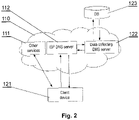
- the second embodiment of the system as shown in Fig. 2 is equivalent to the first embodiment with the following differences.
- the data collecting DNS server 122 is not configured as a DNS server directly at the client device 121, but at another DNS server 112, such an ISP DNS server that is configured as the DNS server directly at the client device 121. In that case, the data collecting DNS server 122 receives DNS queries related to the data collection domain name from the client device 121 via the other DNS server 112 and returns the IP address directly to the client device 121 or also via the other DNS server 112.
- Fig. 3 shows schematically the method of operation of the system.
- the steps on the left are performed by the client device 121, while the steps on the right are performed by the server 122.
- the client device generates data corresponding to the device module 230 in a form of a data string. This can be for example data corresponding to the measurements made by the module 230, other data generated by the module 230 or simply a current state of the module 230.
- a data collection DNS query is formed in a form of a domain name string that contains the data string followed by a data collection domain name.
- the data collection domain name can be e.g. "dns.adbglobal.com" and it is the domain name corresponding to the data collection server 122.
- the data string contains the data to be collected by the server 122. It may further contain the client device identifier.
- step 14 the data collection server 122 configured as the DNS server receives the data collection DNS query.
- step 15 it extracts the data string from the DNS query domain name string.
- the client device may, when forming the DNS query in step 12, encrypt the data to be sent and provide the encrypted data as the data string - in that case, step 15 may involve, apart from extraction of the data string, the decryption of the data string.
- step 16 the data collection server sends the data string and an identifier of the client device 121 to the data collection database 123.
- the client identifier may be extracted from the query or it can be the IP address from which the DNS query originated, depending on the system configuration.
- the data collection database 123 can be used for various purposes which are beyond the scope of the present application.
- the data collection server 122 may form 17 an IP address response depending on the content of the data string and sends it in step 18 to the client device 121.
- the IP address response may be a simple acknowledgement or a command that is next interpreted by the client device 121 and executed.
- the IP address response type is defined by the values of the IP address, for example the acknowledgement can have a form of an IP address "1.1.1.1” and a command can have a form of an IP address "20.20.20.x", wherein "x" defines a type of command.
- the IP address should be a special address reserved for system use such as not to be confused with an address of an actual other device in the network.
- the IP address response may be in a form of a plurality of IP addresses, which may be useful to transmit a plurality of commands to the client device.
- the client device 121 may extract in step 20 response data from the IP address response and perform in step 21 an action depending on the extracted response data (wherein the action is defined according to the IP address - command converter 221).
- Fig. 4 shows a schematic illustration of an example embodiment of a structure of the client device 121 or the data collection server 122. They may contain a controller 400 that may include at least one non-transitory processor-readable storage medium 410 that stores at least one of processor-executable instructions 415 or data; and at least one processor 420 communicably coupled to the at least one non-transitory processor-readable storage medium 410.
- the at least one processor 420 may be configured to (by executing the instructions 415) perform the corresponding steps of the method of Fig. 3 (i.e. steps 11-13, 19-21 for the client device 121 or steps 14-18 for the server).
- the client device is configured to send data corresponding to currently watched tv programs, if the program is watched for more than 5 minutes.
- the client device 121 may send the DNS query in a form of a string such as: live1.stb1.dns.adbglobal.com, wherein "live1" is a program identifier, "stb1" is a client device identifier (or an identifier of a module of that client device) and "dns.adbglobal.com” is the data collection domain name.
- the server device 122 responds by sending an acknowledgement response in a form of an IP address such as "1.1.1.1".
- the client device is configured to send data corresponding to currently watched tv programs, and the server device may ask for the source of that program.
- the client device 121 may send the DNS query in a form of a string such as: live1.stb1.dns.adbglobal.com, wherein "live1" is a program identifier, "stb1" is a client device identifier (or an identifier of a module of that client device) and "dns.adbglobal.com” is the data collection domain name.
- the server device 122 responds by sending a command in a form of an IP address such as "10.20.30.40" which is interpreted by the client device as a command to send a more detailed DNS query.
- the client device sends a response such as "dvbs.stb1.dns.adbglobal.com” wherein "dvbs” identifies the source of the program (e.g. a satellite signal receiver).
- the server device 122 responds by sending an acknowledgement response in a form of an IP address such as "1.1.1.1".
- the client device is configured to send data corresponding to currently watched tv programs, and the server device may ask for the type and parameters of internet connection.
- the client device 121 may send the DNS query in a form of a string such as: live1.stb1.dns.adbglobal.com, wherein "live1" is a program identifier, "stb1" is a client device identifier (or an identifier of a module of that client device) and "dns.adbglobal.com” is the data collection domain name.
- the server device 122 responds by sending a command in a form of an IP address such as "20.20.20.20" which is interpreted by the client device as a command to send parameters of the internet connection.
- the client device sends two responses such as "wifi.stb1.dns.adbglobal.com” wherein “wifi” identifies that the connection is over a Wi-Fi network and such as "60dbi.aes.wpa2.5ghz.pass_12345678.ssid_test.stb1.dns.adbglobal.com", which informs about the parameters of the Wi-Fi connection: ssid: test, password: 12345678, bandwidth: 5GHz, WPA2 AES, signal strength 60dBi.
- the server device 122 responds by sending an acknowledgement response in a form of an IP address such as "1.1.1.1".
- the battery-operated client device is configured to send data corresponding to its current temperature.
- the client device 121 may send the DNS query in a form of a string such as: 25c.thermometer1.dns.adbglobal.com, wherein "25c” identifies the value of the temperature as 25 degrees Celsius, and "thermomenter1" identifies which module of the device generated this data and "dns.adbglobal.com” is the data collection domain name.
- the server device 122 responds by sending a command to define the battery power level, such as "10.20.30.50".
- the client device 121 responds as "10.dns.adbglobal.com", which indicates that the battery level is 10 percent.
- the server device 122 responds by sending a command to switch to low power energy usage, such as "10.20.50.50".
- the device switches to low power mode.
- the DNS server may be further configured to send, via other communication channels (e.g. SMS or email), a message to the user of the device to power the device or replace the battery.
- the client device is configured to send data indicating that it is interested to learn about the most recent firmware version that can be installed at this client device and the server device may provide the most recent firmware version.
- the client device 121 may send the DNS query in a form of a string such as: pyta firmware_update.stb1.dns.adbglobal.com, wherein "firmware_update” is a request for the recent firmware version identifier, "stb1" is a client device identifier (or an identifier of a module of that client device) and "dns.adbglobal.com” is the data collection domain name.
- the server device 122 responds by sending a response in a form of an IP address such as "5.5.5.5” which indicates the current firmware version. In case the client device has an older version of firmware, it can initiate a firmware update procedure.
- the presented solution makes the process of sending data via the DNS protocol more efficient than using additional dedicated messages. This makes the system particularly useful for low-resource client devices or networks with a large number of client devices wherein network bandwidth is limited.
Landscapes
- Engineering & Computer Science (AREA)
- Computer Networks & Wireless Communication (AREA)
- Signal Processing (AREA)
- Data Exchanges In Wide-Area Networks (AREA)
Priority Applications (1)
| Application Number | Priority Date | Filing Date | Title |
|---|---|---|---|
| US17/571,606 US20220224775A1 (en) | 2021-01-08 | 2022-01-10 | System and method for transmitting data using dns protocol |
Applications Claiming Priority (1)
| Application Number | Priority Date | Filing Date | Title |
|---|---|---|---|
| EP21150809 | 2021-01-08 |
Publications (1)
| Publication Number | Publication Date |
|---|---|
| EP4027608A1 true EP4027608A1 (fr) | 2022-07-13 |
Family
ID=74130038
Family Applications (1)
| Application Number | Title | Priority Date | Filing Date |
|---|---|---|---|
| EP21165471.0A Withdrawn EP4027608A1 (fr) | 2021-01-08 | 2021-03-29 | Système et procédé de transmission de données utilisant un protocole dns |
Country Status (2)
| Country | Link |
|---|---|
| US (1) | US20220224775A1 (fr) |
| EP (1) | EP4027608A1 (fr) |
Family Cites Families (12)
| Publication number | Priority date | Publication date | Assignee | Title |
|---|---|---|---|---|
| US20100318681A1 (en) * | 2009-06-12 | 2010-12-16 | Barracuda Networks, Inc | Protocol-independent, mobile, web filter system provisioning dns triage, uri scanner, and query proxy services |
| US20180139171A1 (en) * | 2016-11-17 | 2018-05-17 | Armada Logistics, Inc. | Systems, apparatuses and methods for tracking assets using domain name system signaling |
| US9762612B1 (en) * | 2017-05-17 | 2017-09-12 | Farsight Security, Inc. | System and method for near real time detection of domain name impersonation |
| US20190098118A1 (en) * | 2017-09-28 | 2019-03-28 | Nominum, Inc. | Repurposing Domain Name System as a Business Data Transport Layer |
| ES2948932T3 (es) * | 2018-01-26 | 2023-09-22 | Ericsson Telefon Ab L M | Nodo, otro nodo y métodos realizados por el mismo para apoyar el Sistema de Nombres de Dominio sobre el Protocolo de Aplicación Restringida |
| US11122411B2 (en) * | 2018-09-14 | 2021-09-14 | RaGaPa Inc. | Distributed, crowdsourced internet of things (IoT) discovery and identification using block chain |
| WO2020118375A1 (fr) * | 2018-12-14 | 2020-06-18 | Newsouth Innovations Pty Limited | Appareil et processus de détection d'attaques de sécurité de réseau sur des dispositifs iot |
| US20200314107A1 (en) * | 2019-03-29 | 2020-10-01 | Mcafee, Llc | Systems, methods, and media for securing internet of things devices |
| US11785049B2 (en) * | 2019-09-06 | 2023-10-10 | Action Streamer, LLC | Methods and systems for network security and privacy protection |
| EP4035334B1 (fr) * | 2019-09-25 | 2024-10-23 | Valimail Inc. | Émission et rotation centralisées de clé de session |
| US11533229B2 (en) * | 2020-05-21 | 2022-12-20 | Blackberry Limited | Method and system for signaling communication configuration for Iot devices using manufacturer usage description files |
| US11968166B2 (en) * | 2020-06-16 | 2024-04-23 | T-Mobile Usa, Inc. | Server-side initiation of DNS resolution |
-
2021
- 2021-03-29 EP EP21165471.0A patent/EP4027608A1/fr not_active Withdrawn
-
2022
- 2022-01-10 US US17/571,606 patent/US20220224775A1/en not_active Abandoned
Non-Patent Citations (2)
| Title |
|---|
| LEE SEJUN ET AL: "DNSNA: DNS name autoconfiguration for Internet of Things devices", 2016 18TH INTERNATIONAL CONFERENCE ON ADVANCED COMMUNICATION TECHNOLOGY (ICACT), GLOBAL IT RESEARCH INSTITUTE (GIRI), 31 January 2016 (2016-01-31), pages 410 - 416, XP032875482, DOI: 10.1109/ICACT.2016.7423412 * |
| MOCKAPETRIS ISI P: "DOMAIN NAMES - IMPLEMENTATION AND SPECIFICATION; rfc1035.txt", DOMAIN NAMES - IMPLEMENTATION AND SPECIFICATION; RFC1035.TXT, INTERNET ENGINEERING TASK FORCE, IETF; STANDARD, INTERNET SOCIETY (ISOC) 4, RUE DES FALAISES CH- 1205 GENEVA, SWITZERLAND, 1 November 1987 (1987-11-01), XP015005974 * |
Also Published As
| Publication number | Publication date |
|---|---|
| US20220224775A1 (en) | 2022-07-14 |
Similar Documents
| Publication | Publication Date | Title |
|---|---|---|
| EP3550892B1 (fr) | Procédé de sélection de tranche de réseau, équipement d'utilisateur, et dispositif de réseau | |
| US11283816B2 (en) | Hierarchical scanning of internet connected assets | |
| US20130268632A1 (en) | Server assisted authenticated device | |
| EP3208976A1 (fr) | Dispositif de commande, routeur de bordure, procédé de commande et programme de commande | |
| GB2558205A (en) | Enabling communications between devices | |
| CN104160681A (zh) | 用于使用dns数据识别与ip流相关的应用的方法和装置 | |
| US10862862B2 (en) | Identifying devices on a remote network | |
| US20190379739A1 (en) | Data transmission between an application server and at least one internet-of-things communication device using a mobile communication network | |
| US20150381716A1 (en) | Method and system for sharing files over p2p | |
| JP6447297B2 (ja) | 通信方法、情報処理装置、及びプログラム | |
| CN106507414B (zh) | 报文转发方法及装置 | |
| US20160294465A1 (en) | Information collection system, relay terminal, control method for relay terminal to connect to center system, sensor terminal, and control method for sensor terminal to connect to center system | |
| US20220224775A1 (en) | System and method for transmitting data using dns protocol | |
| KR101707633B1 (ko) | 표준/비표준 응용 프로토콜간 데이터 교환 방법과 사용자 정의 조건에 따른 동적제어 가능한 미들웨어 장치 | |
| EP3811592B1 (fr) | Procédé de découverte de protocole de communication dans un protocole d'application contraint (coap) | |
| US20170034004A1 (en) | Discovering network nodes | |
| KR102544882B1 (ko) | 네트워크 장치 및 네트워크 구성 판별 방법 | |
| US10091637B2 (en) | Providing information to a service in a communication network | |
| US9912557B2 (en) | Node information detection apparatus, node information detection method, and program | |
| CN110768983B (zh) | 一种报文处理方法和装置 | |
| JP2018055201A (ja) | 管理装置及び管理システム | |
| US9473564B2 (en) | Information processing system, information processing method, and non-transitory computer readable medium for specifying installed software application | |
| CN114651463A (zh) | 客户端对象和服务器对象之间的无线通信方法 | |
| KR101189805B1 (ko) | 무선 주파수 식별 태그 리더의 인식 방법 및 그 장치 | |
| CN106416398B (zh) | 一种信息获取的设备、方法和装置 |
Legal Events
| Date | Code | Title | Description |
|---|---|---|---|
| PUAI | Public reference made under article 153(3) epc to a published international application that has entered the european phase |
Free format text: ORIGINAL CODE: 0009012 |
|
| STAA | Information on the status of an ep patent application or granted ep patent |
Free format text: STATUS: THE APPLICATION HAS BEEN PUBLISHED |
|
| AK | Designated contracting states |
Kind code of ref document: A1 Designated state(s): AL AT BE BG CH CY CZ DE DK EE ES FI FR GB GR HR HU IE IS IT LI LT LU LV MC MK MT NL NO PL PT RO RS SE SI SK SM TR |
|
| STAA | Information on the status of an ep patent application or granted ep patent |
Free format text: STATUS: REQUEST FOR EXAMINATION WAS MADE |
|
| 17P | Request for examination filed |
Effective date: 20230109 |
|
| RBV | Designated contracting states (corrected) |
Designated state(s): AL AT BE BG CH CY CZ DE DK EE ES FI FR GB GR HR HU IE IS IT LI LT LU LV MC MK MT NL NO PL PT RO RS SE SI SK SM TR |
|
| STAA | Information on the status of an ep patent application or granted ep patent |
Free format text: STATUS: EXAMINATION IS IN PROGRESS |
|
| 17Q | First examination report despatched |
Effective date: 20240521 |
|
| STAA | Information on the status of an ep patent application or granted ep patent |
Free format text: STATUS: THE APPLICATION IS DEEMED TO BE WITHDRAWN |
|
| 18D | Application deemed to be withdrawn |
Effective date: 20240924 |