EP4028276B1 - Procédé de fonctionnement de lunettes de réalité virtuelle dans un véhicule et système de réalité virtuelle avec des lunettes de réalité virtuelle et un véhicule - Google Patents
Procédé de fonctionnement de lunettes de réalité virtuelle dans un véhicule et système de réalité virtuelle avec des lunettes de réalité virtuelle et un véhicule Download PDFInfo
- Publication number
- EP4028276B1 EP4028276B1 EP20740303.1A EP20740303A EP4028276B1 EP 4028276 B1 EP4028276 B1 EP 4028276B1 EP 20740303 A EP20740303 A EP 20740303A EP 4028276 B1 EP4028276 B1 EP 4028276B1
- Authority
- EP
- European Patent Office
- Prior art keywords
- virtual environment
- virtual
- vehicle
- glasses
- processed
- Prior art date
- Legal status (The legal status is an assumption and is not a legal conclusion. Google has not performed a legal analysis and makes no representation as to the accuracy of the status listed.)
- Active
Links
Images

Classifications
-
- G—PHYSICS
- G02—OPTICS
- G02B—OPTICAL ELEMENTS, SYSTEMS OR APPARATUS
- G02B27/00—Optical systems or apparatus not provided for by any of the groups G02B1/00 - G02B26/00, G02B30/00
- G02B27/01—Head-up displays
- G02B27/017—Head mounted
-
- B—PERFORMING OPERATIONS; TRANSPORTING
- B60—VEHICLES IN GENERAL
- B60K—ARRANGEMENT OR MOUNTING OF PROPULSION UNITS OR OF TRANSMISSIONS IN VEHICLES; ARRANGEMENT OR MOUNTING OF PLURAL DIVERSE PRIME-MOVERS IN VEHICLES; AUXILIARY DRIVES FOR VEHICLES; INSTRUMENTATION OR DASHBOARDS FOR VEHICLES; ARRANGEMENTS IN CONNECTION WITH COOLING, AIR INTAKE, GAS EXHAUST OR FUEL SUPPLY OF PROPULSION UNITS IN VEHICLES
- B60K35/00—Instruments specially adapted for vehicles; Arrangement of instruments in or on vehicles
- B60K35/20—Output arrangements, i.e. from vehicle to user, associated with vehicle functions or specially adapted therefor
- B60K35/28—Output arrangements, i.e. from vehicle to user, associated with vehicle functions or specially adapted therefor characterised by the type of the output information, e.g. video entertainment or vehicle dynamics information; characterised by the purpose of the output information, e.g. for attracting the attention of the driver
-
- B—PERFORMING OPERATIONS; TRANSPORTING
- B60—VEHICLES IN GENERAL
- B60K—ARRANGEMENT OR MOUNTING OF PROPULSION UNITS OR OF TRANSMISSIONS IN VEHICLES; ARRANGEMENT OR MOUNTING OF PLURAL DIVERSE PRIME-MOVERS IN VEHICLES; AUXILIARY DRIVES FOR VEHICLES; INSTRUMENTATION OR DASHBOARDS FOR VEHICLES; ARRANGEMENTS IN CONNECTION WITH COOLING, AIR INTAKE, GAS EXHAUST OR FUEL SUPPLY OF PROPULSION UNITS IN VEHICLES
- B60K35/00—Instruments specially adapted for vehicles; Arrangement of instruments in or on vehicles
-
- B—PERFORMING OPERATIONS; TRANSPORTING
- B60—VEHICLES IN GENERAL
- B60K—ARRANGEMENT OR MOUNTING OF PROPULSION UNITS OR OF TRANSMISSIONS IN VEHICLES; ARRANGEMENT OR MOUNTING OF PLURAL DIVERSE PRIME-MOVERS IN VEHICLES; AUXILIARY DRIVES FOR VEHICLES; INSTRUMENTATION OR DASHBOARDS FOR VEHICLES; ARRANGEMENTS IN CONNECTION WITH COOLING, AIR INTAKE, GAS EXHAUST OR FUEL SUPPLY OF PROPULSION UNITS IN VEHICLES
- B60K35/00—Instruments specially adapted for vehicles; Arrangement of instruments in or on vehicles
- B60K35/20—Output arrangements, i.e. from vehicle to user, associated with vehicle functions or specially adapted therefor
- B60K35/21—Output arrangements, i.e. from vehicle to user, associated with vehicle functions or specially adapted therefor using visual output, e.g. blinking lights or matrix displays
- B60K35/211—Output arrangements, i.e. from vehicle to user, associated with vehicle functions or specially adapted therefor using visual output, e.g. blinking lights or matrix displays producing three-dimensional [3D] effects, e.g. stereoscopic images
-
- B—PERFORMING OPERATIONS; TRANSPORTING
- B60—VEHICLES IN GENERAL
- B60K—ARRANGEMENT OR MOUNTING OF PROPULSION UNITS OR OF TRANSMISSIONS IN VEHICLES; ARRANGEMENT OR MOUNTING OF PLURAL DIVERSE PRIME-MOVERS IN VEHICLES; AUXILIARY DRIVES FOR VEHICLES; INSTRUMENTATION OR DASHBOARDS FOR VEHICLES; ARRANGEMENTS IN CONNECTION WITH COOLING, AIR INTAKE, GAS EXHAUST OR FUEL SUPPLY OF PROPULSION UNITS IN VEHICLES
- B60K35/00—Instruments specially adapted for vehicles; Arrangement of instruments in or on vehicles
- B60K35/20—Output arrangements, i.e. from vehicle to user, associated with vehicle functions or specially adapted therefor
- B60K35/21—Output arrangements, i.e. from vehicle to user, associated with vehicle functions or specially adapted therefor using visual output, e.g. blinking lights or matrix displays
- B60K35/213—Virtual instruments
-
- B—PERFORMING OPERATIONS; TRANSPORTING
- B60—VEHICLES IN GENERAL
- B60K—ARRANGEMENT OR MOUNTING OF PROPULSION UNITS OR OF TRANSMISSIONS IN VEHICLES; ARRANGEMENT OR MOUNTING OF PLURAL DIVERSE PRIME-MOVERS IN VEHICLES; AUXILIARY DRIVES FOR VEHICLES; INSTRUMENTATION OR DASHBOARDS FOR VEHICLES; ARRANGEMENTS IN CONNECTION WITH COOLING, AIR INTAKE, GAS EXHAUST OR FUEL SUPPLY OF PROPULSION UNITS IN VEHICLES
- B60K35/00—Instruments specially adapted for vehicles; Arrangement of instruments in or on vehicles
- B60K35/20—Output arrangements, i.e. from vehicle to user, associated with vehicle functions or specially adapted therefor
- B60K35/21—Output arrangements, i.e. from vehicle to user, associated with vehicle functions or specially adapted therefor using visual output, e.g. blinking lights or matrix displays
- B60K35/22—Display screens
-
- B—PERFORMING OPERATIONS; TRANSPORTING
- B60—VEHICLES IN GENERAL
- B60K—ARRANGEMENT OR MOUNTING OF PROPULSION UNITS OR OF TRANSMISSIONS IN VEHICLES; ARRANGEMENT OR MOUNTING OF PLURAL DIVERSE PRIME-MOVERS IN VEHICLES; AUXILIARY DRIVES FOR VEHICLES; INSTRUMENTATION OR DASHBOARDS FOR VEHICLES; ARRANGEMENTS IN CONNECTION WITH COOLING, AIR INTAKE, GAS EXHAUST OR FUEL SUPPLY OF PROPULSION UNITS IN VEHICLES
- B60K35/00—Instruments specially adapted for vehicles; Arrangement of instruments in or on vehicles
- B60K35/80—Arrangements for controlling instruments
-
- B—PERFORMING OPERATIONS; TRANSPORTING
- B60—VEHICLES IN GENERAL
- B60K—ARRANGEMENT OR MOUNTING OF PROPULSION UNITS OR OF TRANSMISSIONS IN VEHICLES; ARRANGEMENT OR MOUNTING OF PLURAL DIVERSE PRIME-MOVERS IN VEHICLES; AUXILIARY DRIVES FOR VEHICLES; INSTRUMENTATION OR DASHBOARDS FOR VEHICLES; ARRANGEMENTS IN CONNECTION WITH COOLING, AIR INTAKE, GAS EXHAUST OR FUEL SUPPLY OF PROPULSION UNITS IN VEHICLES
- B60K2360/00—Indexing scheme associated with groups B60K35/00 or B60K37/00 relating to details of instruments or dashboards
- B60K2360/16—Type of output information
- B60K2360/164—Infotainment
-
- B—PERFORMING OPERATIONS; TRANSPORTING
- B60—VEHICLES IN GENERAL
- B60K—ARRANGEMENT OR MOUNTING OF PROPULSION UNITS OR OF TRANSMISSIONS IN VEHICLES; ARRANGEMENT OR MOUNTING OF PLURAL DIVERSE PRIME-MOVERS IN VEHICLES; AUXILIARY DRIVES FOR VEHICLES; INSTRUMENTATION OR DASHBOARDS FOR VEHICLES; ARRANGEMENTS IN CONNECTION WITH COOLING, AIR INTAKE, GAS EXHAUST OR FUEL SUPPLY OF PROPULSION UNITS IN VEHICLES
- B60K2360/00—Indexing scheme associated with groups B60K35/00 or B60K37/00 relating to details of instruments or dashboards
- B60K2360/16—Type of output information
- B60K2360/167—Vehicle dynamics information
-
- B—PERFORMING OPERATIONS; TRANSPORTING
- B60—VEHICLES IN GENERAL
- B60K—ARRANGEMENT OR MOUNTING OF PROPULSION UNITS OR OF TRANSMISSIONS IN VEHICLES; ARRANGEMENT OR MOUNTING OF PLURAL DIVERSE PRIME-MOVERS IN VEHICLES; AUXILIARY DRIVES FOR VEHICLES; INSTRUMENTATION OR DASHBOARDS FOR VEHICLES; ARRANGEMENTS IN CONNECTION WITH COOLING, AIR INTAKE, GAS EXHAUST OR FUEL SUPPLY OF PROPULSION UNITS IN VEHICLES
- B60K2360/00—Indexing scheme associated with groups B60K35/00 or B60K37/00 relating to details of instruments or dashboards
- B60K2360/20—Optical features of instruments
- B60K2360/31—Virtual images
-
- G—PHYSICS
- G02—OPTICS
- G02B—OPTICAL ELEMENTS, SYSTEMS OR APPARATUS
- G02B27/00—Optical systems or apparatus not provided for by any of the groups G02B1/00 - G02B26/00, G02B30/00
- G02B27/01—Head-up displays
- G02B27/0101—Head-up displays characterised by optical features
- G02B2027/014—Head-up displays characterised by optical features comprising information/image processing systems
-
- G—PHYSICS
- G02—OPTICS
- G02B—OPTICAL ELEMENTS, SYSTEMS OR APPARATUS
- G02B27/00—Optical systems or apparatus not provided for by any of the groups G02B1/00 - G02B26/00, G02B30/00
- G02B27/01—Head-up displays
- G02B27/017—Head mounted
- G02B2027/0178—Eyeglass type
-
- G—PHYSICS
- G02—OPTICS
- G02B—OPTICAL ELEMENTS, SYSTEMS OR APPARATUS
- G02B27/00—Optical systems or apparatus not provided for by any of the groups G02B1/00 - G02B26/00, G02B30/00
- G02B27/01—Head-up displays
- G02B27/0179—Display position adjusting means not related to the information to be displayed
- G02B2027/0183—Adaptation to parameters characterising the motion of the vehicle
-
- G—PHYSICS
- G02—OPTICS
- G02B—OPTICAL ELEMENTS, SYSTEMS OR APPARATUS
- G02B27/00—Optical systems or apparatus not provided for by any of the groups G02B1/00 - G02B26/00, G02B30/00
- G02B27/01—Head-up displays
- G02B27/0179—Display position adjusting means not related to the information to be displayed
- G02B2027/0187—Display position adjusting means not related to the information to be displayed slaved to motion of at least a part of the body of the user, e.g. head, eye
Definitions
- the invention relates to a method for operating virtual reality glasses in a vehicle, in particular in a motor vehicle, and a virtual reality system that includes virtual reality glasses and a vehicle.
- a wearer of corresponding glasses that is, a wearer of VR glasses or MR glasses often experiences symptoms of motion sickness when the wearer wears these glasses in a moving environment.
- the reason for this is that there is a contradiction between the perceived sensory stimuli, i.e. the macroscopic movement of the wearer's body, for example in a moving motor vehicle in which the wearer of the VR glasses sits, and that displayed by the wearer using the glasses visually perceived virtual environment.
- the U.S. 2018 0089900 A1 shows a VR system for motor vehicles to reduce a risk of motion sickness for a wearer of corresponding VR glasses.
- the VR system provides a display in which visual cues match the person's physically experienced movement. In this case, for example, visual cues are displayed that indicate a flow movement past the wearer. A speed of this visual cue is adjusted to the speed or acceleration of the motor vehicle.
- the U.S. 2017/0253252 A1 shows a system in which a driver in a motor vehicle wears VR glasses.
- a visual graphic is displayed on the VR glasses, which is designed, for example, as a force vector of an expected movement of the motor vehicle, which is driving autonomously in this case.
- a virtual sphere can be moved in a virtual vessel to indicate an expected direction of movement of the motor vehicle.
- the U.S. 2015/097860 A1 discloses a method for dynamic in-vehicle virtual reality comprising receiving vehicle data and receiving user data from a virtual reality device.
- the method includes creating a virtual view based on the vehicle data, the user data, and a virtual world model, the virtual world model including one or more components that define the virtual view, wherein creating the virtual view includes expanding one or more components of the virtual world model according to at least one of the vehicle data and the user data and rendering the virtual view to an output device by controlling the output device to update the display of the virtual view according to the vehicle dynamics data.
- the invention is based on the finding that with the already known methods for reducing the risk of motion sickness for the wearer of virtual reality (VR) glasses in a moving vehicle, special content is created in each case, which is then displayed to the latter. For example, content that is influenced by a current trajectory of the vehicle is produced for the VR glasses, such as the ball moving in a vessel described above.
- VR glasses virtual reality
- the method according to the invention is therefore based on the fact that already known image content of the virtual environment is only processed without new image content having to be generated explicitly in order to contribute to reducing the risk of kinetosis for the wearer of the VR glasses.
- a method according to the invention for operating VR glasses in a vehicle to reduce a risk of kinetosis for a wearer of the VR glasses in the vehicle is provided.
- the vehicle is preferably a motor vehicle.
- an airplane for example, can be provided as the vehicle in which the VR glasses are operated.
- a motor vehicle is always mentioned as an example of the vehicle in which the VR glasses are operated.
- a virtual environment described by predefined image data is generally displayed for the wearer of the VR glasses by means of the VR glasses.
- VR is the representation and simultaneous perception of a reality and its physical properties in a real-time, computer-generated, interactive virtual environment.
- the method according to the invention can be carried out with a VR contact lens, for example.
- VR glasses are always described below as a display device for displaying the virtual environment.
- the method according to the invention comprises the following steps for a control device of the VR glasses: First, movement data recorded by means of a detection device of the vehicle and describing a vehicle movement of the vehicle are received.
- a sensor system of the vehicle can be used for this purpose, for example, with the aid of which a speed, an acceleration, a wheel lock angle and/or an extent of vibrations of the vehicle due to driving on a bumpy roadway can be quantified.
- predictive route data can be accessed as movement data, which includes information about a route ahead and with the help of which the movement data mentioned can consequently also be determined. Such predictive route data can be present in a navigation system of the vehicle, for example.
- This data is therefore available that describe the current movement and, if applicable, the expected future movement of the vehicle.
- This data is recorded in the individual recording devices and transmitted to the control device of the VR glasses, for example via a corresponding communication link between a recording device in the vehicle.
- This communication connection can be wireless, for example via a wireless local area network (WLAN for Wireless Local Area Network), a Bluetooth connection and/or a mobile data network, for example based on the Long Term Evolution (LTE) mobile radio standard. Long Term Evolution Advanced (LTE-A) or Fifth Generation (5G).
- LTE Long Term Evolution Advanced
- 5G Fifth Generation
- the image data describing the virtual environment is divided into a background image data set and a foreground image data set.
- the background image data set characterizes a background of the virtual environment.
- the foreground image data record characterizes at least one object positioned in a foreground of the virtual environment.
- This division of the virtual environment takes place using an image processing criterion on the image data describing the virtual environment.
- At least one image processing algorithm is stored in the form of the image processing criterion, with the aid of which the described division of the image data into the foreground image dataset and the background image dataset is possible.
- the image processing algorithm can be based, for example, on edge detection, contrast detection and/or artificial intelligence methods.
- the flat plane with the mountain range as the background image data set is separated from the tree as the object positioned in the foreground of the virtual environment.
- the recorded movement data is evaluated to determine a lateral offset between a position of the at least one object positioned in the foreground of the virtual environment and the background. It can therefore be determined according to the lateral offset that the foreground is shifted relative to the background by, for example, one millimeter to the left in the viewing direction of the eyes of the wearer of the VR glasses.
- the lateral offset is selected in such a way that when the at least one object in the foreground is moved relative to the background of the virtual environment for the wearer of the VR glasses, the risk of kinetosis is reduced, since a probability value for a probability of kinetosis for the Wearer of the VR glasses is below a predetermined minimum probability value due to the described relative shifting of the two image planes.
- a direction of the lateral offset typically corresponds to a direction of movement of the vehicle.
- a corresponding lateral offset of the tree positioned in the foreground to the mountain range in the background is determined, in which the tree in the viewing direction of the eyes of the wearer of the VR glasses from shifted to the left from a current position.
- the two image planes are therefore shifted relative to one another to match the movement data received from the vehicle.
- the mountain range can be shifted from a current position to the right, or both the tree to the left and the mountain range are shifted to the right, i.e. the tree and mountain range are moved away from one another according to the lateral offset.
- processed image data are determined to implement the determined relative offset, which describe a processed virtual environment in which the at least one object in the foreground is shifted relative to the background according to the determined lateral offset.
- New image data are thus generated for display on the VR glasses, which describe the processed virtual environment that is desired due to the lateral offset.
- the processed virtual environment described by the processed image data is then displayed using the VR glasses.
- One advantage of the method according to the invention is that existing VR content, ie the virtual environment already described using the specified image data, is used without the need for virtual image content produced specifically to reduce the risk of kinetosis for the wearer of the VR glasses.
- a 360 degree representation of a virtual landscape, a video and/or a comic can be displayed as the virtual environment.
- Based on the movement data describing the movement of the vehicle there is a corresponding relative movement of the background plane to the foreground plane, such a movement also being physically felt by the wearer of the VR glasses due to the vehicle movement.
- the visual movement in the virtual environment is thus adapted to the movement of the vehicle experienced by the wearer. This significantly reduces the risk of kinetosis for the wearer of the VR glasses.
- This method can also be applied to both static and moving virtual environment content that is displayed on the VR glasses. So it is also for example for a represented Comic or video content applicable, wherein a respective object is moved in the foreground of such moving video content, for example, such that its predetermined video content movement is calculated with the specific lateral offset by both being added, for example. This reduces the risk of kinetosis for the wearer of VR glasses, and this is particularly easy and comfortable for the wearer, since no additional image content is generated and displayed.
- the invention also includes configurations that result in additional advantages.
- the determined lateral offset and a steering angle of the vehicle included in the movement data are non-linearly correlated with one another.
- the foreground is therefore not shifted as much relative to the background as would be expected on the basis of the movement data of the vehicle. Rather, only a weakened movement of the foreground to the background can be carried out, whereby ultimately the movement experienced by the wearer of the VR glasses due to the vehicle movement is only indicated in its direction by the lateral offset of the two image planes to one another.
- the at least one object positioned in the foreground of the virtual environment is enlarged by a predetermined magnification factor.
- the enlarged at least one object is shifted relative to the background. Provision can therefore be made, for example, for the object recognized in the foreground to be displayed in the form of a tree enlarged by a factor of, for example, ten percent in relation to the background, and in the processed virtual environment as a tree enlarged by ten percent by, for example, five millimeters in the wearer’s line of sight is shifted to the left.
- magnification factor can be, for example, one percent, two percent, three percent, four percent, five percent, ten percent, 15 percent, 20 percent, 25 percent or 30 percent.
- the edited virtual environment can be conveniently displayed using the VR glasses without editing the background image data set and simply by simply enlarging the virtual object in the virtual foreground becomes possible.
- the wearer of the VR glasses does not see any effects of the method that may be caused by the displacement of the object in the foreground relative to the background and that may be perceived as disturbing in the virtual environment.
- a corresponding enlargement of the at least one object in the foreground can be selected.
- the two sizes of the lateral offset and the specified magnification factor can thus be correlated with one another.
- an image gap occurs in the processed virtual environment due to the displacement of the at least one object in the foreground according to the determined lateral offset
- the image gap in the processed virtual environment using an image gap filling criterion on the processed image data a virtual image fill content is closed.
- the image gap filling criterion thus contains information, for example, on a coloring in the area around the object in the foreground, so that, for example, using a content-based image filling, for example using a so-called content-aware fill algorithm, which is stored in the image gap filling criterion, the virtual image gap with the corresponding virtual image fill content can be filled.
- Artificially generated content is therefore used to close the image gap that has arisen, so that when the at least one object in the foreground is displaced relative to the background, no recognizable blank space is created in the background even without enlarging the at least one object in the foreground.
- a suitable image fill content can thus be determined by the image gap fill criterion based on color values of the background image. With the help of minimal use of artificially generated image content, this enables the wearer of the VR glasses to have a trouble-free and comfortable experience of the processed virtual environment using the VR glasses.
- the detected movement data for determining a rotation angle of the at least an object positioned in the foreground of the virtual environment relative to the background Processed image data are then determined that describe the processed virtual environment in which the at least one object in the foreground is shifted relative to the background according to the determined lateral offset and is additionally rotated according to the determined rotation angles.
- the probability value for the probability of kinetosis is reduced below the predefined minimum probability value for the wearer of the VR glasses, so that the risk of kinetosis for the wearer of the VR glasses is also reduced .
- the angle of rotation that is determined also reflects the movement performed by the vehicle, which is available on the basis of the movement data. For example, in addition to a purely lateral displacement, a slight rotational movement can be performed by the virtual object in the virtual foreground in order to realistically simulate the movement experienced by the wearer of the VR glasses when the vehicle is cornering due to the driving movement of the vehicle by means of the processed virtual Visually display the environment for the wearer.
- the slight anti-clockwise rotation experienced by the body of the wearer can be imitated by rotating the at least one object in the foreground by, for example, five degrees counterclockwise is rotated clockwise (an axis of rotation runs through a center point of the at least one virtual object in the wearer's viewing direction).
- This additionally increases the comfort for the wearer of the VR glasses, since such a movement of the two image planes relative to one another is particularly advantageous for reducing the risk of kinetosis while wearing the VR glasses when driving the vehicle.
- lateral displacement can generally be understood not only as a movement along a transverse axis of the vehicle, i.e. to the left or right to a direction of travel in the longitudinal direction of the vehicle, but also a movement perpendicular thereto up or down, that is, along a vehicle vertical direction of the vehicle.
- a movement perpendicular thereto up or down that is, along a vehicle vertical direction of the vehicle.
- this movement can also be reflected using a corresponding lateral displacement of the object positioned in the foreground relative to the background.
- a method according to the invention for operating VR glasses in a vehicle to reduce a risk of kinetosis for a wearer of the VR glasses in the vehicle includes the following steps for the control device of the VR glasses: First, environmental data that is captured by a detection device of the vehicle and describes a vehicle movement of the vehicle is received, as already explained in the first aspect of the invention. In a next step, however, the virtual environment is enlarged by a predetermined magnification factor, so that an edge area of the virtual environment lies outside of a display area displayed on the VR glasses.
- the display area comprises at least a partial area of a field of view of a wearer of the VR glasses.
- the virtual environment can be enlarged by ten percent, resulting in an edge of the virtual environment that is no longer displayed by the VR glasses because it extends beyond their display area.
- the magnification can be selected, for example, as a function of an image quality and a resolution of the VR glasses.
- the magnification factor here can be, for example, one percent, two percent, three percent, four percent, five percent, ten percent, 15 percent, 20 percent, 25 percent or 30 percent.
- the displayed display area preferably includes a predetermined sub-area of the field of vision of the wearer of the VR glasses. This is often the case, for example, with a video or comic as the virtual environment that is displayed, for example, on a virtual screen in the field of vision of the wearer of the VR glasses. If this is the case virtual screen that remains the same size enlarges the virtual environment displayed on the virtual screen, so that an edge area that is not displayed on the VR glasses forms around the virtual screen.
- the display area is the virtual screen.
- the display area within the meaning of the invention is the area displayed on the VR glasses for the wearer of the VR glasses, in which the virtual environment is displayed.
- the display area preferably does not extend over the entire field of view of the wearer of the VR glasses.
- the display area therefore preferably comprises only a partial area of the field of view of the wearer of the VR glasses.
- the recorded movement data is evaluated to determine a movement trajectory for at least one area of the enlarged virtual environment that is in the displayed display area.
- a trajectory is determined for any pixel of the enlarged virtual environment, which trajectory leads from a current position of this pixel on the display area to a target position on the display area.
- processed image data is determined as part of the method, with the processed image data describing a processed virtual environment in which the enlarged virtual environment is moved according to the movement trajectory.
- the processed virtual environment described by the processed image data is then displayed on the VR glasses.
- the virtual environment Due to the fact that the virtual environment was first enlarged, despite the movement of the image according to the movement trajectory, it can be achieved that the entire display area is filled with the virtual environment, since an area of the enlarged virtual environment always moves up from the previously covered edge area, for example if the processed virtual environment is shifted in a certain direction according to the movement trajectory.
- the complete content of the display area of the VR glasses can be shifted according to the movement data of the vehicle.
- the virtual environment is first enlarged and the edge area of the enlarged virtual environment is specified by limiting the display area of the VR glasses to the partial area of the field of view of the wearer of the VR glasses.
- This second aspect of the invention also includes configurations that result in additional advantages.
- a distance covered according to the determined movement trajectory by the area of the enlarged virtual environment in the displayed display area and a steering angle of the vehicle included in the movement data are nonlinearly correlated with one another.
- the distance between the current position of a specific pixel and its target position based on the predefined movement trajectory can therefore be shorter, for example, than the detected steering angle of the vehicle would lead one to expect.
- the movement trajectory itself can therefore cover a shorter distance than would be assumed due to the movement of the vehicle, since a stronger movement of the vehicle relative to a first movement of the vehicle does not have to result in a greater change in position of the virtual environment compared to the change in position during the first movement. This ensures that although the risk of kinetosis is reduced, it is not noticeable at all severe impairment of the virtual environment itself comes from the method described.
- the processed virtual environment described by the processed image data when the processed virtual environment described by the processed image data is displayed on the VR glasses, the processed virtual environment always fills the entire display area. It is therefore explicitly not provided that, due to the movement along the movement trajectory, the virtual environment is shifted in such a way that a gap ultimately arises in the displayed virtual environment despite the given edge area. For this reason, it is provided that the entire display area of the virtual environment on the VR glasses is always filled with at least a partial area of the enlarged virtual environment. This prevents irritation of the wearer of the VR glasses due to suddenly occurring gaps in the edge area of the display area of the virtual environment, which enables the VR glasses to be used sensibly in the moving vehicle.
- the VR glasses include a detection unit and the control device takes into account the movement data of the glasses, which are recorded by means of the detection unit and describe a movement of the VR glasses, as movement data.
- the movement data described above which describes the detected vehicle movement of the vehicle
- data provided by the VR glasses themselves can be taken into account in order to ultimately determine the lateral offset and/or the movement trajectory.
- a head movement of the wearer of the VR glasses can be detected, which can, for example, increase or counteract a movement for the wearer in a direction of movement of the vehicle.
- a movement, a speed of the movement, a rotational movement and/or an acceleration of the movement of the glasses are recorded and made available as glasses movement data.
- the VR glasses include a corresponding glasses sensor device as a detection unit. This ultimately results in a particularly reliable reduction of the risk of kinetosis for the wearer of the VR glasses can be achieved, since not only the external influences on his body can be taken into account, but the actual movement of the VR glasses is also taken into account based on the glasses movement data.
- the virtual reality system according to the invention includes VR glasses and a vehicle.
- the VR system is designed to carry out a method as described above, based on the evaluation of the determined lateral offset, and/or a method as described above, which is based on determining a movement trajectory.
- the two methods described can thus ultimately be combined.
- the preferred embodiments presented in connection with the two methods according to the invention and their advantages apply correspondingly, to the extent applicable, to the VR system according to the invention. For this reason, the corresponding developments of the virtual reality system according to the invention are not described again here.
- the vehicle is preferably designed as a motor vehicle, in particular as a passenger car or truck, or as a passenger bus or motorcycle.
- MR mixed reality
- the invention also includes the control device of the VR glasses.
- the control device has a processor device that is set up to carry out an embodiment of the method according to the invention.
- the processor device can have at least one microprocessor and/or at least one microcontroller and/or at least one FPGA (Field Programmable Gate Array) and/or at least one DSP (Digital Signal Processor).
- the processor device can have program code which is set up to execute the embodiment of the method according to the invention by the processor device to perform.
- the program code can be stored in a data memory of the processor device.
- the invention also includes the combinations of features of the described embodiments.
- a virtual reality (VR) system 10 is outlined.
- the VR system 10 includes VR glasses 12 and a vehicle 14, which is a motor vehicle.
- a carrier 16 of the VR glasses 12 is located in the vehicle 14.
- the VR glasses 12 include a control device 18, with the aid of which the VR glasses 12 are controlled.
- the vehicle 14 includes a detection device 20 which detects movement data describing a vehicle movement of the vehicle 14 .
- the detected movement data are transmitted from the detection device 20 to the control device 18 of the VR glasses 12 .
- a first method step S1 the movement data recorded by the recording device 20 of the vehicle 14 and describing the vehicle movement of the vehicle 14 are received by the control device 18 of the VR glasses 12.
- the recording device 20 records a current acceleration, a current speed, a current steering angle and/or a current change in height of vehicle 14, for example due to driving on a bumpy road.
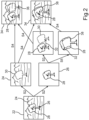
- a virtual environment 22 is outlined, which is displayed using the VR glasses 12 .
- the virtual environment 22 is stored in the control device 18 on the basis of predefined image data.
- the virtual environment 22 shows a landscape in the background 24 of which a mountain range can be seen, whereas in a foreground 26 of the virtual environment 22 a tree 28 can be seen as an object 28 positioned there.
- the image data describing the virtual environment 22 is divided into a background image data set, which characterizes the background 24 of the virtual environment 22, and at least one foreground image data set, which characterizes at least the one tree 28 positioned in the foreground 26 of the virtual environment 22.
- This division takes place using an image processing criterion on the image data describing the virtual environment 22 .
- image processing criterion for example, classic methods of digital image processing are used, so that, for example, using an edge filter and/or a sharpness criterion, the tree 28 as the object 28 is in the foreground 26 from the background 24 can be distinguished.
- an image gap 30 in the background 24 since the tree 28, which is now only described by the foreground image data set, has been cut out of the background image data set.
- a next step S3 the detected movement data of the vehicle 14 is evaluated to determine a lateral offset 32 between the tree 28 positioned in the foreground 26 of the virtual environment 22 and the background 24.
- the lateral offset 32 is shown in the form of an arrow.
- the original position of the tree, where the image gap 30 is in the background image data set, is also sketched with dashed lines.
- processed image data are then determined which describe a processed virtual environment 34 in which the tree 28 in the foreground 26 is shifted relative to the background 24 according to the determined lateral offset 32 .
- the virtual environment 34 described by the processed image data is then displayed on the VR glasses 12 for the wearer 16 .
- the lateral offset 32 ensures that due to the relative displacement of the tree 28 in the foreground 26 to the background 24 of the virtual environment 22 for the wearer 16 of the VR glasses 12, a risk of kinetosis is reduced in such a way that a probability value for a probability of kinetosis for the carrier 16 is below a predetermined minimum probability value.
- the risk of contracting motion sickness so-called motion sickness, is significantly reduced for the wearer 16 of the VR glasses 12 despite a movement of the vehicle 14 according to the movement data.
- the image gap 30 arises in the processed virtual environment 34 due to the displacement of the tree 28 in the foreground 26 according to the determined lateral offset 32
- the image gap 30 is filled in using an image gap filling criterion on the processed image data with a virtual image filling content 36 in the edited virtual environment 34 closed.
- This image filling content 36 can be generated artificially using a color value in the vicinity of the image gap 30, for example. If, for example, there is a virtual light green meadow around the virtual tree 28, a corresponding image filling content 36 in the same color as this virtual meadow can ensure that the image gap 30 can no longer be seen by the wearer 16 of the VR glasses 12.
- the tree 28 in the foreground 26 can also be enlarged with a predetermined magnification factor, so that an enlarged tree 38 can be seen in the foreground 26.
- the augmented tree 38 is shifted relative to the background 24 . This is evident here from the differences between the original tree 28 shown in dashed lines and the augmented tree 38 shown larger and drawn in solid line in the edited virtual environment 34 .
- Such a step ie initially enlarging the tree 28 by the predetermined enlargement factor, takes place in a step S5, whereupon the virtual environment 34 is determined in a step analogous to step S4.
- the lateral offset 32 can be non-linearly correlated with the steering angle of the vehicle 14 covered by the movement data.
- the shifting according to the lateral offset 32 can take place with a weakened movement, which ultimately merely indicates the change in acceleration of the vehicle 14 experienced by the carrier 16 .
- a rotation angle of the tree 28 in the foreground 26 relative to the background 24 can also be determined on the basis of the recorded movement data.
- right-hand cornering of the vehicle 14 can be particularly emphasized, for example, by the tree 28 not only being shifted laterally to the left, as here in the example in the viewing direction of the carrier 16, but also being rotated slightly counterclockwise (with an axis of rotation parallel to the viewing direction).
- a rotation by an angle between 0 degrees and 90 degrees is possible.
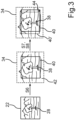
- step S1 the virtual environment 22 is enlarged by a predetermined magnification factor, so that an edge area 42 is formed in a display area 40 of the VR glasses 12, with parts of the enlarged virtual environment 38 still lying in this edge area 42.
- the edge area 42 is no longer displayed on the VR glasses 12 .
- the enlargement of the virtual environment 22 to the enlarged virtual environment 38 takes place in a step S6.
- the display area 40 comprises a partial area of a field of view of the wearer 16 of the VR glasses 12.
- the display area 40 with the virtual landscape displayed on it is located as a screen in the direct field of view of the wearer 16 of the VR glasses 12, with a surrounding the display area 40 around arranged visual edge area is displayed black and without virtual content displayed there for the wearer 16.
- the visual edge area is here around the edge of the display area 40 drawn with a solid line and covers the respective content delimited by a dashed and/or dotted line, since the corresponding content outside of the display area 40 is not visible to the wearer 16 of the VR glasses 12 is displayed.
- a video displayed on the display area 40 and/or a comic displayed there is suitable as a virtual environment.
- a next step S7 the recorded movement data is evaluated to determine a movement trajectory 44 for at least one area of the enlarged virtual environment 38 located in the display area 40.
- processed image data are determined that describe a processed virtual environment 34 , in which the enlarged virtual environment 38 according to the movement trajectory 44 is moved.
- the processed virtual environment 34 described by the processed image data is displayed on the VR glasses 12 .
- the distance covered according to the determined movement trajectory 44 and the steering angle of the vehicle 14 covered by the movement data can be non-linearly correlated with one another.
- the edited virtual environment 34 also always fills the entire display area 40.
- the originally displayed display area 40 is marked with a dotted line, whereas the edited virtual environment 34 displayed is shown within the dashed edge area and thus as display area 40'.
- glasses movement data of VR glasses 12 can also be present as movement data, which are provided by a corresponding sensor device of VR glasses 12, the detection unit of the VR glasses.
- the examples show a reduction in the risk of kinetosis in a VR system 10.
- mixed reality glasses ie a so-called MR system.
Landscapes
- Engineering & Computer Science (AREA)
- Chemical & Material Sciences (AREA)
- Combustion & Propulsion (AREA)
- Transportation (AREA)
- Mechanical Engineering (AREA)
- Physics & Mathematics (AREA)
- General Physics & Mathematics (AREA)
- Optics & Photonics (AREA)
- Processing Or Creating Images (AREA)
- Controls And Circuits For Display Device (AREA)
Claims (9)
- Procédé pour faire fonctionner des lunettes de réalité virtuelle (12) dans un véhicule (14), dans lequel un environnement virtuel (22) décrit par des données d'image prédéfinies est affiché au moyen des lunettes de réalité virtuelle (12), le procédé comprenant les étapes suivantes pour un dispositif de commande (18) des lunettes de réalité virtuelle (12) :- recevoir (S1) des données de mouvement décrivant un mouvement de véhicule du véhicule (14) acquises au moyen d'un dispositif d'acquisition (20) du véhicule (14) ;- diviser (S2) les données d'image décrivant l'environnement virtuel (22) en un ensemble de données d'image d'arrière-plan qui caractérise un arrière-plan (24) de l'environnement virtuel (22), et au moins un ensemble de données d'image de premier plan qui caractérise au moins un objet (28) positionné au premier plan (28) de l'environnement virtuel (22), en appliquant un critère de traitement d'image aux données d'image décrivant l'environnement virtuel (22) ;- évaluer (S3) les données de mouvement acquises pour déterminer un décalage latéral (32) entre une position du au moins un objet (28) positionné au premier plan (26) de l'environnement virtuel (22) et l'arrière-plan (24) ;- déterminer (S4) des données d'image traitées qui décrivent un environnement virtuel traité (34), dans lequel le au moins un objet (28) est déplacé au premier plan (26) par rapport à l'arrière-plan (24) en fonction du décalage latéral (32) déterminé ;- afficher l'environnement virtuel traité (34) décrit par les données d'image traitées sur les lunettes de réalité virtuelle (12).
- Procédé selon la revendication précédente, dans lequel le décalage latéral déterminé (22) et un angle de braquage du véhicule (14) inclus dans les données de mouvement sont corrélés l'un avec l'autre de façon non linéaire.
- Procédé selon l'une des revendications précédentes, dans lequel le au moins un objet (28) positionné au premier plan (26) de l'environnement virtuel (22) est agrandi (S5) d'un facteur de grossissement prédéfini et le au moins un objet (38) agrandi par rapport à l'arrière-plan (24) est déplacé (S4) dans l'environnement virtuel traité (34).
- Procédé selon l'une des revendications précédentes, dans lequel, si un vide d'image (30) apparaît dans l'environnement virtuel traité (34) en raison du déplacement du au moins un objet (28) au premier plan (26) en fonction du décalage latéral (32) déterminé, le vide d'image (30) est comblé en appliquant un critère de remplissage de vide d'image aux données d'image traitées avec un contenu de remplissage d'image virtuel (36) dans l'environnement virtuel traité (34).
- Procédé selon l'une des revendications précédentes, dans lequel les données de mouvement acquises sont évaluées pour déterminer un angle de rotation du au moins un objet (28) positionné au premier plan (26) de l'environnement virtuel (22) par rapport à l'arrière-plan (24) et des données d'image traitées décrivant l'environnement virtuel traité (34) sont déterminées, environnement dans lequel le au moins un objet (28) est déplacé au premier plan (26) par rapport à l'arrière-plan (24) en fonction du décalage latéral (32) déterminé et tourné en fonction de l'angle de rotation déterminé.
- Procédé pour faire fonctionner des lunettes de réalité virtuelle (12) dans un véhicule (14), dans lequel un environnement virtuel (22) décrit par des données d'image prédéfinies est affiché au moyen des lunettes de réalité virtuelle (12), le procédé comprenant les étapes suivantes pour un dispositif de commande (18) des lunettes de réalité virtuelle (12) :- recevoir (S1) des données de mouvement décrivant un mouvement de véhicule du véhicule (14) acquises au moyen d'un dispositif d'acquisition (20) du véhicule (14) ;- agrandir (S6) l'environnement virtuel (22) d'un facteur de grossissement prédéfini, de telle sorte qu'une zone de bord (42) de l'environnement virtuel (22) se situe à l'extérieur d'une zone d'affichage (40) affichée sur les lunettes de lunettes de réalité virtuelle (12), la zone d'affichage (40) comprenant au moins une zone partielle d'un champ de vision d'un porteur (16) des lunettes de réalité virtuelle (12) ;- évaluer (S7) les données de mouvement acquises pour déterminer une trajectoire de mouvement (24) pour au moins une zone située dans la zone d'affichage (40) affichée de l'environnement virtuel agrandi (22) ;- déterminer des données d'image traitées décrivant un environnement virtuel traité (34), dans lequel l'environnement virtuel agrandi (38) est déplacé (S8) en fonction de la trajectoire de mouvement (44) ;- afficher l'environnement virtuel traité (34) décrit par les données d'image traitées sur les lunettes de réalité virtuelle (12),caractérisé en ce que
une distance parcourue par la zone située dans la zone d'affichage (40) affichée de l'environnement virtuel agrandi (38) en fonction de la trajectoire de mouvement (44) déterminée et un angle de braquage inclus dans les données de mouvement du véhicule (14) sont corrélés l'un avec l'autre de façon non linéaire. - Procédé selon la revendication 6, dans lequel lors de l'affichage de l'environnement virtuel traité (34) décrit par les données d'image traitées sur les lunettes de réalité virtuelle (12), l'environnement virtuel traité (34) remplit toujours la totalité de la zone d'affichage (40).
- Procédé selon l'une des revendications précédentes, dans lequel les lunettes de réalité virtuelle (12) comprennent une unité d'acquisition et le dispositif de commande (18) considère des données de mouvement de lunettes décrivant un mouvement des lunettes de réalité virtuelle (12) et acquises au moyen de l'unité d'acquisition, comme des données de mouvement.
- Système de réalité virtuelle (10), comprenant des lunettes de réalité virtuelle (12) et un véhicule (14), le système de réalité virtuelle (10) étant configuré pour mettre en oeuvre un procédé selon l'une des revendications 1 à 5 et/ou un procédé selon l'une des revendications 6 à 8.
Applications Claiming Priority (2)
| Application Number | Priority Date | Filing Date | Title |
|---|---|---|---|
| DE102019124386.6A DE102019124386A1 (de) | 2019-09-11 | 2019-09-11 | Verfahren zum Betreiben einer Virtual-Reality-Brille in einem Fahrzeug sowie Virtual-Reality-System mit einer Virtual-Reality-Brille und einem Fahrzeug |
| PCT/EP2020/069769 WO2021047805A1 (fr) | 2019-09-11 | 2020-07-13 | Procédé de fonctionnement de lunettes de réalité virtuelle dans un véhicule et système de réalité virtuelle avec des lunettes de réalité virtuelle et un véhicule |
Publications (2)
| Publication Number | Publication Date |
|---|---|
| EP4028276A1 EP4028276A1 (fr) | 2022-07-20 |
| EP4028276B1 true EP4028276B1 (fr) | 2023-09-06 |
Family
ID=71614898
Family Applications (1)
| Application Number | Title | Priority Date | Filing Date |
|---|---|---|---|
| EP20740303.1A Active EP4028276B1 (fr) | 2019-09-11 | 2020-07-13 | Procédé de fonctionnement de lunettes de réalité virtuelle dans un véhicule et système de réalité virtuelle avec des lunettes de réalité virtuelle et un véhicule |
Country Status (5)
| Country | Link |
|---|---|
| US (2) | US12013534B2 (fr) |
| EP (1) | EP4028276B1 (fr) |
| CN (1) | CN114364563B (fr) |
| DE (1) | DE102019124386A1 (fr) |
| WO (1) | WO2021047805A1 (fr) |
Families Citing this family (5)
| Publication number | Priority date | Publication date | Assignee | Title |
|---|---|---|---|---|
| DE102019124386A1 (de) | 2019-09-11 | 2021-03-11 | Audi Ag | Verfahren zum Betreiben einer Virtual-Reality-Brille in einem Fahrzeug sowie Virtual-Reality-System mit einer Virtual-Reality-Brille und einem Fahrzeug |
| DE102021117327A1 (de) * | 2021-07-05 | 2023-01-05 | Ford Global Technologies, Llc | Verfahren zum Betrieb eines Kraftfahrzeugs |
| WO2023126669A1 (fr) * | 2021-12-29 | 2023-07-06 | Bosch Car Multimedia Portugal S.A | Dispositif et procédé d'affichage d'un flux visuel permettant d'empêcher le mal des transports sur des véhicules autonomes |
| DE102024200647A1 (de) * | 2024-01-25 | 2025-07-31 | ZF Mobility Solutions GmbH | Reduzierung von Kinetose bei einem Passagier in einem autonom fahrenden Fahrzeug |
| US20260122204A1 (en) * | 2024-10-28 | 2026-04-30 | GM Global Technology Operations LLC | See through viewing system for vehicle |
Family Cites Families (20)
| Publication number | Priority date | Publication date | Assignee | Title |
|---|---|---|---|---|
| WO1998048145A1 (fr) | 1997-04-23 | 1998-10-29 | Retreivable Information Systems L.L.C. | Systeme de surveillance de production multizone |
| US7092003B1 (en) | 1999-01-21 | 2006-08-15 | Mel Siegel | 3-D imaging arrangements |
| US7722526B2 (en) | 2004-07-16 | 2010-05-25 | Samuel Kim | System, method and apparatus for preventing motion sickness |
| WO2007086431A1 (fr) | 2006-01-25 | 2007-08-02 | Matsushita Electric Industrial Co., Ltd. | Affichage vidéo |
| JPWO2014077046A1 (ja) * | 2012-11-13 | 2017-01-05 | ソニー株式会社 | 画像表示装置及び画像表示方法、移動体装置、画像表示システム、並びにコンピューター・プログラム |
| US9547173B2 (en) | 2013-10-03 | 2017-01-17 | Honda Motor Co., Ltd. | System and method for dynamic in-vehicle virtual reality |
| DE102013016921A1 (de) | 2013-10-11 | 2015-04-16 | Oliver Bunsen | Bildanzeigesystem und -verfahren zur bewegungssynchronen Bildanzeige in einem Transportmittel |
| US9979952B2 (en) * | 2013-12-13 | 2018-05-22 | Htc Corporation | Method of creating a parallax video from a still image |
| DE102015003882A1 (de) | 2015-03-26 | 2016-09-29 | Audi Ag | Verfahren zum Betreiben einer in einem Kraftfahrzeug angeordneten Virtual-Reality-Brille und Virtual-Reality-System |
| US10294979B2 (en) | 2015-10-23 | 2019-05-21 | Ts Tech Co., Ltd. | Vehicle seat |
| DE102016120430A1 (de) * | 2015-10-26 | 2017-04-27 | Active Knowledge Ltd. | Bewegliche, innere stoßdämpfende Polsterung zur Energiedissipation in einem autonomen Fahrzeug |
| WO2017142009A1 (fr) * | 2016-02-18 | 2017-08-24 | 国立大学法人名古屋大学 | Système d'affichage d'espace virtuel |
| US9902403B2 (en) | 2016-03-03 | 2018-02-27 | Uber Technologies, Inc. | Sensory stimulation for an autonomous vehicle |
| CN107462989A (zh) * | 2016-06-06 | 2017-12-12 | 华硕电脑股份有限公司 | 影像稳定方法与电子装置 |
| WO2017213218A1 (fr) * | 2016-06-10 | 2017-12-14 | 株式会社コロプラ | Procédé destiné à fournir un espace virtuel, programme destiné à amener un ordinateur à mettre en œuvre ledit procédé, et système destiné à fournir un espace virtuel |
| DE102016212687A1 (de) | 2016-07-12 | 2018-01-18 | Audi Ag | Verfahren zum Betreiben einer Anzeigeeinrichtung eines Kraftfahrzeugs |
| US10643391B2 (en) | 2016-09-23 | 2020-05-05 | Apple Inc. | Immersive virtual display |
| JP2019152980A (ja) | 2018-03-01 | 2019-09-12 | キヤノン株式会社 | 画像処理装置、画像処理方法、及びプログラム |
| KR101971937B1 (ko) * | 2018-11-08 | 2019-04-24 | 주식회사 휴메닉 | 고령자를 위한 혼합현실 기반 인지훈련 시스템 및 방법 |
| DE102019124386A1 (de) | 2019-09-11 | 2021-03-11 | Audi Ag | Verfahren zum Betreiben einer Virtual-Reality-Brille in einem Fahrzeug sowie Virtual-Reality-System mit einer Virtual-Reality-Brille und einem Fahrzeug |
-
2019
- 2019-09-11 DE DE102019124386.6A patent/DE102019124386A1/de not_active Withdrawn
-
2020
- 2020-07-13 WO PCT/EP2020/069769 patent/WO2021047805A1/fr not_active Ceased
- 2020-07-13 EP EP20740303.1A patent/EP4028276B1/fr active Active
- 2020-07-13 US US17/642,127 patent/US12013534B2/en active Active
- 2020-07-13 CN CN202080063218.5A patent/CN114364563B/zh active Active
-
2024
- 2024-05-09 US US18/659,166 patent/US12429693B2/en active Active
Also Published As
| Publication number | Publication date |
|---|---|
| US12013534B2 (en) | 2024-06-18 |
| US20220382050A1 (en) | 2022-12-01 |
| CN114364563A (zh) | 2022-04-15 |
| US12429693B2 (en) | 2025-09-30 |
| US20240288691A1 (en) | 2024-08-29 |
| DE102019124386A1 (de) | 2021-03-11 |
| EP4028276A1 (fr) | 2022-07-20 |
| CN114364563B (zh) | 2024-10-18 |
| WO2021047805A1 (fr) | 2021-03-18 |
Similar Documents
| Publication | Publication Date | Title |
|---|---|---|
| EP4028276B1 (fr) | Procédé de fonctionnement de lunettes de réalité virtuelle dans un véhicule et système de réalité virtuelle avec des lunettes de réalité virtuelle et un véhicule | |
| DE102018213588B4 (de) | Steuervorrichtung und Verfahren zum Reduzieren von Bewegungskrankheit eines Benutzers beim Betrachten eines Medieninhalts mittels einer Datenbrille während einer Fahrt in einem Kraftfahrzeug | |
| DE102016216601B4 (de) | Verfahren zum Unterstützen eines Fahrers eines Kraftfahrzeugs beim Fahren auf einer Rennstrecke, Kraftfahrzeug und Computerprogrammprodukt | |
| EP3978294B1 (fr) | Dispositif d'affichage tête haute et procédé de fonctionnement d'un dispositif d'affichage tête haute | |
| DE102015109027A1 (de) | Head-Up Display mit situationsbasierter Anpassung der Darstellung von virtuellen Bildinhalten | |
| DE102017211748B4 (de) | Verfahren zum Betreiben einer Ausgabeeinrichtung eines Kraftfahrzeugs, Fahrerassistenzeinrichtung, und Kraftfahrzeug | |
| DE102015003882A1 (de) | Verfahren zum Betreiben einer in einem Kraftfahrzeug angeordneten Virtual-Reality-Brille und Virtual-Reality-System | |
| EP3292535B1 (fr) | Procédé de production d'une image complète d'un environnement d'un véhicule et d'un dispositif correspondant | |
| WO2017178360A1 (fr) | Procédé et dispositif de génération d'un signal d'image et système d'affichage pour véhicule | |
| EP3959560B1 (fr) | Procédé de commande de la luminosité d'une image projetée par un dispositif d'imagerie d'un affichage tête haute se trouvant dans un véhicule automobile | |
| EP3296795B1 (fr) | Procédé d'affichage d'un objet image dans un véhicule sur des affichages perçus intérieur et extérieur du véhicule | |
| WO2016165799A1 (fr) | Procédé pour faire fonctionner des lunettes de réalité virtuelle et système équipé de lunettes de réalité virtuelle | |
| DE102014009299A1 (de) | Verfahren zum Betreiben einer Virtual-Reality-Brille und System mit einer Virtual-Reality-Brille | |
| EP3610643A1 (fr) | Système de vue panoramique pour un véhicule | |
| DE102014009301B4 (de) | Verfahren zum Betreiben einer Virtual-Reality-Brille und System mit einer Virtual-Reality-Brille | |
| EP4499455A1 (fr) | Détection de l'environnement et guidage téléguidé d'un véhicule ego | |
| DE102021131157A1 (de) | Verfahren zur Darstellung eines virtuellen Objekts in einer erweiterten Realität in einem Kraftfahrzeug | |
| DE102023125517A1 (de) | Verfahren für ein Kraftfahrzeug bei Kinetose eines Nutzers des Kraftfahrzeugs, Computerprogramm und/oder computerlesbares Medium, Datenverarbeitungsvorrichtung, Kraftfahrzeug | |
| EP2804785A1 (fr) | Système d'affichage destiné à un véhicule | |
| DE102020201519B4 (de) | Verfahren und Vorrichtung zum Betreiben einer visuellen Schnittstelle zwischen einem Fahrzeug und einem Fahrzeuginsassen | |
| DE102025107896A1 (de) | Anzeigesteuerungsvorrichtung, Anzeigesteuerungsverfahren und Speichermedium | |
| WO2019086222A1 (fr) | Procédé et dispositif pour utiliser un dispositif de réalité virtuelle | |
| DE102023208023A1 (de) | Erhöhte Immersion bei teleoperierter Steuerung von Kraftfahrzeugen | |
| DE102025150642A1 (de) | Verfahren, Fahrzeug und mobiles Endgerät sowie Medium | |
| DE102023105653A1 (de) | Fortbewegungsmittel, Fahrerassistenzsystem und Verfahren zur Information eines Anwenders eines Fortbewegungsmittels |
Legal Events
| Date | Code | Title | Description |
|---|---|---|---|
| STAA | Information on the status of an ep patent application or granted ep patent |
Free format text: STATUS: UNKNOWN |
|
| STAA | Information on the status of an ep patent application or granted ep patent |
Free format text: STATUS: THE INTERNATIONAL PUBLICATION HAS BEEN MADE |
|
| PUAI | Public reference made under article 153(3) epc to a published international application that has entered the european phase |
Free format text: ORIGINAL CODE: 0009012 |
|
| STAA | Information on the status of an ep patent application or granted ep patent |
Free format text: STATUS: REQUEST FOR EXAMINATION WAS MADE |
|
| 17P | Request for examination filed |
Effective date: 20220411 |
|
| AK | Designated contracting states |
Kind code of ref document: A1 Designated state(s): AL AT BE BG CH CY CZ DE DK EE ES FI FR GB GR HR HU IE IS IT LI LT LU LV MC MK MT NL NO PL PT RO RS SE SI SK SM TR |
|
| DAV | Request for validation of the european patent (deleted) | ||
| DAX | Request for extension of the european patent (deleted) | ||
| GRAP | Despatch of communication of intention to grant a patent |
Free format text: ORIGINAL CODE: EPIDOSNIGR1 |
|
| STAA | Information on the status of an ep patent application or granted ep patent |
Free format text: STATUS: GRANT OF PATENT IS INTENDED |
|
| INTG | Intention to grant announced |
Effective date: 20230417 |
|
| P01 | Opt-out of the competence of the unified patent court (upc) registered |
Effective date: 20230529 |
|
| GRAS | Grant fee paid |
Free format text: ORIGINAL CODE: EPIDOSNIGR3 |
|
| GRAA | (expected) grant |
Free format text: ORIGINAL CODE: 0009210 |
|
| STAA | Information on the status of an ep patent application or granted ep patent |
Free format text: STATUS: THE PATENT HAS BEEN GRANTED |
|
| AK | Designated contracting states |
Kind code of ref document: B1 Designated state(s): AL AT BE BG CH CY CZ DE DK EE ES FI FR GB GR HR HU IE IS IT LI LT LU LV MC MK MT NL NO PL PT RO RS SE SI SK SM TR |
|
| REG | Reference to a national code |
Ref country code: GB Ref legal event code: FG4D Free format text: NOT ENGLISH |
|
| REG | Reference to a national code |
Ref country code: CH Ref legal event code: EP |
|
| REG | Reference to a national code |
Ref country code: IE Ref legal event code: FG4D Free format text: LANGUAGE OF EP DOCUMENT: GERMAN |
|
| REG | Reference to a national code |
Ref country code: DE Ref legal event code: R096 Ref document number: 502020005149 Country of ref document: DE |
|
| REG | Reference to a national code |
Ref country code: LT Ref legal event code: MG9D |
|
| REG | Reference to a national code |
Ref country code: NL Ref legal event code: MP Effective date: 20230906 |
|
| PG25 | Lapsed in a contracting state [announced via postgrant information from national office to epo] |
Ref country code: GR Free format text: LAPSE BECAUSE OF FAILURE TO SUBMIT A TRANSLATION OF THE DESCRIPTION OR TO PAY THE FEE WITHIN THE PRESCRIBED TIME-LIMIT Effective date: 20231207 |
|
| PG25 | Lapsed in a contracting state [announced via postgrant information from national office to epo] |
Ref country code: SE Free format text: LAPSE BECAUSE OF FAILURE TO SUBMIT A TRANSLATION OF THE DESCRIPTION OR TO PAY THE FEE WITHIN THE PRESCRIBED TIME-LIMIT Effective date: 20230906 Ref country code: RS Free format text: LAPSE BECAUSE OF FAILURE TO SUBMIT A TRANSLATION OF THE DESCRIPTION OR TO PAY THE FEE WITHIN THE PRESCRIBED TIME-LIMIT Effective date: 20230906 Ref country code: NO Free format text: LAPSE BECAUSE OF FAILURE TO SUBMIT A TRANSLATION OF THE DESCRIPTION OR TO PAY THE FEE WITHIN THE PRESCRIBED TIME-LIMIT Effective date: 20231206 Ref country code: LV Free format text: LAPSE BECAUSE OF FAILURE TO SUBMIT A TRANSLATION OF THE DESCRIPTION OR TO PAY THE FEE WITHIN THE PRESCRIBED TIME-LIMIT Effective date: 20230906 Ref country code: LT Free format text: LAPSE BECAUSE OF FAILURE TO SUBMIT A TRANSLATION OF THE DESCRIPTION OR TO PAY THE FEE WITHIN THE PRESCRIBED TIME-LIMIT Effective date: 20230906 Ref country code: HR Free format text: LAPSE BECAUSE OF FAILURE TO SUBMIT A TRANSLATION OF THE DESCRIPTION OR TO PAY THE FEE WITHIN THE PRESCRIBED TIME-LIMIT Effective date: 20230906 Ref country code: GR Free format text: LAPSE BECAUSE OF FAILURE TO SUBMIT A TRANSLATION OF THE DESCRIPTION OR TO PAY THE FEE WITHIN THE PRESCRIBED TIME-LIMIT Effective date: 20231207 Ref country code: FI Free format text: LAPSE BECAUSE OF FAILURE TO SUBMIT A TRANSLATION OF THE DESCRIPTION OR TO PAY THE FEE WITHIN THE PRESCRIBED TIME-LIMIT Effective date: 20230906 |
|
| PG25 | Lapsed in a contracting state [announced via postgrant information from national office to epo] |
Ref country code: NL Free format text: LAPSE BECAUSE OF FAILURE TO SUBMIT A TRANSLATION OF THE DESCRIPTION OR TO PAY THE FEE WITHIN THE PRESCRIBED TIME-LIMIT Effective date: 20230906 |
|
| PG25 | Lapsed in a contracting state [announced via postgrant information from national office to epo] |
Ref country code: IS Free format text: LAPSE BECAUSE OF FAILURE TO SUBMIT A TRANSLATION OF THE DESCRIPTION OR TO PAY THE FEE WITHIN THE PRESCRIBED TIME-LIMIT Effective date: 20240106 |
|
| PG25 | Lapsed in a contracting state [announced via postgrant information from national office to epo] |
Ref country code: ES Free format text: LAPSE BECAUSE OF FAILURE TO SUBMIT A TRANSLATION OF THE DESCRIPTION OR TO PAY THE FEE WITHIN THE PRESCRIBED TIME-LIMIT Effective date: 20230906 |
|
| PG25 | Lapsed in a contracting state [announced via postgrant information from national office to epo] |
Ref country code: SM Free format text: LAPSE BECAUSE OF FAILURE TO SUBMIT A TRANSLATION OF THE DESCRIPTION OR TO PAY THE FEE WITHIN THE PRESCRIBED TIME-LIMIT Effective date: 20230906 Ref country code: RO Free format text: LAPSE BECAUSE OF FAILURE TO SUBMIT A TRANSLATION OF THE DESCRIPTION OR TO PAY THE FEE WITHIN THE PRESCRIBED TIME-LIMIT Effective date: 20230906 Ref country code: IS Free format text: LAPSE BECAUSE OF FAILURE TO SUBMIT A TRANSLATION OF THE DESCRIPTION OR TO PAY THE FEE WITHIN THE PRESCRIBED TIME-LIMIT Effective date: 20240106 Ref country code: ES Free format text: LAPSE BECAUSE OF FAILURE TO SUBMIT A TRANSLATION OF THE DESCRIPTION OR TO PAY THE FEE WITHIN THE PRESCRIBED TIME-LIMIT Effective date: 20230906 Ref country code: EE Free format text: LAPSE BECAUSE OF FAILURE TO SUBMIT A TRANSLATION OF THE DESCRIPTION OR TO PAY THE FEE WITHIN THE PRESCRIBED TIME-LIMIT Effective date: 20230906 Ref country code: CZ Free format text: LAPSE BECAUSE OF FAILURE TO SUBMIT A TRANSLATION OF THE DESCRIPTION OR TO PAY THE FEE WITHIN THE PRESCRIBED TIME-LIMIT Effective date: 20230906 Ref country code: SK Free format text: LAPSE BECAUSE OF FAILURE TO SUBMIT A TRANSLATION OF THE DESCRIPTION OR TO PAY THE FEE WITHIN THE PRESCRIBED TIME-LIMIT Effective date: 20230906 Ref country code: PT Free format text: LAPSE BECAUSE OF FAILURE TO SUBMIT A TRANSLATION OF THE DESCRIPTION OR TO PAY THE FEE WITHIN THE PRESCRIBED TIME-LIMIT Effective date: 20240108 |
|
| PG25 | Lapsed in a contracting state [announced via postgrant information from national office to epo] |
Ref country code: PL Free format text: LAPSE BECAUSE OF FAILURE TO SUBMIT A TRANSLATION OF THE DESCRIPTION OR TO PAY THE FEE WITHIN THE PRESCRIBED TIME-LIMIT Effective date: 20230906 Ref country code: IT Free format text: LAPSE BECAUSE OF FAILURE TO SUBMIT A TRANSLATION OF THE DESCRIPTION OR TO PAY THE FEE WITHIN THE PRESCRIBED TIME-LIMIT Effective date: 20230906 |
|
| REG | Reference to a national code |
Ref country code: DE Ref legal event code: R097 Ref document number: 502020005149 Country of ref document: DE |
|
| PG25 | Lapsed in a contracting state [announced via postgrant information from national office to epo] |
Ref country code: DK Free format text: LAPSE BECAUSE OF FAILURE TO SUBMIT A TRANSLATION OF THE DESCRIPTION OR TO PAY THE FEE WITHIN THE PRESCRIBED TIME-LIMIT Effective date: 20230906 |
|
| PLBE | No opposition filed within time limit |
Free format text: ORIGINAL CODE: 0009261 |
|
| STAA | Information on the status of an ep patent application or granted ep patent |
Free format text: STATUS: NO OPPOSITION FILED WITHIN TIME LIMIT |
|
| PG25 | Lapsed in a contracting state [announced via postgrant information from national office to epo] |
Ref country code: DK Free format text: LAPSE BECAUSE OF FAILURE TO SUBMIT A TRANSLATION OF THE DESCRIPTION OR TO PAY THE FEE WITHIN THE PRESCRIBED TIME-LIMIT Effective date: 20230906 Ref country code: SI Free format text: LAPSE BECAUSE OF FAILURE TO SUBMIT A TRANSLATION OF THE DESCRIPTION OR TO PAY THE FEE WITHIN THE PRESCRIBED TIME-LIMIT Effective date: 20230906 |
|
| 26N | No opposition filed |
Effective date: 20240607 |
|
| PG25 | Lapsed in a contracting state [announced via postgrant information from national office to epo] |
Ref country code: BG Free format text: LAPSE BECAUSE OF FAILURE TO SUBMIT A TRANSLATION OF THE DESCRIPTION OR TO PAY THE FEE WITHIN THE PRESCRIBED TIME-LIMIT Effective date: 20230906 |
|
| PG25 | Lapsed in a contracting state [announced via postgrant information from national office to epo] |
Ref country code: BG Free format text: LAPSE BECAUSE OF FAILURE TO SUBMIT A TRANSLATION OF THE DESCRIPTION OR TO PAY THE FEE WITHIN THE PRESCRIBED TIME-LIMIT Effective date: 20230906 |
|
| PG25 | Lapsed in a contracting state [announced via postgrant information from national office to epo] |
Ref country code: MC Free format text: LAPSE BECAUSE OF FAILURE TO SUBMIT A TRANSLATION OF THE DESCRIPTION OR TO PAY THE FEE WITHIN THE PRESCRIBED TIME-LIMIT Effective date: 20230906 |
|
| REG | Reference to a national code |
Ref country code: CH Ref legal event code: PL |
|
| PG25 | Lapsed in a contracting state [announced via postgrant information from national office to epo] |
Ref country code: LU Free format text: LAPSE BECAUSE OF NON-PAYMENT OF DUE FEES Effective date: 20240713 |
|
| PG25 | Lapsed in a contracting state [announced via postgrant information from national office to epo] |
Ref country code: LU Free format text: LAPSE BECAUSE OF NON-PAYMENT OF DUE FEES Effective date: 20240713 |
|
| PG25 | Lapsed in a contracting state [announced via postgrant information from national office to epo] |
Ref country code: BE Free format text: LAPSE BECAUSE OF NON-PAYMENT OF DUE FEES Effective date: 20240731 Ref country code: CH Free format text: LAPSE BECAUSE OF NON-PAYMENT OF DUE FEES Effective date: 20240731 |
|
| REG | Reference to a national code |
Ref country code: BE Ref legal event code: MM Effective date: 20240731 |
|
| PG25 | Lapsed in a contracting state [announced via postgrant information from national office to epo] |
Ref country code: IE Free format text: LAPSE BECAUSE OF NON-PAYMENT OF DUE FEES Effective date: 20240713 |
|
| PGFP | Annual fee paid to national office [announced via postgrant information from national office to epo] |
Ref country code: DE Payment date: 20250731 Year of fee payment: 6 |
|
| PGFP | Annual fee paid to national office [announced via postgrant information from national office to epo] |
Ref country code: GB Payment date: 20250725 Year of fee payment: 6 |
|
| PGFP | Annual fee paid to national office [announced via postgrant information from national office to epo] |
Ref country code: FR Payment date: 20250729 Year of fee payment: 6 Ref country code: AT Payment date: 20251020 Year of fee payment: 5 |
|
| PG25 | Lapsed in a contracting state [announced via postgrant information from national office to epo] |
Ref country code: CY Free format text: LAPSE BECAUSE OF FAILURE TO SUBMIT A TRANSLATION OF THE DESCRIPTION OR TO PAY THE FEE WITHIN THE PRESCRIBED TIME-LIMIT; INVALID AB INITIO Effective date: 20200713 |
|
| PG25 | Lapsed in a contracting state [announced via postgrant information from national office to epo] |
Ref country code: HU Free format text: LAPSE BECAUSE OF FAILURE TO SUBMIT A TRANSLATION OF THE DESCRIPTION OR TO PAY THE FEE WITHIN THE PRESCRIBED TIME-LIMIT; INVALID AB INITIO Effective date: 20200713 |