EP4030671B1 - Kommunikationsverfahren und -vorrichtung - Google Patents
Kommunikationsverfahren und -vorrichtung Download PDFInfo
- Publication number
- EP4030671B1 EP4030671B1 EP20874241.1A EP20874241A EP4030671B1 EP 4030671 B1 EP4030671 B1 EP 4030671B1 EP 20874241 A EP20874241 A EP 20874241A EP 4030671 B1 EP4030671 B1 EP 4030671B1
- Authority
- EP
- European Patent Office
- Prior art keywords
- psfch resources
- psfch
- transmit power
- resources
- priority
- Prior art date
- Legal status (The legal status is an assumption and is not a legal conclusion. Google has not performed a legal analysis and makes no representation as to the accuracy of the status listed.)
- Active
Links
Images


Classifications
-
- H—ELECTRICITY
- H04—ELECTRIC COMMUNICATION TECHNIQUE
- H04W—WIRELESS COMMUNICATION NETWORKS
- H04W52/00—Power management, e.g. Transmission Power Control [TPC] or power classes
- H04W52/04—Transmission power control [TPC]
- H04W52/38—TPC being performed in particular situations
- H04W52/383—TPC being performed in particular situations power control in peer-to-peer links
-
- H—ELECTRICITY
- H04—ELECTRIC COMMUNICATION TECHNIQUE
- H04W—WIRELESS COMMUNICATION NETWORKS
- H04W72/00—Local resource management
- H04W72/20—Control channels or signalling for resource management
- H04W72/25—Control channels or signalling for resource management between terminals via a wireless link, e.g. sidelink
-
- H—ELECTRICITY
- H04—ELECTRIC COMMUNICATION TECHNIQUE
- H04L—TRANSMISSION OF DIGITAL INFORMATION, e.g. TELEGRAPHIC COMMUNICATION
- H04L5/00—Arrangements affording multiple use of the transmission path
- H04L5/0001—Arrangements for dividing the transmission path
- H04L5/0003—Two-dimensional division
- H04L5/0005—Time-frequency
- H04L5/0007—Time-frequency the frequencies being orthogonal, e.g. OFDM(A) or DMT
- H04L5/001—Time-frequency the frequencies being orthogonal, e.g. OFDM(A) or DMT the frequencies being arranged in component carriers
-
- H—ELECTRICITY
- H04—ELECTRIC COMMUNICATION TECHNIQUE
- H04L—TRANSMISSION OF DIGITAL INFORMATION, e.g. TELEGRAPHIC COMMUNICATION
- H04L5/00—Arrangements affording multiple use of the transmission path
- H04L5/003—Arrangements for allocating sub-channels of the transmission path
- H04L5/0048—Allocation of pilot signals, i.e. of signals known to the receiver
- H04L5/0051—Allocation of pilot signals, i.e. of signals known to the receiver of dedicated pilots, i.e. pilots destined for a single user or terminal
-
- H—ELECTRICITY
- H04—ELECTRIC COMMUNICATION TECHNIQUE
- H04L—TRANSMISSION OF DIGITAL INFORMATION, e.g. TELEGRAPHIC COMMUNICATION
- H04L5/00—Arrangements affording multiple use of the transmission path
- H04L5/003—Arrangements for allocating sub-channels of the transmission path
- H04L5/0053—Allocation of signalling, i.e. of overhead other than pilot signals
- H04L5/0055—Physical resource allocation for ACK/NACK
-
- H—ELECTRICITY
- H04—ELECTRIC COMMUNICATION TECHNIQUE
- H04W—WIRELESS COMMUNICATION NETWORKS
- H04W24/00—Supervisory, monitoring or testing arrangements
- H04W24/08—Testing, supervising or monitoring using real traffic
-
- H—ELECTRICITY
- H04—ELECTRIC COMMUNICATION TECHNIQUE
- H04W—WIRELESS COMMUNICATION NETWORKS
- H04W4/00—Services specially adapted for wireless communication networks; Facilities therefor
- H04W4/30—Services specially adapted for particular environments, situations or purposes
- H04W4/40—Services specially adapted for particular environments, situations or purposes for vehicles, e.g. vehicle-to-pedestrians [V2P]
-
- H—ELECTRICITY
- H04—ELECTRIC COMMUNICATION TECHNIQUE
- H04W—WIRELESS COMMUNICATION NETWORKS
- H04W52/00—Power management, e.g. Transmission Power Control [TPC] or power classes
- H04W52/04—Transmission power control [TPC]
- H04W52/18—TPC being performed according to specific parameters
- H04W52/22—TPC being performed according to specific parameters taking into account previous information or commands
- H04W52/225—Calculation of statistics, e.g. average or variance
-
- H—ELECTRICITY
- H04—ELECTRIC COMMUNICATION TECHNIQUE
- H04W—WIRELESS COMMUNICATION NETWORKS
- H04W52/00—Power management, e.g. Transmission Power Control [TPC] or power classes
- H04W52/04—Transmission power control [TPC]
- H04W52/30—Transmission power control [TPC] using constraints in the total amount of available transmission power
- H04W52/32—TPC of broadcast or control channels
- H04W52/325—Power control of control or pilot channels
-
- H—ELECTRICITY
- H04—ELECTRIC COMMUNICATION TECHNIQUE
- H04W—WIRELESS COMMUNICATION NETWORKS
- H04W52/00—Power management, e.g. Transmission Power Control [TPC] or power classes
- H04W52/04—Transmission power control [TPC]
- H04W52/30—Transmission power control [TPC] using constraints in the total amount of available transmission power
- H04W52/36—Transmission power control [TPC] using constraints in the total amount of available transmission power with a discrete range or set of values, e.g. step size, ramping or offsets
- H04W52/365—Power headroom reporting
-
- H—ELECTRICITY
- H04—ELECTRIC COMMUNICATION TECHNIQUE
- H04W—WIRELESS COMMUNICATION NETWORKS
- H04W52/00—Power management, e.g. Transmission Power Control [TPC] or power classes
- H04W52/04—Transmission power control [TPC]
- H04W52/30—Transmission power control [TPC] using constraints in the total amount of available transmission power
- H04W52/36—Transmission power control [TPC] using constraints in the total amount of available transmission power with a discrete range or set of values, e.g. step size, ramping or offsets
- H04W52/367—Power values between minimum and maximum limits, e.g. dynamic range
-
- H—ELECTRICITY
- H04—ELECTRIC COMMUNICATION TECHNIQUE
- H04W—WIRELESS COMMUNICATION NETWORKS
- H04W72/00—Local resource management
- H04W72/04—Wireless resource allocation
- H04W72/044—Wireless resource allocation based on the type of the allocated resource
- H04W72/0446—Resources in time domain, e.g. slots or frames
-
- H—ELECTRICITY
- H04—ELECTRIC COMMUNICATION TECHNIQUE
- H04W—WIRELESS COMMUNICATION NETWORKS
- H04W72/00—Local resource management
- H04W72/04—Wireless resource allocation
- H04W72/044—Wireless resource allocation based on the type of the allocated resource
- H04W72/0473—Wireless resource allocation based on the type of the allocated resource the resource being transmission power
-
- H—ELECTRICITY
- H04—ELECTRIC COMMUNICATION TECHNIQUE
- H04W—WIRELESS COMMUNICATION NETWORKS
- H04W72/00—Local resource management
- H04W72/12—Wireless traffic scheduling
- H04W72/1263—Mapping of traffic onto schedule, e.g. scheduled allocation or multiplexing of flows
-
- H—ELECTRICITY
- H04—ELECTRIC COMMUNICATION TECHNIQUE
- H04W—WIRELESS COMMUNICATION NETWORKS
- H04W72/00—Local resource management
- H04W72/50—Allocation or scheduling criteria for wireless resources
- H04W72/56—Allocation or scheduling criteria for wireless resources based on priority criteria
-
- H—ELECTRICITY
- H04—ELECTRIC COMMUNICATION TECHNIQUE
- H04W—WIRELESS COMMUNICATION NETWORKS
- H04W92/00—Interfaces specially adapted for wireless communication networks
- H04W92/16—Interfaces between hierarchically similar devices
- H04W92/18—Interfaces between hierarchically similar devices between terminal devices
-
- H—ELECTRICITY
- H04—ELECTRIC COMMUNICATION TECHNIQUE
- H04L—TRANSMISSION OF DIGITAL INFORMATION, e.g. TELEGRAPHIC COMMUNICATION
- H04L5/00—Arrangements affording multiple use of the transmission path
- H04L5/003—Arrangements for allocating sub-channels of the transmission path
- H04L5/0044—Allocation of payload; Allocation of data channels, e.g. PDSCH or PUSCH
-
- H—ELECTRICITY
- H04—ELECTRIC COMMUNICATION TECHNIQUE
- H04W—WIRELESS COMMUNICATION NETWORKS
- H04W72/00—Local resource management
- H04W72/04—Wireless resource allocation
- H04W72/044—Wireless resource allocation based on the type of the allocated resource
Definitions
- This application relates to the field of communications technologies, and in particular, to a communications method and apparatus.
- Vehicle to everything (vehicle to everything, V2X) is a key technology of an intelligent transportation system, and is considered to be one of the fields that have the largest industry potential and clearest market requirements in an internet of things system.
- the vehicle to everything usually refers to a communications network that uses vehicle information provided by a sensor, a vehicle-mounted terminal, and the like that are mounted on a vehicle, to implement vehicle to vehicle (vehicle to vehicle, V2V), vehicle to infrastructure (vehicle to infrastructure, V2I), vehicle to network (vehicle to network, V2N), and vehicle to pedestrian (vehicle to pedestrian, V2P) communication.
- V2V vehicle to vehicle
- V2I vehicle to infrastructure
- V2N vehicle to network
- V2P vehicle to pedestrian
- the V2X features wide application space, great industry potential, and high social benefits.
- the V2X is of great significance to promote innovative development of the automobile and information communications industry, build a new model and a new service for automobile and transportation services, promote innovation and application of technologies such as unmanned driving, assisted driving, intelligent driving, connected driving, intelligent connected driving, automated driving, and car sharing, and improve traffic efficiency and a safety level.
- a sending terminal sends data to a receiving terminal by using a subchannel
- the receiving terminal needs to perform hybrid automatic repeat request (hybrid automatic repeat request, HARQ) feedback to the sending terminal.
- the HARQ feedback is an acknowledgement (acknowledgement, ACK) or a negative acknowledgement (negative acknowledgement, NACK).
- ACK indicates that the receiving terminal correctly receives the data
- NACK indicates that the receiving terminal does not correctly receive the data.
- the HARQ feedback is carried on a physical sidelink feedback channel (physical sidelink feedback channel, PSFCH).
- PSFCH physical sidelink feedback channel
- the receiving terminal needs to perform HARQ feedback for each PSSCH.
- transmit power of the receiving terminal may not support simultaneous HARQ feedbacks for all PSSCHs.
- the receiving terminal may select M' PSFCH resources based on priorities, to simultaneously perform HARQ feedback for some PSSCHs in the plurality of PSSCHs.
- a manner of selecting the M' PSFCH resources is not provided, and each selection manner has advantages and disadvantages. Therefore, overall performance of a communications system may be further affected.
- Embodiments of this application provide a communications method and apparatus, to ensure overall performance of a communications system.
- A/B may represent A or B.
- the term "and/or” in this specification describes only an association relationship for associated objects and represents that three relationships may exist.
- a and/or B may represent the following three cases: Only A exists, both A and B exist, and only B exists.
- "at least one” refers to one or more
- "a plurality of” refers to two or more. Words such as “first” and “second” do not limit a quantity and an execution sequence, and the words such as “first” and “second” do not indicate a definite difference.
- example or “for example” is used to represent giving an example, an illustration, or a description. Any embodiment or design scheme described as an “example” or “for example” in this application should not be explained as being more preferred or having more advantages than another embodiment or design scheme. Exactly, use of the word “example” or “for example” or the like is intended to present a relative concept in a specific manner.
- Network elements in this application include a network device and a terminal in a communications system.
- a method provided in an embodiment of this application mainly relates to communication between terminals, and communication between a terminal and a network device.
- the communications system in the embodiments of this application includes but is not limited to a long term evolution (long term evolution, LTE) system, a fifth generation (5th-generation, 5G) system, an NR system, a wireless local area network (wireless local area networks, WLAN) system, a future evolution system, or a plurality of communications convergence systems.
- the 5G system may be a non-standalone (non-standalone, NSA) 5G system or a standalone (standalone, SA) 5G system.
- the network device in this embodiment of this application is an entity that is on a network side and that is configured to send a signal or receive a signal, or send a signal and receive a signal.
- the network device may be an apparatus that is deployed in a radio access network (radio access network, RAN) and that provides a wireless communication function for the terminal, for example, may be a transmission reception point (transmission reception point, TRP), a base station, various forms of control nodes (for example, a network controller, a radio controller (for example, a radio controller in a cloud radio access network (cloud radio access network, CRAN) scenario)), or the like.
- the network device may be various forms of a macro base station, a micro base station (also referred to as a small cell), a relay station, an access point (access point, AP), or the like, or may be an antenna panel of a base station.
- the control node may be connected to a plurality of base stations, and configure resources for a plurality of terminals covered by the plurality of base stations. In systems using different radio access technologies, names of devices having base station functions may be different.
- a base station in an LTE system may be referred to as an evolved NodeB (evolved NodeB, eNB, or eNodeB), and a base station in a 5G system or an NR system may be referred to as a next generation NodeB (next generation node base station, gNB).
- eNB evolved NodeB
- gNB next generation NodeB
- the network device may alternatively be a network device in a future evolved public land mobile network (public land mobile network, PLMN) or the like.
- PLMN public land mobile network
- the terminal in this embodiment of this application is an entity that is on a user side and that is configured to receive a signal or send a signal, or receive a signal and send a signal.
- the terminal is configured to provide a user with one or more of a voice service and a data connectivity service.
- the terminal may be referred to as user equipment (user equipment, UE), a terminal device, an access terminal, a subscriber unit, a subscriber station, a mobile station, a remote station, a remote terminal, a mobile device, a user terminal, a wireless communications device, a user agent, or a user apparatus.
- the terminal may be a V2X device, for example, a smart car (smart car or intelligent car), a digital car (digital car), an unmanned car (unmanned car, driverless car, pilotless car, or automobile), an automatic car (self-driving car or autonomous car), a pure electric vehicle (pure EV or Battery EV), a hybrid electric vehicle (hybrid electric vehicle, HEV), a range extended electric vehicle (range extended EV, REEV), a plug-in hybrid electric vehicle (plug-in HEV, PHEV), a new energy vehicle, or a road site unit (road site unit, RSU).
- the terminal may be a D2D device, for example, an electricity meter or a water meter.
- the terminal may be a mobile station (mobile station, MS), a subscriber unit (subscriber unit), an unmanned aerial vehicle, an internet of things (internet of things, IoT) device, a station (station, ST) in a WLAN, a cellular phone (cellular phone), a smart phone (smart phone), a cordless phone, a wireless data card, a tablet computer, a session initiation protocol (session initiation protocol, SIP) phone, a wireless local loop (wireless local loop, WLL) station, a personal digital assistant (personal digital assistant, PDA) device, a laptop computer (laptop computer), a machine type communication (machine type communication, MTC) terminal, a handheld device with a wireless communication function, a computing device or another processing device connected to a wireless modem, a vehicle-mounted device, or a wearable device (which may also be referred to as a wearable intelligent device).
- the terminal may be a terminal in a next generation communications system, for example, a terminal in a
- the method provided in the embodiments of this application may be applicable to but is not limited to the following fields; device to device (device to device, D2D), V2X, unmanned driving (unmanned driving), automated driving (automated driving, ADS), driver assistance (driver assistance, ADAS), intelligent driving (intelligent driving), connected driving (connected driving), intelligent network driving (intelligent network driving), car sharing (car sharing), and the like.
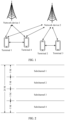
- a V2X architecture is classified into standalone (Standalone) deployment and multi-RAT dual connectivity (Multi-Rat Dual Connectivity, MR-DC) deployment.
- two terminals for example, a terminal 2 and a terminal 3 in FIG. 1
- the network device perform management and configuration on the two terminals.
- the network device may be the gNB, a next-generation eNB (ng-eNB), the eNB, or the like.
- two terminals that perform V2X communication both access a master node (master node, MN) and a secondary node (secondary node, SN)
- master node master node
- secondary node secondary node
- both a terminal 1 and the terminal 4 in FIG. 1 access the network device 1 and the network device 2.
- One of the network device 1 and the network device 2 is the master node, and the other is the secondary node.
- the master node may perform management and configuration on the terminals that perform V2X communication.
- a communication link on which direct communication is performed between terminals may be referred to as a sidelink (sidelink, SL).
- SL sidelink
- a sending terminal may directly send data to a receiving terminal, and does not need to first send the data to the network device, and then forward the data to the receiving terminal through a core network. This can greatly reduce a data transmission delay.
- the SL HARQ combines forward error correction (FEC) and an automatic repeat request (ARQ). After redundant information is added, the FEC enables the receiving terminal to correct some errors, to reduce a number of retransmission times. For an error that cannot be corrected by the FEC, the receiving terminal requests, by using an ARQ mechanism, the sending terminal to retransmit the data.
- the receiving terminal uses an error detection code, for example, a cyclic redundancy check (cyclic redundancy check, CRC), to detect whether an error occurs in received data. If no error occurs, the receiving terminal sends an ACK to the sending terminal. After receiving the ACK, the sending terminal sends next data. If an error occurs, the receiving terminal sends a NACK to the sending terminal, and after receiving the NACK, the sending terminal retransmits the data.
- the ACK and the NACK are the HARQ feedback.
- the receiving terminal after the receiving terminal receives a data packet, if a decoding error occurs, the receiving terminal discards the data packet and requests retransmission.
- the data packet that encounters the decoding error includes useful information. If the data packet is discarded, the useful information is lost.
- the HARQ with soft combining (HARQ with soft combining) is used, the data packet that encounters the decoding error is stored in a HARQ buffer, and is soft-combined with a retransmitted data packet subsequently received. Then decoding is performed. Similarly, if the decoding still fails, the foregoing process may continue to be repeated. Newly received retransmitted data is combined with data in the buffer, and decoding is performed again. Compared with separate decoding (to be specific, data transmitted each time is separately decoded and is not combined with previous data for decoding), this improves a decoding success probability.
- LTE V2X supports only broadcast service. Therefore, the SL HARQ feedback is not supported.
- NR V2X supports unicast, multicast, and a broadcast service, but supports the SL HARQ feedback only in a unicast scenario and a multicast scenario.
- SL transmission is based on a resource pool.
- the resource pool is a logical concept.
- a resource pool includes a plurality of physical resources, and any physical resource may be used to transmit data.
- the network device configures one or more resource pools for a plurality of terminals, and the plurality of terminals share the one or more resource pools.
- a terminal needs to use a physical resource from the resource pool for transmission.
- the terminal is controlled by the network device, and selects a physical resource from the resource pool based on indication information sent by the network device, to transmit data.
- the terminal independently selects a physical resource from the resource pool to transmit data.
- Each resource pool contains one or more subchannels.
- sizes of frequency domain resources in other words, quantities of physical resource blocks (physical resource block, PRB)
- Sizes of frequency domain resources of subchannels in different resource pools may be the same or may be different.
- a bandwidth occupied by a physical resource in a resource pool is 20 M, and 20 M is divided into four subchannels, a bandwidth occupied by one subchannel is 5 M.
- a quantity of subchannels included in a resource pool and a bandwidth occupied by each subchannel may be configured by the network device for the terminal.
- Physical sidelink control channel Physical sidelink control channel (physical sidelink control channel, PSCCH), PSSCH and PSFCH
- the subchannel may include a PSCCH, a PSSCH, and a PSFCH.
- the PSCCH is used to carry control information of SL data, and the control information may be specifically carried in sidelink control information (sidelink control information, SCI) on the PSCCH.
- the PSSCH is used to carry the SL data.
- the PSFCH is used to carry a HARQ feedback for the SL data.
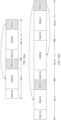
- the PSFCH includes one or two symbols in time domain and includes one or more PRBs in frequency domain, and the one or more PRBs are some of frequency domain resources of the PSSCH.
- a period of a PSFCH time-frequency resource (referred to as a PSFCH resource for short) is N slots (slot), and a value of N is currently 1, 2, or 4.
- n is an integer greater than or equal to 0
- a PSFCH corresponding to the PSSCH appears in a slot (n + a)
- a is a minimum integer greater than or equal to K.
- K is not determined.
- the HARQ feedback needs to be performed, by using PSFCH resources in a slot (n + 2), on SL data carried on a PSSCH in a slot n and SL data carried on a PSSCH in a slot (n + 1).
- the HARQ feedback needs to be performed, by using some of the PSFCH resources in the slot (n + 2), on the SL data carried on the PSSCH in the slot n.
- the HARQ feedback needs to be performed, by using the other PSFCH resources of the PSFCH resources in the slot (n + 2), on the SL data carried on the PSSCH in the slot (n + 1).
- sending (or receiving) SL data carried on one PSSCH is described as “sending (or receiving) a PSSCH”.
- a PSFCH resource may carry a sequence, the sequence has a specific sequence interval, and the sequence interval is a quantity of bits by which cyclic shift is performed on a sequence. For example, (1, 2, 3, 4) is a sequence, and then a sequence (2, 3, 4, 1) is obtained by performing cyclic shift by one bit, and a sequence interval between the two sequences is 1.
- sequence intervals may be the same or may be different, and may be specifically configured by the network device.
- a sequence on a PSFCH resource including one PRB is used to represent an ACK/a NACK.
- These sequences are obtained by performing cyclic shift on a base sequence (for example, a sequence in a physical uplink control channel (physical uplink control channel, PUCCH) format 0).
- the base sequence may be referred to as a sequence 0, and a sequence obtained by shifting x may be referred to as a sequence x.
- a bit error rate between the different ACKs/NACKs is related to a sequence interval, and a larger sequence interval indicates a lower bit error rate.
- an embodiment of this application provides a communications method (which may also be considered as a PSFCH resource determining method). As shown in FIG. 5 , the method includes the following steps.
- At least one sending terminal sends X PSSCHs to a receiving terminal.
- the receiving terminal receives the X PSSCHs from the at least one sending terminal.
- X is an integer greater than 1.
- Any one of the at least one sending terminal and the receiving terminal may perform unicast communication, or may perform multicast communication (in this case, the receiving terminal is one of all receiving terminals in the multicast communication).
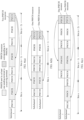
- a sending terminal 1 may send a PSSCH to the receiving terminal in the slot n by using a subchannel 1
- a sending terminal 2 may send another PSSCH to the receiving terminal in the slot n by using a subchannel 2.
- a sending terminal 1 may send a PSSCH to the receiving terminal in the slot (n + 1) by using the subchannel 1
- a sending terminal 2 may send a PSSCH to the receiving terminal in each of the slot n and the slot (n + 1) by using the subchannel 2.
- One PSSCH corresponds to one PSFCH resource
- feedback information of one PSSCH is carried on a corresponding PSFCH resource
- X PSFCH resources corresponding to the X PSSCHs have a same time domain resource.
- there are two PSFCH resources in both FIG. 6(a) and FIG. 6(b) and the two PSFCH resources have a same time domain resource.
- There are three PSFCH resources in FIG. 6(c) and the three PSFCH resources have a same time domain resource.
- a period of the PSFCH resources is N slots. When N is greater than 1, N PSSCHs may need to share the PSFCH resources.
- the PSFCH resources shared by the N PSSCHs are divided into N parts (the PSFCH resources may be evenly divided or unevenly divided).
- the N parts are considered as N PSFCH resources.
- PSFCH resources in the slot (n + 2) are two PSFCH resources, one PSFCH resource corresponds to the PSSCH in the slot n, and the other PSFCH resource corresponds to the PSSCH in the slot (n + 1).
- PSFCH resources that are in the slot (n + 2) and that are on the subchannel 1 and the subchannel 2 in FIG. 6(c) One PSFCH resource that is in the slot (n + 2) and that is on the subchannel 1 in FIG. 6(c) corresponds to the PSSCH in the slot (n + 1).
- the PSFCH resources in the slot (n + 2) are divided into two parts, one part is the PSFCH resource corresponding to the PSSCH in the slot (n + 1).
- the receiving terminal determines M PSFCH resources based on priorities of the X PSFCH resources, transmit power corresponding to the X PSFCH resources, and total transmit power of the receiving terminal.
- M is less than or equal to M', and M' is an upper limit of a quantity of PSFCH resources occupied on a same time domain resource, that is, a maximum quantity of PSFCH resources that can be simultaneously used by the receiving terminal.
- M' may be a value specified in a communications standard.
- the priorities of the PSFCH resources may be classified according to a priority rule.
- the priority of the PSFCH resource may be determined based on a corresponding PSCCH or PSSCH.
- the transmit power corresponding to the PSFCH resources may be obtained through channel measurement. For example, when a channel measurement result indicates that channel quality is poorer, transmit power corresponding to a PSFCH resource may be higher.
- the receiving terminal sends feedback information to some or all of the at least one sending terminal on the M PSFCH resources.
- the some or all of the at least one sending terminal receive the feedback information from the receiving terminal on the M PSFCH resources.
- the feedback information may be a HARQ feedback that is of the receiving terminal and that is for the PSSCH sent by the sending terminal, and may be specifically an ACK or a NACK.
- the receiving terminal may send feedback information to only some of the at least one sending terminal, and may subsequently send or not send feedback information to the remaining sending terminals. This is not limited in this application.
- the receiving terminal may determine the M PSFCH resources based on the priorities of the PSFCH resources, the transmit power corresponding to the PSFCH resources, and the total transmit power of the receiving terminal, to send the M PSFCH resources based on a sending capability (namely, the total transmit power) of the receiving terminal. This improves overall performance of a network system.
- step 502 may include: The receiving terminal sequentially accumulates, in descending order of the priorities of the X PSFCH resources, the transmit power corresponding to the PSFCH resources, and determines the M PSFCH resources based on the accumulation.
- the X PSFCH resources are classified into L priorities.
- a quantity of PSFCH resources with an i th priority in the L priorities is denoted as li, and a smaller value of i indicates a higher priority.
- P j represents transmit power corresponding to a j th PSFCH resource sorted in descending order of the priorities, j is an integer greater than 0, and k is a quantity of accumulated PSFCH resources.
- Case 1 An accumulation result of accumulating transmit power corresponding to m PSFCH resources is less than or equal to the total transmit power of the receiving terminal, and m is equal to M', or an accumulation result of accumulating transmit power corresponding to m PSFCH resources is equal to the total transmit power of the receiving terminal, and m is less than M'.
- the receiving terminal determines that the m PSFCH resources are the M PSFCH resources.
- the receiving terminal determines that the m accumulated PSFCH resources are the M PSFCH resources.
- P max represents the total transmit power of the receiving terminal.
- the six PSFCH resources are marked as a PSFCH 1 to a PSFCH 6 and are classified into three priorities, and a quantity of PSFCH resources with each priority is 2.
- the PSFCH 1 and the PSFCH 2 are of a first priority
- the PSFCH 3 and the PSFCH 4 are of a second priority
- the PSFCH 5 and the PSFCH 6 are of a third priority.
- M' 2, P 1 ⁇ P max , and P 1 + P 2 ⁇ P max
- the receiving terminal determines that the PSFCH 1 and the PSFCH 2 are the M PSFCH resources.
- the receiving terminal determines that the PSFCH 1 and the PSFCH 2 are the M PSFCH resources.
- Case 2 An accumulation result of accumulating transmit power corresponding to m PSFCH resources is less than or equal to the total transmit power of the receiving terminal, an accumulation result of accumulating transmit power corresponding to m + 1 PSFCH resources is greater than the total transmit power of the receiving terminal, and m + 1 is less than or equal to M'.
- the receiving terminal determines that the m PSFCH resources are the M PSFCH resources.
- the receiving terminal determines that the m accumulated PSFCH resources are the M PSFCH resources.
- the six PSFCH resources are marked as a PSFCH 1 to a PSFCH 6 and are classified into three priorities, and a quantity of PSFCH resources with each priority is 2.
- the PSFCH 1 and the PSFCH 2 are of a first priority
- the PSFCH 3 and the PSFCH 4 are of a second priority
- the receiving terminal determines that the PSFCH 1, the PSFCH 2, and the PSFCH 3 are the M PSFCH resources.
- Case 3 An accumulation result of accumulating transmit power corresponding to m PSFCH resources is less than or equal to the total transmit power of the receiving terminal, an accumulation result of accumulating transmit power corresponding to m + 1 PSFCH resources is greater than the total transmit power of the receiving terminal, and m + 1 is less than or equal to M'.
- the receiving terminal may determine the M PSFCH resources in any one of the following manner 1 to manner 4.
- the manner 1 specifically includes the following step (11) and step (12).
- the receiving terminal reduces transmit power corresponding to an (m + 1) th PSFCH resource in the m + 1 PSFCH resources, so that the accumulation result of accumulating the transmit power corresponding to the m + 1 PSFCH resources is less than or equal to the total transmit power of the receiving terminal.
- the receiving terminal determines that the m + 1 PSFCH resources are the M PSFCH resources.
- the receiving terminal determines that the m + 1 PSFCH resources are the M PSFCH resources.
- the receiving terminal may reduce the transmit power corresponding to the (m + 1) th PSFCH resource to ⁇ ( ⁇ is greater than 0 and less than or equal to 1) times of the original transmit power.
- the six PSFCH resources are marked as a PSFCH 1 to a PSFCH 6 and are classified into three priorities, and a quantity of PSFCH resources with each priority is 2.
- the PSFCH 1 and the PSFCH 2 are of a first priority
- the PSFCH 3 and the PSFCH 4 are of a second priority
- the PSFCH 5 and the PSFCH 6 are of a third priority.
- the receiving terminal may reduce P 4 to ⁇ P 4 , so that P 1 + P 2 + P 3 + ⁇ P 4 ⁇ P max , and the receiving terminal may determine that the PSFCH 1, the PSFCH 2, the PSFCH 3, and the PSFCH 4 are the M PSFCH resources.
- the manner 2 specifically includes the following step (21) and step (22).
- the receiving terminal reduces transmit power corresponding to a PSFCH resource with a first priority in the m + 1 PSFCH resources, so that the accumulation result of accumulating the transmit power corresponding to the m + 1 PSFCH resources is less than or equal to the total transmit power of the receiving terminal, where the first priority is a priority of an (m + 1) th PSFCH resource in the m + 1 PSFCH resources.
- the receiving terminal determines that the m + 1 PSFCH resources are the M PSFCH resources.
- a same proportion may be reduced when transmit power corresponding to the x2 PSFCH resources is reduced.
- the transmit power corresponding to the x2 PSFCH resources is reduced to ⁇ ( ⁇ greater than 0 and less than or equal to 1) times of the original transmit power, and different proportions may also be reduced.
- transmit power corresponding to some PSFCH resources in the x2 PSFCH resources is reduced to ⁇ 1 ( ⁇ 1 is greater than 0 and less than or equal to 1) times of the original transmit power
- transmit power corresponding to some PSFCH resources is reduced to ⁇ 2 ( ⁇ 2 is greater than 0 and less than or equal to 1) times of the original transmit power.
- the six PSFCH resources are marked as a PSFCH 1 to a PSFCH 6 and are classified into three priorities, and a quantity of PSFCH resources with each priority is 2.
- the PSFCH 1 and the PSFCH 2 are of a first priority
- the PSFCH 3 and the PSFCH 4 are of a second priority
- the PSFCH 5 and the PSFCH 6 are of a third priority.
- the receiving terminal may reduce P 3 to ⁇ P 3 , so that P 1 + P 2 + ⁇ P 3 ⁇ P max , and the receiving terminal may determine that the PSFCH 1, the PSFCH 2, and the PSFCH 3 are the M PSFCH resources.
- the receiving terminal may reduce P 3 to ⁇ P 3 , and reduce P 4 to ⁇ P 4 , so that P 1 + P 2 + ⁇ P 3 + ⁇ P 4 ⁇ P max , and the receiving terminal may determine that the PSFCH 1, the PSFCH 2, the PSFCH 3, and the PSFCH 4 are the M PSFCH resources.
- the manner 3 specifically includes the following step (31) and step (32).
- the receiving terminal reduces transmit power corresponding to x1 PSFCH resources with the first priority, so that an accumulation result of accumulating the transmit power corresponding to m + 1 - x2 + x1 PSFCH resources is less than or equal to the total transmit power of the receiving terminal,
- the first priority is a priority of an (m + 1) th PSFCH resource in the m + 1 PSFCH resources
- x2 is a quantity of PSFCH resources with the first priority in the m + 1 PSFCH resources
- x1 min(x3, M' - (m + 1 - x2)), min is a minimum function
- x3 is a quantity of PSFCH resources with the highest priority.
- the receiving terminal determines that the m + 1 - x2 + x1 PSFCH resources are the M PSFCH resources.
- the receiving terminal determines that the m + 1 - x2 + x1 PSFCH resources are the M PSFCH resources.
- min(x3, M' - (m + 1 - x2) means min(the quantity of PSFCH resources with the first priority, M' - the quantity of all PSFCH resources with all priorities higher than the first priority).
- a value of x1 is determined according to the method. This can ensure that the quantity of accumulated PSFCH resources is less than or equal to M'.
- the M PSFCH resources determined by the receiving terminal include all PSFCH resources with all priorities higher than the first priority, min (the quantity of PSFCH resources with the first priority, M' - the quantity of all PSFCH resources with all priorities higher than the first priority) PSFCH resources with the n th priority that are sent at the ⁇ times of the transmit power.
- the six PSFCH resources are marked as a PSFCH 1 to a PSFCH 6 and are classified into three priorities, and a quantity of PSFCH resources with each priority is 2.
- the PSFCH 1 and the PSFCH 2 are of a first priority
- the PSFCH 3 and the PSFCH 4 are of a second priority
- the PSFCH 5 and the PSFCH 6 are of a third priority.
- the manner 4 specifically includes the following step (41) and step (42).
- the receiving terminal determines a first combination from a plurality of combinations, where the plurality of combinations are combinations of PSFCH resources with a first priority, and the first priority is a priority of an (m + 1) th PSFCH resource in the m + 1 PSFCH resources.
- the receiving terminal determines that m + 1 - x2 + x3 accumulated PSFCH resources are the M PSFCH resources, where x2 is a quantity of PSFCH resources with the first priority in the m + 1 PSFCH resources, and x3 is a quantity of PSFCH resources in the first combination.
- the receiving terminal may traverse the combinations of the PSFCH resources with the first priority, determine the first combination, and further determine the m + 1 - x2 + x3 accumulated PSFCH resources as the M PSFCH resources.
- the first combination meets the following feature 1 to feature 3.
- a sum of the quantity of PSFCH resources in the first combination and a quantity of all PSFCH resources with priorities higher than the first priority is less than or equal to M'.
- a sum of transmit power corresponding to the PSFCH resources in the first combination and transmit power corresponding to all the PSFCH resources with the priorities higher than the first priority is less than or equal to the total transmit power of the receiving terminal.
- Feature 3 The sum of the quantity of PSFCH resources with the first combination and the quantity of all PSFCH resources with the priorities higher than the first priority is a maximum.
- the combination selected by the receiving terminal is a combination that meets the feature 1 and the feature 2 and that can make M in the determined M PSFCH resources be the maximum.
- the receiving terminal may select one combination from the plurality of combinations as the first combination.
- the first combination further meets the following feature 4.
- the sum of the transmit power corresponding to the PSFCH resources in the first combination and the transmit power corresponding to all the PSFCH resources with the priorities higher than the first priority is a minimum (in other words, total power is the minimum); or a difference between the total transmit power of the receiving terminal and the sum of the transmit power corresponding to the PSFCH resources in the first combination and the transmit power corresponding to all the PSFCH resources with the priorities higher than the first priority is a maximum (in other words, a power headroom is a maximum).
- the six PSFCH resources are marked as a PSFCH 1 to a PSFCH 6 and are classified into three priorities, and a quantity of PSFCH resources with each priority is 2.
- the PSFCH 1 and the PSFCH 2 are of a first priority
- the PSFCH 3 and the PSFCH 4 are of a second priority
- the PSFCH 5 and the PSFCH 6 are of a third priority.
- a combination that can minimize total power of the M PSFCH resources or maximize the power headroom may be selected from I1 and I2.
- the minimum total power is used as the standard:
- the Pmax used for calculating ⁇ 1 is calculated based on the PSFCH 1, the PSFCH 2, the PSFCH 3, and power of hardware of the receiving terminal.
- the Pmax used for calculating ⁇ 2 is calculated based on the PSFCH 1, the PSFCH 2, the PSFCH 4, and power of hardware of the receiving terminal.
- Pmax used for calculating ⁇ 1 and Pmax used for calculating ⁇ 2 may have same values or different values.
- I1 may make the total power maximum, and the receiving terminal determines that the PSFCH 1, the PSFCH 2, and the PSFCH 3 are the M PSFCH resources.
- I2 may make the total power maximum, and the receiving terminal determines that the transmission PSFCH 1, the PSFCH 2, and the PSFCH 4 are the M PSFCH resources.
- a combination that can minimize total power of the M PSFCH resources or maximize the power headroom may be selected from I1 and I2.
- the minimum total power is used as the standard:
- ⁇ 1 P max ⁇ P 1 ⁇ P 2 ⁇ P 3
- ⁇ 2 P max ⁇ P 1 ⁇ P 2 ⁇ P 4 .
- the Pmax used for calculating ⁇ 1 is calculated based on the PSFCH 1, the PSFCH 2, the PSFCH 3, and power of hardware of the receiving terminal.
- the Pmax used for calculating ⁇ 2 is calculated based on the PSFCH 1, the PSFCH 2, the PSFCH 4, and power of hardware of the receiving terminal.
- Pmax used for calculating ⁇ 1 and Pmax used for calculating ⁇ 2 may have same values or different values.
- I1 may make the total power maximum, and the receiving terminal determines that the PSFCH 1, the PSFCH 2, and the PSFCH 3 are the M PSFCH resources.
- I2 may make the total power maximum, and the receiving terminal determines that the PSFCH 1, the PSFCH 2, and the PSFCH 4 are the M PSFCH resources.
- the manner 1, the manner 2, and the manner 3 have simpler implementation processes.
- the manner 4 has higher complexity, but can enable the sum of the transmit power corresponding to the determined M PSFCH resources to be the minimum.
- the foregoing embodiment provides a process of selecting the M PSFCH resources and details of power control. It can be ensured that the M PSFCH resources are sent within the sending capability of the receiving terminal (that is, within the total transmit power of the receiving terminal). In addition, it can be ensured that the quantity of the determined M PSFCH resources is less than or equal to the upper limit of the quantity of PSFCH resources occupied on the same time domain resource. This improves overall performance of a network system. It should be noted that in the foregoing embodiments, the method provided in this embodiment of this application is described by using an example in which PSSCH resources are in a one-to-one correspondence with PSFCH resources. During actual implementation, a plurality of PSSCHs sent by one sending terminal may also correspond to one PSFCH resource.
- a method for selecting the M PSFCH resources is similar, and a difference only lies in that the receiving terminal needs to perform code division (for example, perform code division by using different sequences described in the foregoing embodiment) on a same PSFCH resource to send feedback information for a plurality of PSSCHs.
- each network element for example, the sending terminal and the receiving terminal, includes a corresponding hardware structure and/or software module for performing each function.
- each network element for example, the sending terminal and the receiving terminal, includes a corresponding hardware structure and/or software module for performing each function.
- a person skilled in the art should easily be aware that, in combination with units and algorithm steps of the examples described in the embodiments disclosed in this specification, this application may be implemented by hardware or a combination of hardware and computer software. Whether a function is performed by hardware or hardware driven by computer software depends on particular applications and design constraints of the technical solutions. A person skilled in the art may use different methods to implement the described functions for each particular application, but it should not be considered that the implementation goes beyond the scope of this application.
- the sending terminal and the receiving terminal may be divided into function units based on the foregoing method examples.
- each function unit may be obtained through division based on a corresponding function, or two or more functions may be integrated into one processing unit.
- the integrated unit may be implemented in a form of hardware, or may be implemented in a form of a software functional unit.
- unit division is an example, and is merely a logical function division. In actual implementation, another division manner may be used.
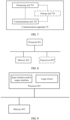
- FIG. 7 is a possible schematic structural diagram of the communications apparatus (denoted as a communications apparatus 70) in the foregoing embodiments.
- the communications apparatus 70 includes a processing unit 701 and a communications unit 702, and may further include a storage unit 703.
- the schematic structural diagram shown in FIG. 7 may be used to show a structure of the sending terminal or the receiving terminal in the foregoing embodiments.
- the processing unit 701 is configured to control and manage an action of the sending terminal.
- the processing unit 701 is configured to support the sending terminal in performing 501 and 503 in FIG. 5 , and/or an action performed by the sending terminal in another process described in the embodiments of this application.
- the processing unit 701 may communicate with another network entity by using the communications unit 702, for example, communicate with the receiving terminal shown in FIG. 5 .
- the storage module 703 is configured to store program code and data of the sending terminal.
- the communications apparatus 70 may be a device, or may be a chip in a device.
- the processing unit 701 is configured to control and manage an action of the receiving terminal.
- the processing unit 701 is configured to support the receiving terminal in performing 501 to 503 in FIG. 5 , and/or an action performed by the receiving terminal in another process described in the embodiments of this application.
- the processing unit 701 may communicate with another network entity by using the communications unit 702, for example, communicate with the sending terminal shown in FIG. 5 .
- the storage unit 703 is configured to store program code and data of the receiving terminal.
- the communications apparatus 70 may be a device, or may be a chip in a device.
- the processing unit 701 may be a processor or a controller, and the communications unit 702 may be a communications interface, a transceiver, a transceiver circuit, a transceiver apparatus, or the like.
- the communications interface is a collective term, and may include one or more interfaces.
- the storage unit 703 may be a memory.
- the processing unit 701 may be a processor or a controller, and the communications unit 702 may be an input interface and/or an output interface, a pin, a circuit, or the like.
- the storage unit 703 may be a storage unit (for example, a register or a cache) in the chip, or may be a storage unit (for example, a read-only memory or a random access memory) that is in the device and that is located outside the chip.
- a storage unit for example, a register or a cache
- a storage unit for example, a read-only memory or a random access memory
- the communications unit may also be referred to as a transceiver unit.
- An antenna and a control circuit that have receiving and sending functions in the communications apparatus 70 may be considered as the communications unit 702 in the communications apparatus 70, and a processor that has a processing function in the communications apparatus 70 may be considered as the processing unit 701 in the communications apparatus 70.
- a component configured to implement a receiving function in the communications unit 702 may be considered as a receiving unit.
- the receiving unit is configured to perform the receiving step in the embodiments of this application.
- the receiving unit may be a receiver, a receiver, a receiver circuit, or the like.
- a component configured to implement a sending function in the communications unit 702 may be considered as a sending unit.
- the sending unit is configured to perform the sending step in the embodiments of this application.
- the sending unit may be a transmitter, a transmitter, a sending circuit, or the like.
- the integrated unit in FIG. 7 When an integrated unit in FIG. 7 is implemented in a form of a software function module and sold or used as an independent product, the integrated unit may be stored in a computer-readable storage medium. Based on such an understanding, the technical solutions of this application essentially, or the part contributing to the prior art, or all or some of the technical solutions may be implemented in the form of a software product.
- the computer software product is stored in a storage medium and includes a plurality of instructions for instructing a computer device (which may be a personal computer, a server, or a network device) or a processor (processor) to perform all or some of the steps of the methods described in the embodiments of this application.
- the storage medium that stores the computer software product includes any medium that can store program code, for example, a USB flash drive, a removable hard disk, a read-only memory (read-only memory, ROM), a random access memory (random access memory, RAM), a magnetic disk, or an optical disc.
- program code for example, a USB flash drive, a removable hard disk, a read-only memory (read-only memory, ROM), a random access memory (random access memory, RAM), a magnetic disk, or an optical disc.
- the unit in FIG. 7 may alternatively be referred to as a module.
- the processing unit may be referred to as a processing module.
- the communications apparatus includes a processor 801, and optionally, further includes a memory 802 connected to the processor 801.
- the processor 801 may be a general-purpose central processing unit (central processing unit, CPU), a microprocessor, an application-specific integrated circuit (application-specific integrated circuit, ASIC), or one or more integrated circuits configured to control program execution of the solutions of this application.
- the processor 801 may alternatively include a plurality of CPUs, and the processor 801 may be a single-core processor (single-CPU) or a multi-core processor (multi-CPU).
- the processor herein may refer to one or more devices, circuits, or processing cores configured to process data (for example, a computer program instruction).
- the memory 802 may be a ROM or another type of static storage device that can store static information and an instruction, or a RAM or another type of dynamic storage device that can store information and an instruction, or may be an electrically erasable programmable read-only memory (electrically erasable programmable read-only memory, EEPROM), a compact disc read-only memory (compact disc read-only memory, CD-ROM) or another compact disc storage, an optical disc storage (including a compact disc, a laser disc, an optical disc, a digital versatile disc, a Blu-ray disc, or the like), a magnetic disk storage medium or another magnetic storage device, or any other medium that can be used to carry or store expected program code in a form of an instruction or a data structure and that can be accessed by a computer.
- EEPROM electrically erasable programmable read-only memory
- CD-ROM compact disc read-only memory
- an optical disc storage including a compact disc, a laser disc, an optical disc, a digital versatile disc, a Blu
- the memory 802 is not limited in this embodiment of this application.
- the memory 802 may exist independently, or may be integrated into the processor 801.
- the memory 802 may include computer program code.
- the processor 801 is configured to execute the computer program code stored in the memory 802, to implement a method provided in the embodiments of this application.
- the communications apparatus further includes a transceiver 803.
- the processor 801, the memory 802, and the transceiver 803 are connected via a bus.
- the transceiver 803 is configured to communicate with another device or a communications network.
- the transceiver 803 may include a transmitter and a receiver.
- a component configured to implement a receiving function in the transceiver 803 may be considered as a receiver.
- the receiver is configured to perform the receiving step in the embodiments of this application.
- a component configured to implement a sending function in the transceiver 803 may be considered as a transmitter.
- the transmitter is configured to perform the sending step in the embodiments of this application.
- the schematic structural diagram shown in FIG. 8 may be used to show a structure of the sending terminal or the receiving terminal in the foregoing embodiments.
- the processor 801 is configured to control and manage an action of the sending terminal.
- the processor 801 is configured to support the sending terminal in performing 501 and 503 in FIG. 5 , and/or an action performed by the sending terminal in another process described in the embodiments of this application.
- the processor 801 may communicate with another network entity by using the transceiver 803, for example, communicate with the receiving terminal shown in FIG. 5 .
- the memory 802 is configured to store program code and data of the sending terminal.
- the processor 801 is configured to control and manage an action of the receiving terminal.
- the processor 801 is configured to support the receiving terminal in performing 501 to 503 in FIG. 5 , and/or an action performed by the receiving terminal in another process described in the embodiments of this application.
- the processor 801 may communicate with another network entity by using the transceiver 803, for example, communicate with the sending terminal shown in FIG. 5 .
- the memory 802 is configured to store program code and data of the receiving terminal.
- the processor 801 includes a logic circuit and an input interface and/or an output interface.
- the output interface is configured to perform a sending action in a corresponding method
- the input interface is configured to perform a receiving action in a corresponding method.
- the schematic structural diagram shown in FIG. 9 may be used to show a structure of the sending terminal or the receiving terminal in the foregoing embodiments.
- the processor 801 is configured to control and manage an action of the sending terminal.
- the processor 801 is configured to support the sending terminal in performing 501 and 503 in FIG. 5 , and/or an action performed by the sending terminal in another process described in the embodiments of this application.
- the processor 801 may communicate with another network entity by using an input interface and/or an output interface, for example, communicate with the receiving terminal shown in FIG. 5 .
- the memory 802 is configured to store program code and data of the sending terminal.
- the processor 801 is configured to control and manage an action of the receiving terminal.
- the processor 801 is configured to support the receiving terminal in performing 501 to 503 in FIG. 5 , and/or an action performed by the receiving terminal in another process described in the embodiments of this application.
- the processor 801 may communicate with another network entity by using an input interface and/or an output interface, for example, communicate with the sending terminal shown in FIG. 5 .
- the memory 802 is configured to store program code and data of the receiving terminal.
- An embodiment of this application further provides a computer-readable storage medium, including instructions.
- the instructions When the instructions are run on a computer, the computer is enabled to perform any one of the foregoing methods.
- An embodiment of this application further provides a computer program product including instructions.
- the computer program product runs on a computer, the computer is enabled to perform any one of the foregoing methods.
- An embodiment of this application further provides a communications system, including the foregoing sending terminal and the foregoing receiving terminal.
- the communications system further includes the foregoing terminal.
- All or some of the foregoing embodiments may be implemented by using software, hardware, firmware, or any combination thereof.
- a software program is used to implement the embodiments, the embodiments may be implemented completely or partially in a form of a computer program product.
- the computer program product includes one or more computer instructions.
- the computer may be a general-purpose computer, a dedicated computer, a computer network, or other programmable apparatuses.
- the computer instructions may be stored in a computer-readable storage medium or may be transmitted from a computer-readable storage medium to another computer-readable storage medium.
- the computer instructions may be transmitted from a website, computer, server, or data center to another website, computer, server, or data center in a wired (for example, a coaxial cable, an optical fiber, or a digital subscriber line (digital subscriber line, DSL)) or wireless (for example, infrared, radio, or microwave) manner.
- the computer storage medium may be any usable medium accessible by a computer, or a data storage device, such as a server or a data center, integrating one or more usable media.
- the usable medium may be a magnetic medium (for example, a floppy disk, a hard disk, or a magnetic tape), an optical medium (for example, a DVD), a semiconductor medium (for example, a solid-state drive (solid state disk, SSD)), or the like.
- a magnetic medium for example, a floppy disk, a hard disk, or a magnetic tape
- an optical medium for example, a DVD
- a semiconductor medium for example, a solid-state drive (solid state disk, SSD)
Landscapes
- Engineering & Computer Science (AREA)
- Signal Processing (AREA)
- Computer Networks & Wireless Communication (AREA)
- Physics & Mathematics (AREA)
- Probability & Statistics with Applications (AREA)
- Mobile Radio Communication Systems (AREA)
Claims (15)
- Kommunikationsvorrichtung, die eine Kommunikationseinheit (702) und eine Verarbeitungseinheit (701) umfasst, wobeidie Kommunikationseinheit dazu konfiguriert ist, X gemeinsam genutzte physikalische Sidelink-Kanäle PSSCHs von mindestens einem sendenden Endgerät zu empfangen, wobei ein PSSCH einer physikalischen Sidelink-Rückkopplungskanal-PSFCH-Ressource entspricht, X PSFCH-Ressourcen, die den X PSSCHs entsprechen, eine gleiche Zeitbereichsressource aufweisen und X eine Ganzzahl größer als 1 ist;die Verarbeitungseinheit dazu konfiguriert ist, M PSFCH-Ressourcen basierend auf Prioritäten der X PSFCH-Ressourcen, einer den X PSFCH-Ressourcen entsprechenden Sendeleistung und einer Gesamtsendeleistung der Vorrichtung zu bestimmen, wobei M kleiner als oder gleich M' ist und M' eine Obergrenze einer Anzahl an PSFCH-Ressourcen ist, die auf einer gleichen Zeitbereichsressource belegt werden, und wobei die Verarbeitungseinheit dazu konfiguriert ist, in absteigender Reihenfolge der Prioritäten der X PSFCH-Ressourcen die den PSFCH-Ressourcen entsprechende Sendeleistung sequentiell zu akkumulieren und die M PSFCH-Ressourcen basierend auf der Akkumulation zu bestimmen, wobei die X PSFCH-Ressourcen in L Prioritäten klassifiziert werden, wobei eine Anzahl an PSFCH-Ressourcen mit einer i-ten Priorität in den L Prioritäten als li bezeichnet wird und ein kleinerer Wert von i eine höhere Priorität anzeigt, wobei die den PSFCH-Ressourcen entsprechende Sendeleistung in absteigender Reihenfolge der Prioritäten der X PSFCH-Ressourcen akkumuliert wird und ein Akkumulationsergebnis als
 die Kommunikationseinheit ferner dazu konfiguriert ist, Rückkopplungsinformationen an einige oder alle des mindestens einen sendenden Endgeräts auf den M PSFCH-Ressourcen zu senden.
 - Vorrichtung nach Anspruch 1, wobei,
wenn ein Akkumulationsergebnis eines Akkumulierens einer m PSFCH-Ressourcen entsprechenden Sendeleistung kleiner als oder gleich der Gesamtsendeleistung ist und m gleich M' ist, oder wenn ein Akkumulationsergebnis eines Akkumulierens einer m PSFCH-Ressourcen entsprechenden Sendeleistung gleich der Gesamtsendeleistung ist und m kleiner als M' ist, Bestimmen, dass die m PSFCH-Ressourcen die M PSFCH-Ressourcen sind. - Vorrichtung nach Anspruch 1, wobei,
wenn ein Akkumulationsergebnis eines Akkumulierens einer m PSFCH-Ressourcen entsprechenden Sendeleistung kleiner als oder gleich der Gesamtsendeleistung ist, ein Akkumulationsergebnis eines Akkumulierens einer m + 1 PSFCH-Ressourcen entsprechenden Sendeleistung größer als die Gesamtsendeleistung ist und m + 1 kleiner als oder gleich M' ist, Bestimmen, dass die m PSFCH-Ressourcen die M PSFCH-Ressourcen sind. - Vorrichtung nach Anspruch 1, wobei,
wenn ein Akkumulationsergebnis eines Akkumulierens einer m PSFCH-Ressourcen entsprechenden Sendeleistung kleiner als oder gleich der Gesamtsendeleistung ist, ein Akkumulationsergebnis eines Akkumulierens einer m + 1 PSFCH-Ressourcen entsprechenden Sendeleistung größer als die Gesamtsendeleistung ist und m + 1 kleiner als oder gleich M' ist, Reduzieren der einer (m + 1)-ten PSFCH-Ressource in den m + 1 PSFCH-Ressourcen entsprechenden Sendeleistung derart, dass das Akkumulationsergebnis eines Akkumulierens der den m + 1 PSFCH-Ressourcen entsprechenden Sendeleistung kleiner als oder gleich der Gesamtsendeleistung ist; und Bestimmen, dass die m + 1 PSFCH-Ressourcen die M PSFCH-Ressourcen sind. - Vorrichtung nach Anspruch 1, wobei,wenn ein Akkumulationsergebnis eines Akkumulierens einer m PSFCH-Ressourcen entsprechenden Sendeleistung kleiner als oder gleich der Gesamtsendeleistung ist, ein Akkumulationsergebnis eines Akkumulierens einer m + 1 PSFCH-Ressourcen entsprechenden Sendeleistung größer als die Gesamtsendeleistung ist und m + 1 kleiner als oder gleich M' ist, Reduzieren einer einer PSFCH-Ressource mit einer ersten Priorität in den m + 1 PSFCH-Ressourcen entsprechenden Sendeleistung derart, dass das Akkumulationsergebnis eines Akkumulierens der den m + 1 PSFCH-Ressourcen entsprechenden Sendeleistung kleiner als oder gleich der Gesamtsendeleistung ist, wobei die erste Priorität eine Priorität einer (m + 1)-ten PSFCH-Ressource in den m + 1 PSFCH-Ressourcen ist; undBestimmen, dass die m + 1 PSFCH-Ressourcen die M PSFCH-Ressourcen sind.
- Vorrichtung nach Anspruch 1, wobeiwenn ein Akkumulationsergebnis eines Akkumulierens einer m PSFCH-Ressourcen entsprechenden Sendeleistung kleiner als oder gleich der Gesamtsendeleistung ist, ein Akkumulationsergebnis eines Akkumulierens einer m + 1 PSFCH-Ressourcen entsprechenden Sendeleistung größer als die Gesamtsendeleistung ist und m + 1 kleiner als oder gleich M' ist, Reduzieren einer x1 PSFCH-Ressourcen mit einer ersten Priorität entsprechenden Sendeleistung derart, dass ein Akkumulationsergebnis eines Akkumulierens einer m + 1 - x2 + x1 PSFCH-Ressourcen entsprechenden Sendeleistung kleiner als oder gleich der Gesamtsendeleistung ist, wobei die erste Priorität eine Priorität einer (m + 1)-ten PSFCH-Ressource in den m + 1 PSFCH-Ressourcen ist, x2 eine Anzahl an PSFCH-Ressourcen mit der ersten Priorität in den m + 1 PSFCH-Ressourcen ist, x1 = min(x3, M' - (m + 1 - x2)), min eine Mindestwertfunktion ist und x3 eine Anzahl an PSFCH-Ressourcen mit der ersten Priorität ist; undBestimmen, dass die m + 1 - x2 + x1 PSFCH-Ressourcen die M PSFCH-Ressourcen sind.
- Vorrichtung nach Anspruch 1, wobei,wenn ein Akkumulationsergebnis eines Akkumulierens einer m PSFCH-Ressourcen entsprechenden Sendeleistung kleiner als oder gleich der Gesamtsendeleistung ist, ein Akkumulationsergebnis eines Akkumulierens einer m + 1 PSFCH-Ressourcen entsprechenden Sendeleistung größer als die Gesamtsendeleistung ist und m + 1 kleiner als oder gleich M' ist, Bestimmen einer ersten Kombination aus einer Mehrzahl von Kombinationen, wobei die Mehrzahl von Kombinationen Kombinationen von PSFCH-Ressourcen mit einer ersten Priorität sind und die erste Priorität eine Priorität einer (m + 1)-ten PSFCH-Ressource in den m + 1 PSFCH-Ressourcen ist; undBestimmen, dass m + 1 - x2 + x3 akkumulierte PSFCH-Ressourcen die M PSFCH-Ressourcen sind, wobei x2 eine Anzahl an PSFCH-Ressourcen mit der ersten Priorität in den m + 1 PSFCH-Ressourcen ist und x3 eine Anzahl an PSFCH-Ressourcen in der ersten Kombination ist, wobeiim Vergleich mit einer anderen Kombination die erste Kombination die folgenden Merkmale erfüllt: eine Summe der Anzahl an PSFCH-Ressourcen in der ersten Kombination und einer Anzahl aller PSFCH-Ressourcen mit Prioritäten, die höher als die erste Priorität sind, ist kleiner als oder gleich M', eine Summe einer den PSFCH-Ressourcen in der ersten Kombination entsprechenden Sendeleistung und einer Sendeleistung, die allen PSFCH-Ressourcen mit den Prioritäten entspricht, die höher als die erste Priorität sind, ist kleiner als oder gleich der Gesamtsendeleistung, und die Summe der Anzahl an PSFCH-Ressourcen in der ersten Kombination und der Anzahl aller PSFCH-Ressourcen mit den Prioritäten, die höher als die erste Priorität sind, ist ein Maximum.
- Vorrichtung nach Anspruch 7, wobei im Vergleich mit der anderen Kombination die erste Kombination ferner das folgende Merkmal erfüllt: die Summe der den PSFCH-Ressourcen in der ersten Kombination entsprechenden Sendeleistung und der Sendeleistung, die allen PSFCH-Ressourcen mit den Prioritäten entspricht, die höher als die erste Priorität sind, ist ein Minimum oder eine Differenz zwischen der Gesamtsendeleistung und der Summe der den PSFCH-Ressourcen in der ersten Kombination entsprechenden Sendeleistung und der Sendeleistung, die allen PSFCH-Ressourcen mit den Prioritäten entspricht, die höher als die erste Priorität sind, ist ein Maximum.
- Vorrichtung nach Anspruch 1, wobei M größer oder gleich


- Kommunikationsverfahren, umfassend:Empfangen, durch eine Kommunikationsvorrichtung, von X gemeinsam genutzten physikalischen Sidelink-Kanälen PSSCHs, wobei jeder PSSCH einer physikalischen Sidelink-Rückkopplungskanal-PSFCH-Ressource entspricht, X PSFCH-Ressourcen, die den X PSSCHs entsprechen, eine gleiche Zeitbereichsressource aufweisen, und X eine Ganzzahl größer als 1 ist;Bestimmen, durch die Kommunikationsvorrichtung, von M PSFCH-Ressourcen basierend auf Prioritäten der X PSFCH-Ressourcen, einer den X PSFCH-Ressourcen entsprechenden Sendeleistung und einer Gesamtsendeleistung der Kommunikationsvorrichtung, wobei M kleiner als oder gleich M' ist und M' eine Obergrenze einer Anzahl an PSFCH-Ressourcen ist, die auf einer gleichen Zeitbereichsressource belegt werden, und sequentielles Akkumulieren, in absteigender Reihenfolge der Prioritäten der X PSFCH-Ressourcen, der den PSFCH-Ressourcen entsprechenden Sendeleistung, und Bestimmen der M PSFCH-Ressourcen basierend auf der Akkumulation, wobei die X PSFCH-Ressourcen in L Prioritäten klassifiziert werden, wobei eine Anzahl an PSFCH-Ressourcen mit einer i-ten Priorität in den L Prioritäten als li bezeichnet wird und ein kleinerer Wert von i eine höhere Priorität anzeigt, wobei die den PSFCH-Ressourcen entsprechende Sendeleistung in absteigender Reihenfolge der Prioritäten der X PSFCH-Ressourcen akkumuliert wird und ein Akkumulationsergebnis als
 Senden, durch die Kommunikationsvorrichtung, von Rückkopplungsinformationen auf den M PSFCH-Ressourcen.
 - Verfahren nach Anspruch 10, wobei M größer oder gleich


- Verfahren nach Anspruch 10,
wenn ein Akkumulationsergebnis eines Akkumulierens einer m PSFCH-Ressourcen entsprechenden Sendeleistung kleiner als oder gleich der Gesamtsendeleistung ist und m gleich M' ist, oder wenn ein Akkumulationsergebnis eines Akkumulierens einer m PSFCH-Ressourcen entsprechenden Sendeleistung gleich der Gesamtsendeleistung ist und m kleiner als M' ist, Bestimmen, durch die Kommunikationseinrichtung, dass die m PSFCH-Ressourcen die M PSFCH-Ressourcen sind. - Verfahren nach Anspruch 10,
wenn ein Akkumulationsergebnis eines Akkumulierens einer m PSFCH-Ressourcen entsprechenden Sendeleistung kleiner als oder gleich der Gesamtsendeleistung ist, ein Akkumulationsergebnis eines Akkumulierens einer m + 1 PSFCH-Ressourcen entsprechenden Sendeleistung größer als die Gesamtsendeleistung ist und m + 1 kleiner als oder gleich M' ist, Bestimmen, durch die Kommunikationsvorrichtung, dass die m PSFCH-Ressourcen die M PSFCH-Ressourcen sind. - Computerprogrammprodukt, das Anweisungen umfasst, die, wenn das Programm durch einen Computer ausgeführt wird, den Computer veranlassen, das Verfahren nach einem der Ansprüche 10 bis 13 durchzuführen durchgeführt wird.
- Computerlesbares Speichermedium, umfassend, das, wenn das durch einen Computer ausgeführt, den Computer veranlassen, das Verfahren nach einem der Ansprüche 10 bis 13 durchzuführen durchgeführt wird.
Applications Claiming Priority (2)
| Application Number | Priority Date | Filing Date | Title |
|---|---|---|---|
| CN201910969472.0A CN112653541B (zh) | 2019-10-12 | 2019-10-12 | 通信方法及装置 |
| PCT/CN2020/114598 WO2021068708A1 (zh) | 2019-10-12 | 2020-09-10 | 通信方法及装置 |
Publications (3)
| Publication Number | Publication Date |
|---|---|
| EP4030671A1 EP4030671A1 (de) | 2022-07-20 |
| EP4030671A4 EP4030671A4 (de) | 2022-11-16 |
| EP4030671B1 true EP4030671B1 (de) | 2025-02-19 |
Family
ID=75343015
Family Applications (1)
| Application Number | Title | Priority Date | Filing Date |
|---|---|---|---|
| EP20874241.1A Active EP4030671B1 (de) | 2019-10-12 | 2020-09-10 | Kommunikationsverfahren und -vorrichtung |
Country Status (6)
| Country | Link |
|---|---|
| US (1) | US12245165B2 (de) |
| EP (1) | EP4030671B1 (de) |
| JP (2) | JP2022551321A (de) |
| KR (2) | KR20250112303A (de) |
| CN (3) | CN112653541B (de) |
| WO (1) | WO2021068708A1 (de) |
Families Citing this family (14)
| Publication number | Priority date | Publication date | Assignee | Title |
|---|---|---|---|---|
| CN112653541B (zh) * | 2019-10-12 | 2022-06-10 | 华为技术有限公司 | 通信方法及装置 |
| KR20210074874A (ko) * | 2019-12-12 | 2021-06-22 | 삼성전자주식회사 | 무선 통신 시스템에서 단말의 송신 전력 제어 방법 및 장치 |
| US11716753B2 (en) * | 2021-01-26 | 2023-08-01 | Qualcomm Incorporated | Feedback methods for subband full duplex systems |
| WO2023060600A1 (zh) * | 2021-10-15 | 2023-04-20 | Oppo广东移动通信有限公司 | 无线通信的方法和终端 |
| US20240349315A1 (en) * | 2021-12-31 | 2024-10-17 | Qualcomm Incorporated | Simultaneous single-bit and multi-bit physical sidelink feedback channel (psfch) communication |
| CN115884385A (zh) * | 2022-03-31 | 2023-03-31 | 中兴通讯股份有限公司 | 信道传输方法、通信装置、通信设备、存储介质及产品 |
| CN115915261A (zh) * | 2022-08-01 | 2023-04-04 | 中兴通讯股份有限公司 | 信息确定方法及装置、存储介质及电子装置 |
| CN117641619A (zh) * | 2022-08-17 | 2024-03-01 | 中兴通讯股份有限公司 | 一种直连通信方法及装置 |
| US20240284343A1 (en) * | 2023-02-02 | 2024-08-22 | Samsung Electronics Co., Ltd. | Sl power control |
| EP4666483A1 (de) * | 2023-02-14 | 2025-12-24 | InterDigital Patent Holdings, Inc. | Verfahren und vorrichtungen zur autonomen sidelink-konfigurierten berechtigungsneuübertragung |
| WO2024168633A1 (zh) * | 2023-02-15 | 2024-08-22 | 北京小米移动软件有限公司 | Psfch发送方法、装置 |
| US20250056432A1 (en) * | 2023-08-09 | 2025-02-13 | Qualcomm Incorporated | Systems and methods for power control for sidelink waveforms |
| WO2024152554A1 (en) * | 2023-08-10 | 2024-07-25 | Lenovo (Beijing) Limited | Simultaneous psfch transmissions or receptions |
| WO2025065356A1 (zh) * | 2023-09-27 | 2025-04-03 | 深圳传音控股股份有限公司 | 处理方法、通信设备及存储介质 |
Family Cites Families (19)
| Publication number | Priority date | Publication date | Assignee | Title |
|---|---|---|---|---|
| CN104284439B (zh) * | 2013-07-10 | 2018-05-11 | 中国移动通信集团公司 | 一种用户终端的调度方法和装置 |
| CN105991271B (zh) * | 2015-02-13 | 2021-02-26 | 索尼公司 | 无线通信的装置、方法和存储介质 |
| CN111066355A (zh) * | 2017-08-31 | 2020-04-24 | 华为技术有限公司 | 一种通信方法及设备 |
| US10356802B2 (en) * | 2017-12-20 | 2019-07-16 | Industrial Technology Research Institute | Base station and scheduling method of uplink resource unit |
| CN113287275B (zh) * | 2018-10-19 | 2024-09-20 | 苹果公司 | 非正交多址接入混合自动重发请求 |
| US12335994B2 (en) * | 2018-11-29 | 2025-06-17 | Beijing Xiaomi Mobile Software Co., Ltd. | Resource collision resolution method and apparatus |
| CN118174830A (zh) * | 2019-01-09 | 2024-06-11 | 交互数字专利控股公司 | 侧链路反馈信道 |
| WO2020220290A1 (zh) * | 2019-04-30 | 2020-11-05 | 富士通株式会社 | 边链路数据的发送和接收方法以及装置 |
| US11695531B2 (en) * | 2019-05-02 | 2023-07-04 | Intel Corporation | Resources selection for feedback based NR-V2X communication |
| US12362863B2 (en) * | 2019-05-03 | 2025-07-15 | Lg Electronics Inc. | Sidelink HARQ feedback for groupcast transmission |
| WO2020228772A1 (en) * | 2019-05-14 | 2020-11-19 | Guangdong Oppo Mobile Telecommunications Corp., Ltd. | Data transmission method and device |
| US12207290B2 (en) * | 2019-08-16 | 2025-01-21 | Lg Electronics Inc. | Method for transmitting and receiving sidelink signal in wireless communication system |
| EP4042595B1 (de) * | 2019-10-03 | 2025-11-12 | Hannibal IP LLC | Verfahren und vorrichtungen zur harq-codebuchkonstruktion |
| US11716648B2 (en) * | 2019-10-04 | 2023-08-01 | Qualcomm Incorporated | Congestion control for NR V2X |
| CN112653541B (zh) * | 2019-10-12 | 2022-06-10 | 华为技术有限公司 | 通信方法及装置 |
| WO2021091352A1 (ko) * | 2019-11-08 | 2021-05-14 | 엘지전자 주식회사 | Nr v2x에서 sl 전송 자원을 선택하는 방법 및 장치 |
| CN118678469A (zh) * | 2019-12-03 | 2024-09-20 | 华硕电脑股份有限公司 | 产生侧链路混合自动重复请求确认的方法和装置 |
| EP4099595A4 (de) * | 2020-02-24 | 2023-02-22 | Huawei Technologies Co., Ltd. | Verfahren und vorrichtung zur bestimmung von rückkopplungsressourcen |
| CN113556143B (zh) * | 2020-04-20 | 2022-08-12 | 炬芯科技股份有限公司 | 一种通信方法、通信电路及通信系统 |
-
2019
- 2019-10-12 CN CN201910969472.0A patent/CN112653541B/zh active Active
- 2019-10-12 CN CN202210622204.3A patent/CN115225231B/zh active Active
- 2019-10-12 CN CN202210622201.XA patent/CN115225230A/zh active Pending
-
2020
- 2020-09-10 KR KR1020257022826A patent/KR20250112303A/ko active Pending
- 2020-09-10 WO PCT/CN2020/114598 patent/WO2021068708A1/zh not_active Ceased
- 2020-09-10 KR KR1020227012425A patent/KR20220065802A/ko active Pending
- 2020-09-10 US US17/768,041 patent/US12245165B2/en active Active
- 2020-09-10 EP EP20874241.1A patent/EP4030671B1/de active Active
- 2020-09-10 JP JP2022521678A patent/JP2022551321A/ja not_active Ceased
-
2023
- 2023-08-10 JP JP2023130864A patent/JP7536155B2/ja active Active
Also Published As
| Publication number | Publication date |
|---|---|
| CN115225231B (zh) | 2024-11-26 |
| JP2023144026A (ja) | 2023-10-06 |
| EP4030671A4 (de) | 2022-11-16 |
| JP7536155B2 (ja) | 2024-08-19 |
| KR20250112303A (ko) | 2025-07-23 |
| CN112653541B (zh) | 2022-06-10 |
| US20220386247A1 (en) | 2022-12-01 |
| CN115225230A (zh) | 2022-10-21 |
| KR20220065802A (ko) | 2022-05-20 |
| CN115225231A (zh) | 2022-10-21 |
| CN112653541A (zh) | 2021-04-13 |
| JP2022551321A (ja) | 2022-12-08 |
| US12245165B2 (en) | 2025-03-04 |
| EP4030671A1 (de) | 2022-07-20 |
| WO2021068708A1 (zh) | 2021-04-15 |
Similar Documents
| Publication | Publication Date | Title |
|---|---|---|
| US12245165B2 (en) | Communications method and apparatus | |
| US12267846B2 (en) | Communication method and apparatus for providing HARQ information via sidelink | |
| EP3962155B1 (de) | Verfahren und vorrichtung zur übertragungsmodusbestimmung | |
| WO2022151422A1 (zh) | 通信方法和通信装置 | |
| US12324002B2 (en) | Method for determining physical sidelink feedback channel resource and apparatus | |
| WO2022151073A1 (zh) | 上行确认信息的传输方法及装置 | |
| EP3751763A1 (de) | Indikationsverfahren, netzwerkvorrichtung und benutzergerät | |
| EP3614597B1 (de) | Datenrückkopplungsverfahren und zugehörige vorrichtung | |
| EP4027563B1 (de) | Kommunikationsverfahren und -vorrichtung | |
| WO2021164603A1 (zh) | 辅链路控制信息的资源指示方法与装置、终端设备 | |
| EP4447357A1 (de) | Datenübertragungsverfahren und -vorrichtung | |
| CN118844039A (zh) | 物理侧链路反馈信道符号确定 | |
| US12563639B2 (en) | Method and apparatus for processing sidelink process | |
| WO2021134448A1 (zh) | 一种侧行数据传输的方法、装置和系统 | |
| WO2026064917A1 (zh) | 信息反馈方法、装置、设备、介质和程序产品 |
Legal Events
| Date | Code | Title | Description |
|---|---|---|---|
| STAA | Information on the status of an ep patent application or granted ep patent |
Free format text: STATUS: THE INTERNATIONAL PUBLICATION HAS BEEN MADE |
|
| PUAI | Public reference made under article 153(3) epc to a published international application that has entered the european phase |
Free format text: ORIGINAL CODE: 0009012 |
|
| STAA | Information on the status of an ep patent application or granted ep patent |
Free format text: STATUS: REQUEST FOR EXAMINATION WAS MADE |
|
| 17P | Request for examination filed |
Effective date: 20220412 |
|
| AK | Designated contracting states |
Kind code of ref document: A1 Designated state(s): AL AT BE BG CH CY CZ DE DK EE ES FI FR GB GR HR HU IE IS IT LI LT LU LV MC MK MT NL NO PL PT RO RS SE SI SK SM TR |
|
| A4 | Supplementary search report drawn up and despatched |
Effective date: 20221017 |
|
| RIC1 | Information provided on ipc code assigned before grant |
Ipc: H04W 72/10 20090101ALN20221011BHEP Ipc: H04W 52/38 20090101ALI20221011BHEP Ipc: H04W 52/36 20090101ALI20221011BHEP Ipc: H04W 52/22 20090101ALI20221011BHEP Ipc: H04L 5/00 20060101AFI20221011BHEP |
|
| DAV | Request for validation of the european patent (deleted) | ||
| DAX | Request for extension of the european patent (deleted) | ||
| STAA | Information on the status of an ep patent application or granted ep patent |
Free format text: STATUS: EXAMINATION IS IN PROGRESS |
|
| 17Q | First examination report despatched |
Effective date: 20230804 |
|
| GRAP | Despatch of communication of intention to grant a patent |
Free format text: ORIGINAL CODE: EPIDOSNIGR1 |
|
| STAA | Information on the status of an ep patent application or granted ep patent |
Free format text: STATUS: GRANT OF PATENT IS INTENDED |
|
| RIC1 | Information provided on ipc code assigned before grant |
Ipc: H04W 72/56 20230101ALN20240811BHEP Ipc: H04W 52/38 20090101ALI20240811BHEP Ipc: H04W 52/36 20090101ALI20240811BHEP Ipc: H04W 52/22 20090101ALI20240811BHEP Ipc: H04L 5/00 20060101AFI20240811BHEP |
|
| INTG | Intention to grant announced |
Effective date: 20240910 |
|
| RIC1 | Information provided on ipc code assigned before grant |
Ipc: H04W 72/56 20230101ALN20240903BHEP Ipc: H04W 52/38 20090101ALI20240903BHEP Ipc: H04W 52/36 20090101ALI20240903BHEP Ipc: H04W 52/22 20090101ALI20240903BHEP Ipc: H04L 5/00 20060101AFI20240903BHEP |
|
| GRAS | Grant fee paid |
Free format text: ORIGINAL CODE: EPIDOSNIGR3 |
|
| GRAA | (expected) grant |
Free format text: ORIGINAL CODE: 0009210 |
|
| STAA | Information on the status of an ep patent application or granted ep patent |
Free format text: STATUS: THE PATENT HAS BEEN GRANTED |
|
| AK | Designated contracting states |
Kind code of ref document: B1 Designated state(s): AL AT BE BG CH CY CZ DE DK EE ES FI FR GB GR HR HU IE IS IT LI LT LU LV MC MK MT NL NO PL PT RO RS SE SI SK SM TR |
|
| REG | Reference to a national code |
Ref country code: GB Ref legal event code: FG4D |
|
| REG | Reference to a national code |
Ref country code: CH Ref legal event code: EP |
|
| P01 | Opt-out of the competence of the unified patent court (upc) registered |
Free format text: CASE NUMBER: APP_4470/2025 Effective date: 20250127 |
|
| REG | Reference to a national code |
Ref country code: IE Ref legal event code: FG4D |
|
| REG | Reference to a national code |
Ref country code: DE Ref legal event code: R096 Ref document number: 602020046530 Country of ref document: DE |
|
| REG | Reference to a national code |
Ref country code: NL Ref legal event code: FP |
|
| PG25 | Lapsed in a contracting state [announced via postgrant information from national office to epo] |
Ref country code: RS Free format text: LAPSE BECAUSE OF FAILURE TO SUBMIT A TRANSLATION OF THE DESCRIPTION OR TO PAY THE FEE WITHIN THE PRESCRIBED TIME-LIMIT Effective date: 20250519 |
|
| PG25 | Lapsed in a contracting state [announced via postgrant information from national office to epo] |
Ref country code: FI Free format text: LAPSE BECAUSE OF FAILURE TO SUBMIT A TRANSLATION OF THE DESCRIPTION OR TO PAY THE FEE WITHIN THE PRESCRIBED TIME-LIMIT Effective date: 20250219 |
|
| PG25 | Lapsed in a contracting state [announced via postgrant information from national office to epo] |
Ref country code: PL Free format text: LAPSE BECAUSE OF FAILURE TO SUBMIT A TRANSLATION OF THE DESCRIPTION OR TO PAY THE FEE WITHIN THE PRESCRIBED TIME-LIMIT Effective date: 20250219 |
|
| PG25 | Lapsed in a contracting state [announced via postgrant information from national office to epo] |
Ref country code: ES Free format text: LAPSE BECAUSE OF FAILURE TO SUBMIT A TRANSLATION OF THE DESCRIPTION OR TO PAY THE FEE WITHIN THE PRESCRIBED TIME-LIMIT Effective date: 20250219 |
|
| REG | Reference to a national code |
Ref country code: LT Ref legal event code: MG9D |
|
| PG25 | Lapsed in a contracting state [announced via postgrant information from national office to epo] |
Ref country code: IS Free format text: LAPSE BECAUSE OF FAILURE TO SUBMIT A TRANSLATION OF THE DESCRIPTION OR TO PAY THE FEE WITHIN THE PRESCRIBED TIME-LIMIT Effective date: 20250619 Ref country code: NO Free format text: LAPSE BECAUSE OF FAILURE TO SUBMIT A TRANSLATION OF THE DESCRIPTION OR TO PAY THE FEE WITHIN THE PRESCRIBED TIME-LIMIT Effective date: 20250519 |
|
| PG25 | Lapsed in a contracting state [announced via postgrant information from national office to epo] |
Ref country code: HR Free format text: LAPSE BECAUSE OF FAILURE TO SUBMIT A TRANSLATION OF THE DESCRIPTION OR TO PAY THE FEE WITHIN THE PRESCRIBED TIME-LIMIT Effective date: 20250219 |
|
| PG25 | Lapsed in a contracting state [announced via postgrant information from national office to epo] |
Ref country code: PT Free format text: LAPSE BECAUSE OF FAILURE TO SUBMIT A TRANSLATION OF THE DESCRIPTION OR TO PAY THE FEE WITHIN THE PRESCRIBED TIME-LIMIT Effective date: 20250620 Ref country code: LV Free format text: LAPSE BECAUSE OF FAILURE TO SUBMIT A TRANSLATION OF THE DESCRIPTION OR TO PAY THE FEE WITHIN THE PRESCRIBED TIME-LIMIT Effective date: 20250219 |
|
| PG25 | Lapsed in a contracting state [announced via postgrant information from national office to epo] |
Ref country code: GR Free format text: LAPSE BECAUSE OF FAILURE TO SUBMIT A TRANSLATION OF THE DESCRIPTION OR TO PAY THE FEE WITHIN THE PRESCRIBED TIME-LIMIT Effective date: 20250520 Ref country code: BG Free format text: LAPSE BECAUSE OF FAILURE TO SUBMIT A TRANSLATION OF THE DESCRIPTION OR TO PAY THE FEE WITHIN THE PRESCRIBED TIME-LIMIT Effective date: 20250219 |
|
| REG | Reference to a national code |
Ref country code: AT Ref legal event code: MK05 Ref document number: 1769367 Country of ref document: AT Kind code of ref document: T Effective date: 20250219 |
|
| PG25 | Lapsed in a contracting state [announced via postgrant information from national office to epo] |
Ref country code: SE Free format text: LAPSE BECAUSE OF FAILURE TO SUBMIT A TRANSLATION OF THE DESCRIPTION OR TO PAY THE FEE WITHIN THE PRESCRIBED TIME-LIMIT Effective date: 20250219 |
|
| PGFP | Annual fee paid to national office [announced via postgrant information from national office to epo] |
Ref country code: NL Payment date: 20250814 Year of fee payment: 6 |
|
| PG25 | Lapsed in a contracting state [announced via postgrant information from national office to epo] |
Ref country code: SM Free format text: LAPSE BECAUSE OF FAILURE TO SUBMIT A TRANSLATION OF THE DESCRIPTION OR TO PAY THE FEE WITHIN THE PRESCRIBED TIME-LIMIT Effective date: 20250219 |
|
| PG25 | Lapsed in a contracting state [announced via postgrant information from national office to epo] |
Ref country code: DK Free format text: LAPSE BECAUSE OF FAILURE TO SUBMIT A TRANSLATION OF THE DESCRIPTION OR TO PAY THE FEE WITHIN THE PRESCRIBED TIME-LIMIT Effective date: 20250219 |
|
| PGFP | Annual fee paid to national office [announced via postgrant information from national office to epo] |
Ref country code: DE Payment date: 20250730 Year of fee payment: 6 |
|
| PG25 | Lapsed in a contracting state [announced via postgrant information from national office to epo] |
Ref country code: IT Free format text: LAPSE BECAUSE OF FAILURE TO SUBMIT A TRANSLATION OF THE DESCRIPTION OR TO PAY THE FEE WITHIN THE PRESCRIBED TIME-LIMIT Effective date: 20250219 |
|
| PGFP | Annual fee paid to national office [announced via postgrant information from national office to epo] |
Ref country code: GB Payment date: 20250731 Year of fee payment: 6 |
|
| PG25 | Lapsed in a contracting state [announced via postgrant information from national office to epo] |
Ref country code: AT Free format text: LAPSE BECAUSE OF FAILURE TO SUBMIT A TRANSLATION OF THE DESCRIPTION OR TO PAY THE FEE WITHIN THE PRESCRIBED TIME-LIMIT Effective date: 20250219 |
|
| PGFP | Annual fee paid to national office [announced via postgrant information from national office to epo] |
Ref country code: FR Payment date: 20250808 Year of fee payment: 6 |
|
| PG25 | Lapsed in a contracting state [announced via postgrant information from national office to epo] |
Ref country code: EE Free format text: LAPSE BECAUSE OF FAILURE TO SUBMIT A TRANSLATION OF THE DESCRIPTION OR TO PAY THE FEE WITHIN THE PRESCRIBED TIME-LIMIT Effective date: 20250219 Ref country code: CZ Free format text: LAPSE BECAUSE OF FAILURE TO SUBMIT A TRANSLATION OF THE DESCRIPTION OR TO PAY THE FEE WITHIN THE PRESCRIBED TIME-LIMIT Effective date: 20250219 |
|
| PG25 | Lapsed in a contracting state [announced via postgrant information from national office to epo] |
Ref country code: RO Free format text: LAPSE BECAUSE OF FAILURE TO SUBMIT A TRANSLATION OF THE DESCRIPTION OR TO PAY THE FEE WITHIN THE PRESCRIBED TIME-LIMIT Effective date: 20250219 |
|
| PG25 | Lapsed in a contracting state [announced via postgrant information from national office to epo] |
Ref country code: SK Free format text: LAPSE BECAUSE OF FAILURE TO SUBMIT A TRANSLATION OF THE DESCRIPTION OR TO PAY THE FEE WITHIN THE PRESCRIBED TIME-LIMIT Effective date: 20250219 |
|
| REG | Reference to a national code |
Ref country code: DE Ref legal event code: R097 Ref document number: 602020046530 Country of ref document: DE |
|
| PLBE | No opposition filed within time limit |
Free format text: ORIGINAL CODE: 0009261 |
|
| STAA | Information on the status of an ep patent application or granted ep patent |
Free format text: STATUS: NO OPPOSITION FILED WITHIN TIME LIMIT |
|
| REG | Reference to a national code |
Ref country code: CH Ref legal event code: L10 Free format text: ST27 STATUS EVENT CODE: U-0-0-L10-L00 (AS PROVIDED BY THE NATIONAL OFFICE) Effective date: 20251231 |
|
| 26N | No opposition filed |
Effective date: 20251120 |
|
| REG | Reference to a national code |
Ref country code: CH Ref legal event code: H13 Free format text: ST27 STATUS EVENT CODE: U-0-0-H10-H13 (AS PROVIDED BY THE NATIONAL OFFICE) Effective date: 20260504 |