EP4031688B1 - Procédé in vitro pour déterminer le risque de développement du cancer du sein chez un sujet - Google Patents
Procédé in vitro pour déterminer le risque de développement du cancer du sein chez un sujet Download PDFInfo
- Publication number
- EP4031688B1 EP4031688B1 EP20801170.0A EP20801170A EP4031688B1 EP 4031688 B1 EP4031688 B1 EP 4031688B1 EP 20801170 A EP20801170 A EP 20801170A EP 4031688 B1 EP4031688 B1 EP 4031688B1
- Authority
- EP
- European Patent Office
- Prior art keywords
- risk
- age
- value
- breast cancer
- menopause
- Prior art date
- Legal status (The legal status is an assumption and is not a legal conclusion. Google has not performed a legal analysis and makes no representation as to the accuracy of the status listed.)
- Active
Links
Images



Classifications
-
- C—CHEMISTRY; METALLURGY
- C12—BIOCHEMISTRY; BEER; SPIRITS; WINE; VINEGAR; MICROBIOLOGY; ENZYMOLOGY; MUTATION OR GENETIC ENGINEERING
- C12Q—MEASURING OR TESTING PROCESSES INVOLVING ENZYMES, NUCLEIC ACIDS OR MICROORGANISMS; COMPOSITIONS OR TEST PAPERS THEREFOR; PROCESSES OF PREPARING SUCH COMPOSITIONS; CONDITION-RESPONSIVE CONTROL IN MICROBIOLOGICAL OR ENZYMOLOGICAL PROCESSES
- C12Q1/00—Measuring or testing processes involving enzymes, nucleic acids or microorganisms; Compositions therefor; Processes of preparing such compositions
- C12Q1/68—Measuring or testing processes involving enzymes, nucleic acids or microorganisms; Compositions therefor; Processes of preparing such compositions involving nucleic acids
- C12Q1/6876—Nucleic acid products used in the analysis of nucleic acids, e.g. primers or probes
- C12Q1/6883—Nucleic acid products used in the analysis of nucleic acids, e.g. primers or probes for diseases caused by alterations of genetic material
- C12Q1/6886—Nucleic acid products used in the analysis of nucleic acids, e.g. primers or probes for diseases caused by alterations of genetic material for cancer
-
- G—PHYSICS
- G16—INFORMATION AND COMMUNICATION TECHNOLOGY [ICT] SPECIALLY ADAPTED FOR SPECIFIC APPLICATION FIELDS
- G16B—BIOINFORMATICS, i.e. INFORMATION AND COMMUNICATION TECHNOLOGY [ICT] SPECIALLY ADAPTED FOR GENETIC OR PROTEIN-RELATED DATA PROCESSING IN COMPUTATIONAL MOLECULAR BIOLOGY
- G16B20/00—ICT specially adapted for functional genomics or proteomics, e.g. genotype-phenotype associations
-
- G—PHYSICS
- G16—INFORMATION AND COMMUNICATION TECHNOLOGY [ICT] SPECIALLY ADAPTED FOR SPECIFIC APPLICATION FIELDS
- G16B—BIOINFORMATICS, i.e. INFORMATION AND COMMUNICATION TECHNOLOGY [ICT] SPECIALLY ADAPTED FOR GENETIC OR PROTEIN-RELATED DATA PROCESSING IN COMPUTATIONAL MOLECULAR BIOLOGY
- G16B40/00—ICT specially adapted for biostatistics; ICT specially adapted for bioinformatics-related machine learning or data mining, e.g. knowledge discovery or pattern finding
- G16B40/20—Supervised data analysis
-
- C—CHEMISTRY; METALLURGY
- C12—BIOCHEMISTRY; BEER; SPIRITS; WINE; VINEGAR; MICROBIOLOGY; ENZYMOLOGY; MUTATION OR GENETIC ENGINEERING
- C12Q—MEASURING OR TESTING PROCESSES INVOLVING ENZYMES, NUCLEIC ACIDS OR MICROORGANISMS; COMPOSITIONS OR TEST PAPERS THEREFOR; PROCESSES OF PREPARING SUCH COMPOSITIONS; CONDITION-RESPONSIVE CONTROL IN MICROBIOLOGICAL OR ENZYMOLOGICAL PROCESSES
- C12Q2600/00—Oligonucleotides characterized by their use
- C12Q2600/112—Disease subtyping, staging or classification
-
- C—CHEMISTRY; METALLURGY
- C12—BIOCHEMISTRY; BEER; SPIRITS; WINE; VINEGAR; MICROBIOLOGY; ENZYMOLOGY; MUTATION OR GENETIC ENGINEERING
- C12Q—MEASURING OR TESTING PROCESSES INVOLVING ENZYMES, NUCLEIC ACIDS OR MICROORGANISMS; COMPOSITIONS OR TEST PAPERS THEREFOR; PROCESSES OF PREPARING SUCH COMPOSITIONS; CONDITION-RESPONSIVE CONTROL IN MICROBIOLOGICAL OR ENZYMOLOGICAL PROCESSES
- C12Q2600/00—Oligonucleotides characterized by their use
- C12Q2600/156—Polymorphic or mutational markers
Definitions
- the present invention relates to in vitro methods for determining the risk of developing breast cancer, particularly in women.
- the present invention relates to methods in which genotypic risks related to single nucleotide polymorphisms (SNPs), risks related to phenotypic characteristics and family history and risks related to interactions between variables associated with said phenotypic characteristics are combined.
- SNPs single nucleotide polymorphisms
- GWAS genome-wide association studies
- BCAC Breast Cancer Association Consortium
- the breast cancer association describes the following factors: family history, mutations in target genes (BRCA) and genotypic risk factors of genetic susceptibility (single nucleotide polymorphisms, SNPs (Michailidou et al. 2013; Michailidou et al. 2015; Michailidou et al. 2017; Nickels et al.) and phenotypic risk factors (breast density, age at menopause and age at first child, etc.) (Pollán et al.).
- a strategy capable of integrating all these factors efficiently could improve the prevention of individual risk of developing the disease.
- EP2438193A1 describes methods and systems to assess the overall risk of developing breast cancer and describes performing a clinical risk assessment using the models of Gail, Claus, BOADICEA, Jonker, the Extended Formula of Claus, Tyrer-Cuzick and the Manchester Scoring System and combining said clinical risk assessment with the assessment of genetic risks based on the presence of certain SNPs.
- the publication by Shieh Yiwey et al. 2016, discloses brest cancer prediction using a combination of a clinical risk model and polygenic risk score.
- single nucleotide polymorphisms refer to changes of a single pair of nitrogenous bases of the genome.
- a single nucleotide polymorphism is the replacement of a nucleotide with another nucleotide at the polymorphic site.
- a "polymorphic site” is the locus wherein a variation occurs. The deletion of an individual nucleotide, or the insertion of an individual nucleotide, also results in single nucleotide polymorphisms.
- polymorphism refers to the appearance of two or more alternative genomic sequences or alleles between different genomes or individuals.
- OR OR
- OR OR
- the value of the OR ratio is usually used to determine if being exposed to a certain substance or factor increases the risk of cancer. The results are interpreted as follows:
- logistic regression refers to a regression method that estimates the probability of a qualitative binary variable depending on a quantitative variable.
- One of the main applications of logistic regression is that of binary classification, wherein the observations are classified into one group or the other depending on the value taken by the variable used as a predictor.
- the "Cox model” also called “proportional hazards model” refers to a regression model used for survival analysis.
- the Cox model uses the hazard function and detects existing relationships between the risk that occurs in a given individual in the study at a certain time and according to some independent and/or explanatory variables.
- the Cox model enables evaluation of which variables within a set of variables have a relation or influence on the risk function and therefore also on the survival function, since both functions are connected.
- Z-score refers to a measure of how many standard deviations below or above the population mean is a given data. Values observed above the population mean have positive Z-score scores, while values below the population mean have negative Z-score scores.
- ROC curve refers to a graphical representation of sensitivity versus specificity for a binary classifier system. Another interpretation of this curve is the representation of the true positive rate (TPR) versus the false positive rate (FPR). Points above the diagonal line represent good classification results (better than a random classification). Classification results above the diagonal are better the further they are from the diagonal.
- the technical problem to be solved is to provide an improved method of determining the risk of developing breast cancer, in relation to greater precision in the sense of greater sensitivity and specificity, with respect to the methods described in the state of the art, which combine genotypic risk and phenotypic risk to obtain the risk of developing breast cancer in a subject.
- the invention provides an improved method for determining the risk of developing breast cancer, with greater precision, in the sense of greater sensitivity and specificity, with respect to the methods described in the state of the art, which combine genotypic risk and phenotypic risk to obtain the risk of developing breast cancer in a subject.
- the method of the invention to determine the risk of developing breast cancer integrates risk information associated with family history, genotypic risk and phenotypic risk, said combination of information resulting in an individual risk value for a subject of suffering from breast cancer. This enables the general population to be stratified into different risk groups and thus selecting the subjects that are at higher risk of developing breast cancer in order to provide a more thorough clinical follow-up.
- the present invention provides an in vitro method for determining the risk of developing breast cancer in a subject, wherein said method comprises combining the following parameters in a model:
- said age-breast density and age- age at menopause interactions obtained by regression indicate that said risk of developing breast cancer in said subject, associated with breast density and the age at menopause is conditioned by age.
- said subject is a woman.
- 117 single nucleotide polymorphisms shown in Table 1 and described in the scientific publications indicated in said Table are used in the estimation of the Polygenic Risk Score, PRS.
- BRM Breast Risk Model
- BRM Breast Risk Model
- BIOP BIOP + ⁇ 4 OR E 1 + ⁇ 5 OR AF + ⁇ 6 OR EM + ⁇ 7 E + ⁇ 8 E + ⁇ 9 E
- OR DM is the value of the OR associated with breast density
- BIOP is the value of the OR associated with the biopsy
- OR E1 is the value of the OR associated with the age at first child
- OR AF is the value of the OR associated with family history
- OR EM is the value of the OR associated with the age at menopause
- E is the age
- ⁇ 0 , ⁇ 1 , ⁇ 2 , ⁇ 3 , ⁇ 4 , ⁇ 5 , ⁇ 6 , ⁇ 7 , ⁇ 8 and ⁇ 9 are coefficients determined in said model with a training cohort
- the BRM formula includes the factors that have the greatest statistical significance (see Table 8) in the case-control study with the training cohort (see Example 1): PRS genotypic risk, breast density (DM), biopsy (BIOP), age at menopause (MS), age (E), age-density breast interaction and age- age at menopause interaction, as well as other factors that have lower statistical significance (family history (AF) and age at first child (E1)) in said Example 1. In the survival analysis of Example 2, all factors have statistical significance.
- the OR values and the Polygenic Risk Score (PRS) are multiplied by the weights or coefficients ⁇ 1 , ⁇ 2 , ⁇ 3 , ⁇ 4 , ⁇ 5 , ⁇ 6 , ⁇ 7 , ⁇ 8 , and ⁇ 9 that were obtained from a logistic regression in the case-control study with the training cohort.
- Weights provide each of the genotypic/phenotypic variables with greater or lesser importance in the calculation of total risk. These weights depend on the training cohort in which the model is trained.
- BRM ⁇ 0 + ⁇ 1 PRS + ⁇ 2 OR DM + ⁇ 3 OR BIOP + ⁇ 4 OR E 1 + ⁇ 5 OR AF + ⁇ 6 OR EM + ⁇ 7 E + ⁇ 8 E + ⁇ 9 E
- OR DM is the value of the OR associated with breast density
- BIOP is the value of the OR associated with the biopsy
- OR E1 is the value of the OR associated with the age at first child
- OR AF is the value of the OR associated with the family history
- OR EM is the value of the OR associated with the age at menopause
- E is the age
- ⁇ 0 , ⁇ 1 , ⁇ 2 , ⁇ 3 , ⁇ 4 , ⁇ 5 , ⁇ 6 , ⁇ 7 , ⁇ 8 and ⁇ 9 are coefficients determined in said model with a training cohort
- ⁇ 0 has a value in any of the following ranges: 0.01-100 ⁇ 10 22 , 0.1-10 ⁇ 10 22 , 0.1-4 ⁇ 10 22 , 0.1-2 ⁇ 10 22 and 0.5-1.5 ⁇ 10 22 .
- the coefficients ⁇ 1 - ⁇ 9 have values between 0 and 2.
- ⁇ 1 has a value in any of the following ranges: 0-1, 0-0.8, 0-0.6, 0.1-0.4 and 0.2-0.3.
- ⁇ 2 has a value in any of the following ranges: 0-1, 0-0.8, 0-0.6, 0-0.4, 0-0.2 and 0.05-0.15.
- ⁇ 3 has a value in any of the following ranges: 0-1, 0-0.8, 0-0.7, 0-0.5, 0-0.3 and 0.1-0.2.
- ⁇ 4 has a value in any of the following ranges: 0-1, 0-0.8, 0.2-0.7, 0.3-0.6 and 0.4-0.5.
- ⁇ 5 has a value in any of the following ranges: 0.5-1.5, 0.7-1.2, 0.8-1.1 and 0.9-1.
- ⁇ 6 has a value in any of the following ranges: 0-1, 0-0.5, 0-0.3, 0-0.2 and 0-0.1.
- ⁇ 7 has a value in any of the following ranges: 0-1, 0-0.8, 0.2-0.7, 0.3-0.6 and 0.4-0.5.
- ⁇ 8 has a value in any of the following ranges: 0.5-1.5, 0.8-1.3, 0.9-1.2 and 1-1.1.
- ⁇ 9 has a value in any of the following ranges: 1-2, 1.4-1.9, 1.5-1.8 and 1.6-1.7.
- said regression is logistic regression.
- PRS polygenic risk score
- the present invention also provides a method for stratifying or classifying subjects according to the risk of developing breast cancer, which comprises determining the risk of developing breast cancer in said subjects according to the method of the invention described above and assigning or classifying subjects into low risk, populational risk and high risk groups.
- said subject is a woman.
- a subject is assigned:
- the present invention also provides a method for selecting subjects at risk of developing breast cancer which comprises determining the risk of developing breast cancer of said subjects according to the method of the invention described above and selecting subjects based on the value of said risk of developing breast cancer.
- said subject is a woman.
- subjects assigned or classified into a high risk group are selected when the BRM value is equal to or greater than 2.
- Tables 2 and 3 are based on the data described in Pharoah et al.
- a blood sample was obtained from all women, and their DNA was automatically extracted using a DNA extractor (MagNA Pure, Roche, Mannheim, Germany), then the DNA was quantified by the Picogreen fluorimetric technique and finally genotyped using a Openarray custom genotyping array containing the SNPs associated with breast cancer in Table 1.
- a DNA extractor MagNA Pure, Roche, Mannheim, Germany
- the working cohort was called the training cohort.
- the analysis was focused on case-control studies.
- the training cohort had 1095 women from the Caucasian population, of which 462 were cases and 633 controls.
- the median age in the training cohort was 52 years and the age ranged between 20 and 83 years.
- Controls were used to analyse the individual risk of developing breast cancer in order to identify the risk group to which they belonged (low, moderate, high).
- each of the ORs was multiplied by a weight, ⁇ , which allowed each of the genotypic/phenotypic variables to be given greater or lesser importance in the calculation of the total risk of breast cancer.
- Table 8 shows the weights obtained for each of the factors and for the age-breast density and age- age at menopause interactions. Table 8 also shows the statistical significance of the factors through the P-value represented in the last column. In the logistic regression, it was inferred if the probability of being a case was statistically related to each dependent variable. To test this dependence, a hypothesis test was performed, where the null hypothesis was that the variables were independent. The P-value determined the probability of making a mistake if the null hypothesis was rejected. The lower the P-value, the greater statistical significance in the relationship between variables and rejecting the null hypothesis means that there is a statistically significant relationship between both variables (alternative hypothesis).
- Table 9 shows that the interactions of breast density and age at menopause, respectively, with age, are the factors with the greatest weight within the algorithm. Breast density and age at menopause are independently not as important for the risk calculation, but are important when analysed in interaction with age.
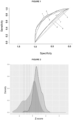
- FIG. 1 shows that the model that uses all the variables, both genotypic risk and the risk associated with all phenotypic factors, including interaction between terms, obtains better sensitivity and specificity values.
- Table 11 shows the Low-Risk data for different values of ⁇ . Table 10. High-Risk Data for different values of ⁇ .
- OR BRM X BRM median of the control population
- the group of women who had been stratified in the populational risk group was not taken into account. Based on this, the calculation of sensitivity (ability to detect cases in the high-risk group) was performed taking into account only the group of women stratified by the BRM global interaction model as high risk (true positives vs false negatives).
- the Cox proportional hazards model was statistically significant with a P-value ⁇ 10 -16 .
- the survival analysis with the Cox proportional hazards model infers or predicts the survival or risk curve for each woman independently. Survival analysis with the Cox proportional hazards model allows to deduce the age intervals at which a high-risk woman will develop breast cancer.
- h(t) is the risk function of breast cancer, dependent on time t and risk factors V i , h 0 (t) is the baseline hazard function, m is the number of risk factors, V i are the risk factors polygenic risk score (PRS), breast density, biopsy, age at menopause, age, family history, age at first child, age-breast density interaction and age- age at menopause interaction and ⁇ i corresponds to the coefficients described above.
- the baseline hazard function is the risk of a subject simply for his age and has a value of 0 for all risk factors.
- Tables 12 and 13 show the results obtained with said survival analysis with the Cox proportional hazards model.
- the age column shows the age at which breast cancer was detected in women.
- the middle column shows the mean obtained with the survival analysis with the Cox proportional hazards model that represents the prediction of the age at which women would develop breast cancer according to the prediction model.
- the difference column shows the difference between the actual age at which breast cancer was detected in women and the prediction.
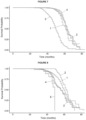
- Figure 10 shows the survival curves inferred with the Cox proportional hazards model for one woman.
- Figure 11 shows the results for another woman.
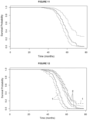
- Figure 12 simultaneously shows the survival curves inferred with the Cox proportional hazards model for two different women. Table 12. Survival prediction results with the Cox proportional hazards model in women in the test group.
Landscapes
- Life Sciences & Earth Sciences (AREA)
- Health & Medical Sciences (AREA)
- Engineering & Computer Science (AREA)
- Chemical & Material Sciences (AREA)
- Physics & Mathematics (AREA)
- Bioinformatics & Cheminformatics (AREA)
- Proteomics, Peptides & Aminoacids (AREA)
- Genetics & Genomics (AREA)
- Organic Chemistry (AREA)
- Analytical Chemistry (AREA)
- General Health & Medical Sciences (AREA)
- Biophysics (AREA)
- Medical Informatics (AREA)
- Biotechnology (AREA)
- Zoology (AREA)
- Bioinformatics & Computational Biology (AREA)
- Theoretical Computer Science (AREA)
- Wood Science & Technology (AREA)
- Pathology (AREA)
- Spectroscopy & Molecular Physics (AREA)
- Evolutionary Biology (AREA)
- Molecular Biology (AREA)
- Immunology (AREA)
- Data Mining & Analysis (AREA)
- General Engineering & Computer Science (AREA)
- Public Health (AREA)
- Computer Vision & Pattern Recognition (AREA)
- Databases & Information Systems (AREA)
- Epidemiology (AREA)
- Evolutionary Computation (AREA)
- Hospice & Palliative Care (AREA)
- Bioethics (AREA)
- Software Systems (AREA)
- Artificial Intelligence (AREA)
- Oncology (AREA)
- Biochemistry (AREA)
- Microbiology (AREA)
- Measuring Or Testing Involving Enzymes Or Micro-Organisms (AREA)
- Investigating Or Analysing Biological Materials (AREA)
Claims (8)
- Procédé in vitro pour déterminer le risque de développer un cancer du sein chez un sujet, dans lequel ledit procédé comprend la combinaison des paramètres suivants dans un modèle :- le score de risque polygénique (PRS) calculé à partir des risques associés à la présence de polymorphismes mononucléotidiques (SNP) dans un échantillon biologique prélevé sur ledit sujet,- le risque associé chez ledit sujet aux facteurs : densité mammaire, biopsie, âge à la ménopause, âge, antécédents familiaux et âge au premier enfant et- le risque associé chez ledit sujet aux interactions âge-densité des seins et âge-âge lors de la ménopause, lesdites interactions étant des interactions obtenues par régression,dans lequel ledit risque de développer un cancer du sein chez ledit sujet est calculé à partir d'un modèle basé sur la combinaison desdits paramètres et dans lequel le résultat obtenu dans ledit modèle est indicatif dudit risque de développer un cancer du sein chez ledit sujet,dans lequel lesdits polymorphismes mononucléotidiques (SNP) sont rs10069690, rs10088218, rs1045485, rs10472076, rs10474352, rs10771399, rs10816625, rs10931936, rs10941679, rs10965163, rs10995190, rs10995201, rs11196174, rs11196175, rs11199914, rs11249433, rs113577745, rs11552449, rs11571833, rs11814448, rs11820646, rs11977670, rs12422552, rs12443621, rs12710696, rs1292011, rs13039229, rs13066793, rs13281615, rs13294895, rs13329835, rs13365225, rs13387042, rs1353747, rs1432679, rs1466785, rs1550623, rs16857609, rs16886113, rs16991615, rs17356907, rs17631303, rs17817449, rs183211, rs184577, rs1895062, rs204247, rs2046210, rs2236007, rs2253407, rs2290203, rs2290854, rs2304277, rs2363956, rs2420946, rs2588809, rs2736108, rs2747652, rs27633, rs2823093, rs2943559, rs2981579, rs2992756, rs344008, rs3757322, rs3760982, rs3803662, rs3903072, rs4442975, rs45631563, rs4691139, rs4733664, rs4784227, rs4808801, rs4849887, rs4973768, rs554219, rs58058861, rs58847541, rs6001930, rs614367, rs616488, rs619373, rs6472903, rs6504950, rs6507583, rs6682208, rs67397200, rs6762644, rs6815814, rs6828523, rs704010, rs7072776, rs720475, rs72749841, rs72755295, rs72826962, rs7297051, rs73161324, rs7529522, rs75915166, rs78269692, rs8009944, rs8170, rs865686, rs889312, rs909116, rs9303542, rs9348512, rs9397437, rs941764, rs9693444, rs9790517, rs9790879, rs9833888, rs527616 et rs2380205,dans lequel la combinaison, dans ledit modèle, du score PRS, du risque associé aux facteurs et du risque associé aux interactions, est réalisée par la formule
 où ORDM est la valeur de l'OR associée à la densité mammaire, ORBIOP est la valeur de l'OR associée à la biopsie, ORE1 est la valeur de l'OR associée à l'âge au premier enfant, ORAF est la valeur de l'OR associée aux antécédents familiaux, OREM est la valeur de l'OR associée à l'âge à la ménopause, E est l'âge, β0, β1, β2, β3, β4, βs, βs, β7, β8 et β9 sont des coefficients déterminés dans ledit modèle avec une cohorte d'entraînement, βl est le coefficient associé au PRS, β2 est le coefficient associé à la densité mammaire, β3 est le coefficient associé à la biopsie, β4 est le coefficient associé à l'âge au premier enfant, β5 est le coefficient associé aux antécédents familiaux, β6 est le coefficient associé à l'âge à la ménopause, β7 est le coefficient associé à l'âge, β8 est le coefficient associé à l'interaction âge-densité mammaire et β9 est le coefficient associé à l'âge-âge à l'interaction ménopausique,dans lequel ledit modèle est un modèle de risques proportionnels de Cox, dans lequel ledit risque de développer un cancer du sein chez un sujet est calculé par la formule
 où h(t) est la fonction de risque du cancer du sein, t est le temps, h0(t) est la fonction de risque de base, m est le nombre de facteurs de risque, Vi sont les facteurs de risque : score de risque polygénique (PRS), densité mammaire, biopsie, âge à la ménopause, âge, antécédents familiaux, âge au premier enfant, interaction âge-densité mammaire et âge-âge à l'interaction ménopausique ; et βi correspond aux coefficients β0-β9.
 - Procédé selon la revendication 1, dans lequel le score PRS est calculé par la formule

- Procédé selon la revendication 1 ou 2, dans lequel les coefficients β1-β9 ont des valeurs comprises entre 0 et 2.
- Procédé selon l'une quelconque des revendications 1 à 3, dans lequel ladite régression est une régression logistique.
- Procédé pour stratifier ou classer des sujets selon le risque de développer un cancer du sein, qui comprend la détermination du risque de développer un cancer du sein chez lesdits sujets selon le procédé de l'une quelconque des revendications 1 à 4 et l'affectation ou la classification de sujets dans des groupes à faible risque, à risque de population et à risque élevé.
- Méthode selon la revendication 5, dans lequel un sujet est assigné ou classifié :- dans le groupe à faible risque si la valeur BRM est égale ou supérieure à 0 et inférieure ou égale à 0,5,- dans le groupe de risque de population lorsque la valeur BRM est supérieure à 0,5 et inférieure à 2,- dans le groupe à haut risque lorsque la valeur BRM est égale ou supérieure à 2.
- Procédé de sélection de sujets à risque de développer un cancer du sein comprenant la détermination du risque de développer un cancer du sein desdits sujets selon le procédé de l'une quelconque des revendications 1 à 4 et la sélection de sujets sur la base de la valeur dudit risque de développer un cancer du sein.
- Procédé selon la revendication 7, dans lequel des sujets affectés ou classés dans un groupe à haut risque sont sélectionnés lorsque la valeur de BRM est égale ou supérieure à 2.
Applications Claiming Priority (2)
| Application Number | Priority Date | Filing Date | Title |
|---|---|---|---|
| EP19382918 | 2019-10-22 | ||
| PCT/EP2020/079612 WO2021078794A1 (fr) | 2019-10-22 | 2020-10-21 | Procédé in vitro permettant de déterminer un risque de développement d'un cancer du sein chez un sujet |
Publications (3)
| Publication Number | Publication Date |
|---|---|
| EP4031688A1 EP4031688A1 (fr) | 2022-07-27 |
| EP4031688B1 true EP4031688B1 (fr) | 2023-07-12 |
| EP4031688C0 EP4031688C0 (fr) | 2023-07-12 |
Family
ID=68583302
Family Applications (1)
| Application Number | Title | Priority Date | Filing Date |
|---|---|---|---|
| EP20801170.0A Active EP4031688B1 (fr) | 2019-10-22 | 2020-10-21 | Procédé in vitro pour déterminer le risque de développement du cancer du sein chez un sujet |
Country Status (3)
| Country | Link |
|---|---|
| EP (1) | EP4031688B1 (fr) |
| CL (1) | CL2022001002A1 (fr) |
| WO (1) | WO2021078794A1 (fr) |
Families Citing this family (2)
| Publication number | Priority date | Publication date | Assignee | Title |
|---|---|---|---|---|
| CN113628749A (zh) * | 2021-08-23 | 2021-11-09 | 北京果壳生物科技有限公司 | 基于机器学习模型进行患病风险预测的方法及系统 |
| WO2023239919A1 (fr) * | 2022-06-10 | 2023-12-14 | Dana-Farber Cancer Institute, Inc. | Un déséquilibre allélique de l'accessibilité de la chromatine dans le cancer identifie des variants de risque causal et leurs mécanismes |
Citations (2)
| Publication number | Priority date | Publication date | Assignee | Title |
|---|---|---|---|---|
| WO2019071322A1 (fr) * | 2017-10-13 | 2019-04-18 | Genetic Technologies Limited | Méthode d'évaluation du risque de développer un cancer du sein |
| WO2019200404A2 (fr) * | 2018-04-13 | 2019-10-17 | Grail, Inc. | Modèle de prédiction de dosages multiples pour la détection du cancer |
Family Cites Families (2)
| Publication number | Priority date | Publication date | Assignee | Title |
|---|---|---|---|---|
| CN102712949B (zh) | 2009-06-01 | 2015-12-16 | 遗传技术有限公司 | 用于乳腺癌风险评估的方法 |
| KR20140098695A (ko) * | 2013-01-31 | 2014-08-08 | 서울대학교산학협력단 | 유방암 발병 위험도 및 확률 예측 방법 |
-
2020
- 2020-10-21 EP EP20801170.0A patent/EP4031688B1/fr active Active
- 2020-10-21 WO PCT/EP2020/079612 patent/WO2021078794A1/fr not_active Ceased
-
2022
- 2022-04-21 CL CL2022001002A patent/CL2022001002A1/es unknown
Patent Citations (2)
| Publication number | Priority date | Publication date | Assignee | Title |
|---|---|---|---|---|
| WO2019071322A1 (fr) * | 2017-10-13 | 2019-04-18 | Genetic Technologies Limited | Méthode d'évaluation du risque de développer un cancer du sein |
| WO2019200404A2 (fr) * | 2018-04-13 | 2019-10-17 | Grail, Inc. | Modèle de prédiction de dosages multiples pour la détection du cancer |
Non-Patent Citations (4)
| Title |
|---|
| CHUNYAN HE ET AL: "Reproductive aging-associated common genetic variants and the risk of breast cancer", BREAST CANCER RESEARCH, CURRENT MEDICINE GROUP LTD, GB, vol. 14, no. 2, 20 March 2012 (2012-03-20), pages R54, XP021125986, ISSN: 1465-5411, DOI: 10.1186/BCR3155 * |
| KARA N MAXWELL ET AL: "Common breast cancer risk variants in the post-COGS era: a comprehensive review", BREAST CANCER RESEARCH, vol. 15, no. 6, 1 December 2013 (2013-12-01), XP055465838, DOI: 10.1186/bcr3591 * |
| MARINA POLLÁN ET AL: "Mammographic density and risk of breast cancer according to tumor characteristics and mode of detection: a Spanish population-based case-control study", BREAST CANCER RESEARCH, CURRENT MEDICINE GROUP LTD, GB, vol. 15, no. 1, 29 January 2013 (2013-01-29), pages R9, XP021147723, ISSN: 1465-5411, DOI: 10.1186/BCR3380 * |
| MITCHELL H. GAIL: "Value of Adding Single-Nucleotide Polymorphism Genotypes to a Breast Cancer Risk Model", JOURNAL OF THE NATIONAL CANCER INSTITUTE, vol. 101, no. 13, 1 July 2009 (2009-07-01), GB, pages 959 - 963, XP055687895, ISSN: 0027-8874, DOI: 10.1093/jnci/djp130 * |
Also Published As
| Publication number | Publication date |
|---|---|
| CL2022001002A1 (es) | 2023-02-17 |
| WO2021078794A1 (fr) | 2021-04-29 |
| EP4031688C0 (fr) | 2023-07-12 |
| EP4031688A1 (fr) | 2022-07-27 |
Similar Documents
| Publication | Publication Date | Title |
|---|---|---|
| JP2021035393A (ja) | 染色体提示の決定 | |
| US20110301863A1 (en) | Prediction method for the screening, prognosis, diagnosis or therapeutic response of prostate cancer, and device for implementing said method | |
| JP7775188B2 (ja) | In vitro受精に関する多遺伝子リスクスコア | |
| KR20160065208A (ko) | 유전적 변이의 비침습 평가를 위한 방법 및 프로세스 | |
| Luo et al. | Recent positive selection signatures reveal phenotypic evolution in the Han Chinese population | |
| US20210285042A1 (en) | Systems and methods for calling variants using methylation sequencing data | |
| US20120309639A1 (en) | Compositions and Methods for Diagnosing Genome Related Diseases and Disorders | |
| EP3662479A1 (fr) | Procédé de détection prénatale non invasive d'anomalies chromosomiques du sexe du foetus et de détermination du sexe du foetus en vue d'une grossesse unique et d'une grossesse gémellaire | |
| US20210102262A1 (en) | Systems and methods for diagnosing a disease condition using on-target and off-target sequencing data | |
| AU2022279367A1 (en) | Methods of assessing risk of developing breast cancer | |
| CN116343902A (zh) | 一种用于复杂疾病多基因遗传风险评估的方法和系统 | |
| JP2024035014A (ja) | 2種以上の検査を実施可能な遺伝学的解析方法 | |
| KR20220013349A (ko) | 검출 한계 기반 품질 제어 메트릭 | |
| CN113053460A (zh) | 用于基因组和基因分析的系统和方法 | |
| EP4031688A1 (fr) | Procédé in vitro permettant de déterminer un risque de développement d'un cancer du sein chez un sujet | |
| WO2013152307A1 (fr) | Panneau d'expression génique pour le pronostic du cancer du sein | |
| Huang et al. | A noninvasive prenatal test pipeline with a well-generalized machine-learning approach for accurate fetal trisomy detection using low-depth short sequence data | |
| JP6564053B2 (ja) | 細胞間または細胞群間の同一人かどうか、他人かどうか、親子かどうか、または血縁関係かどうかの判定方法 | |
| US20190002981A1 (en) | Method of Testing for Preeclampsia and Treatment Therefor | |
| Daoud et al. | Genetic diagnostic testing for inherited cardiomyopathies: considerations for offering multi-gene tests in a health care setting | |
| Grill et al. | A simple-to-use method incorporating genomic markers into prostate cancer risk prediction tools facilitated future validation | |
| KR20240053754A (ko) | 유방암 발병 위험도 예측 장치 및 방법 | |
| CN116895380A (zh) | 基于多因素特征融合的疾病风险预测方法MFF-DeepPRS | |
| CN116469552A (zh) | 一种用于乳腺癌多基因遗传风险评估的方法和系统 | |
| US20160244847A1 (en) | Predicting increased risk for cancer |
Legal Events
| Date | Code | Title | Description |
|---|---|---|---|
| STAA | Information on the status of an ep patent application or granted ep patent |
Free format text: STATUS: UNKNOWN |
|
| STAA | Information on the status of an ep patent application or granted ep patent |
Free format text: STATUS: THE INTERNATIONAL PUBLICATION HAS BEEN MADE |
|
| PUAI | Public reference made under article 153(3) epc to a published international application that has entered the european phase |
Free format text: ORIGINAL CODE: 0009012 |
|
| STAA | Information on the status of an ep patent application or granted ep patent |
Free format text: STATUS: REQUEST FOR EXAMINATION WAS MADE |
|
| 17P | Request for examination filed |
Effective date: 20220422 |
|
| AK | Designated contracting states |
Kind code of ref document: A1 Designated state(s): AL AT BE BG CH CY CZ DE DK EE ES FI FR GB GR HR HU IE IS IT LI LT LU LV MC MK MT NL NO PL PT RO RS SE SI SK SM TR |
|
| DAV | Request for validation of the european patent (deleted) | ||
| DAX | Request for extension of the european patent (deleted) | ||
| GRAP | Despatch of communication of intention to grant a patent |
Free format text: ORIGINAL CODE: EPIDOSNIGR1 |
|
| STAA | Information on the status of an ep patent application or granted ep patent |
Free format text: STATUS: GRANT OF PATENT IS INTENDED |
|
| RIC1 | Information provided on ipc code assigned before grant |
Ipc: G16B 40/20 20190101ALI20230207BHEP Ipc: G16B 20/00 20190101ALI20230207BHEP Ipc: C12Q 1/6886 20180101AFI20230207BHEP |
|
| INTG | Intention to grant announced |
Effective date: 20230314 |
|
| GRAS | Grant fee paid |
Free format text: ORIGINAL CODE: EPIDOSNIGR3 |
|
| GRAA | (expected) grant |
Free format text: ORIGINAL CODE: 0009210 |
|
| STAA | Information on the status of an ep patent application or granted ep patent |
Free format text: STATUS: THE PATENT HAS BEEN GRANTED |
|
| P01 | Opt-out of the competence of the unified patent court (upc) registered |
Effective date: 20230526 |
|
| AK | Designated contracting states |
Kind code of ref document: B1 Designated state(s): AL AT BE BG CH CY CZ DE DK EE ES FI FR GB GR HR HU IE IS IT LI LT LU LV MC MK MT NL NO PL PT RO RS SE SI SK SM TR |
|
| REG | Reference to a national code |
Ref country code: CH Ref legal event code: EP |
|
| REG | Reference to a national code |
Ref country code: IE Ref legal event code: FG4D |
|
| REG | Reference to a national code |
Ref country code: DE Ref legal event code: R096 Ref document number: 602020013843 Country of ref document: DE |
|
| U01 | Request for unitary effect filed |
Effective date: 20230803 |
|
| U07 | Unitary effect registered |
Designated state(s): AT BE BG DE DK EE FI FR IT LT LU LV MT NL PT SE SI Effective date: 20230904 |
|
| P04 | Withdrawal of opt-out of the competence of the unified patent court (upc) registered |
Effective date: 20230830 |
|
| U20 | Renewal fee for the european patent with unitary effect paid |
Year of fee payment: 4 Effective date: 20230905 |
|
| REG | Reference to a national code |
Ref country code: LT Ref legal event code: MG9D |
|
| PG25 | Lapsed in a contracting state [announced via postgrant information from national office to epo] |
Ref country code: GR Free format text: LAPSE BECAUSE OF FAILURE TO SUBMIT A TRANSLATION OF THE DESCRIPTION OR TO PAY THE FEE WITHIN THE PRESCRIBED TIME-LIMIT Effective date: 20231013 |
|
| PG25 | Lapsed in a contracting state [announced via postgrant information from national office to epo] |
Ref country code: ES Free format text: LAPSE BECAUSE OF FAILURE TO SUBMIT A TRANSLATION OF THE DESCRIPTION OR TO PAY THE FEE WITHIN THE PRESCRIBED TIME-LIMIT Effective date: 20230712 |
|
| PG25 | Lapsed in a contracting state [announced via postgrant information from national office to epo] |
Ref country code: IS Free format text: LAPSE BECAUSE OF FAILURE TO SUBMIT A TRANSLATION OF THE DESCRIPTION OR TO PAY THE FEE WITHIN THE PRESCRIBED TIME-LIMIT Effective date: 20231112 |
|
| PG25 | Lapsed in a contracting state [announced via postgrant information from national office to epo] |
Ref country code: RS Free format text: LAPSE BECAUSE OF FAILURE TO SUBMIT A TRANSLATION OF THE DESCRIPTION OR TO PAY THE FEE WITHIN THE PRESCRIBED TIME-LIMIT Effective date: 20230712 Ref country code: NO Free format text: LAPSE BECAUSE OF FAILURE TO SUBMIT A TRANSLATION OF THE DESCRIPTION OR TO PAY THE FEE WITHIN THE PRESCRIBED TIME-LIMIT Effective date: 20231012 Ref country code: IS Free format text: LAPSE BECAUSE OF FAILURE TO SUBMIT A TRANSLATION OF THE DESCRIPTION OR TO PAY THE FEE WITHIN THE PRESCRIBED TIME-LIMIT Effective date: 20231112 Ref country code: HR Free format text: LAPSE BECAUSE OF FAILURE TO SUBMIT A TRANSLATION OF THE DESCRIPTION OR TO PAY THE FEE WITHIN THE PRESCRIBED TIME-LIMIT Effective date: 20230712 Ref country code: GR Free format text: LAPSE BECAUSE OF FAILURE TO SUBMIT A TRANSLATION OF THE DESCRIPTION OR TO PAY THE FEE WITHIN THE PRESCRIBED TIME-LIMIT Effective date: 20231013 Ref country code: ES Free format text: LAPSE BECAUSE OF FAILURE TO SUBMIT A TRANSLATION OF THE DESCRIPTION OR TO PAY THE FEE WITHIN THE PRESCRIBED TIME-LIMIT Effective date: 20230712 |
|
| PG25 | Lapsed in a contracting state [announced via postgrant information from national office to epo] |
Ref country code: PL Free format text: LAPSE BECAUSE OF FAILURE TO SUBMIT A TRANSLATION OF THE DESCRIPTION OR TO PAY THE FEE WITHIN THE PRESCRIBED TIME-LIMIT Effective date: 20230712 |
|
| REG | Reference to a national code |
Ref country code: DE Ref legal event code: R097 Ref document number: 602020013843 Country of ref document: DE |
|
| PG25 | Lapsed in a contracting state [announced via postgrant information from national office to epo] |
Ref country code: SM Free format text: LAPSE BECAUSE OF FAILURE TO SUBMIT A TRANSLATION OF THE DESCRIPTION OR TO PAY THE FEE WITHIN THE PRESCRIBED TIME-LIMIT Effective date: 20230712 Ref country code: RO Free format text: LAPSE BECAUSE OF FAILURE TO SUBMIT A TRANSLATION OF THE DESCRIPTION OR TO PAY THE FEE WITHIN THE PRESCRIBED TIME-LIMIT Effective date: 20230712 Ref country code: CZ Free format text: LAPSE BECAUSE OF FAILURE TO SUBMIT A TRANSLATION OF THE DESCRIPTION OR TO PAY THE FEE WITHIN THE PRESCRIBED TIME-LIMIT Effective date: 20230712 Ref country code: SK Free format text: LAPSE BECAUSE OF FAILURE TO SUBMIT A TRANSLATION OF THE DESCRIPTION OR TO PAY THE FEE WITHIN THE PRESCRIBED TIME-LIMIT Effective date: 20230712 |
|
| PLBE | No opposition filed within time limit |
Free format text: ORIGINAL CODE: 0009261 |
|
| STAA | Information on the status of an ep patent application or granted ep patent |
Free format text: STATUS: NO OPPOSITION FILED WITHIN TIME LIMIT |
|
| PG25 | Lapsed in a contracting state [announced via postgrant information from national office to epo] |
Ref country code: MC Free format text: LAPSE BECAUSE OF FAILURE TO SUBMIT A TRANSLATION OF THE DESCRIPTION OR TO PAY THE FEE WITHIN THE PRESCRIBED TIME-LIMIT Effective date: 20230712 |
|
| REG | Reference to a national code |
Ref country code: CH Ref legal event code: PL |
|
| 26N | No opposition filed |
Effective date: 20240415 |
|
| PG25 | Lapsed in a contracting state [announced via postgrant information from national office to epo] |
Ref country code: CH Free format text: LAPSE BECAUSE OF NON-PAYMENT OF DUE FEES Effective date: 20231031 |
|
| PG25 | Lapsed in a contracting state [announced via postgrant information from national office to epo] |
Ref country code: CH Free format text: LAPSE BECAUSE OF NON-PAYMENT OF DUE FEES Effective date: 20231031 |
|
| U20 | Renewal fee for the european patent with unitary effect paid |
Year of fee payment: 5 Effective date: 20240828 |
|
| PG25 | Lapsed in a contracting state [announced via postgrant information from national office to epo] |
Ref country code: IE Free format text: LAPSE BECAUSE OF NON-PAYMENT OF DUE FEES Effective date: 20231021 |
|
| PG25 | Lapsed in a contracting state [announced via postgrant information from national office to epo] |
Ref country code: IE Free format text: LAPSE BECAUSE OF NON-PAYMENT OF DUE FEES Effective date: 20231021 |
|
| P05 | Withdrawal of opt-out of the competence of the unified patent court (upc) changed |
Free format text: CASE NUMBER: APP_568675/2023 Effective date: 20230904 |
|
| GBPC | Gb: european patent ceased through non-payment of renewal fee |
Effective date: 20241021 |
|
| PG25 | Lapsed in a contracting state [announced via postgrant information from national office to epo] |
Ref country code: GB Free format text: LAPSE BECAUSE OF NON-PAYMENT OF DUE FEES Effective date: 20241021 |
|
| PG25 | Lapsed in a contracting state [announced via postgrant information from national office to epo] |
Ref country code: CY Free format text: LAPSE BECAUSE OF FAILURE TO SUBMIT A TRANSLATION OF THE DESCRIPTION OR TO PAY THE FEE WITHIN THE PRESCRIBED TIME-LIMIT; INVALID AB INITIO Effective date: 20201021 |
|
| PG25 | Lapsed in a contracting state [announced via postgrant information from national office to epo] |
Ref country code: HU Free format text: LAPSE BECAUSE OF FAILURE TO SUBMIT A TRANSLATION OF THE DESCRIPTION OR TO PAY THE FEE WITHIN THE PRESCRIBED TIME-LIMIT; INVALID AB INITIO Effective date: 20201021 |
|
| U20 | Renewal fee for the european patent with unitary effect paid |
Year of fee payment: 6 Effective date: 20250923 |
|
| PG25 | Lapsed in a contracting state [announced via postgrant information from national office to epo] |
Ref country code: TR Free format text: LAPSE BECAUSE OF FAILURE TO SUBMIT A TRANSLATION OF THE DESCRIPTION OR TO PAY THE FEE WITHIN THE PRESCRIBED TIME-LIMIT Effective date: 20230712 |