EP4032206B1 - Vorhersage von bedingungen auf trägerfrequenzen in einem kommunikationsnetz - Google Patents
Vorhersage von bedingungen auf trägerfrequenzen in einem kommunikationsnetz Download PDFInfo
- Publication number
- EP4032206B1 EP4032206B1 EP19945496.8A EP19945496A EP4032206B1 EP 4032206 B1 EP4032206 B1 EP 4032206B1 EP 19945496 A EP19945496 A EP 19945496A EP 4032206 B1 EP4032206 B1 EP 4032206B1
- Authority
- EP
- European Patent Office
- Prior art keywords
- carrier frequencies
- subset
- model
- conditions
- measurements
- Prior art date
- Legal status (The legal status is an assumption and is not a legal conclusion. Google has not performed a legal analysis and makes no representation as to the accuracy of the status listed.)
- Active
Links
Images


Classifications
-
- H—ELECTRICITY
- H04—ELECTRIC COMMUNICATION TECHNIQUE
- H04W—WIRELESS COMMUNICATION NETWORKS
- H04W16/00—Network planning, e.g. coverage or traffic planning tools; Network deployment, e.g. resource partitioning or cells structures
- H04W16/22—Traffic simulation tools or models
-
- H—ELECTRICITY
- H04—ELECTRIC COMMUNICATION TECHNIQUE
- H04W—WIRELESS COMMUNICATION NETWORKS
- H04W36/00—Hand-off or reselection arrangements
- H04W36/0005—Control or signalling for completing the hand-off
- H04W36/0083—Determination of parameters used for hand-off, e.g. generation or modification of neighbour cell lists
- H04W36/0085—Hand-off measurements
-
- G—PHYSICS
- G06—COMPUTING OR CALCULATING; COUNTING
- G06N—COMPUTING ARRANGEMENTS BASED ON SPECIFIC COMPUTATIONAL MODELS
- G06N3/00—Computing arrangements based on biological models
- G06N3/02—Neural networks
- G06N3/04—Architecture, e.g. interconnection topology
- G06N3/0499—Feedforward networks
-
- G—PHYSICS
- G06—COMPUTING OR CALCULATING; COUNTING
- G06N—COMPUTING ARRANGEMENTS BASED ON SPECIFIC COMPUTATIONAL MODELS
- G06N3/00—Computing arrangements based on biological models
- G06N3/02—Neural networks
- G06N3/08—Learning methods
- G06N3/09—Supervised learning
-
- G—PHYSICS
- G06—COMPUTING OR CALCULATING; COUNTING
- G06N—COMPUTING ARRANGEMENTS BASED ON SPECIFIC COMPUTATIONAL MODELS
- G06N3/00—Computing arrangements based on biological models
- G06N3/02—Neural networks
- G06N3/08—Learning methods
- G06N3/098—Distributed learning, e.g. federated learning
-
- H—ELECTRICITY
- H04—ELECTRIC COMMUNICATION TECHNIQUE
- H04B—TRANSMISSION
- H04B17/00—Monitoring; Testing
- H04B17/30—Monitoring; Testing of propagation channels
- H04B17/373—Predicting channel quality or other radio frequency [RF] parameters
-
- H—ELECTRICITY
- H04—ELECTRIC COMMUNICATION TECHNIQUE
- H04B—TRANSMISSION
- H04B17/00—Monitoring; Testing
- H04B17/30—Monitoring; Testing of propagation channels
- H04B17/391—Modelling the propagation channel
- H04B17/3913—Predictive models, e.g. based on neural network models
-
- H—ELECTRICITY
- H04—ELECTRIC COMMUNICATION TECHNIQUE
- H04L—TRANSMISSION OF DIGITAL INFORMATION, e.g. TELEGRAPHIC COMMUNICATION
- H04L5/00—Arrangements affording multiple use of the transmission path
- H04L5/0001—Arrangements for dividing the transmission path
- H04L5/0003—Two-dimensional division
- H04L5/0005—Time-frequency
- H04L5/0007—Time-frequency the frequencies being orthogonal, e.g. OFDM(A) or DMT
- H04L5/001—Time-frequency the frequencies being orthogonal, e.g. OFDM(A) or DMT the frequencies being arranged in component carriers
-
- H—ELECTRICITY
- H04—ELECTRIC COMMUNICATION TECHNIQUE
- H04L—TRANSMISSION OF DIGITAL INFORMATION, e.g. TELEGRAPHIC COMMUNICATION
- H04L5/00—Arrangements affording multiple use of the transmission path
- H04L5/003—Arrangements for allocating sub-channels of the transmission path
- H04L5/0048—Allocation of pilot signals, i.e. of signals known to the receiver
-
- H—ELECTRICITY
- H04—ELECTRIC COMMUNICATION TECHNIQUE
- H04L—TRANSMISSION OF DIGITAL INFORMATION, e.g. TELEGRAPHIC COMMUNICATION
- H04L5/00—Arrangements affording multiple use of the transmission path
- H04L5/003—Arrangements for allocating sub-channels of the transmission path
- H04L5/0058—Allocation criteria
-
- H—ELECTRICITY
- H04—ELECTRIC COMMUNICATION TECHNIQUE
- H04W—WIRELESS COMMUNICATION NETWORKS
- H04W24/00—Supervisory, monitoring or testing arrangements
- H04W24/08—Testing, supervising or monitoring using real traffic
-
- H—ELECTRICITY
- H04—ELECTRIC COMMUNICATION TECHNIQUE
- H04W—WIRELESS COMMUNICATION NETWORKS
- H04W76/00—Connection management
- H04W76/10—Connection setup
-
- G—PHYSICS
- G06—COMPUTING OR CALCULATING; COUNTING
- G06N—COMPUTING ARRANGEMENTS BASED ON SPECIFIC COMPUTATIONAL MODELS
- G06N20/00—Machine learning
-
- G—PHYSICS
- G06—COMPUTING OR CALCULATING; COUNTING
- G06N—COMPUTING ARRANGEMENTS BASED ON SPECIFIC COMPUTATIONAL MODELS
- G06N3/00—Computing arrangements based on biological models
- G06N3/02—Neural networks
- G06N3/08—Learning methods
-
- G—PHYSICS
- G06—COMPUTING OR CALCULATING; COUNTING
- G06N—COMPUTING ARRANGEMENTS BASED ON SPECIFIC COMPUTATIONAL MODELS
- G06N5/00—Computing arrangements using knowledge-based models
- G06N5/01—Dynamic search techniques; Heuristics; Dynamic trees; Branch-and-bound
-
- H—ELECTRICITY
- H04—ELECTRIC COMMUNICATION TECHNIQUE
- H04W—WIRELESS COMMUNICATION NETWORKS
- H04W36/00—Hand-off or reselection arrangements
- H04W36/0005—Control or signalling for completing the hand-off
- H04W36/0055—Transmission or use of information for re-establishing the radio link
- H04W36/0069—Transmission or use of information for re-establishing the radio link in case of dual connectivity, e.g. decoupled uplink/downlink
- H04W36/00692—Transmission or use of information for re-establishing the radio link in case of dual connectivity, e.g. decoupled uplink/downlink using simultaneous multiple data streams, e.g. cooperative multipoint [CoMP], carrier aggregation [CA] or multiple input multiple output [MIMO]
-
- H—ELECTRICITY
- H04—ELECTRIC COMMUNICATION TECHNIQUE
- H04W—WIRELESS COMMUNICATION NETWORKS
- H04W36/00—Hand-off or reselection arrangements
- H04W36/16—Performing reselection for specific purposes
- H04W36/22—Performing reselection for specific purposes for handling the traffic
-
- H—ELECTRICITY
- H04—ELECTRIC COMMUNICATION TECHNIQUE
- H04W—WIRELESS COMMUNICATION NETWORKS
- H04W72/00—Local resource management
- H04W72/50—Allocation or scheduling criteria for wireless resources
- H04W72/54—Allocation or scheduling criteria for wireless resources based on quality criteria
Definitions
- This disclosure relates to methods, nodes and systems in a communications network. More particularly but non-exclusively, the disclosure relates to predicting conditions on carrier frequencies in a communications network.
- a user equipment can be connected to one or more radio nodes, and supported by one or more core network nodes. Furthermore, the UE may be served via one or more frequency carriers, and one or more radio access technologies, as will be explained further below.
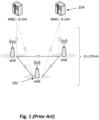
- a simplified architecture of an example LTE communications network is shown in Fig. 1 , including radio access nodes (e.g. evolved Node Bs which may be referred to as eNode Bs or eNB) 102 and evolved packet core nodes (e.g. a mobile management entity, MME or Serving Gateway, S-GW) 104.
- radio access nodes e.g. evolved Node Bs which may be referred to as eNode Bs or eNB
- evolved packet core nodes e.g. a mobile management entity, MME or Serving Gateway, S-GW
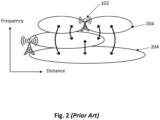
- Load balancing is a technique to balance the traffic load between overlaid cells 204 in the network in order to utilize the capacity on the different frequency layers.
- Potential opportunities for load balancing e.g. transfer of load between cells are illustrated with arrows in Fig. 2 .
- Each eNode B assesses the traffic load in its cells.
- the traffic load information is exchanged between the cells, after which a load balancing algorithm identifies whether there is a need to move users between the cells in order to balance the traffic load. If there is a need to move users in order to balance the traffic load, users are selected and ordered to perform inter-frequency measurements in order to be moved in some way (handover, release with redirect, etc.).
- a UE may be configured to transmit and/or receive data via more than one frequency layer/carrier from the same radio node. This is known as carrier aggregation (CA). Furthermore a UE may be configured to transmit/or receive data across two or more different nodes, which is known as dual connectivity (DC). DC enables the establishment of user plane connections via another radio node, referred to as a secondary eNB (SeNB), while maintaining the higher layer connection management (e.g. radio resource management, RRC) via a master eNB (MeNB).
- SANB secondary eNB
- RRC radio resource management
- MeNB master eNB
- a UE in idle mode can be instructed to perform radio resource management (RRM) measurements for certain target carriers using information element (IE) MeasIdleConfig from Rel-15 onwards.
- IE information element
- SIB5 System Information block Type 5
- SIB5 System Information block Type 5
- the UE is also provided with a timer that indicates the validity duration of this dedicated signaling.
- the IE MeasIdleConfig is used to convey information to the UE about measurements requested to be done while in RRC_IDLE. It has the following format:
- Load balancing is used to move users from over-crowded cells to underutilised cells, to ensure that network capacity is used as optimally as possible.
- load balancing is to choose users to move from one cell (the source cell) that is highly loaded to another cell (the target cell) that is under-utilized.
- Each unqualified load balancing inter-frequency measurement is a waste of resources such as signaling, processing, UE battery consumption and user performance.
- the disadvantage is two-fold: many users will spend measurement resources unnecessarily and the cell will stay in a high-load situation longer.
- Aggregation features such as CA and DC as described above also share the need to understand radio conditions on other carriers for an individual user.
- One challenge with these features is to find and assign appropriate secondary cells. Choosing an unsuitable cell may not provide aggregation gains while still having the cost of initiating aggregation in terms of signaling, processing, memory, UE battery consumption etc.
- NR new radio
- NR new radio
- f 1 , f 2 ,..., f N the network operator would ideally know the radio conditions on all available N carrier frequencies before making a load balancing decision, however it can only instruct the UE to measure and report on, at most, 8 carriers in idle mode.
- a method in a communications network for determining a first model for use in predicting conditions on carrier frequencies in the communications network.
- the method comprises obtaining measurements of conditions on a plurality of carrier frequencies, and determining a first model based on the obtained measurements that takes as input the conditions on a first subset of the plurality of carrier frequencies and outputs a prediction of the conditions on a second subset of the plurality of carrier frequencies, based on the conditions of the first subset of carrier frequencies.
- a method in a communications network for determining conditions on carrier frequencies in the communications network comprises determining a first subset of a plurality of carrier frequencies, the first subset of carrier frequencies being for use in predicting conditions on a second subset of the plurality of carrier frequencies, providing conditions on the first subset of the plurality of carrier frequencies to a first model, and receiving from the first model a prediction of the conditions on the second subset of the plurality of carrier frequencies.
- Some embodiments herein therefore enable the network, or UE to determine network conditions on many (e.g. potentially all available) secondary target carriers, based on the 8 target carriers that the UE is able to perform measurement reporting on in idle mode.
- the network can predict the coverage on each carrier and perform improved load balancing and admission control without the need for the UE to individually request conditions on each carrier frequency. This reduces signaling overhead and facilitates a reduced number of inter-frequency measurements per user equipment.
- a node in a communications network comprising a processor and a memory.
- the memory contains instructions executable by the processor and the set of instructions, when executed by the processor, cause the processor to: obtain measurements of conditions on a plurality of carrier frequencies, and determine a first model based on the obtained measurements that takes as input the conditions on a first subset of the plurality of carrier frequencies and outputs a prediction of the conditions on a second subset of the plurality of carrier frequencies, based on the conditions of the first subset of carrier frequencies.
- a node in a communications network comprising a processor and a memory.
- the memory contains instructions executable by the processor and the set of instructions, when executed by the processor, cause the processor to: determine a first subset of a plurality of carrier frequencies, the first subset of carrier frequencies being for use in predicting conditions on a second subset of the plurality of carrier frequencies, provide conditions on the first subset of the plurality of carrier frequencies to a first model, and receive from the first model a prediction of the conditions on the second subset of the plurality of carrier frequencies.
- a user equipment comprising a processor and a memory, said memory containing instructions executable by said processor.
- the memory contains instructions executable by the processor and the set of instructions, when executed by the processor, cause the processor to: obtain measurements of conditions on a plurality of carrier frequencies, and determine a first model based on the obtained measurements that takes as input the conditions on a first subset of the plurality of carrier frequencies and outputs a prediction of the conditions on a second subset of the plurality of carrier frequencies, based on the conditions of the first subset of carrier frequencies.
- a user equipment comprising a processor and a memory.
- the memory contains instructions executable by the processor and the set of instructions, when executed by the processor, cause the processor to: determine a first subset of a plurality of carrier frequencies, the first subset of carrier frequencies being for use in predicting conditions on a second subset of the plurality of carrier frequencies; provide conditions on the first subset of the plurality of carrier frequencies to a first model, and receive from the first model a prediction of the conditions on the second subset of the plurality of carrier frequencies.
- a seventh aspect there is a computer program product comprising a computer readable medium, the computer readable medium having computer readable code embodied therein, the computer readable code being configured such that, on execution by a suitable computer or processor, the computer or processor is caused to perform the method of the first or second aspects.
- the network operator When performing load balancing decisions and deciding whether to move a subscriber to another carrier frequency, assuming that there are N carrier frequencies available for a network operator, denoted by f 1 , f 2 ,..., f N , the network operator would ideally know the radio conditions on all available N carrier frequencies before making a load balancing decision, however it can only instruct the UE to measure and report on, at most, 8 carriers in idle mode. It is an object of embodiments herein to address this issue.
- embodiments here describe methods and apparatus for i) determining one or more models with which to map or predict the quality on one or more frequencies to the quality of one or more (other) frequencies, ii) determine one or more models for determining a suitable measurement configuration for the target carriers, including, for example, the number of measurements, the frequency and in case of dedicated measurement configuration the validity duration of the configuration, and iii) estimate the radio conditions on all available carriers using the measurement reports received on the subset of carriers determined in the first step.
- some embodiments herein describe determining a predictive model (or function) that may take received measurement reports, e.g., UE measurements on carrier frequencies ⁇ f x ,f y ,f z ⁇ , as input and output a prediction of radio conditions on all N available carrier frequencies.
- Fig. 3 illustrates a method 300 in a communications network for determining a first model for use in predicting conditions on carrier frequencies in the communications network.
- the method 300 comprises in a first block 302 obtaining measurements of conditions on a plurality of carrier frequencies.
- the method comprises determining a first model based on the obtained measurements that takes as input the conditions on a first subset of the plurality of carrier frequencies and outputs a prediction of the conditions on a second subset of the plurality of carrier frequencies, based on the conditions of the first subset of carrier frequencies.
- the communications network may comprise any one, or any combination of: a wired link (e.g. ASDL) or a wireless link such as Global System for Mobile Communications (GSM), Wideband Code Division Multiple Access (WCDMA), Long Term Evolution (LTE), WiFi, or Bluetooth wireless technologies.
- GSM Global System for Mobile Communications
- WCDMA Wideband Code Division Multiple Access
- LTE Long Term Evolution
- WiFi Wireless Fidelity
- the method 300 may be performed, for example, by a network node in a communications network such as the network node 600 described below.
- the network node may comprise any component or network function (e.g. any hardware or software module) in the communications network suitable for making load balancing decisions, for example, in Carrier Aggregation or Dual Connectivity.
- a node may comprise equipment capable, configured, arranged and/or operable to communicate directly or indirectly with a UE (such as a wireless device) and/or with other network nodes or equipment in the communications network to enable and/or provide wireless or wired access to the UE and/or to perform other functions (e.g., administration) in the communications network.
- nodes include, but are not limited to, access points (APs) (e.g., radio access points), base stations (BSs) (e.g., radio base stations, Node Bs, evolved Node Bs (eNBs) and NR NodeBs (gNBs)).
- APs access points
- BSs base stations
- eNBs evolved Node Bs
- gNBs NR NodeBs
- core network functions such as, for example, core network functions in a Fifth Generation Core network (5GC), such as Access and Mobility Management function (AMF), Session Management function (SMF) and Network Slice Selection Function (NSSF).
- AMF Access and Mobility Management function
- SMF Session Management function
- NSSF Network Slice Selection Function
- the method 300 may be performed by a user equipment, UE (e.g. a device or terminal) such as the UE 700 as described below.
- UE e.g. a device or terminal
- Examples of UEs include, but are not limited to, mobile phones, desktop computers, laptop computers, tablet computers and wearable technology such as fitness trackers or iwatches.
- the method may comprise obtaining one or more measurements based on downlink signals on a set of carriers. For example, these may be based on, for example, associated measurement reports, uplink signals and/or dedicated measurements. In some embodiments, obtaining one or more measurements may comprise obtaining UE specific information such as geographical position.
- the measurements of conditions may indicate the radio quality on a carrier and may be suitable for use in making a load-balancing decision, or for selecting carriers for use in Carrier Aggregation and/or Dual Connectivity.
- RSRP Reference Signal Received Power
- RSRQ Reference Signal Received Quality
- SINR Signal to Interference and Noise Ratio
- a UE may be set to obtain such measurements whilst in idle mode.
- a network node may set the UE's idle mode measurement configuration to make measurements that can be used to build or train the first model.
- a plurality of UEs may make measurements on a plurality of carriers (including the first subset of carriers and the second subset of carriers), or the carriers where no accurate model is built.
- the network can have built an accurate model using f1, f2 for predicting f3. But not from f1, f2 for predicting f4, in this case the UE is configured to measure on frequency f1, f2, f4 in idle mode. This will thus enable the network to predict the third frequency, and build a model between f1, f2 to f4.
- determining a first model comprises determining a mapping function between carriers that can be used to map the conditions on one or more carriers to conditions on one or more other carriers.
- determining a first model may comprise training a machine learning model to predict the conditions on the second subset of the plurality of carrier frequencies based on the conditions on the first subset of the plurality of carrier frequencies using the obtained measurements as training data.
- machine learning and machine learning models that can be used to predict conditions on a second subset of carrier frequencies based on a first set of carrier frequencies.
- appropriate machine learning models include, but are not limited to: decision trees or neural networks.
- neural networks are a type of supervised machine learning model that can be trained to predict a desired output for given input data.
- Neural networks are trained by providing training data comprising example input data and the corresponding "correct" or ground truth outcome that is desired.
- Neural networks comprise a plurality of layers of neurons, each neuron representing a mathematical operation that is applied to the input data. The output of each layer in the neural network is fed into the next layer to produce an output. For each piece of training data, weights associated with the neurons are adjusted until the optimal weightings are found that produce predictions for the training examples that reflect the corresponding ground truths.
- the training data may comprise the conditions on the first subset of the plurality of carrier frequencies and the ground truths may comprise actual conditions on the second subset of the plurality of carrier frequencies. In this way the ground truths are example (correct) outputs for the example inputs.
- Decision trees also known as classification trees or regression trees, are supervised learning methods used to create a model that predicts the value of a target variable by learning simple decision rules inferred from the data features. To predict a response, a leaf node is to be reached from the root node by following a sequence of criteria.
- the first model may comprise a plurality of sub-models, for example, the number of which may depend on the number of carrier frequencies, the accuracy requirements, and the correlation between frequencies. For example, in an embodiment where there are three carrier frequencies, a model could be built from f1,f2 -> f3, the UE would in this case perform idle mode measurements on f1,f2. The UE could also measure only on f1, and predict f2, f3 from f1. The uncertainty will be higher in this scenario since both f2 and f3 are estimated. However, the network can set the idle mode measurement configuration to trade-off between the required prediction accuracy of the three frequencies (f1,f2,f3), and the UE measurement overhead.
- N frequencies are available (f1,... ,fN), and the UE is capable of measuring M frequencies
- M ⁇ N the sub-models that can be built are: Each combinations of M carriers to predict remaining N-M carriers. If M>N the models that can be built are:
- the network may configure the UE with m frequencies where m ⁇ M, in which case the network can configure different combinations for m to predict different combinations /number of carriers, and evaluate the accuracy:
- the output prediction of conditions on the second subset of the plurality of carrier frequencies may comprise, for example, an indication of a signal quality on a carrier such as SINR, RSRP or RSRQ; an accuracy metric, e.g. such as a root mean squared error; a probability of signal quality above a threshold on a carrier; or an accuracy metric such as a measure of logarithmic loss (Logloss).
- a signal quality on a carrier such as SINR, RSRP or RSRQ
- an accuracy metric e.g. such as a root mean squared error
- a probability of signal quality above a threshold on a carrier e.g.
- an accuracy metric e.g. such as a measure of logarithmic loss (Logloss).
- Logloss logarithmic loss
- the method may comprise training the first model to predict conditions on the remaining N-M carrier frequencies.
- the method may further comprise training the first model to predict conditions on the remaining N-M carrier frequencies for each possible combination of M carrier frequencies.
- the method may further comprise training the first model to predict conditions on the remaining N-M carrier frequencies for each possible value of M.
- a model may be used to predict conditions on any carrier frequency from conditions on any other carrier frequency, or combination of carrier frequencies.
- the number of carrier frequencies in the first subset of the plurality of carrier frequencies may comprise the maximum number of frequencies on which measurements may be reported in idle mode by a user equipment. As such, this enables the conditions on any number of other carrier frequencies to be predicted, based on this fixed number of carrier measurements.
- the second subset of the plurality of carrier frequencies may comprise frequencies available to the UE for a load balancing, CA or DC orchestration operation.
- the first model may then be used to predict, from measurements made on the maximum number of frequencies (e.g. 8 frequencies) on which measurements may be reported in idle mode by a user equipment, the conditions on the frequencies available to the UE for the load balancing, CA or DC orchestration operation.
- the second subset of the plurality of carrier frequencies may comprise all carrier frequencies available to the user equipment.
- the first model may be used to predict, from measurements made on the maximum number of frequencies (e.g. 8 frequencies) on which measurements may be reported in idle mode by a user equipment, the conditions on all of the other carrier frequencies available to the user equipment.
- the training may be performed completely by a network node, for example, the network node may determine or train the first model based on training data as described above.
- the method may be performed in a distributed manner such that some training is performed by a plurality of individual UEs.
- the training may be coordinated and combined into a single model by a network node.
- the method may further comprise: sending details of the first model to a user equipment such that the user equipment may create a local version of the first model on the user equipment and train the local model, based on measurements of conditions on the plurality of carrier frequencies as measured by the user equipment.
- the network node may subsequently receive from the user equipment an indication of an outcome of the training of the local model performed by the user equipment and update the first model based on the received outcome. In this way the training of the first model may be distributed facilitating training based on a much wider training data set and conditions.
- the UE may receive an indication of a type of model and/or parameters for said model from a network node in order for the UE to establish a local copy of the first model.
- the UE may train the local copy of the first model on data acquired by the UE, and send trained/updated parameters to the network node.
- the Network Node can collect feedback from different UEs to further enhance its prediction models.
- the feedback can be transmitted in the form of trained models that can be used to improve the centralized first model or verify prediction accuracy.
- the UE may reply with a trained Machine learning model.
- This approach allows the incorporation of many simple models from UEs to boost prediction performance, moreover, it is possible to include sensitive information such as radio and/or geographical position as an input to the model, that may not be available to the network node.
- the UE may:
- the method further comprises determining the accuracy of the predicted conditions on each of the second subset of the plurality of carrier frequencies.
- determining the accuracy of the output of the first model The accuracy may, for example, be determined based on the number of times the model accurately (e.g. within a tolerance) predicts the conditions on a carrier frequency, compared to the total number of samples.
- the method may further comprise determining a validity period for the predicted conditions on each of the second subset of the plurality of carrier frequencies.
- the validity period may comprise a timer that indicates how long the UE may use this configuration. In this way, when a prediction is made by the first model the accuracy and duration for which the prediction applies may be provided to the UE, such that the most appropriate load balancing decisions may be made.
- the first model can enable conditions on any carrier frequency to be determined (or estimated) from any combination of other carrier frequency measurements.
- some combinations of input parameters e.g. using certain combinations of the plurality of carrier frequencies as the first subset of the plurality of carrier frequencies
- a method 400 of determining a measurement configuration for target carriers This method is illustrated in Fig. 4 .
- a method of determining which frequencies should be comprised in the first subset of the plurality of carrier frequencies in order to best predict the conditions on the second subset of carrier frequencies may be, for example, to determine a suitable measurement configuration that enables radio conditions to be estimated on all carrier frequencies (e.g. all carrier frequencies available to a UE), based on the restricted number of carrier frequencies on which the UE can measure (e.g. the maximum eight), using the first model as described above.
- the purpose of such a method may be, for example, to determine a suitable measurement configuration that enables radio conditions to be estimated on carrier frequencies available to the UE for a load balancing, CA or DC orchestration operation to be determined, based on measurements on the restricted number of carrier frequencies on which the UE can measure (e.g. the maximum eight), using the first model as described above.
- a measurement configuration may comprise, for example, an indication of the number of measurements that should be made by a UE, the carrier frequencies on which the measurements should be made, and in embodiments of dedicated measurement configuration, an indication how long the measurement configuration is estimated to be valid for (e.g. a validity duration).
- a measurement configuration may comprise an IDLE model measurement configuration for a UE, describing measurements to be made by a UE as part of an early measurement based setup procedure (as described in Rel-15).
- a machine learning model may be used to determine the measurement configuration.
- the method 400 may comprise in a block 402(or the method 300 may further comprise) determining a second model wherein the second model takes as input an indication of each of the frequencies in the second subset of the plurality of carrier frequencies and outputs a measurement configuration indicating an IDLE mode measurement configuration for a UE that may be used to collect measurements that may be provided as input to the first model.
- the second model may take as input a list of carrier frequencies.
- the list of carrier frequencies may comprise an indication of one or more carrier frequencies for which it is desired to know the conditions on.
- a list of carrier frequencies for which it is desired to know the conditions on for example, so that a load balancing, CA or DC orchestration decision may be made.
- the list of carrier frequencies may comprise an indication of each of the frequencies in the second subset of the plurality of carrier frequencies.
- the second model may output a measurement configuration indicating an IDLE mode measurement configuration for a UE that may be used to collect measurements that may be provided as input to the first model such that the first model may predict the conditions on the carrier frequencies in the list of carrier frequencies (e.g. the second subset of the plurality of carrier frequencies) in an optimal manner.
- the second model may output a measurement configuration comprising a configuration for a MeasIdleConfig information element (IE) as described above, such as, for example, MeasIdleConfigSIB-r15 and/or MeasldleConfigDedicated-r15
- IE MeasIdleConfig information element
- the second machine learning model may comprise any type of machine learning model can be trained to take as input a list of carrier frequencies as described above and output a measurement configuration indicating an IDLE mode measurement configuration for a UE that may be used by the UE to collect measurements that may be provided as input to the first model such that the first model may predict the conditions on the carrier frequencies in the list of carrier frequencies. Examples of machine learning models suitable for such a purpose were described above with respect to the first machine learning model and the details therein apply equally to the second machine learning model.
- the output IDLE mode configuration may be used to collect measurements that may be input to the first model and used by the first model in order to determine conditions on all available carrier frequencies available to the UE. In some embodiments, the output IDLE mode configuration may be used to collect measurements that may be input to the first model and used by the first model in order to determine conditions on carrier frequencies available to the UE for use in a load balancing, CA or DC operation.
- the second model may further take other parameters, such as an accuracy requirement for a prediction made by the first model.
- An accuracy requirement may indicate, for example, that all predictions should be above a threshold accuracy; that estimations of conditions of particular frequencies should be above a threshold accuracy, or within a threshold range.
- An accuracy requirement may also indicate particular carrier frequencies where a high level of accuracy is not required. Such accuracy requirements may have a technical effect on the determined configuration and enable predictions to be made more optimally, for example, by achieving a desired accuracy of prediction based on the fewest number of input carrier frequency measurements. For example, in an example embodiment, if the second subset of carrier frequencies comprises 20 frequencies (e.g.
- the UE may need to be configured to make measurements on 8 frequencies; however if only a 50% accuracy level is required, then three carriers may be sufficient to predict the other 20 carriers.
- Examples of other input parameters that may be provided to the second model include but are not limited to: load information on one or more of the carrier frequencies, and/or geographical information related to the location of the UE making the measurements.
- the second model may be trained using the same training data as that used to train the first machine learning model (e.g. the training data may be re-used).
- UE specific information such as radio and/or geographical position may additionally be provided.
- Training data may generally comprise measurements based on downlink signals at a set of carriers and measurement reports, optionally uplink signals and associated measurements. It is also possible to include device specific information such as radio and/or geographical position.
- the output of the second model may comprise one or more frequencies that the UE should report on in IDLE mode, for example, an output may comprise ⁇ fx,fy,fz ⁇ meaning that three target carrier frequencies fx, fy and fz should be configured for measurement and reporting.
- the outcome may be of the form ⁇ f a ,f b ,T ⁇ , indicating that the carrier frequencies f a and f b should be configured for measurement and reporting for a duration of T seconds.
- an appropriate measurement configuration may be determined for a UE in order for the UE to make measurements in IDLE mode that may be provided to the first model for use in predicting conditions on carrier frequencies available to the UE.
- These measurements and predictions may be used in a load balancing, CA or DC operation, for example.
- the use of machine learning models allows the measurement configuration to be determined based on much more complex data, including load information and geographic location.
- the method comprises in a first block 502 determining a first subset of a plurality of carrier frequencies, the first subset of carrier frequencies being for use in predicting conditions on a second subset of the plurality of carrier frequencies.
- the method comprises providing conditions on the first subset of the plurality of carrier frequencies to a first model.
- the method then comprises receiving from the first model a prediction of the conditions on the second subset of the plurality of carrier frequencies.
- the method 500 may be used, for example, in configuring a UE to make measurements on an appropriate first subset of carrier frequencies, such that conditions on the remaining carrier frequencies available to it may be determined (e.g. estimated or predicted). In this way, from a smaller number of measurements, the conditions on all carrier frequencies available to the UE may be determined and this information may be used to choose appropriate carrier frequencies for performing carrier aggregation and/or dual connectivity processes and/or to make improved load balancing decisions.
- the method 500 may be performed by a node in the communications network such as the node 600 as described below.
- nodes were also described above with respect to the method 300 and the details therein will be understood to apply equally to the method 500.
- the first model was described in detail above with respect to the method 300 and the details therein will be understood to apply equally to the method 500.
- Block 502 may comprise determining the first subset of the plurality of carrier frequencies using a machine learning model such as the second machine learning model as described above with respect to the method 300.
- a machine learning model such as the second machine learning model as described above with respect to the method 300.
- the details of the second machine learning model described above with respect to the method 300 will be understood to apply equally to the method 500.
- determining a first subset of the plurality of carrier frequencies may thus comprise providing an indication of the frequencies in the second subset of carrier frequencies to a second machine learning model as input, and receiving from the second machine learning model a measurement configuration indicating an IDLE mode measurement configuration for a UE that may be used to collect measurements that may be provided as input to the first model in order for the first machine learning model to predict the conditions on the second subset of the plurality of carrier frequencies.
- the first subset of carrier frequencies may be determined based on an accuracy of the first model at predicting the conditions on the second subset of the plurality of carrier frequencies from the conditions on the first subset of the plurality of carrier frequencies. For example, the accuracy of the first model at predicting the conditions on the second subset of the carrier frequencies from the first subset of carrier frequencies may be provided as an input parameter to the second model.
- the first subset of carrier frequencies may be selected such that the accuracy of the first model at predicting the conditions on each carrier frequency in the second subset of the plurality of carrier frequencies is above a threshold accuracy; or to provide the highest accuracy predictions of the conditions on each of the second subset of the plurality of carrier frequencies from the conditions on the first subset of carrier frequencies.
- the carrier frequencies comprised in the second subset of carrier frequencies comprise carrier frequencies on which the resource load is below a threshold (e.g. where the load is considered to be "low”).
- the first subset of carriers may be restricted in number to the maximum number of frequencies on which measurements may be reported in idle mode by a user equipment. This may be eight frequencies, for example.
- the selection of the first subset of carrier frequencies can be based on a trade-off between the performance of the first model and the number of frequencies required and the combination of frequencies.
- the combination of frequencies can be significant as some combinations of frequencies can result in a higher (predictive) performance of the first model than others.
- the performance of the first model can be expressed in different ways, such as mean absolute error, mean squared error, variance, AUC, etc, depending on if regression or classification is used.
- the measurement configuration could be chosen such that the performance of the first model is above a certain threshold with as few carriers as possible. Note that the choice of carriers can also impact the configuration duration, T. In some embodiments, configurations are only accepted if they are at least valid for T k seconds.
- the selection of the first subset of carrier frequencies may be based on which carrier frequencies can be used by the first model to provide predictions with the highest accuracy on the remaining carriers.
- the method may comprise obtaining conditions on the first subset of the plurality of carrier frequencies.
- the output measurement configuration provided by the second model may be sent to the UE in order for the UE to determine (e.g. measure) conditions on the first subset of the plurality of carrier frequencies.
- the measurement configuration may be sent to the UE, in a MeasIdleConfig IE, for example.
- the obtained conditions may then be provided to the first model.
- the method then comprises receiving from the first model a prediction of the conditions on the second subset of the plurality of carrier frequencies.
- the method 500 may further comprise making a scheduling decision, based on the output of the first model.
- the method 500 may further comprise sending the prediction of the conditions on the second subset of the plurality of carrier frequencies from the first model to the user equipment for use by the user equipment to determine a carrier frequency or frequencies to connect to, for example, as part of a CA, DC or other load balancing decision.
- Such operations may be performed based on a better understanding of the conditions on available frequency carriers.
- a network node may determine a carrier frequency for the user equipment to connect to, based on the prediction of the conditions on the second subset of the plurality of carrier frequencies from the first model. The network node may send this to the user equipment for the user equipment to initiate a connection to the determined carrier frequency.
- block 502 may be performed by a network node.
- the network node may send an indication of the first subset of a plurality of carrier frequencies (e.g. a measurement configuration determined by the second model), and details of the first model to the UE.
- the UE may then make measurements on the conditions on the first plurality of carrier frequencies as described in the measurement configuration and provide the measurements to a local copy of the first model (e.g. the UE may perform blocks 502 and 504).
- the measurement configuration and first model can be sent either via broadcasting of system information or via dedicated signaling.
- the method 500 may therefore comprise a UE receiving an indication of one or more parameters from a node in the communications network, and using the one or more parameters to determine the first model, for example, to create a local copy of the model.
- the first model could be sent to a UE using a modified MeasIdleConfig information element with the following format:
- the measurement configuration may be broadcasted by the network node using a (dedicated) system information message, denoted by SystemlnformationBlockType-xx of the following format:
- the IE SystemlnformationBlockType-xx contains information relevant for different machine learning model that can be applied by UEs in different scenarios.
- An example of a corresponding MeasIdleConfig IE in an embodiment where SystemlnformationBlockType-xx is broadcast, is as follows:
- the UE may perform measurements on given frequencies (f1,f2...,fN) and apply the measurements to the second machine learning model to output an appropriate measurement configuration for the UE.
- the second machine learning model outputs a measurement configuration for the UE comprising the first subset of the plurality of carrier frequencies e.g. (fO1, fO2).
- the UE may then perform measurements on the first subset of the plurality of carrier frequencies and save the measurements for cell(s) qualified for IDLE mode reporting and find a suitable cell to camp normally.
- the measurements may then be provided as input to the first machine learning model for use in predicting the conditions on the on the second subset of the plurality of carrier frequencies.
- the UE may make measurements of the conditions on the first subset of the plurality of carrier frequencies and provide said measurements to the first model.
- the UE may then report the conditions on the first subset of the plurality of carrier frequencies and the output of the first model (e.g. the predicted conditions on the second subset of the plurality of carrier frequencies) to the network node.
- the network node may thus determine whether to move the UE onto a different carrier, based on the reported conditions.
- blocks 502, 504 and 506 are performed by the network node.
- the method may further comprise sending an indication of the determined first subset of carrier frequencies to a user equipment, and receiving measurements of conditions on the first subset of carrier frequencies from the user equipment.
- Providing conditions on the first subset of the plurality of carrier frequencies to a first model may then comprise the network node providing the measurements of conditions on the first subset of carrier frequencies from the user equipment to the first model.
- the network node may send a request the UE to make measurements of the conditions on the first subset of the plurality of carrier frequencies.
- the network node may receive the requested conditions from the UE and proceed to perform blocks 504 and 506 of the method 500.
- the UE is effectively blind to the first and second models and the methods that are proposed; that is, it only serves the network node with measurement reports when requested.
- the network node may provide the UE with parameters pertaining to both the first model and the second model.
- the UE may perform all three blocks 502, 504 and 506 of the method 500, based on local copies of the first and second models.
- the UE may save the model information for example in VarMeasIdleConfig.
- the VarMeasIdleConfig IE may have the following format:
- the ML model is transmitted through SIB5 or dedicated signaling the corresponding UE actions may be as below:
- the UE shall: 1> if the RRCConnectionRelease message includes the measldleConfig:
- the UE actions may be as below:
- the UE Upon receiving SystemlnformationBlockType-xx, the UE shall: 1> if in RRC_IDLE and UE has stored VarMeasIdleConfig_ and SIB-xx includes the mlModelToCampNormally and the UE is capable of IDLE mode measurements for CA:
- Idle mode measurements performed by the UE may be modified as below:
- This procedure specifies the measurements done by a UE in RRC_IDLE when it has an IDLE mode measurement configuration and the storage of the available measurements by a UE in both RRC_IDLE and RRC_CONNECTED.
- the UE shall:
- load balancing instead of essentially randomly selecting UEs and requesting each of them to perform inter-frequency measurements, suitable UEs may be targeted much more efficiently. This means that with regard to load balancing the following gains are enabled: reduced number of inter-frequency measurements per UE which provides all of the general benefits mentioned above; Load differences may be neutralized faster which means that system resources are utilized more efficiently; multiple target carriers can be evaluated for an individual UE without increasing the number of inter-frequency measurements, which allows the load balancing function to distribute UEs in a more efficient way.
- CA Carrier Aggregation
- DC Dual Connectivity
- UCS Unlicensed Carriers
- this disclosure allows those secondary cells to be setup up faster and with less effort.
- the network can adapt which frequencies the UE should measure based on the prediction models at the network node, leading to faster model training.
- the main goal of admission control (AC) is to manage a trade-off between the number of bearers and Quality of Service (QoS) that users experience if admitted.
- QoS Quality of Service
- Embodiments herein can assist AC processes by making faster decision based on the users' QoS requirements.
- Information received from the model regarding the estimated radio conditions on all available carriers in combination with QoS bearers information can improve AC procedure and avoid quality degradation.
- a network node 600 in a communications network according to some embodiments herein.
- the node 600 is configured (e.g. adapted or programmed) to perform any of the embodiments of the method 300 and/or the method 500 as described above.
- the node 600 may comprise any component or network function (e.g. any hardware or software module) in the communications network suitable for performing the functions described herein.
- a node may comprise equipment capable, configured, arranged and/or operable to communicate directly or indirectly with a UE (such as a wireless device) and/or with other network nodes or equipment in the communications network to enable and/or provide wireless or wired access to the UE and/or to perform other functions (e.g., administration) in the communications network.
- nodes include, but are not limited to, access points (APs) (e.g., radio access points), base stations (BSs) (e.g., radio base stations, Node Bs, evolved Node Bs (eNBs) and NR NodeBs (gNBs)).
- APs access points
- BSs base stations
- eNBs evolved Node Bs
- gNBs NR NodeBs
- core network functions such as, for example, core network functions in a Fifth Generation Core network (5GC).
- 5GC Fifth Generation Core network
- the node 600 may be configured or operative to perform the methods and functions described herein, such as the methods 300, 400 or 500 as described above.
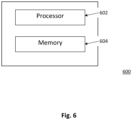
- the node 600 may comprise processing circuitry (or logic) 602. It will be appreciated that the node 600 may comprise one or more virtual machines running different software and/or processes.
- the node 600 may therefore comprise one or more servers, switches and/or storage devices and/or may comprise cloud computing infrastructure or infrastructure configured to perform in a distributed manner, that runs the software and/or processes.
- the processor 602 may control the operation of the node 600 in the manner described herein.
- the processor 602 can comprise one or more processors, processing units, multi-core processors or modules that are configured or programmed to control the node 600 in the manner described herein.
- the processor 602 can comprise a plurality of software and/or hardware modules that are each configured to perform, or are for performing, individual or multiple steps of the functionality of the node 600 as described herein.
- the node 600 may comprise a memory 604.
- the memory 604 of the node 600 can be configured to store program code or instructions that can be executed by the processor 602 of the node 600 to perform the functionality described herein.
- the memory 604 of the node 600 can be configured to store any requests, resources, information, data, signals, or similar that are described herein.
- the processor 602 of the node 600 may be configured to control the memory 604 of the node 600 to store any requests, resources, information, data, signals, or similar that are described herein.
- the node 600 may comprise other components in addition or alternatively to those indicated in Fig. 6 .
- the node 600 may comprise a communications interface.
- the communications interface may be for use in communicating with other nodes in the communications network, (e.g. such as other physical or virtual nodes).
- the communications interface may be configured to transmit to and/or receive from other nodes or network functions requests, resources, information, data, signals, or similar.
- the processor 602 of node 600 may be configured to control such a communications interface to transmit to and/or receive from other nodes or network functions requests, resources, information, data, signals, or similar.
- the node 600 may be configured to obtain measurements of conditions on a plurality of carrier frequencies, and determine a first model based on the obtained measurements that takes as input the conditions on a first subset of the plurality of carrier frequencies and outputs a prediction of the conditions on a second subset of the plurality of carrier frequencies, based on the conditions of the first subset of carrier frequencies.
- the node 600 may be configured to determine a first subset of a plurality of carrier frequencies, the first subset of carrier frequencies being for use in predicting conditions on a second subset of the plurality of carrier frequencies, provide conditions on the first subset of the plurality of carrier frequencies to a first model, and receive from the first model a prediction of the conditions on the second subset of the plurality of carrier frequencies.
- Determining a first subset of a plurality of carrier frequencies, providing conditions on the first subset of the plurality of carrier frequencies to a first model and receiving from the first model a prediction of the conditions on the second subset of the plurality of carrier frequencies were all described above with respect to blocks 502, 504 and 506 of the method 500 and the detail therein will be appreciated to apply equally to embodiments of the node 600.
- a user equipment 700 comprising a processor 702 and a memory 704.
- the memory 704 contains instructions executable by the processor 702, and the set of instructions, when executed by the processor, cause the processor to: obtain measurements of conditions on a plurality of carrier frequencies, and determine a first model based on the obtained measurements that takes as input the conditions on a first subset of the plurality of carrier frequencies and outputs a prediction of the conditions on a second subset of the plurality of carrier frequencies, based on the conditions of the first subset of carrier frequencies.
- the set of instructions when executed by the processor, cause the processor to: determine a first subset of a plurality of carrier frequencies, the first subset of carrier frequencies being for use in predicting conditions on a second subset of the plurality of carrier frequencies, provide conditions on the first subset of the plurality of carrier frequencies to a first model, and receive from the first model a prediction of the conditions on the second subset of the plurality of carrier frequencies.
- Determining a first subset of a plurality of carrier frequencies, providing conditions on the first subset of the plurality of carrier frequencies to a first model and receiving from the first model a prediction of the conditions on the second subset of the plurality of carrier frequencies were all described above with respect to blocks 502, 504 and 506 of the method 500 and the detail therein will be appreciated to apply equally to embodiments of the user equipment 700.
- the UE 700 may comprise a device capable, configured, arranged and/or operable to communicate wirelessly with network nodes and/or other wireless devices.
- the term UE may be used interchangeably herein with wireless device (WD).
- Communicating wirelessly may involve transmitting and/or receiving wireless signals using electromagnetic waves, radio waves, infrared waves, and/or other types of signals suitable for conveying information through air.
- a UE may be configured to transmit and/or receive information without direct human interaction.
- a UE may be designed to transmit information to a network on a predetermined schedule, when triggered by an internal or external event, or in response to requests from the network.
- Examples of a UE 700 include, but are not limited to, a smart phone, a mobile phone, a cell phone, a voice over IP (VoIP) phone, a wireless local loop phone, a desktop computer, a personal digital assistant (PDA), a wireless cameras, a gaming console or device, a music storage device, a playback appliance, a wearable terminal device, a wireless endpoint, a mobile station, a tablet, a laptop, a laptop-embedded equipment (LEE), a laptop-mounted equipment (LME), a smart device, a wireless customer-premise equipment (CPE). a vehicle-mounted wireless terminal device, etc.
- a UE may support device-to-device (D2D) communication, for example by implementing a 3GPP standard for sidelink communication, vehicle-to-vehicle (V2V), vehicle-to-infrastructure (V2I), vehicle-to-everything (V2X) and may in this case be referred to as a D2D communication device.
- D2D device-to-device
- V2V vehicle-to-vehicle
- V2I vehicle-to-infrastructure
- V2X vehicle-to-everything
- a UE may represent a machine or other device that performs monitoring and/or measurements, and transmits the results of such monitoring and/or measurements to another UE and/or a network node.
- IoT Internet of Things
- the UE may in this case be a machine-to-machine (M2M) device, which may in a 3GPP context be referred to as an MTC device.
- M2M machine-to-machine
- the UE may be a UE implementing the 3GPP narrow band internet of things (NB-loT) standard.
- NB-loT narrow band internet of things
- machines or devices are sensors, metering devices such as power meters, industrial machinery, or home or personal appliances (e.g. refrigerators, televisions, etc.) personal wearables (e.g., watches, fitness trackers, etc.).
- a UE may represent a vehicle or other equipment that is capable of monitoring and/or reporting on its operational status or other functions associated with its operation.
- a UE 700 as described above may represent the endpoint of a wireless connection, in which case the device may be referred to as a wireless terminal. Furthermore, a UE as described above may be mobile, in which case it may also be referred to as a mobile device or a mobile terminal.
- the UE 700 may be configured or operative to perform the methods and functions described herein, such as the methods 300, 400 or 500 as described above.
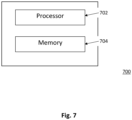
- the UE 700 may comprise processor (or logic) 702. It will be appreciated that the UE 700 may comprise one or more virtual machines running different software and/or processes.
- the UE 700 may therefore comprise one or more servers, switches and/or storage devices and/or may comprise cloud computing infrastructure or infrastructure configured to perform in a distributed manner, that runs the software and/or processes.
- the processor 702 may control the operation of the UE 700 in the manner described herein.
- the processor 702 can comprise one or more processors, processing units, multi-core processors or modules that are configured or programmed to control the UE 700 in the manner described herein.
- the processor 702 can comprise a plurality of software and/or hardware modules that are each configured to perform, or are for performing, individual or multiple steps of the functionality of the UE 700 as described herein.
- the UE 700 may comprise a memory 704.
- the memory 704 of the UE 700 can be configured to store program code or instructions that can be executed by the processor 702 of the UE 700 to perform the functionality described herein.
- the memory 704 of the UE 700 can be configured to store any requests, resources, information, data, signals, or similar that are described herein.
- the processor 702 of the UE 700 may be configured to control the memory 704 of the UE 700 to store any requests, resources, information, data, signals, or similar that are described herein.
- the UE 700 may comprise other components in addition or alternatively to those indicated in Fig. 7 .
- the UE 700 may comprise a communications interface.
- the communications interface may be for use in communicating with other UEs and/or nodes in the communications network, (e.g. such as other physical or virtual nodes such as the node 600 described above).
- the communications interface may be configured to transmit to and/or receive from nodes or network functions requests, resources, information, data, signals, or similar.
- the processor 702 of UE 700 may be configured to control such a communications interface to transmit to and/or receive from nodes or network functions requests, resources, information, data, signals, or similar.
- a computer program product comprising a computer readable medium, the computer readable medium having computer readable code embodied therein, the computer readable code being configured such that, on execution by a suitable computer or processor, the computer or processor is caused to perform the any of the embodiments of the methods 300, 400 or 500 as described above.
- the disclosure also applies to computer programs, particularly computer programs on or in a carrier, adapted to put embodiments into practice.
- the program may be in the form of a source code, an object code, a code intermediate source and an object code such as in a partially compiled form, or in any other form suitable for use in the implementation of the method according to the embodiments described herein.
- a program code implementing the functionality of the method or system may be sub-divided into one or more sub-routines.
- the sub-routines may be stored together in one executable file to form a self-contained program.
- Such an executable file may comprise computer-executable instructions, for example, processor instructions and/or interpreter instructions (e.g. Java interpreter instructions).
- one or more or all of the sub-routines may be stored in at least one external library file and linked with a main program either statically or dynamically, e.g. at run-time.
- the main program contains at least one call to at least one of the sub-routines.
- the sub-routines may also comprise function calls to each other.
- An embodiment relating to a computer program product comprises computer-executable instructions corresponding to each processing stage of at least one of the methods set forth herein. These instructions may be sub-divided into sub-routines and/or stored in one or more files that may be linked statically or dynamically.
- Another embodiment relating to a computer program product comprises computer-executable instructions corresponding to each means of at least one of the systems and/or products set forth herein. These instructions may be sub-divided into sub-routines and/or stored in one or more files that may be linked statically or dynamically.
- the carrier of a computer program may be any entity or device capable of carrying the program.
- the carrier may include a data storage, such as a ROM, for example, a CD ROM or a semiconductor ROM, or a magnetic recording medium, for example, a hard disk.
- the carrier may be a transmissible carrier such as an electric or optical signal, which may be conveyed via electric or optical cable or by radio or other means.
- the carrier may be constituted by such a cable or other device or means.
- the carrier may be an integrated circuit in which the program is embedded, the integrated circuit being adapted to perform, or used in the performance of, the relevant method.
- a computer program may be stored/distributed on a suitable medium, such as an optical storage medium or a solid-state medium supplied together with or as part of other hardware, but may also be distributed in other forms, such as via the Internet or other wired or wireless telecommunication systems. Any reference signs in the claims should not be construed as limiting the scope.
Landscapes
- Engineering & Computer Science (AREA)
- Signal Processing (AREA)
- Computer Networks & Wireless Communication (AREA)
- Physics & Mathematics (AREA)
- Theoretical Computer Science (AREA)
- Evolutionary Computation (AREA)
- Artificial Intelligence (AREA)
- General Health & Medical Sciences (AREA)
- General Physics & Mathematics (AREA)
- Computational Linguistics (AREA)
- Biophysics (AREA)
- Molecular Biology (AREA)
- Computing Systems (AREA)
- General Engineering & Computer Science (AREA)
- Data Mining & Analysis (AREA)
- Mathematical Physics (AREA)
- Software Systems (AREA)
- Biomedical Technology (AREA)
- Life Sciences & Earth Sciences (AREA)
- Health & Medical Sciences (AREA)
- Electromagnetism (AREA)
- Quality & Reliability (AREA)
- Mobile Radio Communication Systems (AREA)
Claims (16)
- Verfahren in einem Kommunikationsnetzwerk zum Bestimmen eines ersten Modells zur Verwendung beim Vorhersagen von Bedingungen auf Trägerfrequenzen in dem Kommunikationsnetzwerk, das Verfahren umfassend:Erhalten (302) von Messungen von Bedingungen auf einer Vielzahl von Trägerfrequenzen; undBestimmen (304) eines ersten Modells basierend auf den erhaltenen Messungen, das als Eingabe die Bedingungen auf einer ersten Teilmenge der Vielzahl von Trägerfrequenzen nutzt und eine Vorhersage der Bedingungen auf einer zweiten Teilmenge der Vielzahl von Trägerfrequenzen basierend auf den Bedingungen der ersten Teilmenge von Trägerfrequenzen ausgibt;dadurch gekennzeichnet, dass das Verfahren ferner umfasst:
Bestimmen eines zweiten Modells, wobei das zweite Modell als Eingabe eine Angabe jeder der Frequenzen in der zweiten Teilmenge der Vielzahl von Trägerfrequenzen nutzt und eine Messkonfiguration ausgibt, die eine RUHE-Modus-Messkonfiguration für ein Benutzergerät, UE, angibt, die verwendet werden kann, um Messungen zu sammeln, die als Eingabe in das erste Modell bereitgestellt werden können. - Verfahren nach Anspruch 1, wobei das Bestimmen (304) eines ersten Modells ein Trainieren eines Modells für maschinelles Lernen darin, die Bedingungen auf der zweiten Teilmenge der Vielzahl von Trägerfrequenzen basierend auf den Bedingungen auf der ersten Teilmenge der Vielzahl von Trägerfrequenzen unter Verwendung der erhaltenen Messungen als Trainingsdaten vorherzusagen.
- Verfahren nach einem der Ansprüche 1 oder 2, wobei eine Anzahl von Trägerfrequenzen in der ersten Teilmenge der Vielzahl von Trägerfrequenzen eine maximale Anzahl von Frequenzen umfasst, auf denen Messungen im Ruhemodus durch ein Benutzergerät gemeldet werden können.
- Verfahren nach Anspruch 3, wobei die zweite Teilmenge der Vielzahl von Trägerfrequenzen Frequenzen umfasst, die dem UE für einen Orchestrierungsvorgang für Lastausgleich, Trägeraggregation, CA, oder duale Konnektivität, DC, verfügbar sind, und das erste Modell verwendet werden kann, um aus Messungen, die auf der maximalen Anzahl an Frequenzen vorgenommen werden, auf denen Messungen im Ruhemodus durch ein Benutzergerät gemeldet werden können, die Bedingungen auf den Frequenzen vorherzusagen, die dem UE für den Lastausgleichs-, CA- oder DC-Orchestrierungsvorgang verfügbar sind.
- Verfahren nach Anspruch 3, wobei die zweite Teilmenge der Vielzahl von Trägerfrequenzen alle Trägerfrequenzen umfasst, die dem Benutzergerät verfügbar sind, und das erste Modell verwendet werden kann, um aus Messungen, die auf der maximalen Anzahl an Frequenzen vorgenommen werden, auf denen Messungen im Ruhemodus durch ein Benutzergerät gemeldet werden können, die Bedingungen auf allen anderen Trägerfrequenzen vorherzusagen, die dem Benutzergerät verfügbar sind.
- Verfahren nach einem der Ansprüche 1 bis 5, wobei das Verfahren durch einen Knoten in dem Kommunikationsnetzwerk durchgeführt wird und wobei das Verfahren ferner umfasst:Senden von Details des ersten Modells an ein Benutzergerät, sodass das Benutzergerät eine lokale Version des ersten Modells auf dem Benutzergerät erstellen und das lokale Modell trainieren kann, basierend auf Messungen von Bedingungen auf der Vielzahl von Trägerfrequenzen, wie durch das Benutzergerät gemessen;Empfangen von dem Benutzergerät einer Angabe eines Ergebnisses des Trainings des lokalen Modells, das durch das Benutzergerät durchgeführt wird; undAktualisieren des ersten Modells basierend auf dem empfangenen Ergebnis.
- Verfahren nach einem der Ansprüche 1 bis 6, ferner umfassend:
Bestimmen einer Genauigkeit der vorhergesagten Bedingungen auf jeder von der zweiten Teilmenge der Vielzahl von Trägerfrequenzen. - Verfahren nach Anspruch 7, wobei das Verfahren ferner umfasst:
Bestimmen eines Gültigkeitszeitraums für die vorhergesagten Bedingungen auf jeder von der zweiten Teilmenge der Vielzahl von Trägerfrequenzen. - Verfahren nach einem der Ansprüche 1 bis 8, wobei das zweite Modell ferner als Eingabe mindestens eines der Folgenden nutzt:eine Genauigkeitsanforderung für eine Vorhersage, die durch das erste Modell vorgenommen wird;eine Angabe einer Last auf einer oder mehreren Trägerfrequenzen;geografische Informationen, die sich auf ein UE beziehen.
- Verfahren in einem Kommunikationsnetzwerk zum Bestimmen von Bedingungen auf Trägerfrequenzen in dem Kommunikationsnetzwerk, das Verfahren umfassend:Bestimmen (502) einer ersten Teilmenge einer Vielzahl von Trägerfrequenzen, wobei die erste Teilmenge von Trägerfrequenzen zur Verwendung beim Vorhersagen von Bedingungen auf einer zweiten Teilmenge der Vielzahl von Trägerfrequenzen vorgesehen ist;wobei die erste Teilmenge der Vielzahl von Trägerfrequenzen bestimmt wird, indem die Trägerfrequenzen in der zweiten Teilmenge der Vielzahl von Trägerfrequenzen als Eingabe in ein zweites Modell für maschinelles Lernen bereitgestellt werden und von dem zweiten Modell für maschinelles Lernen eine RUHE-Modus-Messkonfiguration für ein Benutzergerät, UE, empfangen wird, die die erste Teilmenge der Vielzahl von Trägerfrequenzen umfasst und die zum Sammeln von Messungen verwendet werden kann, die als Eingabe in ein erstes Modell bereitgestellt werden können, damit das erste Modell die Bedingungen auf der zweiten Teilmenge der Vielzahl von Trägerfrequenzen vorhersagt;Bereitstellen (504) von Bedingungen auf der ersten Teilmenge der Vielzahl von Trägerfrequenzen an das erste Modell; undEmpfangen (506) einer Vorhersage der Bedingungen auf der zweiten Teilmenge der Vielzahl von Trägerfrequenzen von dem ersten Modell.
- Verfahren nach Anspruch 10, wobei das Bestimmen (502) der ersten Teilmenge der Vielzahl von Trägerfrequenzen umfasst:
Bestimmen der ersten Teilmenge von Trägerfrequenzen basierend auf einer Genauigkeit des ersten Modells beim Vorhersagen der Bedingungen auf der zweiten Teilmenge der Vielzahl von Trägerfrequenzen aus den Bedingungen auf der ersten Teilmenge der Vielzahl von Trägerfrequenzen. - Verfahren nach Anspruch 10 oder 11, wobei die Trägerfrequenzen, die in der zweiten Teilmenge von Trägerfrequenzen enthalten sind, Trägerfrequenzen umfassen, auf denen die Ressourcenlast unter einem Schwellenwert liegt.
- Verfahren nach einem der Ansprüche 10 bis 12, wobei das Bestimmen (502) einer ersten Teilmenge der Vielzahl von Trägerfrequenzen das Bestimmen von Trägerfrequenzen umfasst, für die bestimmt wird, dass das erste Modell für mehr als ein Schwellenwert-Zeitintervall gültig ist.
- Verfahren nach einem der Ansprüche 10 bis 13, wobei das Verfahren durch einen Netzwerkknoten durchgeführt wird und das Verfahren ferner umfasst:Senden einer Angabe der bestimmten ersten Teilmenge von Trägerfrequenzen an ein Benutzergerät; undEmpfangen von Messungen von Bedingungen auf der ersten Teilmenge von Trägerfrequenzen von dem Benutzergerät; undwobei das Bereitstellen von Bedingungen auf der ersten Teilmenge der Vielzahl von Trägerfrequenzen an ein erstes Modell das Bereitstellen der Messungen von Bedingungen auf der ersten Teilmenge von Trägerfrequenzen von dem Benutzergerät an das erste Modell umfasst.
- Verfahren nach Anspruch 14, ferner umfassend:Senden der Vorhersage der Bedingungen auf der zweiten Teilmenge der Vielzahl von Trägerfrequenzen von dem ersten Modell an das Benutzergerät zur Verwendung durch das Benutzergerät, um eine Trägerfrequenz zu bestimmen, mit der eine Verbindung hergestellt werden soll, oderferner umfassend:
Bestimmen einer Trägerfrequenz für das Benutzergerät, mit der eine Verbindung hergestellt werden soll, basierend auf der Vorhersage der Bedingungen auf der zweiten Teilmenge der Vielzahl von Trägerfrequenzen von dem ersten Modell. - Verfahren nach einem der Ansprüche 10, 11, 12 oder 13, wobei das Verfahren durch ein Benutzergerät durchgeführt wird und das Verfahren ferner umfasst:Empfangen einer Angabe eines oder mehrerer Parameter von einem Knoten in dem Kommunikationsnetzwerk; undVerwenden des einen oder der mehreren Parameter, um das erste Modell zu bestimmen.
Applications Claiming Priority (1)
| Application Number | Priority Date | Filing Date | Title |
|---|---|---|---|
| PCT/SE2019/050893 WO2021054877A1 (en) | 2019-09-19 | 2019-09-19 | Predicting conditions on carrier frequencies in a communications network |
Publications (4)
| Publication Number | Publication Date |
|---|---|
| EP4032206A1 EP4032206A1 (de) | 2022-07-27 |
| EP4032206A4 EP4032206A4 (de) | 2022-10-05 |
| EP4032206B1 true EP4032206B1 (de) | 2023-11-01 |
| EP4032206C0 EP4032206C0 (de) | 2023-11-01 |
Family
ID=74883106
Family Applications (1)
| Application Number | Title | Priority Date | Filing Date |
|---|---|---|---|
| EP19945496.8A Active EP4032206B1 (de) | 2019-09-19 | 2019-09-19 | Vorhersage von bedingungen auf trägerfrequenzen in einem kommunikationsnetz |
Country Status (3)
| Country | Link |
|---|---|
| US (1) | US12262219B2 (de) |
| EP (1) | EP4032206B1 (de) |
| WO (1) | WO2021054877A1 (de) |
Families Citing this family (13)
| Publication number | Priority date | Publication date | Assignee | Title |
|---|---|---|---|---|
| EP4075852A4 (de) * | 2019-12-13 | 2023-01-18 | Sony Group Corporation | Informationsverarbeitungsvorrichtung, informationsverarbeitungsverfahren, endgerät, basisstationsvorrichtung und programm |
| US12278782B2 (en) * | 2020-01-24 | 2025-04-15 | Nokia Technologies Oy | Apparatuses, methods and computer program using channel measurement data for a primary component carrier |
| CN115211168B (zh) * | 2020-08-14 | 2025-06-17 | 中兴通讯股份有限公司 | 一种基于ai的负载预测方法 |
| WO2022214162A1 (en) * | 2021-04-06 | 2022-10-13 | Telefonaktiebolaget Lm Ericsson (Publ) | Server and agent for reporting of computational results during an iterative learning process |
| CN116419270A (zh) * | 2021-12-31 | 2023-07-11 | 维沃移动通信有限公司 | 信息获取方法、装置及通信设备 |
| WO2023137684A1 (en) * | 2022-01-21 | 2023-07-27 | Qualcomm Incorporated | Mobility reporting for non-serving cells based on machine learning |
| US12231183B2 (en) * | 2022-04-29 | 2025-02-18 | Qualcomm Incorporated | Machine learning for beam predictions with confidence indications |
| WO2024065251A1 (en) * | 2022-09-28 | 2024-04-04 | Qualcomm Incorporated | Channel characteristic predictions based at least in part on subset of downlink reference signal resources |
| US20240340653A1 (en) * | 2023-04-06 | 2024-10-10 | Sharp Kabushiki Kaisha | Network Configured Operation of User Equipment With Artificial Intelligence/Machine Learning Model Capability |
| US20240340634A1 (en) * | 2023-04-06 | 2024-10-10 | Sharp Kabushiki Kaisha | Autonomous Operation of User Equipment With Artificial Intelligence/Machine Learning Model Capability |
| CN120730321A (zh) * | 2024-03-27 | 2025-09-30 | 大唐移动通信设备有限公司 | 频域测量预测方法、装置和处理器可读存储介质 |
| WO2025199873A1 (en) * | 2024-03-28 | 2025-10-02 | Mediatek Singapore Pte. Ltd. | Methods and apparatus of rrm measurement event prediction for wireless communication systems |
| WO2025234912A1 (en) * | 2024-05-09 | 2025-11-13 | Telefonaktiebolaget Lm Ericsson (Publ) | Predictions of measurements or measurement events in time and/or frequency domain |
Family Cites Families (9)
| Publication number | Priority date | Publication date | Assignee | Title |
|---|---|---|---|---|
| GB2464289B (en) | 2008-10-08 | 2012-12-05 | Samsung Electronics Co Ltd | Estimating link qualities in multi-carrier systems |
| US9860051B2 (en) * | 2015-01-26 | 2018-01-02 | Nokia Solutions And Networks Oy | Method and apparatus for management of frequency-division-duplex and time-division-duplex carrier aggregation |
| GB2540806B (en) * | 2015-07-29 | 2018-10-17 | Samsung Electronics Co Ltd | Idle mode load balancing |
| EP3375245B1 (de) | 2015-11-09 | 2021-09-15 | Telefonaktiebolaget LM Ericsson (PUBL) | Messung mehrerer träger unter diskontinuierlicher aktivität |
| WO2017091115A1 (en) * | 2015-11-24 | 2017-06-01 | Telefonaktiebolaget Lm Ericsson (Publ) | Method and control node for configuring carrier aggregation for a wireless device |
| WO2017162262A1 (en) * | 2016-03-21 | 2017-09-28 | Telefonaktiebolaget Lm Ericsson (Publ) | Target carrier radio predictions using source carrier measurements |
| WO2019068628A1 (en) * | 2017-10-02 | 2019-04-11 | Telefonaktiebolaget Lm Ericsson (Publ) | ENHANCED INTER-FREQUENCY SEARCH ORDER |
| WO2019190245A1 (en) * | 2018-03-28 | 2019-10-03 | Samsung Electronics Co., Ltd. | Apparatus and method for measurement in wireless communication system |
| US10673546B2 (en) * | 2018-09-27 | 2020-06-02 | Nokia Solutions And Networks Oy | Scell selection and optimization for telecommunication systems |
-
2019
- 2019-09-19 WO PCT/SE2019/050893 patent/WO2021054877A1/en not_active Ceased
- 2019-09-19 EP EP19945496.8A patent/EP4032206B1/de active Active
- 2019-09-19 US US17/640,988 patent/US12262219B2/en active Active
Also Published As
| Publication number | Publication date |
|---|---|
| EP4032206C0 (de) | 2023-11-01 |
| EP4032206A1 (de) | 2022-07-27 |
| WO2021054877A1 (en) | 2021-03-25 |
| EP4032206A4 (de) | 2022-10-05 |
| US20220295295A1 (en) | 2022-09-15 |
| US12262219B2 (en) | 2025-03-25 |
Similar Documents
| Publication | Publication Date | Title |
|---|---|---|
| EP4032206B1 (de) | Vorhersage von bedingungen auf trägerfrequenzen in einem kommunikationsnetz | |
| CN114788353B (zh) | 执行切换过程 | |
| US12035383B2 (en) | Service carrier frequency selecting method and apparatus | |
| EP4356582B9 (de) | Konfiguration eines maschinenlernmodells in drahtlosen netzwerken | |
| US10999854B2 (en) | Method and user equipment for predicting available throughput for uplink data | |
| CN105247926B (zh) | 分层的移动性 | |
| TW201836305A (zh) | 用於窄頻物聯網路(nb-iot)設備的信號品質量測的技術和裝置 | |
| CN114128351B (zh) | 无线通信中rat间蜂窝小区重选期间的早期测量 | |
| US10790897B1 (en) | Systems and methods for selecting radio beams | |
| EP2962489B1 (de) | Lieferung von messungen | |
| JP2014523159A (ja) | デジタル・セルラー無線遠隔通信ネットワークにおける測定の実施 | |
| JP2014523159A5 (de) | ||
| CN107251467A (zh) | 蜂窝网络和wlan的聚合 | |
| CN118524467A (zh) | 用于通信的装置及方法 | |
| US10321346B2 (en) | Carrier-based RSRQ metric for efficient small cell offloading | |
| US20250097773A1 (en) | Communication method and apparatus | |
| US20160029424A1 (en) | Direct device-to-device communications radio technology selection | |
| CN104348584B (zh) | 一种针对abs机制实现信道质量反馈和预测的方法 | |
| US20230162006A1 (en) | Server and agent for reporting of computational results during an iterative learning process | |
| US12156080B2 (en) | Systems and methods for efficiently causing a secondary cell to become a primary cell | |
| TW201715904A (zh) | 對頻率間量測的管理 | |
| US12618930B2 (en) | Performing a handover procedure | |
| WO2025249257A1 (en) | Method performed by first access network node, method performed by second access network node, first access network node, and second access network node | |
| CN114762425B (zh) | 将同时模式1和模式2用于负载平衡和模式切换的方法和装置 | |
| WO2026033983A1 (ja) | 周辺セルの測定を効率的に行う端末装置、基地局、制御方法及びプログラム |
Legal Events
| Date | Code | Title | Description |
|---|---|---|---|
| STAA | Information on the status of an ep patent application or granted ep patent |
Free format text: STATUS: THE INTERNATIONAL PUBLICATION HAS BEEN MADE |
|
| PUAI | Public reference made under article 153(3) epc to a published international application that has entered the european phase |
Free format text: ORIGINAL CODE: 0009012 |
|
| STAA | Information on the status of an ep patent application or granted ep patent |
Free format text: STATUS: REQUEST FOR EXAMINATION WAS MADE |
|
| 17P | Request for examination filed |
Effective date: 20220318 |
|
| AK | Designated contracting states |
Kind code of ref document: A1 Designated state(s): AL AT BE BG CH CY CZ DE DK EE ES FI FR GB GR HR HU IE IS IT LI LT LU LV MC MK MT NL NO PL PT RO RS SE SI SK SM TR |
|
| STAA | Information on the status of an ep patent application or granted ep patent |
Free format text: STATUS: EXAMINATION IS IN PROGRESS |
|
| A4 | Supplementary search report drawn up and despatched |
Effective date: 20220902 |
|
| RIC1 | Information provided on ipc code assigned before grant |
Ipc: H04W 72/04 20090101ALI20220829BHEP Ipc: H04W 36/00 20090101ALI20220829BHEP Ipc: H04W 24/10 20090101ALI20220829BHEP Ipc: H04L 5/00 20060101ALI20220829BHEP Ipc: H04B 17/391 20150101ALI20220829BHEP Ipc: G06N 20/00 20190101ALI20220829BHEP Ipc: H04B 17/373 20150101AFI20220829BHEP |
|
| 17Q | First examination report despatched |
Effective date: 20220914 |
|
| DAV | Request for validation of the european patent (deleted) | ||
| DAX | Request for extension of the european patent (deleted) | ||
| GRAJ | Information related to disapproval of communication of intention to grant by the applicant or resumption of examination proceedings by the epo deleted |
Free format text: ORIGINAL CODE: EPIDOSDIGR1 |
|
| GRAP | Despatch of communication of intention to grant a patent |
Free format text: ORIGINAL CODE: EPIDOSNIGR1 |
|
| GRAP | Despatch of communication of intention to grant a patent |
Free format text: ORIGINAL CODE: EPIDOSNIGR1 |
|
| STAA | Information on the status of an ep patent application or granted ep patent |
Free format text: STATUS: GRANT OF PATENT IS INTENDED |
|
| INTG | Intention to grant announced |
Effective date: 20230523 |
|
| GRAS | Grant fee paid |
Free format text: ORIGINAL CODE: EPIDOSNIGR3 |
|
| GRAA | (expected) grant |
Free format text: ORIGINAL CODE: 0009210 |
|
| STAA | Information on the status of an ep patent application or granted ep patent |
Free format text: STATUS: THE PATENT HAS BEEN GRANTED |
|
| AK | Designated contracting states |
Kind code of ref document: B1 Designated state(s): AL AT BE BG CH CY CZ DE DK EE ES FI FR GB GR HR HU IE IS IT LI LT LU LV MC MK MT NL NO PL PT RO RS SE SI SK SM TR |
|
| REG | Reference to a national code |
Ref country code: GB Ref legal event code: FG4D |
|
| REG | Reference to a national code |
Ref country code: CH Ref legal event code: EP |
|
| REG | Reference to a national code |
Ref country code: DE Ref legal event code: R096 Ref document number: 602019040884 Country of ref document: DE |
|
| REG | Reference to a national code |
Ref country code: IE Ref legal event code: FG4D |
|
| U01 | Request for unitary effect filed |
Effective date: 20231115 |
|
| U07 | Unitary effect registered |
Designated state(s): AT BE BG DE DK EE FI FR IT LT LU LV MT NL PT SE SI Effective date: 20231121 |
|
| PG25 | Lapsed in a contracting state [announced via postgrant information from national office to epo] |
Ref country code: GR Free format text: LAPSE BECAUSE OF FAILURE TO SUBMIT A TRANSLATION OF THE DESCRIPTION OR TO PAY THE FEE WITHIN THE PRESCRIBED TIME-LIMIT Effective date: 20240202 |
|
| PG25 | Lapsed in a contracting state [announced via postgrant information from national office to epo] |
Ref country code: IS Free format text: LAPSE BECAUSE OF FAILURE TO SUBMIT A TRANSLATION OF THE DESCRIPTION OR TO PAY THE FEE WITHIN THE PRESCRIBED TIME-LIMIT Effective date: 20240301 |
|
| PG25 | Lapsed in a contracting state [announced via postgrant information from national office to epo] |
Ref country code: ES Free format text: LAPSE BECAUSE OF FAILURE TO SUBMIT A TRANSLATION OF THE DESCRIPTION OR TO PAY THE FEE WITHIN THE PRESCRIBED TIME-LIMIT Effective date: 20231101 |
|
| PG25 | Lapsed in a contracting state [announced via postgrant information from national office to epo] |
Ref country code: IS Free format text: LAPSE BECAUSE OF FAILURE TO SUBMIT A TRANSLATION OF THE DESCRIPTION OR TO PAY THE FEE WITHIN THE PRESCRIBED TIME-LIMIT Effective date: 20240301 Ref country code: GR Free format text: LAPSE BECAUSE OF FAILURE TO SUBMIT A TRANSLATION OF THE DESCRIPTION OR TO PAY THE FEE WITHIN THE PRESCRIBED TIME-LIMIT Effective date: 20240202 Ref country code: ES Free format text: LAPSE BECAUSE OF FAILURE TO SUBMIT A TRANSLATION OF THE DESCRIPTION OR TO PAY THE FEE WITHIN THE PRESCRIBED TIME-LIMIT Effective date: 20231101 |
|
| PG25 | Lapsed in a contracting state [announced via postgrant information from national office to epo] |
Ref country code: RS Free format text: LAPSE BECAUSE OF FAILURE TO SUBMIT A TRANSLATION OF THE DESCRIPTION OR TO PAY THE FEE WITHIN THE PRESCRIBED TIME-LIMIT Effective date: 20231101 Ref country code: PL Free format text: LAPSE BECAUSE OF FAILURE TO SUBMIT A TRANSLATION OF THE DESCRIPTION OR TO PAY THE FEE WITHIN THE PRESCRIBED TIME-LIMIT Effective date: 20231101 Ref country code: NO Free format text: LAPSE BECAUSE OF FAILURE TO SUBMIT A TRANSLATION OF THE DESCRIPTION OR TO PAY THE FEE WITHIN THE PRESCRIBED TIME-LIMIT Effective date: 20240201 Ref country code: HR Free format text: LAPSE BECAUSE OF FAILURE TO SUBMIT A TRANSLATION OF THE DESCRIPTION OR TO PAY THE FEE WITHIN THE PRESCRIBED TIME-LIMIT Effective date: 20231101 |
|
| PG25 | Lapsed in a contracting state [announced via postgrant information from national office to epo] |
Ref country code: CZ Free format text: LAPSE BECAUSE OF FAILURE TO SUBMIT A TRANSLATION OF THE DESCRIPTION OR TO PAY THE FEE WITHIN THE PRESCRIBED TIME-LIMIT Effective date: 20231101 |
|
| PG25 | Lapsed in a contracting state [announced via postgrant information from national office to epo] |
Ref country code: SK Free format text: LAPSE BECAUSE OF FAILURE TO SUBMIT A TRANSLATION OF THE DESCRIPTION OR TO PAY THE FEE WITHIN THE PRESCRIBED TIME-LIMIT Effective date: 20231101 |
|
| PG25 | Lapsed in a contracting state [announced via postgrant information from national office to epo] |
Ref country code: SM Free format text: LAPSE BECAUSE OF FAILURE TO SUBMIT A TRANSLATION OF THE DESCRIPTION OR TO PAY THE FEE WITHIN THE PRESCRIBED TIME-LIMIT Effective date: 20231101 Ref country code: SK Free format text: LAPSE BECAUSE OF FAILURE TO SUBMIT A TRANSLATION OF THE DESCRIPTION OR TO PAY THE FEE WITHIN THE PRESCRIBED TIME-LIMIT Effective date: 20231101 Ref country code: CZ Free format text: LAPSE BECAUSE OF FAILURE TO SUBMIT A TRANSLATION OF THE DESCRIPTION OR TO PAY THE FEE WITHIN THE PRESCRIBED TIME-LIMIT Effective date: 20231101 |
|
| REG | Reference to a national code |
Ref country code: DE Ref legal event code: R097 Ref document number: 602019040884 Country of ref document: DE |
|
| PLBE | No opposition filed within time limit |
Free format text: ORIGINAL CODE: 0009261 |
|
| STAA | Information on the status of an ep patent application or granted ep patent |
Free format text: STATUS: NO OPPOSITION FILED WITHIN TIME LIMIT |
|
| 26N | No opposition filed |
Effective date: 20240802 |
|
| U20 | Renewal fee for the european patent with unitary effect paid |
Year of fee payment: 6 Effective date: 20240927 |
|
| PG25 | Lapsed in a contracting state [announced via postgrant information from national office to epo] |
Ref country code: MC Free format text: LAPSE BECAUSE OF FAILURE TO SUBMIT A TRANSLATION OF THE DESCRIPTION OR TO PAY THE FEE WITHIN THE PRESCRIBED TIME-LIMIT Effective date: 20231101 |
|
| REG | Reference to a national code |
Ref country code: CH Ref legal event code: PL |
|
| GBPC | Gb: european patent ceased through non-payment of renewal fee |
Effective date: 20240919 |
|
| PG25 | Lapsed in a contracting state [announced via postgrant information from national office to epo] |
Ref country code: GB Free format text: LAPSE BECAUSE OF NON-PAYMENT OF DUE FEES Effective date: 20240919 |
|
| PG25 | Lapsed in a contracting state [announced via postgrant information from national office to epo] |
Ref country code: CH Free format text: LAPSE BECAUSE OF NON-PAYMENT OF DUE FEES Effective date: 20240930 |
|
| PG25 | Lapsed in a contracting state [announced via postgrant information from national office to epo] |
Ref country code: IE Free format text: LAPSE BECAUSE OF NON-PAYMENT OF DUE FEES Effective date: 20240919 |
|
| U20 | Renewal fee for the european patent with unitary effect paid |
Year of fee payment: 7 Effective date: 20250929 |
|
| PG25 | Lapsed in a contracting state [announced via postgrant information from national office to epo] |
Ref country code: RO Free format text: LAPSE BECAUSE OF FAILURE TO SUBMIT A TRANSLATION OF THE DESCRIPTION OR TO PAY THE FEE WITHIN THE PRESCRIBED TIME-LIMIT Effective date: 20231101 |
|
| PG25 | Lapsed in a contracting state [announced via postgrant information from national office to epo] |
Ref country code: CY Free format text: LAPSE BECAUSE OF FAILURE TO SUBMIT A TRANSLATION OF THE DESCRIPTION OR TO PAY THE FEE WITHIN THE PRESCRIBED TIME-LIMIT; INVALID AB INITIO Effective date: 20190919 |
|
| PG25 | Lapsed in a contracting state [announced via postgrant information from national office to epo] |
Ref country code: HU Free format text: LAPSE BECAUSE OF FAILURE TO SUBMIT A TRANSLATION OF THE DESCRIPTION OR TO PAY THE FEE WITHIN THE PRESCRIBED TIME-LIMIT; INVALID AB INITIO Effective date: 20190919 |