EP4032415A1 - Dispositif de préparation d'un ananas prêt à être consommé dans le commerce traditionnel - Google Patents
Dispositif de préparation d'un ananas prêt à être consommé dans le commerce traditionnel Download PDFInfo
- Publication number
- EP4032415A1 EP4032415A1 EP22159638.0A EP22159638A EP4032415A1 EP 4032415 A1 EP4032415 A1 EP 4032415A1 EP 22159638 A EP22159638 A EP 22159638A EP 4032415 A1 EP4032415 A1 EP 4032415A1
- Authority
- EP
- European Patent Office
- Prior art keywords
- cutting
- unit
- pineapple fruit
- fruit
- pineapple
- Prior art date
- Legal status (The legal status is an assumption and is not a legal conclusion. Google has not performed a legal analysis and makes no representation as to the accuracy of the status listed.)
- Granted
Links
Images


Classifications
-
- A—HUMAN NECESSITIES
- A23—FOODS OR FOODSTUFFS; TREATMENT THEREOF, NOT COVERED BY OTHER CLASSES
- A23N—MACHINES OR APPARATUS FOR TREATING HARVESTED FRUIT, VEGETABLES OR FLOWER BULBS IN BULK, NOT OTHERWISE PROVIDED FOR; PEELING VEGETABLES OR FRUIT IN BULK; APPARATUS FOR PREPARING ANIMAL FEEDING- STUFFS
- A23N4/00—Machines for stoning fruit or removing seed-containing sections from fruit, characterised by their stoning or removing device
- A23N4/12—Machines for stoning fruit or removing seed-containing sections from fruit, characterised by their stoning or removing device for coring fruit
- A23N4/20—Machines for stoning fruit or removing seed-containing sections from fruit, characterised by their stoning or removing device for coring fruit for pineapples
-
- A—HUMAN NECESSITIES
- A23—FOODS OR FOODSTUFFS; TREATMENT THEREOF, NOT COVERED BY OTHER CLASSES
- A23N—MACHINES OR APPARATUS FOR TREATING HARVESTED FRUIT, VEGETABLES OR FLOWER BULBS IN BULK, NOT OTHERWISE PROVIDED FOR; PEELING VEGETABLES OR FRUIT IN BULK; APPARATUS FOR PREPARING ANIMAL FEEDING- STUFFS
- A23N7/00—Peeling vegetables or fruit
- A23N7/002—Peeling pinaeapples
-
- B—PERFORMING OPERATIONS; TRANSPORTING
- B26—HAND CUTTING TOOLS; CUTTING; SEVERING
- B26D—CUTTING; DETAILS COMMON TO MACHINES FOR PERFORATING, PUNCHING, CUTTING-OUT, STAMPING-OUT OR SEVERING
- B26D1/00—Cutting through work characterised by the nature or movement of the cutting member or particular materials not otherwise provided for; Apparatus or machines therefor; Cutting members therefor
- B26D1/01—Cutting through work characterised by the nature or movement of the cutting member or particular materials not otherwise provided for; Apparatus or machines therefor; Cutting members therefor involving a cutting member which does not travel with the work
- B26D1/04—Cutting through work characterised by the nature or movement of the cutting member or particular materials not otherwise provided for; Apparatus or machines therefor; Cutting members therefor involving a cutting member which does not travel with the work having a linearly-movable cutting member
-
- B—PERFORMING OPERATIONS; TRANSPORTING
- B26—HAND CUTTING TOOLS; CUTTING; SEVERING
- B26D—CUTTING; DETAILS COMMON TO MACHINES FOR PERFORATING, PUNCHING, CUTTING-OUT, STAMPING-OUT OR SEVERING
- B26D3/00—Cutting work characterised by the nature of the cut made; Apparatus therefor
- B26D3/16—Cutting rods or tubes transversely
- B26D3/161—Cutting rods or tubes transversely for obtaining more than one product at a time
-
- B—PERFORMING OPERATIONS; TRANSPORTING
- B26—HAND CUTTING TOOLS; CUTTING; SEVERING
- B26D—CUTTING; DETAILS COMMON TO MACHINES FOR PERFORATING, PUNCHING, CUTTING-OUT, STAMPING-OUT OR SEVERING
- B26D3/00—Cutting work characterised by the nature of the cut made; Apparatus therefor
- B26D3/24—Cutting work characterised by the nature of the cut made; Apparatus therefor to obtain segments other than slices, e.g. cutting pies
- B26D3/26—Cutting work characterised by the nature of the cut made; Apparatus therefor to obtain segments other than slices, e.g. cutting pies specially adapted for cutting fruit or vegetables, e.g. for onions
-
- B—PERFORMING OPERATIONS; TRANSPORTING
- B26—HAND CUTTING TOOLS; CUTTING; SEVERING
- B26D—CUTTING; DETAILS COMMON TO MACHINES FOR PERFORATING, PUNCHING, CUTTING-OUT, STAMPING-OUT OR SEVERING
- B26D5/00—Arrangements for operating and controlling machines or devices for cutting, cutting-out, stamping-out, punching, perforating, or severing by means other than cutting
-
- B—PERFORMING OPERATIONS; TRANSPORTING
- B26—HAND CUTTING TOOLS; CUTTING; SEVERING
- B26D—CUTTING; DETAILS COMMON TO MACHINES FOR PERFORATING, PUNCHING, CUTTING-OUT, STAMPING-OUT OR SEVERING
- B26D9/00—Cutting apparatus combined with punching or perforating apparatus or with dissimilar cutting apparatus
-
- B—PERFORMING OPERATIONS; TRANSPORTING
- B26—HAND CUTTING TOOLS; CUTTING; SEVERING
- B26D—CUTTING; DETAILS COMMON TO MACHINES FOR PERFORATING, PUNCHING, CUTTING-OUT, STAMPING-OUT OR SEVERING
- B26D1/00—Cutting through work characterised by the nature or movement of the cutting member or particular materials not otherwise provided for; Apparatus or machines therefor; Cutting members therefor
- B26D1/0006—Cutting members therefor
- B26D2001/0033—Cutting members therefor assembled from multiple blades
-
- B—PERFORMING OPERATIONS; TRANSPORTING
- B26—HAND CUTTING TOOLS; CUTTING; SEVERING
- B26D—CUTTING; DETAILS COMMON TO MACHINES FOR PERFORATING, PUNCHING, CUTTING-OUT, STAMPING-OUT OR SEVERING
- B26D2210/00—Machines or methods used for cutting special materials
- B26D2210/02—Machines or methods used for cutting special materials for cutting food products, e.g. food slicers
Definitions
- the invention relates to a device for preparing a pineapple fruit ready for consumption in stationary retail.
- Pineapples are usually peeled by hand with a knife or processed at home with a special device or with a so-called pineapple cutter.
- Such a pineapple cutter is usually designed with an elongated hollow cylinder, on the outside of which a knife is arranged.
- the knife is designed in such a way that the pineapple cutter is driven through the pineapple in a rotary movement, similar to that of a screw when it is screwed into a thread. This cuts the edible flesh of the pineapple in a spiral and at the same time, due to the hollow-cylindrical design of the pineapple cutter, the inedible stalk is removed.
- the spiral-shaped flesh is usually cut into smaller portioning units by hand.
- Such a preparation of a pineapple fruit is time-consuming for consumers, associated with effort when cutting up the pineapple fruit and consequently causes the pineapple cutter and plates to be rinsed off.
- pineapple fruit is placed in a receiving device and is moved through a cutting device with the aid of a drive in order to separate the edible pulp from the inedible part.
- the device comprises a device for determining the diameter of the pineapple fruit in order to minimize waste in the form of peel and stalk in the cutting device and to increase the yield of fruit pulp.
- a device can be created with the help of which an optimum amount of pulp can be obtained from a pineapple fruit, as a result of which waste is reduced.
- a device of this type is particularly interesting for stationary trade, since it can be used to process pineapples of different sizes using a single device. Thus, in advance, only a rough classification of pineapples according to size is allowed, which means that costs can be saved in this process.
- the device for determining the diameter of the pineapple fruit comprises a force-loaded counter-holder element, which is loaded with a force acting against the conveying direction.
- the counter-holding element it is also possible to erect or position a pineapple fruit that has been inserted at an angle, for example, in the device in such a way that the fruit can be optimally processed within the device.
- the device for determining the diameter of the pineapple fruit is set up, from the travel path of the driver in the conveying direction and the point in time at which the force of the force-loaded counter-holder element is exceeded by the force of the driver on the pineapple fruit, the difference in path between counter-holder element and driver to determine.
- the path difference corresponds to the diameter of the pineapple fruit.
- the device for determining the diameter of the pineapple fruit includes a force-loaded counter-holder element for generating a force counter to the conveying direction of the pineapple fruit to be processed and a first sensor for detecting the position of the counter-holder element.
- the counter-holder element is designed as a swivel arm.
- the first sensor is designed to detect a predetermined open position and a predetermined closed position of the counter-holder element.
- the first sensor can have at least two positions, one predetermined Open position and a predetermined closed position, detect the counter-holder element.
- the first sensor is preferably designed as a contact switch or as a contactless sensor or switch.
- a sensor designed in this way can easily detect a predetermined open position (for example, when the contact switch is not contacted) and a predetermined closed position (for example, when the contact switch is contacted).
- a predetermined open position for example, when the contact switch is not contacted
- a predetermined closed position for example, when the contact switch is contacted.
- a contactless sensor or switch is preferably a sensor with inductive detection or with induction detection.
- the device is preferably designed in such a way that a contact signal from the first sensor signals the predetermined open position and a missing contact signal signals the predetermined closed position of the counter-holder element.
- the counter-holder element is aligned in such a way that the travel path of a pineapple fruit in the conveying direction is released by the counter-holder element.
- the counter-holder element is preferably aligned along the conveying direction of the pineapple fruit to be processed in order to prevent the application of force to the pineapple fruit to be processed, so that the pineapple fruit can be moved in the conveying direction by the driver to the cutting device.
- the counter-holder element In a closed position, the counter-holder element is advantageously oriented in such a way that the travel path of a pineapple fruit in the conveying direction is blocked by the counter-holder element.
- the counter-holder element is aligned transversely to the conveying direction of the pineapple fruit to be processed in order to generate a maximum force counter to the conveying direction of the pineapple fruit to be processed.
- the device for determining the diameter of the pineapple fruit includes a lever arrangement and a spring force element.
- lever arrangement and the counter-holder element are designed to be pivotable about a common pivot axis.
- the spring force element is arranged on the lever arrangement in order to apply a certain force to the counter-holder element via the pivot axis for counter-holding and against the conveying direction of the pineapple fruit to be processed.
- the lever arrangement is set up to move the counter-holder element from the closed position to the open position and hold it there as soon as the force exerted by the driver on the pineapple fruit to be processed on the counter-holder element exceeds the force of the spring force element.
- the lever arrangement is designed to be self-locking with respect to the positions of the counter-holder element. Self-locking is to be understood in connection with the fact that the counter-holder element can only be transferred from the closed position to the open position or vice versa under the action of force.
- the device for determining the diameter of the pineapple fruit includes a resetting mechanism for resetting the counter-holder element from the open position into the closed position.
- the reset mechanism is connected to the lever arrangement in order to reset the force-loaded counter-holder element from the open position to the closed position, as a result of which a renewed determination of the diameter of a pineapple fruit can be guaranteed.
- the resetting mechanism comprises a stop element which is mounted in a rotatable manner and a connecting element which connects the stop element to the lever arrangement.
- the axis of rotation of the stop element and the pivot axis of the counter-holder element are favorably oriented in the same way, i.e. preferably oriented in the same direction in space.
- the connecting element preferably connects the stop element and the counter-holder element to one another in such a way that a rotation of one element simultaneously causes a rotation of the other element in the same direction.
- the connecting element connects the stop element to the lever arrangement in such a way that counter to the moving back of the driver Conveying direction and against the stop element, the counter-holder element can be reset from the open position to the closed position.
- the device for determining the diameter of the pineapple fruit includes a second sensor for detecting the position of the driver.
- the second sensor is designed to detect the distance covered by the driver of the drive and thus the position of the driver.
- the second sensor is preferably arranged on the drive. With the help of such an arrangement, it is possible for the second sensor to detect, for example, the movement of a motor shaft and thus to detect the movement or the distance covered by a driver arranged on the shaft or on the drive.
- the second sensor detects the position of the driver relative to a predetermined starting position.
- the device for determining the diameter of the pineapple fruit is set up in such a way that the driver is arranged in the predetermined starting position when the counter-holder element is arranged in the closed position.
- the device for determining the diameter of the pineapple fruit is set up in such a way that the driver is arranged in the predetermined starting position when the first sensor detects a predetermined closed position of the counter-holder element.
- the device for determining the diameter of the pineapple fruit is set up such that the driver is arranged in the predetermined starting position when the driver acts against the stop element of a reset mechanism and the counter-holder element is reset from the open position to the closed position. It is thus possible for the device for determining the diameter to recognize a predetermined starting position in a simple manner, from which position the driver can be detected.
- the device for determining the diameter of the pineapple fruit includes a determination unit for determining the diameter of the pineapple fruit.
- the determining unit for determining the diameter of the pineapple fruit is connected to the first and the second sensor.
- the determination unit for determining the diameter of the pineapple fruit is set up to store the predetermined distance in the conveying direction between the counter-holder element and the predetermined starting position of the driver.
- the determination unit is set up from the travel path of the driver in the conveying direction, which is detected by the second sensor, and the point in time, which is detected by the first sensor and at which the force of the force-loaded counter-holder element acting against the conveying direction is exceeded by the driver to determine the distance covered by the driver since the starting position.
- This makes it possible, for example, to calculate the difference between the path or distance between the holder element and the starting position of the driver and the relative position between the driver and the starting position at the time the first sensor is triggered (when the force of the counter-holder element that is subjected to force, acting against the conveying direction, is driver is exceeded) to determine the diameter of the pineapple fruit.
- the determination unit prefferably be set up to determine the path difference between the counter-holder element and the driver from the path covered by the driver and the time at which the first sensor detects a predetermined open position of the counter-holder element, the path difference corresponding to the diameter of the pineapple fruit .
- the determination unit is set up to determine the path difference from the path covered by the driver and the stored, predetermined distance of the counter-holder element from the starting position of the driver.
- the device for determining the diameter of the pineapple fruit includes a control unit for controlling the movement of the drive.
- control unit in cooperation with a determination unit of the device for determining the diameter of the pineapple fruit, is set up to control the drive in such a way that the pineapple fruit can be placed in the cutting device based on the calculated diameter of the pineapple fruit in such a way that waste in the form of peel and stalk can be minimized and the yield of pulp can be maximized.
- control unit is designed to move the drivers counter to the conveying direction after the pineapple fruit has been placed in the cutting device. This can ensure that the cutting device does not damage the driver during the processing of the pineapple fruit.
- the control unit is preferably set up to deactivate the drive, in particular as soon as the closed position of the counter-holder element is detected by the first sensor.
- the cutting device comprises a separating unit for separating the skin and the stalk from the edible pulp of the pineapple fruit.
- the separating unit is designed in such a way that it creates a hollow-cylindrical intermediate product made of edible pulp.
- the separating unit comprises a lifting-movable peeling-coring knife that is set up to remove the stalk of a pineapple fruit and to peel the pineapple fruit and create a hollow-cylindrical intermediate product made of edible pulp.
- the separating unit comprises an electric lifting drive, on which the peeling-coring knife is arranged and with which the peeling-coring knife can be lifted.
- liftable is understood to mean that the peeling and coring knife is designed to be movable in the vertical direction or up and down.
- the peeling and coring knife can be moved in a separating direction by the lifting drive and can be moved counter to the separating direction in order to release the edible fruit pulp.
- the peeling and coring knife comprises two concentrically arranged cutting elements. It is thus possible to create a hollow-cylindrical intermediate product from edible pulp.
- the cutting elements are advantageously adapted to the size of the pineapple fruit.
- the cutting device comprises a portioning unit for portioning edible fruit pulp ready for consumption.
- the portioning unit is advantageously set up to portion an intermediate product in the form of a hollow cylinder, created by a separating unit, by cutting. With the help of the portioning unit, it is possible to portion a hollow-cylindrical intermediate product in such a way that the edible pulp can simply be consumed with a fork.
- the portioning unit is designed as a transverse cutting unit for cutting slices and/or as a longitudinal cutting unit for cutting sticks and/or pieces.
- transverse cutting unit of the portioning unit is also advantageously made for the transverse cutting unit of the portioning unit to be designed in such a way that it is only available when required. It is therefore possible to only produce bars using the longitudinal cutting unit. The same applies favorably to the longitudinal cutting unit of the portioning unit, so that this is preferably also only available when required, in order to only produce slices using the cross-cutting unit. As indicated, it is also possible for both the transverse cutting unit and the longitudinal cutting unit to be used.
- the portioning unit preferably comprises a horizontal set of knives for cutting slices and/or a vertical set of knives for cutting sticks and/or pieces.
- the transverse cutting unit comprises a horizontal blade pack with at least two cutting blade elements arranged horizontally one above the other.
- the at least two cutting blade elements arranged horizontally one above the other are connected to one another.
- the horizontally stacked arranged cutting blade elements it is possible to cut circular rings from a hollow-cylindrical intermediate product.
- the lengthwise cutting unit comprises a vertical blade pack with at least two cutting blade elements arranged next to one another.
- the at least two cutting blade elements arranged next to one another are advantageously connected to one another.
- the portioning unit comprises a lifting-movable punch unit.
- the at least two cutting blade elements of the longitudinal cutting unit arranged next to one another are preferably connected in a star shape to the punch unit that can be moved in a lifting manner.
- the stroke-movable stamping unit comprises a cylinder element to which a vertical blade pack is attached.
- the cylinder element also has a diameter which is adapted to the inner diameter of a hollow-cylindrical intermediate product produced by a separating unit, so that the cylinder element can be lowered into the inner diameter of the intermediate product.
- the cutting blade elements arranged in a star shape have a radial length in the radial direction, starting from the cylinder element, which exceeds the outer diameter of a hollow-cylindrical intermediate product produced by a cutting unit. In this way, a reliable division of the hollow-cylindrical intermediate product can be ensured.
- the portioning unit comprises an electric lifting drive, as a result of which the longitudinal cutting unit can be lifted.
- the longitudinal cutting unit can be moved by the lifting drive for cutting in a separating direction and opposite to the separating direction.
- the electric lifting drive of the portioning unit and the electric lifting drive of the separating unit are advantageously designed together as a common lifting drive.
- the cutting device comprises a swivel base unit for releasing a pineapple fruit that has been prepared and portioned ready for consumption.
- the prepared and ready-to-eat portioned pineapple fruit can be released from the device and supplied to a purchaser of the pineapple fruit.
- the swivel floor unit comprises an actuating element, a floor element that releases or closes a drop opening, and a spring element, which are operatively connected to one another.
- the base element is preferably prestressed by the spring element into a first position in which the drop opening is released.
- the driver is set up to guide a pineapple fruit, to act against the actuating element, as a result of which the base element can be moved against the tension force of the spring element into a second position in which the drop opening is closed.
- the base element advantageously comprises a cutting base with notches which are adapted to the arrangement of the cutting elements of the longitudinal cutting unit. This ensures that the cutting elements maintain their maximum sharpness.
- the cutting device is advantageously designed to cut off the ends of the pineapple fruit to be processed in the form of end caps by means of a top-tail knife.
- the receiving device and/or the cutting device and/or the device for determining the diameter of the pineapple fruit are preferably aligned along a circular path.
- the receiving device and/or the cutting device and/or the device for determining the diameter of the pineapple fruit are arranged along a fruit support.
- the fruit support is designed in such a way that the pineapple fruit is moved on one level, in particular on a single level, after the device for determining the diameter of the pineapple fruit, viewed in the conveying direction, up to the end of the cutting device.
- the device comprises a housing which allows a consumer or a purchaser of pineapple pulp to insert and remove the pineapple fruit in stationary retail. This means that a consumer or a buyer cannot gain access from outside, which means that injuries caused by the automated device can be prevented.
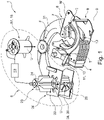
- figure 1 shows a 3-dimensional plan view of a simplified device 1 according to the invention for preparing a pineapple fruit A ready for consumption in stationary retail.
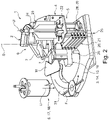
- Figures 2 to 4 show further 3-dimensional views of the device 1 from figure 1 .
- FIG. 1 Show in more detail Figures 1 to 4 a device 1 for preparing a pineapple fruit A ready for consumption in stationary retail.
- the device 1 has a receiving device 2 for receiving a pineapple fruit A in the device 1, a drive 3 with a driver 4 for moving a pineapple fruit A to be processed in the conveying direction F from the receiving device 2 to a cutting device 5, and a cutting device 5 for separating the Skin and stalk of edible pulp of pineapple fruit A.
- the device 1 comprises a device 6 for determining the diameter of the pineapple fruit A in order to minimize waste in the form of peel and stalk in the cutting device 5 and to increase the yield of fruit pulp.
- the device 6 for determining the diameter of the pineapple fruit A has two force-loaded counter-holder elements 7 which are designed as swivel arms and are loaded with a force acting counter to the conveying direction F. These counter-holder elements 7 also serve, among other things, to erect or position, for example, a pineapple fruit A that has been placed at an angle in the device 1 in such a way that the fruit can be optimally processed within the device 1 .
- the device 6 for determining the diameter of the pineapple fruit A is set up to calculate the path difference between the counter-holder element 7 from the travel path of the driver 4 in the conveying direction F and the point in time at which the force of the force-loaded counter-holder elements 7 is exceeded by the force of the driver 4 on the pineapple fruit A and driver 4 to be determined. Because the path difference corresponds to the diameter of the pineapple fruit A.
- the device 6 for determining the diameter of the pineapple fruit A has a first sensor 8 for detecting the position of the counter-holder elements 7.
- the first sensor 8 is implemented as a contact switch and designed to detect a predetermined open position and a predetermined closed position of the counter-holder elements 7 .
- the device 1 with the first sensor 8 is designed in such a way that a contact signal from the first sensor 8 signals the predetermined open position and a missing contact signal signals the predetermined closed position of the counter-holder elements 7 .
- the counter-holder elements 7 are aligned such that the path of travel of a pineapple fruit A in the conveying direction F is released by the counter-holder elements 7, with the counter-holder elements 7 being aligned along the conveying direction F of the pineapple fruit A to be processed in the open position.
- a force acting on the pineapple fruit A to be processed can be suppressed, so that the pineapple fruit A can be moved unhindered from the counter-holder elements 7 in the conveying direction F through the driver 4 to the cutting device 5 .
- the counter-holder elements 7 are oriented in such a way that the travel path of a pineapple fruit A in the conveying direction F is blocked by the counter-holder elements 7 .
- the counter-holder elements 7 in the closed position are aligned transversely to the conveying direction F of the pineapple fruit A to be processed in order to generate a maximum force counter to the conveying direction F of the pineapple fruit A to be processed.
- the device 6 for determining the diameter of the pineapple fruit A has a lever arrangement 9 and a spring force element 10, the lever arrangement 9 and the counter-holder elements 7 being pivotable about a common pivot axis S.
- the lever arrangement 9 has a pivoting part on which the counter-holding elements 7 are arranged, a triangular connecting part on which the spring force element 10, a connecting element 13 and a molded part for connecting the connecting part to the pivoting part.
- the spring force element 10 is arranged on the lever arrangement 9 in order to act on the counter-holder elements 7 via the pivot axis S with a certain force for counter-holding and against the conveying direction F of the pineapple fruit A to be processed.
- the lever arrangement 9 is - as in figure 3 set up to move the counter-holder elements 7 from the closed position to the open position and hold them there as soon as the force that acts on the counter-holder elements 7 from the driver 4 via the pineapple fruit A to be processed exceeds the force of the spring force element 10.
- the triangular connecting part of the lever arrangement 9 is pivoted about the pivoting part on which the counter-retaining elements 7 are arranged or pivoted about the pivot axis S in such a way that the triangular connecting part contacts the first sensor 8 designed as a contact switch.
- the device 6 for determining the diameter of the pineapple fruit A has a resetting mechanism 11 for resetting the counter-holder elements 7 from the open position to the closed position.
- the reset mechanism 11 is connected to the lever arrangement 9 in order to reset the force-loaded counter-holder elements 7 from the open position to the closed position, as a result of which a renewed determination of the diameter of a pineapple fruit A can be guaranteed.
- the resetting mechanism 11 has a pivoted stop element 12 (attached like a swingarm to two extension arms around the axis of rotation T) and a connecting element 13 (in the form of a bent piece of sheet metal) which connects the stop element 12 to the lever arrangement 9.
- the axis of rotation T of the stop element 12 and the pivot axis S of the counter-holder elements 7 are oriented in the same direction or in the same spatial direction, with the connecting element 13 connecting the stop element 12 and the counter-holder elements 7 to one another.
- the stop element 12 and the counter-holder elements 7 are also designed in such a way that a rotation of one element causes a rotation of the other element in the same direction at the same time.
- the connecting element 13 also connects the stop element 12 to the lever arrangement 9 in such a way that the counter-holder elements 7 can be reset from the open position to the closed position by moving back the driver 4 counter to the conveying direction F and against the stop element 12 .
- the stop element 12 also pivots; namely in the same direction as the counter-holder elements 7 due to the connecting element 13s, which connects the stop element 12 to the lever arrangement 9.
- the device 6 for determining the diameter of the pineapple fruit A includes a second sensor 14 for detecting the position of the driver 4 .
- the second sensor 14 is designed to detect the distance covered by the driver 4 of the drive 3 and thus the position of the driver 4 .
- the second sensor 14 is arranged on or in the drive 3 .
- the second sensor 14 is able to detect the position of the driver 4 relative to a predetermined starting position.
- the device 6 for determining the diameter of the pineapple fruit A is set up in such a way that the driver 4 is in the predetermined starting position when the counter-holder elements 7 are arranged in the closed position.
- the device 6 for determining the diameter of the pineapple fruit A can also recognize the predetermined starting position of the driver 4 when the first sensor 8 detects the closed position of the counter-holder element 7 .
- the device 6 for determining the diameter of the pineapple fruit A is set up in such a way that the driver 4 is arranged in the predetermined starting position when the driver 4 acts against the stop element 16 of the reset mechanism 11 and the counter-holder elements 7 move from the open position to has reset the closed position.
- the first sensor 8 designed as a contact switch is not contacted.
- the device 6 for determining the diameter of the pineapple fruit A has a determination unit 15 for determining the diameter of the pineapple fruit A.
- the determination unit 15 is connected to the first 8 and the second sensor 14, with the determination unit 15 being set up to detect the path covered by the driver 4 in the conveying direction F, starting from the predetermined starting position.
- the determination unit 15 is designed in such a way that it stores the predetermined distance between the counter-holder elements 7 and the predetermined starting position of the driver 4 .
- the determination unit 15 determines from the travel path of the driver 4 in the conveying direction F, which is detected by the second sensor 14, and the point in time, which is detected by the first sensor 8 and at which the force acting counter to the conveying direction F of the force-loaded counter-holder elements 7 is surpassed by the driver 4 to determine the distance covered by the driver 4 since the starting position.
- the determination unit 15 is able to determine the distance covered by the driver 4 at the time of a contact signal from the first sensor 8 .
- the determination unit 15 is set up to determine the path difference between the counter-holder elements 7 and the driver 4 from the distance covered by the driver 4 and the time at which the first sensor 8 detects the predetermined open position of the counter-holder elements 7 .
- the determination unit 15 has also stored in a memory the path difference between the path covered by the driver 4 and the distance between the counter-holder elements 7 and the starting position of the driver 4 .
- Figures 1 to 4 shows that the device 6 for determining the diameter of the pineapple fruit A includes a control unit 16 for controlling the movement of the drive 3 .
- control unit 16 controls the drive 3 in such a way that the pineapple fruit A can be placed in the cutting device 5 based on the calculated diameter of the pineapple fruit A in such a way that waste in the form of peel and stalk can be minimized and the yield of pulp can be maximized.
- control unit 16 deactivate the drive 3, in particular as soon as the closed position of the counter-holder elements 7 is detected by the first sensor 8, to move the driver 4 counter to the conveyor direction F or else in the conveyor direction F again.
- the cutting device 5 has a separating unit 17 for separating the peel and the stalk from the edible pulp of the pineapple fruit A.
- the separating unit 17 is equipped with two concentric and circular cutting elements, so that the separating unit 17 is able to create a hollow-cylindrical intermediate product from edible pulp of a pineapple fruit A.
- the separating unit 17 has a lifting-movable peeling-coring knife 18 which is set up to remove the stalk of a pineapple fruit A and to peel the pineapple fruit A and create a hollow-cylindrical intermediate product made of edible pulp.
- the separating unit 18 has an electric lifting drive 19, as in figure 1 to recognize where the peeling-coring knife 18 is arranged and with which the peeling-coring knife 18 can be moved.
- the lifting drive 19 makes it possible to move the peeling-coring knife 18 in a separating direction U and also counter to the separating direction U in order to cut out or then release edible fruit pulp.
- the peeling and coring knife 18 has two concentrically arranged cutting elements which are adapted to the size of the pineapple fruit.
- separating unit 18 While the separating unit 18 is located behind the receiving device 2 viewed in the conveying direction F, a portioning unit 20 for ready-to-eat portioning of edible fruit pulp is now arranged behind the separating unit 18 when viewed in the conveying direction F.
- the portioning unit 20 of the cutting device 5 is set up to portion a hollow-cylindrical intermediate product created by the separating unit 17 by cutting.
- the portioning unit 20 is designed as a transverse cutting unit for cutting slices and as a longitudinal cutting unit for cutting sticks and/or pieces. Since slices are always cut first in the present case, logically only pieces can subsequently be cut from the slices using the longitudinal cutting unit.
- the portioning unit 20 has a horizontal knife pack 21 for cutting slices and a vertical knife pack 22 for cutting sticks and/or pieces.
- the transverse cutting unit has a horizontal blade package 21 with various cutting blade elements arranged horizontally one above the other, the cutting blade elements being connected to one another.
- the longitudinal cutting unit is equipped with a vertical knife pack 22 with various cutting knife elements arranged next to one another, which are also connected to one another.
- the portioning unit 20 has a punch unit 23 that can be lifted, the cutting knife elements of the longitudinal cutting unit being connected in a star shape to the punch unit 23 that can be lifted.
- the punch unit 23 that can be moved up and down has a cylinder element 24 to which the vertical blade assembly 22 is attached.
- the cylinder element 24 has a diameter which is adapted to the inner diameter of a hollow-cylindrical intermediate product produced by the separating unit 17, so that the cylinder element 24 can be sunk into the inner diameter of the intermediate product.
- the star-shaped arranged cutting blade elements also have a radial length in the radial direction, starting from the cylinder element 24, which exceeds the outer diameter of a hollow-cylindrical intermediate product produced by the separating unit 17. This ensures that the intermediate product is broken up safely.
- the portioning unit 20 is connected to the electric lifting drive 19, as a result of which the longitudinal cutting unit can be lifted, so that it can be moved by the lifting drive 19 for cutting in the cutting direction U and counter to the cutting direction U.
- the cutting device 5 below the cutting blade elements of the longitudinal cutting unit of the portioning unit 20 has a swivel base unit 25 for releasing a prepared and ready-to-eat portioned pineapple fruit A.
- the swivel base unit 25 comprises an actuating element 26 (see figure 2 ), a bottom element 27 (see figure 3 ) which has a drop opening 28 (see figure 1 ) releases or closes, and a spring element 29 (see figure 3 ), all of which are operatively connected to one another.
- the bottom element 27 is pretensioned by the spring element 29 in a first position in which the drop opening 28 is released.
- the driver 4 for guiding a pineapple fruit A now acts against the actuating element 26 from a certain position, whereby the base element 27 is moved against the tension of the spring element 29 into a second position in which the drop opening 28 is closed.
- the base element 27 has a cutting base 30 with notches which are adapted to the arrangement of the cutting elements of the slitter unit. This ensures that the hollow-cylindrical intermediate product is divided along its entire height without the cutting elements of the longitudinal cutting unit becoming blunt.
- the cutting device 5 is designed by means of a top-tail knife, from which in the Figures 1 to 4 only the lower knife M is shown to separate the ends of the pineapple fruit A to be processed in the form of end caps.
- the receiving device 2, the cutting device 5 and the device 6 for determining the diameter of the pineapple fruit A are aligned or arranged along a circular path.
- the receiving device 2 and the cutting device 5 and the device 6 for determining the diameter of the pineapple fruit A are arranged along a fruit support 31 .
- the fruit support 31 is designed in such a way that the pineapple fruit A, viewed in the conveying direction F, is moved on one level, in particular on a single level, after the device for determining the diameter 6 of the pineapple fruit A up to the end of the cutting device 5 .
- the device 1 includes a housing (not shown) that allows a consumer or a purchaser of the pulp of a pineapple fruit to place and remove the pineapple fruit A in a brick-and-mortar store.
Landscapes
- Life Sciences & Earth Sciences (AREA)
- Engineering & Computer Science (AREA)
- Forests & Forestry (AREA)
- Mechanical Engineering (AREA)
- Chemical & Material Sciences (AREA)
- Food Science & Technology (AREA)
- Polymers & Plastics (AREA)
- Apparatuses For Bulk Treatment Of Fruits And Vegetables And Apparatuses For Preparing Feeds (AREA)
- Preparation Of Compounds By Using Micro-Organisms (AREA)
Applications Claiming Priority (2)
| Application Number | Priority Date | Filing Date | Title |
|---|---|---|---|
| DE202018105274.8U DE202018105274U1 (de) | 2018-09-14 | 2018-09-14 | Vorrichtung zum verzehrfertigen Aufbereiten einer Ananasfrucht im stationären Handel |
| EP19195016.1A EP3623122B1 (fr) | 2018-09-14 | 2019-09-03 | Dispositif de préparation prête à la consommation d'un fruit de l'ananas dans le commerce stationnaire |
Related Parent Applications (2)
| Application Number | Title | Priority Date | Filing Date |
|---|---|---|---|
| EP19195016.1A Division EP3623122B1 (fr) | 2018-09-14 | 2019-09-03 | Dispositif de préparation prête à la consommation d'un fruit de l'ananas dans le commerce stationnaire |
| EP19195016.1A Division-Into EP3623122B1 (fr) | 2018-09-14 | 2019-09-03 | Dispositif de préparation prête à la consommation d'un fruit de l'ananas dans le commerce stationnaire |
Publications (3)
| Publication Number | Publication Date |
|---|---|
| EP4032415A1 true EP4032415A1 (fr) | 2022-07-27 |
| EP4032415B1 EP4032415B1 (fr) | 2023-11-29 |
| EP4032415C0 EP4032415C0 (fr) | 2023-11-29 |
Family
ID=65019926
Family Applications (2)
| Application Number | Title | Priority Date | Filing Date |
|---|---|---|---|
| EP22159638.0A Active EP4032415B1 (fr) | 2018-09-14 | 2019-09-03 | Dispositif de préparation d'un ananas prêt à être consommé dans le commerce traditionnel |
| EP19195016.1A Active EP3623122B1 (fr) | 2018-09-14 | 2019-09-03 | Dispositif de préparation prête à la consommation d'un fruit de l'ananas dans le commerce stationnaire |
Family Applications After (1)
| Application Number | Title | Priority Date | Filing Date |
|---|---|---|---|
| EP19195016.1A Active EP3623122B1 (fr) | 2018-09-14 | 2019-09-03 | Dispositif de préparation prête à la consommation d'un fruit de l'ananas dans le commerce stationnaire |
Country Status (3)
| Country | Link |
|---|---|
| EP (2) | EP4032415B1 (fr) |
| DE (1) | DE202018105274U1 (fr) |
| ES (1) | ES2969749T3 (fr) |
Families Citing this family (7)
| Publication number | Priority date | Publication date | Assignee | Title |
|---|---|---|---|---|
| DE202018105274U1 (de) | 2018-09-14 | 2019-01-02 | Hepro Gmbh | Vorrichtung zum verzehrfertigen Aufbereiten einer Ananasfrucht im stationären Handel |
| CN110962173B (zh) * | 2019-12-25 | 2021-06-15 | 李菊英 | 一种菠萝去芯、切块一体的罐头制作装置 |
| DE202021100256U1 (de) * | 2021-01-20 | 2021-02-03 | Hepro Gmbh Maschinen Und Spezialgeräte | System zum verzehrfertigen Aufbereiten einer Ananasfrucht im stationären Handel |
| ES2966862B2 (es) * | 2022-09-30 | 2025-04-04 | Zummo Innovaciones Mecanicas S A U | Máquina de pelado y corte de piñas |
| EP4623706B1 (fr) | 2024-03-28 | 2026-04-15 | SanLucar Fruit S.L.U. | Machine et méthode de préparation automatique d'un ananas entier pour la consommation à un point de vente d'ananas |
| EP4623705B1 (fr) | 2024-03-28 | 2026-04-01 | SanLucar Fruit S.L.U. | Machine et méthode de préparation automatique d'un ananas entier pour la consommation à un point de vente d'ananas |
| EP4623704B1 (fr) | 2024-03-28 | 2026-04-15 | SanLucar Fruit S.L.U. | Machine et méthode de préparation automatique d'un ananas entier pour la consommation à un point de vente d'ananas |
Citations (9)
| Publication number | Priority date | Publication date | Assignee | Title |
|---|---|---|---|---|
| US4373432A (en) * | 1978-07-21 | 1983-02-15 | Maui Land & Pineapple Company, Inc. | Top and butt trimmer for pineapples |
| EP0084204A1 (fr) * | 1982-01-18 | 1983-07-27 | Castle & Cooke, Inc. | Dispositif pour peler des ananas |
| WO2013036110A1 (fr) | 2011-09-06 | 2013-03-14 | Tastymatic B.V. | Dispositif et procédé de retrait de la partie centrale et de la chair d'un fruit |
| WO2014184298A1 (fr) * | 2013-05-15 | 2014-11-20 | Bm Boxmeer B.V. | Dispositif et procédé pour le traitement d'un ananas |
| WO2016030866A1 (fr) * | 2014-08-29 | 2016-03-03 | Fal-Ross Limited | Préparation produire |
| EP2997835A1 (fr) * | 2014-09-17 | 2016-03-23 | FB-Handels und Service Ltd. | Procede et dispositif de preparation sans danger d'ananas frais pour la consommation |
| EP3005887A1 (fr) * | 2014-10-08 | 2016-04-13 | Thomas Völkl | Dispositif destine a decouper un ananas |
| CN106954864A (zh) * | 2017-03-22 | 2017-07-18 | 苏利云 | 一种凤梨去心装置 |
| DE202018105274U1 (de) | 2018-09-14 | 2019-01-02 | Hepro Gmbh | Vorrichtung zum verzehrfertigen Aufbereiten einer Ananasfrucht im stationären Handel |
Family Cites Families (10)
| Publication number | Priority date | Publication date | Assignee | Title |
|---|---|---|---|---|
| US3638696A (en) * | 1969-08-22 | 1972-02-01 | Atlas Pacifik Eng Co | Means for peeling pineapples |
| US3780641A (en) | 1971-12-06 | 1973-12-25 | W Hole | Method for preparing pineapple |
| US4108059A (en) * | 1976-06-21 | 1978-08-22 | Atlas Pacific Engineering Company | Method and means for peeling pineapples |
| US4985268A (en) * | 1988-12-09 | 1991-01-15 | Pitters Pty. Ltd. | Method for processing pineapples |
| AU678592B2 (en) | 1993-09-22 | 1997-06-05 | Pitters Pty. Ltd. | Pineapple processing apparatus |
| WO2011123926A1 (fr) | 2010-04-07 | 2011-10-13 | In-Store Advanced Automation Inc. | Appareil de coupe pour vide-pomme |
| AU2012212659B2 (en) * | 2011-01-07 | 2016-10-13 | Taylor Commercial Foodservice, LLC. | Method and apparatus for preparing food, particularly fruit |
| JP2015527080A (ja) * | 2012-09-05 | 2015-09-17 | アトラス、パシフィック、エンジニアリング、カンパニーAtlas Pacific Engineering Company | 果実チャンク及びスピア生成方法及び装置 |
| NL2012779B1 (nl) | 2014-05-07 | 2016-02-23 | Tastymatic B V | Inrichting en werkwijze voor het scheiden van de kern en de schil van een vrucht. |
| WO2020055232A1 (fr) | 2018-09-10 | 2020-03-19 | Dutch Food Technology B.V. | Dispositif destiné à la transformation d'ananas |
-
2018
- 2018-09-14 DE DE202018105274.8U patent/DE202018105274U1/de active Active
-
2019
- 2019-09-03 ES ES22159638T patent/ES2969749T3/es active Active
- 2019-09-03 EP EP22159638.0A patent/EP4032415B1/fr active Active
- 2019-09-03 EP EP19195016.1A patent/EP3623122B1/fr active Active
Patent Citations (9)
| Publication number | Priority date | Publication date | Assignee | Title |
|---|---|---|---|---|
| US4373432A (en) * | 1978-07-21 | 1983-02-15 | Maui Land & Pineapple Company, Inc. | Top and butt trimmer for pineapples |
| EP0084204A1 (fr) * | 1982-01-18 | 1983-07-27 | Castle & Cooke, Inc. | Dispositif pour peler des ananas |
| WO2013036110A1 (fr) | 2011-09-06 | 2013-03-14 | Tastymatic B.V. | Dispositif et procédé de retrait de la partie centrale et de la chair d'un fruit |
| WO2014184298A1 (fr) * | 2013-05-15 | 2014-11-20 | Bm Boxmeer B.V. | Dispositif et procédé pour le traitement d'un ananas |
| WO2016030866A1 (fr) * | 2014-08-29 | 2016-03-03 | Fal-Ross Limited | Préparation produire |
| EP2997835A1 (fr) * | 2014-09-17 | 2016-03-23 | FB-Handels und Service Ltd. | Procede et dispositif de preparation sans danger d'ananas frais pour la consommation |
| EP3005887A1 (fr) * | 2014-10-08 | 2016-04-13 | Thomas Völkl | Dispositif destine a decouper un ananas |
| CN106954864A (zh) * | 2017-03-22 | 2017-07-18 | 苏利云 | 一种凤梨去心装置 |
| DE202018105274U1 (de) | 2018-09-14 | 2019-01-02 | Hepro Gmbh | Vorrichtung zum verzehrfertigen Aufbereiten einer Ananasfrucht im stationären Handel |
Non-Patent Citations (1)
| Title |
|---|
| MENOFMEDIA: "140418RaboLvCM FVO14 Pinabar", YOUTUBE, 23 April 2014 (2014-04-23), XP093004657, Retrieved from the Internet <URL:https://www.youtube.com/watch?v=9KWRJ8k8pmA> |
Also Published As
| Publication number | Publication date |
|---|---|
| DE202018105274U1 (de) | 2019-01-02 |
| EP4032415B1 (fr) | 2023-11-29 |
| EP3623122B1 (fr) | 2022-10-26 |
| EP4032415C0 (fr) | 2023-11-29 |
| ES2969749T3 (es) | 2024-05-22 |
| EP3623122A1 (fr) | 2020-03-18 |
Similar Documents
| Publication | Publication Date | Title |
|---|---|---|
| EP3623122B1 (fr) | Dispositif de préparation prête à la consommation d'un fruit de l'ananas dans le commerce stationnaire | |
| EP3005887B1 (fr) | Dispositif destine a decouper un ananas | |
| DE69109804T2 (de) | Gerät zum Trennen des Kernes, der Schale und des Fleisches einer Frucht, insbesondere einer Ananas. | |
| EP1857232A1 (fr) | Dispositif de coupe de légumes | |
| EP2384267B1 (fr) | Couteau rotatif pour produits alimentaires | |
| EP3307501B1 (fr) | Dispositif pour la découpe d'aliments | |
| EP4032414B1 (fr) | Système de préparation d'un fruit d'ananas prêt à être consommé dans le commerce traditionnel | |
| EP2374581B1 (fr) | Dispositif de découpage de produits alimentaires | |
| DE60303937T2 (de) | Schneidemaschine für lebensmittel | |
| EP2241421A1 (fr) | Dispositif pour portionner des aliments | |
| EP3359356B1 (fr) | Dispositif pour couper un tronçon d'aliments | |
| DE102016108440A1 (de) | Schneidevorrichtung für Lebensmittel | |
| EP2322330A1 (fr) | Procédé et dispositif de coupe d'un tronçon de viande contenant des os en tranches | |
| DE69214752T2 (de) | Kirschentkerner | |
| DE102007038460A1 (de) | Produkthalterung für eine Lebensmittelschneidemaschine | |
| DE202024102201U1 (de) | Aufnahmeeinrichtung zur Aufnahme einer Frucht | |
| DE102014011167B4 (de) | Schneidmaschine für strangförmige Lebensmittel | |
| EP0936034B1 (fr) | Procédé et appareil pour couper et séparer de segments à partir d'un objet rond | |
| DE102010006967B4 (de) | Schneidevorrichtung zum Halbieren eines knollenförmigen Lebensmittels und zum gleichzeitigen Schneiden dieser Hälften in verbundene Scheiben | |
| DE69118519T2 (de) | Konditionieren von in Scheiben geschnittenen Tabakballen | |
| DE102016108274A1 (de) | Schneidmesser für Portionier- oder Schneidvorrichtung | |
| DE19837644B4 (de) | Vorrichtung und Verfahren zum Schneiden von Lebensmittelprodukten | |
| DE10333335B3 (de) | Werkzeug zum Entfernen des Stielansatzes von Tomaten | |
| EP4469250A1 (fr) | Dispositif de coupe et de mise en forme | |
| DE3033673A1 (de) | Geraet zum zerschneiden von nahrungsmitteln wie fruechte und gemuese |
Legal Events
| Date | Code | Title | Description |
|---|---|---|---|
| PUAI | Public reference made under article 153(3) epc to a published international application that has entered the european phase |
Free format text: ORIGINAL CODE: 0009012 |
|
| STAA | Information on the status of an ep patent application or granted ep patent |
Free format text: STATUS: THE APPLICATION HAS BEEN PUBLISHED |
|
| AC | Divisional application: reference to earlier application |
Ref document number: 3623122 Country of ref document: EP Kind code of ref document: P |
|
| AK | Designated contracting states |
Kind code of ref document: A1 Designated state(s): AL AT BE BG CH CY CZ DE DK EE ES FI FR GB GR HR HU IE IS IT LI LT LU LV MC MK MT NL NO PL PT RO RS SE SI SK SM TR |
|
| STAA | Information on the status of an ep patent application or granted ep patent |
Free format text: STATUS: REQUEST FOR EXAMINATION WAS MADE |
|
| 17P | Request for examination filed |
Effective date: 20220915 |
|
| RBV | Designated contracting states (corrected) |
Designated state(s): AL AT BE BG CH CY CZ DE DK EE ES FI FR GB GR HR HU IE IS IT LI LT LU LV MC MK MT NL NO PL PT RO RS SE SI SK SM TR |
|
| TPAC | Observations filed by third parties |
Free format text: ORIGINAL CODE: EPIDOSNTIPA |
|
| STAA | Information on the status of an ep patent application or granted ep patent |
Free format text: STATUS: EXAMINATION IS IN PROGRESS |
|
| 17Q | First examination report despatched |
Effective date: 20230131 |
|
| TPAC | Observations filed by third parties |
Free format text: ORIGINAL CODE: EPIDOSNTIPA |
|
| GRAP | Despatch of communication of intention to grant a patent |
Free format text: ORIGINAL CODE: EPIDOSNIGR1 |
|
| STAA | Information on the status of an ep patent application or granted ep patent |
Free format text: STATUS: GRANT OF PATENT IS INTENDED |
|
| INTG | Intention to grant announced |
Effective date: 20230808 |
|
| GRAS | Grant fee paid |
Free format text: ORIGINAL CODE: EPIDOSNIGR3 |
|
| GRAA | (expected) grant |
Free format text: ORIGINAL CODE: 0009210 |
|
| STAA | Information on the status of an ep patent application or granted ep patent |
Free format text: STATUS: THE PATENT HAS BEEN GRANTED |
|
| AC | Divisional application: reference to earlier application |
Ref document number: 3623122 Country of ref document: EP Kind code of ref document: P |
|
| AK | Designated contracting states |
Kind code of ref document: B1 Designated state(s): AL AT BE BG CH CY CZ DE DK EE ES FI FR GB GR HR HU IE IS IT LI LT LU LV MC MK MT NL NO PL PT RO RS SE SI SK SM TR |
|
| REG | Reference to a national code |
Ref country code: GB Ref legal event code: FG4D Free format text: NOT ENGLISH |
|
| REG | Reference to a national code |
Ref country code: CH Ref legal event code: EP |
|
| REG | Reference to a national code |
Ref country code: DE Ref legal event code: R096 Ref document number: 502019010052 Country of ref document: DE |
|
| REG | Reference to a national code |
Ref country code: IE Ref legal event code: FG4D Free format text: LANGUAGE OF EP DOCUMENT: GERMAN |
|
| REG | Reference to a national code |
Ref country code: DE Ref legal event code: R081 Ref document number: 502019010052 Country of ref document: DE Owner name: HEPRO GMBH MASCHINEN UND SPEZIALGERAETE, DE Free format text: FORMER OWNER: ANMELDERANGABEN UNKLAR / UNVOLLSTAENDIG, 80297 MUENCHEN, DE |
|
| U01 | Request for unitary effect filed |
Effective date: 20231215 |
|
| U07 | Unitary effect registered |
Designated state(s): AT BE BG DE DK EE FI FR IT LT LU LV MT NL PT SE SI Effective date: 20231222 |
|
| REG | Reference to a national code |
Ref country code: DE Ref legal event code: R026 Ref document number: 502019010052 Country of ref document: DE |
|
| PLBI | Opposition filed |
Free format text: ORIGINAL CODE: 0009260 |
|
| 26 | Opposition filed |
Opponent name: SANLUCAR VERTRIEB DEUTSCHLAND GMBH Effective date: 20240213 |
|
| PG25 | Lapsed in a contracting state [announced via postgrant information from national office to epo] |
Ref country code: GR Free format text: LAPSE BECAUSE OF FAILURE TO SUBMIT A TRANSLATION OF THE DESCRIPTION OR TO PAY THE FEE WITHIN THE PRESCRIBED TIME-LIMIT Effective date: 20240301 |
|
| PG25 | Lapsed in a contracting state [announced via postgrant information from national office to epo] |
Ref country code: IS Free format text: LAPSE BECAUSE OF FAILURE TO SUBMIT A TRANSLATION OF THE DESCRIPTION OR TO PAY THE FEE WITHIN THE PRESCRIBED TIME-LIMIT Effective date: 20240329 |
|
| PG25 | Lapsed in a contracting state [announced via postgrant information from national office to epo] |
Ref country code: IS Free format text: LAPSE BECAUSE OF FAILURE TO SUBMIT A TRANSLATION OF THE DESCRIPTION OR TO PAY THE FEE WITHIN THE PRESCRIBED TIME-LIMIT Effective date: 20240329 Ref country code: GR Free format text: LAPSE BECAUSE OF FAILURE TO SUBMIT A TRANSLATION OF THE DESCRIPTION OR TO PAY THE FEE WITHIN THE PRESCRIBED TIME-LIMIT Effective date: 20240301 |
|
| REG | Reference to a national code |
Ref country code: ES Ref legal event code: FG2A Ref document number: 2969749 Country of ref document: ES Kind code of ref document: T3 Effective date: 20240522 |
|
| PG25 | Lapsed in a contracting state [announced via postgrant information from national office to epo] |
Ref country code: RS Free format text: LAPSE BECAUSE OF FAILURE TO SUBMIT A TRANSLATION OF THE DESCRIPTION OR TO PAY THE FEE WITHIN THE PRESCRIBED TIME-LIMIT Effective date: 20231129 Ref country code: PL Free format text: LAPSE BECAUSE OF FAILURE TO SUBMIT A TRANSLATION OF THE DESCRIPTION OR TO PAY THE FEE WITHIN THE PRESCRIBED TIME-LIMIT Effective date: 20231129 Ref country code: NO Free format text: LAPSE BECAUSE OF FAILURE TO SUBMIT A TRANSLATION OF THE DESCRIPTION OR TO PAY THE FEE WITHIN THE PRESCRIBED TIME-LIMIT Effective date: 20240229 Ref country code: HR Free format text: LAPSE BECAUSE OF FAILURE TO SUBMIT A TRANSLATION OF THE DESCRIPTION OR TO PAY THE FEE WITHIN THE PRESCRIBED TIME-LIMIT Effective date: 20231129 |
|
| PG25 | Lapsed in a contracting state [announced via postgrant information from national office to epo] |
Ref country code: CZ Free format text: LAPSE BECAUSE OF FAILURE TO SUBMIT A TRANSLATION OF THE DESCRIPTION OR TO PAY THE FEE WITHIN THE PRESCRIBED TIME-LIMIT Effective date: 20231129 |
|
| PG25 | Lapsed in a contracting state [announced via postgrant information from national office to epo] |
Ref country code: SK Free format text: LAPSE BECAUSE OF FAILURE TO SUBMIT A TRANSLATION OF THE DESCRIPTION OR TO PAY THE FEE WITHIN THE PRESCRIBED TIME-LIMIT Effective date: 20231129 |
|
| PG25 | Lapsed in a contracting state [announced via postgrant information from national office to epo] |
Ref country code: SM Free format text: LAPSE BECAUSE OF FAILURE TO SUBMIT A TRANSLATION OF THE DESCRIPTION OR TO PAY THE FEE WITHIN THE PRESCRIBED TIME-LIMIT Effective date: 20231129 Ref country code: SK Free format text: LAPSE BECAUSE OF FAILURE TO SUBMIT A TRANSLATION OF THE DESCRIPTION OR TO PAY THE FEE WITHIN THE PRESCRIBED TIME-LIMIT Effective date: 20231129 Ref country code: RO Free format text: LAPSE BECAUSE OF FAILURE TO SUBMIT A TRANSLATION OF THE DESCRIPTION OR TO PAY THE FEE WITHIN THE PRESCRIBED TIME-LIMIT Effective date: 20231129 Ref country code: CZ Free format text: LAPSE BECAUSE OF FAILURE TO SUBMIT A TRANSLATION OF THE DESCRIPTION OR TO PAY THE FEE WITHIN THE PRESCRIBED TIME-LIMIT Effective date: 20231129 |
|
| PLAX | Notice of opposition and request to file observation + time limit sent |
Free format text: ORIGINAL CODE: EPIDOSNOBS2 |
|
| U20 | Renewal fee for the european patent with unitary effect paid |
Year of fee payment: 6 Effective date: 20240925 |
|
| PLBB | Reply of patent proprietor to notice(s) of opposition received |
Free format text: ORIGINAL CODE: EPIDOSNOBS3 |
|
| PG25 | Lapsed in a contracting state [announced via postgrant information from national office to epo] |
Ref country code: MC Free format text: LAPSE BECAUSE OF FAILURE TO SUBMIT A TRANSLATION OF THE DESCRIPTION OR TO PAY THE FEE WITHIN THE PRESCRIBED TIME-LIMIT Effective date: 20231129 |
|
| REG | Reference to a national code |
Ref country code: CH Ref legal event code: PL |
|
| PG25 | Lapsed in a contracting state [announced via postgrant information from national office to epo] |
Ref country code: CH Free format text: LAPSE BECAUSE OF NON-PAYMENT OF DUE FEES Effective date: 20240930 |
|
| PG25 | Lapsed in a contracting state [announced via postgrant information from national office to epo] |
Ref country code: IE Free format text: LAPSE BECAUSE OF NON-PAYMENT OF DUE FEES Effective date: 20240903 |
|
| PGFP | Annual fee paid to national office [announced via postgrant information from national office to epo] |
Ref country code: GB Payment date: 20250923 Year of fee payment: 7 |
|
| U20 | Renewal fee for the european patent with unitary effect paid |
Year of fee payment: 7 Effective date: 20250923 |
|
| PLCK | Communication despatched that opposition was rejected |
Free format text: ORIGINAL CODE: EPIDOSNREJ1 |
|
| PG25 | Lapsed in a contracting state [announced via postgrant information from national office to epo] |
Ref country code: CY Free format text: LAPSE BECAUSE OF FAILURE TO SUBMIT A TRANSLATION OF THE DESCRIPTION OR TO PAY THE FEE WITHIN THE PRESCRIBED TIME-LIMIT; INVALID AB INITIO Effective date: 20190903 |
|
| APAH | Appeal reference modified |
Free format text: ORIGINAL CODE: EPIDOSCREFNO |
|
| APBP | Date of receipt of notice of appeal recorded |
Free format text: ORIGINAL CODE: EPIDOSNNOA2O |
|
| PGFP | Annual fee paid to national office [announced via postgrant information from national office to epo] |
Ref country code: ES Payment date: 20251020 Year of fee payment: 7 |
|
| PG25 | Lapsed in a contracting state [announced via postgrant information from national office to epo] |
Ref country code: HU Free format text: LAPSE BECAUSE OF FAILURE TO SUBMIT A TRANSLATION OF THE DESCRIPTION OR TO PAY THE FEE WITHIN THE PRESCRIBED TIME-LIMIT; INVALID AB INITIO Effective date: 20190903 |
|
| APBQ | Date of receipt of statement of grounds of appeal recorded |
Free format text: ORIGINAL CODE: EPIDOSNNOA3O |