EP4032881A1 - Verfahren und vorrichtung zur reinigung eines furanderivats - Google Patents
Verfahren und vorrichtung zur reinigung eines furanderivats Download PDFInfo
- Publication number
- EP4032881A1 EP4032881A1 EP21152776.7A EP21152776A EP4032881A1 EP 4032881 A1 EP4032881 A1 EP 4032881A1 EP 21152776 A EP21152776 A EP 21152776A EP 4032881 A1 EP4032881 A1 EP 4032881A1
- Authority
- EP
- European Patent Office
- Prior art keywords
- activated carbon
- solvent
- furan derivative
- reaction mixture
- hydroxymethylfurfural
- Prior art date
- Legal status (The legal status is an assumption and is not a legal conclusion. Google has not performed a legal analysis and makes no representation as to the accuracy of the status listed.)
- Pending
Links
Images
Classifications
-
- C—CHEMISTRY; METALLURGY
- C07—ORGANIC CHEMISTRY
- C07D—HETEROCYCLIC COMPOUNDS
- C07D307/00—Heterocyclic compounds containing five-membered rings having one oxygen atom as the only ring hetero atom
- C07D307/02—Heterocyclic compounds containing five-membered rings having one oxygen atom as the only ring hetero atom not condensed with other rings
- C07D307/34—Heterocyclic compounds containing five-membered rings having one oxygen atom as the only ring hetero atom not condensed with other rings having two or three double bonds between ring members or between ring members and non-ring members
- C07D307/38—Heterocyclic compounds containing five-membered rings having one oxygen atom as the only ring hetero atom not condensed with other rings having two or three double bonds between ring members or between ring members and non-ring members with substituted hydrocarbon radicals attached to ring carbon atoms
- C07D307/40—Radicals substituted by oxygen atoms
- C07D307/46—Doubly bound oxygen atoms, or two oxygen atoms singly bound to the same carbon atom
Definitions
- the present invention relates to a method and an apparatus for purifying a furan derivative.
- the terms “have”, “comprise” or “include” or any arbitrary grammatical variations thereof are used in a non-exclusive way. Thus, these terms may both refer to a situation in which, besides the feature introduced by these terms, no further features are present in the entity described in this context and to a situation in which one or more further features are present.
- the expressions “A has B”, “A comprises B” and “A includes B” may both refer to a situation in which, besides B, no other element is present in A (i.e. a situation in which A solely and exclusively consists of B) and to a situation in which, besides B, one or more further elements are present in entity A, such as element C, elements C and D or even further elements.
- the terms "at least one”, “one or more” or similar expressions indicating that a feature or element may be present once or more than once typically will be used only once when introducing the respective feature or element.
- the expressions “at least one” or “one or more” will not be repeated, non-withstanding the fact that the respective feature or element may be present once or more than once.
- a method for purifying a furan derivative comprising the following steps, preferably in the given order:
- the purification process has a simple construction and can operate with a solvent which is rather safe under human health and environmental aspects and which can be bio-based, for example, ethanol, acetone.
- the adsorption and desorption process can be carried out at low temperature and low pressure such as temperatures below 110°C and atmospheric pressure. Particularly, the degradation of the final product is minimized as the separation at the activated carbon can be carried out at temperature below 110°C, which prevents the thermal decomposition of the products.
- the solvent can be removed by evaporation at vacuum allowing to decrease the boiling point of the solvent.
- the process water after the separation of the desired product at the activated carbon is rich in carbohydrate such as sugars.
- the significant advantage of the invention is that a wide concentration range of desired product in the feed stream can be processed.
- Another advantage of the method described herein is the removal of sugars from the aqueous reaction mixture before other components are removed.
- the process can be fully bio-based.
- the activated carbon can be produced from agricultural waste and bio-ethanol can be used as solvent which significantly improves life-cycle assessment.
- the process water is not contaminated with harmful solvents.
- furan derivative as used herein is a broad term and is to be given its ordinary and customary meaning to a person of ordinary skill in the art and is not to be limited to a special or customized meaning.
- the term specifically may refer, without limitation, to a compound containing the furan ring.
- the term refers to furan and its furfural derivatives.
- purifying is a broad term and is to be given its ordinary and customary meaning to a person of ordinary skill in the art and is not to be limited to a special or customized meaning.
- the term specifically may refer, without limitation, to a process of rendering something pure, i.e. clean of foreign elements and/or pollution.
- reaction mixture is a broad term and is to be given its ordinary and customary meaning to a person of ordinary skill in the art and is not to be limited to a special or customized meaning.
- the term specifically may refer, without limitation, to a mixture containing reactants and products of 5-HMF synthesis from carbohydrates.
- These carbohydrates can be market available sugars, e.g. fructose/glucose, or obtained by hydrolysis of polysaccharide-based biomass, e.g. lignocellulose.
- absorption is a broad term and is to be given its ordinary and customary meaning to a person of ordinary skill in the art and is not to be limited to a special or customized meaning.
- the term specifically may refer, without limitation, to the adhesion of atoms, ions or molecules from a gas, liquid or dissolved solid to a surface. This process creates a film of the adsorbate on the surface of the adsorbent. This process differs from absorption, in which a fluid (the absorbate) is dissolved by or permeates a liquid or solid (the absorbent), respectively.
- Adsorption is a surface phenomenon, while absorption involves the whole volume of the material, although adsorption does often precede absorption.
- activated carbon is a broad term and is to be given its ordinary and customary meaning to a person of ordinary skill in the art and is not to be limited to a special or customized meaning.
- the term specifically may refer, without limitation, to a form of carbon processed to have small, low-volume pores that increase the surface area available for adsorption or chemical reactions.
- Activated carbon is also called activated charcoal. Activated is sometimes substituted with active. Due to its high degree of microporosity, one gram of activated carbon can have a surface area in excess of 3,000 m 2 as determined by gas adsorption. An activation level sufficient for useful application may be obtained solely from high surface area. Further chemical treatment often enhances adsorption properties.
- Activated carbon is usually derived from charcoal. Basically, activated carbon is carbon produced from carbonaceous source materials such as bamboo, coconut husk, willow peat, wood, coir, lignite, coal, and petroleum pitch.
- desorption as used herein is a broad term and is to be given its ordinary and customary meaning to a person of ordinary skill in the art and is not to be limited to a special or customized meaning.
- the term specifically may refer, without limitation, to a process whereby a substance is released from or through a surface. The process is the opposite of sorption (that is, either adsorption or absorption). This occurs in a system being in the state of sorption equilibrium between bulk phase (fluid, e.g. gas or liquid solution) and an adsorbing surface (solid or boundary separating two fluids). When the concentration (or pressure) of substance in the bulk phase is lowered, some of the sorbed substance changes to the bulk state.
- desorption is the ability for a chemical to move with the mobile phase. The more a chemical desorbs, the less likely it will adsorb, thus instead of sticking to the stationary phase, the chemical moves up with the solvent front.
- stripping is also referred to as desorption as one component of a liquid stream moves by mass transfer into a vapor phase through the liquid-vapor interface. After adsorption, the adsorbed chemical will remain on the substrate nearly indefinitely, provided the temperature remains low. However, as the temperature rises also desorption is increased.
- separating is a broad term and is to be given its ordinary and customary meaning to a person of ordinary skill in the art and is not to be limited to a special or customized meaning.
- the term specifically may refer, without limitation, to a method that converts a mixture or solution of chemical substances into two or more distinct product mixtures. At least one of the fractions resulting from the separation is enriched in one or more of the source mixture's constituents. In some cases, a separation may fully divide the mixture into pure constituents. Separations exploit differences in chemical properties or physical properties (such as size, shape, mass, density, or chemical affinity) between the constituents of a mixture. Processes are often classified according to the particular differences they use to achieve separation.
- the purpose of separation may be analytical, can be used as a lie component in the original mixture without any attempt to save the fractions, or maybe preparative, i.e. to "prepare" fractions or samples of the components that can be saved.
- the separation can be done on a small scale, effectively a laboratory scale for analytical or preparative purposes, or on a large scale, effectively an industrial scale for preparative purposes, or on some intermediate scale.
- the reaction mixture is obtained from a 5-hydroxymethylfurfural synthesis of carbohydrates, wherein the products of the 5-hydroxymethylfurfural synthesis comprise a furan derivative and a carbohydrate.
- the furan derivative may be produced on an organic basis.
- the method may further comprise supplying the reaction mixture to at least one column comprising the activated carbon.
- the activated carbon may be provided at a compact device which decreases the space necessary for activated carbon.
- such a column is well established and easily to integrate in existing apparatus and/or to be scaled-up. Thus, providing such a column is a reliable and well established process.
- the term "column" as used herein is a broad term and is to be given its ordinary and customary meaning to a person of ordinary skill in the art and is not to be limited to a special or customized meaning.
- the term specifically may refer, without limitation, to a tube-shaped device on which is fixed a material called the stationary phase.
- the stationary phase is activated carbon.
- the column is used for the separation of a mixture.
- the mixture is dissolved in a fluid called the mobile phase, which carries it through the column, respectively.
- the different constituents of the mixture have different affinities for the stationary phase.
- the different molecules stay longer or shorter on the stationary phase, depending on their interactions with its surface sites. So, they travel at different apparent velocities in the mobile fluid, causing them to separate.
- the separation is based on the differential partitioning between the mobile and the stationary phases. Subtle differences in a compound's partition coefficient result in differential retention on the stationary phase and thus affect the separation. While small-scale columns range from inner diameters of 0.5 cm and withstand pressures of up to 130 MPa, industrial large scale columns reach diameters of up to 2 m and operate at considerable lower pressures (below 1 MPa). While it is favorable to view the packed bed of a column large scale columns are manufactured from steel due to its superior resilience.
- the method may further comprise supplying the solvent to the column so as to desorb the furan derivative from the activated carbon.
- the adsorbed furan derivative may be eluted with a solvent while other components such as the carbohydrate pass the column.
- the carbohydrate may include at least one monosaccharide, particularly fructose or glucose.
- the furan derivative may be produced from rather cheap and bio-based organic components.
- the adsorption of the furan derivative from the reaction mixture at the activated carbon may be carried out at a temperature in a range of 5.0°C to 60°C and preferably of 10°C to 50°C.
- the adsorption takes places at a rather low temperature which avoids a degradation of the desired product and increases the process efficiency.
- the desorption of the furan derivative adsorbed at the activated carbon may be carried out when the activated carbon is saturated.
- the desorption may be carried out when the activated carbon is no longer capable to adsorb the furan derivative.
- the adsorbing capacity of the activated carbon is completely used.
- the bed of the column can be rinsed with water after desorption to remove residual components adhering to the activated carbon such as solvent, sugars and the like. This further improves the quality of the 5-hydroxymethylfurfural at the end.
- the solvent may be selected from the group consisting of C1 to C10 alkanol, C3 to C10 alkanone, mixtures of two or more C1 to C10 alkanols, mixtures of two or more C3 to C10 alkanones, and mixtures of one or more C1 to C10 alkanol(s) with one or more C3 to C10 alkanone(s).
- C1 to C10 alkanol C3 to C10 alkanone
- mixtures of two or more C1 to C10 alkanols mixtures of two or more C3 to C10 alkanones
- mixtures of one or more C1 to C10 alkanol(s) with one or more C3 to C10 alkanone(s may be used.
- C1 to C10 alkanol comprises alkanols with straight alkyl chain having one or more hydroxyl group(s), and alkanols with branched alkyl chain having one or more hydroxyl group(s), wherein each hydroxyl group is independently selected from the group consisting of primary hydroxyl group, secondary hydroxyl group and tertiary hydroxyl group.
- the solvent may comprise at least ethanol and/or acetone.
- solvents which are rather safe or harmless under human health and environmental aspects, may be used.
- the desorption of the furan derivative adsorbed at the activated carbon may be carried out at a temperature at which the solvent is in a liquid state. Basically, it is recommended to perform the desorption at an elevated temperature to improve the efficiency of desorption. However, the desorption medium should stay in the liquid phase.
- the residence time of the feed strongly depends on the initial concentration of desired products (furfurals, especially 5-HMF) in the reaction mixture. For a higher concentration of the adsorbate in the reaction mixture longer dwell time is recommended.
- the desorption of the furan derivative adsorbed at the activated carbon may be carried out at a temperature below a boiling point of the solvent, preferably 2°C to 20°C and more preferably 5°C to 10°C below a boiling point of the solvent. Thus, it is ensured that the solvent is in the liquid state throughout the desorption process.
- the activated carbon may preferably be a biological based activated carbon, particularly made of coconut or wood.
- bio-based and/or agricultural residues such as straw or nutshells may be used as activated carbon which increases the ecological efficiency.
- other types of activated carbon than biological based activated carbon may alternatively be used such as coal based active carbon.
- the activated carbon may be produced from carbonaceous source materials such as bamboo, coconut husk, willow peat, wood, coir, lignite, coal, and petroleum pitch.
- the solvent may be separated from the mixture revealed from desorption from the activated carbon by means of evaporation. Thus, after desorption, the solvent is evaporated. After the evaporation of the desorption medium, the concentrated and purified product (furfurals, especially 5-HMF) is obtained.
- the evaporation may be atmospheric distillation or vacuum evaporation.
- the solvent may be evaporated by means of a well-established and cost efficient process.
- the method may further comprise recovering the solvent after separating the solvent from the mixture.
- the solvent is not lost but can be reused again.
- the method may further comprise returning the recovered solvent.
- the recovered desorption medium is recycled back to the process.
- the method may further comprise separating the carbohydrate from the reaction mixture while carrying out adsorption of the furan derivative from the reaction mixture at the activated carbon.
- the carbohydrate may be used for further processing.
- the adsorption of the furan derivative from the reaction mixture at the activated carbon may be carried out at a pressure of 0.5 to 50 bar absolute.
- the adsorption takes place at rather low pressure which simplifies the process and makes it safer regarding work protection.
- the method may further comprise alternately supplying the reaction mixture to at least two columns each comprising the activated carbon.
- the throughput may be significantly increased as there is always at least one column that may be used for the adsorption process.
- Alternately supplying the reaction mixture to the two columns each comprising the activated carbon may include switching between the columns when the activated carbon of one of the columns is saturated. Thus, the throughput is increased.
- the furan derivative is selected from the group of furfural derivatives, more preferred from the group consisting of 5-chloromethylfurfural, 5-methylfurfural, and 5-hydroxymethylfurfural, wherein the furan derivative preferably comprises at least 5-hydroxymethylfurfural, more preferably is 5-hydroxymethylfurfural.
- an apparatus for purifying a furan derivative comprising a reactor, wherein the reactor comprises activated carbon and an inlet for supplying a reaction mixture comprising a furan derivative and a carbohydrate, wherein the activated carbon is configured to adsorb the furan derivative from the reaction mixture, a solvent reservoir storing a solvent and being in fluid communication with the reactor, wherein the solvent is configured to desorb a furan derivative adsorbed at the activated carbon, and a separating device configured to separate solvent from a mixture including furan derivative desorbed from the activated carbon and the solvent so as to obtain a purified furan derivative.
- the purification apparatus has a simple construction and can operate with a solvent which is rather safe under human health and environmental aspects and which can be bio-based, for example, ethanol, acetone.
- the adsorption and desorption process can be carried out by means of the apparatus at low temperatures and low pressure such as temperatures below 110°C and atmospheric pressure.
- the degradation of the final product is minimized as the separation at the activated carbon can be carried out at a temperature below 110°C, which prevents the thermal decomposition of the products.
- the process water after the separation of the desired product at the activated carbon is rich in carbohydrate such as sugars. Therefore, it can be recirculated, mixed with feedstock and feed again into a reactor or used in other ways where a sugar solution is needed.
- the significant advantage of the invention is that a wide concentration range of desired product in the feed stream can be processed.
- Another advantage of the method described herein is the selective removal of sugars from the aqueous reaction mixture.
- the process can be fully bio-based.
- the activated carbon can be produced from agricultural waste and bio-ethanol can be used as solvent which significantly improves life-cycle assessment.
- the process water is not contaminated with harmful solvents.
- the reaction mixture is obtained from a 5-hydroxymethylfurfural synthesis of carbohydrates, wherein the products of the 5-hydroxymethylfurfural synthesis comprise a furan derivative and a carbohydrate.
- the furan derivative may be produced on an organic basis.
- the reactor may comprise at least one column comprising the activated carbon.
- the activated carbon may be provided at a compact device which decreases the space necessary for activated carbon. Further, such a column is well established and easily to be integrated in existing apparatus and/or to be scaled-up.
- the solvent may be selected from the group consisting of C1 to C10 alkanol, C3 to C10 alkanone, mixtures of two or more C1 to C10 alkanols, mixtures of two or more C3 to C10 alkanones, and mixtures of one or more C1 to C10 alkanol(s) with one or more C3 to C10 alkanone(s).
- C1 to C10 alkanol C3 to C10 alkanone
- mixtures of two or more C1 to C10 alkanols mixtures of two or more C3 to C10 alkanones
- mixtures of one or more C1 to C10 alkanol(s) with one or more C3 to C10 alkanone(s may be used.
- the solvent may comprise at least ethanol and/or acetone.
- solvents which are rather safe or harmless under human health and environmental aspects, may be used.
- the activated carbon may preferably be a biological based activated carbon, particularly made of coconut or wood.
- bio-based and/or agricultural residues may be used as activated carbon which increases the ecological efficiency.
- other types of activated carbon than biological based activated carbon may alternatively be used such as coal based active carbon.
- the activated carbon may be produced from carbonaceous source materials such as bamboo, coconut husk, willow peat, wood, coir, lignite, coal, and petroleum pitch.
- the separating device may comprise an evaporator configured to evaporate the solvent from the mixture.
- the solvent is evaporated.
- the concentrated and purified product is obtained.
- the apparatus may further comprise a recovering device configured to recover the solvent separated from the mixture.
- a recovering device configured to recover the solvent separated from the mixture.
- the reactor may comprise at least two columns each comprising the activated carbon, wherein the reactor may further comprise a switching device configured to switch a supply of the reaction mixture between the two columns.
- the throughput is increased.
- a computer program including computer-executable instructions for performing the method according to the present invention in one or more of the embodiments enclosed herein when the program is executed on a computer or computer network.
- the computer program may be stored on a computer-readable data carrier and/or on a computer-readable storage medium.
- computer-readable data carrier and “computer-readable storage medium” specifically may refer to non-transitory data storage means, such as a hardware storage medium having stored thereon computer-executable instructions.
- the computer-readable data carrier or storage medium specifically may be or may comprise a storage medium such as a random-access memory (RAM) and/or a read-only memory (ROM).
- RAM random-access memory
- ROM read-only memory
- one, more than one or even all of method steps a) to d) as indicated above may be performed by using a computer or a computer network, preferably by using a computer program.
- program code means in order to perform the method according to the present invention in one or more of the embodiments enclosed herein when the program is executed on a computer or computer network.
- the program code means may be stored on a computer-readable data carrier and/or on a computer-readable storage medium.
- a data carrier having a data structure stored thereon, which, after loading into a computer or computer network, such as into a working memory or main memory of the computer or computer network, may execute the method according to one or more of the embodiments disclosed herein.
- a computer program product with program code means stored on a machine-readable carrier, in order to perform the method according to one or more of the embodiments disclosed herein, when the program is executed on a computer or computer network.
- a computer program product refers to the program as a tradable product.
- the product may generally exist in an arbitrary format, such as in a paper format, or on a computer-readable data carrier and/or on a computer-readable storage medium.
- the computer program product may be distributed over a data network.
- modulated data signal which contains instructions readable by a computer system or computer network, for performing the method according to one or more of the embodiments disclosed herein.
- one or more of the method steps or even all of the method steps of the method according to one or more of the embodiments disclosed herein may be performed by using a computer or computer network.
- any of the method steps including provision and/or manipulation of data may be performed by using a computer or computer network.
- these method steps may include any of the method steps, typically except for method steps requiring manual work, such as providing the samples and/or certain aspects of performing the actual measurements.
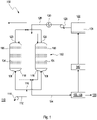
- FIG. 1 shows a schematically illustration of an apparatus 100 for purifying a furan derivative.
- the apparatus comprises a reactor 102.
- the reactor 102 comprises activated carbon 104.
- the reactor 102 comprises at least one column 106 comprising the activated carbon 104.
- the reactor 102 comprises two columns 106.
- the two columns 106 are arranged in parallel.
- the activated carbon 104 is made from a carbonaceous source material.
- the activated carbon 104 is a biological based activated carbon.
- the activated carbon 104 may be made of agricultural residues such as lignocellulose.
- the activated carbon 104 is made of coconut or wood.
- the reactor 102 further comprises an inlet 108 for supplying a reaction mixture 110 comprising a furan derivative and a carbohydrate.
- the reaction mixture 110 may be an aqueous reaction mixture and further includes process water.
- the furan derivative is selected from the group of furfural derivatives, more preferred from the group consisting of 5-chloromethylfurfural, 5-methylfurfural, and 5-hydroxymethylfurfural.
- the furan derivative comprises at least 5-hydroxymethylfurfural and more preferably is 5-hydroxymethylfurfural.
- the reaction mixture 110 is preferably obtained from a 5-hydroxymethylfurfural synthesis of carbohydrates.
- the products of the 5-hydroxymethylfurfural synthesis comprise a furan derivative and a carbohydrate, wherein the activated carbon 104 is configured to adsorb the furan derivative from the reaction mixture 110.
- the inlet 108 is located at a bottom end of the columns 106.
- the inlet 108 may be connected to a reaction mixture supply line 112 including a first pump 114 configured to deliver the reaction mixture 110.
- the reactor 102 further comprises a switching device 116 configured to switch a supply of the reaction mixture between the two columns 106.
- the reactor 102 further comprises a first outlet 118.
- the first outlet 118 is located at the bottom end of the columns 106.
- the reactor 102 further comprises a second outlet 120.
- the second outlet 120 is located at the top end of the columns 106.
- the apparatus 100 further comprises a solvent reservoir 122 storing a solvent 124 and being in fluid communication with the reactor 102.
- the solvent reservoir 122 is in fluid communication with the at least one column 106.
- the solvent reservoir 118 is connected to the reactor 102 by means of a solvent supply line 126.
- the solvent supply line 126 is connected to a top end of the columns 106.
- the solvent supply line 126 includes a second pump 128 configured to deliver the solvent 124 from the solvent reservoir 122 to the columns 106.
- the solvent supply line 126 further includes a heating device 130 configured to preheat the solvent 124.
- the solvent is configured to desorb the furan derivative adsorbed at the activated carbon 104.
- the solvent 124 is selected from the group consisting of C1 to C10 alkanol, C3 to C10 alkanone, mixtures of two or more C1 to C10 alkanols, mixtures of two or more C3 to C10 alkanones, and mixtures of one or more C1 to C10 alkanol(s) with one or more C3 to C10 alkanone(s).
- the solvent 124 comprises at least ethanol and/or acetone.
- the apparatus 100 further comprises a separating device 132 configured to separate the solvent 124 from a mixture 134 including furan derivative desorbed from the activated carbon 104 and the solvent 124 so as to obtain a purified furan derivative 136.
- the separating device 132 comprises an evaporator 138 configured to evaporate the solvent 124 from the mixture 134.
- the separating device 132 is in fluid communication with the first outlet 118 of the reactor 102.
- the apparatus 100 further comprises a recovering device 140 configured to recover the solvent 124 separated from the mixture 134.
- the recovering device 140 is in fluid communication with the solvent reservoir 122. Thus, the recovering device 140 is configured to return the recovered solvent 124 to the solvent reservoir 122.
- the apparatus 100 is configured to be used with a method for purifying a furan derivative as will be describes in further detail below.
- the method begins with providing a reaction mixture 110 comprising a furan derivative and a carbohydrate.
- the reaction mixture 110 is preferably obtained from a 5-hydroxymethylfurfural synthesis of carbohydrates, wherein the products of the 5-hydroxymethylfurfural synthesis comprise a furan derivative and a carbohydrate.
- the furan derivative is selected from the group of furfural derivatives, more preferred from the group consisting of 5-chloromethylfurfural, 5-methylfurfural, and 5-hydroxymethylfurfural, wherein the furan derivative preferably comprises at least 5-hydroxymethylfurfural, more preferred is 5-hydroxymethylfurfural.
- the carbohydrate includes at least one monosaccharide, particularly fructose or glucose.
- the reaction mixture 110 is supplied to at least one column 106 comprising the activated carbon 104.
- the activated carbon 104 is a biological based activated carbon, particularly made of coconut or wood.
- the adsorption of the furan derivative from the reaction mixture 100 at the activated carbon is carried out at a temperature in a range of 5.0°C to 60°C and preferably of 10°C to 50°C, such as 25°C.
- the adsorption of the furan derivative from the reaction mixture 110 at the activated carbon 104 is carried out at a pressure of 0.5 to 50 bar absolute, such as. 1.0 bar absolute.
- the carbohydrate from the reaction mixture 110 is separated.
- the furan derivative is efficiently captured on the activated carbon 104 while other compounds such as the carbohydrate and process water are passing through the column 106.
- the carbohydrate together with the process water may be discharged from the reactor 102 and the column 106, respectively, at the second outlet 120.
- the column 106 and the activated carbon 104 may be rinsed with water to remove impurities.
- the method proceeds further with carrying out desorption of the furan derivative adsorbed at the activated carbon 104 after a predetermined time by means of a solvent 124 which reveals a mixture 134 comprising the solvent 124 and the furan derivative.
- the solvent 124 is supplied to the column 106 so as to desorb the furan derivative from the activated carbon 104.
- the solvent 124 is supplied from the solvent reservoir 122 to the column 106 by means of the second pump 128 and enters the column 106 through the solvent supply line 126.
- the solvent 124 is selected from the group consisting of C1 to C10 alkanol, C3 to C10 alkanone, mixtures of two or more C1 to C10 alkanols, mixtures of two or more C3 to C10 alkanones, and mixtures of one or more C1 to C10 alkanol(s) with one or more C3 to C10 alkanone(s).
- the solvent 124 comprises at least ethanol and/or acetone. The desorption of the furan derivative adsorbed at the activated carbon 104 is carried out at a temperature where the solvent 124 is in a liquid state.
- the desorption of the furan derivative adsorbed at the activated carbon 124 is carried out at a temperature below a boiling point of the solvent 124, preferably 2°C to 20°C and more preferably 5°C to 10°C below a boiling point of the solvent 124 such as 5°C below a boiling point of the solvent 124.
- the residence time of the feed strongly depends on the initial concentration of desired products furfurals, especially 5-HMF, in the reaction mixture 110. For a higher concentration of the adsorbate in the reaction mixture 110 longer dwell time is recommended.
- the point of time when the desorption process is initiated may depend on a load of the activated carbon 104.
- the desorption of the furan derivative adsorbed at the activated carbon 104 is carried out when the activated carbon 104 is saturated.
- the reaction mixture 110 is alternately supplied to at least two columns 106 each comprising the activated carbon 104 as shown in Figure 1 .
- This step may include switching between the columns 106 when the activated carbon 104 of one of the columns 106 is saturated. With other words, the reaction mixture 110 is supplied to one of the columns 106 until the activated carbon 104 thereof is saturated. If the activated carbon of the one column 106 is saturated, the reaction mixture 110 is supplied to the other column 106 while the furan derivative of the one column 106 is desorbed. This switching increases the throughput of the reactor 102.
- the mixture 134 is discharged from the column 106 and is supplied to the separating device 132.
- the solvent 124 is separated from the mixture 134 so as to obtain a purified furan derivative 136.
- the solvent 124 is separated from the mixture 134 revealed from desorption from the activated carbon 104 by means of evaporation at the evaporator 138 of the separating device 132.
- the evaporation is atmospheric distillation or vacuum evaporation.
- the concentrated and purified product purified furan derivative is obtained.
- the solvent 124 may be recovered at the recovering device 140.
- the recovering device 140 returns the recovered solvent 124. Particularly, the recovering device 140 returns the recovered solvent 124 to the solvent reservoir 122.
- the reaction mixture 100 used for the adsorption at the column 106 was process water from a 5-HMF synthesis.
- the product was collected in tanks and contained about 0.5-1% 5-HMF, unreacted sugar and by products like formic, acetic, and levulinic acid, and also small amounts of furfural.
- the process water was pumped to the adsorption column 106 filled with activated carbon 104 made of coconut.
- the residence time of liquid in the adsorption column 106 was 20 min.
- the samples were collected every 100 ml of outlet solution.
- the adsorption took place at room temperature, i.e. 20 °C, and atmospheric pressure.
- the bed of the column 106 was rinsed with 200 ml hot demineralised water having a temperature of 75 ⁇ 2 °C.
- the column 106 was emptied of liquid.
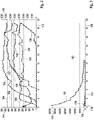
- Figure 2 shows breakthrough curves of main components of the reaction mixture 110.
- the x-axis 142 indicates a bed volume ration which is dimensionless or a percentage value.
- a concentration of glucose, formic acid, and levulic acid is given in mg/L.
- a concentration of fructose and 5-hydroxymethylfurfural is given in mg/L.
- Line 148 indicates the concentration graph of glucose
- line 150 indicates the concentration graph of formic acid
- line 152 indicates the concentration graph of levulic acid
- line 154 indicates the concentration graph of fructose
- line 156 indicates the concentration graph of 5-hydroxymethylfurfural.
- Horizontal dashed line 158 is inlet concentration of glucose
- horizontal dashed line 160 indicates the inlet concentration formic acid
- horizontal dashed line 162 indicates the inlet concentration of levulic acid
- horizontal dashed line 164 indicates the inlet concentration of fructose
- horizontal dashed line 166 indicates the inlet concentration of 5-hydroxymethylfurfural.
- 5-hydroxymethylfurfural in the outlet solution or revealed mixture 134 appears much later than the other components. 5-hydroxymethylfurfural is efficiently captured on the activated carbon 104 of the column 106 while the other components such as sugars are passing through the column 106.
- Figure 3 shows desorption curves of the main components during desorption with ethanol.
- the x-axis 168 indicates a bed volume ration which is dimensionless or a percentage value.
- the y-axis 170 indicates a concentration of glucose, formic acid, and levulinic acid, fructose and 5-hydroxymethylfurfural in mg/L.
- Line 172 indicates the concentration graph of glucose
- line 174 indicates the concentration graph of formic acid
- line 176 indicates the concentration graph of levulinic acid
- line 178 indicates the concentration graph of fructose
- line 180 indicates the concentration graph of 5-hydroxymethylfurfural.
- Horizontal dashed line 182 is inlet concentration of 5-hydroxymethylfurfural.
- the desorption process is carried out using a flow of short-chained hydrocarbons as solvent 124 such as alcohols or ketones, for example, ethanol or acetone.
- solvent 124 such as alcohols or ketones, for example, ethanol or acetone.
- the course of 5-hydroxymethylfurfural and other components desorption by means of ethanol is exemplarily illustrated in Figure 3 .
- mainly 5-hydroxymethylfurfural is desorbed.
- Other components like sugars or organic acids, are desorbed only in small amounts.
Landscapes
- Chemical & Material Sciences (AREA)
- Organic Chemistry (AREA)
- Saccharide Compounds (AREA)
Priority Applications (1)
| Application Number | Priority Date | Filing Date | Title |
|---|---|---|---|
| EP21152776.7A EP4032881A1 (de) | 2021-01-21 | 2021-01-21 | Verfahren und vorrichtung zur reinigung eines furanderivats |
Applications Claiming Priority (1)
| Application Number | Priority Date | Filing Date | Title |
|---|---|---|---|
| EP21152776.7A EP4032881A1 (de) | 2021-01-21 | 2021-01-21 | Verfahren und vorrichtung zur reinigung eines furanderivats |
Publications (1)
| Publication Number | Publication Date |
|---|---|
| EP4032881A1 true EP4032881A1 (de) | 2022-07-27 |
Family
ID=74205650
Family Applications (1)
| Application Number | Title | Priority Date | Filing Date |
|---|---|---|---|
| EP21152776.7A Pending EP4032881A1 (de) | 2021-01-21 | 2021-01-21 | Verfahren und vorrichtung zur reinigung eines furanderivats |
Country Status (1)
| Country | Link |
|---|---|
| EP (1) | EP4032881A1 (de) |
Citations (10)
| Publication number | Priority date | Publication date | Assignee | Title |
|---|---|---|---|---|
| FR895076A (fr) * | 1942-04-24 | 1945-01-15 | Westfalische Zellstoff A G Alp | Procédé de séparation ou d'enrichissement de furfurol à partir de solutions ou de vapeurs |
| US4016180A (en) * | 1975-06-18 | 1977-04-05 | Flambeau Paper Company | Chemical concentration by adsorption |
| US4159223A (en) * | 1971-09-09 | 1979-06-26 | Scott Paper Company | Use of activated carbon to recover and separate chemicals produced during pulping operations |
| WO2006063220A2 (en) * | 2004-12-10 | 2006-06-15 | Archer-Daniels-Midland Company | Preparation of 2,5-(hydr0xymethyl)furaldehyde (hmf) , derivatives thereof and levulinic acid from fructose as well as preparation of 2 , 5-bis- (hydroxymethyl) furan from 2 , 5- (hydroxymethyl) furaldehyde |
| JP2007319068A (ja) * | 2006-05-31 | 2007-12-13 | Kobe Steel Ltd | 単糖およびフルフラールの製造方法 |
| US20110105770A1 (en) * | 2009-11-05 | 2011-05-05 | Battelle Memorial Institute | Adsorption separation processes for ionic liquid catalytic processes |
| WO2011070602A1 (en) * | 2009-12-11 | 2011-06-16 | Chemtex Italia S.R.L. | Regenerative purification of a pretreated biomass stream |
| US20120135485A1 (en) * | 2010-11-29 | 2012-05-31 | Georgia Tech Research Corporation | Sorbent and process for removing fermentation inhibitors |
| JP2015061524A (ja) * | 2013-08-21 | 2015-04-02 | 三菱化学株式会社 | 糖液の精製方法、活性炭処理糖液、有機化合物の製造方法および微生物の培養方法 |
| JP2018074927A (ja) * | 2016-11-08 | 2018-05-17 | 国立大学法人北海道大学 | 多元ポリ乳酸製造方法及びバイオプラスチック |
-
2021
- 2021-01-21 EP EP21152776.7A patent/EP4032881A1/de active Pending
Patent Citations (10)
| Publication number | Priority date | Publication date | Assignee | Title |
|---|---|---|---|---|
| FR895076A (fr) * | 1942-04-24 | 1945-01-15 | Westfalische Zellstoff A G Alp | Procédé de séparation ou d'enrichissement de furfurol à partir de solutions ou de vapeurs |
| US4159223A (en) * | 1971-09-09 | 1979-06-26 | Scott Paper Company | Use of activated carbon to recover and separate chemicals produced during pulping operations |
| US4016180A (en) * | 1975-06-18 | 1977-04-05 | Flambeau Paper Company | Chemical concentration by adsorption |
| WO2006063220A2 (en) * | 2004-12-10 | 2006-06-15 | Archer-Daniels-Midland Company | Preparation of 2,5-(hydr0xymethyl)furaldehyde (hmf) , derivatives thereof and levulinic acid from fructose as well as preparation of 2 , 5-bis- (hydroxymethyl) furan from 2 , 5- (hydroxymethyl) furaldehyde |
| JP2007319068A (ja) * | 2006-05-31 | 2007-12-13 | Kobe Steel Ltd | 単糖およびフルフラールの製造方法 |
| US20110105770A1 (en) * | 2009-11-05 | 2011-05-05 | Battelle Memorial Institute | Adsorption separation processes for ionic liquid catalytic processes |
| WO2011070602A1 (en) * | 2009-12-11 | 2011-06-16 | Chemtex Italia S.R.L. | Regenerative purification of a pretreated biomass stream |
| US20120135485A1 (en) * | 2010-11-29 | 2012-05-31 | Georgia Tech Research Corporation | Sorbent and process for removing fermentation inhibitors |
| JP2015061524A (ja) * | 2013-08-21 | 2015-04-02 | 三菱化学株式会社 | 糖液の精製方法、活性炭処理糖液、有機化合物の製造方法および微生物の培養方法 |
| JP2018074927A (ja) * | 2016-11-08 | 2018-05-17 | 国立大学法人北海道大学 | 多元ポリ乳酸製造方法及びバイオプラスチック |
Similar Documents
| Publication | Publication Date | Title |
|---|---|---|
| US8236973B2 (en) | Adsorption separation processes for ionic liquid catalytic processes | |
| Cooney et al. | Solvent regeneration of activated carbon | |
| AU2011205117B2 (en) | Process for the preparation and purification of hydroxymethylfuraldehyde and derivatives | |
| US8177980B2 (en) | Separation of a mixture of polyhydric alcohols | |
| CN107253901A (zh) | 一种高纯度异丙醇的分离与净化方法 | |
| CA2661531A1 (en) | Method of obtaining an organic salt or acid from an aqueous sugar stream | |
| WO2012155074A1 (en) | Process for purifying lignocellulosic feedstocks | |
| Zheng et al. | Experimental and mathematical simulation of noncompetitive and competitive adsorption dynamic of formic acid–Levulinic acid–5-Hydroxymethylfurfural from single, binary, and ternary systems in a fixed-bed column of SY-01 resin | |
| Gomes et al. | Fractionation of acids, ketones and aldehydes from alkaline lignin oxidation solution with SP700 resin | |
| Hsiao et al. | Cost and energy efficient cyclic separation of 5-hydroxymethyl furfural from an aqueous solution | |
| KR101928608B1 (ko) | 숙신산의 정제 | |
| Schroer et al. | Structure-performance correlations of cross-linked boronic acid polymers as adsorbents for recovery of fructose from glucose–fructose mixtures | |
| EP0047518A2 (de) | Extraktion von Saccharose aus einem Zuckergemisch | |
| JP2017533236A (ja) | リグニンを含有する組成物からの価値のある芳香族生成物の抽出方法 | |
| WO2008157617A1 (en) | Method for purifying hydroxymethyl-furfural using non-functional polymeric resins | |
| Lee | Removal and recovery of acetic acid and two furans during sugar purification of simulated phenols-free biomass hydrolysates | |
| CN101759537B (zh) | 一种生产hplc级丙酮的方法 | |
| Pawar | Purification of 5‐Hydroxymethyl furfural from side products of fructose dehydration reaction in a green solvent | |
| US20170015642A1 (en) | Conversion of fructose-containing feedstocks to hmf-containing product | |
| AU2019276050B2 (en) | Salt and acid mixture catalyzed hmf production | |
| JP2727046B2 (ja) | ヒノキチオールの回収方法 | |
| KR100650964B1 (ko) | 유기 액체의 탈수방법 | |
| Jia et al. | Adsorption process and mechanism for furfural separation with macroporous resin | |
| Tongtummachat et al. | Efficient continuous-flow separation and purification processes of 5-hydroxymethylfurfural | |
| EP3498699A1 (de) | Chromatographieverfahren zur reinigung von furfuralderivaten |
Legal Events
| Date | Code | Title | Description |
|---|---|---|---|
| PUAI | Public reference made under article 153(3) epc to a published international application that has entered the european phase |
Free format text: ORIGINAL CODE: 0009012 |
|
| STAA | Information on the status of an ep patent application or granted ep patent |
Free format text: STATUS: THE APPLICATION HAS BEEN PUBLISHED |
|
| AK | Designated contracting states |
Kind code of ref document: A1 Designated state(s): AL AT BE BG CH CY CZ DE DK EE ES FI FR GB GR HR HU IE IS IT LI LT LU LV MC MK MT NL NO PL PT RO RS SE SI SK SM TR |
|
| STAA | Information on the status of an ep patent application or granted ep patent |
Free format text: STATUS: REQUEST FOR EXAMINATION WAS MADE |
|
| 17P | Request for examination filed |
Effective date: 20230123 |
|
| RBV | Designated contracting states (corrected) |
Designated state(s): AL AT BE BG CH CY CZ DE DK EE ES FI FR GB GR HR HU IE IS IT LI LT LU LV MC MK MT NL NO PL PT RO RS SE SI SK SM TR |
|
| STAA | Information on the status of an ep patent application or granted ep patent |
Free format text: STATUS: EXAMINATION IS IN PROGRESS |
|
| 17Q | First examination report despatched |
Effective date: 20230926 |