EP4033242B1 - Dispositif et procédé d'analyse complète d'aérosol carboné en temps réel - Google Patents
Dispositif et procédé d'analyse complète d'aérosol carboné en temps réel Download PDFInfo
- Publication number
- EP4033242B1 EP4033242B1 EP21187069.6A EP21187069A EP4033242B1 EP 4033242 B1 EP4033242 B1 EP 4033242B1 EP 21187069 A EP21187069 A EP 21187069A EP 4033242 B1 EP4033242 B1 EP 4033242B1
- Authority
- EP
- European Patent Office
- Prior art keywords
- abs
- brc
- poa
- soa
- calculation
- Prior art date
- Legal status (The legal status is an assumption and is not a legal conclusion. Google has not performed a legal analysis and makes no representation as to the accuracy of the status listed.)
- Active
Links
Images


Classifications
-
- G—PHYSICS
- G01—MEASURING; TESTING
- G01N—INVESTIGATING OR ANALYSING MATERIALS BY DETERMINING THEIR CHEMICAL OR PHYSICAL PROPERTIES
- G01N1/00—Sampling; Preparing specimens for investigation
- G01N1/02—Devices for withdrawing samples
- G01N1/22—Devices for withdrawing samples in the gaseous state
- G01N1/2202—Devices for withdrawing samples in the gaseous state involving separation of sample components during sampling
- G01N1/2205—Devices for withdrawing samples in the gaseous state involving separation of sample components during sampling with filters
-
- G—PHYSICS
- G01—MEASURING; TESTING
- G01N—INVESTIGATING OR ANALYSING MATERIALS BY DETERMINING THEIR CHEMICAL OR PHYSICAL PROPERTIES
- G01N15/00—Investigating characteristics of particles; Investigating permeability, pore-volume or surface-area of porous materials
- G01N15/06—Investigating concentration of particle suspensions
- G01N15/0606—Investigating concentration of particle suspensions by collecting particles on a support
- G01N15/0618—Investigating concentration of particle suspensions by collecting particles on a support of the filter type
- G01N15/0625—Optical scan of the deposits
-
- G—PHYSICS
- G01—MEASURING; TESTING
- G01N—INVESTIGATING OR ANALYSING MATERIALS BY DETERMINING THEIR CHEMICAL OR PHYSICAL PROPERTIES
- G01N31/00—Investigating or analysing non-biological materials by the use of the chemical methods specified in the subgroup; Apparatus specially adapted for such methods
- G01N31/12—Investigating or analysing non-biological materials by the use of the chemical methods specified in the subgroup; Apparatus specially adapted for such methods using combustion
-
- G—PHYSICS
- G01—MEASURING; TESTING
- G01N—INVESTIGATING OR ANALYSING MATERIALS BY DETERMINING THEIR CHEMICAL OR PHYSICAL PROPERTIES
- G01N1/00—Sampling; Preparing specimens for investigation
- G01N1/28—Preparing specimens for investigation including physical details of (bio-)chemical methods covered elsewhere, e.g. G01N33/50, C12Q
- G01N1/44—Sample treatment involving radiation, e.g. heat
-
- G—PHYSICS
- G01—MEASURING; TESTING
- G01N—INVESTIGATING OR ANALYSING MATERIALS BY DETERMINING THEIR CHEMICAL OR PHYSICAL PROPERTIES
- G01N1/00—Sampling; Preparing specimens for investigation
- G01N1/02—Devices for withdrawing samples
- G01N1/22—Devices for withdrawing samples in the gaseous state
- G01N1/2202—Devices for withdrawing samples in the gaseous state involving separation of sample components during sampling
- G01N2001/222—Other features
- G01N2001/2223—Other features aerosol sampling devices
-
- G—PHYSICS
- G01—MEASURING; TESTING
- G01N—INVESTIGATING OR ANALYSING MATERIALS BY DETERMINING THEIR CHEMICAL OR PHYSICAL PROPERTIES
- G01N15/00—Investigating characteristics of particles; Investigating permeability, pore-volume or surface-area of porous materials
- G01N2015/0042—Investigating dispersion of solids
- G01N2015/0046—Investigating dispersion of solids in gas, e.g. smoke
-
- G—PHYSICS
- G01—MEASURING; TESTING
- G01N—INVESTIGATING OR ANALYSING MATERIALS BY DETERMINING THEIR CHEMICAL OR PHYSICAL PROPERTIES
- G01N21/00—Investigating or analysing materials by the use of optical means, i.e. using sub-millimetre waves, infrared, visible or ultraviolet light
- G01N21/17—Systems in which incident light is modified in accordance with the properties of the material investigated
- G01N21/25—Colour; Spectral properties, i.e. comparison of effect of material on the light at two or more different wavelengths or wavelength bands
- G01N21/31—Investigating relative effect of material at wavelengths characteristic of specific elements or molecules, e.g. atomic absorption spectrometry
-
- G—PHYSICS
- G01—MEASURING; TESTING
- G01N—INVESTIGATING OR ANALYSING MATERIALS BY DETERMINING THEIR CHEMICAL OR PHYSICAL PROPERTIES
- G01N33/00—Investigating or analysing materials by specific methods not covered by groups G01N1/00 - G01N31/00
- G01N33/0004—Gaseous mixtures, e.g. polluted air
- G01N33/0009—General constructional details of gas analysers, e.g. portable test equipment
- G01N33/0027—General constructional details of gas analysers, e.g. portable test equipment concerning the detector
- G01N33/0036—General constructional details of gas analysers, e.g. portable test equipment concerning the detector specially adapted to detect a particular component
- G01N33/004—CO or CO2
-
- Y—GENERAL TAGGING OF NEW TECHNOLOGICAL DEVELOPMENTS; GENERAL TAGGING OF CROSS-SECTIONAL TECHNOLOGIES SPANNING OVER SEVERAL SECTIONS OF THE IPC; TECHNICAL SUBJECTS COVERED BY FORMER USPC CROSS-REFERENCE ART COLLECTIONS [XRACs] AND DIGESTS
- Y02—TECHNOLOGIES OR APPLICATIONS FOR MITIGATION OR ADAPTATION AGAINST CLIMATE CHANGE
- Y02A—TECHNOLOGIES FOR ADAPTATION TO CLIMATE CHANGE
- Y02A50/00—TECHNOLOGIES FOR ADAPTATION TO CLIMATE CHANGE in human health protection, e.g. against extreme weather
- Y02A50/20—Air quality improvement or preservation, e.g. vehicle emission control or emission reduction by using catalytic converters
Definitions
- the present invention belongs to the field of methods and devices for analysing materials by determining their chemical or physical properties by the use of thermal and optical means, more precisely to the systems especially adapted for detection and quantification of carbonaceous aerosol.
- the invention relates to a device and a method for complete carbonaceous aerosol analysis in real time.
- CA Carbonaceous aerosol
- PM 2.5 Carbonaceous aerosol
- CA carbonaceous aerosol
- CM carbonaceous matter
- OA organic aerosol
- EC refractory, strong light-absorbing fraction
- BC black carbon
- BC and EC are often used interchangeably; nevertheless, in this patent application BC will be used exclusively when describing the refractory strong-absorbing fraction of CA.
- EC is used only for EC-to-BC intercomparison of thermal-optical and optical method.
- the BC is chemically inert and has well-defined chemical structure. It is exclusively emitted from incomplete combustion, thus having only primary origin.
- OA is made up of many different complex molecular structures and includes not only particulate organic carbon, but also hydrogen, oxygen, nitrogen, and sulphur.
- BC In contrast to BC, OA can be volatile and have high oxidative potential.
- OA is directly emitted to the atmosphere in particulate form as primary organic matter (POA) by combustion and biogenic processes, or it can have a secondary origin (SOA) from the gas-to-particle conversion of (semi)volatile organic compounds in the atmosphere.
- POA primary organic matter
- SOA secondary origin
- the mass of carbon atoms found in CA and OA is called total carbon (TC) and organic carbon (OC).
- Measurement of total carbon (TC) is performed with devices, which use thermal treatment of sampled air with particles to calculate total carbon based on generated carbon dioxide. Additionally, OC can be further divided to carbon fraction of POA and SOA (POC and SOC, respectively).
- Two measurement techniques are used for TC/OC determination; thermo-optical OC/EC method and newly developed TC-BC method. Thermo-optical OC/EC method was developed in 1982 by Huntzinker et al. ( Huntzicker, J. J., Johnson, R. L., Shah, J. J., and Cary, R.
- OA/OC ambient organic aerosol to organic carbon ratio
- the ratio can vary widely depending on the sources, monitoring location, season, and meteorology.
- the lower ambient OA/OC ratios are consistent with fresh aerosol emissions from traffic, while the higher values are usually observed for aged ambient oxygenated OA (Chirico et al., 2010: doi.org/10.5194/acp-10-11545-2010).
- the POA/POC and SOA/SOC ratios for primary and secondary OA were introduced by Jardinerty et al. (2008: doi.org/10.1021/es8008166) and Zhang et al. (2018: doi.org/10.1016/j.jes.2017.12.018).
- Organic aerosol can be further divided into light-absorbing OA, also known as brown carbon (BrC), and non-light absorbing OA (OA non-abs ), both with possible primary and secondary origin (POA BrC , SOA BrC , POA non-abs , SOA non-abs , respectively).
- brown carbon Cbrown/BrC
- brown smoke released by the combustion of organic matter which absorbs strongly in the ultraviolet wavelengths and less significantly going into the visible wavelengths (Laskin et al., 2015; Moise et al., 2015). It coexists with black carbon when released in the atmosphere. Contrary to the black carbon, brown carbon is emitted mainly by biomass combustion, but also from smoldering fires or coal combustion, from soil, and volatile organic compounds given off by vegetation.
- US2019277819 discloses a device for measuring, in near-real-time, the level of black carbon, brown carbon, organic carbon, total carbon and CO 2 in air.
- the device also provides for a direct calculation of aerosol angstrom coefficient as well as estimation of emissions rates of black carbon or brown carbon from nearby combustion sources. This device determines brown carbon based on transmittance measurements at 370 nm.
- the utility model CN209182229 provides an online detection device for light absorption characteristics of water-insoluble brown carbon in atmosphere.
- An atmospheric sample inlet is positioned on the front side of a continuous liquefaction sampling device; the conveying device is communicated with the continuous liquefaction sampling device so as to input atmospheric fine particles into the continuous liquefaction sampling device; the atomizer is communicated with the continuous liquefaction sampling device and is close to the atmospheric sample inlet; a methanol solution is contained in the atomizer, atomized methanol is conveyed into the continuous liquefaction sampling device, a methanol injection port is communicated with the continuous liquefaction sampling device and located on the rear side of the continuous liquefaction sampling device, and an output port of the continuous liquefaction sampling device is divided into two channels which are communicated with the organic carbon analyzer and the ultraviolet-visible spectrophotometer respectively.
- the device differs from the present invention in the design as well as in determination of aerosol species. This device does not allow determination of brown
- the invention addresses the problem of complete analysis of all aerosol species, not only the most common types as determined by known devices.
- the technical problem has been solved as defined in the independent claims, while preferred embodiments of the invention are defined in the dependent claims.
- the essence of the device for complete carbonaceous aerosol analysis in real time is that the device is a system combining two different instruments, wherein the first instrument measures total carbon (TC) using flash heating of collected aerosol samples and generation of CO 2 , while the second instrument performs an optical attenuation analysis at preferably 7 wavelengths from near UV (370 nm) to near IR range (950 nm) in order to characterize optical absorption of aerosols accumulated on a glass-fiber/PTFE filter tape.
- the device i.e., the system of said instruments, collects and processes collected data of both instruments, wherein said processing may be performed by any of the instruments or by a separate processing means, computer or computer application.
- the invention allows determination of previously unknown or undetectable aerosol components, namely POA non-abs and SOA non-abs , which are primary and secondary non-light-absorbing OA, respectively.
- aerosol species can be determined based on the operation of both instruments, wherein newly assessed aerosol species are underlined. Parameters written in bold italic are taken from published scientific literature or can be determined by complementary measurement. Among these: - b is a determined proportionality parameter, region or site specific, depend and also on thermal protocol of OC/EC analysis, wherein its usual range is 0.5 to 1.5; - MAC BC , which is 7.77 m 2 /g; - MAC BrC is mass absorption cross-section for brown carbon (BrC).
- Second instrument namely any suitable absorption photometer, preferably Magee Scientific Aethalometer AE33 measures absorption at preferably 7 different wavelengths and thus determines BC according to known methods.
- Elemental carbon is determined from the black carbon using the parameter b, which can be taken from the literature as mentioned above: b *BC BrC
- BrC b abs BrC 370 nm , t MA C BrC 370 nm OC
- CA Complete carbonaceous aerosol can be determined using a novel equation allowed by the device according to the invention:
- CA t BC t ⁇ 1 ⁇ OA OC + TC t ⁇ OA OC OA
- Organic aerosol can be calculated from the organic carbon using the OA/OC ratio taken from the literature as mentioned above:
- OA t OA OC OC t POC
- SOC Primary and secondary organic carbon content of POA and SOA can be determined from the black carbon measurement by using the following equations:
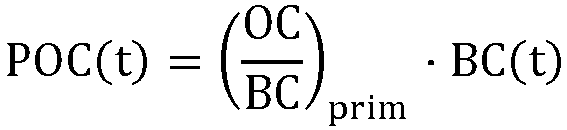
- POC t OC BC prim ⁇ BC t
- BC tracer method such as described in article Wu and Yu, 2016 (https://doi.org/10.5194/acp-16-5453-2016) is preferably used for optimal OC BC prim determination.
- BC(t) and POC(t) are emitted from the same source; therefore, they should be well correlated, while the correlation between the BC(t) and SOC(t) should be low due to different formation paths.
- the (OC/BC) prim ratio is required for the method. It is determined as the minimum R-squared value between SOC(t)-hypothetical and BC(t), where SOC(t)-hypothetical is calculated for every hypothetically possible (OC/BC) prim ratio.
- POA, SOA From POC and SOC the primary and secondary organic aerosol can be calculated, wherein the ratio POA/POC and SOA/SOC are taken from the literature as described above:
- POA t POC t ⁇ POA
- POC SOA t SOC t ⁇ SOA SOC
- BC tracer method is preferably used to determine optimal b abs ⁇ b abs ⁇ 0 prim .
- Optimal b abs ⁇ b abs ⁇ 0 prim b abs ⁇ b abs ⁇ 0 prim is found as the value where R-squared value between b abs BrC , sec ⁇ t -hypotetical and BC(t) has minimum.
- the first instrument namely the total carbon analyzer, samples and measures total carbon in regular time periods, preferably hourly, wherein the second instrument, namely the aethalometer, preferably samples and measures black carbon every minute. These periods may also be altered according to needs of users and location of the device according to the invention.
- Time resolution of measurements is limited with the time resolution of the total carbon analyser, which is smaller than the time resolution of the absorption photometer. Usual time resolutions are 20 min, 30 min, 60 min, 2h, 4h, 6h, 12h, in 24 h and can be adjusted with regards to aerosol concentration in air - the lower the concentration, the longer sampling time is needed and vice versa. In urban environments a time resolution of 60 min is sufficient.
- Input parameters needed for calculation are programmed into the device, either any of the instruments or both, or to the processing means, wherein the instruments and/or the processing means are arranged to perform the above calculations. Calculations may be done in real-time, online or in the period post sampling (postprocessing). All components of carbonaceous aerosol are preferably given in mass concentration units [ng/m 3 ].
- the device according to the invention provides results for BC ff (t), BC bb (t), POA BrC (t), SOA BrC (t), POA non-abs (t), and SOA non-abs (t), preferably hourly, however the time period between result readings may also be from 20 minutes to 24 hours.
- users of the device obtain very detailed information about aerosol components during different parts of days and nights (diurnal profile for each CA component). If the sampling and measurement periods are different for both instruments, the results are provided in the longer of the periods, while the more frequent data are averaged to the longer period. For example, if the TCA measures total carbon every hour and the aethalometer determines black carbon every minute, the results are provided by the device hourly and the black carbon data are averaged per hour.
- the method for complete aerosol determination performed by the device according to the invention comprises the following steps:
- the steps c), d), and e) may be performed in any sequence, wherein other steps are performed as described.
- Calculation and processing of data is performed by the device (system) or by any of the two instruments, preferably by the total carbon analyzer.
- the processing protocol may be performed online by an instrument, computer or by postprocessing of measurement data.
- the device and the method according to the invention take the advantage of decoupling thermal and optical method into two separate instruments, both dedicated for different measurements. With this, the new method has higher time resolution, no dead time, online loading compensation for BC measurements and is more convenient for field measurements.
- the device and the method is important in determination of particles and especially pollutants in air. It has been pointed out on several occasions that beside the particle mass concentration, the chemical composition and size distribution of PM are equally important. Most importantly, BC can affect health and climate, BrC can cause various health effects, wherein PAHs are cancerogeous, and OA non-abs are the largest contribution to the total CA mass and consequently PM.
- the invention allows simplified determination and complete analysis of carbonaceous aerosols, online and high-time resolution and use of only two instruments.
- the device according to the invention may be designed in alternative ways obvious to the skilled person based on the above description, within the scope of the claims.
- the exemplary embodiments of the invention do not limit the scope of the invention as described herein and defined in the claims.
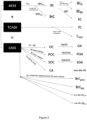
- FIG 1 shows an overview of the carbonaceous aerosol components, wherein CA is divided into black carbon (BC) and organic aerosols (OA). The latter can be further divided into brown carbon (BrC) representing organic carbon (OC) and non-absorbing organic aerosols, wherein the source of BC may be traffic (fossil fuel) or biomass burning. Volatile organic compounds may also be present in the CA.
- BC black carbon
- OA organic aerosols
- BrC brown carbon
- OC organic carbon
- Volatile organic compounds may also be present in the CA.
- CA may have primary origin or secondary origin, wherein BC is always primary and OA may be primary or secondary as described in the background of the invention.
- the device CASS Carbonaceous Aerosol Speciation System
- a first instrument which is a Total Carbon Analyzer TCA08
- a second instrument which is an Aethalometer AE33, both by Magee Scientific.
- the first instrument collects a sample of atmospheric aerosols on a quartz fibre filter positioned inside a small stainless-steel chamber, at a controlled sampling flow rate, preferably of 16.7 LPM.
- the default sampling time of TCA08 is 60 min, but can be set from 20 min - 24 h, depending on the ambient aerosol concentrations.
- TCA08 instrument has two identical parallel channels, through which air-flows are being controlled by ball valves and solenoids, wherein one channel is collecting a sample and the other channel performs analysis of an already collected sample, which is flash-heated to convert all Carbon to CO 2 . The CO 2 concentration is then integrated to give the Total Carbon (TC) content of the sample.
- TC Total Carbon
- the second instrument Magee Scientific Aethalometer ® model AE33 is performing an optical attenuation analysis at 7 wavelengths from near UV (370 nm) to near IR range (950 nm) in order to characterize black carbon (BC) aerosols accumulated on a glass-fibre/PTFE filter tape.
- FIG. 2 shows which CA components are determined with each of the instruments, wherein AE33 provides BC and BrC, as well as BC ff , BC bb and EC data, while the TCA08 provides TC and Cvoc. From these parameters OC, OA, POC, POA, SOC, SOA, OA non-abs , POA non-abs , SOA non-abs as well as total CA can be calculated according to the equations presented above. Processing of acquired data and calculation of remaining CA components is performed hourly by the TCA 08 device, wherein AE33 reports on a defined time-base, which is usually 1 s or 60 s the BC/EC data.
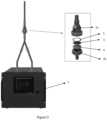
- FIG. 3 shows the configuration of TCA08 device 1, which allows measurement of Cvoc, wherein a quartz-fibre filter is provided, which prevents entry of particles into the instrument, while volatile organic compounds (VOC) can pass through the filter and thus reach the instrument for measurement.
- the TCA08 device 1 thus has an additional two-part housing 2a, 2b, within which the mentioned filter 3 supported on one side by a support mesh 4 and on the other side by a metal ring 5 is provided.
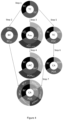
- a visual presentation of the calculation method is shown in figure 4 comprises the following steps:
- steps c), d), and e) may be performed in any sequence, wherein other steps are performed as described. In general, until the steps intersect, they may be performed in any order, while each vertical line has to be performed in the sequence shown in figure 4 .
- Figure 5 shows exemplary results obtained with the device according to the possible embodiment, wherein it is visible how individual components of the CA vary between seasons and also during the day.
Landscapes
- Health & Medical Sciences (AREA)
- Chemical & Material Sciences (AREA)
- Life Sciences & Earth Sciences (AREA)
- Biochemistry (AREA)
- General Physics & Mathematics (AREA)
- Pathology (AREA)
- Physics & Mathematics (AREA)
- Analytical Chemistry (AREA)
- Immunology (AREA)
- General Health & Medical Sciences (AREA)
- Engineering & Computer Science (AREA)
- Molecular Biology (AREA)
- Combustion & Propulsion (AREA)
- Biomedical Technology (AREA)
- Dispersion Chemistry (AREA)
- Investigating Or Analysing Materials By Optical Means (AREA)
- Investigating Or Analyzing Non-Biological Materials By The Use Of Chemical Means (AREA)
Claims (12)
- Dispositif et procédé d'analyse complète d'aérosol carboné en temps réel, caractérisés par le fait que :- le dispositif est un système combinant deux instruments différents, le premier instrument mesurant le carbone total (TC) en utilisant un chauffage rapide des échantillons d'aérosol recueillis et la génération de CO2, tandis que le second instrument effectue une analyse de l'atténuation optique à plusieurs longueurs d'onde, de préférence 7 longueurs d'onde, allant de l'ultraviolet proche au proche infrarouge, ledit premier instrument étant capable de déterminer l'absorption optique des aérosols accumulés sur une bande filtrante en fibres de verre/PTFE,- le dispositif, c.-à-d. le système desdits instruments, est conçu pour recueillir et traiter les données collectées des deux instruments, où ledit traitement peut être réalisé par n'importe lequel des instruments ou par un traitement séparé, un ordinateur ou une application informatique, et- les aérosols carbonés totaux CA(t) sont la somme du carbone suie provenant des combustibles fossiles (BCff) et de la combustion de biomasse (BCbb), des carbones bruns primaires et secondaires sous forme d'aérosols organiques POABrC (t) et SOABrC(t), des aérosols organiques primaires non absorbants (POAnon-abs (t)) et des aérosols secondaires non-absorbants (SOAnon-abs (t)), où les calculs suivants sont programmés dans le dispositif, un des deux instruments ou les deux, ou dans un moyen de traitement approprié connecté au dispositif :a) le premier et le second instrument sont configurés pour mesurer le TC(t) et le BC(t), respectivement ;b) le carbone organique (OC) est calculé comme suit : OC(t) = TC(t) - BC(t) ;c) BCff(t) et BCbb(t) sont calculés à partir des données obtenues à l'étape a) par le second instrument,
où les paramètres requis : les coefficients d'Angström d'absorption AAEff et AAEbb sont pris dans la littérature scientifique ou mesurés séparément ou définis à l'avance ;d) Le calcul du carbone brun BrC pour la répartition de l'absorption de la lumière en

 e) la réalisation de la méthode de traçage de BC pour

 f) le calcul de POABrC (t) et de SOABrC (t) à partir de
 g) le calcul de POA(t) et de SOA(t) à partir de POC(t) et SOC(t) obtenus à l'étape e), où les paramètres requis sont les rapports (POA/POC) et (SOA/SOC) ;h) le calcul de POAnon-abs (t) en tant que POA(t)- POABrC (t) et le calcul de SOAnon-abs (t) en tant que SOA(t)- SOABrC(t) ; eti) le calcul des aérosols carbonés totaux CA(t) = BCff(t) + BCbb(t) + POABrC (t) + SOABrC (t)+ POAnon-abs (t) + SOAnon-abs (t),où les étapes c), d) et e) peuvent être effectuées dans n'importe quel ordre.
 - Le dispositif selon la revendication 1, caractérisé par le fait que la quantité de carbone suie BC est déterminée de la façon suivante :
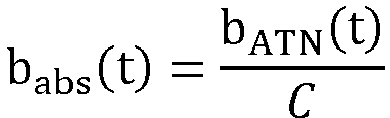
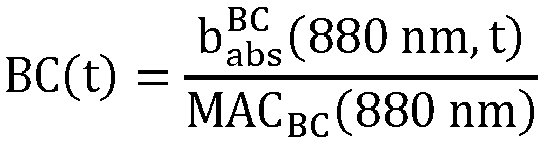 où ATN est l'atténuation de la lumière dans la bande filtrante où l'échantillon est déposé, et est calculée en tant que ATN = -100 · In (I/I0), où I est le signal d'intensité du détecteur pour la zone de mesure et I0 le signal du détecteur pour la zone de référence, C est le paramètre de multi-dispersion ou paramètre d'intensification de la matrice filtrante, et MAC est la section efficace d'absorption massique,et le BC causé par la circulation, c.-à-d. le combustible fossile (BCff), et par la combustion de biomasse (BCbb) peut être déterminé au moyen du calcul suivant, où AAE est le coefficient d'Angström d'absorption :


- Le dispositif selon la revendication 1 ou la revendication 2, caractérisé par le fait que l'absorption optique dépendant de la longueur d'onde sur les aérosols carbonés peut être répartie en deux composants : BC et BrC :


- Le dispositif selon l'une quelconque des revendications précédentes, caractérisé par le fait que l'aérosol carboné peut être calculé à partir du carbone organique en utilisant le rapport OA/OC trouvé dans la littérature scientifique à l'aide de l'équation suivante

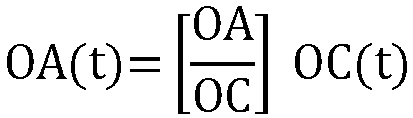
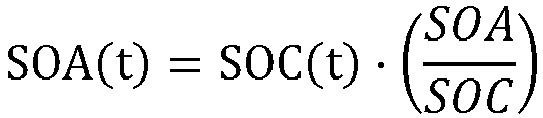
- Le dispositif selon l'une quelconque des revendications suivantes, caractérisé par le fait qu'à partir de POC et de SOC, les aérosols organiques primaire et secondaire peuvent être calculés, où les rapports POA/POC et SOA/SOC sont trouvés dans la littérature scientifique



- Le dispositif selon l'une quelconque des revendications précédentes, caractérisé par le fait que l'analyseur de carbone total a un prélèvement d'échantillon fourni par un filtre en fibres de quartz, qui empêche l'entrée de particules dans l'instrument, tandis que les composés organiques volatiles (VOC) peuvent passer à travers le filtre et ainsi atteindre l'instrument pour la mesure.
- Le dispositif selon l'une quelconque des revendications précédentes, caractérisé par le fait que le premier instrument, à savoir l'analyseur de carbone total, est conçu de façon à échantillonner et mesurer le carbone total toutes les heures, alors que le second instrument, à savoir l'aéthalomètre, est conçu pour échantillonner et mesurer le carbone suie toutes les minutes.
- Le dispositif selon l'une quelconque des revendications précédentes, caractérisé par le fait que le dispositif est conçu pour effectuer les calculs en temps réel, en ligne ou à un moment post-échantillonnage (post-traitement).
- Le dispositif selon l'une quelconque des revendications précédentes, où le dispositif est conçu pour fournir des résultats pour BCff(t) + BCbb(t) + POABrC (t) + SOABrC (t)+ POAnon-abs (t) + SOAnon-abs (t), avec une période de temps entre les lectures de résultats allant de 20 minutes à 24 heures, de préférence toutes les heures.
- Une méthode pour l'analyse complète en temps réel des aérosols carbonés, effectuée par le dispositif selon l'une quelconque des revendications précédentes, caractérisée par le fait que la méthode comprend les étapes suivantes :a) des mesures avec le premier et le second instrument pour obtenir des mesures du TC(t) et du BC(t), respectivement ;b) le calcul de l'OC à partir des données obtenues à l'étape a) ;c) le calcul de BCff(t), BCbb(t) à partir des données obtenues à l'étape a) par le second instrument, qui est tout aéthalomètre approprié, où les paramètres requis : AAEff et AAEbb, sont pris dans la littérature scientifique ou mesurés séparément ou définis à l'avance ;d) Le calcul du BrC pour la répartition de l'absorption de la lumière en
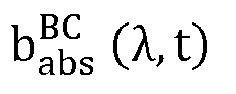

 e) Le calcul de POC(t) et de SOC(t) à partir de OC(t) obtenu à l'étape b), où le calcul de POC(t) et SOC(t) à partir de OC(t) obtenu à l'étape b) est effectué en utilisant les équations suivantes :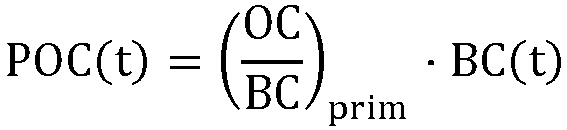
 f) La réalisation de la méthode de traçage de BC pour
 g) Le calcul de POABrC (t) et de SOABrC (t) à partir de
 h) Le calcul de POA(t) et de SOA(t) à partir de POC(t) et SOC(t) obtenus à l'étape e), où les paramètres requis sont les rapports (POA/POC) et (SOA/SOC) ;i) le calcul de POAnon-abs (t) en tant que POA(t)- POABrC (t) et le calcul de SOAnon-abs (t) en tant que SOA(t)- SOABrC (t) ; etj) le calcul des aérosols carbonés totaux CA(t) = BCff(t) + BCbb(t) + POABrC (t) + SOABrC (t)+ POAnon-abs (t) + SOAnon-abs (t),où les étapes c), d) et e) peuvent être effectuées dans n'importe quel ordre.
 - La méthode selon la revendication 10, où le calcul et le traitement des données sont réalisés par le dispositif, c.-à-d. le système, ou par n'importe lequel des deux instruments, de préférence par l'analyseur de carbone total, ou par des moyens de traitement séparés, tels qu'un ordinateur ou un programme informatique.
- La méthode selon la revendication 10 ou la revendication 11, où le calcul et le traitement des données sont effectués en ligne par un instrument, un ordinateur ou par post-traitement des données de mesure.
Priority Applications (2)
| Application Number | Priority Date | Filing Date | Title |
|---|---|---|---|
| EP21187069.6A EP4033242B1 (fr) | 2021-07-21 | 2021-07-21 | Dispositif et procédé d'analyse complète d'aérosol carboné en temps réel |
| CN202111056157.2A CN115684041B (zh) | 2021-07-21 | 2021-09-09 | 用于实时全碳质气溶胶分析的设备和方法 |
Applications Claiming Priority (1)
| Application Number | Priority Date | Filing Date | Title |
|---|---|---|---|
| EP21187069.6A EP4033242B1 (fr) | 2021-07-21 | 2021-07-21 | Dispositif et procédé d'analyse complète d'aérosol carboné en temps réel |
Publications (3)
| Publication Number | Publication Date |
|---|---|
| EP4033242A1 EP4033242A1 (fr) | 2022-07-27 |
| EP4033242C0 EP4033242C0 (fr) | 2025-06-18 |
| EP4033242B1 true EP4033242B1 (fr) | 2025-06-18 |
Family
ID=77021206
Family Applications (1)
| Application Number | Title | Priority Date | Filing Date |
|---|---|---|---|
| EP21187069.6A Active EP4033242B1 (fr) | 2021-07-21 | 2021-07-21 | Dispositif et procédé d'analyse complète d'aérosol carboné en temps réel |
Country Status (2)
| Country | Link |
|---|---|
| EP (1) | EP4033242B1 (fr) |
| CN (1) | CN115684041B (fr) |
Families Citing this family (3)
| Publication number | Priority date | Publication date | Assignee | Title |
|---|---|---|---|---|
| CN115577231A (zh) * | 2022-10-26 | 2023-01-06 | 上海船舶工艺研究所(中国船舶集团有限公司第十一研究所) | 区域船舶黑碳排放测算方法及装置 |
| CN115690519B (zh) * | 2022-11-30 | 2023-08-04 | 北京中环高科环境治理有限公司 | 一种黑碳遥测方法、装置及系统 |
| CN120142203B (zh) * | 2025-05-15 | 2025-08-22 | 杭州朋谱科技有限公司 | 估算二次有机碳浓度的方法 |
Family Cites Families (4)
| Publication number | Priority date | Publication date | Assignee | Title |
|---|---|---|---|---|
| CN102466575B (zh) * | 2010-11-08 | 2015-09-16 | 上海宝钢工业检测公司 | 空气中可吸入颗粒物中碳元素含量的测定方法 |
| US11320411B2 (en) | 2018-03-09 | 2022-05-03 | Government Of The United States As Represented By The Administrator Of The U.S. Environmental Protection Agency | Air pollution sensor to measure major carbon components in the environment |
| CN209182229U (zh) | 2018-09-28 | 2019-07-30 | 南京天博环境检测技术有限公司 | 大气中非水溶性棕碳吸光特性在线检测装置 |
| EP3832302A1 (fr) * | 2019-12-02 | 2021-06-09 | Aerosol d.o.o. | Chambre de chauffage pour mesurer un aérosol carboné et dispositif comprenant ladite chambre |
-
2021
- 2021-07-21 EP EP21187069.6A patent/EP4033242B1/fr active Active
- 2021-09-09 CN CN202111056157.2A patent/CN115684041B/zh active Active
Also Published As
| Publication number | Publication date |
|---|---|
| EP4033242A1 (fr) | 2022-07-27 |
| CN115684041B (zh) | 2026-03-03 |
| EP4033242C0 (fr) | 2025-06-18 |
| CN115684041A (zh) | 2023-02-03 |
Similar Documents
| Publication | Publication Date | Title |
|---|---|---|
| Li et al. | Dynamic changes in optical and chemical properties of tar ball aerosols by atmospheric photochemical aging | |
| EP4033242B1 (fr) | Dispositif et procédé d'analyse complète d'aérosol carboné en temps réel | |
| Setyan et al. | Characterization of submicron particles influenced by mixed biogenic and anthropogenic emissions using high-resolution aerosol mass spectrometry: results from CARES | |
| Drewnick et al. | Intercomparison and evaluation of four semi-continuous PM2. 5 sulfate instruments | |
| Cheng et al. | Mass absorption efficiency of elemental carbon and water-soluble organic carbon in Beijing, China | |
| Herich et al. | A 2.5 year's source apportionment study of black carbon from wood burning and fossil fuel combustion at urban and rural sites in Switzerland | |
| Ward et al. | Results of a residential indoor PM 2.5 sampling program before and after a woodstove changeout. | |
| Flores et al. | Evolution of the complex refractive index in the UV spectral region in ageing secondary organic aerosol | |
| Park et al. | Comparison of continuous and filter-based carbon measurements at the Fresno Supersite | |
| CN103226128B (zh) | 一种解析环境空气细颗粒物中二次有机碳来源的方法 | |
| Thompson et al. | Aerosol optical properties at Pasadena, CA during CalNex 2010 | |
| Chen et al. | Seasonal and spatial variations of optical properties of light absorbing carbon and its influencing factors in a typical polluted city in Yangtze River Delta, China | |
| Lim et al. | Semicontinuous aerosol carbon measurements: Comparison of Atlanta Supersite measurements | |
| Li et al. | Quantifying the relationship between visibility degradation and PM2. 5 constituents at a suburban site in Hong Kong: Differentiating contributions from hydrophilic and hydrophobic organic compounds | |
| Park et al. | Relationship between carbonaceous components and aerosol light absorption during winter at an urban site of Gwangju, Korea | |
| Kim et al. | Estimation of seasonal diurnal variations in primary and secondary organic carbon concentrations in the urban atmosphere: EC tracer and multiple regression approaches | |
| Ajtai et al. | A method for segregating the optical absorption properties and the mass concentration of winter time urban aerosol | |
| Turpin et al. | Intercomparison of photoacoustic and thermal-optical methods for the measurement of atmospheric elemental carbon | |
| Birch | Monitoring of diesel particulate exhaust in the workplace. | |
| Quincey et al. | An evaluation of measurement methods for organic, elemental and black carbon in ambient air monitoring sites | |
| Zhang et al. | Aerosol measurements by soot particle aerosol mass spectrometer: a review | |
| Malik et al. | Physical and chemical properties of PM1 in Delhi: A comparison between clean and polluted days | |
| Tao et al. | Quantifying the relative contributions of aqueous phase and photochemical processes to water-soluble organic carbon formation in winter in a megacity of South China | |
| Salo et al. | Black carbon instrument responses to laboratory generated particles | |
| Yan et al. | Aerosol optical properties at urban and coastal sites in Shandong Province, Northern China |
Legal Events
| Date | Code | Title | Description |
|---|---|---|---|
| PUAI | Public reference made under article 153(3) epc to a published international application that has entered the european phase |
Free format text: ORIGINAL CODE: 0009012 |
|
| STAA | Information on the status of an ep patent application or granted ep patent |
Free format text: STATUS: THE APPLICATION HAS BEEN PUBLISHED |
|
| AK | Designated contracting states |
Kind code of ref document: A1 Designated state(s): AL AT BE BG CH CY CZ DE DK EE ES FI FR GB GR HR HU IE IS IT LI LT LU LV MC MK MT NL NO PL PT RO RS SE SI SK SM TR |
|
| STAA | Information on the status of an ep patent application or granted ep patent |
Free format text: STATUS: REQUEST FOR EXAMINATION WAS MADE |
|
| 17P | Request for examination filed |
Effective date: 20230127 |
|
| RBV | Designated contracting states (corrected) |
Designated state(s): AL AT BE BG CH CY CZ DE DK EE ES FI FR GB GR HR HU IE IS IT LI LT LU LV MC MK MT NL NO PL PT RO RS SE SI SK SM TR |
|
| GRAP | Despatch of communication of intention to grant a patent |
Free format text: ORIGINAL CODE: EPIDOSNIGR1 |
|
| STAA | Information on the status of an ep patent application or granted ep patent |
Free format text: STATUS: GRANT OF PATENT IS INTENDED |
|
| RIC1 | Information provided on ipc code assigned before grant |
Ipc: G01N 21/31 20060101ALN20250113BHEP Ipc: G01N 15/06 20060101ALI20250113BHEP Ipc: G01N 1/44 20060101ALI20250113BHEP Ipc: G01N 1/22 20060101ALI20250113BHEP Ipc: G01N 31/12 20060101AFI20250113BHEP |
|
| INTG | Intention to grant announced |
Effective date: 20250124 |
|
| GRAS | Grant fee paid |
Free format text: ORIGINAL CODE: EPIDOSNIGR3 |
|
| GRAA | (expected) grant |
Free format text: ORIGINAL CODE: 0009210 |
|
| STAA | Information on the status of an ep patent application or granted ep patent |
Free format text: STATUS: THE PATENT HAS BEEN GRANTED |
|
| AK | Designated contracting states |
Kind code of ref document: B1 Designated state(s): AL AT BE BG CH CY CZ DE DK EE ES FI FR GB GR HR HU IE IS IT LI LT LU LV MC MK MT NL NO PL PT RO RS SE SI SK SM TR |
|
| REG | Reference to a national code |
Ref country code: GB Ref legal event code: FG4D |
|
| REG | Reference to a national code |
Ref country code: CH Ref legal event code: EP |
|
| REG | Reference to a national code |
Ref country code: DE Ref legal event code: R096 Ref document number: 602021032349 Country of ref document: DE |
|
| REG | Reference to a national code |
Ref country code: CH Ref legal event code: EP |
|
| REG | Reference to a national code |
Ref country code: IE Ref legal event code: FG4D |
|
| U01 | Request for unitary effect filed |
Effective date: 20250712 |
|
| U07 | Unitary effect registered |
Designated state(s): AT BE BG DE DK EE FI FR IT LT LU LV MT NL PT RO SE SI Effective date: 20250718 |
|
| U20 | Renewal fee for the european patent with unitary effect paid |
Year of fee payment: 5 Effective date: 20250728 |
|
| PG25 | Lapsed in a contracting state [announced via postgrant information from national office to epo] |
Ref country code: NO Free format text: LAPSE BECAUSE OF FAILURE TO SUBMIT A TRANSLATION OF THE DESCRIPTION OR TO PAY THE FEE WITHIN THE PRESCRIBED TIME-LIMIT Effective date: 20250918 Ref country code: GR Free format text: LAPSE BECAUSE OF FAILURE TO SUBMIT A TRANSLATION OF THE DESCRIPTION OR TO PAY THE FEE WITHIN THE PRESCRIBED TIME-LIMIT Effective date: 20250919 |
|
| PG25 | Lapsed in a contracting state [announced via postgrant information from national office to epo] |
Ref country code: HR Free format text: LAPSE BECAUSE OF FAILURE TO SUBMIT A TRANSLATION OF THE DESCRIPTION OR TO PAY THE FEE WITHIN THE PRESCRIBED TIME-LIMIT Effective date: 20250618 |
|
| PG25 | Lapsed in a contracting state [announced via postgrant information from national office to epo] |
Ref country code: RS Free format text: LAPSE BECAUSE OF FAILURE TO SUBMIT A TRANSLATION OF THE DESCRIPTION OR TO PAY THE FEE WITHIN THE PRESCRIBED TIME-LIMIT Effective date: 20250918 |
|
| PG25 | Lapsed in a contracting state [announced via postgrant information from national office to epo] |
Ref country code: IS Free format text: LAPSE BECAUSE OF FAILURE TO SUBMIT A TRANSLATION OF THE DESCRIPTION OR TO PAY THE FEE WITHIN THE PRESCRIBED TIME-LIMIT Effective date: 20251018 |
|
| PGFP | Annual fee paid to national office [announced via postgrant information from national office to epo] |
Ref country code: GB Payment date: 20251106 Year of fee payment: 5 |
|
| PG25 | Lapsed in a contracting state [announced via postgrant information from national office to epo] |
Ref country code: SM Free format text: LAPSE BECAUSE OF FAILURE TO SUBMIT A TRANSLATION OF THE DESCRIPTION OR TO PAY THE FEE WITHIN THE PRESCRIBED TIME-LIMIT Effective date: 20250618 |
|
| PG25 | Lapsed in a contracting state [announced via postgrant information from national office to epo] |
Ref country code: CZ Free format text: LAPSE BECAUSE OF FAILURE TO SUBMIT A TRANSLATION OF THE DESCRIPTION OR TO PAY THE FEE WITHIN THE PRESCRIBED TIME-LIMIT Effective date: 20250618 |
|
| PG25 | Lapsed in a contracting state [announced via postgrant information from national office to epo] |
Ref country code: PL Free format text: LAPSE BECAUSE OF FAILURE TO SUBMIT A TRANSLATION OF THE DESCRIPTION OR TO PAY THE FEE WITHIN THE PRESCRIBED TIME-LIMIT Effective date: 20250618 |
|
| PG25 | Lapsed in a contracting state [announced via postgrant information from national office to epo] |
Ref country code: SK Free format text: LAPSE BECAUSE OF FAILURE TO SUBMIT A TRANSLATION OF THE DESCRIPTION OR TO PAY THE FEE WITHIN THE PRESCRIBED TIME-LIMIT Effective date: 20250618 |
|
| PG25 | Lapsed in a contracting state [announced via postgrant information from national office to epo] |
Ref country code: ES Free format text: LAPSE BECAUSE OF FAILURE TO SUBMIT A TRANSLATION OF THE DESCRIPTION OR TO PAY THE FEE WITHIN THE PRESCRIBED TIME-LIMIT Effective date: 20250618 |
|
| REG | Reference to a national code |
Ref country code: CH Ref legal event code: H13 Free format text: ST27 STATUS EVENT CODE: U-0-0-H10-H13 (AS PROVIDED BY THE NATIONAL OFFICE) Effective date: 20260224 |
|
| PG25 | Lapsed in a contracting state [announced via postgrant information from national office to epo] |
Ref country code: MC Free format text: LAPSE BECAUSE OF FAILURE TO SUBMIT A TRANSLATION OF THE DESCRIPTION OR TO PAY THE FEE WITHIN THE PRESCRIBED TIME-LIMIT Effective date: 20250618 |
|
| PG25 | Lapsed in a contracting state [announced via postgrant information from national office to epo] |
Ref country code: CH Free format text: LAPSE BECAUSE OF NON-PAYMENT OF DUE FEES Effective date: 20250731 |
|
| PLBE | No opposition filed within time limit |
Free format text: ORIGINAL CODE: 0009261 |
|
| STAA | Information on the status of an ep patent application or granted ep patent |
Free format text: STATUS: NO OPPOSITION FILED WITHIN TIME LIMIT |
|
| REG | Reference to a national code |
Ref country code: CH Ref legal event code: L10 Free format text: ST27 STATUS EVENT CODE: U-0-0-L10-L00 (AS PROVIDED BY THE NATIONAL OFFICE) Effective date: 20260430 |