EP4033400B1 - Système d'acquisition d'image d'iris pour agrandir une plage de reconnaissance d'iris - Google Patents
Système d'acquisition d'image d'iris pour agrandir une plage de reconnaissance d'iris Download PDFInfo
- Publication number
- EP4033400B1 EP4033400B1 EP21844612.8A EP21844612A EP4033400B1 EP 4033400 B1 EP4033400 B1 EP 4033400B1 EP 21844612 A EP21844612 A EP 21844612A EP 4033400 B1 EP4033400 B1 EP 4033400B1
- Authority
- EP
- European Patent Office
- Prior art keywords
- iris
- camera
- distance
- information
- subject
- Prior art date
- Legal status (The legal status is an assumption and is not a legal conclusion. Google has not performed a legal analysis and makes no representation as to the accuracy of the status listed.)
- Active
Links
Images


Classifications
-
- G—PHYSICS
- G06—COMPUTING OR CALCULATING; COUNTING
- G06V—IMAGE OR VIDEO RECOGNITION OR UNDERSTANDING
- G06V10/00—Arrangements for image or video recognition or understanding
- G06V10/10—Image acquisition
- G06V10/12—Details of acquisition arrangements; Constructional details thereof
-
- G—PHYSICS
- G06—COMPUTING OR CALCULATING; COUNTING
- G06V—IMAGE OR VIDEO RECOGNITION OR UNDERSTANDING
- G06V40/00—Recognition of biometric, human-related or animal-related patterns in image or video data
- G06V40/10—Human or animal bodies, e.g. vehicle occupants or pedestrians; Body parts, e.g. hands
- G06V40/18—Eye characteristics, e.g. of the iris
-
- H—ELECTRICITY
- H04—ELECTRIC COMMUNICATION TECHNIQUE
- H04N—PICTORIAL COMMUNICATION, e.g. TELEVISION
- H04N23/00—Cameras or camera modules comprising electronic image sensors; Control thereof
- H04N23/45—Cameras or camera modules comprising electronic image sensors; Control thereof for generating image signals from two or more image sensors being of different type or operating in different modes, e.g. with a CMOS sensor for moving images in combination with a charge-coupled device [CCD] for still images
-
- H—ELECTRICITY
- H04—ELECTRIC COMMUNICATION TECHNIQUE
- H04N—PICTORIAL COMMUNICATION, e.g. TELEVISION
- H04N23/00—Cameras or camera modules comprising electronic image sensors; Control thereof
- H04N23/56—Cameras or camera modules comprising electronic image sensors; Control thereof provided with illuminating means
-
- H—ELECTRICITY
- H04—ELECTRIC COMMUNICATION TECHNIQUE
- H04N—PICTORIAL COMMUNICATION, e.g. TELEVISION
- H04N23/00—Cameras or camera modules comprising electronic image sensors; Control thereof
- H04N23/60—Control of cameras or camera modules
- H04N23/61—Control of cameras or camera modules based on recognised objects
- H04N23/611—Control of cameras or camera modules based on recognised objects where the recognised objects include parts of the human body
-
- H—ELECTRICITY
- H04—ELECTRIC COMMUNICATION TECHNIQUE
- H04N—PICTORIAL COMMUNICATION, e.g. TELEVISION
- H04N23/00—Cameras or camera modules comprising electronic image sensors; Control thereof
- H04N23/60—Control of cameras or camera modules
- H04N23/67—Focus control based on electronic image sensor signals
-
- H—ELECTRICITY
- H04—ELECTRIC COMMUNICATION TECHNIQUE
- H04N—PICTORIAL COMMUNICATION, e.g. TELEVISION
- H04N23/00—Cameras or camera modules comprising electronic image sensors; Control thereof
- H04N23/60—Control of cameras or camera modules
- H04N23/67—Focus control based on electronic image sensor signals
- H04N23/671—Focus control based on electronic image sensor signals in combination with active ranging signals, e.g. using light or sound signals emitted toward objects
-
- H—ELECTRICITY
- H04—ELECTRIC COMMUNICATION TECHNIQUE
- H04N—PICTORIAL COMMUNICATION, e.g. TELEVISION
- H04N23/00—Cameras or camera modules comprising electronic image sensors; Control thereof
- H04N23/60—Control of cameras or camera modules
- H04N23/69—Control of means for changing angle of the field of view, e.g. optical zoom objectives or electronic zooming
-
- H—ELECTRICITY
- H04—ELECTRIC COMMUNICATION TECHNIQUE
- H04N—PICTORIAL COMMUNICATION, e.g. TELEVISION
- H04N23/00—Cameras or camera modules comprising electronic image sensors; Control thereof
- H04N23/60—Control of cameras or camera modules
- H04N23/695—Control of camera direction for changing a field of view, e.g. pan, tilt or based on tracking of objects
-
- H—ELECTRICITY
- H04—ELECTRIC COMMUNICATION TECHNIQUE
- H04N—PICTORIAL COMMUNICATION, e.g. TELEVISION
- H04N23/00—Cameras or camera modules comprising electronic image sensors; Control thereof
- H04N23/60—Control of cameras or camera modules
- H04N23/698—Control of cameras or camera modules for achieving an enlarged field of view, e.g. panoramic image capture
-
- H—ELECTRICITY
- H04—ELECTRIC COMMUNICATION TECHNIQUE
- H04N—PICTORIAL COMMUNICATION, e.g. TELEVISION
- H04N23/00—Cameras or camera modules comprising electronic image sensors; Control thereof
- H04N23/90—Arrangement of cameras or camera modules, e.g. multiple cameras in TV studios or sports stadiums
Definitions
- the present disclosure relates to an iris image acquisition system for expanding an iris recognition range, the system allowing an iris image of a subject at a distance to be quickly and accurately acquired.
- the iris is one of structural parts of the eye and serves to control the amount of light entering through the pupil, like the aperture of a camera, and is made up of the most complex and sophisticated fibrous tissue in the human body.
- the iris forms a comb tooth-shaped pattern in infancy and the iris pattern is hardly changed throughout life.
- everyone's iris pattern is different, and even in a case of twins, their own right and left irises are different from each other.
- the iris is the only externally identifiable internal organ of the human body, and it is known that the possibility of damage due to external influences is very small as the iris is protected inside the eye lens.
- iris recognition is widely applied in the security field through biometric information recognition.
- Conventional systems generally applied to such distant iris recognition may include systems respectively developed by Sarnoff Corporation and Mitsubishi Corporation.
- a portal system aka “Iris On the Move", developed by Sarnoff Corporation, is a system configured to use two non-moving single-focus megapixel-class high-resolution cameras and acquire an iris image by photographing a user approaching from a distance to pass a gate, and the portal system has an advantage of demonstrating fast processing speed (20 subjects per minute).
- the distant iris recognition system developed by Mitsubishi Corporation is an iris image acquisition system configured to detect a user's face at a distance in a relatively wide operation range by using a pan-tilt device, a single wide-field of view (WFOV) camera, and a single megapixel-class narrow-field of view (NFOV) camera, and use a distance prediction technique using extracted facial feature point information, so as to acquire an iris image, and accordingly there is an advantage of having a relatively wide operation range due to a pan-tilt function.
- WFOV wide-field of view
- NFOV narrow-field of view
- AF high-performance autofocusing
- the conventional iris recognition device is implemented through close-up imaging, and in a case of a system capable of distant photographing, the system is implemented in a method in which expensive parts and equipment are used, and is custom-made and supplied in small quantities.
- the iris should be photographed by performing zoom focus control of a lens and light amount control of an IR LED through a technique such as image analysis and the like, whereby resource consumption through multiple stages is high.
- a distant iris image acquisition system wherein a face recognition camera is introduced in order to confirm a position of the iris, and a pan-tilt (PT) motor is controlled to find a face recognition position so that an iris photographing camera is controlled to face the eyes.
- PT pan-tilt
- a distant iris image acquisition system including: a wide-angle camera configured to photograph a user-detected image; a narrow-angle camera, which is a low-light camera or near-infrared camera, provided with a zoom lens and an auto-focus function, so as to photograph a user's iris image; a near-infrared illumination device mounted on a body of the narrow-angle camera to illuminate a photographing area of the narrow-angle camera only when the narrow-angle camera is operated; a pan-tilt (PT) device configured to pan or tilt the wide-angle camera and the narrow-angle camera, which are mounted in an optical axis proximity parallel structure; and a main processor configured to pan or tilt the PT device so as to position the eyes at a center of a photographed image of the wide-angle camera according to a result of detecting an eye position after confirming
- a distant iris image acquisition system using panning and tilting of a mirror including: a wide-angle camera configured to photograph a user-detected image; a narrow-angle camera provided with a zoom lens and a focus lens adjustment function to photograph a user's iris image; a near-infrared illumination device configured to illuminate a photographing area of the narrow-angle camera only when the narrow-angle camera is operated; a mirror member configured to match optical axes of the wide-angle camera and the narrow-angle camera by transmitting or reflecting visible light, or by transmitting or reflecting infrared light in a state disposed in front of the wide-angle camera and the narrow-angle camera; a mirror pan-tilt (PT) device configured to change photographing directions of the wide-angle camera and narrow-angle camera whose optical axes coincide with each other by panning or tilting a total reflection mirror so as to change a path of
- PT mirror pan-tilt
- Document US 6,714,665 B1 discloses a recognition system which obtains and analyzes images of at least one object in a scene comprising a wide field of view (WFOV) imager which is used to capture an image of the scene and to locate the object and a narrow field of view (NFOV) imager which is responsive to the location information provided by the WFOV imager and which is used to capture an image of the object, the image of the object having a higher resolution than the image captured by the WFOV imager.
- WFOV wide field of view
- NFOV narrow field of view
- a system obtains and analyzes images of the irises of eyes of a human or animal in an image with little or no active involvement by the human or animal.
- the document discloses a method for obtaining and analyzing images of at least one object in a scene comprising capturing a wide field of view image of the object to locate the object in the scene; and then using a narrow field of view imager responsive to the location information provided in the capturing step to obtain higher resolution image of the object.
- Document US 6 714 665 B1 relates to a recognition system which obtains and analyzes images of at least one object in a scene comprising a wide field of view (WFOV) imager which is used to capture an image of the scene and to locate the object and a narrow field of view (NFOV) imager which is responsive to the location information provided by the WFOV imager and which is used to capture an image of the object, the image of the object having a higher resolution than the image captured by the WFOV imager.
- WFOV wide field of view
- NFOV narrow field of view
- a system obtains and analyzes images of the irises of eyes of a human or animal in an image with little or no active involvement by the human or animal.
- the document discloses a method for obtaining and analyzing images of at least one object in a scene comprising capturing a wide field of view image of the object to locate the object in the scene; and then using a narrow field of view imager responsive to the location information provided in the capturing step to obtain higher resolution image of the object.
- Document CN 1 892 676 A relates to a face and iris combination optical imaging device.
- the device comprises: a visible light imaging optical path system, a near-infrared light imaging optical path system, and a face imaging optical path system.
- the face/iris combination optical imaging device integrates the aforementioned imaging optical path systems through systematic optical equivalent transformation.
- the document discloses a face and iris combination optical imaging method. This method includes the steps of eye position tracking and positioning, as well as acquiring an iris texture image of maximum quality.
- the document utilizes a mapping table to define the correspondence between input and output values of the imaging parameters and the relationship between preset eye positions and positioning information. By referencing the mapping table, unified synchronization control is achieved.
- Document CN 111 447 430 A relates to a homography is used to map features between the video camera (wide-field-of-view camera) and the high-resolution still camera (narrow-field-of-view camera). Specifically, it enables the system to relate positions of facial features detected in the video camera's image plane to corresponding positions in the still camera's image plane.
- An objective of the present disclosure is to provide an iris image acquisition system for expanding an iris recognition range, wherein a direction, zoom, and focusing of an iris photographing camera for photographing an iris image of a distant subject may be controlled quickly and easily, without high-level information processing and arithmetic processing, on the basis of information including distance information on distances measured by a distance sensor and geometric mapping information generated on the basis of a distance-specific correlation between a wide-angle face recognition camera capable of estimating a position of a face and eyes of a person and a narrow-angle iris photographing camera capable of zoom-focus control.
- each component is omitted or schematically illustrated for convenience and clarity, and the size of each component does not reflect the actual size.
- the same reference numerals throughout the specification refer to the same components, and the reference numerals for the same components in the individual diagrams will be omitted.
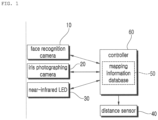
- FIG. 1 is an overall block diagram of an iris image acquisition system for expanding an iris recognition range according to an exemplary embodiment of the present disclosure.
- the iris image acquisition system for expanding the iris recognition range is applied as part of a security facility for access control by being installed not only on general entrance doors requiring iris recognition, but also, for example, at entrances through which many people pass, such as speed gates, airports, and port facilities, and as shown in FIG.
- the system includes: a wide-angle face recognition camera 10 capable of estimating a position of the face and eyes by photographing a subject; a narrow-angle iris photographing camera 20 provided with a zoom lens and a focus lens adjustment function to photograph a subject's iris image; a near-infrared LED 30 configured to emit near-infrared light to a photographing area of the iris photographing camera 20 when the iris photographing camera 20 is operated; a distance sensor 40 configured to measure a distance to the subject; a mapping information database 50 configured to record and store geometric mapping information generated on the basis of distance-specific correlation between the face recognition camera 10 and the iris photographing camera 20; and a controller 60 configured to control operations of the face recognition camera 10, the iris photographing camera 20, the near-infrared LED 30, and the distance sensor 40, and control a direction, zoom, and focusing of the iris photographing camera 20 according to information including subject eye position information acquired through the image acquired by the face recognition camera 10, distance information on a distance to a subject, the
- the face recognition camera 10 is provided as a camera that photographs a visible light image by photographing the subject so that a position of the face and eyes thereof may be estimated.
- the face recognition camera 10 provides image data for estimating a position of a face and eyes by photographing a subject-detected image.
- the face recognition camera 10 is preferable to be a wide-angle camera in which a lens with a field of view of 30 degrees or more is attached to a general color camera, and is also preferable to have a normal zoom function and a tilting function, but may be provided as a fixed camera without the normal zoom function and tilting function.
- the face recognition camera 10 is installed at a height of 1.3 m so that an image including the face may be acquired regardless of the height of a subject, and is automatically tiltable by the controller 60 to be described later within a range of 30 degree angles upward and 20 degree angles downward.
- the iris photographing camera 20 is installed by being spaced apart from one of a one side, an upper part, or a lower part of the above-described face recognition camera 10 by a predetermined distance.
- the iris photographing camera 20 has a zoom lens and a focus lens adjustment function, and serves to photograph a subject's iris image.
- the iris photographing camera 20 may be a low-light camera (e.g., a VGA-class low-light camera) that obtains a brighter image than that of a general camera by amplifying a small amount of electrical signal generated from a CCD sensor when receiving a small amount of light, but is preferable to be a near-infrared camera having a higher reactivity depending on an infrared wavelength than that of a general surveillance camera in comparison.
- the iris photographing camera 20 is preferably a narrow-angle camera to which a zoom lens having an angle of view of 1 degree angles to 5 degree angles is attached.
- the iris photographing camera 20 is installed at the height of 1.3 m so that an iris image may be acquired regardless of the height of the subject, and is automatically tiltable by the controller 60 within a range of 30 degree angles upward and 20 degree angles downward.
- the face recognition camera 10 and the iris photographing camera 20 are arranged to form an intersection point outside a parallel line of sight or a maximum distance set for imaging.
- the near-infrared LED 30 is installed in the above-described iris photographing camera 20.
- the near-infrared LED 30 serves to illuminate a photographing area of the iris photographing camera 20 by emitting near-infrared light to the photographing area of the iris photographing camera 20 when the iris photographing camera 20 is operated.
- the near-infrared LED 30 is mounted on the iris photographing camera 20 so as to interwork with the iris photographing camera 20, and is lit only when the iris photographing camera 20 is operated.
- the near-infrared LED 30 preferably has an illumination angle sufficient to illuminate an area being photographed by the iris photographing camera 20.
- an illumination angle sufficient to illuminate an area being photographed by the iris photographing camera 20.
- a near-infrared LED 30 having an illumination angle of 5 degree angles is applied.
- a single near-infrared LED 30 may be mounted on any one position of the top, bottom, left, and right of the body of the iris photographing camera 20 to be lit only when the iris photographing camera 30 is operated. In this case, it is preferable that the reflected light by illumination is focused on or below an area of the iris, the area not being used for iris recognition.
- a total of two near-infrared LEDs 30 may be respectively mounted on the upper and lower sides of the body, or left and right sides of the body of the iris photographing camera 20 to be lit only when the iris photographing camera 20 is operated.
- the illumination directions of the two near-infrared LEDs 30 should be inclined toward a photographing area relative to a center line, and as a distance increases, an overlapping areas increase, and accordingly, it is preferable that the iris photographing camera 20 is designed to sufficiently cover the area to be imaged.
- the near-infrared LED 30 strongly emits near-infrared light only for a period of several milliseconds (ms) or less during which the area corresponding to the position of the iris is imaged under the precise strobing control of the controller 60.
- the distance sensor 40 is installed on the body of the above-described face recognition camera 10 or iris photographing camera 20.
- the distance sensor 40 measures a distance between a subject and the face recognition camera 10 or iris photographing camera 20 and transmits a sensor signal for generating distance information to the controller 60, and may be formed by using a conventional ultrasonic distance sensor.
- controller 60 for controlling the operations of the above-described face recognition camera 10, iris photographing camera 20, near-infrared LED 30, and distance sensor 40 includes a mapping information database 50.
- the mapping information database 50 is formed by recording and storing geometric mapping information generated on the basis of a distance-specific correlation between the face recognition camera 10 and the iris photographing camera 20.
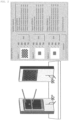
- FIG. 2 illustrates the exemplary embodiment in which the geometric mapping information is generated on the basis of the distance-specific correlation between the face recognition camera and the iris photographing camera.
- the geometric mapping information of the mapping information database 50 may be acquirable by interpreting homography information, which varies depending on each of zoom magnifications of the face recognition camera 10 and the iris photographing camera 20, with a geometrical homography in which spatial information is reflected.
- the specific method includes a method using a hand and a pencil to directly solve the questions geometrically, a method using homography, and a method using 3D transformation.
- the homography refers to a constant transformation relationship established between projected corresponding points when one plane is projected onto another plane.
- Homography is usually expressed as a 3 ⁇ 3 matrix, and is defined as a transformation relationship established for the expression of homogeneous coordinates of the corresponding points.
- Homography is generally established not only between two planes in a direct projection relationship, but also between all planes directly or indirectly connected by projection relationships.
- a method for obtaining an actual position of an object detected in an image by using homography is as follows: First, arbitrary four points are taken on a floor within a camera field of view, ground coordinates of the four points are measured through actual measurement, and a reference (i.e., origin, and the like) of the ground coordinate system is set. After measuring the ground coordinates of the four points according to the set reference (i.e., the ground coordinate system), image coordinates of the corresponding points (i.e., pixel coordinates in a camera image) are acquired. The calculation of a homography transformation matrix H from the pixel coordinates to the ground coordinates is performed directly by using a findHomogray function of opencv or by using a code below.
- the above-described face recognition camera 10, iris photographing camera 20, near-infrared LED 30, and distance sensor 40 are connected to the controller 60 by wired or wireless communication.
- the controller 60 controls the operations of the face recognition camera 10, iris photographing camera 20, near-infrared LED 30, and distance sensor 40, and includes the above-described mapping information database 50.
- the controller 60 controls the direction, zoom, and focusing of the iris photographing camera 20 according to the subject eye position information acquired through the image acquired by the face recognition camera 10, the distance information on the distance to the subject acquired through the sensor signal of the distance sensor 40, and the geometric mapping information of the mapping information database 50 mapped to the distance information.
- the face recognition camera 10 and the iris photographing camera 20 are formed in a single body frame installed to be tiltable, the controller 60 including the mapping information database 50 may be mounted on this body frame, and the face recognition camera 10 and the iris photographing camera 20 are respectively arranged to be tiltable while being spaced apart from each other according to the exemplary embodiment, and may be connected to the controller 60 including the mapping information database 50 by wire or wireless communication.
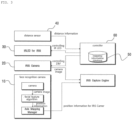
- FIG. 3 is a detailed block diagram of the iris image acquisition system for expanding the iris recognition range according to the exemplary embodiment of the present disclosure.
- the controller 60 controls operations of the near-infrared LED 30 and the iris photographing camera 20 on the basis of the distance information and the geometric mapping information of the mapping information database 50, and in particular, the zoom and focusing of the iris photographing camera 20 may be controlled.
- an instant focusing is possible not by an auto-focusing function, but by focusing based on the mapping information, so that high-level calculation is not required and fast processing is possible.
- the iris image acquisition system for expanding the iris recognition range may photograph a subject through the wide-angle face recognition camera 10, may extract an eye position on the basis of a facial feature algorithm, and may accurately photograph the subject's eye position by the iris photographing camera 20 through coordinate mapping.
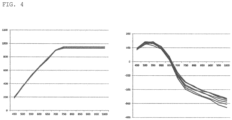
- FIG. 4 is an exemplary view illustrating a calibration data analysis for zoom lens tolerance correction according to the exemplary embodiment of the present disclosure
- FIG. 5 is a view illustrating the exemplary embodiment in which zoom information and focusing information for each distance are analyzed according to the exemplary embodiment of the present disclosure
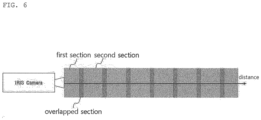
- FIG. 6 is a view illustrating the exemplary embodiment in which adjacent sections are set to overlap each other according to the exemplary embodiment of the present disclosure.
- the geometric mapping information of the mapping information database 50 may be generated on the basis of the correlation coefficient according to the distance between the subject and the face recognition camera 10 and iris photographing camera 20.
- the correlation coefficient may be calculated for each of a plurality of sections by generating first data on the basis of zoom information and focusing information by the distance to the subject, extracting a plurality of reference points whose rate of change according to the distance of the focusing information exceeds a predetermined first threshold point, and dividing the first data into the plurality of sections on the basis of the plurality of reference points.
- the reason for generating the first data by distance is that since a minimum distance for iris recognition is different depending on the distance to the subject, it is preferable to generate, by distance, the zoom information and focusing information of the iris photographing camera 20 according to the distance to the subject.
- the first data may be divided into the plurality of sections and the correlation coefficient may be calculated for each section.
- the reason for setting the reference points that divides the sections on the basis of a rate of change according to the distance of the focusing information is to secure the minimal sharpness that allows iris recognition to be executable.
- the first data may be generated by generating the zoom information by the distance to the subject, calculating a range of depth of field on the basis of the zoom information and the distance to the subject, and calculating the focusing information on the basis of the range of the depth of field.
- the focusing information is generated so that the subject may be included in the depth of field of the camera.
- the plurality of sections may be set so that the range of depth of field overlaps by a preset range, and thus it may be set so that there is no missing position according to the distance to the subject.
- FIG. 7 is a view illustrating a concept of calculating a correlation coefficient according to the exemplary embodiment of the present disclosure
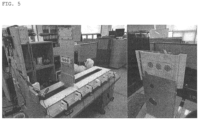
- FIG. 8 is a view illustrating the exemplary embodiment of the iris image acquisition system for expanding the iris recognition range according to the exemplary embodiment of the present disclosure.
- the mapping information may be generated by accumulating correlation coefficients according to the distance between the face recognition camera 10 and the iris photographing camera 20. In this way, the iris recognition may be performed more quickly.
- FIG. 8 is a view illustrating an example of tracking the position of the subject's iris by using the correlation coefficient.
- the subject eye position information may be extracted from the subject's face image photographed through the face recognition camera 10
- the subject's eyes may be photographed by controlling the iris photographing camera 20 on the basis of the position information of the eyes
- the subject's eye image may be extracted by controlling the zoom and focusing of the iris photographing camera 20 on the basis of the subject's distance information and the above-described matching information.
- the iris image acquisition system may solve inconvenience of existing commercial products that require a user's eye to be close to the camera for personal authentication, and may control the access of many people at high speed.
- the iris image acquisition system for expanding the iris recognition range it is possible to enable that the direction, zoom, and focusing of the iris photographing camera 20 are controlled quickly and easily, without the high-level information processing and arithmetic processing, on the basis of information including the distance information on distances measured by the distance sensor 40 and the geometric mapping information generated on the basis of the distance-specific correlation between the wide-angle face recognition camera 10 capable of estimating the position of the person's face and eyes and the narrow-angle iris photographing camera 20 provided with the zoom lens and the focus lens adjustment function so as to accurately photograph the iris.
- the high-level information processing and arithmetic processing such as autofocusing (AF) and image analysis performed in the process of acquiring the iris image of the subject at the distance are reduced, so that the system may be implemented in embedded systems having limited system resources.
- AF autofocusing
- image analysis performed in the process of acquiring the iris image of the subject at the distance are reduced, so that the system may be implemented in embedded systems having limited system resources.
- the present disclosure is applicable to the field of camera equipment or security systems based on the acquisition of a subject's iris image.
Landscapes
- Engineering & Computer Science (AREA)
- Multimedia (AREA)
- Signal Processing (AREA)
- Human Computer Interaction (AREA)
- Theoretical Computer Science (AREA)
- Physics & Mathematics (AREA)
- General Physics & Mathematics (AREA)
- General Health & Medical Sciences (AREA)
- Ophthalmology & Optometry (AREA)
- Health & Medical Sciences (AREA)
- Image Input (AREA)
- Measurement Of The Respiration, Hearing Ability, Form, And Blood Characteristics Of Living Organisms (AREA)
- Studio Devices (AREA)
Claims (3)
- Système d'acquisition d'image d'iris pour agrandir une plage de reconnaissance d'iris, le système comprenant :une caméra de reconnaissance faciale grand-angle estimant une position d'un visage et d'yeux en photographiant un sujet ;une caméra de photographie d'iris à angle étroit pourvue d'une fonction de réglage de lentille de changement de focale et d'une lentille de mise au point pour photographier une image d'iris du sujet ;une LED proche infrarouge configurée pour émettre une lumière proche infrarouge vers une zone de photographie de la caméra de photographie d'iris lorsque la caméra de photographie d'iris fonctionne ;un capteur de distance configuré pour mesurer une distance jusqu'au sujet ;une base de données d'informations de mappage configurée pour enregistrer et stocker des informations de mappage géométrique générées sur la base d'une corrélation spécifique à la distance entre la caméra de reconnaissance faciale et la caméra de photographie d'iris ; etun dispositif de commande configuré pour commander des opérations de la caméra de reconnaissance faciale, de la caméra de photographie d'iris,de la LED proche infrarouge et du capteur de distance, et commander une direction, un changement de focale et une mise au point de la caméra de photographie d'iris en fonction d'informations incluant des informations de position d'yeux du sujet acquises par le biais de l'image acquise par la caméra de reconnaissance faciale, des informations de distance concernant la distance jusqu'au sujet, les informations de distance étant acquises par le biais d'un signal de capteur du capteur de distance, et des informations de mappage géométrique de la base de données de mappage, les informations de mappage géométrique étant mappées sur les informations de distance,caractérisé en ce quela caméra de photographie d'iris est installée à une hauteur de 1,3 m de telle sorte que l'image d'iris peut être acquise quelle que soit une taille du sujet, et est automatiquement inclinable par le dispositif de commande dans une plage d'angles de 30 degrés vers le haut et d'angles de 20 degrés vers le bas,dans lequel les informations de mappage géométrique de la base de données d'informations de mappage sont acquises en interprétant des informations d'homographie, qui varient en fonction de chacun des agrandissements de changement de focale de la caméra de reconnaissance faciale et de la caméra de photographie d'iris, avec une homographie géométrique dans laquelle sont réfléchies des informations spatiales,dans lequel les informations de mappage géométrique de la base de données d'informations de mappage sont générées sur la base d'un coefficient de corrélation en fonction d'une distance entre le sujet et la caméra de reconnaissance faciale et la caméra de photographie d'iris, etle coefficient de corrélation est calculé pour chacune d'une pluralité de sections en générant des premières données sur la base d'informations de changement de focale et d'informations de mise au point par la distance jusqu'au sujet, en extrayant une pluralité de points de référence dont le taux de changement en fonction de la distance des informations de mise au point dépasse un premier point seuil prédéterminé, et en divisant les premières données en la pluralité de sections sur la base de la pluralité de points de référence.
- Système selon la revendication 1, dans lequel les premières données sont générées en générant les informations de changement de focale par la distance jusqu'au sujet, en calculant une plage de profondeur de champ sur la base des informations de changement de focale et de la distance jusqu'au sujet, et en générant les informations de mise au point sur la base de la plage de la profondeur de champ.
- Système selon la revendication 2, dans lequel la pluralité de sections est réglée de telle sorte que la plage de la profondeur de champ est en chevauchement d'une plage prédéfinie de telle sorte qu'il n'y a pas de position manquante en fonction de la distance jusqu'au sujet.
Applications Claiming Priority (2)
| Application Number | Priority Date | Filing Date | Title |
|---|---|---|---|
| KR1020200172232A KR102274270B1 (ko) | 2020-12-10 | 2020-12-10 | 홍채인식범위 확장을 위한 홍채 영상 획득시스템 |
| PCT/KR2021/010536 WO2022124518A1 (fr) | 2020-12-10 | 2021-08-10 | Système d'acquisition d'image d'iris pour agrandir une plage de reconnaissance d'iris |
Publications (4)
| Publication Number | Publication Date |
|---|---|
| EP4033400A1 EP4033400A1 (fr) | 2022-07-27 |
| EP4033400A4 EP4033400A4 (fr) | 2023-08-30 |
| EP4033400C0 EP4033400C0 (fr) | 2025-06-18 |
| EP4033400B1 true EP4033400B1 (fr) | 2025-06-18 |
Family
ID=76894417
Family Applications (1)
| Application Number | Title | Priority Date | Filing Date |
|---|---|---|---|
| EP21844612.8A Active EP4033400B1 (fr) | 2020-12-10 | 2021-08-10 | Système d'acquisition d'image d'iris pour agrandir une plage de reconnaissance d'iris |
Country Status (5)
| Country | Link |
|---|---|
| US (1) | US11882354B2 (fr) |
| EP (1) | EP4033400B1 (fr) |
| KR (1) | KR102274270B1 (fr) |
| CN (1) | CN114945955B (fr) |
| WO (1) | WO2022124518A1 (fr) |
Families Citing this family (3)
| Publication number | Priority date | Publication date | Assignee | Title |
|---|---|---|---|---|
| KR102274270B1 (ko) * | 2020-12-10 | 2021-07-08 | 주식회사 케이티앤씨 | 홍채인식범위 확장을 위한 홍채 영상 획득시스템 |
| EP4258638B1 (fr) * | 2022-01-04 | 2026-02-11 | Canon Kabushiki Kaisha | Dispositif de traitement d'image, procédé de traitement d'image et support d'informations |
| US11792506B2 (en) | 2022-02-09 | 2023-10-17 | Motorola Mobility Llc | Electronic devices and corresponding methods for defining an image orientation of captured images |
Citations (2)
| Publication number | Priority date | Publication date | Assignee | Title |
|---|---|---|---|---|
| CN1892676A (zh) * | 2005-06-03 | 2007-01-10 | 沈洪泉 | 面部/虹膜组合光学成像的装置及方法 |
| CN111447430A (zh) * | 2019-11-21 | 2020-07-24 | 苏州思源科安信息技术有限公司 | 一种远距离大视场虹膜光学成像的装置及方法 |
Family Cites Families (16)
| Publication number | Priority date | Publication date | Assignee | Title |
|---|---|---|---|---|
| US6714665B1 (en) * | 1994-09-02 | 2004-03-30 | Sarnoff Corporation | Fully automated iris recognition system utilizing wide and narrow fields of view |
| KR100296305B1 (ko) | 1999-03-23 | 2001-07-12 | 구자홍 | 홍채인식 시스템의 자동초점 조절 방법 및 장치 |
| KR100493700B1 (ko) * | 2002-10-02 | 2005-06-02 | 엘지전자 주식회사 | 홍채 인식 시스템 및 그 자동 인식방법 |
| KR100904254B1 (ko) * | 2007-09-06 | 2009-06-25 | 연세대학교 산학협력단 | 비강압적 홍채 영상 획득 시스템 및 그 방법 |
| KR100869998B1 (ko) | 2007-09-06 | 2008-11-24 | 연세대학교 산학협력단 | 원거리 홍채 영상 획득 시스템 |
| KR100977499B1 (ko) | 2008-06-16 | 2010-08-23 | 연세대학교 산학협력단 | 거울의 패닝과 틸팅을 이용한 원거리 홍채 영상 획득시스템 |
| CN101770573B (zh) * | 2010-01-14 | 2012-02-01 | 沈洪泉 | 用于虹膜识别的自动聚焦虹膜图像成像装置及其控制方法 |
| US9292926B1 (en) * | 2014-11-24 | 2016-03-22 | Adobe Systems Incorporated | Depth map generation |
| US20170019588A1 (en) * | 2015-07-16 | 2017-01-19 | Catherine Ann Gordon | Camera system |
| CN107491672B (zh) * | 2017-07-18 | 2021-01-22 | Oppo广东移动通信有限公司 | 解锁处理方法及相关产品 |
| FR3081072B1 (fr) * | 2018-05-09 | 2020-04-17 | Idemia Identity & Security France | Procede de reconnaissance biometrique a partir des iris |
| US11546569B2 (en) * | 2019-04-15 | 2023-01-03 | Synaptive Medical Inc. | System and methods for correcting image data of distinct images and generating and stereoscopic three-dimensional images |
| JP7400949B2 (ja) * | 2020-03-30 | 2023-12-19 | 日本電気株式会社 | 撮像システム、撮像方法及び撮像プログラム |
| US11190689B1 (en) * | 2020-07-29 | 2021-11-30 | Google Llc | Multi-camera video stabilization |
| US20220109822A1 (en) * | 2020-10-02 | 2022-04-07 | Facebook Technologies, Llc | Multi-sensor camera systems, devices, and methods for providing image pan, tilt, and zoom functionality |
| KR102274270B1 (ko) * | 2020-12-10 | 2021-07-08 | 주식회사 케이티앤씨 | 홍채인식범위 확장을 위한 홍채 영상 획득시스템 |
-
2020
- 2020-12-10 KR KR1020200172232A patent/KR102274270B1/ko active Active
-
2021
- 2021-08-10 WO PCT/KR2021/010536 patent/WO2022124518A1/fr not_active Ceased
- 2021-08-10 US US17/628,003 patent/US11882354B2/en active Active
- 2021-08-10 CN CN202180004713.3A patent/CN114945955B/zh active Active
- 2021-08-10 EP EP21844612.8A patent/EP4033400B1/fr active Active
Patent Citations (2)
| Publication number | Priority date | Publication date | Assignee | Title |
|---|---|---|---|---|
| CN1892676A (zh) * | 2005-06-03 | 2007-01-10 | 沈洪泉 | 面部/虹膜组合光学成像的装置及方法 |
| CN111447430A (zh) * | 2019-11-21 | 2020-07-24 | 苏州思源科安信息技术有限公司 | 一种远距离大视场虹膜光学成像的装置及方法 |
Non-Patent Citations (1)
| Title |
|---|
| GUO GUODONG ET AL: "A System for Automatic Iris Capturing", MITSUBISHI ELECTRIC RESEARCH LABORATORIES, 1 June 2005 (2005-06-01), pages 1 - 10, XP055940191, Retrieved from the Internet <URL:https://www.merl.com/publications/docs/TR2005-044.pdf> [retrieved on 20220708] * |
Also Published As
| Publication number | Publication date |
|---|---|
| KR102274270B1 (ko) | 2021-07-08 |
| WO2022124518A1 (fr) | 2022-06-16 |
| EP4033400C0 (fr) | 2025-06-18 |
| US20220417420A1 (en) | 2022-12-29 |
| EP4033400A4 (fr) | 2023-08-30 |
| CN114945955B (zh) | 2025-04-29 |
| CN114945955A (zh) | 2022-08-26 |
| US11882354B2 (en) | 2024-01-23 |
| EP4033400A1 (fr) | 2022-07-27 |
Similar Documents
| Publication | Publication Date | Title |
|---|---|---|
| US7715595B2 (en) | System and method for iris identification using stereoscopic face recognition | |
| US7574021B2 (en) | Iris recognition for a secure facility | |
| US10178290B2 (en) | Method and apparatus for automatically acquiring facial, ocular, and iris images from moving subjects at long-range | |
| US20050084179A1 (en) | Method and apparatus for performing iris recognition from an image | |
| US9336439B2 (en) | System and method for the long range acquisition of iris images from stationary and mobile subjects | |
| US20080075334A1 (en) | Combined face and iris recognition system | |
| US6134339A (en) | Method and apparatus for determining the position of eyes and for correcting eye-defects in a captured frame | |
| US8433103B2 (en) | Long distance multimodal biometric system and method | |
| EP4033400B1 (fr) | Système d'acquisition d'image d'iris pour agrandir une plage de reconnaissance d'iris | |
| Wheeler et al. | Stand-off iris recognition system | |
| JP2002514098A (ja) | 虹彩取得用イメージのための装置 | |
| KR100977499B1 (ko) | 거울의 패닝과 틸팅을 이용한 원거리 홍채 영상 획득시스템 | |
| CN105574525B (zh) | 一种复杂场景多模态生物特征图像获取方法及其装置 | |
| JP2002352235A (ja) | 虹彩認識システムの焦点距離を合わせる装置及び方法 | |
| WO2018157827A1 (fr) | Dispositif de capture d'iris de suivi d'œil humain dynamique, dispositif et procédé d'identification d'iris de suivi d'œil humain dynamique | |
| KR20120057033A (ko) | Iptv 제어를 위한 원거리 시선 추적 장치 및 방법 | |
| CN109451233B (zh) | 一种采集高清晰度面部图像的装置 | |
| WO2005008567A1 (fr) | Appareil et procede de reconnaissance omnidirectionnelle par l'iris | |
| KR20040084993A (ko) | 인증 대상 화상 촬상 장치 및 그 촬상 방법 | |
| KR101635602B1 (ko) | 홍채 인식 방법 및 장치 | |
| KR101919138B1 (ko) | 원거리 멀티 생체 인식 방법 및 장치 | |
| EP3599989A1 (fr) | Système et procédé de détection de pupille à grande vitesse | |
| KR20210101928A (ko) | 홍채인식범위 확장을 위한 홍채 영상 획득시스템 | |
| AU2007223336B2 (en) | A combined face and iris recognition system | |
| US20250217999A1 (en) | System, method, and device for capturing high resolution images over a panoramic scene in near and far fields for imaging of persons |
Legal Events
| Date | Code | Title | Description |
|---|---|---|---|
| STAA | Information on the status of an ep patent application or granted ep patent |
Free format text: STATUS: UNKNOWN |
|
| STAA | Information on the status of an ep patent application or granted ep patent |
Free format text: STATUS: THE INTERNATIONAL PUBLICATION HAS BEEN MADE |
|
| PUAI | Public reference made under article 153(3) epc to a published international application that has entered the european phase |
Free format text: ORIGINAL CODE: 0009012 |
|
| STAA | Information on the status of an ep patent application or granted ep patent |
Free format text: STATUS: REQUEST FOR EXAMINATION WAS MADE |
|
| 17P | Request for examination filed |
Effective date: 20220127 |
|
| AK | Designated contracting states |
Kind code of ref document: A1 Designated state(s): AL AT BE BG CH CY CZ DE DK EE ES FI FR GB GR HR HU IE IS IT LI LT LU LV MC MK MT NL NO PL PT RO RS SE SI SK SM TR |
|
| REG | Reference to a national code |
Free format text: PREVIOUS MAIN CLASS: G06K0009000000 Ipc: H04N0023611000 Ref country code: DE Ref legal event code: R079 Ref document number: 602021032580 Country of ref document: DE Free format text: PREVIOUS MAIN CLASS: G06K0009000000 Ipc: H04N0023611000 |
|
| A4 | Supplementary search report drawn up and despatched |
Effective date: 20230731 |
|
| RIC1 | Information provided on ipc code assigned before grant |
Ipc: H04N 23/90 20230101ALI20230725BHEP Ipc: H04N 23/69 20230101ALI20230725BHEP Ipc: H04N 23/67 20230101ALI20230725BHEP Ipc: H04N 23/611 20230101AFI20230725BHEP |
|
| DAV | Request for validation of the european patent (deleted) | ||
| DAX | Request for extension of the european patent (deleted) | ||
| GRAP | Despatch of communication of intention to grant a patent |
Free format text: ORIGINAL CODE: EPIDOSNIGR1 |
|
| STAA | Information on the status of an ep patent application or granted ep patent |
Free format text: STATUS: GRANT OF PATENT IS INTENDED |
|
| INTG | Intention to grant announced |
Effective date: 20250113 |
|
| GRAS | Grant fee paid |
Free format text: ORIGINAL CODE: EPIDOSNIGR3 |
|
| GRAA | (expected) grant |
Free format text: ORIGINAL CODE: 0009210 |
|
| STAA | Information on the status of an ep patent application or granted ep patent |
Free format text: STATUS: THE PATENT HAS BEEN GRANTED |
|
| AK | Designated contracting states |
Kind code of ref document: B1 Designated state(s): AL AT BE BG CH CY CZ DE DK EE ES FI FR GB GR HR HU IE IS IT LI LT LU LV MC MK MT NL NO PL PT RO RS SE SI SK SM TR |
|
| REG | Reference to a national code |
Ref country code: GB Ref legal event code: FG4D |
|
| REG | Reference to a national code |
Ref country code: CH Ref legal event code: EP |
|
| REG | Reference to a national code |
Ref country code: DE Ref legal event code: R096 Ref document number: 602021032580 Country of ref document: DE |
|
| REG | Reference to a national code |
Ref country code: CH Ref legal event code: EP |
|
| REG | Reference to a national code |
Ref country code: IE Ref legal event code: FG4D |
|
| U01 | Request for unitary effect filed |
Effective date: 20250716 |
|
| U07 | Unitary effect registered |
Designated state(s): AT BE BG DE DK EE FI FR IT LT LU LV MT NL PT RO SE SI Effective date: 20250721 |
|
| U20 | Renewal fee for the european patent with unitary effect paid |
Year of fee payment: 5 Effective date: 20250716 |
|
| PG25 | Lapsed in a contracting state [announced via postgrant information from national office to epo] |
Ref country code: NO Free format text: LAPSE BECAUSE OF FAILURE TO SUBMIT A TRANSLATION OF THE DESCRIPTION OR TO PAY THE FEE WITHIN THE PRESCRIBED TIME-LIMIT Effective date: 20250918 Ref country code: GR Free format text: LAPSE BECAUSE OF FAILURE TO SUBMIT A TRANSLATION OF THE DESCRIPTION OR TO PAY THE FEE WITHIN THE PRESCRIBED TIME-LIMIT Effective date: 20250919 |
|
| PGFP | Annual fee paid to national office [announced via postgrant information from national office to epo] |
Ref country code: GB Payment date: 20250829 Year of fee payment: 5 |
|
| PG25 | Lapsed in a contracting state [announced via postgrant information from national office to epo] |
Ref country code: HR Free format text: LAPSE BECAUSE OF FAILURE TO SUBMIT A TRANSLATION OF THE DESCRIPTION OR TO PAY THE FEE WITHIN THE PRESCRIBED TIME-LIMIT Effective date: 20250618 |
|
| PG25 | Lapsed in a contracting state [announced via postgrant information from national office to epo] |
Ref country code: RS Free format text: LAPSE BECAUSE OF FAILURE TO SUBMIT A TRANSLATION OF THE DESCRIPTION OR TO PAY THE FEE WITHIN THE PRESCRIBED TIME-LIMIT Effective date: 20250918 |
|
| PG25 | Lapsed in a contracting state [announced via postgrant information from national office to epo] |
Ref country code: IS Free format text: LAPSE BECAUSE OF FAILURE TO SUBMIT A TRANSLATION OF THE DESCRIPTION OR TO PAY THE FEE WITHIN THE PRESCRIBED TIME-LIMIT Effective date: 20251018 |
|
| PG25 | Lapsed in a contracting state [announced via postgrant information from national office to epo] |
Ref country code: SM Free format text: LAPSE BECAUSE OF FAILURE TO SUBMIT A TRANSLATION OF THE DESCRIPTION OR TO PAY THE FEE WITHIN THE PRESCRIBED TIME-LIMIT Effective date: 20250618 |
|
| PG25 | Lapsed in a contracting state [announced via postgrant information from national office to epo] |
Ref country code: CZ Free format text: LAPSE BECAUSE OF FAILURE TO SUBMIT A TRANSLATION OF THE DESCRIPTION OR TO PAY THE FEE WITHIN THE PRESCRIBED TIME-LIMIT Effective date: 20250618 |
|
| PG25 | Lapsed in a contracting state [announced via postgrant information from national office to epo] |
Ref country code: PL Free format text: LAPSE BECAUSE OF FAILURE TO SUBMIT A TRANSLATION OF THE DESCRIPTION OR TO PAY THE FEE WITHIN THE PRESCRIBED TIME-LIMIT Effective date: 20250618 |
|
| PG25 | Lapsed in a contracting state [announced via postgrant information from national office to epo] |
Ref country code: SK Free format text: LAPSE BECAUSE OF FAILURE TO SUBMIT A TRANSLATION OF THE DESCRIPTION OR TO PAY THE FEE WITHIN THE PRESCRIBED TIME-LIMIT Effective date: 20250618 |
|
| PG25 | Lapsed in a contracting state [announced via postgrant information from national office to epo] |
Ref country code: ES Free format text: LAPSE BECAUSE OF FAILURE TO SUBMIT A TRANSLATION OF THE DESCRIPTION OR TO PAY THE FEE WITHIN THE PRESCRIBED TIME-LIMIT Effective date: 20250618 |
|
| REG | Reference to a national code |
Ref country code: CH Ref legal event code: H13 Free format text: ST27 STATUS EVENT CODE: U-0-0-H10-H13 (AS PROVIDED BY THE NATIONAL OFFICE) Effective date: 20260324 |
|
| PG25 | Lapsed in a contracting state [announced via postgrant information from national office to epo] |
Ref country code: MC Free format text: LAPSE BECAUSE OF FAILURE TO SUBMIT A TRANSLATION OF THE DESCRIPTION OR TO PAY THE FEE WITHIN THE PRESCRIBED TIME-LIMIT Effective date: 20250618 |
|
| PLBE | No opposition filed within time limit |
Free format text: ORIGINAL CODE: 0009261 |
|
| STAA | Information on the status of an ep patent application or granted ep patent |
Free format text: STATUS: NO OPPOSITION FILED WITHIN TIME LIMIT |