EP4033492A1 - Procédé et appareil de construction de base de données, et procédé et appareil de récupération de fichier - Google Patents
Procédé et appareil de construction de base de données, et procédé et appareil de récupération de fichier Download PDFInfo
- Publication number
- EP4033492A1 EP4033492A1 EP20865284.2A EP20865284A EP4033492A1 EP 4033492 A1 EP4033492 A1 EP 4033492A1 EP 20865284 A EP20865284 A EP 20865284A EP 4033492 A1 EP4033492 A1 EP 4033492A1
- Authority
- EP
- European Patent Office
- Prior art keywords
- document
- sequence
- biological
- attribute information
- target
- Prior art date
- Legal status (The legal status is an assumption and is not a legal conclusion. Google has not performed a legal analysis and makes no representation as to the accuracy of the status listed.)
- Pending
Links
Images








Classifications
-
- G—PHYSICS
- G16—INFORMATION AND COMMUNICATION TECHNOLOGY [ICT] SPECIALLY ADAPTED FOR SPECIFIC APPLICATION FIELDS
- G16H—HEALTHCARE INFORMATICS, i.e. INFORMATION AND COMMUNICATION TECHNOLOGY [ICT] SPECIALLY ADAPTED FOR THE HANDLING OR PROCESSING OF MEDICAL OR HEALTHCARE DATA
- G16H70/00—ICT specially adapted for the handling or processing of medical references
-
- G—PHYSICS
- G06—COMPUTING OR CALCULATING; COUNTING
- G06F—ELECTRIC DIGITAL DATA PROCESSING
- G06F16/00—Information retrieval; Database structures therefor; File system structures therefor
- G06F16/20—Information retrieval; Database structures therefor; File system structures therefor of structured data, e.g. relational data
- G06F16/21—Design, administration or maintenance of databases
- G06F16/211—Schema design and management
-
- G—PHYSICS
- G06—COMPUTING OR CALCULATING; COUNTING
- G06F—ELECTRIC DIGITAL DATA PROCESSING
- G06F16/00—Information retrieval; Database structures therefor; File system structures therefor
- G06F16/10—File systems; File servers
- G06F16/14—Details of searching files based on file metadata
- G06F16/148—File search processing
-
- G—PHYSICS
- G06—COMPUTING OR CALCULATING; COUNTING
- G06F—ELECTRIC DIGITAL DATA PROCESSING
- G06F16/00—Information retrieval; Database structures therefor; File system structures therefor
- G06F16/30—Information retrieval; Database structures therefor; File system structures therefor of unstructured textual data
- G06F16/33—Querying
- G06F16/338—Presentation of query results
-
- G—PHYSICS
- G06—COMPUTING OR CALCULATING; COUNTING
- G06F—ELECTRIC DIGITAL DATA PROCESSING
- G06F16/00—Information retrieval; Database structures therefor; File system structures therefor
- G06F16/30—Information retrieval; Database structures therefor; File system structures therefor of unstructured textual data
- G06F16/35—Clustering; Classification
- G06F16/353—Clustering; Classification into predefined classes
-
- G—PHYSICS
- G06—COMPUTING OR CALCULATING; COUNTING
- G06F—ELECTRIC DIGITAL DATA PROCESSING
- G06F16/00—Information retrieval; Database structures therefor; File system structures therefor
- G06F16/90—Details of database functions independent of the retrieved data types
- G06F16/903—Querying
- G06F16/9038—Presentation of query results
-
- G—PHYSICS
- G06—COMPUTING OR CALCULATING; COUNTING
- G06F—ELECTRIC DIGITAL DATA PROCESSING
- G06F16/00—Information retrieval; Database structures therefor; File system structures therefor
- G06F16/90—Details of database functions independent of the retrieved data types
- G06F16/93—Document management systems
-
- G—PHYSICS
- G16—INFORMATION AND COMMUNICATION TECHNOLOGY [ICT] SPECIALLY ADAPTED FOR SPECIFIC APPLICATION FIELDS
- G16B—BIOINFORMATICS, i.e. INFORMATION AND COMMUNICATION TECHNOLOGY [ICT] SPECIALLY ADAPTED FOR GENETIC OR PROTEIN-RELATED DATA PROCESSING IN COMPUTATIONAL MOLECULAR BIOLOGY
- G16B45/00—ICT specially adapted for bioinformatics-related data visualisation, e.g. displaying of maps or networks
-
- G—PHYSICS
- G16—INFORMATION AND COMMUNICATION TECHNOLOGY [ICT] SPECIALLY ADAPTED FOR SPECIFIC APPLICATION FIELDS
- G16B—BIOINFORMATICS, i.e. INFORMATION AND COMMUNICATION TECHNOLOGY [ICT] SPECIALLY ADAPTED FOR GENETIC OR PROTEIN-RELATED DATA PROCESSING IN COMPUTATIONAL MOLECULAR BIOLOGY
- G16B50/00—ICT programming tools or database systems specially adapted for bioinformatics
- G16B50/30—Data warehousing; Computing architectures
-
- G—PHYSICS
- G06—COMPUTING OR CALCULATING; COUNTING
- G06F—ELECTRIC DIGITAL DATA PROCESSING
- G06F2216/00—Indexing scheme relating to additional aspects of information retrieval not explicitly covered by G06F16/00 and subgroups
- G06F2216/11—Patent retrieval
-
- Y—GENERAL TAGGING OF NEW TECHNOLOGICAL DEVELOPMENTS; GENERAL TAGGING OF CROSS-SECTIONAL TECHNOLOGIES SPANNING OVER SEVERAL SECTIONS OF THE IPC; TECHNICAL SUBJECTS COVERED BY FORMER USPC CROSS-REFERENCE ART COLLECTIONS [XRACs] AND DIGESTS
- Y02—TECHNOLOGIES OR APPLICATIONS FOR MITIGATION OR ADAPTATION AGAINST CLIMATE CHANGE
- Y02A—TECHNOLOGIES FOR ADAPTATION TO CLIMATE CHANGE
- Y02A90/00—Technologies having an indirect contribution to adaptation to climate change
- Y02A90/10—Information and communication technologies [ICT] supporting adaptation to climate change, e.g. for weather forecasting or climate simulation
Definitions
- This application relates to the technical field of natural language processing, and in particular, to a method and an apparatus for constructing a database, a method and a system for labeling an association degree of biological sequences, a method and an apparatus for retrieving a document, a computer device and a storage medium.
- Bio sequences in patent documents are generally represented in a form of letter strings or sequence numbers. These biological sequences are generally used to describe major molecular structures of DNA, RNA, other nucleotides and proteins and express the genetic information carried.
- Protection is claimed based on a product (especially a drug) that a biological sequence plays a role.
- this application provides a method for constructing a biological sequence database, and the method includes:
- this application provides a method for labeling an association degree of gene sequences, the method includes:
- this application provides a method for retrieving a document, and the method includes:
- this application provides an apparatus for constructing a database, including:
- this application provides a system for labeling an association degree of biological sequences, and the system includes:
- this application provides an apparatus for retrieving a document, the apparatus includes:
- this application provides a computer device, including a memory, a processor, and a computer program stored on the memory and executable by the processor, when the processor executes the computer program, steps of the method according to any of the embodiments of this application are implemented.
- this application provides a computer-readable storage medium on which a computer program is stored, when the computer program is executed by the processor, steps of the method according to any one of the embodiments of this application are implemented.
- a method and an apparatus for constructing a database, a method and a system for labeling an association degree of biological sequences, a method and an apparatus for retrieving a document, a computer device and a storage medium are provided.
- the solution of this application extracts a biological sequence and attribute information from a target document and construct an entry in the database based on the extracted biological sequence and attribute information.
- the server may match the entry for the user through the biological sequence, attribute information or a combination of the two in the entry. Therefore, when the database of this application is applied to a retrieval platform, the user is provided with various search supports such as biological sequence retrieval, biological sequence attribute retrieval, and comprehensive biological sequence and biological sequence attribute.
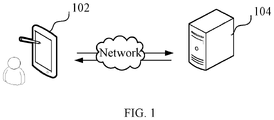
- the method for constructing a biological sequence database may be applied to an application environment shown in FIG. 1 .
- a terminal 100 communicates with a server 200 through the network.
- the server 200 may be implemented by an independent server or a server cluster including multiple servers.
- a processor of the server may execute a preset algorithm to identify specific terms (such as biological fields) and biological sequences in patent documents.
- the terminal 100 may be, but is not limited to, a personal computer, a notebook computer, a smart phone, or a tablet computer.
- the user can perform document retrieval through the terminal 100, and retrieval results are obtained through the document retrieval based on the biological sequence database.
- the server 200 may contain a database that is used for relevant retrieval of biological sequences.
- the user may interact with the server 200 through a corresponding interface on the terminal 100.
- the server 200 After receiving a retrieval request input by the user through the terminal 100, the server 200 will match an entry in the database, and feedback the retrieval results to the user according to the entry.
- a method for constructing a database is provided, and a database constructed by the method may be deployed on a server 200 in an application environment and applied to a searching engine to perform relevant searches.
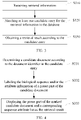
- the method includes following steps.
- Step S210 obtaining a target document and extracting a biological sequence and attribute information from the target document.
- the target document is generally a document in the biology field, such as a paper, a journal, a patent document, and the like.
- a processor is used to extract the biological sequence and attribute information from the target document.
- the processor first obtains a document from a data source to form a document set, and then obtains the target document from the document set according to a preset condition.
- the data source may be a professional document library, a platform, a website, or the like.
- the preset condition may include: determining document types of documents in the document set; determining a filtering rule of a corresponding target document according to a difference between the document types, wherein filtering rules corresponding to different document types are different; wherein the filtering rule is used to filter documents of corresponding document types to obtain the target document.
- the processor may extract the biological sequence and the attribute information in the target document through a trained deep learning model.
- the deep learning model may be a natural language processing model, such as Biobert, Scispacy, Variational Autoencoders, etc.
- the training process of the model is as follows.
- a training sample is constructed, and the training sample is generally a document labeled with a biological sequence and attribute information of the biological sequence.
- the constructed training samples are used to train an initial deep learning model until a neural network of the initial deep learning model converges, that is, a trained deep learning model is obtained.
- the deep learning model may identify biological sequences and corresponding attribute information recorded in an input document.
- Step S220 associating a document identifier of the target document with a corresponding biological sequence and the attribute information to obtain an entry.
- the attribute information may include one or more of attributes relevant to the biological sequence like percentage similarity between biological sequences, a species, a preparation method, a variant, a function, an inclusion, a homology, an involved drug, an involved disease, etc.
- the processor associates the document identifier of the target document with the corresponding biological sequence and the attribute information to obtain the entry.
- a search application server solr may be used to associate and map the document identifier, the biological sequence identifier of the corresponding biological sequence, and the attribute information to obtain the entry.
- Step S230 constructing a database using the entry.
- the processor adds the obtained entry to the database to construct the database.
- the entries obtained from documents of different document categories may be stored separately.
- the entries of papers, journals, and patent documents may be stored in corresponding storage spaces of the database, respectively.
- the server 200 will match an entry for the biological sequence a from the storage space corresponding to the entry of the patent document, and then generate the retrieval result according to the entry.
- the processor may also use the document category of the document to label the corresponding entry.
- the processor may identify the document type of the document according to a feature of the document. This feature can be a difference between different layouts for different types of documents. For example, different layouts of drawings in journals and drawings in patent documents.
- the processor may first perform text recognition on the documents in the document set to obtain text information contained in the documents; then, determine the document types of documents in the document set according to a preset keyword contained in the text information. This method can quickly and accurately identify document types with specific expressions. For example, when identifying patent documents, "characterized by" can be set as a keyword for the document type identification.
- the method for constructing the database in this embodiment constructs the entry in the database based on the extracted biological sequence and the attribute information.
- the server can match the entry for the user through a manner of the biological sequence, the attribute information in the entry, or a combination of the two. Therefore, when the database is applied to the retrieval platform, the user is provided with various search supports such as biological sequence retrieval, biological sequence attribute retrieval, and comprehensive biological sequence and biological sequence attributes.
- the above method for constructing the database may further include: analyzing technical terms and/or attribute information in the biology field by the processor to obtain association information; and performing association processing on the entry according to the association information to obtain a biological sequence database.
- the association information is obtained by analyzing the technical terms and/or the attribute information in the biology field, and the association information may be used to associate entries of different words expressing the same or similar meanings in the biology field, such as DNA, deoxygenation RNA, gene, and genetic material expressing the same or similar meanings in the biological field, and the processor may process the information in the entries as equivalent. Further, it is also possible to perform association processing on the entries containing part or all of the attribute information. For example, the biological sequence a and a biological sequence b can both be applied to the treatment of non-small cell lung cancer, and the processor may perform association processing on the entries of the biological sequence a and the biological sequence b .
- an association level may be set according to different association information. For example, in the biology field, the association of entries of different words that express the same or similar meanings is a higher-level association, while the association of entries that contain part or all of the attribute information is a lower-level association. Further, when performing association processing on the entries containing part or all of the attribute information, the association level may also be set according to a degree of overlap of the attribute information of the two biological sequences.
- the method of this embodiment performs association processing on the entries, which makes it possible to provide users with more diversified retrieval results (for example, association retrieval) when retrieval results are provided based on the biological sequence database.
- association retrieval for example, association retrieval
- the entry that the biological sequence database exactly matches with the biological sequence a is an entry that contains the biological sequence a and a sequence number of the biological sequence a
- the biological sequence contains too few entries of the biological sequence a (for example, less than the preset number of 10)
- the entry associated with the biological sequence a may also be used as a candidate entry, and the candidate entry is used to generate the retrieval result.
- the entry associated with the biological sequence a may be selected as the candidate entry according to the association level. Therefore, the search based on the biological sequence database can provide users with more complete retrieval results.
- step S210 may include: the processor extracts the biological sequence and the attribute information in the claims and/or other parts of the patent document, wherein the other parts are parts of the patent document except the claims.
- the biological sequence described in the patent document is represented by a sequence number (seq ID No) in many cases, a specific sequence is generally recorded in a corresponding sequence table, and each sequence number corresponds to a certain sequence number. Therefore, when performing retrieval for the biological sequence recorded in the patent document, it is also necessary to pay attention to the sequence number that identifies the biological sequence. Therefore, when extracting the biological sequence of the patent document, the biological sequence number (seq ID No) in the patent document and the biological sequence may be processed as equivalent.
- a corresponding claim tree can be obtained first according to a claim structure of each patent document; then an identical sequence in each of the claims in the corresponding patent document is identified through the claim tree and biological technical terms. Finally, the biological sequences and the attribute information in claims are identified based on these identical sequences.
- the method of this embodiment extracts the biological sequence and the attribute information from the claims and/or other parts of the patent document and constructs the entries in the biological sequence database based on the extracted biological sequence and the attribute information.
- a searching based on the biological sequence database can meet different types of retrieval requirements such as patent novelty and freed to operate.
- a location identifier may also be used to label an extraction location of the attribute information in the entry or storing corresponding entry separately according to the extraction location of the attribute information.
- the specific retrieval requirement may be retrieval such as novelty retrieval, free-to-operate retrieval, and the like.
- the solution in this embodiment distinguishes the entries according to the extraction locations of the biological sequences.
- the user can select to search the entry corresponding to the claim and obtain the retrieval result. In this way, the user is provided with more precise data for feedback.
- a method for retrieving a document is also provided.
- the method is applied to the application scenario in FIG. 1 as an example for illustration.
- a user may input retrieval information through a retrieval interface provided by a retrieval platform on a terminal 100 to obtain a retrieval result.
- the terminal 100 After inputting the retrieval information through the retrieval interface, the terminal 100 generates a retrieval request according to the retrieval information input by the user and sends the request to a server 200.
- the server 200 matches entries for the retrieval information in its biological sequence database and generates the retrieval result according to the matched entries.
- the retrieval result may be sent to the retrieval interface of the terminal 100 for display.
- the method specifically includes following steps.
- Step 310 receiving retrieval information.
- the retrieval information is one or a combination of a biological sequence and attribute information of the biological sequence.
- the user can select two modes to perform relevant retrieval.
- a sequence query mode can be selected; when the user wishes to conduct retrieval through the attributes of biological sequences, an attribute query mode can be selected.
- the user can input at least one kind of attribute information as retrieval information.
- the user can also choose a hybrid retrieval mode that is a combination of the sequence query mode and the attribute query mode.
- the user may further input attribute information to define the biological sequence.
- the user can also input a preset fuzzy retrieval character instead of a specific base in the query sequence to expand the retrieval range.
- Step 320 matching at least one candidate entry for the retrieval information in a database.
- the database is constructed using the method of the above embodiments.
- the database contains at least one entry, and each entry contains a document identification (such as a patent application number, a patent application publication/patent publication number, a journal number, etc.), biological sequence information, and attribute information of a biological sequence in the target document.
- the biological sequence information may be a biological sequence or identity information of the biological sequence, such as seq ID No.
- the server 200 matches at least one candidate entry for the retrieval information from the database in this application.
- solr may be used to process the retrieval information first to obtain an index, and then the index may be used to match the at least one candidate entry for the retrieval information in the biological sequence database.
- Step 330 obtaining a retrieval result according to the candidate entry.
- the server 200 may obtain the retrieval result according to the information contained in the candidate entry.
- the information contained in the candidate entry may be processed correspondingly according to a retrieval result type selected by the user to obtain the retrieval result.
- retrieval result types may include: a basic view, a new field view of sequence similarity, a genome view, an inclusion view, a functional similarity view, and the like. These retrieval result types correspond to different display information respectively, and the display information is relevant information expected by the user.
- the server 200 displays a document identifier (for example, the patent application number) and attribute information in each candidate entry as the retrieval result.
- the above-mentioned document retrieval method is applicable to retrieval scenarios relevant to biological sequences.
- the method may be applied to a variety of retrieval modes, including but not limited to retrieval using a sequence directly, retrieval using attribute information directly, retrieval using a combination of multiple attribute information, and retrieval using a sequence combined with an attribute. This enables the user to achieve diverse retrieval needs without switching multiple platforms.
- the server 200 may first obtain the relevant sequence according to the original retrieval information, and then use a relevant sequence as the retrieval information in step S310.
- the relevant sequence is a biological sequence obtained based on the retrieval information.
- the user may input retrieval information through the user interface of the terminal 100.
- the server 200 receives the retrieval information and obtains the relevant sequence according to the retrieval information.
- the server 200 may first perform retrieval processing on the query sequence in the biological information database based on the blast program and the FASTA program to obtain the relevant sequence that match the query sequence. Then, the relevant sequence is used as the retrieval information in step S310.
- the biological information database may be the National Center for Biotechnology Information of the United States (NCBI), the DNA database of Japan (DDBJ), or the nucleotide database of the European Molecular Biology Laboratory (EMBL).
- the server 200 may determine the relevant sequence according to a percentage similarity between the biological sequence and the query sequence (biological sequence).
- step S330 includes the follows.
- Step S331 determining a candidate document according to the document identifier in the candidate entry.
- Step S332 labeling the biological sequence and/or the attribute information of a preset part of the candidate document.
- the preset part may be set to be claims, an abstract of the specification, an independent claim, or the like.
- the preset part may be an abstract.
- Step S333 displaying the preset part of the marked candidate document and a corresponding sequence attribute list as the retrieval result.
- the sequence attribute list is obtained according to the biological sequence and the attribute information in the candidate entry.
- the sequence attribute list may include one or more of the properties relevant to the biological sequence such as a percentage similarity, a species, a preparation method, a variant, a function, an inclusion, a homology, an involved drug, an involved disease, and the like of the corresponding biological sequence. Details can be seen in FIG. 5 .
- the method of this embodiment may comprehensively and concisely present the biological sequence involved in the candidate document and the relevant attribute of the biological sequence to the user.
- the obtained candidate document is a patent document
- the user can quickly and comprehensively obtain the attribute information of the biological sequence claimed in the patent according to the retrieval result of the method in this embodiment.
- step S330 includes:
- Step S335 generating a map label for each of target biological sequences according to a percentage similarity between the target biological sequences and a query sequence.
- the target biological sequence is the biological sequence corresponding to each candidate entry.
- a map labels is a constituent element of a biological sequence map.
- the map label can be a bar graph.
- a height of the bar graph may increase as the corresponding percentage similarity increases.
- different colors may also be used to distinguish the bar graphs corresponding to the similar percentages in different ranges.
- Step S336 determining a relative locational relationship between the map label of each of the target biological sequences and a map label of the query sequence according to the percentage similarity.
- the distance between the map label of the corresponding target biological sequence and the map label of the query sequence may be set in descending order of the percentage similarity.
- Step S337 generating a biological sequence map according to the map label of each of the target biological sequences, the map label of the query sequence, and the relative locational relationship between the map label of each of the target biological sequences and the map label of the query sequence; and displaying the biological sequence map as the retrieval result.
- the location of the map label of the query sequence in the biological sequence map may be determined first, and then the location of the map label of each of the target biological sequences in the biological sequence graph may be determined according to the map label of the query sequence and the relative location between the map label of each of the target biological sequences and the map label of the query sequence.
- the specific form of the biological sequence map can be seen in FIG. 7 .
- the patent document or journal corresponding to the target biological sequence may also be linked to the map label on the biological map in a form of a hyperlink, so that the user can obtain the original text of the corresponding document through simple interactional operations (for example, click a preset icon with a mouse).
- the method of this embodiment may enable the user to quickly know the percentage similarity between the query sequence and the target biological sequence.
- Step S330 includes the follows.
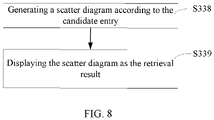
- Step S338 generating a scatter diagram according to the candidate entry.
- dots in the scatter diagram are relevant species obtained according to the attribute information of the candidate entry.
- An X-axis of the scatter diagram is a number of the biological sequences involved in the relevant species, and a Y-axis of the scatter diagram is a number of patents involved in the relevant species.
- the dots in the scatter diagram may represent an average percentage similarity between the biological sequence contained in the species and the query sequence.
- the server 200 first calculates the average of the percentage similarity between the biological sequences involved in each of the relevant species; and then sets a color and/or a shape of each origin in the scatter diagram according to the average of the percentage similarity.
- Step S339 displaying the scatter diagram as the retrieval result.
- the method of this embodiment can intuitively reflect the relationship between species, biological sequences and query sequences for the user, so as to facilitate selection of appropriate species when doing innovative research or market research.
- the retrieval information includes a query sequence
- the server 200 may display the patent document identification number and attribute information in the candidate entry as the retrieval result.
- FIG. 10 is a basic view of an attribute query mode provided by an embodiment of this application.
- the original retrieval information input by the user includes attribute information.
- the server 200 may first perform preamble processing on the attribute information to obtain a relevant sequence matching the attribute information. Then, the relevant sequence is used as the retrieval information in step S310.
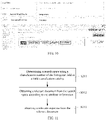
- S310 includes the follows.
- Step S311 determining a search space using a classification number of the biological field in a field classification catalog.
- the classification number may be an IPC classification number or a CPC classification number or the like.
- Step S312 obtaining a relevant document from the search space according to the attribute information.
- Step S313 obtaining a relevant sequence from the relevant document.
- the relevant sequence may be used as retrieval information to perform steps S320-S330 in the method for retrieving the document in any of the above embodiments, and sub-steps of steps S320-S330.
- a space for obtaining the relevant sequence is limited by the classification number associated with the biological field, which narrows the search range, thereby improving the response efficiency of the server.
- step S330 includes the follows.
- Step S340 determining a relevant gene sequence according to the attribute information of the candidate entry.
- Step S341 counting a number of patents for each segment in the relevant genome, each segment in the relevant genome corresponding to a sequence.
- Step S342 generating a bar graph using the relevant gene sequence and the number of patents of each segment in the relevant genome.
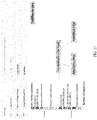
- Step S343 displaying the bar graph as the retrieval result. Details can be seen in the genome view in FIG. 13 .
- the solution of this embodiment can intuitively display the patent application status of each gene segment for the user, which is convenient for the user to carry out research and development work.
- step S330 includes the follows.
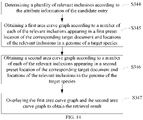
- Step S344 determining a plurality of relevant inclusions according to the attribute information of the candidate entry.
- Step S345 obtaining a first area curve graph according to a number of each of the relevant inclusions appearing in a first preset location of the corresponding target document and locations of the relevant inclusions in a genome of a target species.
- the target document is a patent document
- the first preset location may be a claim.
- Step S346 obtaining a second area curve graph according to a number of each of the relevant inclusions appearing in a second preset location of the corresponding target document and locations of the relevant inclusions in the genome of the target species.
- the second preset location may be another location in the patent document other than the claims, such as a detailed description of the embodiments and the like.
- Step S347 overlaying the first area curve graph and the second area curve graph to obtain the retrieval result. Details can be seen in the inclusions view of FIG. 15 .
- the method of this embodiment can intuitively display the extraction location of the biological sequence relevant to the user for the user, which is beneficial for the user to realize a thorough FTO search.
- Step S330 includes the follows.
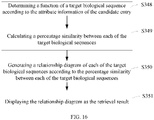
- Step S348 determining a function of a target biological sequence according to the attribute information of the candidate entry.
- the target biological sequence is the biological sequence corresponding to each candidate entry.
- Step S349 calculating a percentage similarity between each of the target biological sequences.
- Step S350 generating a relationship diagram of each of the target biological sequences according to the percentage similarity between each of the target biological sequences.
- Each node in the relationship diagram corresponds to a target biological sequence, and a color and/or a shape of each node in the relationship diagram is set according to a function of the corresponding target biological sequence.
- Step S351 displaying the relationship diagram as the retrieval result. Details can be seen in a functional similarity view in FIG. 17 .
- the method in this embodiment may intuitively display the relationship between each target biological sequence and the function of similar sequence for the user, which is helpful for the user to discover the application of the target biological sequence in a new field and helps to promote innovation.
- the attribute query in FIG. 17 uses the keywords "lung cancer” and "mutation”.
- sequences pink nodes marked as BRCA in the relational graph of FIG. 17 , based on this, it can be deduced that sequences targeting lung cancer are likely to be used to target breast cancer.
- step S330 includes the follows.
- Step S352 filtering candidate entries according to attribute filter items input by a user to obtain a target entry, where the attribute filter items include one or more of percentage similarity, a species, a preparation method, a variant, a function, an inclusion, a homology, an involved drug, and an involved disease.
- Step S353 obtaining the retrieval result according to the target entry.
- the method of this embodiment may display the retrieval result according to the needs of the user, which is helpful for the user to filter effective information.
- this application also proposes a method for labeling an association degree of biological sequences.
- the method may be applied to the application environment shown in FIG. 1 .
- the method includes: outputting a relevant biological sequence including at least one attribute according to the database and the attribute information; labeling a relevancy dimension of each of the relevant biological sequences according to an associated number of each of the relevant biological sequences and the attribute information.
- the database is constructed according to any of the methods for constructing a database in the foregoing embodiments.
- the biological sequence may be a gene sequence, a protein sequence, and the like.
- the server 200 first matches the received input information in the database constructed by the method according to the embodiments of this application to obtain a relevant biological sequence including at least one attribute, and then label the relevancy dimension of each of the relevant biological sequences according to the associated number of each of the relevant biological sequences and the attribute information.
- the server 200 matches “non-small cell lung cancer” in the database to find relevant biological sequences such as “EGFR gene sequence”, “ALK gene sequence” (these gene sequences are relevant to “non-small cell lung cancer”), and then obtain the number of attributes other than "non-small cell lung cancer” from the entries containing "EGFR gene sequence” and "ALK gene sequence”. If an entry contains “EGFR gene sequence”, the gene sequence is relevant to "non-small cell lung cancer", the drug “icotinib hydrochloride”, and the disease “psoriasis". The relevancy dimension of the "EGFR gene sequence” is labeled as 3.
- the relevancy dimension of the relevant biological sequence can be known.
- an apparatus for constructing a biological sequence database including:
- the feature extracting module 810 is specifically configured to obtain a document from a data source to form a document set; and obtain the target document from the document set according to a preset condition.
- the feature extracting module 810 is specifically configured to perform text recognition on the documents in the document set to obtain text information contained in the documents; and determine the document types of documents in the document set according to a preset keyword contained in the text information.
- the document types of documents in the document set include at least one of patent documents and non-patent documents.
- the associating module 820 is further configured to analyze technical terms and/or attribute information in a biological field to obtain association information, wherein the attribute information includes one or more of percentage similarity between biological sequences, a species, a preparation method, a variant, a function, an inclusion, a homology, an involved drug, and an involved disease; perform association processing on the entry according to the association information to obtain a database.
- the feature extracting module 820 is specifically configured to extract the biological sequence and the attribute information in the claims and/or other parts of the patent document.
- the other parts are the parts of the patent document other than the claims.
- the feature extracting module 820 is specifically configured to obtain a corresponding claim tree according to a claim structure of each patent document; identify an identical sequence in each of the claims in the corresponding patent document through the claim tree and biological technical terms.
- the associating module 820 is specifically configured to index the document identifier of the target document, a biological sequence identifier of the corresponding biological sequence, and the attribute information using a search application server solr to obtain the entry.
- the attribute information includes one or more of percentage similarity between biological sequences, a species, a preparation method, a variant, a function, an inclusion, a homology, an involved drug, and an involved disease.
- the associating module 820 is further configured to label an extraction location of the attribute information in the entry using a location identifier; or store corresponding entry respectively according to the extraction location of the attribute information.
- the feature extracting module 810 is specifically configured to obtain a corresponding claim tree according to a claim structure of each patent document; identify an identical sequence in each of the claims in the corresponding patent document through the claim tree and biological technical terms.
- a system for labeling an association degree of biological sequences includes:
- an apparatus for retrieving a document including:
- the retrieval result generating module 930 is specifically configured to display a document identifier and attribute information in each candidate entry as the retrieval result.
- the retrieval result generating module 930 is specifically configured to determine a candidate document according to the document identifier in the candidate entry; label the biological sequence and/or the attribute information of a preset part of the candidate document; and display the preset part of the marked candidate document and a corresponding sequence attribute list as the retrieval result, wherein the sequence attribute list is obtained according to the biological sequence and the attribute information in the candidate entry.
- the retrieval result generating module 930 is specifically configured to obtain the retrieval result according to the candidate entry, including: generate a map label for each of target biological sequences according to a percentage similarity between the target biological sequences and a query sequence, wherein the target biological sequence is the biological sequence corresponding to each candidate entry; determine a relative locational relationship between the map label of each of the target biological sequences and a map label of the query sequence according to the percentage similarity; generate a biological sequence map according to the map label of each of the target biological sequences, the map label of the query sequence, and the relative locational relationship between the map label of each of the target biological sequences and the map label of the query sequence; and display the biological sequence map as the retrieval result.
- the retrieval result generating module 930 is specifically configured to: if the retrieval result type selected by the user is a new field view of sequence similarity, obtain the retrieval result according to the candidate entry, including: generate a scatter diagram according to the candidate entry, wherein an origin of the scatter diagram is a relevant species obtained according to the attribute information of the candidate entry, an X-axis of the scatter diagram is a number of biological sequences involved in the relevant species, and a Y-axis of the scatter diagram is a number of patents involved in the relevant species; and display the scatter diagram as the retrieval result.
- the retrieval result generating module 930 is specifically configured to calculate an average of percentage similarity between the biological sequences involved in each of the relevant species; and set a color and/or a shape of each origin in the scatter diagram according to the average of the percentage similarity.
- the retrieval result generating module 930 is specifically configured to determine a relevant gene sequence according to the attribute information of the candidate entry; count a number of patents for each segment in the relevant genome, each segment in the relevant genome corresponding to a sequence; generate a bar graph using the relevant gene sequence and the number of patents of each segment in the relevant genome; and display the bar graph as the retrieval result.
- the retrieval result generating module 930 is specifically configured to determine a plurality of relevant inclusions according to the attribute information of the candidate entry; obtain a first area curve graph according to a number of each of the relevant inclusions appearing in a first preset location of the corresponding target document and locations of the relevant inclusions in a genome of a target species; obtain a second area curve graph according to a number of each of the relevant inclusions appearing in a second preset location of the corresponding target document and locations of the relevant inclusions in the genome of the target species; overlay the first area curve graph and the second area curve graph to obtain the retrieval result.
- the retrieval result generating module 930 is specifically configured to determine a function of a target biological sequence according to the attribute information of the candidate entry; calculate a percentage similarity between each of the target biological sequences; generate a relationship diagram of each of the target biological sequences according to the percentage similarity between each of the target biological sequences, wherein each node in the relationship diagram corresponds to a target biological sequence, and a color and/or a shape of each node in the relationship diagram is set according to a function of the corresponding target biological sequence; display the relationship diagram as the retrieval result.
- the retrieval result generating module 930 is specifically configured to filter candidate entries according to attribute filter items input by a user to obtain a target entry, wherein the attribute filter items include one or more of percentage similarity, a species, a preparation method, a variant, a function, an inclusion, a homology, an involved drug, and an involved disease; and obtain the retrieval result according to the target entry.
- an apparatus for constructing a database a system for labeling an association degree of biological sequences, and an apparatus for retrieving a document
- All or part of the modules in the apparatus for constructing the database, the system for an association degree of biological sequences, and the apparatus for retrieving the document can be implemented in whole or in part by software, hardware, and combinations thereof.
- the above-mentioned modules may be embedded in or independent of the processor in the computer device in the form of hardware or stored in the memory in the computer device in the form of software, so that the processor can call and execute the operations corresponding to the above modules.
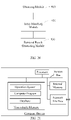
- a computer device in an embodiment, the computer device may be a server, and its internal structure diagram may be as shown in FIG. 22.
- the computer device includes a processor, a memory, a network interface, and a database connected by a system bus.
- the processor of the computer device is configured to provide computing and controlling capabilities.
- the memory of the computer device includes a non-volatile storage medium, and an internal memory.
- the nonvolatile storage medium stores an operating system, a computer program, and a database.
- the internal memory provides an environment for the execution of the operating system and computer programs in the non-volatile storage medium.
- the database of the computer device is configured to store the entries.
- the network interface of the computer device is configured to communicate with an external terminal through a network connection.
- the computer program when executed by a processor, a method for retrieving patent documents containing biological sequences is realized.
- FIG. 22 is only a block diagram of a partial structure relevant to the solution of this application and does not constitute a limitation on the computer device to which the solution of this application is applied.
- a specific computer device includes more or fewer components than shown in the figures, or combine certain components, or have a different arrangement of components.
- a computer device which includes a memory, a processor, and a computer program stored in the memory and executable on the processor.
- the processor executes the computer program, the following steps are implemented: obtaining a target document; extracting a biological sequence and attribute information in the target document; associating a document identifier of the target document with a corresponding biological sequence and the attribute information to obtain an entry; and constructing a database using the entry.
- the processor specifically implements the following steps when executing the computer program: obtaining a document from a data source to form a document set; and obtaining the target document from the document set according to a preset condition.
- the processor further implements the following steps when executing the computer program: performing text recognition on documents in the document set to obtain text information contained in the documents; determining the document types of documents in the document set according to a preset keyword contained in the text information.
- the processor further implements the following steps when executing the computer program: analyzing technical terms and/or attribute information in a biological field to obtain association information, wherein the attribute information includes one or more of percentage similarity between biological sequences, a species, a preparation method, a variant, a function, an inclusion, a homology, an involved drug, and an involved disease; performing association processing on the entry according to the association information to obtain a biological sequence database.
- the processor specifically implements the following steps when executing the computer program: extracting the biological sequence and the attribute information in the claims and/or other parts of the patent document.
- the other parts are parts of the patent document other than the claims.
- the processor specifically implements the following steps when executing the computer program: obtaining a corresponding claim tree according to a claim structure of each patent document; identifying an identical sequence in each of the claims in the corresponding patent document through the claim tree and biological technical terms.
- the processor specifically implements the following steps when executing the computer program: indexing the document identifier of the target document, a biological sequence identifier of the corresponding biological sequence, and the attribute information using a search application server solr to obtain the entry.
- the processor further implements the following steps when executing the computer program: labeling an extraction location of the attribute information in the entry using a location identifier; or storing corresponding entry respectively according to the extraction location of the attribute information.
- a computer device including a memory, a processor, and a computer program stored on the memory and executable on the processor, and the processor implements the following steps when executing the computer program: outputting a relevant gene sequence including at least one attribute according to the database and the attribute information; labeling a relevancy dimension of each of the relevant gene sequences according to an associated number of each of the relevant gene sequences and the attribute information.
- a computer device including a memory, a processor, and a computer program stored on the memory and executable on the processor, and the processor implements the following steps when executing the computer program: receiving retrieval information; matching at least one candidate entry for the retrieval information in the database; and obtaining a retrieval result according to the candidate entry.
- the processor specifically implements the following steps when executing the computer program: displaying a document identifier and the attribute information in each candidate entry as the retrieval result.
- the processor specifically implements the following steps when executing the computer program: determining a candidate document according to the document identifier in the candidate entry; labeling the biological sequence and/or the attribute information of a preset part of the candidate document; and displaying the preset part of the marked candidate document and a corresponding sequence attribute list as the retrieval result, wherein the sequence attribute list is obtained according to the biological sequence and the attribute information in the candidate entry.
- the processor specifically implements the following steps when executing the computer program: generating a map label for each of target biological sequences according to a percentage similarity between the target biological sequences and a query sequence, the target biological sequence being the biological sequence corresponding to each candidate entry; determining a relative locational relationship between the map label of each of the target biological sequences and a map label of the query sequence according to the percentage similarity; generating a biological sequence map according to the map label of each of the target biological sequences, the map label of the query sequence, and the relative locational relationship between the map label of each of the target biological sequences and the map label of the query sequence; and displaying the biological sequence map as the retrieval result.
- the processor specifically implements the following steps when executing the computer program: generating a scatter diagram according to the candidate entry, wherein an origin of the scatter diagram is a relevant species obtained according to the attribute information of the candidate entry, an X-axis of the scatter diagram is a number of biological sequences involved in the relevant species, and a Y-axis of the scatter diagram is a number of patents involved in the relevant species; and displaying the scatter diagram as the retrieval result.
- the processor further implements the following steps when executing the computer program: calculating an average of percentage similarity between the biological sequences involved in each of the relevant species; and setting a color and/or a shape of each origin in the scatter diagram according to the average of the percentage similarity.
- the processor specifically implements the following steps when executing the computer program: determining a relevant gene sequence according to the attribute information of the candidate entry; counting a number of patents for each segment in the relevant genome, each segment in the relevant genome corresponding to a sequence; generating a bar graph using the relevant gene sequence and the number of patents of each segment in the relevant genome; and displaying the bar graph as the retrieval result.
- the processor specifically implements the following steps when executing the computer program: determining a plurality of relevant inclusions according to the attribute information of the candidate entry; obtaining a first area curve graph according to a number of each of the relevant inclusions appearing in a first preset location of the corresponding target document and locations of the relevant inclusions in a genome of a target species; obtaining a second area curve graph according to a number of each of the relevant inclusions appearing in a second preset location of the corresponding target document and locations of the relevant inclusions in the genome of the target species; and overlaying the first area curve graph and the second area curve graph to obtain the retrieval result.
- the processor specifically implements the following steps when executing the computer program: determining a function of a target biological sequence according to the attribute information of the candidate entry, wherein the target biological sequence is the biological sequence corresponding to each of the candidate entries; calculating a percentage similarity between each of the target biological sequences; generating a relationship diagram of each of the target biological sequences according to the percentage similarity between each of the target biological sequences, wherein each node in the relationship diagram corresponds to a target biological sequence, and a color and/or a shape of each node in the relationship diagram is set according to a function of the corresponding target biological sequence; and displaying the relationship diagram as the retrieval result.
- the processor specifically implements the following steps when executing the computer program: filtering candidate entries according to attribute filter items input by a user to obtain a target entry, wherein the attribute filter items include one or more of percentage similarity, a species, a preparation method, a variant, a function, an inclusion, a homology, an involved drug, and an involved disease; and obtaining the retrieval result according to the target entry.
- a computer-readable storage medium on which a computer program is stored.
- the computer program is executed by a processor, the following steps are implemented: obtaining a target document; extracting a biological sequence and attribute information in the target document; associating a document identifier of the target document with a corresponding biological sequence and the attribute information to obtain an entry; and constructing a database using the entry.
- the following steps are specifically implemented: obtaining a document from a data source to form a document set; and obtaining the target document from the document set according to a preset condition.
- the following steps are further implemented: performing text recognition on the documents in the document set to obtain text information contained in the documents; determining the document types of documents in the document set according to a preset keyword contained in the text information.
- the following steps are specifically implemented: analyzing technical terms and/or attribute information in a biological field to obtain association information, wherein the attribute information includes one or more of percentage similarity between biological sequences, a species, a preparation method, a variant, a function, an inclusion, a homology, an involved drug, and an involved disease; performing association processing on the entry according to the association information to obtain a biological sequence database.
- the following steps are specifically implemented: indexing the document identifier of the target document, a biological sequence identifier of the corresponding biological sequence, and the attribute information using a search application server solr to obtain the entry.
- the following steps are specifically implemented: extracting the biological sequence and the attribute information in the claims and/or other parts of the patent document, wherein the other parts are parts of the patent document other than the claims.
- the following steps are specifically implemented: obtaining a corresponding claim tree according to a claim structure of each patent document; identifying an identical sequence in each of the claims in the corresponding patent document through the claim tree and biological technical terms.
- the following steps are specifically implemented: indexing the document identifier of the target document, a biological sequence identifier of the corresponding biological sequence, and the attribute information using a search application server solr to obtain the entry.
- the following steps are specifically implemented: labeling an extraction location of the attribute information in the entry using a location identifier; or storing corresponding entry respectively according to the extraction location of the attribute information.
- a computer-readable storage medium on which a computer program is stored, and when the computer program is executed by a processor, the following steps are implemented: outputting a relevant gene sequence including at least one attribute according to a database and attribute information; labeling a relevancy dimension of each of the relevant gene sequences according to an associated number of each of the relevant gene sequences and the attribute information.
- a computer-readable storage medium on which a computer program is stored, and when the computer program is executed by a processor, the following steps are implemented: receiving retrieval information; matching at least one candidate entry for the retrieval information in the database; and obtaining a retrieval result according to the candidate entry.
- the following steps are specifically implemented: displaying a document identifier and the attribute information in each candidate entry as the retrieval result.
- the following steps are specifically implemented: determining a candidate document according to the document identifier in the candidate entry; labeling the biological sequence and/or the attribute information of a preset part of the candidate document; and displaying the preset part of the marked candidate document and a corresponding sequence attribute list as the retrieval result, wherein the sequence attribute list is obtained according to the biological sequence and the attribute information in the candidate entry.
- the following steps are further implemented: generating a map label for each of target biological sequences according to a percentage similarity between the target biological sequences and a query sequence, wherein the target biological sequence is the biological sequence corresponding to each candidate entry; determining a relative locational relationship between the map label of each of the target biological sequences and a map label of the query sequence according to the percentage similarity; generating a biological sequence map according to the map label of each of the target biological sequences, the map label of the query sequence, and the relative locational relationship between the map label of each of the target biological sequences and the map label of the query sequence; and displaying the biological sequence map as the retrieval result.
- the retrieval result type selected by the user is a new field view of sequence similarity
- the following steps are further implemented: generating a scatter diagram according to the candidate entry, wherein an origin of the scatter diagram is a relevant species obtained according to the attribute information of the candidate entry, an X-axis of the scatter diagram is a number of biological sequences involved in the relevant species, and a Y-axis of the scatter diagram is a number of patents involved in the relevant species; and displaying the scatter diagram as the retrieval result.
- the following steps are further implemented: calculating an average of percentage similarity between the biological sequences involved in each of the relevant species; and setting a color and/or a shape of each origin in the scatter diagram according to the average of the percentage similarity.
- the retrieval result type selected by the user is a genome view
- the following steps are further implemented: determining a relevant gene sequence according to the attribute information of the candidate entry; counting a number of patents for each segment in the relevant genome, each segment in the relevant genome corresponding to a sequence; generating a bar graph using the relevant gene sequence and the number of patents of each segment in the relevant genome; and displaying the bar graph as the retrieval result.
- the retrieval result type selected by the user is an inclusion view
- the following steps are further implemented: determining a plurality of relevant inclusions according to the attribute information of the candidate entry; obtaining a first area curve graph according to a number of each of the relevant inclusions appearing in a first preset location of the corresponding target document and locations of the relevant inclusions in a genome of a target species; obtaining a second area curve graph according to a number of each of the relevant inclusions appearing in a second preset location of the corresponding target document and locations of the relevant inclusions in the genome of the target species; and overlaying the first area curve graph and the second area curve graph to obtain the retrieval result.
- the retrieval result type selected by the user is a functional similarity view
- the following steps are further implemented: determining a function of a target biological sequence according to the attribute information of the candidate entry, wherein the target biological sequence is the biological sequence corresponding to each of the candidate entries; calculating a percentage similarity between each of the target biological sequences; generating a relationship diagram of each of the target biological sequences according to the percentage similarity between each of the target biological sequences, wherein each node in the relationship diagram corresponds to a target biological sequence, and a color and/or a shape of each node in the relationship diagram is set according to a function of the corresponding target biological sequence; and displaying the relationship diagram as the retrieval result.
- the following steps are further implemented: filtering candidate entries according to the attribute filter items input by a user to obtain a target entry, wherein the attribute filter items include one or more of percentage similarity, a species, a preparation method, a variant, a function, an inclusion, a homology, an involved drug, and an involved disease; obtaining the retrieval result according to the target entry.
- Nonvolatile memory may include read only a memory (ROM), a programmable ROM (PROM), an electrically programmable ROM (EPROM), an electrically erasable programmable ROM (EEPROM), or a flash memory.
- Volatile memory may include a random access memory (RAM) or an external cache memory.
- RAM is available in various forms such as a static RAM (SRAM), a dynamic RAM (DRAM), a synchronous DRAM (SDRAM), a double data rate SDRAM (DDRSDRAM), an enhanced SDRAM (ESDRAM), a synchronous link (Synchlink) DRAM (SLDRAM), a memory bus (Rambus) direct RAM (RDRAM), a direct memory bus dynamic RAM (DRDRAM), and a memory bus dynamic RAM (RDRAM) and so on.
- SRAM static RAM
- DRAM dynamic RAM
- SDRAM synchronous DRAM
- DDRSDRAM double data rate SDRAM
- ESDRAM enhanced SDRAM
- SLDRAM synchronous link
- RDRAM synchronous link
- RDRAM direct RAM
- DRAM direct memory bus dynamic RAM
- RDRAM memory bus dynamic RAM
Landscapes
- Engineering & Computer Science (AREA)
- Theoretical Computer Science (AREA)
- Physics & Mathematics (AREA)
- Databases & Information Systems (AREA)
- Data Mining & Analysis (AREA)
- General Engineering & Computer Science (AREA)
- General Physics & Mathematics (AREA)
- Health & Medical Sciences (AREA)
- Life Sciences & Earth Sciences (AREA)
- General Health & Medical Sciences (AREA)
- Medical Informatics (AREA)
- Evolutionary Biology (AREA)
- Spectroscopy & Molecular Physics (AREA)
- Biophysics (AREA)
- Bioinformatics & Cheminformatics (AREA)
- Bioinformatics & Computational Biology (AREA)
- Biotechnology (AREA)
- Computational Linguistics (AREA)
- Bioethics (AREA)
- General Business, Economics & Management (AREA)
- Business, Economics & Management (AREA)
- Epidemiology (AREA)
- Primary Health Care (AREA)
- Public Health (AREA)
- Library & Information Science (AREA)
- Information Retrieval, Db Structures And Fs Structures Therefor (AREA)
Applications Claiming Priority (2)
| Application Number | Priority Date | Filing Date | Title |
|---|---|---|---|
| CN201910881925.4A CN112530523B (zh) | 2019-09-18 | 2019-09-18 | 数据库构建方法、文件检索方法以及装置 |
| PCT/CN2020/113214 WO2021052184A1 (fr) | 2019-09-18 | 2020-09-03 | Procédé et appareil de construction de base de données, et procédé et appareil de récupération de fichier |
Publications (2)
| Publication Number | Publication Date |
|---|---|
| EP4033492A1 true EP4033492A1 (fr) | 2022-07-27 |
| EP4033492A4 EP4033492A4 (fr) | 2022-10-19 |
Family
ID=74883874
Family Applications (1)
| Application Number | Title | Priority Date | Filing Date |
|---|---|---|---|
| EP20865284.2A Pending EP4033492A4 (fr) | 2019-09-18 | 2020-09-03 | Procédé et appareil de construction de base de données, et procédé et appareil de récupération de fichier |
Country Status (4)
| Country | Link |
|---|---|
| US (1) | US12541487B2 (fr) |
| EP (1) | EP4033492A4 (fr) |
| CN (1) | CN112530523B (fr) |
| WO (1) | WO2021052184A1 (fr) |
Families Citing this family (8)
| Publication number | Priority date | Publication date | Assignee | Title |
|---|---|---|---|---|
| CN113111869B (zh) * | 2021-04-06 | 2022-12-09 | 上海交通大学 | 提取文字图片及其描述的方法和系统 |
| CN113012755B (zh) * | 2021-04-12 | 2023-10-27 | 聊城大学 | 基因组atcg的检索方法 |
| CN115050478B (zh) * | 2022-03-31 | 2023-07-25 | 数魔方(北京)医药科技有限公司 | 药品信息挖掘方法、预警方法、装置和存储介质 |
| CN115238081B (zh) * | 2022-06-14 | 2024-04-30 | 杭州原数科技有限公司 | 一种文物智能识别方法、系统及可读存储介质 |
| CN115910210A (zh) * | 2022-10-28 | 2023-04-04 | 智慧芽信息科技(苏州)有限公司 | 生物序列检索方法、装置、电子设备及存储介质 |
| CN119025517A (zh) * | 2023-05-26 | 2024-11-26 | 鼎捷软件股份有限公司 | 数据构建系统以及数据构建方法 |
| CN116935965B (zh) * | 2023-06-30 | 2026-03-13 | 魔方医药科技(苏州)有限公司 | 生物序列提取和检索方法、装置和电子设备 |
| CN117077004B (zh) * | 2023-08-18 | 2024-02-23 | 中国科学院华南植物园 | 物种鉴定方法、系统、设备及存储介质 |
Family Cites Families (22)
| Publication number | Priority date | Publication date | Assignee | Title |
|---|---|---|---|---|
| US6470277B1 (en) * | 1999-07-30 | 2002-10-22 | Agy Therapeutics, Inc. | Techniques for facilitating identification of candidate genes |
| US6941317B1 (en) * | 1999-09-14 | 2005-09-06 | Eragen Biosciences, Inc. | Graphical user interface for display and analysis of biological sequence data |
| US6636849B1 (en) * | 1999-11-23 | 2003-10-21 | Genmetrics, Inc. | Data search employing metric spaces, multigrid indexes, and B-grid trees |
| WO2004037994A2 (fr) * | 2002-10-22 | 2004-05-06 | University Of Utah Research Foundation | Gestion de bases de donnees biologiques |
| JP2004334753A (ja) * | 2003-05-12 | 2004-11-25 | Hitachi Ltd | 情報検索方法 |
| KR100601941B1 (ko) | 2004-02-17 | 2006-07-14 | 삼성전자주식회사 | 서열 색인 방법 및 그 시스템 |
| US20050240352A1 (en) * | 2004-04-23 | 2005-10-27 | Invitrogen Corporation | Online procurement of biologically related products/services using interactive context searching of biological information |
| US7623997B2 (en) * | 2004-07-02 | 2009-11-24 | The United States Of America As Represented By The Secretary Of The Navy | Computer-implemented biological sequence identifier system and method |
| KR20060104681A (ko) * | 2005-03-31 | 2006-10-09 | 삼성전자주식회사 | Dna 단편 번호를 이용한 특허 검색 시스템 및 방법 |
| CN1851704A (zh) * | 2006-05-17 | 2006-10-25 | 杨仑 | 对专利基因或基因专利进行检索、注释和数据挖掘的方法 |
| US9529891B2 (en) * | 2013-07-25 | 2016-12-27 | Kbiobox Inc. | Method and system for rapid searching of genomic data and uses thereof |
| US9563741B2 (en) * | 2014-05-16 | 2017-02-07 | Battelle Memorial Institute | Constructing custom knowledgebases and sequence datasets with publications |
| CN105740243B (zh) * | 2014-12-08 | 2018-10-26 | 深圳华大基因研究院 | 生物信息数据库的构建方法和装置 |
| CN106547756B (zh) * | 2015-09-17 | 2021-02-12 | 北京国双科技有限公司 | 数据库的创建方法及装置 |
| US10037365B2 (en) * | 2016-01-29 | 2018-07-31 | Integral Search International Ltd. | Computer-implemented patent searching method in connection to matching degree |
| CN107168966B (zh) * | 2016-03-07 | 2020-10-20 | 创新先进技术有限公司 | 一种搜索引擎索引构建方法及装置 |
| US10489439B2 (en) * | 2016-04-14 | 2019-11-26 | Xerox Corporation | System and method for entity extraction from semi-structured text documents |
| CN107798219B (zh) * | 2016-08-30 | 2021-07-13 | 清华大学 | 将数据进行生物存储并还原的方法 |
| WO2019169205A1 (fr) * | 2018-02-28 | 2019-09-06 | Rocky Kahn | Visionneur de document alignant pdf et xml |
| CN114375448A (zh) * | 2019-06-07 | 2022-04-19 | 徕卡显微系统Cms有限公司 | 用于处理生物学相关数据的系统和方法、用于控制显微镜的系统和方法及显微镜 |
| CN110246590A (zh) * | 2019-06-17 | 2019-09-17 | 上海米帝信息技术有限公司 | 一种血液病知识图谱数据库的构建方法 |
| US11810669B2 (en) * | 2019-08-22 | 2023-11-07 | Kenneth Neumann | Methods and systems for generating a descriptor trail using artificial intelligence |
-
2019
- 2019-09-18 CN CN201910881925.4A patent/CN112530523B/zh active Active
-
2020
- 2020-09-03 EP EP20865284.2A patent/EP4033492A4/fr active Pending
- 2020-09-03 WO PCT/CN2020/113214 patent/WO2021052184A1/fr not_active Ceased
-
2022
- 2022-03-16 US US17/696,737 patent/US12541487B2/en active Active
Also Published As
| Publication number | Publication date |
|---|---|
| US20220229820A1 (en) | 2022-07-21 |
| US12541487B2 (en) | 2026-02-03 |
| CN112530523B (zh) | 2024-10-29 |
| CN112530523A (zh) | 2021-03-19 |
| WO2021052184A1 (fr) | 2021-03-25 |
| EP4033492A4 (fr) | 2022-10-19 |
Similar Documents
| Publication | Publication Date | Title |
|---|---|---|
| EP4033492A1 (fr) | Procédé et appareil de construction de base de données, et procédé et appareil de récupération de fichier | |
| Trabelsi et al. | Comprehensive evaluation of deep learning architectures for prediction of DNA/RNA sequence binding specificities | |
| Gront et al. | Generalized fragment picking in Rosetta: design, protocols and applications | |
| Degroeve et al. | SpliceMachine: predicting splice sites from high-dimensional local context representations | |
| Wang et al. | A heterogeneous network-based method with attentive meta-path extraction for predicting drug–target interactions | |
| US10055539B2 (en) | Systems and methods for using paired-end data in directed acyclic structure | |
| Waris et al. | Identification of DNA binding proteins using evolutionary profiles position specific scoring matrix | |
| AU2014340461A1 (en) | Systems and methods for using paired-end data in directed acyclic structure | |
| Calvillo et al. | Searching research papers using clustering and text mining | |
| Mitra et al. | Feature selection and clustering of gene expression profiles using biological knowledge | |
| Nakaya et al. | Extraction of correlated gene clusters by multiple graph comparison | |
| Oliver et al. | Vernal: a tool for mining fuzzy network motifs in RNA | |
| de Oliveira et al. | Sequential search leads to faster, more efficient fragment-based de novo protein structure prediction | |
| CN115829673A (zh) | 基于大数据的电子商城用户偏好分析方法及系统 | |
| Wibowo et al. | XGB5hmC: Identifier based on XGB model for RNA 5-hydroxymethylcytosine detection | |
| JP2011191834A (ja) | 文書分類方法、文書分類装置、およびプログラム | |
| Yuan et al. | Partial mixture model for tight clustering of gene expression time-course | |
| Schroeder et al. | Shapeme: A tool and web front-end for de novo discovery of structural motifs underpinning protein-dna interactions | |
| Xia | Position weight matrix and Perceptron | |
| Kynast et al. | ATLIGATOR: editing protein interactions with an atlas-based approach | |
| Sun et al. | Tree-structured algorithm for long weak motif discovery | |
| Boyen et al. | Mining minimal motif pair sets maximally covering interactions in a protein-protein interaction network | |
| Malik et al. | Structome-TM: Complementing dataset assembly for structural phylogenetics by addressing size-based biases | |
| JP2001178463A (ja) | 類似発現パターン抽出方法及び関連生体高分子抽出方法 | |
| CN119851755B (zh) | 遗传变异的解读方法、装置、计算机设备、可读存储介质和程序产品 |
Legal Events
| Date | Code | Title | Description |
|---|---|---|---|
| STAA | Information on the status of an ep patent application or granted ep patent |
Free format text: STATUS: THE INTERNATIONAL PUBLICATION HAS BEEN MADE |
|
| PUAI | Public reference made under article 153(3) epc to a published international application that has entered the european phase |
Free format text: ORIGINAL CODE: 0009012 |
|
| STAA | Information on the status of an ep patent application or granted ep patent |
Free format text: STATUS: REQUEST FOR EXAMINATION WAS MADE |
|
| 17P | Request for examination filed |
Effective date: 20220413 |
|
| AK | Designated contracting states |
Kind code of ref document: A1 Designated state(s): AL AT BE BG CH CY CZ DE DK EE ES FI FR GB GR HR HU IE IS IT LI LT LU LV MC MK MT NL NO PL PT RO RS SE SI SK SM TR |
|
| A4 | Supplementary search report drawn up and despatched |
Effective date: 20220919 |
|
| RIC1 | Information provided on ipc code assigned before grant |
Ipc: G16H 70/00 20180101ALI20220913BHEP Ipc: G16B 45/00 20190101ALI20220913BHEP Ipc: G06F 16/35 20190101ALI20220913BHEP Ipc: G06F 16/338 20190101ALI20220913BHEP Ipc: G16B 50/30 20190101AFI20220913BHEP |
|
| DAV | Request for validation of the european patent (deleted) | ||
| DAX | Request for extension of the european patent (deleted) | ||
| STAA | Information on the status of an ep patent application or granted ep patent |
Free format text: STATUS: EXAMINATION IS IN PROGRESS |
|
| 17Q | First examination report despatched |
Effective date: 20240315 |
|
| REG | Reference to a national code |
Ref country code: DE Ref legal event code: R003 |
|
| STAA | Information on the status of an ep patent application or granted ep patent |
Free format text: STATUS: THE APPLICATION HAS BEEN REFUSED |