EP4035547A1 - Kleidungsstück - Google Patents
Kleidungsstück Download PDFInfo
- Publication number
- EP4035547A1 EP4035547A1 EP20868975.2A EP20868975A EP4035547A1 EP 4035547 A1 EP4035547 A1 EP 4035547A1 EP 20868975 A EP20868975 A EP 20868975A EP 4035547 A1 EP4035547 A1 EP 4035547A1
- Authority
- EP
- European Patent Office
- Prior art keywords
- garment
- protrusion
- fabric
- air
- feeling
- Prior art date
- Legal status (The legal status is an assumption and is not a legal conclusion. Google has not performed a legal analysis and makes no representation as to the accuracy of the status listed.)
- Pending
Links
- 239000004744 fabric Substances 0.000 claims abstract description 49
- 230000035699 permeability Effects 0.000 claims abstract description 33
- 239000000835 fiber Substances 0.000 claims description 43
- 238000010521 absorption reaction Methods 0.000 claims description 12
- 238000013461 design Methods 0.000 abstract description 21
- 238000000034 method Methods 0.000 description 25
- 239000000463 material Substances 0.000 description 22
- 230000000052 comparative effect Effects 0.000 description 19
- 238000011156 evaluation Methods 0.000 description 12
- 238000009423 ventilation Methods 0.000 description 11
- 238000007664 blowing Methods 0.000 description 10
- 229920000728 polyester Polymers 0.000 description 9
- 229920001778 nylon Polymers 0.000 description 6
- 239000004677 Nylon Substances 0.000 description 5
- 238000004043 dyeing Methods 0.000 description 5
- 238000001816 cooling Methods 0.000 description 4
- 239000004745 nonwoven fabric Substances 0.000 description 4
- 238000012360 testing method Methods 0.000 description 4
- 238000004378 air conditioning Methods 0.000 description 3
- 230000035900 sweating Effects 0.000 description 3
- CURLTUGMZLYLDI-UHFFFAOYSA-N Carbon dioxide Chemical compound O=C=O CURLTUGMZLYLDI-UHFFFAOYSA-N 0.000 description 2
- JOYRKODLDBILNP-UHFFFAOYSA-N Ethyl urethane Chemical compound CCOC(N)=O JOYRKODLDBILNP-UHFFFAOYSA-N 0.000 description 2
- 239000004698 Polyethylene Substances 0.000 description 2
- 241001584775 Tunga penetrans Species 0.000 description 2
- 230000000694 effects Effects 0.000 description 2
- 239000006260 foam Substances 0.000 description 2
- 238000004519 manufacturing process Methods 0.000 description 2
- 238000005259 measurement Methods 0.000 description 2
- 229920002647 polyamide Polymers 0.000 description 2
- -1 polyethylene Polymers 0.000 description 2
- 229920000573 polyethylene Polymers 0.000 description 2
- QTBSBXVTEAMEQO-UHFFFAOYSA-M Acetate Chemical compound CC([O-])=O QTBSBXVTEAMEQO-UHFFFAOYSA-M 0.000 description 1
- 244000025254 Cannabis sativa Species 0.000 description 1
- 235000012766 Cannabis sativa ssp. sativa var. sativa Nutrition 0.000 description 1
- 235000012765 Cannabis sativa ssp. sativa var. spontanea Nutrition 0.000 description 1
- 229920000742 Cotton Polymers 0.000 description 1
- 229920000297 Rayon Polymers 0.000 description 1
- 235000009120 camo Nutrition 0.000 description 1
- 229910002092 carbon dioxide Inorganic materials 0.000 description 1
- 239000001569 carbon dioxide Substances 0.000 description 1
- 235000005607 chanvre indien Nutrition 0.000 description 1
- 235000013351 cheese Nutrition 0.000 description 1
- 239000002131 composite material Substances 0.000 description 1
- 230000007423 decrease Effects 0.000 description 1
- 238000007599 discharging Methods 0.000 description 1
- 238000001035 drying Methods 0.000 description 1
- 229920001971 elastomer Polymers 0.000 description 1
- 239000000806 elastomer Substances 0.000 description 1
- 239000011487 hemp Substances 0.000 description 1
- 230000001771 impaired effect Effects 0.000 description 1
- 238000009940 knitting Methods 0.000 description 1
- 239000007788 liquid Substances 0.000 description 1
- 238000000691 measurement method Methods 0.000 description 1
- 238000012545 processing Methods 0.000 description 1
- 230000001737 promoting effect Effects 0.000 description 1
- 239000002964 rayon Substances 0.000 description 1
- 230000000284 resting effect Effects 0.000 description 1
- 238000009751 slip forming Methods 0.000 description 1
- 210000004243 sweat Anatomy 0.000 description 1
- 230000005068 transpiration Effects 0.000 description 1
- 238000010792 warming Methods 0.000 description 1
- 238000009976 warp beam dyeing Methods 0.000 description 1
- 210000002268 wool Anatomy 0.000 description 1
- 239000002759 woven fabric Substances 0.000 description 1
Images

Classifications
-
- A—HUMAN NECESSITIES
- A41—WEARING APPAREL
- A41D—OUTERWEAR; PROTECTIVE GARMENTS; ACCESSORIES
- A41D13/00—Professional, industrial or sporting protective garments, e.g. surgeons' gowns or garments protecting against blows or punches
- A41D13/002—Professional, industrial or sporting protective garments, e.g. surgeons' gowns or garments protecting against blows or punches with controlled internal environment
- A41D13/0025—Professional, industrial or sporting protective garments, e.g. surgeons' gowns or garments protecting against blows or punches with controlled internal environment by means of forced air circulation
-
- A—HUMAN NECESSITIES
- A41—WEARING APPAREL
- A41D—OUTERWEAR; PROTECTIVE GARMENTS; ACCESSORIES
- A41D13/00—Professional, industrial or sporting protective garments, e.g. surgeons' gowns or garments protecting against blows or punches
- A41D13/002—Professional, industrial or sporting protective garments, e.g. surgeons' gowns or garments protecting against blows or punches with controlled internal environment
- A41D13/005—Professional, industrial or sporting protective garments, e.g. surgeons' gowns or garments protecting against blows or punches with controlled internal environment with controlled temperature
- A41D13/0053—Cooled garments
-
- A—HUMAN NECESSITIES
- A41—WEARING APPAREL
- A41D—OUTERWEAR; PROTECTIVE GARMENTS; ACCESSORIES
- A41D27/00—Details of garments or of their making
- A41D27/28—Means for ventilation
-
- A—HUMAN NECESSITIES
- A41—WEARING APPAREL
- A41D—OUTERWEAR; PROTECTIVE GARMENTS; ACCESSORIES
- A41D31/00—Materials specially adapted for outerwear
- A41D31/04—Materials specially adapted for outerwear characterised by special function or use
- A41D31/12—Hygroscopic; Water retaining
-
- A—HUMAN NECESSITIES
- A41—WEARING APPAREL
- A41D—OUTERWEAR; PROTECTIVE GARMENTS; ACCESSORIES
- A41D31/00—Materials specially adapted for outerwear
- A41D31/04—Materials specially adapted for outerwear characterised by special function or use
- A41D31/14—Air permeable, i.e. capable of being penetrated by gases
Definitions
- the present invention relates to a garment that can be suitably used in a high temperature and/or high humidity environment, and various wearing scenes requiring comfort such as an office, a home, and the like.
- Patent Document 1 proposes an air-conditioning garment that is provided with a fan for in-taking outside air, and has an outer material and a lining, the air-conditioning garment being capable of forcibly generating a flow of air in a space between the outer material and the lining. According to this proposal, the body can be effectively cooled by forcibly generating the flow of air in the space between the outer material and the lining.
- Patent Document 2 proposes a garment including a garment body that covers a wearer and a tubular ventilation portion that communicates with a space inside the garment body, in which the ventilation portion includes a ventilation port that is detachably attached to a blow portion of a blower.
- the blow portion of the blower can be attached to the tubular ventilation portion communicating with the space inside the garment, and the blower can intake air from the outside into the garment to cool the body.
- the body can be effectively cooled by forcibly generating the flow of air in the space between the outer material and the lining.
- the technique since the technique has a structure in which air is stored in garment (between the outer material and the lining), it is necessary to attach a fan having a large blowing flow rate, and the garment is in a greatly inflated state, and thus, from the viewpoint of design, the technique is not suitable for wearing scenes such as an office, a home, and the like.
- the body can be cooled by taking air from the outside into the garment by the blower attached to the tubular ventilation portion communicating with the space inside the garment.
- the technique it is necessary to attach the blower to a waist portion using a belt or the like, and the wearing comfort is poor due to the uncomfortable feeling.
- the technique uses a fabric such as a taffeta fabric through which air hardly passes so that the air flowing into the garment does not flow out through the fabric of the garment body, and the outflow of air is limited to the cuff and the collar. Therefore, at the time of operating the blower, the garment is greatly inflated, and are not suitable for wearing scenes such as an office, a home, and the like from the viewpoint of design.
- An object of the present invention is to solve the above-described problems in the related art, and to provide a garment capable of suppressing stuffy feeling and heatful feeling in the garment to keep an environment in the garment comfortable, and having excellent design and wearing comfort even in a wearing scene such as an office or a home.
- the present inventors have found that by using a fabric having high air permeability for garment, inflation of the garment and a stuffy feeling in the garment can be suppressed, and by providing a path forming section for imparting directivity to wind in the garment inside the garment so that the body can be efficiently cooled even with a fabric having high air permeability, the garment is excellent in design and wearing comfort and suitable for wearing scenes in an office, a home, and the like, and have completed the present invention.
- the present invention has been made to solve the above problems, and is a garment made of a fabric having an air permeability of 50 to 500 cm 3 /cm 2 /s, including a blower fan unit and a path forming section for imparting directivity to wind in the garment inside the garment.
- the path forming section includes a protrusion, and the protrusion extends in one direction with a length of 30 to 500 mm.
- the protrusion has a thickness of 3 to 30 mm.
- the path forming section is made of a fiber structure.
- the garment is made of a fabric using a hygroscopic fiber as at least a part thereof.
- a moisture absorption rate difference ( ⁇ MR) of the hygroscopic fiber is 2.0 to 10.0%.
- the stuffy feeling and the heatful feeling in the garment can be suppressed to keep the environment in the garment comfortable, and the wearing comfort and the design are excellent. Therefore, the present invention can be suitably used in a high temperature and/or high humidity environment and various wearing scenes requiring comfort such as an office, a home, and the like.
- the garment of the present invention is a garment made of a fabric having an air permeability of 50 to 500 cm 3 /cm 2 /s, including a blower fan unit and a path forming section for imparting directivity to wind in the garment inside the garment. Details of the present invention will be described below.
- the air permeability of the fabric is 50 to 500 cm 3 /cm 2 /s.
- the air permeability of the fabric in the present invention refers to a value measured by the method described in examples.
- the air permeability of the fabric is 500 cm 3 /cm 2 /s or less, preferably 450 cm 3 /cm 2 /s or less, more preferably 400 cm 3 /cm 2 /s or less, and still more preferably 350 cm 3 /cm 2 /s or less, the mechanical properties of the fabric are improved, the process passability and handleability at the time of manufacturing the garment are excellent, and the garment is excellent in durability at the time of use.
- the fabric is not too thin, and can be worn without discomfort without providing a lining.
- the garment of the present invention is preferably made of a fabric using a hygroscopic fiber in at least a part thereof.
- the hygroscopic fibers include, but are not limited to, polyester-based hygroscopic fibers, polyamide-based fibers, polyacrylic fibers, rayon-based fibers, acetate-based fibers, cotton, hemp, silk, wool, and the like.
- polyester-based moisture absorbing fibers and polyamide-based fibers are preferable from the viewpoint of excellent mechanical properties and durability.
- a moisture absorption rate difference ( ⁇ MR) of the hygroscopic fiber is preferably 2.0 to 10.0%.
- the moisture absorption rate difference ( ⁇ MR) of the hygroscopic fiber in the present invention refers to a value measured by the method described in examples.
- the ⁇ MR means a difference between a moisture absorption rate at a temperature of 30°C and a humidity of 90% RH assuming a temperature and a humidity in the garment after light exercise and a moisture absorption rate at a temperature of 20°C and a humidity of 65% RH as an outside air temperature and humidity.
- the ⁇ MR is an index of hygroscopicity, and as a value of ⁇ MR is higher, the stuffy feeling and sticky feeling during sweating are reduced, and the wearing comfort of the garment is improved.
- the ⁇ MR of the hygroscopic fiber is preferably 2.0% or more, more preferably 3.0% or more, and still more preferably 4.0% or more, the stuffy feeling and sticky feeling in the garment can be reduced, and thereby the garment excellent in the wearing comfort is obtained.
- the ⁇ MR of the hygroscopic fiber preferably 10.0% or less, more preferably 9.0% or less, and still more preferably 8.0% or less, process passability and handleability at the time of manufacturing a fabric or garment are improved, and the garment excellent in the durability at the time of use is obtained.
- the garment of the present invention preferably has at least one air inlet for taking outside air into the garment.
- the air inlet is not an opening portion such as a collar, a sleeve, or a hem of a normal garment, but a portion that is separately provided for taking outside air into the garment and has higher air permeability than that of a basic portion of the garment. With such an air inlet, the outside air can be efficiently taken into the garment, so that it is possible to suppress the heatful feeling and the stuffy feeling, and the garment is excellent in the wearing comfort.
- the number of air inlets and the positions of the air inlets are not particularly limited, and can be appropriately selected within a range that does not impair the wearing feeling, design, and the like.
- the air inlet provided in the garment of the present invention is preferably made of a material having higher air permeability than the fabric of the basic portion (garment body) constituting the garment.
- the air permeability of the air inlet is not particularly limited, but is preferably 400 cm 3 /cm 2 /s or more.
- the garment of the present invention may include an air outlet for discharging air in the garment to the outside of the garment.
- the air outlet is not an opening portion of a collar, a sleeve, a hem, or the like of normal garment, but is a portion having higher air permeability than that of the basic portion of the garment separately provided so as to correspond to the air inlet in order to discharge the air in the garment to the outside of the garment.
- ventilation in the garment can be promoted, so that it is possible to suppress the heatful feeling and the stuffy feeling, and the garment is excellent in the wearing comfort.
- the number of air outlets and the positions of the air outlets are not particularly limited, and can be appropriately selected within a range that does not impair the wearing feeling, design, and the like.
- the air outlet provided in the garment of the present invention is preferably made of a material having higher air permeability than the fabric of the garment. By making the air permeability of the air outlet higher than that of the fabric of the garment body, the air in the garment can be efficiently discharged to the outside of the garment.
- the air permeability of the air outlet is not particularly limited, but is preferably 400 cm 3 /cm 2 /s or more.
- the fiber used in the garment of the present invention may be any of a filament, a staple, a spun yarn, and the like, and may be subjected to processing such as false twisting or twisting.
- the fiber used in the garment of the present invention is not particularly limited in the total fineness as a multifilament, and can be appropriately selected according to the application and required characteristics, but is preferably 10 to 500 dtex.
- the total fineness is preferably 10 dtex or more, more preferably 30 dtex or more, and still more preferably 50 dtex or more, not only yarn breakage occurs less and process passability is good, but also generation of fuzz during use is less and garment excellent in durability is obtained.
- the total fineness to preferably 500 dtex or less, more preferably 400 dtex or less, and still more preferably 300 dtex or less, the garment excellent in the wearing comfort is obtained without impairing the flexibility of the garment.
- the fiber used in the garment of the present invention is not particularly limited in a single fiber fineness, and can be appropriately selected according to the application and required characteristics, but is preferably 0.5 to 4.0 dtex.
- the single fiber fineness in the present invention refers to a value obtained by dividing the total fineness by the number of single fibers.
- the single fiber fineness By setting the single fiber fineness to preferably 0.5 dtex or more, more preferably 0.6 dtex or more, and still more preferably 0.8 dtex or more, not only yarn breakage occurs less and process passability is good, but also generation of fuzz during use is less and garment excellent in durability is obtained.
- the single fiber fineness to preferably 4.0 dtex or less, more preferably 2.0 dtex or less, and still more preferably 1.5 dtex or less, the garment excellent in the wearing comfort is obtained without impairing the flexibility of the garment.
- the fiber used in the garment of the present invention is not particularly limited in the breaking strength of the fiber, and can be appropriately selected according to the application and required characteristics, and is preferably 2.0 to 5.0 cN/dtex from the viewpoint of the mechanical properties.
- the breaking strength is preferably 2.0 cN/dtex or more, and more preferably 3.0 cN/dtex or more, air conditioning is achieved which generates less fuzz during use and is excellent in the durability.
- the breaking strength to preferably 5.0 cN/dtex or less, the flexibility of the garment is not impaired, and the garment is excellent in the wearing comfort.
- the fiber used in the garment of the present invention is not particularly limited in the breaking elongation of the fiber, and can be appropriately selected according to the application and required characteristics, and is preferably 10 to 60% from the viewpoint of the durability.
- the breaking elongation By setting the breaking elongation to preferably 10% or more, more preferably 15% or more, and still more preferably 20% or more, the wear resistance of the garment is improved, and the garment is less likely to generate fuzz during use and is excellent in the durability.
- the breaking elongation to preferably 60% or less, more preferably 55% or less, and still more preferably 50% or less, the dimensional stability of the garment is improved, and thus the garment is excellent in the durability.
- the fiber used in the garment of the present invention is not particularly limited in terms of the cross-sectional shape of the fiber, and can be appropriately selected according to the application and required characteristics.
- the cross-section may be a perfect circular cross-section or a non-circular cross-section. Specific examples of the non-circular cross-section include, but are not limited to, multilobal, polygonal, flat, elliptical, and the like.
- the fabric used for the garment of the present invention is not particularly limited in terms of fabric form, and may be a woven fabric, a knitted fabric, a pile fabric, a nonwoven fabric, or the like according to a known method.
- the garment of the present invention may have any weave structure or knitted structure, and plain weave, twill weave, satin weave, double weave, or modified weave thereof, warp knit, weft knit, circular knit, lace knit, or modified knit thereof can be suitably employed.
- the fabric used for the garment of the present invention may be dyed as necessary.
- a dyeing method is not particularly limited, and a cheese dyeing machine, a liquid flow dyeing machine, a drum dyeing machine, a beam dyeing machine, a jigger, a high-pressure jigger, and the like can be suitably employed according to a known method.
- the dye concentration and the dyeing temperature are not particularly limited, and a known method can be suitably employed.
- the garment of the present invention includes a blower fan unit including at least a fan and a motor.
- a blower fan unit including at least a fan and a motor.
- the blower fan unit included in the garment of the present invention is preferably a centrifugal fan or a blower fan in which the attached fan blows air in the direction substantially perpendicular to the fan axial direction.
- the centrifugal fan or the blower fan By using the centrifugal fan or the blower fan, the outside air having directivity in the direction substantially parallel to the body can be easily blown, and the body can be efficiently cooled. Furthermore, by blowing air in the direction substantially parallel to the body, the garment is less likely to be inflated as compared with a case where the air is blown in the direction substantially perpendicular to the body, and thus the garment excellent in the design is obtained.
- the fan preferably has an outer diameter of 10 to 60 mm.
- the outer diameter of the fan By setting the outer diameter of the fan to preferably 10 mm or more, more preferably 15 mm or more, and still more preferably 20 mm or more, a wind volume sufficient to send outside air into the garment can be obtained.
- the outer diameter of the fan by setting the outer diameter of the fan to preferably 60 mm or less, more preferably 55 mm or less, and still more preferably 50 mm or less, noise at the time of fan driving is reduced, and a blower fan unit body can be made smaller, so that the blower fan unit with less discomfort at the time of wearing is obtained.
- the blower fan unit included in the garment of the present invention preferably has a thickness of 3 to 20 mm in the fan axial direction.
- a thickness in the fan axial direction By setting the thickness in the fan axial direction to preferably 3 mm or more, more preferably 4 mm or more, and still more preferably 5 mm or more, a wind volume sufficient to send outside air into the garment can be obtained.
- the thickness in the fan axial direction by setting the thickness in the fan axial direction to preferably 20 mm or less, more preferably 17 mm or less, and still more preferably 15 mm or less, since the blower unit body can be thinned, discomfort at the time of wearing is reduced, and the garment excellent in the wearing comfort is obtained.
- the blower fan unit included in the garment of the present invention is preferably housed in a case having an air inlet and a blowing port in order to prevent the garment and fingertips from being caught in the fan.
- a built-in object housed in the case is not particularly limited, and examples thereof include a case in which only a fan and a motor are housed, and a case in which a battery, a power switch, and the like are housed in addition to the fan and the motor.
- the battery or the power switch is preferably connected to the blower fan unit via wiring such as a power cable having connection terminals at both ends.
- the blower fan unit included in the garment of the present invention preferably has a weight of 200 g or less.
- the weight By setting the weight to preferably 200 g or less, more preferably 100 g or less, and still more preferably 50 g or less, it becomes difficult to feel a weight feeling when worn, and a garment excellent in the wearing comfort is obtained.
- the garment of the present invention includes a path forming section for imparting the directivity to the wind in the garment inside the garment.
- the path forming section for imparting the directivity to the wind in the garment is a portion for forming a ventilation path that regulates the flow of the wind blown into the garment from the blower fan unit in a specific direction.
- the present inventors have found that by providing a path forming section for imparting the directivity to wind in the garment inside the garment in addition to providing a blower fan unit in the garment made of a fabric having a certain air permeability, the garment can be suitably used in various wearing scenes such as an office, a home, and the like.
- a blower fan unit is provided in the garment having high air permeability, it is possible to suppress inflation of the garment and a stuffy feeling in the garment, but it is difficult to obtain a garment excellent in the wearing comfort since the wind escapes to the outside of the garment before the air reaches the body portion where should be cooled.
- the path forming section for imparting the directivity to the wind in the garment inside the garment and actively forming the ventilation path, the wind can be guided to the body portion where should be cooled, and the design and the wearing comfort are successfully dramatically improved.
- Fig. 1(a) is a front view of a path forming section in a garment showing an embodiment of the present invention
- Fig. 1(b) is a side view thereof
- Fig. 1(c) is a cross-sectional view thereof.
- a protrusion 1 as a path forming section extends in one direction. That is, the protrusions 1a and 1b arranged at the same interval as a width of a blowing port of a blower fan unit 2 are attached to the garment fabric 3, and the protrusions 1a and 1b are continuously provided substantially in the air blowing direction of the blower fan unit 2.
- the path forming section does not necessarily need to be formed of a convex path material as long as the directivity can be imparted to the wind in the garment.
- a garment fabric may be sewn into a bag shape in a cross section, and the inside of the garment fabric may be filled with a stuffing material to form a protrusion, thereby forming a path forming section.
- the number of protrusions constituting the path forming section is not particularly limited, but from the viewpoint of restricting the wind blown from the blower fan unit and forming the ventilation path, the number of protrusions may be two or more of the protrusions depending on the size of the garment.
- the protrusion 1 extending in one direction has a length L of 30 to 500 mm.
- the length L of the protrusion in the present invention refers to a value measured by the method described in examples.
- the length L of the protrusion By setting the length L of the protrusion to 30 mm or more, preferably 50 mm or more, and more preferably 70 mm or more, the air and moisture in the garment can be efficiently discharged to the outside of the garment, and the garment with suppressed stuffy feeling and heatful feeling is obtained.
- the length L of the protrusion to 500 mm or less, preferably 450 mm or less, and more preferably 400 mm, a garment with less discomfort due to contact between the body and the protrusion and the excellent wearing comfort is obtained.
- the protrusion 1 formed on the garment of the present invention preferably has a thickness T of 3 to 20 mm.
- the thickness T of the protrusion in the present invention refers to a value measured by the method described in examples.
- the thickness T of the protrusion is preferably 20 mm or less, more preferably 17 mm or less, and still more preferably 15 mm or less, it is possible to obtain a garment having less discomfort due to contact between the body and the protrusion, excellent wearing comfort, and excellent design without floating the protrusion in appearance.
- the protrusion 1 formed on the garment of the present invention preferably has a width W of 5 to 30 mm.
- the width W of the protrusion in the present invention is a width of each protrusion, and refers to a value measured by the method described in examples.
- the width W of the protrusion preferably 30 mm or less, more preferably 25 mm or less, and still more preferably 20 mm or less, a contact area with the body is reduced, and the discomfort at the time of wearing can be suppressed.
- the interval between the adjacent protrusions may be kept constant as illustrated in Fig. 1 , but may be changed depending on the position.
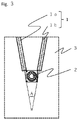
- Fig. 3 is a schematic explanatory view of attachment angles of a plurality of protrusions.
- the attachment angle of the protrusion By setting the attachment angle of the protrusion to preferably 20° or less, more preferably 10° or less, and still more preferably 5° or less, the directivity can be imparted to the wind in the garment, so that the body can be efficiently cooled.
- the attachment angle when the adjacent protrusions 1a and 1b are attached in parallel is 0°, and the attachment angle when the interval between the adjacent protrusions 1a and 1b decreases as the distance from the blowing port increases is negative. Therefore, the lower limit of the attachment angle of the protrusion is preferably 0°.
- the path forming section provided in the garment of the present invention is preferably made of a fiber structure. Since the path forming section is made of the fiber structure, there is little uncomfortable feeling at a portion in contact with the skin, and since the path forming section has flexibility, the path forming section can follow the movement of the body, and the garment is excellent in the wearing comfort.
- the fiber structure not only a normal woven or knitted fabric such as a double raschel, but also a nonwoven fabric, a braid, a lace, a rope, or a composite material thereof may be used.
- the positions of the blower fan unit and the path forming section included in the garment of the present invention can be appropriately selected according to the form and wearing scene of the garment, and are preferably provided such that air flows from the lower portion to the upper portion in the back portion and the armpit portion.
- locally cooling and ventilating a back portion having a large amount of skin moisture and an uncomplicated movement and an armpit portion having a large amount of perspiration is an effective means for efficiently cooling the body, and is also preferable from the viewpoint of promoting a chimney effect which is a phenomenon in which air warmed by the human body moves from a lower portion to an upper portion in the garment.
- the form of the garment of the present invention is not particularly limited, and may be either an upper wear or a bottom wear, the upper wear may be either a long sleeve or a short sleeve, and the bottom wear may be either a long hem or a short hem.
- the upper wear means a garment worn on the upper body
- the bottom wear means a garment worn on the lower body.
- the upper wear in the present invention include, but are not limited to, underwear such as an inner shirt, a tank top, and a camisole, general garment such as a T-shirt, a polo shirt, a cut and sew, a pajama, a shirt, a blouson, and a work wear, and sports garment such as a sports inner shirt and a sports shirt.
- Specific examples of the bottom wear in the present invention include, but are not limited to, underwear such as inner pants, general garment such as a slack, pants, a skirt, a pajama, and a work wear, and sports garment such as sports pants.
- the stuffy feeling and the heatful feeling in the garment of the present invention can be suppressed to keep the environment in the garment comfortable, and the wearing comfort and the design are excellent, it can be suitably used in a high temperature and/or high humidity environment and various wearing scenes requiring comfort scenes such as an office, a home, and the like.
- the air permeability was calculated according to JIS L 1096: 2010 (Testing methods for woven and knitted fabrics) 8.26.1 (Method A) using the fabrics obtained in examples as samples. The measurement was performed five times per sample, and the average value thereof was taken as the air permeability (cm 3 /cm 2 /s).
- Fibers constituting the garment were used as a sample, first dried with hot air at 60°C for 30 minutes, and then allowed to stand for 24 hours in a thermo-hygrostat LHU-123 manufactured by ESPEC CORP. moistened at a temperature of 20°C and a humidity of 65% RH, and a weight W1 (g) of the sample was measured. Thereafter, the sample was allowed to stand for 24 hours in a thermo-hygrostat humidified at a temperature of 30°C and a humidity of 90% RH, and a weight W2 (g) of the sample was measured. Thereafter, the sample was hot-air dried at 105°C for 2 hours, and a weight W3 (g) of the sample after absolute drying was measured.
- a moisture absorption rate MR1 (%) when the sample was left to stand in an atmosphere at a temperature of 20°C and a humidity of 65% RH for 24 hours from an absolute dry condition was calculated by the following formula using the weights W1 and W3 of the sample
- a moisture absorption rate MR2 (%) when the sample was left to stand in an atmosphere at a temperature of 30°C and a humidity of 90% RH for 24 hours from an absolute dry condition was calculated by the following formula using the weights W2 and W3 of the sample
- the moisture absorption rate difference ( ⁇ MR) was calculated by the following formula.
- MR 1 % W 1 ⁇ W 3 / W 3 ⁇ 100
- MR 2 % W 2 ⁇ W 3 / W 3 ⁇ 100
- the measurement was performed five times per sample, and the average value thereof was taken as the moisture absorption rate difference ( ⁇ MR).
- the length L, the width W, and the thickness T of the protrusion formed on the garment were measured using a caliper in a state where the garment fabric was not wrinkled or loosened.
- the length L (mm) of the protrusion and the width W (mm) of the protrusion were measured at 3 points per level according to the methods described in JIS L 1096: 2010 (Testing methods for woven and knitted fabrics) 8.2.1 (Method A) and 8.2.2 (Method A), and the average thereof was calculated by rounding off to one decimal place.
- the thickness T of the protrusion was calculated by measuring 3 points per level at a pressure of 0.7 kPa for knit according to the thickness measurement method described in JIS L 1096: 2010 (Testing methods for woven and knitted fabrics) 8.4 (Method A), and the average thereof was calculated by rounding off to one decimal place.
- the evaluation of the comfort was performed on 20 subjects wearing the garment produced in examples and comparative examples.
- the subjects, with their garment worn evaluated the situation inside the garment after sitting and resting on a chair in a room at a temperature of 30°C and a humidity of 90% RH for 1 hour, which is assumed to be an indoor environment in summer where cooling is not effective.
- the evaluation of the wearing feeling was performed on 20 subjects wearing the garment produced in examples and comparative examples.
- An average score of the scores given by 20 subjects was calculated, and the average score of 3.0 points or more was regarded as pass, where 5 points were given to "no discomfort was felt at all due to the path forming section or the blower fan unit", 4 points were given to "almost no discomfort was felt due to the path forming section or the blower fan unit", 3 points were given to "discomfort was slightly felt due to the path forming section or the blower fan unit", 2 points were given to "discomfort was felt due to the path forming section or the blower fan unit”, and 1 point was given to "discomfort was strongly felt due to the path forming section or the blower fan unit".
- a mannequin was made to wear the garment produced in examples and comparative examples, and 20 subjects evaluated the appearance.
- An average point of scores given by 20 subjects was calculated, and the average score of 3.0 points or more was regarded as pass, where 5 points were given to "the blower fan unit is inconspicuous and can be worn without problems in the office", 4 points were given to "the blower fan unit is hardly noticeable, and can be worn without problems in the office", 3 points were given to "although the blower fan unit is conspicuous, it can be worn in the office", 2 points were given to "since the blower fan unit is conspicuous, there is resistance to wearing in the office", and 1 point was given to "since the blower fan unit is conspicuous, there is strong resistance to wearing in the office”.
- Fig. 2 is a schematic explanatory view illustrating positions of a path forming section and a blower fan unit in Example 1.
- Fig. 2(a) is a schematic view of a garment back portion
- Fig. 2(b) is a schematic view of an inside of the back portion.
- a hole of 30 mm in length ⁇ 80 mm in width was made at a position 250 to 280 mm above the hem of the back body so as to be at the center in the left-right direction, and a nylon mesh fabric having an air permeability of 550 cm 3 /cm 2 /s was attached to the hole to form an air inlet 4.
- a hole of 30 mm in length ⁇ 100 mm in width was made at a position 30 to 60 mm below the collar of the back body so as to be at the center in the left-right direction, and a nylon mesh fabric having an air permeability of 550 cm 3 /cm 2 /s was attached to the hole to form an air outlet 5.
- a protrusion body was formed using a double raschel fabric having a thickness T of 10 mm, a length L of 300 mm, and a width W of 15 mm; a surface structure and a back surface structure of the fabric were knitted from a false twist yarn of 167 dtex-48f of polyester fibers, and a binding structure of a middle layer was knitted from a 440 dtex monofilament of polyester elastomer fibers. Then, the double-raschel fabric was attached inside the back body of the short-sleeve polo shirt so that the vertical direction of the garment coincided with the length direction of the protrusion body to obtain a protrusion 1.
- Three protrusion bodies were attached in parallel at an interval of 50 mm in the width direction so that the lower end of the protrusion body coincided with the upper end of the air inlet 4 and was symmetric with the left and right center line of the garment. Thereafter, two blower fan units 2 having a centrifugal fan with an outer diameter of 30 mm and a thickness of 5 mm were attached to the inside of the garment at an interval of 20 mm so as to overlap with the air inlet 4 with the blowing outlet facing the upper portion of the garment.
- a garment was obtained in the same manner as in Example 1 except that the air permeability of the garment was 320 cm 3 /cm 2 /s in Example 2, 40 cm 3 /cm 2 /s in Comparative Example 1, and 550 cm 3 /cm 2 /s in Comparative Example 2.
- the obtained evaluation results of the garment are shown in Table 1.
- a garment was obtained in the same manner as in Example 1 except that the blower fan unit was not attached.
- the obtained evaluation results of the garment are shown in Table 1.
- a garment was obtained in the same manner as in Example 1 except that the length L of the protrusion was 100 mm in Example 3 and 25 mm in Example 4.
- the obtained evaluation results of the garment are shown in Table 2.
- a garment was obtained in the same manner as in Example 1 except that the thickness T of the protrusion was 20 mm.
- the obtained evaluation results of the garment are shown in Table 2.
- a garment was obtained in the same manner as in Example 1 except that the path forming section was not provided.
- the obtained evaluation results of the garment are shown in Table 2.
- a garment was obtained in the same manner as in Example 1 except that, as a material of the path forming section, a three-dimensional shaped nonwoven fabric made of polyester having a basis weight of 50 g/m 2 in Example 6 and a urethane foam having an apparent density of 20 kg/m 3 in Example 7 were used to form a protrusion.
- the obtained evaluation results of the garment are shown in Table 3.
- a garment was obtained in the same manner as in Example 1 except that 13 polyethylene columnar bodies each having a 10 mm square were disposed at intervals of 20 mm in the vertical direction of the garment and arranged in 5 rows in the width direction of the garment.
- the obtained evaluation results of the garment are shown in Table 3.
- a garment was obtained in the same manner as in Example 1 except that a false twist yarn of 66 dtex-72f made of polyester having a ⁇ MR of 0.2% in Example 8 and a false twist yarn of 66 dtex-72f made of hygroscopic polyester having a ⁇ MR of 3.1% in Example 9 were used as the fibers constituting the garment.
- the obtained evaluation results of the garment are shown in Table 4.
- Example 1 Example 2 Comparative Example 1 Comparative Example 2 Comparative Example 3 Material of garment Hygroscopic nylon Air permeability [cm 3 /cm 2 /s] 150 320 40 550 150 ⁇ MR [%] 4.2 4.2 4.2 4.2 4.2 4.2 Presence or absence of fan Presence Presence Presence Presence Presence Absence Material of path material Double raschel Length L of protrusion [mm] 300 300 300 300 300 Width W of protrusion [mm] 15 15 15 15 15 15 Thickness T of protrusion [mm] 10 10 10 10 10 Comfort [Point] 4.4 4.7 2.4 2.8 2.4 Wearing feeling [Point] 4.2 4.3 3.6 4.0 4.2 Design [Point] 4.4 4.0 3.2 2.5 4.4 [Table 2] Example 3 Example 4 Example 5 Comparative Example 4 Material of garment Hygroscopic nylon Air permeability [cm 3 /cm 2 /s] 150 150 150 150 ⁇ MR [%] 4.2 4.2 4.2 4.2 Presence or absence of fan Presence Presence Presence Pres
- the garment obtained in Examples 1 to 9 had good results in all of the evaluations of comfort, wearing feeling, and design, the garment was suitably used in wearing scenes in offices, homes, and the like.
- the garment obtained in Comparative Example 1 since the air permeability of the fabric to be used was low, it was not possible to suppress the heatful feeling and the stuffy feeling in the garment, and thereby the garment was inferior in the comfort.
- the garment obtained in Comparative Example 2 since the air permeability of the fabric to be used was high, the wind passed through the garment and did not reach the back portion, and the garment was thin and transparent, the garment was inferior in the comfort and the design. Since the garment obtained in Comparative Example 3 does not have the blower fan unit, it was not possible to suppress the heatful feeling and the stuffy feeling in the garment, and the garment was inferior in the comfort.
- the garment obtained in Comparative Example 4 was not provided with the path forming section, the portion of the body where should be cooled was not exposed to the wind, and the heatful feeling and the stuffy feeling in the garment was not able to be suppressed, so that the garment was inferior in the comfort.
- the garment obtained in Comparative Example 5 had a large number of protrusions, but the protrusions were not continuously formed, the wind blown from the blower fan unit diffused in the garment. The heatful feeling and the stuffy feeling in the garment was not able to be suppressed, so that the garment was inferior in the comfort.
- the stuffy feeling and the heatful feeling in the garment of the present invention can be suppressed to keep the environment in the garment comfortable, and the wearing comfort and the design are excellent, it can be suitably used in a high temperature and/or high humidity environment and various wearing scenes requiring comfort such as office and home.
Landscapes
- Engineering & Computer Science (AREA)
- Textile Engineering (AREA)
- Environmental & Geological Engineering (AREA)
- Health & Medical Sciences (AREA)
- General Health & Medical Sciences (AREA)
- Physical Education & Sports Medicine (AREA)
- Professional, Industrial, Or Sporting Protective Garments (AREA)
- Details Of Garments (AREA)
Applications Claiming Priority (2)
| Application Number | Priority Date | Filing Date | Title |
|---|---|---|---|
| JP2019175669 | 2019-09-26 | ||
| PCT/JP2020/029935 WO2021059759A1 (ja) | 2019-09-26 | 2020-08-05 | 衣服 |
Publications (2)
| Publication Number | Publication Date |
|---|---|
| EP4035547A1 true EP4035547A1 (de) | 2022-08-03 |
| EP4035547A4 EP4035547A4 (de) | 2023-09-27 |
Family
ID=75166594
Family Applications (1)
| Application Number | Title | Priority Date | Filing Date |
|---|---|---|---|
| EP20868975.2A Pending EP4035547A4 (de) | 2019-09-26 | 2020-08-05 | Kleidungsstück |
Country Status (6)
| Country | Link |
|---|---|
| US (1) | US20220408856A1 (de) |
| EP (1) | EP4035547A4 (de) |
| JP (1) | JP7456384B2 (de) |
| CN (1) | CN114423308A (de) |
| TW (1) | TW202116196A (de) |
| WO (1) | WO2021059759A1 (de) |
Families Citing this family (2)
| Publication number | Priority date | Publication date | Assignee | Title |
|---|---|---|---|---|
| JP2021070885A (ja) * | 2019-10-31 | 2021-05-06 | 株式会社セフト研究所 | 空調衣服の服本体及び空調衣服 |
| JP7339228B2 (ja) * | 2020-11-10 | 2023-09-05 | トヨタ自動車株式会社 | 空調衣服 |
Family Cites Families (38)
| Publication number | Priority date | Publication date | Assignee | Title |
|---|---|---|---|---|
| TW317577B (de) * | 1995-01-25 | 1997-10-11 | Toray Industries | |
| US5547733A (en) * | 1995-06-02 | 1996-08-20 | Malden Mills Industries, Inc. | Plaited double-knit fabric |
| EP0814191A4 (de) * | 1995-12-19 | 1998-10-07 | Toray Industries | Faserstrukturen und verfahren zu ihrer herstellung |
| JP3804097B2 (ja) * | 1996-03-29 | 2006-08-02 | 東レ株式会社 | 着用快適性に優れたサポートストッキング |
| JP3826436B2 (ja) * | 1996-06-26 | 2006-09-27 | 東レ株式会社 | ポリエステル着物 |
| GB0100560D0 (en) * | 2001-01-09 | 2001-02-21 | Lamination Technologies Ltd | Clothing |
| WO2002067707A1 (fr) * | 2001-02-23 | 2002-09-06 | Seft Development Laboratory Co.,Ltd. | Vetement de refroidissement |
| JP2003013346A (ja) * | 2001-06-27 | 2003-01-15 | Suminoe Textile Co Ltd | 三次元立体編物 |
| SE0104296D0 (sv) * | 2001-12-18 | 2001-12-18 | St Jude Medical | Pacemaker |
| US7735149B2 (en) * | 2003-04-01 | 2010-06-15 | Clemson University | Microclimate regulating garment and composite structure |
| EP1860217A3 (de) * | 2003-06-23 | 2010-10-20 | Teijin Fibers Limited | Zwei verschiedene Garne enthaltende Web- oder Maschenware sowie daraus hergestellte Bekleidung |
| US20070271939A1 (en) * | 2003-12-25 | 2007-11-29 | Seft Development Laboratory Co., Ltd. | Air-Conditioning Garment |
| US20080254263A1 (en) * | 2005-02-23 | 2008-10-16 | Teijin Fibers Limited | Composite Fabric Material Exhibiting Three-Dimensional Structural Change Upon Water Absorption, and Textile Products |
| EP2056686B1 (de) * | 2006-07-26 | 2013-03-06 | Fathallah Nahhas | Kühlvorrichtung zur minderung des risikos der männlichen unfruchtbarkeit in umgebungen mit erhöhter temperatur |
| DE102006060990B4 (de) * | 2006-12-20 | 2010-01-07 | Entrak Energie- Und Antriebstechnik Gmbh & Co. Kg | Kleidungsstück zur Personenklimatisierung |
| DE202007018496U1 (de) * | 2007-04-24 | 2008-09-11 | Dräger Safety AG & Co. KGaA | Anordnung zur Überwachung des Körperflüssigkeitszustandes einer Person |
| JP2009155773A (ja) * | 2007-12-27 | 2009-07-16 | Toyobo Co Ltd | 自動空調機能付き衣服 |
| CN103635121B (zh) * | 2011-07-06 | 2016-10-12 | 坦普罗尼克斯公司 | 分布式热电加热和冷却的集成 |
| TWI507581B (zh) * | 2011-11-29 | 2015-11-11 | Columbia Sportswear Na Inc | 涼爽織物及製造彼之方法 |
| WO2015148411A1 (en) * | 2014-03-23 | 2015-10-01 | Cornell University | Temperature-regulating garment |
| TW201542111A (zh) * | 2014-05-02 | 2015-11-16 | Meng-Hua Yu | 散熱衣 |
| BR112017011036A2 (pt) * | 2014-12-26 | 2018-01-09 | Toray Industries, Inc. | vestimenta protetora |
| US20160227848A1 (en) * | 2015-02-11 | 2016-08-11 | Anthony E. Majoros | Motorcyclist apparel cooling system |
| JP6824612B2 (ja) * | 2016-03-04 | 2021-02-03 | 株式会社ファーストリテイリング | 衣服 |
| JP6655478B2 (ja) * | 2016-06-14 | 2020-02-26 | 創和テキスタイル株式会社 | 織物 |
| JP6908910B2 (ja) | 2016-06-28 | 2021-07-28 | ハイドサイン株式会社 | 衣服および冷却システム |
| CN109415846B (zh) * | 2016-07-11 | 2021-12-28 | 东丽株式会社 | 吸湿性优异的海岛型复合纤维、假捻丝和纤维结构体 |
| CN107794641A (zh) * | 2016-08-31 | 2018-03-13 | 东丽纤维研究所(中国)有限公司 | 一种具有运动追随性的面料 |
| EP3529069B1 (de) * | 2016-10-18 | 2024-12-25 | Teijin Limited | Cooling fabric |
| GB2562820A (en) * | 2017-01-12 | 2018-11-28 | Yu Shen Entpr Inc | Mesh fabric structure and mesh fabric material |
| JP6910174B2 (ja) | 2017-03-29 | 2021-07-28 | 帝人株式会社 | 空調服 |
| JP6754898B2 (ja) * | 2017-05-31 | 2020-09-16 | 旭化成株式会社 | 着圧ストッキング |
| US10945482B2 (en) * | 2017-10-20 | 2021-03-16 | Nike, Inc. | Knitted loft zones |
| JP6568611B2 (ja) * | 2018-01-25 | 2019-08-28 | 帝人株式会社 | 衣服 |
| JP3216594U (ja) * | 2018-03-29 | 2018-06-07 | 大成建設株式会社 | 空調付衣服 |
| WO2019194087A1 (ja) * | 2018-04-02 | 2019-10-10 | 東レ株式会社 | 着用快適性に優れた衣服 |
| DE102018205136A1 (de) * | 2018-04-05 | 2019-10-10 | Adidas Ag | Bekleidungsartikel |
| JP2019199667A (ja) * | 2018-05-17 | 2019-11-21 | 有限会社伊藤組 | 涼感機能服 |
-
2020
- 2020-08-05 JP JP2020544314A patent/JP7456384B2/ja active Active
- 2020-08-05 CN CN202080065749.8A patent/CN114423308A/zh active Pending
- 2020-08-05 EP EP20868975.2A patent/EP4035547A4/de active Pending
- 2020-08-05 US US17/642,803 patent/US20220408856A1/en not_active Abandoned
- 2020-08-05 WO PCT/JP2020/029935 patent/WO2021059759A1/ja not_active Ceased
- 2020-08-28 TW TW109129425A patent/TW202116196A/zh unknown
Also Published As
| Publication number | Publication date |
|---|---|
| CN114423308A (zh) | 2022-04-29 |
| TW202116196A (zh) | 2021-05-01 |
| WO2021059759A1 (ja) | 2021-04-01 |
| EP4035547A4 (de) | 2023-09-27 |
| JP7456384B2 (ja) | 2024-03-27 |
| US20220408856A1 (en) | 2022-12-29 |
| JPWO2021059759A1 (de) | 2021-04-01 |
Similar Documents
| Publication | Publication Date | Title |
|---|---|---|
| JP2021021161A (ja) | 空調衣服 | |
| JP7524767B2 (ja) | 空調衣服 | |
| JP2021021164A (ja) | ダブルラッシェル編地およびそれを用いた衣服 | |
| EP4035549A1 (de) | Kleidungsstück | |
| US20220408856A1 (en) | Garment | |
| JP2018168485A (ja) | 空調服 | |
| JP2006249595A (ja) | ぬれ感の少ない編地および衣料 | |
| JP2017179664A (ja) | 通気可変性ストレッチ織物 | |
| EP3777588B1 (de) | Kleidungsstück mit verbessertem tragekomfort | |
| TW201816216A (zh) | 彈性圓形編織物 | |
| EP4005425B1 (de) | Kühlendes kleidungsstück | |
| JPH1077544A (ja) | 編織物 | |
| HK40044301A (en) | Garment having exceptional wearing comfort | |
| JP2021055247A (ja) | 衣服 | |
| JP2021050458A (ja) | 衣服 | |
| CN220423166U (zh) | 一种透气梭织裤 | |
| CN216627596U (zh) | 一种防紫外线抗菌的制服套装 | |
| JP2020204113A (ja) | 受風冷却シートならびにそれを用いた衣服、外衣、鞄、靴および帽子 | |
| CN216466627U (zh) | 一种抗菌透气上衣 | |
| JP2022086122A (ja) | 衣服 | |
| CN215837160U (zh) | 一种吸湿抗菌型运动服 | |
| CN214726975U (zh) | 一种吸湿速干面料 | |
| CN214193591U (zh) | 一种吸湿透气涤纶长丝 | |
| JP2021017678A (ja) | 空調衣服 | |
| JP2021017679A (ja) | 空調衣服 |
Legal Events
| Date | Code | Title | Description |
|---|---|---|---|
| STAA | Information on the status of an ep patent application or granted ep patent |
Free format text: STATUS: THE INTERNATIONAL PUBLICATION HAS BEEN MADE |
|
| PUAI | Public reference made under article 153(3) epc to a published international application that has entered the european phase |
Free format text: ORIGINAL CODE: 0009012 |
|
| STAA | Information on the status of an ep patent application or granted ep patent |
Free format text: STATUS: REQUEST FOR EXAMINATION WAS MADE |
|
| 17P | Request for examination filed |
Effective date: 20220216 |
|
| AK | Designated contracting states |
Kind code of ref document: A1 Designated state(s): AL AT BE BG CH CY CZ DE DK EE ES FI FR GB GR HR HU IE IS IT LI LT LU LV MC MK MT NL NO PL PT RO RS SE SI SK SM TR |
|
| DAV | Request for validation of the european patent (deleted) | ||
| DAX | Request for extension of the european patent (deleted) | ||
| A4 | Supplementary search report drawn up and despatched |
Effective date: 20230824 |
|
| RIC1 | Information provided on ipc code assigned before grant |
Ipc: A41D 31/14 20190101ALI20230818BHEP Ipc: A41D 31/12 20190101ALI20230818BHEP Ipc: A41D 27/28 20060101ALI20230818BHEP Ipc: A41D 13/005 20060101ALI20230818BHEP Ipc: A41D 13/002 20060101ALI20230818BHEP Ipc: A41D 1/00 20180101AFI20230818BHEP |