EP4036055A1 - Procédé de production d'un gaz produit contenant de l'hydrogène utilisant l'énergie de déchets - Google Patents
Procédé de production d'un gaz produit contenant de l'hydrogène utilisant l'énergie de déchets Download PDFInfo
- Publication number
- EP4036055A1 EP4036055A1 EP21154189.1A EP21154189A EP4036055A1 EP 4036055 A1 EP4036055 A1 EP 4036055A1 EP 21154189 A EP21154189 A EP 21154189A EP 4036055 A1 EP4036055 A1 EP 4036055A1
- Authority
- EP
- European Patent Office
- Prior art keywords
- boiler
- reactor
- waste
- heat
- steam
- Prior art date
- Legal status (The legal status is an assumption and is not a legal conclusion. Google has not performed a legal analysis and makes no representation as to the accuracy of the status listed.)
- Withdrawn
Links
Images



Classifications
-
- C—CHEMISTRY; METALLURGY
- C01—INORGANIC CHEMISTRY
- C01B—NON-METALLIC ELEMENTS; COMPOUNDS THEREOF; METALLOIDS OR COMPOUNDS THEREOF NOT COVERED BY SUBCLASS C01C
- C01B3/00—Hydrogen; Gaseous mixtures containing hydrogen; Separation of hydrogen from mixtures containing it; Purification of hydrogen; Reversible storage of hydrogen
- C01B3/02—Production of hydrogen; Production of gaseous mixtures containing hydrogen
- C01B3/32—Production of hydrogen; Production of gaseous mixtures containing hydrogen by reaction of gaseous or liquid organic compounds with gasifying agents, e.g. water, carbon dioxide or air
- C01B3/34—Production of hydrogen; Production of gaseous mixtures containing hydrogen by reaction of gaseous or liquid organic compounds with gasifying agents, e.g. water, carbon dioxide or air by reaction of hydrocarbons with gasifying agents
- C01B3/38—Production of hydrogen; Production of gaseous mixtures containing hydrogen by reaction of gaseous or liquid organic compounds with gasifying agents, e.g. water, carbon dioxide or air by reaction of hydrocarbons with gasifying agents using catalysts
-
- C—CHEMISTRY; METALLURGY
- C12—BIOCHEMISTRY; BEER; SPIRITS; WINE; VINEGAR; MICROBIOLOGY; ENZYMOLOGY; MUTATION OR GENETIC ENGINEERING
- C12P—FERMENTATION OR ENZYME-USING PROCESSES TO SYNTHESISE A DESIRED CHEMICAL COMPOUND OR COMPOSITION OR TO SEPARATE OPTICAL ISOMERS FROM A RACEMIC MIXTURE
- C12P5/00—Preparation of hydrocarbons or halogenated hydrocarbons
- C12P5/02—Preparation of hydrocarbons or halogenated hydrocarbons acyclic
- C12P5/023—Methane
-
- C—CHEMISTRY; METALLURGY
- C01—INORGANIC CHEMISTRY
- C01B—NON-METALLIC ELEMENTS; COMPOUNDS THEREOF; METALLOIDS OR COMPOUNDS THEREOF NOT COVERED BY SUBCLASS C01C
- C01B2203/00—Integrated processes for the production of hydrogen or synthesis gas
- C01B2203/02—Processes for making hydrogen or synthesis gas
- C01B2203/0205—Processes for making hydrogen or synthesis gas containing a reforming step
- C01B2203/0227—Processes for making hydrogen or synthesis gas containing a reforming step containing a catalytic reforming step
- C01B2203/0233—Processes for making hydrogen or synthesis gas containing a reforming step containing a catalytic reforming step the reforming step being a steam reforming step
-
- C—CHEMISTRY; METALLURGY
- C01—INORGANIC CHEMISTRY
- C01B—NON-METALLIC ELEMENTS; COMPOUNDS THEREOF; METALLOIDS OR COMPOUNDS THEREOF NOT COVERED BY SUBCLASS C01C
- C01B2203/00—Integrated processes for the production of hydrogen or synthesis gas
- C01B2203/08—Methods of heating or cooling
- C01B2203/0805—Methods of heating the process for making hydrogen or synthesis gas
- C01B2203/0811—Methods of heating the process for making hydrogen or synthesis gas by combustion of fuel
-
- C—CHEMISTRY; METALLURGY
- C01—INORGANIC CHEMISTRY
- C01B—NON-METALLIC ELEMENTS; COMPOUNDS THEREOF; METALLOIDS OR COMPOUNDS THEREOF NOT COVERED BY SUBCLASS C01C
- C01B2203/00—Integrated processes for the production of hydrogen or synthesis gas
- C01B2203/12—Feeding the process for making hydrogen or synthesis gas
- C01B2203/1205—Composition of the feed
- C01B2203/1211—Organic compounds or organic mixtures used in the process for making hydrogen or synthesis gas
- C01B2203/1235—Hydrocarbons
- C01B2203/1241—Natural gas or methane
-
- F—MECHANICAL ENGINEERING; LIGHTING; HEATING; WEAPONS; BLASTING
- F23—COMBUSTION APPARATUS; COMBUSTION PROCESSES
- F23G—CREMATION FURNACES; CONSUMING WASTE PRODUCTS BY COMBUSTION
- F23G2201/00—Pretreatment
- F23G2201/70—Blending
- F23G2201/702—Blending with other waste
-
- F—MECHANICAL ENGINEERING; LIGHTING; HEATING; WEAPONS; BLASTING
- F23—COMBUSTION APPARATUS; COMBUSTION PROCESSES
- F23G—CREMATION FURNACES; CONSUMING WASTE PRODUCTS BY COMBUSTION
- F23G2206/00—Waste heat recuperation
- F23G2206/10—Waste heat recuperation reintroducing the heat in the same process, e.g. for predrying
-
- F—MECHANICAL ENGINEERING; LIGHTING; HEATING; WEAPONS; BLASTING
- F23—COMBUSTION APPARATUS; COMBUSTION PROCESSES
- F23G—CREMATION FURNACES; CONSUMING WASTE PRODUCTS BY COMBUSTION
- F23G2209/00—Specific waste
- F23G2209/26—Biowaste
-
- Y—GENERAL TAGGING OF NEW TECHNOLOGICAL DEVELOPMENTS; GENERAL TAGGING OF CROSS-SECTIONAL TECHNOLOGIES SPANNING OVER SEVERAL SECTIONS OF THE IPC; TECHNICAL SUBJECTS COVERED BY FORMER USPC CROSS-REFERENCE ART COLLECTIONS [XRACs] AND DIGESTS
- Y02—TECHNOLOGIES OR APPLICATIONS FOR MITIGATION OR ADAPTATION AGAINST CLIMATE CHANGE
- Y02E—REDUCTION OF GREENHOUSE GAS [GHG] EMISSIONS, RELATED TO ENERGY GENERATION, TRANSMISSION OR DISTRIBUTION
- Y02E50/00—Technologies for the production of fuel of non-fossil origin
- Y02E50/30—Fuel from waste, e.g. synthetic alcohol or diesel
Definitions
- the present invention relates to a process including steam reforming of a reaction gas containing methane for the production of hydrogen. More specifically, the invention relates to a process that allows a production of hydrogen from renewable feedstock materials and enables an overall improved efficiency of the steam methane reforming process.
- an electric car is only as environmentally friendly as the source of energy that is used for the electric power production to fuel the car.
- E-mobility is useless if the electricity is originally produced in gas or coal power plants.
- the use of electric power must go hand in hand with an energy production from renewable (non-fossil) resources.
- a promising CO 2 -neutral energy source is the combustion and/or fermentation of biomass, since this biomass has bound CO 2 from the environment.
- the biomethane resulting from fermentation and/or combustion of biomass is therefore CO 2 -neutral.
- Another ideal candidate for environmentally friendly energy source is hydrogen since it is CO 2 -neutral if produced by a CO 2 -neutral energy source and can be stored for use in a fuel cell in various occasions such as cars or households.
- hydrogen is not readily available but must be produced.
- steam methane reforming process For the production of hydrogen, the so-called “steam methane reforming process” is routinely used in the chemical processing industry to obtain pure hydrogen (or a synthesis gas comprising a mixture of hydrogen and carbon monoxide) from a reaction gas containing methane or another hydrocarbon source and steam.
- the steam methane reforming reaction - or just short: reforming reaction - is generally represented by the following equation (I) CH 4 + 2H 2 O ⁇ CO 2 + 4H 2 (I)
- the reforming process is generally carried out at a high temperature and pressure to facilitate the reaction between the steam and methane, and in the presence of a usually nickel-based catalyst supported on alumina or another suitable material.
- steam reforming is an effective way of producing hydrogen, there are still quite a challenges to overcome: For once, steam reforming is a strongly endothermic process and requires a high reaction temperature (> 750°C). For the reforming reaction to take place, the required catalyst is usually located in tubes placed in a furnace, which is heated through combustion of a fuel to provide the required heat. This heat is usually either provided by the combustion of methane or by using part of the hydrogen produced in the steam reformer as fuel for the furnace. In the latter case, no external fuel is required, but it lowers the net amount of hydrogen that is available for industrial uses. In addition, large and complex reforming furnaces are generally needed. This complexity of the components and the associated costs generally require large production facilities for making the steam reforming process economically viable. There is thus a need for more compact reforming technologies that allow smaller productions to be profitable.
- the process uses renewable, i.e. non-fossil, organic feedstock material for the production of hydrogen.
- the present invention refers to a process for producing a hydrogen-containing product gas using energy from waste comprising the steps of:
- waste refers to organic and inorganic compounds that can be combusted in a waste incinerator.
- waste incinerator refers to a housing of the waste incinerator in which the combustion of waste takes place.
- methane comprising gas refers to any gas that comprises aside from potential other components methane (CH 4 ).
- the methane comprising gas can be of renewable or non-renewable origin.
- Non-renewable sources of methane are e.g. natural gas from landfills or coal beds.
- An example of a renewable methane source is the process of anaerobic digestion by means of which organic matter is digested to produce inter alia biomethane.
- steam is a synonym of water vapor and refers the gaseous phase of water.
- reactor refers to a housing in which the methane comprising gas and the steam can react to the hydrogen comprising product gas.
- the process of the present invention involves the combustion of waste in a boiler of an incineration plant in order to produce heat that can then be used to drive the steam reforming process.
- the inventive process eliminates the need for using hydrogen and/or methane as combustion fuel to activate the endothermic steam-methane reforming process. Therefore, the ratio of produced mol of hydrogen per supplied mol of methane is higher, which results in an improved energy balance of the process compared with the state of the art.
- the hydrogen producing reaction of step c) is generally employed by using a steam reforming catalyst.
- Suitable steam reforming catalysts are well known in the art. These include transition metal catalysts, such as rhodium, nickel, cobalt, platinum, palladium, ruthenium and iridium. The catalyst may be supported or unsupported.
- the methane comprising gas of step a) comprises biomethane produced in an anaerobic digestor by the digestion of organic material.
- anaerobic digestor hereby refers to a housing in which microorganisms break down biodegradable material in the absence of oxygen in a sequence of processes. Such anaerobic digestors are commonly known in the art.
- biodegradable material also known as organic material
- the production of hydrogen can be labelled renewable, CO 2 -neutral or green hydrogen.
- a preferred organic material for the anaerobic digestor is comingled food waste such as supermarket left overs, catering and kitchen waste, biowaste, garden waste such as cut gras or branches, market and vegetable waster and wood waste. Since it is produced from biodegradable material, the gas originating from an anaerobic digestor is generally called biogas.
- This biogas usually comprises biomethane as well as about 15% - 60% of CO 2 and other contaminants. These contaminants are preferably removed with a pressure-temperature swing absorption (PTSA) or a membrane in a process called biogas upgrading. Suitable upgrading processes are well known in the art.
- the upgraded biomethane preferably has a methane concentration of at least 80%, more preferably above 95%.
- a suitable anaerobic digestor produces between 200 and 350 kg/h of methane .
- waste from the waste supply is separated into an organic waste fraction and an inorganic waste fraction; the organic waste fraction being delivered to the anaerobic digestor for digestion and the inorganic waste fraction being delivered to the boiler for combustion.
- waste incineration plant can process all kind of waste as long as it is combustible
- the anaerobic digester can generally only process organic waste.
- a single waste source can be used to supply both the waste incinerator and the anaerobic digester. This allows for an improved energy balance since said waste can serve as fuel for the production of heat and as starting material for the production of biomethane, i.e. for producing two of the three main components in the steam reforming reaction.
- Part of the heat produced in the boiler or part of the biomethane produced in the anaerobic digestor may also be used in other areas of the inventive system.
- the anaerobic digestor runs preferably between 30°C to 38°C for a mesophilic digestion or between 49 to 57°C for thermophilic digestion.
- the anaerobic digestor could theoretically be heated by the combustion of some of the produced biomethane or by use of another thermal source, like electricity. However, this would lead to a decreased methane net balance of the anaerobic digestor or to increased operation costs.
- a part of the combustion heat produced in step a) - or part of excess heat produced by the reaction in the reactor in step c) - is transferred to the anaerobic digester to support the digestion. If more biomethane is produced in the anaerobic digestor than required for the steam reforming process, such excess biomethane may be stored and transported for use as an energy source in distant processes.
- biomethane is part of the biogas produced through the digestion of organic waste in the anaerobic digestor.
- the material remaining after the digestion is called residual waste material.
- this residual waste material is transported to the boiler for combustion.
- the residual waste may be in a solid state or in form of a slurry. Although solid material is easier combustible, the incineration process generally tolerates it if at least part of the waste is provided in form of a slurry, which safes the costs for equipment needed for drying the waste material prior to supplying it to the boiler.
- the residual waste material or so-called "leftover" from the anaerobic digestion cannot be further used for the production of biomethane, but it still possesses a thermal value that can be fully utilized by combustion of the residual waste in the boiler.
- the heat produced in the boiler in step a) is used in the steam supply to produce steam.
- the produced heat can either be transported to a separate steam supply by a heat transfer media, or preferably the steam supply is placed within the boiler of the waste incinerator.
- the heat can directly be transferred to the steam supply without using a heat transfer media, which reduces heat loss during the transfer and enables a more compact construction of the incinerator-steam reformer system, which will be described in more detail further below.
- the heat produced in the boiler in step a) is transferred to the steam reforming unit in step b) via a heat transfer medium, whereby said heat transfer medium is a fluid, preferably air, and circulates through pipes of heat exchangers provided in the boiler and the reactor.
- Transport of the heat transfer media in a closed circuit has the advantage that there is no direct contact of the heat transfer medium (generally air) with the combustion flue gases of the boiler or the steam-methane gas mixture in the reactor. This provides stable reaction conditions in the boiler and the reactor and allows that heat transfer can be precisely controlled by regulating the amount of transported heat transfer medium.
- step b) the heat produced in the boiler in step a) is transferred to the steam reforming unit via a heat transfer medium, whereby said heat transfer medium is combustion flue gas and said flue gas is fed from the boiler through or around pipes running through the reactor.
- a heat transfer medium is used to transfer heat from the boiler to the reactor.
- flue gases are used as heat transfer medium, these flue gases are preferably transported in a closed pipe through the reactor and subsequently to a flue gas treatment unit or back to the boiler. This construction allows a more direct heat transfer to the reactor since the hot flue gas is directly used as a heat transfer medium instead of transferring the heat from the hot flue gases to another transfer medium, e.g. air, that is then transferred to the reactor.
- the reactor of the steam reforming unit is placed within the boiler of the waste incinerator, such that heat from the boiler is directly transferred to the reactor via thermal conduction through walls of the reactor.
- the heat is directly transferred via the walls of the reactor, thereby further reducing the heat loss that would occur when using a heat transfer medium.
- the amount of heat that is provided by the boiler to the reactor can be adjusted.
- the boiler and the reactor may share one common wall, which still allows a direct heat transfer and reduces the loss of heat that would occur with the provision of a heat transfer media.
- the amount of heat that is provided by the boiler to the reactor can be adjusted.
- the reactor may be integrated into the boiler wall(s).
- the reactor may comprise one or more pipes running within the boiler wall(s), or the rector itself forms one or more walls of the boiler. This has the advantage that the space within the boiler is not restricted by the reactor. In addition, it provides a large surface area for heat exchange.
- the reactor is supplied with heat of a temperature of 800 - 1000°C, preferably with 850 - 900°C. It is further preferred that 5 - 10% of the heat produced in the boiler is transported to the reactor.
- a temperature range of 800 - 1000°C for the above-mentioned steam-methane reforming process have shown to provide high yields of produced hydrogen.
- the ideal temperature range is 850 - 900°C. Within this temperature range the reaction generally provided the highest yields of produced hydrogen.
- 5 - 10% of the heat from the boiler is transferred to the reactor. With the usual size of the boilers of incineration plants, 5-10% of the heat produced in the boiler is generally sufficient for driving the reforming reaction in the reactor without having a negative impact on the efficiency of combustion.
- Up to an additional 5% of the total heat produced in the boiler (i.e. up to a combined total of 15% of the heat produced) can be further used for other processes, e.g. to heat the anaerobic digestor as mentioned above anaerobic digestor, without reducing the efficiency of combustion in the boiler.
- heat may also be extracted from other sources, i.e. other than the boiler.
- heat is extracted from the product gas of step c) and supplied to the anaerobic digestor and/or used to increase the temperature of the methane comprising gas prior to being supplied to the reactor.
- the temperature of the methane comprising gas has to be increased to about 300°C - 500°C. This heating of the methane comprising gas can efficiently be achieved in a heat exchanger, in which heat of the product gas is transferred to the methane comprising gas.
- the product gas in the reactor has a temperature of about 800°C - 1000°C and needs to be cooled down to enable the "Water Gas Shift Reaction" according to equation (III) mentioned above. Therefore, a heat transfer from the product gas to the methane comprising gas and/or to the anaerobic digestor decreases the need for external energy for heating and cooling and thus improves the energy balance of the inventive process .
- the present invention also refers to a system for the production of hydrogen in accordance with the above-described process.
- Said system comprises
- the present invention thus provides an integrative system including a boiler or a waste incinerator and a reactor of a steam reforming unit.
- the connection between the boiler and the reactor is such that it enables transferring heat from the boiler to the reactor to support the above mentioned hydrogen production reaction in the reactor without the need to use an external energy source, such as methane or hydrogen.
- an external energy source such as methane or hydrogen.
- the boiler of the waste incinerator and the reactor of the steam reforming unit are connected via at least one heat transfer pipe for transferring heat from the waste incinerator to the reactor with the aid of a heat transfer medium running through the pipe.
- the heat transfer medium is preferably transported in a closed circuit, such that there is no direct contact of the heat transfer medium with the steam and methane gas mixture in the reactor. This provides stable reaction conditions in the reactor and the transported heat can be precisely controlled by adjusting the amount of transported heat transfer medium.
- the reactor of the steam reforming unit is located inside of the boiler, enabling direct heat transfer from the waste incinerator to the reactor via thermal conduction through reactor walls.
- the heat is directly transferred through the walls of the reactor. This reduces the loss of heat that generally occurs when a heat transfer medium is used for the heat transfer.
- the amount of heat that is provided by the boiler to the reactor can be adjusted.
- the reactor is integrated into the boiler wall or forms at least part of one or more of the boiler wall(s).
- the reactor preferably comprises or consists of at least one reactor pipe that runs through the wall(s) of the boiler. If the reactor consists of a number of pipes placed within the reactor wall(s), there is a large surface area that can be used for the heat transfer.
- the boiler and the reactor may share one common wall, but are placed adjacent to each other.
- the heat transfer therefore takes place via the common wall and still provides the benefit of less heat loss compared to the use of a heat transfer medium.
- the amount of heat transfer occurring between the boiler and the reactor is dependent on the thickness and size of the common wall.
- the gas supply is an anaerobic digestor for the production of biomethane.
- This enables the production of biomethane from the organic waste, which counts as a CO 2 neutral energy source and as a renewable (non-fossil) hydrogen feedstock source, compared with the steam methane reforming from natural gas sources, which is a fossil hydrogen feedstock source.
- the system includes a separation device for the separation of waste from the waste supply into an organic waste fraction to be delivered to the anaerobic digester and an inorganic waste fraction to be delivered to the boiler.
- a separation device allows to use a broader range of waste.
- a waste incineration processes all kind of waste that is suitable for combustion.
- the prior separation of the waste into organic waste that can be used to produce biomethane in the anaerobic digestor and into inorganic waste that can be used for combustion in the boiler provides an improved energy balance, since one waste source can provide combustion heat as well as biomethane than can be stored and transported and used as an energy source in other processes.
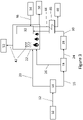
- FIG. 1 shows a schematic view of a preferred embodiment of the inventive process for hydrogen production.
- a waste supply 10 supplies unsorted waste 12 to a waste separation device 14, in which the waste is separated into organic waste 16 that can be digested in an anaerobic digestor 18, and into inorganic waste 20 that can be combusted in a boiler 22 of a waste incinerator (not shown).
- the organic waste 16 is digested through anaerobic digestion, i.e. a process in which organic matter is broken down by bacteria in the absence of oxygen to produce i) raw biogas 24 comprising biomethane 30 and ii) residual waste 26.
- the residual waste 26 is transported to the boiler 22 for combustion, whereas the raw biogas 24 is upgraded in an upgrading device 28 to biomethane 30.
- the biomethane 30 is transported to a reactor 32 of a steam reforming unit (not shown).
- a steam supply 34 supplies steam 36 to the reactor 32.
- the reactor 32 and the boiler 22 are connected by at least one heat transfer medium pipe 38 that is filled with a heat transfer medium 40, here air.
- the combustion of the inorganic waste 20 and the residual waste 26 in the boiler 22(the combustion is indicated by flame symbols), hot flue gases 42 are produced. These hot flue gases 42 emit heat that is taken up by the heat transfer medium 40 in the pipe 38.
- the hot transfer medium 40 is then transported to the reactor 32, where heat from the hot transfer medium is released into the reactor to support the steam reforming reaction of steam 36 and biomethane 30 to produce a hot product gas 44 comprising hydrogen.
- the hot product gas 44 and the biomethane 30 from the anaerobic digestor 18 are both delivered to a heat exchanger 46 to allow a heat exchange between the hot product gas 44 and the biomethane 30, such that the temperature of the biomethane 30 is increased while the temperature of the hot product gas 44 is decreased.
- the temperature reduction of the hot product gas 44 is important to allow the hydrogen content of the product gas 44 to be increased in a subsequent water-gas-shift reaction.
- the product gas 45 is then transported from the heat exchanger 46 to a hydrogen separation unit 48 to isolate the hydrogen from the product gas 45.
- the remnants of the combusted waste from the boiler 22 are transported to a combustion residue storage 50, whereas the flue gases 42 from the boiler 22 are transported to a treatment unit 52 for cleaning, before they are released into the environment.
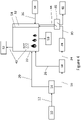
- FIG 2 shows a schematic view of a second preferred embodiment of the inventive process for hydrogen production.
- the boiler 22 comprises an open heat transfer pipe 54 through which the heat transfer medium (here: flue gases 42) transfer the heat from the boiler 22 to the reactor 32 to support the steam reforming reaction of steam 36 and biomethane 30 to produce the hot product gas 44 comprising hydrogen.
- the heat transfer medium here: flue gases 42
- FIG 3 shows a schematic view of a third preferred embodiment of the inventive process for hydrogen production.
- the reactor 32 is now placed within the boiler 22.
- the hot flue gases 42 transfer the combustion heat directly to the walls of the reactor 32 and the heat reaches the reactor 32 via thermal conduction to support the steam reforming reaction of steam 36 and biomethane 30 to produce the hot product gas 44 comprising hydrogen.
- FIG 4 shows a schematic view of a fourth preferred embodiment of the inventive process for hydrogen production.
- the reactor 32 is here either integrated into a wall 54 of the boiler 22 or the boiler and the reactor share a common wall 54.
- combustion heat is given off into the reactor 32 via the hot flue gases 42 that transfer the combustion heat directly to the wall 54.
- the heat supports the steam reforming reaction of steam 36 and biomethane 30 to produce the hot product gas 44 comprising hydrogen.
- the reactor may consist of one or more pipes (not shown) that run inside, i.e. within, the wall 54.
- FIG. 5 shows a schematic view of a preferred embodiment of the inventive process for hydrogen production, in which the boiler 22 also works as a steam supply 34.
- a water supply 56 supplies water into a pipe 58 running through the boiler 22 to the reactor 32.
- the temperature of the water is increased to the point of evaporation such that steam 36 is generated and thus provided to the reactor 32.
Landscapes
- Chemical & Material Sciences (AREA)
- Organic Chemistry (AREA)
- Chemical Kinetics & Catalysis (AREA)
- Engineering & Computer Science (AREA)
- Zoology (AREA)
- General Health & Medical Sciences (AREA)
- Life Sciences & Earth Sciences (AREA)
- Health & Medical Sciences (AREA)
- Wood Science & Technology (AREA)
- General Chemical & Material Sciences (AREA)
- Microbiology (AREA)
- Biochemistry (AREA)
- Bioinformatics & Cheminformatics (AREA)
- General Engineering & Computer Science (AREA)
- Biotechnology (AREA)
- Genetics & Genomics (AREA)
- Combustion & Propulsion (AREA)
- Inorganic Chemistry (AREA)
- Processing Of Solid Wastes (AREA)
- Hydrogen, Water And Hydrids (AREA)
Priority Applications (5)
| Application Number | Priority Date | Filing Date | Title |
|---|---|---|---|
| EP21154189.1A EP4036055A1 (fr) | 2021-01-29 | 2021-01-29 | Procédé de production d'un gaz produit contenant de l'hydrogène utilisant l'énergie de déchets |
| EP22702448.6A EP4284753A1 (fr) | 2021-01-29 | 2022-01-26 | Procédé de production d'un produit gazeux contenant de l'hydrogène à l'aide d'énergie provenant de déchets |
| CN202280012275.XA CN116888066A (zh) | 2021-01-29 | 2022-01-26 | 使用来自废物的能量生产含氢气的产物气体的方法 |
| JP2023546070A JP7595850B2 (ja) | 2021-01-29 | 2022-01-26 | 廃棄物からのエネルギーを使用して水素含有生成ガスを生成する方法 |
| PCT/EP2022/051702 WO2022161985A1 (fr) | 2021-01-29 | 2022-01-26 | Procédé de production d'un produit gazeux contenant de l'hydrogène à l'aide d'énergie provenant de déchets |
Applications Claiming Priority (1)
| Application Number | Priority Date | Filing Date | Title |
|---|---|---|---|
| EP21154189.1A EP4036055A1 (fr) | 2021-01-29 | 2021-01-29 | Procédé de production d'un gaz produit contenant de l'hydrogène utilisant l'énergie de déchets |
Publications (1)
| Publication Number | Publication Date |
|---|---|
| EP4036055A1 true EP4036055A1 (fr) | 2022-08-03 |
Family
ID=74418191
Family Applications (2)
| Application Number | Title | Priority Date | Filing Date |
|---|---|---|---|
| EP21154189.1A Withdrawn EP4036055A1 (fr) | 2021-01-29 | 2021-01-29 | Procédé de production d'un gaz produit contenant de l'hydrogène utilisant l'énergie de déchets |
| EP22702448.6A Pending EP4284753A1 (fr) | 2021-01-29 | 2022-01-26 | Procédé de production d'un produit gazeux contenant de l'hydrogène à l'aide d'énergie provenant de déchets |
Family Applications After (1)
| Application Number | Title | Priority Date | Filing Date |
|---|---|---|---|
| EP22702448.6A Pending EP4284753A1 (fr) | 2021-01-29 | 2022-01-26 | Procédé de production d'un produit gazeux contenant de l'hydrogène à l'aide d'énergie provenant de déchets |
Country Status (4)
| Country | Link |
|---|---|
| EP (2) | EP4036055A1 (fr) |
| JP (1) | JP7595850B2 (fr) |
| CN (1) | CN116888066A (fr) |
| WO (1) | WO2022161985A1 (fr) |
Families Citing this family (1)
| Publication number | Priority date | Publication date | Assignee | Title |
|---|---|---|---|---|
| CN116750716A (zh) * | 2023-08-04 | 2023-09-15 | 深能环保科技研发中心(深圳)有限公司 | 垃圾焚烧和沼气制氢的耦合系统及方法 |
Citations (6)
| Publication number | Priority date | Publication date | Assignee | Title |
|---|---|---|---|---|
| US6282902B1 (en) * | 1997-10-28 | 2001-09-04 | Hitachi, Ltd. | Waste processing system and fuel reformer used in the waste processing system |
| JP5128823B2 (ja) * | 2006-12-28 | 2013-01-23 | 株式会社東芝 | ガス改質器 |
| US20140186258A1 (en) * | 2011-08-11 | 2014-07-03 | L'Air Liquide, Société Anonyme pour I'Elude et I' Exploitaton de Procédés Georges Claude | Method for producing hydrogen from biogas |
| KR101845499B1 (ko) * | 2015-02-09 | 2018-04-04 | 주식회사 두산 | 연료전지 시스템 |
| WO2018115596A1 (fr) * | 2016-12-23 | 2018-06-28 | Avefori Oy | Procédé et système de fabrication de méthanol à partir de déchets organiques |
| US20190241434A1 (en) * | 2016-07-14 | 2019-08-08 | Zeg Power As | Method and Device for Upgrading of Biogas and Hydrogen Production From Anaerobic Fermentation of Biological Material |
Family Cites Families (9)
| Publication number | Priority date | Publication date | Assignee | Title |
|---|---|---|---|---|
| JP3063622B2 (ja) * | 1996-05-28 | 2000-07-12 | 株式会社日立製作所 | ごみ発電システム及びごみ処理システム |
| JP2003086227A (ja) | 2001-09-13 | 2003-03-20 | Mitsubishi Heavy Ind Ltd | 燃料電池を用いた発電方法および燃料電池を用いた発電システム |
| JP2003221204A (ja) | 2002-01-31 | 2003-08-05 | Mitsubishi Heavy Ind Ltd | 消化ガスによる発電その他の駆動方法及びそのシステム |
| TW200728212A (en) * | 2006-01-27 | 2007-08-01 | Horizon Tech Ltd | Anaerobic hydrogen fermentation system |
| CN102731179B (zh) * | 2012-07-20 | 2014-02-26 | 四川四通欧美环境工程有限公司 | 有机垃圾与污泥的固体厌氧及好氧堆肥系统的处置方法 |
| CN105886330A (zh) * | 2014-12-11 | 2016-08-24 | 北京中科洁能环境工程技术有限公司 | 一种城市生活固体废弃物综合处理工艺系统 |
| CN107262505A (zh) * | 2017-08-01 | 2017-10-20 | 北京神源环保有限公司 | 一种生活垃圾清洁处理的系统和方法 |
| CN108504549A (zh) * | 2018-04-13 | 2018-09-07 | 南安市创培电子科技有限公司 | 一种利用农业废弃物发电的工艺 |
| CN111233290A (zh) * | 2020-01-23 | 2020-06-05 | 重庆市渝西水务有限公司 | 一种用于污水处理厂的污泥处理系统 |
-
2021
- 2021-01-29 EP EP21154189.1A patent/EP4036055A1/fr not_active Withdrawn
-
2022
- 2022-01-26 JP JP2023546070A patent/JP7595850B2/ja active Active
- 2022-01-26 CN CN202280012275.XA patent/CN116888066A/zh active Pending
- 2022-01-26 EP EP22702448.6A patent/EP4284753A1/fr active Pending
- 2022-01-26 WO PCT/EP2022/051702 patent/WO2022161985A1/fr not_active Ceased
Patent Citations (6)
| Publication number | Priority date | Publication date | Assignee | Title |
|---|---|---|---|---|
| US6282902B1 (en) * | 1997-10-28 | 2001-09-04 | Hitachi, Ltd. | Waste processing system and fuel reformer used in the waste processing system |
| JP5128823B2 (ja) * | 2006-12-28 | 2013-01-23 | 株式会社東芝 | ガス改質器 |
| US20140186258A1 (en) * | 2011-08-11 | 2014-07-03 | L'Air Liquide, Société Anonyme pour I'Elude et I' Exploitaton de Procédés Georges Claude | Method for producing hydrogen from biogas |
| KR101845499B1 (ko) * | 2015-02-09 | 2018-04-04 | 주식회사 두산 | 연료전지 시스템 |
| US20190241434A1 (en) * | 2016-07-14 | 2019-08-08 | Zeg Power As | Method and Device for Upgrading of Biogas and Hydrogen Production From Anaerobic Fermentation of Biological Material |
| WO2018115596A1 (fr) * | 2016-12-23 | 2018-06-28 | Avefori Oy | Procédé et système de fabrication de méthanol à partir de déchets organiques |
Also Published As
| Publication number | Publication date |
|---|---|
| WO2022161985A1 (fr) | 2022-08-04 |
| JP7595850B2 (ja) | 2024-12-09 |
| JP2024504798A (ja) | 2024-02-01 |
| CN116888066A (zh) | 2023-10-13 |
| EP4284753A1 (fr) | 2023-12-06 |
Similar Documents
| Publication | Publication Date | Title |
|---|---|---|
| Kumar et al. | An overview of conventional and non-conventional hydrogen production methods | |
| Armor | Catalysis and the hydrogen economy | |
| CN104025356B (zh) | 具有二氧化碳废气利用的零排放发电站 | |
| US6571747B1 (en) | Method and device for producing energy or methanol | |
| HUP0500320A2 (en) | Production of synthetic transportation fuels from carbonaceous materials using self-sustained hydro-gasification | |
| Bhaskar et al. | Thermochemical route for biohydrogen production | |
| MX2014007345A (es) | Procedimiento e instalacion para la conversion de dioxido de carbono en monoxido de carbono. | |
| Gregorie et al. | Hydrogen and biogas | |
| WO2023097403A1 (fr) | Système et/ou procédé hybride-électrique de production d'hydrogène | |
| US20150005399A1 (en) | Method and device for producing synthetic gas and method and device for synthesizing liquid fuel | |
| US20070049648A1 (en) | Manufacture of fuels by a co-generation cycle | |
| CA3238331A1 (fr) | Biomethane et/ou hydrogene produit a partir de biomasse ayant des emissions de gaz a effet de serre reduites sur l'ensemble du cycle de vie | |
| CN101712883B (zh) | 甲醇脱水制烃与重整制氢和二氧化碳的联产装置 | |
| WO2023247316A1 (fr) | Conversion d'oxydes de carbone en carburant d'aviation durable (saf) | |
| WO2023037461A1 (fr) | Système de production de combustible liquide neutre en carbone | |
| Sharifi et al. | Power-to-X | |
| KR101953550B1 (ko) | 수소 제조 장치 및 이를 이용하여 수소를 제조하는 방법 | |
| EP4036055A1 (fr) | Procédé de production d'un gaz produit contenant de l'hydrogène utilisant l'énergie de déchets | |
| Dupont | Steam reforming of sunflower oil for hydrogen gas production | |
| KR102399818B1 (ko) | 수열가스화(htg) 및 전기메탄화셀(emc) 기술을 활용한 고농도 수소-메탄 가스 생산 반응로 시스템 | |
| de Araújo et al. | Introduction to hydrogen as an energy vector | |
| KR102840575B1 (ko) | 축열식 청록수소 생산 시스템 | |
| Leonzio | Power to gas systems integrated with anaerobic digesters and gasification systems | |
| Singh et al. | Thermochemical hydrogen production | |
| Schildhauer et al. | Methanation |
Legal Events
| Date | Code | Title | Description |
|---|---|---|---|
| PUAI | Public reference made under article 153(3) epc to a published international application that has entered the european phase |
Free format text: ORIGINAL CODE: 0009012 |
|
| STAA | Information on the status of an ep patent application or granted ep patent |
Free format text: STATUS: THE APPLICATION HAS BEEN PUBLISHED |
|
| AK | Designated contracting states |
Kind code of ref document: A1 Designated state(s): AL AT BE BG CH CY CZ DE DK EE ES FI FR GB GR HR HU IE IS IT LI LT LU LV MC MK MT NL NO PL PT RO RS SE SI SK SM TR |
|
| STAA | Information on the status of an ep patent application or granted ep patent |
Free format text: STATUS: REQUEST FOR EXAMINATION WAS MADE |
|
| 17P | Request for examination filed |
Effective date: 20221114 |
|
| RBV | Designated contracting states (corrected) |
Designated state(s): AL AT BE BG CH CY CZ DE DK EE ES FI FR GB GR HR HU IE IS IT LI LT LU LV MC MK MT NL NO PL PT RO RS SE SI SK SM TR |
|
| RAP3 | Party data changed (applicant data changed or rights of an application transferred) |
Owner name: KANADEVIA INOVA AG |
|
| STAA | Information on the status of an ep patent application or granted ep patent |
Free format text: STATUS: EXAMINATION IS IN PROGRESS |
|
| 17Q | First examination report despatched |
Effective date: 20250213 |
|
| STAA | Information on the status of an ep patent application or granted ep patent |
Free format text: STATUS: THE APPLICATION IS DEEMED TO BE WITHDRAWN |
|
| 18D | Application deemed to be withdrawn |
Effective date: 20250614 |