EP4036716A1 - Verfahren und vorrichtung zur erfassung einer spiegelbilddatei - Google Patents
Verfahren und vorrichtung zur erfassung einer spiegelbilddatei Download PDFInfo
- Publication number
- EP4036716A1 EP4036716A1 EP20879292.9A EP20879292A EP4036716A1 EP 4036716 A1 EP4036716 A1 EP 4036716A1 EP 20879292 A EP20879292 A EP 20879292A EP 4036716 A1 EP4036716 A1 EP 4036716A1
- Authority
- EP
- European Patent Office
- Prior art keywords
- tasks
- image file
- task
- duration
- source code
- Prior art date
- Legal status (The legal status is an assumption and is not a legal conclusion. Google has not performed a legal analysis and makes no representation as to the accuracy of the status listed.)
- Granted
Links
Images




Classifications
-
- G—PHYSICS
- G06—COMPUTING OR CALCULATING; COUNTING
- G06F—ELECTRIC DIGITAL DATA PROCESSING
- G06F8/00—Arrangements for software engineering
- G06F8/40—Transformation of program code
- G06F8/54—Link editing before load time
-
- G—PHYSICS
- G06—COMPUTING OR CALCULATING; COUNTING
- G06F—ELECTRIC DIGITAL DATA PROCESSING
- G06F9/00—Arrangements for program control, e.g. control units
- G06F9/06—Arrangements for program control, e.g. control units using stored programs, i.e. using an internal store of processing equipment to receive or retain programs
- G06F9/44—Arrangements for executing specific programs
- G06F9/445—Program loading or initiating
- G06F9/44521—Dynamic linking or loading; Link editing at or after load time, e.g. Java class loading
-
- G—PHYSICS
- G06—COMPUTING OR CALCULATING; COUNTING
- G06F—ELECTRIC DIGITAL DATA PROCESSING
- G06F11/00—Error detection; Error correction; Monitoring
- G06F11/07—Responding to the occurrence of a fault, e.g. fault tolerance
- G06F11/14—Error detection or correction of the data by redundancy in operations
- G06F11/1402—Saving, restoring, recovering or retrying
- G06F11/1415—Saving, restoring, recovering or retrying at system level
- G06F11/1417—Boot up procedures
-
- G—PHYSICS
- G06—COMPUTING OR CALCULATING; COUNTING
- G06F—ELECTRIC DIGITAL DATA PROCESSING
- G06F11/00—Error detection; Error correction; Monitoring
- G06F11/07—Responding to the occurrence of a fault, e.g. fault tolerance
- G06F11/14—Error detection or correction of the data by redundancy in operations
- G06F11/1446—Point-in-time backing up or restoration of persistent data
- G06F11/1458—Management of the backup or restore process
- G06F11/1469—Backup restoration techniques
-
- G—PHYSICS
- G06—COMPUTING OR CALCULATING; COUNTING
- G06F—ELECTRIC DIGITAL DATA PROCESSING
- G06F11/00—Error detection; Error correction; Monitoring
- G06F11/07—Responding to the occurrence of a fault, e.g. fault tolerance
- G06F11/14—Error detection or correction of the data by redundancy in operations
- G06F11/1471—Error detection or correction of the data by redundancy in operations involving logging of persistent data for recovery
-
- G—PHYSICS
- G06—COMPUTING OR CALCULATING; COUNTING
- G06F—ELECTRIC DIGITAL DATA PROCESSING
- G06F8/00—Arrangements for software engineering
- G06F8/60—Software deployment
- G06F8/61—Installation
- G06F8/63—Image based installation; Cloning; Build to order
-
- G—PHYSICS
- G06—COMPUTING OR CALCULATING; COUNTING
- G06F—ELECTRIC DIGITAL DATA PROCESSING
- G06F9/00—Arrangements for program control, e.g. control units
- G06F9/06—Arrangements for program control, e.g. control units using stored programs, i.e. using an internal store of processing equipment to receive or retain programs
- G06F9/44—Arrangements for executing specific programs
- G06F9/4401—Bootstrapping
- G06F9/4406—Loading of operating system
-
- G—PHYSICS
- G06—COMPUTING OR CALCULATING; COUNTING
- G06F—ELECTRIC DIGITAL DATA PROCESSING
- G06F2201/00—Indexing scheme relating to error detection, to error correction, and to monitoring
- G06F2201/84—Using snapshots, i.e. a logical point-in-time copy of the data
-
- Y—GENERAL TAGGING OF NEW TECHNOLOGICAL DEVELOPMENTS; GENERAL TAGGING OF CROSS-SECTIONAL TECHNOLOGIES SPANNING OVER SEVERAL SECTIONS OF THE IPC; TECHNICAL SUBJECTS COVERED BY FORMER USPC CROSS-REFERENCE ART COLLECTIONS [XRACs] AND DIGESTS
- Y02—TECHNOLOGIES OR APPLICATIONS FOR MITIGATION OR ADAPTATION AGAINST CLIMATE CHANGE
- Y02D—CLIMATE CHANGE MITIGATION TECHNOLOGIES IN INFORMATION AND COMMUNICATION TECHNOLOGIES [ICT], I.E. INFORMATION AND COMMUNICATION TECHNOLOGIES AIMING AT THE REDUCTION OF THEIR OWN ENERGY USE
- Y02D10/00—Energy efficient computing, e.g. low power processors, power management or thermal management
Definitions
- This application relates to the field of communication technologies, and specifically, to an image file obtaining method.
- An embedded device includes a host and a target machine.
- the host and the target machine are developed based on different architectures.
- the host is responsible for development and compilation, or in other words, the host is a development and compilation apparatus.
- the target machine runs a compiled program downloaded from the host.
- the target machine is also referred to as an embedded apparatus.
- a system startup speed of the embedded apparatus is an important measurement indicator.
- a consumption embedded apparatus for example, an event data recorder, a camera, or a smart printing server
- a system startup time period directly affects user experience.
- a monolithic kernel is used as a preferred kernel architecture of the embedded apparatus. Therefore, kernel program code and application program code of the embedded apparatus are packaged together for development and debugging. The two parts of code are compiled and linked to generate one complete image file, and then the image file is deployed in the embedded apparatus. Because the image file is loaded after the embedded apparatus is powered on, a loading speed of the image file is closely related to a startup speed of the embedded apparatus. Therefore, how to implement fast loading of the image file and shorten a startup time period of the embedded apparatus is an urgent problem to be resolved.
- Embodiments of this application provide an image file obtaining method, to shorten a startup time period of an embedded apparatus.
- a first aspect of this application provides an image file obtaining method.
- the method may include: determining a first value of each of N tasks in program source code, where a task is a code set for implementing some functions, each task may include several functions, the first value is first duration required for executing each of the N tasks or the first value is a ratio of the first duration to second duration, the second duration is duration required for loading each of the N tasks, and N is a positive integer; sorting the N tasks in descending order of the first values; and linking the sorted N tasks to obtain an image file. It can be learned from the first aspect that, the N tasks are sorted in descending order of execution time periods or sorted in descending order of time ratio values.
- an embedded apparatus can first load a task whose execution time period is relatively long after downloading the image file, so that a next task can be loaded in an execution process of a current task; or an embedded apparatus can first load a task whose loading time period is short but task execution time period is long after downloading the image file, so that it can be ensured that total duration required for completing the N tasks is the shortest, and a startup time period of the embedded apparatus is shortened.
- the method further includes: obtaining a functional dependency relationship of each of the N tasks, where the functional dependency relationship of each task is a call relationship between functions included in each of the N tasks; and the linking the sorted N tasks to obtain an image file includes: linking, based on the functional dependency relationship of each of the N tasks, the functions included in each of the sorted N tasks, to obtain the image file.
- the obtaining a functional dependency relationship of each of the N tasks may include: obtaining syntax tree information of all tasks in the program source code, where all the tasks may include the N tasks; obtaining functional dependency relationships of all the tasks based on the syntax tree information, where the functional dependency relationships of all the tasks are call relationships between functions that may be included in all the tasks; and determining the functional dependency relationship of each of the N tasks based on an annotation in the program source code and the functional dependency relationships of all the tasks, where the annotation is preset and is used to identify a function of a task, and functions of the N tasks are prespecified. It can be learned from the second possible implementation of the first aspect that the functional dependency relationship of each task may be obtained based on the syntax tree information and the annotation in the program source code, thereby enhancing diversity of the solution.
- the method may further include: performing division on the program source code, where the program source code obtained after division may include program source code corresponding to the N tasks and program source code corresponding to M tasks, the N tasks correspond to a key service of the embedded apparatus, and the M tasks correspond to a service of the embedded apparatus other than the key service. It can be learned from the second possible implementation of the first aspect that the N tasks are key tasks. In an embedded startup scenario, a key task is first loaded and executed, thereby shortening the startup time period of the embedded apparatus.
- the determining a first value of each of N tasks in program source code may include: determining a start location and an end location of each of the N tasks based on the functional dependency relationship of each of the N tasks, where the start location includes a first timestamp, and the end location includes a second timestamp; and running each of the N tasks, and determining the first value based on a difference between the first timestamp and the second timestamp.
- a second aspect of this application provides a method for starting an embedded apparatus.
- the method may include: loading N tasks in a system image file, and running the N tasks, where the N tasks are linked in descending order of first values, the first value is first duration required for executing each of the N tasks or the first value is a ratio of the first duration to second duration, the second duration is duration required for loading each task, and N is a positive integer.
- the method may further include: loading one or more tasks included in the image file other than the N tasks in the image file after the N tasks are run.
- a third aspect of this application provides an image file obtaining apparatus.
- the apparatus may include a memory, configured to store computer-readable instructions; and may further include a processor coupled to the memory, where the processor is configured to execute the computer-readable instructions in the memory to perform the following operations: determining a first value of each of N tasks in program source code, where the first value is first duration required for executing each of the N tasks or the first value is a ratio of the first duration to second duration, the second duration is duration required for loading each of the N tasks, and N is a positive integer; sorting the N tasks in descending order of the first values; and linking the sorted N tasks to obtain an image file.
- the processor is further configured to: obtain a functional dependency relationship of each of the N tasks, where the functional dependency relationship of each task is a call relationship between functions that may be included in each of the N tasks; and link, based on the functional dependency relationship of each of the N tasks, the functions that may be included in each of the sorted N tasks, to obtain the image file.
- the processor is specifically configured to: obtain syntax tree information of all tasks in the program source code, where all the tasks may include the N tasks; obtain functional dependency relationships of all the tasks based on the syntax tree information, where the functional dependency relationships of all the tasks are call relationships between functions that may be included in all the tasks; and determine the functional dependency relationship of each of the N tasks based on an annotation in the program source code and the functional dependency relationships of all the tasks, where the annotation is preset and is used to identify a function of a task, and functions of the N tasks are prespecified.
- the processor is further configured to perform division on the program source code, where the program source code obtained after division may include program source code corresponding to the N tasks and program source code corresponding to M tasks, the N tasks correspond to a key service of an embedded apparatus, and the M tasks correspond to a service of the embedded apparatus other than the key service.
- the processor is specifically configured to: determine a start location and an end location of each of the N tasks based on the functional dependency relationship of each of the N tasks, where the start location may include a first timestamp, and the end location may include a second timestamp; and run each of the N tasks, and determine the first value based on a difference between the first timestamp and the second timestamp.
- a fourth aspect of this application provides an embedded apparatus.
- the embedded apparatus may include a memory, configured to store computer-readable instructions; and may further include a processor coupled to the memory, where the processor is configured to execute the computer-readable instructions in the memory to perform the following operation: loading N tasks in a system image file, and running the N tasks, where the N tasks are linked in descending order of first values, the first value is first duration required for executing each of the N tasks or the first value is a ratio of the first duration to second duration, the second duration is duration required for loading each task, and N is a positive integer.
- the processor is further configured to: load one or more tasks that may be included in the image file other than the N tasks in the image file after the N tasks are run.
- a fifth aspect of this application provides an image file obtaining apparatus.
- the apparatus may include a storage unit, configured to store computer-readable instructions; and may further include a processing unit, configured to execute the computer-readable instructions in the storage unit to perform the following operations: determining a first value of each of N tasks in program source code, where the first value is first duration required for executing each of the N tasks or the first value is a ratio of the first duration to second duration, the second duration is duration required for loading each of the N tasks, and N is a positive integer; sorting the N tasks in descending order of the first values; and linking the sorted N tasks to obtain an image file.
- the processing unit is further configured to: obtain a functional dependency relationship of each of the N tasks, where the functional dependency relationship of each task is a call relationship between functions that may be included in each of the N tasks; and link, based on the functional dependency relationship of each of the N tasks, the functions that may be included in each of the sorted N tasks, to obtain the image file.
- the processing unit is specifically configured to: obtain syntax tree information of all tasks in the program source code, where all the tasks may include the N tasks; obtain functional dependency relationships of all the tasks based on the syntax tree information, where the functional dependency relationships of all the tasks are call relationships between functions that may be included in all the tasks; and determine the functional dependency relationship of each of the N tasks based on an annotation in the program source code and the functional dependency relationships of all the tasks, where the annotation is preset and is used to identify a function of a task, and functions of the N tasks are prespecified.
- the processing unit is further configured to perform division on the program source code, where the program source code obtained after division may include program source code corresponding to the N tasks and program source code corresponding to M tasks, the N tasks correspond to a key service of an embedded apparatus, and the M tasks correspond to a service of the embedded apparatus other than the key service.
- the processing unit is specifically configured to: determine a start location and an end location of each of the N tasks based on the functional dependency relationship of each of the N tasks, where the start location may include a first timestamp, and the end location may include a second timestamp; and run each of the N tasks, and determine the first value based on a difference between the first timestamp and the second timestamp.
- the embedded apparatus may include a storage unit (or referred to as a memory), configured to store computer-readable instructions; and may further include a processing unit (or referred to as a processor), configured to execute the computer-readable instructions in the storage unit to perform the following operation: loading N tasks in a system image file, and running the N tasks, where the N tasks are linked in descending order of first values, the first value is first duration required for executing each of the N tasks or the first value is a ratio of the first duration to second duration, the second duration is duration required for loading each task, and N is a positive integer.
- the processing unit is further configured to: load one or more tasks that may be included in the image file other than the N tasks in the image file after the N tasks are run.
- a seventh aspect of this application provides a computer-readable storage medium.
- the computer-readable storage medium stores instructions; and when the instructions are run on a computer, the computer is enabled to perform the image file obtaining method according to any one of the first aspect or the possible implementations of the first aspect.
- An eighth aspect of this application provides a computer-readable storage medium.
- the computer-readable storage medium stores instructions. When the instructions are run on a computer, the computer is enabled to perform the method for starting an embedded apparatus according to any one of the second aspect or the possible implementations of the second aspect.
- the computer may include one or more processing units.
- a ninth aspect of this application provides a computer program product including instructions.
- the instructions When the instructions are run on a computer, the computer is enabled to perform the image file obtaining method according to any one of the first aspect or the possible implementations of the first aspect.
- a tenth aspect of this application provides a computer program product including instructions.
- the instructions When the instructions are run on a computer, the computer is enabled to perform the method for starting an embedded apparatus according to any one of the second aspect or the possible implementations of the second aspect.
- the N tasks are sorted in descending order of required execution time periods or sorted in descending order of time ratio values.
- the embedded apparatus can first load a task whose execution time period is relatively long after downloading the image file, so that a next task can be loaded in an execution process of a current task; or the embedded apparatus can first load a task whose loading time period is short but task execution time period is long after downloading the image file, so that it can be ensured that total duration required for completing the N tasks is the shortest, and a startup time period of the embedded apparatus is shortened.
- the embodiments of this application provide an image file obtaining method, a method for starting an embedded apparatus, and an embedded apparatus. According to the technical solutions provided in this application, locations of different tasks in an image file are adjusted in descending order of task execution time periods or in descending order of task time ratio values, and one or more next tasks can be loaded in an execution process of a current task, to implement fast start of an embedded apparatus.
- locations of different tasks in an image file are adjusted in descending order of task execution time periods or in descending order of task time ratio values, and one or more next tasks can be loaded in an execution process of a current task, to implement fast start of an embedded apparatus.
- Naming or numbering of steps in this application does not mean that steps in the method procedure need to be performed according to a time/logical order indicated by the naming or numbering. An execution order of process steps that have been named or numbered may be changed based on a technical objective to be implemented, provided that a same or similar technical effect can be achieved.
- Division into the modules in this application is logical division. In actual application, there may be another division manner. For example, a plurality of modules may be combined or integrated into another system, or some features may be ignored or not performed.
- the displayed or discussed mutual coupling or direct coupling or communication connection may be through some ports, and the indirect coupling or communication connection between modules may be in an electrical form or another similar form. This is not limited in this application.
- modules or submodules described as separate components may or may not be physically separated, may or may not be physical modules, or may be distributed to a plurality of circuit modules. Some or all of the modules may be selected based on an actual requirement to implement the objectives of the solutions of this application.
- FIG. 1 is a schematic diagram of an embedded device according to an embodiment of this application.
- the embedded device includes a development and compilation apparatus and an embedded apparatus.
- the development and compilation apparatus is a host, and the embedded apparatus is a target machine.
- This application is used to implement fast start of the embedded apparatus.
- the target machine namely, the embedded apparatus, may be an event data recorder, an intelligent print server, a camera, a smart camera, or the like.
- the host is responsible for developing and compiling a system program of the target machine such as an event data recorder, an intelligent print server, a camera, or a smart camera.
- the embedded apparatus uses a monolithic kernel as its preferred kernel architecture.
- the monolithic kernel is a kernel architecture of an operating system.
- a characteristic of this architecture is that an entire kernel program is a single binary executable file and code can be run only in a kernel mode, namely, a supervisor mode.
- a microkernel architecture corresponds to the monolithic kernel.
- the microkernel separates a kernel from a system service, so that the kernel has a modular attribute. Different modules communicate with each other through inter-process communication (inter-process communication, IPC). Performance of the microkernel is far lower than that of the monolithic kernel. Because an embedded system uses a monolithic kernel as a kernel architecture, kernel program code and application program code of the embedded system are packaged together for development and debugging.
- a key service of an event data recorder may be a camera service and a wireless connection service. In this case, duration between a moment at which the event data recorder is powered on and a moment at which the camera service and the wireless connection service are executed is a startup time period of the event data recorder.
- a key task may be an image display task.
- a startup time period of the smart camera is duration between a moment at which the smart camera is powered on and a moment at which the image display task is executed.
- the task mentioned in this application refers to a set of code blocks for implementing a specific function, and includes at least one complete function code block.
- FIG. 2 is a schematic diagram of a startup time period of an embedded apparatus.
- the startup time period of the embedded apparatus may include duration required for powering on a system, duration required for image loading, duration required for initializing the system, and duration required for executing a key task.
- Loading in this application refers to transmitting program code from another storage medium to a memory.
- an address, an offset, or other information of the program code is first updated to a process control block.
- a processor accesses the address, a page fault is triggered. In this case, the program code is really copied to the memory.
- One manner is a fast start solution based on a snapshot method
- the other manner is a fast start solution based on a scatter loading method. The two solutions are described below.
- Snapshot is a data copy technology that is used based on a time point or that is used when a program is executed to a location point.
- a size of copied data is not limited.
- the copied data may be data of a single task or data in an entire memory.
- kernel program code and application program code of an embedded system are packaged, compiled, and linked to form a complete binary executable image file, and then the image file is burned to the embedded apparatus.
- the embedded apparatus is started for the first time, after a specified task (the specified task may be considered as a key task) is executed, an operation of taking a snapshot of the entire system starts to be performed, and the snapshot is stored at a specified location in a storage medium.
- FIG. 3 is a schematic diagram of a startup time period in a fast start technology based on a snapshot method.
- a system snapshot instead of an original image
- a snapshot restoration operation starts to be performed to mainly restore system status information, memory information, and the like.
- the embedded apparatus may continue to execute program code at a location at which the snapshot is stored, to fast start the embedded apparatus.
- the snapshot method is more inapplicable to an embedded apparatus with limited storage space.
- Scatter loading refers to dividing an application program into two relatively independent parts, first loading a first part of code, and then loading a second part of code.
- entire system program code is divided into two parts, and the entire system program code includes all kernel program code and all application program code.
- the first part is code used in an interval from a moment at which the embedded apparatus is powered on and started to a moment at which a key task is executed, and the second part is code used for other tasks subsequently. Dividing the first part of code into relatively independent parts is a core step of the scatter loading method.
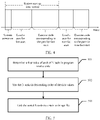
- FIG. 4 is a schematic diagram of a startup time period in a fast start solution based on a scatter loading method. As shown in FIG.
- a part for fast start namely, the first part described above, in an image file is first loaded; after the part for fast start is loaded, code corresponding to the part for fast start is executed; after the code corresponding to the part for fast start is executed, a part for non-fast start in the image file is loaded; and after the part for non-fast start is loaded, code corresponding to the part for non-fast start is executed.
- a developer needs to separate, from entire system program code, the code corresponding to the part for fast start.
- the developer first creates a relatively independent project from startup of the embedded apparatus to execution of a key task, compares the project with a complete project, deletes code that is used in the original complete project and that is irrelevant to the code corresponding to the part for fast start, retains only necessary code or a necessary file, and then compiles and burns the tailored code and verify, through compilation and burning, whether the tailored code can ensure correct execution of the key task.
- the developer needs to invest a large amount of energy to locate and rectify an error that occurs, and an execution process is complex. Especially, for development of a complex embedded apparatus, the developer may not be able to complete the foregoing operations such as tailoring and debugging.
- this application provides an image file obtaining method.
- the solution provided in this application not only can fast start an embedded apparatus, but also can avoid occupation of additional storage space.
- a developer does not need to separate, from entire system program code, code corresponding to a part for fast start, and the developer does not need to invest a large amount of energy to locate and rectify an error that occurs, thereby simplifying a development process.
- FIG. 5 is a schematic flowchart of an image file obtaining method according to an embodiment of this application.
- the image file obtaining method may include the following steps.
- N is a positive integer.
- a task is a set of code for implementing some functions. Each task may include several functions.
- Program source code includes all kernel program source code and all application program source code.
- the program source code includes a plurality of tasks. Because the kernel program source code and the application program source code of an embedded apparatus based on a monolithic kernel architecture may be distributed at any locations in an image file, code included in each task, that is, a function included in each task, may be distributed at any location in the image file.
- the first value is first duration required for executing each of the N tasks or the first value is a ratio of the first duration to second duration, and the second duration is duration required for loading each task. In the following, duration required for executing one task is referred to as an execution time period for short, and duration required for loading one task is referred to as a loading time period for short.
- a loading time period and an execution time period of the task may be obtained.
- a ratio of an execution time period to a loading time period may be referred to as a time ratio
- the first value may be an execution time period or may be a time ratio.
- a host may learn of an execution time period and a loading time period in a plurality of manners. For example, the following provides two manners of learning of an execution time period.
- a functional dependency relationship of each of the N tasks in the program source code is obtained, and a start location and an end location of each task may be determined based on the functional dependency relationship of each task.
- the start location includes a first timestamp
- the end location includes a second timestamp.
- a difference between the first timestamp and the second timestamp may be determined.
- the task may be run for a plurality of times according to an actual requirement to obtain a plurality of differences between first timestamps and second timestamps, and an average value of the plurality of obtained differences between the first timestamps and the second timestamps may be considered as a time period required for executing one task.
- the functional dependency relationship of the task is a mutual call relationship between a plurality of functions included in the task.
- the functional dependency relationship of each of the N tasks may be analyzed by using a compiler analysis technology.
- the functional dependency relationship of each of the N tasks in the program source code is analyzed by using the compiler analysis technology, to determine a minimum code set required for each task.
- N it is assumed that N is 3, and the N tasks are respectively a first task, a second task, and a third task.
- the first task (task 1) includes function (func) 1-1, func1-2, func1-3, and func1-4.
- the second task (task 2) includes func2-1, func2-2, func2-3, and func2-4.
- the third task (task 3) includes func3-1, func3-2, func3-3, and func3-4.
- a plurality of functions included in the task 1, the task 2, and the task 3 may be distributed at any locations in the image file.
- the host may obtain functional dependency relationships of all of the task 1, the task 2, and the task 3. For example, by using the compiler analysis technology, the host obtains the following functional dependency relationship sets expressed in tasks:
- the compilation technology is a technology for translating, into binary machine language code that can be run on a computer, program code written in an advanced computer language.
- a method for obtaining a functional dependency relationship of a task by using the compilation technology and a method for obtaining a functional dependency relationship of a task by other means in a conventional technology can both be used in this application.
- the host is sometimes referred to as "a development and compilation apparatus for an embedded apparatus” or "an image file obtaining apparatus”.
- a development and compilation apparatus for an embedded apparatus or "an image file obtaining apparatus”.
- a method for obtaining duration required for loading one task is similar to the foregoing method for obtaining duration required for executing one task.
- the task may be loaded for a plurality of times to obtain a plurality of differences between first timestamps and second timestamps, and an average value of the plurality of obtained differences between the first timestamps and the second timestamps is considered as a time period required for loading one task.
- the execution time period and the loading time period may be obtained through calculation.
- functions included in each task may be determined based on a dependency relationship that is of each of the N tasks and that is determined by the host, a sum of duration required for executing all the functions included in each task is the execution time period, and a sum of duration required for loading all the functions included in each task is the loading time period.
- the host may sort the N tasks in descending order of execution time periods. For example, N is 3, and the N tasks are respectively a task 1, a task 2, and a task 3. It is assumed that the host determines, based on execution time periods, that T1 is greater than T2 and T3 and that T2 is greater than T3. T1 represents an execution time period of the task 1, T2 represents an execution time period of the task 2, and T3 represents an execution time period of the task 3. Because T1>T2>T3, an order of the N tasks is successively the task 1, the task 2, and the task 3.
- the host may sort the N tasks in descending order of time ratio values.
- N is 3, and the N tasks are respectively a task 1, a task 2, and a task 3.
- T1 represents an execution time period of the task 1
- T2 represents an execution time period of the task 2
- T3 represents an execution time period of the task 3
- t1 represents a loading time period of the task 1
- t2 represents a loading time period of the task 2
- t3 represents a loading time period of the task 3. It is assumed that the host determines that T1/t1 is greater than T2/t2 and T3/t3 and that T3/t3 is greater than T2/t2. Because T1/t1>T3/t3>T2/t2, an order of the N tasks is successively the task 1, the task 3, and the task 2.
- the functional dependency relationship of each of the N tasks is obtained, where the functional dependency relationship of each task is a call relationship between functions included in each of the N tasks.
- the functions included in each of the sorted N tasks are linked based on the functional dependency relationship of each of the N tasks, to obtain the image file.
- the functional dependency relationship is determined, or in other words, the functions included in each task are determined.
- a configuration file including the functions included in each task is referred to as a link script file. These link script files are used in a linking process.
- the functions included in each of the N tasks are linked according to a sorting rule that is of the N tasks and that is determined in step 501 and step 502, to generate the image file.
- the N tasks are sorted in descending order of execution time periods or sorted in descending order of time ratio values.
- the embedded apparatus can first load a task whose execution time period is relatively long after downloading the image file, so that a next task can be loaded in an execution process of a current task; or the embedded apparatus can first load a task whose loading time period is short after downloading the image file, so that it can be ensured that total duration required for loading the N tasks is the shortest, and a time period required for loading the image file is shortened.
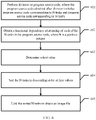
- FIG. 6 is a schematic flowchart of an image file obtaining method according to an embodiment of this application.
- the image file obtaining method may include the following steps.
- the N tasks correspond to a key service of an embedded apparatus
- the M tasks correspond to a service of the embedded apparatus other than the key service.
- a key service of the target machine may be a video recording service or a wireless connection service
- the program source code may further include other tasks such as a Bluetooth service and a photographing service.
- the Bluetooth service, the photographing service, and the like are tasks other than the key task.
- which tasks of a plurality of tasks included in the program source code are key tasks, that is, the foregoing N tasks, is determined according to an actual application requirement.
- a host analyzes the program source code by using a compilation technology to obtain functional dependency relationships of all the tasks in the program source code. Specifically, the host may obtain syntax tree information of all the tasks in the program source code by using the compilation technology, and may obtain the functional dependency relationships of all the tasks in the program source code based on the syntax tree information of all the tasks in the program source code.
- the functional dependency relationships of the N tasks may be obtained based on an annotation in the program source code; or functions of the N tasks may be obtained based on a running result of the program source code to obtain the functional dependency relationships of the N tasks.
- the functional dependency relationships of the N tasks may be obtained based on an annotation in the program source code; or functions of the N tasks may be obtained based on a running result of the program source code to obtain the functional dependency relationships of the N tasks.
- a plurality of tasks in the program source code may be distinguished based on the annotation.
- the annotation corresponding to the program source code is extracted to obtain a function corresponding to each of the plurality of tasks included in the program source code.
- a function of a key task is predetermined, and each key task may be determined from the program source code based on the annotation.
- the functional dependency relationship of each of the N tasks may be obtained based on the annotation and the functional dependency relationships.
- the N tasks may alternatively be obtained based on the running result of the program source code. If a developer does not provide an annotation for the program source code when writing the program source code, a function corresponding to each of a plurality of tasks included in the program source code may be obtained based on the running result of the program source code. A function of a key task and an input condition are predetermined, and the program source code is run. Each key task may be determined, that is, the N tasks may be obtained, from the program source code based on a running result obtained under the input condition. The functional dependency relationship of each of the N tasks may be obtained based on the running result and the functional dependency relationships of all the tasks.
- step 603 to step 605 For an understanding about step 603 to step 605, refer to step 502 to step 504 in the embodiment corresponding to FIG. 5 . Details are not described herein again.
- the image file may be downloaded from the host to a flash chip of the target machine.
- the image file is loaded from the flash chip to a memory of the embedded apparatus, that is, the target machine.
- FIG. 7 the following describes a loading process performed after the target machine is started.
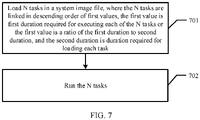
- FIG. 7 is a schematic flowchart of a method for starting an embedded apparatus according to an embodiment of this application.
- the method for starting an embedded apparatus may include the following steps.
- An embedded apparatus loads the N tasks in the system image file by using a system bootstrap program.
- the system bootstrap program may be modified, so that the N tasks in the system image file are first loaded during image file loading performed by using the system bootstrap program.
- the N tasks are linked in descending order of first values.
- the first value is first duration required for executing each of the N tasks or the first value is a ratio of the first duration to second duration, the second duration is duration required for loading each task, and N is a positive integer.
- a first task is run after being loaded, and a next task may be loaded during running of the first task.
- the next task is, for example, a second task, and the first task and the second task may be any two adjacent linked tasks in the N tasks.
- the method may further include: loading one or more tasks included in the image file other than the N tasks in the image file after the N tasks are run.
- a key task in a process of starting the embedded apparatus, not only a key task can be first loaded and executed, but also a time period required for loading the key task can further be shortened.
- the key tasks are sorted, and the sorted N tasks are linked to generate the image file. In this way, a next task can be loaded during running of a current key task, to concurrently implement loading operations and execution operations on different tasks to a greatest extent, thereby ensuring fast start of the embedded apparatus.
- Program source code includes all kernel program source code and all application program source code.
- the program source code includes a plurality of tasks. It is assumed that the program source code includes a plurality of tasks, and four of the tasks are key tasks and are respectively a task 1, a task 2, a task 3, and a task 4. Because the kernel program source code and the application program source code of an embedded apparatus based on a monolithic kernel architecture may be distributed at any locations in an image file, code included in each task, that is, a function included in each task, may be distributed at any location in the image file.
- a box 1 represents code or a function included in the task 1
- a box 2 represents code included in the task 2
- a box 3 represents code included in the task 3
- a box 4 represents code included in the task 4.
- different tasks may share same code.
- any box 1 and any box 4 may represent same code.
- an image file obtained according to this solution is a modified image file shown in FIG. 8b .
- the image file may be downloaded from the host to a flash chip of a target machine.
- the target machine starts to run, the image file is loaded from the flash chip to a memory of an embedded apparatus, that is, the target machine.
- the task 1, the task 2, the task 3, and the task 4 are preferentially loaded.
- the task 1 is run after being loaded, and the task 2 may be loaded during running of the task 1. Because the task 1 requires a longest execution time period, a subsequent task may have been loaded during execution of the task 1.
- the task 1 when the task 1 is executed, the task 2 has been loaded, and a part of the task 3 has been loaded.
- the foregoing development and compilation apparatus and the embedded apparatus include corresponding hardware structures and/or software modules for executing the functions.
- modules and algorithm steps of the examples described with reference to the embodiments disclosed in this specification may be implemented in this application by hardware or a combination of hardware and computer software. Whether a function is performed by hardware or hardware driven by computer software depends on particular applications and design constraint conditions of the technical solutions. A person skilled in the art may use different methods to implement the described functions of each particular application, but it should not be considered that the implementation goes beyond the scope of this application.
- an image file obtaining apparatus and an embedded apparatus in FIG. 5 to FIG. 7 may be implemented by one physical device, may be jointly implemented by a plurality of physical devices, or may be implemented by a logical function module in one physical device. This is not specifically limited in the embodiments of this application.
- FIG. 9 is a schematic diagram of a hardware structure of an image file obtaining apparatus according to an embodiment of this application.
- the image file obtaining apparatus includes a communication interface 901 and a processor 902, and may further include a memory 903.
- the communication interface 901 may use any apparatus such as a transceiver, to communicate with another device or a communication network, for example, the Ethernet, a radio access network (radio access network, RAN), or a wireless local area network (wireless local area network, WLAN).
- a transceiver to communicate with another device or a communication network, for example, the Ethernet, a radio access network (radio access network, RAN), or a wireless local area network (wireless local area network, WLAN).
- the processor 902 includes but is not limited to one or more of a central processing unit (central processing unit, CPU), a network processor (network processor, NP), an application-specific integrated circuit (application-specific integrated circuit, ASIC), or a programmable logic device (programmable logic device, PLD).
- the PLD may be a complex programmable logic device (complex programmable logic device, CPLD), a field-programmable logic gate array (field-programmable gate array, FPGA), generic array logic (generic array logic, GAL), or any combination thereof.
- the processor 902 is responsible for management of a communication line 904 and general processing, and may further provide various functions, including timing, peripheral interfacing, voltage regulation, power management, and another control function.
- the memory 903 may be configured to store data used by the processor 902 when the processor 902 performs an operation.
- the memory 903 may be a read-only memory (read-only memory, ROM) or another type of static storage device capable of storing static information and instructions, or a random access memory (random access memory, RAM) or another type of dynamic storage device capable of storing information and instructions.
- ROM read-only memory
- RAM random access memory
- the memory 903 may be an electrically erasable programmable read-only memory (electrically erasable programmable read-only memory, EEPROM), a compact disc read-only memory (compact disc read-only memory, CD-ROM) or another optical disk storage, an optical disc storage (including a compact optical disc, a laser disc, an optical disc, a digital versatile disc, a Blu-ray disc, or the like), a magnetic disk storage medium or another magnetic storage device, or any other medium that can be configured to carry or store expected program code in a form of an instruction or a data structure and that can be accessed by a computer.
- the memory may exist independently, and is connected to the processor 902 through the communication line 904.
- the memory 903 may be integrated into the processor 902. If the memory 903 and the processor 902 are components independent of each other, the memory 903 is connected to the processor 902. For example, the memory 903 may communicate with the processor 902 through the communication line.
- the communication interface 901 may communicate with the processor 902 through the communication line, or the communication interface 901 may be directly connected to the processor 902.
- the communication line 904 may include any quantity of interconnected buses and bridges, and the communication line 904 links together various circuits that include one or more processors 902 represented by the processor 902 and a memory represented by the memory 903.
- the communication line 904 may further links together other circuits such as a peripheral device, a voltage regulator, and a power management circuit. These are well known in the art, and therefore are not further described in this application.
- the image file obtaining apparatus may include a memory, configured to store computer-readable instructions; and may further include a processor coupled to the memory, where the processor is configured to execute the computer-readable instructions in the memory to perform the following operations: determining a first value of each of N tasks in program source code, where the first value is first duration required for executing each of the N tasks or the first value is a ratio of the first duration to second duration, the second duration is duration required for loading each of the N tasks, and N is a positive integer; sorting the N tasks in descending order of the first values; and linking the sorted N tasks to obtain an image file.
- the processor is further configured to: obtain a functional dependency relationship of each of the N tasks, where the functional dependency relationship of each task is a call relationship between functions that may be included in each of the N tasks; and link, based on the functional dependency relationship of each of the N tasks, the functions that may be included in each of the sorted N tasks, to obtain the image file.
- the processor is specifically configured to: obtain syntax tree information of all tasks in the program source code, where all the tasks may include the N tasks; obtain functional dependency relationships of all the tasks based on the syntax tree information, where the functional dependency relationships of all the tasks are call relationships between functions that may be included in all the tasks; and determine the functional dependency relationship of each of the N tasks based on an annotation in the program source code and the functional dependency relationships of all the tasks, where the annotation is preset and is used to identify a function of a task, and functions of the N tasks are prespecified.
- the processor is further configured to perform division on the program source code, where the program source code obtained after division may include program source code corresponding to the N tasks and program source code corresponding to M tasks, the N tasks correspond to a key service of an embedded apparatus, and the M tasks correspond to a service of the embedded apparatus other than the key service.
- the processor is specifically configured to: determine a start location and an end location of each of the N tasks based on the functional dependency relationship of each of the N tasks, where the start location may include a first timestamp, and the end location may include a second timestamp; and run each of the N tasks, and determine the first value based on a difference between the first timestamp and the second timestamp.
- function unit division may be performed on the image file obtaining apparatus based on the foregoing method examples.
- each functional unit may be obtained through division based on a corresponding function, or two or more functions may be integrated into one processing unit.
- the integrated unit may be implemented in a form of hardware, or may be implemented in a form of a software functional unit. It should be noted that, in the embodiments of this application, division into the units is an example and merely logical function division, and may be other division in an actual implementation.
- FIG. 10 is a schematic diagram of a structure of an image file obtaining apparatus.
- the image file obtaining apparatus includes: a storage unit 1001, configured to store computer-readable instructions; and may further include a processing unit 1002 coupled to the storage unit 1001, where the processing unit 1002 is configured to execute the computer-readable instructions in the storage unit 1001 to perform the following operations: obtaining a functional dependency relationship of each of N tasks in program source code, where N is a positive integer; determining a first value, where the first value is first duration required for executing each of the N tasks or the first value is a ratio of the first duration to second duration, and the second duration is duration required for loading each task; sorting the N tasks in descending order of first values; and linking the N tasks based on the functional dependency relationship and the order to generate an image file.
- the processing unit 1002 is specifically configured to: obtain syntax tree information of all tasks in the program source code; obtain functional dependency relationships of all the tasks in the program source code based on the syntax tree information of all the tasks; and determine the functional dependency relationship of each of the N tasks based on an annotation in the program source code and the functional dependency relationships of all the tasks, where the annotation is preset and is used to identify a function of a task, and functions of the N tasks are prespecified.
- the processing unit 1002 is further configured to perform division on the program source code, where the program source code obtained after division may include program source code corresponding to the N tasks and program source code corresponding to M tasks, the N tasks correspond to a key service of an embedded apparatus, and the M tasks correspond to a service of the embedded apparatus other than the key service.
- the processing unit 1002 is specifically configured to: determine a start location and an end location of each of the N tasks based on the functional dependency relationship of each of the N tasks, where the start location may include a first timestamp, and the end location may include a second timestamp; and run each of the N tasks, and determine the first value based on a difference between the first timestamp and the second timestamp.
- FIG. 11 is a schematic diagram of a structure of an image file obtaining apparatus.
- the image file obtaining apparatus includes: a compilation and analysis module 1101, configured to obtain a functional dependency relationship of each of N tasks in program source code, where N is a positive integer; a task sorting analysis module 1102, configured to: determine a first value, where the first value is first duration required for executing each of the N tasks or the first value is a ratio of the first duration to second duration, and the second duration is duration required for loading each task; and sort the N tasks in descending order of first values; and a task linking module 1103, configured to link, based on the functional dependency relationship of each of the N tasks, functions included in each of the sorted N tasks, to obtain an image file.
- a compilation and analysis module 1101 configured to obtain a functional dependency relationship of each of N tasks in program source code, where N is a positive integer
- a task sorting analysis module 1102 configured to: determine a first value, where the first value is first duration required for executing each of the N tasks or the first value is a ratio of the first duration to second duration, and the second duration is duration required
- the compilation and analysis module 1101 includes a syntax tree analysis unit 11011 and a functional dependency relationship analysis unit 11012.
- the syntax tree analysis unit 11011 is configured to obtain syntax tree information of all tasks in the program source code of the image file.
- the functional dependency relationship analysis unit 11012 is configured to: obtain functional dependency relationships of all the tasks in the program source code based on the syntax tree information of all the tasks; and determine the functional dependency relationship of each of the N tasks based on an annotation in the program source code and the functional dependency relationships of all the tasks, where the annotation is preset and is used to identify a function of a task, and functions of the N tasks are prespecified.
- the task sorting analysis module 1102 includes a computing unit 11021 and a sorting unit 11022.
- the computing unit 11021 is configured to: determine a start location and an end location of each of the N tasks based on the functional dependency relationship of each of the N tasks, where the start location may include a first timestamp, and the end location may include a second timestamp; and run each of the N tasks, and determine the first value based on a difference between the first timestamp and the second timestamp.
- the sorting unit 11022 is configured to sort the N tasks in descending order of the first values.
- FIG. 12 is a schematic diagram of a hardware structure of the embedded apparatus according to an embodiment of this application.
- the embedded apparatus includes a communication interface 1201 and a processor 1202, and may further include a memory 1203.
- the communication interface 1201 may be any apparatus such as a transceiver, and is configured to communicate with another device or a communication network, for example, the Ethernet, a radio access network (radio access network, RAN), or a wireless local area network (wireless local area network, WLAN).
- a radio access network radio access network, RAN
- a wireless local area network wireless local area network, WLAN
- the processor 1202 includes but is not limited to one or more of a central processing unit (central processing unit, CPU), a network processor (network processor, NP), an application-specific integrated circuit (application-specific integrated circuit, ASIC), or a programmable logic device (programmable logic device, PLD).
- the PLD may be a complex programmable logic device (complex programmable logic device, CPLD), a field-programmable logic gate array (field-programmable gate array, FPGA), generic array logic (generic array logic, GAL), or any combination thereof.
- the processor 1202 is responsible for a communication line 1204 and general processing, and may further provide various functions, including timing, peripheral interfacing, voltage regulation, power management, and another control function.
- the memory 1203 may be configured to store data used by the processor 1202 when the processor 1202 performs an operation.
- the memory 1203 may be a read-only memory (read-only memory, ROM) or another type of static storage device that can store static information and instructions, a random access memory (random access memory, RAM) or another type of dynamic storage device that can store information and instructions, or may be an electrically erasable programmable read-only memory (electrically erasable programmable read-only memory, EEPROM), a compact disc read-only memory (compact disc read-only memory, CD-ROM) or another compact disc storage, an optical disc storage (including a compact disc, a laser disc, an optical disc, a digital versatile disc, a Blu-ray disc, or the like), a magnetic disk storage medium or another magnetic storage device, or any other medium that can be configured to carry or store expected program code in a form of an instruction or a data structure and that can be accessed by a computer.
- ROM read-only memory
- RAM random access memory
- EEPROM electrically erasable programmable read-only memory
- CD-ROM compact disc read-
- the memory may exist independently, and is connected to the processor 1202 through the communication line 1204.
- the memory 1203 may be integrated into the processor 1202. If the memory 1203 and the processor 1202 are mutually independent components, the memory 1203 is connected to the processor 1202.
- the memory 1203 and the processor 1202 may communicate with each other through the communication line.
- the communication interface 1201 and the processor 1202 may communicate with each other through a communication line, and the communication interface 1201 may alternatively be connected to the processor 1202 directly.
- the communication line 1204 may include any quantity of interconnected buses and bridges, and the communication line 1204 links together various circuits including one or more processors 1202 represented by the processor 1202 and a memory represented by the memory 1203.
- the communication line 1204 may further link various other circuits such as a peripheral device, a voltage stabilizer, and a power management circuit. These are well known in the art, and therefore are not further described in this specification.
- the embedded apparatus may include a memory, configured to store computer-readable instructions; and may further include a processor coupled to the memory, where the processor is configured to execute the computer-readable instructions in the memory to perform the following operation: loading N tasks in a system image file, and running the N tasks, where the N tasks are linked in descending order of first values, the first value is first duration required for executing each of the N tasks or the first value is a ratio of the first duration to second duration, the second duration is duration required for loading each task, and N is a positive integer.
- the processor is further configured to load one or more tasks that may be included in the image file other than the N tasks in the image file after the N tasks are run.
- functional unit division may be performed on the embedded apparatus based on the example of the method.
- functional units may be divided based on corresponding functions, or two or more than two functions may be integrated into one processing unit.
- the integrated unit may be implemented in a form of hardware, or may be implemented in a form of a software functional unit. It should be noted that, in the embodiments of this application, division into the units is an example and merely logical function division, and may be other division in an actual implementation.
- FIG. 13 is a schematic diagram of a structure of an embedded apparatus.
- the embedded apparatus includes a storage unit 1301, configured to store computer-readable instructions; and may further include a processing unit 1302 coupled to the storage unit 1301, where the processing unit 1302 is configured to execute the computer-readable instructions in the storage unit 1301 to perform the following operation: loading N tasks in a system image file, and running the N tasks, where the N tasks are linked in descending order of first values, the first value is first duration required for executing each of the N tasks or the first value is a ratio of the first duration to second duration, the second duration is duration required for loading each task, and N is a positive integer.
- processing unit 1302 is further configured to load one or more tasks that may be included in the image file other than the N tasks in the image file after the N tasks are run.
- All or some of the foregoing embodiments may be implemented by using software, hardware, firmware, or any combination thereof.
- software is used to implement the embodiments, all or some of the embodiments may be implemented in a form of a computer program product.
- the computer program product includes one or more computer instructions.
- the computer may be a general purpose computer, a dedicated computer, a computer network, or another programmable apparatus.
- the computer instructions may be stored in a computer-readable storage medium or may be transmitted from a computer-readable storage medium to another computer-readable storage medium.
- the computer instructions may be transmitted from a website, computer, server, or data center to another website, computer, server, or data center in a wired (for example, a coaxial cable, an optical fiber, or a digital subscriber line (DSL)) or wireless (for example, infrared, radio, or microwave) manner.
- a wired for example, a coaxial cable, an optical fiber, or a digital subscriber line (DSL)
- wireless for example, infrared, radio, or microwave
- the computer-readable storage medium may be any usable medium accessible by the computer, or a data storage device, such as a server or a data center, integrating one or more usable media.
- the usable medium may be a magnetic medium (for example, a floppy disk, a hard disk, or a magnetic tape), an optical medium (for example, a DVD), a semiconductor medium (for example, a solid-state drive (solid-state drive, SSD)), or the like.
- the program may be stored in a computer-readable storage medium.
- the storage medium may include a ROM, a RAM, a magnetic disk, or an optical disc, or the like.
Landscapes
- Engineering & Computer Science (AREA)
- Theoretical Computer Science (AREA)
- Software Systems (AREA)
- General Engineering & Computer Science (AREA)
- Physics & Mathematics (AREA)
- General Physics & Mathematics (AREA)
- Quality & Reliability (AREA)
- Computer Security & Cryptography (AREA)
- Stored Programmes (AREA)
Applications Claiming Priority (2)
| Application Number | Priority Date | Filing Date | Title |
|---|---|---|---|
| CN201911018528.0A CN112711427B (zh) | 2019-10-24 | 2019-10-24 | 一种镜像文件的获取方法以及装置 |
| PCT/CN2020/113239 WO2021077916A1 (zh) | 2019-10-24 | 2020-09-03 | 一种镜像文件的获取方法以及装置 |
Publications (3)
| Publication Number | Publication Date |
|---|---|
| EP4036716A1 true EP4036716A1 (de) | 2022-08-03 |
| EP4036716A4 EP4036716A4 (de) | 2022-11-23 |
| EP4036716B1 EP4036716B1 (de) | 2024-08-21 |
Family
ID=75540324
Family Applications (1)
| Application Number | Title | Priority Date | Filing Date |
|---|---|---|---|
| EP20879292.9A Active EP4036716B1 (de) | 2019-10-24 | 2020-09-03 | Verfahren und vorrichtung zur erfassung einer spiegelbilddatei |
Country Status (4)
| Country | Link |
|---|---|
| US (1) | US12118339B2 (de) |
| EP (1) | EP4036716B1 (de) |
| CN (1) | CN112711427B (de) |
| WO (1) | WO2021077916A1 (de) |
Families Citing this family (5)
| Publication number | Priority date | Publication date | Assignee | Title |
|---|---|---|---|---|
| US11928452B2 (en) * | 2022-02-03 | 2024-03-12 | Red Hat, Inc. | Reducing the size of image files usable for deploying software in computing environments |
| CN115690943B (zh) * | 2022-09-27 | 2024-09-24 | 厦门市美亚柏科信息股份有限公司 | 一种大车行驶记录仪数据深度恢复方法、装置及存储介质 |
| CN116166341A (zh) * | 2023-04-25 | 2023-05-26 | 中国人民解放军军事科学院系统工程研究院 | 一种基于深度学习的静态云边协同架构函数计算卸载方法 |
| US20250085973A1 (en) * | 2023-09-11 | 2025-03-13 | Nvidia Corporation | Kernel launch dependencies |
| CN119829150B (zh) * | 2024-12-23 | 2026-03-10 | 南方电网数字电网科技(广东)有限公司 | 一种面向操作系统的镜像服务启动方法及电子设备 |
Family Cites Families (22)
| Publication number | Priority date | Publication date | Assignee | Title |
|---|---|---|---|---|
| US20010042069A1 (en) * | 2000-02-29 | 2001-11-15 | Petrov Peter D. | Method and apparatus for building a memory image |
| US20030121024A1 (en) * | 2001-12-13 | 2003-06-26 | Microsoft Corporation | System and method for building a runtime image from components of a software program |
| US20030140174A1 (en) * | 2002-01-08 | 2003-07-24 | Tsutomu Ohishi | Method for generating application for information processing apparatus and image forming apparatus |
| US7694291B2 (en) * | 2004-04-06 | 2010-04-06 | Hewlett-Packard Development Company, L.P. | Build optimizer tool for efficient management of software builds for mobile devices |
| DE602007004587D1 (de) * | 2007-06-29 | 2010-03-18 | Ericsson Telefon Ab L M | Verschleierung von Ausführungsspuren eines Computerprogrammcodes |
| WO2010067377A2 (en) * | 2008-12-08 | 2010-06-17 | Kpit Cummins Infosystems Ltd. | Method for reorganizing tasks for optimization of resources |
| CN101515239A (zh) * | 2009-04-08 | 2009-08-26 | 南京航空航天大学 | X86飞控计算机快速启动方法 |
| CN101794232A (zh) * | 2009-06-23 | 2010-08-04 | 深圳市朗科科技股份有限公司 | 快速启动系统的方法 |
| US8719808B1 (en) * | 2010-01-27 | 2014-05-06 | Altera Corporation | Method and apparatus for using object files to provide reliable program operation |
| US8918766B2 (en) * | 2012-12-12 | 2014-12-23 | Microsoft Corporation | Analysis of propagated information using annotated forests |
| US11134116B2 (en) * | 2013-03-15 | 2021-09-28 | D2L Corporation | System and method for dynamically loading a webpage |
| CN103677922B (zh) | 2013-12-13 | 2018-01-09 | 北京奇虎科技有限公司 | 对应用软件进行启动的方法和装置 |
| US9830242B2 (en) * | 2015-01-14 | 2017-11-28 | Mediatek Inc. | Loading calculation method and loading calculation system for processor in electronic device |
| US20160350081A1 (en) * | 2015-05-27 | 2016-12-01 | Runnable Inc. | Automatic container definition |
| US10579341B2 (en) * | 2015-06-08 | 2020-03-03 | Synopsys, Inc. | Generation of workload models from execution traces |
| CN105630543B (zh) * | 2015-12-21 | 2019-03-05 | 北京奇虎科技有限公司 | 一种应用冷启动加速的方法及装置 |
| CN105760201B (zh) * | 2016-02-29 | 2019-05-28 | 华为技术有限公司 | 一种嵌入式装置的启动方法和装置 |
| CN106055462A (zh) * | 2016-05-20 | 2016-10-26 | 腾讯科技(深圳)有限公司 | 一种时长获取方法和装置 |
| CN109284137B (zh) * | 2018-09-21 | 2022-02-11 | 武汉光庭信息技术股份有限公司 | 一种基于Hypervisor的QNX操作系统启动方法及装置 |
| US12118361B2 (en) * | 2018-11-21 | 2024-10-15 | Sri International | Unicontainers |
| US11080027B2 (en) * | 2019-01-10 | 2021-08-03 | Vmware, Inc. | Curated image management in a FaaS infrastructure |
| CN114064141B (zh) * | 2021-10-22 | 2024-11-05 | 用友网络科技股份有限公司 | 中间件启动时长优化方法、装置和可读存储介质 |
-
2019
- 2019-10-24 CN CN201911018528.0A patent/CN112711427B/zh active Active
-
2020
- 2020-09-03 WO PCT/CN2020/113239 patent/WO2021077916A1/zh not_active Ceased
- 2020-09-03 EP EP20879292.9A patent/EP4036716B1/de active Active
-
2022
- 2022-04-22 US US17/727,166 patent/US12118339B2/en active Active
Also Published As
| Publication number | Publication date |
|---|---|
| CN112711427B (zh) | 2025-03-25 |
| EP4036716B1 (de) | 2024-08-21 |
| US12118339B2 (en) | 2024-10-15 |
| EP4036716A4 (de) | 2022-11-23 |
| CN112711427A (zh) | 2021-04-27 |
| WO2021077916A1 (zh) | 2021-04-29 |
| US20220244931A1 (en) | 2022-08-04 |
Similar Documents
| Publication | Publication Date | Title |
|---|---|---|
| US12118339B2 (en) | Image file obtaining method and apparatus | |
| JP7212793B2 (ja) | 関数ジャンプを実現するための方法、装置及びコンピュータ記憶媒体 | |
| JP2024536124A (ja) | コード更新時におけるソースコード有効性のチェック | |
| JP2021002317A (ja) | アプリケーションをアップグレードするための方法、装置、デバイスならびに記憶媒体 | |
| CN117034821B (zh) | 用于芯片设计前端仿真验证的回归验证方法及介质 | |
| US9256509B1 (en) | Computing environment analyzer | |
| US10514898B2 (en) | Method and system to develop, deploy, test, and manage platform-independent software | |
| US20160011879A1 (en) | Preconfiguring hardware and speeding up server discovery prior to bios boot | |
| US9311077B2 (en) | Identification of code changes using language syntax and changeset data | |
| CN115454869A (zh) | 界面自动化测试方法、装置、设备及存储介质 | |
| TW201643766A (zh) | 電子裝置的自我修復方法、系統及伺服器 | |
| CN117370984A (zh) | 组件安全检测方法、装置、计算机设备及存储介质 | |
| US11947966B2 (en) | Identifying computer instructions enclosed by macros and conflicting macros at build time | |
| CN111309297A (zh) | 脚本开发系统及方法 | |
| CN117492849A (zh) | 用于多核处理器的启动方法、系统级芯片、设备及介质 | |
| CN117330935A (zh) | 一种集成电路测试方法、装置、介质 | |
| CN105573913A (zh) | 一种onu系统中的程序调试方法及系统 | |
| CN112306844A (zh) | 软件开发系统的接口测试方法、装置、设备及存储介质 | |
| CN115840617A (zh) | 一种调试方法、系统及相关装置 | |
| CN111831539B (zh) | 一种测试方法及相关产品 | |
| US20200349304A1 (en) | Method, apparatus, device, and medium for implementing simulator | |
| US12093686B2 (en) | Code maintenance system | |
| CN111400191A (zh) | 网页安全测试方法、装置及计算机可读存储介质 | |
| CN116932044A (zh) | 一种指令翻译方法及其相关设备 | |
| CN119376786B (zh) | 一种软件工程配置管理方法、设备、介质及程序产品 |
Legal Events
| Date | Code | Title | Description |
|---|---|---|---|
| STAA | Information on the status of an ep patent application or granted ep patent |
Free format text: STATUS: THE INTERNATIONAL PUBLICATION HAS BEEN MADE |
|
| PUAI | Public reference made under article 153(3) epc to a published international application that has entered the european phase |
Free format text: ORIGINAL CODE: 0009012 |
|
| STAA | Information on the status of an ep patent application or granted ep patent |
Free format text: STATUS: REQUEST FOR EXAMINATION WAS MADE |
|
| 17P | Request for examination filed |
Effective date: 20220428 |
|
| AK | Designated contracting states |
Kind code of ref document: A1 Designated state(s): AL AT BE BG CH CY CZ DE DK EE ES FI FR GB GR HR HU IE IS IT LI LT LU LV MC MK MT NL NO PL PT RO RS SE SI SK SM TR |
|
| A4 | Supplementary search report drawn up and despatched |
Effective date: 20221021 |
|
| RIC1 | Information provided on ipc code assigned before grant |
Ipc: G06F 8/61 20180101ALI20221017BHEP Ipc: G06F 9/445 20180101AFI20221017BHEP |
|
| DAV | Request for validation of the european patent (deleted) | ||
| DAX | Request for extension of the european patent (deleted) | ||
| GRAP | Despatch of communication of intention to grant a patent |
Free format text: ORIGINAL CODE: EPIDOSNIGR1 |
|
| STAA | Information on the status of an ep patent application or granted ep patent |
Free format text: STATUS: GRANT OF PATENT IS INTENDED |
|
| RIC1 | Information provided on ipc code assigned before grant |
Ipc: G06F 8/61 20180101ALI20240307BHEP Ipc: G06F 9/445 20180101AFI20240307BHEP |
|
| INTG | Intention to grant announced |
Effective date: 20240404 |
|
| GRAS | Grant fee paid |
Free format text: ORIGINAL CODE: EPIDOSNIGR3 |
|
| GRAA | (expected) grant |
Free format text: ORIGINAL CODE: 0009210 |
|
| STAA | Information on the status of an ep patent application or granted ep patent |
Free format text: STATUS: THE PATENT HAS BEEN GRANTED |
|
| AK | Designated contracting states |
Kind code of ref document: B1 Designated state(s): AL AT BE BG CH CY CZ DE DK EE ES FI FR GB GR HR HU IE IS IT LI LT LU LV MC MK MT NL NO PL PT RO RS SE SI SK SM TR |
|
| REG | Reference to a national code |
Ref country code: GB Ref legal event code: FG4D |
|
| REG | Reference to a national code |
Ref country code: CH Ref legal event code: EP |
|
| REG | Reference to a national code |
Ref country code: IE Ref legal event code: FG4D |
|
| REG | Reference to a national code |
Ref country code: DE Ref legal event code: R096 Ref document number: 602020036421 Country of ref document: DE |
|
| REG | Reference to a national code |
Ref country code: LT Ref legal event code: MG9D |
|
| REG | Reference to a national code |
Ref country code: NL Ref legal event code: MP Effective date: 20240821 |
|
| PG25 | Lapsed in a contracting state [announced via postgrant information from national office to epo] |
Ref country code: NO Free format text: LAPSE BECAUSE OF FAILURE TO SUBMIT A TRANSLATION OF THE DESCRIPTION OR TO PAY THE FEE WITHIN THE PRESCRIBED TIME-LIMIT Effective date: 20241121 |
|
| REG | Reference to a national code |
Ref country code: AT Ref legal event code: MK05 Ref document number: 1716162 Country of ref document: AT Kind code of ref document: T Effective date: 20240821 |
|
| PG25 | Lapsed in a contracting state [announced via postgrant information from national office to epo] |
Ref country code: PT Free format text: LAPSE BECAUSE OF FAILURE TO SUBMIT A TRANSLATION OF THE DESCRIPTION OR TO PAY THE FEE WITHIN THE PRESCRIBED TIME-LIMIT Effective date: 20241223 Ref country code: NL Free format text: LAPSE BECAUSE OF FAILURE TO SUBMIT A TRANSLATION OF THE DESCRIPTION OR TO PAY THE FEE WITHIN THE PRESCRIBED TIME-LIMIT Effective date: 20240821 Ref country code: PL Free format text: LAPSE BECAUSE OF FAILURE TO SUBMIT A TRANSLATION OF THE DESCRIPTION OR TO PAY THE FEE WITHIN THE PRESCRIBED TIME-LIMIT Effective date: 20240821 Ref country code: GR Free format text: LAPSE BECAUSE OF FAILURE TO SUBMIT A TRANSLATION OF THE DESCRIPTION OR TO PAY THE FEE WITHIN THE PRESCRIBED TIME-LIMIT Effective date: 20241122 Ref country code: FI Free format text: LAPSE BECAUSE OF FAILURE TO SUBMIT A TRANSLATION OF THE DESCRIPTION OR TO PAY THE FEE WITHIN THE PRESCRIBED TIME-LIMIT Effective date: 20240821 |
|
| PG25 | Lapsed in a contracting state [announced via postgrant information from national office to epo] |
Ref country code: BG Free format text: LAPSE BECAUSE OF FAILURE TO SUBMIT A TRANSLATION OF THE DESCRIPTION OR TO PAY THE FEE WITHIN THE PRESCRIBED TIME-LIMIT Effective date: 20240821 |
|
| PG25 | Lapsed in a contracting state [announced via postgrant information from national office to epo] |
Ref country code: LV Free format text: LAPSE BECAUSE OF FAILURE TO SUBMIT A TRANSLATION OF THE DESCRIPTION OR TO PAY THE FEE WITHIN THE PRESCRIBED TIME-LIMIT Effective date: 20240821 |
|
| PG25 | Lapsed in a contracting state [announced via postgrant information from national office to epo] |
Ref country code: AT Free format text: LAPSE BECAUSE OF FAILURE TO SUBMIT A TRANSLATION OF THE DESCRIPTION OR TO PAY THE FEE WITHIN THE PRESCRIBED TIME-LIMIT Effective date: 20240821 Ref country code: IS Free format text: LAPSE BECAUSE OF FAILURE TO SUBMIT A TRANSLATION OF THE DESCRIPTION OR TO PAY THE FEE WITHIN THE PRESCRIBED TIME-LIMIT Effective date: 20241221 |
|
| PG25 | Lapsed in a contracting state [announced via postgrant information from national office to epo] |
Ref country code: HR Free format text: LAPSE BECAUSE OF FAILURE TO SUBMIT A TRANSLATION OF THE DESCRIPTION OR TO PAY THE FEE WITHIN THE PRESCRIBED TIME-LIMIT Effective date: 20240821 |
|
| PG25 | Lapsed in a contracting state [announced via postgrant information from national office to epo] |
Ref country code: ES Free format text: LAPSE BECAUSE OF FAILURE TO SUBMIT A TRANSLATION OF THE DESCRIPTION OR TO PAY THE FEE WITHIN THE PRESCRIBED TIME-LIMIT Effective date: 20240821 Ref country code: RS Free format text: LAPSE BECAUSE OF FAILURE TO SUBMIT A TRANSLATION OF THE DESCRIPTION OR TO PAY THE FEE WITHIN THE PRESCRIBED TIME-LIMIT Effective date: 20241121 |
|
| PG25 | Lapsed in a contracting state [announced via postgrant information from national office to epo] |
Ref country code: RS Free format text: LAPSE BECAUSE OF FAILURE TO SUBMIT A TRANSLATION OF THE DESCRIPTION OR TO PAY THE FEE WITHIN THE PRESCRIBED TIME-LIMIT Effective date: 20241121 Ref country code: PT Free format text: LAPSE BECAUSE OF FAILURE TO SUBMIT A TRANSLATION OF THE DESCRIPTION OR TO PAY THE FEE WITHIN THE PRESCRIBED TIME-LIMIT Effective date: 20241223 Ref country code: PL Free format text: LAPSE BECAUSE OF FAILURE TO SUBMIT A TRANSLATION OF THE DESCRIPTION OR TO PAY THE FEE WITHIN THE PRESCRIBED TIME-LIMIT Effective date: 20240821 Ref country code: NO Free format text: LAPSE BECAUSE OF FAILURE TO SUBMIT A TRANSLATION OF THE DESCRIPTION OR TO PAY THE FEE WITHIN THE PRESCRIBED TIME-LIMIT Effective date: 20241121 Ref country code: NL Free format text: LAPSE BECAUSE OF FAILURE TO SUBMIT A TRANSLATION OF THE DESCRIPTION OR TO PAY THE FEE WITHIN THE PRESCRIBED TIME-LIMIT Effective date: 20240821 Ref country code: LV Free format text: LAPSE BECAUSE OF FAILURE TO SUBMIT A TRANSLATION OF THE DESCRIPTION OR TO PAY THE FEE WITHIN THE PRESCRIBED TIME-LIMIT Effective date: 20240821 Ref country code: IS Free format text: LAPSE BECAUSE OF FAILURE TO SUBMIT A TRANSLATION OF THE DESCRIPTION OR TO PAY THE FEE WITHIN THE PRESCRIBED TIME-LIMIT Effective date: 20241221 Ref country code: HR Free format text: LAPSE BECAUSE OF FAILURE TO SUBMIT A TRANSLATION OF THE DESCRIPTION OR TO PAY THE FEE WITHIN THE PRESCRIBED TIME-LIMIT Effective date: 20240821 Ref country code: GR Free format text: LAPSE BECAUSE OF FAILURE TO SUBMIT A TRANSLATION OF THE DESCRIPTION OR TO PAY THE FEE WITHIN THE PRESCRIBED TIME-LIMIT Effective date: 20241122 Ref country code: FI Free format text: LAPSE BECAUSE OF FAILURE TO SUBMIT A TRANSLATION OF THE DESCRIPTION OR TO PAY THE FEE WITHIN THE PRESCRIBED TIME-LIMIT Effective date: 20240821 Ref country code: ES Free format text: LAPSE BECAUSE OF FAILURE TO SUBMIT A TRANSLATION OF THE DESCRIPTION OR TO PAY THE FEE WITHIN THE PRESCRIBED TIME-LIMIT Effective date: 20240821 Ref country code: BG Free format text: LAPSE BECAUSE OF FAILURE TO SUBMIT A TRANSLATION OF THE DESCRIPTION OR TO PAY THE FEE WITHIN THE PRESCRIBED TIME-LIMIT Effective date: 20240821 Ref country code: AT Free format text: LAPSE BECAUSE OF FAILURE TO SUBMIT A TRANSLATION OF THE DESCRIPTION OR TO PAY THE FEE WITHIN THE PRESCRIBED TIME-LIMIT Effective date: 20240821 |
|
| PG25 | Lapsed in a contracting state [announced via postgrant information from national office to epo] |
Ref country code: DK Free format text: LAPSE BECAUSE OF FAILURE TO SUBMIT A TRANSLATION OF THE DESCRIPTION OR TO PAY THE FEE WITHIN THE PRESCRIBED TIME-LIMIT Effective date: 20240821 Ref country code: SM Free format text: LAPSE BECAUSE OF FAILURE TO SUBMIT A TRANSLATION OF THE DESCRIPTION OR TO PAY THE FEE WITHIN THE PRESCRIBED TIME-LIMIT Effective date: 20240821 Ref country code: RO Free format text: LAPSE BECAUSE OF FAILURE TO SUBMIT A TRANSLATION OF THE DESCRIPTION OR TO PAY THE FEE WITHIN THE PRESCRIBED TIME-LIMIT Effective date: 20240821 |
|
| PG25 | Lapsed in a contracting state [announced via postgrant information from national office to epo] |
Ref country code: EE Free format text: LAPSE BECAUSE OF FAILURE TO SUBMIT A TRANSLATION OF THE DESCRIPTION OR TO PAY THE FEE WITHIN THE PRESCRIBED TIME-LIMIT Effective date: 20240821 |
|
| PG25 | Lapsed in a contracting state [announced via postgrant information from national office to epo] |
Ref country code: CZ Free format text: LAPSE BECAUSE OF FAILURE TO SUBMIT A TRANSLATION OF THE DESCRIPTION OR TO PAY THE FEE WITHIN THE PRESCRIBED TIME-LIMIT Effective date: 20240821 |
|
| PG25 | Lapsed in a contracting state [announced via postgrant information from national office to epo] |
Ref country code: IT Free format text: LAPSE BECAUSE OF FAILURE TO SUBMIT A TRANSLATION OF THE DESCRIPTION OR TO PAY THE FEE WITHIN THE PRESCRIBED TIME-LIMIT Effective date: 20240821 Ref country code: SK Free format text: LAPSE BECAUSE OF FAILURE TO SUBMIT A TRANSLATION OF THE DESCRIPTION OR TO PAY THE FEE WITHIN THE PRESCRIBED TIME-LIMIT Effective date: 20240821 |
|
| REG | Reference to a national code |
Ref country code: CH Ref legal event code: PL |
|
| PG25 | Lapsed in a contracting state [announced via postgrant information from national office to epo] |
Ref country code: LU Free format text: LAPSE BECAUSE OF NON-PAYMENT OF DUE FEES Effective date: 20240903 |
|
| REG | Reference to a national code |
Ref country code: DE Ref legal event code: R097 Ref document number: 602020036421 Country of ref document: DE |
|
| PLBE | No opposition filed within time limit |
Free format text: ORIGINAL CODE: 0009261 |
|
| STAA | Information on the status of an ep patent application or granted ep patent |
Free format text: STATUS: NO OPPOSITION FILED WITHIN TIME LIMIT |
|
| PG25 | Lapsed in a contracting state [announced via postgrant information from national office to epo] |
Ref country code: MC Free format text: LAPSE BECAUSE OF FAILURE TO SUBMIT A TRANSLATION OF THE DESCRIPTION OR TO PAY THE FEE WITHIN THE PRESCRIBED TIME-LIMIT Effective date: 20240821 |
|
| REG | Reference to a national code |
Ref country code: BE Ref legal event code: MM Effective date: 20240930 |
|
| PG25 | Lapsed in a contracting state [announced via postgrant information from national office to epo] |
Ref country code: BE Free format text: LAPSE BECAUSE OF NON-PAYMENT OF DUE FEES Effective date: 20240930 |
|
| PG25 | Lapsed in a contracting state [announced via postgrant information from national office to epo] |
Ref country code: FR Free format text: LAPSE BECAUSE OF NON-PAYMENT OF DUE FEES Effective date: 20241021 |
|
| PG25 | Lapsed in a contracting state [announced via postgrant information from national office to epo] |
Ref country code: CH Free format text: LAPSE BECAUSE OF NON-PAYMENT OF DUE FEES Effective date: 20240930 |
|
| PG25 | Lapsed in a contracting state [announced via postgrant information from national office to epo] |
Ref country code: IE Free format text: LAPSE BECAUSE OF NON-PAYMENT OF DUE FEES Effective date: 20240903 |
|
| 26N | No opposition filed |
Effective date: 20250522 |
|
| PG25 | Lapsed in a contracting state [announced via postgrant information from national office to epo] |
Ref country code: SE Free format text: LAPSE BECAUSE OF FAILURE TO SUBMIT A TRANSLATION OF THE DESCRIPTION OR TO PAY THE FEE WITHIN THE PRESCRIBED TIME-LIMIT Effective date: 20240821 |
|
| PGFP | Annual fee paid to national office [announced via postgrant information from national office to epo] |
Ref country code: DE Payment date: 20250730 Year of fee payment: 6 |
|
| PGFP | Annual fee paid to national office [announced via postgrant information from national office to epo] |
Ref country code: GB Payment date: 20250731 Year of fee payment: 6 |
|
| PG25 | Lapsed in a contracting state [announced via postgrant information from national office to epo] |
Ref country code: CY Free format text: LAPSE BECAUSE OF FAILURE TO SUBMIT A TRANSLATION OF THE DESCRIPTION OR TO PAY THE FEE WITHIN THE PRESCRIBED TIME-LIMIT; INVALID AB INITIO Effective date: 20200903 |
|
| PG25 | Lapsed in a contracting state [announced via postgrant information from national office to epo] |
Ref country code: HU Free format text: LAPSE BECAUSE OF FAILURE TO SUBMIT A TRANSLATION OF THE DESCRIPTION OR TO PAY THE FEE WITHIN THE PRESCRIBED TIME-LIMIT; INVALID AB INITIO Effective date: 20200903 |